
A complete issue · 32 pages · 1919
Judge — May 24, 1919
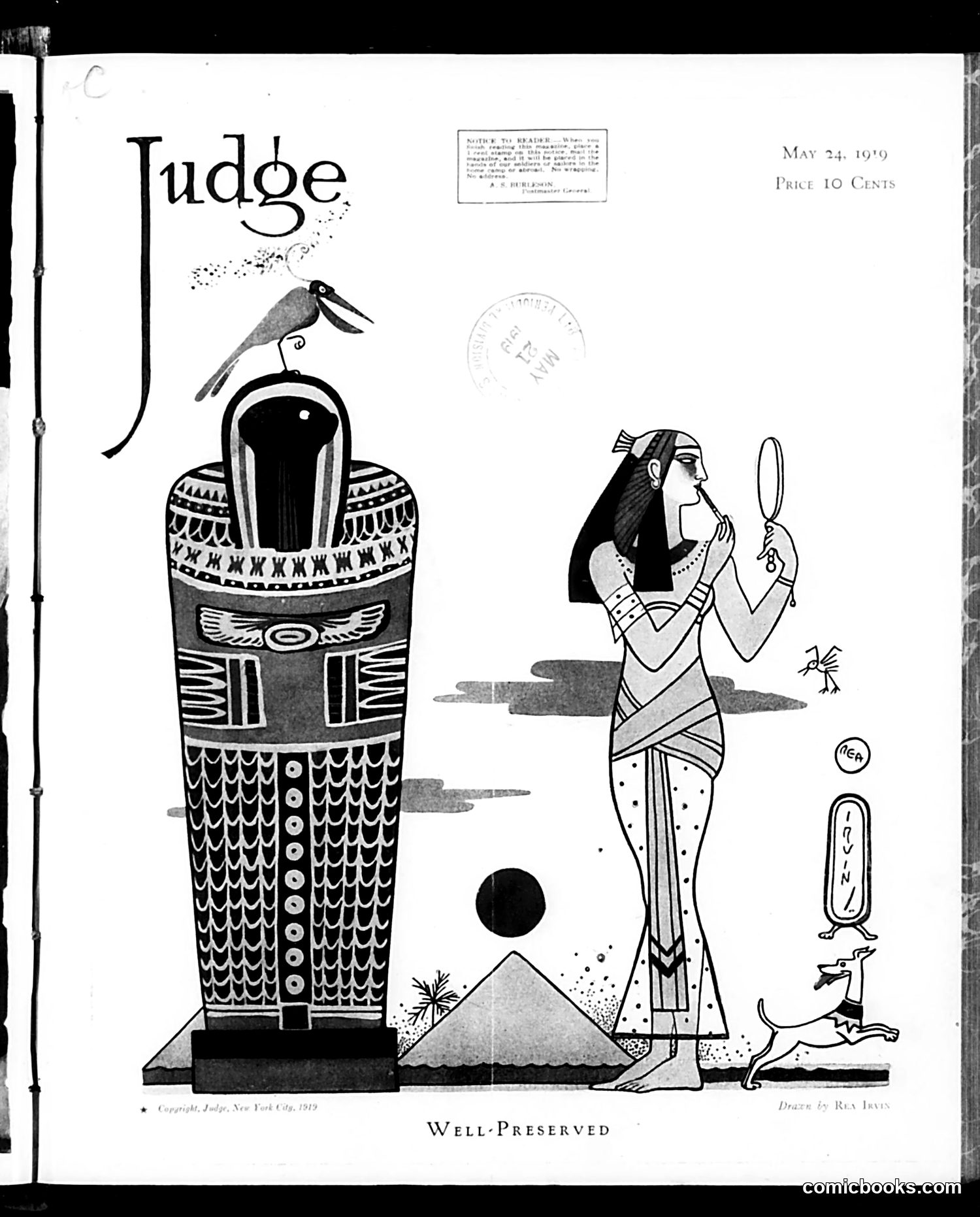
This cartoon is titled "Well-Preserved" and satirizes the preservation of Egyptian antiquities. The image depicts an Egyptian mummy in an ornate sarcophagus alongside a modern woman examining herself in a hand mirror. The humor plays on the double meaning of "well-preserved": the ancient mummy has been literally preserved for millennia through mummification, while the woman—appearing to be a fashionable 1920s flapper—is presumably using cosmetics and beauty treatments to preserve her youthful appearance. The satire suggests vanity and the human obsession with maintaining youth and beauty, contrasting ancient Egyptian death rituals with modern consumer culture. The cartoonist (Rex Irvin) mocks contemporary beauty standards by equating them to mummy preservation.
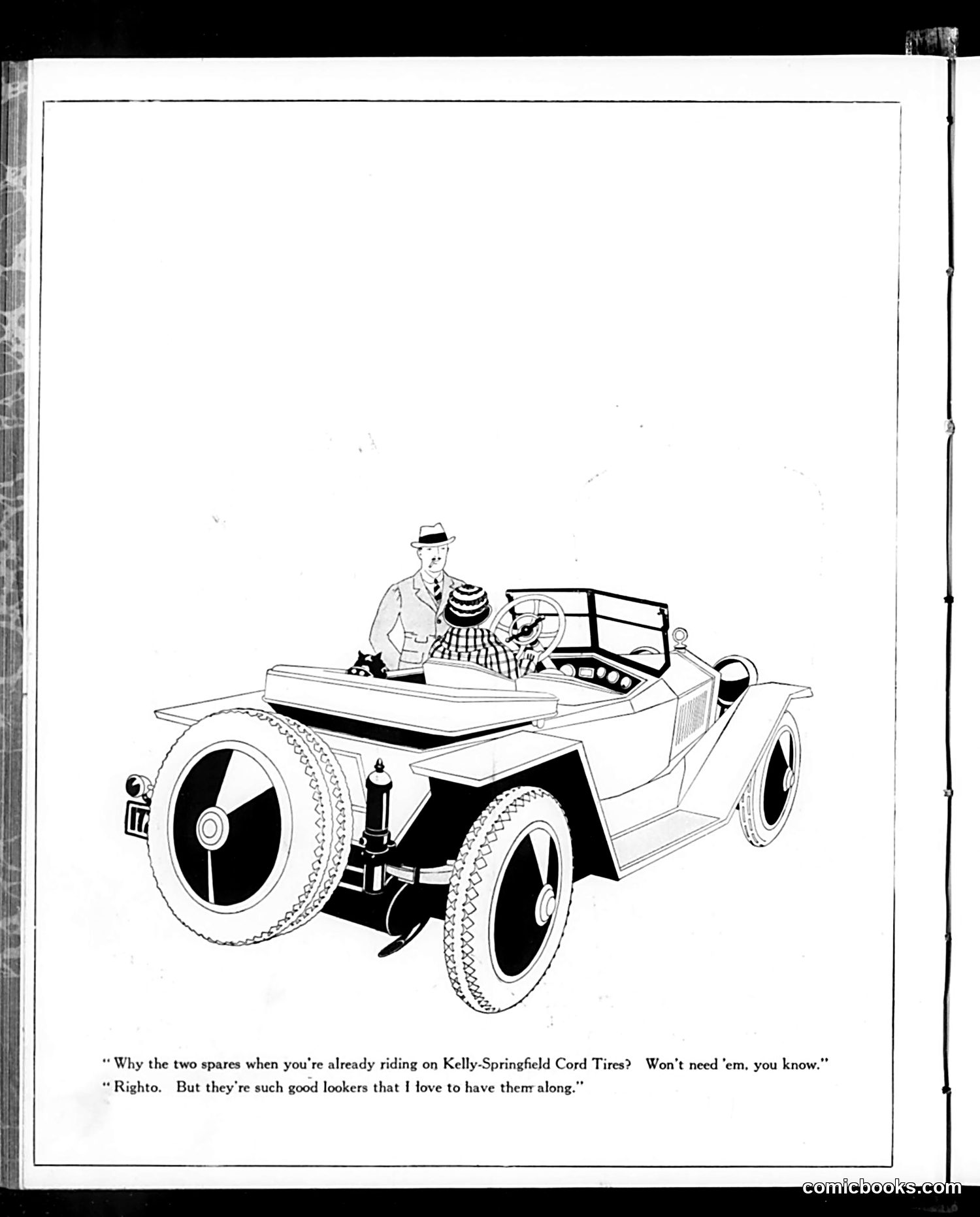
This is an advertisement for Kelly-Springfield Cord Tires, presented as a humorous dialogue. The cartoon depicts an early 1900s automobile carrying a man, woman, and child, loaded with two spare tires despite already having tires on the vehicle. The joke plays on practical concerns of the era: early automobile tires were unreliable and frequently blew out, making spare tires genuinely necessary safety equipment. The husband's comment—that spares aren't needed—is contradicted by his wife's response that she keeps them "because they're such good lookers," a lighthearted justification. The ad's purpose is to suggest Kelly-Springfield tires are so reliable that owners won't need spares, while simultaneously showcasing the tires themselves as attractive products worth displaying.
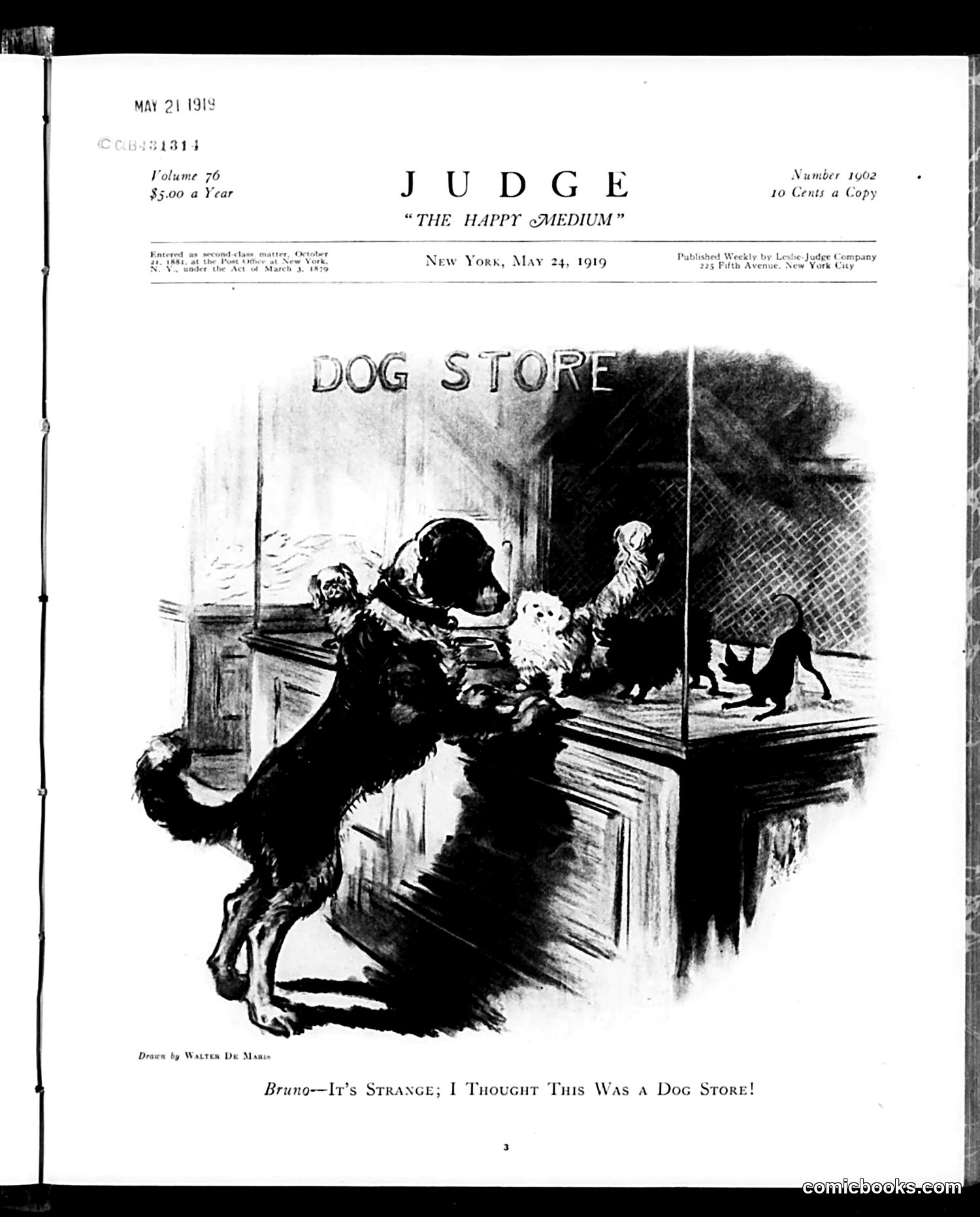
This is a humorous cartoon from Judge magazine (May 24, 1919) titled "Dog Store," drawn by Walter De Maris. The joke plays on a dog's confusion: a large dog stands on hind legs at a shop counter, examining smaller dogs displayed in the window as merchandise. The caption reads "Bruno—It's Strange; I Thought This Was a Dog Store!" The satire targets the commodification of animals—treating dogs as mere retail products rather than living creatures. The cartoon anthropomorphizes the dog character "Bruno," giving him human expectations and rational disappointment. The humor derives from the absurdist premise of a dog shopping for other dogs, while the underlying message critiques the era's pet trade and the casual commercialization of animals. This reflects Progressive Era concerns about animal welfare and consumer culture.
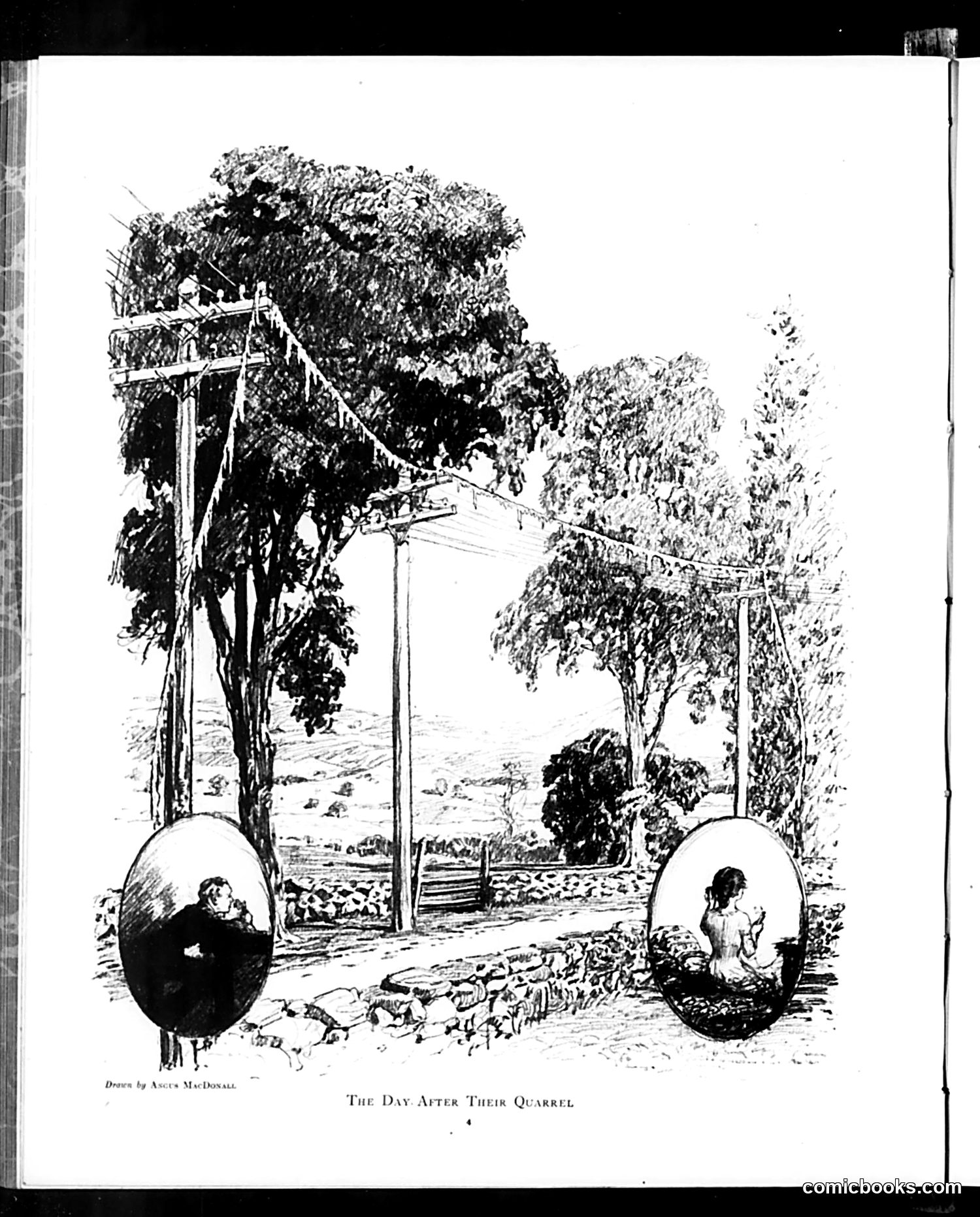
This illustration by Alice MacDonald depicts two figures sitting in separate spheres or bubbles, isolated from each other in what appears to be a pastoral landscape. They sit back-to-back, emotionally distant despite physical proximity—a visual metaphor for estrangement following an argument. The cartoon satirizes romantic or domestic conflict, showing the stubborn silence and emotional withdrawal that follows a quarrel. The figures' enclosed, separated positions emphasize how anger creates psychological distance even in shared spaces. The peaceful countryside setting contrasts ironically with the couple's emotional coldness. Without additional context from the magazine issue, the specific relationship or incident referenced remains unclear, but the satire targets the universal human experience of post-argument tension and wounded pride.
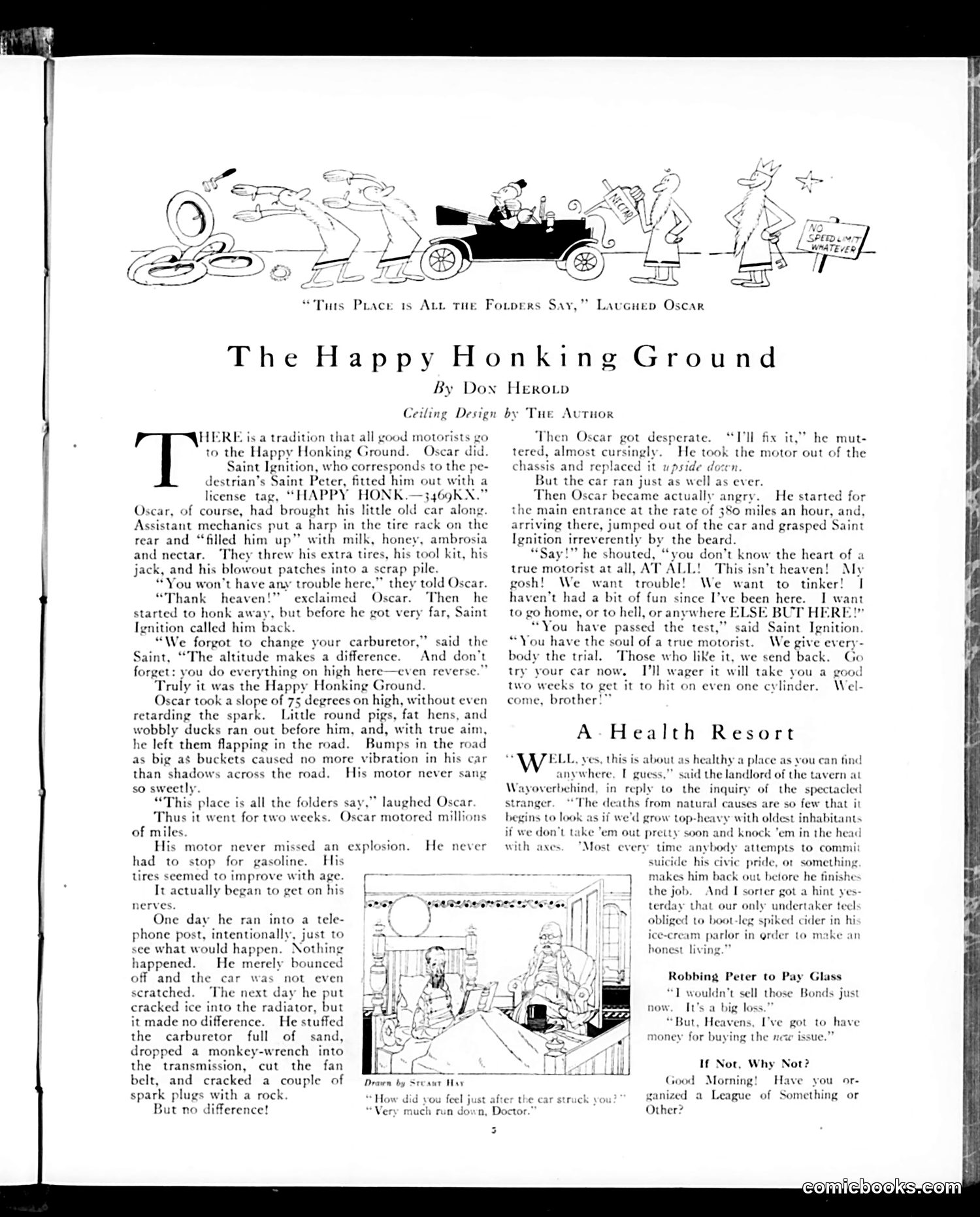
This satirical story by Don Herold mocks early motorists' obsession with their automobiles. The narrative follows Oscar, who buys a dilapidated car and treats it like a prized possession despite constant mechanical failures. The satire targets the emerging car culture of the 1920s-30s, where owning a vehicle—however unreliable—became a status symbol and source of pride. Oscar ignores Saint Islington's practical advice to fix the carburetor, instead viewing the car's failures as tests of his "true motorist" spirit. The joke critiques how automobile enthusiasm had become almost religious, with motorists willing to endure ridiculous hardships rather than admit their vehicles are fundamentally broken. It's commentary on the irrational devotion consumers show toward new technology regardless of actual performance.
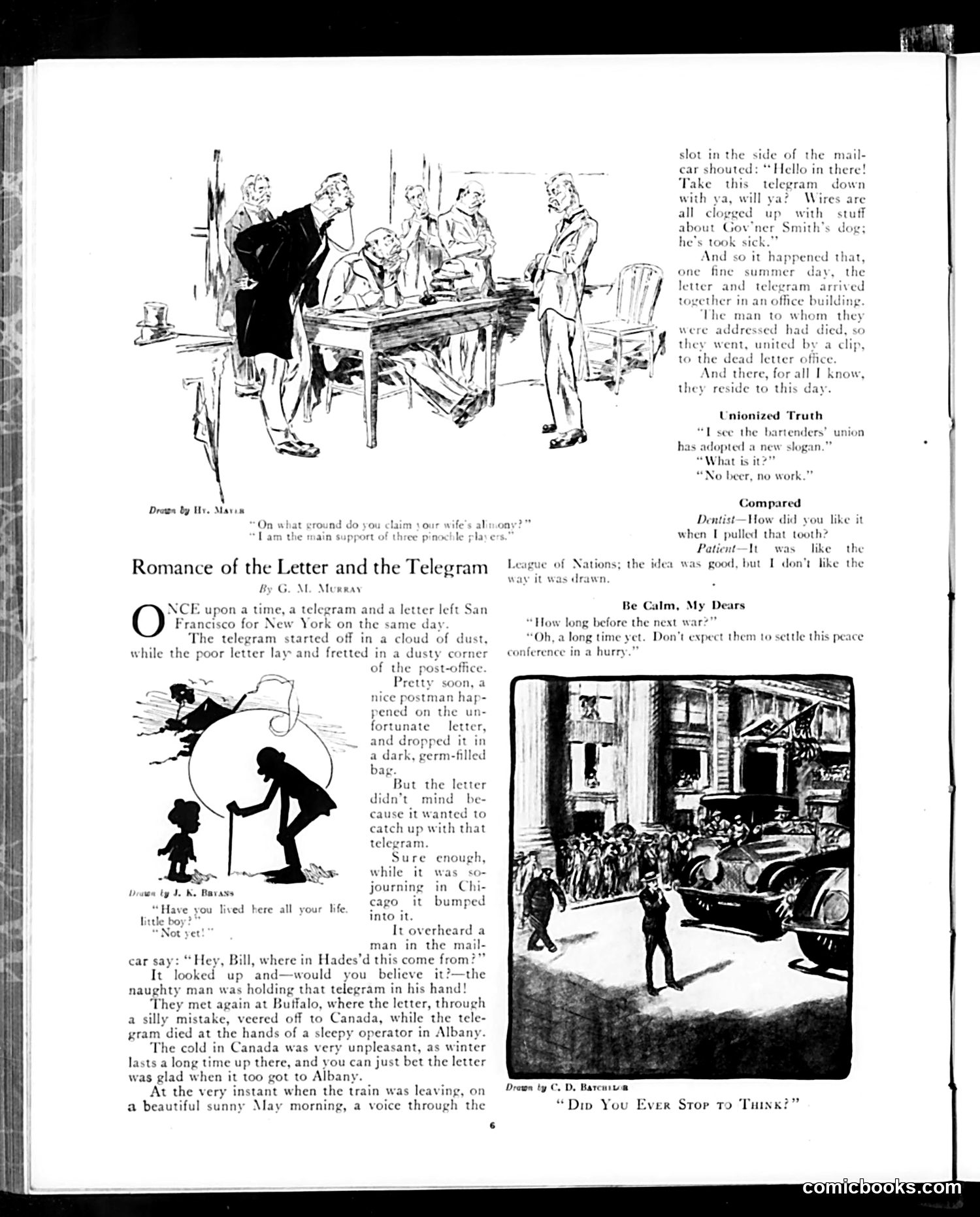
This satirical story by G. M. Murray contrasts the slow, unreliable postal service with the faster telegraph system. The narrative follows a letter and telegram both sent from San Francisco to New York on the same day. The letter gets lost in postal delays and misdirection (ending up in Canada), while the telegram successfully reaches its destination. The humor mocks the inefficiency of the U.S. Mail—a persistent complaint in this era. The accompanying cartoons illustrate the postal service's failures: one shows a letter carrier dropping mail in a "germ-filled bag," another depicts a chaotic street scene labeled "Did You Ever Stop to Think?" The piece advocates for the telegraph's superiority as a communication method, reflecting early-20th-century technological progress and frustration with outdated mail infrastructure.
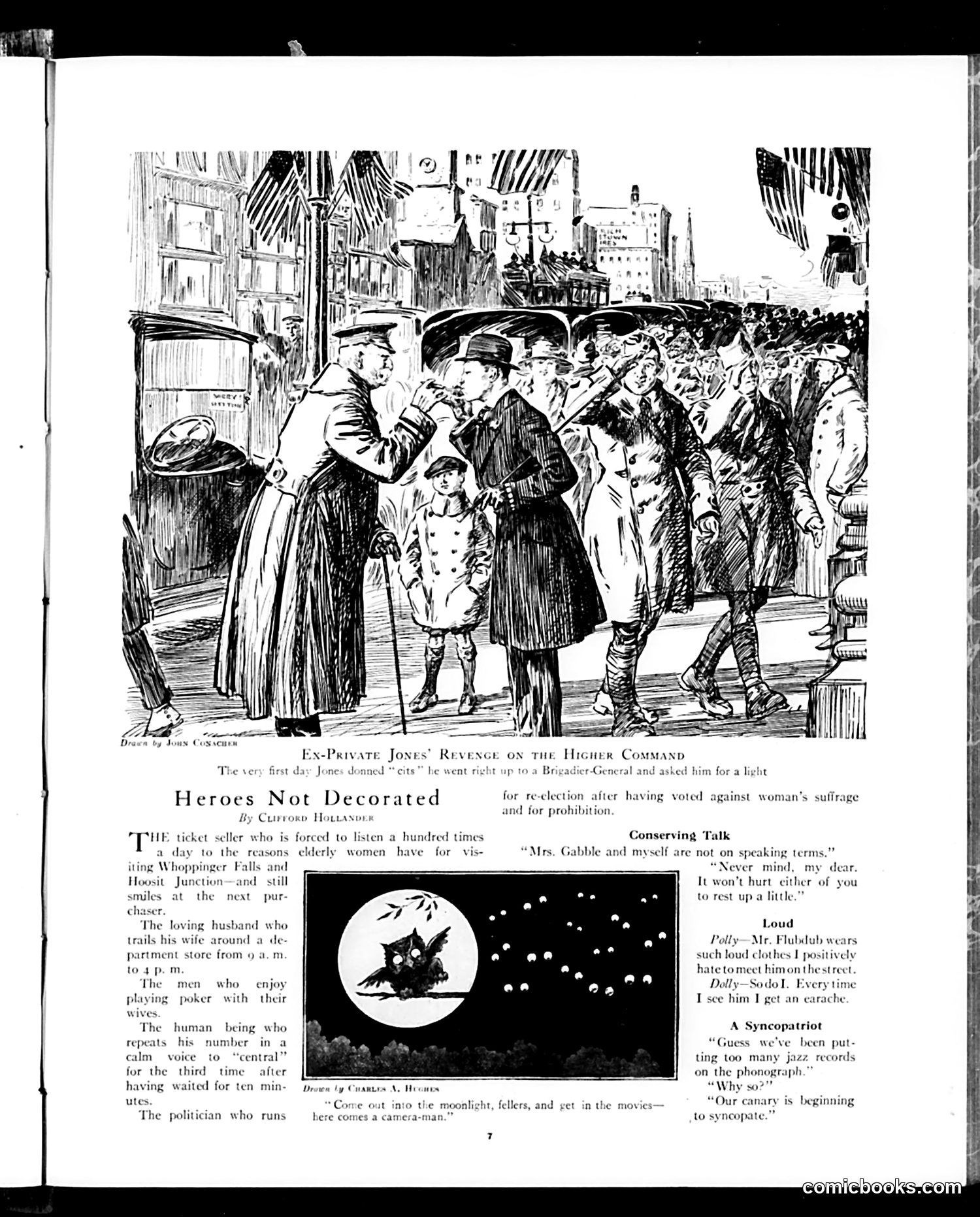
This Judge magazine page contains several satirical items targeting early 20th-century social issues. **Top cartoon**: "Ex-Private Jones' Revenge on the Higher Command" depicts a WWI veteran confronting military brass. The joke appears to reference how ordinary soldiers might resent officers' authority, with Jones now able to challenge them as a civilian ("cits"). **Main article**: "Heroes Not Decorated" by Clifford Hollander sarcastically lists unsung heroes—ticket sellers, patient husbands, poker-playing couples—who deserve recognition but won't receive it. The subheading indicates these "heroes" are politicians who lost re-election after voting *against* women's suffrage and *for* prohibition, suggesting these were unpopular positions. **Side humor pieces** mock contemporary annoyances: gossiping women, loud fashion, and a canary that's learned to dance to jazz music (reflecting 1920s cultural anxieties about jazz's influence). The overall tone satirizes both political cowardice and modern social pretension.
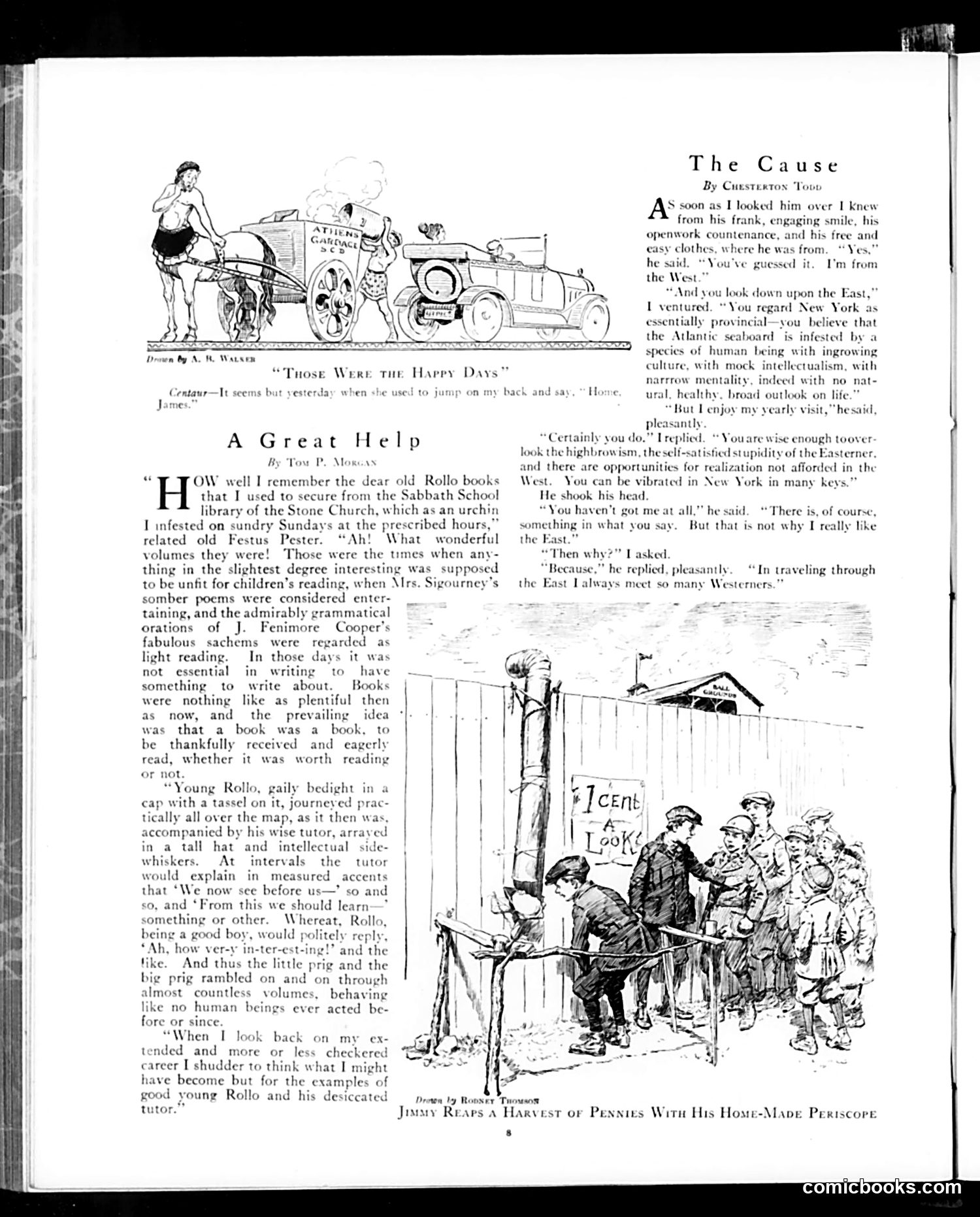
This page contains two separate satirical pieces from *Judge* magazine: **"Those Were the Happy Days"** (top left) mocks nostalgic reverence for old children's literature, specifically the "Rollo" books—moralistic tales featuring a pious boy and pedantic tutor spouting phrases like "how very in-ter-est-ing!" The satire skewers overly earnest, instruction-focused writing that prioritized moral lessons over entertainment. **"The Cause"** (right) satirizes East-West provincial attitudes. A Western visitor claims Easterners are culturally superior but intellectually pretentious. The punchline reveals his real reason for visiting: he enjoys meeting fellow Westerners in the East—undercutting his own critique and suggesting Westerners remain isolated despite travel. The bottom illustration depicts "Jimmy Reaps a Harvest of Pennies"—likely a separate children's story caption (text unclear). The satire targets both outdated pedagogy and regional snobbery prevalent in early 20th-century America.
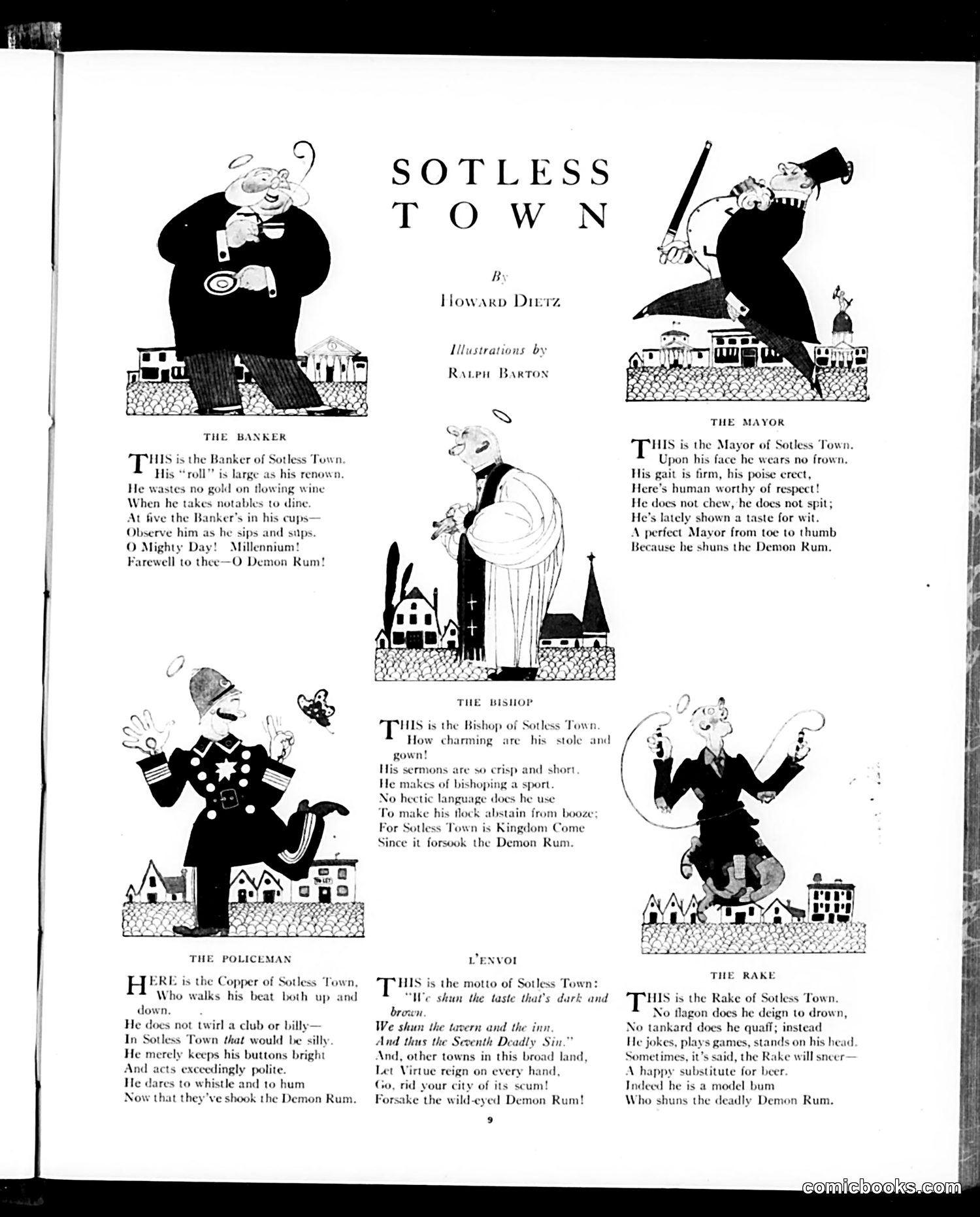
This 1920s Judge magazine page satirizes the Prohibition movement (banning alcohol, 1920-1933). The cartoon depicts "Sotless Town"—a place that has eliminated alcohol and its supposed evils—through caricatures of town figures: a banker, policeman, bishop, mayor, and rake. The satire works by showing these characters as cartoonishly "improved" by eliminating alcohol (the "Demon Rum"). The banker no longer wastes money on wine; the policeman needs no weapons; the bishop converts drinking into virtue; the mayor becomes respectable; even the rake (a dissolute character) substitutes games and clowning for drinking. The point is clear: the cartoonist is mocking Prohibition as naïve social engineering. By presenting these exaggerated, almost absurd improvements, the satire suggests that simply banning alcohol won't genuinely reform human behavior or society. The heavy-handed moralizing ("Seventh Deadly Sin," "Kingdom Come") undercuts itself through the obviously ridiculous outcomes depicted.
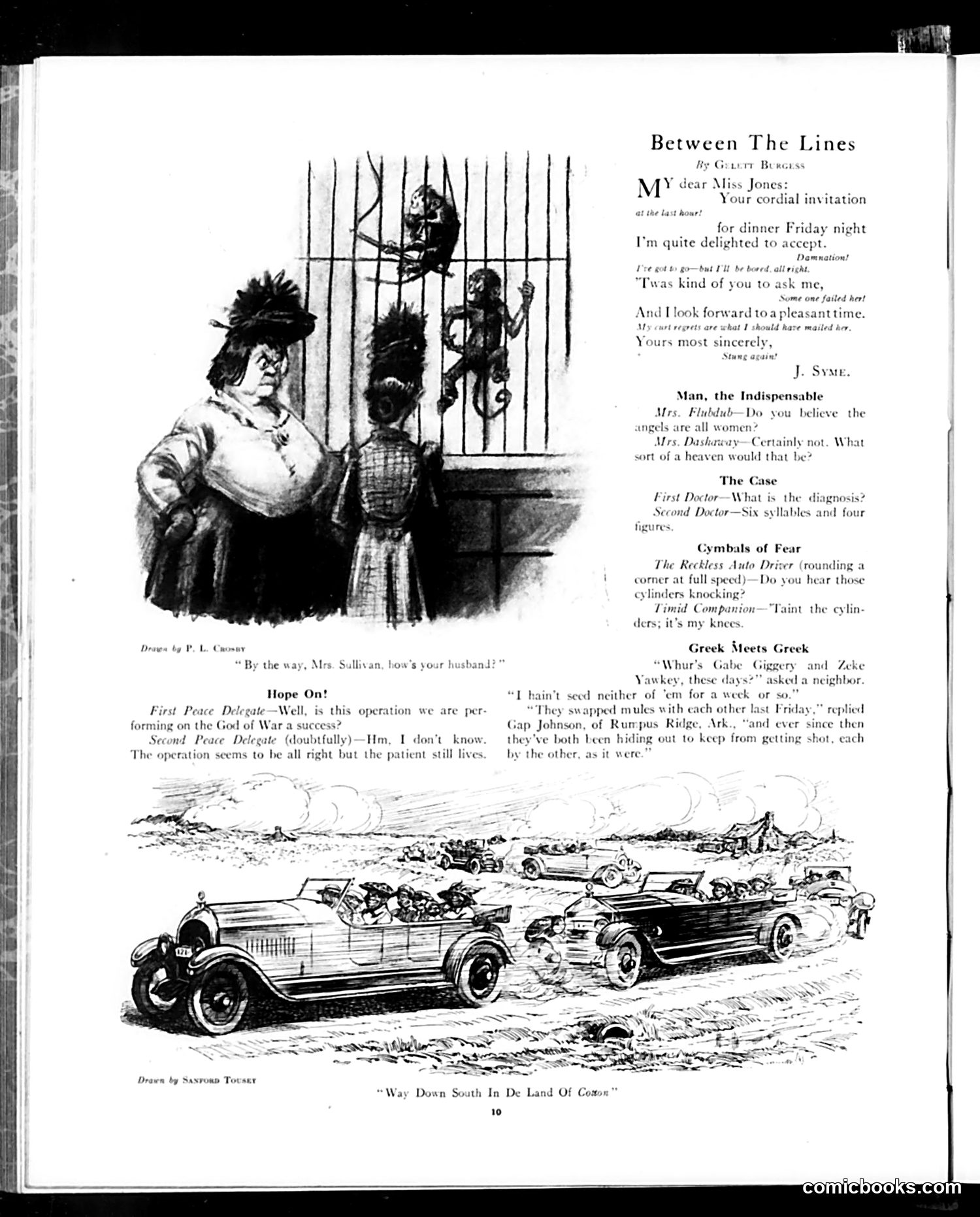
This page collects brief satirical pieces mocking social pretense and contemporary absurdities. **"Between The Lines"** satirizes insincere social correspondence: the letter's surface politeness ("delighted to accept," "look forward") contrasts with bracketed asides revealing the writer's true thoughts ("Damnation! I've got to go—but I'll be bored"). The joke exposes the gap between what people write and what they actually feel. **"The Case"** makes a quick joke about medical billing—a diagnosis reduced to syllables and monetary figures, suggesting doctors charge by complexity rather than actual care. **"Cymbals of Fear"** plays on car terminology: the "timid companion" mistakes engine knock for mechanical trouble, but it's actually their knees knocking from fear—typical early-automobile anxiety humor. **"Greek Meets Greek"** appears to be rural/dialectal humor about two men who swapped mules, then both hide to avoid being shot by the other—a joke about rural revenge culture and distrust. **"Hope On!"** references post-WWI peace negotiations, suggesting military operations against "the God of War" (Germany) succeeded militarily but the underlying conflict persists.
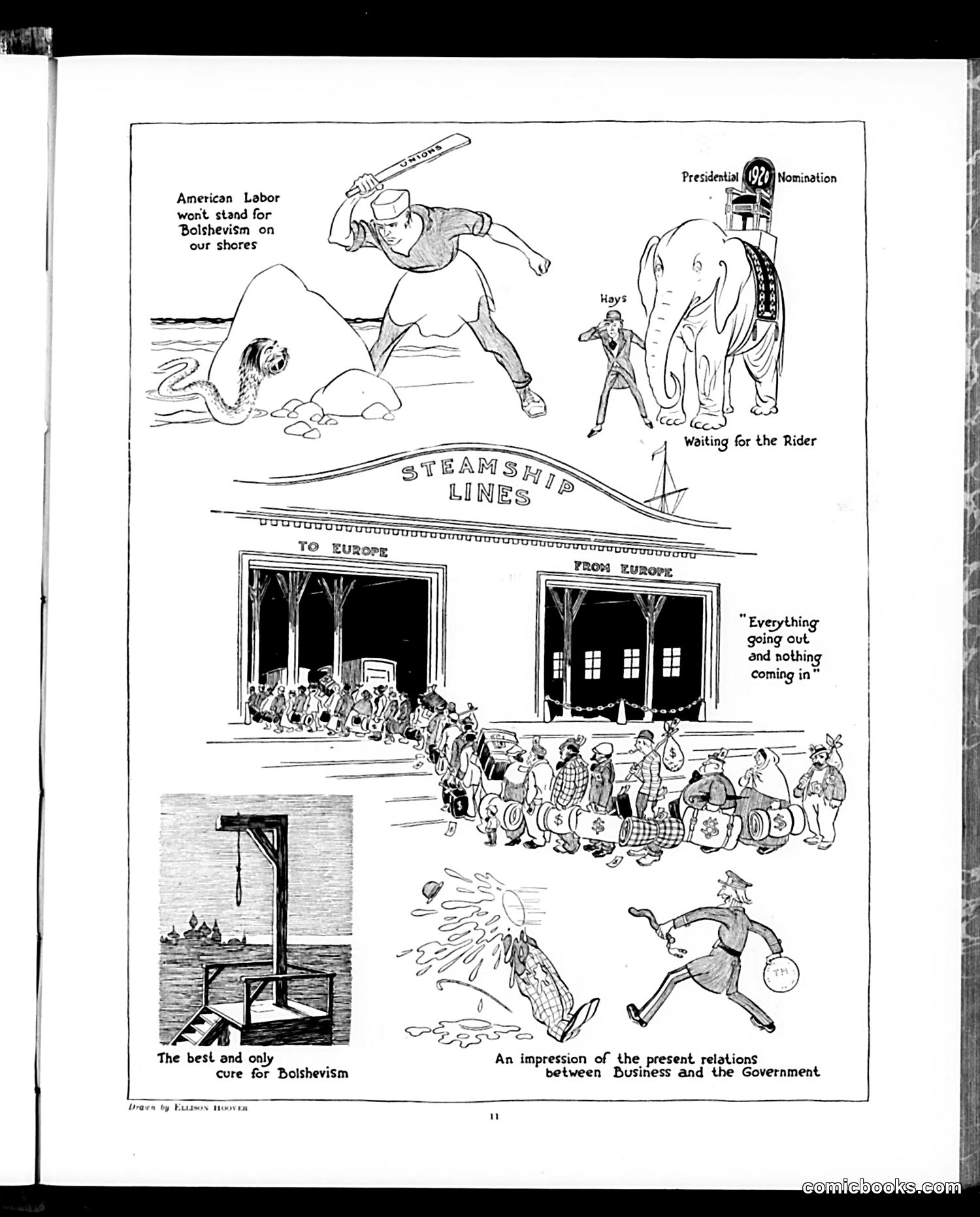
This political cartoon from *Judge* magazine uses multiple satirical panels to criticize early 1920s American anxieties about Bolshevism and labor unrest. The top panels show American labor (depicted as a worker) defeating Bolshevism (represented as a serpent), while "Hays" (appears to be a political figure) waits with the 1924 Presidential Nomination—suggesting labor's support is being courted. The center depicts steamship lines with cargo flowing to/from Europe—addressing fears about foreign communist influence infiltrating America through trade and immigration. The bottom section mocks the strained relationship between business and government as juggling act, with a hanging gallows labeled "the best and only cure for Bolshevism," darkly suggesting violent anti-communist sentiment. Overall, the cartoon satirizes how American elites weaponize anti-Bolshevism rhetoric while ignoring deeper economic problems causing labor unrest.
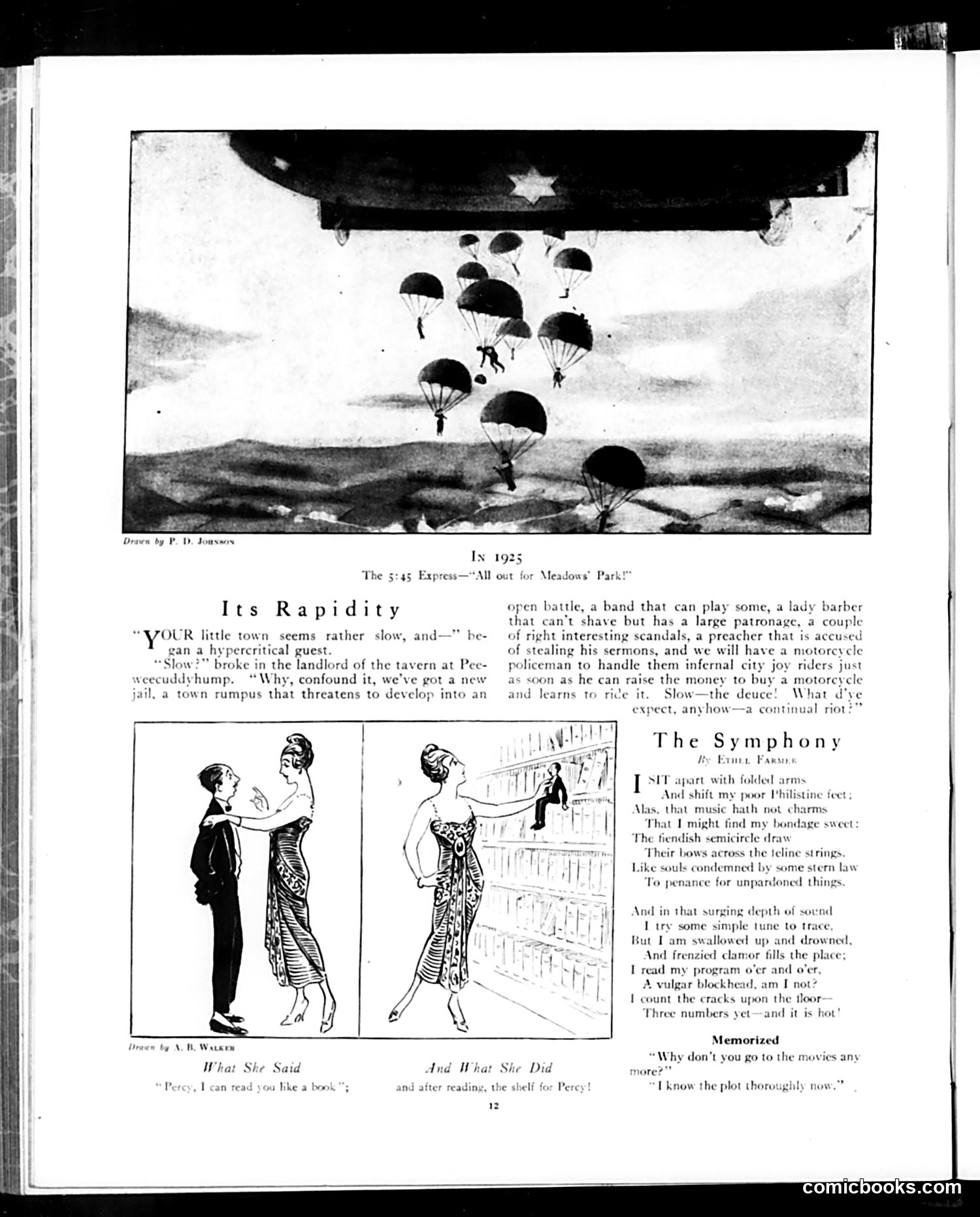
This page contains three separate pieces of humor typical of 1920s satire: **"Its Rapidity"** mocks small-town boasting. A hypercritical visitor complains the town is slow; the landlord defensively lists absurd "developments"—a new jail, a band, a female barber, scandal, a corrupt preacher, and plans for a motorcycle cop. The joke: he conflates chaos and crime with progress, ironically proving the town *is* slow by celebrating dysfunction as achievement. **"What She Said/And What She Did"** (cartoon illustrations by A.B. Walker) shows the gap between a woman's words and actions regarding a book she claims to read—likely satirizing women's pretensions to literary culture. **"The Symphony"** by Emet Farries is a poem mocking concert-goers who don't understand classical music. The speaker sits through a symphony, bored and confused, counting floor cracks while pretending to appreciate high culture—satirizing forced sophistication among the culturally unengaged. All three pieces target 1920s social pretension and intellectual posturing.
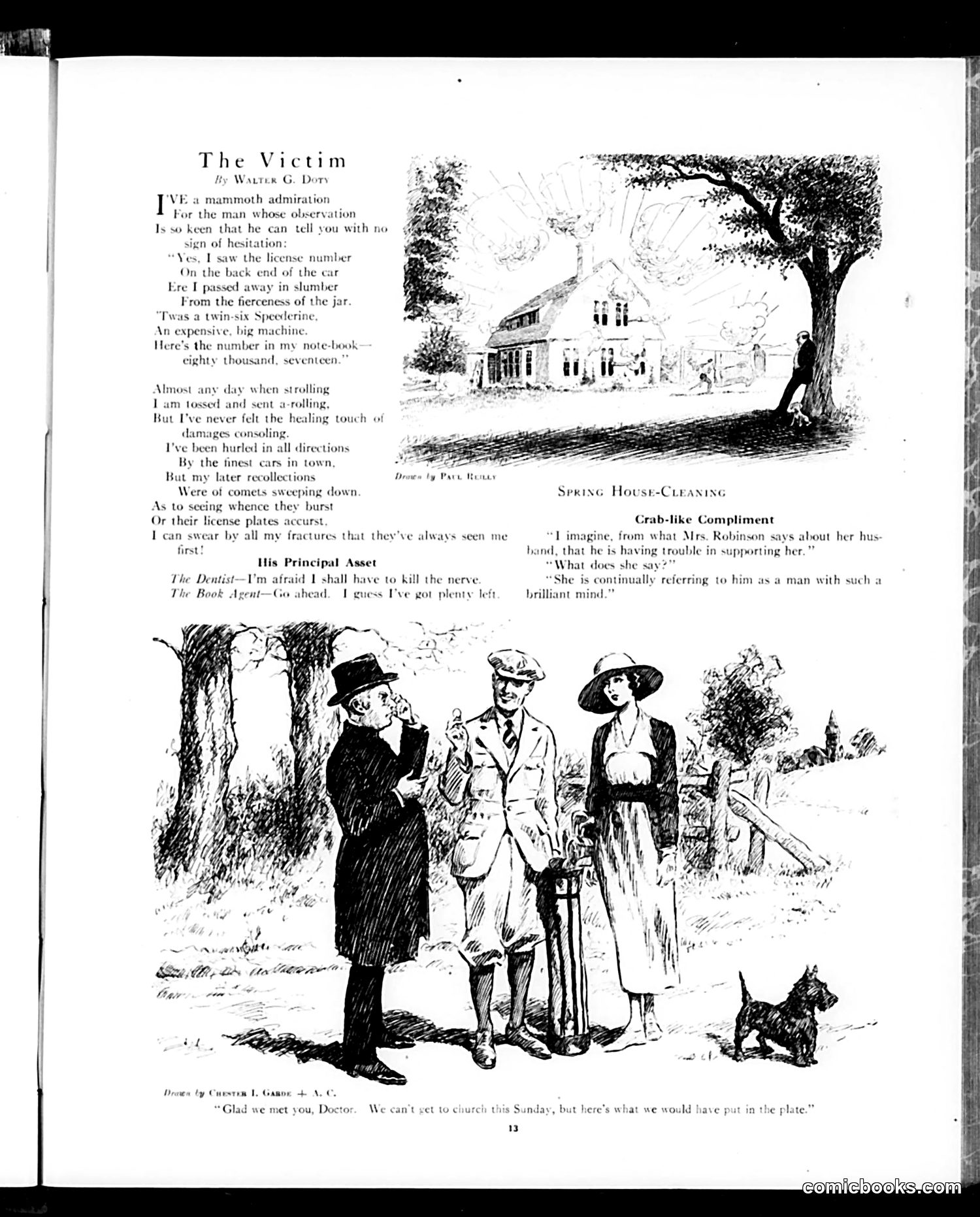
This page from *Judge* contains three distinct satirical pieces: **"The Victim"** (poem with illustration) mocks pedestrians hit by automobiles who memorize license plate numbers but receive no compensation. The joke: the narrator gets repeatedly struck by expensive cars ("twin-six Speederine") yet never recovers damages—suggesting either the legal system fails accident victims or the wealthy evade responsibility. **"His Principal Asset"** is a brief joke contrasting a dentist (who needs to kill a nerve) with a book agent, implying the agent has no nerve or moral center worth preserving—typical era satire of traveling salesmen as ethically hollow. **"Crab-like Compliment"** plays on backhanded insults: when Mrs. Robinson constantly calls her husband "a man with such a brilliant mind," she's actually insulting him—suggesting he's impractical or incompetent at supporting the family, despite intelligence. The "crab-like" reference means the compliment moves sideways, attacking while appearing to praise. All three target early-20th-century social anxieties: automobile danger/legal liability, commercial deception, and marital tension.
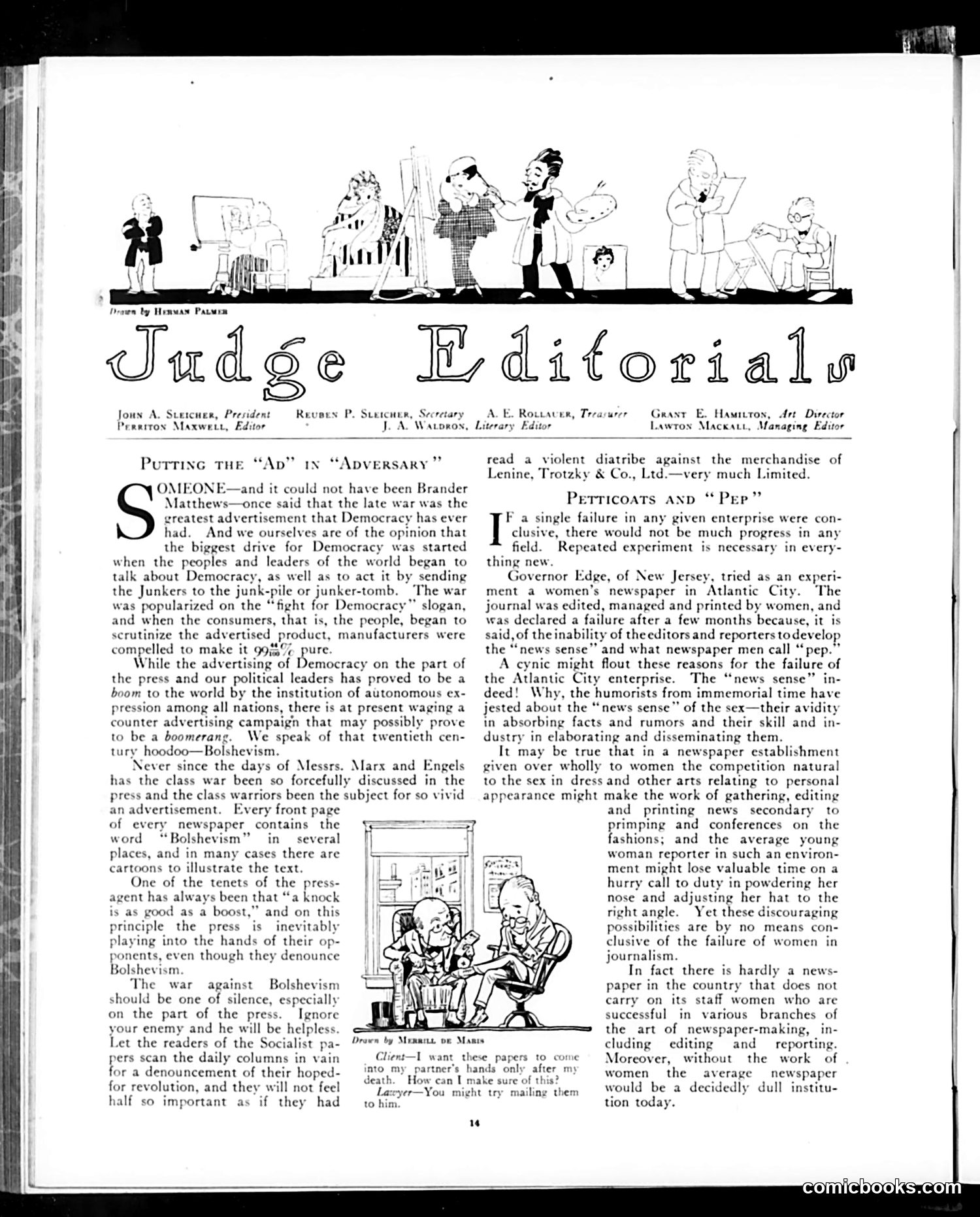
This editorial page from Judge magazine addresses two political/social issues of the post-WWI era: **"Putting the 'Ad' in 'Adversary'"** criticizes American press coverage of Bolshevism. The author argues that constant newspaper denunciations of Lenin, Trotsky, and communist ideology actually *advertise* and amplify the revolutionary movement, making it seem more important than ignoring it would. The cartoon by Miriam de Maris depicts a client asking a lawyer how to ensure papers reach "my partner's hands only after my death"—likely satirizing those obsessively focused on communist threats. **"Petticoats and 'Pep'"** discusses Governor Edge's failed women-only newspaper in Atlantic City. Rather than accepting the failure, the author defends women journalists, sarcastically rejecting claims they lack "news sense" or "pep." He suggests that if the venture failed, it was due to workplace dynamics (women prioritizing appearance/fashion) rather than inherent female incompetence—a backhanded defense reflecting 1920s gender attitudes. Both pieces reflect post-war anxieties: communist threats and evolving women's roles in American journalism.
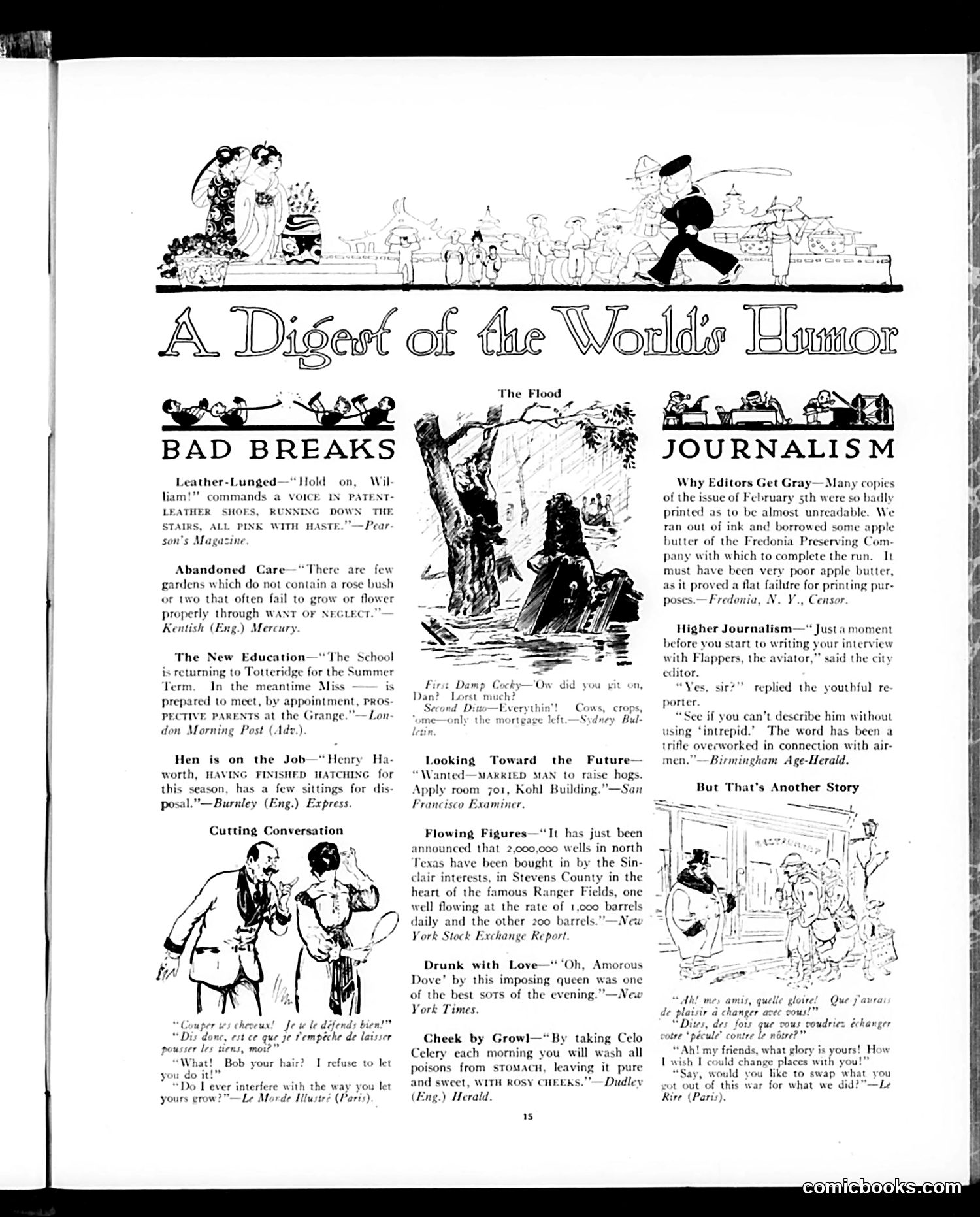
This page collects humorous excerpts from newspapers and magazines worldwide, presenting them as examples of unintentional comedy—what we'd call "bad writing" or "unfortunate phrasing." **Key satirical points:** The humor derives from **contradictions and typos** in published text. For example, "Abandoned Care" warns that roses fail through "want of neglect" (should be "want of care"), creating absurd logic. "The Flood" cartoon shows someone drowning while the text discusses celery's digestive benefits—darkly juxtaposing grim reality with trivial advice. **Social commentary** includes editorial mishaps (using apple butter as printer's ink), overused journalistic clichés ("intrepid" to describe aviators), and the contrast between serious wartime conditions and frivolous social gossip. The French phrases mock cultural pretension. Overall, the page satirizes **editorial incompetence, sloppy journalism, and the gap between highbrow publication standards and actual execution** during this era.
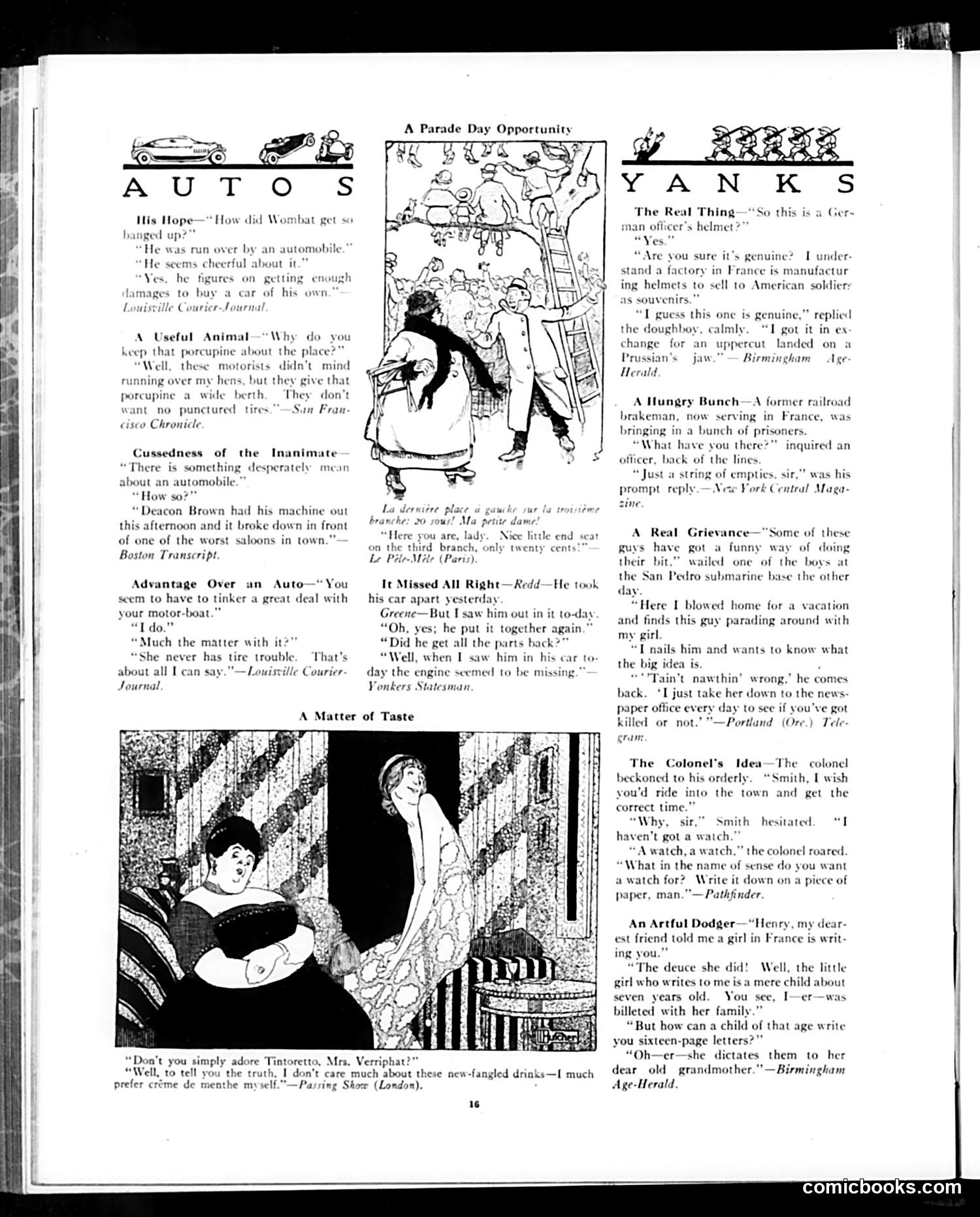
This page from Judge collects brief satirical anecdotes about automobiles and American soldiers in WWI France, reflecting 1918-era concerns. The **automobile jokes** mock the unreliability and danger of early cars—machines breaking down, losing parts, causing accidents, and requiring constant tinkering. One anecdote suggests a porcupine is safer than a car (motorists won't hit it). The **"Yanks"** section targets American soldiers abroad. "The Real Thing" jokes about GIs trading punches with German prisoners for "souvenirs" (a German helmet). "A Hungry Bunch" uses railroad slang: a soldier calls captured Germans "empties" (empty freight cars). "A Real Grievance" portrays a soldier angry his girlfriend is being shown to a newspaper office daily to check casualty lists—implying the soldier expects to be killed. The cartoons satirize both mechanical incompetence at home and military absurdity abroad, with dark humor about war casualties woven throughout.
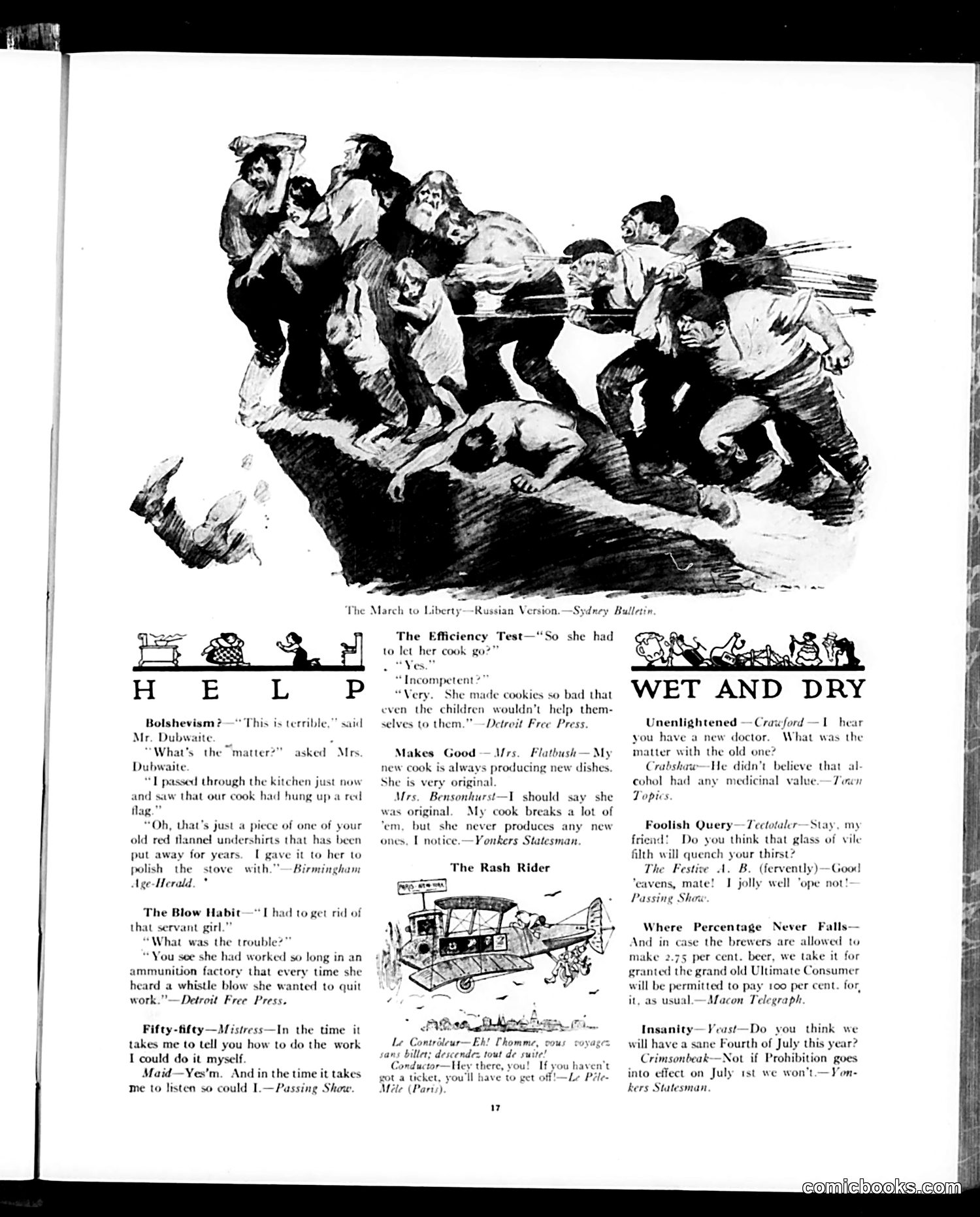
This page satirizes early 20th-century domestic and social issues through short humor pieces. The top cartoon, "The March to Liberty—Russian Version," depicts a chaotic mob of figures and appears to mock Russian revolutionary upheaval, likely referencing Bolshevism (mentioned in the first joke). The satire suggests Russian "liberation" is violent chaos. The remaining content consists of brief jokes about servant problems, domestic inefficiency, and Prohibition. They mock: - Anxious middle-class homeowners mistaking workers' red cloth for communist flags - Servants' incompetence and independence - The disconnect between employers and household staff Several jokes reference **Prohibition** (alcohol ban), mocking both teetotalers and the inevitably high prices consumers will pay if beer becomes legal at low alcohol content. One joke suggests Independence Day celebrations will be ruined by Prohibition's enforcement. The overall theme reflects post-WWI American anxieties: fears of Bolshevism, servant shortages (likely from WWI labor disruption), and Prohibition debates—all filtered through the magazine's middle-class perspective and somewhat condescending humor.
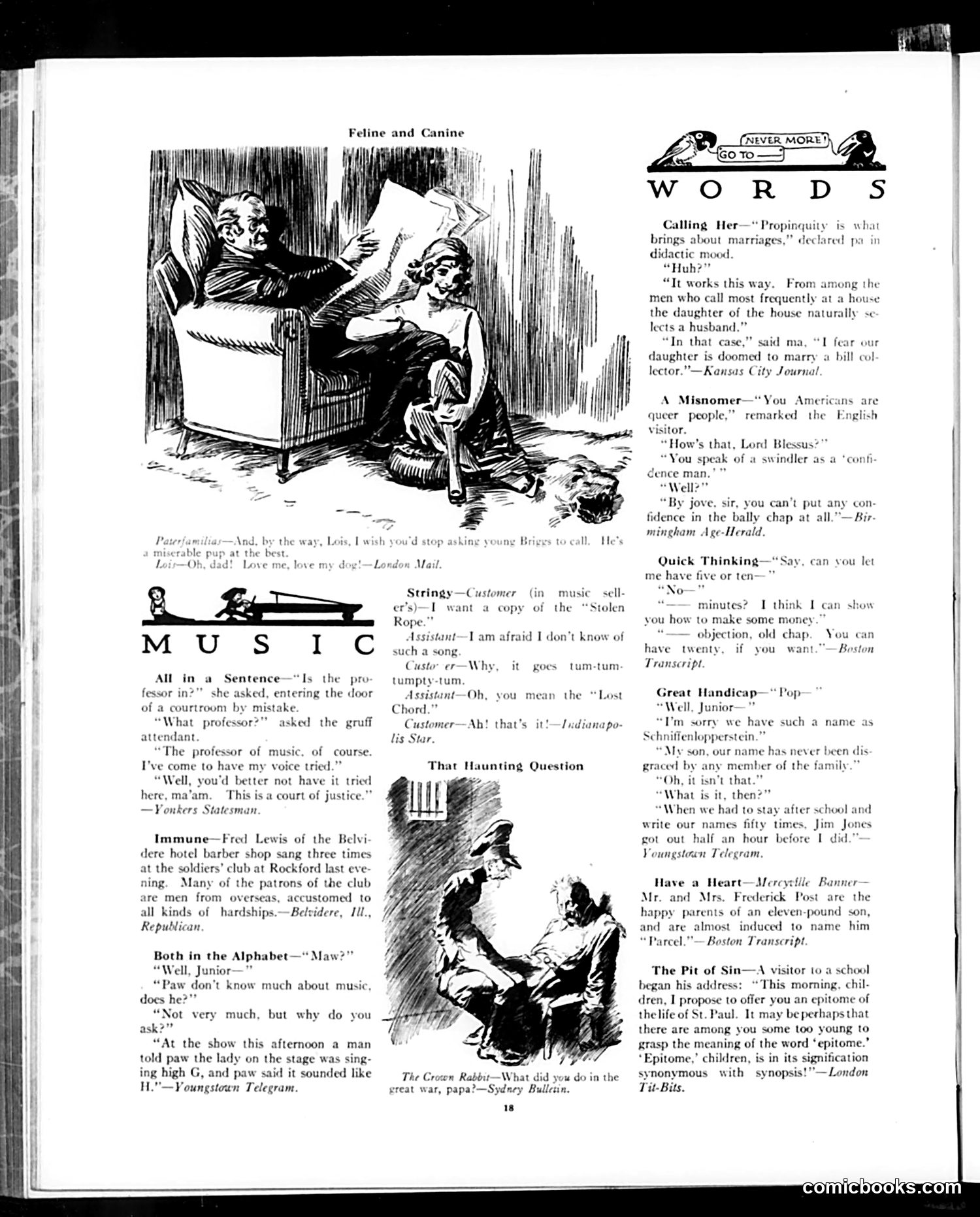
This page from *Judge* contains humor pieces and brief jokes rather than political cartoons. The content reflects early 20th-century American social attitudes: **Main themes:** - **Musical incompetence**: Multiple jokes mock ordinary people's lack of musical knowledge (a man confusing "high G" with "H," someone asking for a non-existent song called "The Stolen Rope"). - **Class and courtroom humor**: A woman mistakes a courtroom for a music school, playing on expectations about institutional settings. - **Domestic life**: A joke about "propinquity" in marriage selection, and another about a bill collector calling frequently on a house—implying debt problems are common. - **Names and embarrassment**: A humorous piece about an unfortunate German surname ("Schniffenlopperstein") causing school-related embarrassment. The satire targets everyday American life—musical pretension, class confusion, financial struggles, and social anxiety—rather than political figures. The cartoons accompanying these pieces are simple illustrations supporting the text's humor rather than standalone political commentary.
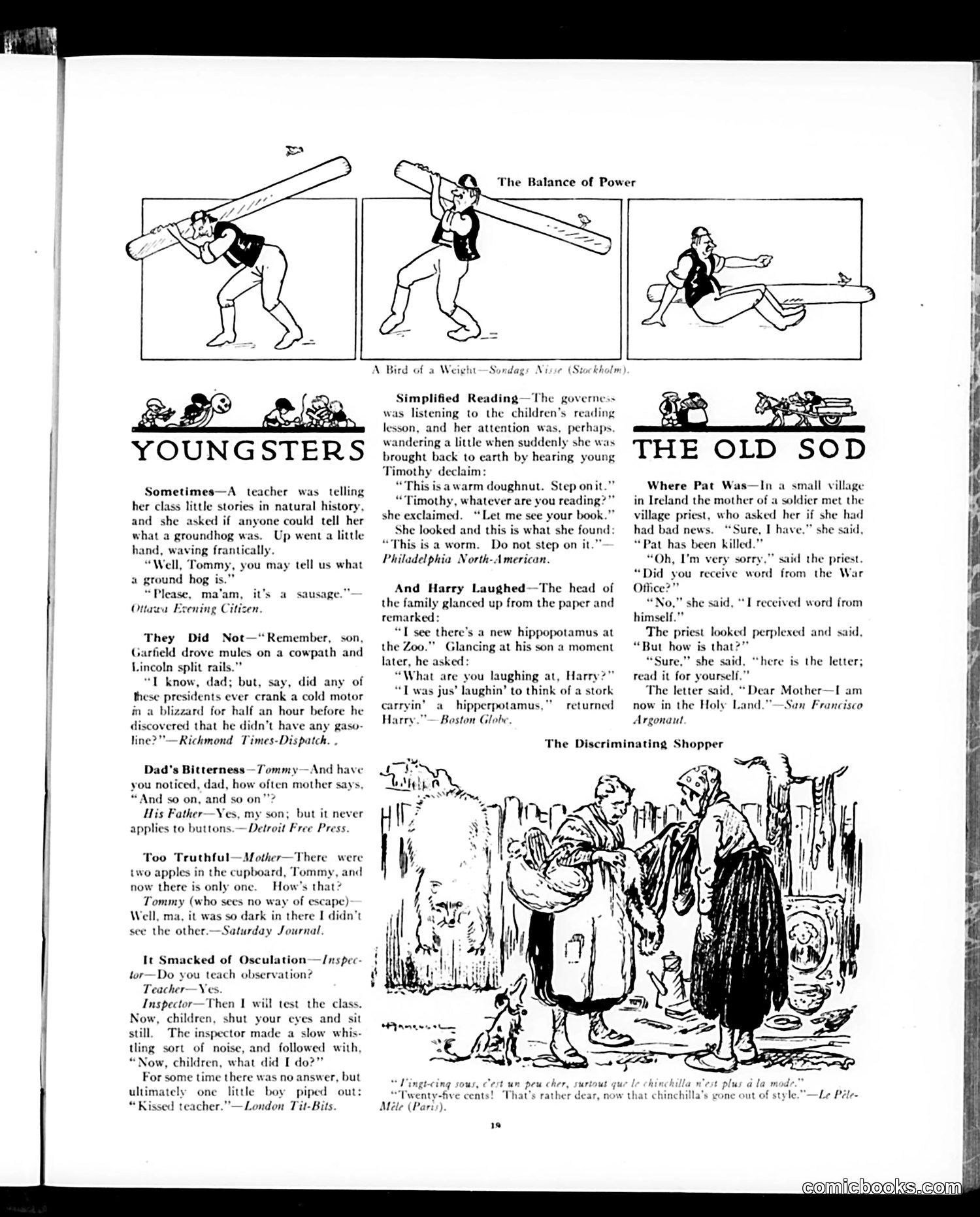
This page from *Judge* magazine contains several short humor pieces targeting different audiences: **Top cartoon ("The Balance of Power")**: A visual gag showing a person struggling to balance increasingly large objects—illustrating the difficulty of maintaining equilibrium under weight. **"Youngsters" and "The Old Sod" sections**: Contain joke anecdotes about children's misunderstandings and Irish humor, including a dark wartime joke where an Irish soldier's mother learns of his death from a letter claiming he's "in the Holy Land" (apparently a euphemism for death). **"The Discriminating Shopper"**: A cartoon depicting a woman at what appears to be a market stall, making a purchase decision. The page reflects early-to-mid 20th century American magazine humor: light domestic comedy, ethnic stereotypes (Irish characters), and wartime references. The jokes rely on wordplay, children's innocent misinterpretations, and observational humor about family life—typical of *Judge*'s genteel satirical approach to American society.
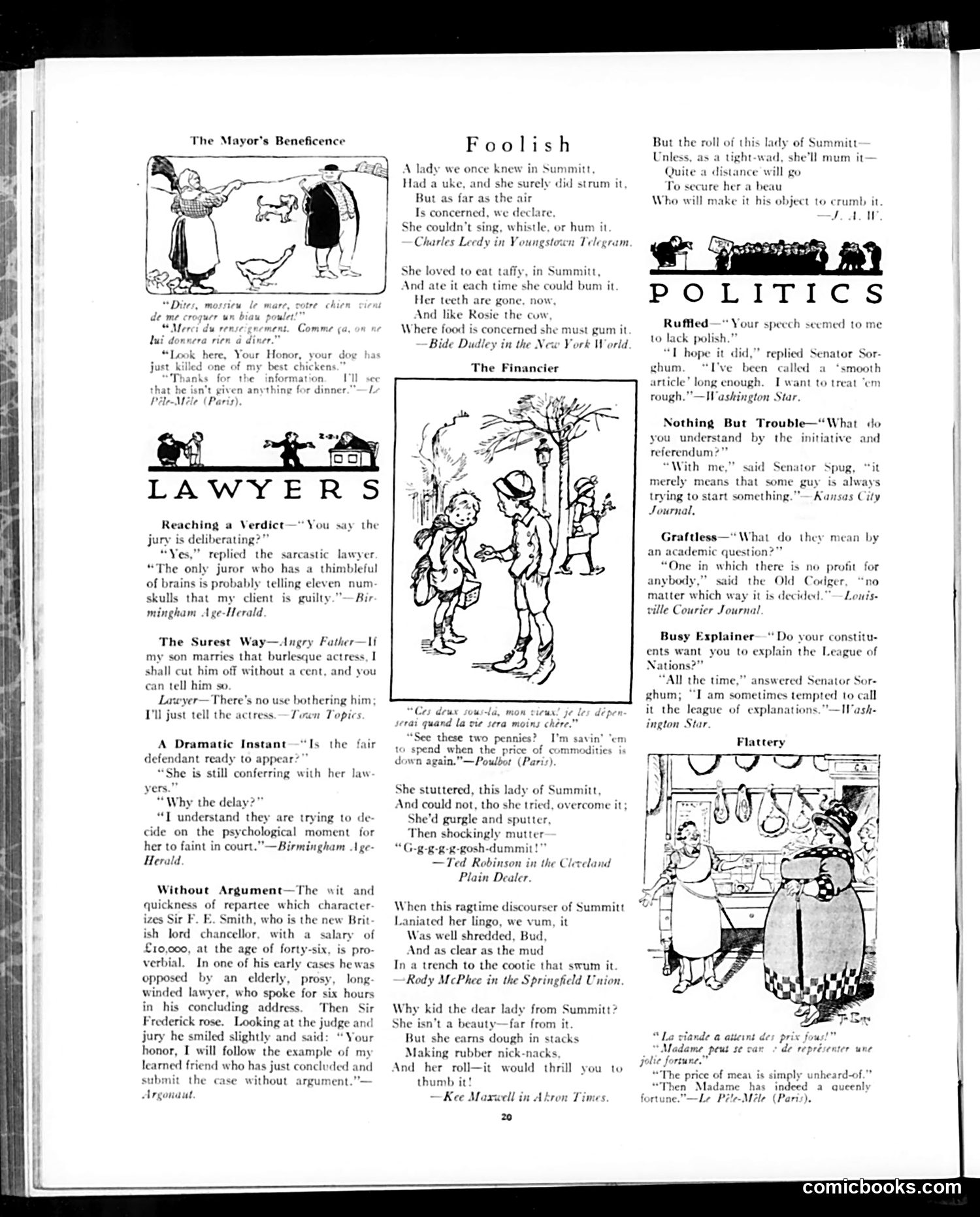
This page collects short humor pieces and jokes targeting early 20th-century American society and politics. Key sections: **"Lawyers"** section mocks the legal profession—portraying jurors as dim-witted, lawyers as manipulative (coaching actresses to faint strategically), and citing Sir F. E. Smith's famous wit in silencing a verbose opposing counsel through sardonic brevity. **"Foolish"** features crude verses about a woman from Summit who plays ukulele poorly, has lost her teeth, stutters badly, and manhandles the English language—all presented as objects of ridicule. **"Politics"** satirizes senators (named Sorghum and Spug—clearly fictional types rather than specific individuals). The jokes mock politicians for lacking polish, misunderstanding progressive reforms like the initiative/referendum as mere self-serving gimmicks, and treating the League of Nations as an excuse for endless explanation rather than actual understanding. The overall tone is dismissive toward working-class women, legal professionals, and politicians—typical of Judge's cynical, elitist humor of the era.
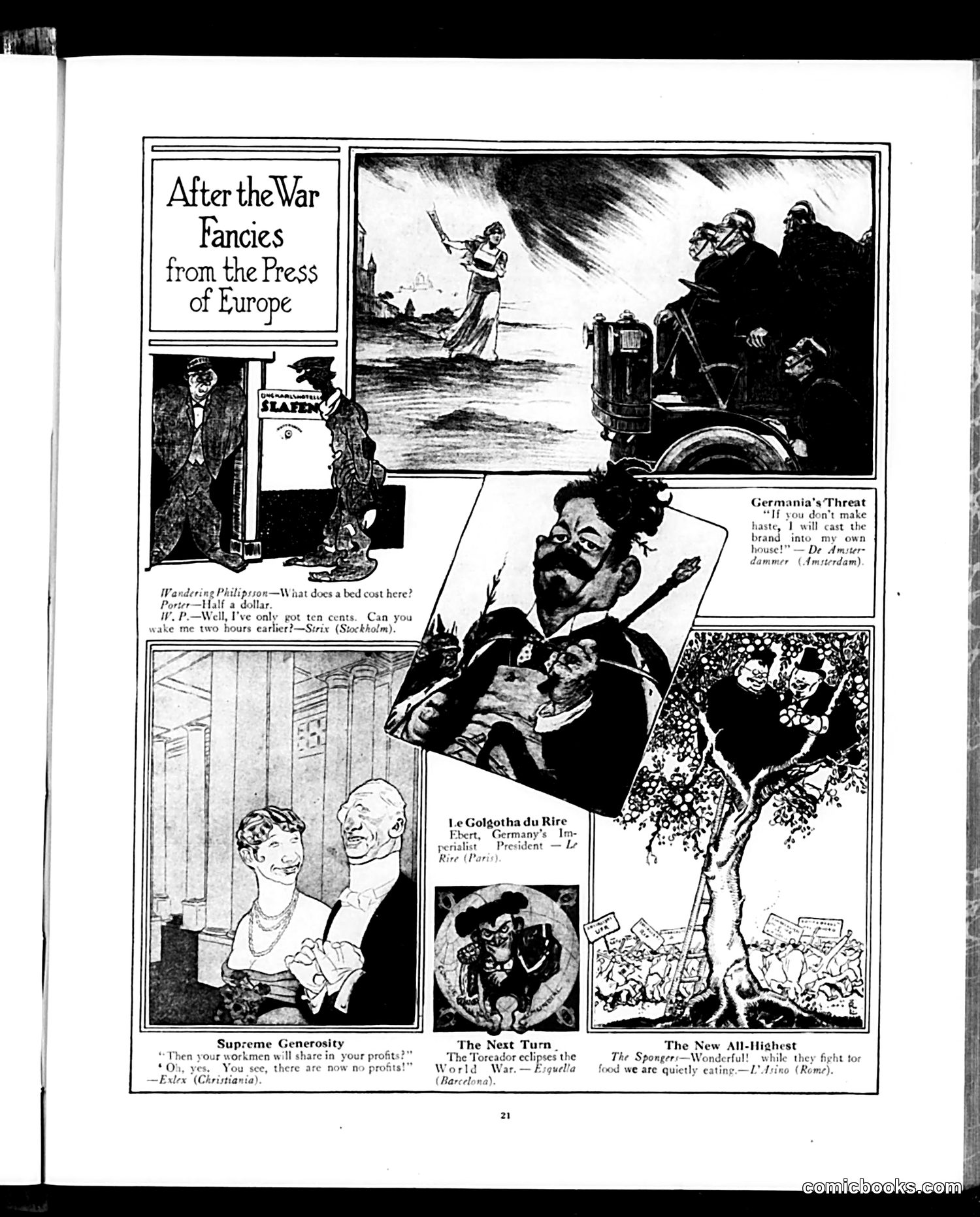
This page collects satirical cartoons from European publications mocking post-WWI conditions. Each cartoon critiques different aspects of the war's aftermath: **Top panels** appear to depict German chaos—one shows a threatening figure (likely representing Germany or revolutionary forces) menacing figures, referencing Amsterdam's caption about casting "brand into my own house." **"Supreme Generosity"** mocks wealthy industrialists promising workers profit-sharing while hoarding gains themselves—a jab at capitalist hypocrisy during economic hardship. **"The Next Turn"** references the Toreador (likely Ebert, Germany's Weimar President) being eclipsed, suggesting political instability. **"The New All-Highest"** shows profiteers feasting while soldiers starve—criticizing those enriching themselves from war's misery. These cartoons reflect widespread European post-war cynicism: economic collapse, class conflict, war profiteering, and political instability plaguing defeated and victorious nations alike.
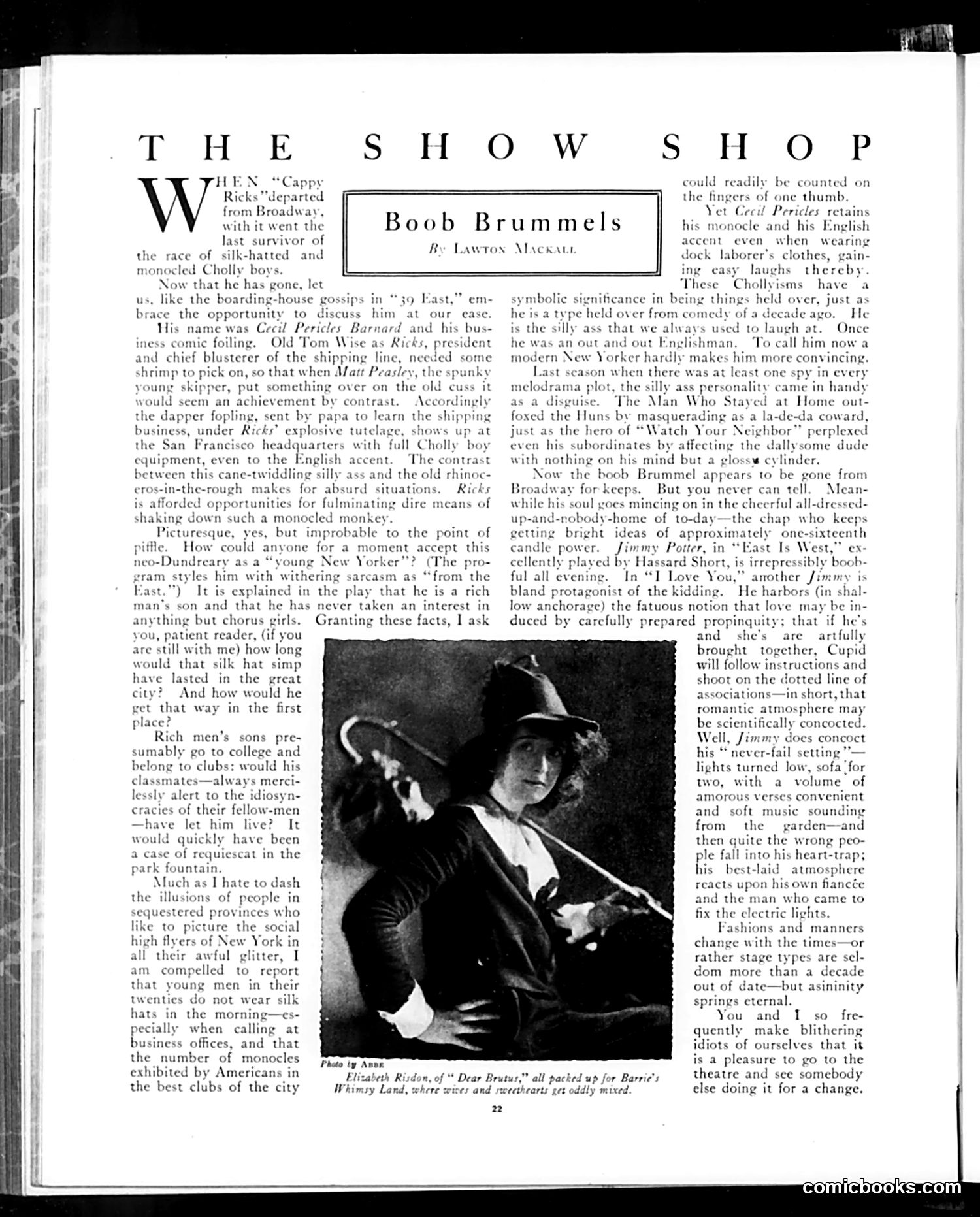
This article critiques the character type of the silly, affected "Cholly boy"—a wealthy young man with an English accent, monocle, and silk hat who represents an outdated comedy stereotype. The author reviews a theatrical production featuring such a character and argues the type is implausible and unrealistic for modern New York. The central complaint: wealthy young men wouldn't actually behave this way in 1920s America. College classmates would mock such affectation; no businessman wears a silk hat to morning office calls; American club members don't adopt monocles. The character persists in theater as lazy comic shorthand inherited from earlier decades, when such figures served as useful disguises in wartime melodramas. The photograph shows an actor (identified in caption) portraying this ridiculous dandy type. The author's point: theater clings to outdated social caricatures disconnected from how actual privileged young men actually lived.
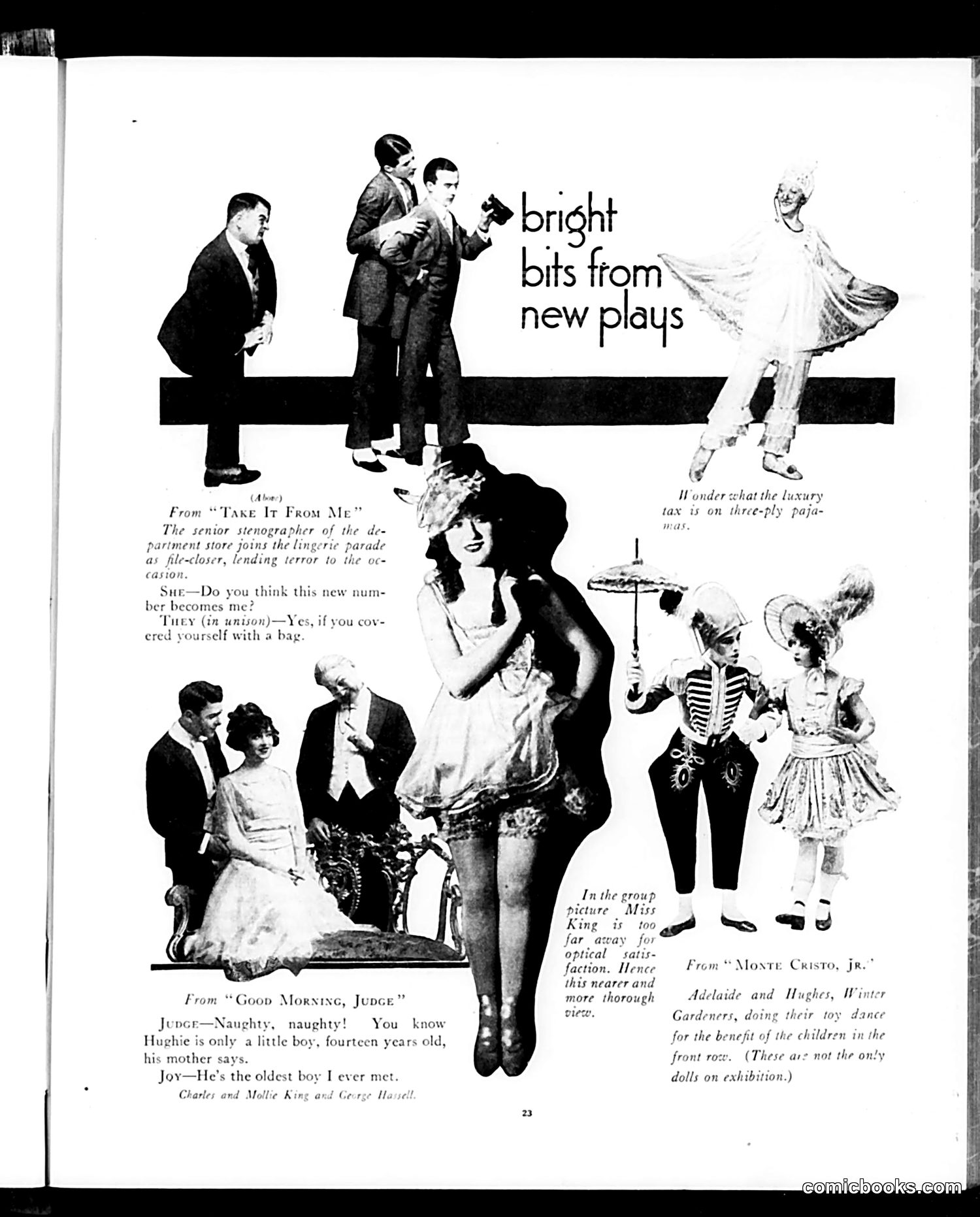
This page collects humorous excerpts from contemporary Broadway productions, presented as jokes rather than serious drama criticism. The humor relies on theatrical wit and social commentary. One excerpt mocks women's fashion, with a woman asking if a new outfit suits her, while men respond it would only work if she covered herself entirely. Another jokes about luxury goods taxation on expensive pajamas. A third features wordplay about a fourteen-year-old boy, with one character calling him "the oldest boy I ever met"—likely implying he acts prematurely adult or sophisticated. The illustrations show actors and actresses from various plays mentioned: "Take It from Me," "Good Morning, Judge," and "Monte Cristo Jr." The page essentially functions as theatrical gossip and satire, capturing the witty banter Broadway audiences expected, while poking fun at contemporary fashion, taxation, and social pretension through these brief comedic scenes.
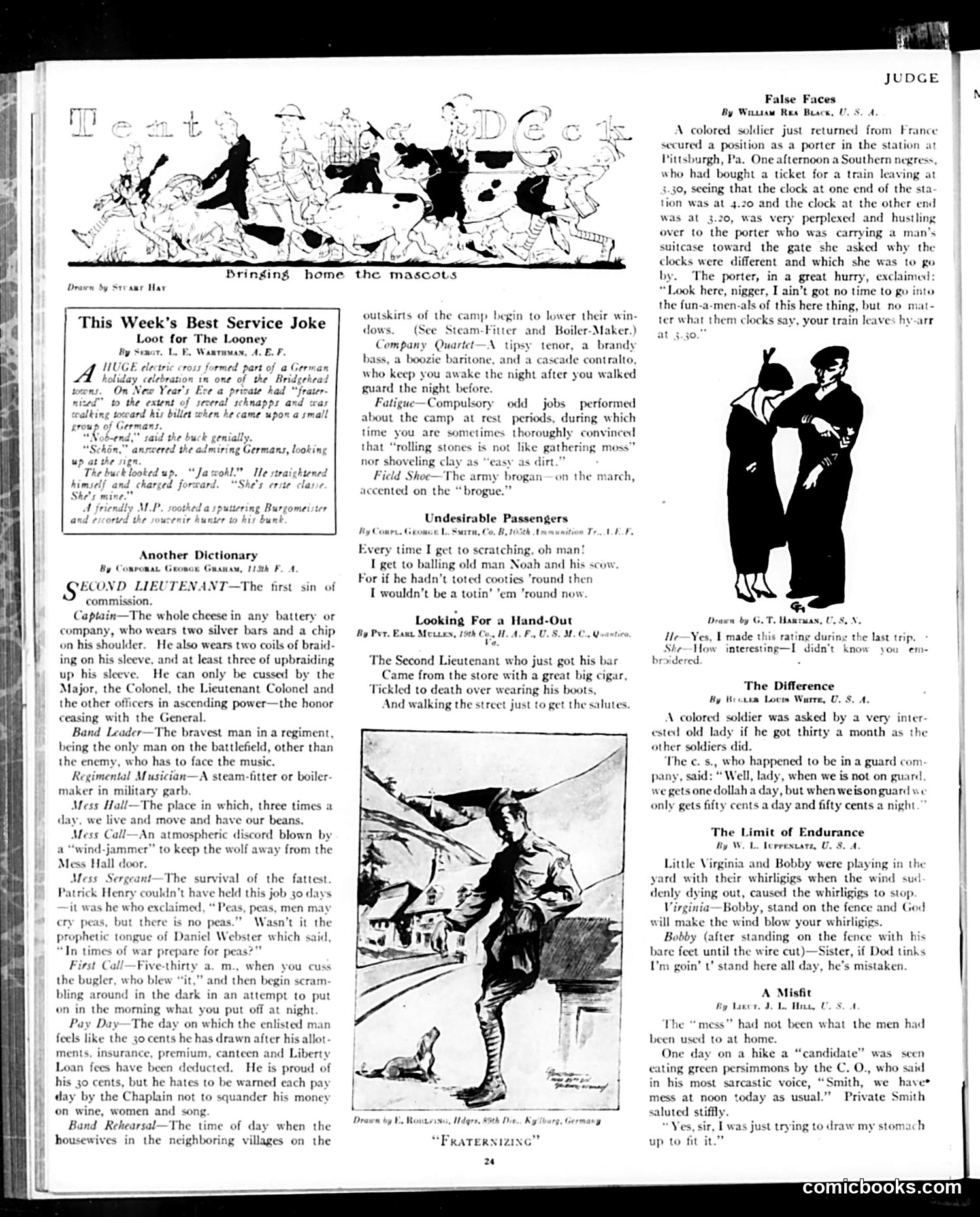
This page from *Judge* (a satirical military humor publication, likely WWI-era based on references to AEF—American Expeditionary Forces) contains several types of content: **"Bringing Home the Mascots"** (top cartoon): A humorous illustration showing soldiers with what appear to be animal mascots or camp followers during military life. **"This Week's Best Service Joke"**: A anecdote about a drunken American soldier fraternizing with Germans on New Year's Eve, using broken German to boast about his attractiveness. **"Another Dictionary"**: Satirical military definitions mocking army life—mess sergeants, band leaders, pay day disappointments, and the absurdities of enlisted service. **Remaining poems and sketches** satirize specific military complaints: cooties (lice), newly-promoted officers showing off, and racial attitudes of the era (the "False Faces" section references segregated America). The overall tone is irreverent mockery of military hierarchy, bureaucracy, and the gap between officers' privileges and enlisted men's hardships—typical of *Judge's* satirical approach to wartime experience.
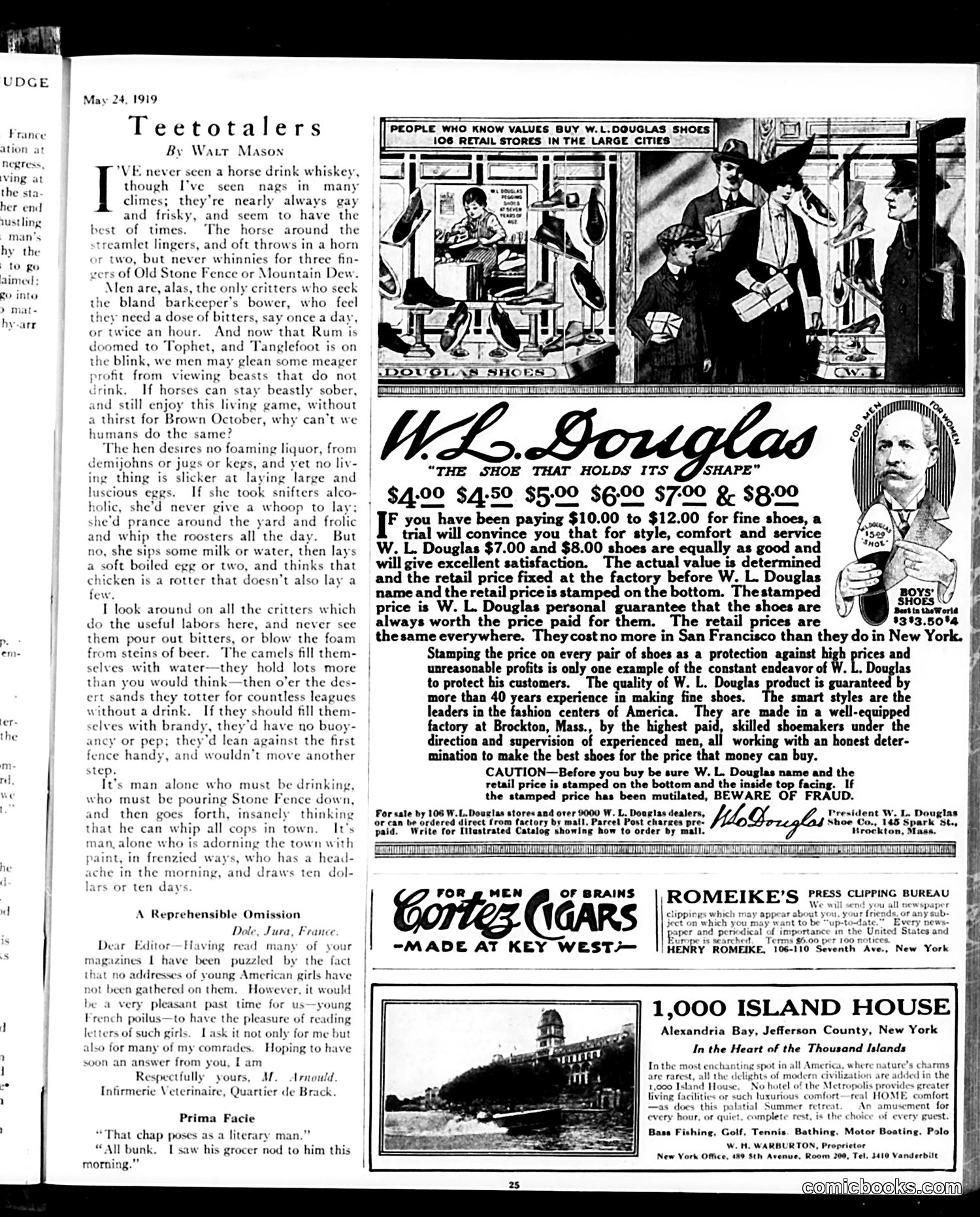
This is a satirical poem mocking Prohibition, which had just been enacted (the 18th Amendment passed in 1919). Mason argues that animals—horses, hens, camels—manage perfectly well without alcohol and seem content, yet *humans* cannot abstain. The implied critique: the government's assumption that Americans lack the self-control animals possess is insulting and reveals Prohibition as a foolish, paternalistic policy. The poem's central irony is that if "lower" creatures can stay "beastly sober" and still enjoy life, why can't civilized men? The reference to "Stone Fence" and "Brown October" (slang for whiskey) and the resigned tone about Rum being "doomed to Tophet" suggest Mason sees Prohibition as a misguided moral crusade that insults human dignity. **Context:** This page mostly features a W.L. Douglas shoe advertisement; the poem appears as filler content typical of Judge magazine's satirical commentary on contemporary politics and social issues.
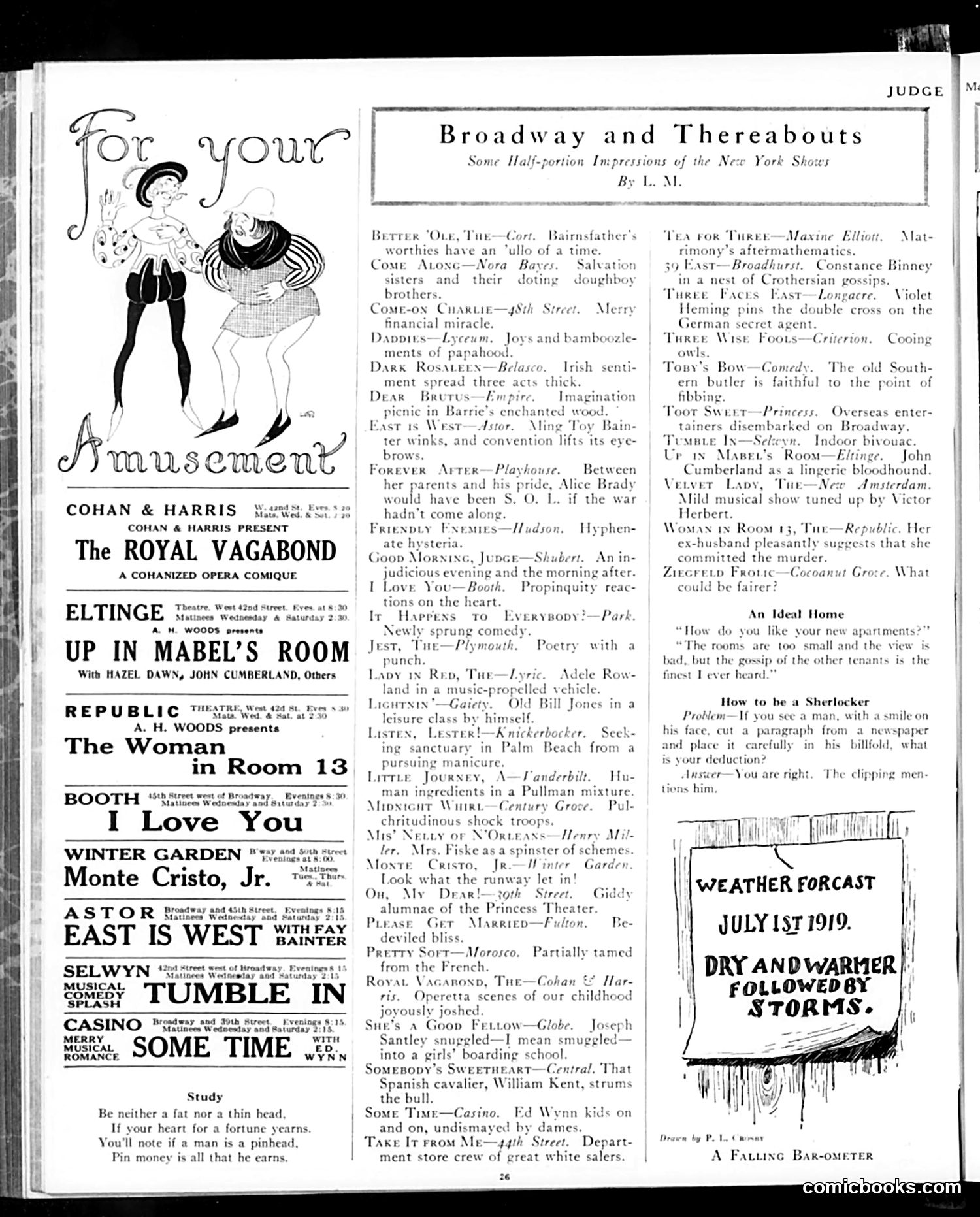
This page is primarily **theatre advertising and Broadway reviews**, not political satire. The left side lists current stage productions with brief critical quips—typical of Judge's entertainment coverage. The small cartoon at top left (captioned "For your Amusement") shows two figures in fashionable dress, likely satirizing contemporary dating or social customs, though details are unclear from the image. The "Weather Forecast" box is a joke: it predicts "DRY AND WARMER FOLLOWED BY STORMS"—an obvious pun on meteorological unpredictability or, possibly, commentary on post-WWI social conditions (the war had just ended in November 1918). The "Sherlocker" puzzle and "Ideal Home" dialogue are light humor pieces typical of Judge's miscellaneous comic content. **Notable context**: The reviews mention wartime references ("Up in Mabel's Room" notes "if the war hadn't come along"), reflecting how thoroughly WWI dominated American consciousness even as peace arrived.
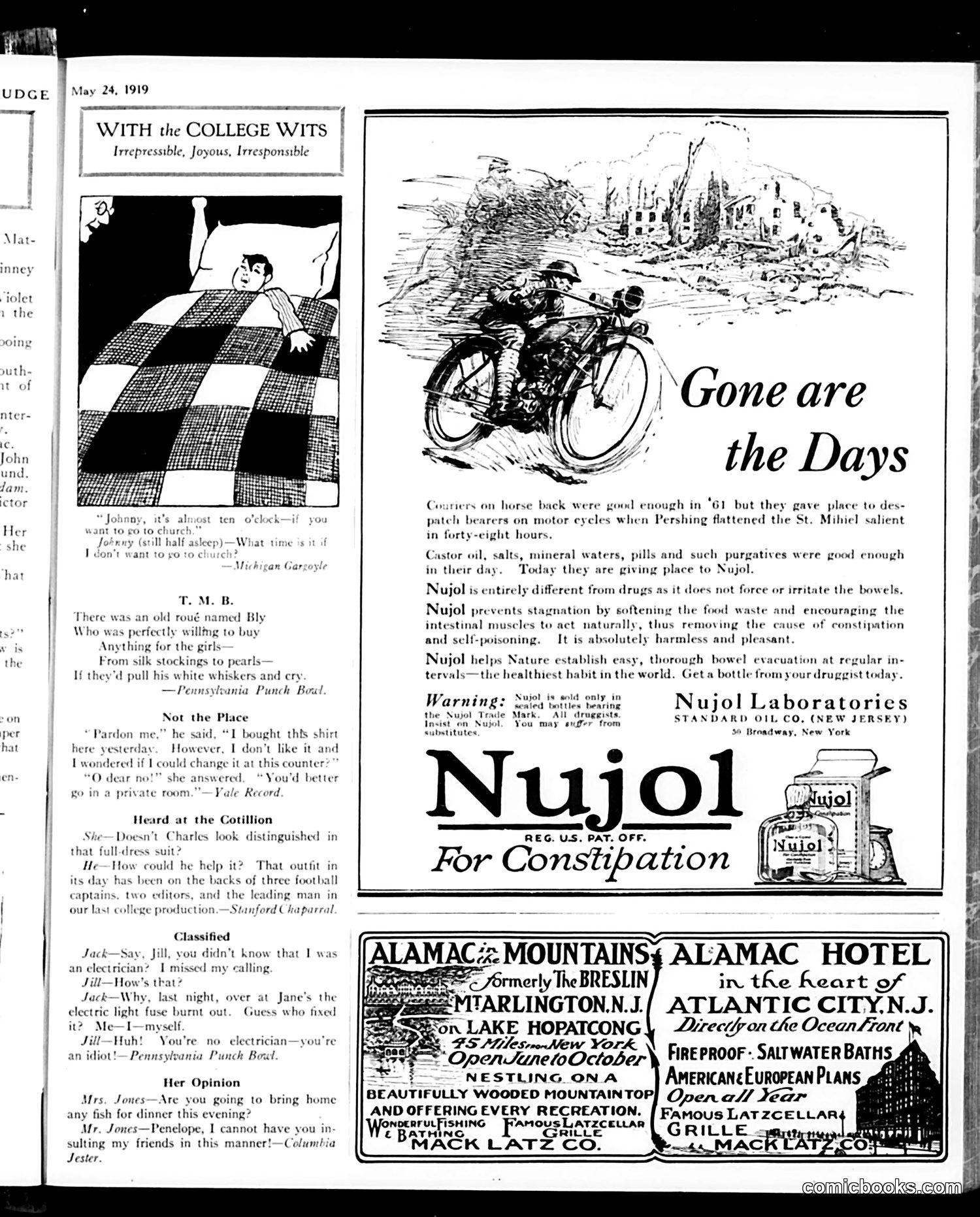
This page combines college humor with advertising. The "College Wits" section features lighthearted jokes about campus life and courtship—typical of Judge's satirical humor targeting educated, urban readers. The dominant content is a **Nujol advertisement** disguised as editorial content under "Gone are the Days." The ad uses WWI references (Pershing's 1918 St. Mihiel offensive) to establish modernity, then pivots to promoting Nujol, a mineral oil laxative. The satire is subtle: just as military tactics evolved from horses to motor cycles, digestive remedies have progressed from old purgatives to Nujol, which claims to work "naturally" without force or irritation. The shorter humor pieces mock social conventions—a man buying a shirt he dislikes to impress girls, confusion about fashion at formal events, and marital banter about bringing home fish for dinner. The bottom half contains hotel and resort advertisements, typical of Judge's revenue model. The overall tone reflects post-WWI American life: modern, slightly irreverent, commercially minded.
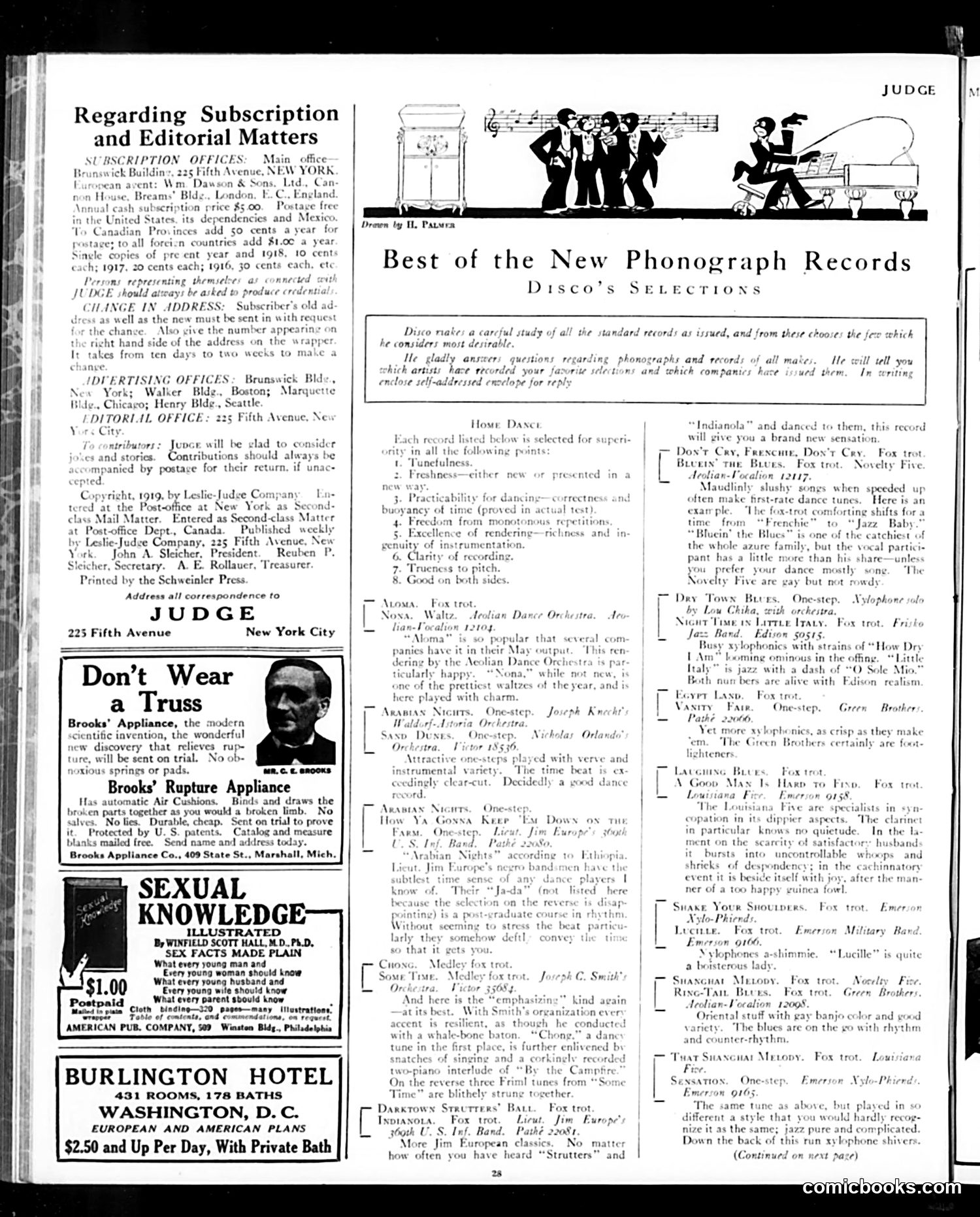
This page is primarily **advertising and administrative content** rather than political satire. The top section contains subscription information for Judge magazine's New York offices and editorial guidelines. The only illustrated content is a small cartoon at the very top (credited "Drawn by H. Palmer") showing silhouetted figures in formal wear with musical notation, likely a humorous vignette about entertainment or high society—though the cartoon is too small to interpret clearly. The bulk of the page comprises: - **Phonograph record reviews** discussing popular dance music and songs of the era (fox trots, waltzes, one-steps) - **Period advertisements** for Brooks' Rupture Appliance, sexual education books, the Burlington Hotel in Washington D.C., and other services The context reflects post-WWI American consumer culture circa 1919, with emphasis on new entertainment technology (phonograph records) and leisure activities. This appears to be a standard editorial/advertising page rather than a satirical commentary piece.
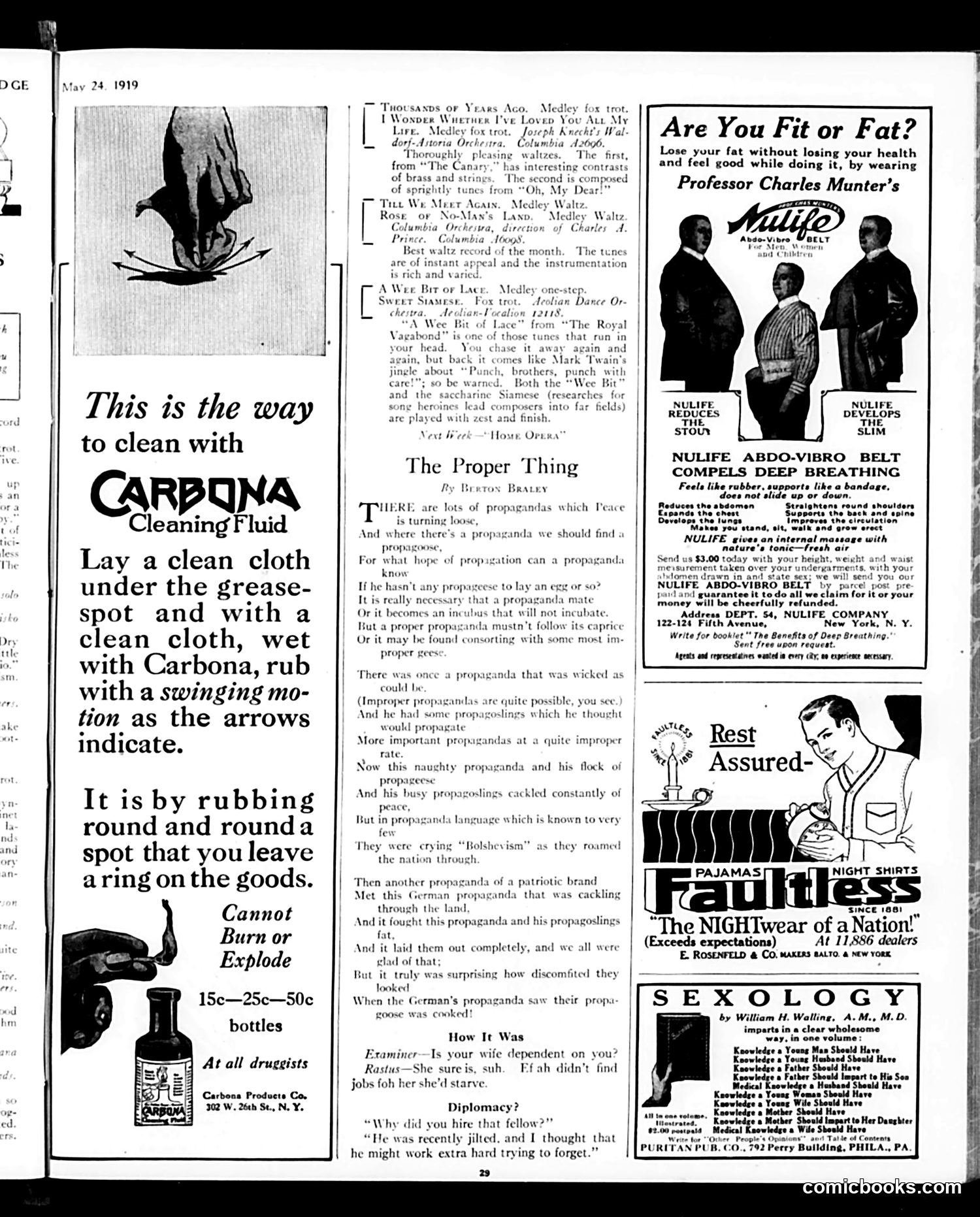
This page is predominantly **advertising**, not political satire. The dominant content includes ads for Carbona Cleaning Fluid, Nulife Abdo-Vibro Belt (a weight-loss device), Faudel Pajamas, and Sexology books. The only satirical article is "The Proper Thing" by Burton Bradley, a **lengthy allegory about propaganda**. Written during the post-WWI period, it depicts propaganda as characters engaged in ideological conflict—specifically mocking German propaganda and celebrating its defeat ("when the German's propaganda saw their props goose was cooked!"). The piece also references "Bolshevism," reflecting American anxieties about communist propaganda circulating after the Russian Revolution. The page's small joke at bottom involves an interracial exchange with racist dialect stereotyping—common to 1919 Judge but offensive by modern standards.
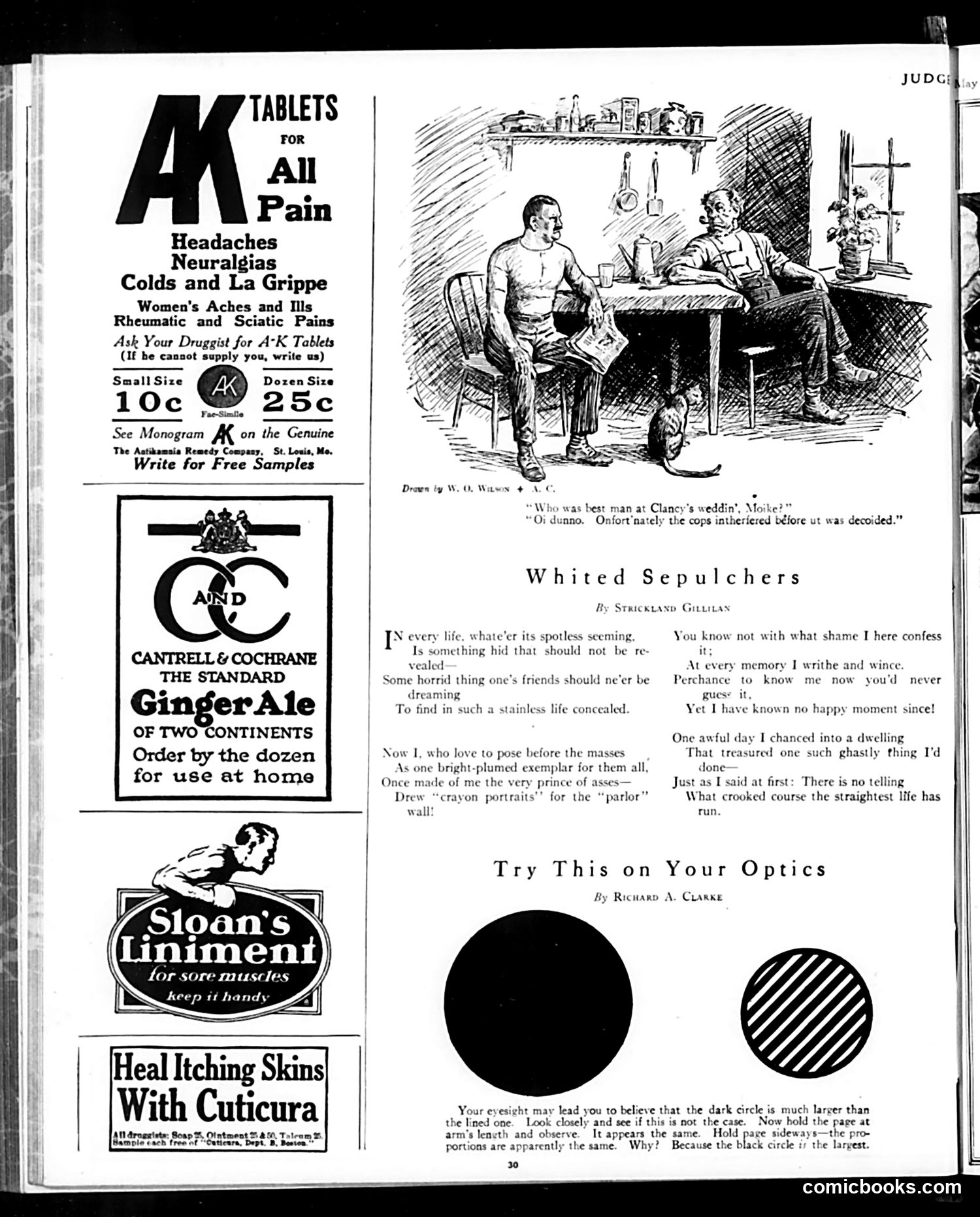
This page combines advertisements with satirical content typical of Judge magazine. **The Main Cartoon** (top right): Shows two men in what appears to be a casual conversation. The caption references "Clancy's weddin'" and mentions police interference "before it was decided"—suggesting the joke involves a dispute (possibly over the best man role or wedding details) that was interrupted by authorities. This appears to be ethnic/working-class humor, common in early 20th-century Judge, mocking Irish-American characters and their tendency toward conflict. **"Whited Sepulchers"** (poem): A moralistic piece about hidden shame beneath respectable appearances—classical satirical territory about hypocrisy. **"Try This on Your Optics"**: An optical illusion demonstrating how perception deceives us—the black circle appears larger than the lined circle, despite being identical. The page is primarily **advertising** (AK Tablets, Ginger Ale, liniment, skin cream) with light satirical content interspersed. The overall message reflects Judge's blend of commercial sponsorship and genteel social commentary.
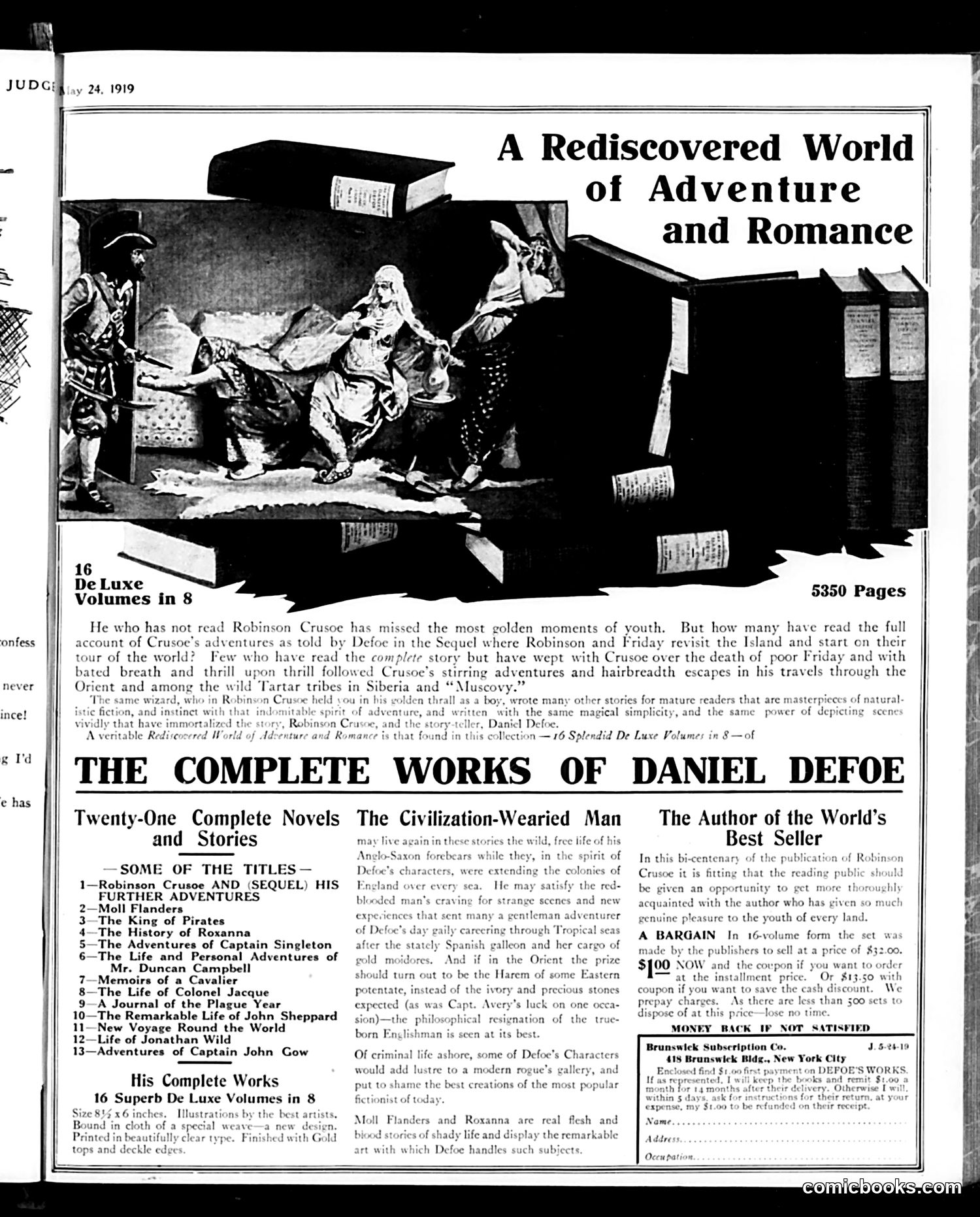
This is primarily a **book advertisement**, not a political cartoon. It promotes a 16-volume collection of Daniel Defoe's complete works, published by the Brunswick Subscription Company. The page celebrates Defoe as "the Author of the World's Best Seller"—referring to *Robinson Crusoe*'s enduring popularity. The illustrated vignette shows characters from Defoe's adventure narratives in exotic settings (pirates, shipwrecks, Oriental scenes). The marketing pitch emphasizes that most readers know only *Robinson Crusoe* itself, missing Defoe's sequels and other novels like *Moll Flanders* and *A Journal of the Plague Year*. It's 1919, marking the bicentenary of Crusoe's publication (1719), which the advertisement uses as a selling point. The "bargain" language ($100 with installment payment options) targets middle-class readers seeking cultured, classic literature. This is straightforward commercial promotion rather than satire—typical of Judge magazine's advertising content.
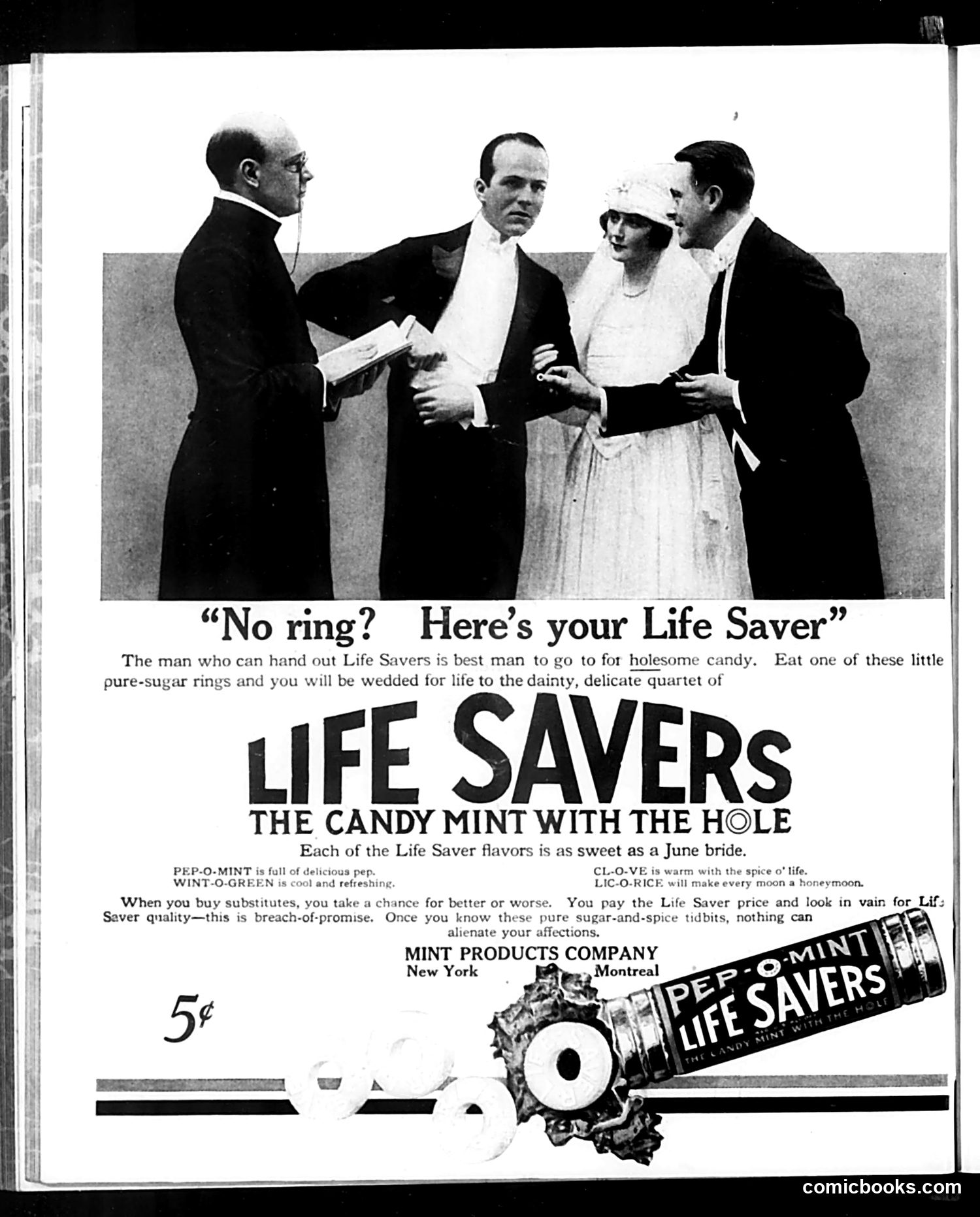
This is primarily a **commercial advertisement**, not political satire. It promotes Life Savers candy (the ring-shaped mints) using a marriage/engagement metaphor. The image shows four formally-dressed figures in what appears to be a wedding scene—a man presenting a Life Saver candy ring to a woman, flanked by two witnesses or officials. The joke plays on "Life Saver" as both a candy product and a figurative savior in romance: the candy becomes a substitute engagement ring. The ad's copy extends the wedding metaphor, claiming Life Saver flavors are "as sweet as a June bride" and that consuming them means being "wedded for life." It warns against buying competitor products, framing this as "breach-of-promise"—legal language for breaking an engagement. The humor relies on treating candy consumption as a serious romantic commitment. For modern readers, the most notable element is the bizarre marketing strategy of equating a cheap mint candy with matrimonial devotion, which would be considered absurd advertising today.