
Judge, 1919-05-24 · page 14 of 32
Judge — May 24, 1919 — page 14: what you’re looking at
What you’re looking at
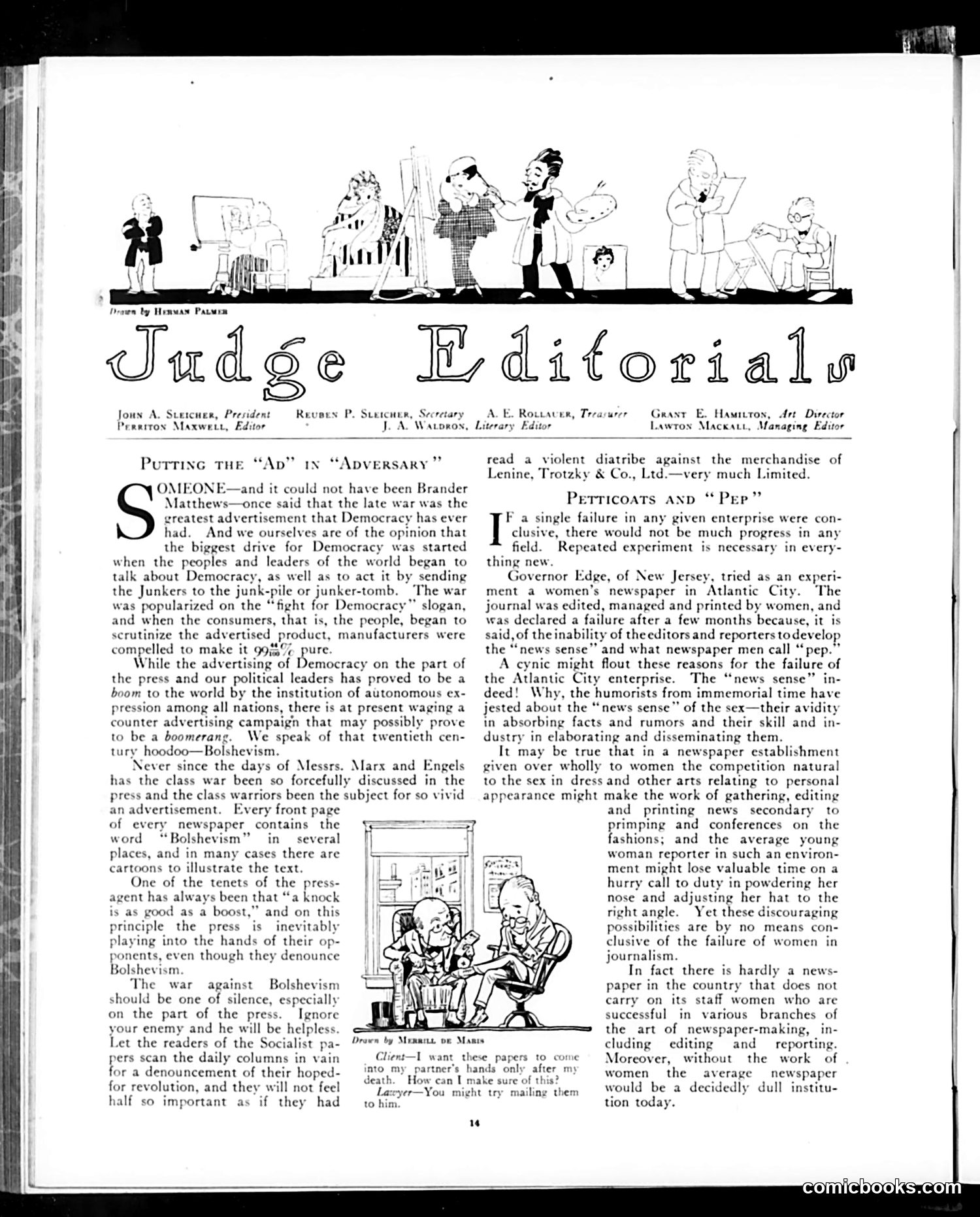
This editorial page from Judge magazine addresses two political/social issues of the post-WWI era: **"Putting the 'Ad' in 'Adversary'"** criticizes American press coverage of Bolshevism. The author argues that constant newspaper denunciations of Lenin, Trotsky, and communist ideology actually *advertise* and amplify the revolutionary movement, making it seem more important than ignoring it would. The cartoon by Miriam de Maris depicts a client asking a lawyer how to ensure papers reach "my partner's hands only after my death"—likely satirizing those obsessively focused on communist threats. **"Petticoats and 'Pep'"** discusses Governor Edge's failed women-only newspaper in Atlantic City. Rather than accepting the failure, the author defends women journalists, sarcastically rejecting claims they lack "news sense" or "pep." He suggests that if the venture failed, it was due to workplace dynamics (women prioritizing appearance/fashion) rather than inherent female incompetence—a backhanded defense reflecting 1920s gender attitudes. Both pieces reflect post-war anxieties: communist threats and evolving women's roles in American journalism.
📄 Transcribed text from this page (OCR, searchable)
Machine-transcribed from the original scan — historical spelling and the odd misread are preserved.
Revses P. Scetcuen, Secretary Joun A. Stercuer, President A. Watpros, Pearrros Maxwett, Editor J diforials Grant E. Hasitron, Art Director - Rowtaver, Treasurer Lawrox Macwatt, Managing Editor Editor Purtinc tHe “Ab” 1x “ApvEeRSARY” OMEONE—and it could not have been Brander Matthews—once said that the late war was the greatest advertisement that Democracy has ever had. And we ourselves are of the opinion that the biggest drive for Democracy was started when the peoples and leaders of the world began to talk about Democracy, as well as to act it by sending the Junkers to the junk-pile or junker-tomb. The war was popularized on the “fight for Democracy” slogan, and when the consumers, that is, the people, began to scrutinize the advertised product, manufacturers were compelled to make it 99%$% pure. While the advertising of Democracy on the part of the press and our political leaders has proved to be a boom to the world by the institution of autonomous ex- pression among all nations, there is at present waging a counter advertising campaign that may possibly prove to be a boomerang. We speak of that twentieth cen- tury hoodoo—Bolshevism. Never since the days of Messrs. Marx and has the class war been so forcefully discussed in the press and the class warriors been the subject for so vivid an advertisement. Every front page of every newspaper contains the word “Bolshevism” in — several places, and in many cases there are cartoons to illustrate the text. One of the tenets of the press- gent has always been that “a knock is as good as a boost,” and on this principle the press is inevitabl playing into the hands of their op- ponents, even though they denounce Bolshevism. The war = against should be one of silence, especially on the part of the press. Ignore your enemy and he will be helpless. Let the readers of the Socialist pa- pers scan the daily columns in vain for a denouncement of their hoped- for revolution, and they will not feel half so important as if they had Bolshevism into n death Hoy to him. Draven by Mrxamt. pe Manis Clients—I_ want these pap partner's hands only can I make sure Lazeyer—You might try after m this mailing them read a violent diatribe against the merchandise of Lenine, Trotzky & Co., Ltd.—very much Limited. Petticoats aNp ‘ PEP’ * a single failure in any given enterprise were con- I clusive, there would not be much progress in any field. Repeated experiment is necessary in every- thing new. Governor Edge, of New Jersey, tried as an experi- ment a women’s newspaper in Atlantic City. The journal was edited, managed and printed by women, and was declared a failure after a few months because, it is said, of the inability of theeditors and reporters todevelop the “‘news sense” and what newspaper men call “pep. A cynic might flout these reasons for the failure of the Atlantic City enterprise. The “news sense” in- deed! Why, the humorists from immemorial time have jested about the “news sense” of the sex—their avidity in absorbing facts and rumors and their skill and in- dustry in elaborating and disseminating them. It may be true that in a newspaper establishment given over wholly to women the competition natural to the sex in dress and other arts relating to personal appearance might make the work of gathering, editing and printing news secondary to primping and conferences on the fashions; and the average young woman reporter in such an environ- ment might lose valuable time on a hurry call to duty in powdering her nose and adjusting her hat to the right angle. Yet these discouraging possibilities are by no means con- clusive of the failure of women in journalism. In fact there is hardly a news- paper in the country that does not carry on its staff women who are successful in various branches of the art of newspaper-making, in- cluding editing and _— reporting Moreover, without the work of women the average newspaper would be a decidedly dull institu- tion today. 4