
Judge, 1919-05-24 · page 18 of 32
Judge — May 24, 1919 — page 18: what you’re looking at
What you’re looking at
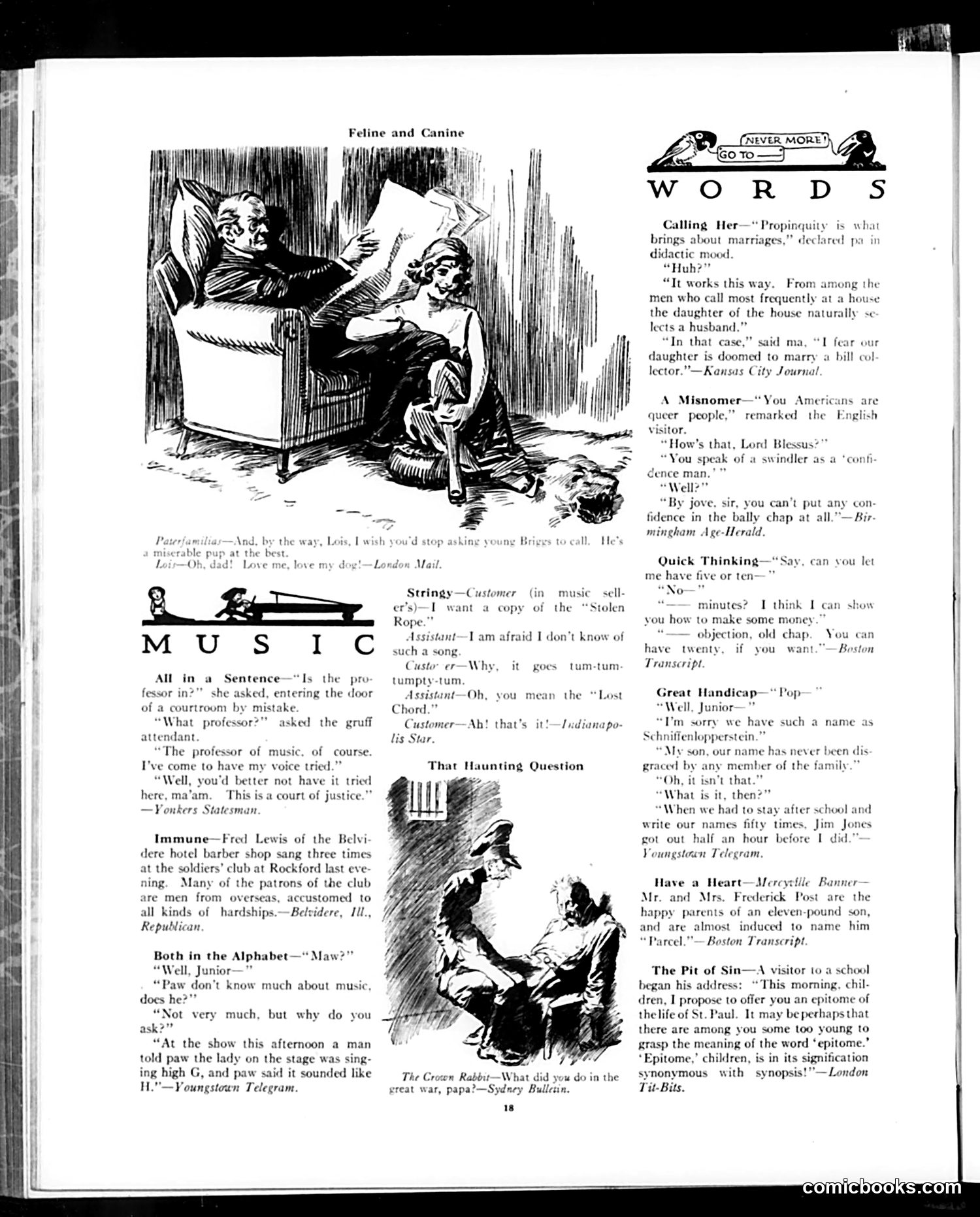
This page from *Judge* contains humor pieces and brief jokes rather than political cartoons. The content reflects early 20th-century American social attitudes: **Main themes:** - **Musical incompetence**: Multiple jokes mock ordinary people's lack of musical knowledge (a man confusing "high G" with "H," someone asking for a non-existent song called "The Stolen Rope"). - **Class and courtroom humor**: A woman mistakes a courtroom for a music school, playing on expectations about institutional settings. - **Domestic life**: A joke about "propinquity" in marriage selection, and another about a bill collector calling frequently on a house—implying debt problems are common. - **Names and embarrassment**: A humorous piece about an unfortunate German surname ("Schniffenlopperstein") causing school-related embarrassment. The satire targets everyday American life—musical pretension, class confusion, financial struggles, and social anxiety—rather than political figures. The cartoons accompanying these pieces are simple illustrations supporting the text's humor rather than standalone political commentary.
📄 Transcribed text from this page (OCR, searchable)
Machine-transcribed from the original scan — historical spelling and the odd misread are preserved.
Feline and Canine MU S IC All in a Sentence—“Is the pro fessor in?" she asked, entering the door of a courtroom by mistake. “What professor?” asked the gruff attendant “The professor of music, of course. I've come to have my voice tried.” “Well, you'd better not have it tried here, ma’am. This is a court of justice.”” —Yonkers Statesman Immune—Fred Lewis of the Belvi dere hotel barber shop sang three times at the soldiers’ club at Rockford last eve- ning. Many of the patrons of the club are men from overseas, accustomed to all kinds of hardships.—Belvidere, Ill., Republican Both in the A “Well, Junior “Paw don’t know much about music, does he?"’ ‘ot very much, but why do you habet—* Maw?” a “At the show this afternoon a man told paw the lady on the stage was sing- ing high G, and paw said it sounded like H."—Youngstown Telegram. Stringy—Customer (in music sell- er’s)—I want a copy of the “Stolen Rope.” Assistant—I am afraid I don’t know of such a song Custor er—Why, it) goes tum-tum tumpty-tum. Assistant—Oh, you mean th Chord.” Custe lis Star. Lost mer—Ab! that’s it!—J/ndianapo- That Haunting Question The Crown Rabbit—What did you do in the great war, papa?—Sydney Bulletin. oJ NEVER MORE?) , Wo R D S Calling Her—"Propinquity is what brings about marriages, didactic mood. “Huh? “It works this way. From among the men who call most frequently at a house the daughter of the house naturally: lects a husband.” “In that case,” said ma, “I fear our daughter is doomed to marry a bill col lector.” —Kansas City Journal leclared pa in A Misnomer—"You Americans are queer people,” remarked the English visitor. “How's that, Lord Blessus?” “You speak of a swindler as a ‘confi dence man. “Well?” “By jove. sir, you can’t put any con- fidence in the bally chap at all."—Bir- mingham Age-Herald. Quick Thinking—“ Say, can vou let me have five or ten—" minutes? I thi you how to make some money.” objection, old chap. You can have twenty, if you want.”—Boston Transcript Great Handicap—“ lop “Well, Junior *m sorry we have such a name as Schniffenlopperstein.” “ My son, our name has never been dis graced by any member of the ily,” “Oh, it isn’t that.” “What is it, then?” “When we had to stay after school and write our names fifty times, Jim Jones got out half an hour before I did.” Youngstown Telegram. Have a Heart—Mercyrille nner Mr. and Mrs. Frederick Post are the happy parents of an eleven-pound son, and are almost induced to name him “Parcel.”"— Boston Transcript. The Pit of Sin—A visitor to a school began his address: “This moming, chil- dren, I propose to offer you an epitome of the life of St. Paul. It may be perhaps that there are among you some too young to grasp the meaning of the word ‘epitome.’ ‘Epitome,’ children, is in its signification synonymous with synopsi —London Tit-Bits.