
A complete issue · 32 pages · 1919
Judge — March 29, 1919
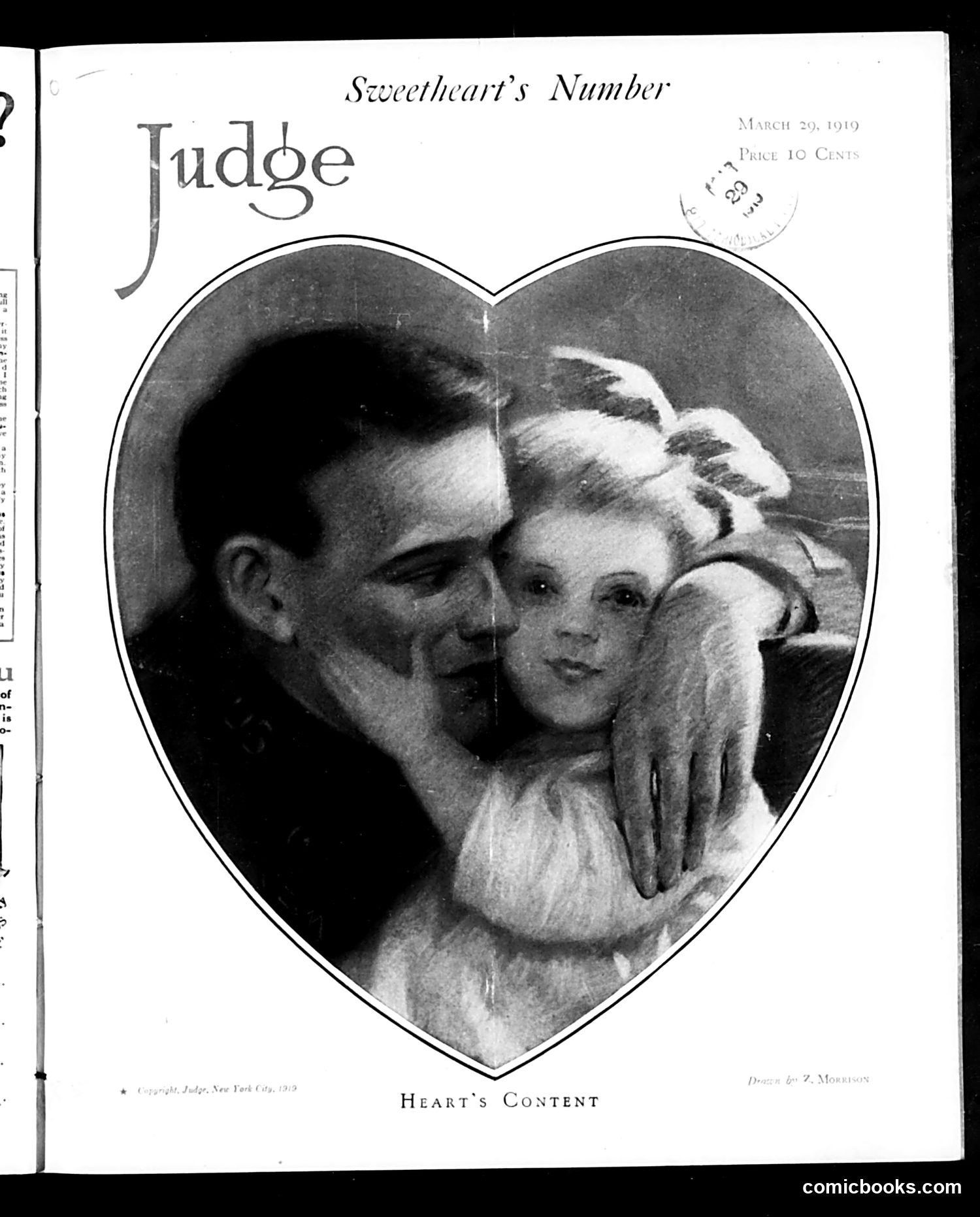
This is the "Sweetheart's Number" cover of Judge magazine, titled "Heart's Content." The image shows a sentimental photograph of a man and child in a heart-shaped frame, credited to photographer Z. Morrison. The cover appears to be a romantic/domestic-themed issue rather than political satire. Published just after World War I ended (November 1918), this likely reflects the postwar mood—soldiers returning home to families, domestic contentment, and sentimentality becoming fashionable in popular media. The ten-cent price and the warm, affectionate imagery suggest Judge's editors were capitalizing on Valentine's Day sentiment and themes of family reunion during the demobilization period. There's no evident political commentary visible.
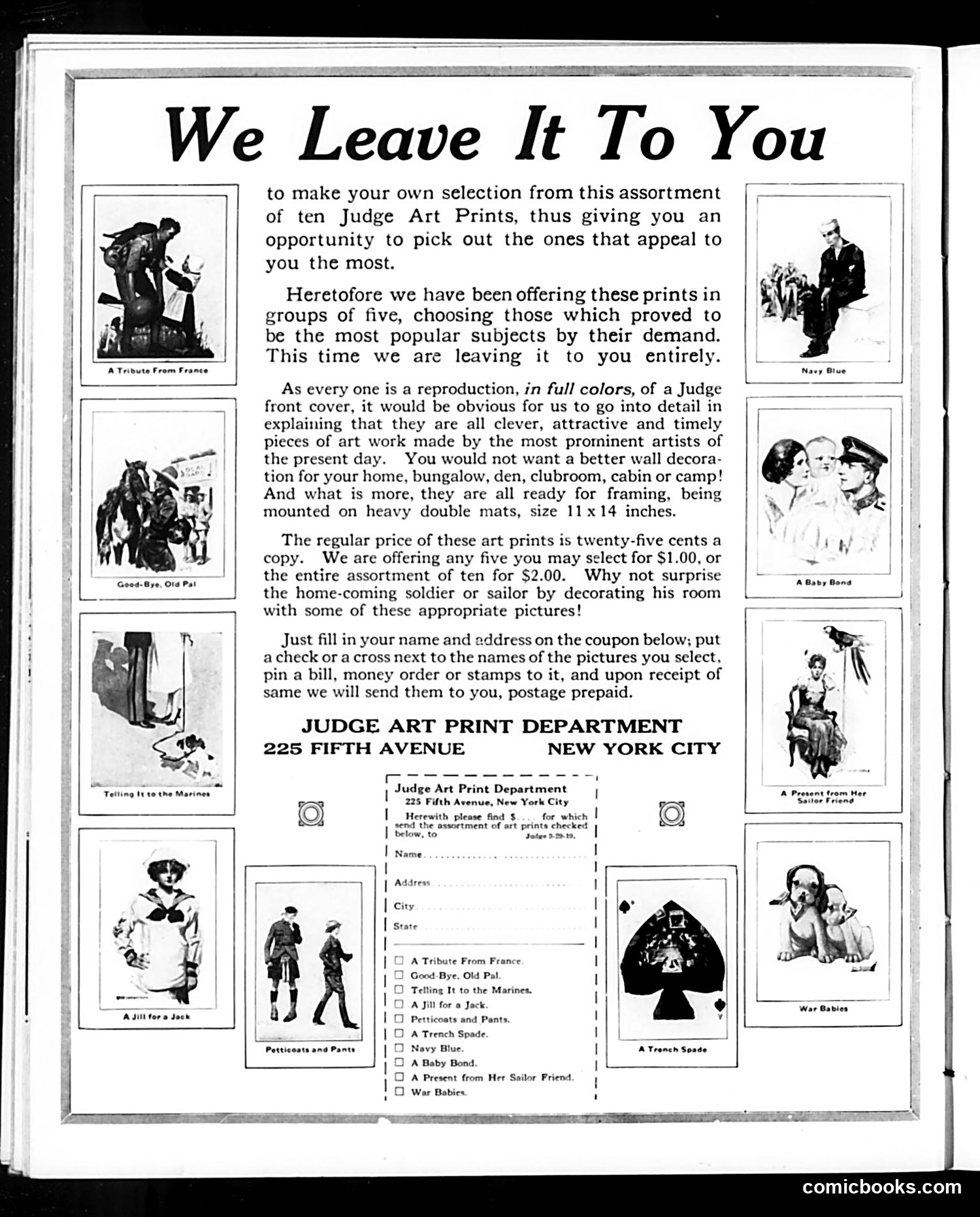
This is primarily **advertising content**, not political satire. Judge magazine offered reproductions of ten popular art prints in full color, priced at 25 cents each or five for $1.00. The prints shown include titles like "A Tribute From France," "Navy Blue," "A Baby Bond," "Telling It to the Marines," "A Jill for a Jack," "Patriotic and Pants," "A Trench Spade," "A Present from Her Sailor Friend," and "War Babies." **Context**: These appear to be **World War I-themed patriotic prints**, likely designed to appeal to Americans supporting the war effort or those with soldiers/sailors in service. The military references ("Marines," "Sailor," "Trench") and domestic sentimentality ("Baby Bond," romantic imagery) suggest prints meant for home decoration, particularly for those welcoming home servicemen.
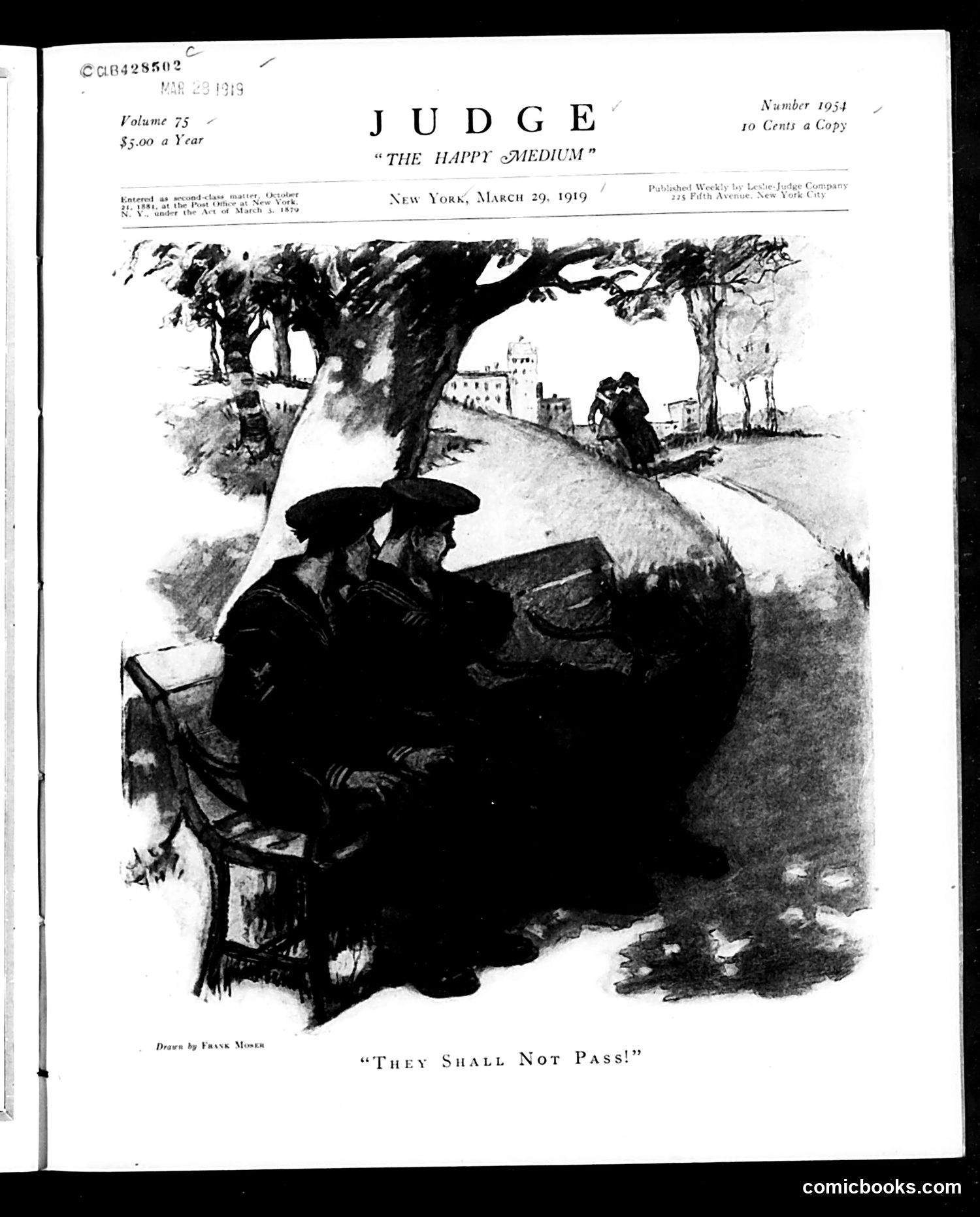
This cartoon by Frank Moses depicts two military figures (appearing to be Allied soldiers or officers) blocking a passage beneath a large tree, with a fortified castle visible in the background. The caption quotes the famous WWI phrase "They Shall Not Pass!"—originally Pétain's declaration at Verdun (1916). The timing (March 1919, just after WWI's November 1918 armistice) suggests this references post-war military occupation or the enforcement of treaty terms, likely regarding German territory or reparations. The soldiers appear to be guarding against passage—possibly depicting Allied forces preventing unauthorized German movement or protecting occupation zones during the Treaty of Versailles negotiations (concluded June 1919). The image celebrates military vigilance during this delicate post-war period.
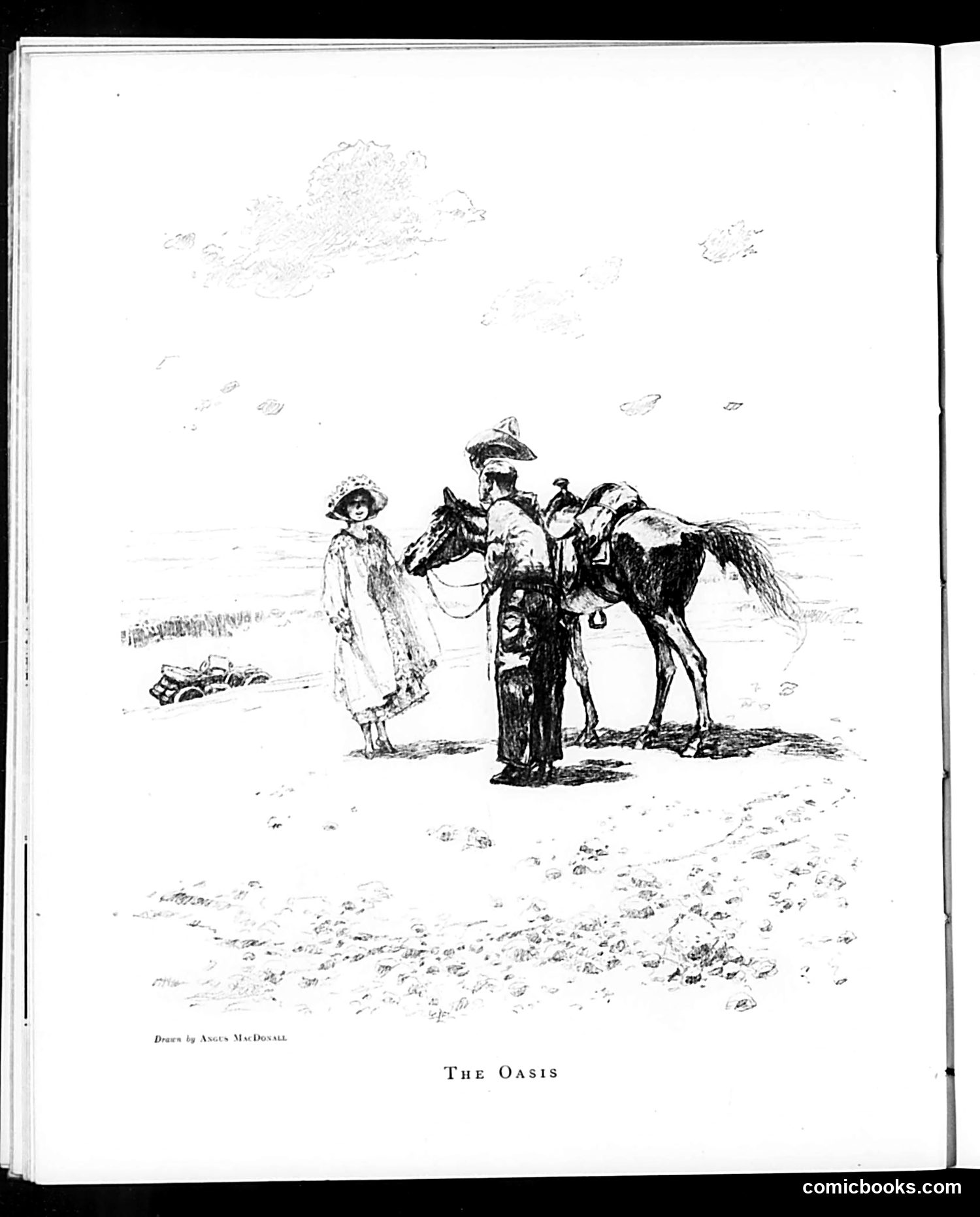
This illustration by Agnes MacDougal depicts a desert scene with three figures: a woman in European dress on the left, a man in military uniform with a camel, and what appears to be local guides or attendants. The title "The Oasis" suggests this is commentary on colonial-era travel or imperialism. The satire likely mocks either: - The contrast between European refinement and harsh desert realities - Colonial attitudes toward non-European peoples and places - The performative nature of imperial exploration Without additional context about Judge magazine's publication date or concurrent events, the specific political target remains unclear. However, the image employs typical early-20th-century colonial imagery and social hierarchies as its satirical subject matter.
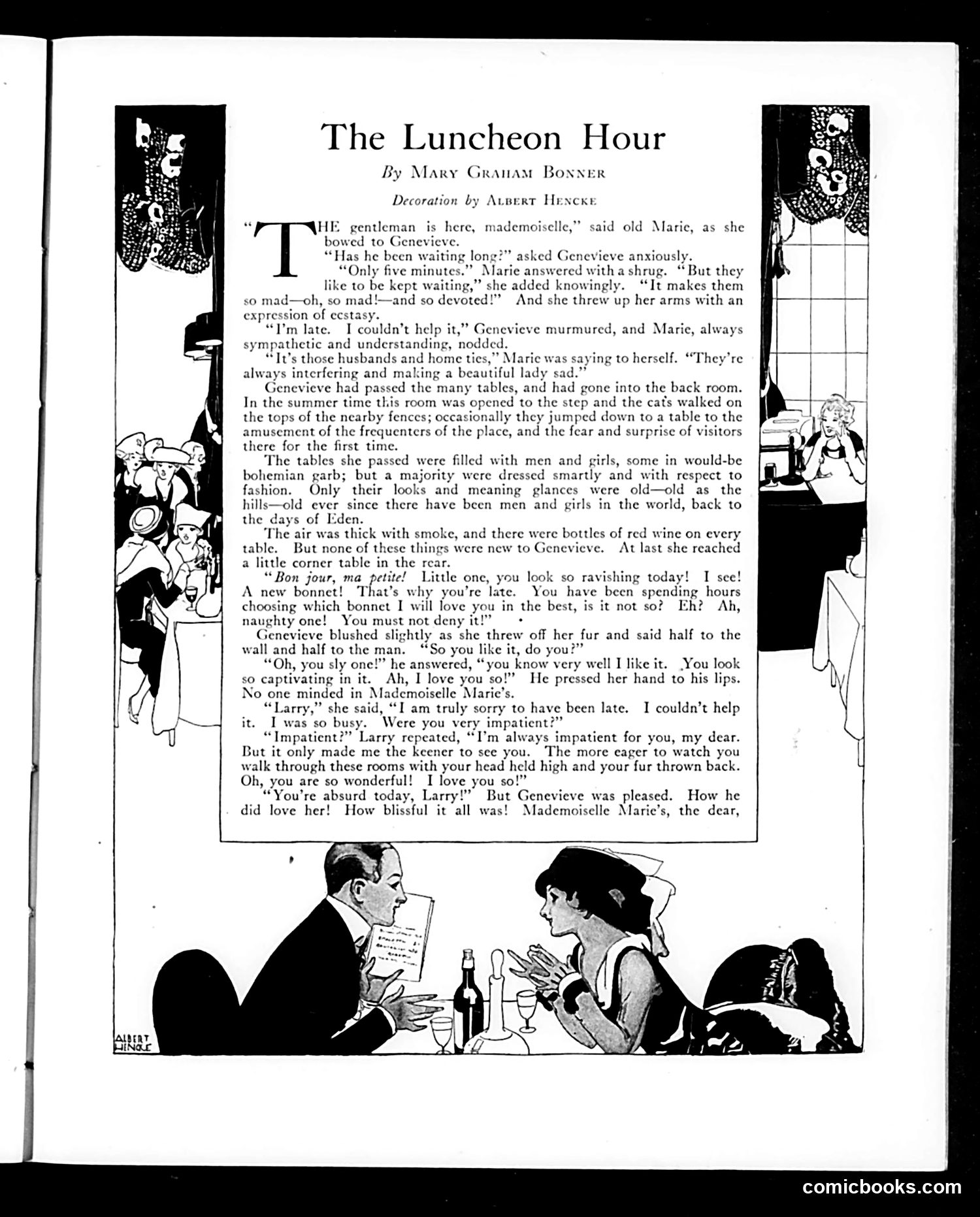
This is a romantic short story by Mary Graham Bonner with decorative illustrations by Albert Hencke, not political satire. The narrative depicts a Parisian café scene where a woman named Genevieve waits for her gentleman caller, Larry, who arrives late. The story explores period attitudes about courtship: Genevieve's maid Marie notes that men "like to be kept waiting" and that lateness makes women "devoted." When Larry arrives, he compliments Genevieve's new bonnet, and she playfully scolds his tardiness while clearly delighted by his attention. The accompanying illustrations show the café setting and a final dinner scene. This appears to be light romantic fiction typical of Judge magazine's broader content mix beyond political commentary.
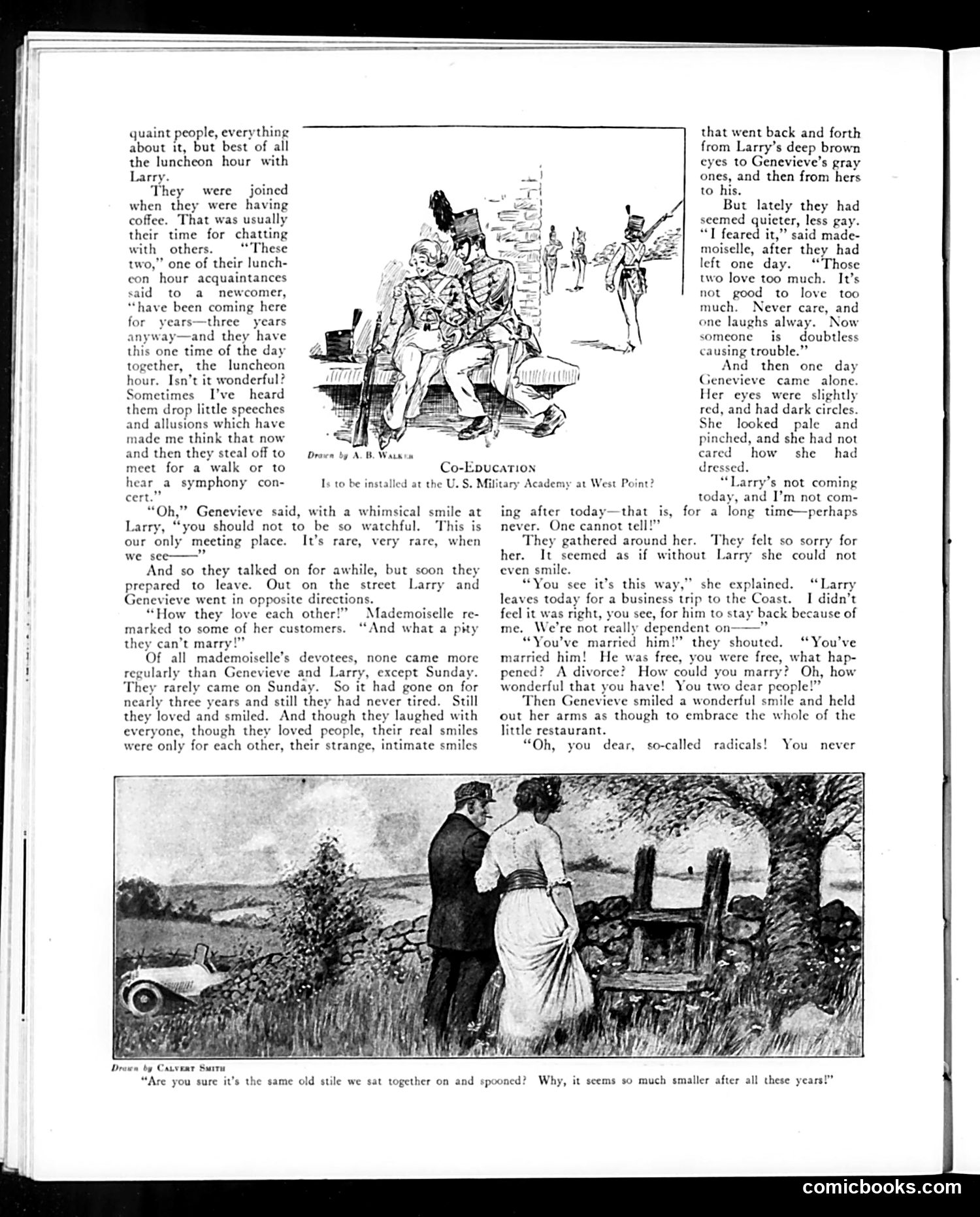
This page contains a serialized romantic story titled "Co-Education" rather than political satire. The narrative concerns Larry and Genevieve, a married couple experiencing marital strain. The story illustrates their relationship troubles through dialogue: Genevieve fears their excessive love has become problematic, Larry leaves on a business trip, and friends encourage reconciliation by reminding them of their courtship. The two illustrations show domestic scenes—one depicts the couple with friends at leisure, the other shows them reuniting at a countryside location. The final caption's quote about a "stile" references their courtship spot, emphasizing nostalgia and rekindled romance. This is **not political satire** but rather a period romance narrative exploring early 20th-century attitudes toward marriage and emotional restraint.
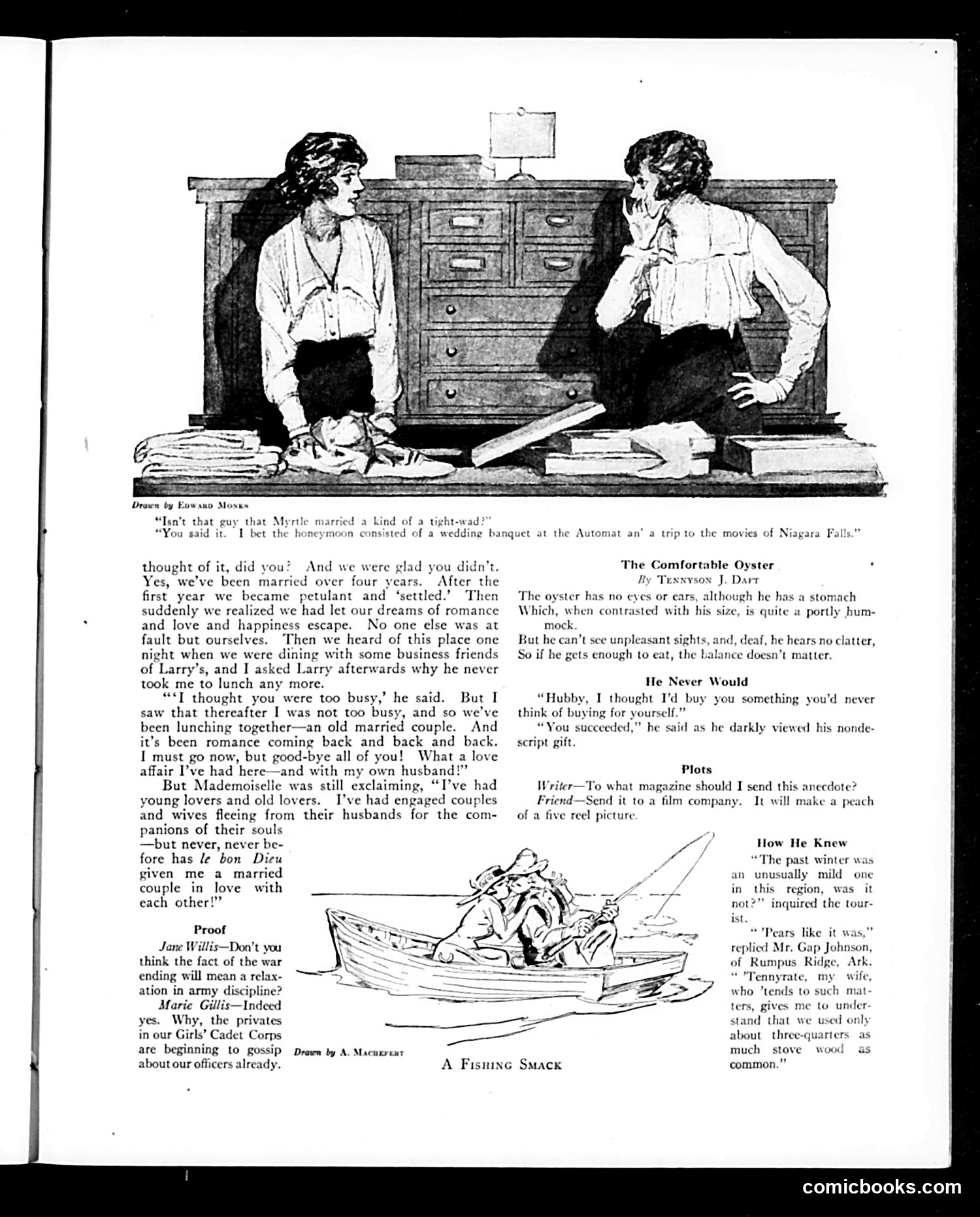
This page contains several brief humorous pieces typical of early 20th-century satirical magazines: **Top cartoon**: Shows two office workers gossiping about a coworker's stingy honeymoon—a wedding banquet at an Automat (self-service restaurant) and movies at Niagara Falls. The humor targets penny-pinching husbands and modest honeymoons. **Main story**: A longer piece about a couple who rekindled romance by lunching together regularly, presented as heartwarming advice. It satirizes how marital tedium sets in quickly. **Smaller jokes**: Include quips about military discipline relaxing post-WWI, an oyster's indifference to its surroundings, a husband's disappointment with a gift, and rural dialect humor about mild winters. The page reflects 1920s concerns: marriage dynamics, consumer culture (Automats), post-war social changes, and class-based humor. Nothing here requires specialized historical knowledge beyond recognizing this as light domestic satire common to the era.
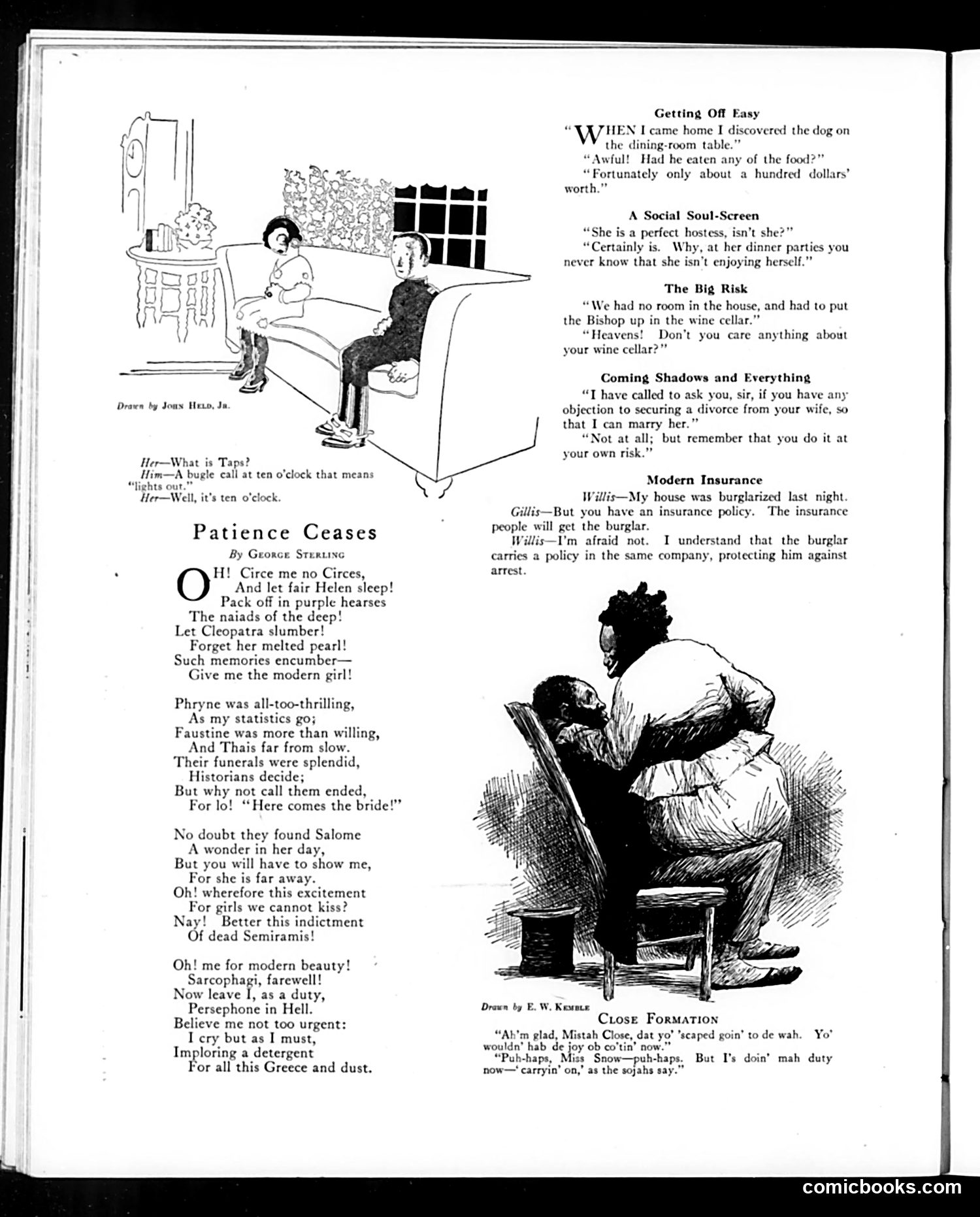
This page from the satirical magazine *Judge* contains several brief humorous pieces mocking early 20th-century American social anxieties and pretensions. **Top cartoon** ("Getting Off Easy"): Jokes about wealth and casual indifference—a dog ate $100 worth of food, but the owner treats it as trivial. **"Patience Ceases" poem**: Satirizes intellectuals obsessed with classical antiquity (Circe, Helen, Cleopatra, Salome, etc.). The speaker argues modern women are preferable to romanticized historical figures, mocking both excessive classicism and the tension between nostalgia and modernity. **Short jokes**: Mock upper-class anxieties (putting a bishop in the wine cellar; insurance policies protecting burglars) and marital infidelity presented matter-of-factly. **"Close Formation" cartoon**: Features what appears to be African American dialect humor—a common (and offensive) comedic device of the era—about avoiding military service while claiming patriotic duty. The page reflects *Judge*'s target audience: educated urbanites concerned with propriety, modern life, and social status.
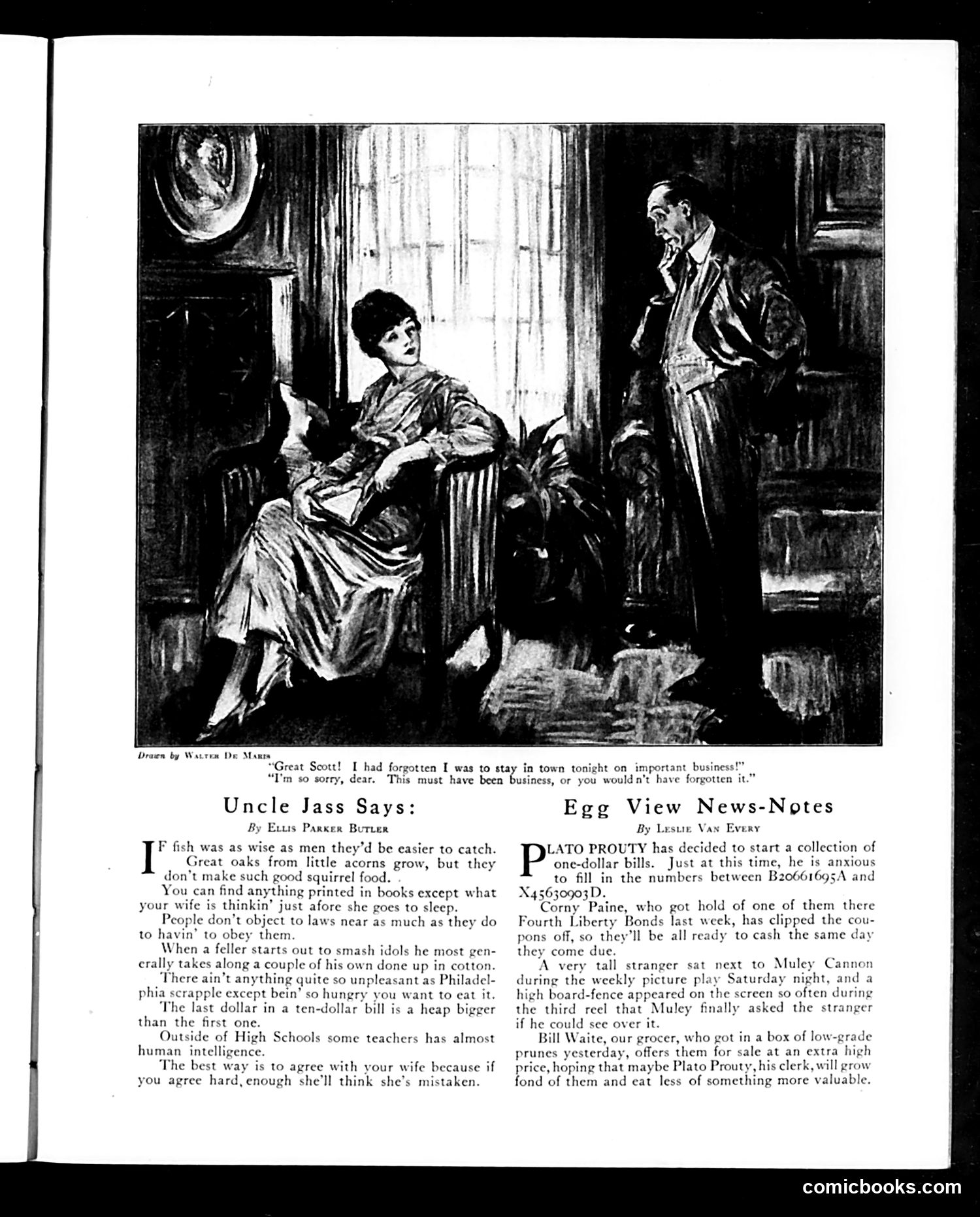
**The Main Cartoon** (top): A domestic scene where a man claims he forgot he was supposed to stay in town on business—implying he'd made plans to go out instead. His wife's cutting response suggests she sees through the excuse, implying he was actually pursuing an affair or other illicit activity. The satire targets marital infidelity and male dishonesty. **"Uncle Jass Says"** and **"Egg View News-Notes"**: These are humor columns using folksy wisdom and small-town gossip. The jokes are gentle observations about human nature (wives' thoughts, idol-smashing, school teachers' intelligence) and local characters in a fictional town called Egg View—featuring names like Plato Prouty and Corny Paine engaged in minor comic misadventures like collecting dollar bills or trying to resell low-grade prunes. The page represents Judge's typical mix of domestic satire and Americana humor common to early 20th-century American magazines.
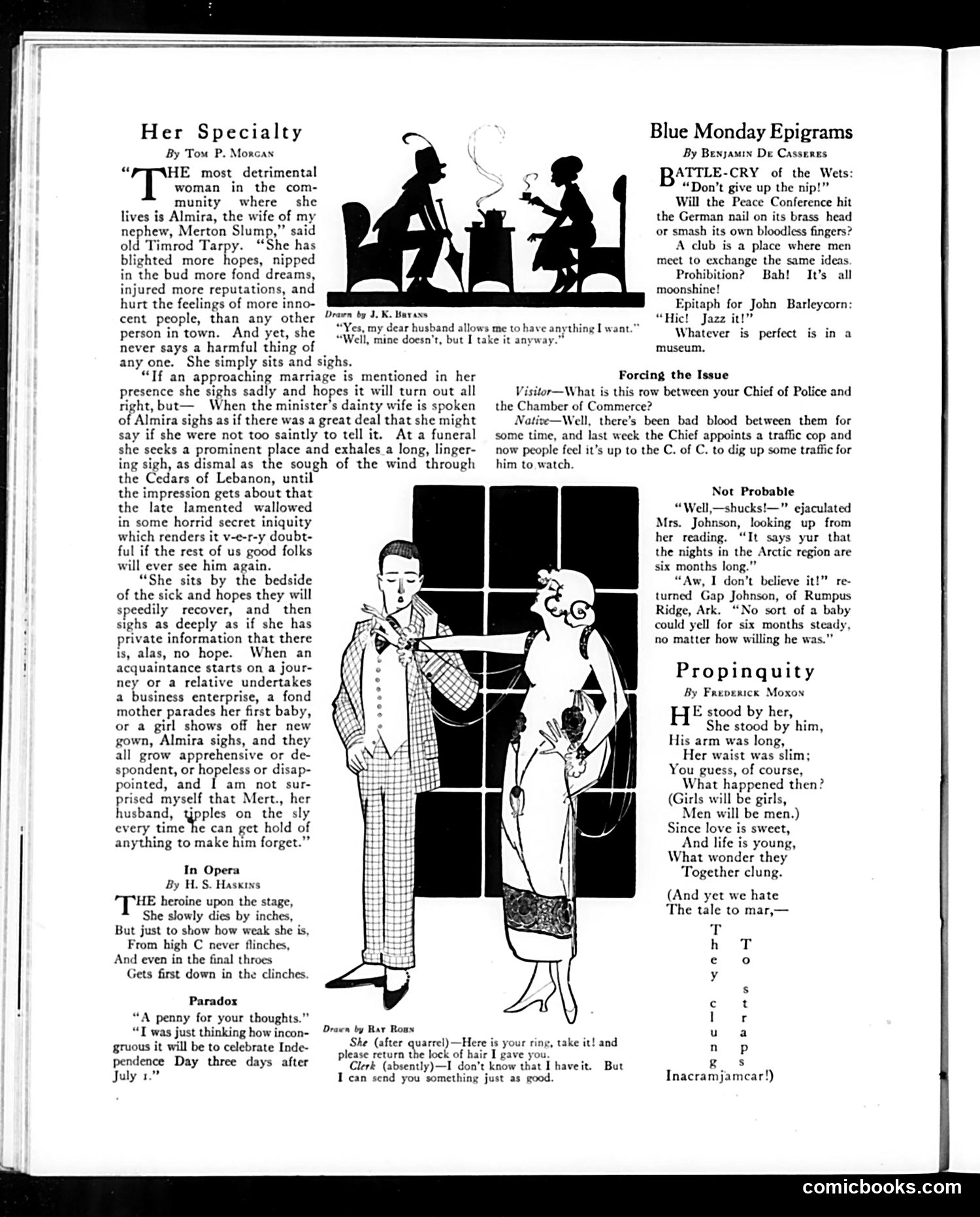
This page from *Judge* magazine contains several short satirical pieces typical of early 20th-century American humor: **"Her Specialty"** mocks a woman (Almira) whose constant sighing and pessimistic demeanor dampens others' spirits—she doesn't gossip, but her sad sighs imply terrible secrets about everyone, poisoning community morale through passive-aggressive disapproval. **"Blue Monday Epigrams"** are brief witty observations, including references to Prohibition ("Don't give up the nip!") and "John Barleycorn" (personification of alcohol/drinking culture), mocking anti-alcohol sentiment. **The cartoon** (drawn by Ray Ross) shows a quarreling couple exchanging rings and locks of hair—typical romantic tokens—with dark humor about the transactional nature of breakups. **"Propinquity"** is light verse about physical proximity leading to romance, playfully acknowledging predictable outcomes while claiming to regret telling such hackneyed tales. The overall tone reflects pre-Prohibition-era American magazine humor: cynical about social pretense, relationships, and moral campaigns.
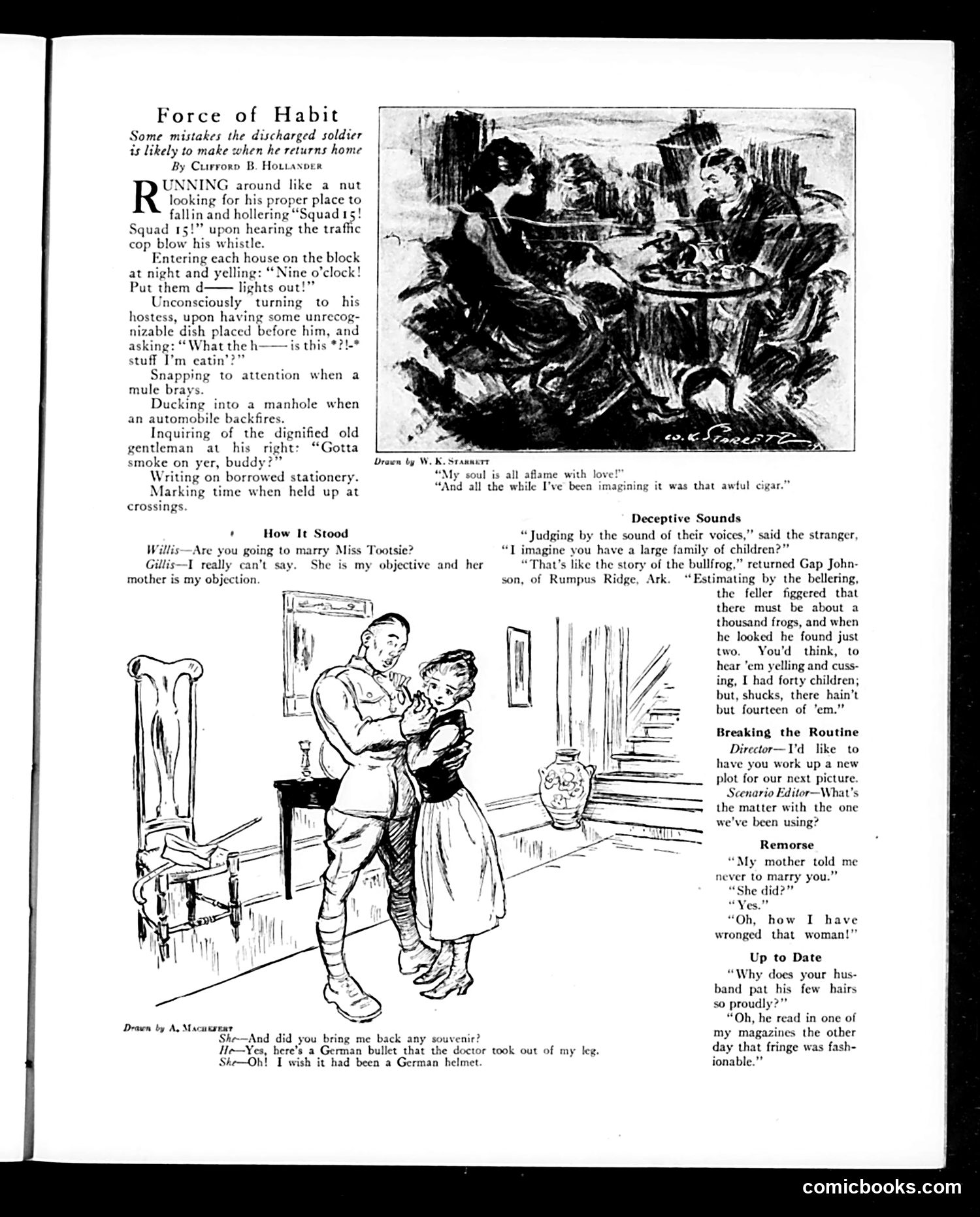
This page collects WWI-related humor satirizing discharged soldiers' difficulty readjusting to civilian life. **"Force of Habit"** (main feature) lists absurd behaviors returning soldiers exhibit—shouting military commands at traffic cops, yelling "lights out" in homes, snapping to attention at animal sounds, ducking at car backfires. The satire mocks how military conditioning has become so ingrained that veterans cannot simply shed their training. **"How It Stood"** is a separate joke about marriage hesitation, unrelated to the war theme. **"Deceptive Sounds"** satirizes acoustic misjudgment—a stranger assumes frogs represent a large family; Gap Johnson similarly overestimated frog quantity by their noise. The remaining short gags ("Remorse," "Up to Date," etc.) appear disconnected from the main war theme, likely filler content typical of such magazines. The page reflects post-WWI American culture's recognition that soldiers faced genuine psychological adjustment challenges, though Judge treats this seriously through comic exaggeration rather than mockery.
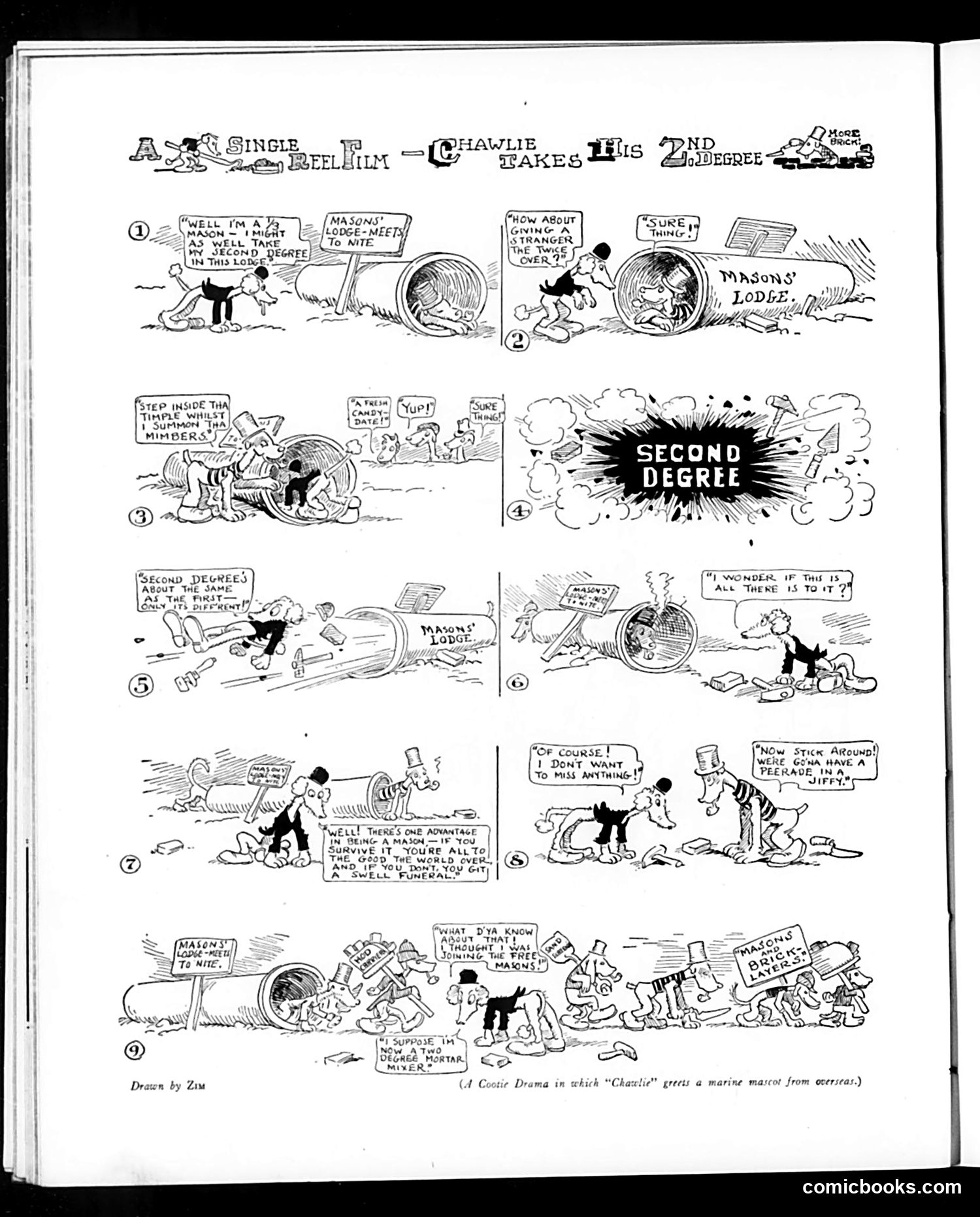
This is a comic strip mocking Freemasonry initiation rituals. The protagonist "Chawlie" (likely a working-class character, suggested by the dialect) seeks admission to a Masonic lodge. The strip satirizes the secretive, elaborate ceremonial degrees of Masonry—particularly the "Second Degree." The humor derives from: 1. **Contrast between expectation and reality**: Chawlie expects something grand; instead, he experiences bizarre, uncomfortable rituals involving large tubes/barrels and cryptic instructions. 2. **Mocking secrecy**: The lodge members repeatedly emphasize that Masonic practices are hidden ("suppose I'm two degrees superior"), while the comic openly ridicules them. 3. **Class satire**: The working-class Chawlie's befuddlement contrasts with the lodge's pretentious ceremony. This reflects early-20th-century American skepticism toward Masonry—a period when secret societies faced public suspicion and frequent satirical attacks in publications like *Judge*.
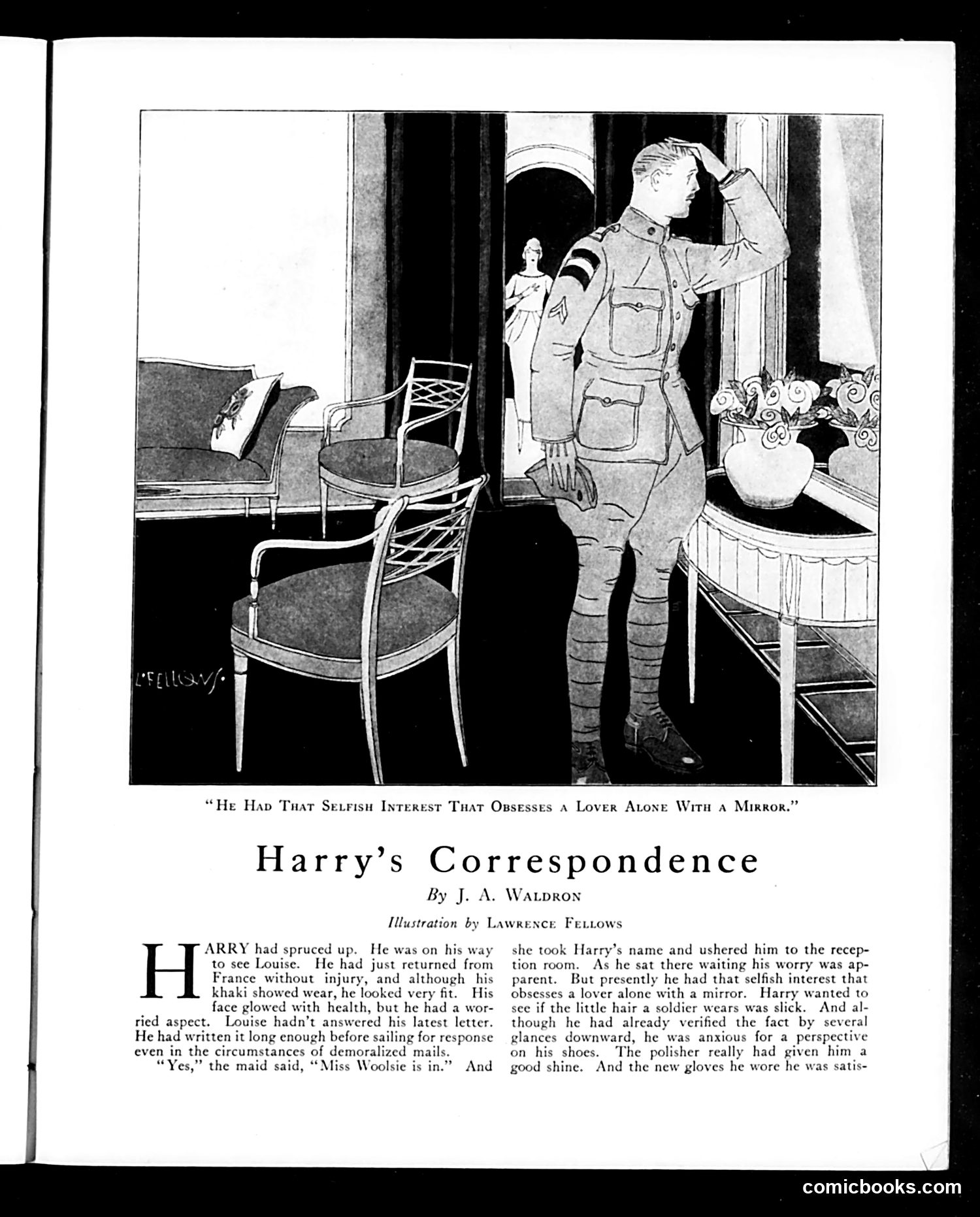
This is a humorous story illustration from Judge magazine about a returning World War I soldier named Harry visiting his romantic interest, Louise. The satire targets masculine vanity and self-absorption. Harry has just returned from France in his military uniform and is anxiously waiting to see Louise, worried she hasn't answered his letter. However, the cartoon's caption and accompanying text reveal the joke: despite his anxiety about their relationship, Harry becomes preoccupied with his own appearance, repeatedly checking his reflection in a mirror—admiring his polished shoes, new gloves, and neatly groomed hair. The satire mocks the "selfish interest" of lovers concerned with their own vanity rather than genuine emotional connection. It's a gentle critique of male narcissism and the gap between romantic intentions and actual behavior, using the returning soldier as a recognizable post-WWI figure to make the observation relatable to contemporary readers.
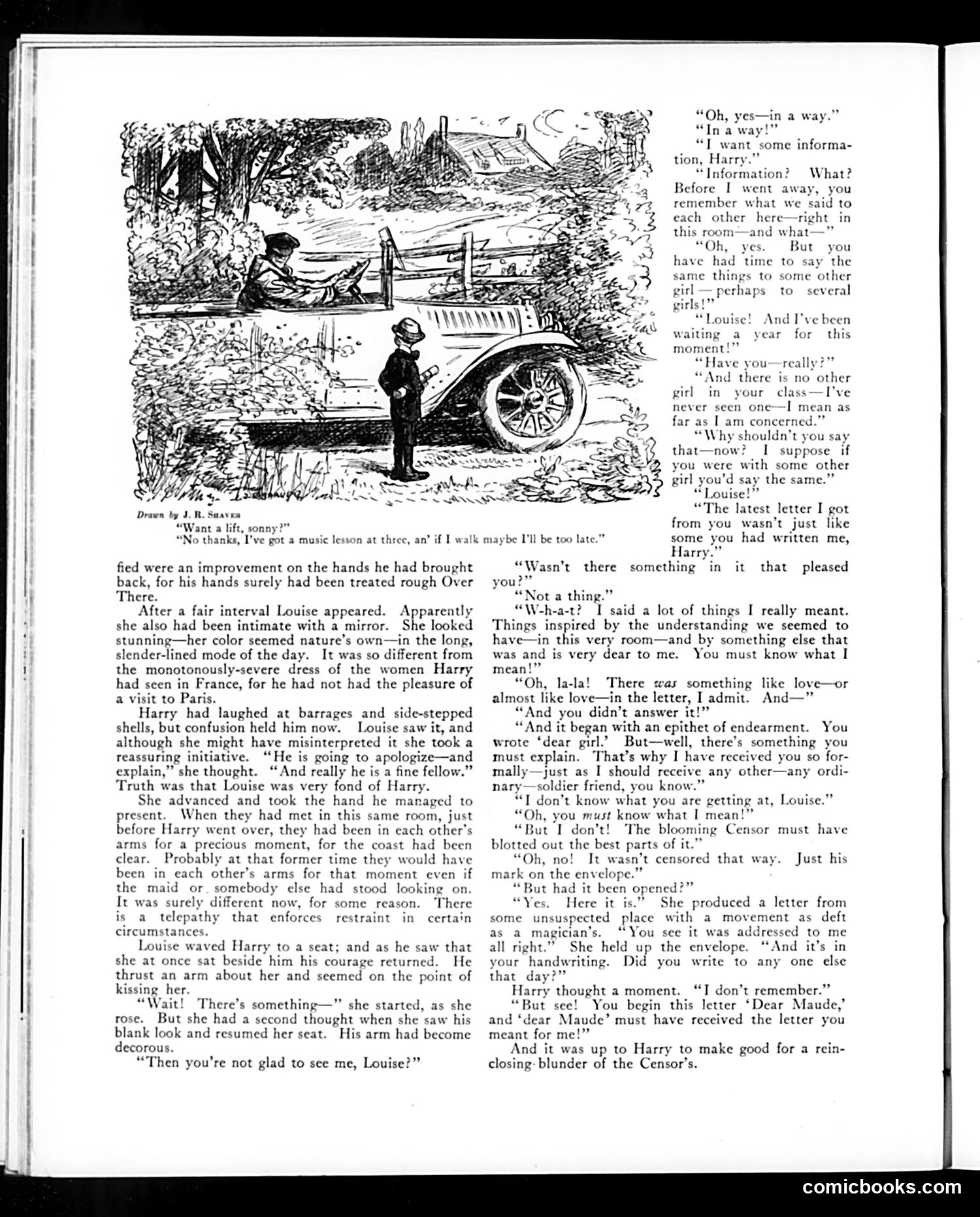
This page contains a serialized romantic story (not a political cartoon) from *Judge* magazine, illustrated by J.R. Seavey. The narrative depicts a post-World War I reunion between Harry, a returning soldier, and Louise, his girlfriend. The central conflict involves a letter Harry supposedly wrote to Louise before deployment. Louise claims it contained terms of endearment ("dear girl") but now questions whether Harry wrote similar letters to other women. She's also concerned that the letter was opened—possibly by military censors—though Harry suggests the Censor "blotted out the best parts." The satire targets wartime censorship of soldiers' mail and the social anxieties of romance during WWI. Louise's skepticism reflects period concerns about soldiers' fidelity and the intrusive nature of government mail inspection. The "music lesson" caption joke (top) offers comic relief about a boy avoiding a ride by claiming punctuality matters.
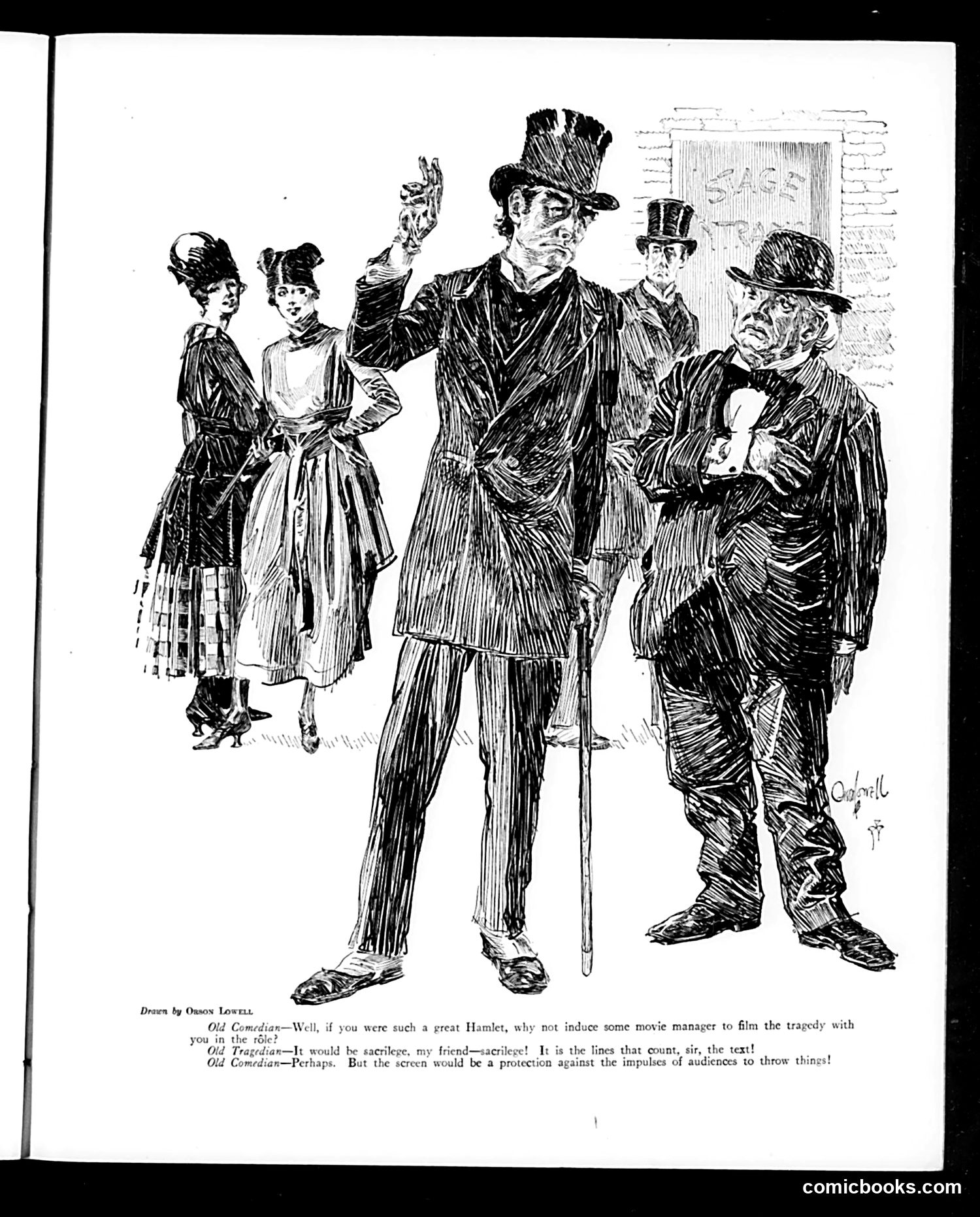
This cartoon mocks theatrical pretension and the emerging film industry. Two men debate whether a self-proclaimed great actor should star in a film version of *Hamlet*. The "Old Comedian" insists the theatrical text matters most, dismissing cinema as inferior. The "Old Tragedian" counters that film would actually protect performers—because audiences throw objects at bad stage acting. The satire targets: (1) theater actors' snobbish dismissal of "movies" as an art form, and (2) the implication that this particular actor is so terrible that live audiences literally throw things in protest. The cartoon reflects early 20th-century cultural anxieties about film replacing live theater, while simultaneously suggesting some stage performers deserve such audience hostility.
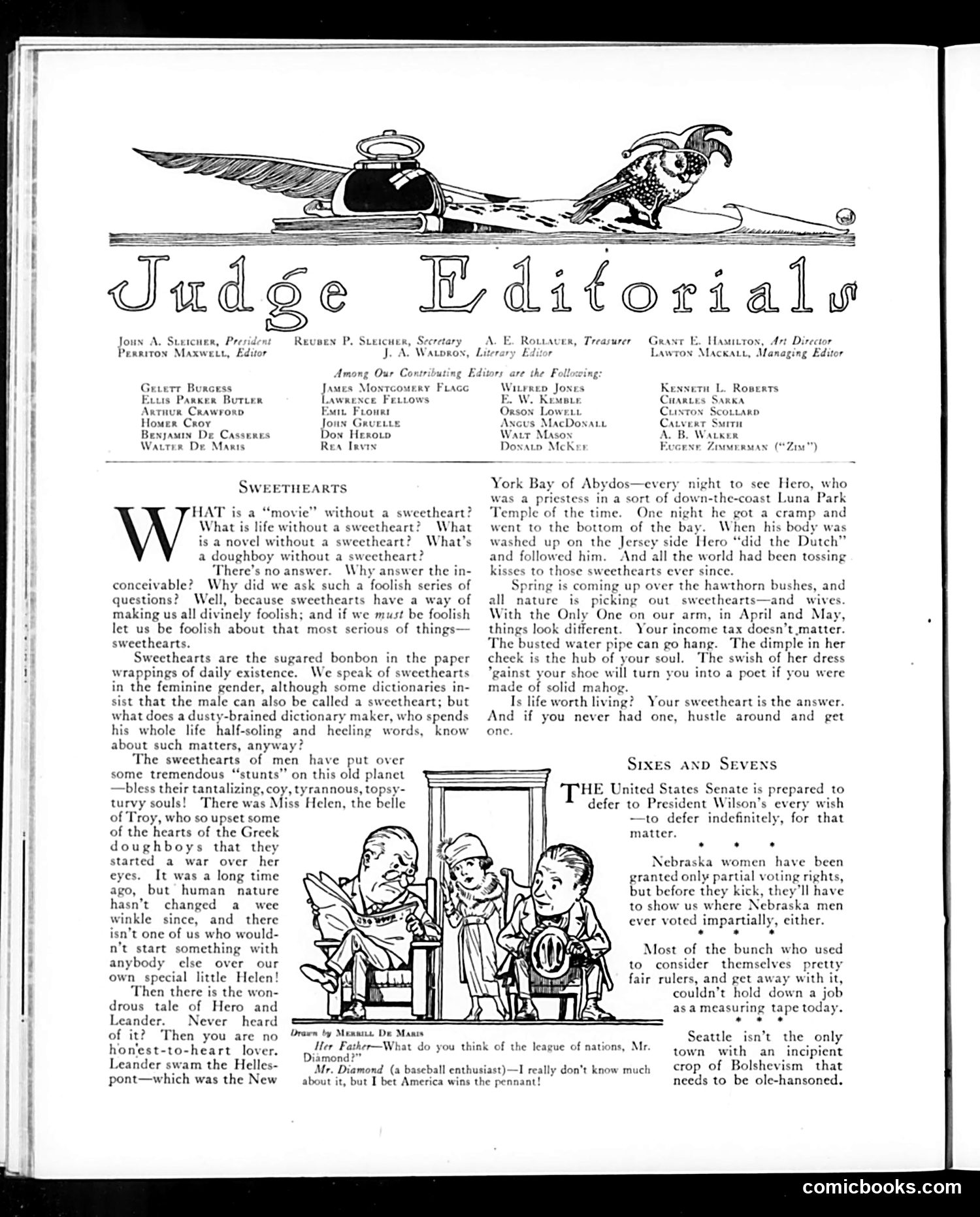
This is primarily a title/editorial page for Judge magazine rather than a political cartoon. The top features the magazine's masthead and staff listings. The content includes two brief satirical pieces: **"Sweethearts"** is a romantic essay celebrating romantic love, with classical references (Helen of Troy, Hero and Leander) positioned as timeless examples of devotion. **"Sixes and Sevens"** contains political commentary: it mocks the U.S. Senate's deference to President Wilson, critiques Nebraska's grant of only partial voting rights to women (sarcastically suggesting Nebraska men haven't voted impartially either), and includes a jab at former political leaders now struggling in ordinary jobs. A final barb references Seattle's "incipient crop of Bolshevism"—referring to socialist/communist sympathies emerging post-WWI—needing to be "ole-hansoned" (unclear reference, possibly a name or neologism). The small cartoon depicts a father and son discussing the League of Nations, with the son—a baseball enthusiast—optimistically predicting "America wins the pennant."
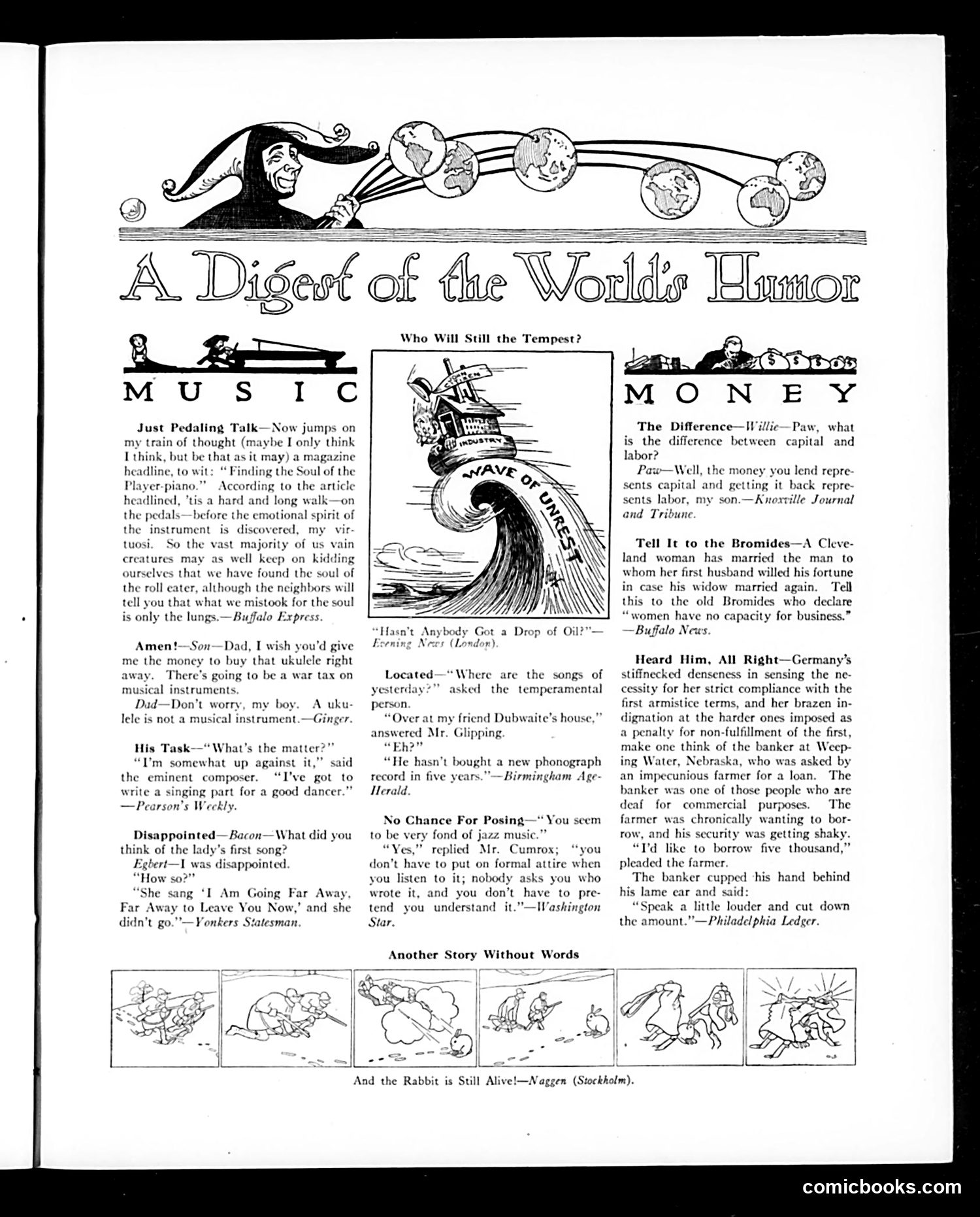
This page from Judge presents satirical humor pieces typical of early 20th-century American comedy. The content reflects post-WWI sensibilities: **Main Cartoons & Jokes:** - Musical instrument jokes mock the player-piano as soulless and ukuleles as non-musical - A piece titled "Who Will Still the Tempest?" uses a ship-in-storm image to satirize Germany's post-WWI intransigence—comparing German stubbornness about armistice terms to a deaf Nebraska banker who won't listen to loan requests - Jazz music satire mocks its informality compared to classical music - A Cleveland woman's remarriage to her late husband's heir is presented as defying the "bromide" (cliché) that women lack business sense **Context:** The German reference suggests this page dates to the immediate post-WWI period when Germany's compliance with Treaty of Versailles terms was contentious. The overall tone reflects Jazz Age social commentary—new musical forms, changing social attitudes, and post-war attitudes toward commerce and propriety.
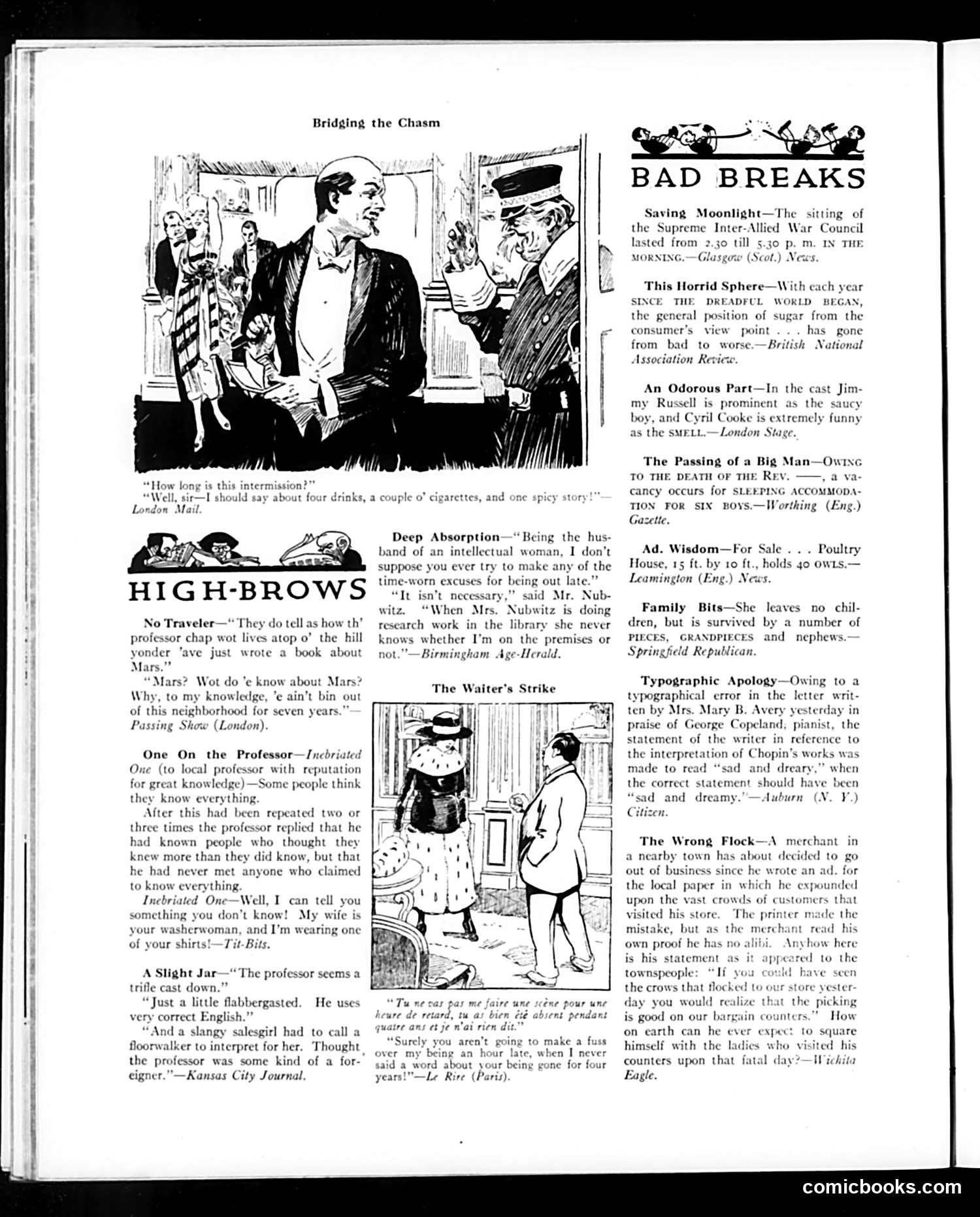
This page from *Judge* contains several satirical pieces mocking intellectual pretension and newspaper blunders. The main cartoon depicts a well-dressed man at what appears to be a social gathering, captioned with a quote about an "intermission"—likely satirizing someone claiming expertise while revealing ignorance. The title "Bridging the Chasm" suggests the gap between appearance and reality, or between educated and common classes. The "HIGH-BROWS" section features jokes about pompous professors: one claims vast knowledge of Mars despite never leaving his neighborhood; another, confronted by a drunk, is humiliated when the man reveals he's wearing the professor's own laundry—a reversal exposing the professor's pretension. "BAD BREAKS" collects newspaper printing errors: a council meeting described as occurring "IN THE MORNING" when held at 2:30 p.m.; an obituary offering "SLEEPING ACCOMMODATION FOR SIX BOYS"; an ad mentioning "CROWS" instead of "CROWDS." The humor targets both intellectual snobbery and journalistic incompetence—the era's recurring satirical targets.
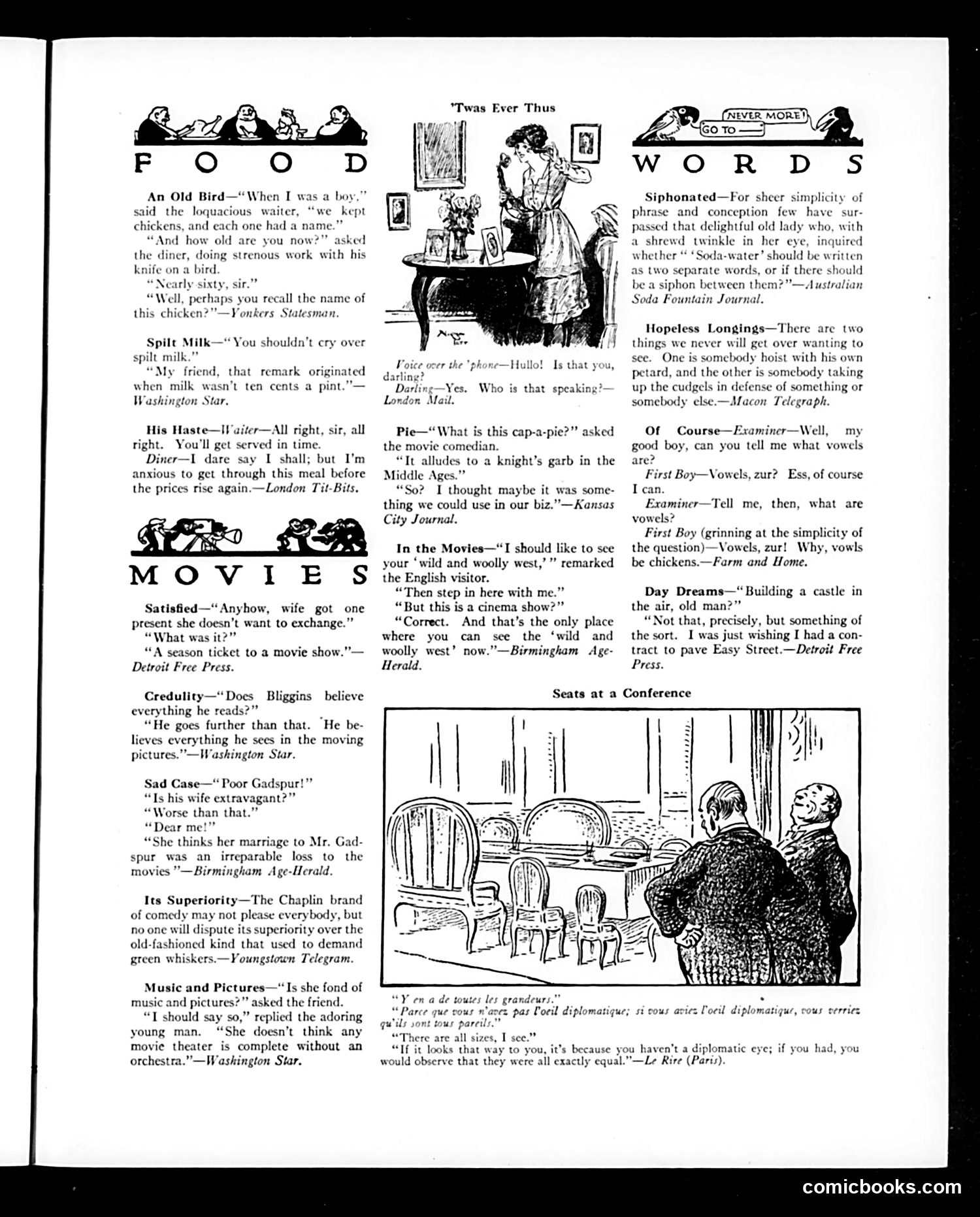
This page collects brief humorous anecdotes organized by theme (Food, Movies, Words). The cartoons and jokes satirize early 20th-century American life: **Social Commentary:** - **Food/Service jokes** mock inflation and rising prices (milk, restaurant meals), reflecting post-WWI economic anxiety - **Movie references** dominate, indicating cinema's new cultural prominence. One joke suggests movies have replaced authentic "wild west" experiences—satirizing how mass media displaces reality - **Charlie Chaplin reference** shows his dominance in silent comedy by this era **The "Seats at a Conference" cartoon** (bottom) depicts two diplomats discussing observation and perception, with French dialogue. It satirizes diplomatic pretense—the joke being that proper "diplomatic eyes" would see equality where ordinary eyes see hierarchy. This likely references post-WWI peace negotiations and diplomatic hypocrisy. **Overall tone:** Gentle, observational humor targeting consumer culture, technological change (cinema, telephones), class anxieties about money, and international affairs—all hallmarks of 1920s-era American satire.
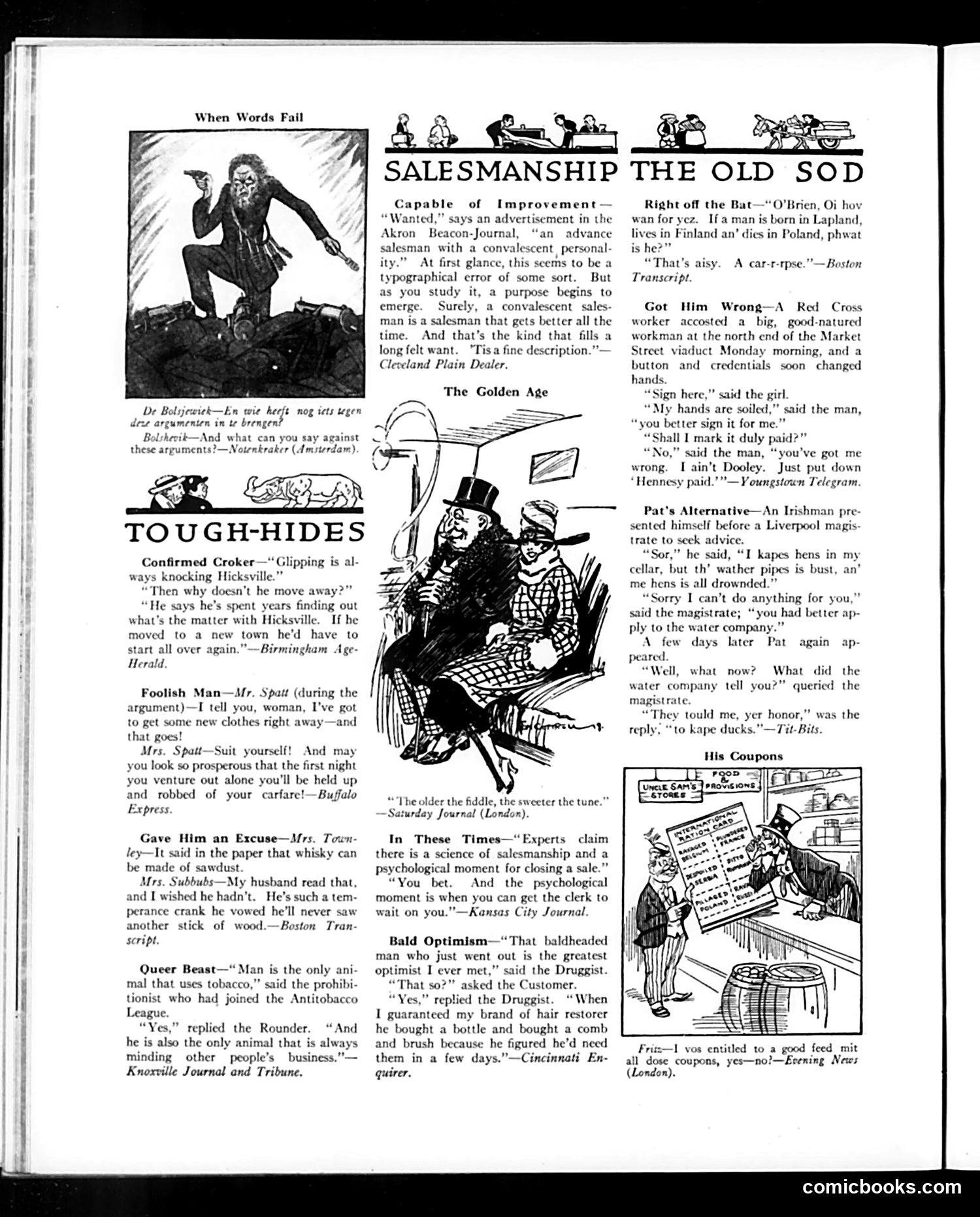
This page from Judge magazine contains humorous anecdotes and a few cartoons satirizing early-20th-century American life. The content falls into several categories: **"Tough-Hides"** section presents short jokes about everyday disputes—a man complaining about a town he's spent years criticizing, a wife wishing her husband gets robbed after buying new clothes, and temperance hypocrisy. **"The Golden Age"** cartoon depicts an older man and woman in a romantic moment, captioned with a saying about age improving quality (like fiddles). **"The Old Sod"** section contains Irish-themed humor with stereotypical Irish dialect, featuring characters named O'Brien, Dooley, Hennesy, and Pat—reflecting the common ethnic humor prevalent in period publications. **"His Coupons"** cartoon shows someone (apparently German, given the name "Fritz") attempting to redeem coupons, likely satirizing wartime rationing or commercial promotions. The page generally ridicules human folly, marital conflict, ethnic stereotypes, and commercial schemes typical of Judge's satirical approach.
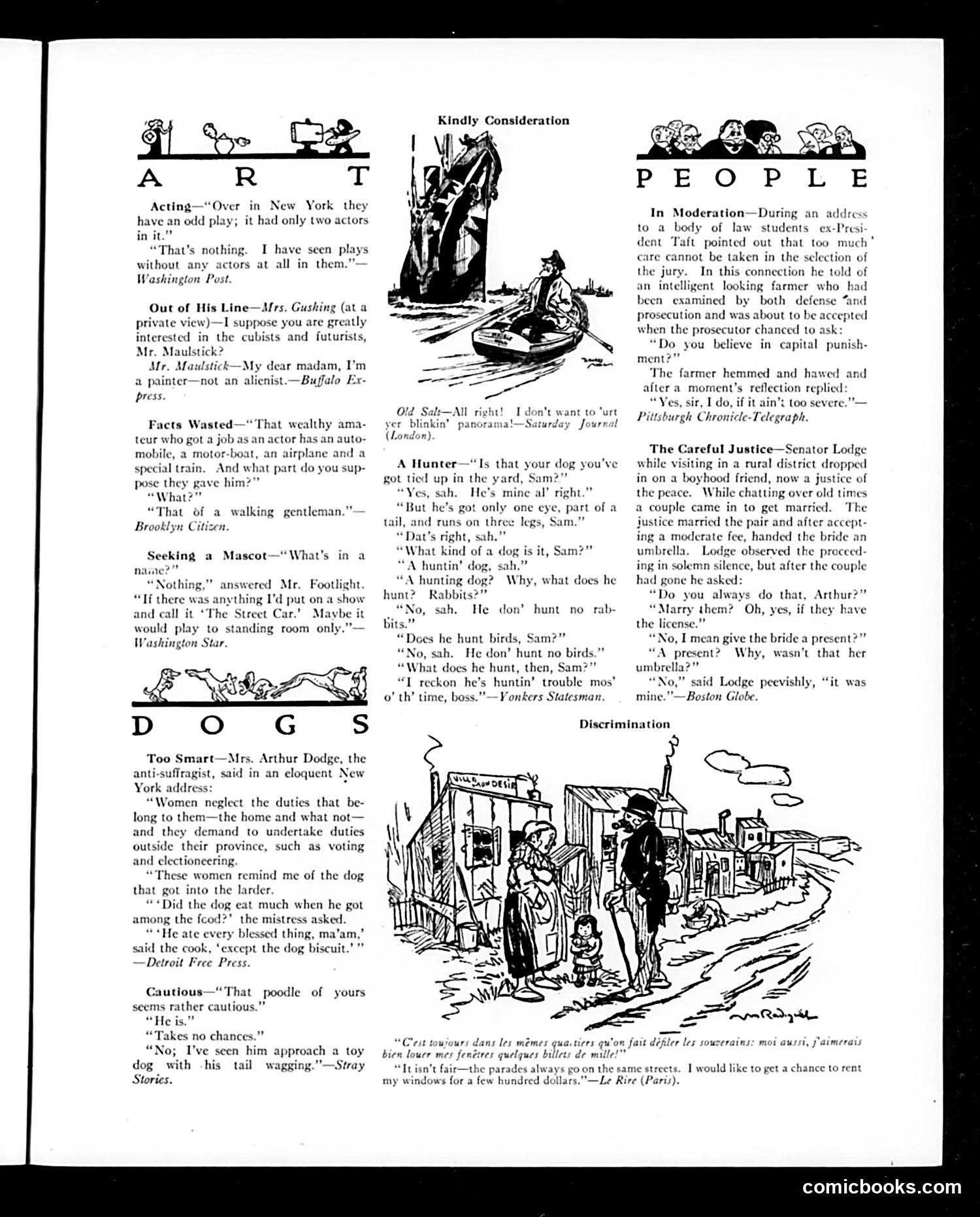
This page contains humor pieces satirizing early 20th-century American social issues: **"Out of His Line"** mocks art world pretension—a painter (Mr. Maulstick) claims ignorance of Cubism and Futurism, artistic movements then considered bewilderingly avant-garde. **"Too Smart"** targets anti-suffrage arguments. Mrs. Arthur Dodge (a real anti-suffragist) uses a dog-in-the-larder analogy to claim women neglect home duties by pursuing voting rights. The joke inverts her logic: the dog ate everything *except* dog biscuits—implying women wouldn't neglect home duties. **"The Careful Justice"** jokes about a rural judge's odd wedding gift: he gives the bride an umbrella that was actually Senator Lodge's—absurd rural behavior. **"A Hunter"** is a dialect-heavy piece about a one-eyed, three-legged dog that hunts "trouble"—gentle humor about rural simplicity. The bottom cartoon references Parisian window-rental complaints about parade disruptions—international humor content typical of Judge's cosmopolitan readership.
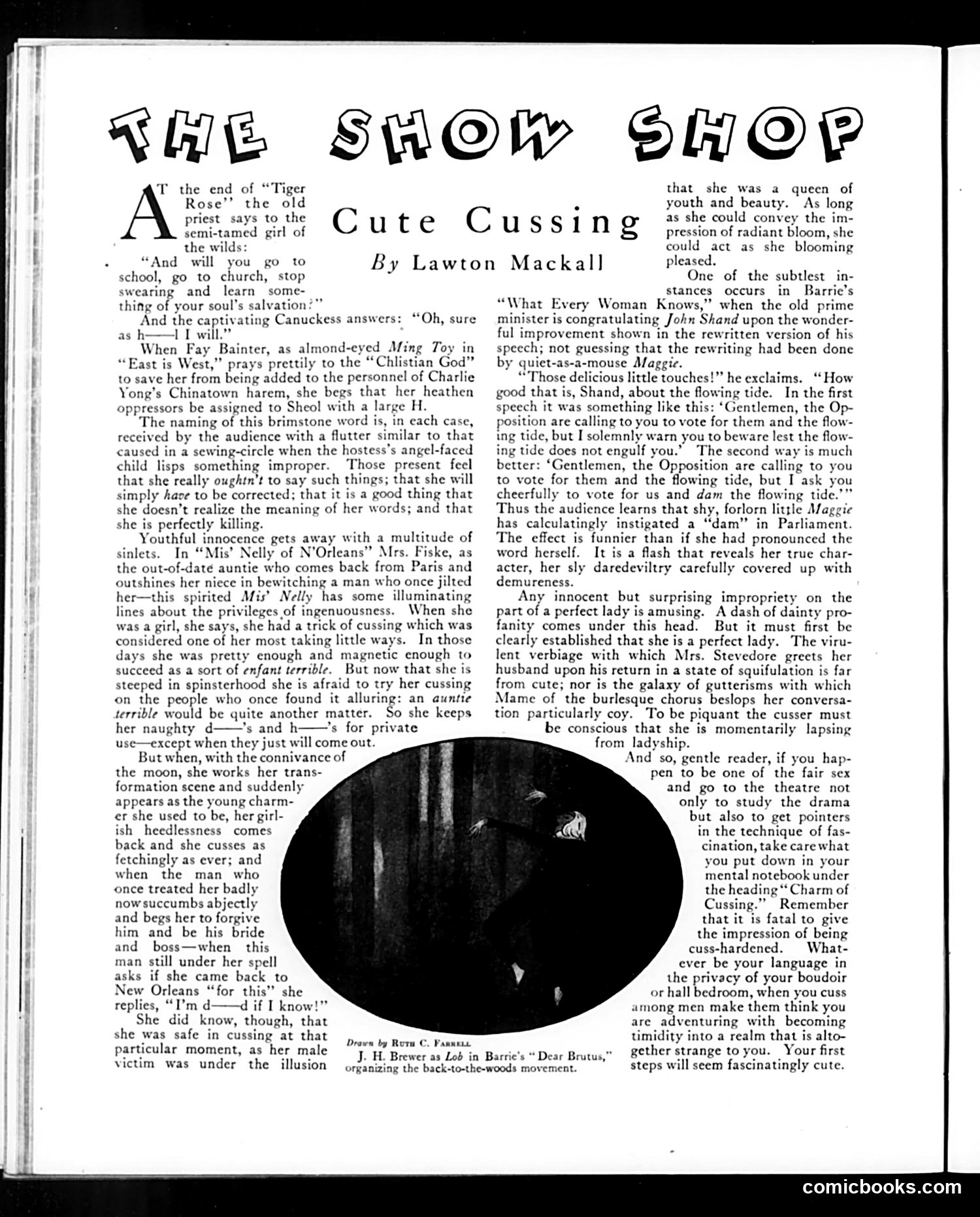
This is a theater criticism article titled "Cute Cussing" analyzing how actresses get away with swearing onstage by exploiting their youth and beauty. The author examines three contemporary plays: "Tiger Rose," "East is West," and "Miss Nelly of N'Orleans," plus J.M. Barrie's "What Every Woman Knows." The satirical point: female performers strategically deploy profanity—censored as "d—s" and "h—s"—to charm audiences. Audiences find it shocking yet endearing when young, beautiful women curse, viewing it as innocent rather than improper. The article argues this "cuteness" vanishes with age; an older woman using the same language would be scandalized. The small illustration depicts a scene from "Dear Brutus" but seems secondary to the text's main argument about how gendered notions of innocence and attractiveness allow actresses theatrical license audiences wouldn't grant men or aging women.
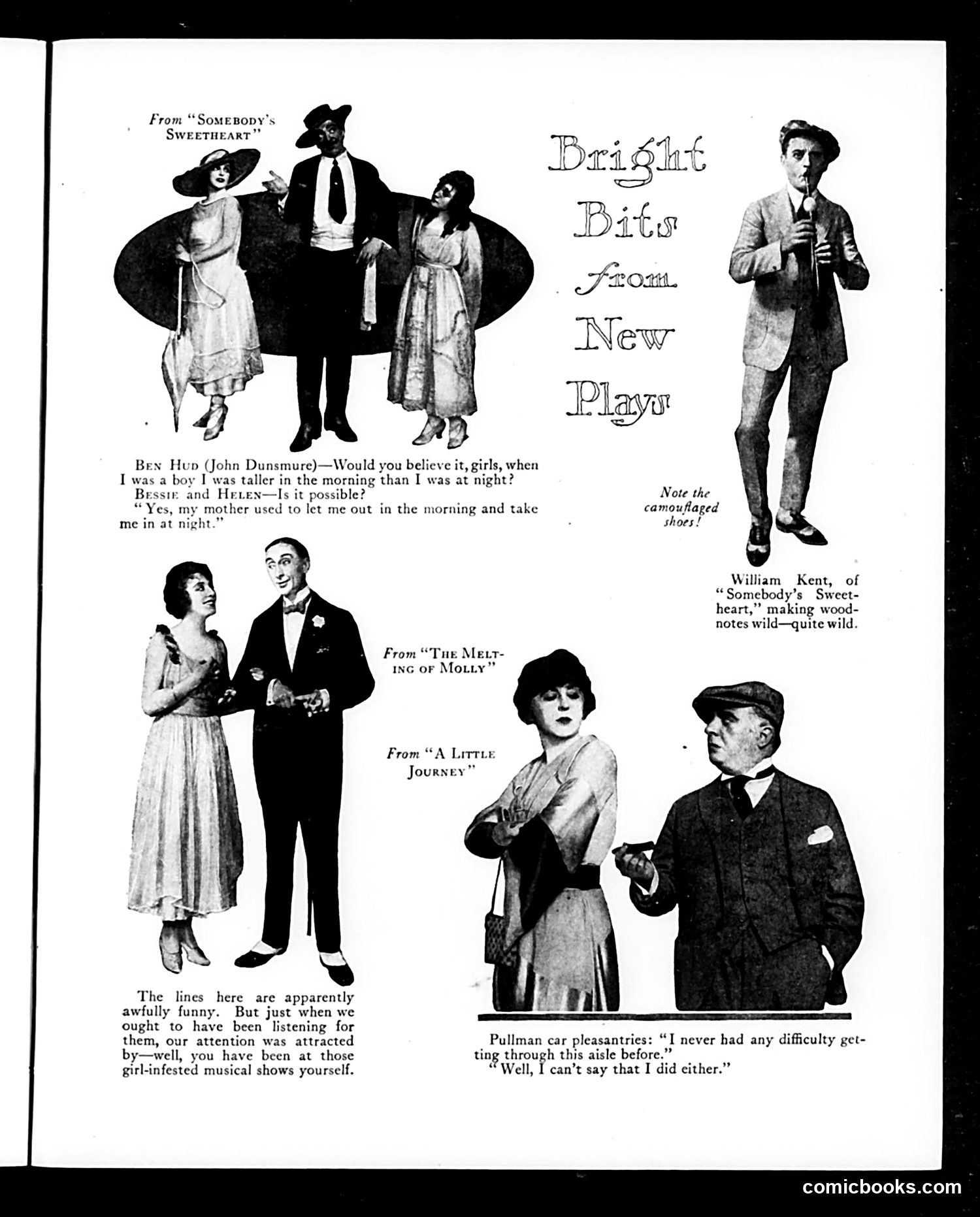
This page presents theatrical humor and character sketches from several Broadway productions of the era. The jokes are drawn from musicals, particularly "Somebody's Sweetheart" and "The Melting of Molly." The satire here is **meta-theatrical**: Judge mocks both the plays themselves and theater audiences. The central joke notes that during "girl-infested musical shows," audiences get distracted by the female performers rather than listening to actual dialogue—suggesting the comedic lines are forgettable compared to visual spectacle. The individual gags are puns and one-liners typical of vaudeville-style humor (Ben Hud's joke about being taller in the morning, the Pullman car exchange). William Kent's "camouflaged shoes" notation appears to be an inside joke about his physical appearance or performance style. The page functions as advertisement-cum-review for these theatrical productions, using humor to promote shows to Judge's readership.
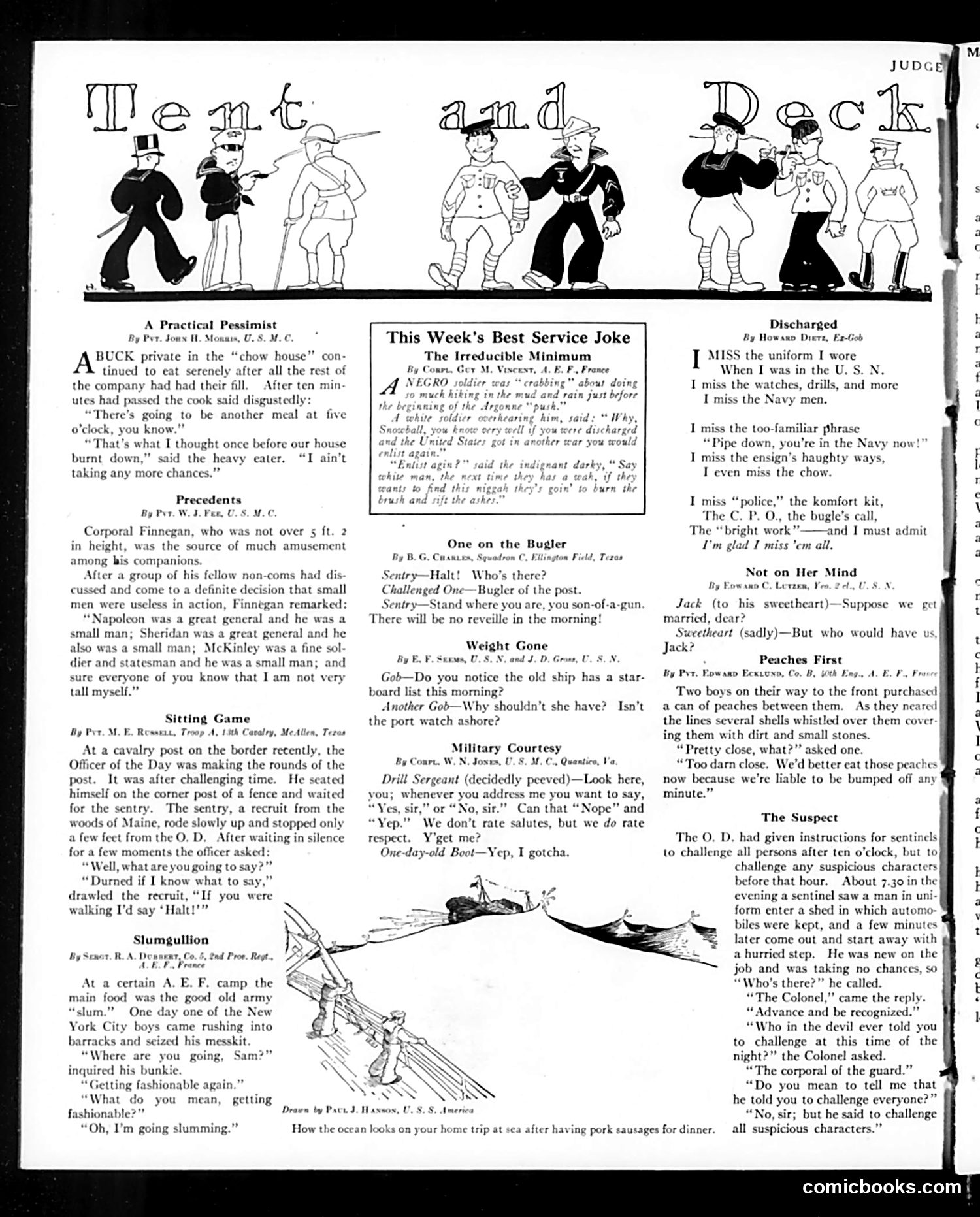
This page collects brief satirical anecdotes about military life, likely from World War I era (references to A.E.F.—American Expeditionary Forces—and naval service). The cartoons and jokes mock military absurdities: a hungry private hoarding food from fear; a short soldier citing Napoleon as precedent; a Maine recruit unfamiliar with formal challenge procedures; racial stereotypes in "service jokes"; and soldiers complaining about military discipline after discharge. The top cartoon shows "Tent and Deck" characters—presumably recurring Judge figures representing military types. The humor targets both military bureaucracy (the drill sergeant's speech about salutes) and soldiers' adaptation to regimented life. The final drawing of seasickness after eating pork sausages provides crude physical comedy. This represents how Judge satirized American military culture through gentle mockery of soldier types and service regulations, appealing to readers familiar with or sympathetic to military experience.
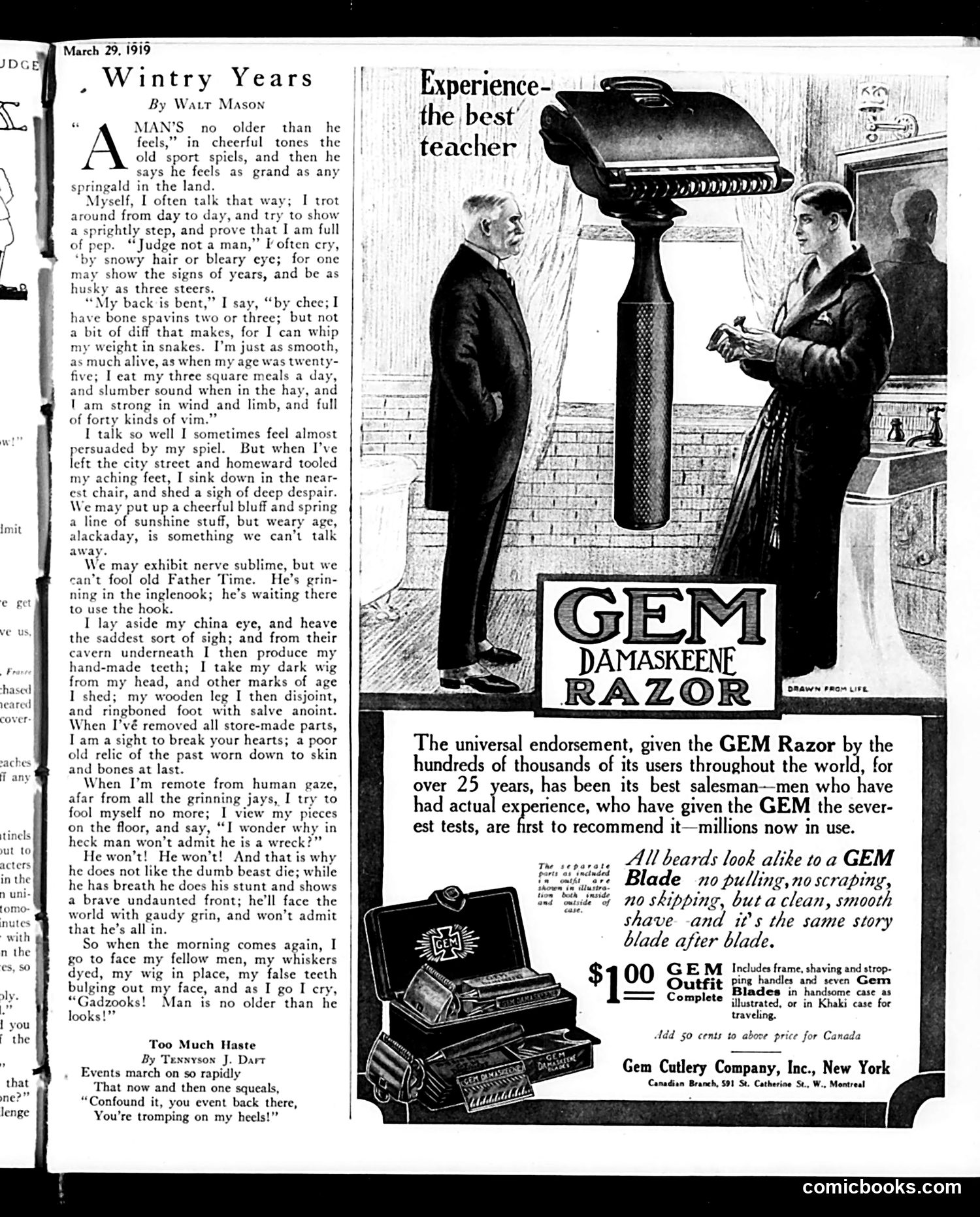
This page combines two distinct elements: a humorous essay and a razor advertisement. **"Wintry Years" by Walt Mason** is a poem about aging. It describes an elderly man who maintains a cheerful public facade—claiming vigor, strength, and vitality—while privately acknowledging his deterioration (false teeth, wooden leg, dyed whiskers, toupee). The satire mocks the common male pretense of denying age: men won't admit weakness or decline, instead projecting false bravado to peers. The final couplet ironically summarizes this self-deception: "Man is no older than he looks!" **"Too Much Haste" by Tennyson J. Dart** is a brief satirical poem about rapid social change during the post-WWI era (1919), suggesting events move so quickly that progress literally tramples the past. **The GEM Razor Advertisement** ironically follows the aging theme, showing two men examining a razor with the tagline "Experience—the best teacher." It emphasizes durability and reliability over 25 years, suggesting the product is as trustworthy as the masculine experience valorized in Mason's poem above.
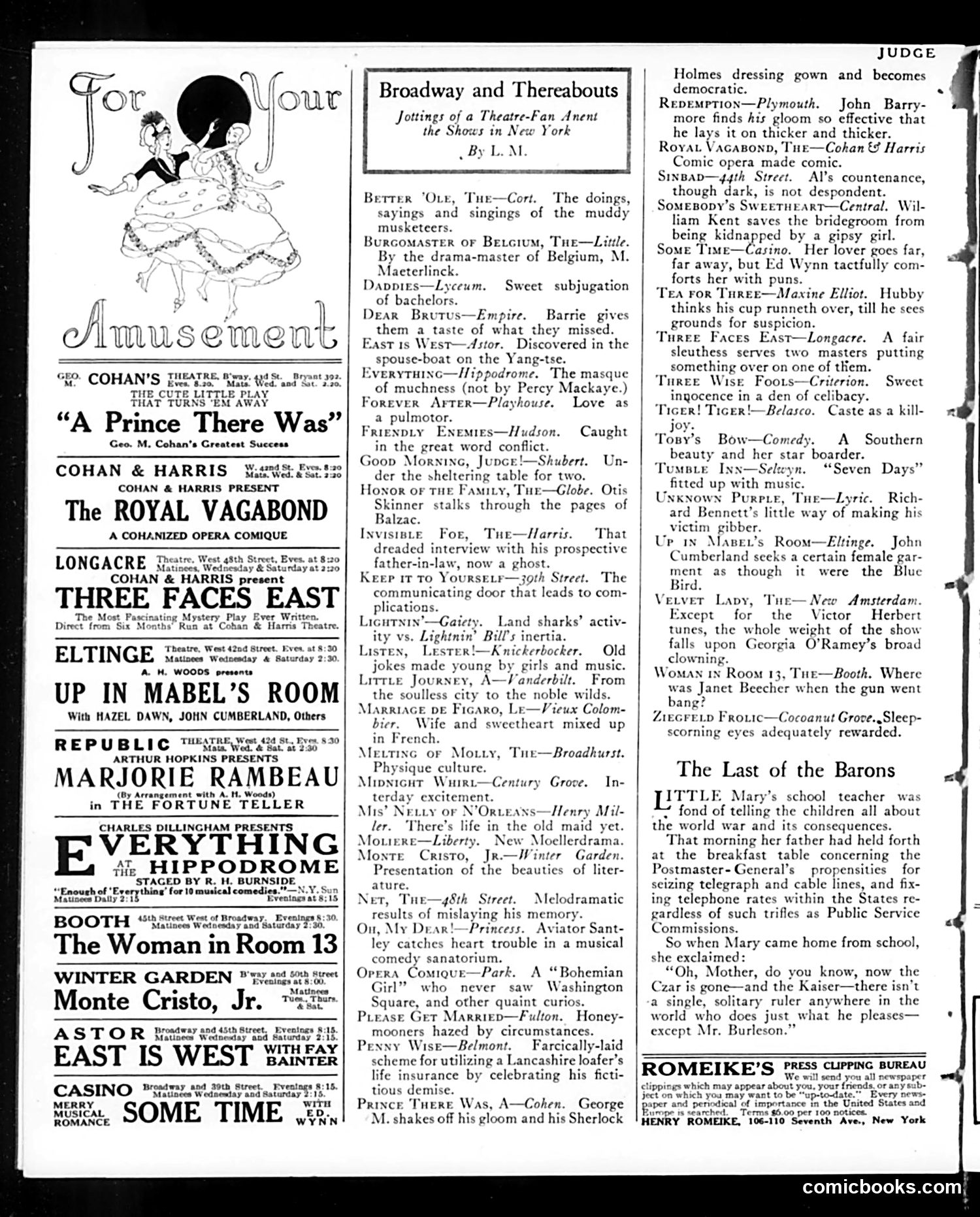
This page is primarily **theater advertising and reviews**, not political satire. The small cartoon at top left appears decorative rather than satirical. The "Broadway and Thereabouts" column by L.M. is a theater-fan's witty review of current New York productions. It uses brief, punchy descriptions with mild jokes about plot premises—for example, *East is West* is "discovered in the spouse-boat on the Yang-tse" (mocking orientalist melodrama), and *Opera Comique* features "a 'Bohemian Girl' who never saw Washington Square." The humor is theatrical, not political. References include George M. Cohan's productions and established Broadway names like John Barrymore. The column pokes gentle fun at tired theatrical conventions and implausible plots rather than social or political issues. The bulk of the page consists of theater advertisements for plays, musicals, and revues typical of early 20th-century Broadway.
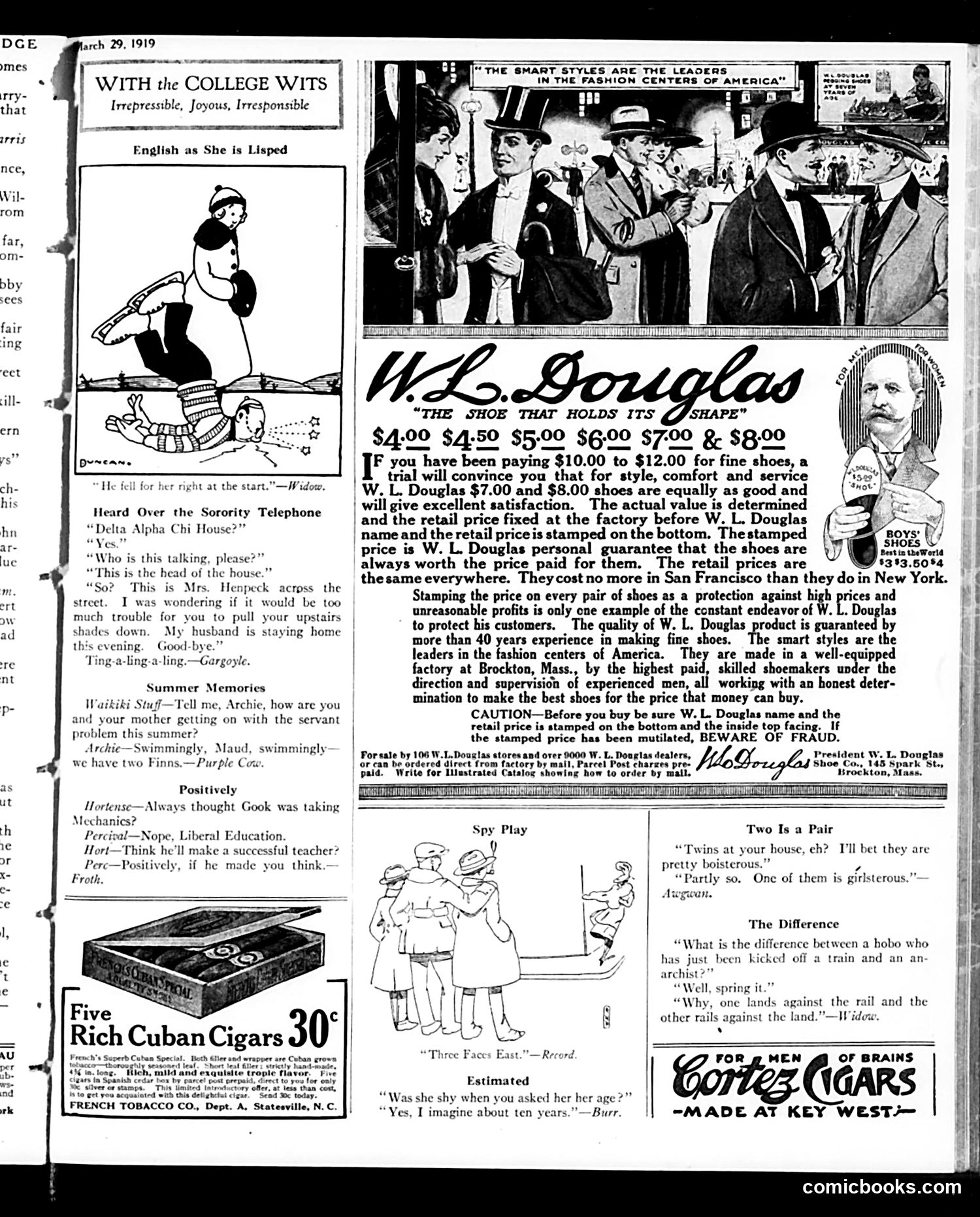
This page is primarily **advertising and humor columns** rather than political satire. The main content includes: **"With the College Wits"** section: Lighthearted college humor jokes about sorority life, servants, and student relationships—typical period comedy with no deeper satire. **W.L. Douglas Shoes Advertisement**: A large commercial ad emphasizing price transparency and quality, featuring an image of well-dressed men in hats. The ad touts stamped retail prices as protection against inflation and fraud—likely referencing post-WWI economic concerns about rising costs and profiteering. **Small humor pieces** ("Spy Play," "Two Is a Pair," "The Difference"): Mild puns and wordplay with no political content. **Five Rich Cuban Cigars Ad**: Standard product advertising. The page reflects 1919 consumer concerns about fair pricing and quality rather than partisan politics. The Douglas shoe ad's emphasis on "protection against high prices and unreasonable profits" subtly addresses contemporary anxiety about post-war economic inflation.
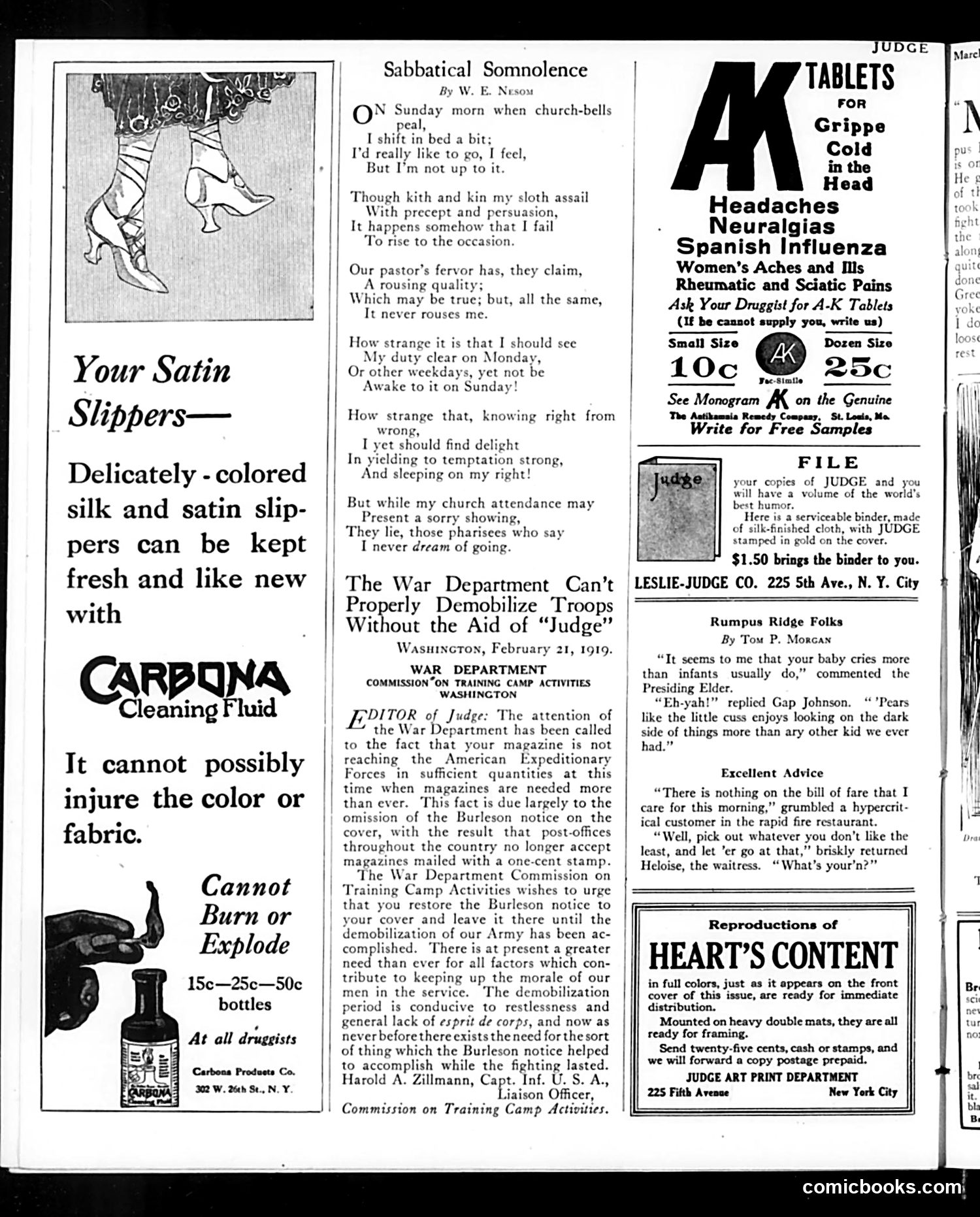
This page combines poetry, advertising, and a notable wartime letter. The main content includes: **"Sabbatical Somnolence"** — a humorous poem about someone's reluctance to attend church on Sunday mornings, despite recognizing the moral obligation. It's gentle satire on religious hypocrisy and human weakness. **The key editorial element** is a letter from the War Department (February 1919, post-WWI) requesting that *Judge* restore the "Burleson notice" to its cover. Postmaster General Albert Burleson had censored publications during wartime; the notice indicated postal approval. The War Department argues this notice is essential for magazine distribution to troops during demobilization, when morale matters most for orderly troop withdrawal. This reveals how government censorship apparatus remained embedded in publishing infrastructure even as the war ended, and how authorities leveraged morale concerns to maintain control over information flow to servicemen. The rest of the page contains period advertisements (cleaning fluid, patent medicine tablets) and light humor pieces typical of the magazine.
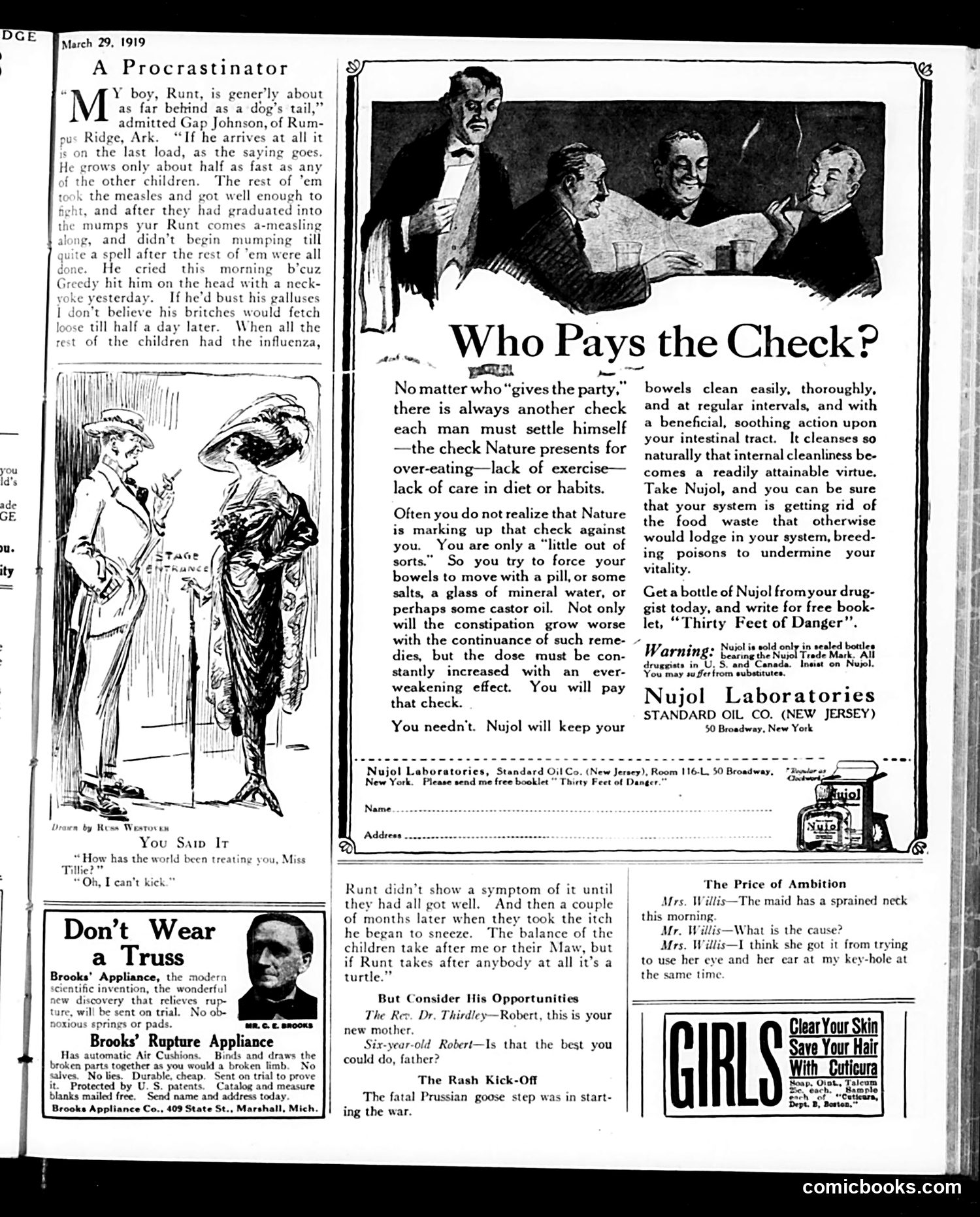
This page consists primarily of **advertisements** for patent medicines and devices, alongside brief humorous anecdotes typical of Judge's satirical style. **"A Procrastinator"** depicts rural character Gap Johnson complaining that his son Runt is perpetually slow—always the last to catch childhood illnesses, always lagging behind his siblings. The joke plays on the idea that even disease progresses faster than Runt. **"Who Pays the Check?"** is a Nujol laxative advertisement using digestive health as metaphor: Nature levies a "check" (bill) against you for overeating and poor habits; constipation remedies only worsen the problem. The ad warns readers they must eventually "pay" through illness. The other brief jokes ("You Said It," "But Consider His Opportunities," "The Rash Kick-Off") are typical period humor—quick, mild social observations. **Context**: This page reflects 1919 anxieties about health, digestion, and physical fitness common in early-20th-century advertising. The rural dialect humor was standard for the era. Post-WWI reference to "Prussian goose step" suggests recent wartime preoccupations.
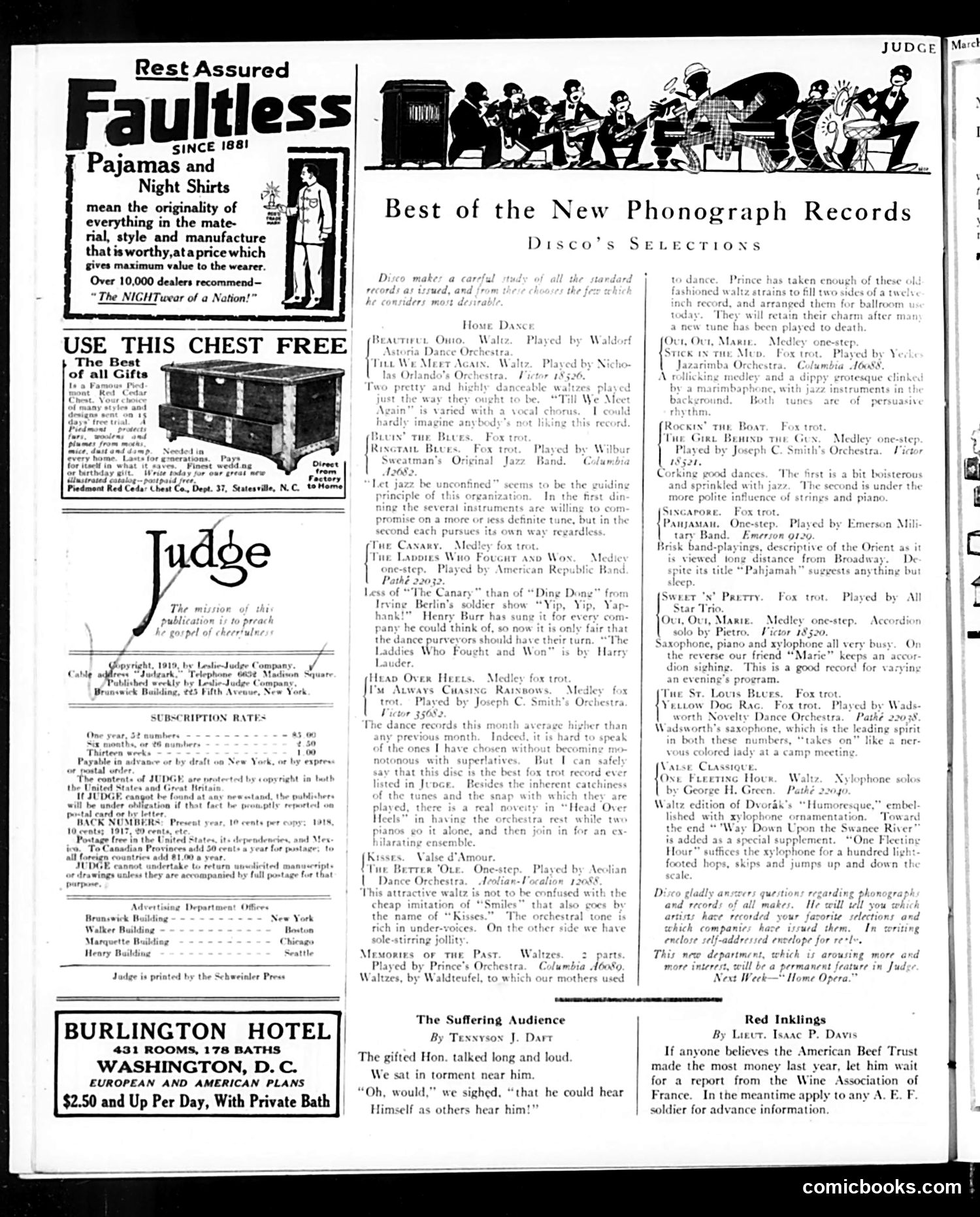
This page is primarily **advertising and record reviews**, not political satire. The dominant content includes: **Advertisements:** Faultless pajamas, a storage chest, the Burlington Hotel in Washington D.C., and phonograph records dominate the layout. **"Best of the New Phonograph Records"** section reviews dance music selections—waltzes, fox trots, and jazz numbers—reflecting 1920s entertainment trends. **Two minor humorous pieces:** 1. **"The Suffering Audience"** by Tennyson J. Dart—a brief joke about enduring a long-winded speaker 2. **"Red Inklings"** by Lieut. Isaac P. Davis—a quip comparing American beef industry profits unfavorably to French wine exports, with a jab at American Expeditionary Force (A.E.F.) soldiers in post-WWI France The page lacks significant political cartooning or satire. It's representative of Judge's evolution toward entertainment and consumer advertising rather than hard-hitting commentary.
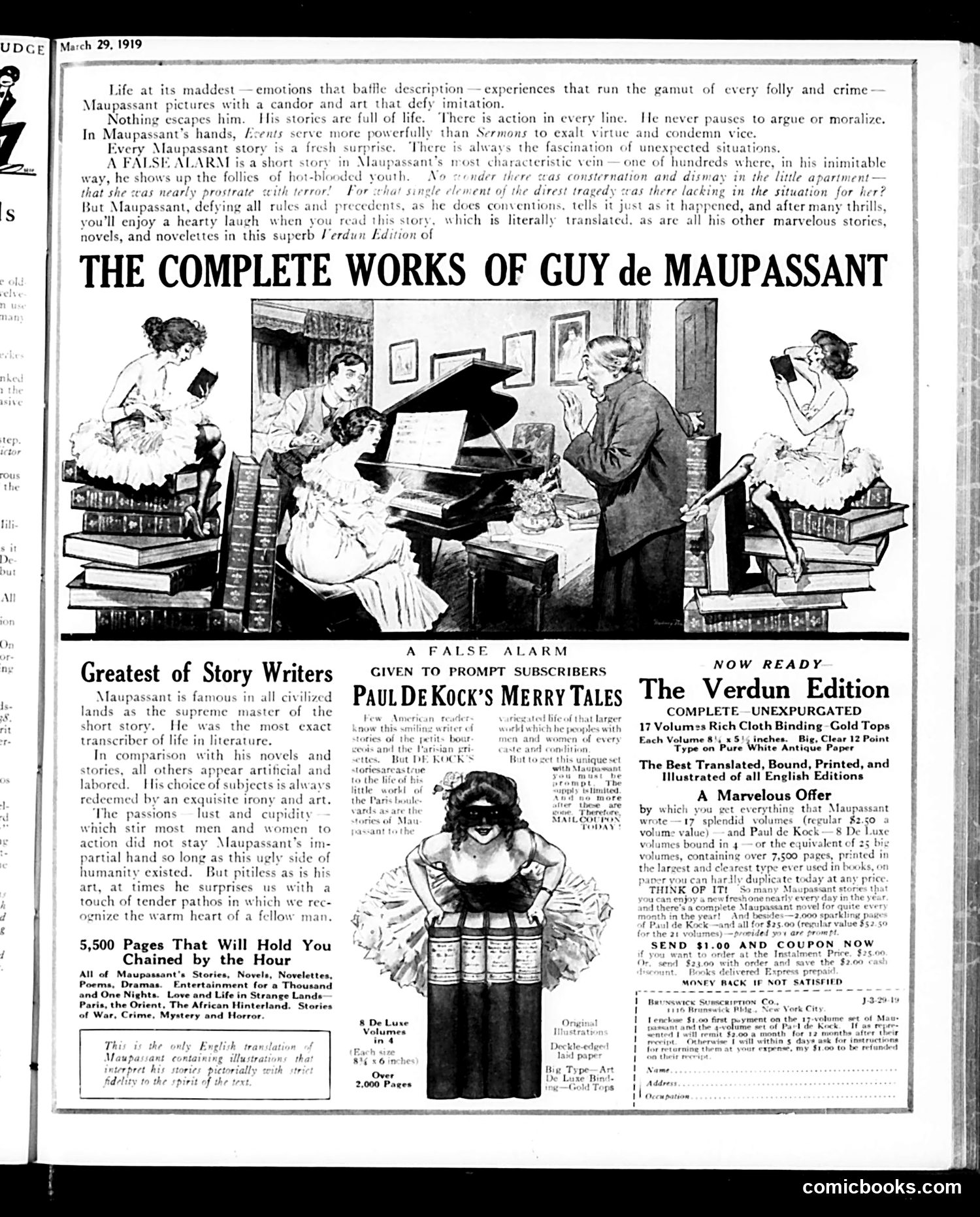
This is primarily a **book advertisement**, not a political cartoon. The page promotes the "Verdun Edition" of Maupassant's complete works (17 volumes), published March 29, 1919. The illustrated vignette at top depicts a domestic scene titled "A False Alarm" — one of Maupassant's stories — showing people in an apartment with a piano, apparently responding to some misunderstanding or comedic mishap involving a young woman. The ad emphasizes Maupassant's reputation as literature's greatest short-story writer: realistic, morally unflinching, capturing life's follies and passions without sentimentality. It appeals to readers wanting complete, "unexpurgated" (uncut) versions in quality binding. A competing offer for "Paul de Kock's Merry Tales" appears below. This represents early 20th-century marketing of classic literature to middle-class readers, positioning Maupassant as edgy yet respectable entertainment.
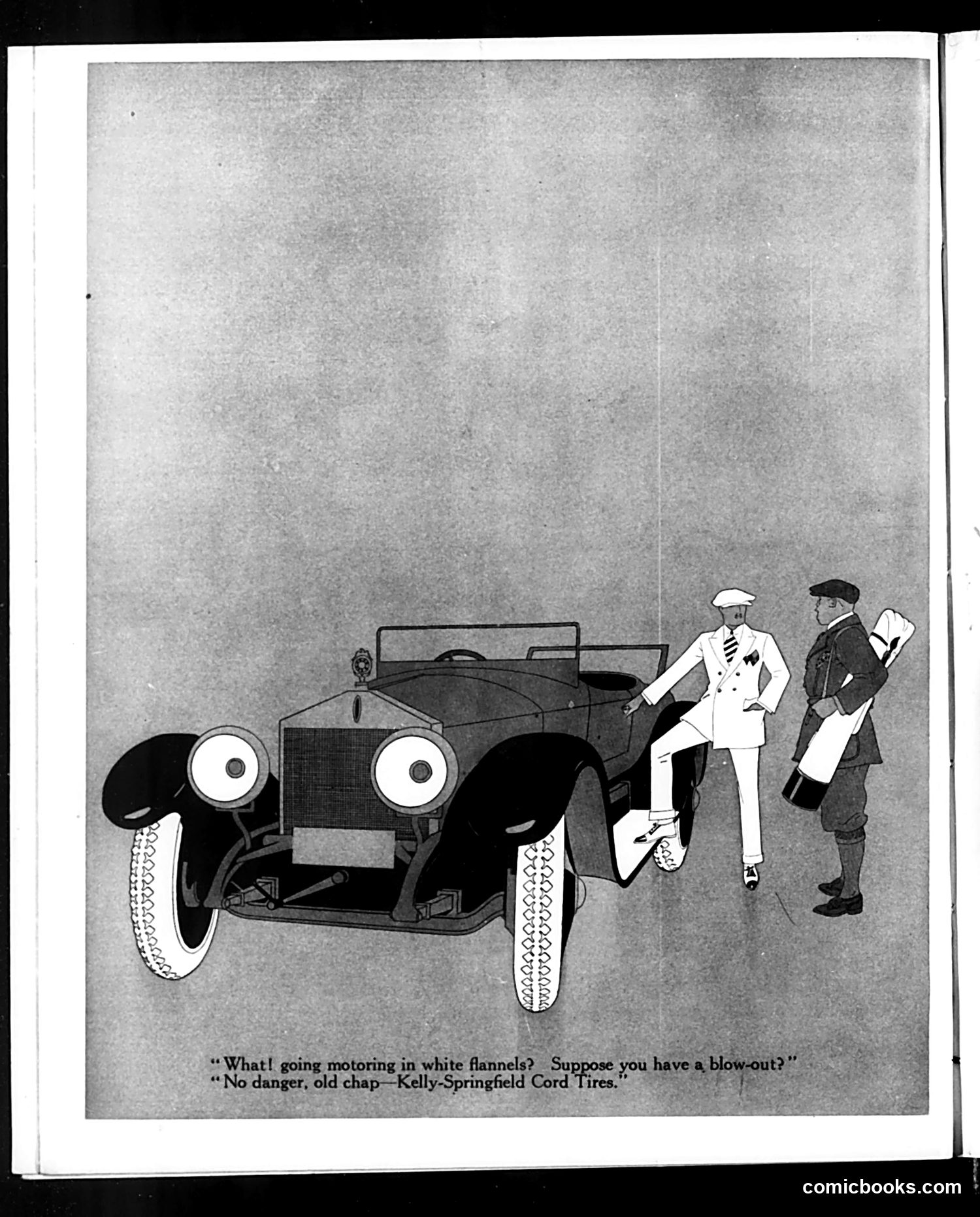
This is an advertisement disguised as a comic dialogue. Two men discuss one man's attire—white flannel clothing—for motoring (driving a car). The first man expresses concern that white flannels are impractical for driving, presumably because they'll get soiled or damaged. The second man reassures him there's "no danger," attributing this confidence to Kelly-Springfield Cord Tires. The joke's premise is that these superior tires are so reliable they won't blow out or cause accidents that would ruin his clothes. It's a humorous pitch suggesting the tire brand is dependable enough to keep one's outfit pristine while motoring—an absurd but effective advertising appeal to early automobile owners concerned about the messiness and unpredictability of early car travel.