
Judge, 1919-03-29 · page 17 of 32
Judge — March 29, 1919 — page 17: what you’re looking at
What you’re looking at
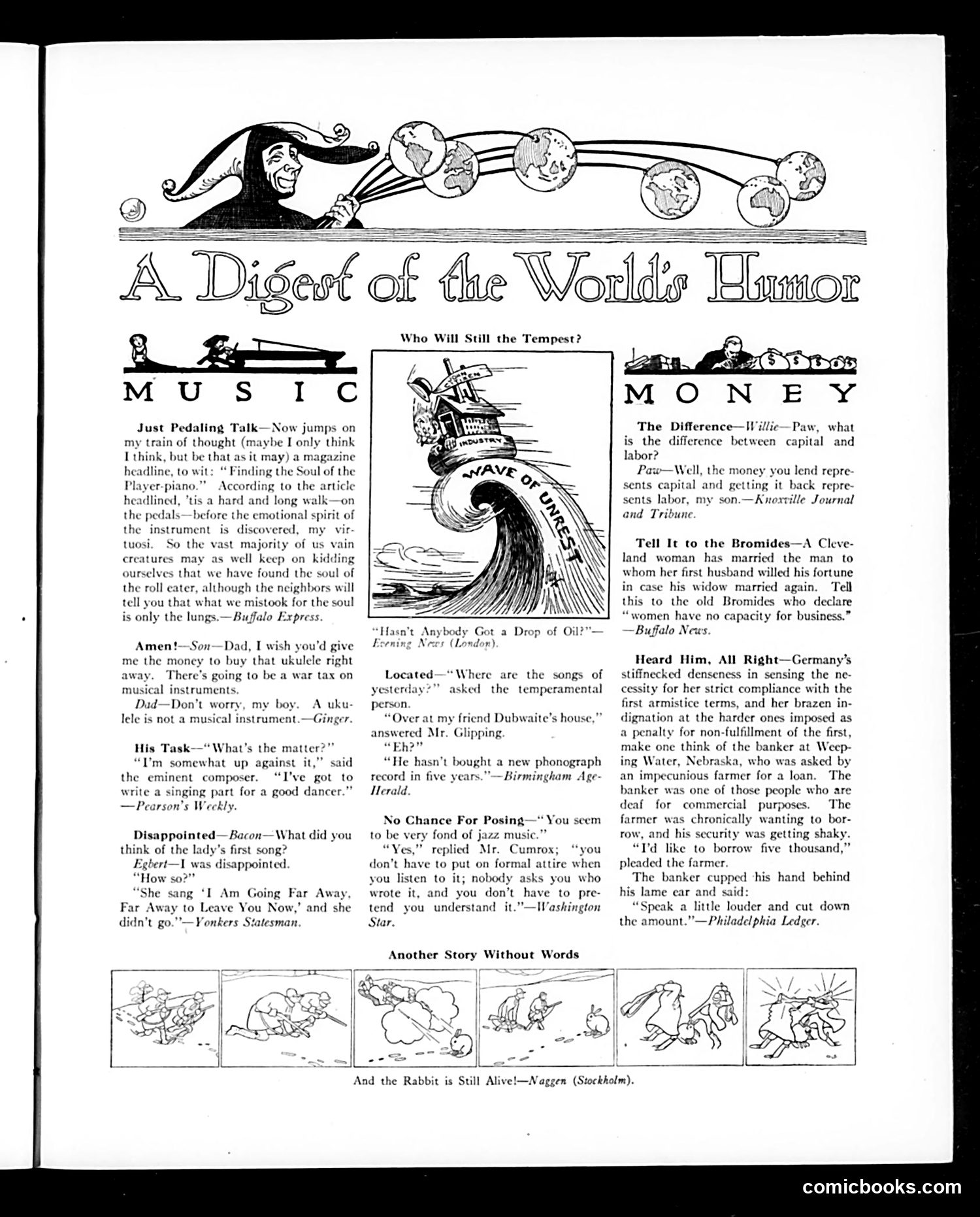
This page from Judge presents satirical humor pieces typical of early 20th-century American comedy. The content reflects post-WWI sensibilities: **Main Cartoons & Jokes:** - Musical instrument jokes mock the player-piano as soulless and ukuleles as non-musical - A piece titled "Who Will Still the Tempest?" uses a ship-in-storm image to satirize Germany's post-WWI intransigence—comparing German stubbornness about armistice terms to a deaf Nebraska banker who won't listen to loan requests - Jazz music satire mocks its informality compared to classical music - A Cleveland woman's remarriage to her late husband's heir is presented as defying the "bromide" (cliché) that women lack business sense **Context:** The German reference suggests this page dates to the immediate post-WWI period when Germany's compliance with Treaty of Versailles terms was contentious. The overall tone reflects Jazz Age social commentary—new musical forms, changing social attitudes, and post-war attitudes toward commerce and propriety.
📄 Transcribed text from this page (OCR, searchable)
Machine-transcribed from the original scan — historical spelling and the odd misread are preserved.
Just Pedaling Talk—Now jumps on my train of thought (maybe I only think I think, but be that as it may) a magazine headline, to wit: “ Finding the Soul of the Player-piano.” According to the article headlined, tis a hard and long walk—on the pedals—before the emotional spirit of the instrument is discovered, my vir- tuosi. So the vast majority of us vain creatures may as well keep on kidding ourselves that we have found the soul of the roll cater, although the neighbors will tell you that what we mistook for the soul is only the lungs.—Buffalo Express. Dad, I wish you'd give me the money to buy that ukulele right aw There's going to be a war tax on musical instruments. Dad—Don't worry A uku- lele is not a musical instrument.—Ginger. Amen!—Son my boy. His Task—‘ What's the mat “I'm somewhat up against it,” said the eminent composer. “I’ve got to write a ng part for a good dancer.” Pearson's Weekly. Disappointed—Bacon—What did you think of the lady’s first song? ert—I was disappointed “How so?” “She sang ‘I Am Going Far Away, Far Away to Leave You Now,’ and she Who Will Still the Tempest? Located—* Where are the songs of yesterday?” asked the temperamental “Over at my friend Dubwaite’s house,” answered Mr. Glipping “Eh?” “He hasn't bought a new phonograph record in five years.” —Birmingham Age- Herald. No Chance For Posing—‘ You seem to be very fond of jazz music “Yes,” replied Mr. Cumrox; don’t have to put on formal attire when you listen to it; nobody asks you who wrote it, and you don’t have to pre- tend you understand it.”—Washington Star, “you Another Story Without Words The Difference—W illie—Paw, what is the difference between capital and labor? Paw—Well, the money you lend repre. sents capital and getting it back repre- sents labor, my son.—Knoxtille Journal and Tribune. Tell It to the Bromides—A Cleve- land woman has married the man to whom her first husband willed his fortune in case his widow married again. this to the old Bromides who d “women have no capacity for business.” —Buffalo News Heard Him, All Right—German: stiffmecked denseness in sensing the ne- cessity for her strict compliance with the first armistice terms, and her brazen in- dignation at the harder ones imposed as a penalty for non-fulfillment of the first, make one think of the banker at Weep- ing Water, Nebraska, who was asked by an impecunious farmer for a loan. The banker was one of those people who are deaf for commercial purposes. The farmer was chronically wanting to bor- row, and his security was getting shaky. “I'd like to borrow five thousand,” pleaded the farmer The banker cupped ‘his hand behind his lame ear and said: peak a little louder and cut down ¢ amount.” —Philadel phia Ledger. comicbooks.com