
A complete issue · 34 pages · 1919
Judge — January 18, 1919
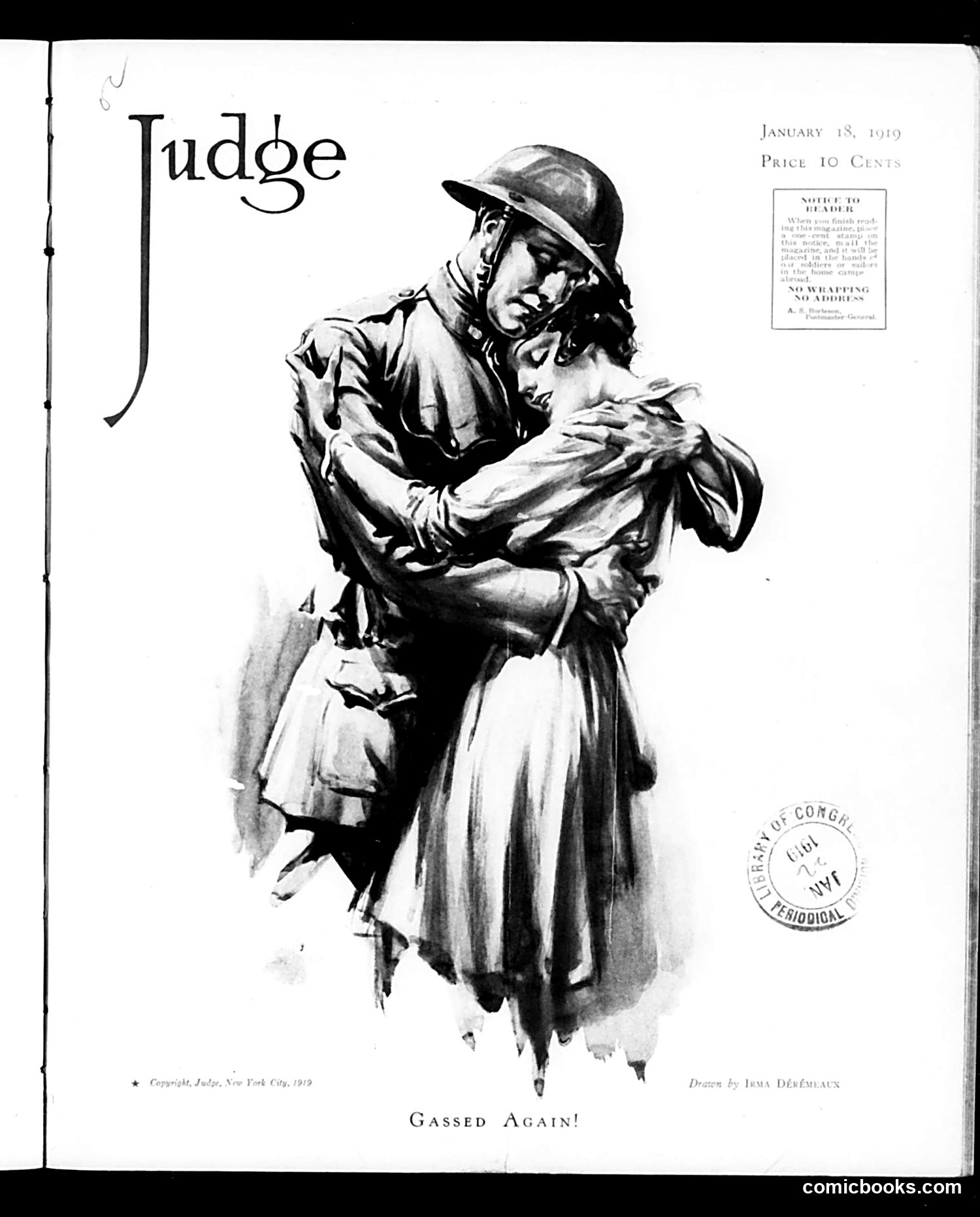
This WWI-era cartoon depicts a soldier in military uniform carrying an injured or unconscious woman, titled "Gassed Again!" The phrase references poison gas attacks—a notorious weapon used extensively in WWI that caused widespread casualties and suffering. The satire likely comments on the ongoing threat or aftermath of chemical weapons during the final months of the war (January 1919 was just after the November 1918 armistice). The "again" suggests repeated exposure to this horrific weapon. The soldier appears as a protector attempting to rescue a civilian woman from gas attacks, possibly satirizing either the military's failure to prevent civilian casualties or the lingering dangers civilians faced even as the war ended. The drawing is credited to Irma Dermeaux.
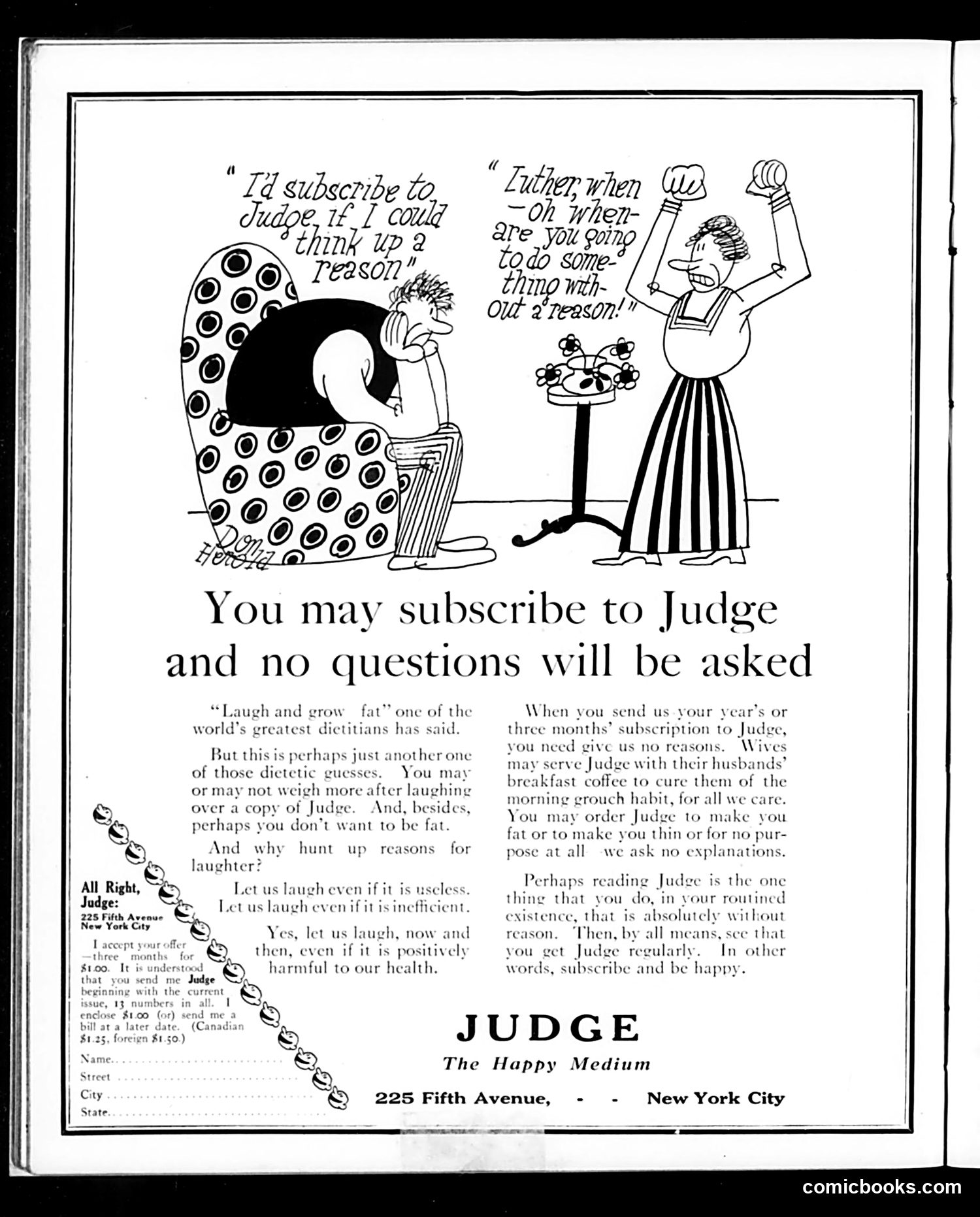
This page is primarily a **subscription advertisement for Judge magazine itself**, not political commentary. The cartoon depicts two figures—a man sitting in an oversized armchair labeled "Judge" and a woman standing nearby—in a humorous domestic scene about leisure and laughter. The ad's central message: subscribing to Judge requires "no questions" about why one wants to laugh. The copy argues that laughter needs no justification, even if "useless" or "inefficient," and that reading Judge offers guilt-free entertainment in one's routine existence. The satire is self-promotional—Judge markets itself as "The Happy Medium," promising subscribers can consume humor without needing to explain or justify the indulgence. It's essentially a lighthearted pitch for the magazine's value as escape entertainment.
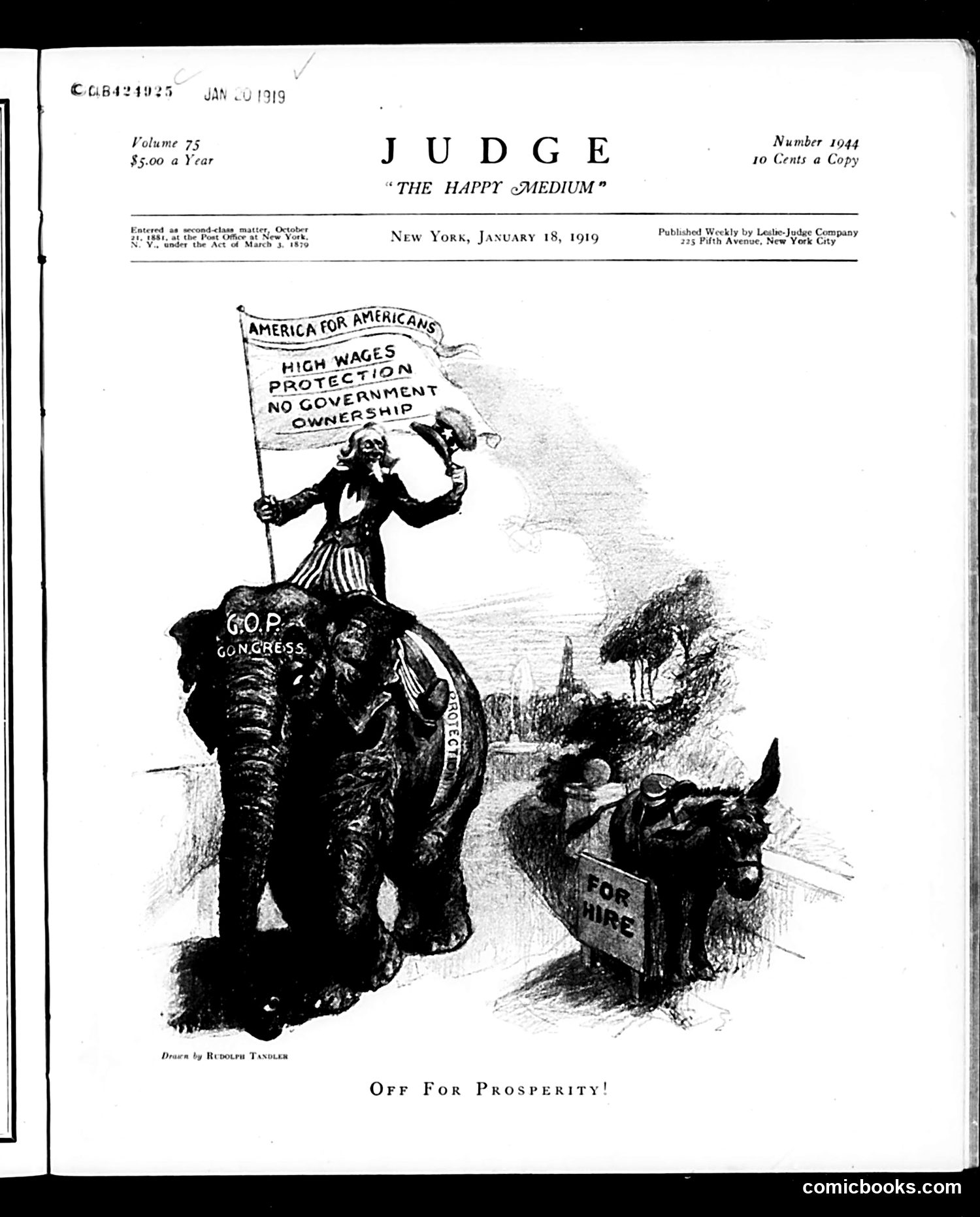
This 1919 Judge magazine cartoon satirizes Republican (G.O.P.) and Congressional policies through animal allegory. An elephant labeled "G.O.P. & CONGRESS" carries a woman representing "AMERICA FOR AMERICANS" who holds a flag advocating "HIGH WAGES, PROTECTION, NO GOVERNMENT OWNERSHIP." A mule labeled "FREE TRADE" follows behind, appearing to pull in the opposite direction—suggesting internal contradiction in Republican economic messaging. The cartoon critiques the party's claim to support American workers and prosperity while seemingly working against its own stated goals. The post-WWI timing (January 1919) reflects contemporary debates over trade policy, labor wages, and government's economic role as America transitioned from wartime to peace.
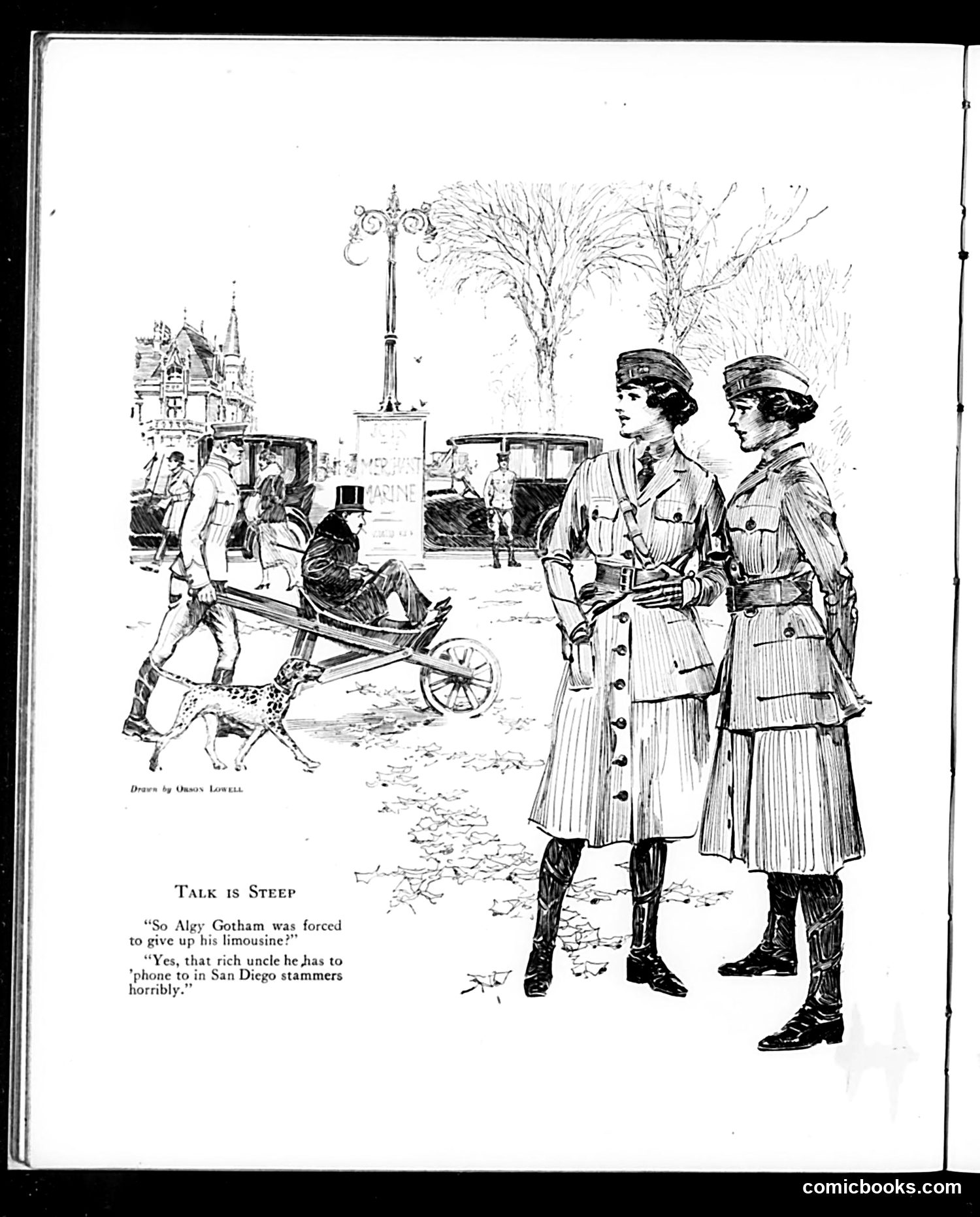
This cartoon satirizes wealthy San Diego resident **Algy Gotham**, who was forced to surrender his limousine. The joke hinges on his uncle's stammer: when asked why Gotham gave up the luxury vehicle, the response is that "that rich uncle he has to 'phone to in San Diego stammers horribly." The humor relies on a pun—the uncle's speech impediment ("stammers") sounds like "San Diego stammers," suggesting the uncle is reluctant or hesitant to fund Gotham's lavish lifestyle. The two uniformed women in the foreground appear to be observers of this social comedown, possibly representing wartime concerns about excess consumption during an era (likely WWI) when such displays of wealth faced public scrutiny or rationing pressures.
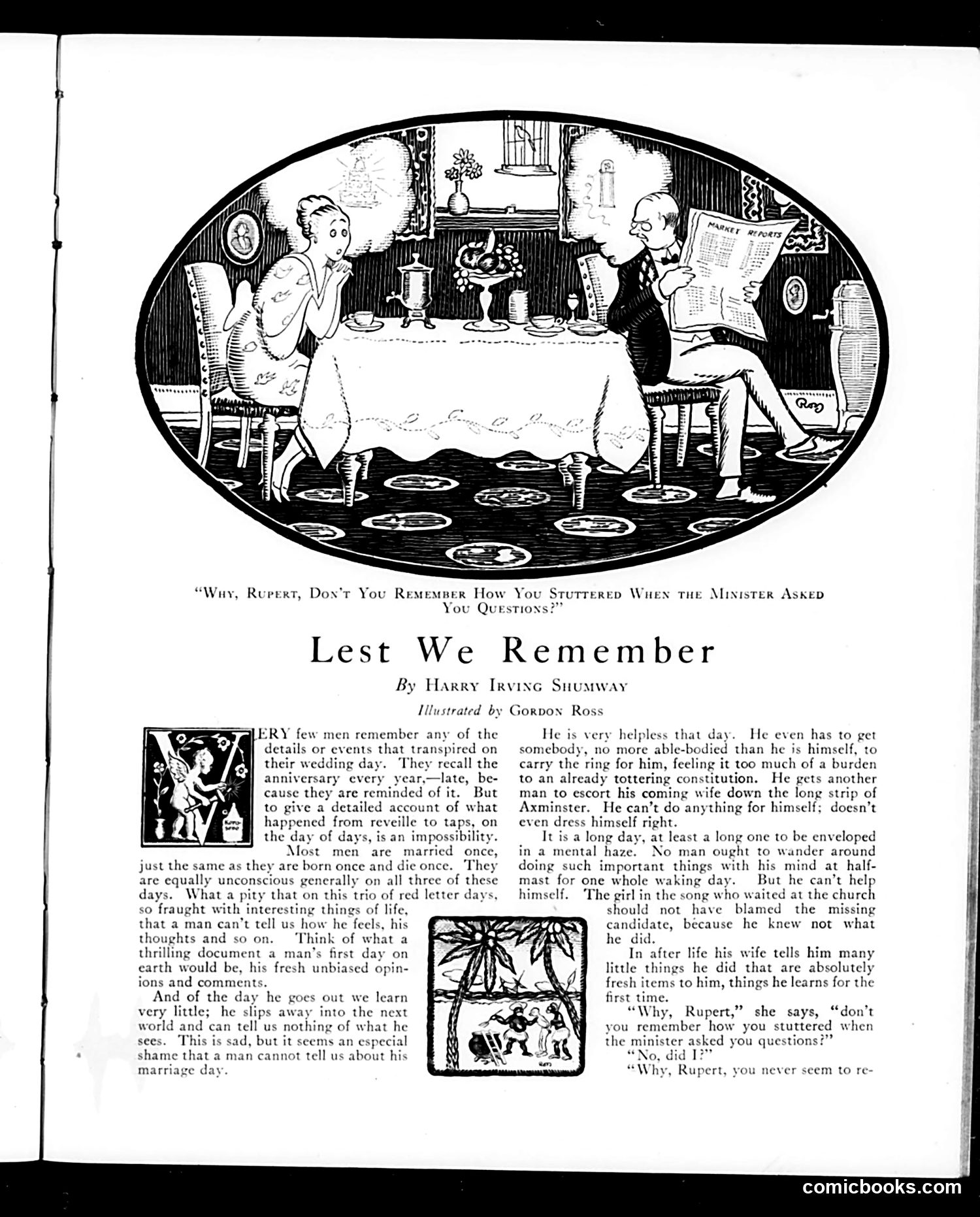
This is a humorous short story about married life, illustrated by Gordon Ross. The main cartoon depicts a couple at dinner, with the caption referencing the husband "Rupert" stuttering when questioned by a minister. The satire concerns the selective memory of married couples regarding embarrassing wedding-day moments. The story suggests that while men cannot discuss their weddings in detail, wives perpetually remind them of awkward incidents—in this case, Rupert's stutter during the marriage ceremony. The joke plays on the contrast between a man's desire to forget embarrassing moments and a wife's determination to preserve them in memory. It's gentle domestic satire about marriage, memory, and gender dynamics typical of early 20th-century Judge magazine humor.
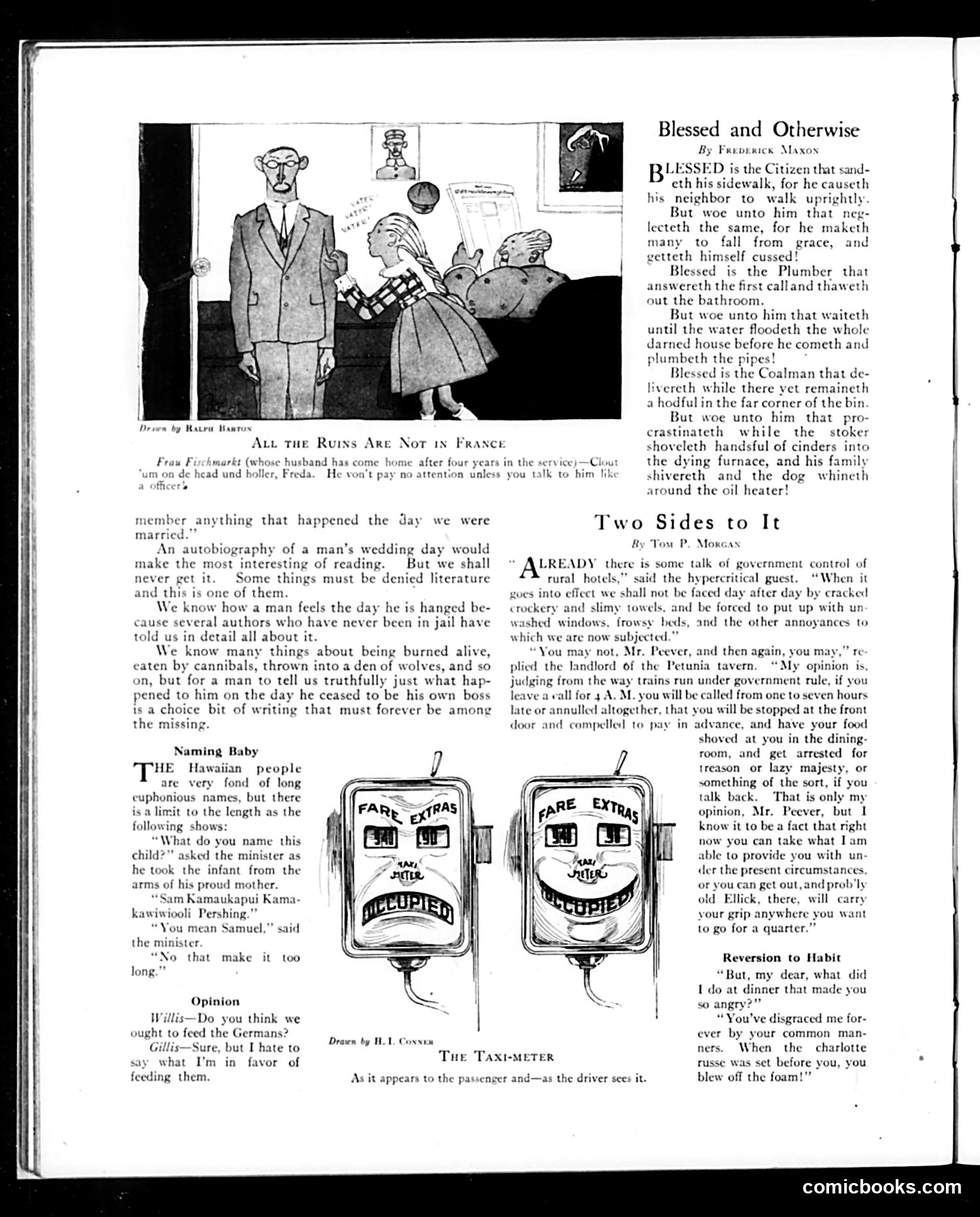
The main cartoon, "All the Ruins Are Not in France," depicts a domestic scene where a serviceman has returned home after four years of military service. The satire concerns the deterioration of his home—a flooded bathroom, broken plumbing, and general decay—suggesting that the "ruins" of war aren't limited to European battlefields but extend to the American home front. The accompanying text and related pieces ("Naming Baby," "Two Sides to It," "The Taxi-meter") address post-WWI readjustment issues: returning soldiers, inflation, government services, and changing social norms. The humor targets both wartime disruptions and contemporary frustrations with bureaucracy and domestic management during the post-war period.
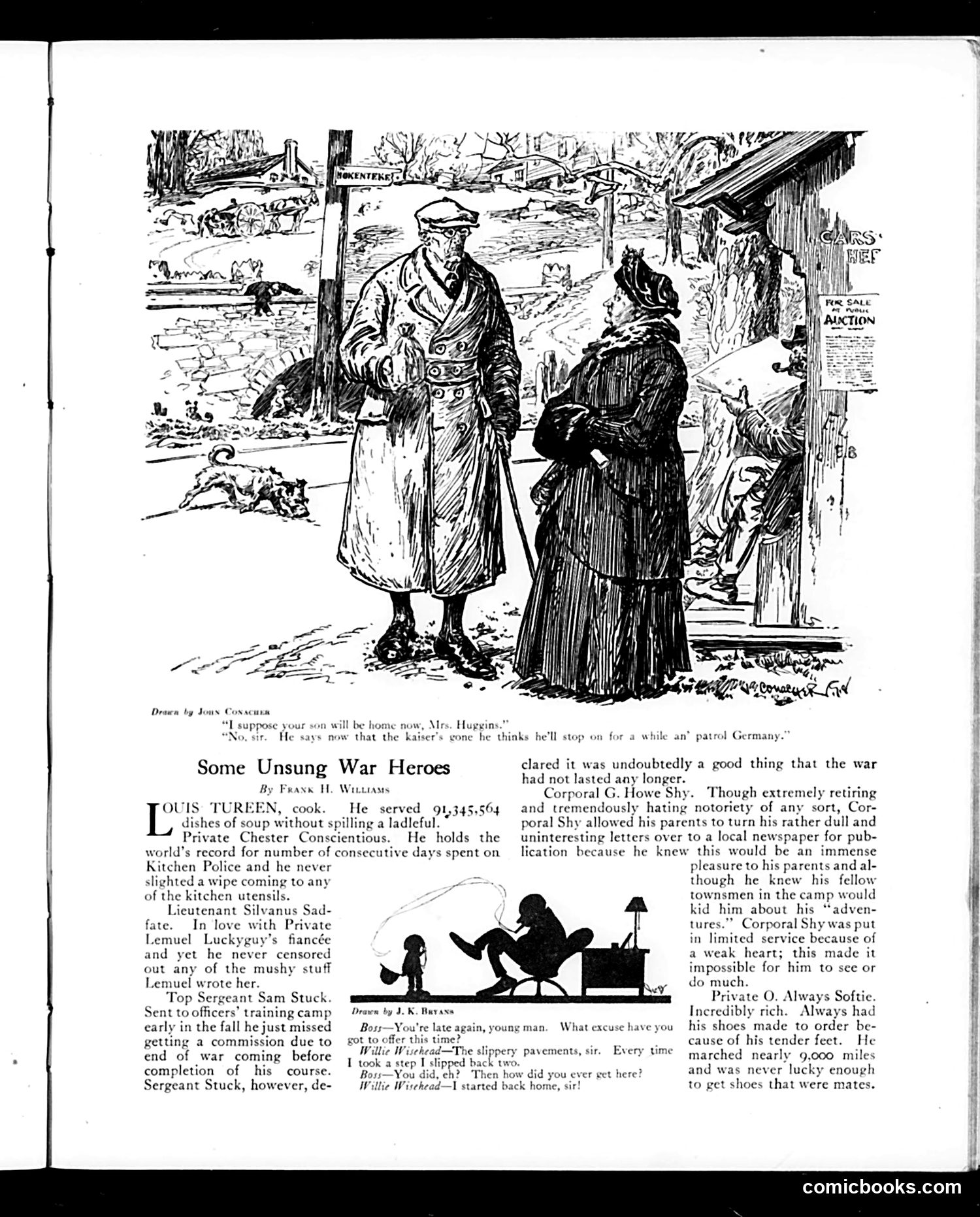
This satirical piece from *Judge* magazine mocks various soldier stereotypes from World War I through humorous character sketches. The top cartoon shows a domestic scene where a woman mentions her son wants to continue "patrolling Germany" now that the Kaiser is gone—satirizing soldiers' reluctance to leave military service. The text profiles absurd "war heroes": Louis Tureen, a cook obsessed with soup; Private Chester, who excels at kitchen duty; Lieutenant Silvanus, lovelorn but ethical; Top Sergeant Sam, who just missed a commission when the war ended; and others like Corporal Shy (publicity-averse) and Private Softie (wealthy but tender-footed). The lower cartoon depicts a boss interrogating "Willie" about tardiness, with Willie blaming "slippery pavements"—only to admit he walked backward home. The satire targets military bureaucracy, absurd promotion hierarchies, and the mundane reality of wartime service behind combat lines—highlighting how ordinary or ridiculous many soldiers' actual duties were.
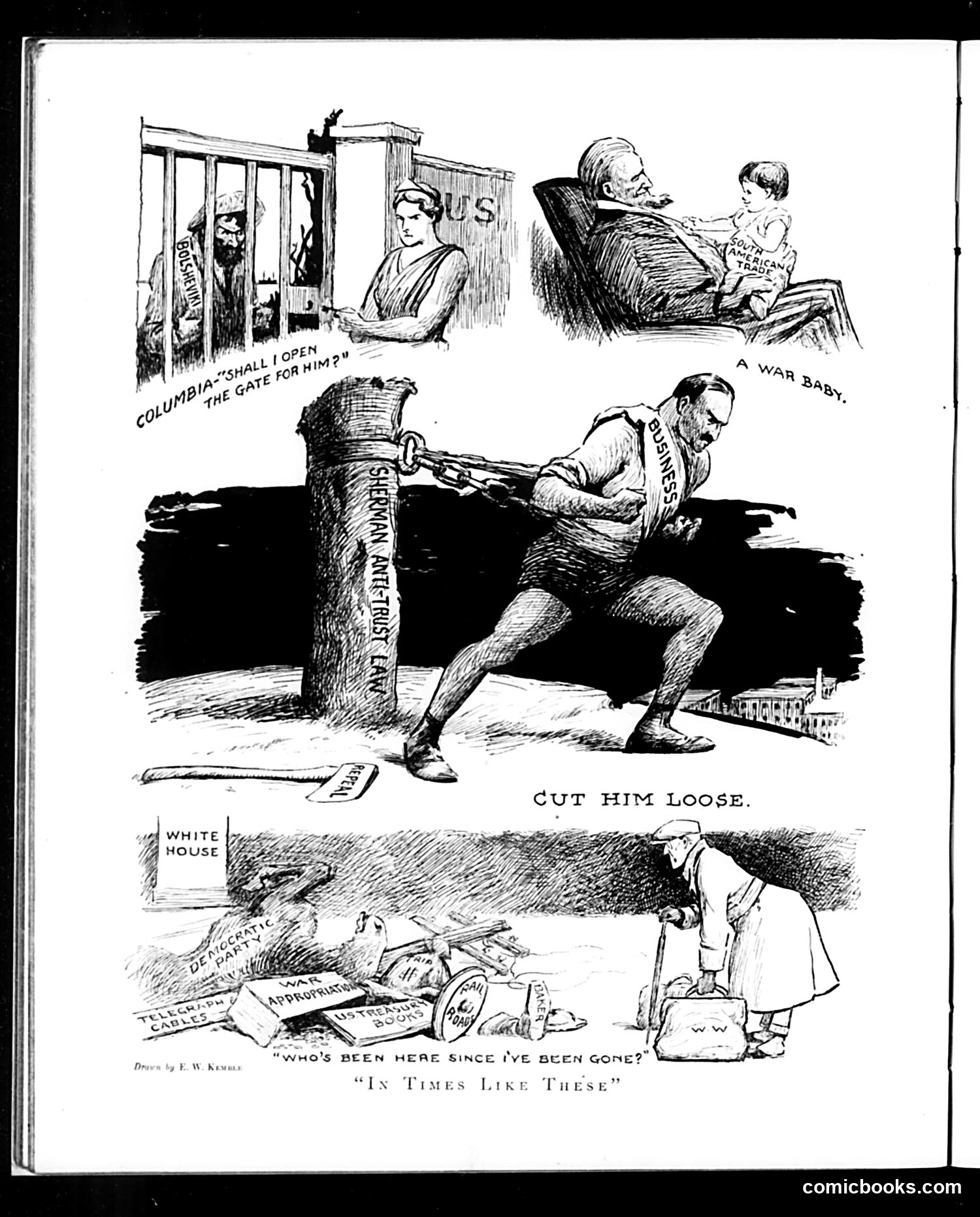
This four-panel cartoon titled "In Times Like These" critiques American preparedness during World War I. The top panels show Columbia (personified America) opening a gate to release prisoners and a man holding a "war baby." The middle panel depicts a man labeled "Business" chained to a post, being forced to cut himself loose—satirizing calls for industrial mobilization. The bottom panel shows the White House with scattered war materials and a woman asking "Who's been here since I've been gone?"—suggesting chaos and mismanagement of war preparations. The cartoon attacks the Wilson administration's handling of military readiness and industrial coordination, depicting America's response as disorganized and inadequate. The imagery suggests those in power have abandoned responsibility during crisis.
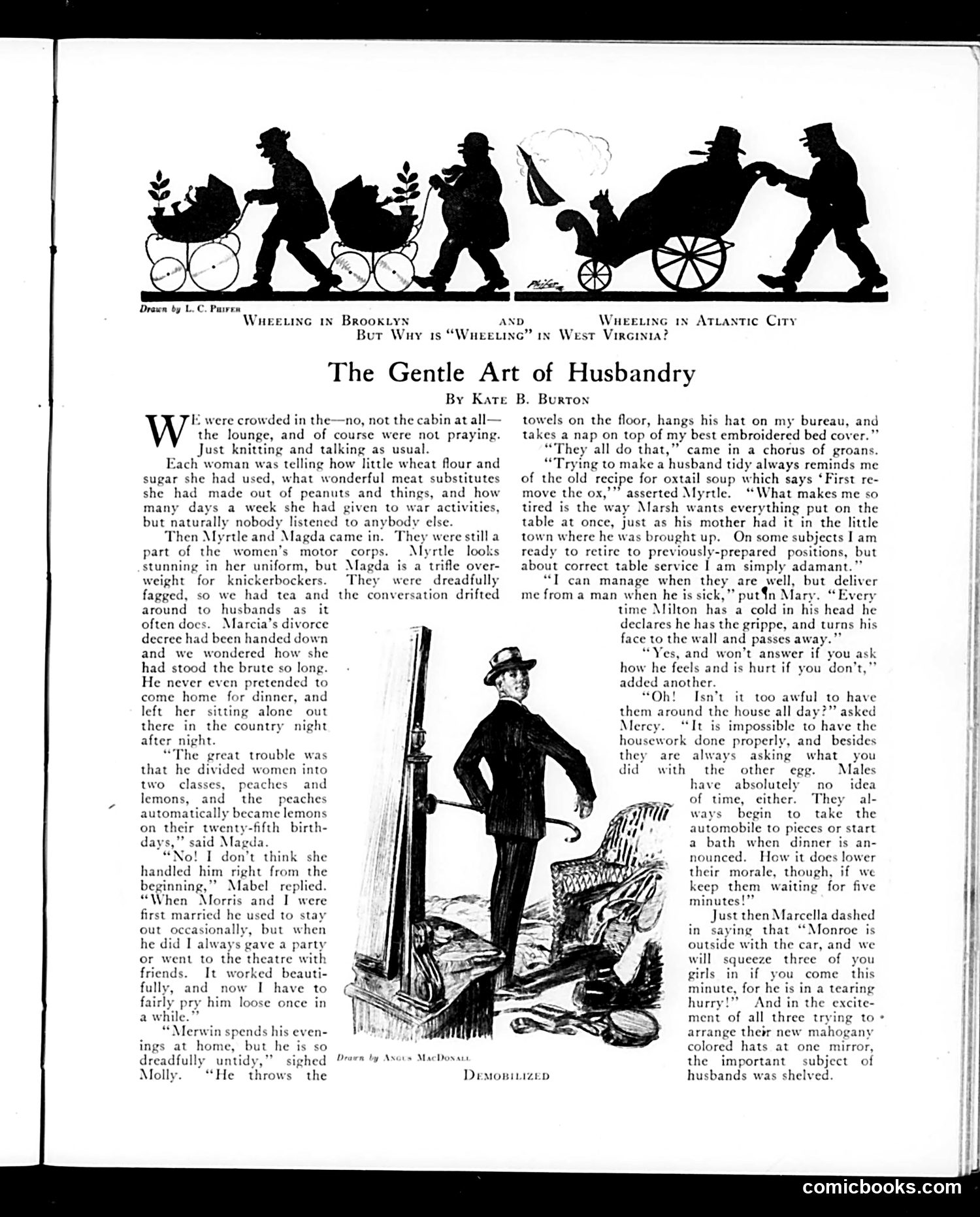
This is a satirical story (not primarily a political cartoon) about women during World War I complaining about their husbands. The silhouette cartoon at top mocks the term "wheeling" as used differently in Brooklyn, Atlantic City, and West Virginia—likely a period slang reference now obscure. The story itself satirizes domestic life during wartime. Women in a motor corps discuss how to "manage" husbands who are messy, clingy, hypochondriacal, and demanding. The humor targets both sexes: husbands for being helpless and petulant, wives for treating marriage as a strategic problem to "handle." The underlying satire is that despite women taking on war work and wartime responsibilities, they're still expected to coddle unreasonable husbands. The oxtail soup joke ("first remove the ox") suggests husbands are the real problem to eliminate. The story ends with shallow domesticity—arranging hats—interrupting serious marital discussion, mocking how women's concerns were dismissed as trivial.
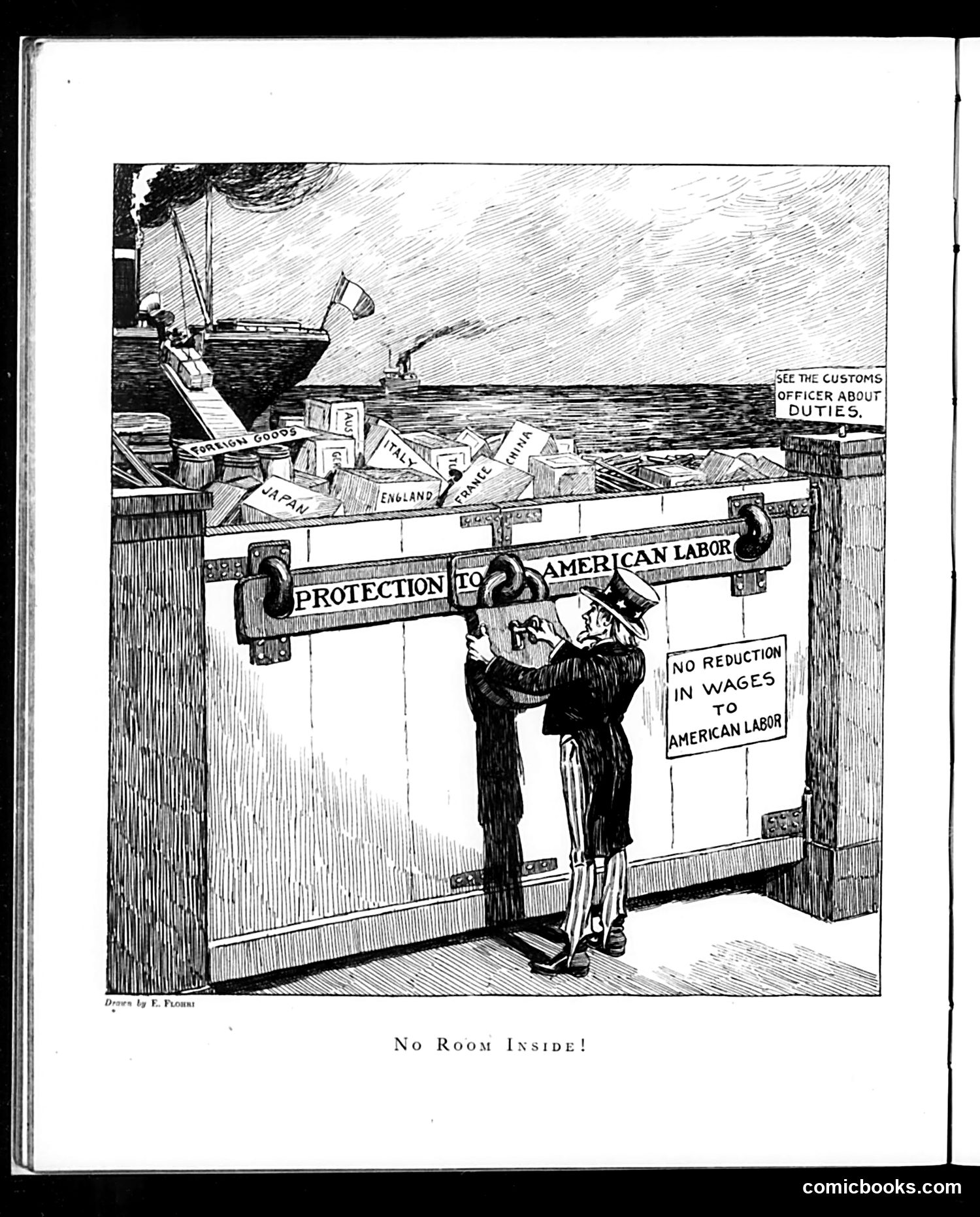
This cartoon satirizes American protectionism and labor policy. A figure representing American labor (depicted as Uncle Sam or a worker) stands guard at a gate labeled "PROTECTION TO AMERICAN LABOR," blocking entry. The gate displays "NO REDUCTION IN WAGES TO AMERICAN LABOR." A ship in the background carries cargo labeled with foreign goods (Japan, England, France, China), suggesting international trade. The customs officer message reinforces the trade-control theme. The satire critiques the contradiction in protectionist policy: while claiming to protect American workers from wage cuts, such policies may actually restrict economic opportunity and ironically harm labor by limiting commerce. The "No Room Inside" title suggests protectionism creates an exclusionary, economically cramped environment rather than genuine protection.
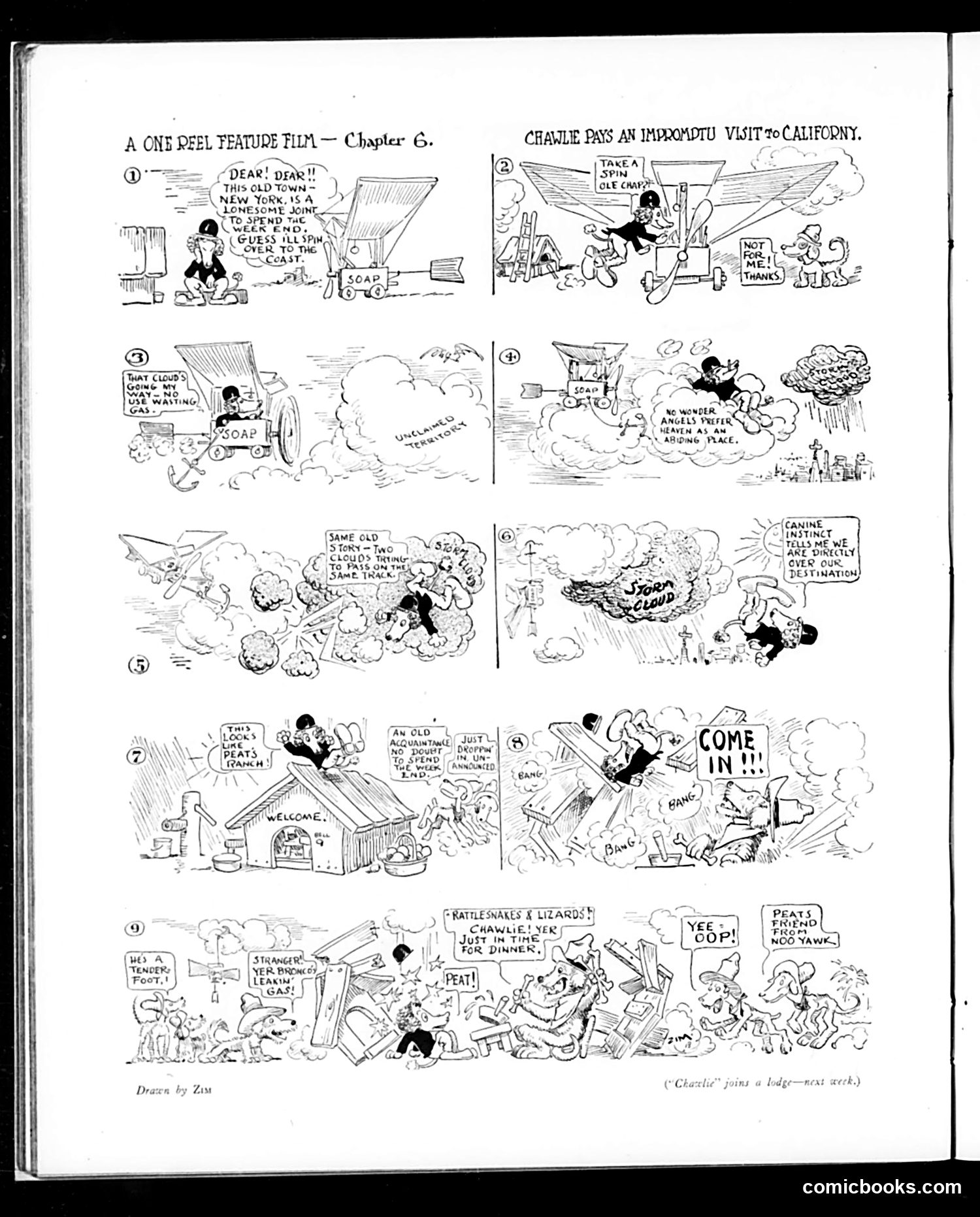
This is a nine-panel comic strip parodying early silent films, specifically Charlie Chaplin's character (the "Tramp"). The narrative follows "Charlie" traveling from New York to California, depicted as a comedic odyssey involving literal clouds that transport him. The satire targets the romanticization of California as an escape destination—a "lonesome joint" New Yorker dreams of fleeing to. The humor relies on slapstick and absurdist scenarios typical of 1920s comedy: Charlie riding clouds, encountering rattlesnakes and lizards, and crashing into a cabin with rustic characters. The strip mocks both urban ennui and frontier clichés, presenting California through exaggerated, fantastical elements. The phrase "Canine instinct tells me we are directly over our destination" plays on the period's casual racism regarding Native Americans and the West. This reflects Judge magazine's satirical approach to contemporary American culture, leisure travel, and the film industry's influence on public imagination.
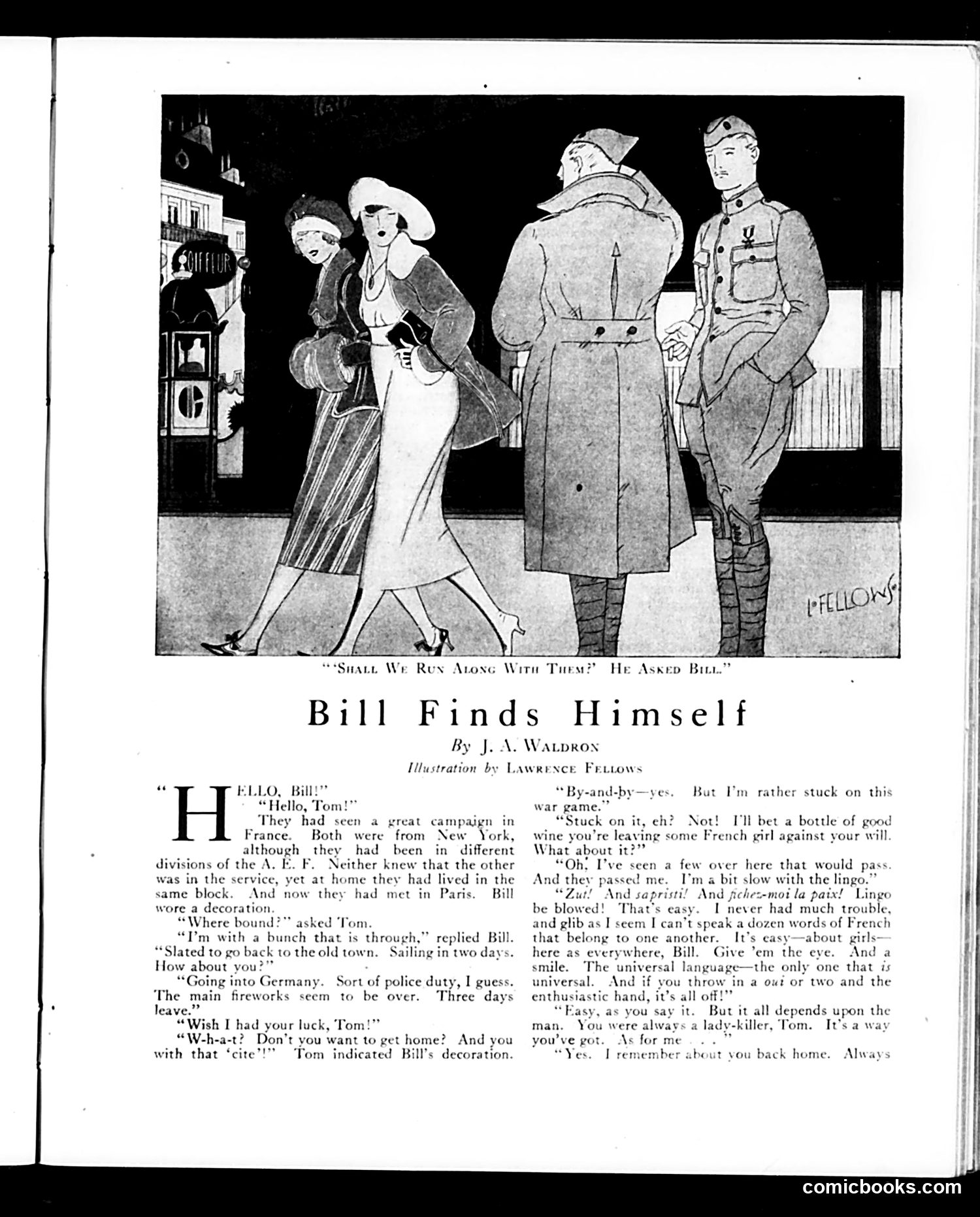
This post-World War I story depicts two American soldiers from New York reuniting in Paris after the war's main fighting has ended. Bill wears a military decoration, suggesting combat service, while Tom appears to have had easier duty ("police duty"). The satire centers on **romantic entanglement**: Tom teases Bill about leaving behind a French girlfriend, implying Bill is reluctant to return home. The joke plays on the stereotype of American soldiers fraternizing with French women during the war—a common source of social anxiety about soldiers' loyalty and morality. The dialogue mocks language barriers ("fichez-moi la paix," the struggles with French) while suggesting that romance transcends language through "the universal language" of flirtation and physical gesture. The illustration shows two military officers alongside the two women, likely depicting the romantic complications at the story's heart. The piece satirizes both soldier behavior abroad and post-war readjustment anxieties.
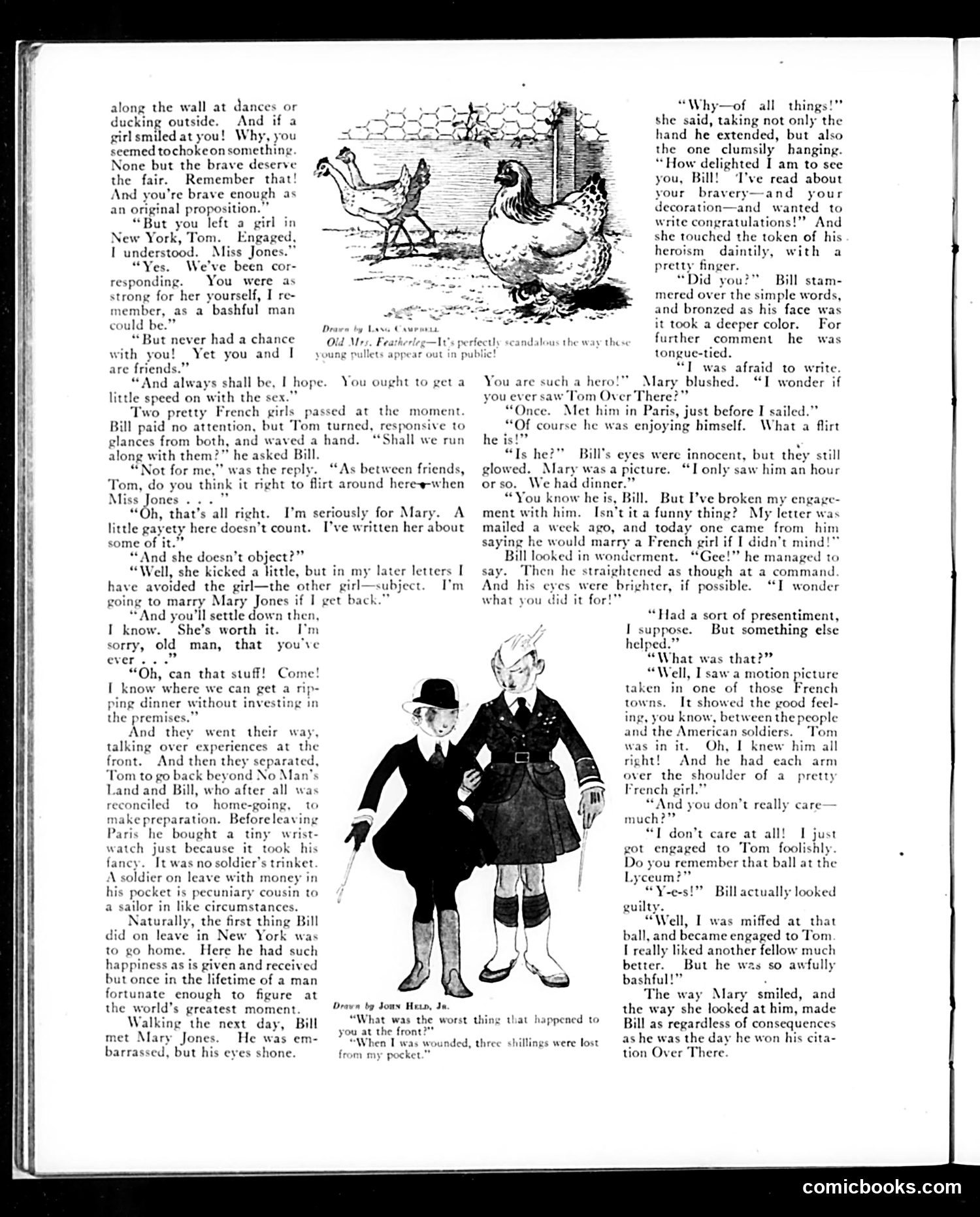
This page contains a serialized romantic story set during World War I, featuring two American soldiers—Bill and Tom—on leave in Paris. The narrative depicts their contrasting approaches to romance: Tom flirts with French girls and maintains a secret engagement back home with Mary Jones, while Bill remains faithful. The central joke involves dramatic irony: Tom writes Mary claiming he'll marry a French girl if she objects to his behavior, intending this as a jest. Mary takes him seriously, breaks their engagement, and coincidentally reconnects with Bill—who has long harbored deeper feelings for her. The two small illustrations show the soldiers in military dress and later depict the pivotal meeting between Bill and Mary. The satire gently mocks wartime romance, male bravado, and the gap between soldiers' wartime escapades and their domestic commitments. The story celebrates Bill's quiet virtue over Tom's flashy infidelity, reflecting period values about masculine honor and constancy.
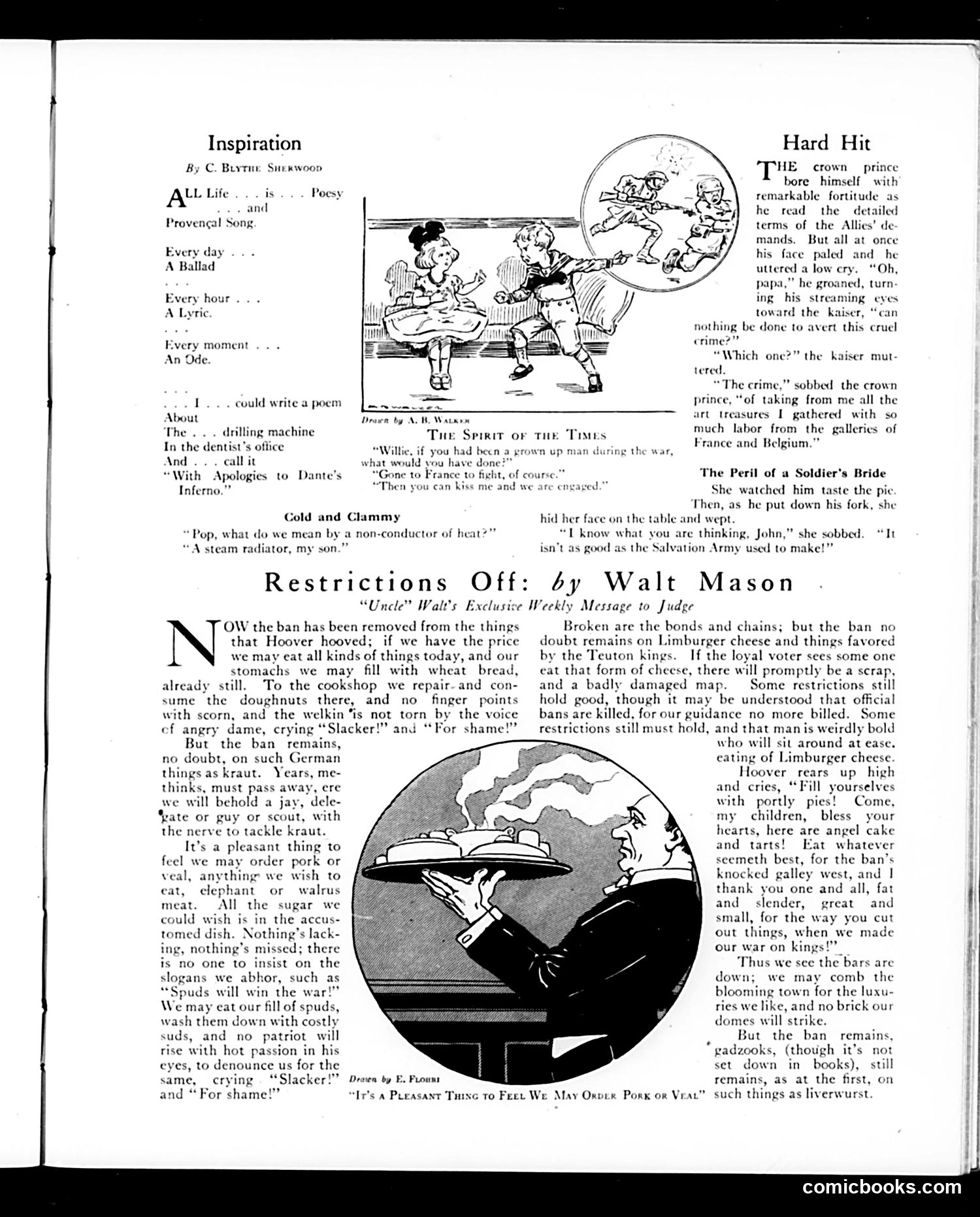
This page reflects post-World War I America, specifically the period after Prohibition's repeal (when President Hoover's wartime food restrictions were lifted). The satire targets the disconnect between official policy changes and lingering social attitudes. **"Restrictions Off"** by Walt Mason mocks the paradox: while the government removed bans on foods like pork, doughnuts, and sugar, Americans remained culturally afraid to consume German-associated items like sauerkraut and Limburger cheese. Citizens feared being called "Slacker" (unpatriotic) by angry neighbors, even though restrictions were officially gone. The cartoon suggests that social policing outlasted legal restrictions—people internalized wartime sacrifice so thoroughly that they couldn't shake the guilt of eating "enemy" foods, despite official permission. **"Hard Hit"** satirizes German royalty, with the Kaiser's son lamenting losing art treasures from French and Belgian galleries—a dark joke about looting during occupation. The other brief comedic pieces are unrelated filler typical of Judge magazine's format.
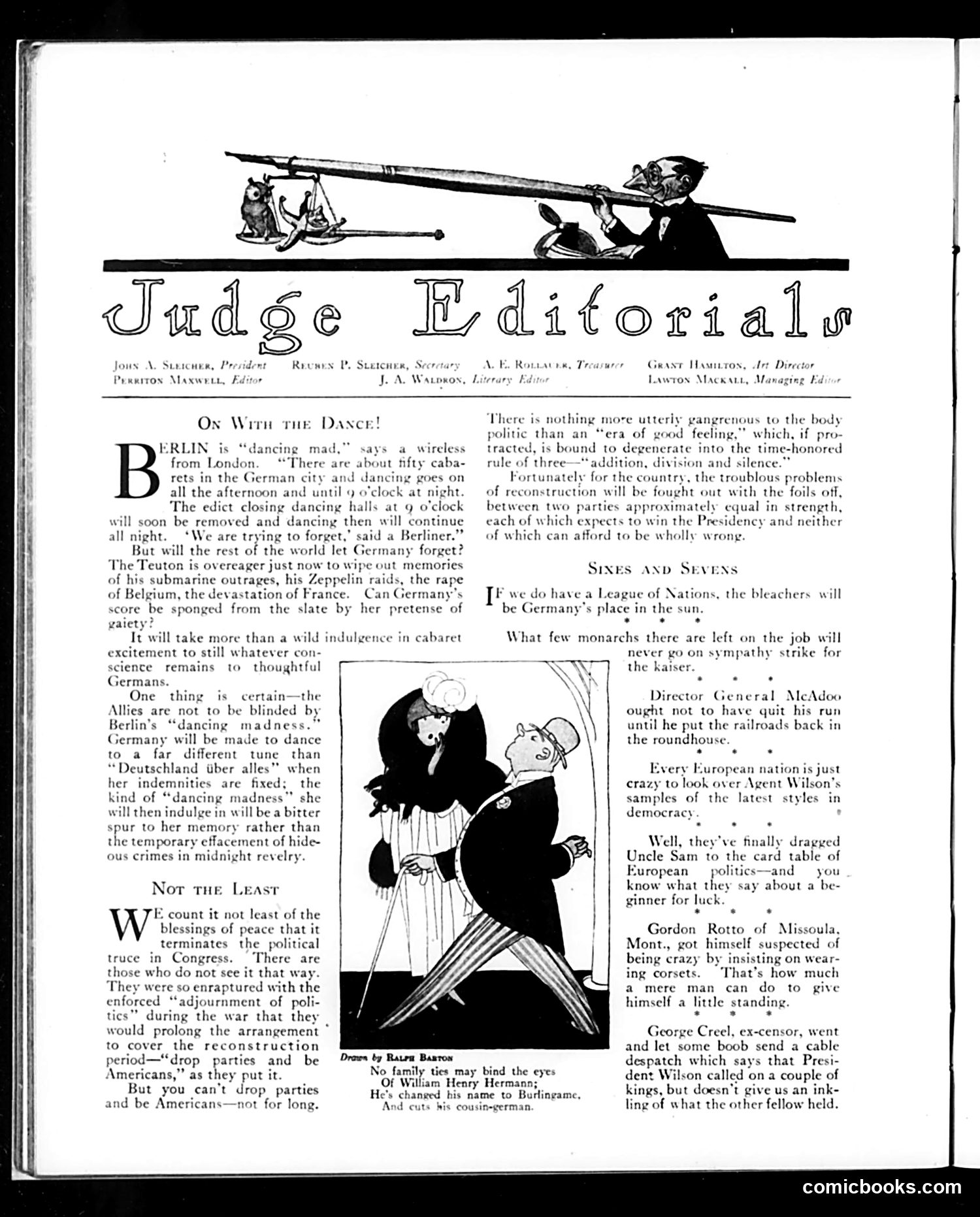
This page presents post-WWI American political commentary, likely from 1918-1919. **Main Cartoon**: Ralph Barton's illustration depicts two figures—one appears to be William Henry Hermann (a German-American who changed his name to Burlingame to hide his heritage), with the caption criticizing him for renouncing family ties during the war period. **"On With the Dance"**: Satirizes Berlin's frenzied cabaret culture as Germans attempt to forget wartime atrocities (submarine warfare, Zeppelin raids, Belgium's invasion, French devastation). The editorial argues no amount of revelry will erase Germany's guilt or shield them from Allied reparations demands. **"Nor the Least"**: Celebrates Congress resuming partisan politics after wartime political truce, arguing genuine American democracy requires party competition. **"Sixes and Sevens"**: A column of brief jabs at postwar figures, including Director General McAdoo (railroad administrator), President Wilson's diplomatic inexperience, and ex-censor George Creel. The overall tone: skeptical of German redemption efforts and optimistic about American democratic restoration.
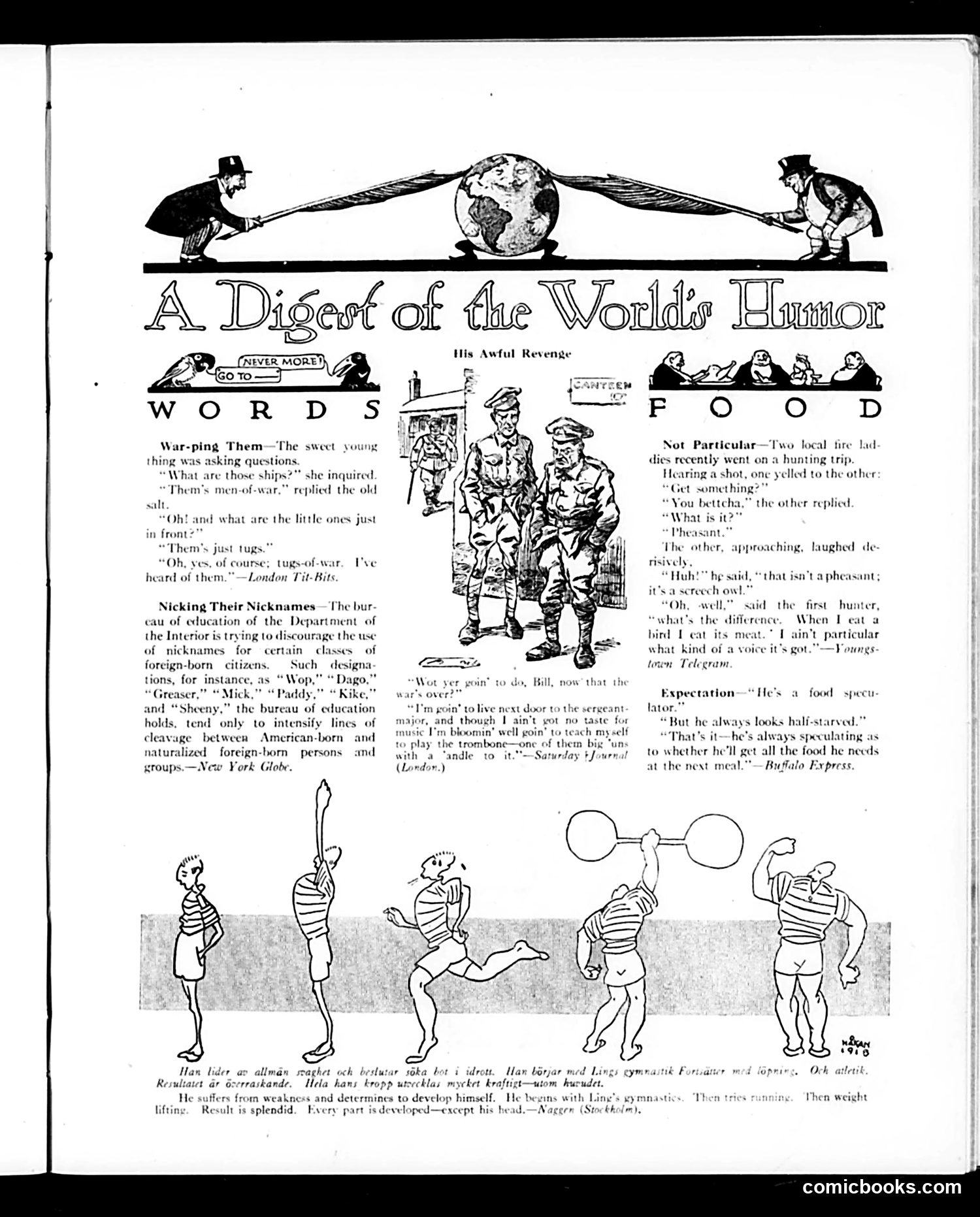
This page from *Judge* contains three separate humorous pieces: **"War-ping Them"**: A simple pun-based joke where a woman mishears "men-of-war" (warships) and "tugs" (small boats), interpreting "tugs-of-war" as the latter—playing on her naïveté about military terminology. **"Nicking Their Nicknames"**: Social commentary on the U.S. Interior Department's effort to discourage ethnic slurs against foreign-born citizens (terms like "Mick," "Paddy," "Kike," "Sheeny"). The satire criticizes these assimilation efforts, suggesting such nicknames create divisions—though the cartoon's perspective on whether this criticism supports or mocks the policy remains unclear. **"Not Particular"** and **"Expectation"**: Two brief hunting/food jokes about indiscriminate eaters, with no obvious political content. The page also includes a Swedish-captioned illustration about physical development through exercise. Overall, this reflects early 20th-century American humor mixing wordplay, ethnic commentary, and everyday social observation typical of *Judge's* satirical approach.
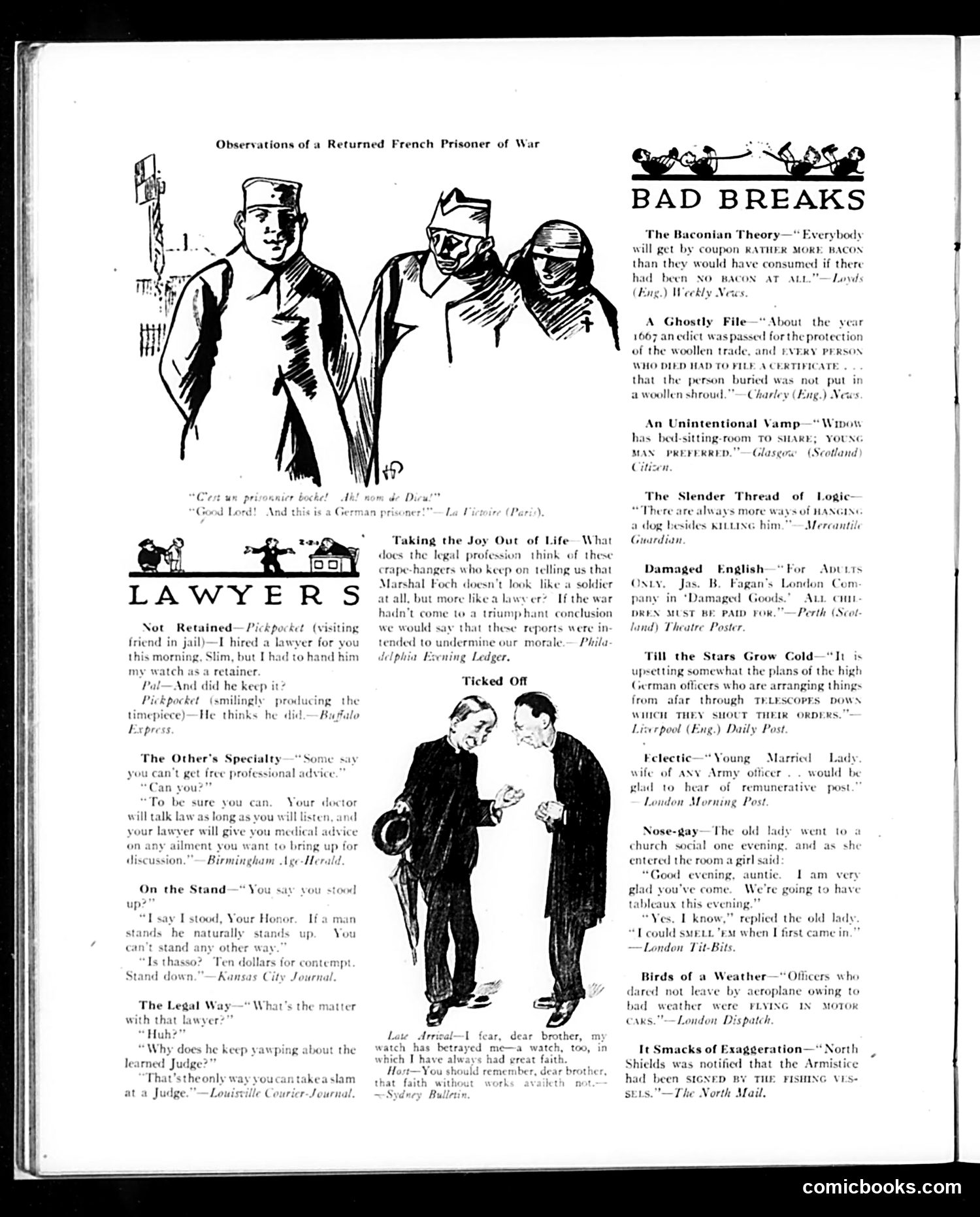
This page presents satirical observations attributed to a French WWI prisoner, framed as humorous cultural commentary. The top cartoon shows four figures—apparently German officers or guards—with the caption suggesting confusion about prisoner identity ("Is this a prisoner, back? C'est un prisonnier, back?"). The bulk of the page is the "Bad Breaks" section: humorous misreadings of newspaper clippings and advertisements that reveal unintended meanings through selective capitalization. For example, a bacon ration notice becomes about consuming "MORE BACON," while a woolen trade edict becomes about filing certificates for the dead. These are not political cartoons but rather **newspaper humor exploiting typographical ambiguity**—a popular Judge magazine format. The satire targets careless journalism, wartime regulations, and absurd literal readings rather than specific political figures or events. The humor relies on readers recognizing the original texts being lampooned.
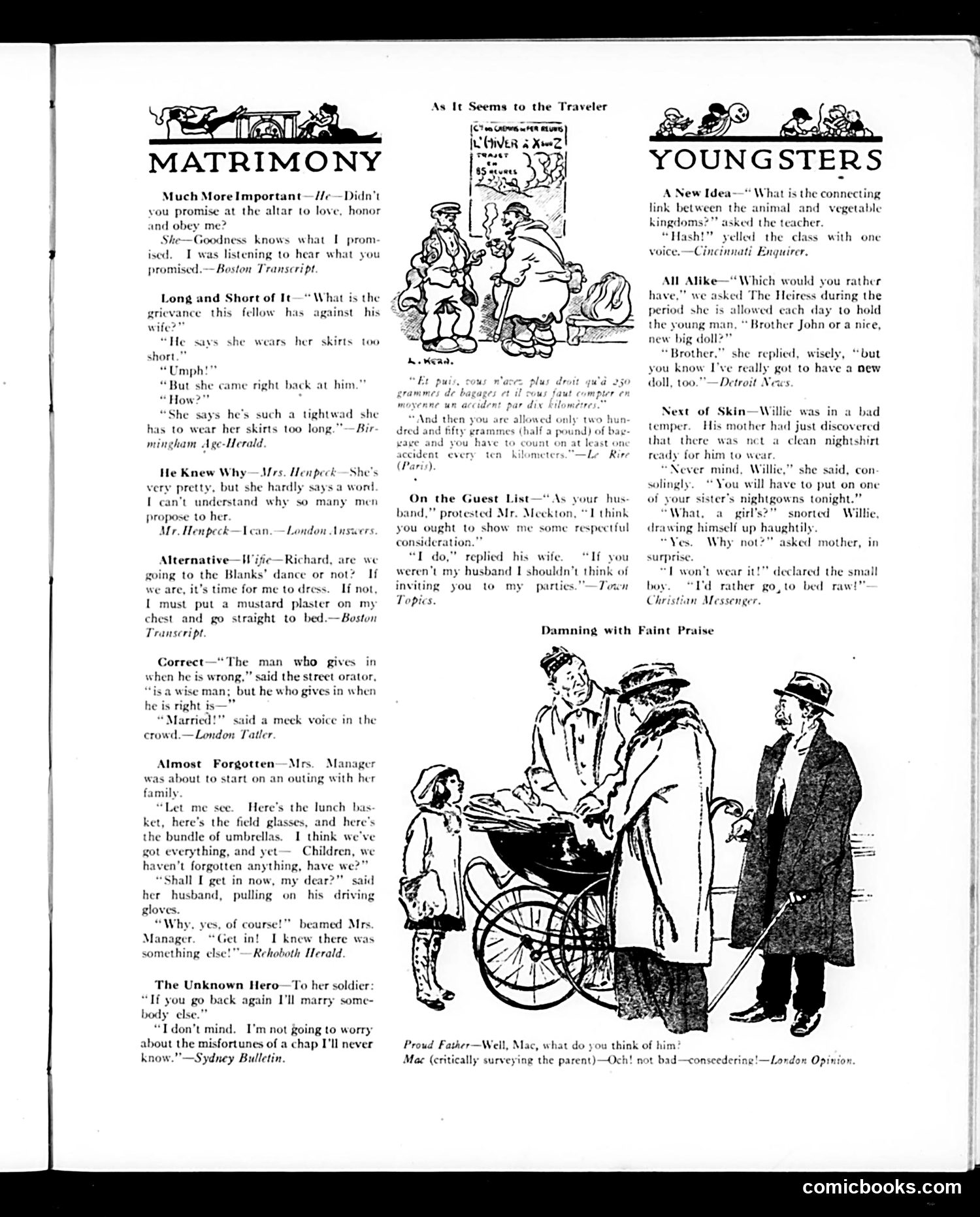
This page contains humorous short jokes about marriage and family life, reflecting early 20th-century domestic satire. The content targets conventional gender relations and marital dynamics. **Matrimony section**: Multiple quips mock husbands and wives—wives who don't listen, wear impractical skirts, or dominate ("Mrs. Henpeck"), and husbands who are cheap or emasculated. "Almost Forgotten" jokes about a husband so insignificant his wife nearly leaves without him. **Youngsters section**: Children deliver innocent but pointed observations. A boy refuses his sister's nightgown, and a teacher's question about animal-vegetable links gets the answer "Hash"—absurdist humor mocking education. **"Damning with Faint Praise"**: A critical observer backhanded compliments someone's parent as "not bad—considering." The cartoons and jokes satirize domestic hierarchies, marital tension, and class pretension typical of Judge's satirical humor—nothing partisan or politically specific appears here.
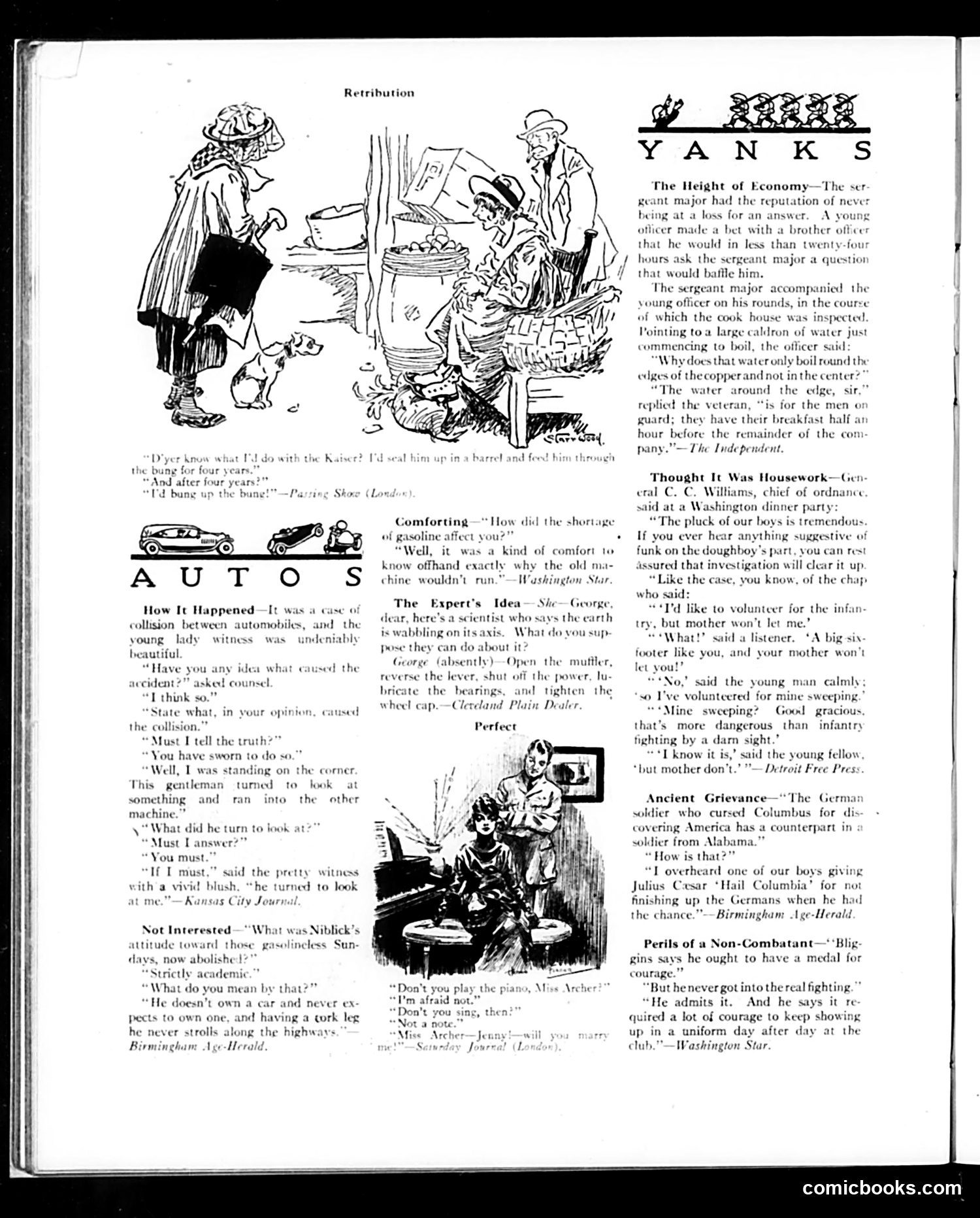
This page contains several short humorous anecdotes rather than traditional political cartoons. The jokes reflect World War I-era American concerns: **"Retribution"** satirizes courtroom testimony—a pretty witness admits she distracted a driver, leading to a collision. The humor relies on vanity and the absurdity of enforced truth-telling. **"Not Interested"** mocks someone indifferent to automobiles due to disability ("cork leg") and lack of ownership—social commentary on emerging car culture. **War-related humor dominates the right column**: "Thought It Was Housework" and "Ancient Grievance" both joke about soldiers' courage and mothers preventing enlistment. "Perils of a Non-Combatant" satirizes someone claiming valor for merely wearing a uniform at a club rather than actual combat service. These reflect 1917-1918 anxieties: masculinity, military service expectations, and the tension between home-front and combat experiences. The satire targets both those avoiding duty and those falsely claiming bravery.
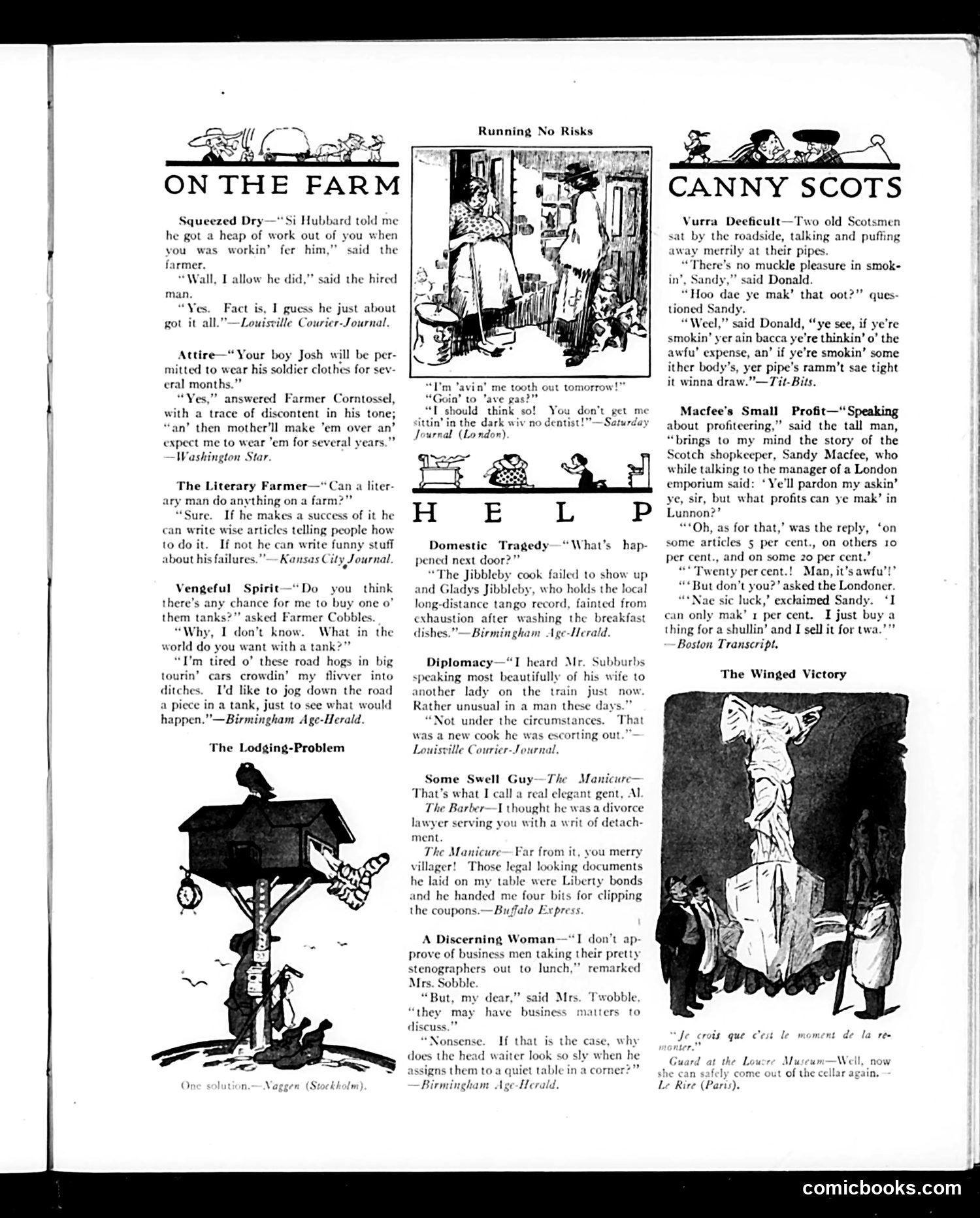
This page contains humorous anecdotes and jokes organized by topic. The "ON THE FARM" section satirizes rural life and farmer attitudes—one joke mocks how employers extract maximum labor from hired workers; another depicts a farmer's frugality (reusing his son's soldier uniform for years); a third ridicules farmers' attempts at writing advice columns. The "HELP" and "CANNY SCOTS" sections continue light social satire. The Scots jokes stereotypically portray Scottish people as miserly—one involves a man reluctant to get anesthesia at the dentist to save money, another depicts a Scotch shopkeeper scandalized by London business profits of 20%, claiming he only makes 1 percent ("a shullin' for twa"). Other brief jokes mock domestic life (a woman fainting from housework after tango dancing), stenographer-boss lunches, divorce lawyers, and profiteering—wartime concerns evident from Liberty bonds references. These are gentle, mainstream humor pieces typical of early 20th-century American periodicals, relying on ethnic stereotypes and class-based wit now dated but historically representative of the era's comedy conventions.
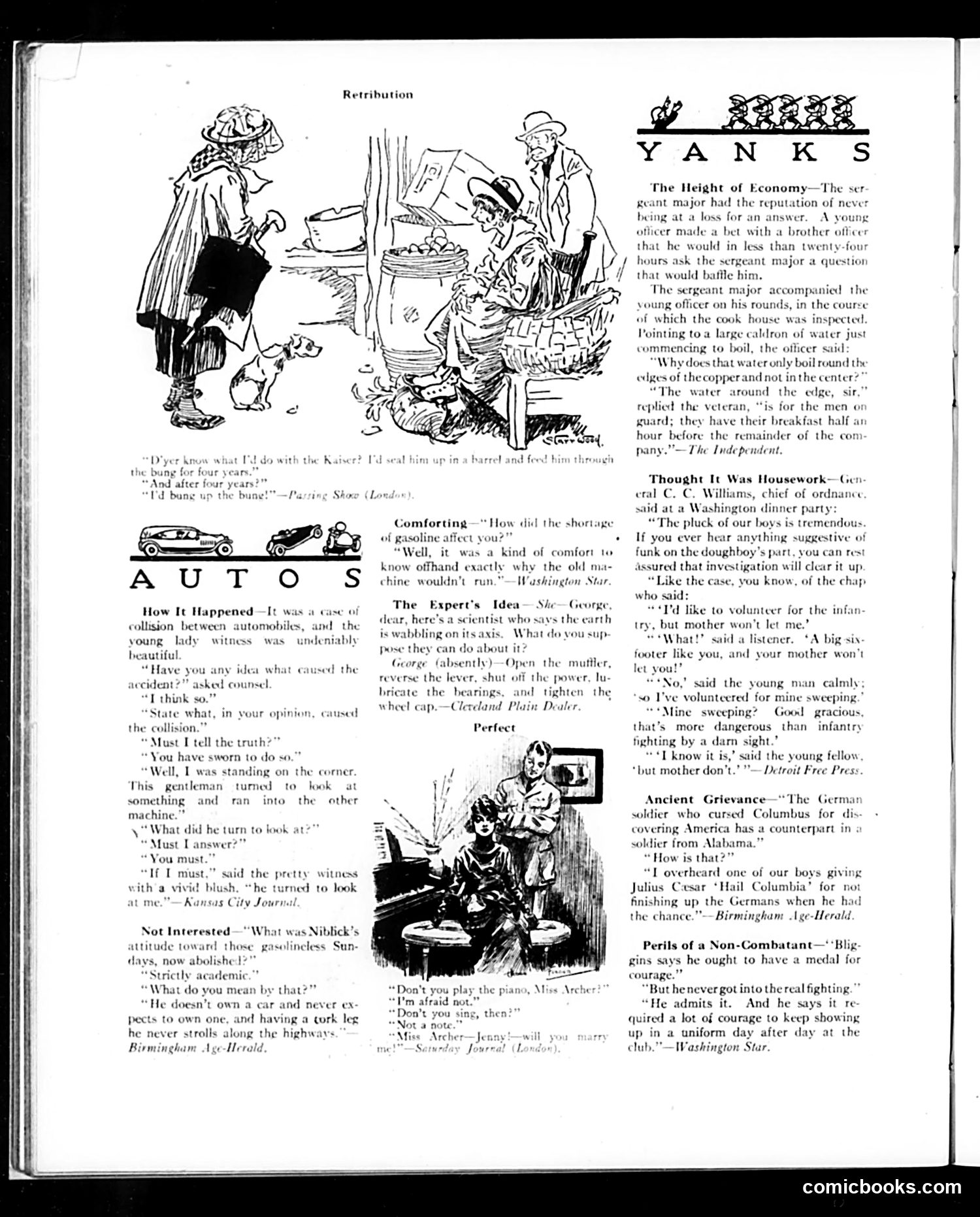
This page from Judge contains multiple short humor pieces satirizing early 20th-century American life, particularly focused on automobiles and World War I. **The "Retribution" cartoon** depicts a traffic accident where a beautiful young woman witness admits she distracted the driver—a joke about vanity and distracted driving in the automobile age. **The "Autos" section** includes jokes mocking car ownership: one about a witness's beauty causing an accident, another ridiculing a man indifferent to "carless Sundays" (likely referring to gasoline rationing during WWI), and a wife's expectation that her husband can fix any mechanical problem. **The WWI-era jokes** ("Ancient Grievance," "Perils of a Non-Combatant") mock soldiers' complaints and criticize men claiming courage for merely appearing in uniform at clubs rather than actual combat. **Overall theme**: The page satirizes technological modernity (automobiles), gender dynamics, and wartime hypocrisy—typical of Judge's satirical approach to contemporary social anxieties.
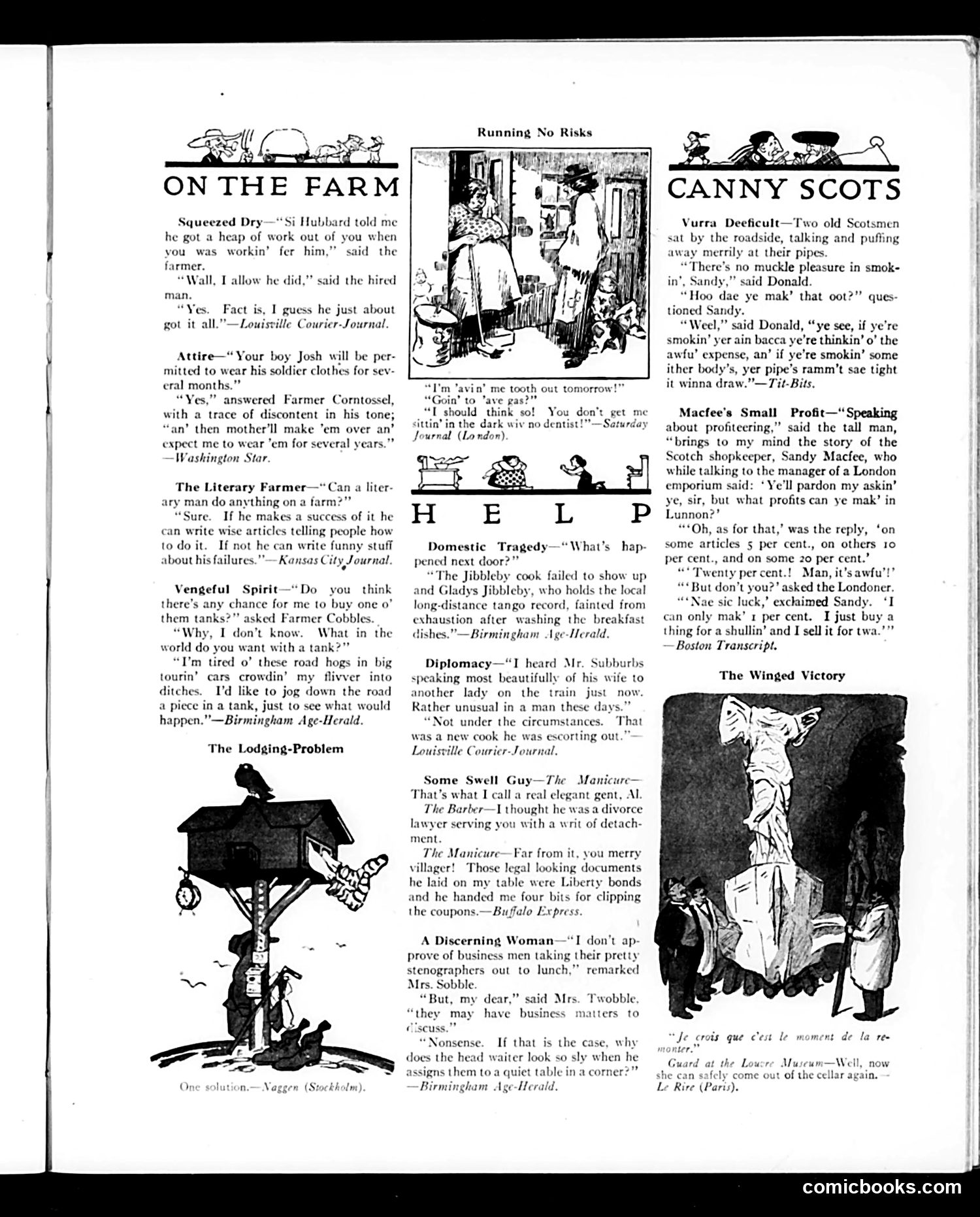
This page contains brief humorous anecdotes and jokes organized into sections: "On the Farm," "Help," and "Canny Scots." **Farm Jokes** mock rural life and wartime conditions: a hired man is "squeezed dry" of labor; a farmer resents his son's military uniform becoming hand-me-downs; a farmer wants to buy a tank to combat aggressive drivers in touring cars. These reflect post-WWI America's rural-urban tensions. **"Help"** section satirizes domestic life and gender dynamics: a wife faints after doing housework (implying women's limited capabilities); a man's flattery toward another woman is revealed as motivated by his new cook; business men taking stenographers to lunch sparks suspicion of impropriety. **"Canny Scots"** stereotypes Scottish frugality: two Scots debate whether smoking their own tobacco or others' causes more anxiety; a Scottish shopkeeper is scandalized by London merchants' profit margins of 5-20%, claiming he makes only 1 percent. The humor relies on period stereotypes about class, gender, nationality, and rural simplicity—typical of early 20th-century American satire.
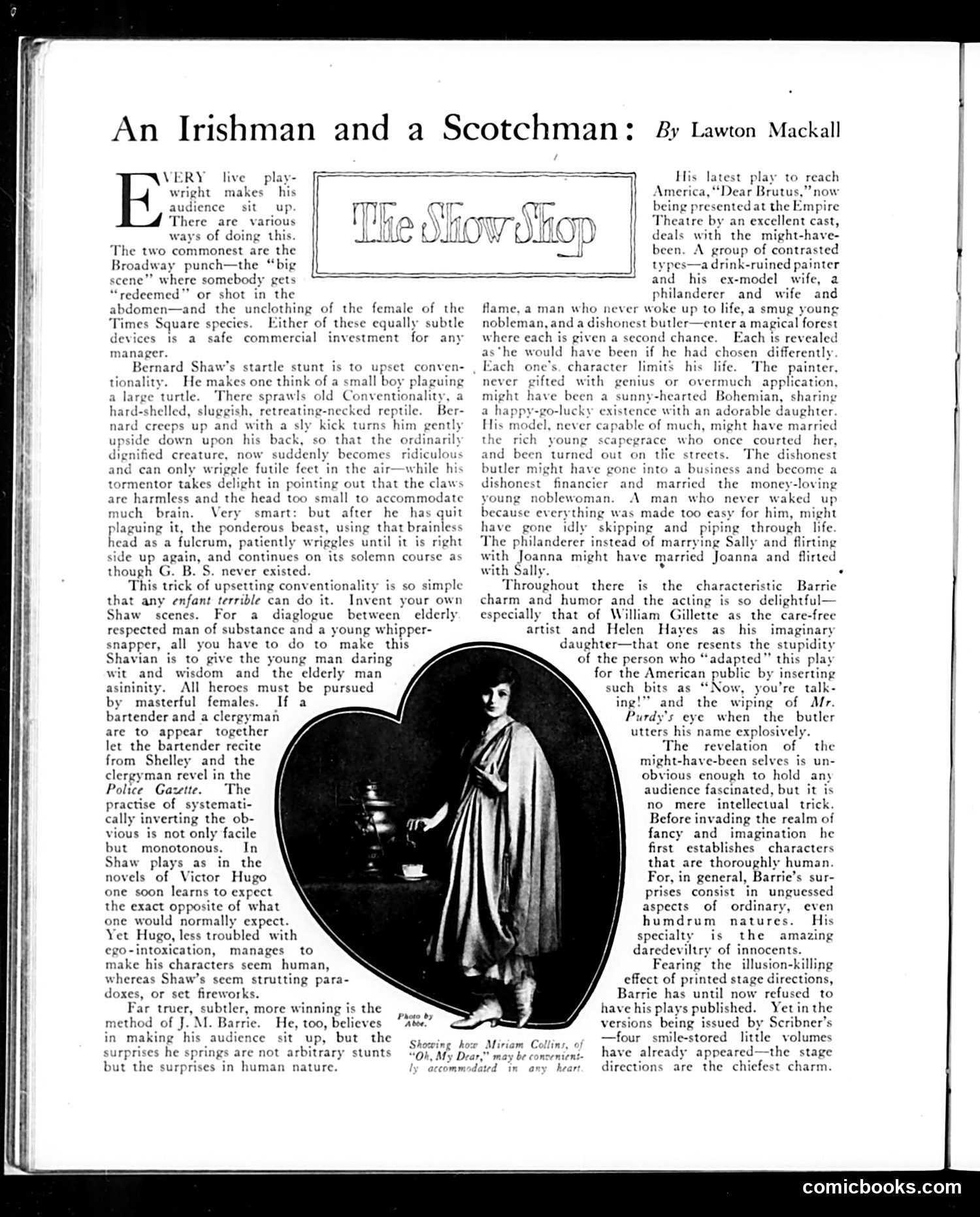
This is a theater critique by Lawton Mackall comparing dramatists Bernard Shaw and J.M. Barrie. The article title references their nationalities (Shaw was Irish, Barrie Scottish), though the text focuses on their contrasting theatrical methods. **The Satire:** Mackall criticizes Shaw's deliberate inversion of social conventions as artificial and predictable—merely flipping expectations systematically. He compares Shaw to a boy tormenting a turtle: once Shaw stops, "conventionality" simply rights itself unchanged. The critique suggests Shaw's paradoxes are facile tricks, like "set fireworks." **The Alternative:** Barrie's method is praised as superior: rather than inverting the obvious, he explores genuine human nature and real psychological depth. His play *Dear Brutus* (referenced, with cast member Miriam Collins pictured) reveals what people might have become—genuine character revelation rather than mere theatrical provocation. **Context:** This represents early 20th-century theatrical criticism valuing psychological realism over abstract intellectual gamesmanship. The comparison was timely: both playwrights were prominent contemporaries, making this relevant to Judge's educated audience interested in drama criticism and cultural commentary.
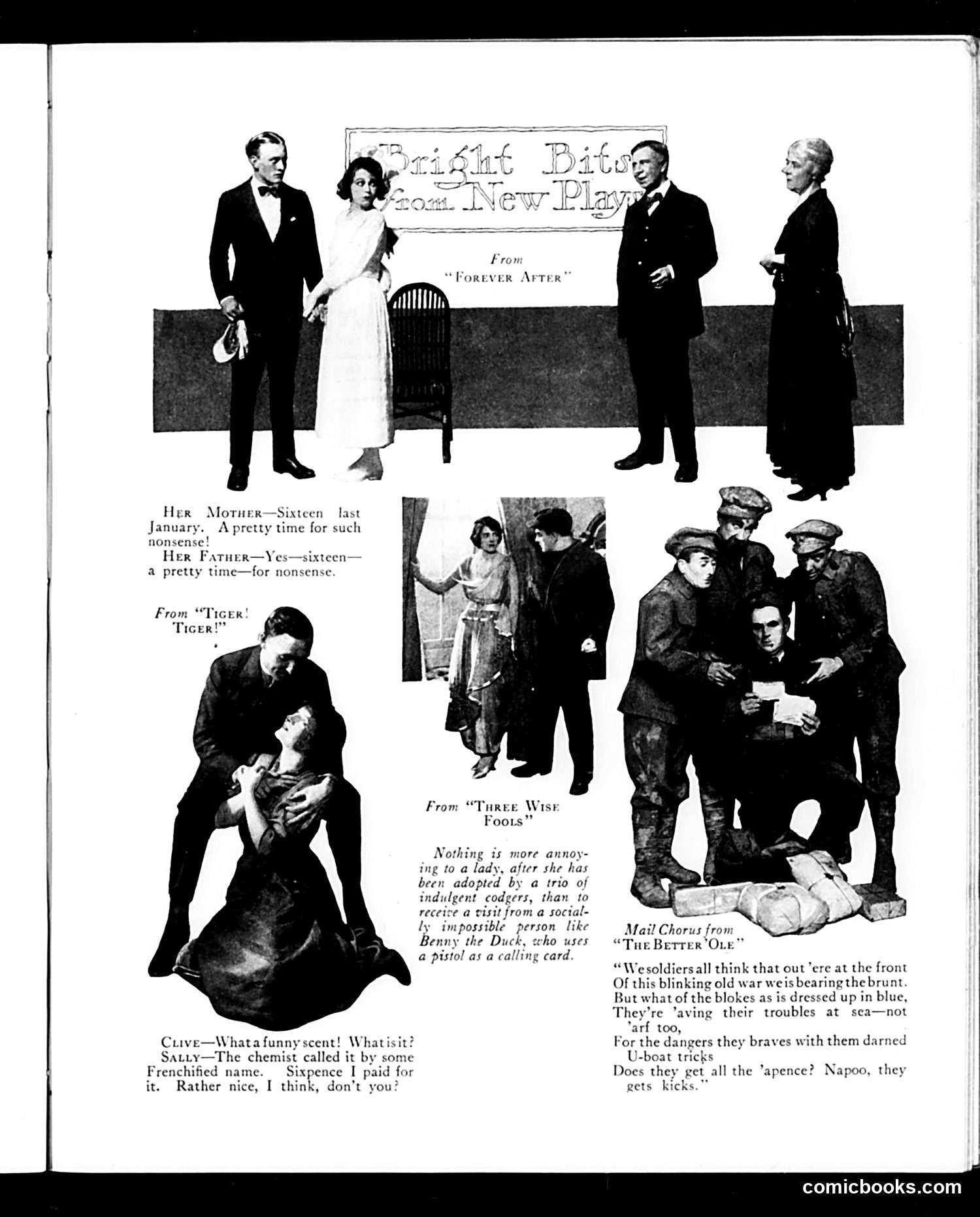
This page showcases theatrical sketches adapted from contemporary plays ("Forever After," "Tiger! Tiger!", and "Three Wise Fools"). The top section depicts a domestic comedy scenario about a sixteen-year-old girl's coming-of-age, with parents debating whether this is an appropriate time for "nonsense" (likely romantic pursuits). The lower sketches satirize wartime anxieties. One joke mocks an absurdly theatrical villain character ("Benny the Duck") who uses a pistol as a "calling card"—satirizing melodramatic stage conventions. Most significantly, the "Mail Chorus" section appears to be from a song expressing soldiers' grievances about the war effort. The soldiers resent that while they fight at the front, others ("blokes dressed in blue"—possibly naval personnel or home-front workers) escape danger, yet receive equal recognition and pay ("'apence"). The slang term "Napoo" (British WWI slang meaning "finished/dead") underscores the dark humor. The page satirizes both theatrical excess and wartime morale complaints.
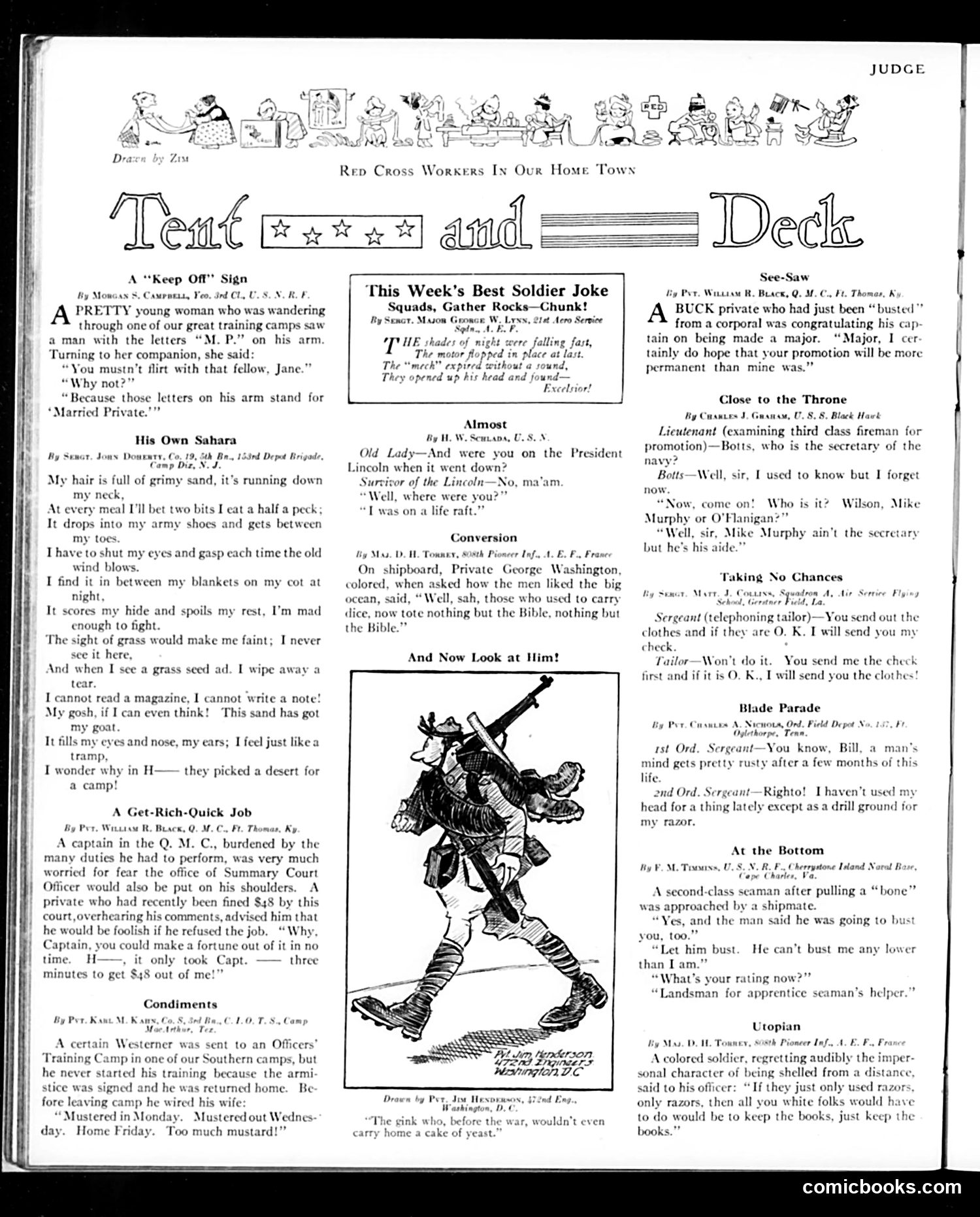
This is a **WWI-era humor page** from Judge magazine, featuring jokes and comic verses submitted by soldiers. The central cartoon depicts a soldier being struck by or struggling with military equipment, illustrating the chaos of training camp life. **Key themes:** - **Military life complaints**: Sand infiltrating everything (the "His Own Sahara" poem), the tedium of training camps - **Rank humor**: References to "Married Private" (M.P.) insignia, a private being "busted" (demoted), officers being promoted - **Military procedure satire**: A captain profiting from court-martial fines; soldiers being rapidly mustered in/out; absurd training tasks - **Racial commentary**: A joke about Black soldiers replacing dice-playing with Bible-carrying (stereotyping while portraying "conversion") - **Navy references**: Shipwreck survivor jokes, naval promotions The humor reflects soldiers' frustrations with training, discipline, and bureaucratic absurdity—typical of wartime military humor, presented for home-front civilian readers.
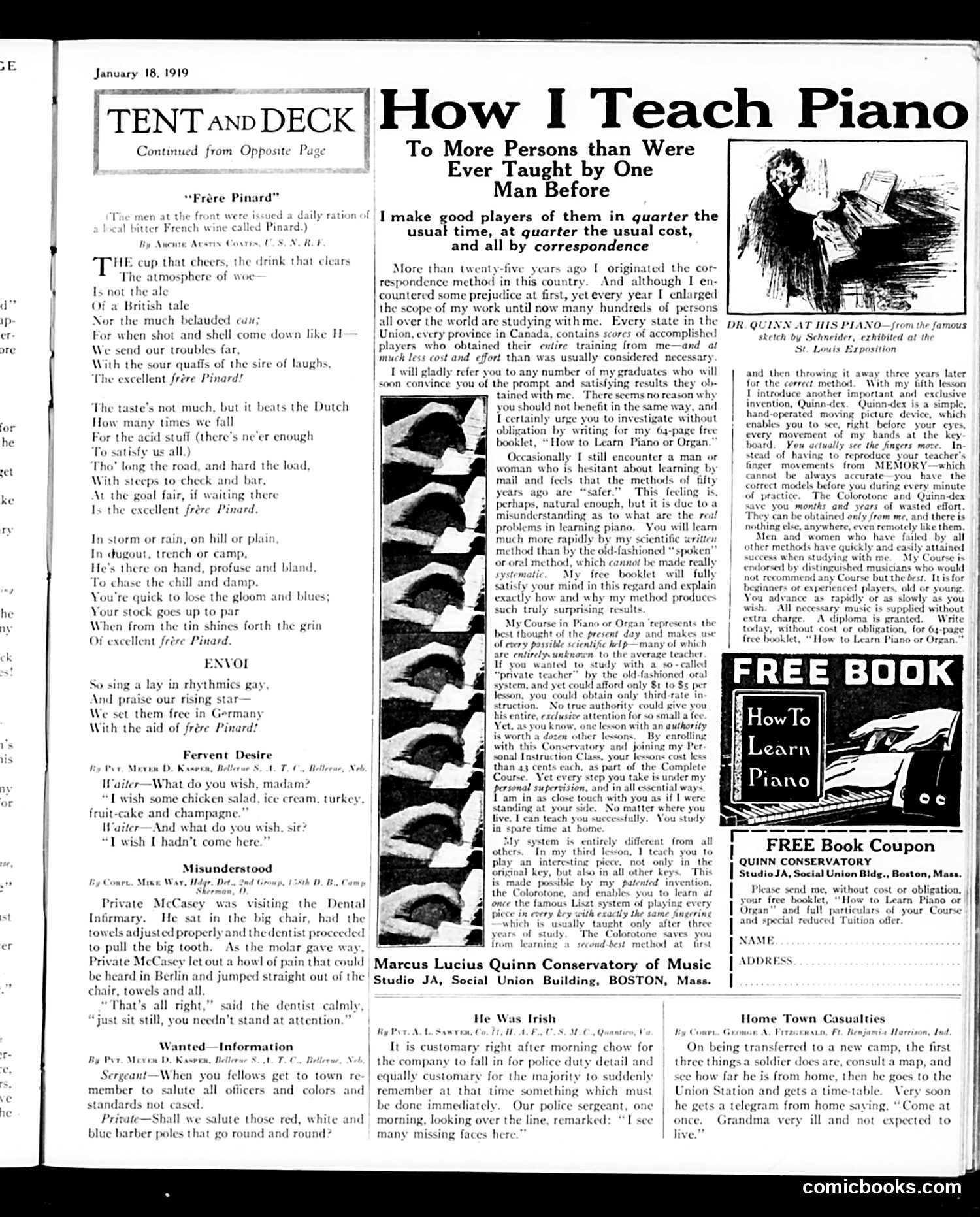
This page from Judge (January 18, 1919) contains multiple unrelated items: poetry about "Frère Pinard" (French military slang for cheap wine rations), humorous anecdotes about dental visits and military life, and—dominantly—a full-page advertisement for Marcus Lucius Quinn's correspondence piano course. The piano advertisement is the main content, featuring photographs of hands at a keyboard and promoting Quinn's method of teaching "good players" in quarter the usual time and cost through mail correspondence. Quinn claims a 25-year track record and introduces the "Quinndex"—a hand-operated moving picture device letting students watch his finger movements directly rather than relying on memory. The satirical poems mock French wine rations and military life; the anecdotes humorously describe wartime absurdities. The page reflects 1919 post-WWI American culture: practical distance-learning innovation, cost-consciousness, and nostalgic humor about the recently-concluded war.
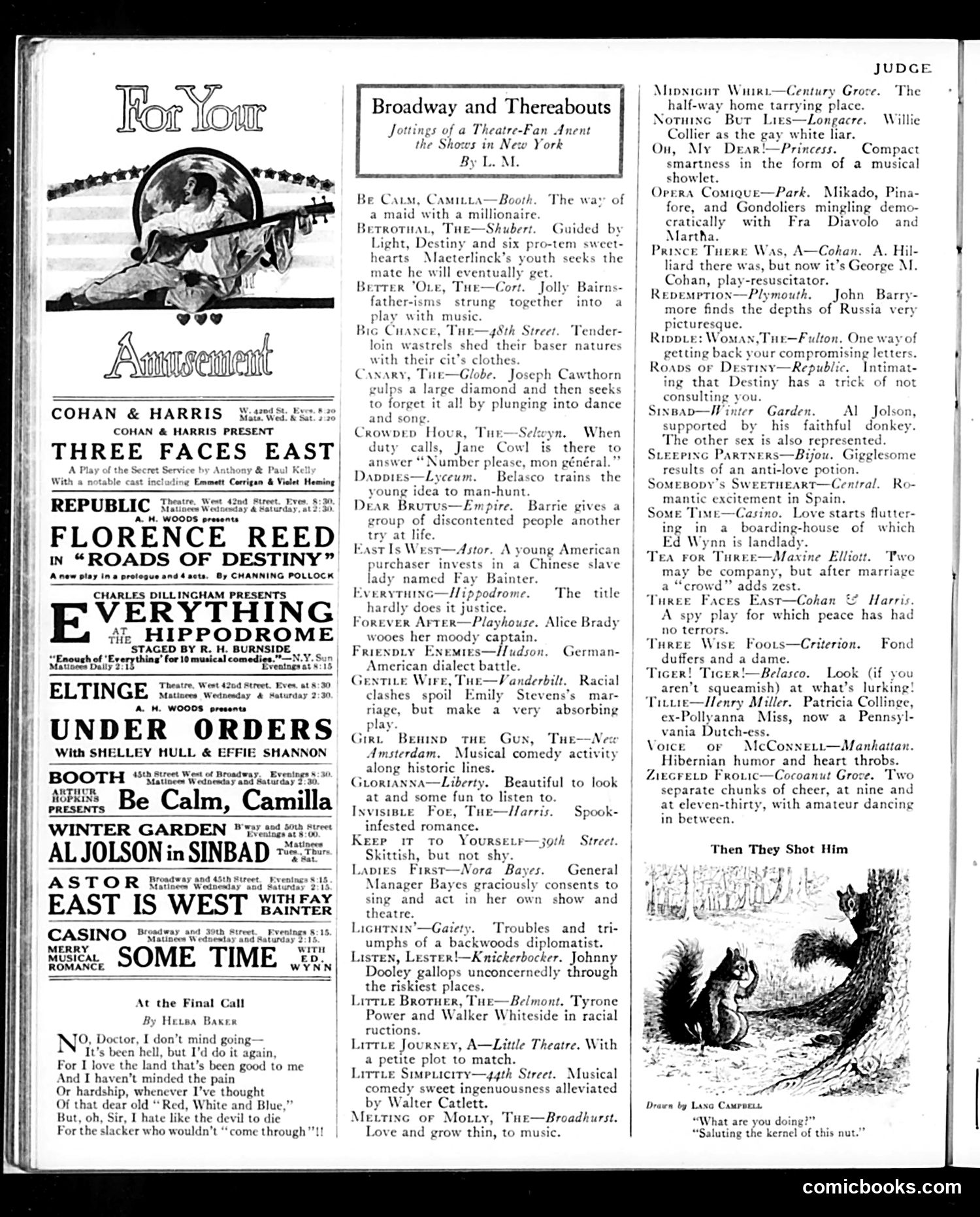
This is primarily a **theater advertising and review page** from Judge magazine, a prominent American satirical publication. The page lists Broadway shows currently running in New York, with brief plot summaries by critic "L.M." The only significant cartoon appears at bottom right: titled **"Then They Shot Him,"** drawn by Lano Campbell. It depicts a soldier in a trench, with the caption: "What are you doing?" / "Saluting the kernel of this nut." This is a **WWI-era military joke**—a pun on "kernel" (corn) versus "colonel" (military rank). The cartoon likely plays on common soldier humor during America's involvement in World War I (1917-1918). Above the cartoon, Helba Baker's poem **"At the Final Call"** expresses patriotic sentiment, with a speaker willing to die for his country but resenting those ("slackers") who avoid military service. This reflects the fierce social pressure and patriotic fervor of the WWI period. The page is otherwise typical theatrical coverage—not primarily satirical or political in nature.
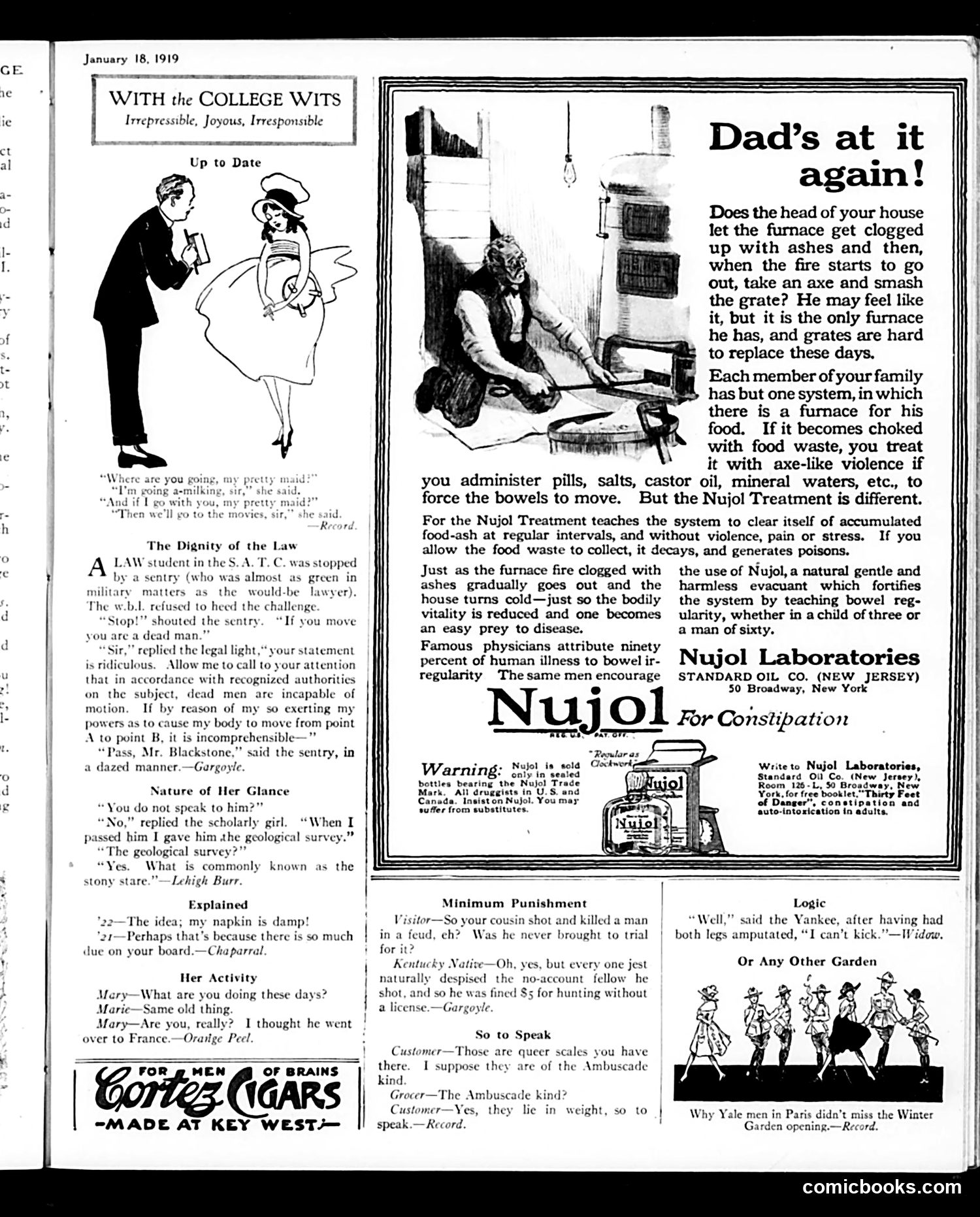
This page combines humor columns ("With the College Wits") and a full-page advertisement for Nujol laxative. **The Advertisement's Message:** The large ad uses an extended metaphor comparing household plumbing to human digestion. It warns fathers against destructively "smashing the grate" of a clogged furnace—a visual analogy for violent laxatives. Instead, Nujol offers gentle, natural relief. The ad attributes 90% of human illness to constipation and claims famous physicians endorse bowel regularity. This reflects early-20th-century medical obsession with "autointoxication" (self-poisoning from constipation), now considered pseudoscience. **The Humor Columns:** Brief jokes mock college students and military life (a 1919 reference to WWI-era conscription). Examples include a pedantic law student using absurd logic with a sentry, and wordplay about geology surveys and ambuscade scales. **Historical Context:** This reflects post-WWI America and the patent medicine era before FDA regulation. Constipation was openly discussed public health concern, and oil-based laxatives were heavily marketed through such comparisons.
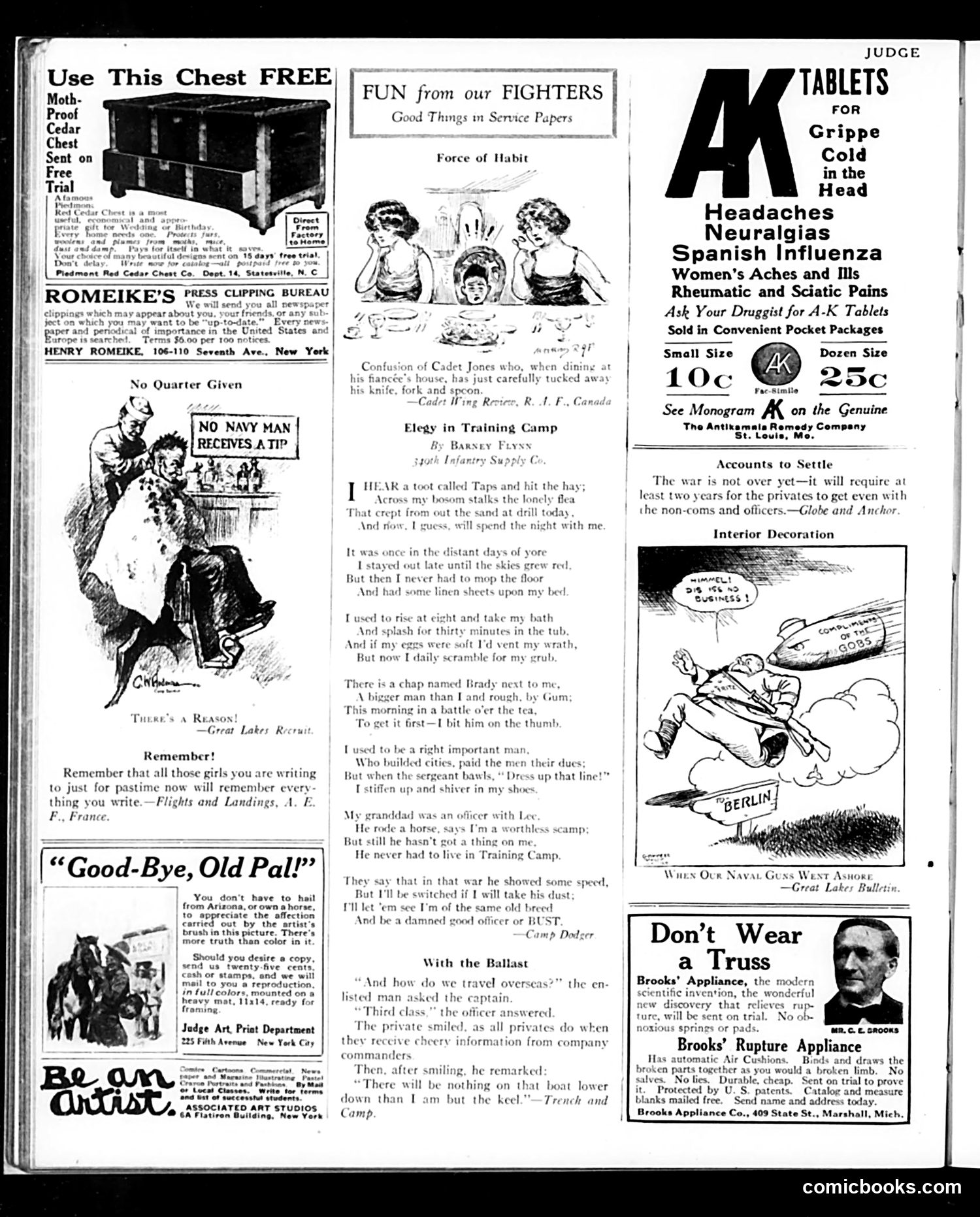
This page comprises primarily **advertisements and WWI-era military humor** rather than political satire. The main content includes: **"Good-Bye, Old Pal!"** — A sentimental cartoon about soldiers departing, appealing to emotional connections between servicemen and those at home. **"Elegy in Training Camp"** — A poem by Barney Flynn contrasting a soldier's former comfortable civilian life (rising at eight, soft-boiled eggs, important work) with harsh military discipline and training camp drudgery. The humor is self-deprecating, about adjustment to military hardship. **"Force of Habit" and "With the Ballast"** — Brief anecdotes mocking military life, officers' authority, and troop transport conditions—gentle service-paper humor rather than sharp satire. The **advertisements** (chest, tablets for influenza, rupture appliances) reflect wartime concerns: Spanish Flu was active during WWI, and medical products dominated period magazines. The overall tone is **supportive of the war effort** while gently ribbing military life's hardships—typical of American humor magazines during 1917-1918.
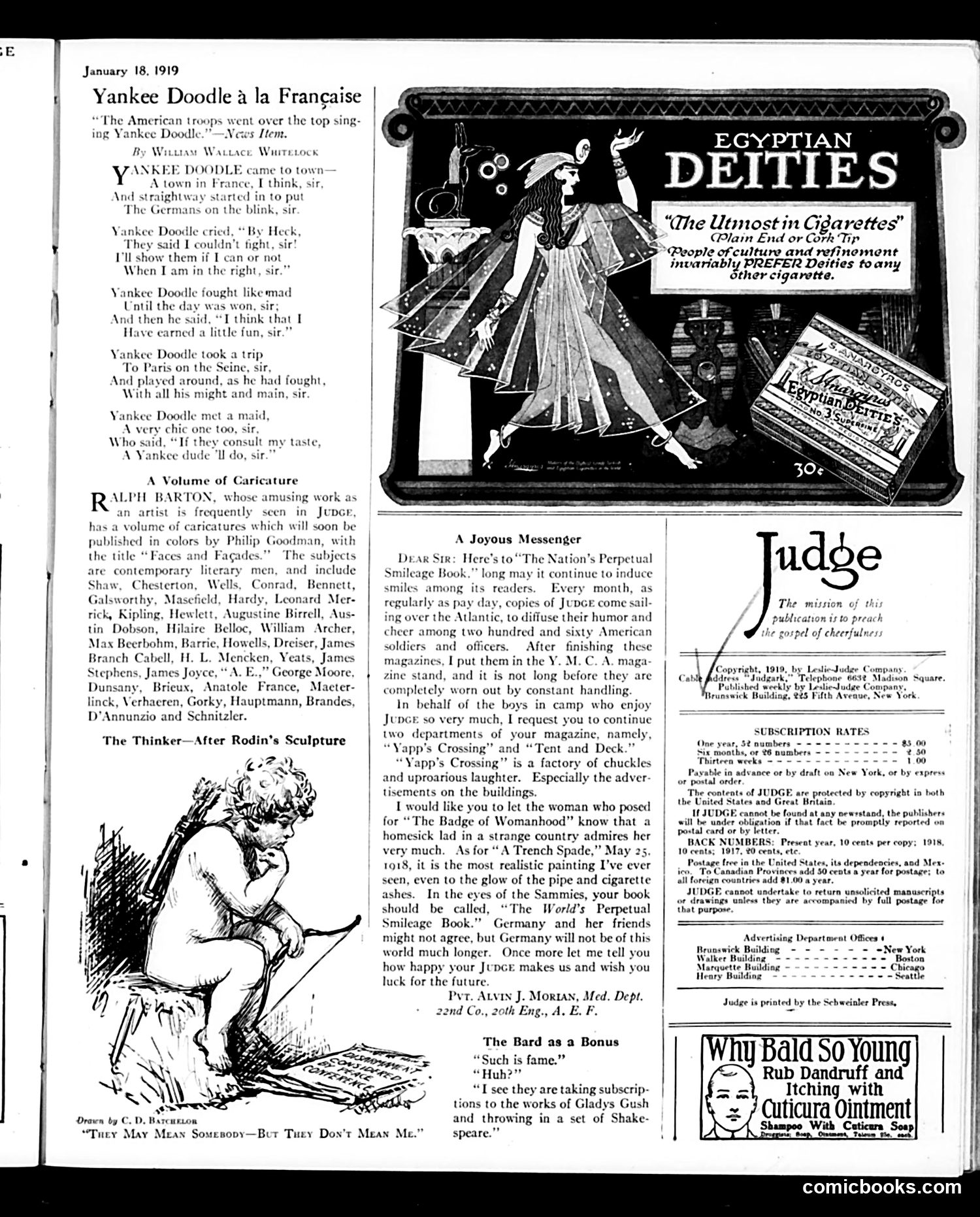
This poem celebrates American soldiers' role in World War I, which ended November 1918. The narrative follows an American soldier ("Yankee Doodle") from combat in France through victory to leisure in Paris, where he meets a French woman who finds him charming. The satire is gentle: it mocks the American soldier's confidence and swagger while also flattering American martial prowess. The poem plays on the traditional nursery rhyme, updating it for contemporary readers familiar with recent troop movements. The reference to soldiers "going over the top" alludes to the famous WWI infantry assault tactic. A letter below from a soldier thanks *Judge* for sending magazines to troops, praising specific cartoons and columns for morale. This validates the magazine's wartime purpose: providing humor to American forces abroad.
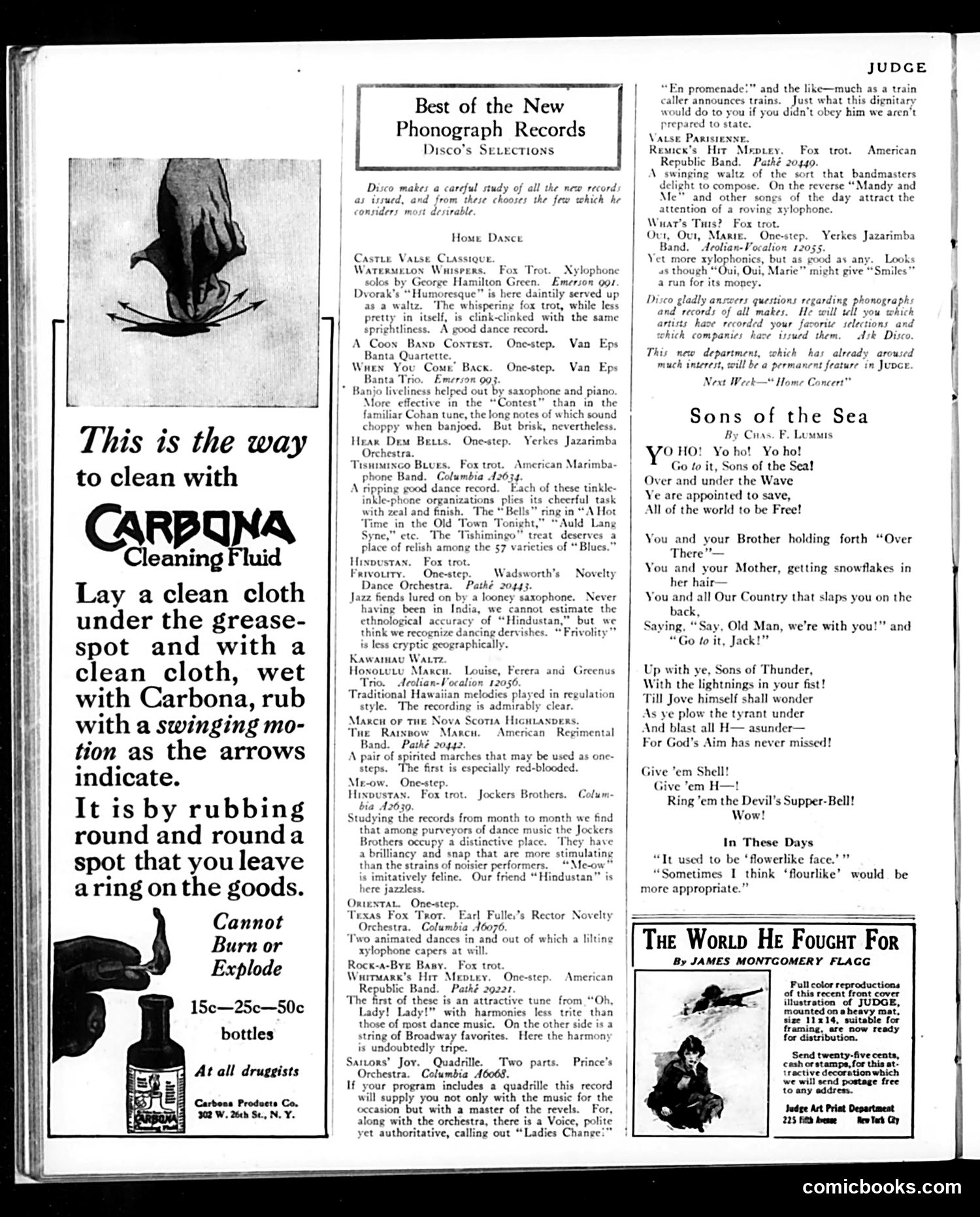
This page is primarily **advertising and record reviews**, not political satire. The main content consists of: 1. **Carbona Cleaning Fluid Advertisement** (left): A product ad showing cleaning instructions with diagrams. The visual joke is the peacock illustration—likely chosen for elegance/refinement to suggest the product's quality, though it's unclear if this is satirical or merely decorative. 2. **Phonograph Record Reviews** (center/right): "Best of the New Phonograph Records" reviewed by "Disco." These are dance records from the 1920s era (fox trots, one-steps, waltzes). The reviews discuss musical quality and recording clarity. 3. **"Sons of the Sea" Poem** (right): A patriotic or adventure poem, possibly referencing naval themes. 4. **"The World He Fought For"** (bottom right): Appears to be promotional content for an illustration or story. **Judge context**: This satirical magazine often mixed genuine advertisements with editorial content. There is **no clear political cartoon or satire visible** on this particular page—it's predominantly commercial and entertainment-focused, reflecting 1920s consumer culture and popular music trends.
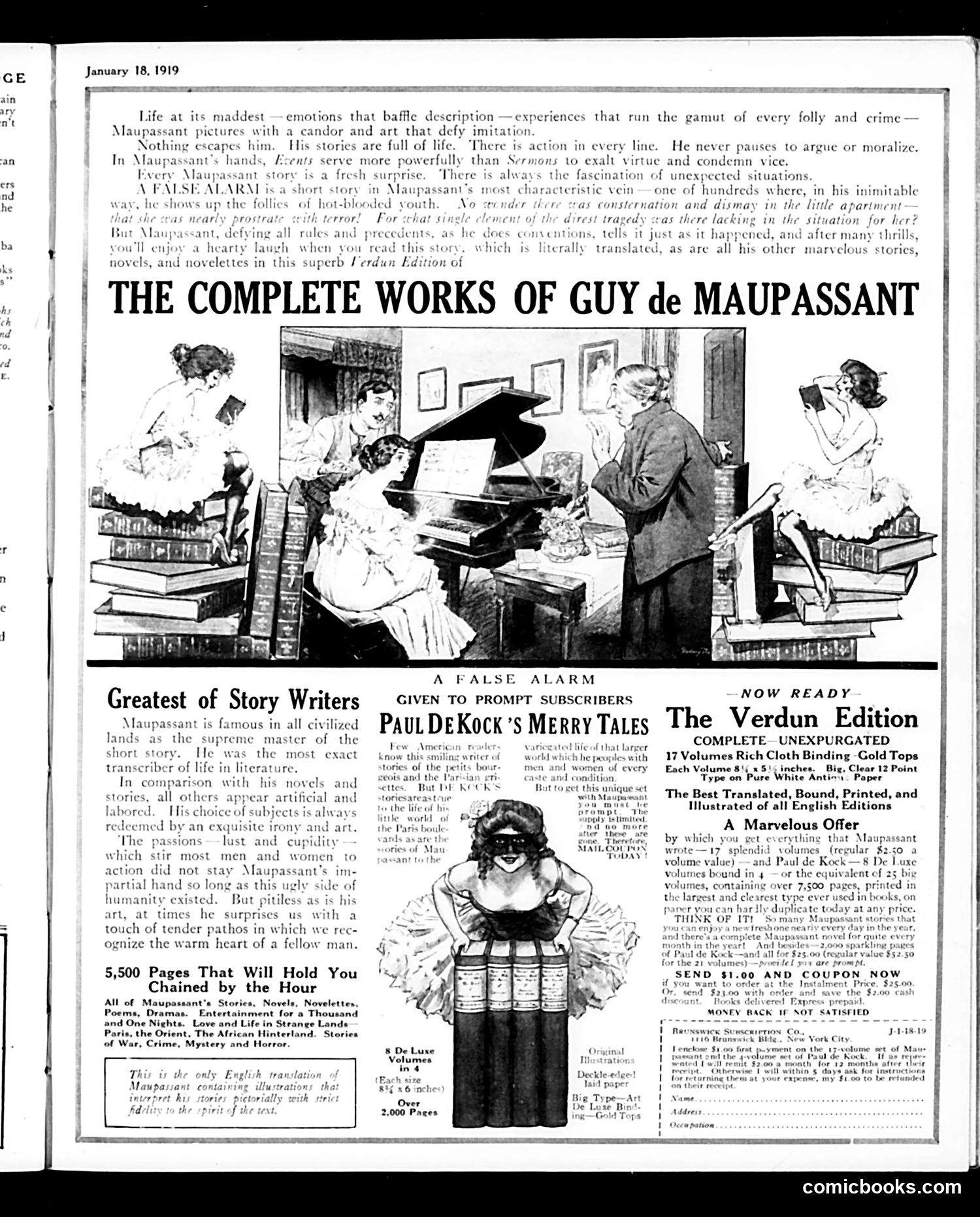
This page is primarily **advertising**, not political satire. It promotes two competing book collections: 1. **"The Complete Works of Guy de Maupassant"** (Verdun Edition) — emphasizing the French author's mastery of short stories depicting human folly and passion. 2. **"Paul De Kock's Merry Tales"** — a rival publisher's offering positioned as similarly comprehensive. The illustrations show people reading and enjoying these works in domestic settings. The copy praises Maupassant's unflinching portrayal of life's "maddest" emotions and moral conflicts. The heading "A False Alarm" appears to reference one of Maupassant's stories included in the collection. There is **no political cartoon or social satire** on this page — it's a commercial pitch to Judge's readers to purchase luxury book sets, which was common editorial content in magazines of this era.
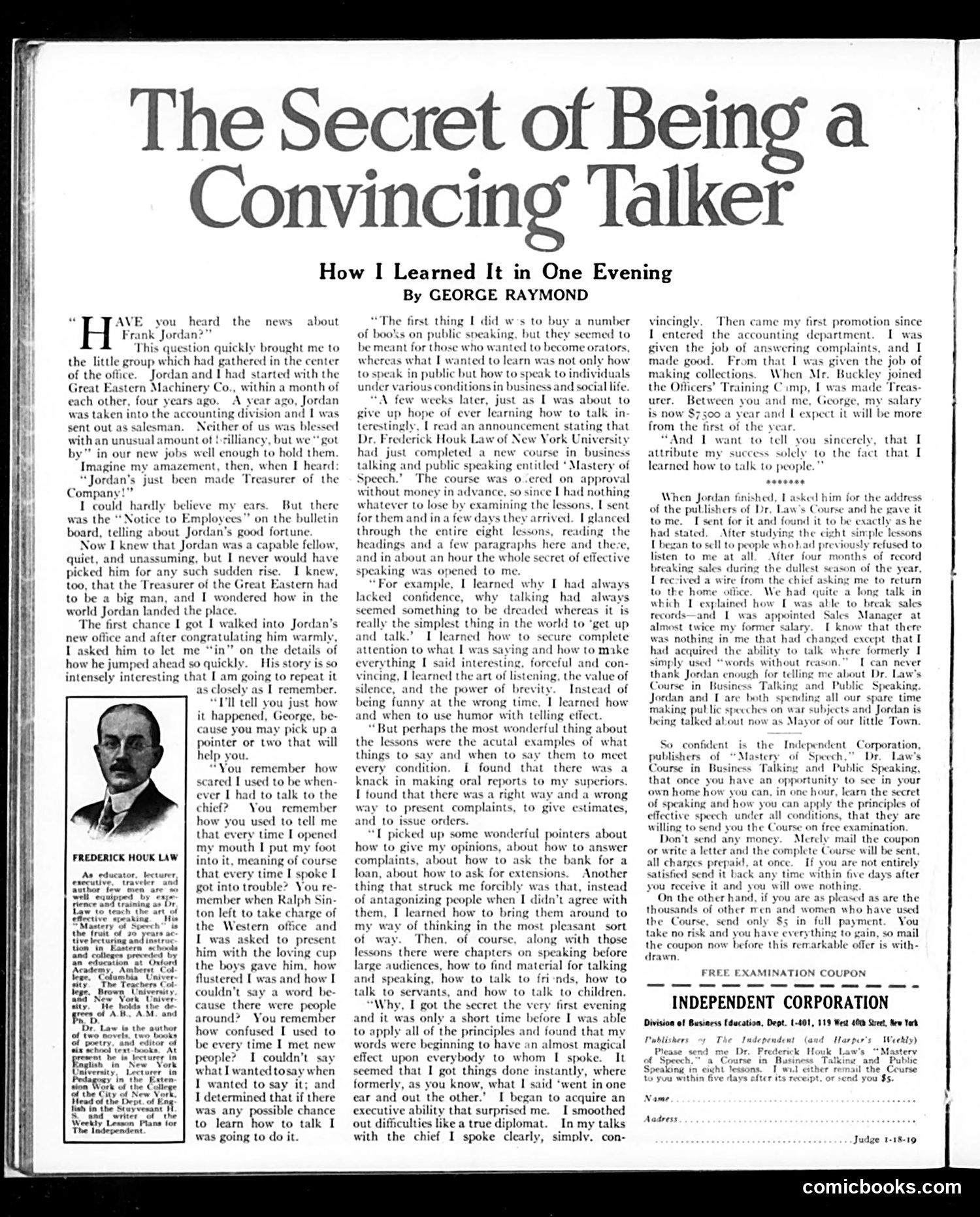
This is primarily a **self-help article with advertising**, not political satire. George Raymond describes how his colleague Frank Jordan achieved rapid promotion by taking a public-speaking course by **Frederick Houk Law** (pictured left—a real educator and lecturer). The narrative frames this as a "secret"—learning confidence and conversational skill through systematic lessons rather than innate talent. Jordan's rise from salesman to company treasurer demonstrates the commercial appeal of self-improvement in early 20th-century American business culture. The article essentially promotes **Law's "Mastery of Speech" course**, marketed as teachable techniques for professional success. There's implicit social commentary: success isn't about brilliance but learnable communication skills available to ordinary men. The page includes a **coupon** for the Independent Corporation's distance-learning course, making this largely advertorial content dressed as inspirational narrative—typical Judge magazine format mixing entertainment with paid promotion.