
Judge, 1919-01-18 · page 24 of 34
Judge — January 18, 1919 — page 24: what you’re looking at
What you’re looking at
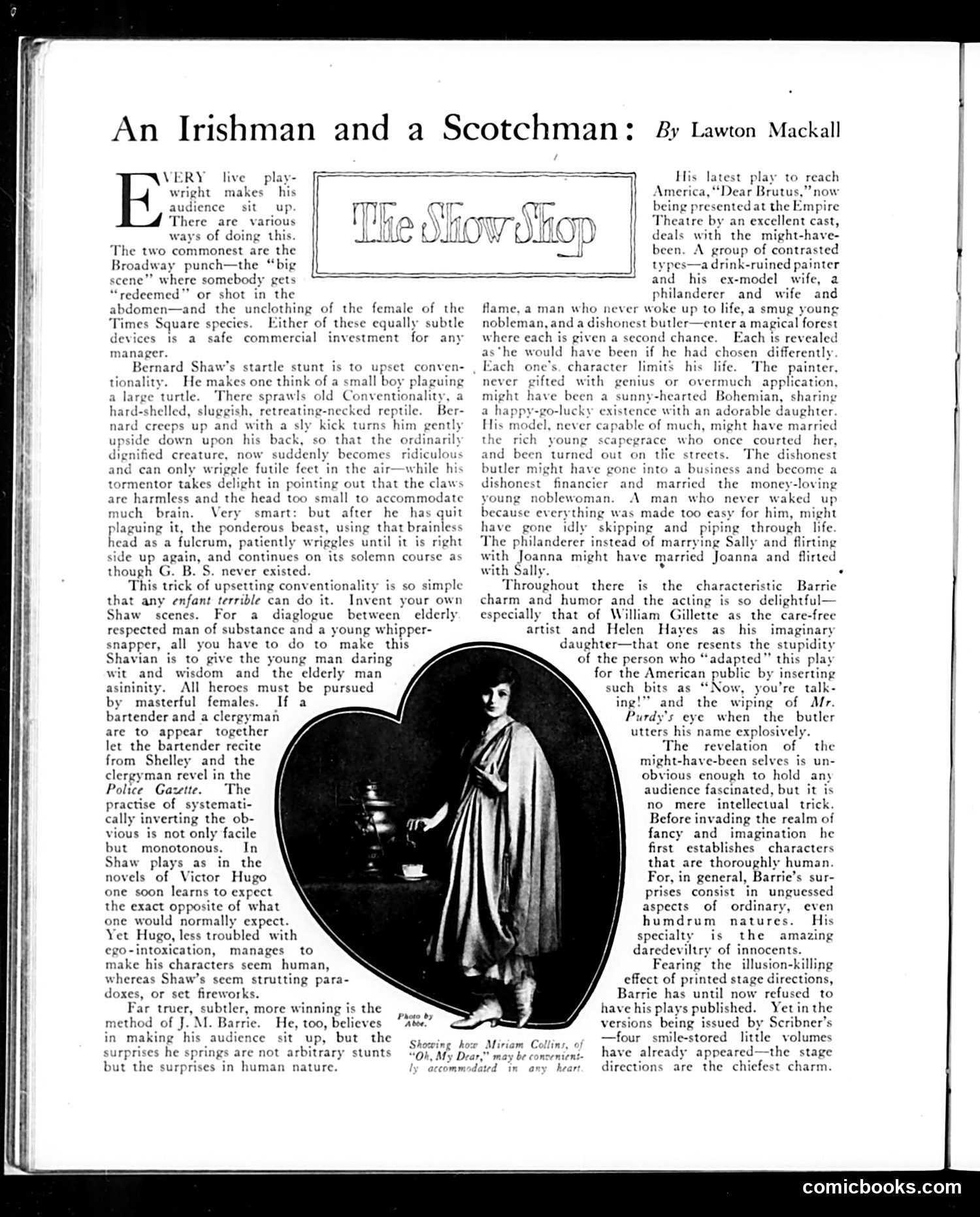
This is a theater critique by Lawton Mackall comparing dramatists Bernard Shaw and J.M. Barrie. The article title references their nationalities (Shaw was Irish, Barrie Scottish), though the text focuses on their contrasting theatrical methods. **The Satire:** Mackall criticizes Shaw's deliberate inversion of social conventions as artificial and predictable—merely flipping expectations systematically. He compares Shaw to a boy tormenting a turtle: once Shaw stops, "conventionality" simply rights itself unchanged. The critique suggests Shaw's paradoxes are facile tricks, like "set fireworks." **The Alternative:** Barrie's method is praised as superior: rather than inverting the obvious, he explores genuine human nature and real psychological depth. His play *Dear Brutus* (referenced, with cast member Miriam Collins pictured) reveals what people might have become—genuine character revelation rather than mere theatrical provocation. **Context:** This represents early 20th-century theatrical criticism valuing psychological realism over abstract intellectual gamesmanship. The comparison was timely: both playwrights were prominent contemporaries, making this relevant to Judge's educated audience interested in drama criticism and cultural commentary.
📄 Transcribed text from this page (OCR, searchable)
Machine-transcribed from the original scan — historical spelling and the odd misread are preserved.
An Irishman and a Scotchman By Lawton Mackall wright makes his audience sit’ up There are various ways of doing this. The two commonest are the Broadway punch—the “big VERY live play- fF | | ——= 1 His latest play to reach America, “Dear Brutus,” now being presented at the Empire Theatre by an excellent cast, | deals with the might-have- | been. A group of contrasted | types—a drink-ruined painter sce’ where somebody gets “redeemed” or shot in the | / i bdomen—and the unclothing of the fem of the ( Times Square species. Either of these equally subtle devices is a safe commercial investment for any manager. Bernard Shaw's startle stunt is to upset conven tionality. He makes one think of a small boy plaguing a large turtle. There sprawls old Conventionality, a hard-shelled, sluggish, retreating-necked reptile. Ber- nard creeps up and with a sly kick turt upside down upon his back, so th. 1 dignified creature, now suddenly bi 1 only wriggle futile feet in and c. ] tormentor takes delight in pointing out that the claws are harmless and the head too small to accommodate much brain. Very smart: but after he has quit plaguing it, the ponderous beast, using that brainless head as a fulcrum, patiently wriggles until it is right side up again, and continues on its solemn course as though G. B.S. never existed. This trick of upsetting conventionality is so simple that any enfant terrible can do it. Invent your own Shaw scenes. For a diaglogue between elderly respected man of substance and a young whipper- snapper, all you have to do to make this Shavian is to give the young man daring v and wisdom and the elderly man asininity. All heroes must be pursued by masterful females. If a bartender and a clergyman are to appear together let the bartender recite from Shelley and the clergyman revel in the Police Gazette. The practise of systemati- cally inverting the ob- vious is not only facile but monotonous. In Shaw plays as in the novels of Victor Hugo one soon learns to expect the exact opposite of what one would normally expect. Yet Hugo, less troubled with ego-intoxication, manages to make his characters seem human, whereas Shaw’s seem strutting para- doxes, or set fireworks. Far truer, subtler, more winning is the method of J. M. Barrie. He, too, believes in making his auc sit up, but the surprises he springs are not arbitrary stunts “9, My Dea! but the surprises in human nature. SSE BEE ae = and his ex-model wife, 2 philanderer and wife and flame, a man who never woke up to life,a smug young nobleman, and a dishonest butler—enter a magical forest where each is given a second chance. Each is revealed as*he would have been if he had chosen differently Each one’s. character limits his life. The painter, never gifted with genius or overmuch application, ig ave been a sunny-hearted Bohemian, sharing a happy-go-lucky existence with an adorable daughter His model, never capable of much, might have married rich you race who once courted her, and been turned out on th streets. The dishonest butle ight have gone into a business and becom dishone finan id married the money ier a loving young noblewoman. A man who never waked up because everything w s made too easy for him, might have gone idly skipping and piping through. life. The philanderer instead of marrying Sally and flirting with Joanna might have married Joanna and flirted with Sall Throughout there is the characteristic Barrie charm and humor and the acting is so delightful— especially that of William Gillette as the care-free artist and Helen Hayes as his imaginary daughter—that one resents the stupidity of the person who “adapted” this play for the American public by inserting such bits as “Now, you're talk- ing!” and the wiping of Mr. Purdy’s eye when the butler utters his name explosively. The revelation of the might-have-been selves is un- obvious enough to hold any audience fascinated, but it is no mere intellectual trick. Before invading the realm of fancy and imagination he first establishes characters that are thoroughly human. For, in general, Barrie’s sur- prises consist in unguessed aspects of ordinary, even humdrum natures. His specialty is the amazing daredeviltry of innocents. Fearing the illusion-killing effect of printed stage directions, Barrie has until now refused to have his plays published. Yet in the versions being issued by Scribner’s —four smile-stored little volumes have already appeared—the stage directions are the chiefest charm. comicbooks.com ~~