
A complete issue · 32 pages · 1919
Judge — January 4, 1919
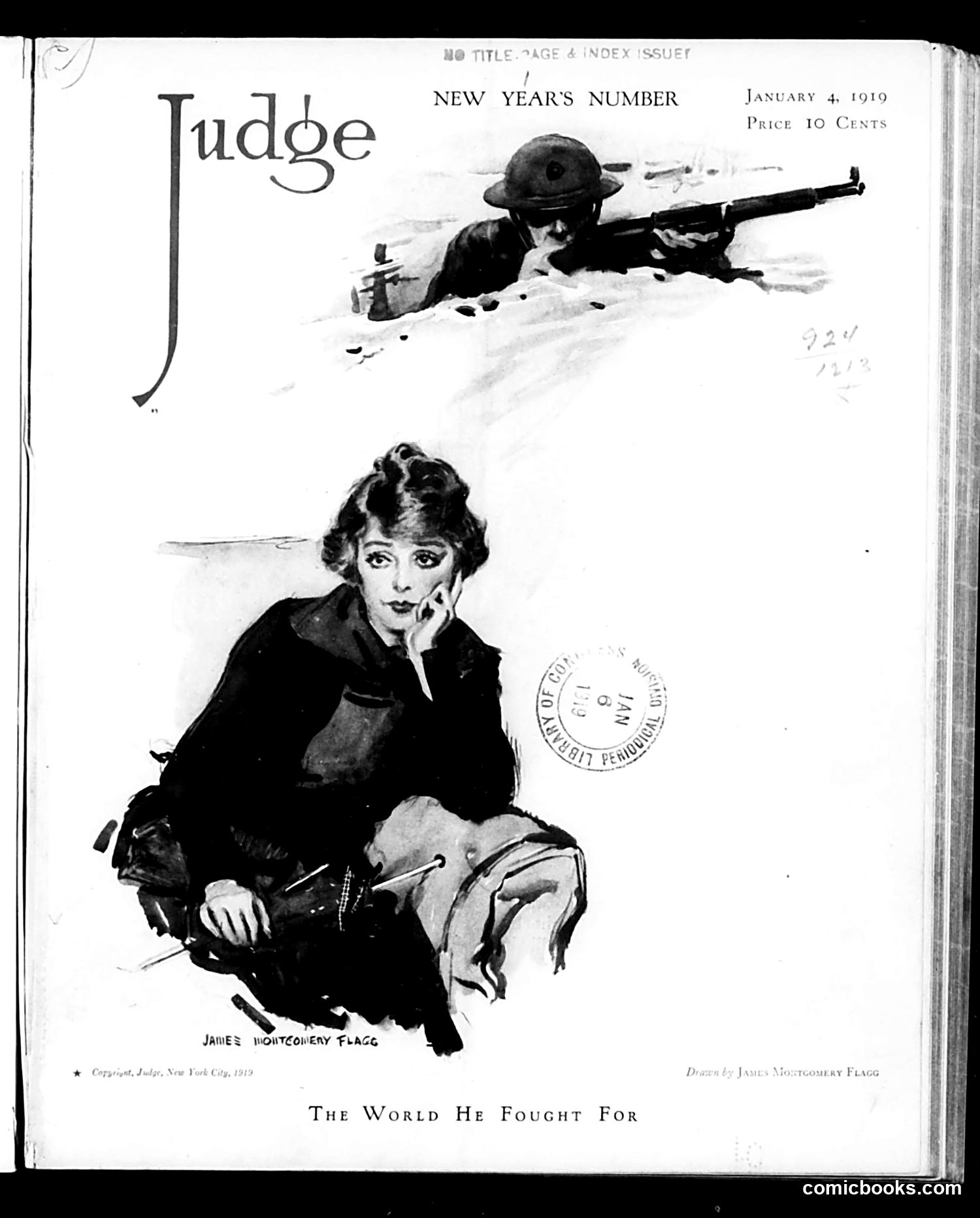
This New Year's Number cover, drawn by James Montgomery Flagg, presents two contrasting wartime images. The top illustration shows a soldier in a trench aiming a rifle—representing American military involvement in World War I, which had ended with the November 1918 armistice. The caption "The World He Fought For" suggests the piece comments on what soldiers sacrificed their lives to achieve. The lower portrait depicts a woman in fashionable attire, appearing contemplative or concerned. The juxtaposition suggests satirical commentary on the disconnect between soldiers' wartime sacrifice and civilian life—possibly critiquing materialism, social frivolity, or changing gender roles during the post-war transition. The overall message appears skeptical about whether the sacrifices were worthwhile or properly valued.
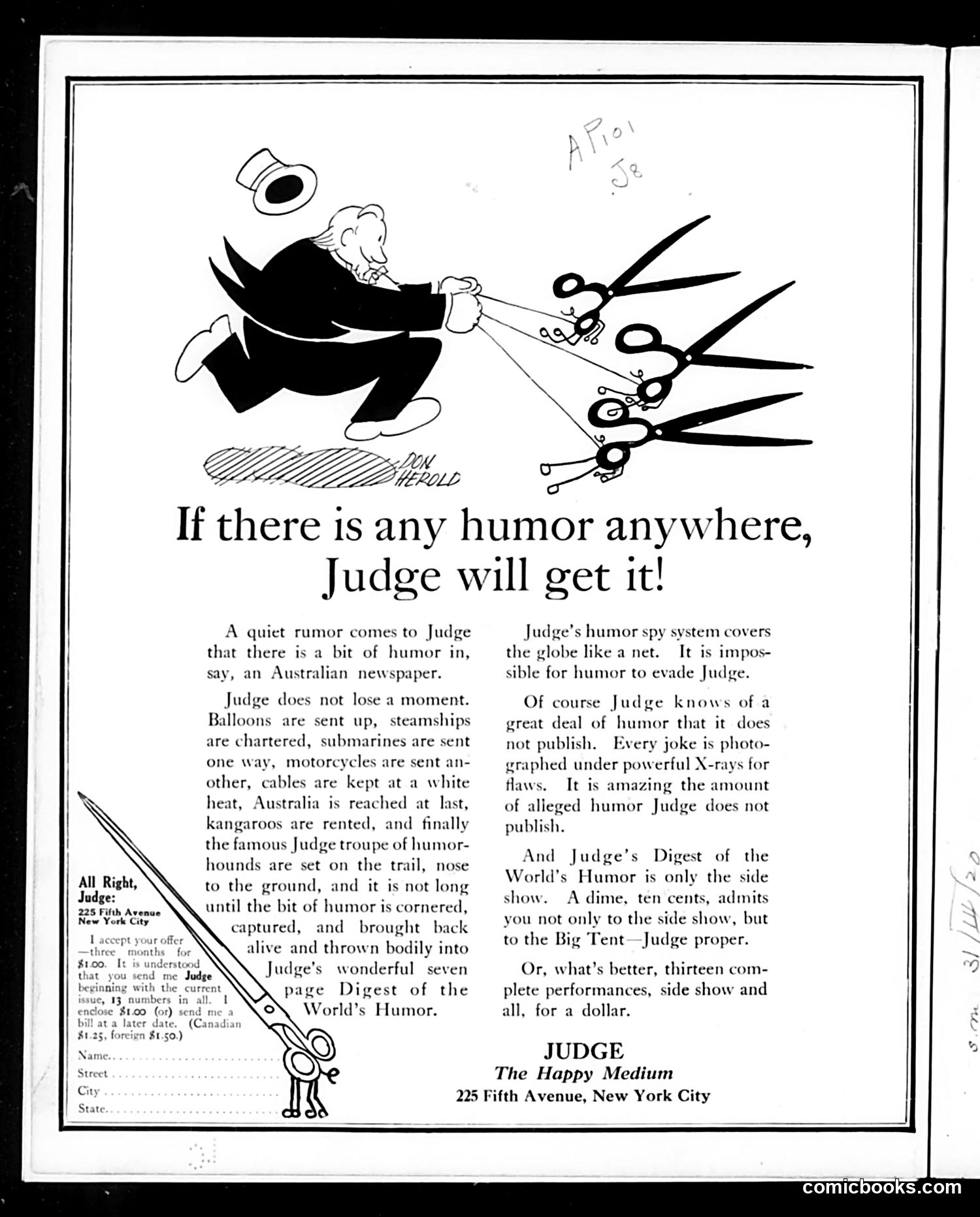
This is primarily a **humorous advertisement** for Judge magazine itself, personified as "Judge"—depicted as a figure wielding scissors like a hunting tool to capture humor worldwide. The satire claims Judge has a sophisticated "humor spy system" that hunts down jokes globally (referencing an Australian newspaper, steamships, submarines, motorcycles, and kangaroos as delivery methods). The joke plays on Judge's self-importance: it boasts of rejecting most humor it finds, publishing only select material in its "Digest of the World's Humor." The bottom section is a subscription offer encouraging readers to subscribe for three months at reduced rates. The overall humor is self-deprecating mock-pomposity—Judge presents itself as an elite arbiter of comedy while actually being just another magazine competing for readers' attention and money.
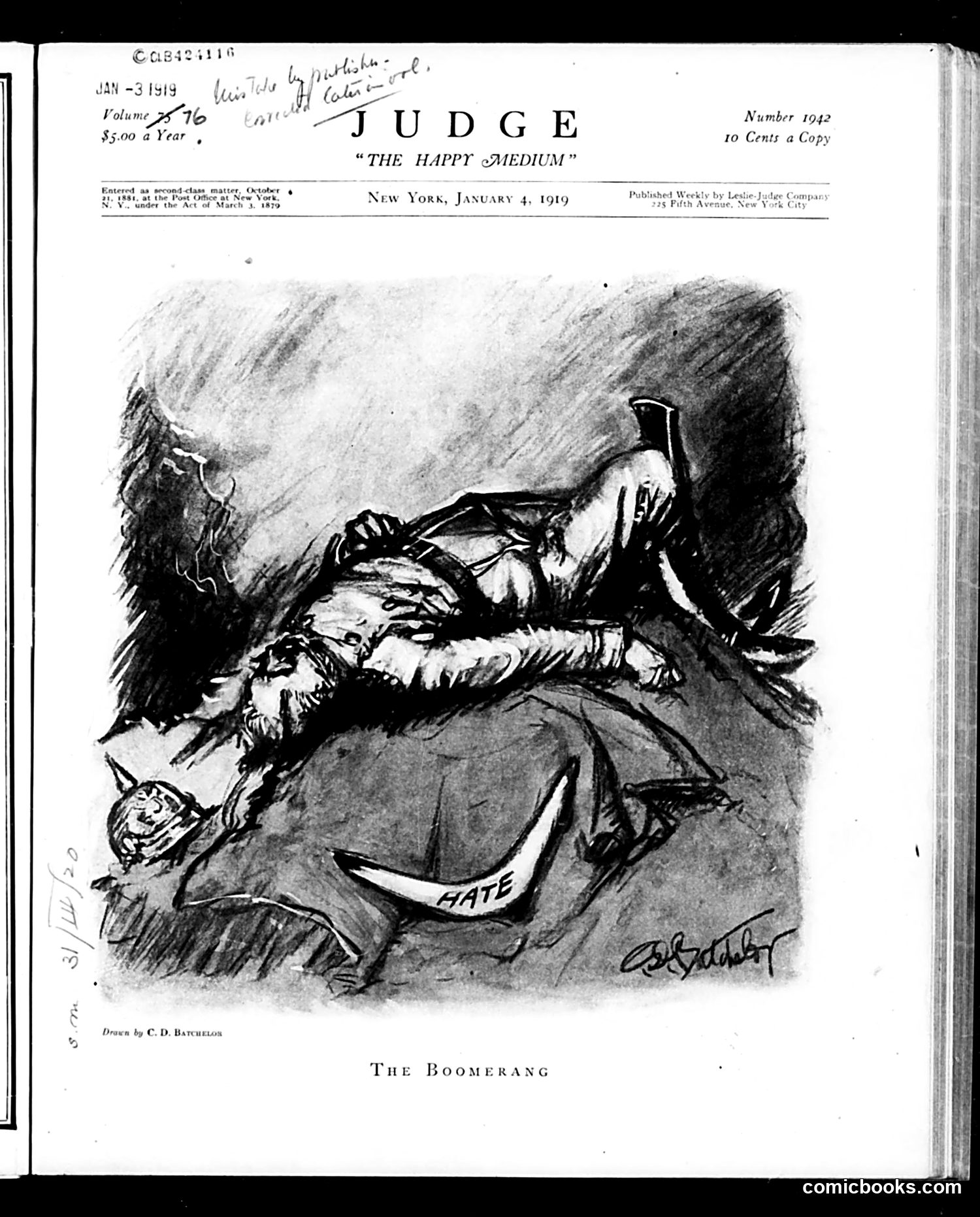
This political cartoon, drawn by C.D. Batchelor, depicts a figure lying on their back, struck by a boomerang labeled "HATE." The imagery suggests a satirical warning about the consequences of hatred or animosity. Published just after World War I's conclusion, this likely references post-war tensions or recriminations. The boomerang metaphor suggests that hatred directed outward returns to harm its originator—a common theme in post-WWI commentary about cycles of revenge and conflict. The specific political target remains unclear without additional context, but the cartoon warns against perpetuating hatred during a period of national reckoning and reconstruction.
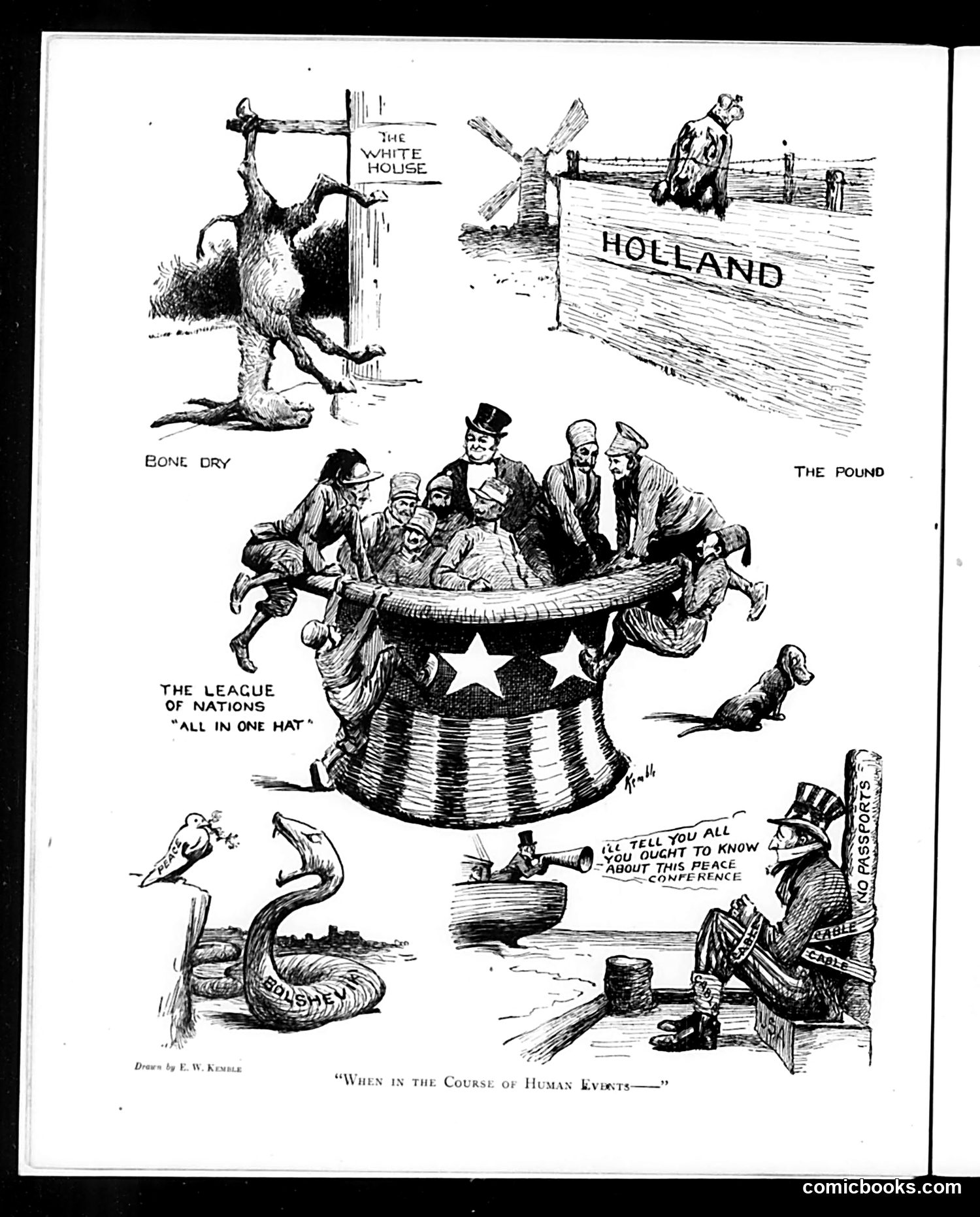
This page satirizes the League of Nations through multiple vignettes. The central image shows various national representatives crammed into an American top hat labeled "All in One Hat"—suggesting the League's attempt to unite disparate nations under one framework, housed within American influence. The surrounding sketches ("Bone Dry," "Holland," "The Pound," "The Poodle") appear to reference specific nations' concerns or problems. The bottom caption, "When in the Course of Human Events—," suggests this addresses serious diplomatic matters. The overall message appears skeptical of the League's viability: cramming incompatible nations together, represented by animals and caricatures, implies the organization was unwieldy and potentially unworkable. The satirist questions whether such unity was genuinely achievable or merely theatrical.
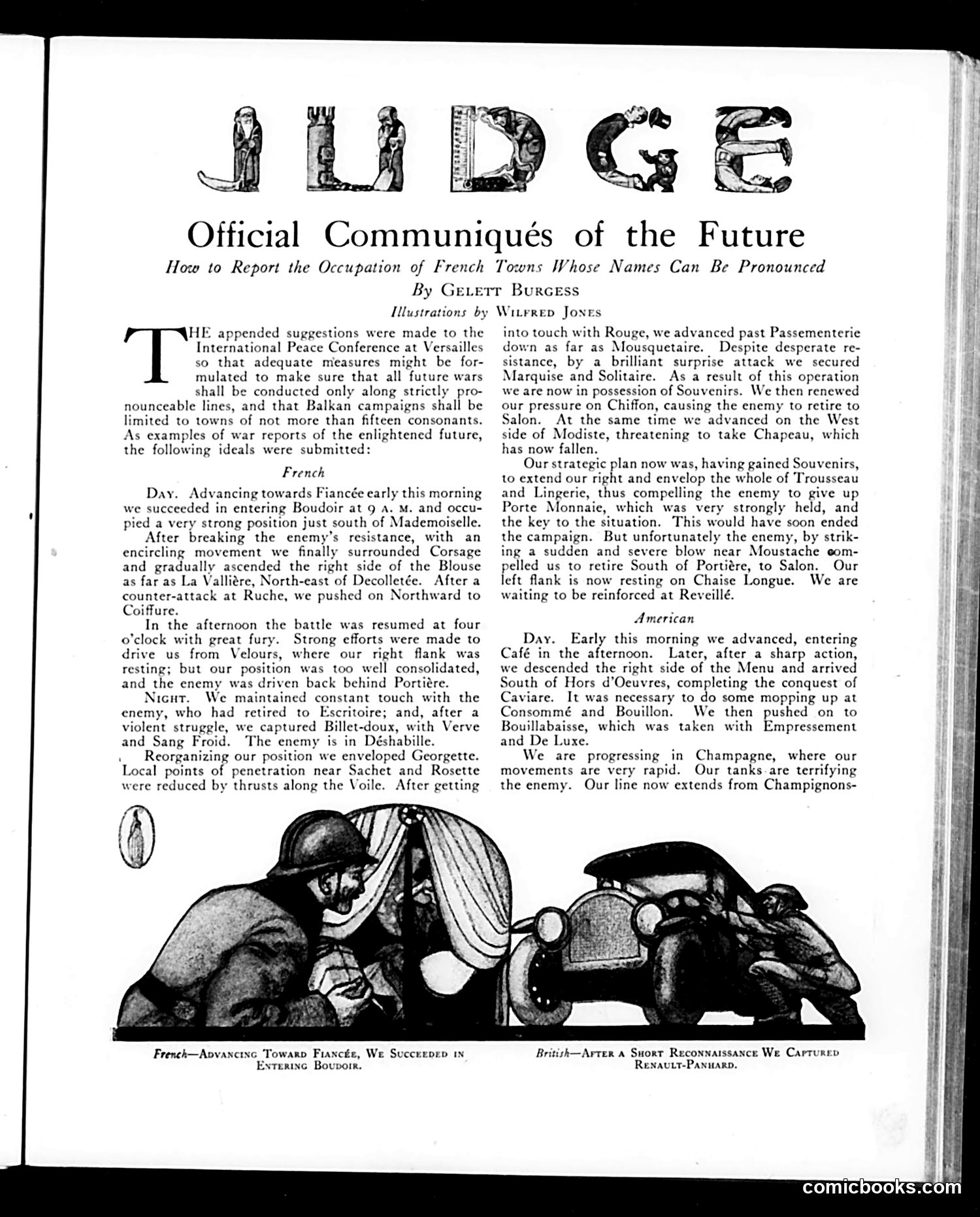
This is a satirical piece titled "Official Communiqués of the Future" mocking military reports about WWI operations in France. The text humorously describes French and American advances capturing various French towns (Boudoir, Fiancée, Moulin, etc.)—deliberately using town names that sound absurd or suggestive when pronounced in English. The satire targets the formal, dry language of official military bulletins by applying it to these ridiculous place names. By having a character named "Gelett Burgess" propose this naming convention for future war reports, *Judge* magazine is poking fun at both the pretentiousness of military communications and the difficulty English speakers had pronouncing French town names. The illustration shows soldiers with a captured vehicle, reinforcing the military campaign context.
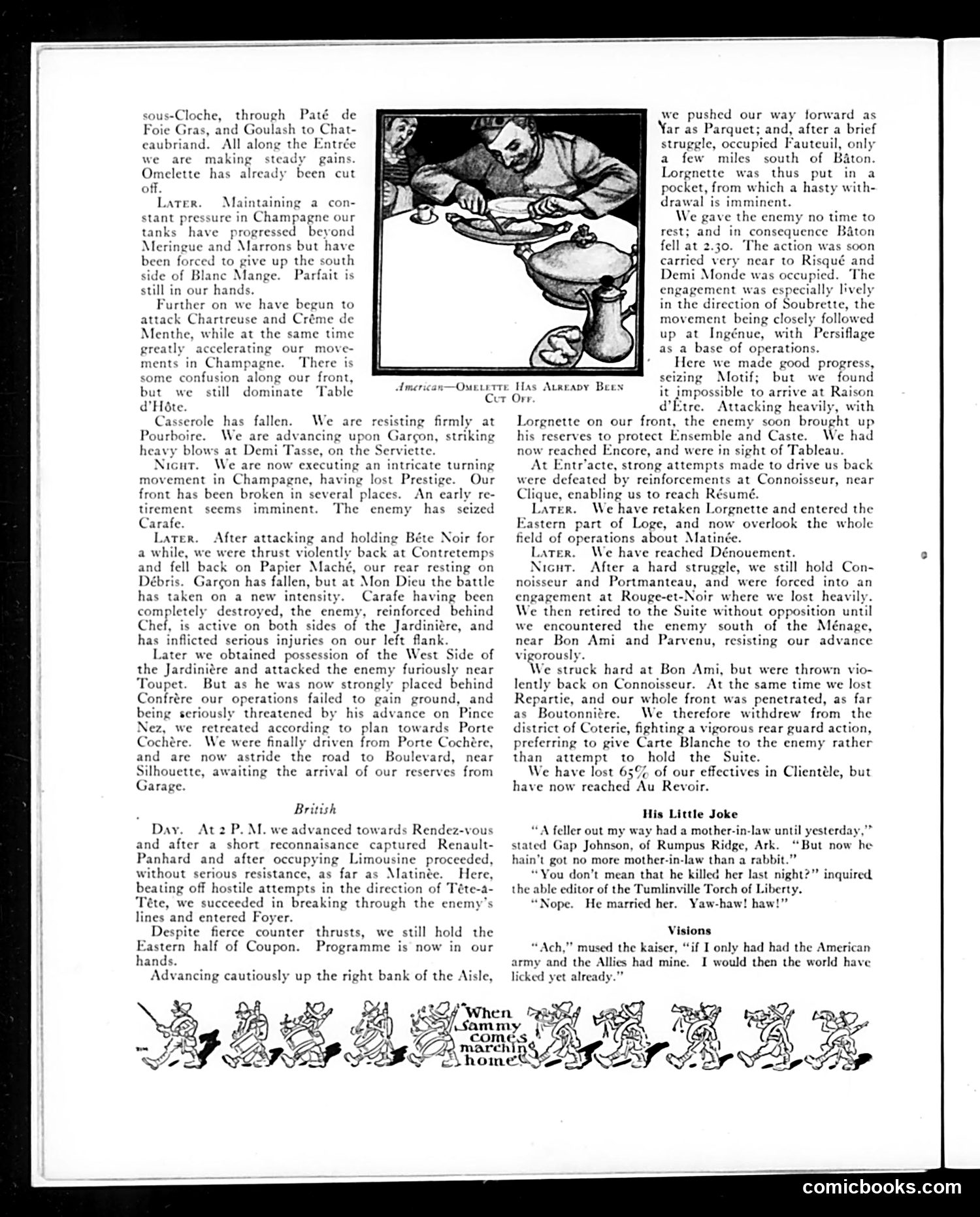
This page presents a WWI-era war dispatch from the British front, describing military operations in France (Champagne, Lorraine, and other regions). The main illustration depicts an American soldier eating from a mess tin—likely satirizing American military provisions or the soldier's appetite during wartime. The page includes two brief humor sections: "His Little Joke" (a pun about a soldier's mother-in-law) and "Visions" (a soldier's fantasy that the American and Allied armies had already won the war). The overall content reflects Judge's patriotic WWI coverage, mixing serious military reporting with light humor to boost morale. The repeated "When Sammy Comes Marching Home" footer reinforces American military involvement and anticipation of soldiers' return.
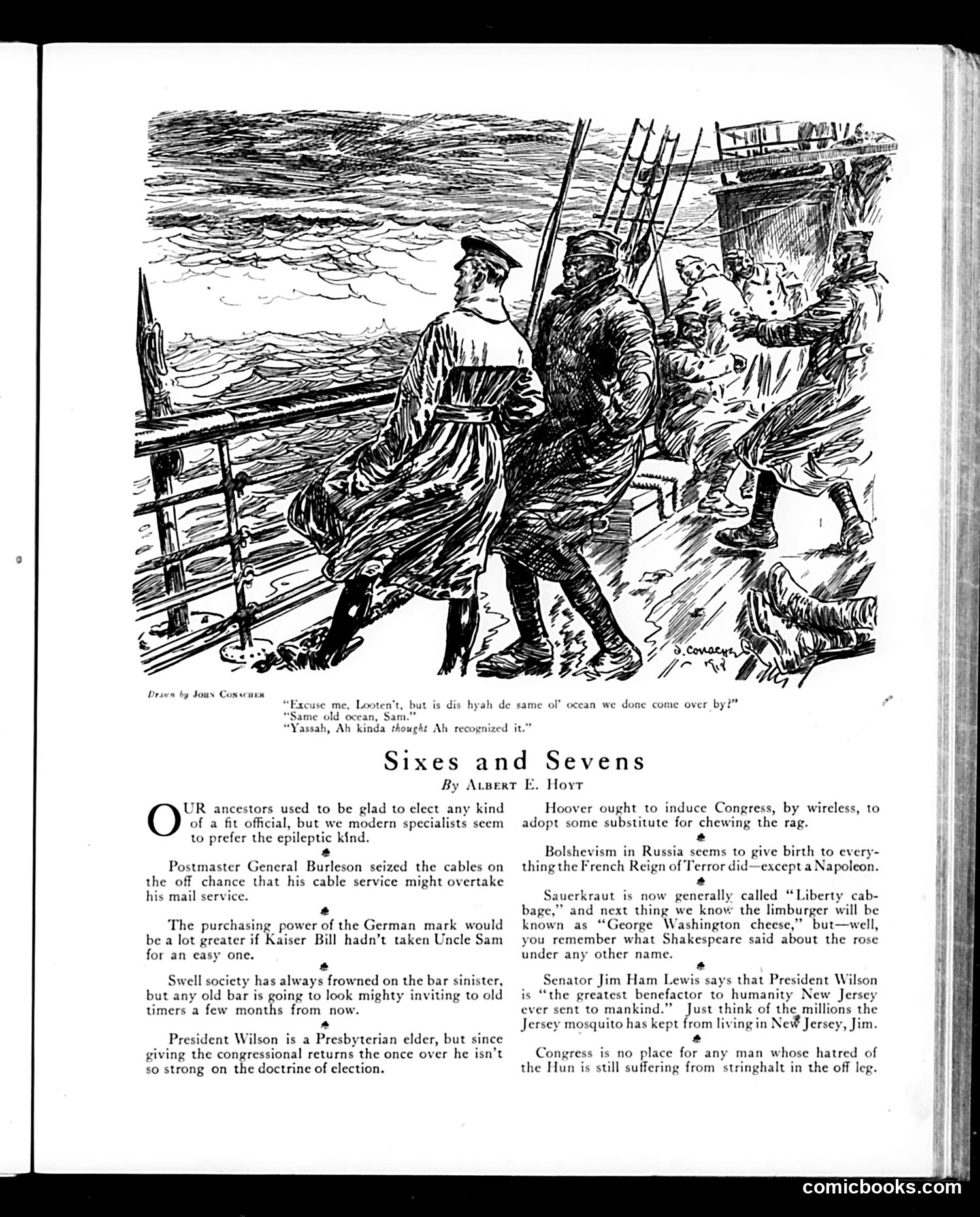
The cartoon depicts two Black passengers aboard a ship, with one asking the other if this is the same ocean they crossed on their journey. The dialogue uses dialect stereotyping common to the era. The accompanying column "Sixes and Sevens" is a collection of brief political quips rather than a unified article. Key references include: - **Postmaster General Burleson**: Criticized for seizing telegraph cables, with a joke about his mail service being slow - **Kaiser Bill**: Germany's leader, mocked for underestimating American resources ("Uncle Sam") - **President Wilson**: Criticized as inconsistent on religious doctrine and election results - **WWI context**: References to anti-German sentiment (renaming sauerkraut "Liberty cabbage"), hostility toward "the Hun," and Bolshevism in Russia - **Prohibition hint**: Jokes about bars becoming "inviting" soon, likely referencing coming alcohol prohibition The satire targets government inefficiency, wartime hysteria, and political hypocrisy. The cartoon itself relies on racist caricature typical of Judge's era.
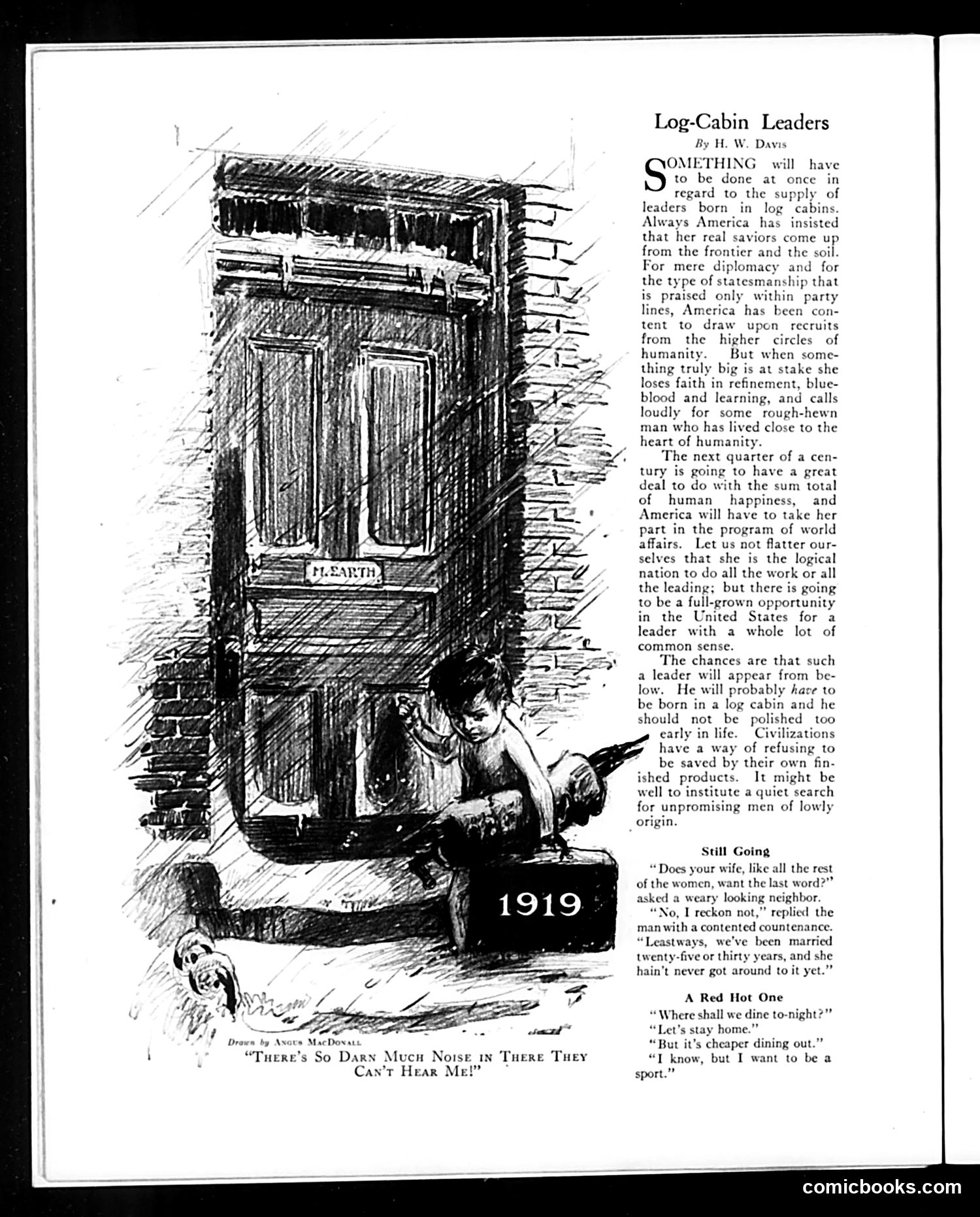
This article argues that America needs a new leader from humble frontier origins—a "log-cabin" figure—to address major world affairs in the coming quarter-century. The author (H.W. Davis) suggests that while refined, educated elites handle diplomacy, true crises demand rough-hewn men of common sense and authentic experience close to ordinary life. He argues civilizations resist being saved by their own "finished products," implying that over-refinement and polish are liabilities. The illustration depicts a child sitting outside a log cabin marked "HEARTH" in 1919, captioned "There's So Darn Much Noise in There They Can't Hear Me!"—suggesting future leaders will emerge from humble, noisy domestic origins. The cartoons below ("Still Going" and "A Red Hot One") are unrelated domestic humor pieces about marriage and dating etiquette.
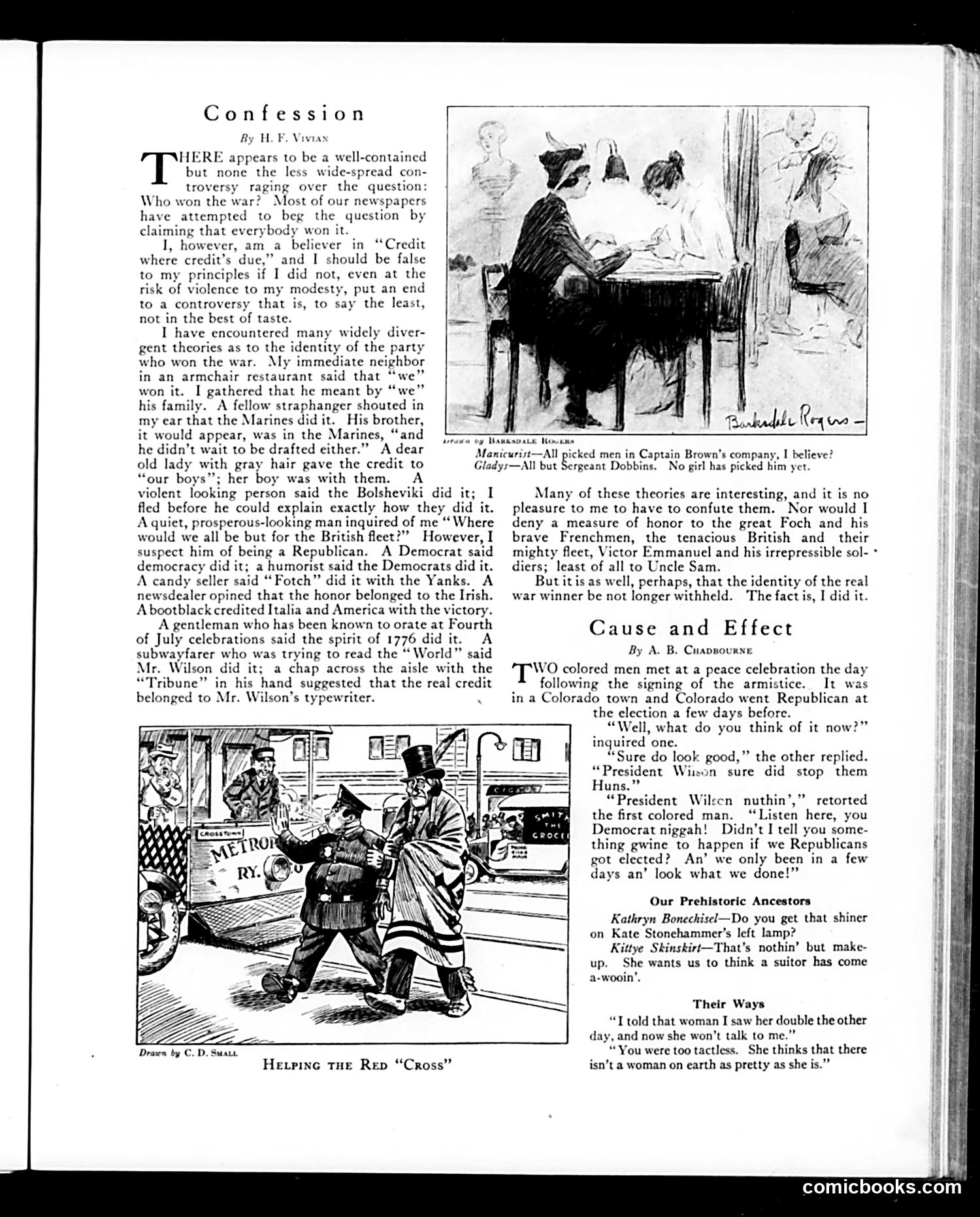
This *Judge* page contains three satirical pieces about post-WWI America: **"Confession"** mocks the debate over who deserves credit for winning World War I. The author humorously catalogs competing claims—the Marines, the British fleet, the Bolsheviks, President Wilson, even Wilson's typewriter—before absurdly claiming personal credit. The satire targets American self-centeredness and partisan bickering (Democrats vs. Republicans) over wartime responsibility. **"Cause and Effect"** uses a conversation between two Black men to satirize Republican electoral strategy. One attributes stopping "the Huns" to Wilson (Democrat), but the other boasts that Republicans' election will produce results—implying Republicans take credit for post-war conditions. The piece critiques opportunistic political messaging. **The lower cartoon** "Helping the Red Cross" depicts someone donating to charity (likely wartime relief). The remaining humorous shorts mock vanity and feminine pretense. The page reflects post-WWI American political divisions and the era's casual racial language typical of early 20th-century publications.
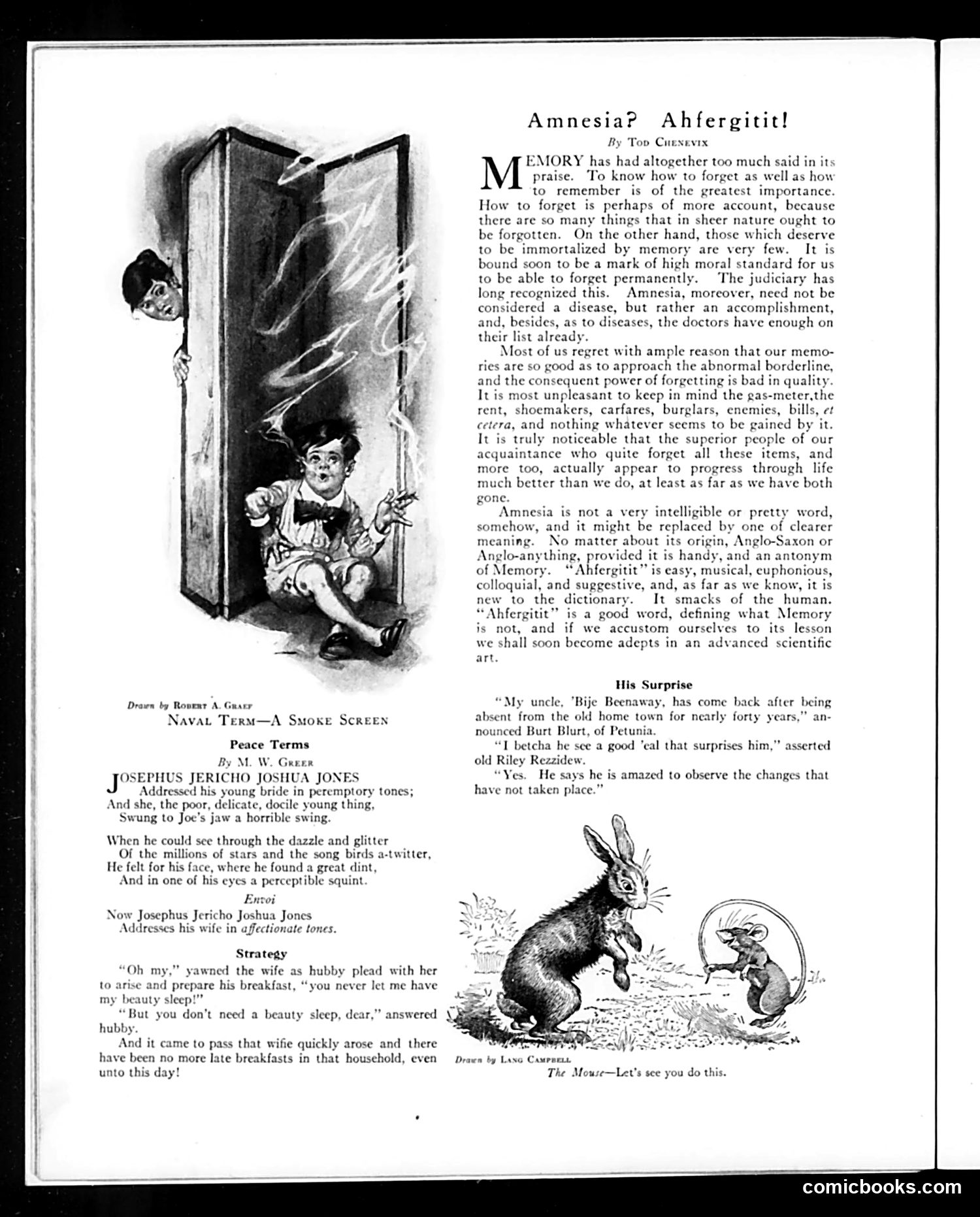
This page contains several humorous pieces satirizing early 20th-century American domestic and social life: **"Peace Terms"** depicts marital discord through exaggeration. A husband addresses his "young bride" in commanding tones; she responds by punching him so hard he sees stars. The joke: once she's demonstrated her strength, he learns to address her "in affectionate tones" instead—a reversal of expected gender dynamics that mocks both traditional male authority and the "new woman" of the era. **"Strategy"** continues the domestic theme, showing a wife claiming she needs "beauty sleep" while refusing to prepare breakfast. The husband capitulates, and she becomes dutiful—satirizing both marital negotiation tactics and the contradiction between women's proclaimed needs and their actual behavior. **"Amnesia? Ahfergitit!"** is a philosophical essay-joke coining the slang term "ahfergitit" (forget it) as superior to "amnesia." It humorously argues that forgetting debts, bills, and social obligations is actually a mark of superiority and moral advancement—obvious satire of those who conveniently "forget" their responsibilities. The pieces mock marriage, gender relations, and selective memory with period-appropriate humor.
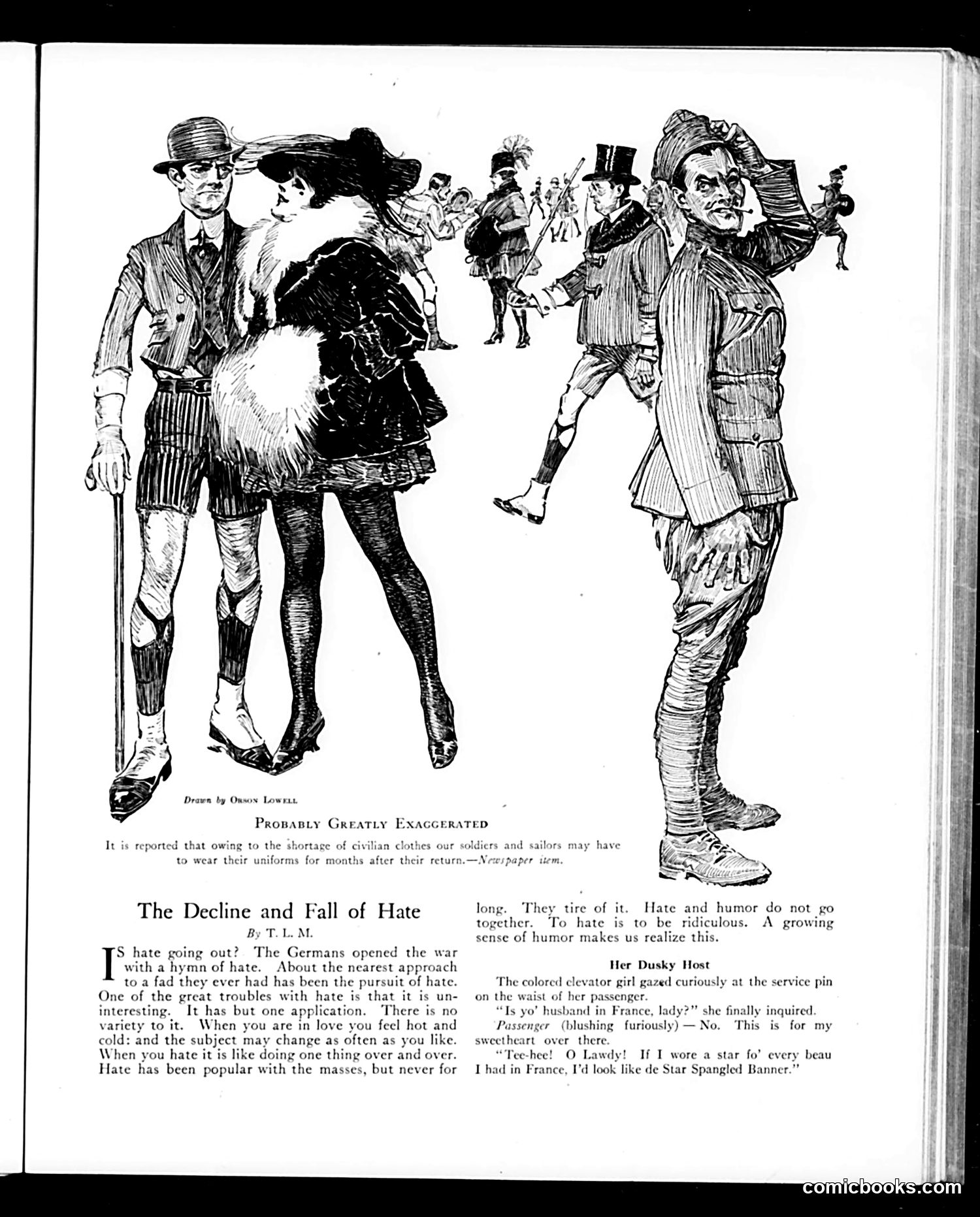
The top cartoon, titled "Probably Greatly Exaggerated," depicts soldiers and sailors struggling to fit into civilian clothes after WWI service. The accompanying note references a newspaper report that troops might need to wear uniforms for months post-return due to clothing shortages—the cartoon exaggerates this by showing a bandaged soldier who appears nearly mummified, poking fun at the practical difficulties soldiers faced reintegrating into civilian life. The main article, "The Decline and Fall of Hate" by T.L.M., argues that German wartime propaganda based on hatred was ineffective because hate lacks variety and becomes tedious—unlike love, which sustains interest. The piece suggests America's superior sense of humor rendered such propaganda ridiculous. The sidebar anecdote "Her Dusky Host" presents a racial stereotype: an African American elevator operator making dialect humor about a woman's service pin (indicating a sweetheart abroad), using exaggerated speech patterns typical of period racist caricature.
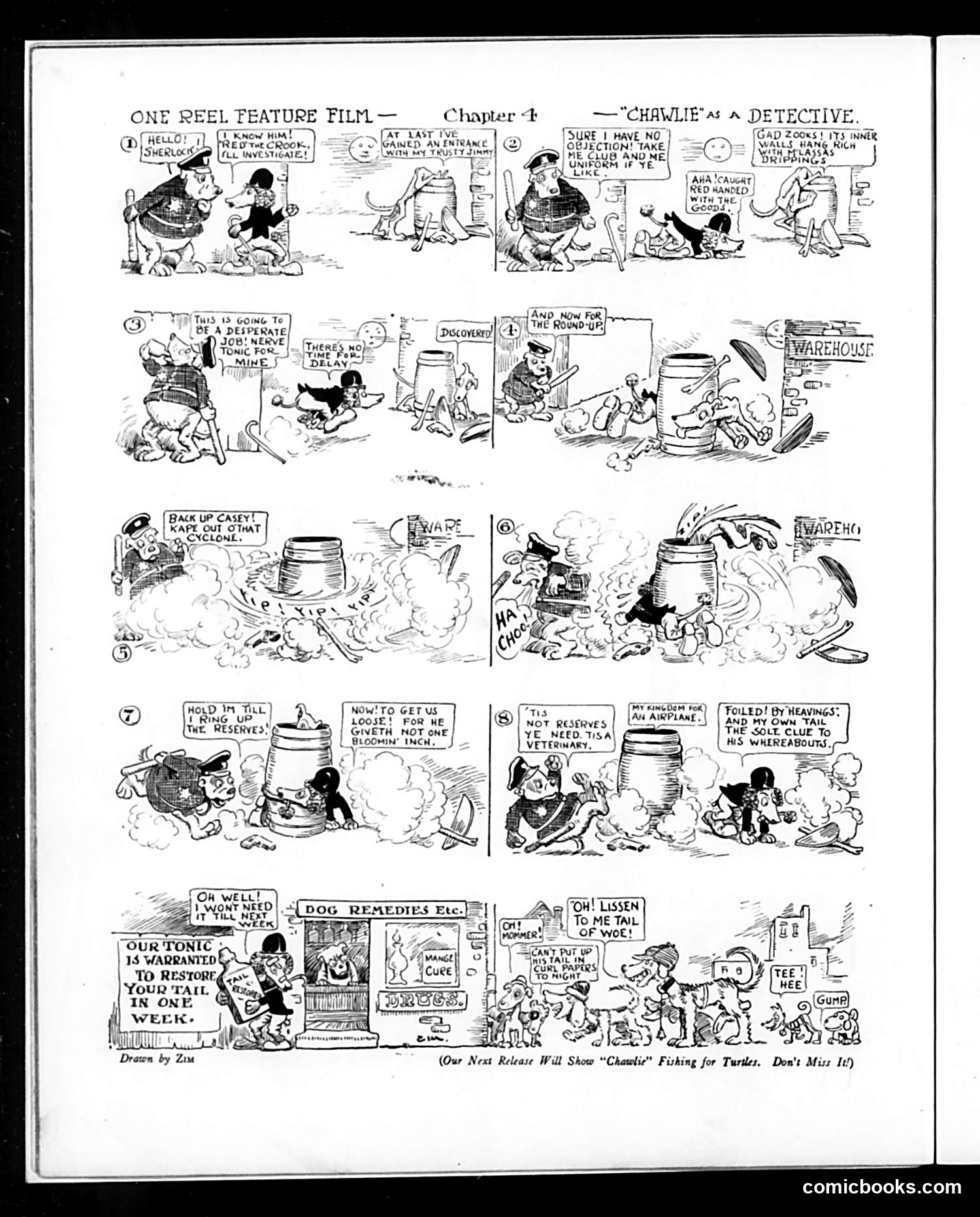
This is a slapstick comedy comic strip parodying silent film detective stories, centered on a character named "Chawlie" (likely referencing Charlie Chaplin's "Tramp" character, a popular film archetype of the era). The humor relies on physical comedy and absurd investigation methods: Chawlie attempts detective work with ridiculous tools (a "trusty jimmy" club), discovers clues through accident rather than deduction, and the plot escalates into increasingly chaotic situations involving warehouses, explosions, and cyclones. The characters speak in exaggerated dialect and malapropisms ("giveth not one broom inch"). The strip mocks both detective fiction conventions and silent film melodrama—the overwrought dramatic poses, impossible escapes, and preposterous plot developments. The final panel advertises dog remedies and tonics, a common magazine advertising format. This appears designed as light entertainment satirizing popular cinema rather than political commentary.
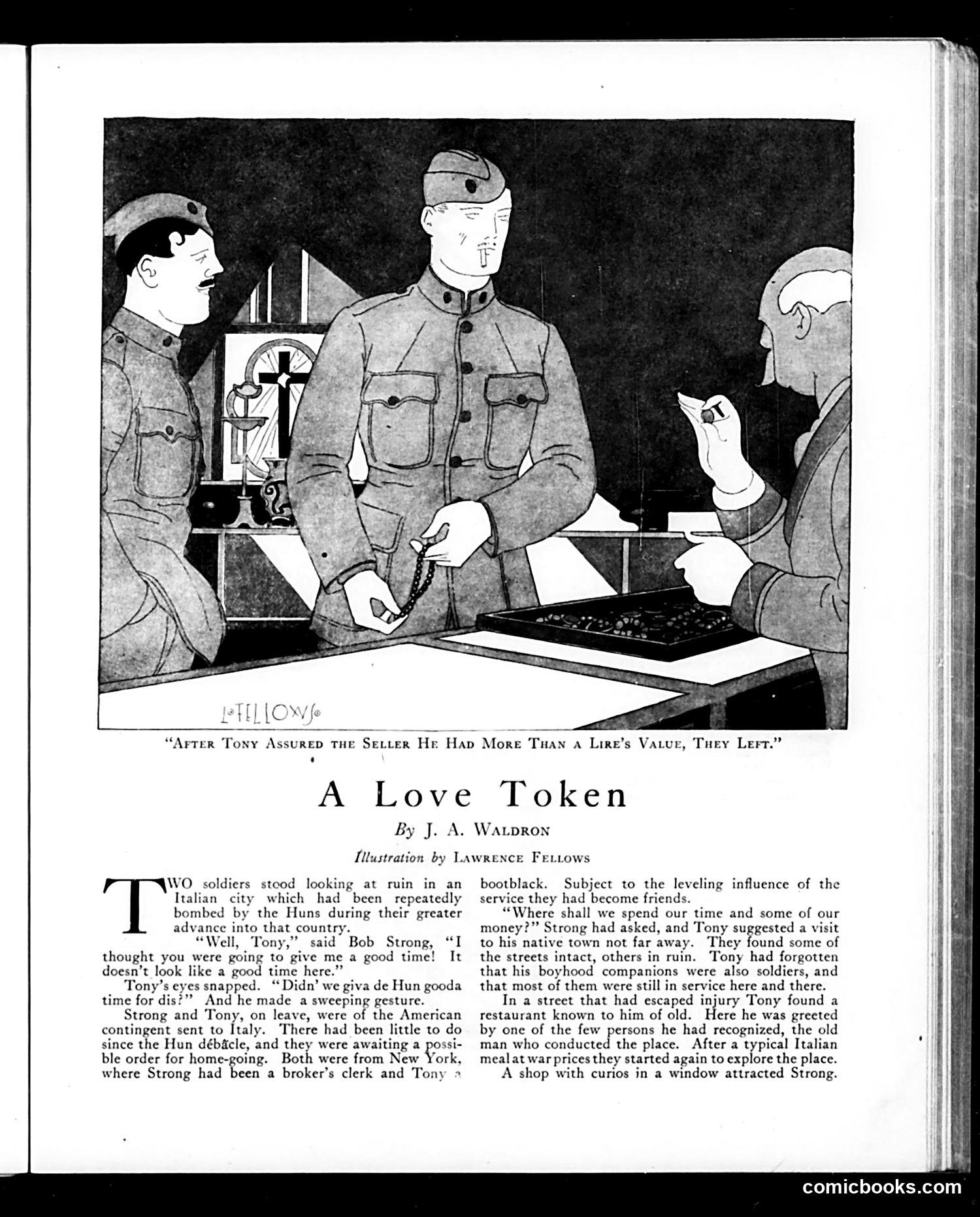
This is a short story illustration (not political satire) from *Judge* magazine depicting American soldiers in post-WWI Italy. Two soldiers—Bob Strong, formerly a New York broker's clerk, and Tony, formerly a bootblack—are on leave in Tony's bombed Italian hometown after "the Hun" (German forces) have been defeated. The caption references Tony buying a "love token" (likely a souvenir) from a shop owner, assuring him it's worth more than one Italian lira. The story illustrates the bond formed between soldiers of different social classes during wartime service, now exploring war-damaged Italian cities together. The "satire" is gentle class commentary: a wealthy American and working-class immigrant becoming equals through military service—a popular post-war narrative about shared sacrifice transcending social hierarchy.
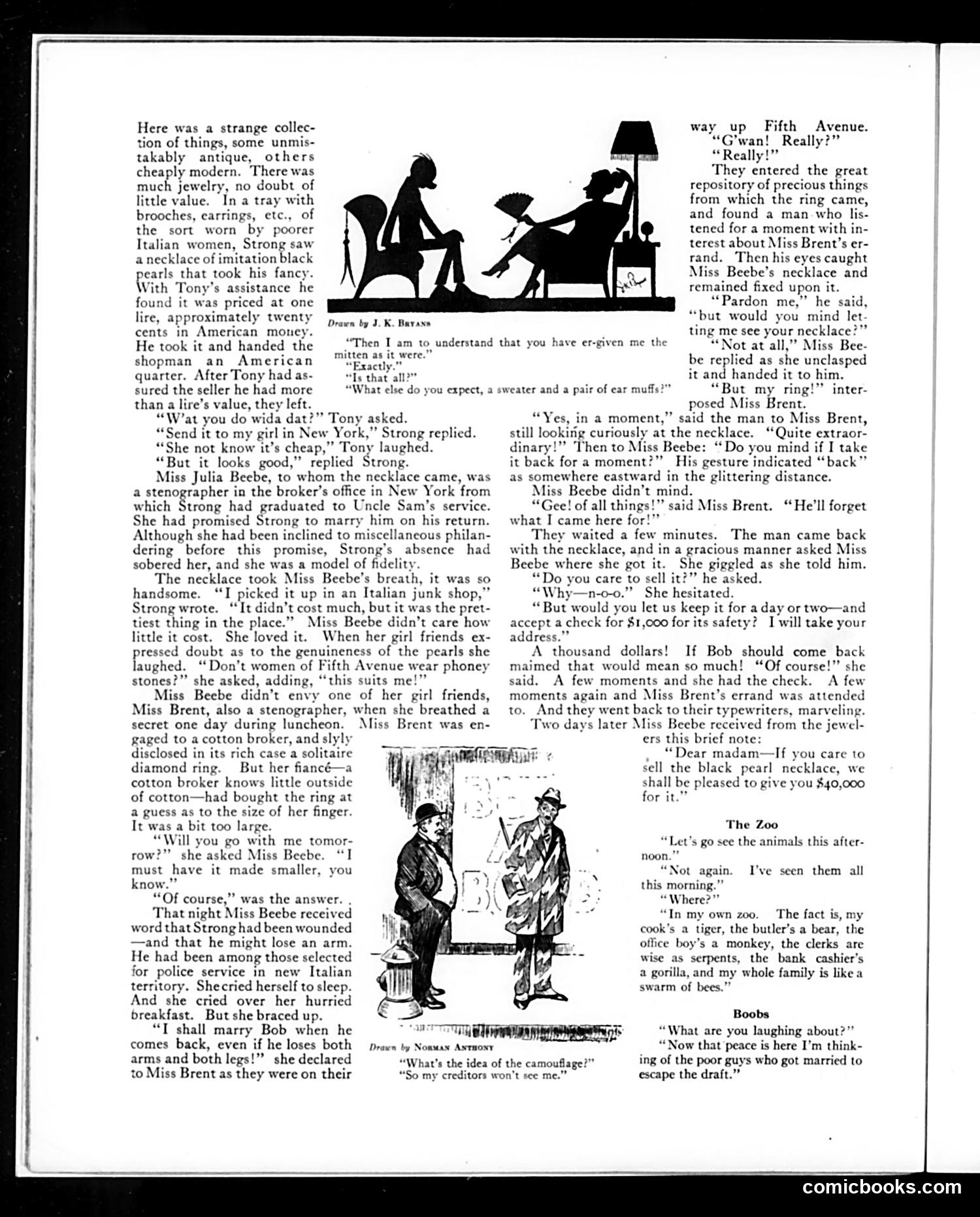
This page presents a serialized story about two stenographers in New York. Miss Beebe receives an inexpensive imitation pearl necklace from her fiancé Strong, a soldier wounded in service. Miss Brent, her friend, seeks to resize her diamond engagement ring from a cotton broker fiancé. When they visit a jeweler, he becomes intensely interested in Beebe's necklace—recognizing it as genuinely valuable despite Strong's claim it was a cheap Italian junk-shop purchase. The jeweler takes it away, suggesting it's actually worth far more than anyone realized. The satire targets early 20th-century class anxieties: the contrast between fake and real wealth, the gullibility of women regarding jewelry, and the gap between appearances and actual value. The story suggests romance and authenticity trump material worth—Beebe loves the necklace regardless of its cost—while simultaneously revealing that genuine value often hides beneath humble origins.
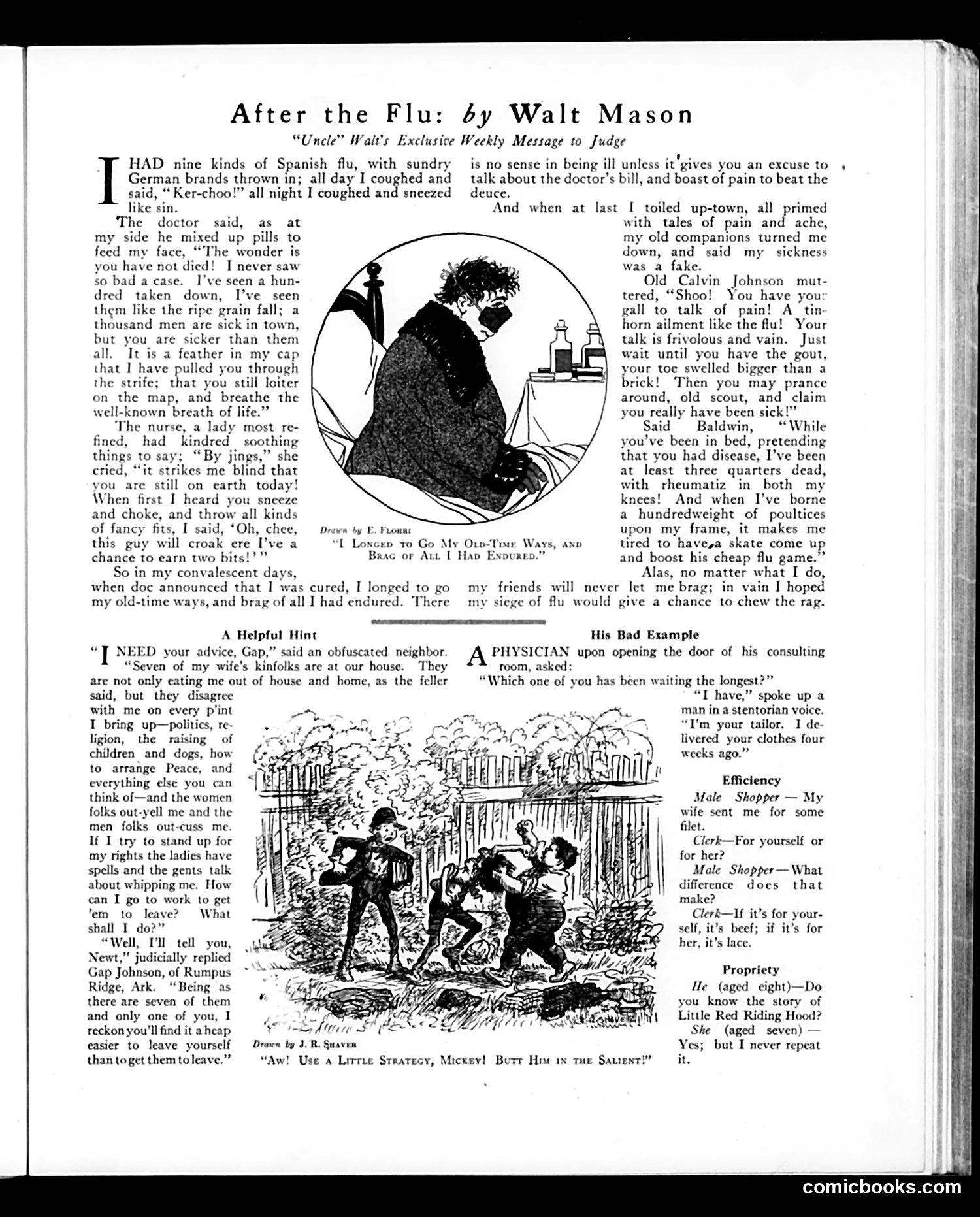
This page satirizes post-flu behavior and social dynamics. The main article, by "Uncle" Walt Mason, describes someone recovering from the 1918 flu pandemic who desperately wants to brag about his illness and suffering to friends—a common human tendency. However, his companions dismiss his complaints, claiming their own ailments (rheumatism, gout) were worse. The satire mocks how people compete to claim the worst suffering. The sidebars offer additional humor: "A Helpful Hint" advises an outnumbered man to simply leave rather than argue with his wife's relatives; "His Bad Example" shows a tailor waiting longest at a doctor's office because the physician owes him money for clothes; and "Efficiency" jokes about gender-based pricing differences. The cartoons humorously reflect post-pandemic social attitudes and everyday frustrations.
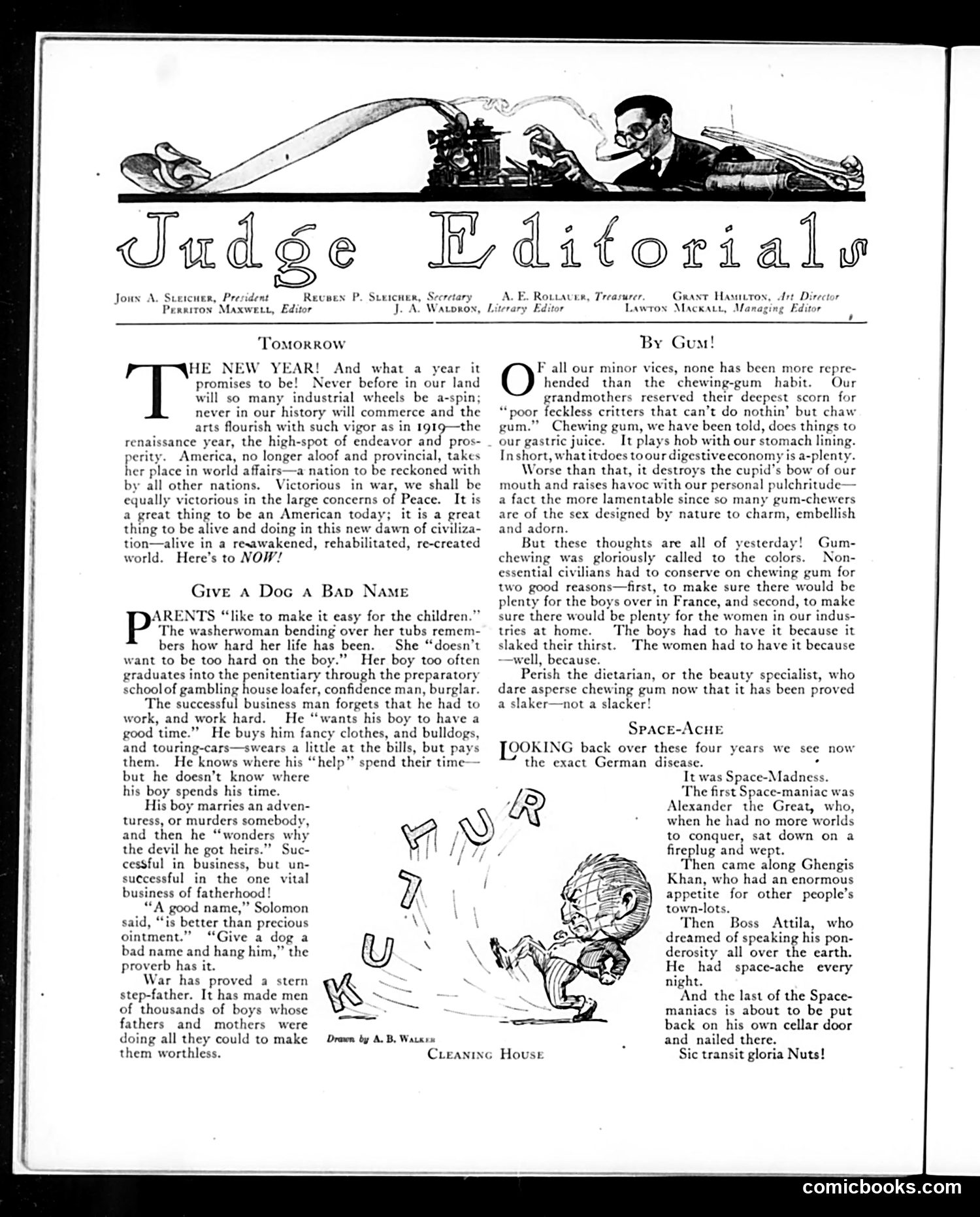
This is a post-WWI editorial page from Judge magazine (likely January 1919) celebrating American victory and prosperity. **"Tomorrow"** opens with triumphalist rhetoric about 1919 as America's "renaissance year"—the nation has emerged from the war as a world power, no longer "aloof and provincial." **"Give a Dog a Bad Name"** critiques parental permissiveness. The editorial argues that wealthy businessmen and working-class parents alike spoil their sons with money and freedom, leading them to crime and ruin. It contrasts this with wartime discipline: the military forced idle boys into manhood. The sermon-like tone references Solomon's proverb about a good name's value. **"By Gum!"** defends gum-chewing, previously considered lower-class and unhealthy. Wartime rationing elevated it to patriotic necessity—soldiers needed it, factory workers needed it. Now it deserves respect. **"Space-Ache"** (illustrated) satirizes megalomaniacal ambition through history: Alexander the Great, Genghis Khan, and Attila the Hun all conquered endlessly, calling it "German disease"—likely linking imperial conquest to German militarism that caused the war.
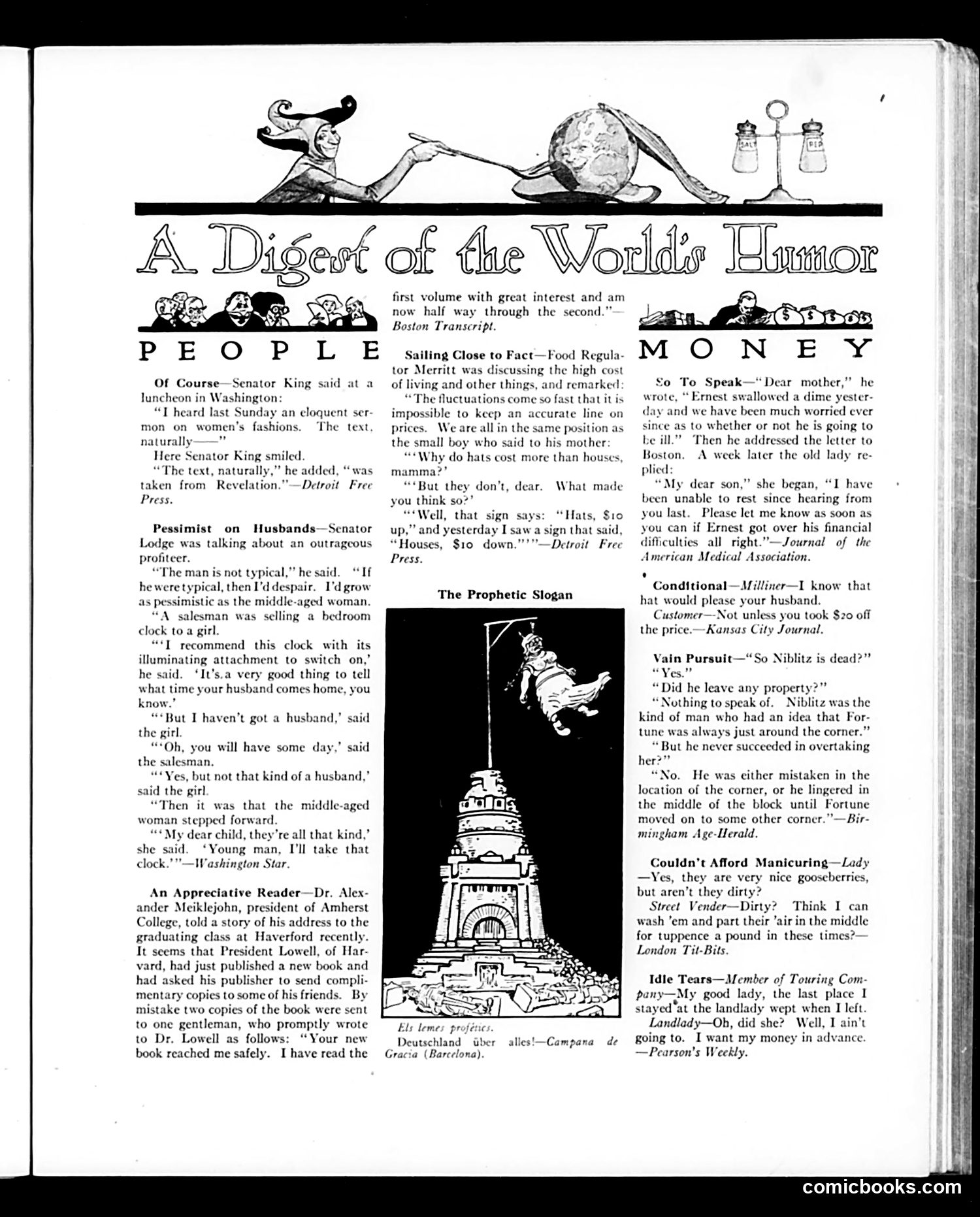
This page collects brief satirical anecdotes typical of Judge magazine's humor section. Key targets include: **Political figures**: Senator King (mocked for citing scripture on women's fashion) and Senator Lodge (quoted on pessimistic husbands). **Social commentary**: Multiple jokes target women's materialism and marital dissatisfaction—a salesman's clock helps wives track when husbands come home; a milliner won't sell a hat unless the husband's price is undercut by $20. **Post-WWI economic anxiety**: "Sailing Close to Fact" satirizes Food Regulator Merritt's inability to control inflation, with house prices collapsing while hat prices rise absurdly. **The central cartoon** ("The Prophetic Slogan") depicts a cherub/fortune figure above a German building, likely referencing post-war German economic collapse or instability. Overall, the page reflects 1920s American concerns: political incompetence, marital discord, inflation, and Germany's troubled economy.
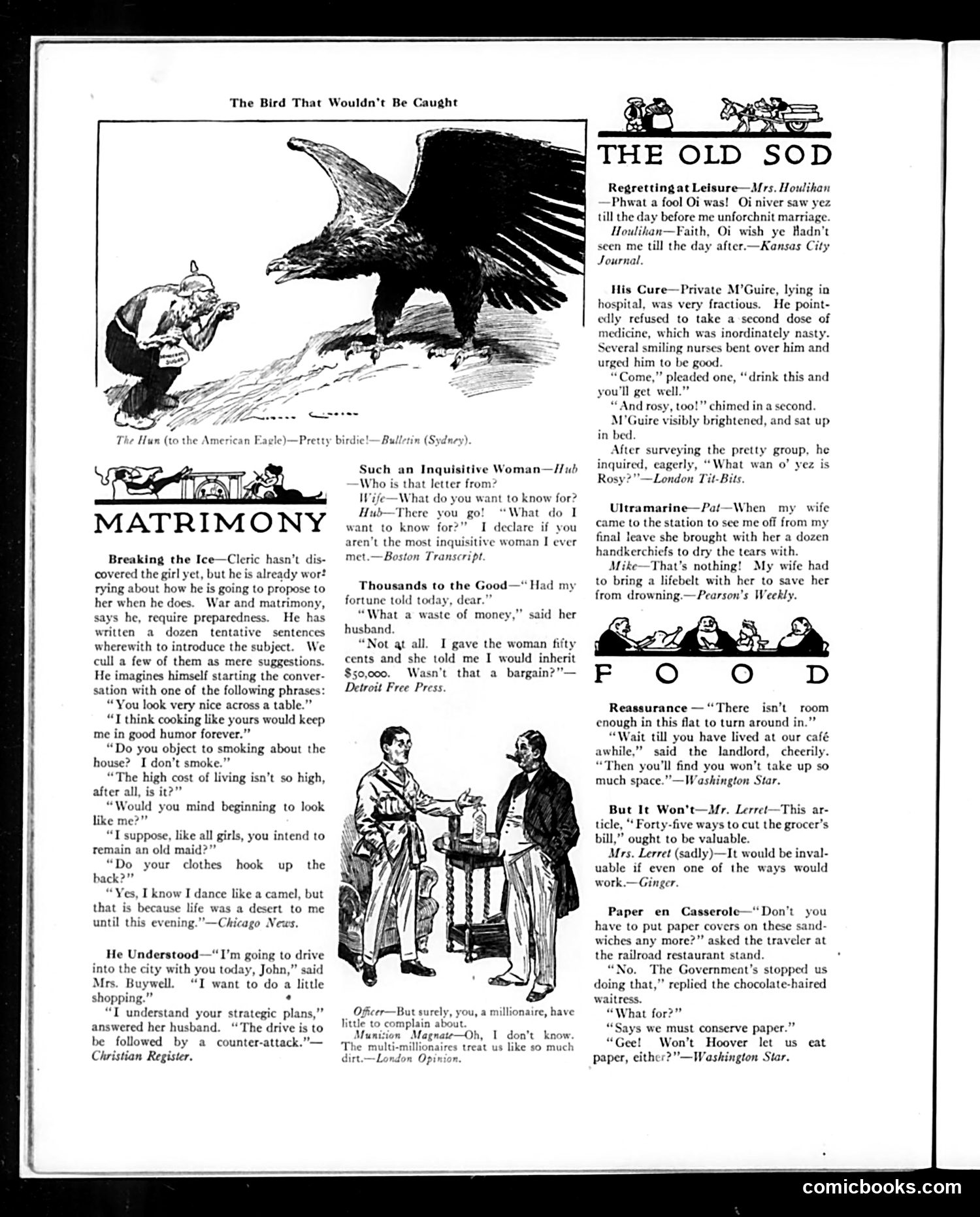
**Main Cartoon - "The Bird That Wouldn't Be Caught":** Shows a German soldier ("The Hun") attempting to catch an American eagle. This references WWI-era propaganda depicting Germany as predatory and America as unconquerable. The eagle's defiant escape symbolizes American resistance to German aggression. **"Matrimony" Section:** A series of humorous anecdotes about marriage proposals and spousal dynamics, using comedic exaggeration. Includes jokes about women's inquisitiveness, fortune-telling, and marital arguments—typical early 20th-century domestic humor reflecting gender stereotypes. **"The Old Sod" and "Food" Sections:** Brief comic items: an Irish couple's regrets about marriage; a hospitalized soldier who brightens at nurses' attention; wartime economy jokes about paper conservation under the Hoover administration. **Overall Context:** This appears to be a WWI-era Judge issue mixing patriotic anti-German sentiment with domestic humor and homefront references (Hoover conservation efforts), typical of American satirical magazines from roughly 1917-1918.
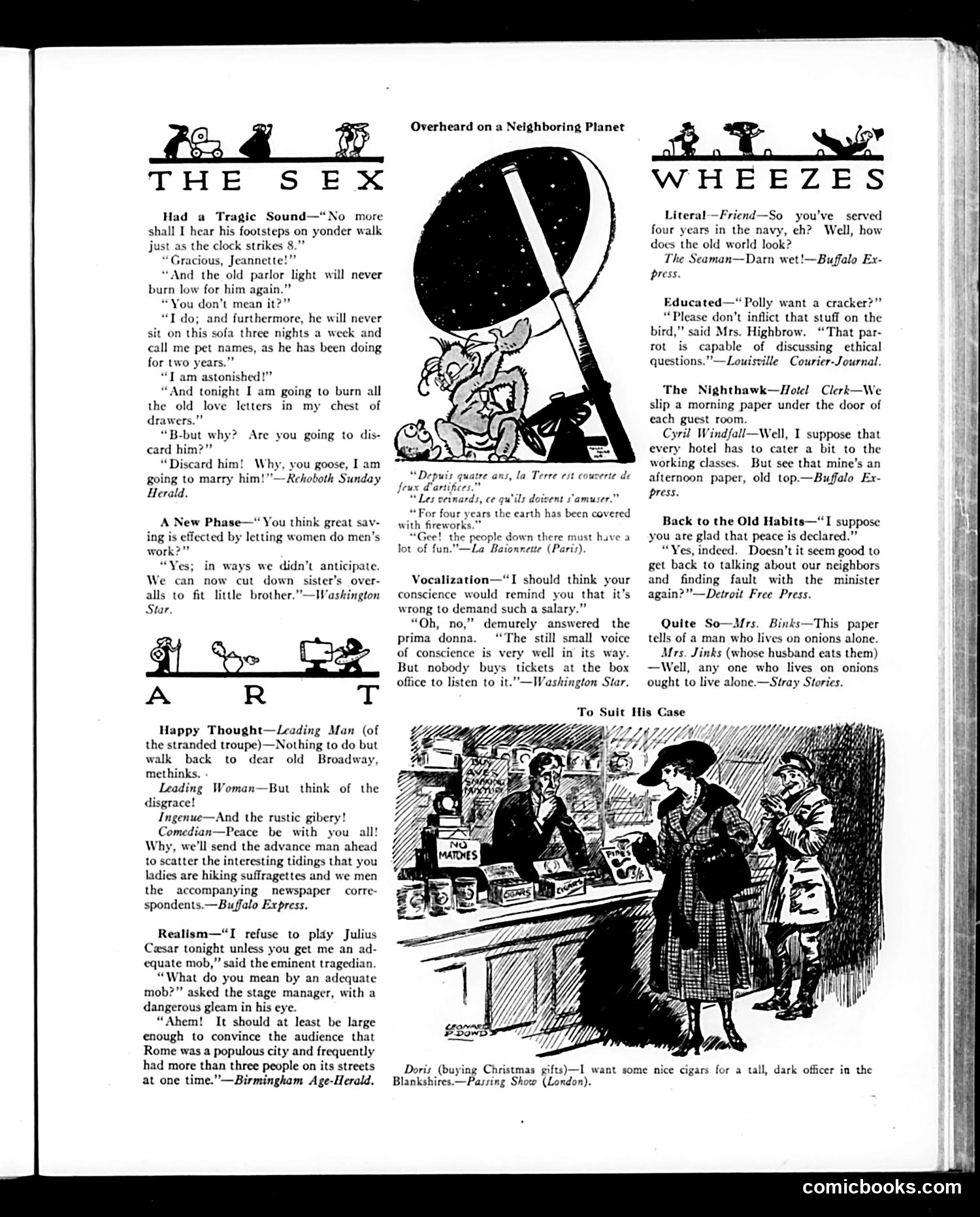
This page contains brief satirical quips and jokes typical of Judge's humor section, plus one illustrated cartoon. **"The Sex"** section opens with a woman breaking her engagement announcement—she's leaving her suitor because she plans to marry him instead. The joke plays on the woman's dramatic, theatrical language about ending their courtship, which turns out to be a proposal. **"A R T"** contains theater industry jokes, including one where a Shakespearean actor demands an adequately large mob scene for Julius Caesar, and another about traveling theater troupes using their misfortune as publicity by claiming to be suffragettes. **The illustrated cartoon** (captioned "To Suit His Case") shows a shop scene where a woman (Doris) is purchasing cigars as a Christmas gift for "a tall, dark officer in the Blankshires"—a British military regiment. The humor appears to involve selecting gifts for a specific military type. **"Wheezes"** offers brief one-liners on various topics: sailors, educated parrots, hotel class distinctions, post-war gossip, and dietary habits. The page primarily showcases wordplay and social satire common to early 20th-century American humor magazines.
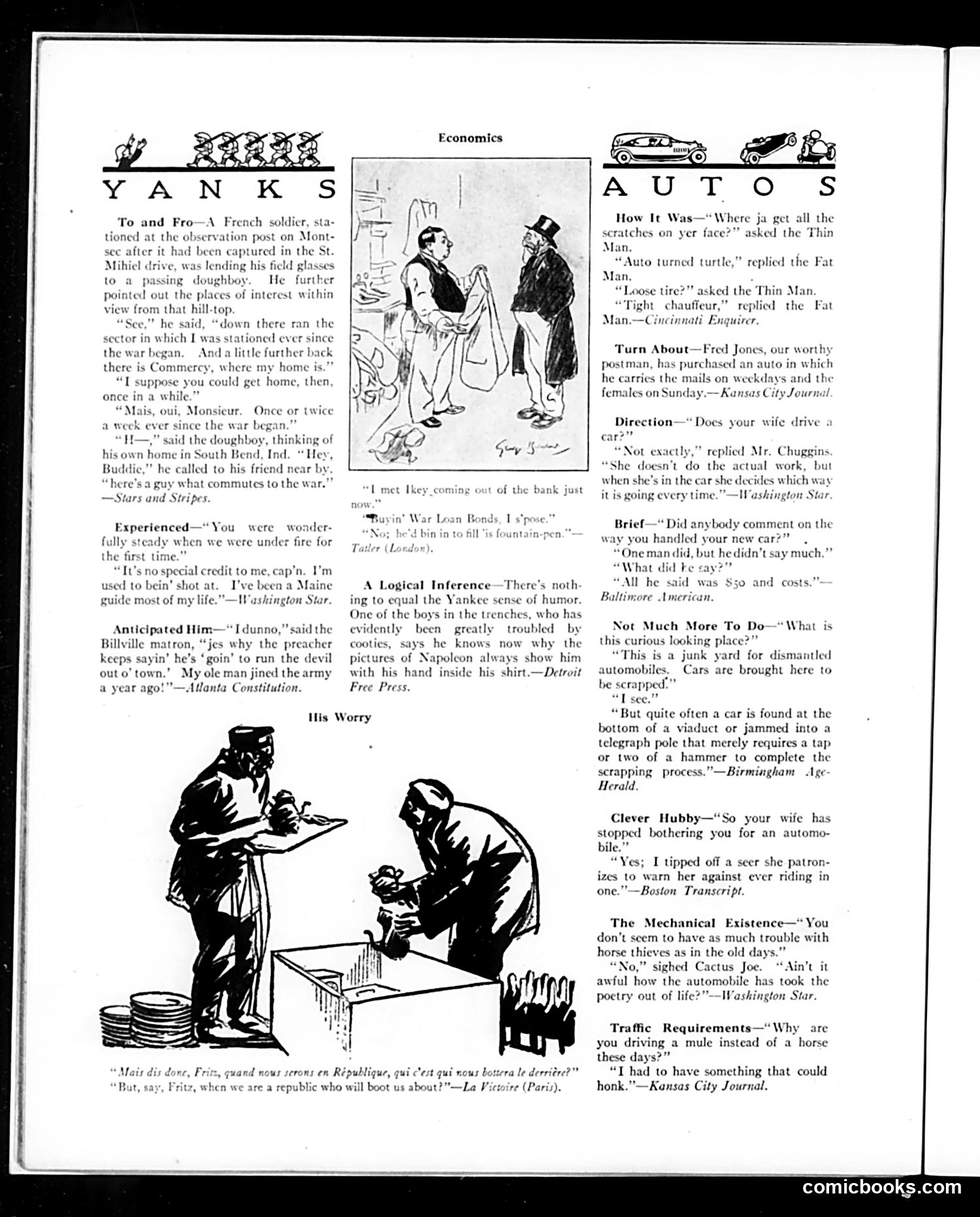
This page collects short humorous anecdotes about automobiles, likely from WWI era (references to trenches, war bonds, soldiers). The cartoons and jokes satirize: **The main cartoon** ("His Worry") depicts two men—likely representing French and American perspectives—discussing post-war politics, with the Frenchman anxiously asking who will "boot us about" after the republic's established. This reflects anxiety about post-war stability. **The automobile jokes** mock the then-new technology's impact on society: wives gaining independence through cars, the impracticality of motoring, traffic dangers, and the replacement of horse-culture with mechanical transportation. One joke suggests automobiles are so dangerous they end up in "junk yards"—crushed at the bottom of viaducts. **The war context** jokes treat soldiers casually commuting to combat ("commutes to the war") and trenches, reflecting American soldiers' novel experience with mechanized warfare. Overall, the page uses automobiles as both literal subject and metaphor for rapid, sometimes chaotic modernity disrupting traditional life—particularly gender roles and rural culture.
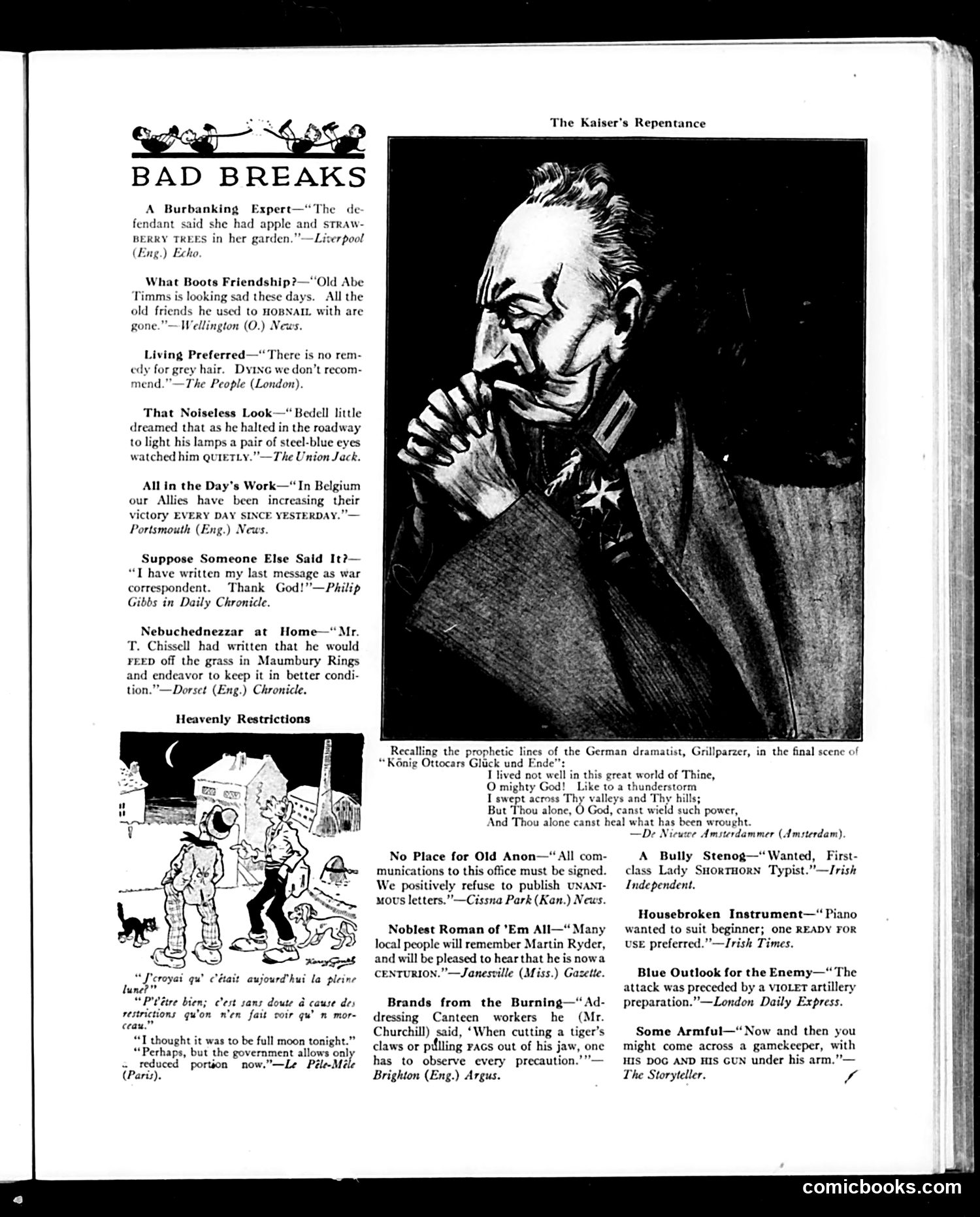
This political cartoon depicts **Kaiser Wilhelm II** of Germany (identifiable by his distinctive upturned mustache and military uniform with medals) in a moment of contrived remorse during **World War I**. The satire quotes German dramatist Grillparzer's lines about living poorly and causing destruction like a thunderstorm, but the accompanying French caption undercuts this supposed repentance: a character notes the moon appears dimmer than expected, and another responds it's due to wartime rationing restrictions—the government only allows a "reduced portion." **The joke**: The Kaiser's grandiose apology for his destructive actions is presented as merely theatrical posturing. By juxtaposing his dramatic spiritual confession with a mundane comment about government rationing, Judge ridicules the idea that Germany's leader genuinely regretted the war's devastation. It's satire suggesting his remorse is as illusory as a dimmed moon—a superficial performance masking continued belligerence.
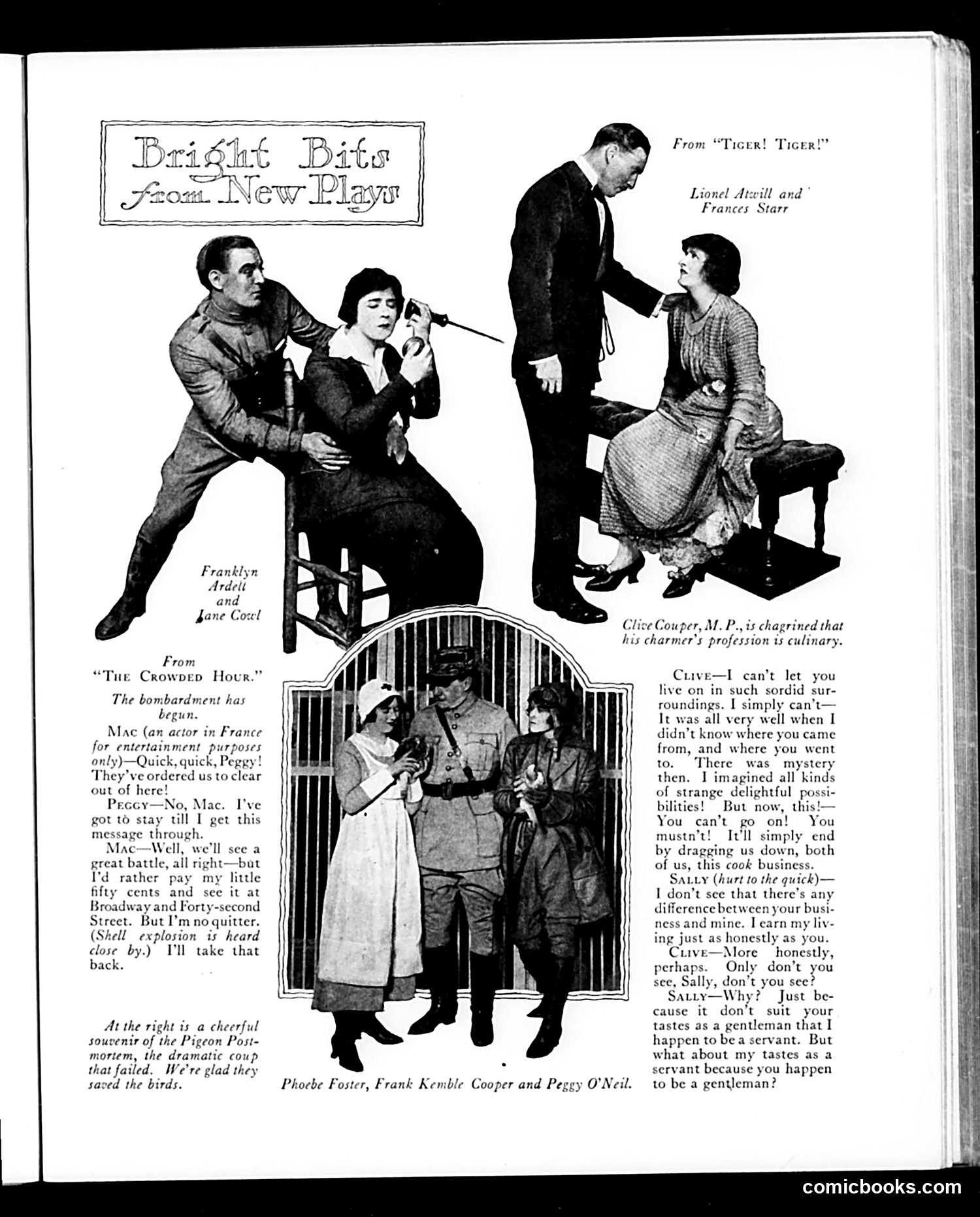
This page showcases scenes from contemporary theatrical productions. The top section depicts "The Crowded Hour," showing actors Franklyn Ardell and Jane Cowl in a wartime evacuation scene—a man urges a woman to flee bombardment, but she refuses to leave until she completes an urgent message, establishing dramatic tension around WWI. The lower sections feature two other plays: "Tiger! Tiger!" with Lionel Atwill and Frances Starr, and an unnamed piece with Phoebe Foster, Frank Kemble Cooper, and Peggy O'Neil. The final scene satirizes class prejudice: a gentleman (M.P. Clive Cooper) is ashamed his romantic partner works as a cook, viewing her profession as degrading. She pointedly challenges his hypocrisy, arguing her honest labor equals his own work—a commentary on Edwardian class snobbery and gender inequality.
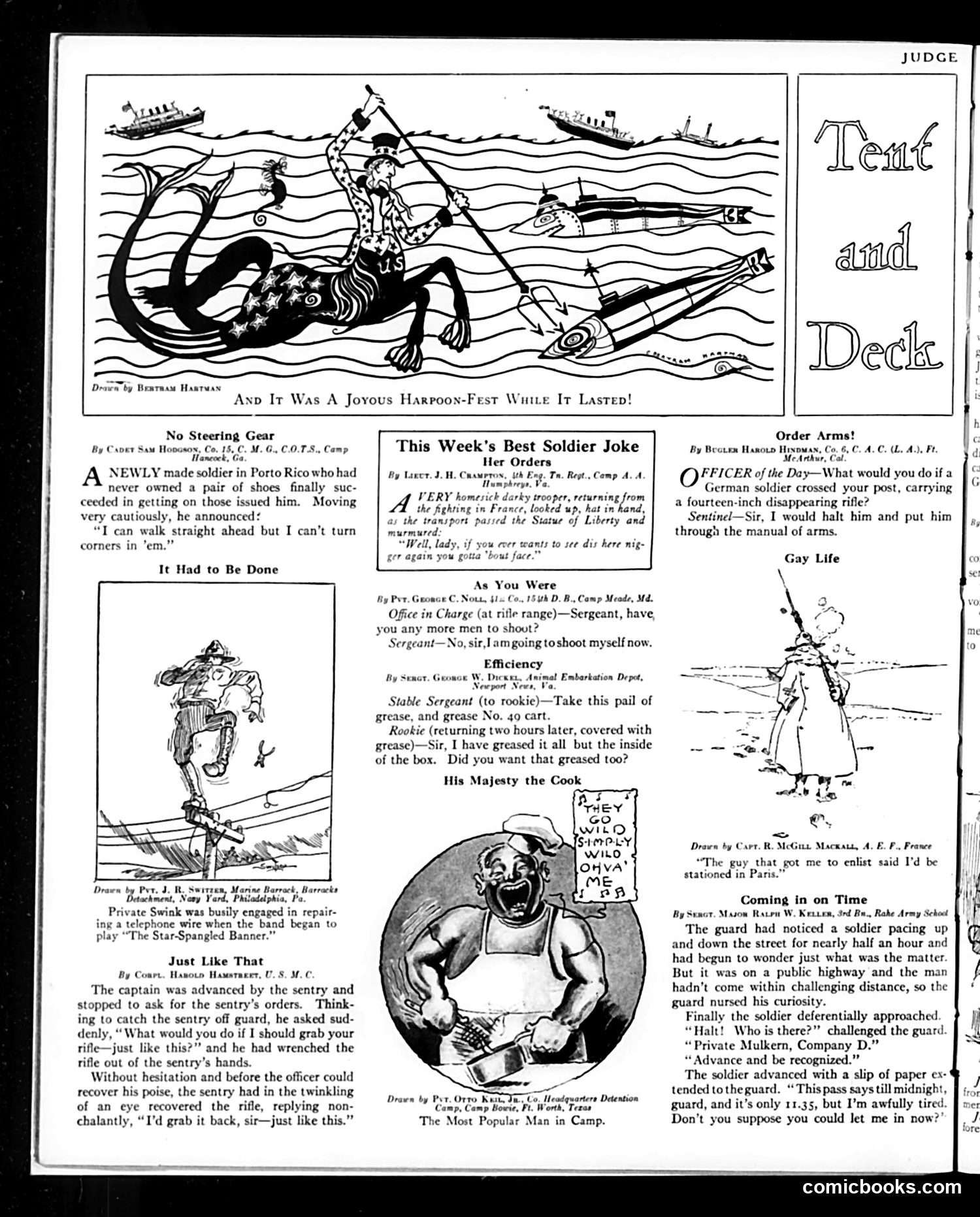
This Judge magazine page presents WWI-era soldier humor through short anecdotes and cartoons. The content includes: **Main themes:** - Military life's absurdities and mishaps (equipment issues, chain-of-command confusion, fatigue) - Racial stereotypes typical of 1910s-20s publications (a "homesick darky trooper" joke uses period racist language) - Soldier competence and discipline (officer testing a sentry's quick thinking) - Camp bureaucracy and procedure (the pass/midnight gate joke) **The cartoons illustrate:** - A soldier struggling with new military shoes - A cook's authority in camp - A soldier hoping for Paris duty - A guard checking credentials **Context:** These are meant as morale-boosting humor for servicemen and the public during WWI. The jokes emphasize soldier cleverness, enlisted men's resourcefulness, and gentle ribbing of military procedures. The racial content reflects unexamined prejudices of the era, particularly offensive to modern readers. The page captures American military culture's informal side during active wartime.
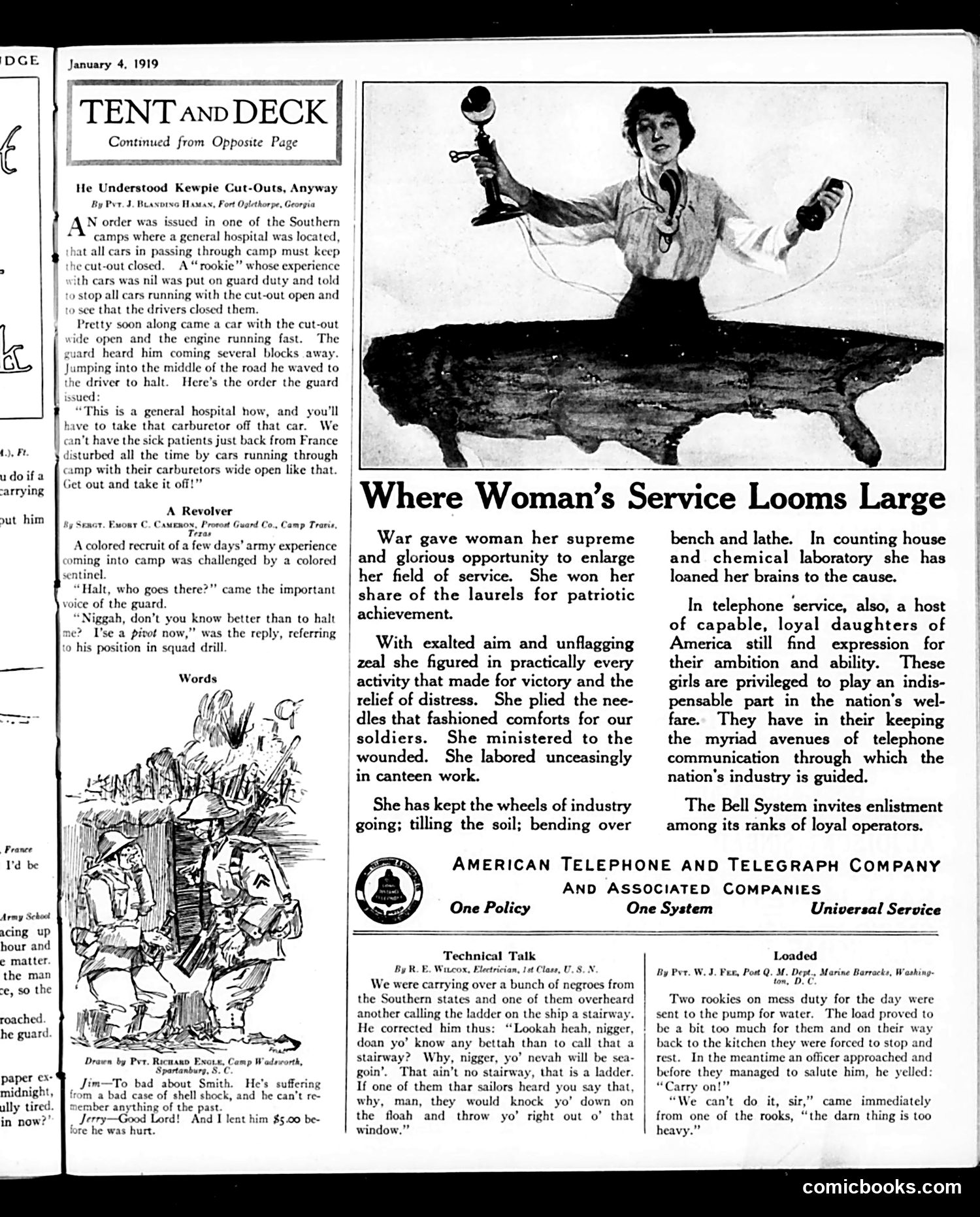
This page contains several brief military humor pieces from World War I, reflecting common army camp experiences. The main cartoon (top right) shows a woman juggling tools and military insignia, illustrating the accompanying article "Where Woman's Service Looms Large"—a celebratory piece about women's wartime contributions to industry, nursing, and telephone service. The smaller anecdotes mock new recruits' ignorance: one rookie mistakes a car's "carburetor" for an engine component needing removal; another confuses "pivot" (a drill position) with "private." The dialect humor pieces employ period-typical racial stereotypes, with African American soldiers mispronouncing military terminology. An adjacent AT&T advertisement uses the patriotic theme, recruiting female telephone operators for essential war work. The page is fundamentally **pro-war propaganda mixed with gentle mockery of military inexperience**—celebrating civilian sacrifice while laughing at recruits' confusion in their new roles.
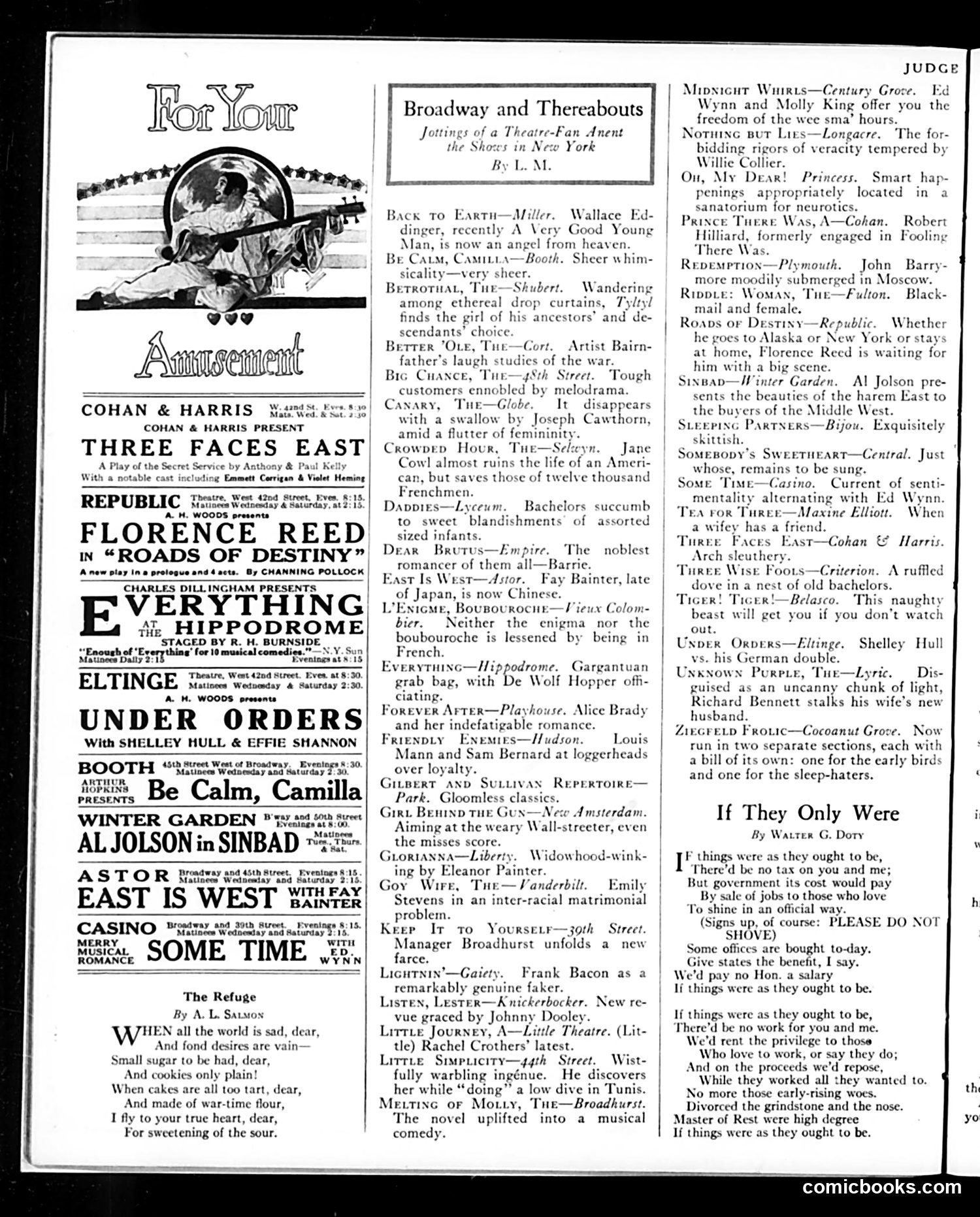
This is primarily a **theater advertising and review page** from Judge magazine, not a political cartoon. The page consists of Broadway theater advertisements and brief critical reviews of current New York shows circa early 1920s. The left side lists theatrical productions with venues and showtimes (Three Faces East, Florence Reed in Roads of Destiny, Everything at the Hippodrome, Under Orders, etc.). The right side contains short, witty capsule reviews of these same shows, written in satirical style characteristic of Judge's cultural criticism. The only non-advertisement content is a poem titled "The Refuge" by A.L. Salmon at bottom left—a sentimental piece about seeking comfort during wartime hardship ("made of war-time flour"). There are **no political cartoons or caricatures** on this page. The "satire" consists entirely of Judge's trademark theatrical commentary—clever one-liners mocking plot absurdities and performer eccentricities rather than political content. This reflects Judge's primary function as entertainment and culture criticism for its era.
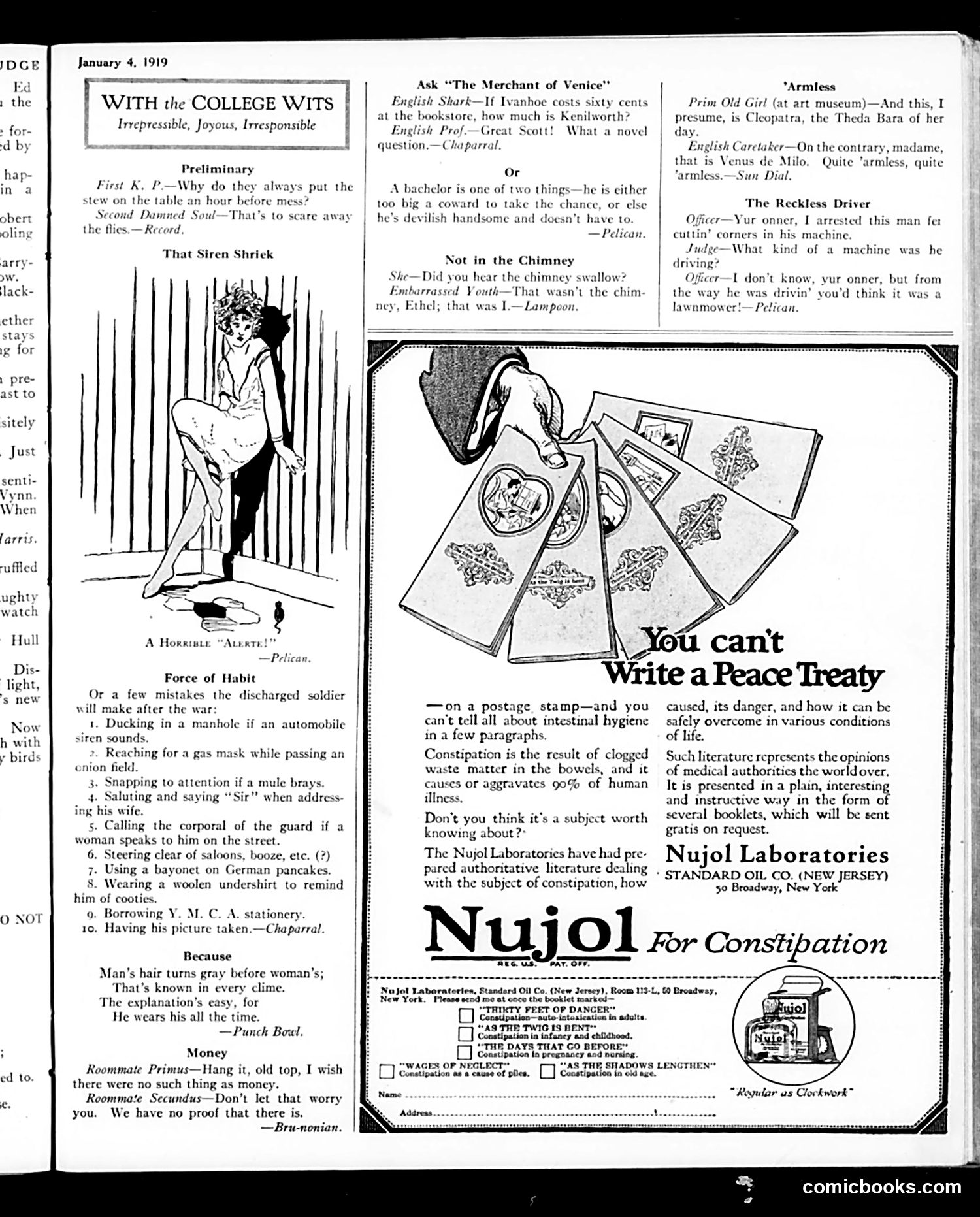
This page contains satirical humor and advertisements typical of post-WWI American magazines. **The cartoons and jokes** mock college life, discharged soldiers readjusting to civilian life, and domestic relations. "Force of Habit" lists absurd behaviors soldiers might retain—saluting wives, ducking at car horns, reaching for gas masks near onions. These jokes reference the recent end of World War I (November 1918) and the difficulty of demobilization. Other brief jokes target bachelor excuses, marital dynamics ("Saluting and saying 'Sir' when addressing his wife"), and absent-mindedness. **The large advertisement** for Nujol (a laxative by Standard Oil) dominates the right side, promoting constipation remedies through pseudo-medical claims. This was common advertising in era magazines—making bodily functions a public discussion topic while wrapping claims in scientific authority. The cartoons' humor relies on observational comedy about domestic life and wartime adjustment—material that would resonate with Judge's educated, middle-class readership.
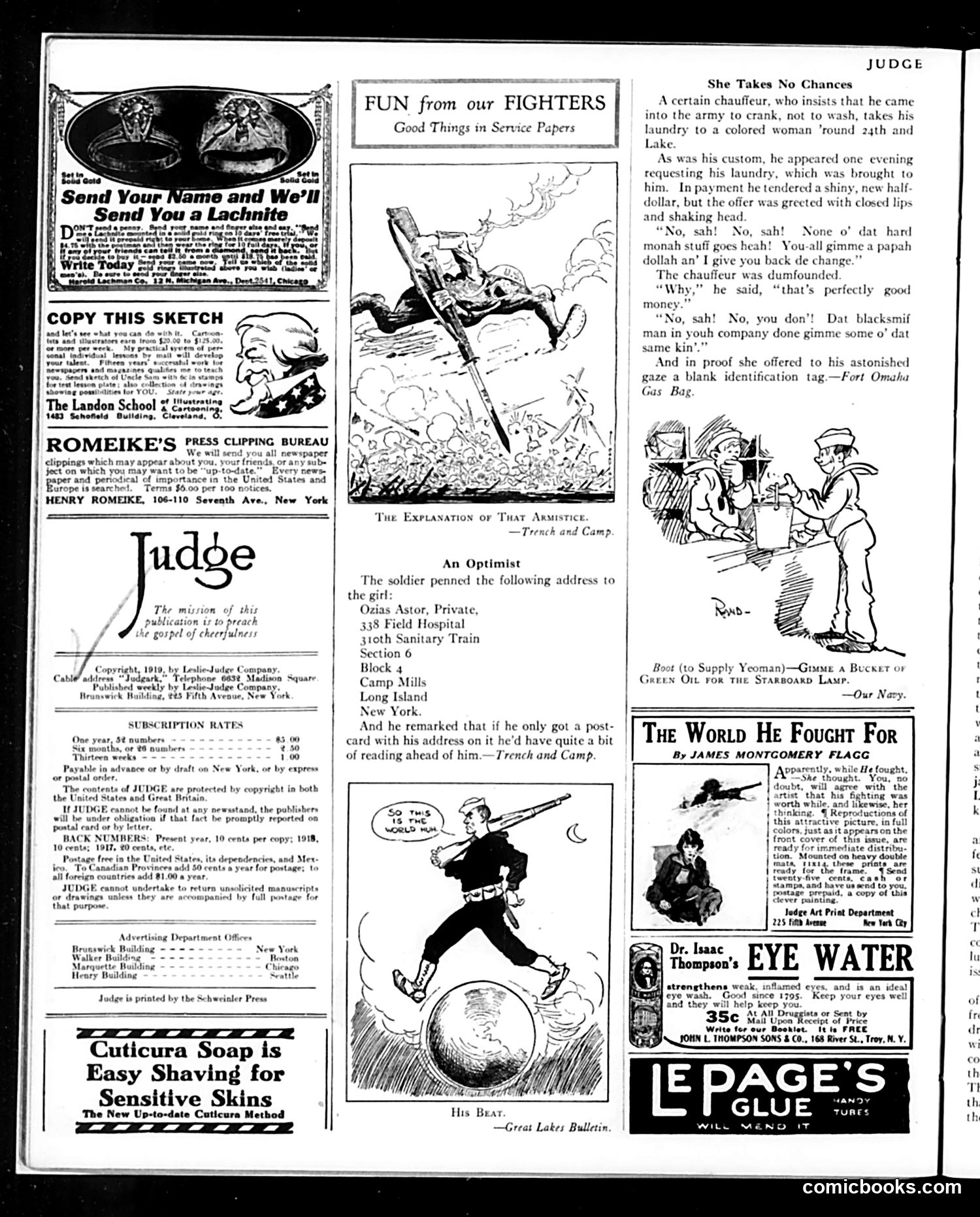
This page is primarily **advertising and publication information** for Judge magazine, circa 1919, with several brief humorous items from military service newspapers. The cartoons depict **WWI-era soldier life**: 1. **"The Explanation of That Armistice"** shows a soldier sliding down a slope—likely satirizing soldiers' relief and physical comedy about the war's end. 2. **"An Optimist"** jokes about a soldier's naïve optimism: he addresses a letter to a girl with an absurdly long military address, hoping to receive mail. 3. **"She Takes No Chances"** humorously portrays a Black laundress refusing a soldier's half-dollar payment, demanding paper currency instead because another soldier gave her counterfeit military identification tags—implying soldiers can't be trusted. 4. **"His Beat"** shows a sailor juggling a cannonball—simple slapstick humor. The page reflects **1919 military culture**: soldiers' pranks, racial dynamics of the era, and wartime optimism. The ads (Cuticura Soap, Dr. Thompson's Eye Water, Ledge's Glue) are period typical.
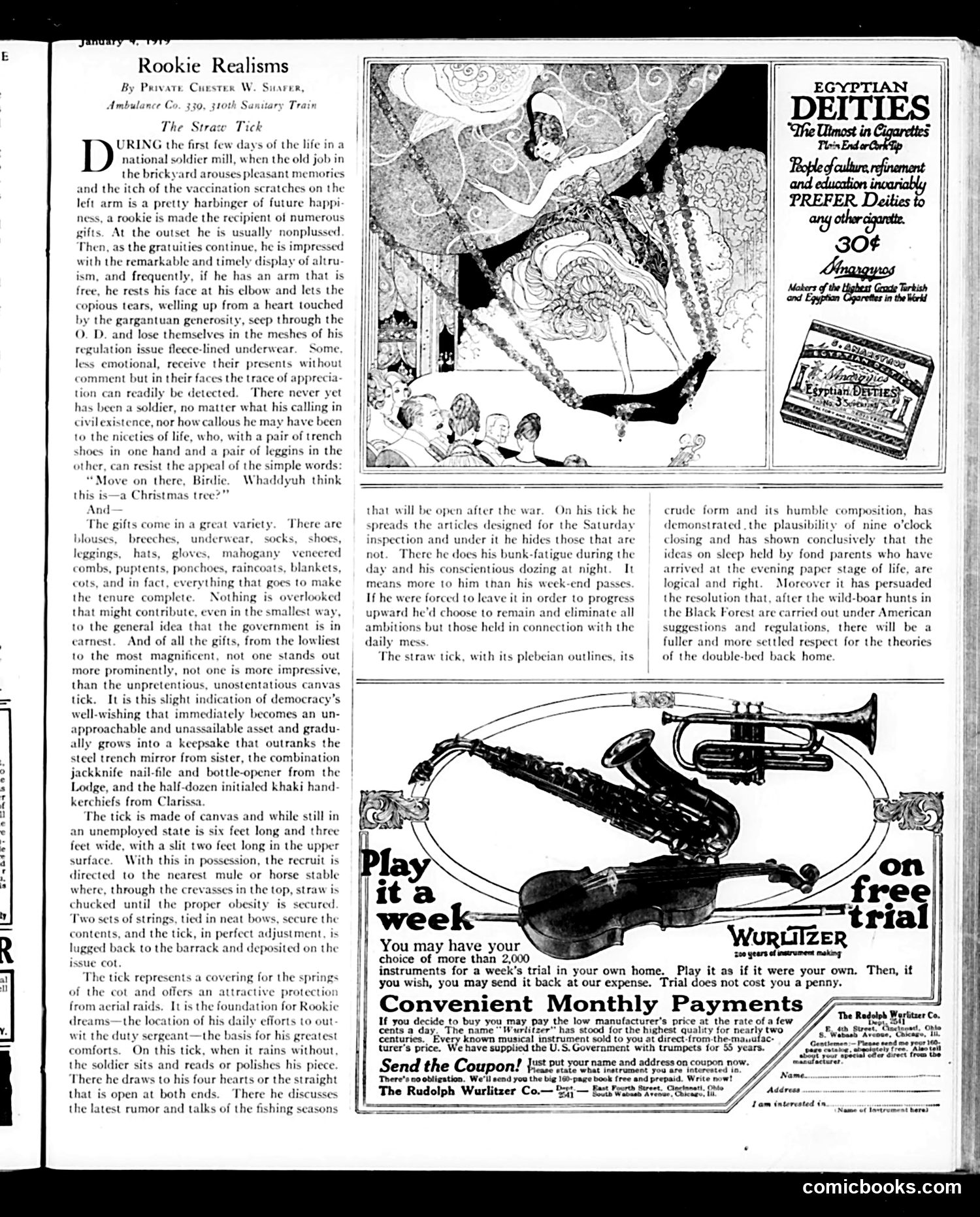
This is a satirical essay about new military recruits during what appears to be World War I. Private Chester W. Shafer describes how soldiers receive various issued items—uniforms, equipment, blankets—but singles out the humble canvas mattress tick (straw-filled sleeping mat) as the most emotionally significant gift. The satire operates on multiple levels: it mocks the touching naïveté of recruits who become genuinely moved by government-issued supplies, treats the lowly tick with mock-heroic language ("keepsake," "foundation for Rookie dreams"), and portrays soldiers' simple pleasures—sitting on it to read, play cards, nap, or hide contraband—with gentle humor. The piece satirizes both military life's realities (discomfort, boredom, petty rule-breaking) and the romanticized patriotism surrounding military service, suggesting that soldiers' true loyalty lies with basic creature comforts rather than grand ideals.
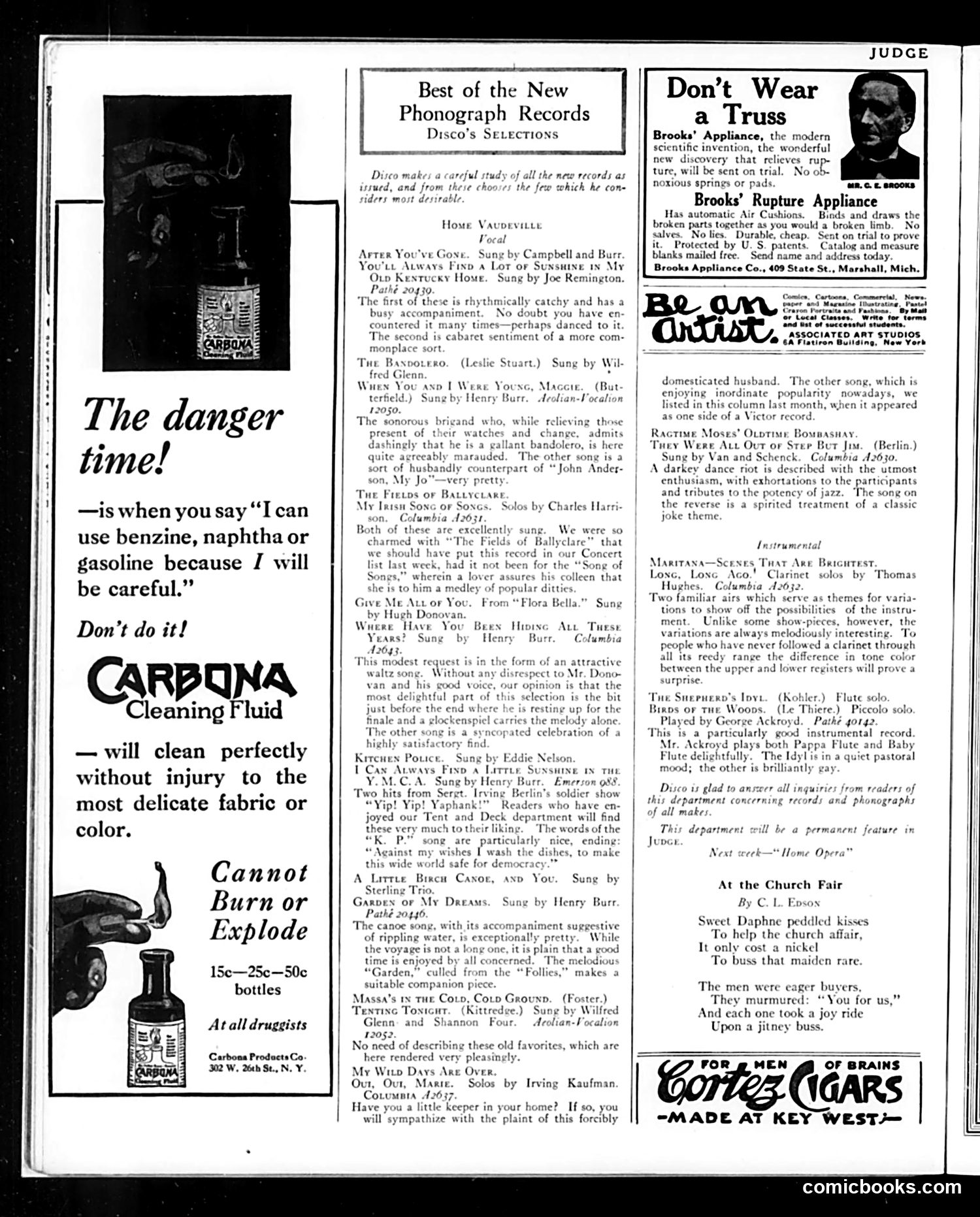
This page is primarily **advertising and entertainment content** rather than political satire. The main editorial content features **record reviews** for phonograph discs—popular songs and instrumental pieces from artists like Henry Burr and Eddie Nelson. These were contemporary hits, with titles like "After You've Gone" and "Kitchen Police." The advertisements are typical of the era: **Carbona Cleaning Fluid** (emphasizing safety—won't burn or explode), **Brooks' Rupture Appliance** (a medical device), and **Cortez Cigars** ("made at Key West"). The only humor appears in small poem snippets, including "At the Church Fair" by C.L. Edson, a light verse about church fundraising and romantic encounters. There are **no political cartoons** on this page—it's a standard magazine section mixing product advertisements with entertainment recommendations, reflecting 1920s consumer culture and popular music preferences.
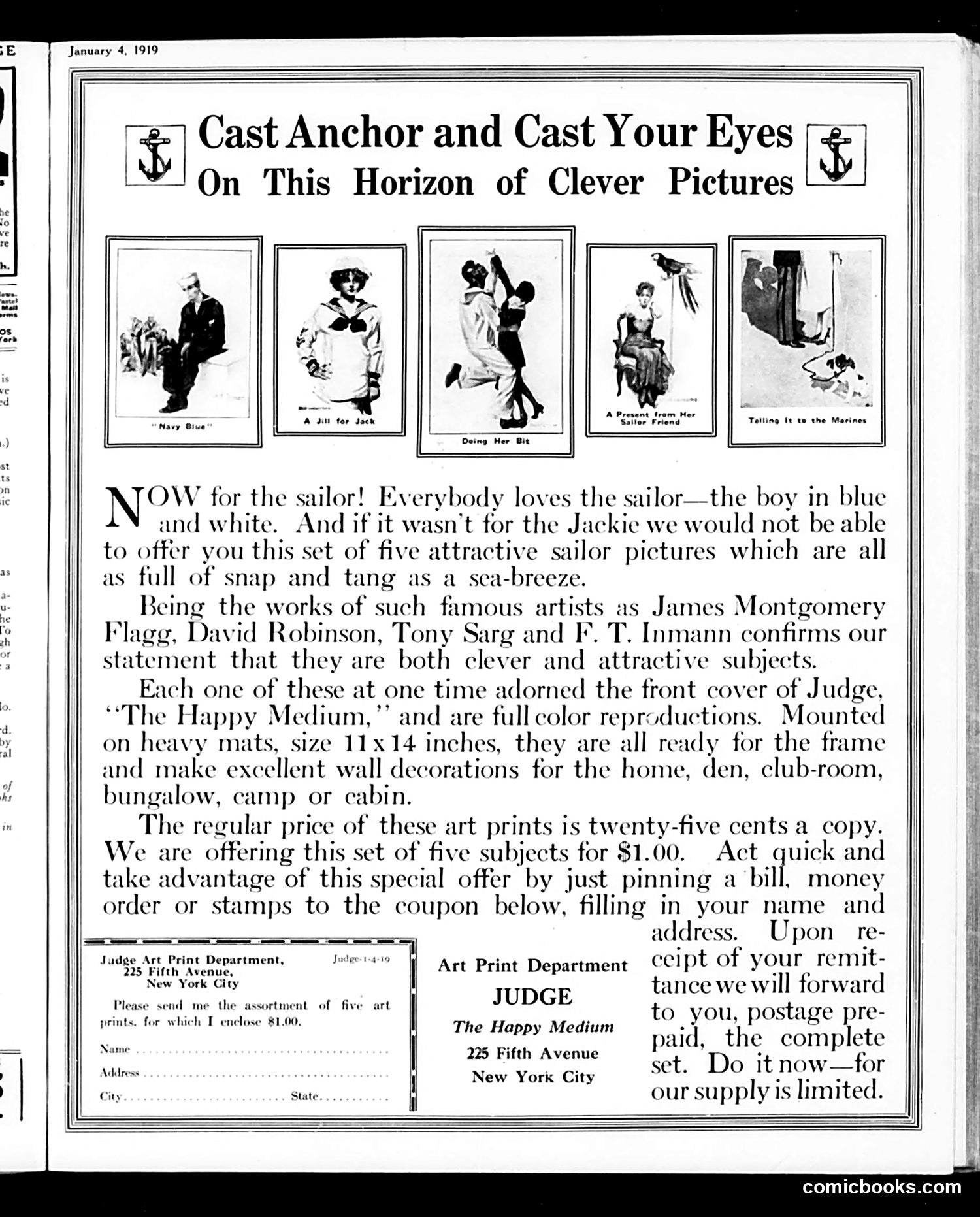
This is primarily **advertising**, not satire or political commentary. Judge magazine is promoting a mail-order set of five sailor-themed art prints for $1.00 (normally 25 cents each). The page capitalizes on **post-WWI patriotic sentiment** toward sailors—"the boy in blue and white"—celebrating the U.S. Navy during or immediately after World War I (dated January 4, 1919, just after the armistice). The reference "Telling It to the Marines" plays on a common phrase suggesting credibility or skepticism. The prints, created by notable illustrators including **James Montgomery Flagg** (famous for WWI recruitment posters), are framed as collectible art suitable for home decoration. The marketing appeals to patriotic nostalgia and the affordability of the offer. No specific political figures or events are caricatured—this is a straightforward commercial promotion leveraging wartime patriotism to sell prints.
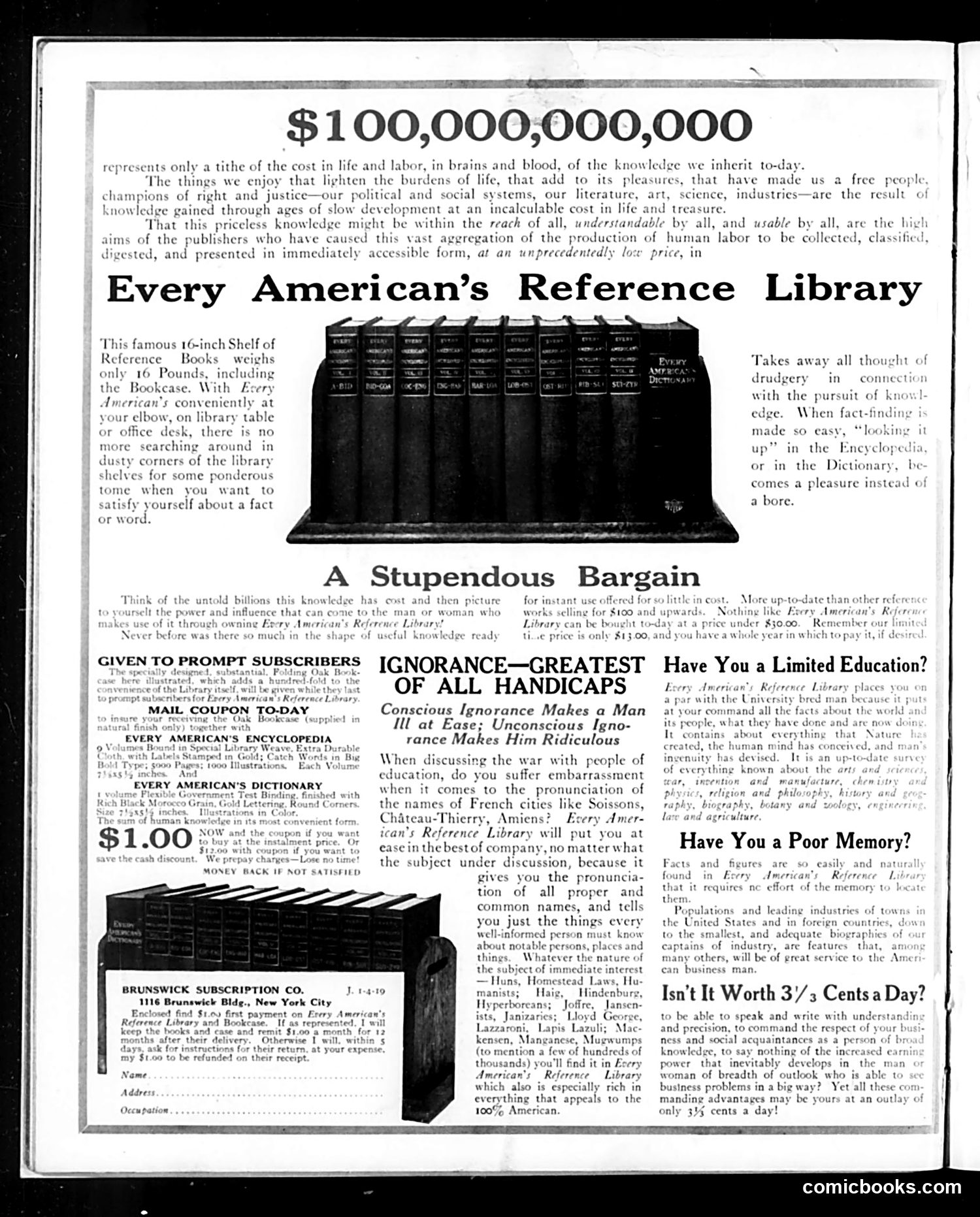
This is a **full-page advertisement**, not political satire. It promotes a 16-volume reference encyclopedia set sold by Brunswick Subscription Co. The pitch uses **aspirational rhetoric** common to early 20th-century marketing: knowledge as democratic access, self-improvement, and social mobility. The opening claims the $100 billion value of accumulated human knowledge should be "understandable by all, and usable by all." The advertisement addresses **social anxieties** of its era: - Fear of embarrassment (mispronouncing French city names during WWI discussions) - Class anxiety (needing to "speak and write with understanding" to command respect) - Limited education as a "handicap" The sales pitch: all this knowledge for $1.00 down, then installments—framed as "only 3⅓ cents a day," making self-improvement seem affordable to working-class readers. There is **no cartoon or satirical figure** present—this is straightforward (if hyperbolic) commercial propaganda exploiting educational insecurity.