
A complete issue · 32 pages · 1918
Judge — November 30, 1918
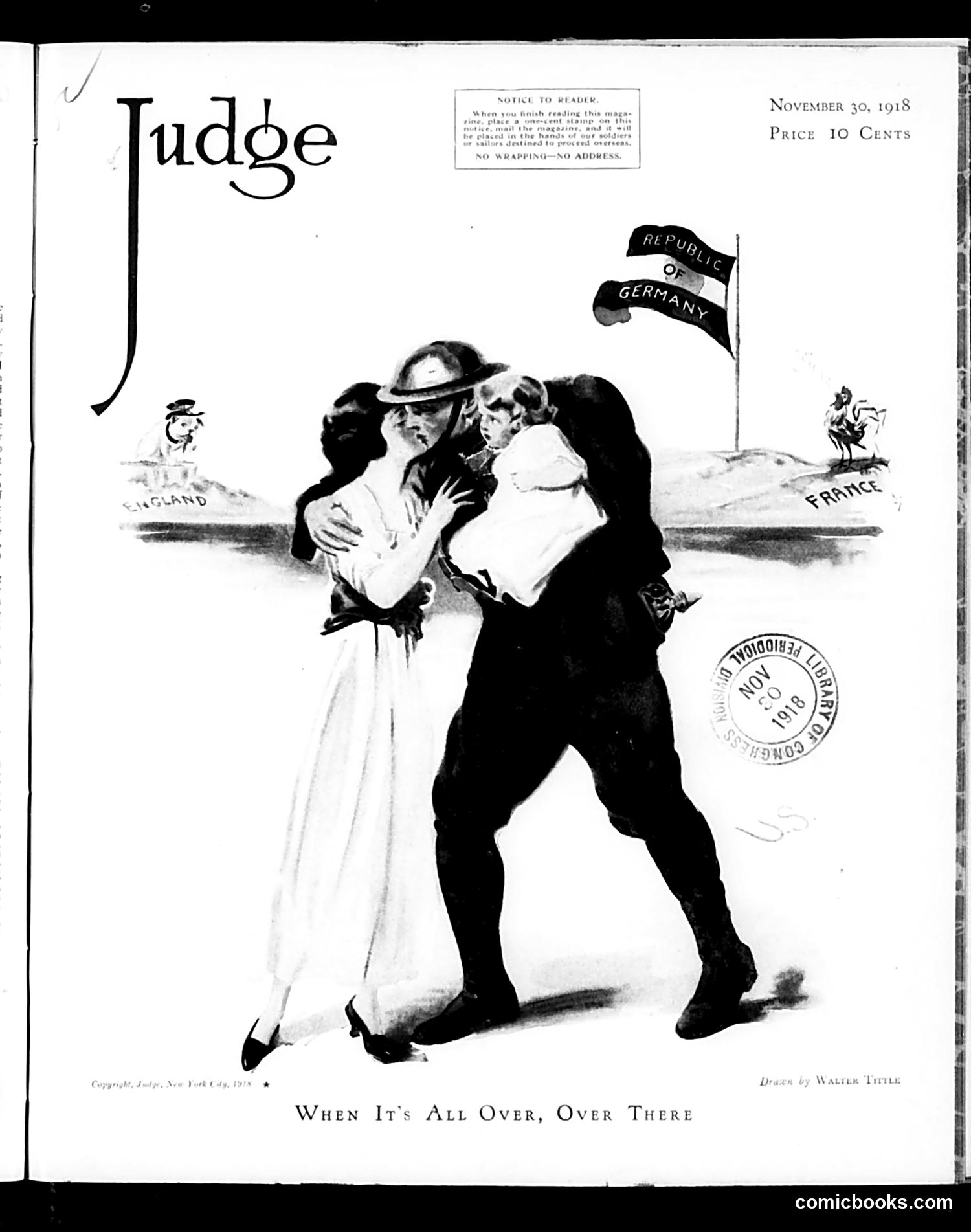
This *Judge* cover from November 30, 1918—just weeks after WWI's armistice (November 11)—depicts a soldier embracing two women, likely representing France and England (marked on the landscape). The "Republic of Germany" flag appears defeated in the background. The cartoon celebrates Allied victory and the soldier's anticipated homecoming. The title's phrase "over there" references the popular 1917 wartime song about American soldiers fighting in Europe. The soldier appears to be returning home after the war's conclusion, greeted by grateful Allied nations. The drawing is by Walter Tittle. The imagery expresses American triumphalism and romantic notions of soldiers' reunion with loved ones following the war's end.
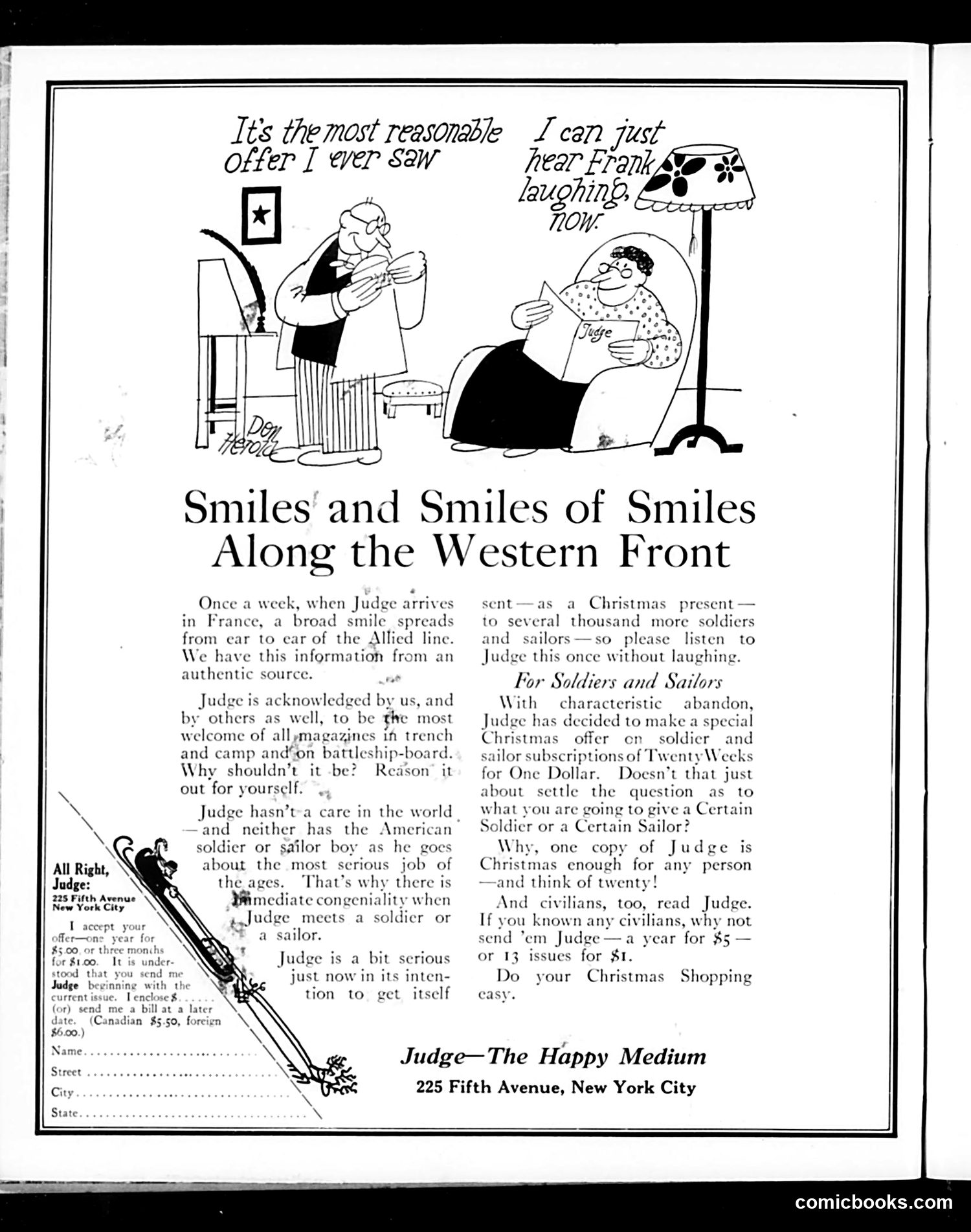
This is primarily a **subscription advertisement** for *Judge* magazine, disguised as editorial content praising the publication's appeal. The cartoon depicts two figures: one labeled "Den Herrick" (likely a cartoonist or editor) presenting *Judge* to a military officer, who laughs in response. The text claims *Judge* is "the most welcome of all magazines in trench and camp and on battleship-board" during World War I. The satire is self-referential: *Judge* is marketing itself by claiming soldiers find it indispensable for morale. The ad encourages subscriptions as Christmas gifts for troops, emphasizing affordability ($1 for 20 weeks). The cartoon's joke appears simple—that *Judge*'s humor provides soldiers welcome relief—but the entire page functions as promotional material leveraging patriotic wartime sentiment to drive circulation.
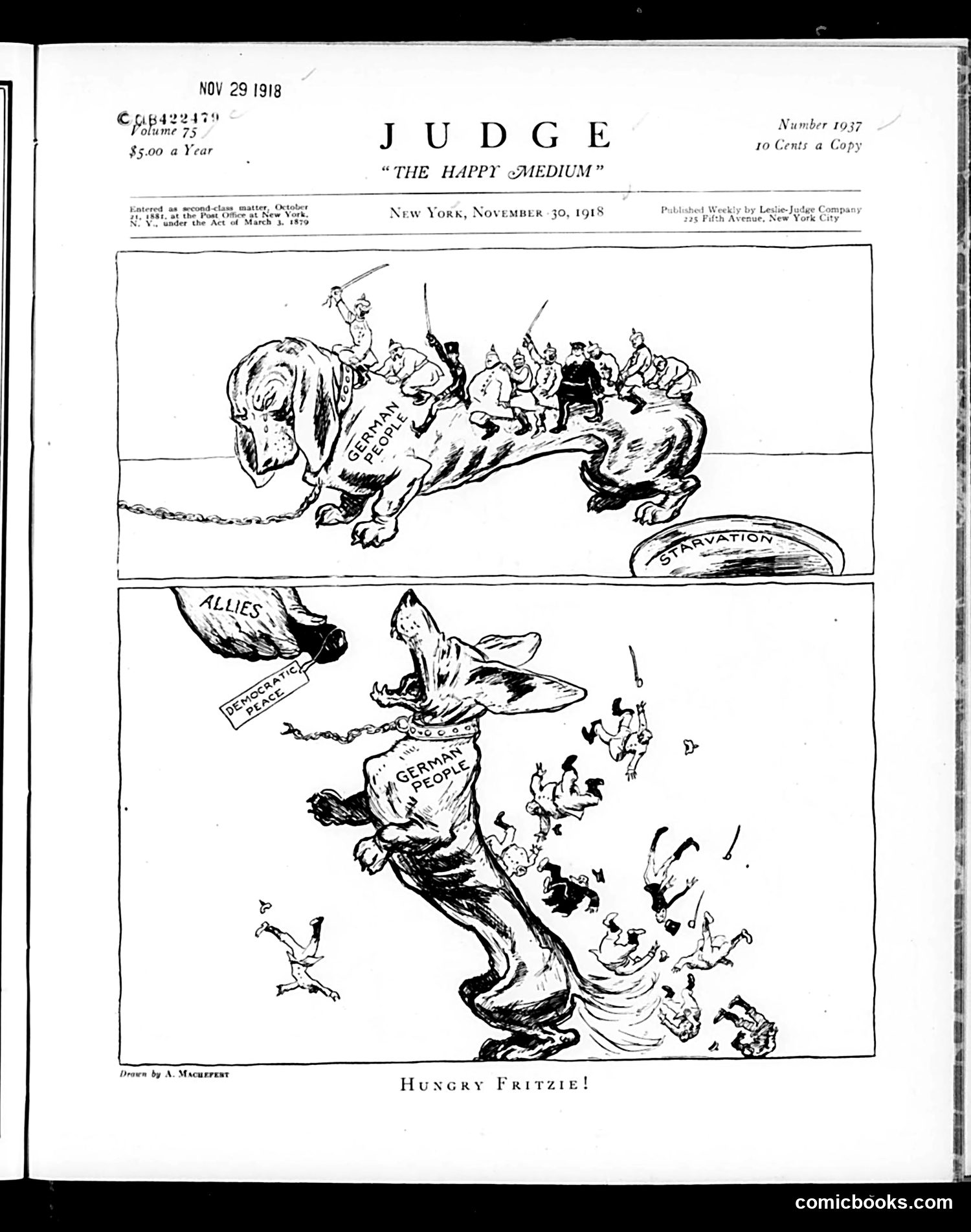
This page contains two satirical cartoons published just after World War I's armistice (November 11, 1918). **Top cartoon**: Depicts "General Personio" (likely General John Pershing, U.S. commander) as a large dachshund being ridden by Allied soldiers, with "starvation" looming below. This mocks how Germany faced severe food shortages leading to surrender. **Bottom cartoon ("Hungry Fritzie!")**: Shows a German figure (identified by label "German People") being juggled or tossed by an Allied hand pouring from a bottle labeled "Allies' Deprecation Peace." Smaller figures scatter around, representing German citizens suffering from hunger and deprivation during the war's end. Both cartoons celebrate Allied victory while satirizing Germany's collapse from starvation and military defeat.
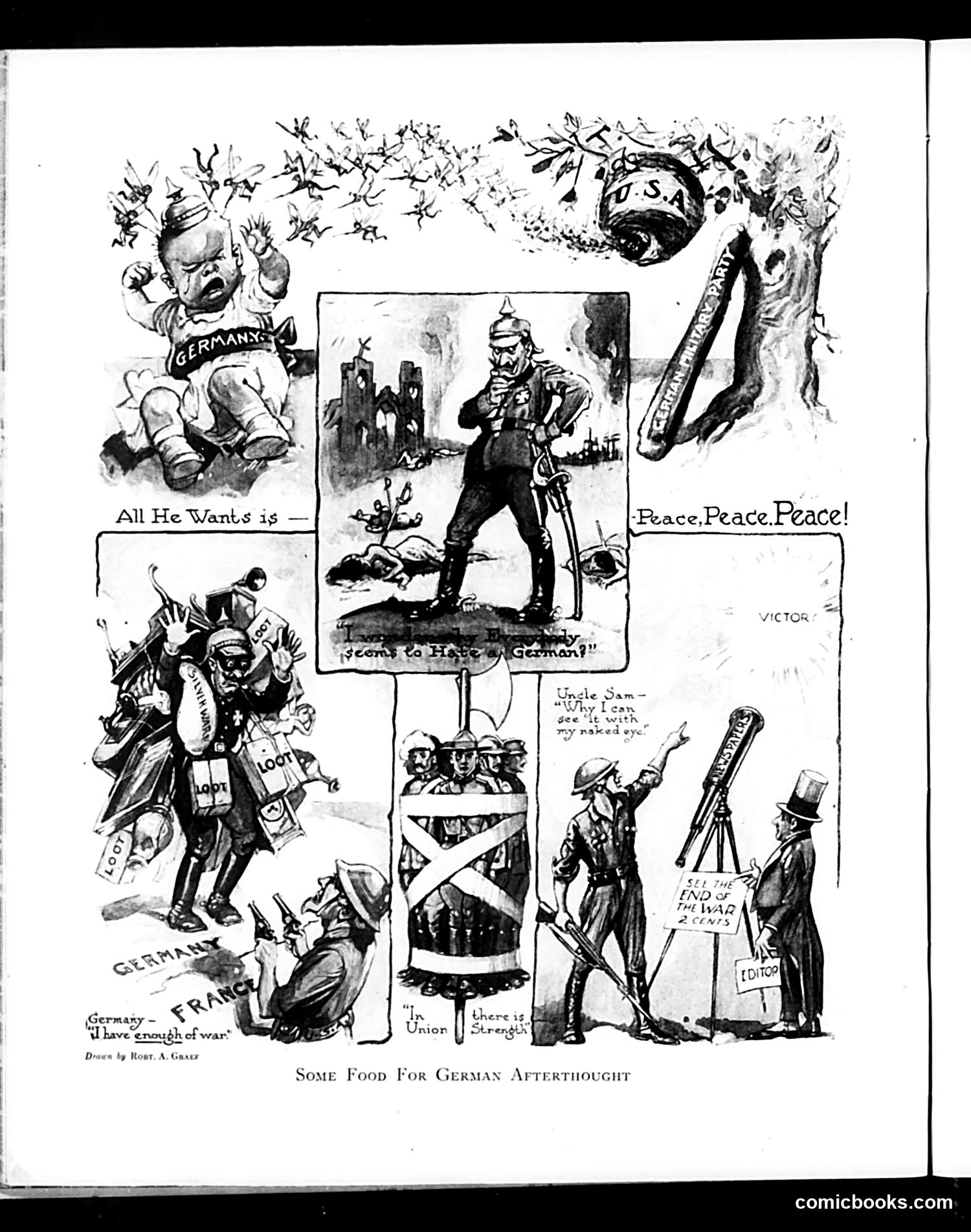
This WWI-era satirical cartoon by Robert A. Graefe depicts Germany's defeat and its consequences. The central panel shows a German military figure amid destroyed cities, questioning "seems to Hate a Germany?" Surrounding panels illustrate Germany's losses: a baby labeled "Germany" cries while being torn apart; France and Germany appear exhausted from war; and Uncle Sam observes with detachment ("Why I can see it with my naked eye"). The final panels show American figures discussing Germany's future, with references to "Union," "strength," and editorial commentary about postwar outcomes. The satire mocks German militarism while suggesting America's role as arbiter of peace terms. The title implies Germans should reflect on the war's destruction as they face reckoning.
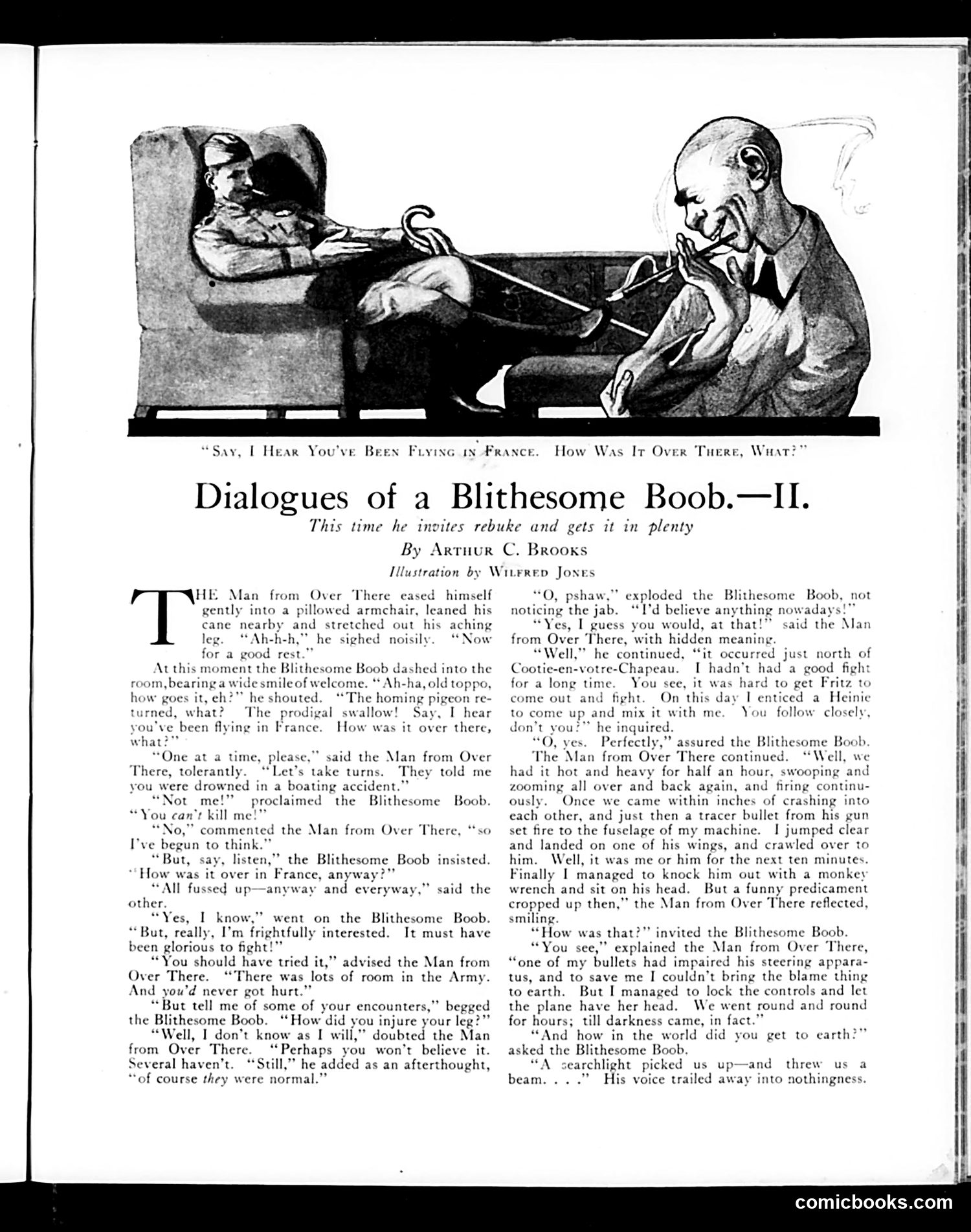
This is a humorous dialogue by Arthur C. Brooks (illustrated by Wilfred Jones) featuring two characters: "the Man from Over There" (a returning American WWI soldier) and "the Blithesome Boob" (a naive, credulous civilian). The satire mocks the Boob's gullibility about wartime experiences. The soldier recounts an absurd aerial combat story—being shot down, rescued by searchlight, and knocked out an enemy pilot with a monkey wrench—to which the Boob responds with believing enthusiasm and inadequate follow-up questions. The joke targets post-war America's tendency to accept exaggerated soldier tales uncritically. The "Boob" represents civilians disconnected from actual combat reality, easily impressed by implausible heroics.
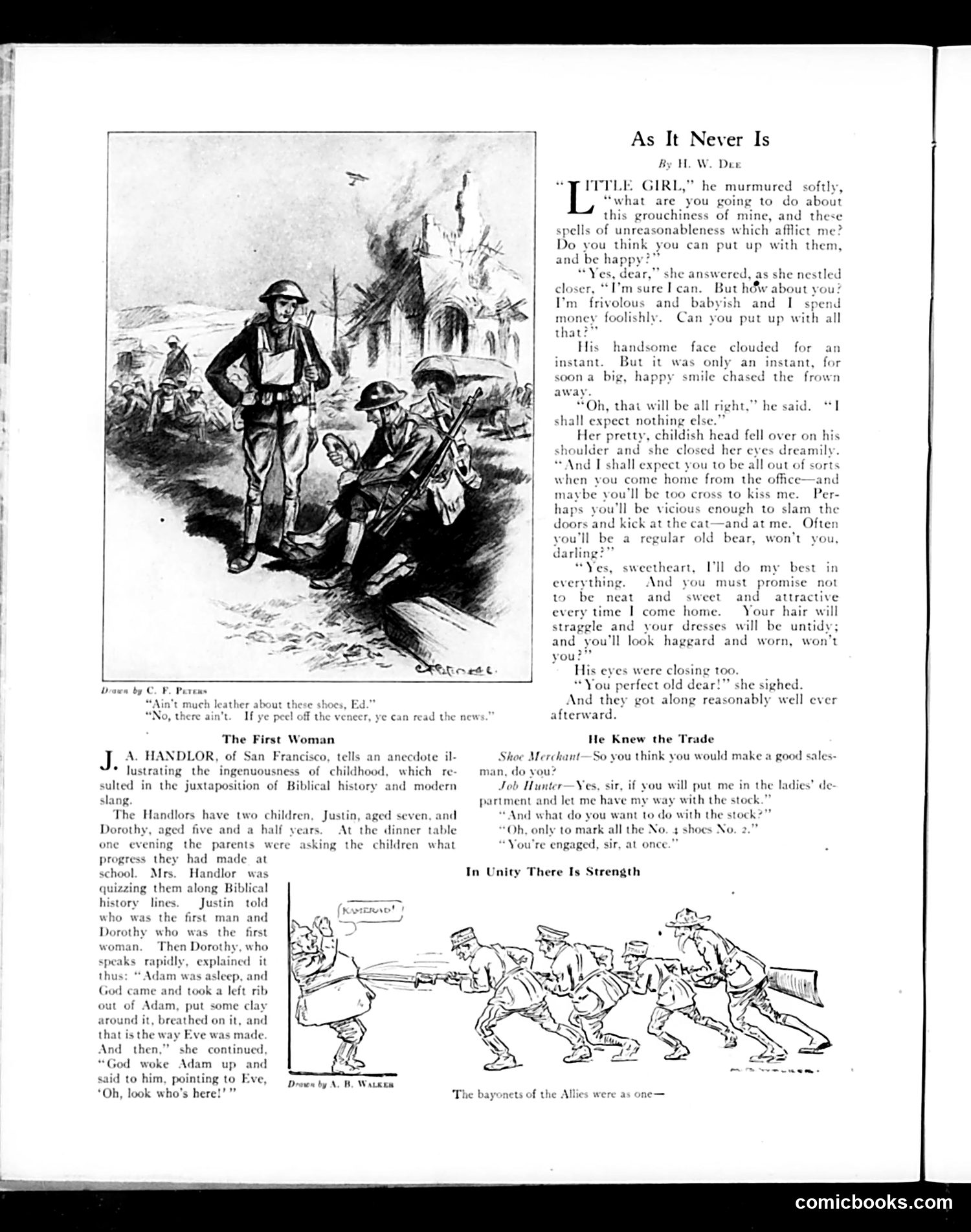
This page contains three distinct pieces rather than political cartoons: 1. **"As It Never Is"**: A sentimental domestic dialogue between a husband and wife about managing his grouchiness and her appearance—gentle satire of idealized marriage expectations. 2. **"The First Woman"**: J.A. Handlor's anecdote about children discussing Biblical history, with a child's misunderstanding of Adam and Eve's creation (the caption joke involves a child saying "Oh, look who's here!" upon learning Eve was made from Adam's rib). 3. **"In Unity There Is Strength"**: A cartoon showing soldiers with bayonets unified in formation, captioned "The bayonets of the Allies were as one"—likely WWI propaganda emphasizing Allied military cooperation. The page mixes humor, sentiment, and wartime messaging typical of Judge's editorial content.
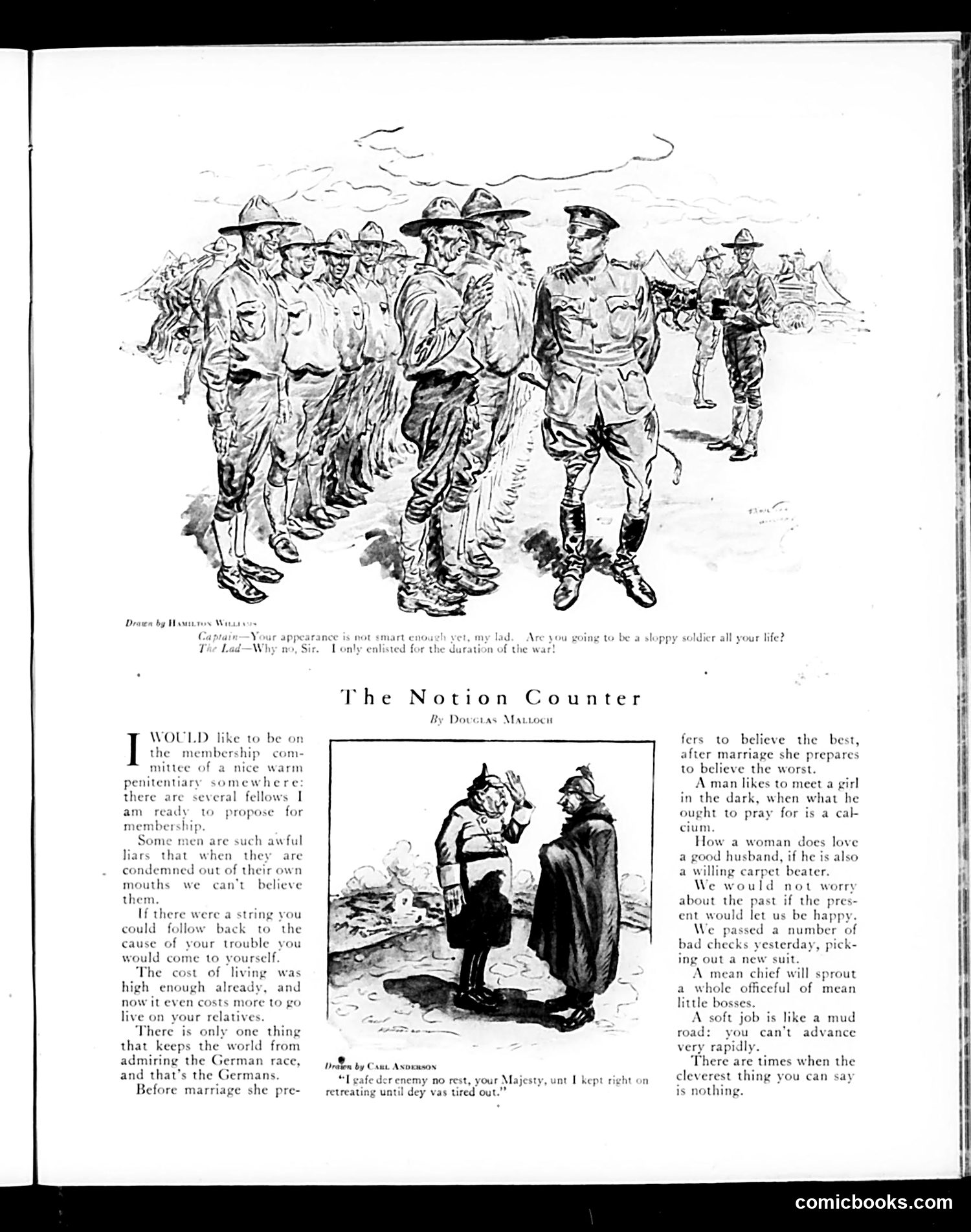
**Top Cartoon (Hamilton Williams):** Shows military officers discussing a new recruit's poor appearance. The caption's humor hinges on class anxiety during WWI—the officer suggests the recruit looks unmilitary, but the recruit counters he "only enlisted for the duration of the war," implying this is temporary hardship, not permanent soldiering. **"The Notion Counter" (Douglas Malloch):** A satirical essay with embedded Carl Anderson cartoon. The text mocks German national character ("that's the Germans") while offering cynical observations about marriage, honesty, and social climbing. The cartoon shows a German military figure bragging to royalty about aggressive tactics ("gave der enemy no rest...until dey vas tired out")—likely satirizing German militarism during WWI. Both pieces reflect American wartime sentiment: skepticism toward German conduct, class consciousness, and domestic social commentary framed through wartime anxiety.
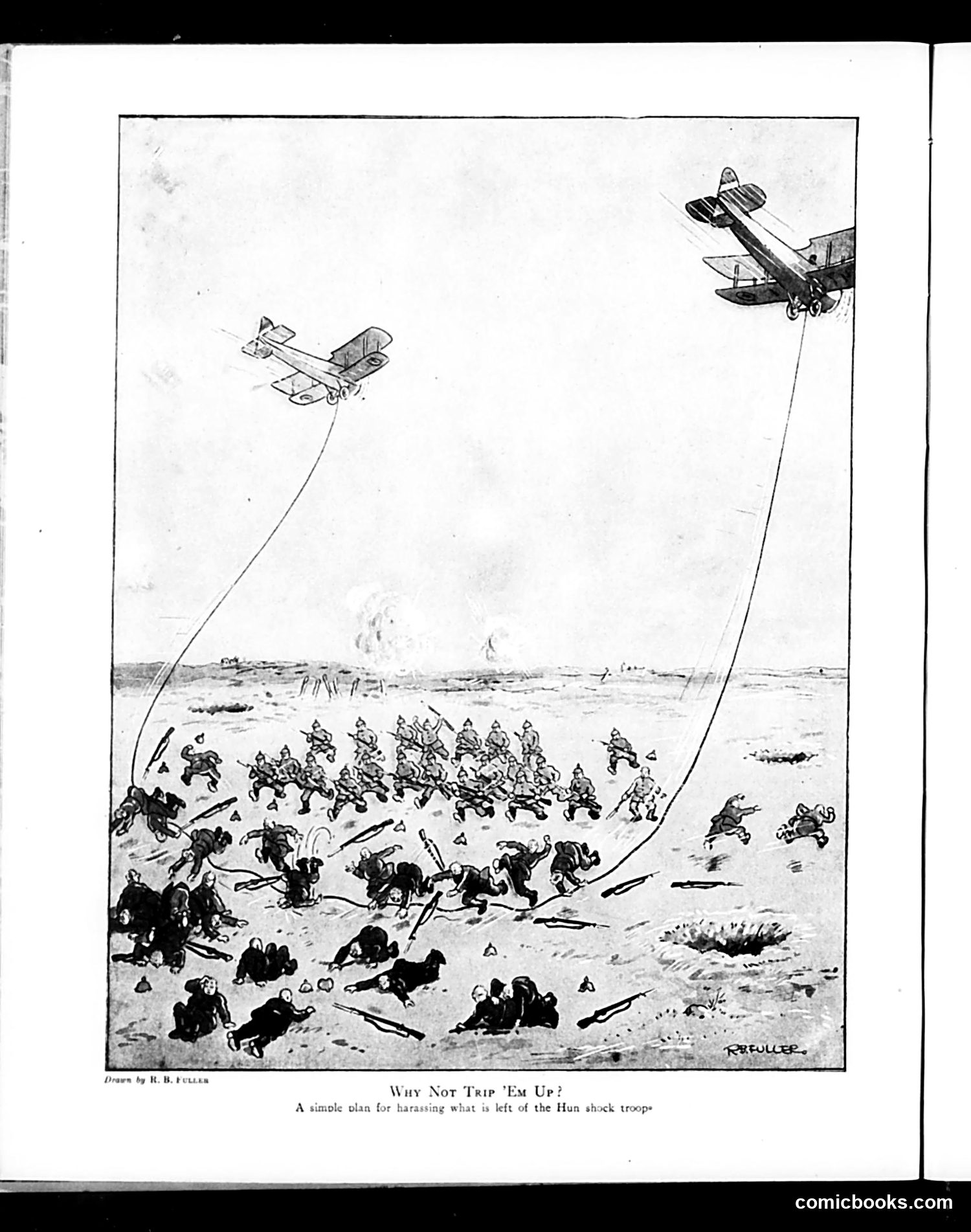
This World War I-era cartoon by R.B. Fuller depicts a military strategy against German ("Hun") forces. Two biplanes hover above a beach where Allied soldiers are positioned in formations on sandy terrain. The caption suggests using aircraft to trip or disable retreating German troops—presenting a darkly humorous "simple plan." The cartoon reflects WWI-era attitudes toward mechanized warfare and aerial combat, which was still relatively new. The caricatured soldiers and casual tone suggest satirizing military strategists proposing increasingly absurd tactical solutions. The "Hun" reference was common Allied propaganda terminology for Germans during this period. The cartoon appears designed to mock overly simplistic or impractical wartime proposals while maintaining popular morale through humor about enemy forces.
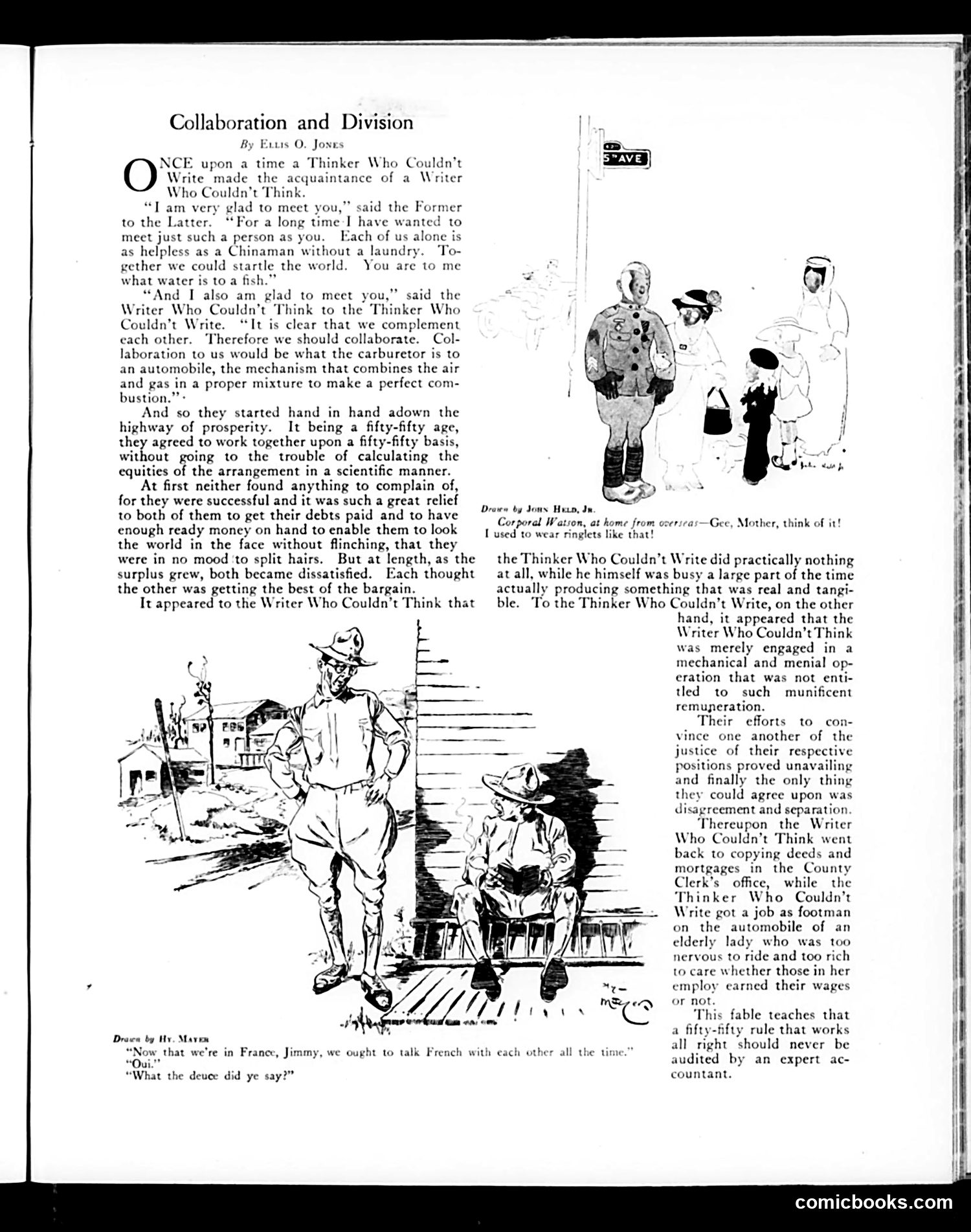
This is a satirical fable by Ellis O. Jones critiquing equal partnerships. Two complementary but flawed professionals—a non-writing thinker and a non-thinking writer—form a 50-50 business arrangement. Initially successful, they grow resentful as profits increase. Each believes the other contributes less valuable work: the writer sees only "mechanical and menial operation," while the thinker sees unproductive idleness. Unable to resolve the dispute fairly, they dissolve the partnership. The cartoons illustrate practical absurdities: soldiers struggling with unexpected consequences of collaboration (speaking French), and a returning soldier noticing how women's fashion has changed. **The satire's point**: Equal partnerships often fail not from actual inequity but from perceived inequity. When prosperity arrives, partners second-guess their arrangement. The moral warns against scrutinizing fair agreements too closely—detailed auditing of "equal" splits paradoxically destroys them.
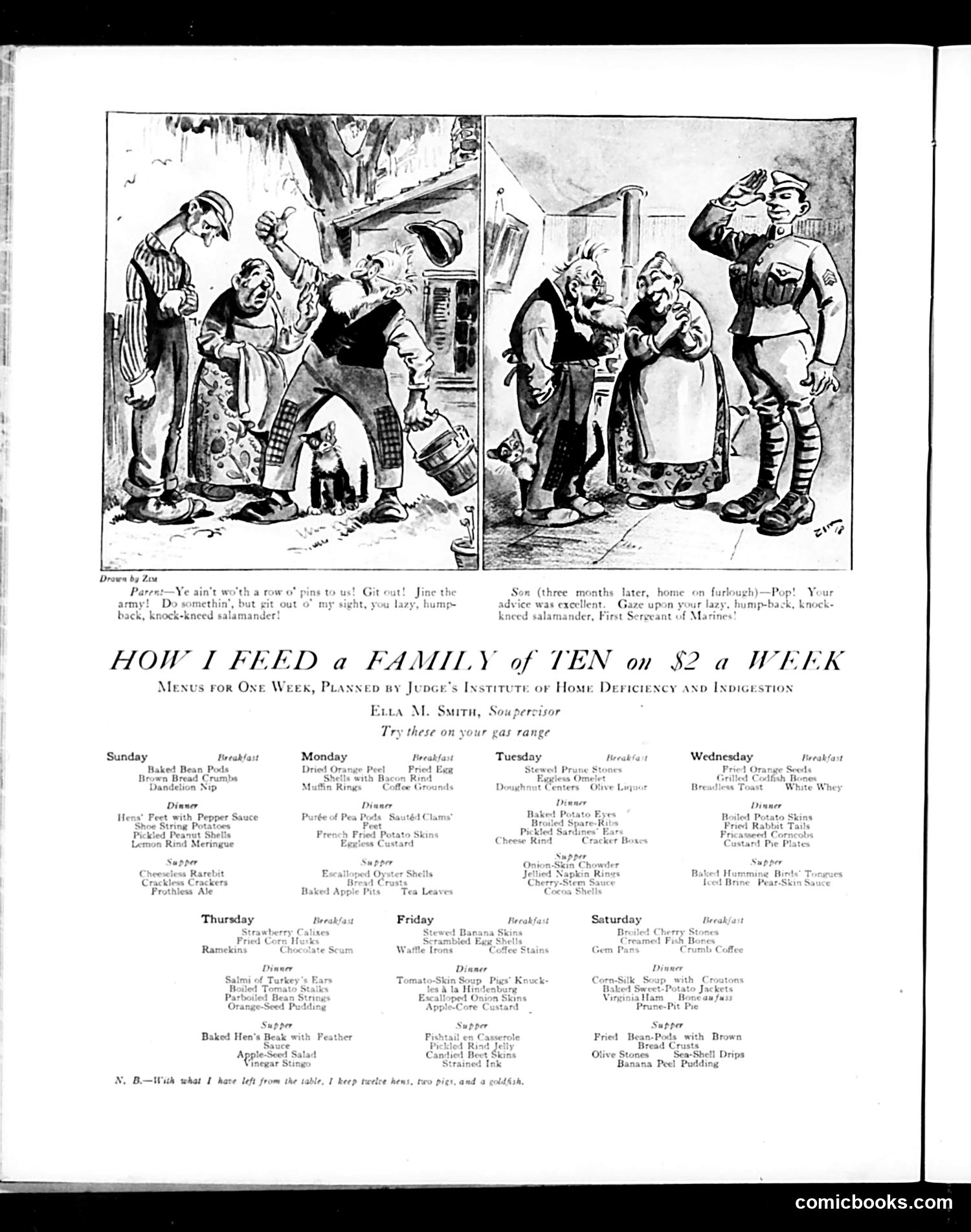
This page satirizes poverty and economic hardship during an era of extreme financial constraint (likely the Depression era, based on the "$2 a week" premise). The cartoons show a working-class family receiving advice from authorities—appearing to depict condescending relief officials or government advisors lecturing poor parents about feeding children on minimal budgets. The satire's bite: Judge mocks the absurdity of official suggestions that families can live adequately on impossibly small amounts. The menus below (beans, potato skins, organ meats, etc.) underscore the degrading diet poverty forces upon families. The cartoon's humor is bitterly ironic—the well-dressed officials offering cheerful advice seem oblivious to the desperation they're addressing. This attacks both the inadequacy of relief efforts and the patronizing tone authorities adopted toward the poor.
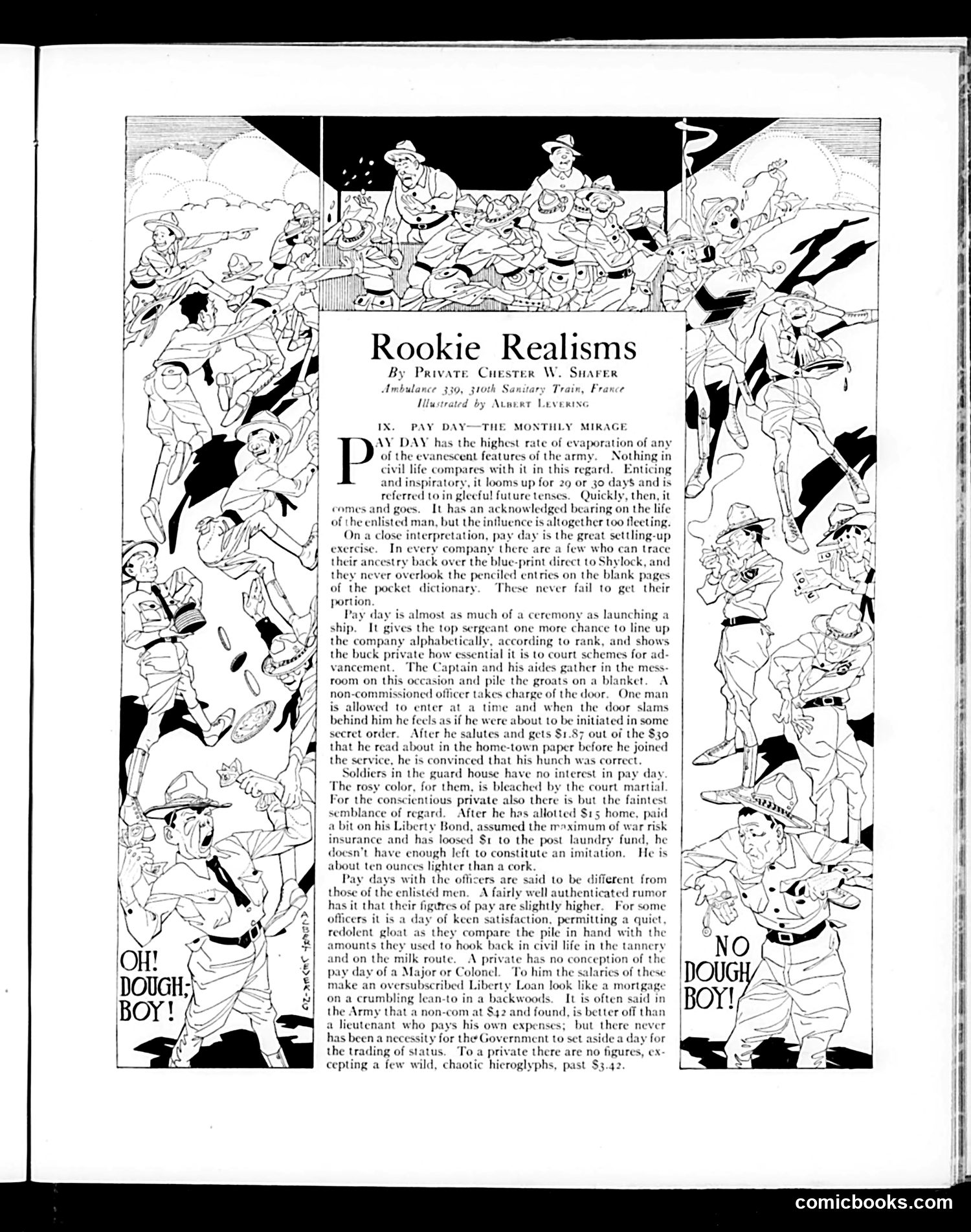
This is a humorous military column by Private Chester W. Shafer, illustrated by Albert Levering, describing American soldiers' experience of monthly pay in World War I France. The piece satirizes how soldiers anticipate pay day eagerly but receive far less than promised. A recruit expects $30 but receives only $1.87 after deductions. The article mocks the ceremonial nature of payment—officers gathering groats on a blanket, controlled entry procedures—while exposing the financial reality: after mandatory allotments home, Liberty Bond purchases, war insurance, and laundry fees, enlisted men have almost nothing remaining. The satire contrasts sharply with officers' pay (unspecified but substantially higher) and hints at financial corruption through references to "Shylock" and soldiers tracking "ancestry" through accounts ledgers. The accompanying illustrations show chaotic soldier activity, emphasizing the contrast between the orderly ceremony and soldiers' actual disappointment.
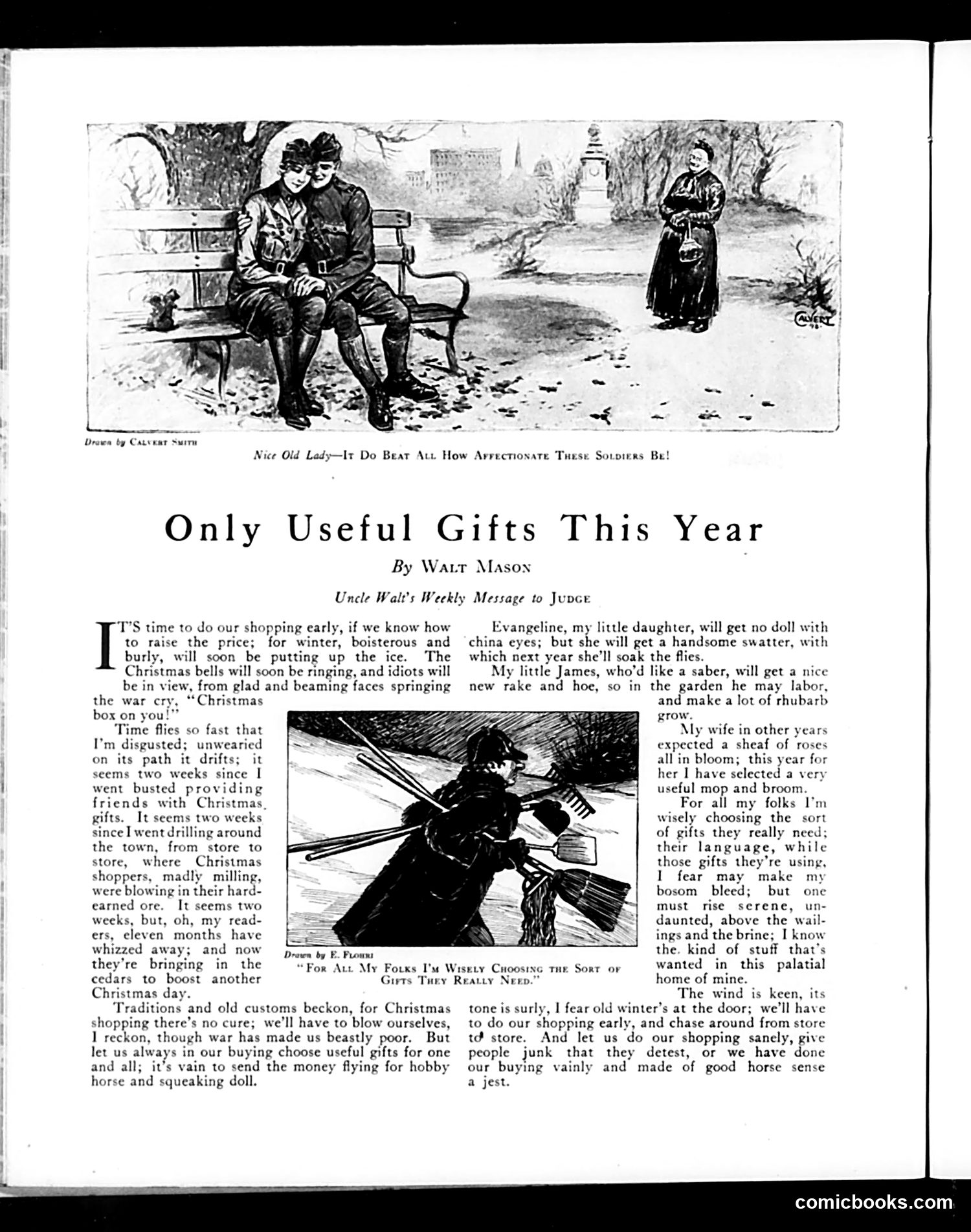
This page combines two related satirical pieces addressing WWI-era gift-giving. The top cartoon by Calvert Smith depicts a "Nice Old Lady" observing two soldiers on a park bench, commenting on their affection—likely mocking sentimentality about soldiers during wartime. The main article by Walt Mason argues for practical Christmas gifts rather than frivolous ones, reflecting wartime austerity. Mason sarcastically recommends "useful" items: a fly swatter instead of a doll for his daughter, a rake and hoe instead of a toy saber for his son, a mop and broom instead of roses for his wife. The humor lies in the pretense that utilitarian household tools constitute meaningful gifts—he acknowledges recipients will curse him ("make my bosom bleed") while he maintains moral superiority about "good horse sense." This reflects early-WWI American values: sacrifice, rejecting frivolity, and celebrating practicality as patriotic duty. The satire gently mocks those who use wartime constraints to justify giving disappointing presents.
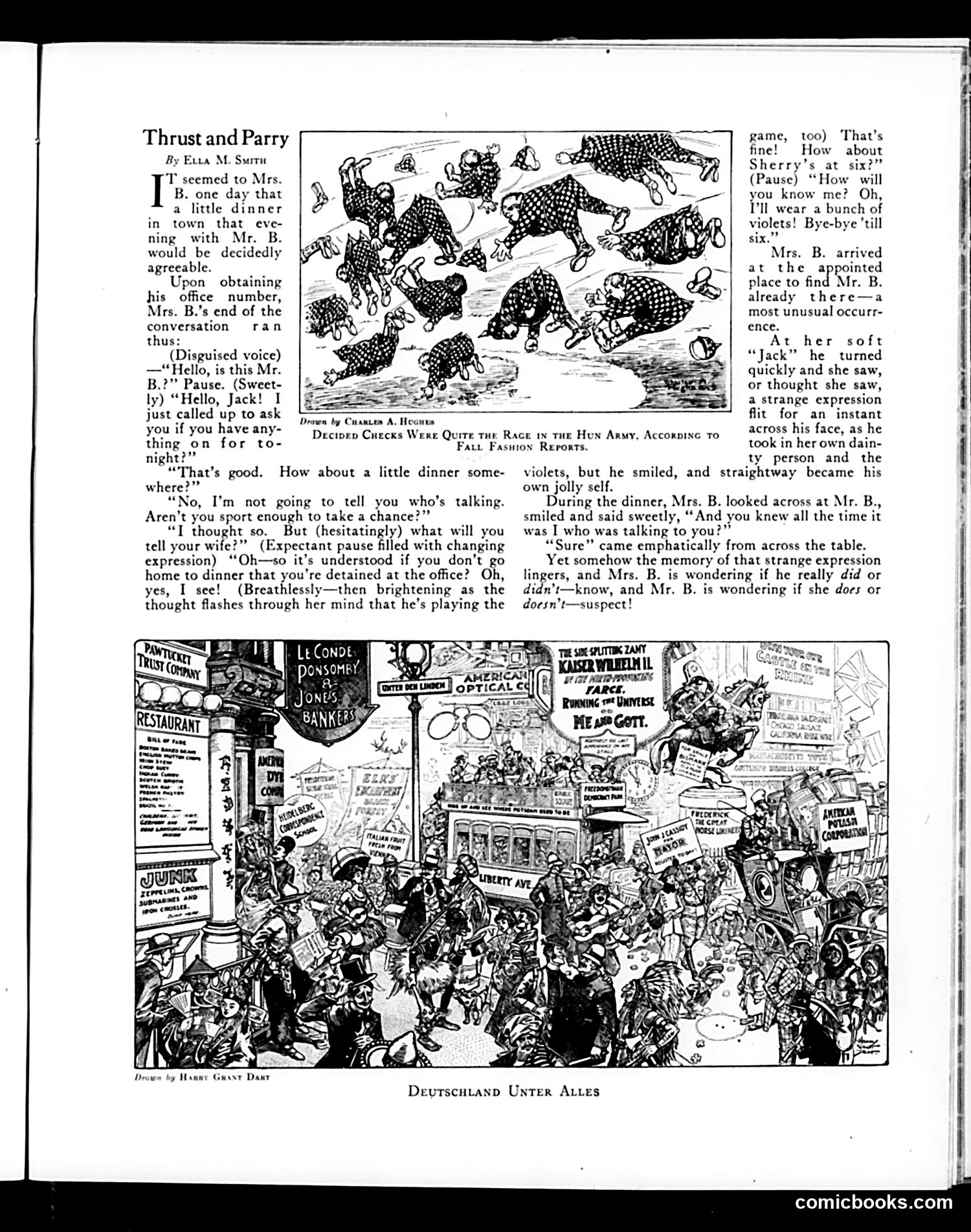
This is a domestic humor piece about marital psychology. Mrs. B. phones her husband Mr. B. disguising her voice to invite "Jack" to dinner, testing whether he'll recognize her. He accepts the invitation without identifying her, claiming afterward he knew it was her all along—though his strange facial expression suggests otherwise. The joke's satirical point: marital uncertainty and the games couples play. Mrs. B. now doubts whether her husband truly recognized her or was simply caught off-guard. Mr. B. wonders if she suspects he *didn't* recognize her. Both parties are left uncertain, trapped in plausible deniability. The lower cartoon, captioned "Dachshunds Were Quite the Rage in the Hun Army," depicts a crowded street scene with numerous dachshunds, satirizing German military fashion or culture. "Hun" references Germany/Germans during WWI era, suggesting this publication's anti-German sentiment typical of American magazines during that period.
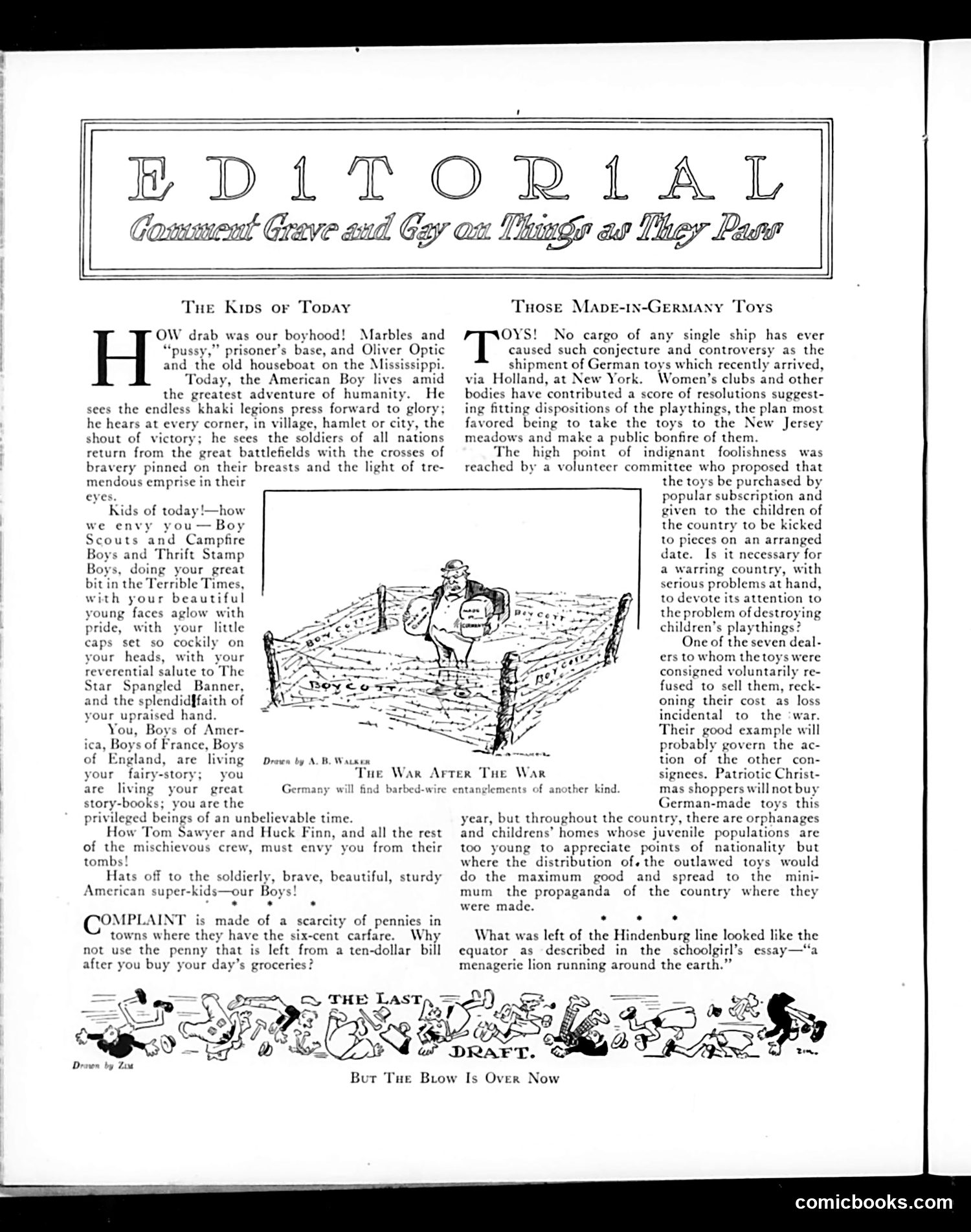
This Judge magazine editorial addresses two contemporary issues from the post-WWI era: **"The Kids of Today"** nostalgically praises American boys—Boy Scouts, Thrift Stamp Boys—for their patriotic service during "the Terrible Times" (World War I), contrasting their adventurous lives favorably with earlier generations' mundane childhoods. **"Those Made-in-Germany Toys"** satirizes the hysteria surrounding German toy shipments arriving via Holland. Women's clubs and patriotic groups proposed destroying or kicking apart these toys as anti-German sentiment. The editorial mocks this as pointless jingoism, arguing that orphanages and children's homes should instead receive the toys to do "maximum good" rather than waste resources on symbolic destruction. One German toy dealer voluntarily refused to sell them, setting a "good example." The piece advocates practical compassion over performative patriotism in the post-war period.
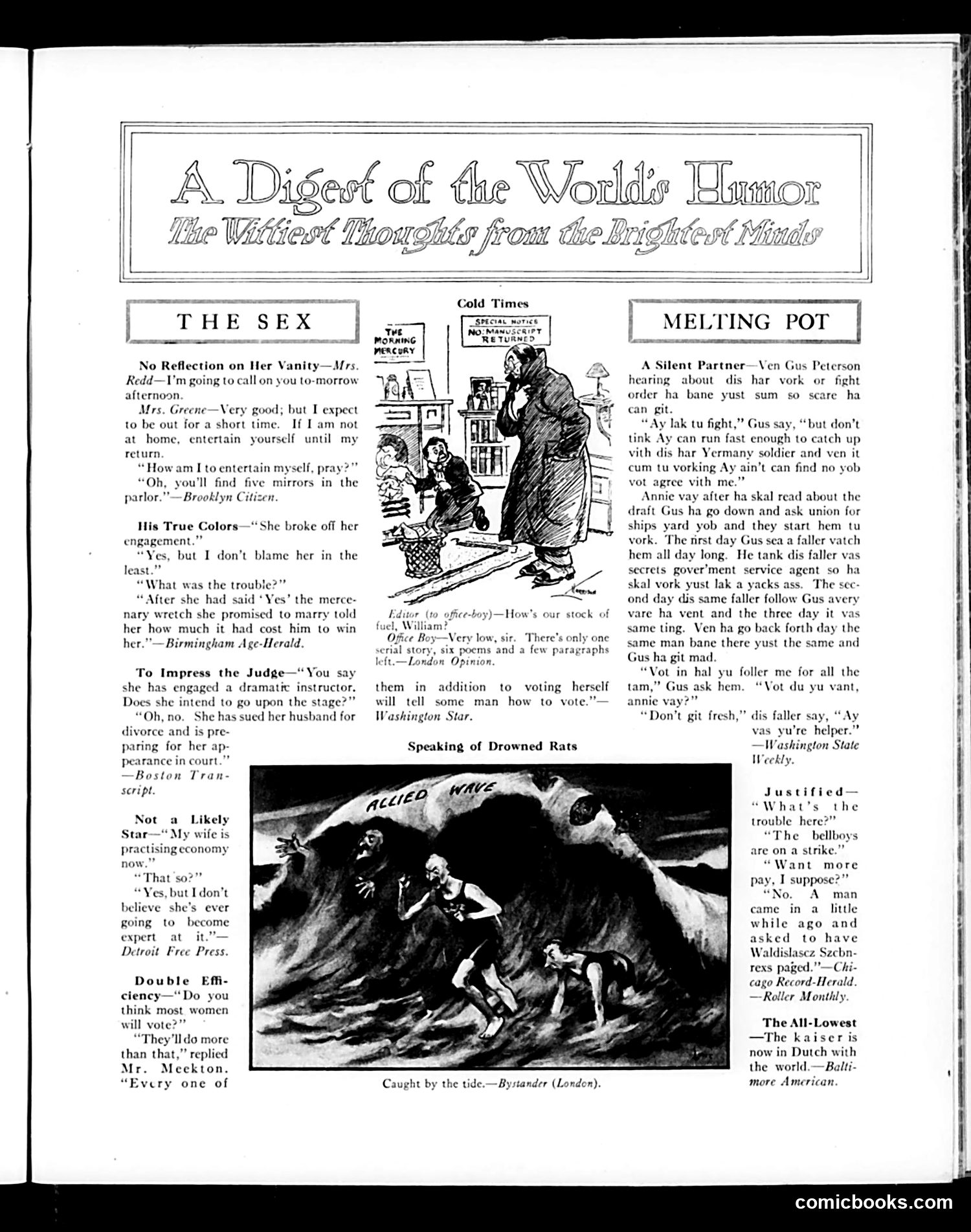
This page from Judge magazine contains satirical humor pieces typical of early 20th-century American wit. The main content includes: **"The Sex"** section: Short jokes mocking women's vanity and behavior—one quip suggests a woman entertains herself by gazing at mirrors; another mocks a woman who breaks an engagement after learning her fiancé spent money courting her. **"Melting Pot"** section: A dialect story featuring "Ven Gus," an immigrant character (likely Eastern European, indicated by the phonetic dialect spelling) struggling with wartime employment and union work. The piece satirizes immigrant workers during what appears to be World War I, when government shipyard work was common. **"Speaking of Drowned Rats"** illustration: Shows figures caught by tide—the caption credits "Bystander (London)," suggesting it's reprinted from British sources. Other brief jokes mock women voting, marriage, and divorce proceedings—reflecting contemporary anxieties about women's changing social roles. The overall tone is condescending toward immigrants, women, and working-class concerns.
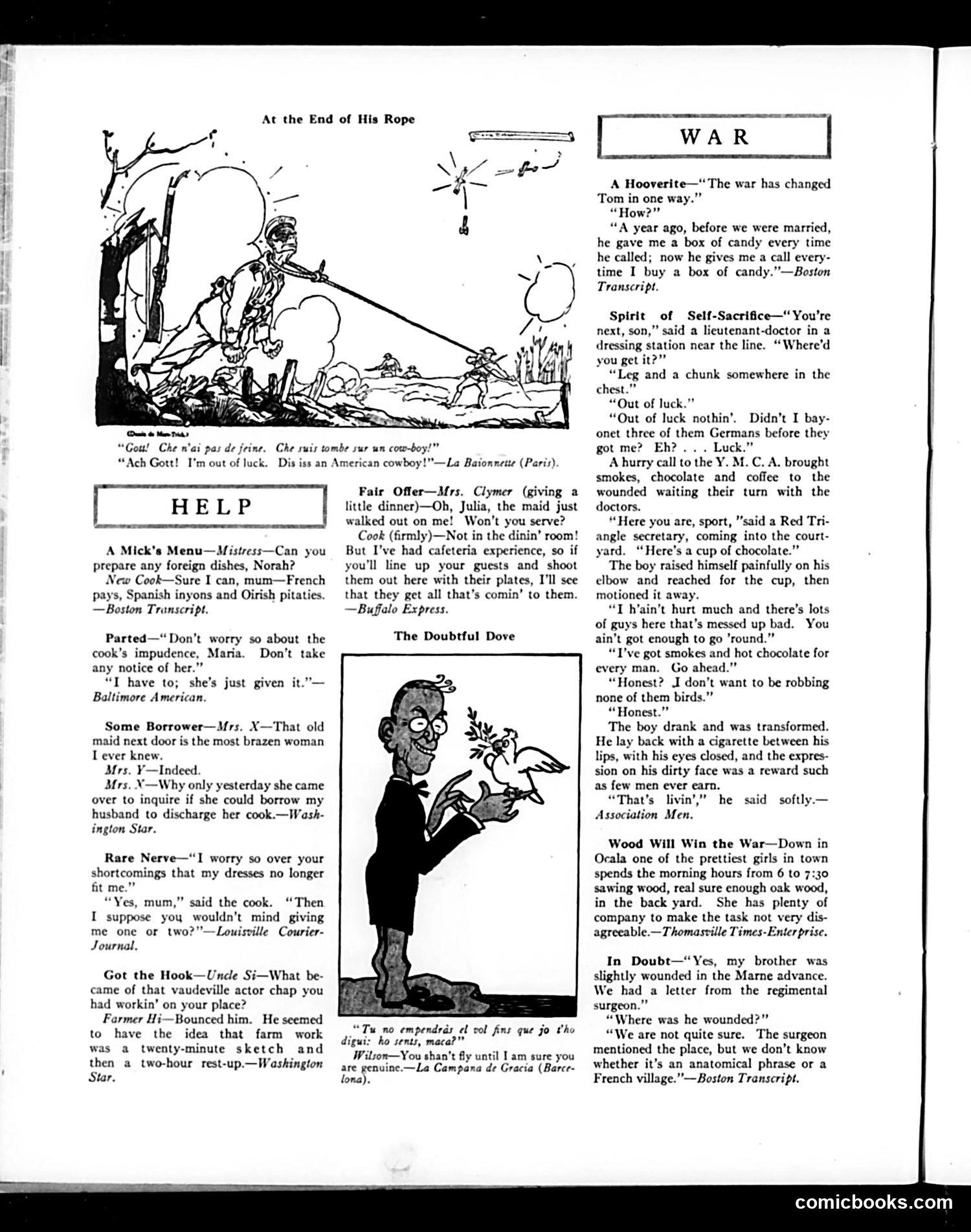
This is a wartime humor page from Judge magazine, likely from 1917-1918, mixing short jokes with war-related content. The main cartoon "At the End of His Rope" depicts a German soldier (identified by the French caption's German dialect) who has surrendered to an American cowboy. The satire mocks German expectations—the soldier says he thought he'd encountered a Frenchman but instead faced an American cowboy, implying surprise at American military involvement and playing on the stereotype of American frontier toughness. The "WAR" section contains brief anecdotes celebrating American home-front sacrifice: soldiers receiving YMCA support, a woman sawing wood for the war effort, and wounded soldiers displaying noble stoicism. These are earnest, propagandistic pieces emphasizing civilian and military virtue. The remaining content—"HELP" section—consists of unrelated domestic humor jokes about servants, cooks, and marriage, typical Judge magazine filler. The overall page blends patriotic war messaging with lightweight domestic humor, reflecting how American periodicals normalized wartime participation through mixed entertainment.
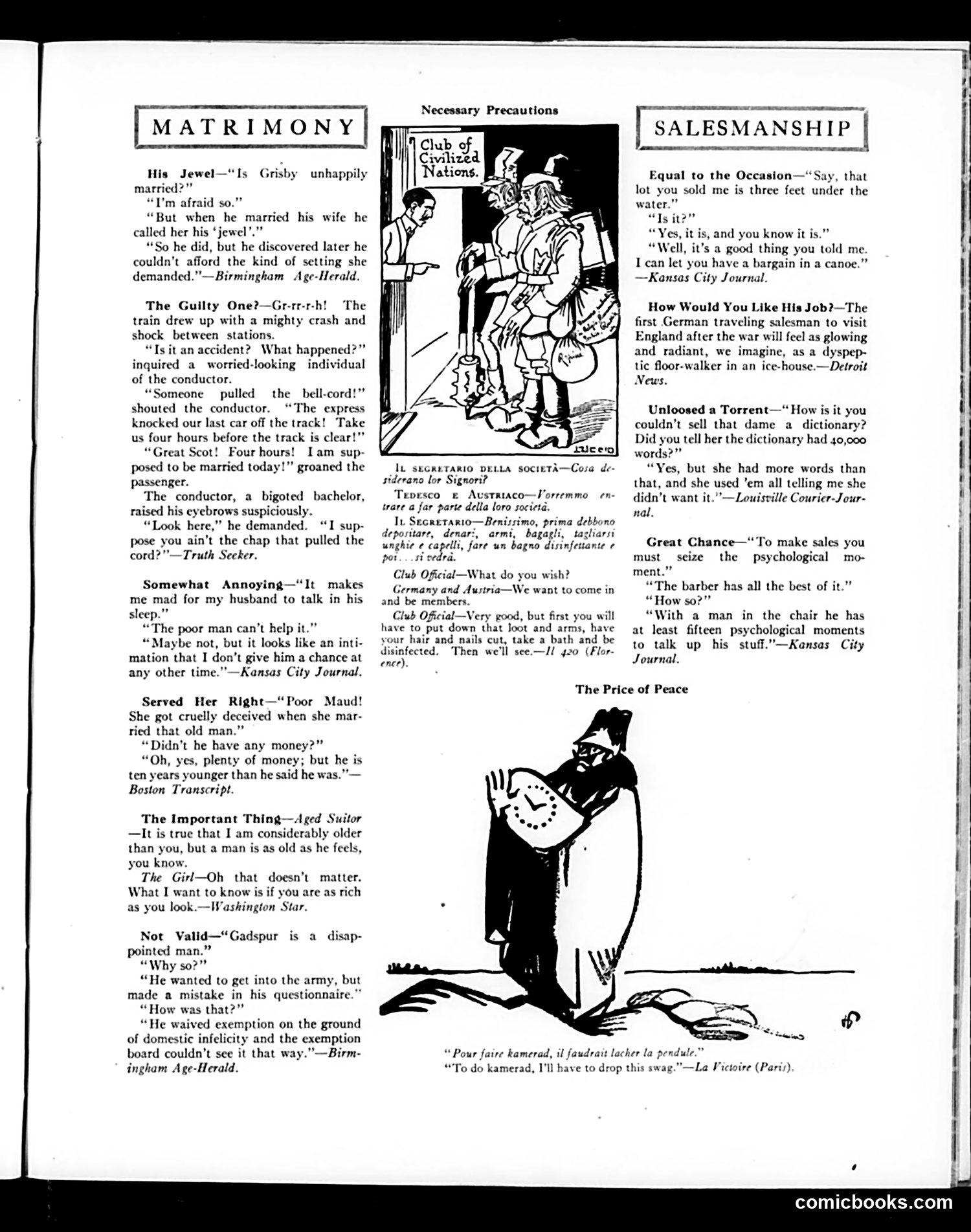
This Judge magazine page contains three humor sections satirizing early 20th-century American life: **MATRIMONY** mocks marriage through brief quips about wives' financial demands, men talking in their sleep, and gold-diggers prioritizing wealth over age—reflecting era anxieties about women's materialism. **"NECESSARY PRECAUTIONS"** is a political cartoon about post-WWI diplomacy. Germany and Austria seek League of Nations membership but face humiliating conditions (disinfection, surrendering weapons/loot)—depicting Allied nations treating defeated enemies as morally "contaminated" requiring cleansing before readmission to civilization. **SALESMANSHIP** celebrates American commercial cunning: a con artist selling underwater land as a canoe opportunity, and a barber exploiting captive customers. The German salesman joke references post-war resentment—Germany's commercial representatives would face hostility in Britain. The page reflects post-WWI attitudes: optimism about American sales culture, vindictive treatment of defeated powers, and gender stereotypes about materialistic wives. "The Price of Peace" cartoon's French caption emphasizes Allied distrust requiring Germany surrender ("drop the swag") before peace.
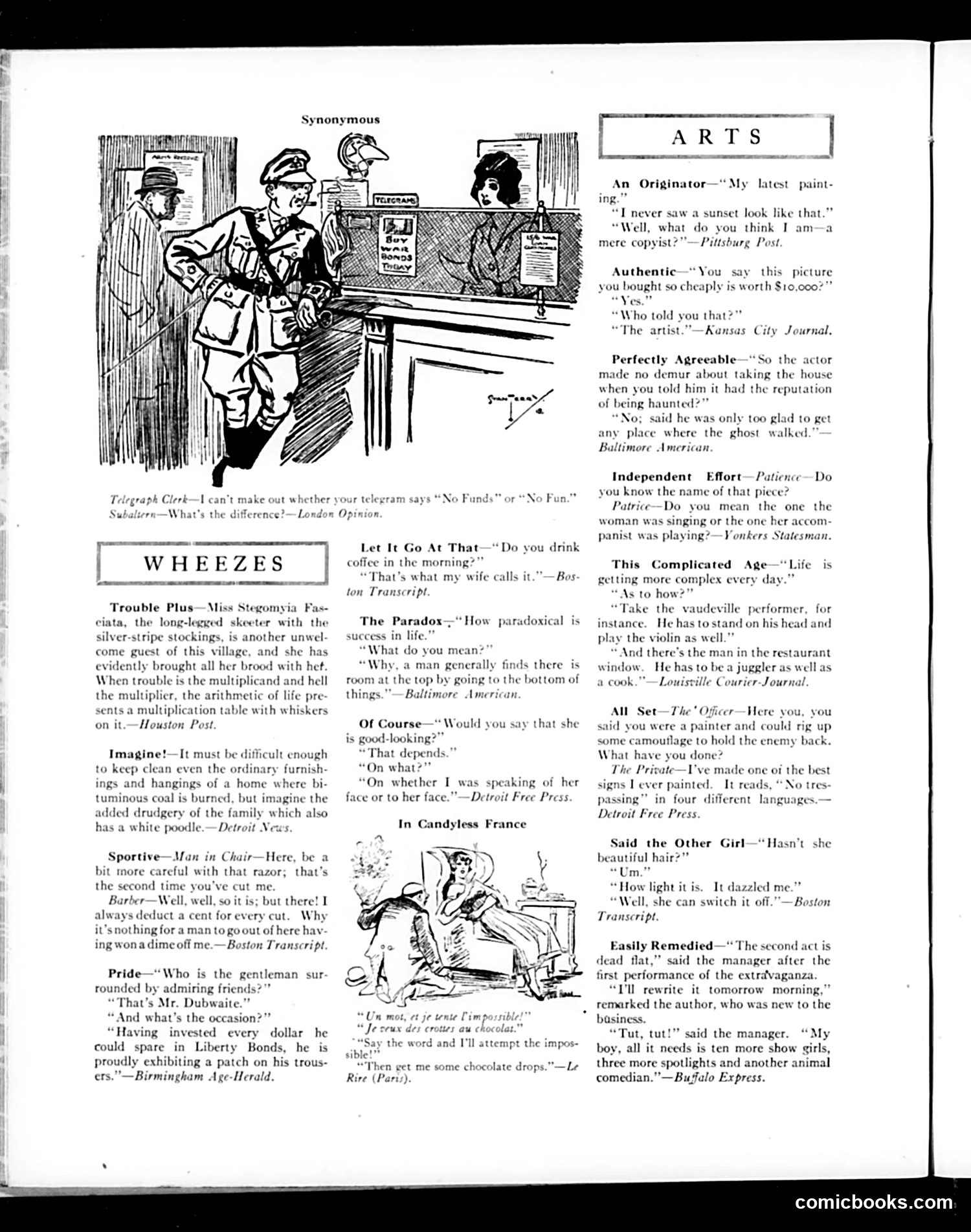
This page from *Judge* (a satirical magazine) contains brief humorous anecdotes rather than political cartoons. The content reflects early 20th-century American social humor: **Key subjects satirized:** - **"Trouble Plus"**: References the mosquito *Stegomyia fasciata* (the yellow fever vector), reflecting contemporary public health anxieties about disease-carrying insects. - **Domestic complaints**: Jokes about coal dust, barber cuts, and coffee quality mock ordinary household frustrations. - **War bonds**: A "Liberty Bonds" reference suggests WWI-era patriotism, with humor about sacrifice (a man proudly shows a patched trouser from investing savings). - **Vaudeville/entertainment**: Multiple jokes target performers and theater, reflecting vaudeville's prominence in the era. - **Gender humor**: Stereotypical jokes about women's appearance and behavior typical of the period. The humor is genteel and observational rather than biting—reflecting middle-class concerns of the early 1900s about modernity, consumerism, and social propriety.
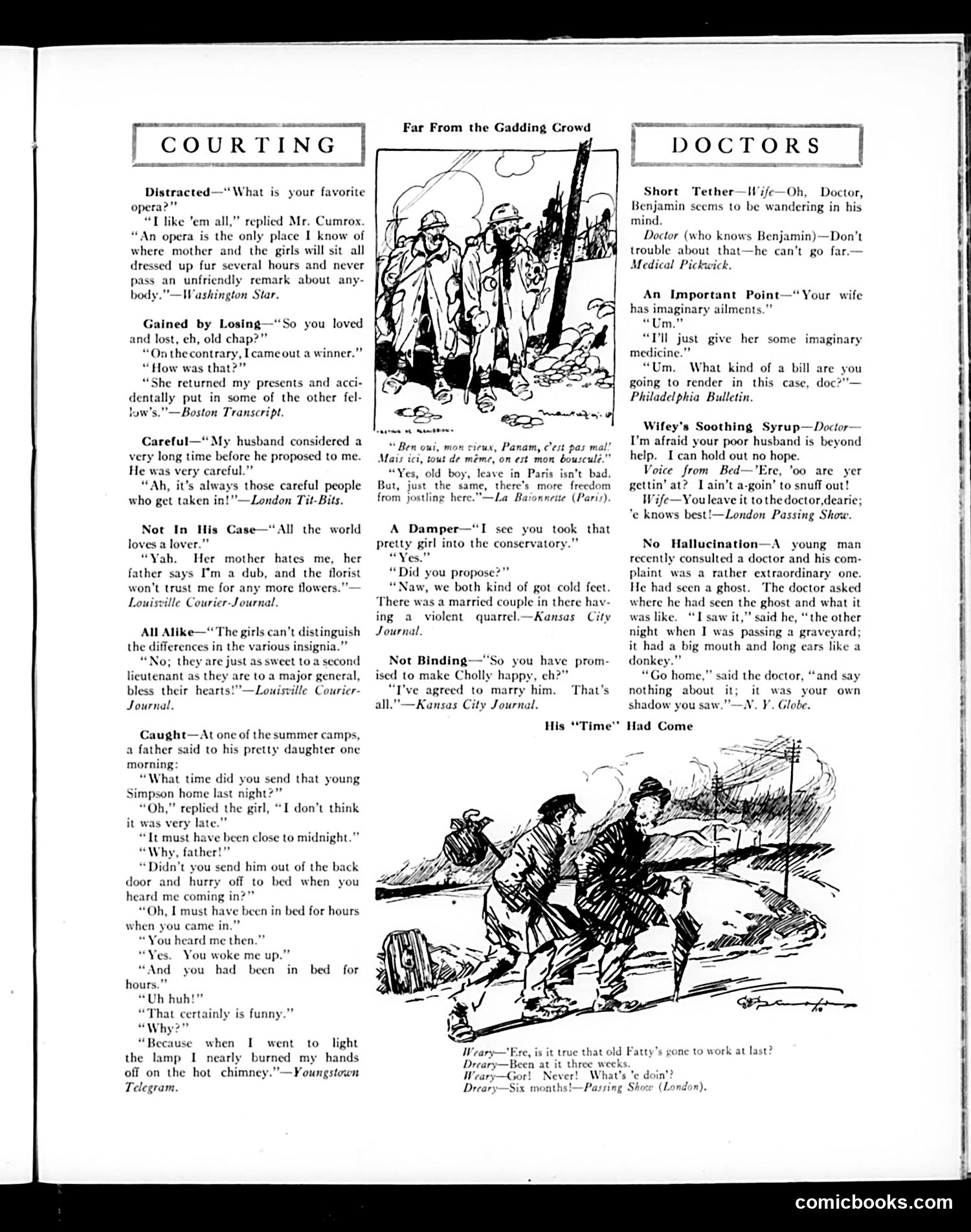
This page contains short comic anecdotes and jokes organized into three sections: "Courting," "Far From the Gadding Crowd," and "Doctors." The jokes are early 20th-century domestic humor satirizing courtship and marriage. Key themes include: men's difficulty affording romance (returning gifts, florist credit issues); the awkwardness of proposal timing; and parents monitoring young couples' behavior (the "back door" anecdote mocking a daughter's contradictory story about when she went to bed). The "Far From the Gadding Crowd" section includes a French military reference contrasting Paris crowds with quieter surroundings—likely WWI-era context, though exact dating is unclear. The "Doctors" section mocks both hypochondriac wives with "imaginary ailments" and doctors' profit motives, plus a joke about mistaking one's own shadow for a ghost (a donkey-like shape). The cartoons illustrate soldiers and rural figures—the humor relies on period-specific assumptions about gender roles, class, and courtship conventions unfamiliar to modern audiences.
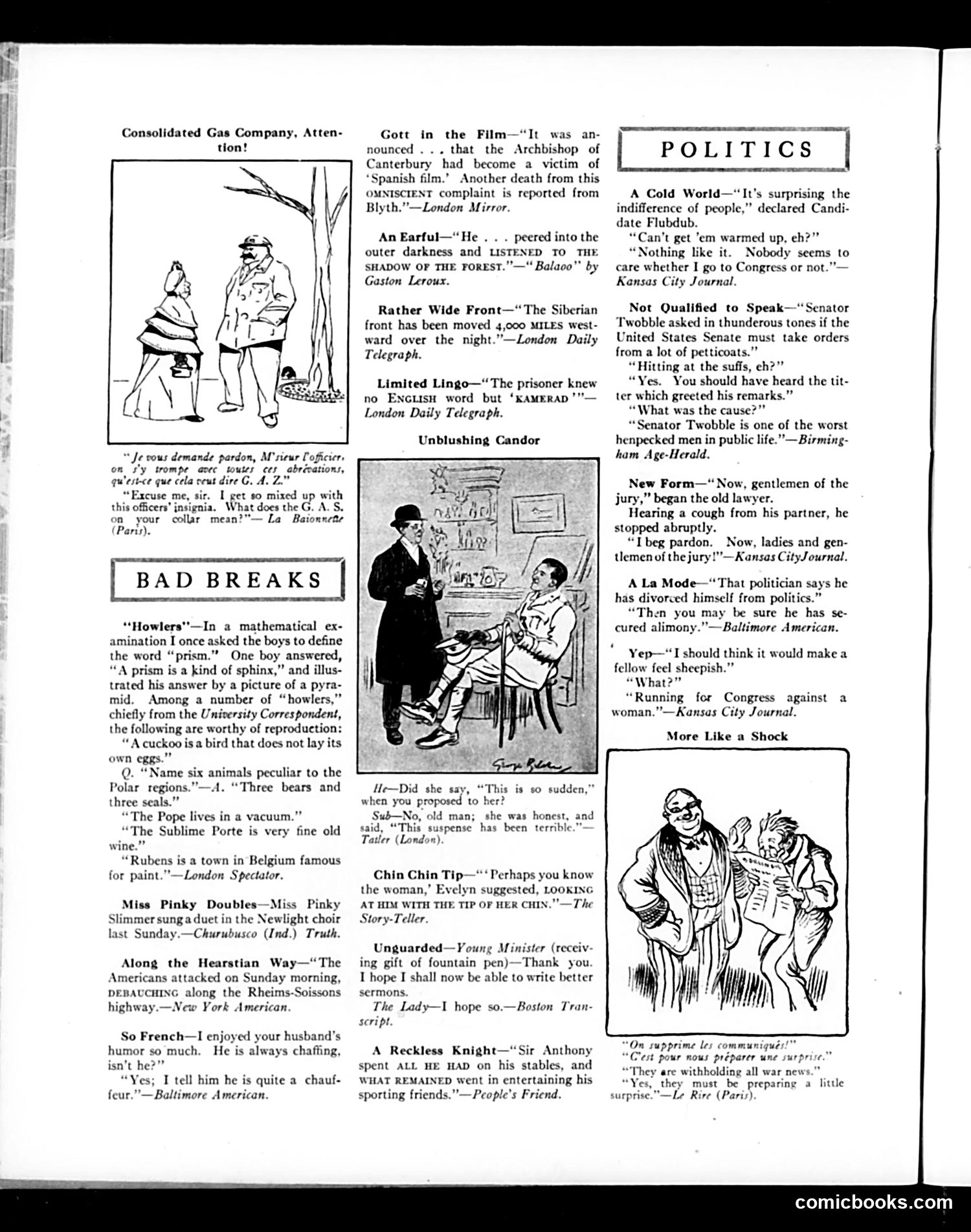
This is a humor compilation page from Judge magazine featuring short satirical jokes and anecdotes rather than political cartoons. The "Bad Breaks" section mocks absurd student exam answers and newspaper typos—deliberately ridiculous misstatements presented for comedic effect. The "Politics" section satirizes contemporary political figures and attitudes, particularly **Senator Twobble**, who appears to be a fictional stand-in for an actual henpecked politician who rails against women's suffrage ("the suffs") while being dominated by his wife at home—the irony being the obvious joke. Other political quips mock **Candidate Flubdub's** inability to generate voter enthusiasm and mock politicians who claim to have "divorced themselves from politics" while still seeking office. The overall tone is light satirical commentary on American political hypocrisy and incompetence, typical of Judge's era. Without specific dates or names attached to these fictional characters, they represent generic types rather than identifiable individuals.
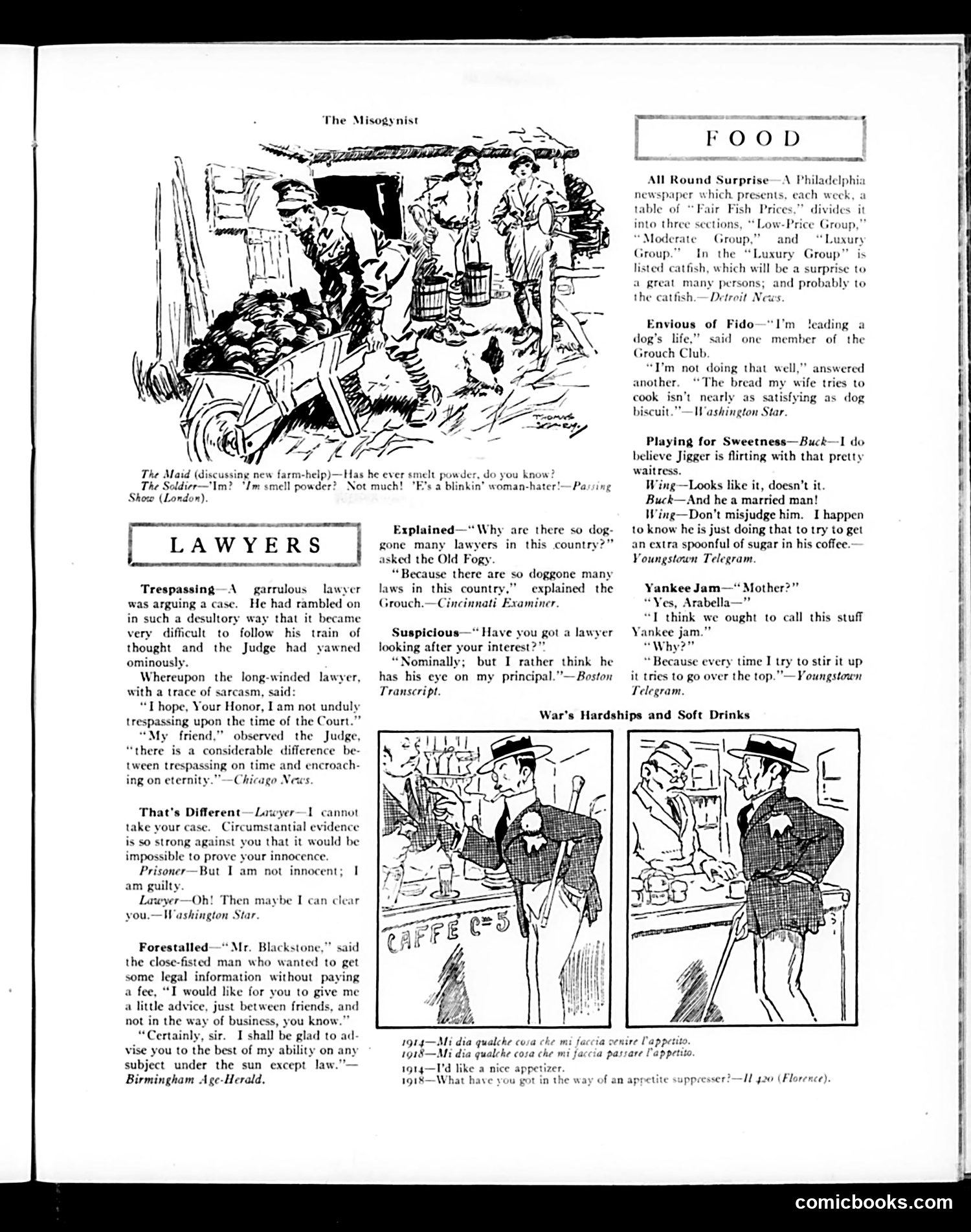
This page from Judge (appears undated, likely WWI-era based on the "War's Hardships" cartoon) contains humor anecdotes and cartoons satirizing lawyers, food, and wartime conditions. **The Lawyer Section** mocks the legal profession through four brief jokes: one about a verbose attorney "trespassing" on court time; another showing a lawyer willing to defend only guilty clients (implying dishonesty); a third about a lawyer charging fees; and one explaining America has many lawyers because America has many laws (satirizing legal complexity). **The Food Section** contains light humor about restaurant life and domestic cooking, including a joke comparing poorly-made bread to dog biscuit. **The War's Hardships cartoon** (bottom) contrasts Italian dining in 1914 (ordering rich appetizers) with 1918 (requesting appetite suppressers), satirizing wartime food scarcity and rationing effects on appetite and consumption. The overall tone is lighthearted satire of professional incompetence and wartime hardship.
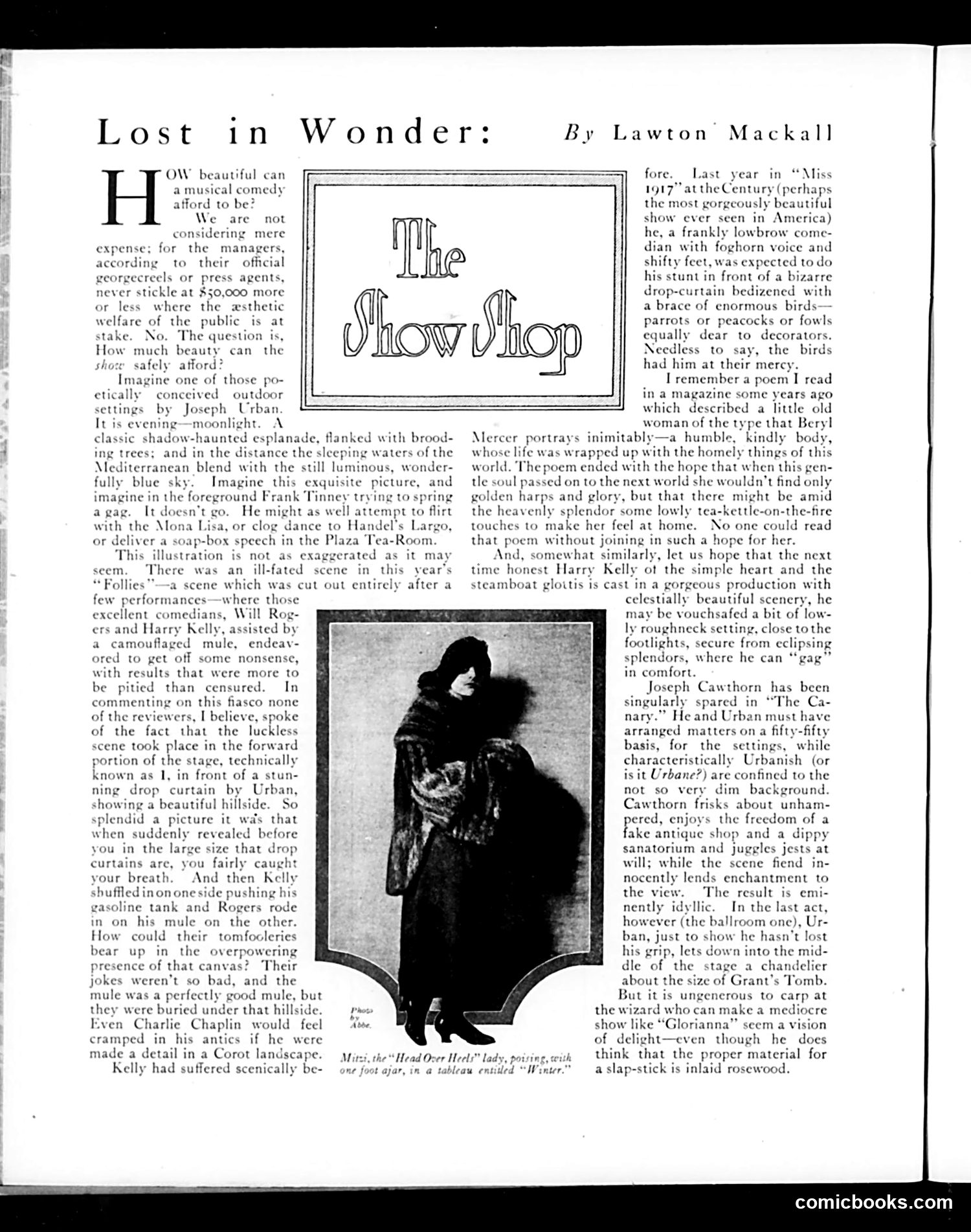
This article critiques a mismatch in 1910s Broadway musical comedy: elaborate, expensive scenic design by Joseph Urban overwhelming comedians trying to perform. The author argues that beautiful stage settings—like Mediterranean landscapes or Corot paintings—actively *inhibit* comedy. He cites Frank Tinney attempting slapstick against an ornate drop curtain, and a failed "Follies" scene where Will Rogers and Harry Kelly performed with a mule in front of Urban's stunning hillside backdrop. The visual grandeur literally buried their jokes. The piece argues comedians need humble, close-to-footlights settings to work effectively. It praises shows like "The Canary," where Joseph Cawthorn and Urban supposedly balanced beautiful scenery with accessible space for comic performance. The central satire: theater managers spend lavishly on aesthetics while undermining the very entertainers meant to captivate audiences. Beauty, taken to extremes, becomes the enemy of comedy.
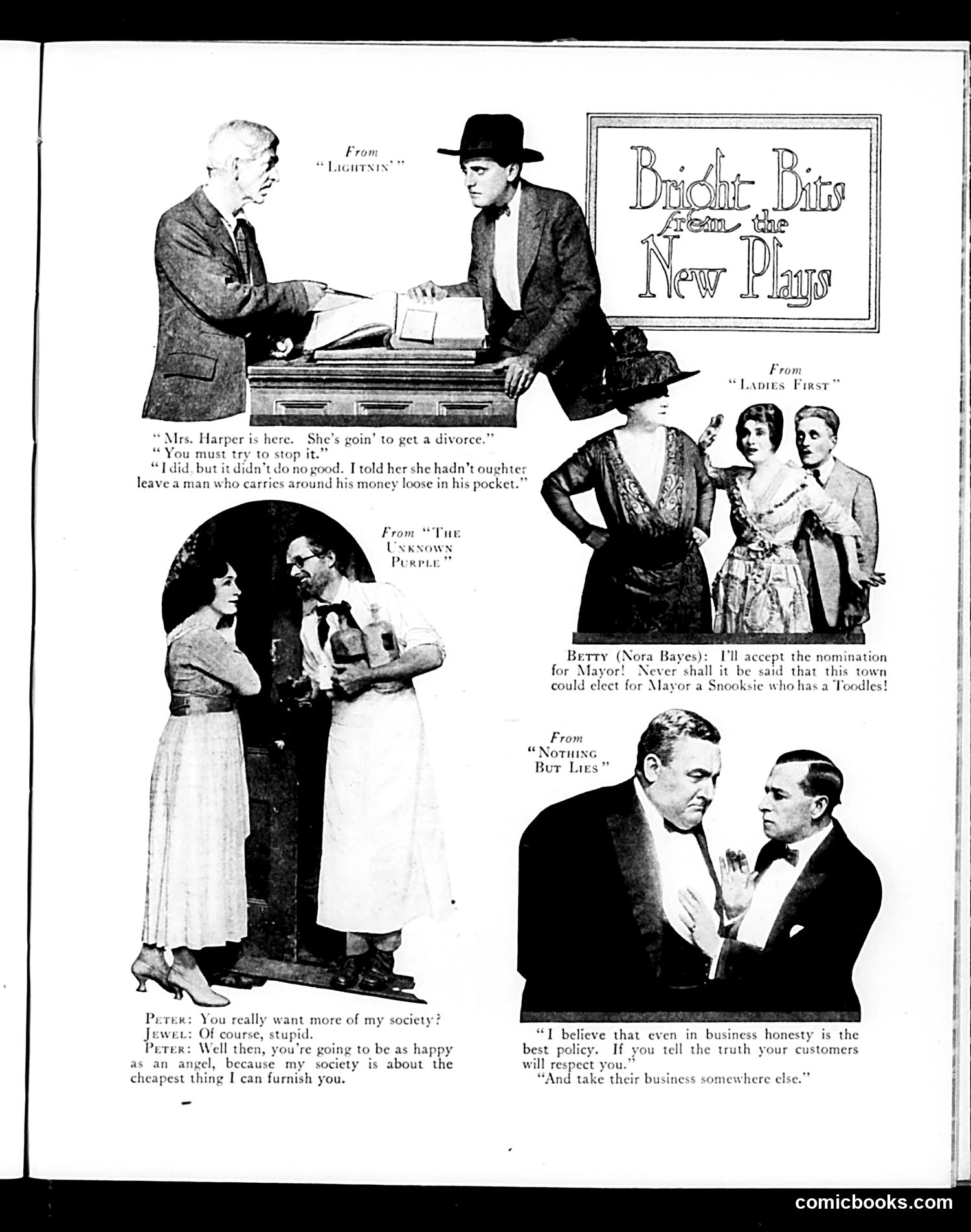
This page presents satirical scenes from contemporary theatrical productions, mocking social and moral hypocrisy of the era. **Top scene** ("Lightnin'"): A wife seeks divorce because her husband carelessly carries loose money—the joke being that financial irresponsibility, not infidelity or cruelty, justifies leaving. **Middle-left** ("The Unknown Purple"): A wealthy man (Peter) dismisses a jeweler's (Jewel's) social aspirations, sneering that his "society" is worthless. The satire targets class pretension and shallow social climbing. **Middle-right** ("Ladies First"): Actress Nora Bayes, playing Betty, campaigns for Mayor while mocking her male rivals as "Snooksies" and "Toodles"—nonsense terms suggesting male politicians are frivolous or incompetent. **Bottom** ("Nothing But Lies"): Two businessmen debate honesty; one naively claims truthfulness builds customer respect, while his colleague cynically notes customers will simply take their business elsewhere—satirizing the gap between business ethics preached and practiced. The overall theme: moral and social hypocrisy among respectable people.
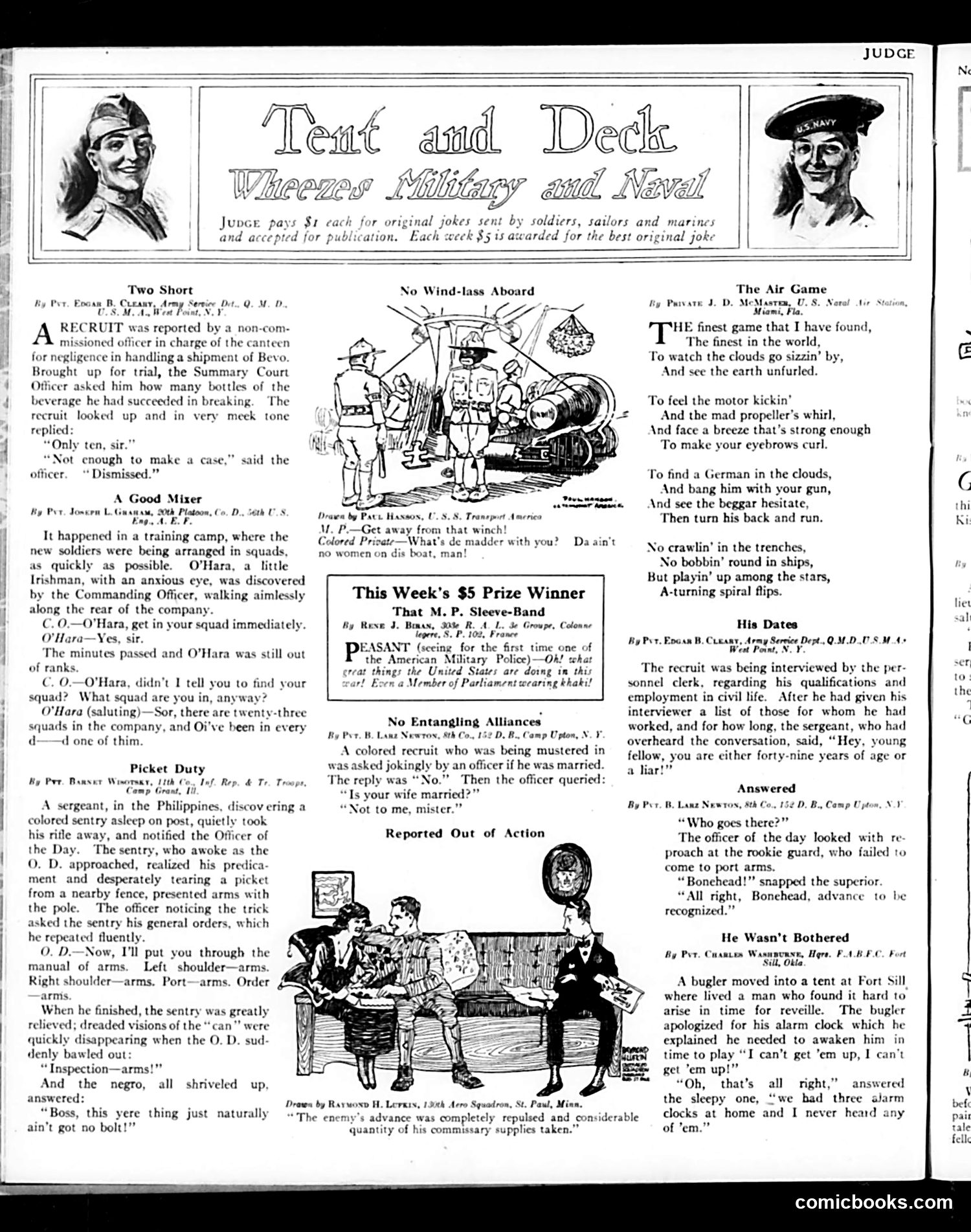
This *Judge* page collects brief humorous anecdotes submitted by soldiers and sailors, typical of the magazine's "Wheezers Military and Naval" section that paid $1 per joke. The jokes target military incompetence and racial stereotypes common to the period: - **"A Good Mixer"**: An Irish recruit named O'Hara comically misunderstands orders, claiming to be in "twenty-three squads" when told to find his assignment. - **"Picket Duty"**: A Black sentry caught sleeping uses a fence picket as a rifle during inspection, then naively admits it "ain't got no bolt"—playing on period stereotypes of Black soldiers as dim-witted. - **"No Entangling Alliances"**: A Black recruit, asked if his wife is married, replies "Not to me, mister"—implying infidelity. - **"The Air Game"**: A poem celebrating fighter pilots over trench warfare. The racial humor reflects era-typical attitudes; these jokes would be considered offensive today. The military incompetence jokes gently mock Army bureaucracy and training.
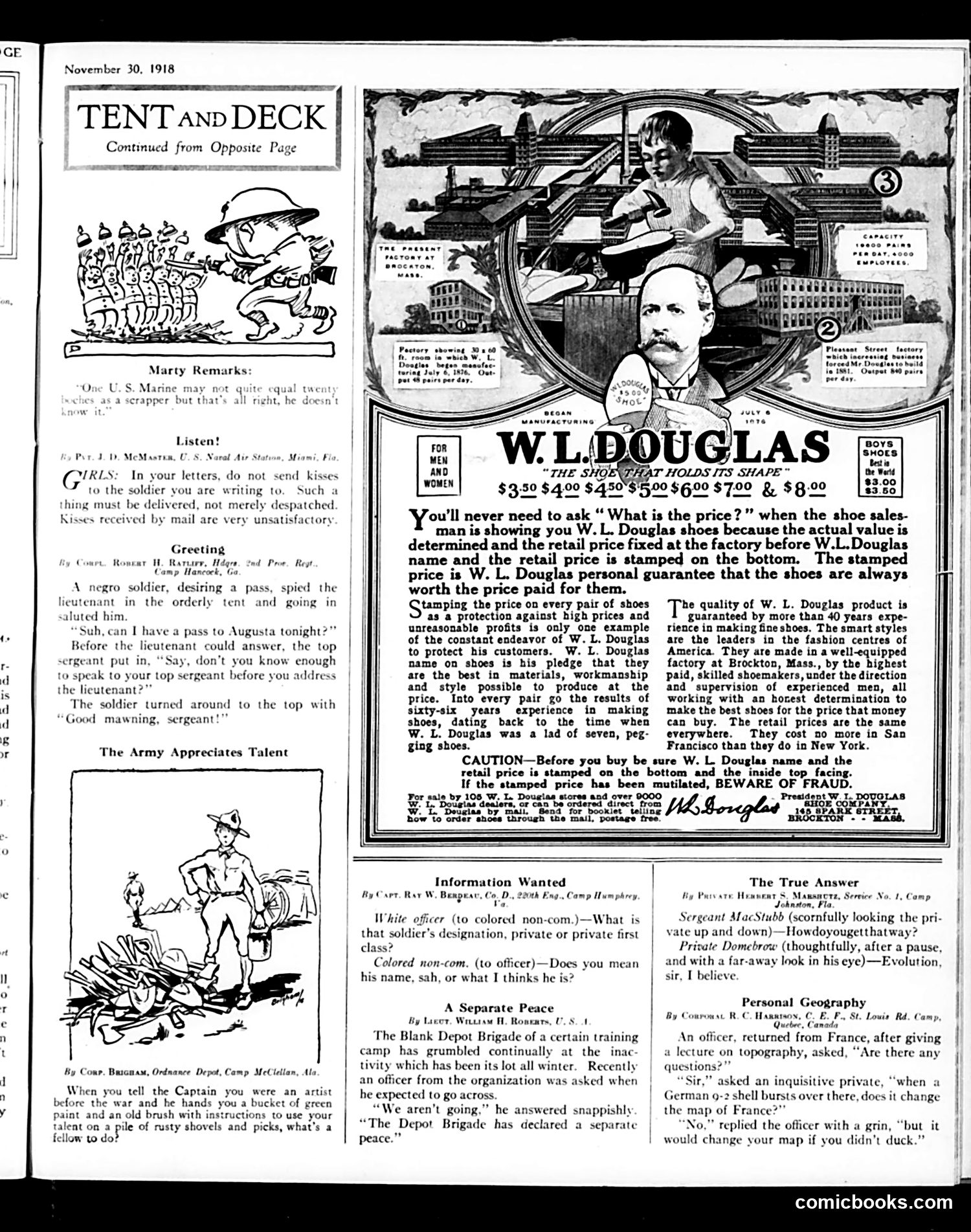
This page contains **primarily advertising** (a large W.L. Douglas shoe advertisement dominates the right side) alongside satirical military humor typical of Judge magazine's wartime content. The cartoons mock **army bureaucracy and racial dynamics**: 1. **"Marty Remarks"**: A caricatured soldier ("scrapper") critiques Marine pay—light social commentary on military compensation. 2. **"Listen!"**: Addresses female readers, warning against sending kisses by mail to soldiers—a moral advisory dressed as humor. 3. **"The Army Appreciates Talent"**: Satirizes the disconnect between civilian skills and military assignments—an artist given paint and shovels to use. 4. **"Information Wanted"**: Uses a "colored" (Black) soldier character in a comedic exchange about rank designation, employing dialect humor typical of the era's racist conventions. 5. **"A Separate Peace"**: References a training camp's inactivity—likely commentary on delays in deployment during the final months of WWI (the Armistice was signed November 11, 1918). The page reflects 1918 wartime attitudes, including casual racism in its humor conventions.
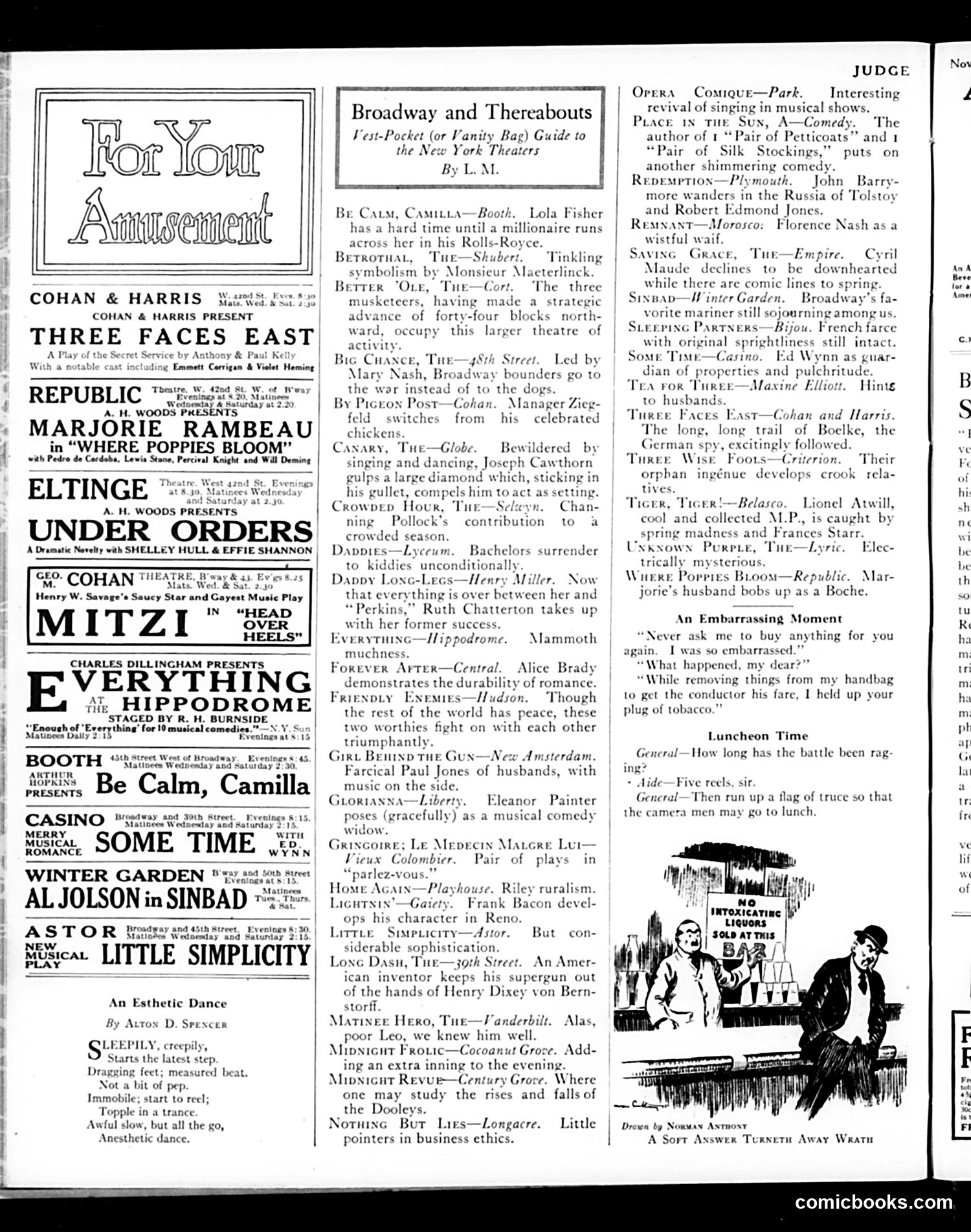
This page is primarily **theatrical advertising** for Broadway shows, with one small cartoon at the bottom by Norman Anthony. The cartoon depicts a domestic dispute: a man sits reading while a woman gestures animatedly at him, appearing angry or upset. The caption reads "A Soft Answer Turneth Away Wrath"—a reference to the biblical proverb (Proverbs 15:1). The joke plays on the contrast between the man's apparent indifference (sitting calmly with his newspaper) and the woman's agitation. The humor suggests that by ignoring or responding mildly to her complaints, he's defusing the argument—whether through deliberate strategy or simple obliviousness isn't entirely clear. The cartoon satirizes marriage dynamics of the era, depicting the common trope of the husband retreating behind his newspaper while the wife expresses frustration—a stock domestic comedy scenario for the period.
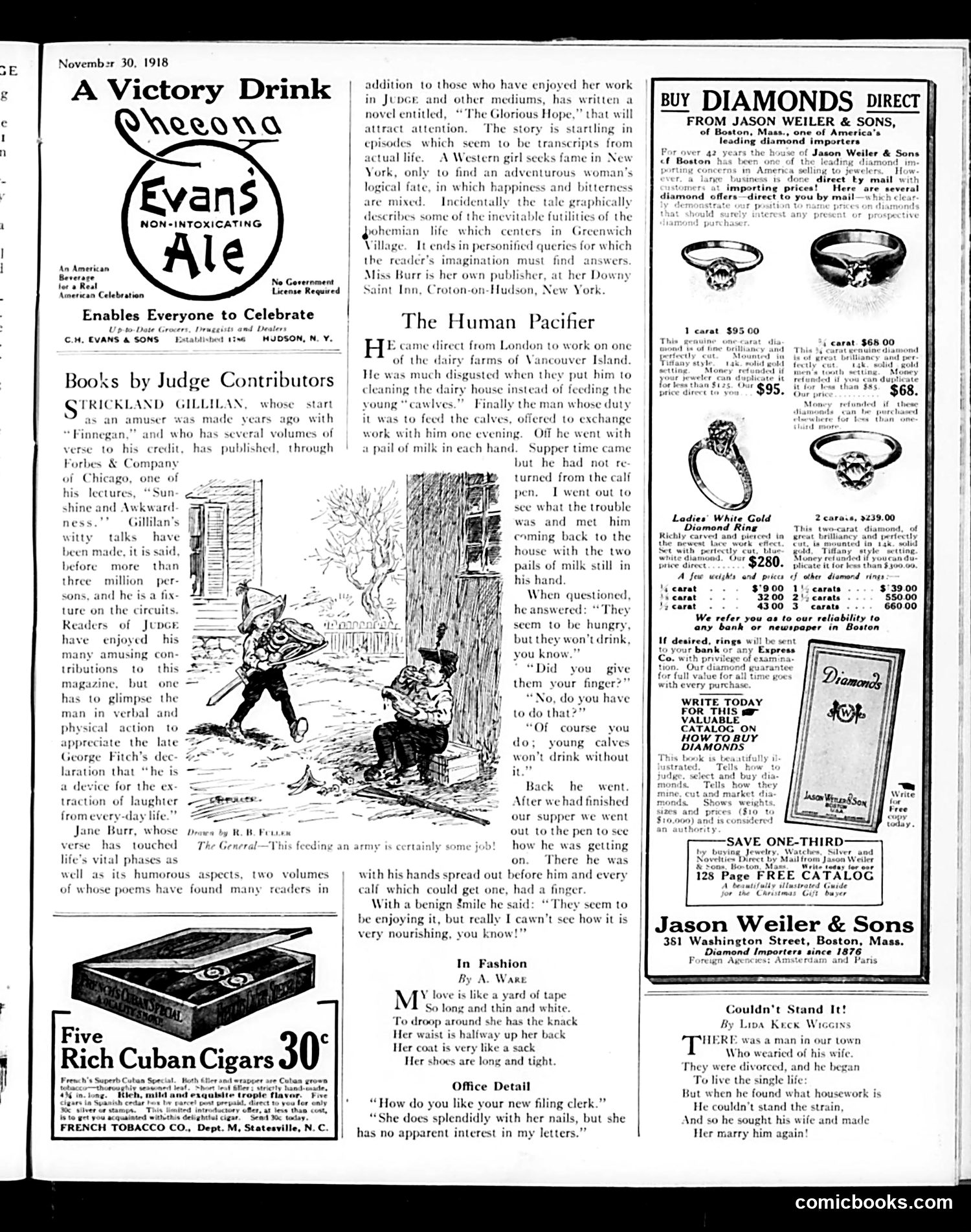
This page contains primarily **advertising and literary content** rather than political cartoons. The notable elements: **"The General" cartoon** (center-left): Shows a man feeding calves with his fingers. The accompanying story "The Human Pacifier" humorously depicts a British farm worker from London who doesn't understand that young calves won't drink milk without sucking on a human finger—a practical farming technique he found absurd but eventually accepted. The joke mocks British unfamiliarity with rural American dairy farming practices. **Context**: Published just after WWI's armistice (November 11, 1918), the page celebrates "A Victory Drink" (Evans Non-Intoxicating Ale) at top. The British worker character reflects contemporary interest in Anglo-American relations post-war. **Other content**: Book reviews of Judge contributors, fashion commentary, and diamond/cigar advertisements. The "Office Detail" joke plays on women clerical workers' supposed vanity about nail appearance over work competence. The page reflects 1918 attitudes toward British immigrants and early 20th-century gender stereotypes.
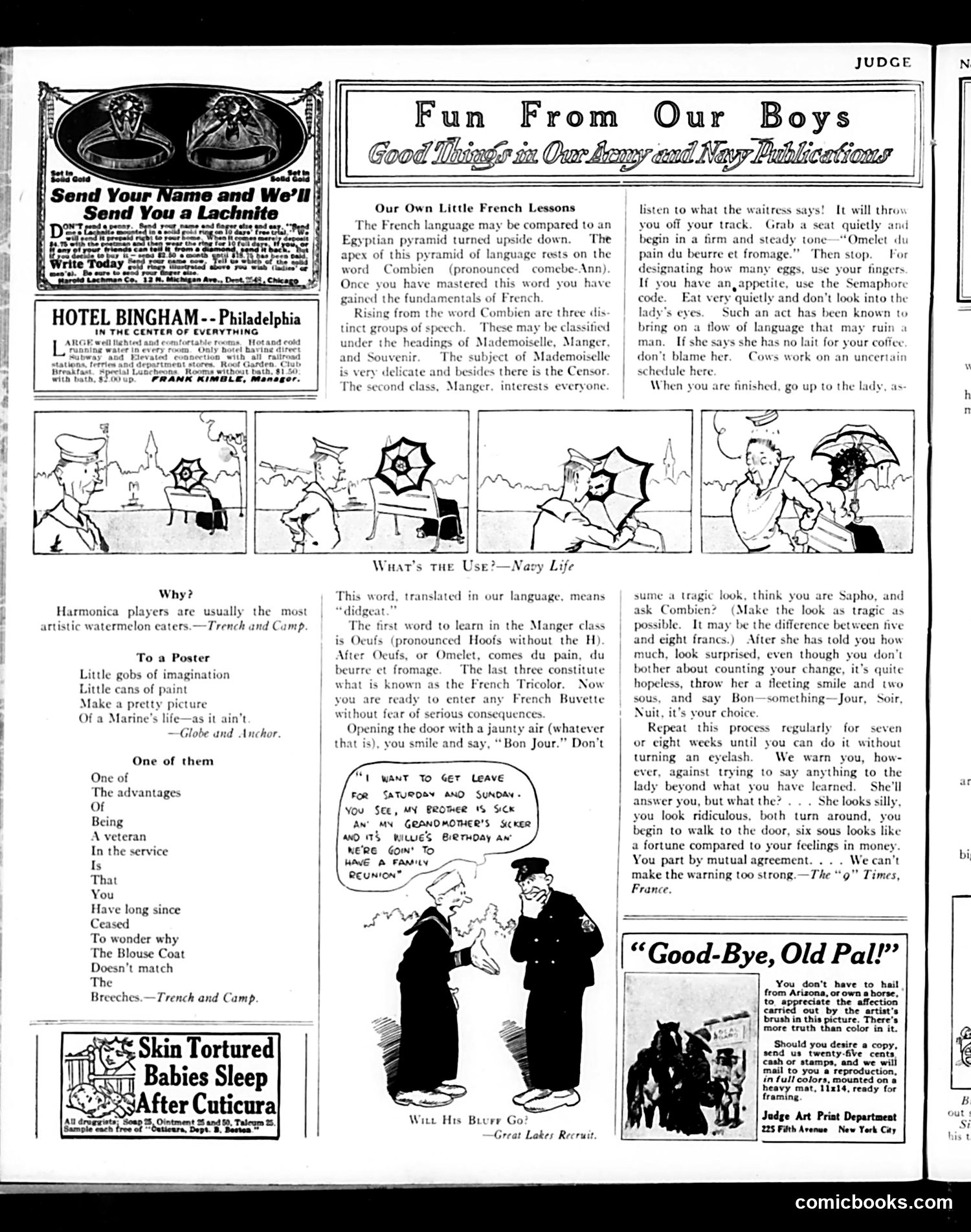
This page from *Judge* magazine contains humorous content aimed at American servicemen during WWI. The main feature, "Our Own Little French Lessons," satirizes soldiers' attempts to navigate French restaurants and interact with French women during deployment. The central cartoon depicts a Great Lakes recruit awkwardly requesting leave to attend his grandmother's birthday reunion—a transparent and comedically obvious excuse. The humor relies on the soldier's bumbling earnestness and the absurdity of combining multiple family obligations. The accompanying French lesson section mocks American servicemen's linguistic struggles, reducing the language to one word ("Combien"—how much) and offering ridiculous advice for ordering food and flirting with waitresses. The satire targets both military inexperience and cultural ignorance. The page also includes patriotic poetry ("To a Poster," "Why?") celebrating military service, typical of *Judge*'s dual role as satirical yet patriotic publication during wartime. Advertisements fill the remaining space. Overall, the content gently ridicules American soldiers abroad while maintaining affectionate, supportive humor common to military publications of the era.
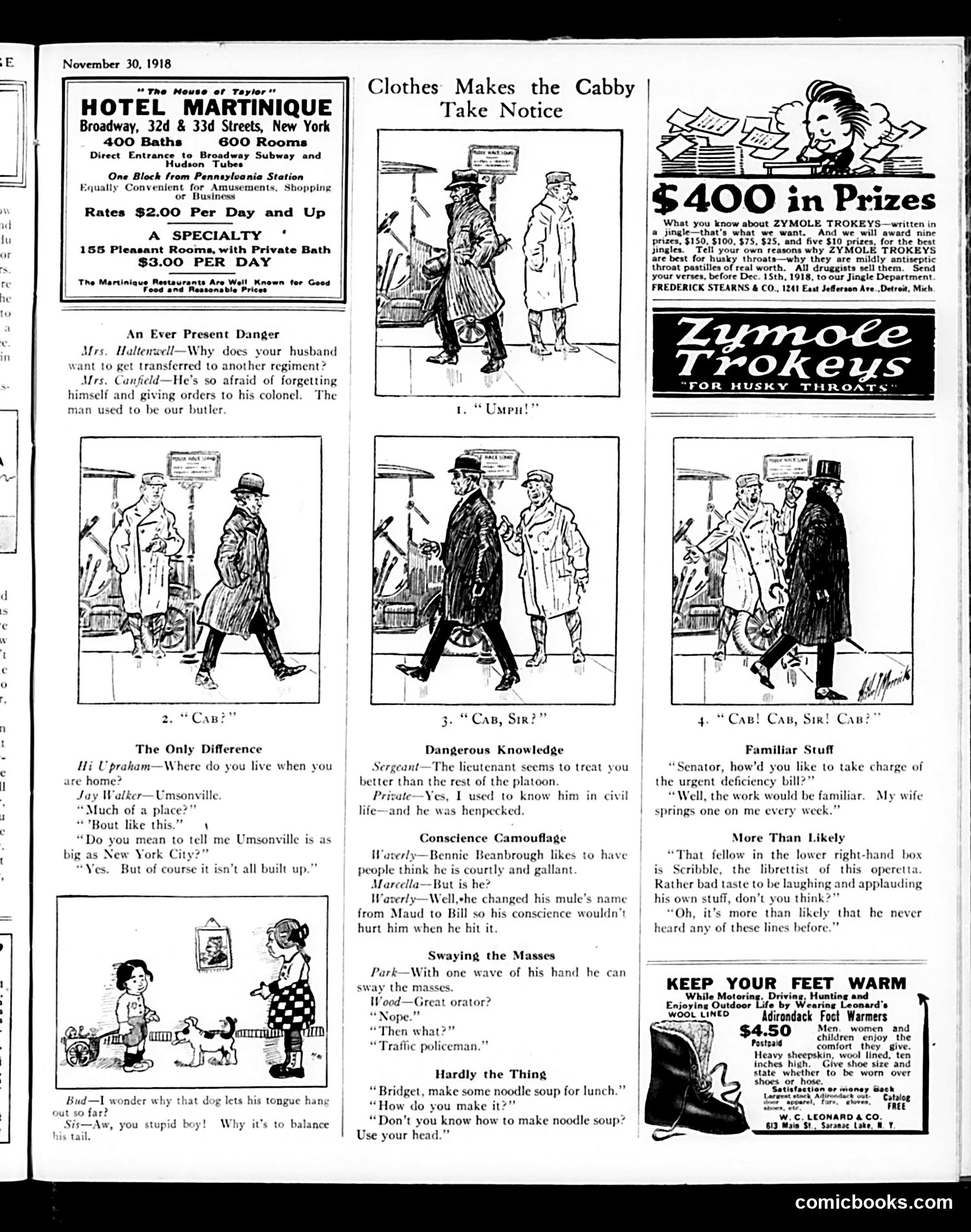
This page is primarily **advertisements and humorous filler content** rather than political satire. The main feature is a four-panel comic strip about a taxi driver who, upon receiving better clothing, assumes an elevated social status and becomes confused about how to address passengers (panels show him saying "Usps!", "Cab?", "Cab, Sir?", and "Cab! Cab, Sir! Cab?"). The joke satirizes **class consciousness and social pretension**—the implication being that superficial changes in appearance lead to anxiety about one's proper social position. The surrounding short jokes mock various social situations: a former butler turned soldier fearing he'll order his colonel around, small-town life, and domestic misunderstandings. The page's other content consists of hotel and product advertisements typical of 1918 publications. There is **no evident political content or reference to contemporary events** (despite the WWI-era date visible in the soldier joke).
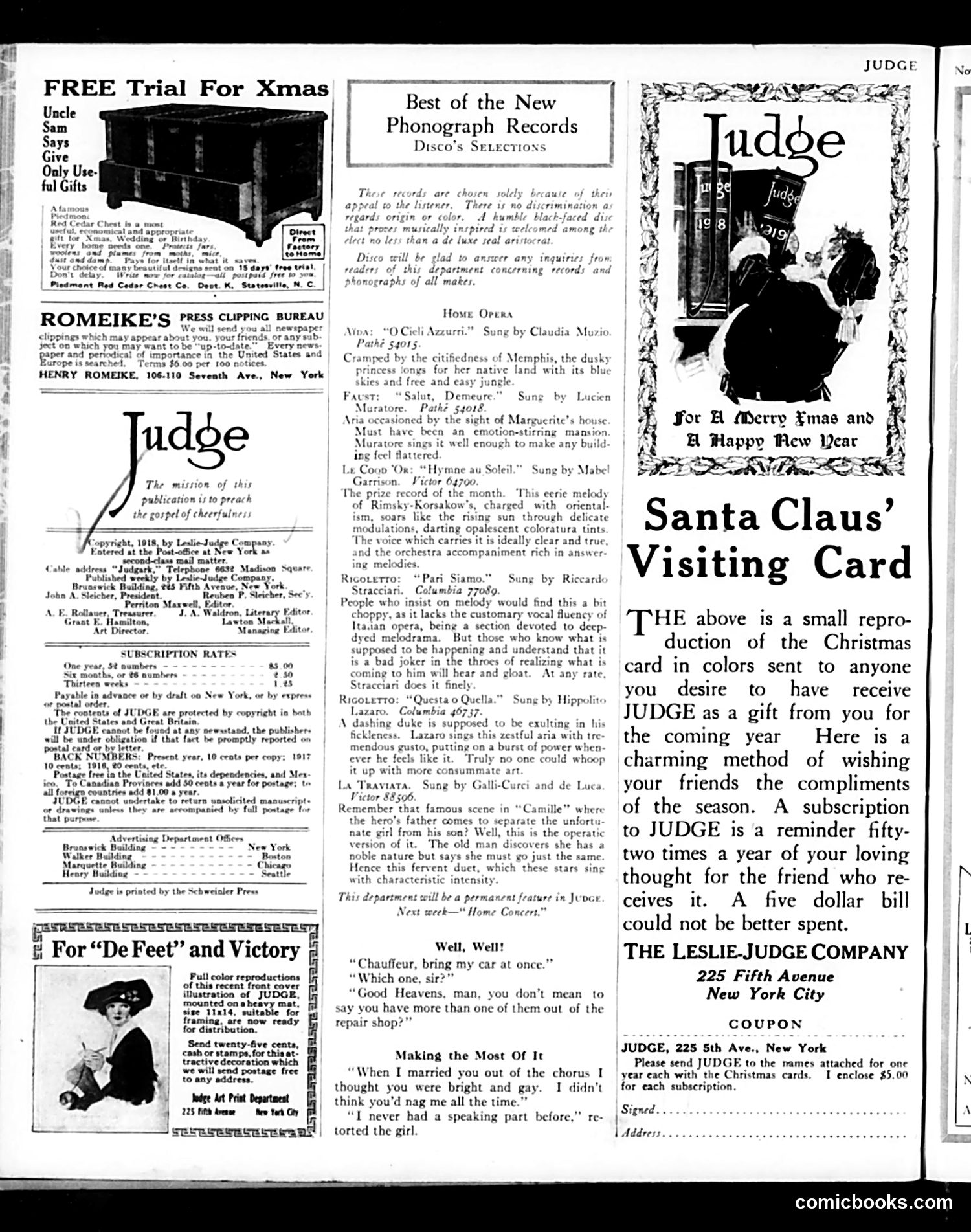
This appears to be primarily a **commercial/advertising page** from Judge magazine (December 1918), rather than containing political satire or editorial cartoons requiring interpretation. The page includes: - **Service advertisements** (Romeike's Press Clipping Bureau, phonograph records from Disco) - **Promotional material** for Judge itself, including subscription rates and a "Santa Claus' Visiting Card" advertisement offering Judge magazine as a gift subscription - **A small humorous sketch** titled "Well, Well!" featuring a dialogue about a chauffeur and multiple automobiles—a brief joke about consumer materialism, though the humor is minor - **A "De Feet and Victory" promotion** offering framed cover art The page reflects 1918 commercial culture: emphasizing consumer goods, magazine subscriptions as gifts, and phonograph records. The single joke plays on middle-class pretension regarding automobile ownership. Overall, this is a magazine interior page dominated by advertising rather than satirical content.
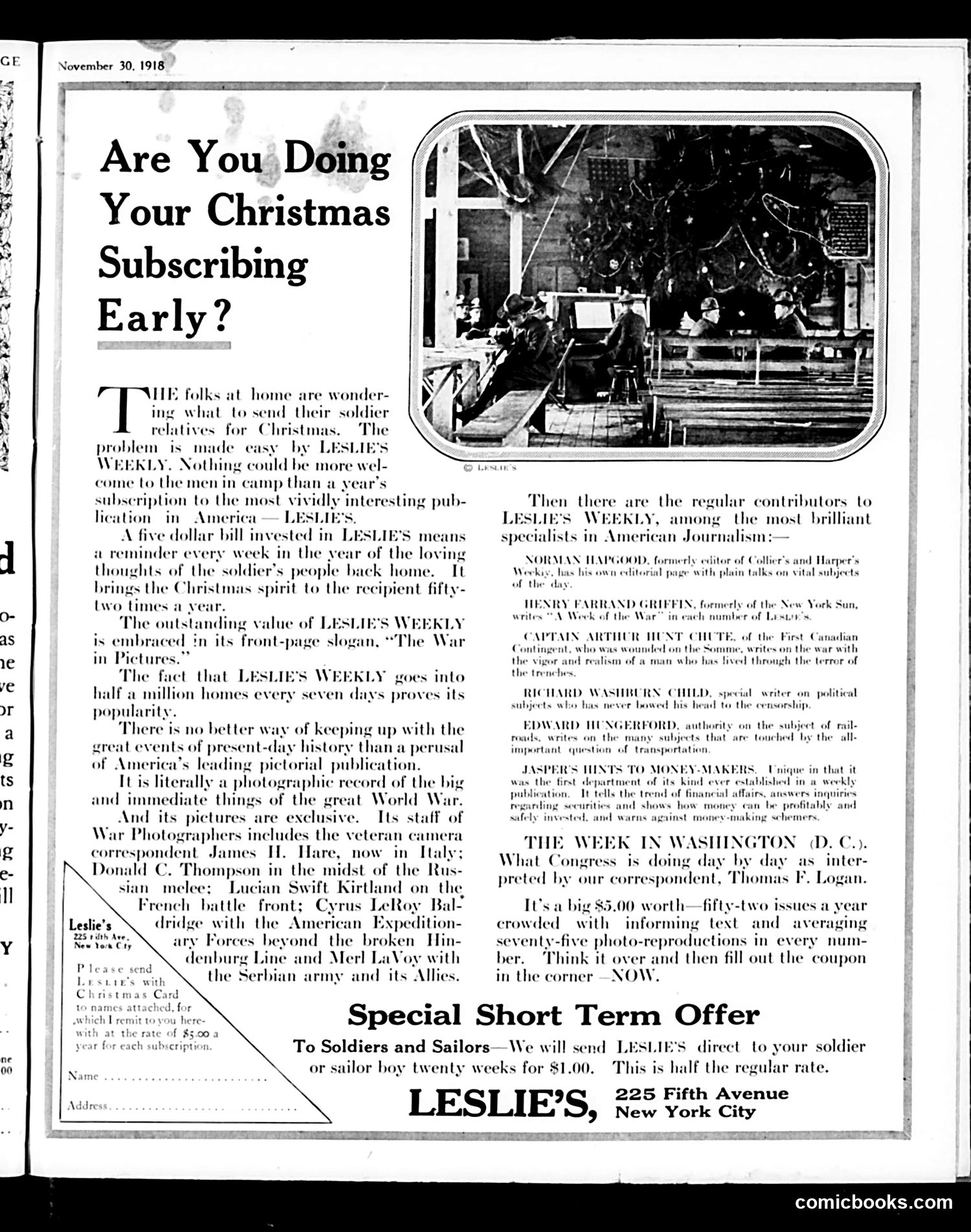
This is primarily a **subscription advertisement**, not a political cartoon. It appeared just after World War I's armistice (November 11, 1918), targeting families wanting to send Christmas gifts to soldiers. The ad promotes **Leslie's Weekly**, a pictorial magazine, as an ideal subscription gift for servicemen in camps. It emphasizes the magazine's exclusive war photography by renowned correspondents (James H. Hare, Donald C. Thompson, Lucian Swift Kirtland) who documented the war firsthand—from the Western Front to the Eastern Front to Serbia. The ad lists prominent contributors including Norman Hapgood, Henry Farrand Griffin, and others writing on war-related topics. A special offer provides 20 weeks for $1.00 to soldiers/sailors—"half the regular rate." **The appeal**: Weekly reminders of home and patriotic support, delivered 52 times yearly. At this post-war moment, it frames magazine subscriptions as meaningful morale boosters for the troops.
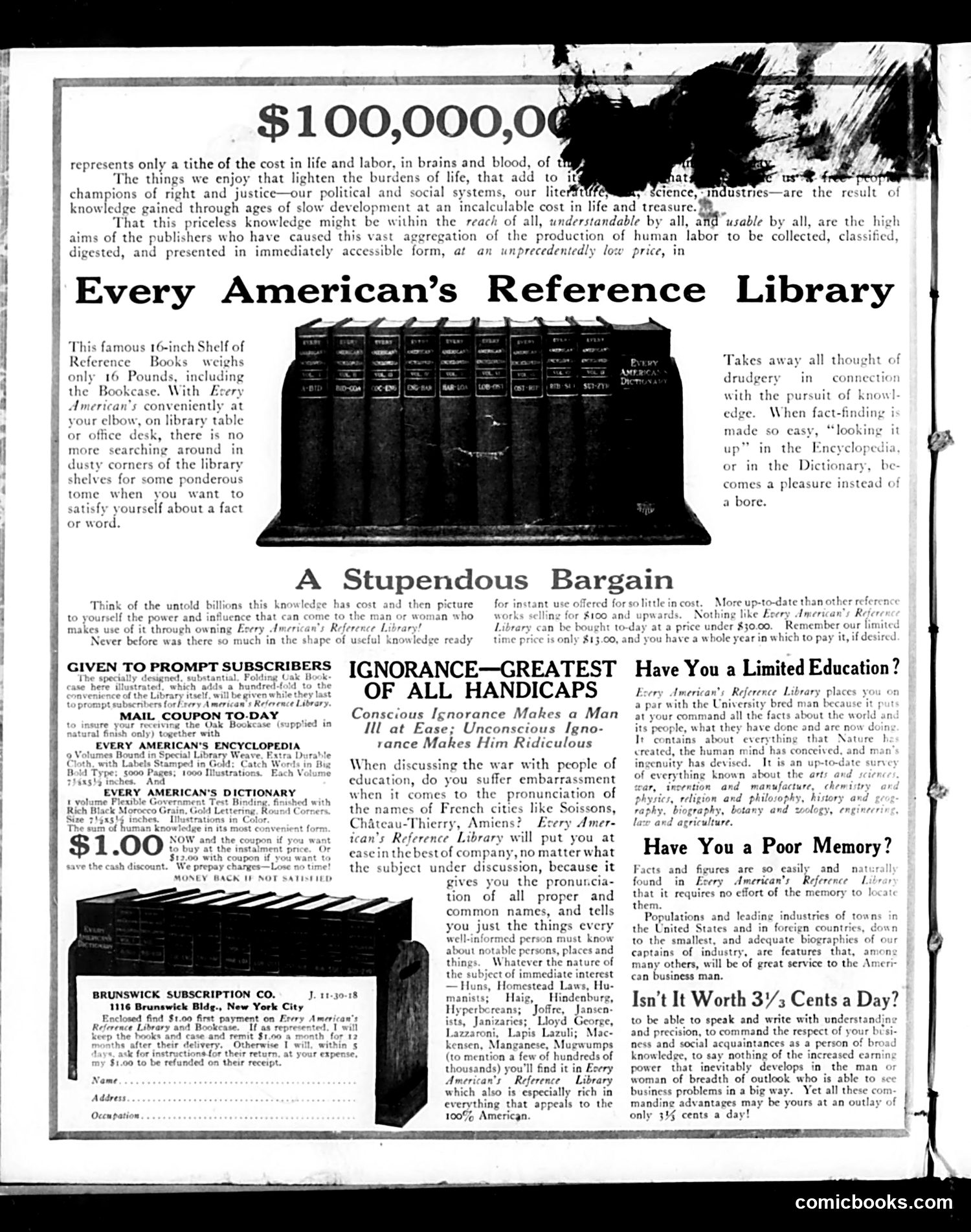
This is primarily a **full-page advertisement**, not a satirical cartoon. It promotes "Every American's Reference Library"—a 16-volume reference set sold by subscription. The ad targets multiple anxieties of early 20th-century Americans: 1. **Limited education**: Promises knowledge "understandable by all" and "usable by all"—addressing fears of social inadequacy. 2. **WWI context**: References to French place names (Soissons, Chateau-Thierry, Amiens) and military figures (Joffre, Hindenburg) suggest readers struggling with war discussion—a timely concern given the OCR date marking (J. 11-30-18, likely November 1918, near war's end). 3. **Class anxiety**: Emphasizes that knowledge grants "respect," "influence," and "earning power." The advertisement's tone is earnest salesmanship, not satirical commentary. It leverages social insecurity to sell an affordable alternative ($1 down, 3½ cents daily) to expensive libraries, positioning the set as democratizing knowledge for ordinary Americans.