
Judge, 1918-11-30 · page 22 of 32
Judge — November 30, 1918 — page 22: what you’re looking at
What you’re looking at
This article critiques a mismatch in 1910s Broadway musical comedy: elaborate, expensive scenic design by Joseph Urban overwhelming comedians trying to perform. The author argues that beautiful stage settings—like Mediterranean landscapes or Corot paintings—actively *inhibit* comedy. He cites Frank Tinney attempting slapstick against an ornate drop curtain, and a failed "Follies" scene where Will Rogers and Harry Kelly performed with a mule in front of Urban's stunning hillside backdrop. The visual grandeur literally buried their jokes. The piece argues comedians need humble, close-to-footlights settings to work effectively. It praises shows like "The Canary," where Joseph Cawthorn and Urban supposedly balanced beautiful scenery with accessible space for comic performance. The central satire: theater managers spend lavishly on aesthetics while undermining the very entertainers meant to captivate audiences. Beauty, taken to extremes, becomes the enemy of comedy.
📄 Transcribed text from this page (OCR, searchable)
Machine-transcribed from the original scan — historical spelling and the odd misread are preserved.
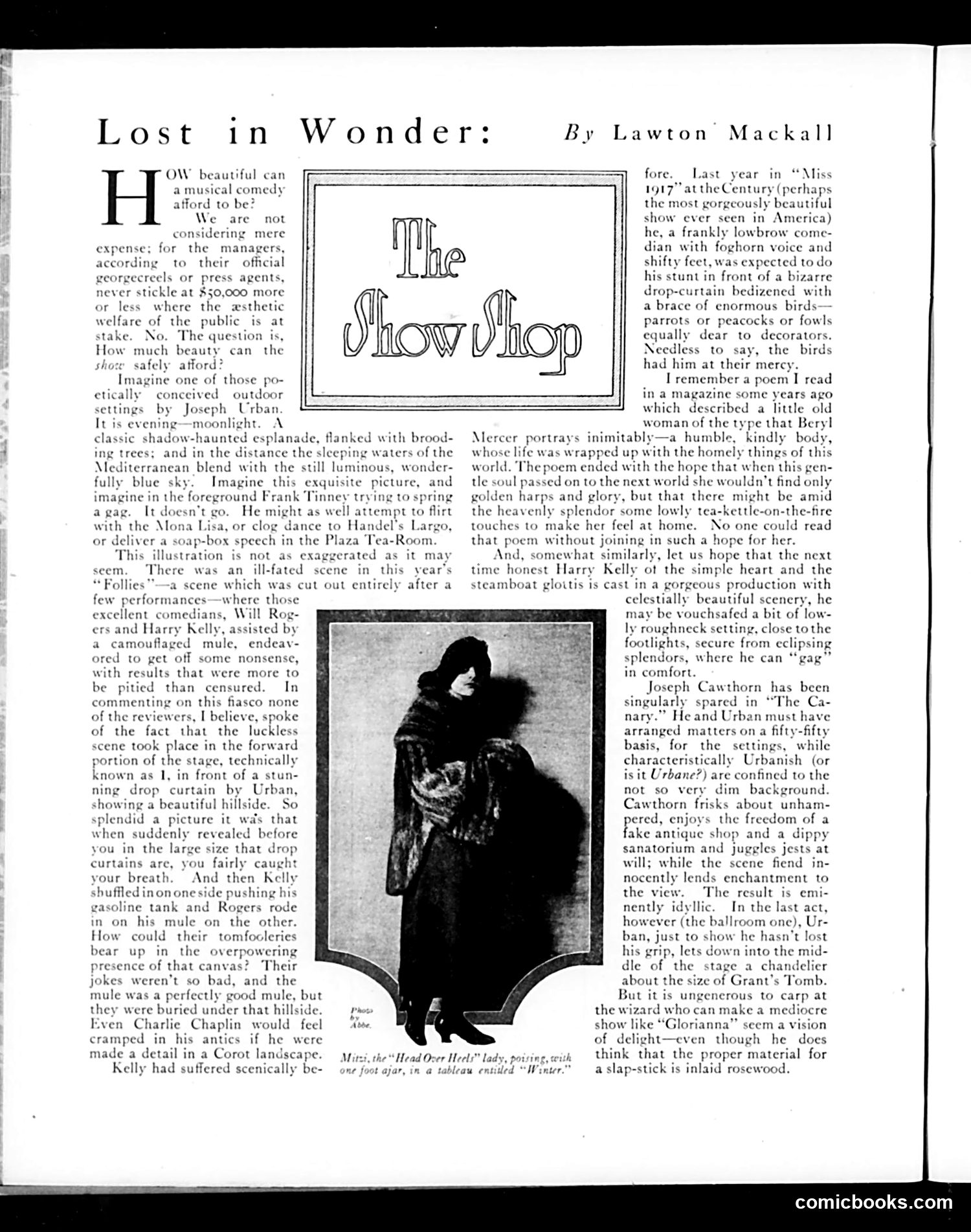
Lost in Wonder: Lawton Mackall OW beautiful can a musical comedy afford to be? We are not considering mere ense; for the managers, according to their official georgecreels or press agents, never stickle at $50,000 more or less where the wxsthetic welfare of the public is at stake. No. The question is, How much beauty can the Imagine one of those po- etically conceived outdoor = fore. Last year in “Miss 1917” atthe Century (perhaps the most gorgeously beautiful show ever seen in America) he, a frankly lowbrow come- dian with foghorn voice and shifty feet, was expected todo his stunt in front of a bizarre drop-curtain bedizened with a brace of enormous birds Parrots or peacocks or fowls equally dear to decorators. Needless to say, the birds had him at their mercy. | I remember a poem I read in a magazine some years ago which described a little old settings by Joseph Urban. & It is evening—moonlight. A classic shadow-haunted esplanade, flanke ing trees; and in the distance the sleeping waters of the Mediterranean blend with the st minous, wonder- fully blue sky. Imagine this exquisite picture, and imagine in the foreground Frank Tinney trying to spring agag. It doesn’t go. He might as well attempt to flirt with the Mona I or clog dance to Handel's Largo, or deliver a soap-box speech in the Plaza Tea-Room. This illustration is not as exaggerated as it may seem. There was an ill-fated scene in this year’s “Follies"—a scene which was cut out entirely after a with brood few performances—where those excellent comedians, Will Rog- ers and Harry Kelly, assisted by a camouflaged mule, endeav- ored to get off some nonsense, with results that were more to be pitied than censured. In commenting on this fiasco none of the reviewers, I believe, spoke of the fact that the luckless scene took place in the forward portion of the s , technically known as 1, in front of a stun- ning drop curtain by Urban, showing a beautiful hillside. So splendid a picture it was that when suddenly revealed before you in the large size that drop curtains are, you fairly cau your breath. And then Kelly shufiled in on one side pushing gasoline tank and Rogers rode in on his mule on the other. How could their tomfocleries be up in the overpowering presence of that canvas?) Their jokes weren’t so bad, and the mule was a perfectly good mule, but they were buried under that hillside. Phot Even Charlie Chaplin would feel Abbe, cramped in his antics if he were made a detail in a Corot landscape. Kelly had suffered scenically be- ris Mer world. The pe rae er portrays inimitabl m ended with the hope that when this gen- tle soul passed on to the next world she wouldn't find only jen harps and glor the heavenly splendor some lowly tea-kettle-on-the-fire touches to make her feel at home. No one could read that poem without j And, somewhat similarly, let us hope that the next time honest Harry Kelly ot the simple heart and the loitis is cast in a go: woman of the type that Beryl —a humble, kindly body ped up with the homely things of thi » but that there might be amid ining in such a hope for her. ous production with celestially beautiful scenery, he may be vouchsafed a bit of low- ly roughneck setting, close tothe footlights, secure from eclipsing splendors, where he can “gag” in comfort. Joseph Cawthorn has been singularly spared in “The Ca- nary.” He and Urban must have arranged matters ona fifty-fifty basis, for the settings, while characteristically Urbanish (or is it Urbane?) are confined to the not so very dim background. Cawthorn frisks about unham- pered, enjoys the freedom of a fake antique shop and a dippy sanatorium and juggles jests at will; while the scene fiend in- nocently lends enchantment to the v The result emi- nently idyllic. In the last act, however (the ballroom one), Ur- ban, just to show he hasn’t lost his grip, lets down into the mid- dle of the stage a chandelier about the size of Grant’s Tomb. 3ut itis ungenerous to carp at the wizard who can make a mediocre show like “Glorianna” seem a vision of delight—even though he does think that the proper material for aslap-stick is inlaid rosewood. comicbooks.com