
Judge, 1918-11-30 · page 9 of 32
Judge — November 30, 1918 — page 9: what you’re looking at
What you’re looking at
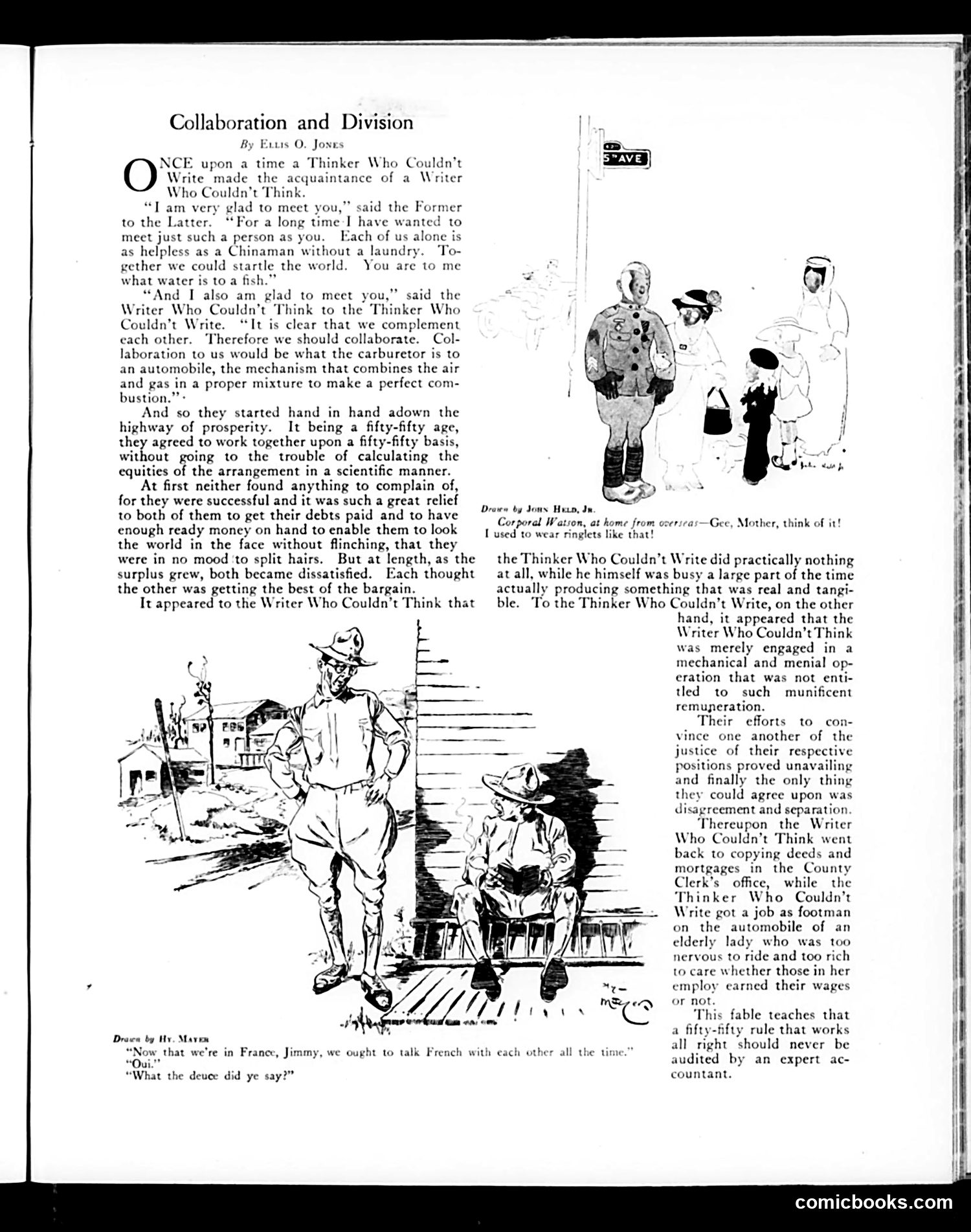
This is a satirical fable by Ellis O. Jones critiquing equal partnerships. Two complementary but flawed professionals—a non-writing thinker and a non-thinking writer—form a 50-50 business arrangement. Initially successful, they grow resentful as profits increase. Each believes the other contributes less valuable work: the writer sees only "mechanical and menial operation," while the thinker sees unproductive idleness. Unable to resolve the dispute fairly, they dissolve the partnership. The cartoons illustrate practical absurdities: soldiers struggling with unexpected consequences of collaboration (speaking French), and a returning soldier noticing how women's fashion has changed. **The satire's point**: Equal partnerships often fail not from actual inequity but from perceived inequity. When prosperity arrives, partners second-guess their arrangement. The moral warns against scrutinizing fair agreements too closely—detailed auditing of "equal" splits paradoxically destroys them.
📄 Transcribed text from this page (OCR, searchable)
Machine-transcribed from the original scan — historical spelling and the odd misread are preserved.
Collaboration and Division By Exus O. Jones Ow: upon a time a Thinker Who Couldn't Write made the acquaintance of a Writer Who Couldn't Think. “Tam very glad to meet you,” said the Former to the Latter. “For a long time I have wanted to meet just such a person as you. Each of us alone is as helpless as a Chinaman without a laundry. To- gether we could startle the world. You are to me what water is to a fish.” “And I also am glad to meet you,” said the Writer Who Couldn’t Think to the Thinker Who Couldn't Write. “It is clear that we complement each other. Therefore we should collaborate. Col- laboration to us would be what the carburetor is to an automobile, the mechanism that combines the air and gas in a proper mixture to make a perfect com- bustion.” And so they started hand in hand adown the highway of prosperity. It being a fifty-fifty age, they agreed to work together upon a fifty-fifty basis, without going to the trouble of calculating the equities of the arrangement in a scientific manner. At first neither found anything to complain of, for they were successful and it was such a great relief to both of them to get their debts paid and to have enough ready money on hand to enable them to look the world in the face without flinching, that they were in no mood ‘to split hairs. But at length, as the surplus grew, both became dissatisfied. Each thought the other was getting the best of the bargain. It appeared to the Writer Who Couldn’t Think that Drawe by Hy. Maven “Now that we're in France, Jimmy, we ought to talk French with each other all the time.” “Oui.” “What the deuce did ye say?” Drews by Jows Hero, Jn. Corporal Watson, at home from overseas—Gee, Mother, think of it! I used to wear ringlets like that! the Thinker Who Couldn’t Write did practically nothing at all, while he himself was busy a large part of the time actually producing something that was real and tangi- ble. To the Thinker Who Couldn’t Write, on the other hand, it appeared that the Writer Who Couldn’t Think was merely engaged in a mechanical and menial op- eration that was not enti- tled to such munificent remuneration. Their efforts to con- vince one another of the justice of their respective positions proved unavailing and finally the only thing they could agree upon was disagreement and separation Thereupon the Writer Who Couldn’t Think went back to copying deeds and mortgages in the County Clerk’s office, while the Thinker Who Couldn’t Write got a job as footman on the automobile of an elderly lady who was too nervous to ride and too rich to care whether those in her employ earned their wages or not. This fable teaches that a fifty-fifty rule that works all right should never be audited by an expert ac- countant. comicbooks.com