
A complete issue · 32 pages · 1918
Judge — November 16, 1918
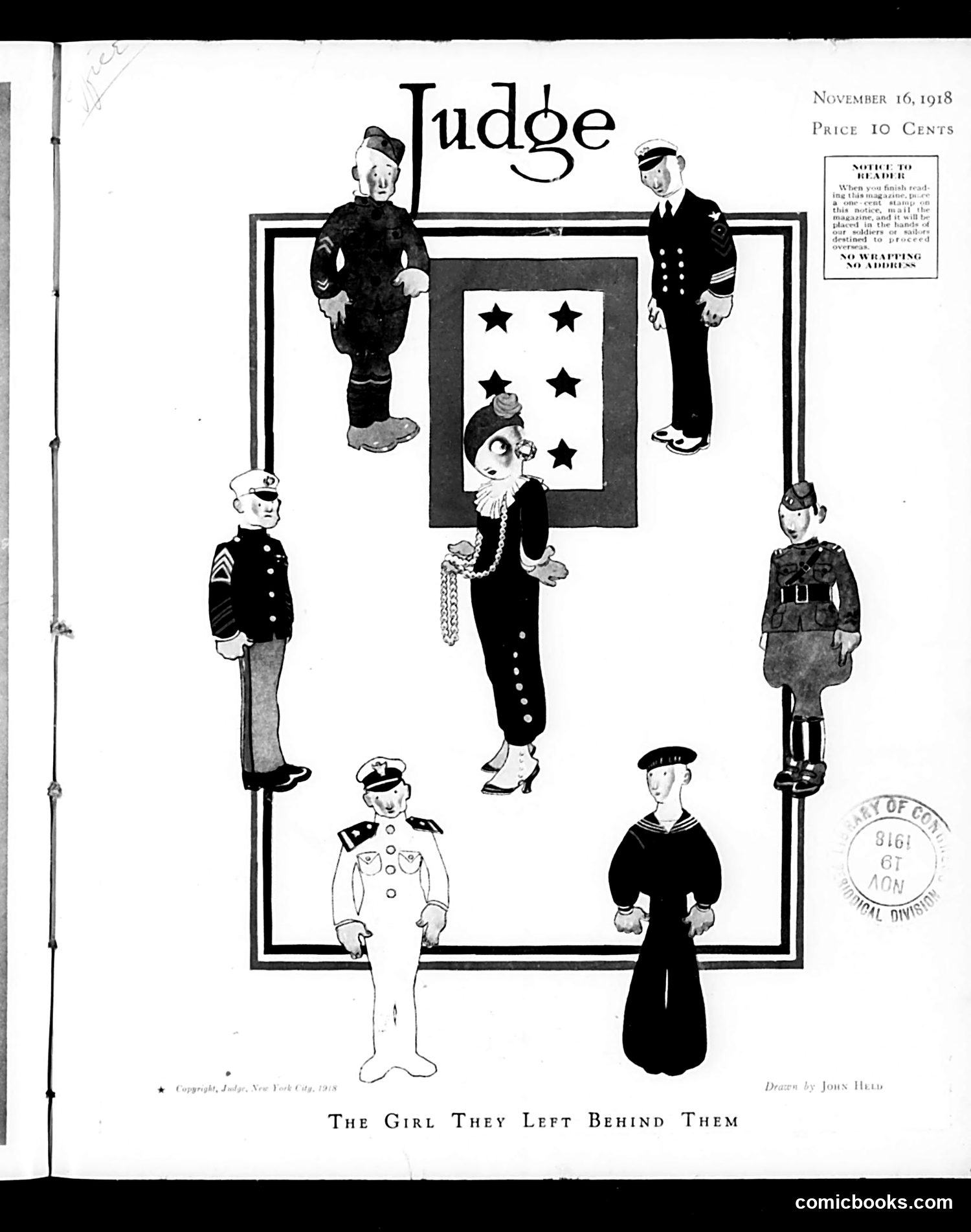
This satirical cover titled "The Girl They Left Behind Them" depicts various military personnel (sailors, soldiers, and officers) surrounding a central framed image of five stars—apparently representing absent servicemen or fallen soldiers. The cartoon plays on the popular WWI-era phrase "the girl you left behind," which romanticized female partners waiting for soldiers. Here, the satire suggests irony: while military men are overseas (represented by the empty stars), the women left behind are surrounded by remaining servicemen of various ranks. The joke likely critiques either the shortage of eligible men on the home front during wartime, or satirizes romantic complications created by deployment. The drawing is by John Held Jr., a prominent cartoonist of the era.
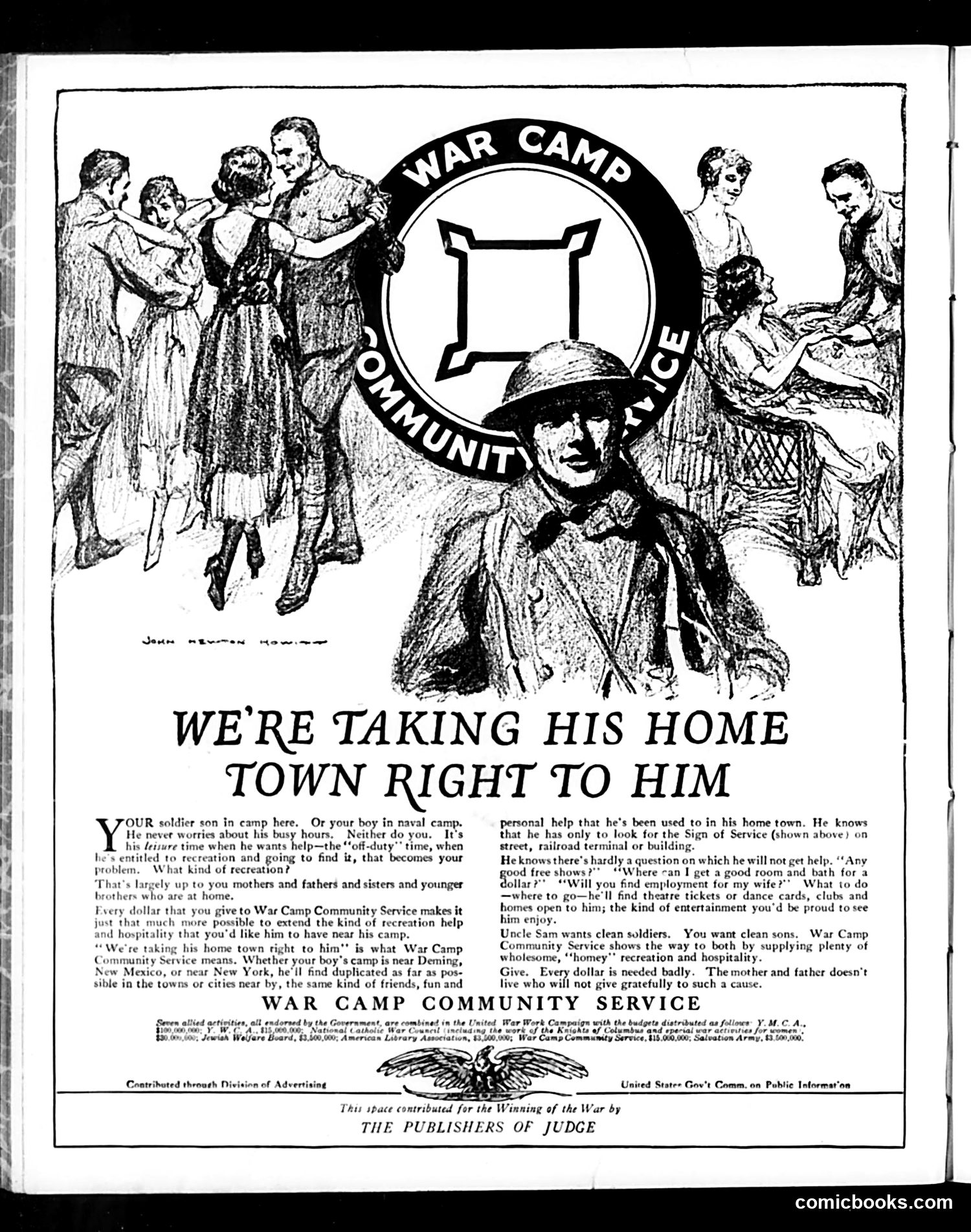
This is a public service advertisement promoting the **War Camp Community Service**, an organization providing recreation and hospitality to soldiers during World War I. The central image shows a uniformed soldier, while surrounding figures represent women and civilians offering support. The headline "We're Taking His Home Town Right to Him" explains the service's purpose: bringing familiar comforts of home to soldiers in distant camps. The accompanying text addresses parents and families, emphasizing that the organization ensures soldiers receive wholesome entertainment, recreation facilities, and moral support—preventing them from seeking questionable establishments. It frames support for the cause as patriotic duty, appealing to families' desire to protect their sons while away at war. This reflects early-WWI American mobilization efforts to maintain soldier morale and welfare.
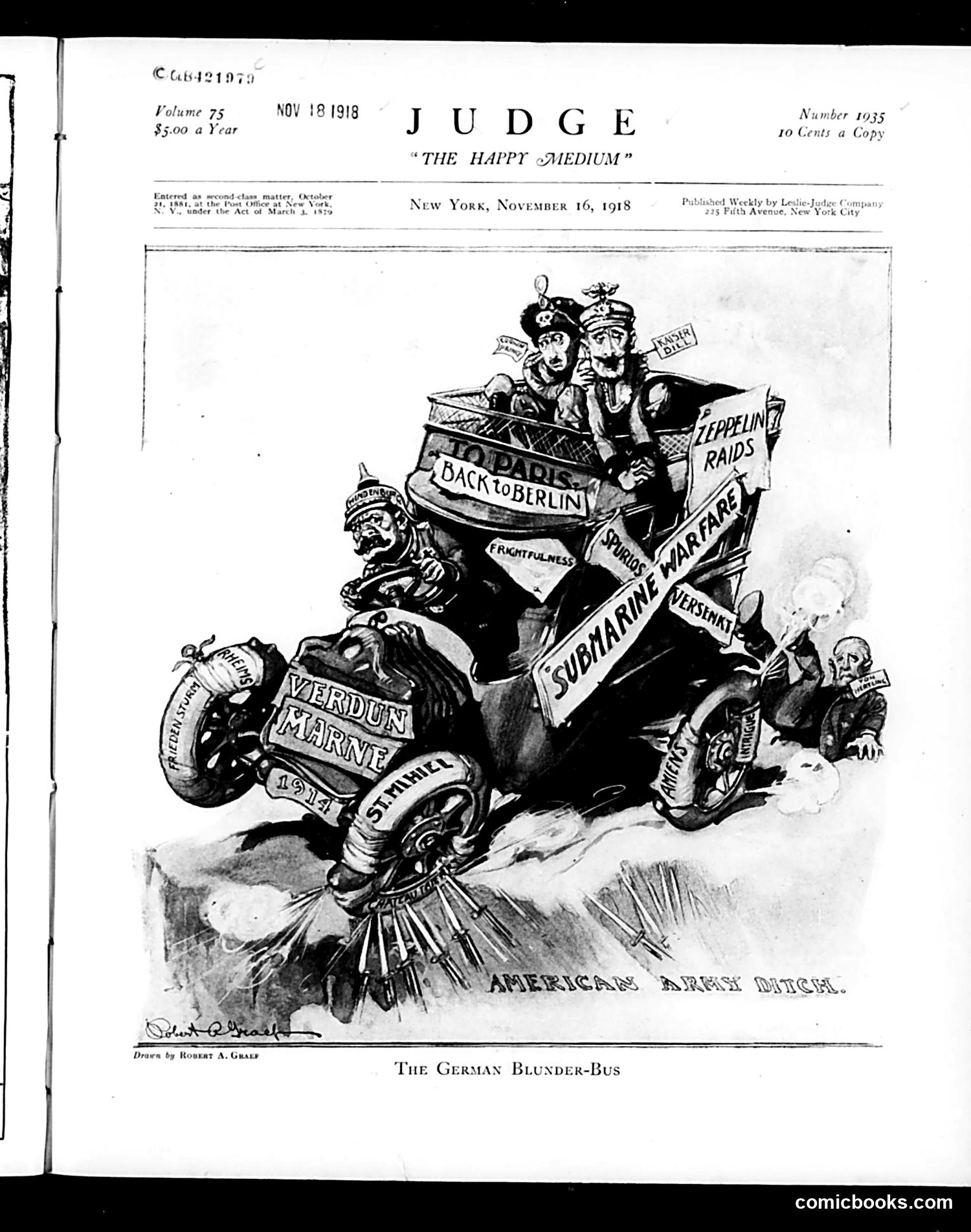
This cartoon from *Judge* magazine (November 16, 1918) depicts Germany's military disasters as a careening vehicle driven by caricatured German leaders. The "bus" is labeled with failed German operations: "Back to Berlin," "Verdun," "Marine 1917," alongside labels for "Submarine Warfare," "Zeppelin Raids," and "War Farce." The cartoon satirizes Germany's compounding military failures and strategic blunders during World War I's final months. German generals and the Kaiser appear as grotesque figures struggling to control an out-of-control vehicle crashing into "American Army Pitch" (referring to U.S. entry into the war in 1917). Published just days before the November 11, 1918 Armistice, the cartoon celebrates Allied victory and mocks German leadership's catastrophic miscalculations throughout the war.
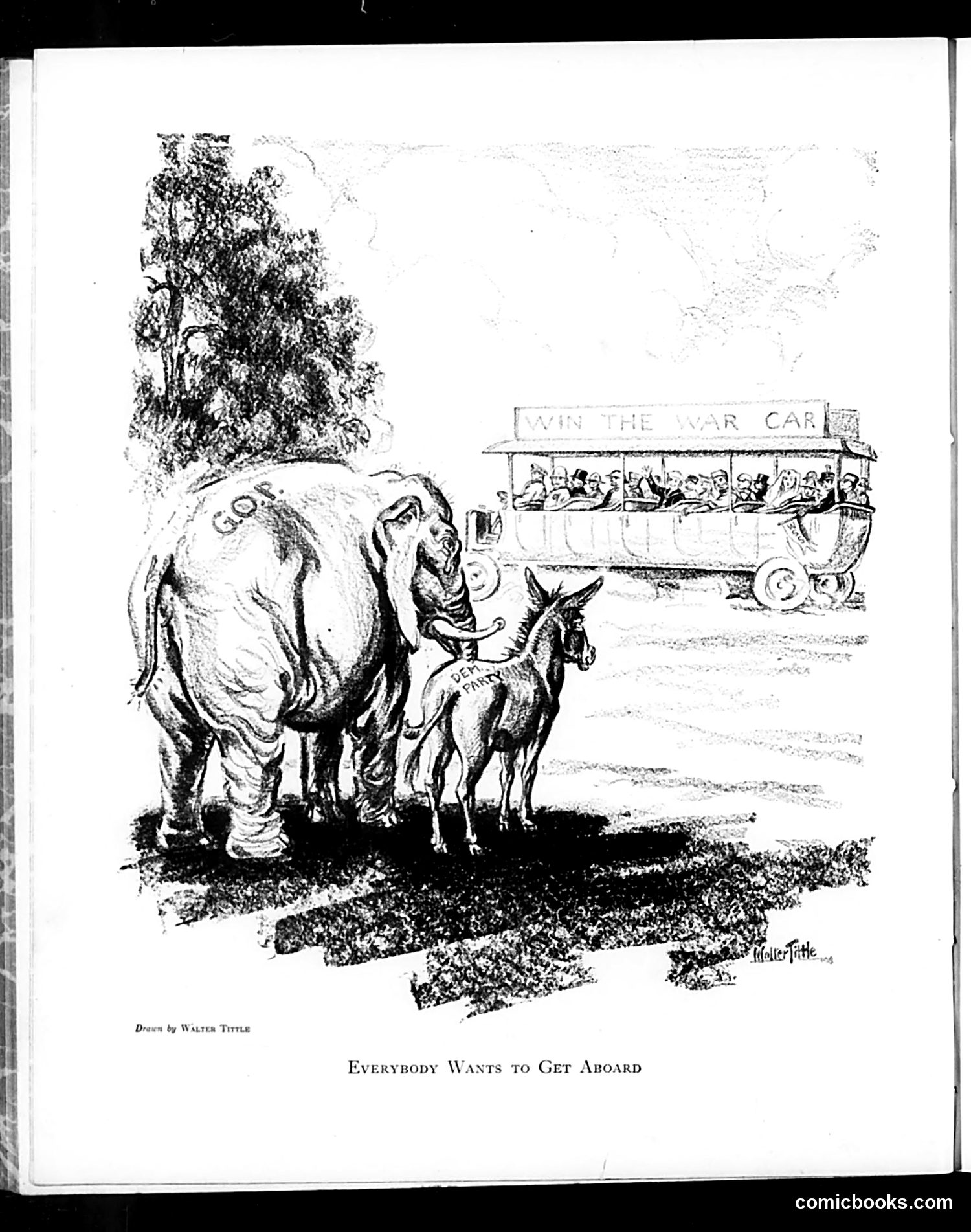
This cartoon by Walter Tittle satirizes the rush to board a "Win the War Car"—a streetcar or trolley promoting wartime efforts. The image shows an elephant (the Republican Party symbol) and a donkey (the Democratic Party symbol) competing to board the vehicle packed with eager passengers. The satire targets opportunistic politicians from both parties seeking to capitalize on patriotic wartime sentiment. By depicting the animals as desperate to "get aboard," Tittle mocks how politicians rushed to associate themselves with the war effort for political gain, rather than acting from genuine principle. The competing animals suggest partisan rivalry despite shared patriotic rhetoric—a critique of self-serving political maneuvering during wartime.
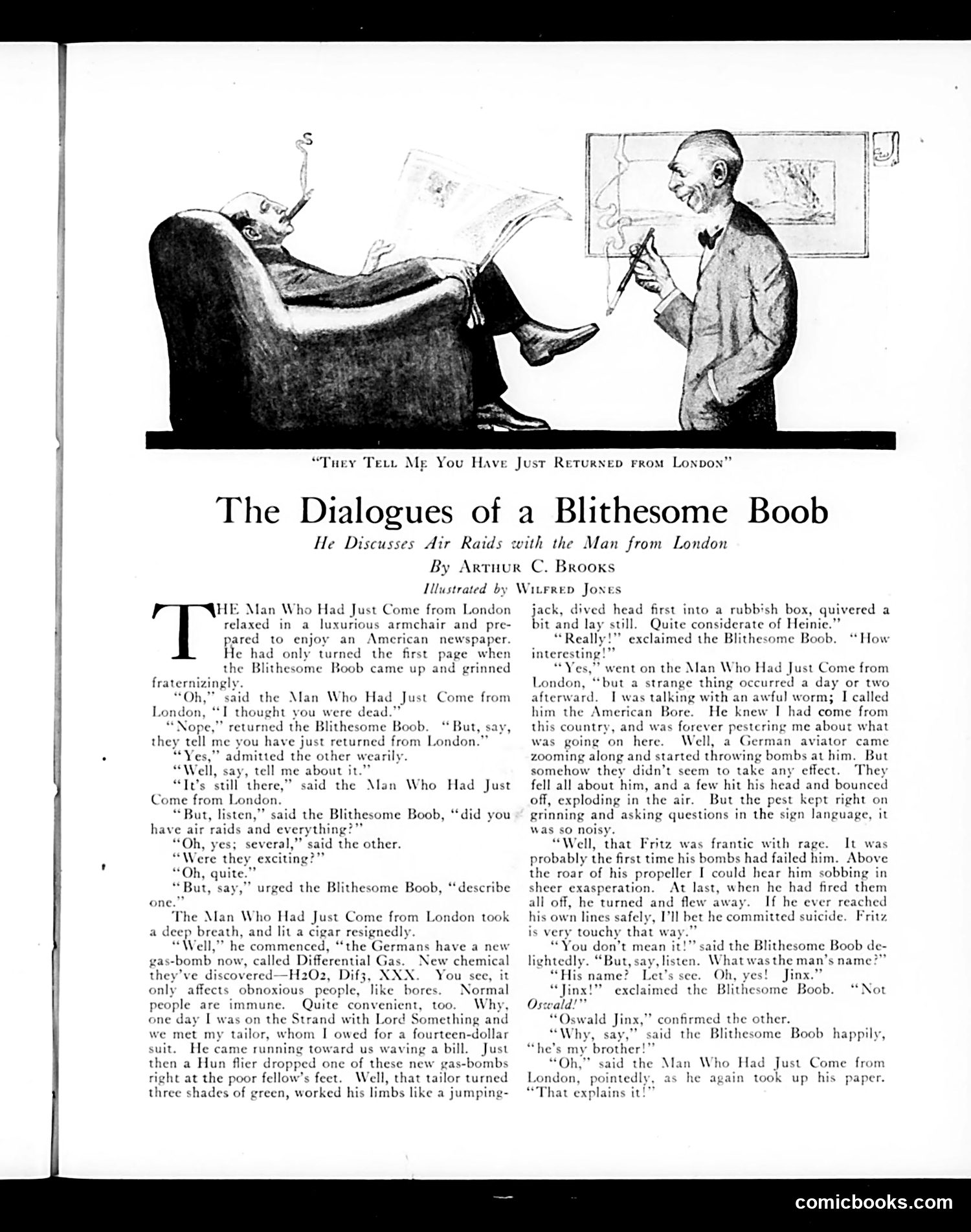
This satirical piece by Arthur C. Brooks mocks an American who recently returned from London and won't stop talking about his trip. The "Blithesome Boob" (the seated man) interrogates the traveler about air raids during World War II, likely referencing the German Luftwaffe's bombing campaign against Britain. The joke centers on the returnee's boastful anecdotes—he witnessed bombing, met a German pilot named Oswald Jinx, and experienced gas attacks. The Boob's exasperated questions ("Have we air raids and everything?") suggest the American is either exaggerating wildly or being insufferably pedantic about his experiences. The satire targets both wartime tourists who dramatize themselves and Americans' tendency toward self-important bragging about foreign travel.
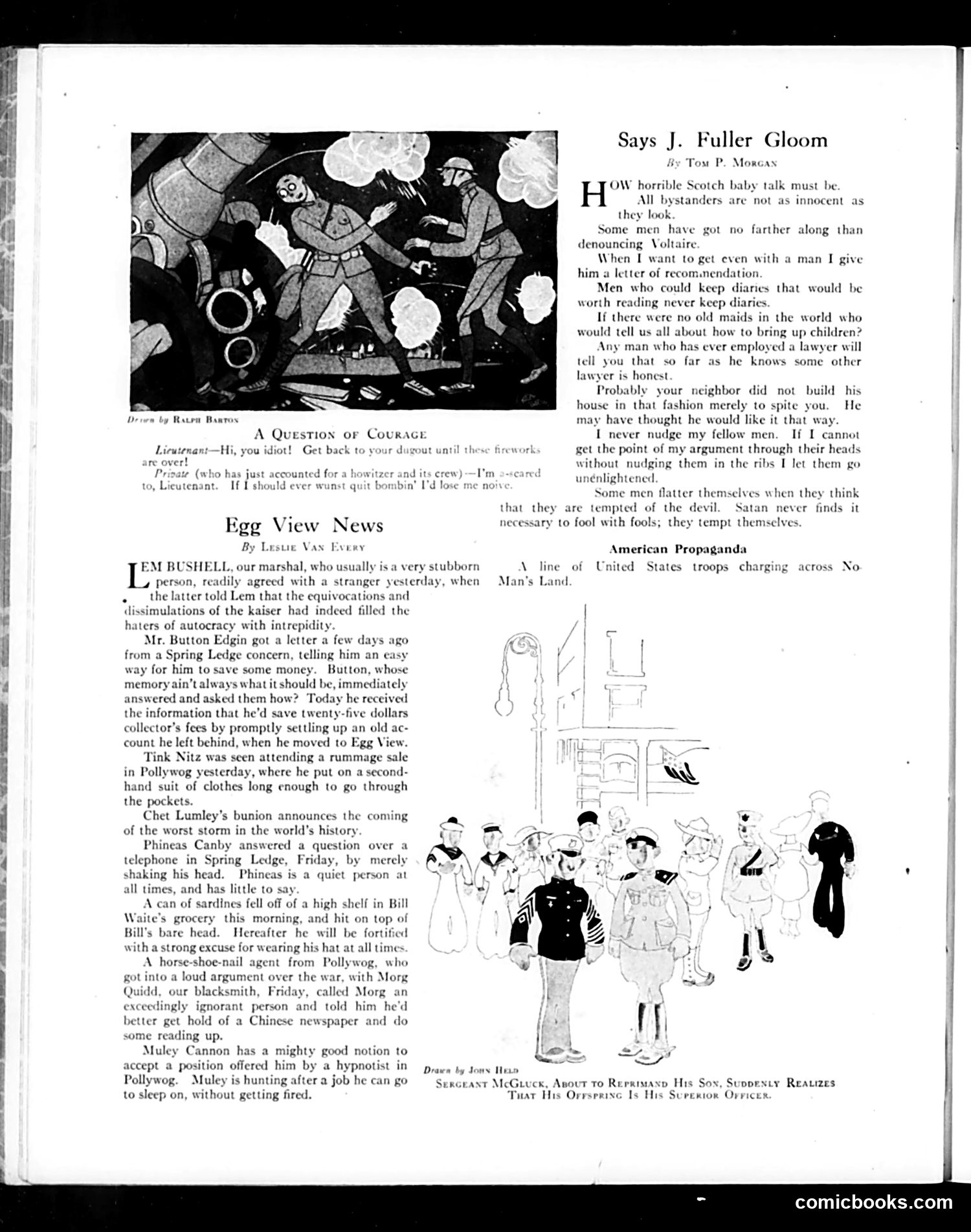
The page contains three distinct sections: **"A Question of Courage"** (top left): A WWI-era comic depicting soldiers in a dugout during artillery bombardment. The humor satirizes military bravery—a lieutenant orders a soldier back to his post despite incoming fire, with the soldier's terrified response ("I'd lose me nerve"). **"Says J. Fuller Gloom"** (right): A misanthropic opinion column mocking human nature—cynicism about lawyers, neighbors, diaries, and moral behavior. The persona appears to be a recurring satirical character. **"Egg View News"** (bottom left): Local gossip items from what seems to be a small town, poking fun at residents' mundane activities and peculiarities. **"American Propaganda"** (bottom right): A sketch showing U.S. troops in formation, apparently satirizing military recruitment or morale-building imagery. The page reflects WWI-era American satirical humor mixing war anxiety with small-town social commentary.
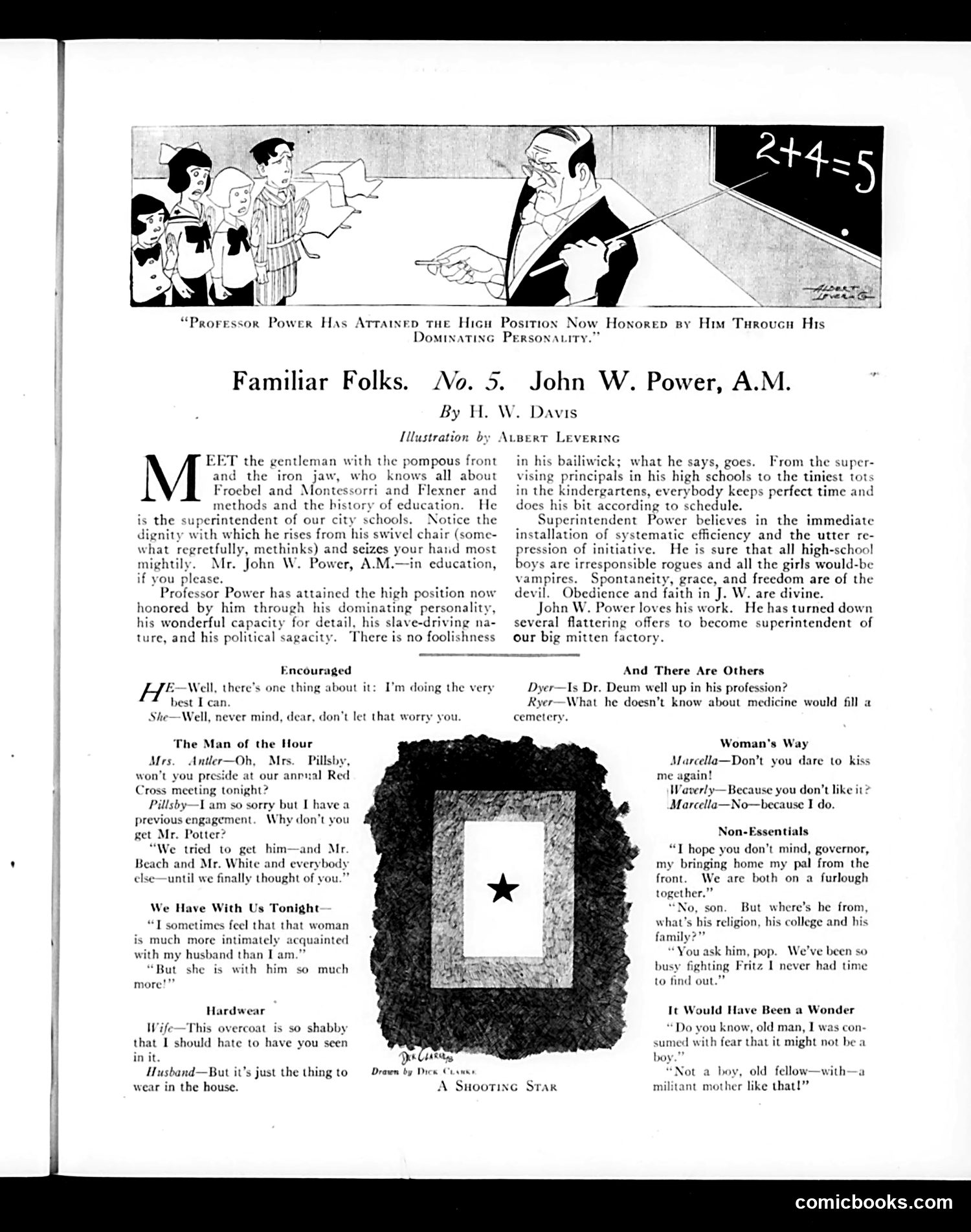
This page from *Judge* magazine satirizes **John W. Power, A.M.**, a school superintendent portrayed as an overbearing, efficiency-obsessed administrator who rules through dominating personality rather than educational merit. The top cartoon shows Power lecturing students, with the equation "2+4=5" on the blackboard—suggesting his authority overrides reality itself. The satire critiques his: - **Rigid authoritarianism**: He demands absolute obedience and views high school students as "irresponsible rogues" and "vampires" - **Suppression of initiative**: He privileges systematic control over spontaneity and learning - **Political maneuvering**: His position derives from personal magnetism and "political sagacity" rather than educational vision The secondary jokes and dialogues (about doctors, romance, military furloughs) appear unrelated filler typical of *Judge*'s format. This reflects early 20th-century Progressive Era debates about educational management—whether schools should prioritize rigid efficiency or student development. The satire mocks administrative tyranny disguised as professionalism.
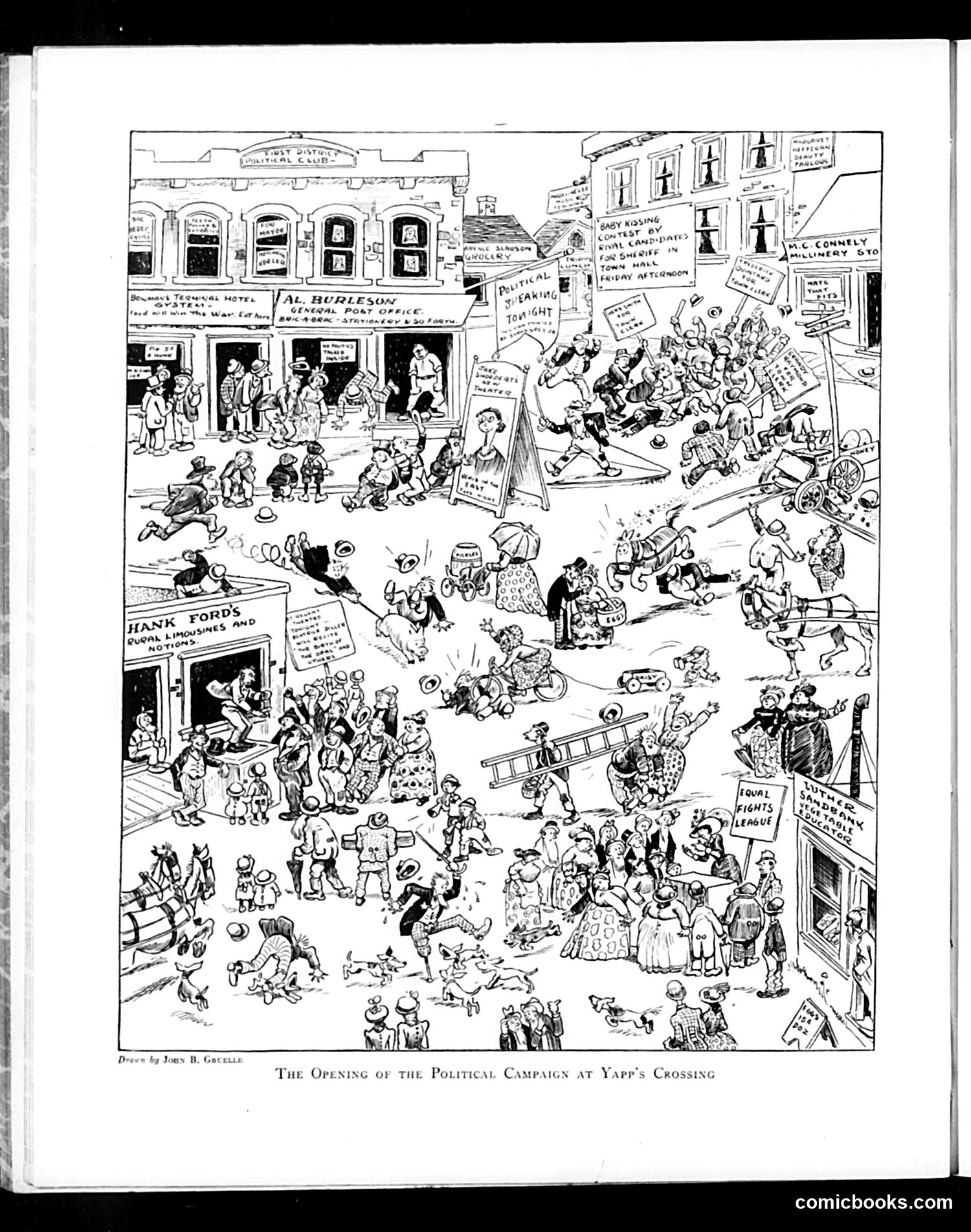
This single large cartoon by James B. Greig satirizes the opening of a political campaign in a small town. The chaotic street scene depicts numerous townspeople engaged in various activities—playing games, gathering in crowds, posting notices, and generally creating pandemonium. Visible storefronts include "Al. Burleson General Post Office" and "Hank Ford's" (showing Ford's political involvement), suggesting this targets early 20th-century American politics, likely around a presidential campaign season. The satire mocks how political campaigns disrupt ordinary town life, turning a peaceful crossing into mayhem. The proliferation of signs, gatherings, and general disorder suggests the cartoon critiques campaign excess and the circus-like atmosphere surrounding electoral politics.
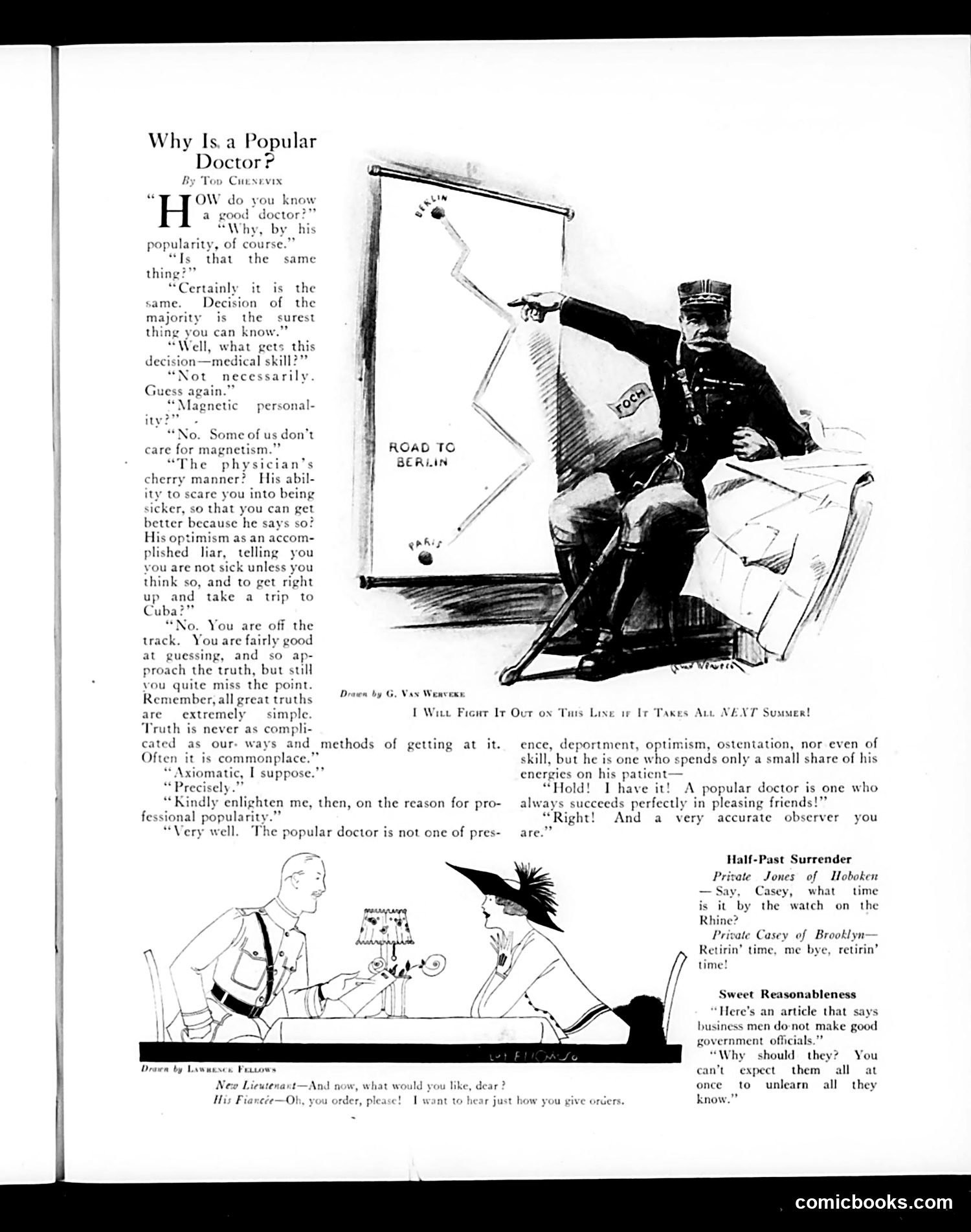
This page from *Judge* contains philosophical humor about what makes doctors popular, plus brief military jokes. The main article "Why Is a Popular Doctor?" presents a Socratic dialogue debunking the assumption that popularity correlates with medical competence. The satirical point: a doctor's popularity actually depends on pleasing friends and social charm rather than skill or clinical excellence—a critique of how reputation, not merit, drives professional success. The illustrations include a military map cartoon labeled "Road to Berlin" (likely WWI-era, given the reference), and two brief joke panels about soldiers. "Half-Past Surrender" makes a dark joke about German military collapse. "Sweet Reasonableness" satirizes the idea that businessmen lack government aptitude because they haven't "unlearned" their commercial habits. The satire targets both medical gatekeeping and wartime politics through absurdist humor typical of *Judge*'s irreverent style.
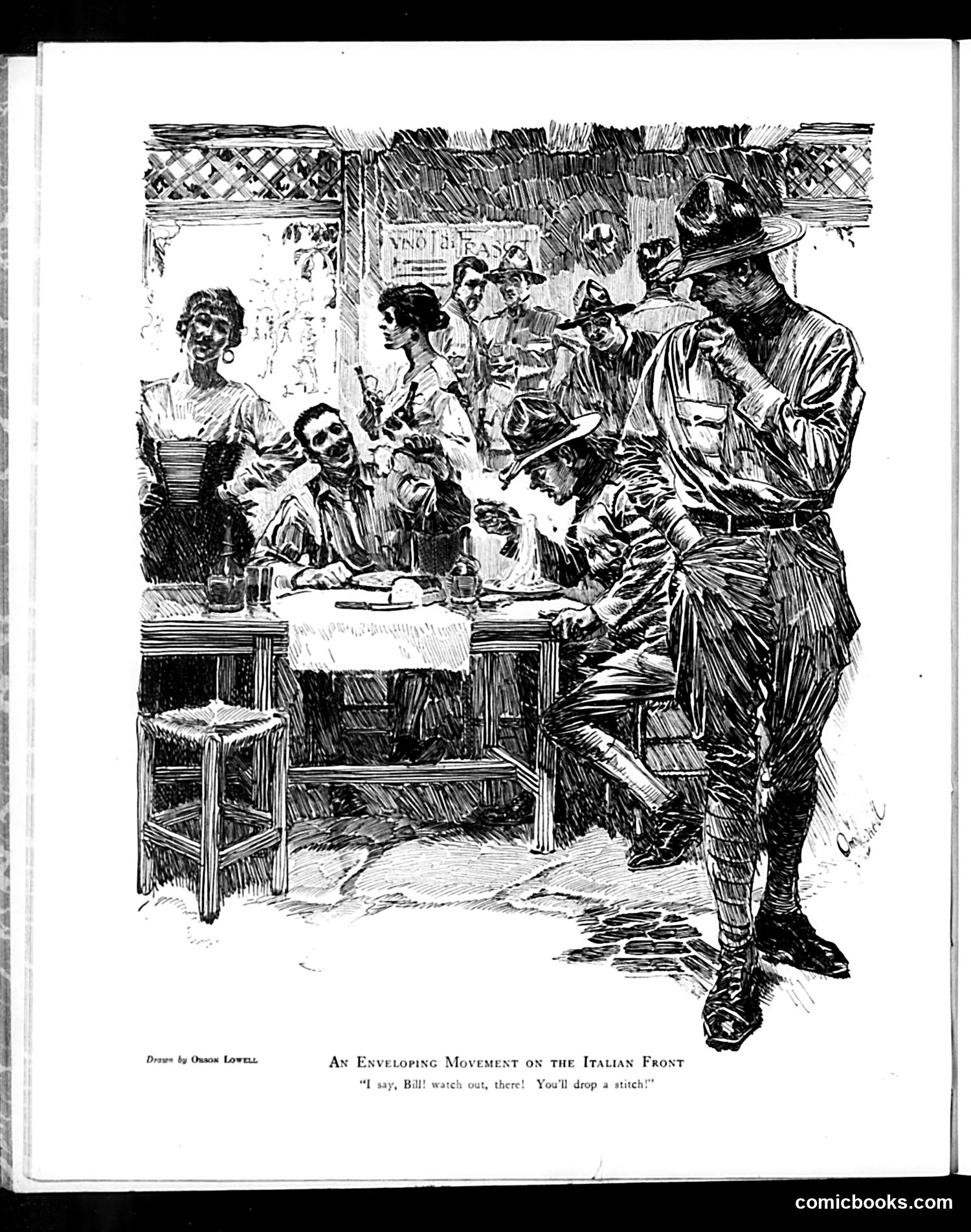
This World War I-era cartoon by Orson Lowell uses visual wordplay to satirize military operations. The title references a "movement on the Italian Front"—likely referring to actual WWI combat in Italy—but the image depicts soldiers engaged in knitting rather than fighting. The joke relies on the double meaning of "dropping a stitch" (a knitting error vs. military vulnerability). The soldiers are portrayed as women doing needlework, suggesting that wartime efforts on the Italian Front were fumbling, ineffectual, or absurdly domestic rather than militarily competent. This reflects contemporary American newspaper satire mocking Allied military performance, particularly Italy's perceived weakness as a fighting force during WWI. The feminization through knitting imagery was a common satirical device conveying incompetence or lack of martial vigor.
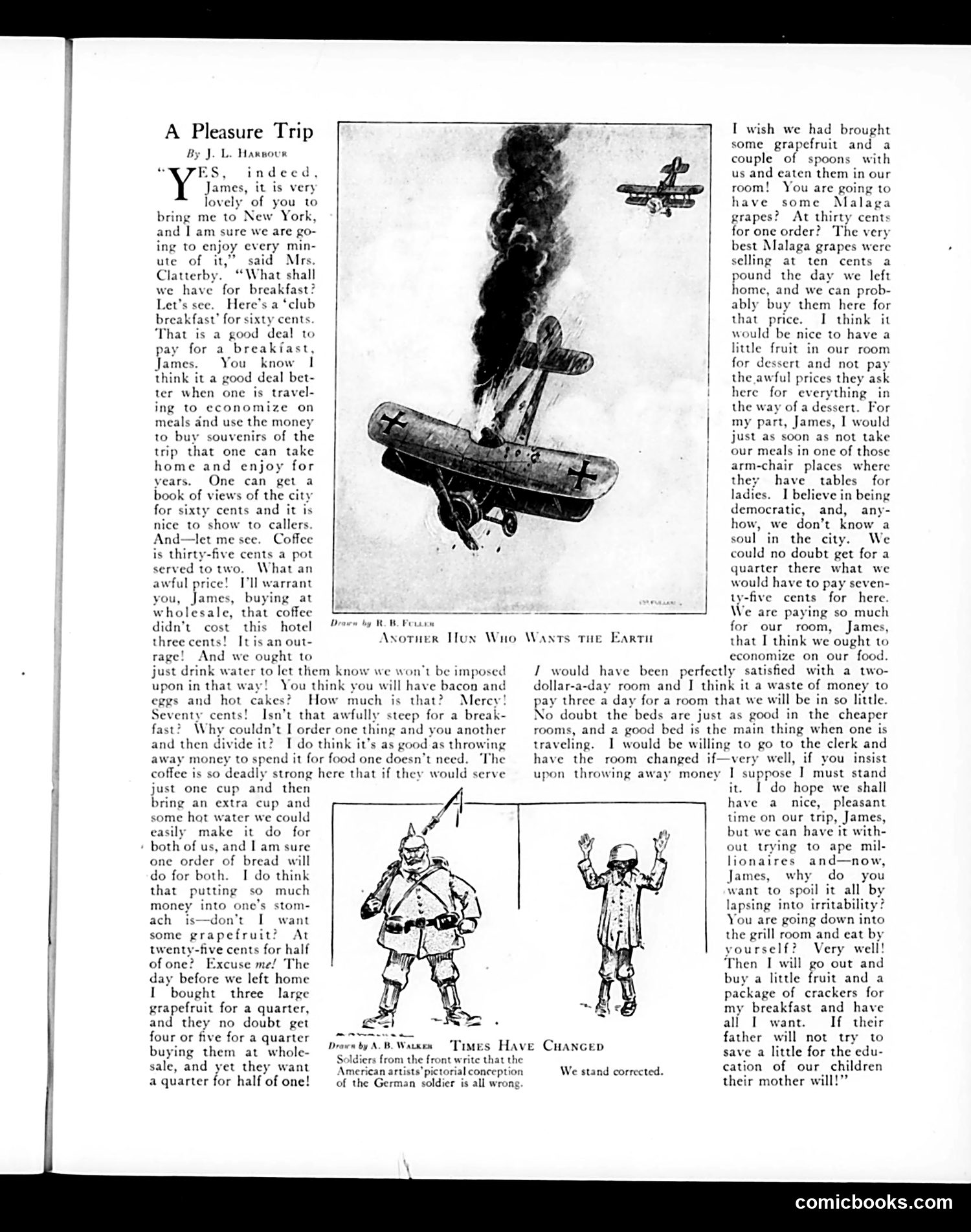
This story satirizes Mrs. Clatterby, a wealthy tourist visiting New York who obsessively complains about restaurant prices while refusing reasonable economies. The humor lies in her contradictions: she nickels-and-dimes over breakfast costs (coffee at 35¢, grapefruit at 25¢) yet splurges on expensive hotel rooms and souvenirs, then lectures her husband James about "economizing." The satire targets the hypocrisy of the moneyed class—she's not actually poor but resents "paying" what things cost, remembering wholesale prices from home. Her suggestions (sharing one coffee, diluting it with water) are absurdly stingy for someone who can afford New York travel. The two companion cartoons ("Another Hus Who Wants the Earth" and "Times Have Changed") show related themes of unreasonable demands and changing perspectives, likely commenting on wartime attitudes. The piece mocks upper-middle-class penny-pinching vanity masquerading as thrift.
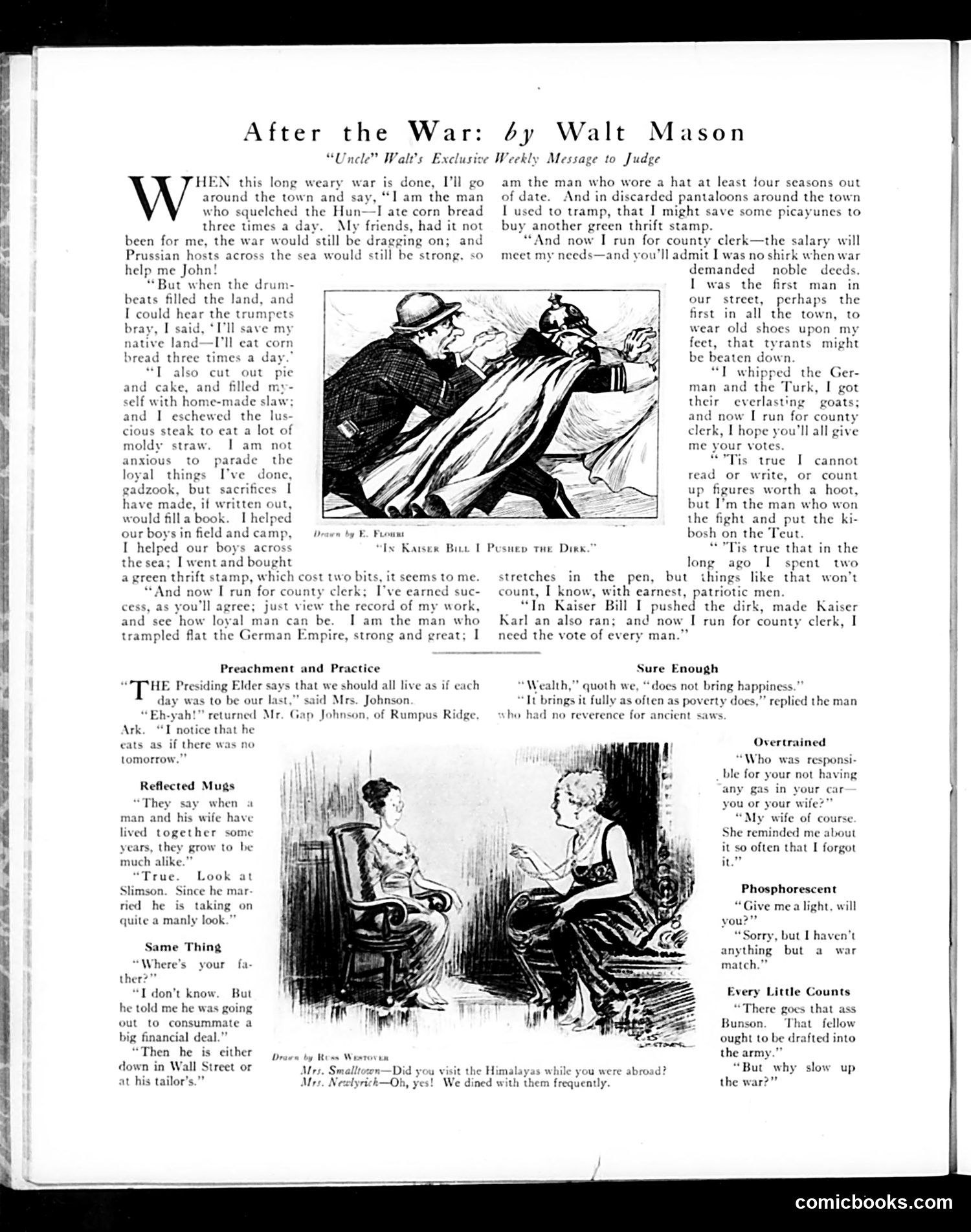
This Judge page satirizes post-war opportunism and false patriotism. Mason's main character—a self-aggrandizing would-be county clerk—boasts of wartime "sacrifices" (eating cornbread, wearing old clothes, buying war bonds) while claiming credit for defeating Germany ("I trampled flat the German Empire"). The satire cuts deep: he admits he's illiterate ("cannot read or write"), has served prison time ("two stretches in the pen"), yet expects voters to overlook these flaws because he participated in the war effort. The joke targets Americans who performed modest wartime duties while positioning themselves as war heroes deserving political office and public gratitude. The surrounding vignettes mock similar hypocrisies—false piety, marital resemblance, financial schemes. The page critiques how war service was weaponized for personal gain and political advancement in 1918-1920s America.
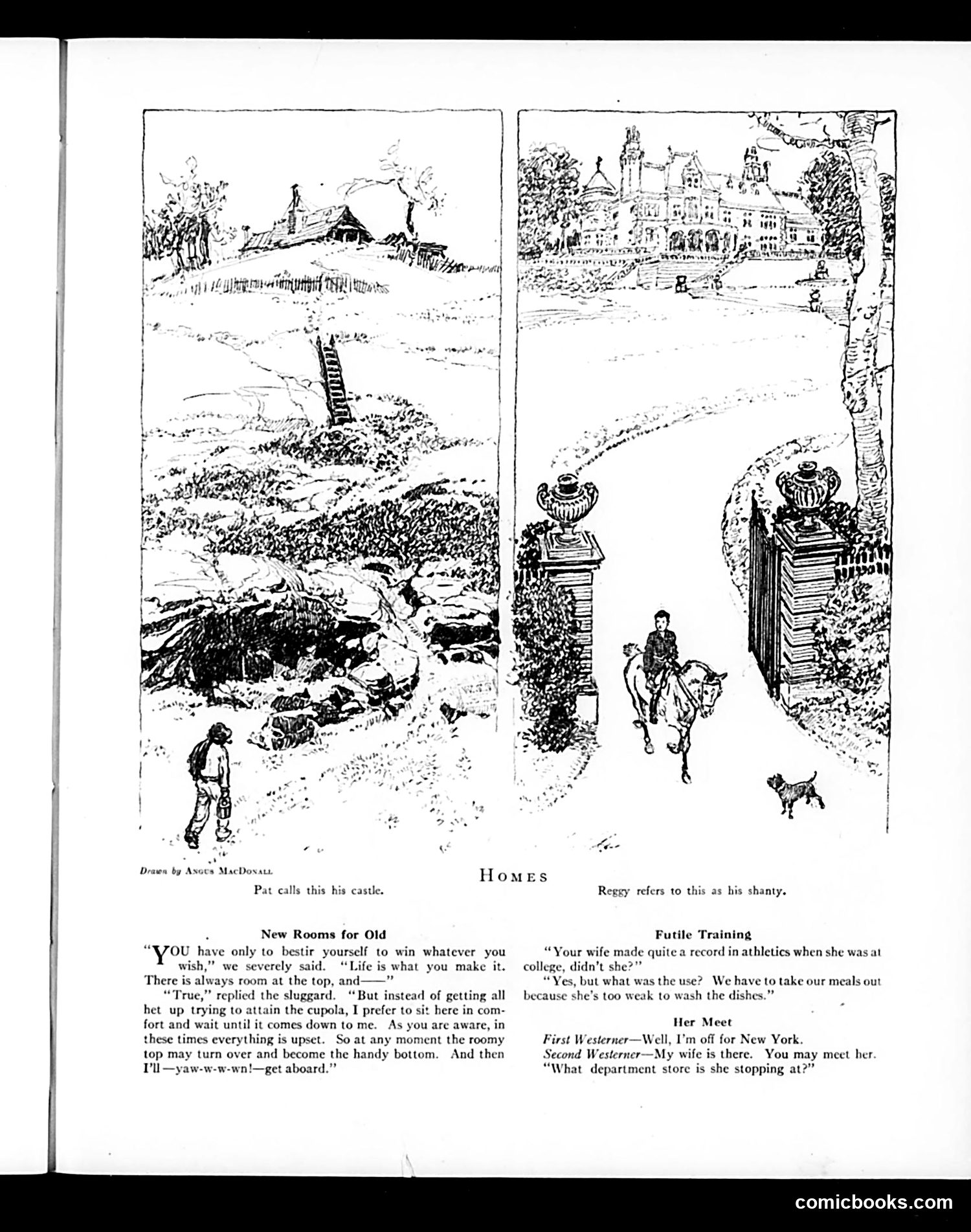
This page contains three separate satirical pieces: **"New Rooms for Old"**: A dialogue mocking lazy pessimism during economically unstable times. A sluggard argues that since "everything is upset," he'll wait for the social hierarchy to invert rather than work to climb it—so the bottom will eventually become the top. The satire targets defeatist attitudes and lack of ambition during periods of social upheaval. **"Homes"**: Two contrasting illustrations. The left shows a modest, ramshackle dwelling ("Pat calls this his castle"), while the right depicts an elegant mansion ("Reggy refers to this as his shanty"). The joke satirizes how perspective distorts perception—the poor man finds pride in his hovel, while the wealthy man ironically downplays his mansion. **"Her Meet" and "Futile Training"**: Brief jokes about women. The first suggests a wife's athletic college training proved useless for domestic life (unable to do dishes). The second is a crude implication that a westerner's wife is at a department store—the "department store" being a euphemism for infidelity or moral looseness. These pieces reflect early 20th-century attitudes toward class, gender, and economic anxiety.
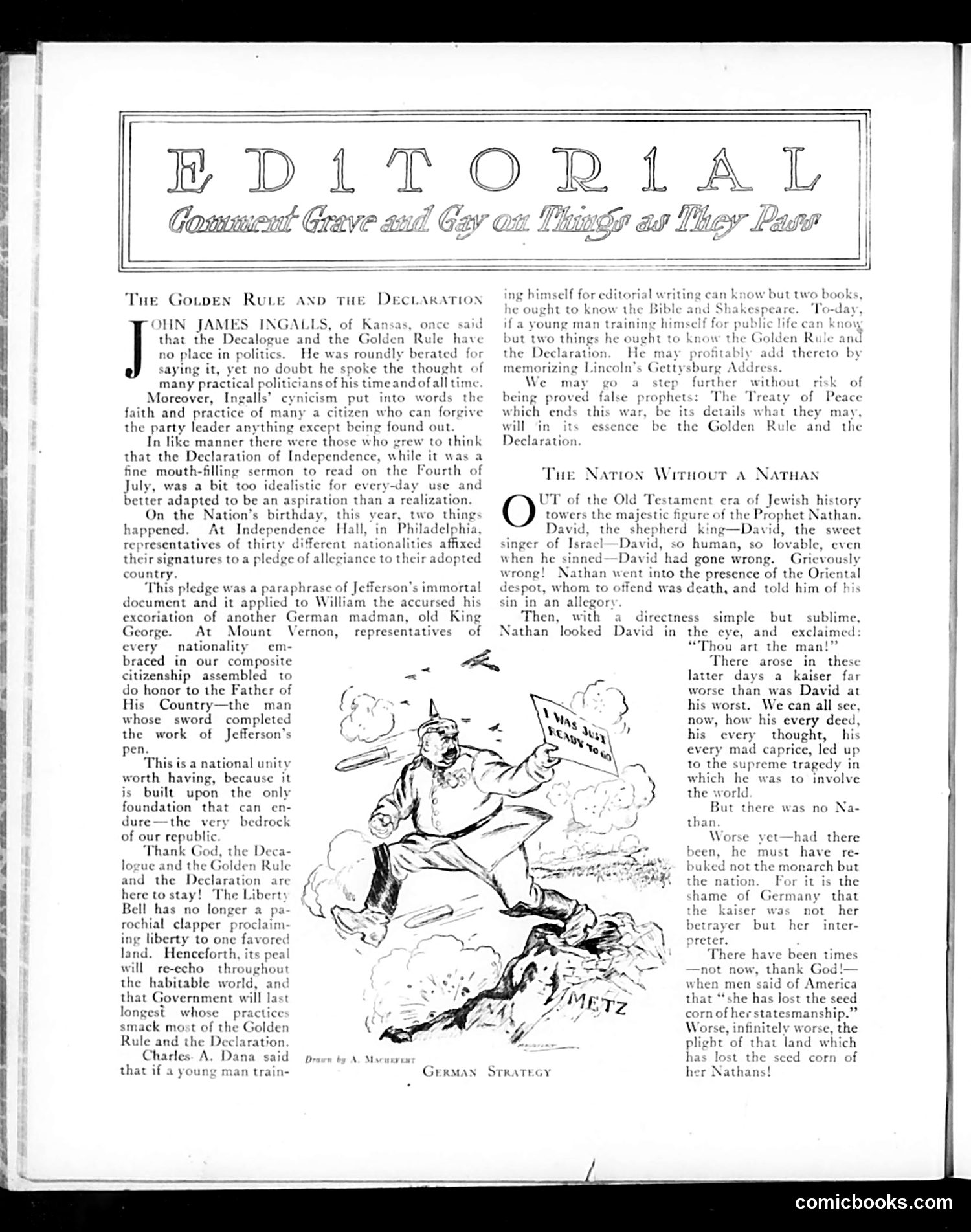
This editorial page addresses American unity during World War I. The left column praises the Declaration of Independence and Golden Rule as foundational to national character, citing ceremonies at Independence Hall and Mount Vernon where representatives of diverse nationalities pledged allegiance—emphasizing that shared American ideals, not ethnic origin, bind the nation together. The cartoon (titled "German Strategy") depicts the German Kaiser as a destructive figure, contrasting him with the Biblical prophet Nathan, who fearlessly confronted King David's wrongdoing. The article argues Germany's tragedy is that the Kaiser represents not just personal evil but the corruption of an entire nation—he is the "interpreter" of German national character, not merely its leader. The piece suggests America, by contrast, maintains moral leadership through adherence to founding principles, making it superior to a Germany that has lost its ethical compass.
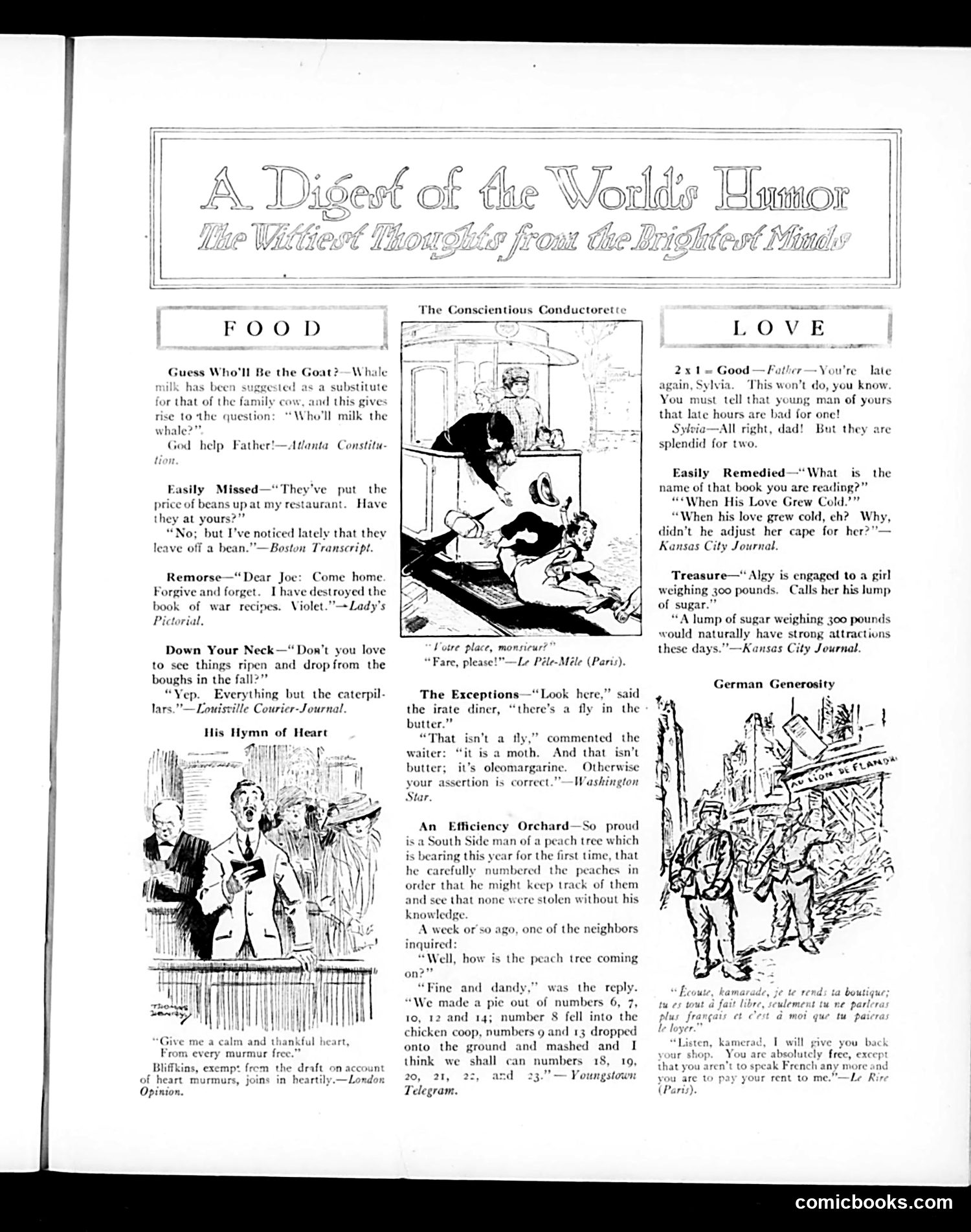
This page from *Judge* magazine collects brief humorous anecdotes organized by topic (Food, Love, German Generosity). The jokes reflect early 20th-century concerns: **FOOD section** satirizes wartime shortages and substitutions—whale milk replacing cow's milk, rising bean prices, and oleomargarine passing as butter. One item mocks German "war recipes," suggesting enemy cuisine was unpalatable. **LOVE section** contains predictable domestic humor: a daughter's cheeky response about late hours being good "for two," and jokes about adjusting capes and heavy fiancées. **GERMAN GENEROSITY** cartoon (partially visible) appears to mock German conduct, likely WWI-related, though the specific reference is unclear from the visible text. Overall, the page reflects wartime anxieties about food rationing, substitutes, and enemy nations—common *Judge* satirical targets during the 1910s-1920s era.
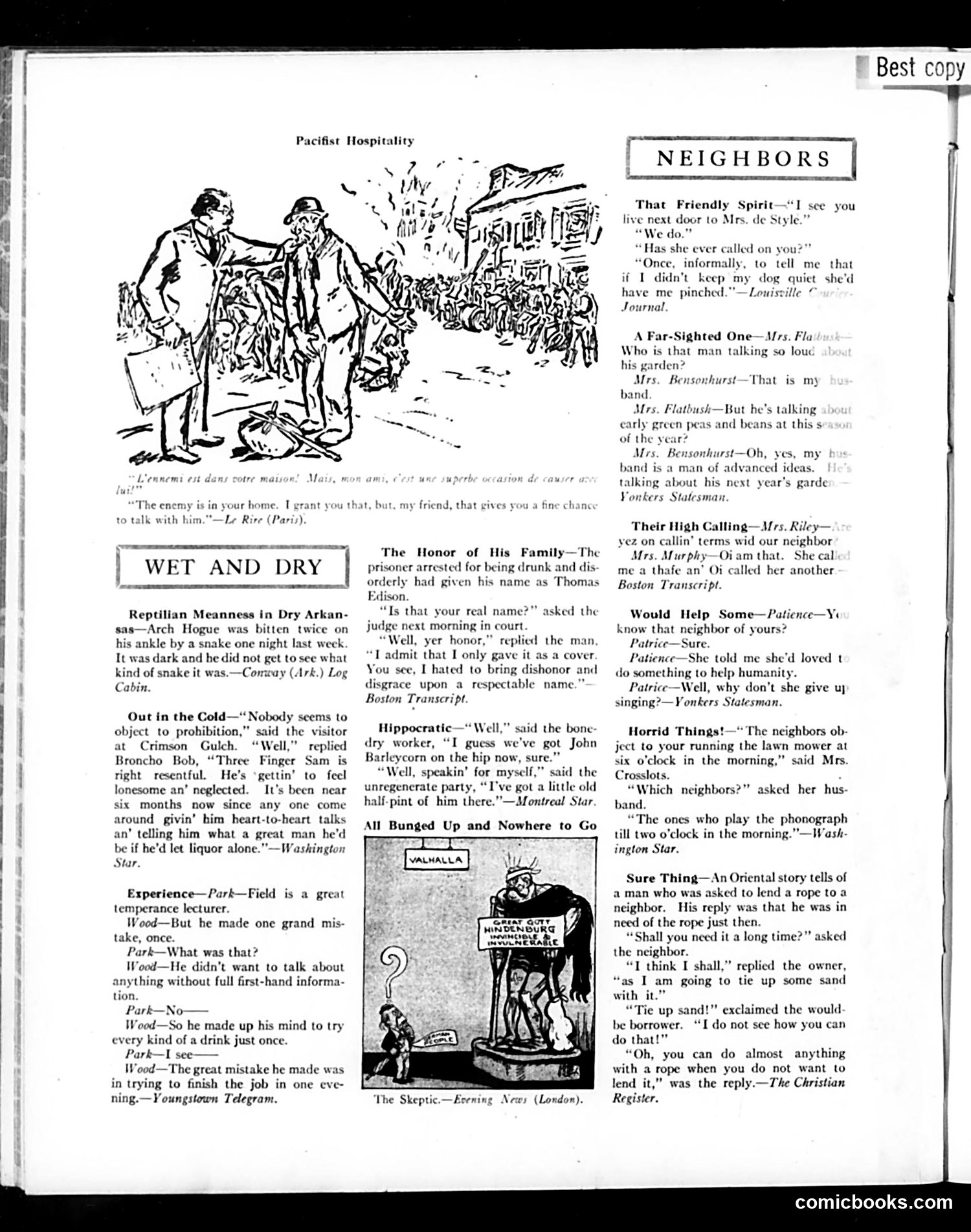
This page from *Judge* magazine contains humor about Prohibition (the ban on alcohol, 1920-1933) and neighborly relations. **"Wet and Dry" Section:** These anecdotes mock Prohibition's effects. One joke describes a temperance lecturer who, seeking firsthand knowledge, sampled every available drink in one evening—satirizing the absurdity of such dedication. Another features a drunk man using the name "Thomas Edison" as an alias, then claiming he only did so to avoid bringing "dishrace upon a respectable name"—the irony being his actual shame comes from drunkenness, not the fake identity. **"Neighbors" Section:** These brief social observations humorously depict petty neighborhood conflicts and hypocrisy: a woman complains about a neighbor's dog while threatening to have him arrested; neighbors who play loud phonographs at 2 a.m. object to someone using a lawn mower at 6 a.m.; neighbors insult each other while maintaining social contact. The cartoon above shows a pacifist welcoming an "enemy" into his home—likely referencing early-WWI attitudes toward German immigrants or pacifist politics.
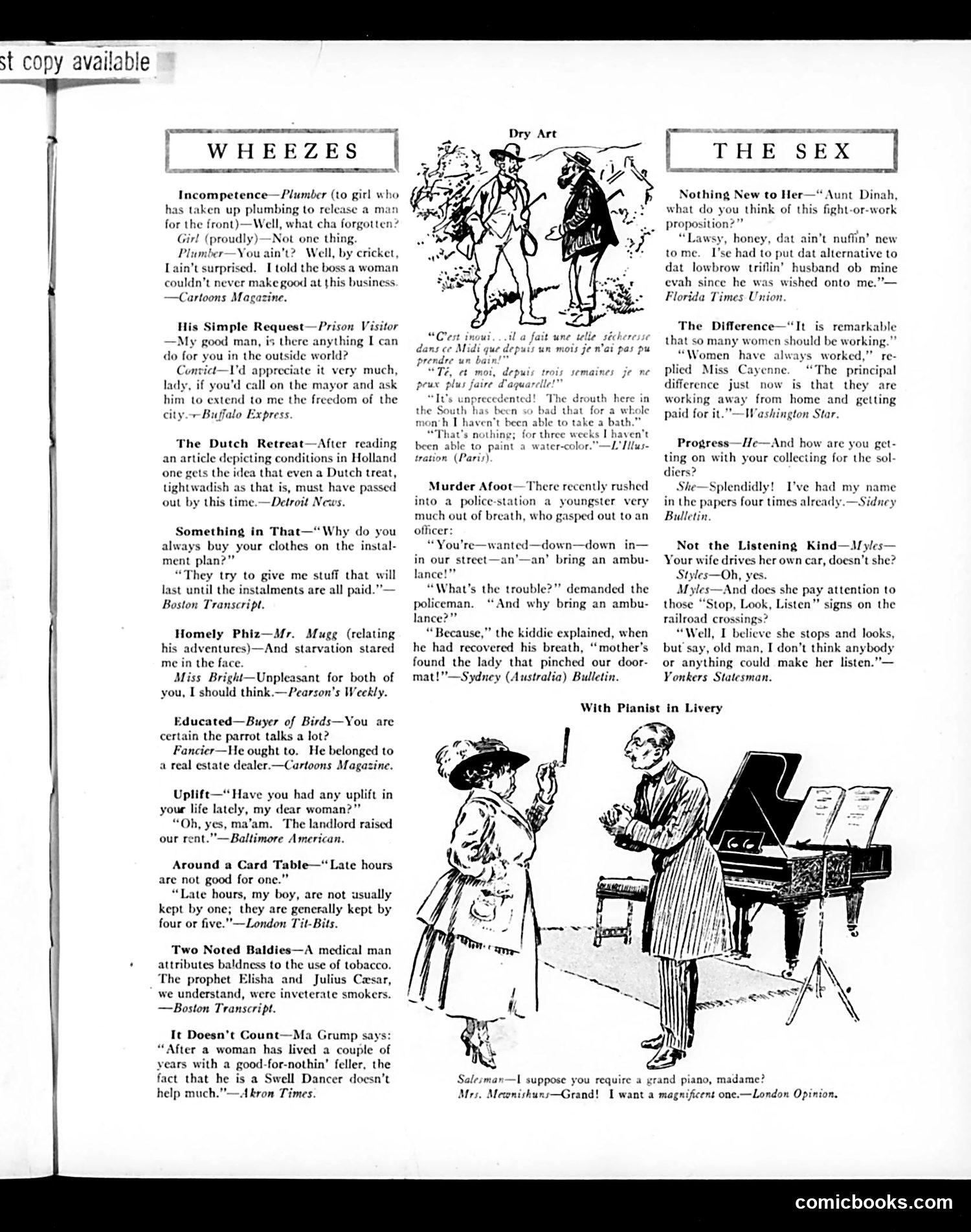
This page from Judge magazine contains brief satirical jokes organized into two sections: "Wheezes" (left) and "The Sex" (right), typical of early 20th-century humor magazines. The jokes mock contemporary social anxieties, particularly around **gender roles during wartime**. "Incompetence" ridicules a woman plumber replacing a man for military service—the punchline being that she's actually competent, contradicting the male plumber's sexist expectations. "The Difference" and "Progress" similarly address women's wartime labor, acknowledging women have always worked but now do so publicly for pay and recognition. Other jokes address marriage dynamics, class pretensions, and urban life. The bottom illustration depicts a piano salesman with an aggressive customer, illustrating the era's consumer culture. The page reflects **WWI-era anxieties** about women entering traditionally male occupations and changing social structures, wrapped in condescending humor typical of the period.
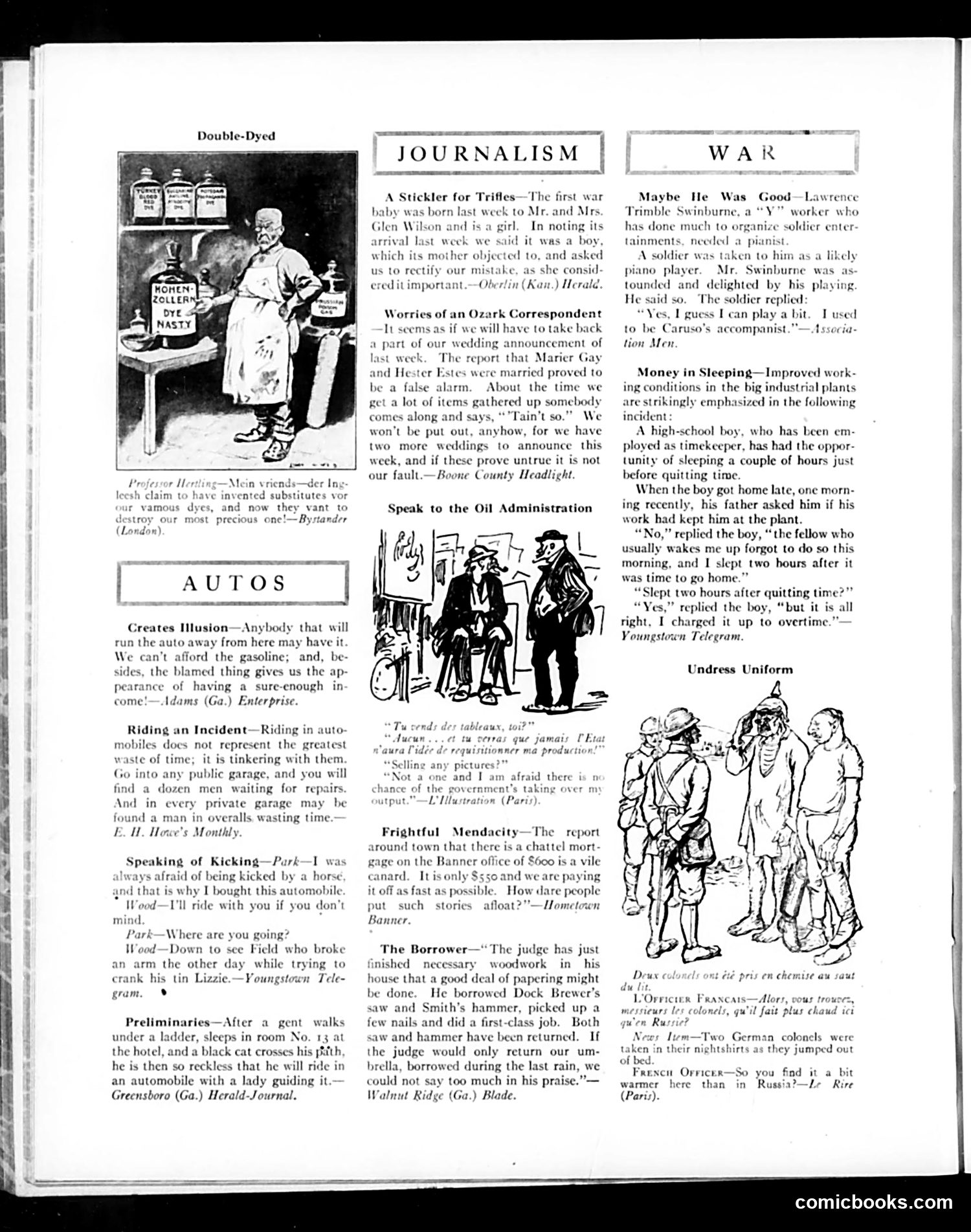
This page from Judge magazine satirizes American life during World War I, organized into three sections: **"Double-Dyed"** (cartoon): A German chemist boasts of inventing dye substitutes, now wanting to "destroy our most precious one"—likely mocking Germany's wartime material shortages and desperation. **"Autos" section**: Multiple brief jokes mock the unreliability and expense of early automobiles. They waste owners' time breaking down, cost money to fuel and repair, and even make riding with inexperienced drivers dangerous—satirizing Americans' growing but problematic relationship with cars. **"Journalism" section**: Editors humorously confess publishing errors (wrong baby gender, false marriage announcements, exaggerated debt claims). This mocks small-town newspapers' carelessness and their editors' casual attitude toward factual accuracy. **"War" section**: Brief anecdotes about soldier entertainment and factory working conditions, reflecting the home front experience during WWI. The overall tone is gentle domestic satire rather than hard political commentary.
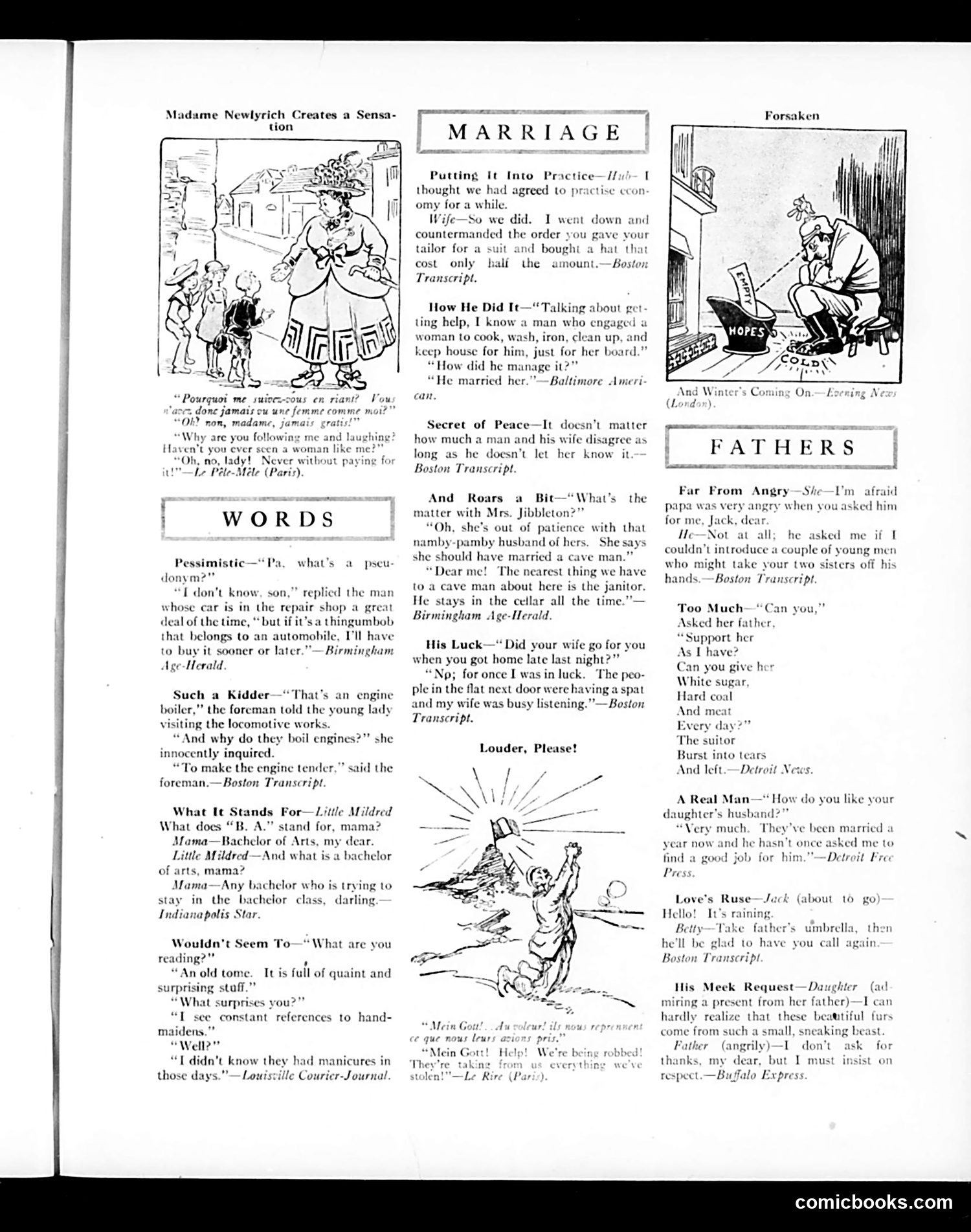
This page collects humor columns and jokes organized under headings like "Words," "Marriage," and "Fathers"—typical early 20th-century American magazine fare. The top-left cartoon shows "Madame Newlyrich," a wealthy nouveau-riche woman being followed and mocked by onlookers. The French dialogue and her ostentatious dress satirize the pretensions of newly rich Americans aping European sophistication. The remaining content consists of short jokes mocking common domestic situations: wives managing household budgets, men evading their wives' anger, fathers reluctant to support daughters' suitors, and general gender role conflicts. The humor trades heavily on stereotypes—wives as shrewd spenders, husbands as hapless, fathers as overburdened. One running theme: the "cave man" husband is humorously presented as preferable to "namby-pamby" modern men. This reflects early 20th-century anxieties about masculinity and changing gender dynamics during the Progressive era. The tone is light, domestic, and assumes middle-class readership familiar with servants, tailors, and urban apartment living.
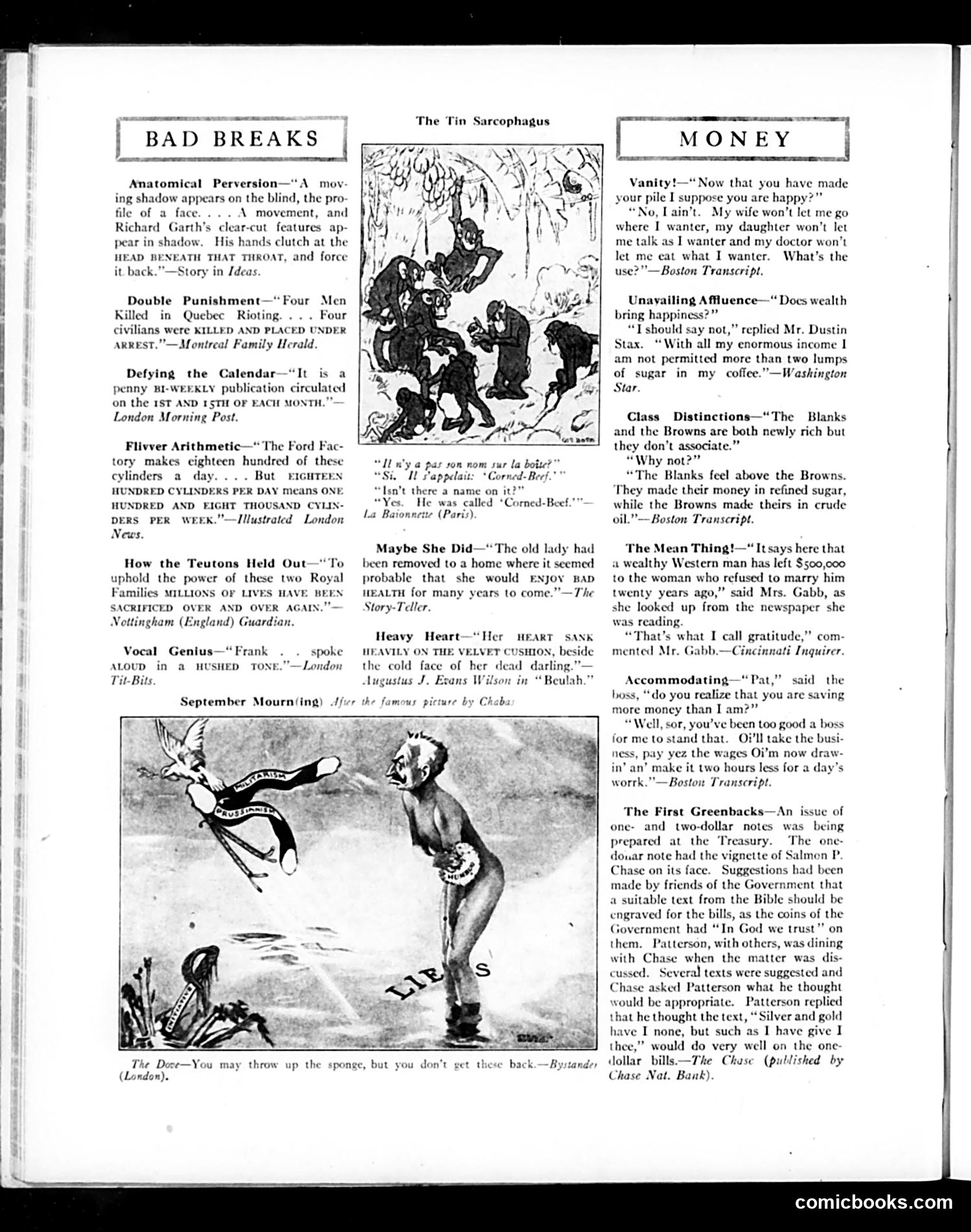
This page from *Judge* magazine collects short humorous items mocking poorly written newspaper and magazine excerpts—the "Bad Breaks" section highlights absurd phrasings and logical errors in published writing. The central cartoon depicts a WWI soldier mourning at a tin coffin containing an unknown soldier (suggested by the French caption asking "Isn't there a name on it?"). This references post-war grief and the anonymity of mass casualties. The "Money" section presents satirical quips about wealth's limitations: newly rich people can't enjoy their freedom (wives and doctors restrict them), and even millionaires face petty constraints (limited sugar in coffee). One item jokes that a scorned woman received $500,000 from a man she rejected decades earlier—suggesting wealthy men use money to retroactively "win" romantic disputes. The final item humorously describes Treasury officials debating Bible verses for dollar bills, with the suggestion of Psalm 3:6 ("Silver and gold have I none...") being inappropriately ironic for currency. Overall, the page satirizes class anxieties, editorial incompetence, and money's failure to guarantee happiness—common themes in early 20th-century American satire.
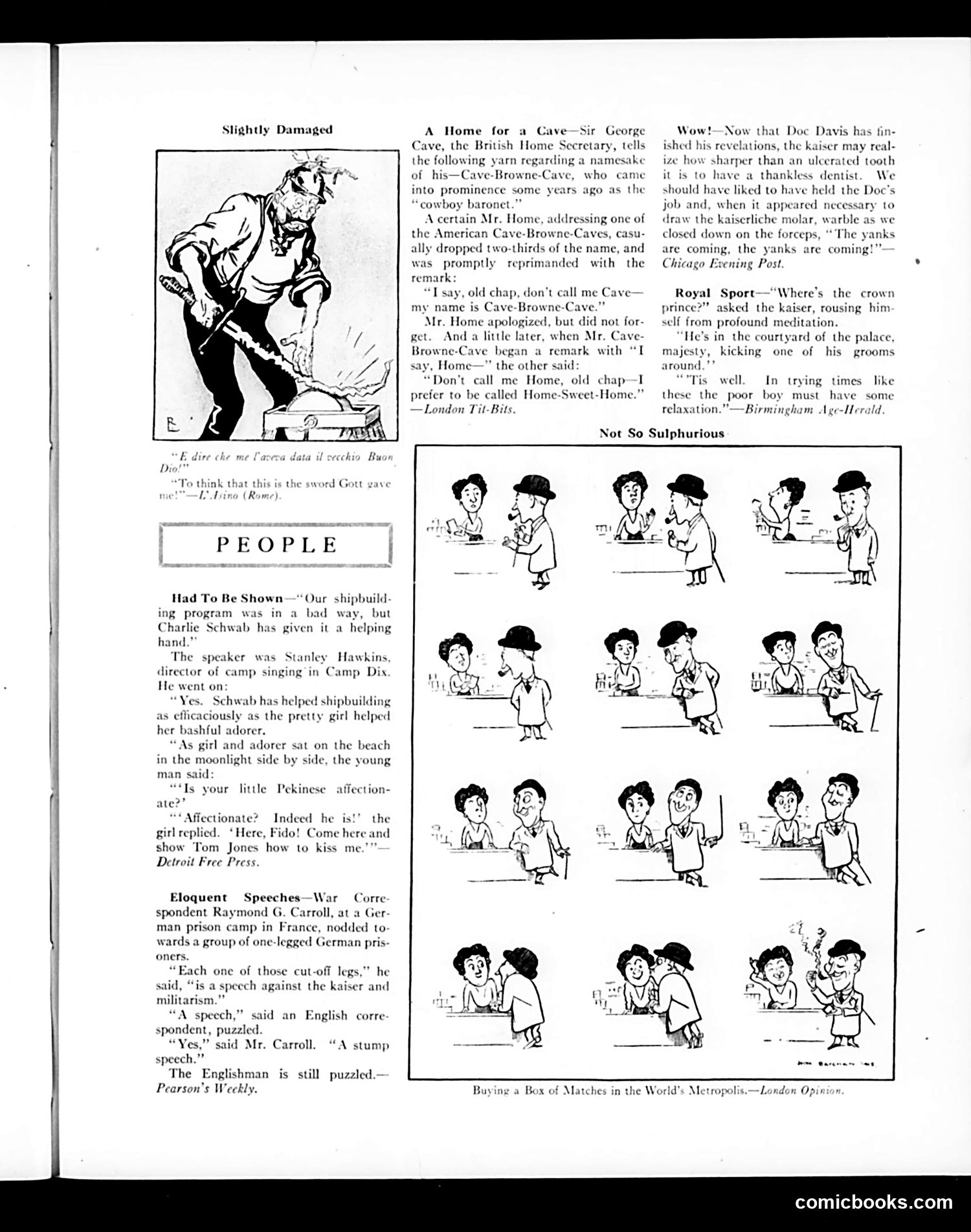
This page collects brief humorous anecdotes from various sources, primarily focused on **World War I-era satire**: **"Slightly Damaged"** mocks shipbuilding director Charlie Schwab's contributions by comparing him to an awkward suitor whose presence actually *hindered* romance—a backhanded compliment suggesting his help was counterproductive. **"Eloquent Speeches"** uses dark humor about German amputees ("one-legged German prisoners"), treating their severed limbs as anti-kaiser propaganda. The English correspondent's confusion satirizes the American tendency toward melodramatic moralizing. **"A Home for a Cave"** is a mild pun-based anecdote about a British aristocrat (Cave-Browne-Cave) correcting someone who dropped part of his hyphenated name, eventually leading to the joke "Home-Sweet-Home." **"Wow!"** celebrates American dentists, casting Kaiser Wilhelm II as needing dental extraction, with yanks as providers. **"Royal Sport"** depicts the German crown prince brutishly kicking servants, presented as therapeutic stress relief—satirizing both Prussian militarism and aristocratic cruelty. The **"Not So Sulphurious"** comic strip (bottom) is unclear without fuller context.
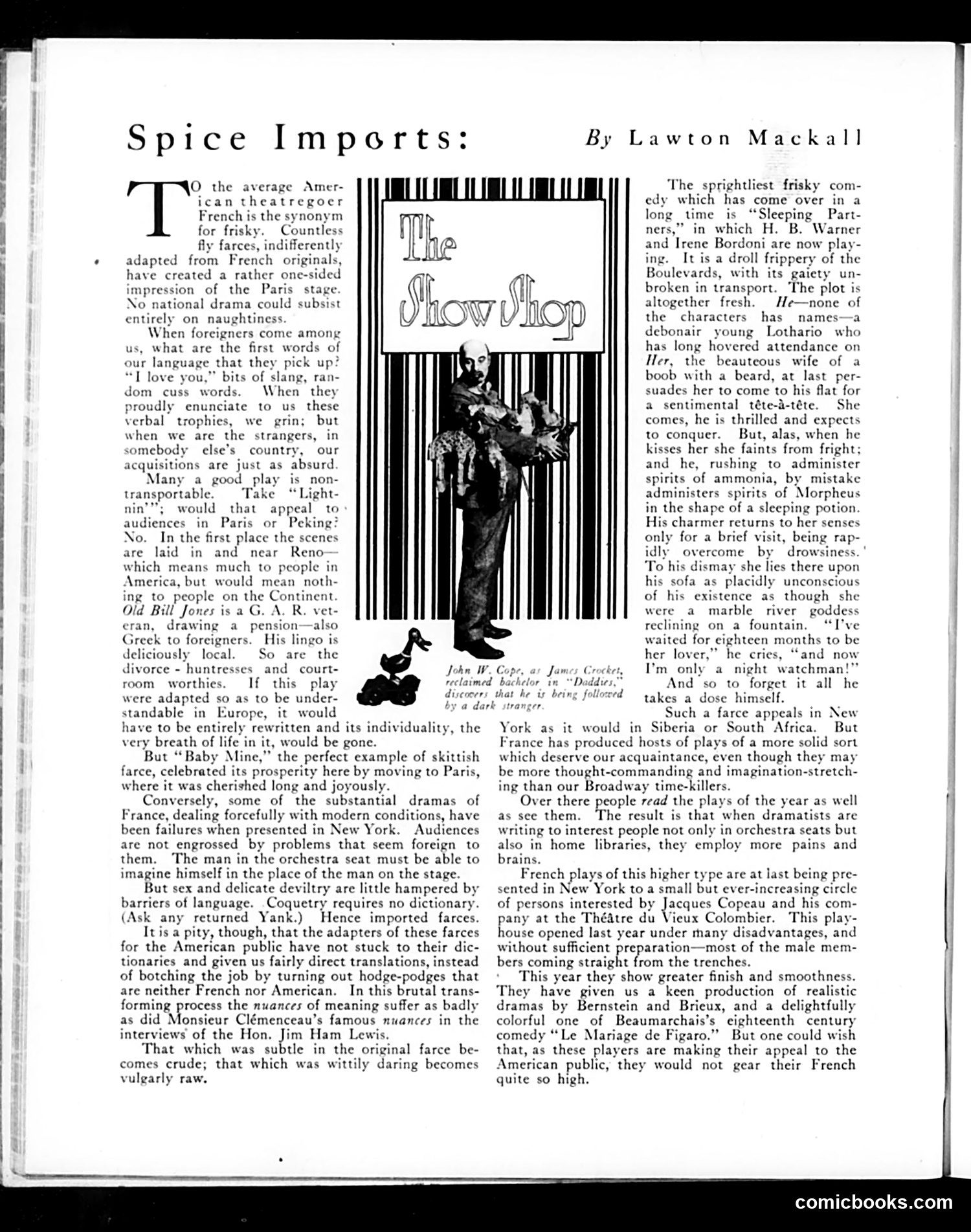
This article by Lawton Mackall critiques the American adaptation of French theatrical comedies. The central argument: French farces export well because physical comedy and flirtation transcend language barriers, but American producers bungle translations by making witty originals crude and vulgar rather than preserving their subtle charm. The accompanying illustration shows a scene from "Sleeping Partners," featuring H.B. Warner and Irene Bordoni—a French bedroom farce where a seduction attempt comically fails when the woman falls asleep. Mackall uses this as a positive example of successful French import. The broader point satirizes American cultural pretension: we import French plays assuming "French = frisky," cherry-picking naughty comedies while misunderstanding that Paris theater contains serious drama too. Just as foreigners learning English pick up only slang and curses, American adapters reduce French sophistication to crude sexuality, losing all nuance in translation.
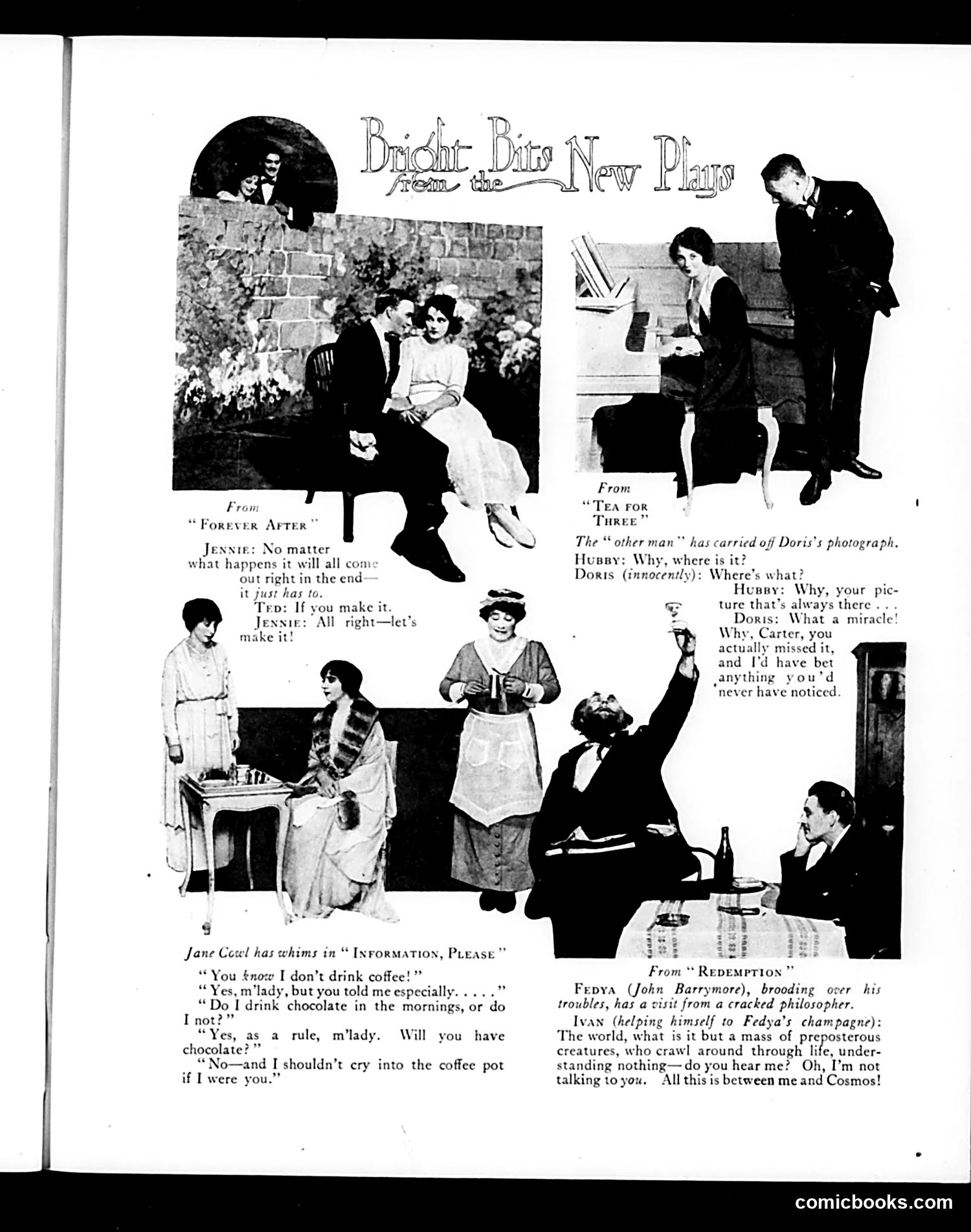
This page presents satirical scenes from contemporary theatrical productions, likely from the 1910s-20s. Each vignette mocks romantic and marital situations through exaggerated dialogue: **"Forever After"** jokes about a woman's naive optimism that everything will work out if she simply "makes it" happen—satire on romantic idealism. **"Information, Please"** features actress Jane Cowl in a scene about a servant correcting her mistress's memory regarding coffee preferences—poking fun at upper-class affectation. **"Tea for Three"** depicts a domestic triangle where a wife's indifference to a missing photograph reveals her unfaithfulness to her suspicious husband. **"Redemption"** shows a drunk philosopher (played by John Barrymore) delivering absurdist commentary about human existence while raiding someone's champagne—mocking both pretentious philosophy and alcoholic excess. The humor targets class pretension, marital infidelity, and philosophical self-importance typical of early 20th-century stage comedy.
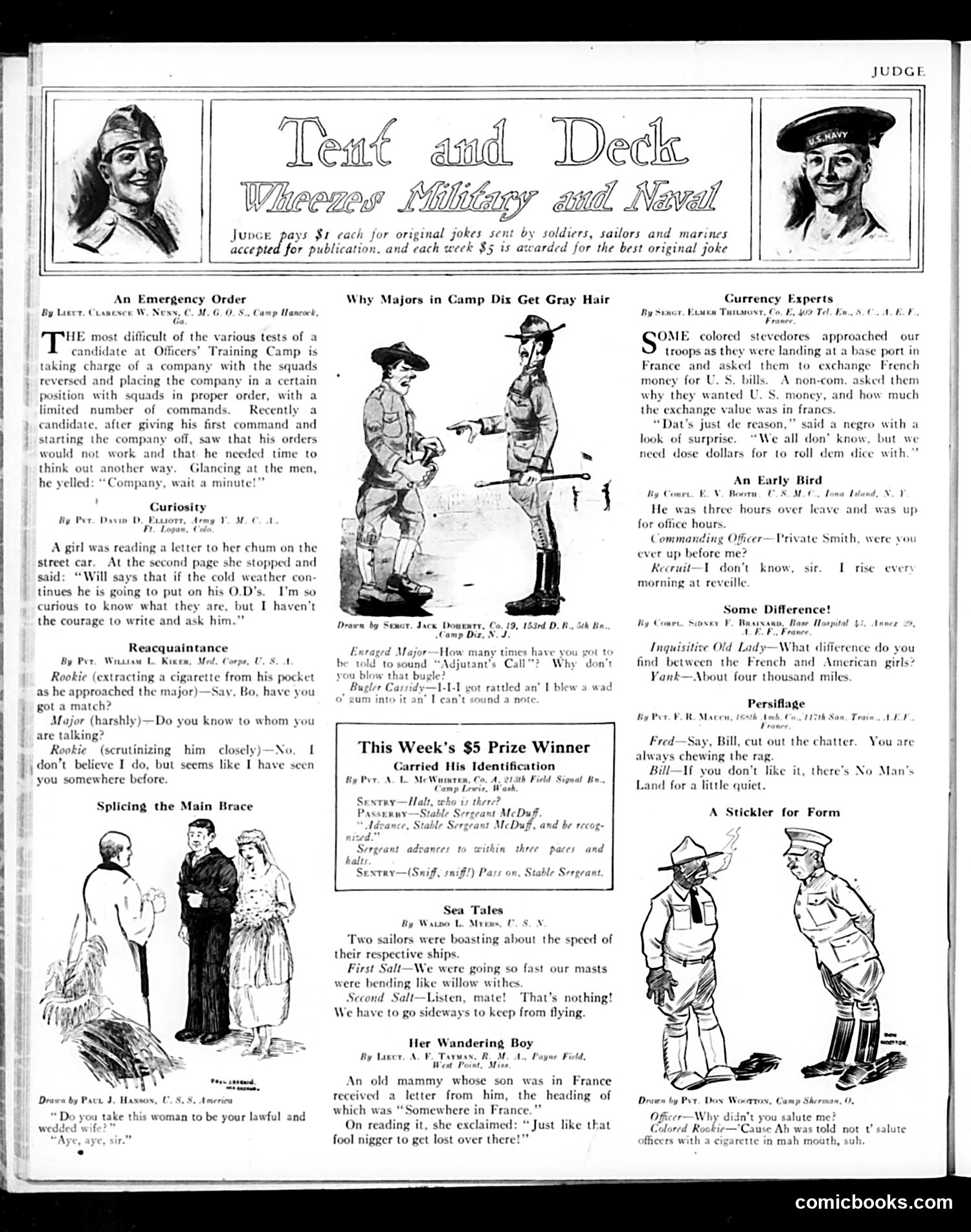
This is a collection of military jokes submitted by servicemen during World War I, organized under the heading "Tent and Deck" (referencing army and navy life). Judge paid $1 per published joke and $5 for the best one weekly. The humor targets common military experiences: confused officer trainees giving impossible commands, soldiers misunderstanding military terminology (like "O.D.'s"—olive drab uniforms), and the stress of military life causing premature aging. Several jokes rely on racial stereotypes common to the era, including derogatory language in "Her Wandering Boy" and "Currency Experts," reflecting the deeply prejudiced attitudes of 1918 America. Other jokes mock military formality and miscommunication—buglers making mistakes, soldiers over leave, and strict adherence to rank protocols. The cartoons accompanying these jokes use period-appropriate illustration styles to visualize the scenarios described.
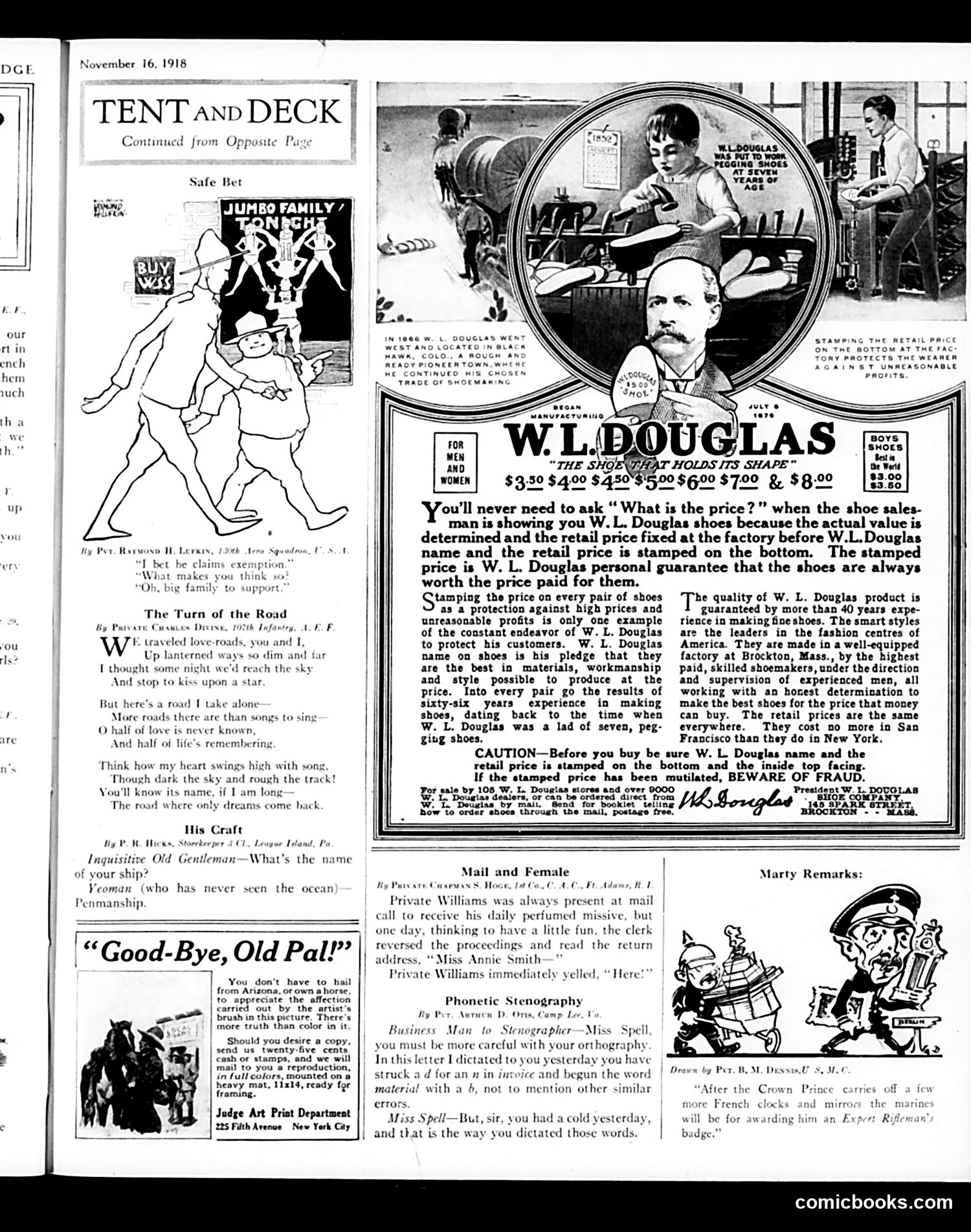
This page is **primarily advertising**, dominated by a large W.L. Douglas shoe company advertisement that occupies the right half. The ad emphasizes the brand's factory-stamped pricing as protection against fraud and profiteering—a relevant concern in 1918, the final year of World War I when price controls and inflation were significant issues. The left side contains light satirical content: - **"Safe Bet"** cartoon about someone claiming exemption from military service (topical for late 1918 as the war was ending) - **"The Turn of the Road"** and **"His Craft"** are sentimental military-themed poems/stories - **"Good-Bye, Old Pal!"** shows soldiers parting—reflecting WWI's emotional resonance The small sketches at bottom ("Mail and Female," "Phonetic Stenography," "Marty Remarks") are humorous observations on everyday life. The page reflects 1918 America: wartime concerns, commercial messaging, and nostalgic patriotic sentiment as the war concluded.
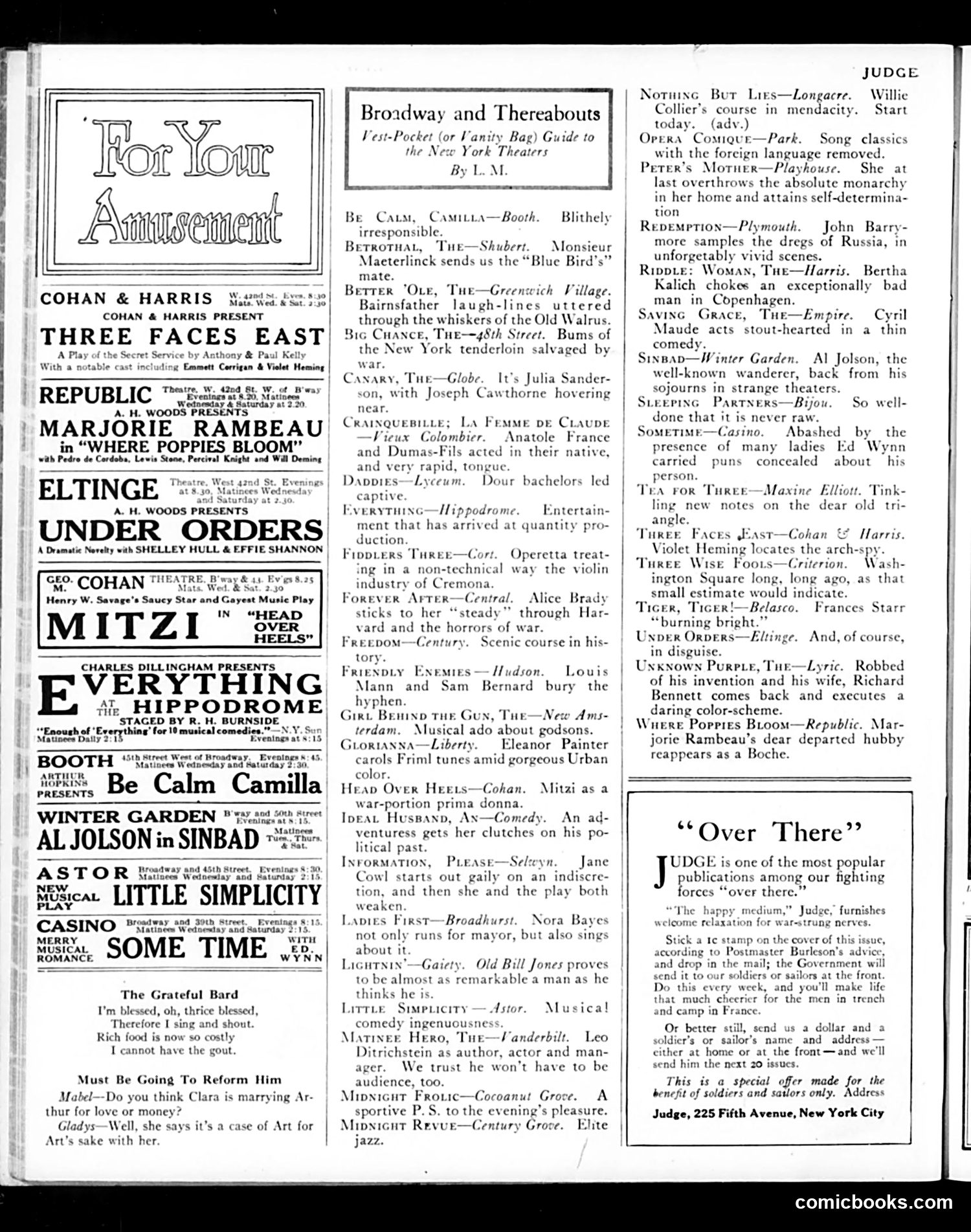
This page is primarily **theatrical advertising and reviews**, not political satire. The left side features Broadway theater advertisements (plays like "Three Faces East," "Where Poppies Bloom," and Al Jolson's "Sinbad"). The right side contains brief theater reviews under "Broadway and Thereabouts," offering snappy critiques of current productions. Notable entries include sardonic observations: "Be Calm, Camilla" is "blithely irresponsible," "Everything" at the Hippodrome has "arrived at quantity production," and a dig at Leo Ditrichstein as an actor-manager who might need to "be audience, too." At the bottom are two **joke items**: one puns on "Art for Art's sake" regarding marriage motives, and another celebrates food inflation making gout (historically a "rich man's disease") unaffordable. The page reflects 1910s-20s urban entertainment culture and Judge's theatrical focus, with social commentary embedded in theater criticism rather than formal cartoons.
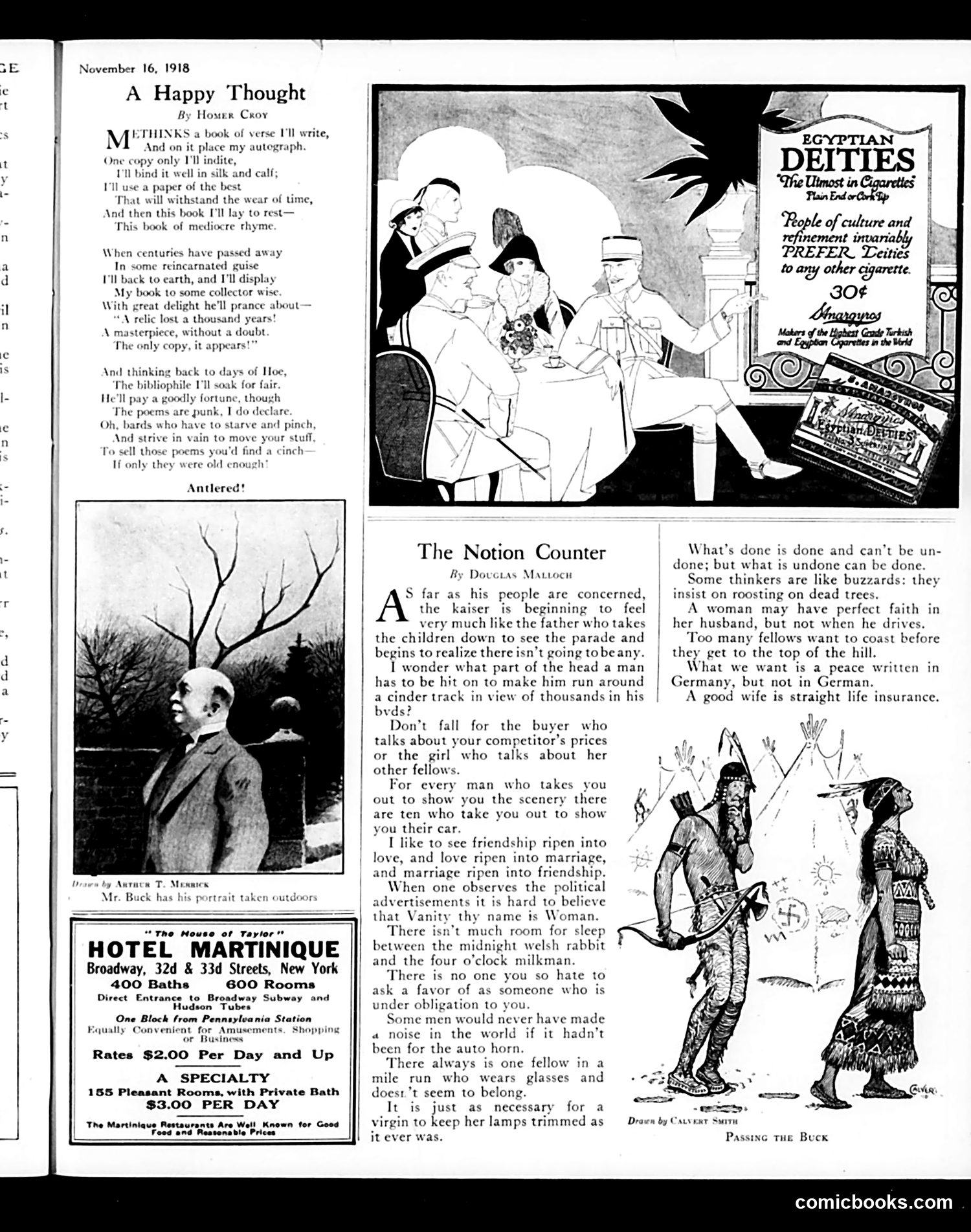
**"A Happy Thought"** (by Homer Croy) satirizes struggling poets. The speaker fantasizes about writing mediocre verse, binding it luxuriously, then burying it for centuries. When "rediscovered," collectors will pay fortunes for this "ancient masterpiece"—despite the poems being worthless. The joke: poets can't sell their work in their own time, so they dream of posthumous fame. The accompanying illustration shows a disheveled poet, reinforcing the starving-artist stereotype. **"The Notion Counter"** (by Douglas Malloch) offers cynical aphorisms about human nature and relationships—observations on marital dynamics, business dealings, and vanity. Notable: references to "the kaiser" suggest this appeared just *after* WWI's armistice (November 11, 1918), making the German leader reference topical. The page also features a Hotel Martinique advertisement and an illustration titled "Passing the Buck" (drawn by Calvert Sain), though its specific meaning is unclear without fuller context.
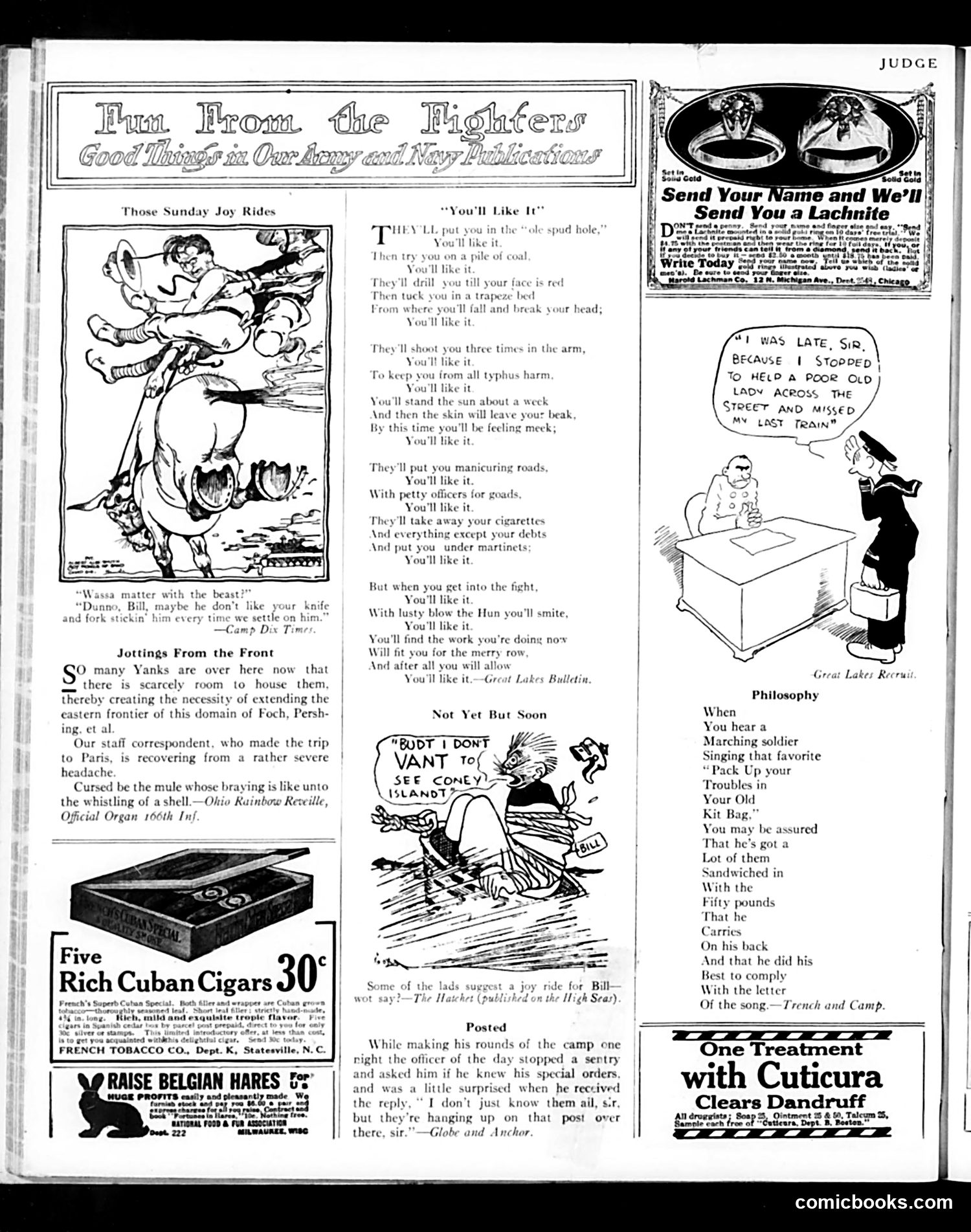
This Judge magazine page satirizes American soldiers' experiences in World War I, primarily through ironic humor about military training and camp life. **"You'll Like It"** is the central piece—a sardonic poem listing harsh training exercises (drilling until exhausted, shooting practice, standing in sun until skin peels, manicuring roads) with the repeated refrain "You'll like it." The joke is that soldiers are being conditioned to accept brutal treatment as normal. The poem concludes that actual combat will seem preferable to peacetime training—darkly suggesting that soldiers will "like" fighting because it's less tedious than preparation. **Other content** includes brief anecdotes mocking military life (a correspondent's headache from Paris, a mule's braying compared to shells, a sentry unfamiliar with orders) and a cartoon about a soldier claiming he was late because he helped an elderly woman cross the street—ironic excuse-making. The overall tone treats soldiers' hardships as grimly humorous rather than heroic, reflecting wartime cynicism about military bureaucracy and the gap between official expectations and soldiers' actual experiences.
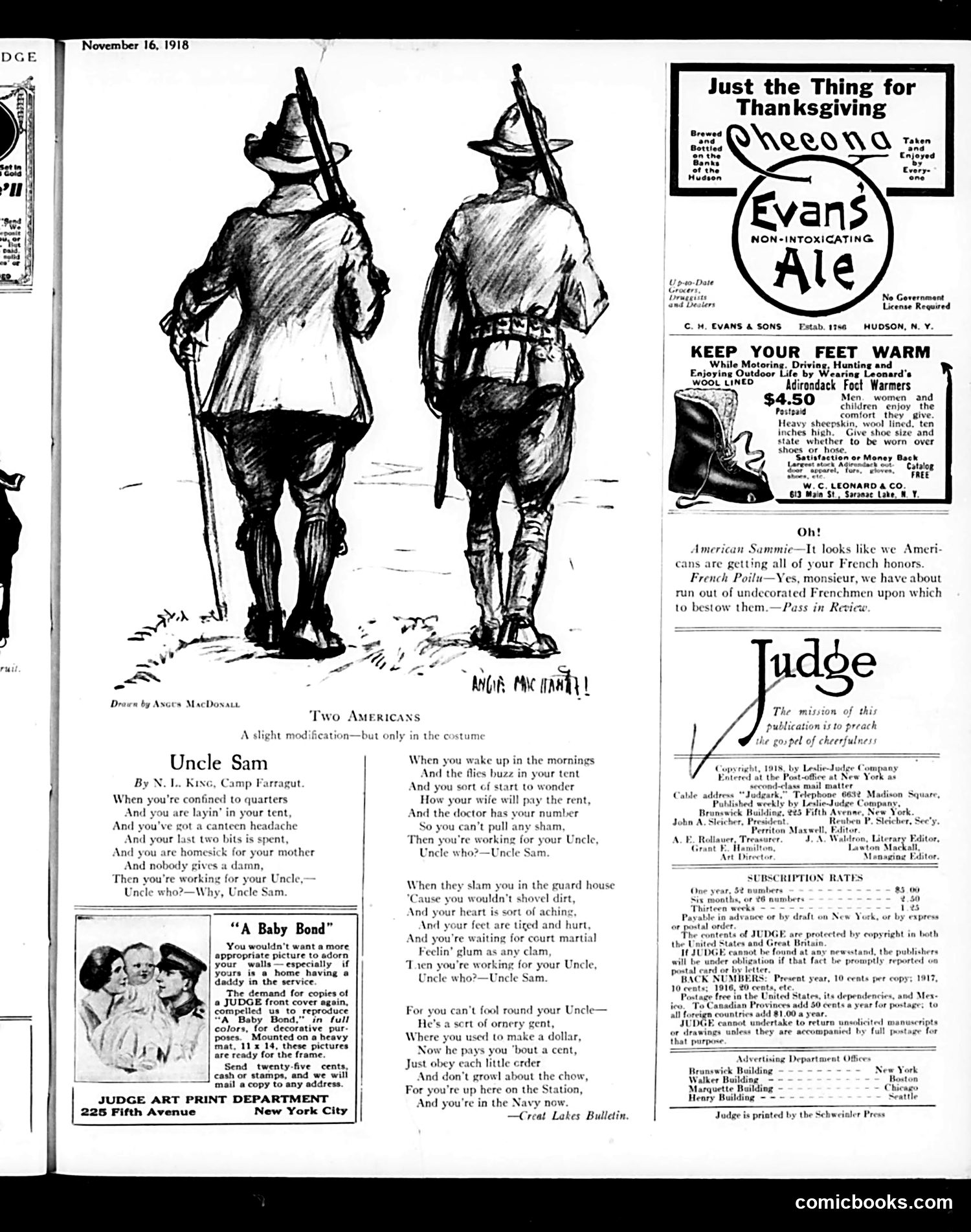
**Main Cartoon - "Two Americans"** This depicts two American soldiers in WWI military uniforms, drawn by Angus MacDonald. The caption notes "A slight modification—but only in the costume," suggesting these represent typical American soldiers freshly adapted to military life. The accompanying poem "Uncle Sam" (credited to N.L. King, Camp Farragut) humorously catalogs the grievances of enlisted men: confinement, hangovers, homesickness, low pay (earning "a cent" instead of "a dollar"), guard duty, and military discipline. The refrain "you're working for your Uncle,—Uncle who?—Why, Uncle Sam" frames military service as involuntary servitude to the government. **Secondary Content** A brief exchange jokes that Americans are receiving French military honors while French soldiers ("Poilus") have run out of undecorated men to honor—suggesting heavy French casualties by war's end (November 1918, just after Armistice). **Context** Published days after WWI's conclusion, this satirizes the American soldier's experience: hardship, low compensation, and lack of agency in military service.
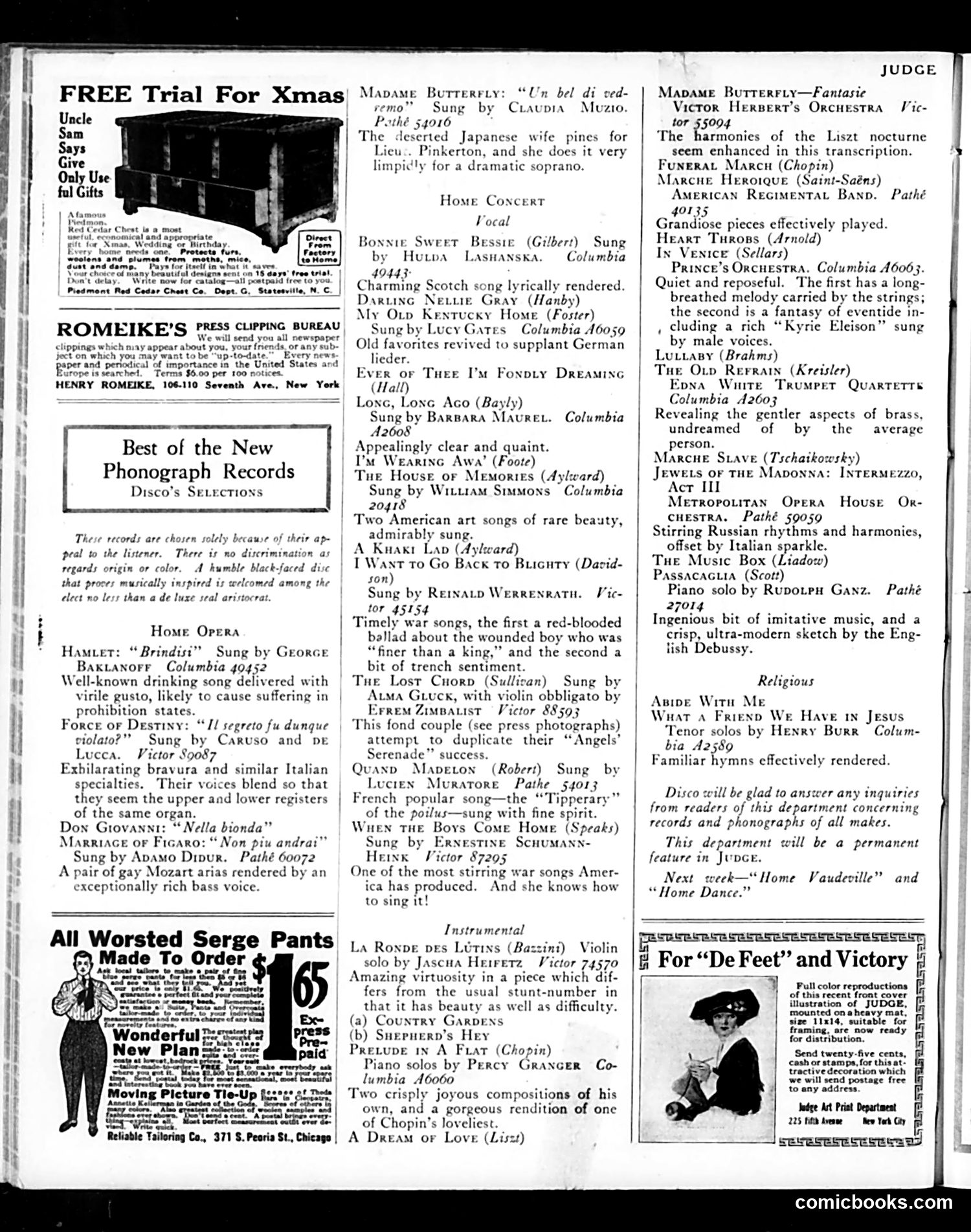
This is primarily a **phonograph record review page** (circa 1917-1918 based on war song references), not a political cartoon page. The content reflects wartime cultural attitudes rather than satire. **Key elements:** The page features record reviews organized by category (Home Opera, Home Concert, Instrumental, Religious). Notable is the prominent inclusion of **war songs**—pieces like "When the Boys Come Home" and "I Want to Go Back to Blighty," celebrating soldiers and military sacrifice. This reflects America's World War I involvement and the patriotic musical culture of the era. **Social context:** The reviews reveal early 20th-century entertainment preferences and gender roles—soprano roles dominate vocal selections. The mention of "prohibition states" (top left ad) references the contemporary temperance movement. **The satire/humor** is minimal here. This is essentially a **consumer guide page** mixed with advertisements (phonograph pants, clipping bureaus), typical of Judge's hybrid editorial-commercial format. Any "satire" lies in Judge's general satirical voice rather than specific political cartoons on this particular page.
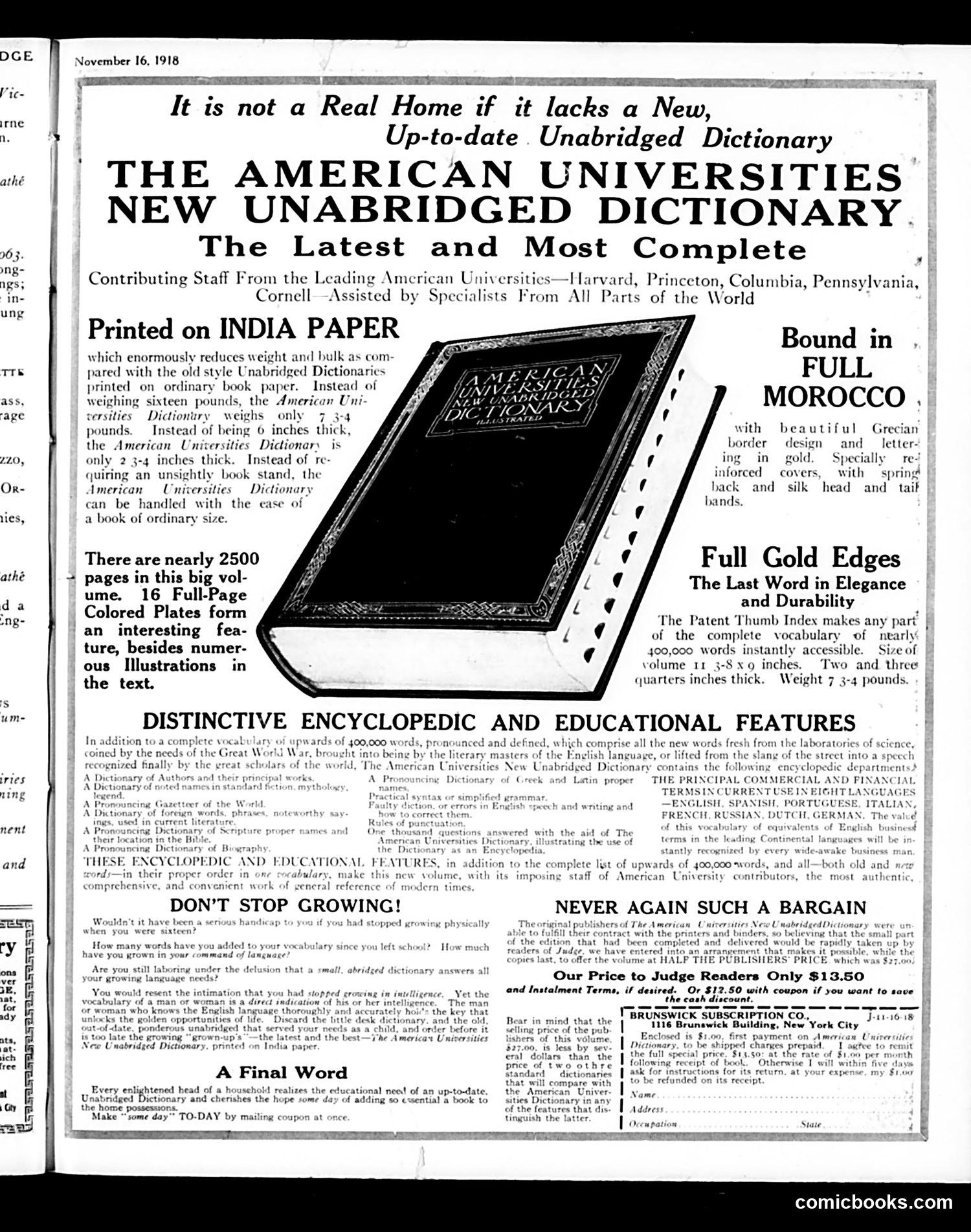
This page is **primarily a full-page advertisement**, not a cartoon or satirical content. It promotes "The American Universities New Unabridged Dictionary" published by Brunswick Subscription Co. The ad uses persuasive messaging typical of the era, appealing to readers' self-improvement aspirations. Key selling points emphasize the dictionary's practicality (lightweight India paper, compact size compared to older unabridged editions) and prestige (contributions from Harvard, Princeton, Columbia, etc.). The marketing strategy includes urgency ("Don't Stop Growing!") and value proposition—offering the dictionary to Judge readers at a discounted price ($13.50, or $12.50 with coupon), suggesting the full publisher's price was higher. The date (November 16, 1918) is just after WWI's armistice, though this ad contains no political commentary. It simply represents contemporary commercial advertising as it appeared in Judge magazine.
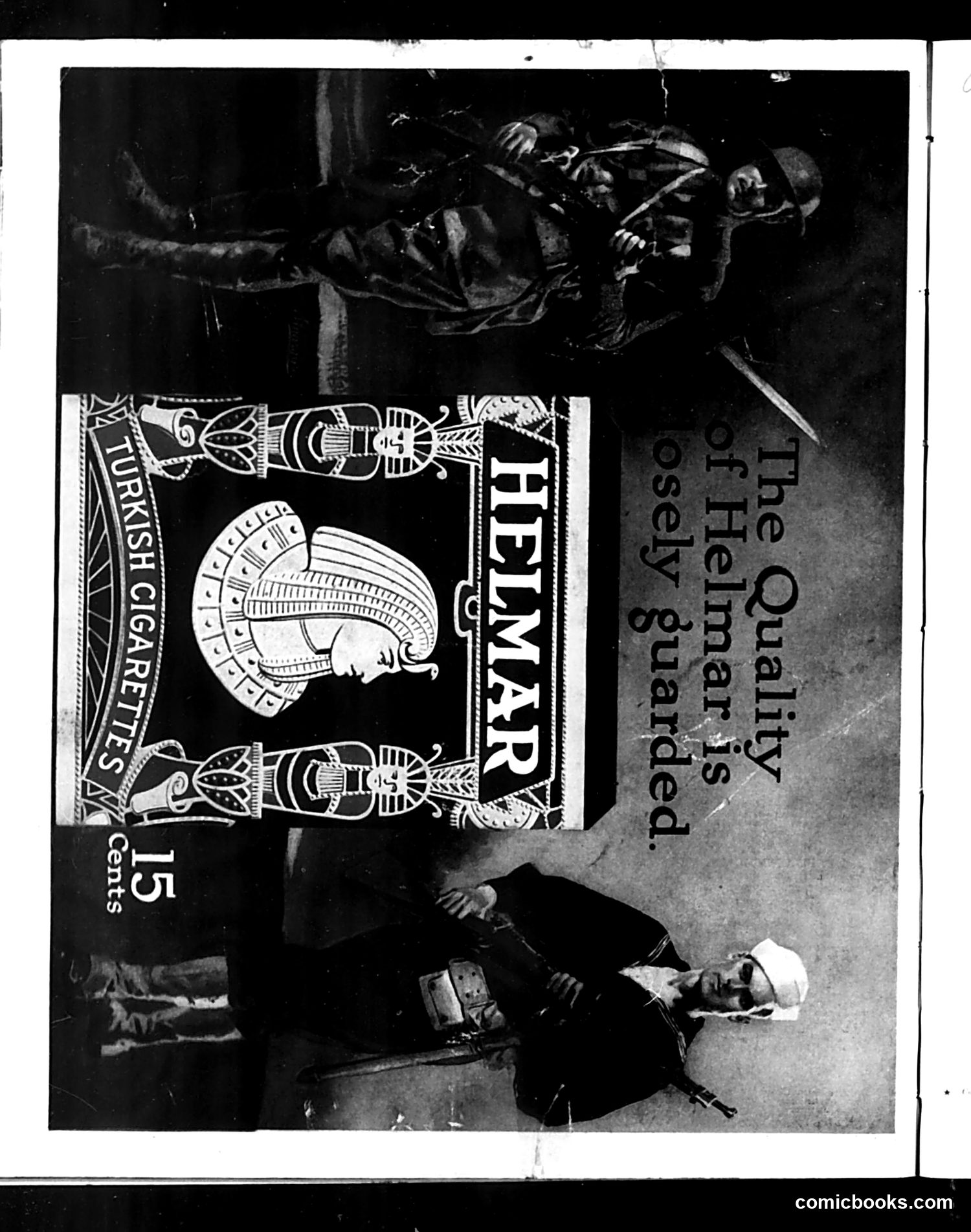
This appears to be a **Turkish cigarette advertisement** from Judge magazine, likely early 20th century. The ad prominently features "HEIBAR" brand Turkish cigarettes with ornamental Turkish imagery (the headdress design and decorative borders). The text reads: "The Quality He Helienar is Osely Guarded" (likely "The Quality He Helienar is Closely Guarded"). The price is listed as **15 Cents**. The photograph shows a man in formal attire examining or displaying the cigarette package. This is straightforward **commercial advertising** rather than political satire—it's marketing an upscale tobacco product by emphasizing exotic Turkish quality and craftsmanship. The ornamental design and careful presentation were typical strategies for selling premium cigarettes during this period.