
Judge, 1918-11-16 · page 20 of 32
Judge — November 16, 1918 — page 20: what you’re looking at
What you’re looking at
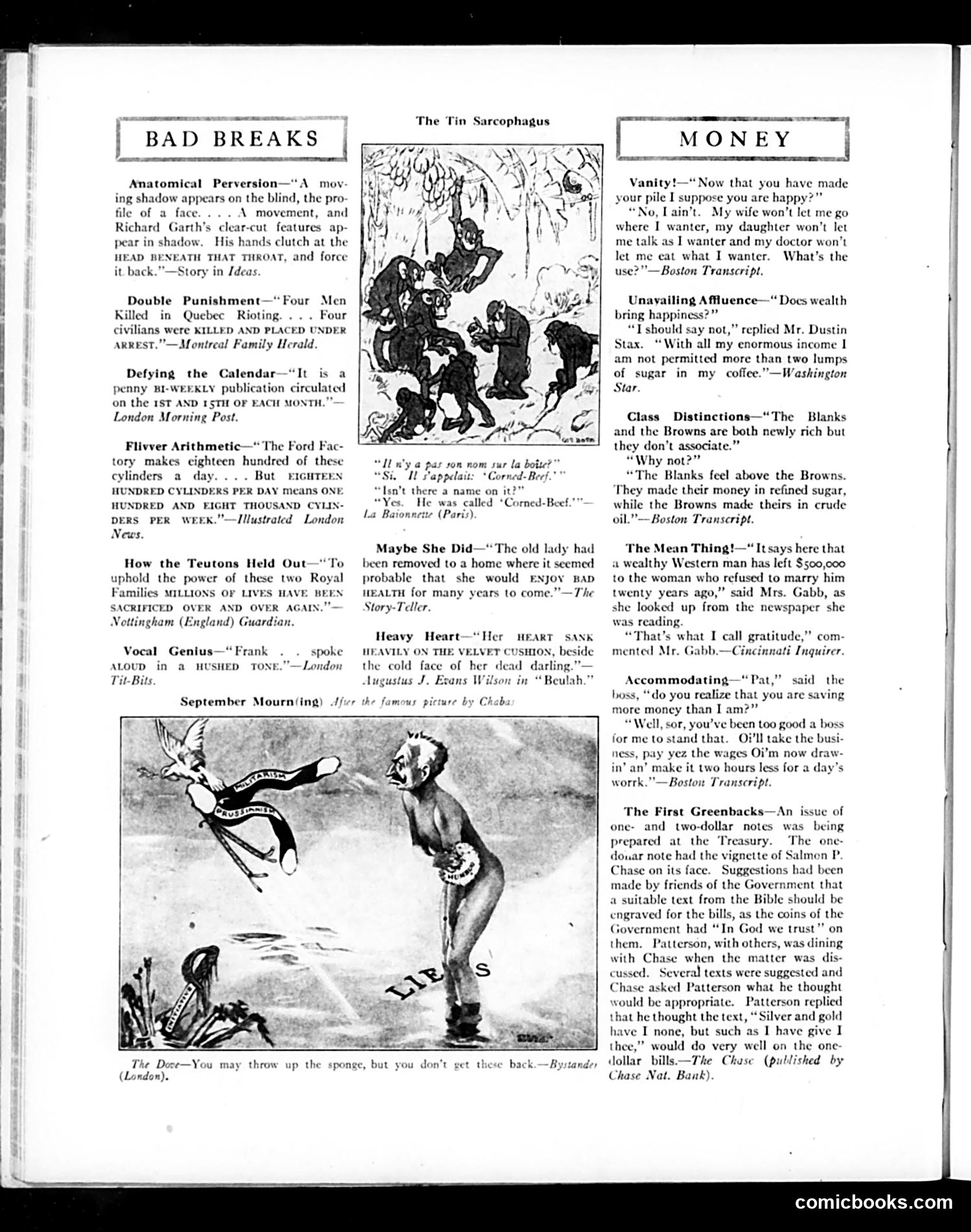
This page from *Judge* magazine collects short humorous items mocking poorly written newspaper and magazine excerpts—the "Bad Breaks" section highlights absurd phrasings and logical errors in published writing. The central cartoon depicts a WWI soldier mourning at a tin coffin containing an unknown soldier (suggested by the French caption asking "Isn't there a name on it?"). This references post-war grief and the anonymity of mass casualties. The "Money" section presents satirical quips about wealth's limitations: newly rich people can't enjoy their freedom (wives and doctors restrict them), and even millionaires face petty constraints (limited sugar in coffee). One item jokes that a scorned woman received $500,000 from a man she rejected decades earlier—suggesting wealthy men use money to retroactively "win" romantic disputes. The final item humorously describes Treasury officials debating Bible verses for dollar bills, with the suggestion of Psalm 3:6 ("Silver and gold have I none...") being inappropriately ironic for currency. Overall, the page satirizes class anxieties, editorial incompetence, and money's failure to guarantee happiness—common themes in early 20th-century American satire.
📄 Transcribed text from this page (OCR, searchable)
Machine-transcribed from the original scan — historical spelling and the odd misread are preserved.
BAD BREAKS Anatomical Perversion—A mov. ing shadow appears on the blind, the pro: file of a face. \ movement, and Richard Garth’s clear-cut features ap- pear in shadow. His hands clutch at the HEAD BENEATH THAT THROAT, and force it. back.”"—Story in Ideas. Double Punishment—‘Four Men Killed in Quebec Rioting. . Four civilians were KILLED AND PLACED UNDER arrest.”—Montreal Family Herald. Defying the Calendar—“It is a penny BI-WEEKLY publication circulated on the 1ST AND 15TH OF EACH MONTH.” London Morning Post. Flivver Arithmetic—* The Ford Fac- tory makes eighteen hundred of these yo... But EIGHTEEN DRED CYLINDERS PER DAY means ONE HUNDRED AND EIGHT THOUSAND CYLIN- DERS PER WEEK.”—IIlustrated London News. How the Teutons Held Out—"To uphold the power of these two Royal Families MILLIONS OF LIVES HAVE BEEN SACRIFICED OVER AND OVER AGAIN.” Nottingham (England) Guard: Vocal Genius—“Frank . . spoke ALoup in a uvusHeD TONE.” —London Tit-Bits September Mourn(ing) .// The Tin Sarcophagus “Il ny @ pas son nom “Si, Ml sappelait “Isn't there a name on it? “Yes. He was called ‘Comed-Beef."” La Baionnete (Paris) Maybe She Did—* The old lady had been removed to a home where it seemed probable that she would ENyoy BAD HEALTH for many years to come.” —The Story-Teller. Heavy Heart—“Her HEART SANK HEAVILY ON THE VELVET CUSHION, beside the cold face of her dead darling.”— Augustus J. ns Wilson in “ Beulah.” the famon The Dove—You may throw up the sponge, but y (London). MONEY j nade Vanity!—* Now that you have your pile I suppose you are happy “No, Lain’t. My wife won’t let me go where I wanter, my daughter won't let me talk as I wanter and my doctor won't let me cat what I wanter. What's the —Boston Transcript, Unavailing Affluence—“ Does wealth bring happiness?” “T should say not,” replied Mr. Dustin Stax. “With all my enormous income | am not permitted more than two lumps of sugar in my coffee.”—Washington Star. Class Distinctions—“The Blanks and the Browns are both newly rich but they don’t associate.” “Why not?” The Blanks feel above the Browns. They made their money in refined sugar, while the Browns made theirs in crude oil.”"—Boston Transcript. The Mean Thing!—“ It says here that a wealthy Western man has left $500,000 to the woman who refused to marry him twenty years ago,” said Mrs. Gabb, as she looked up from the newspaper she was reading. “That’s what I call gratitude,” com- mented Mr. Gabb.—Cincinnati Inquirer. Accommodating—“ Pat,” said the boss, ‘do you realize that you are saving more moncy than I am?” “Well, sor, you’ve been too good a boss for me to stand that. Oi’ll take the busi- ness, pay yez the wages Oi’m now draw- in’ an’ make it two hours less for a day’s worrk.”"—Boston Transcript. The First Greenbacks—An issue of one- and two-dollar notes was being prepared at the Treasury. ‘The one- douar note had the vignette of Salmon P. Chase on its face. Suggestions had been made by friends of the Government that a suitable text from the Bible should be engraved for the bills, as the coins of the Government had “In 1 we trust” on them. Patterson, with others, was dining with Chase when the matter was dis- cussed. Several texts were suggested and Chase asked Patterson what he thought would be appropriate. Patterson replied that he thought the text, “Silver and gold have I none, but such as I have give I thee,” would do very well on the one dollar bills.—The Chase (published by Chase Nat. Bank) comicbooks.com