
Judge, 1918-11-16 · page 2 of 32
Judge — November 16, 1918 — page 2: what you’re looking at
What you’re looking at
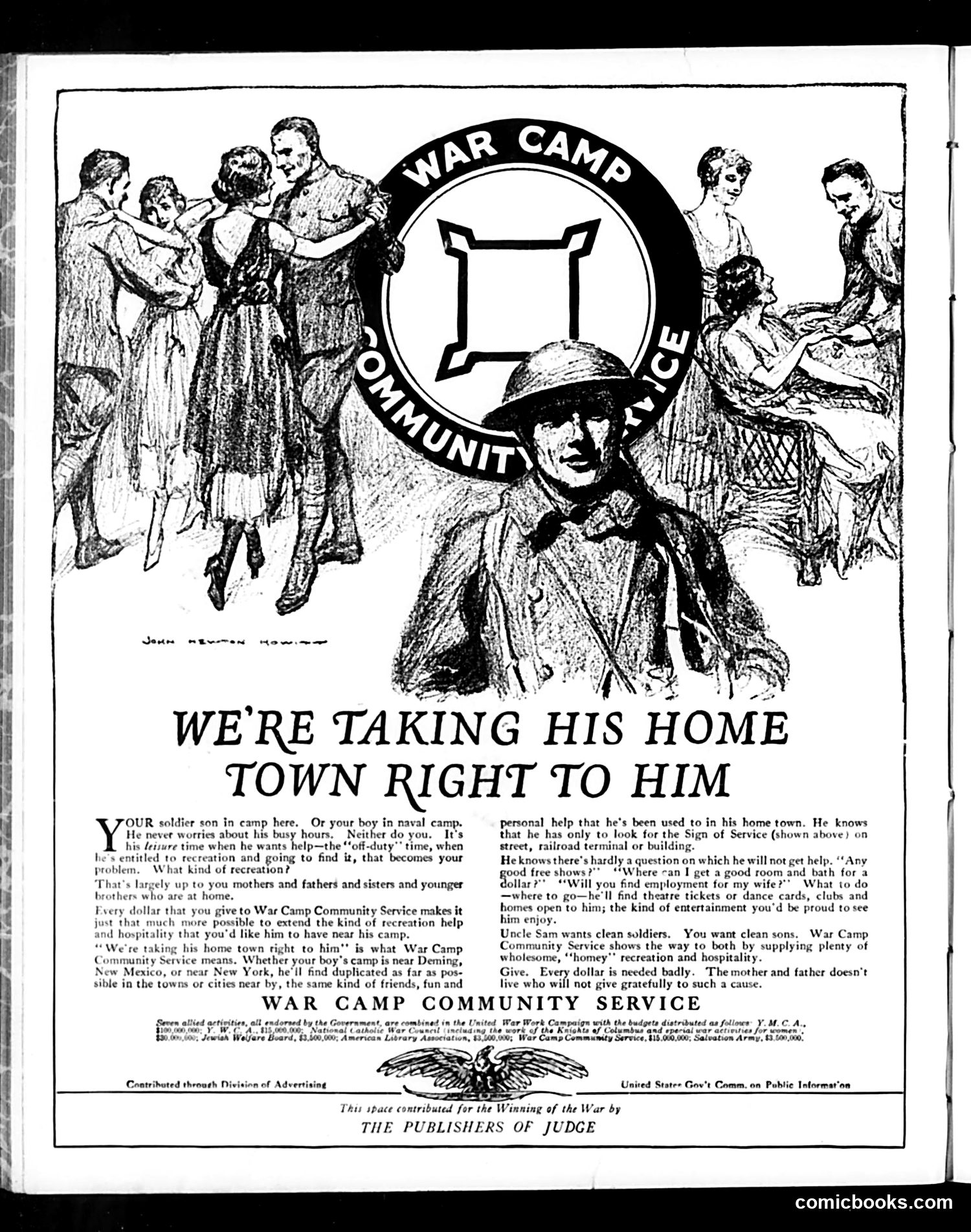
This is a public service advertisement promoting the **War Camp Community Service**, an organization providing recreation and hospitality to soldiers during World War I. The central image shows a uniformed soldier, while surrounding figures represent women and civilians offering support. The headline "We're Taking His Home Town Right to Him" explains the service's purpose: bringing familiar comforts of home to soldiers in distant camps. The accompanying text addresses parents and families, emphasizing that the organization ensures soldiers receive wholesome entertainment, recreation facilities, and moral support—preventing them from seeking questionable establishments. It frames support for the cause as patriotic duty, appealing to families' desire to protect their sons while away at war. This reflects early-WWI American mobilization efforts to maintain soldier morale and welfare.
📄 Transcribed text from this page (OCR, searchable)
Machine-transcribed from the original scan — historical spelling and the odd misread are preserved.
oe _— | ia. ane cones ot — on - Soa ee =? see. See eee 8 es TOWN RIG OUR soldier son in camp here. Or your boy in naval camp. Y He never worries about his busy hours, Neither do you. It's his deisure time when he wants help—the ‘‘off-duty"' time, when he's entitled to recreation and going to find it, that becomes your problem. What kind of recreation? ‘That's largely up to you mothers and fathers and sisters and younger brothers who are at home, Every dollar that you give to War Camp Community Service makes it just that much more possible to extend the kind of recreation help and hospitality that you'd like him to have near his camp. “We're taki his home town right to him'’ is what War Camp Community Service means. Whether your boy's camp is near Deming, New Mexico, or near New York, he'll find duplicated as far as pos- sible in the towns or cities near by, the same kind of friends, fun and aus’ a WE'RE TAKING HIS HOME HT TO HIM Personal help that he’s been used to in his home town. He knows that he has only to look for the Sign of Service (shown above) on street, railroad terminal or building. He knows there's hardly a question on which he will not get help. ‘Any ood free shows ?"’ ‘*Where can I get a good room and bath for a jollar?"" Will you find employment for my wife?’ What to do —where to go—he'll find theatre tickets or dance cards, clubs and homes open to him; the kind of entertainment you'd be proud to see him enjoy. Uncle Sam wants clean soldiers. You want clean sons. War Camp Community Service shows the way to both by supplying plenty of wholesome, “homey” recreation and hospitality. Give. dollar is needed badly. The mother and father doesn't live who will not give gratefully to such a cause. WAR CAMP COMMUNITY SERVICE Hied activities, alt > the United War Work Campaign with the budgets distributed as foll YW. n om; al Jewish Welfare Hoard, $3,400,000; American Library As ihuted throwh 0 of Advertising ding the work of the Kaiohts of Columbus and eperial war actives for $3,100,000; War Camp Commumity Service, $15,000,000; Salvation Army, $3.000,0 United Stater Gov't Comm. on Public Informat'on THE PUBLISHERS OF JUDGE comicbooks.com