A complete issue · 36 pages · 1918
Judge — November 9, 1918
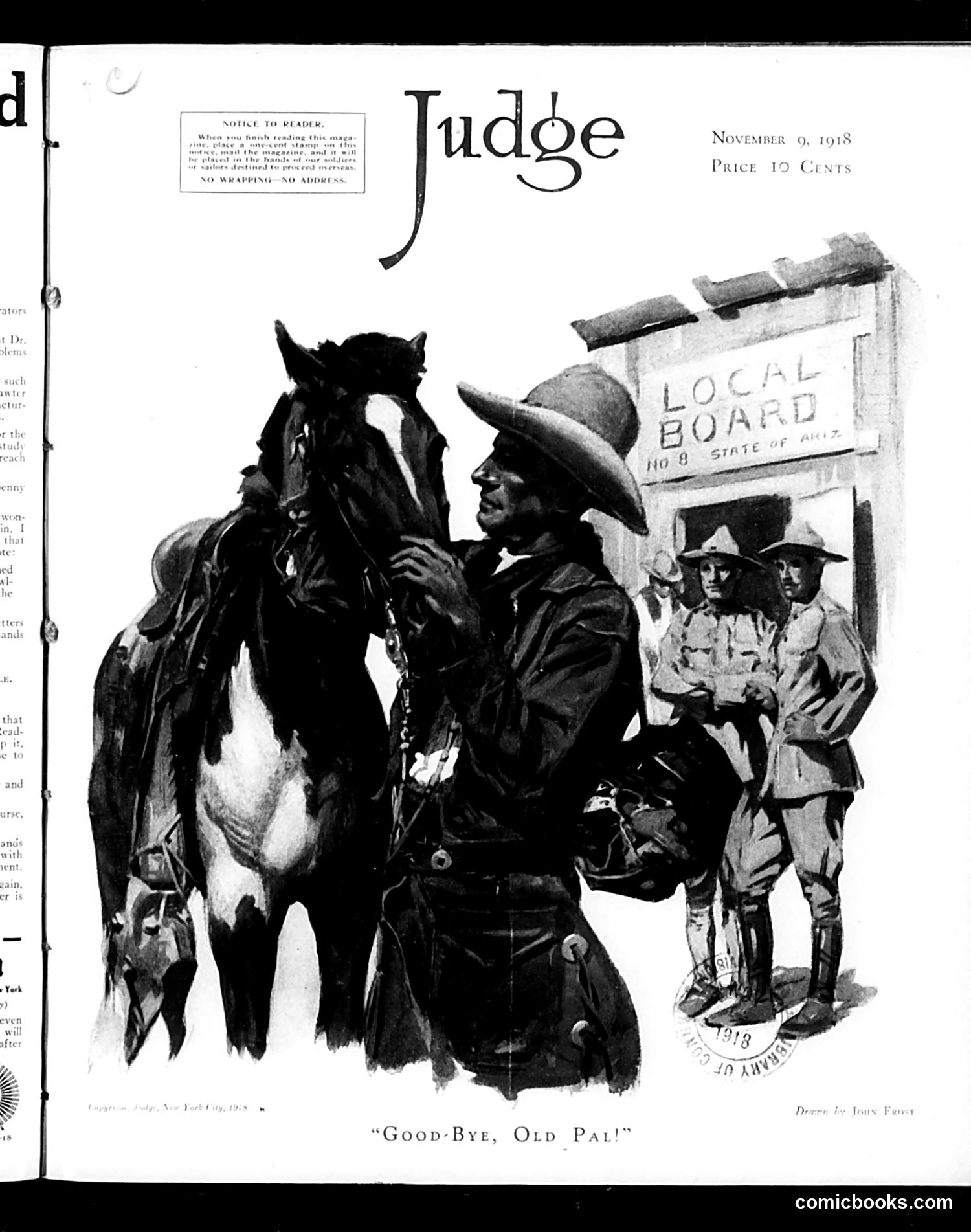
This Judge magazine cover from November 9, 1918 depicts a cowboy soldier saying farewell to his horse at a "Local Board" recruitment office, with other soldiers waiting nearby. The cartoon commemorates the end of World War I, which concluded with the Armistice on November 11, 1918—just two days after this publication. The "old pal" (the horse) represents the military equipment and wartime mobilization being retired as soldiers demobilized. The satire captures the bittersweet transition from wartime to peace: soldiers bidding farewell to their wartime companions and the military apparatus that sustained the war effort. The cowboy aesthetic emphasizes the American character of the troops heading home after the conflict's conclusion.
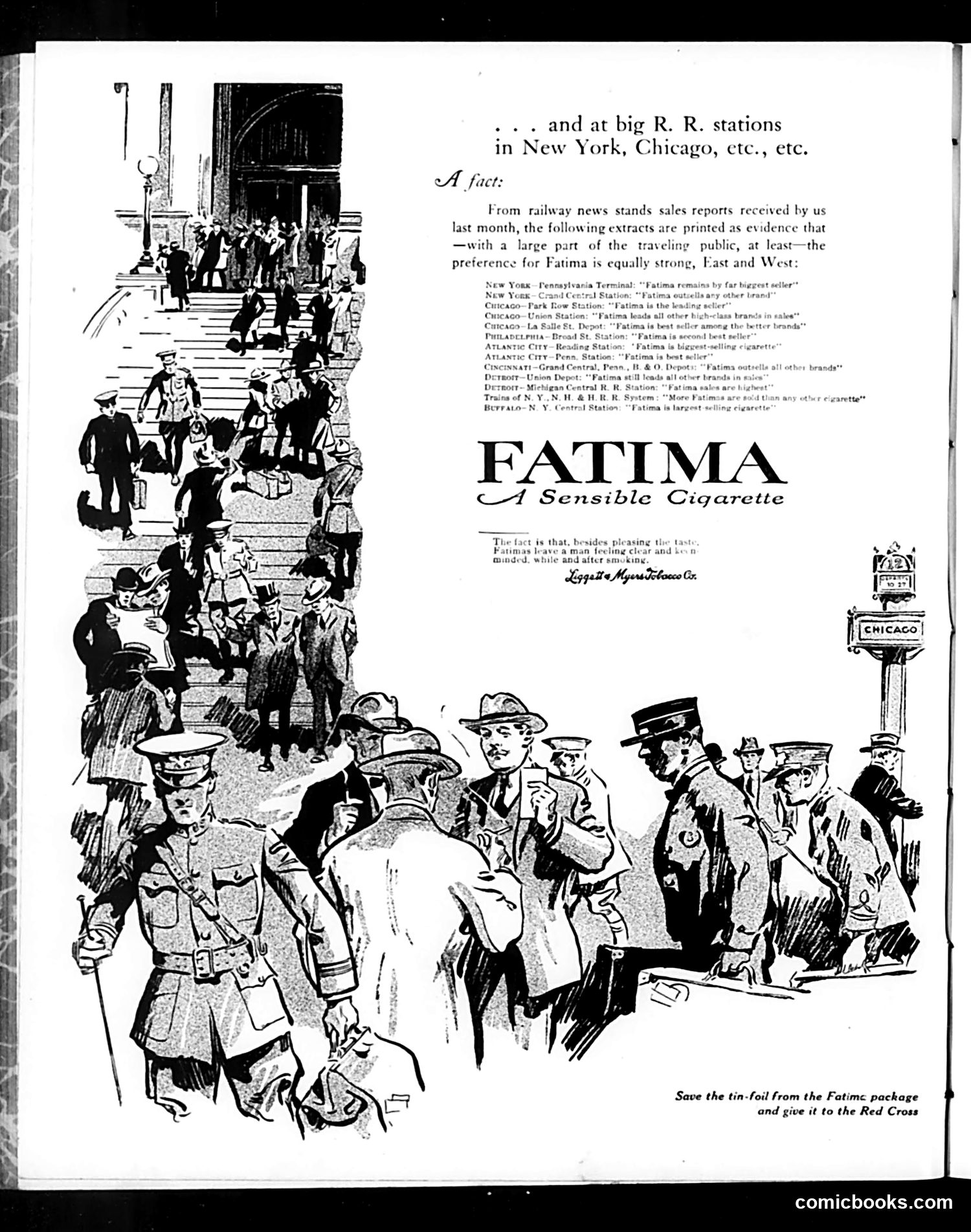
This page is primarily **advertising for Fatima cigarettes**, presented as a satirical editorial endorsement. The top section features sales-office testimonials from major U.S. railroad stations claiming Fatima is the top-selling cigarette brand everywhere—from New York to Chicago to Atlantic City. The cartoon below mocks this saturation by depicting soldiers and officials at a Chicago train station apparently distributing or celebrating Fatima cigarettes. The soldiers and formal dress suggest a patriotic/military context, likely referencing World War I-era nationalism. The satirical point: Fatima's ubiquity is so complete that even military personnel and government officials endorse it. The bottom instruction to "Save the tin-foil from the Fatima package and give it to the Red Cross" ties cigarette consumption to wartime patriotic duty—advertising disguised as civic contribution.
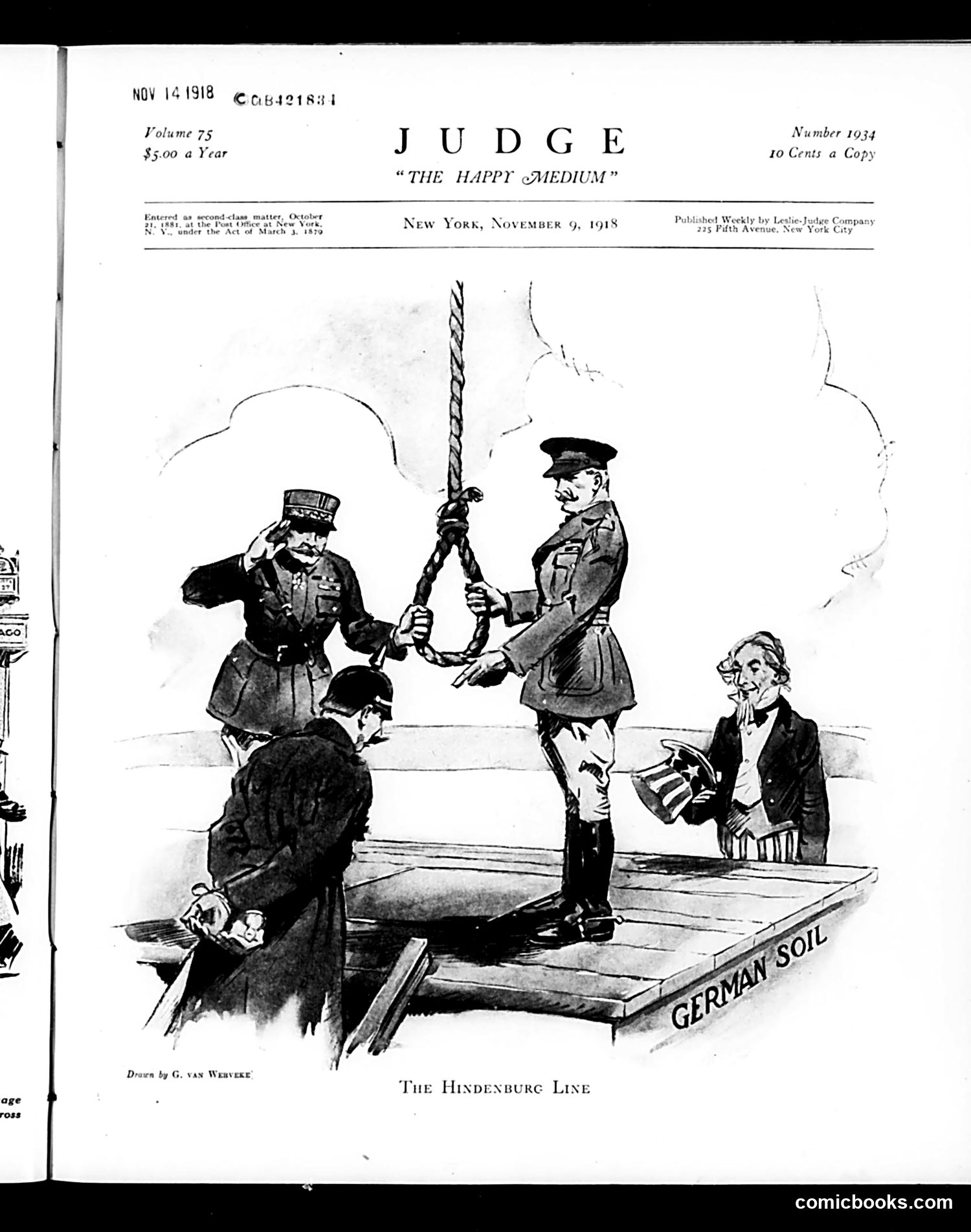
This political cartoon satirizes Germany's surrender in World War I, which occurred just days before this publication date. The cartoon depicts German military officers (identifiable by their uniforms and caps) executing a hanging on "German Soil"—the noose represents Germany's capitulation. The figure on the right appears to be a German civilian or politician witnessing the nation's defeat. The "Hindenburg Line" reference denotes Germany's primary defensive fortification on the Western Front, which had collapsed by autumn 1918, precipitating the armistice signed November 11. The cartoon celebrates Allied victory by portraying Germany's military defeat as self-inflicted destruction, a common satirical trope in American wartime publications.
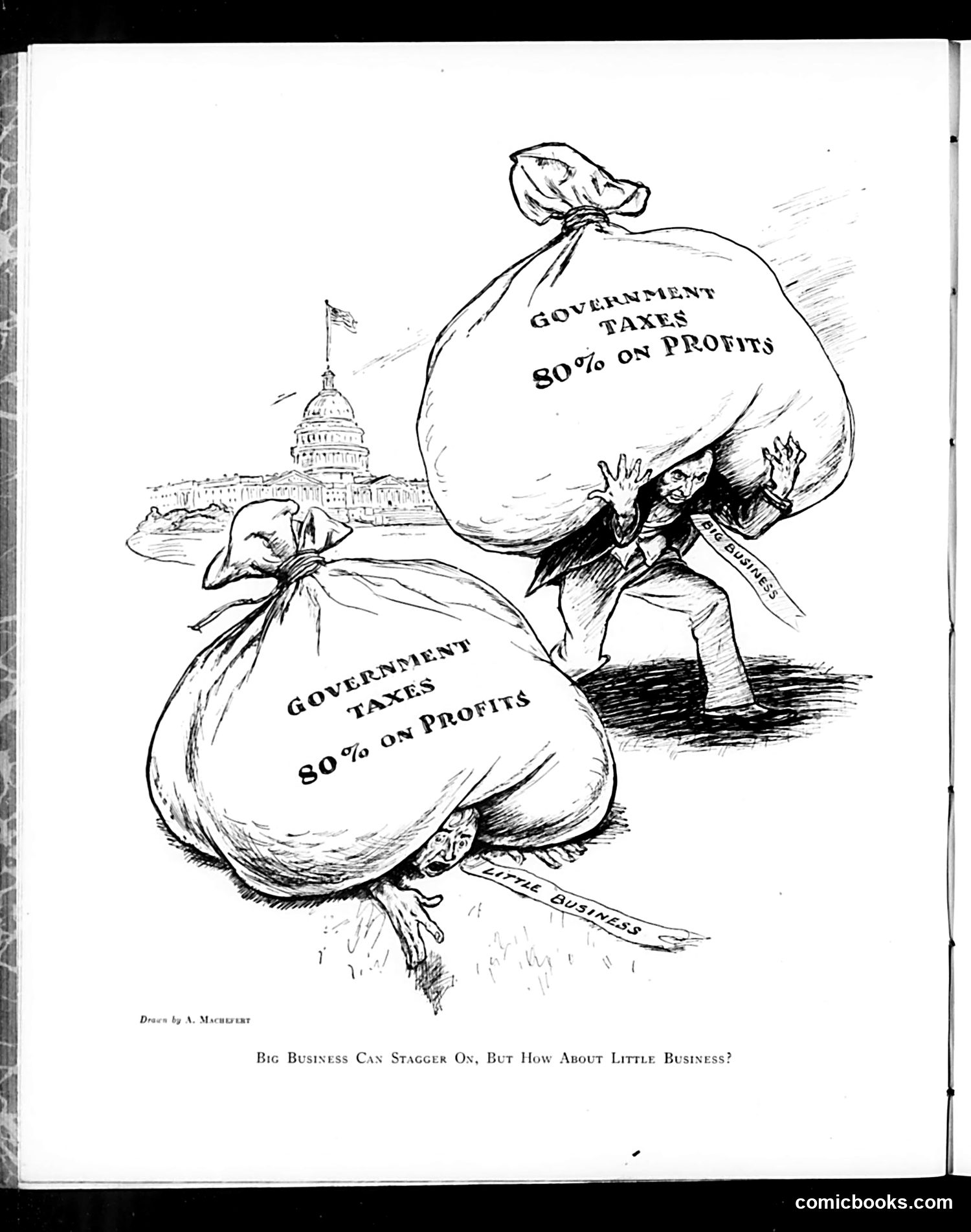
This cartoon critiques tax policy favoring large corporations over small businesses. Two figures representing "Big Business" and "Little Business" struggle under enormous sacks labeled "Government Taxes 80% on Profits." The Capitol building looms in the background, emphasizing government responsibility. The satire's point—stated in the caption "Big Business Can Stagger On, But How About Little Business?"—argues that while large corporations can absorb heavy taxation, small enterprises face financial ruin under identical tax burdens. The visual disparity (one figure carrying a manageable load versus another crushed by an enormous sack) illustrates how identical tax rates create unequal hardship. This reflects Progressive Era debates about whether government taxation should be scaled differently based on business size or profitability.
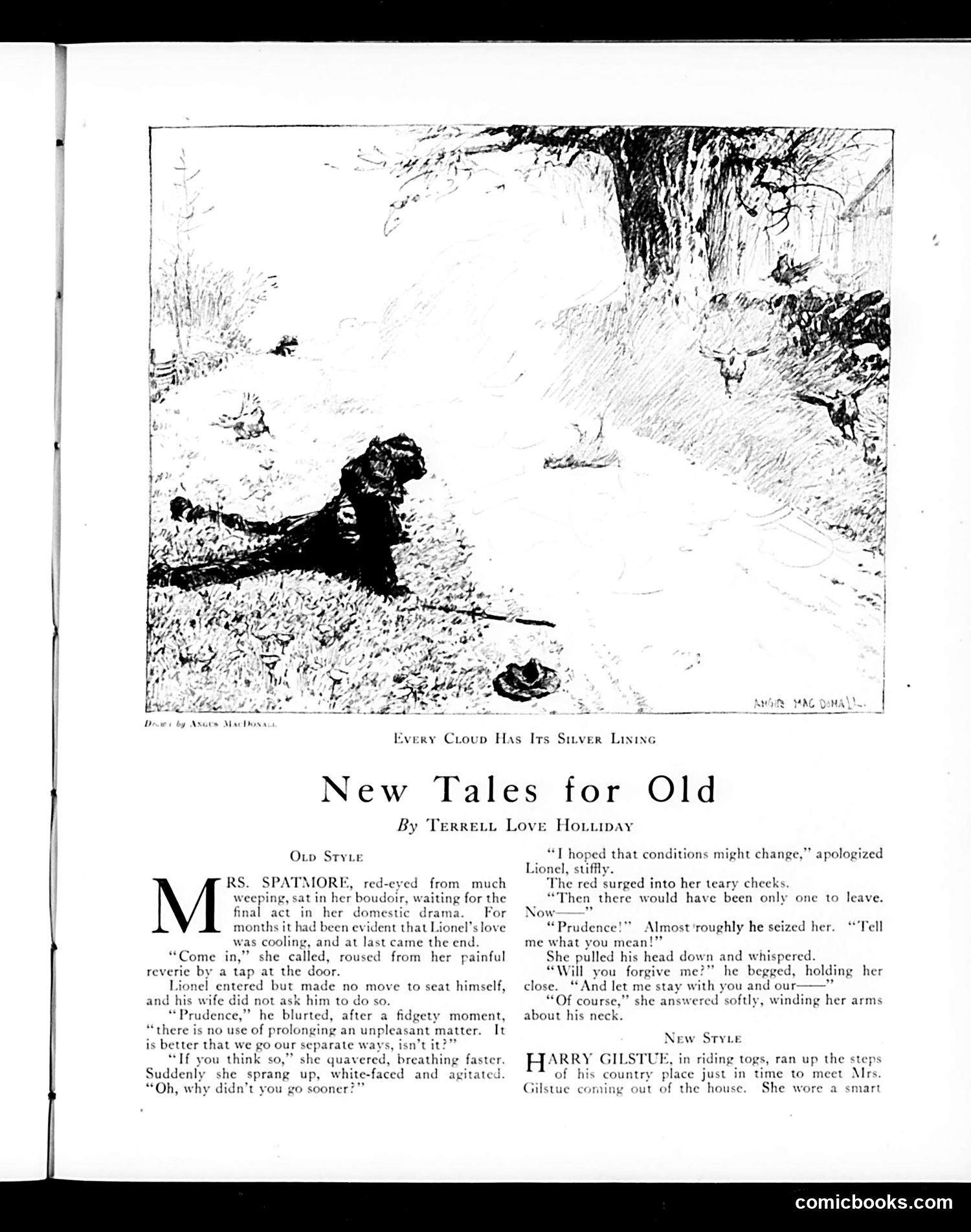
This page from *Judge* magazine contains a short story titled "New Tales for Old" by Terrell Love Holliday, not a political cartoon. The illustration at top depicts a scene from the narrative—showing figures in a rural or outdoor setting. The story itself appears to be a domestic drama: Mrs. Spatmore awaits her husband Lionel's return home, and when he arrives, they have an emotional confrontation about their relationship and separation. The narrative then shifts to introduce a character named Harry Gilstude. This is **fiction content**, not satire or political commentary. The proverb in the heading, "Every Cloud Has Its Silver Lining," suggests the story explores romantic reconciliation or redemption themes typical of early 20th-century popular magazine storytelling.
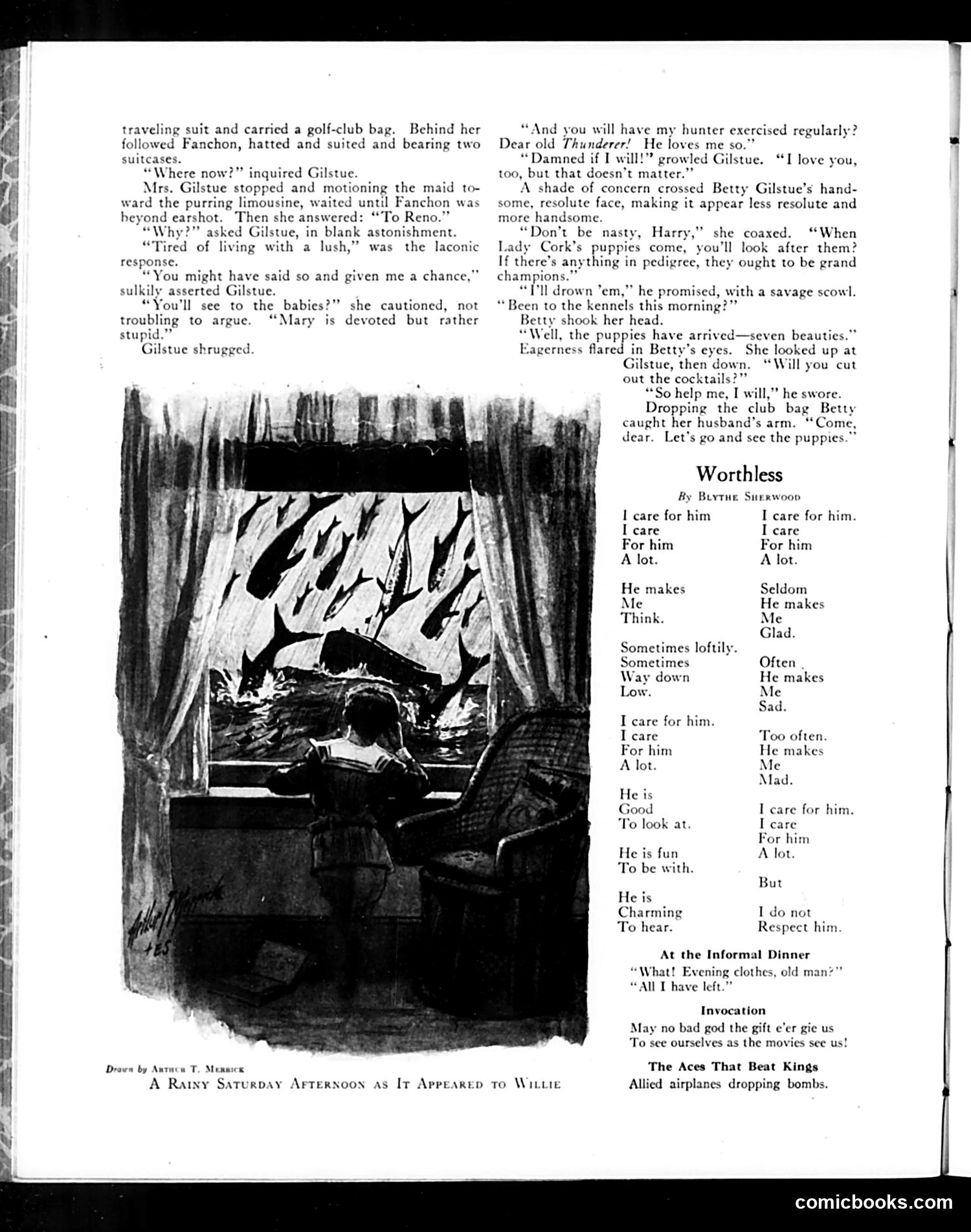
The page features a literary/artistic section rather than political satire. The main illustration, credited to Arthur T. Merriam, depicts an intimate domestic scene titled "A Rainy Saturday Afternoon as It Appeared to Willie"—showing two figures by a fireplace during inclement weather. The prose narrative above concerns characters named Gilstue and Betty, discussing dogs and puppies in somewhat genteel, gossipy fashion typical of early 20th-century magazine fiction. The right column contains poems by Blythe Sherwood titled "Worthless," "At the Informal Dinner," "Invocation," and "The Aces That Beat Kings"—offering satirical commentary on romantic relationships and human nature rather than political critique. This appears to be entertainment/literary content rather than political commentary.
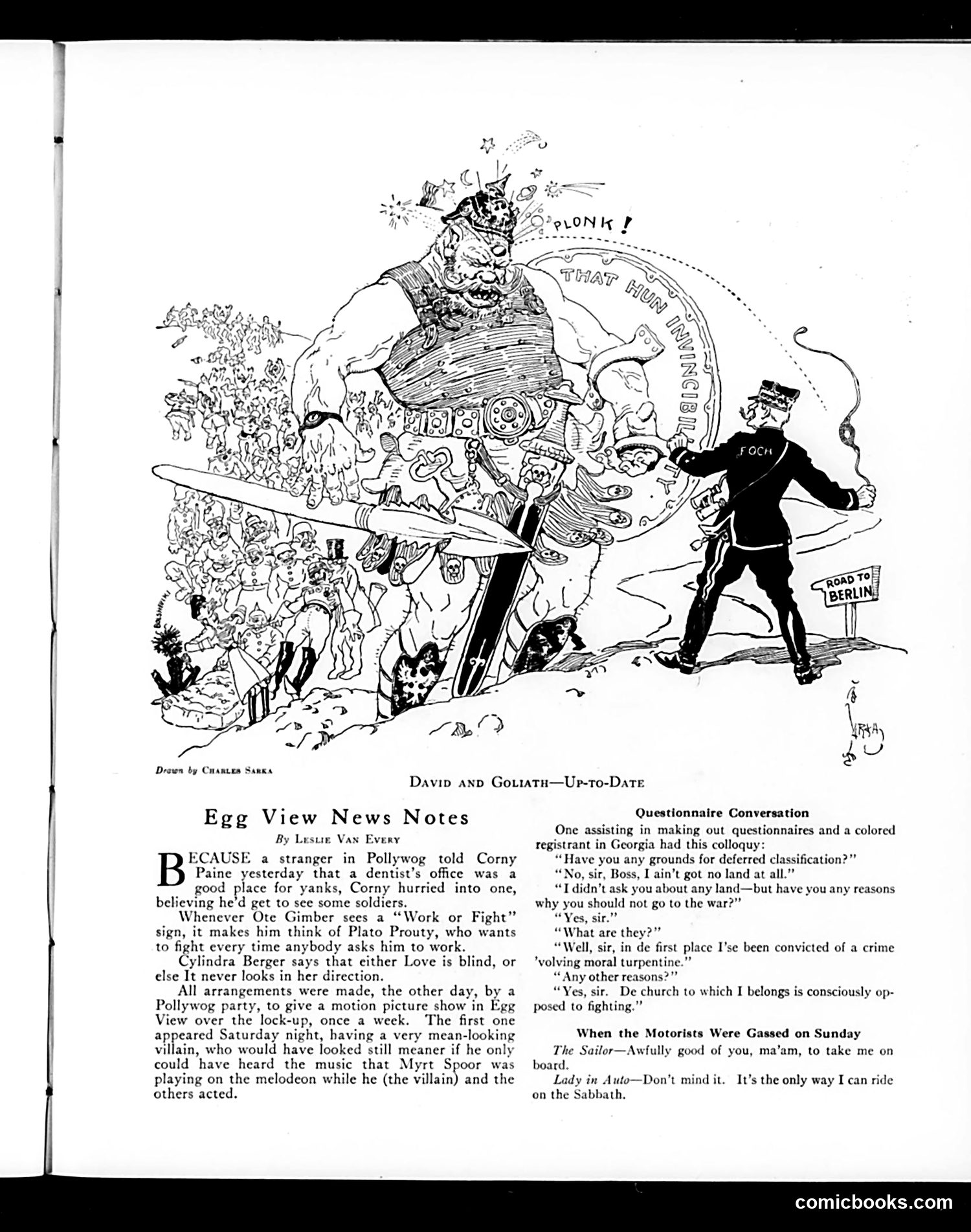
This Judge magazine page contains three satirical pieces, likely from WWI era (references to "Work or Fight" signs and military service): **Main Cartoon**: The top illustration parodies the biblical David vs. Goliath story with modern characters. A figure labeled "Foch" (French military commander) faces an enormous, chaotic mass labeled "That Hun Business"—representing German forces. The satire suggests the Allies must confront an overwhelming enemy, using the familiar biblical narrative to frame contemporary military struggle. **Lower Sections**: Brief humorous anecdotes mock conscription bureaucracy and social hypocrisy. The "Questionnaire Conversation" ridicules a Black registrant's absurd evasion attempts (citing a criminal conviction and church pacifism). The motorist joke critiques wealthy women claiming religious scruples while conveniently violating Sabbath rules. The overall tone is patriotic mockery—poking fun at draft-dodgers, bureaucratic absurdity, and moral inconsistency among the civilian population during wartime.
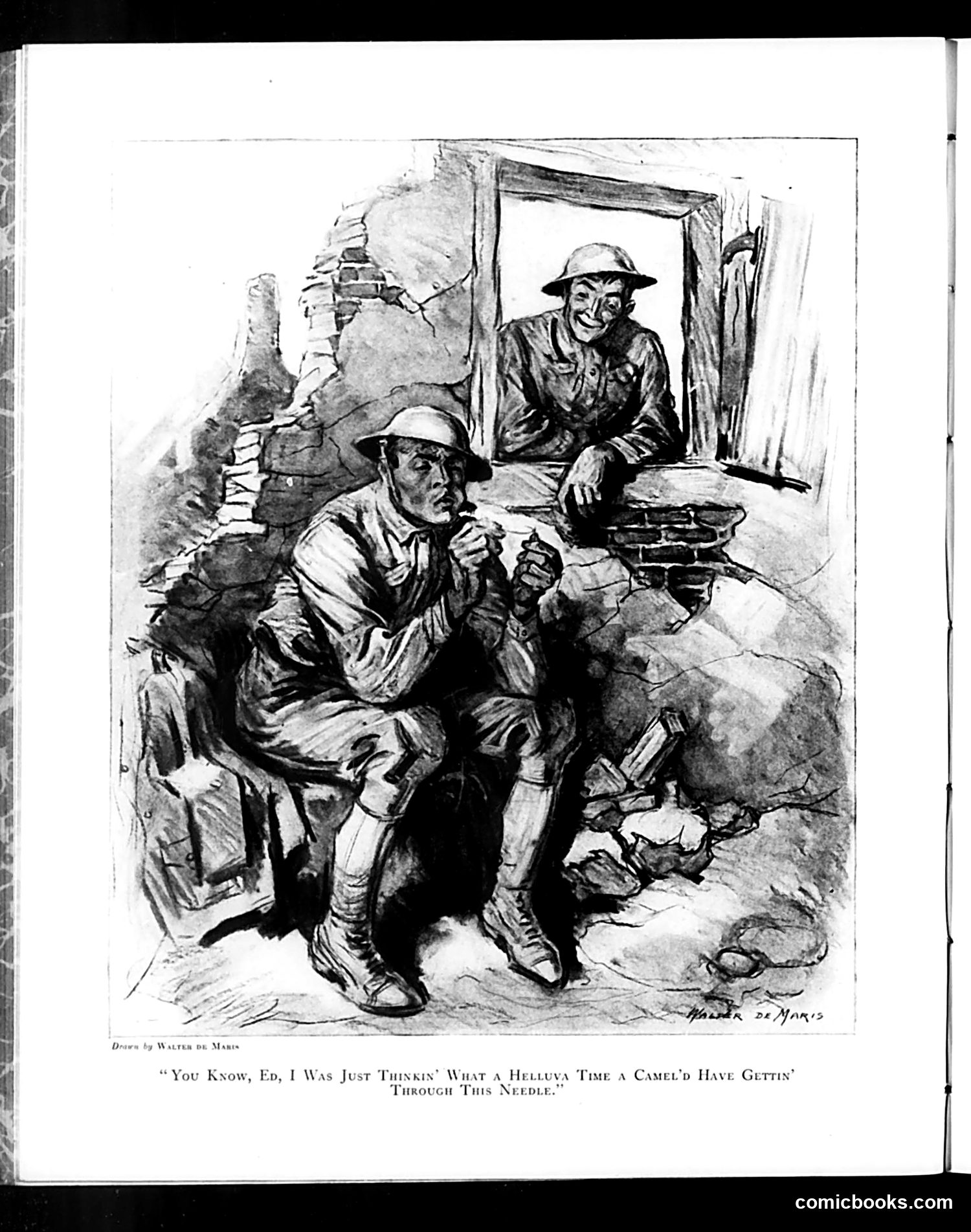
This WWI-era Judge cartoon by Walter de Maris depicts two soldiers in a trench discussing the difficulties of advancing through barbed wire obstacles. One soldier, seated and smoking, remarks to his companion "Ed" about how challenging it would be for a camel to navigate through such defenses. The humor appears to be absurdist wartime banter—soldiers making lighthearted observations about impossible scenarios to cope with the grim realities of trench warfare. The reference to camels is likely either: 1. A non-sequitur joke typical of soldiers' dark humor 2. A possible reference to Middle Eastern campaigns (though unclear without fuller context) The cartoon satirizes the brutal conditions of WWI trench warfare while capturing soldiers' coping mechanisms through gallows humor. The crude dialect spelling reflects early 20th-century comic conventions.
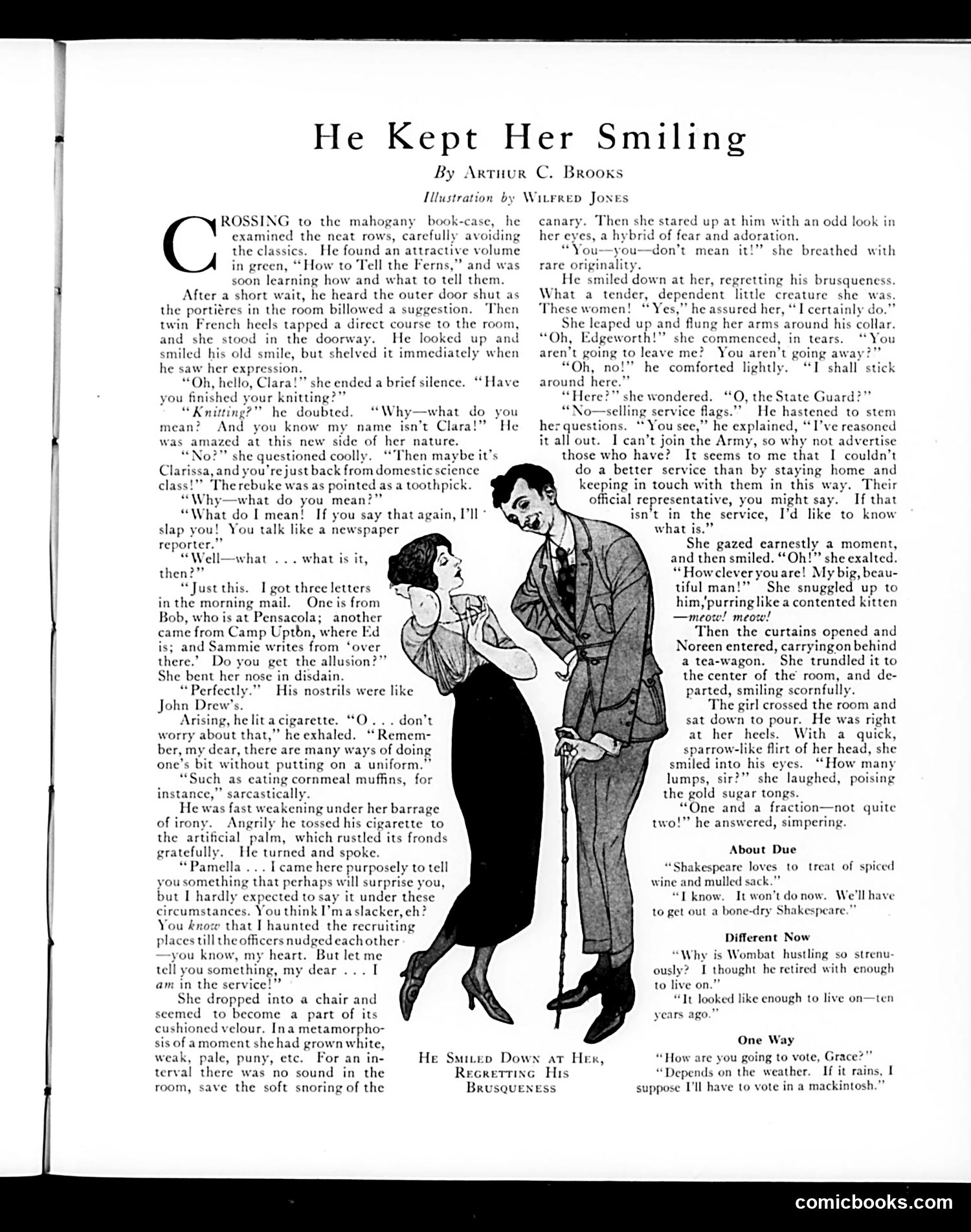
This story satirizes men who avoided military service during World War I. The protagonist initially deceives his girlfriend Clara/Pamella by pretending to read about ferns while she receives letters from three boyfriends actually serving—one at a naval base (Pensacola), one at a military camp (Upton), and one "over there" (in Europe). When confronted as a "slacker" (draft dodger), he claims to be "in the service"—but reveals he merely *sells service flags* (small flags families displayed to indicate sons/relatives serving). The satire is sharp: he convinces her of his patriotism through this trivial contribution while avoiding actual combat. The girlfriend's rapid emotional shift from contempt to admiration upon hearing he's "in the service" (before understanding what that means) mocks how easily women could be manipulated by pseudo-patriotic claims. The joke undercuts both the man's cowardice and her gullibility, reflecting 1910s anxieties about male war participation and national commitment.
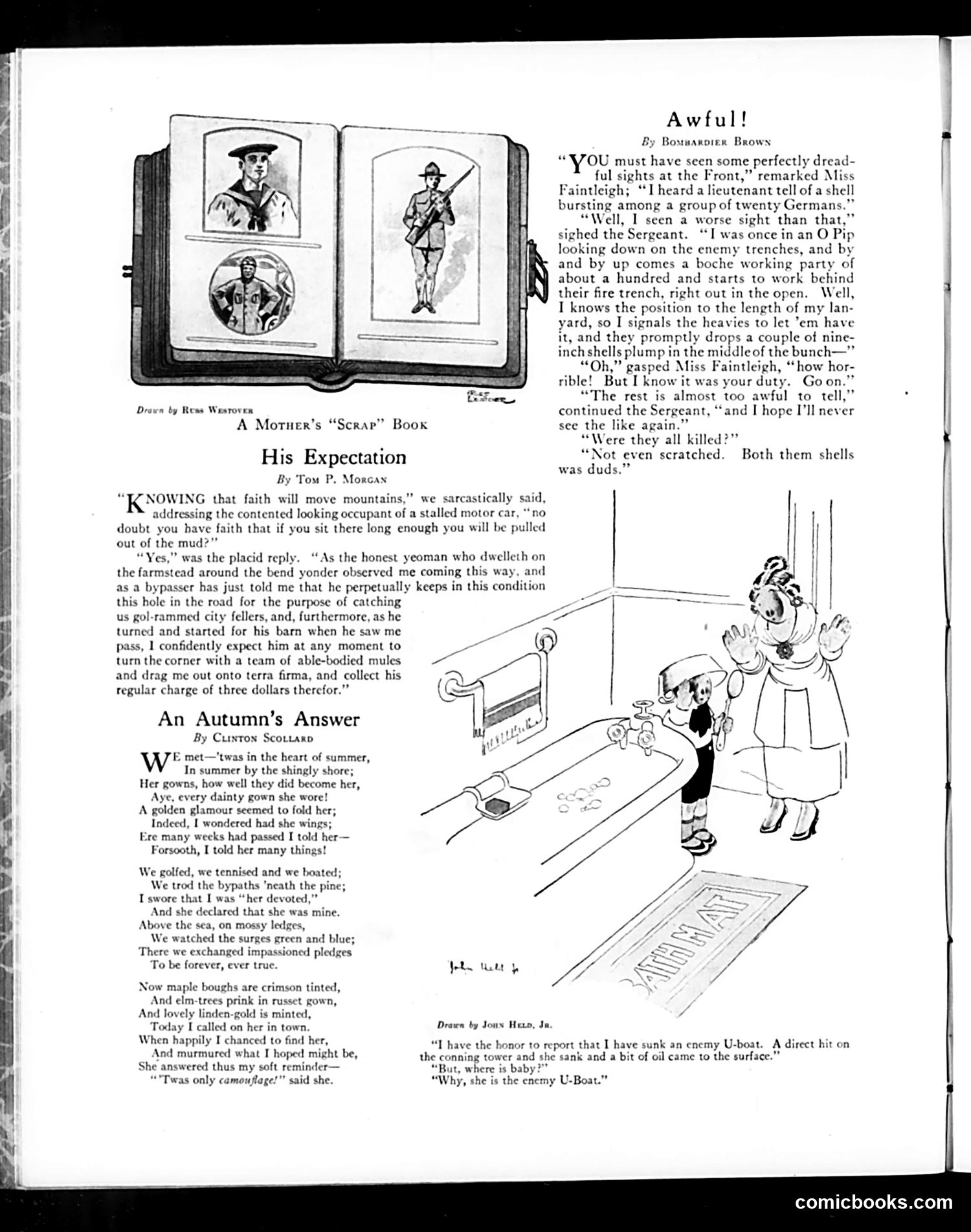
This page contains three distinct pieces of WWI-era satirical content: **"Awful!"** mocks the disconnect between civilian expectations of combat and military reality. A sergeant describes an apparently devastating artillery strike on German troops—the setup suggests massive casualties. The punchline reveals both shells were duds, killing no one. The satire targets either the unreliability of military equipment or civilians' dramatized assumptions about warfare. **"His Expectation"** is a humor piece about a motorist stranded in a muddy road, confidently expecting a local farmer to help—based on "faith moving mountains." The joke plays on urban-rural stereotypes and misplaced optimism. **"An Autumn's Answer"** is a romantic poem where a man recalls a passionate summer romance, only to have the woman dismiss their pledges as mere "camouflage" when he encounters her again in autumn. It's a sentimental commentary on fleeting romance or wartime goodbyes. The military theme and references ("O Pip," U-boats, "boche") confirm this is from WWI's active period.
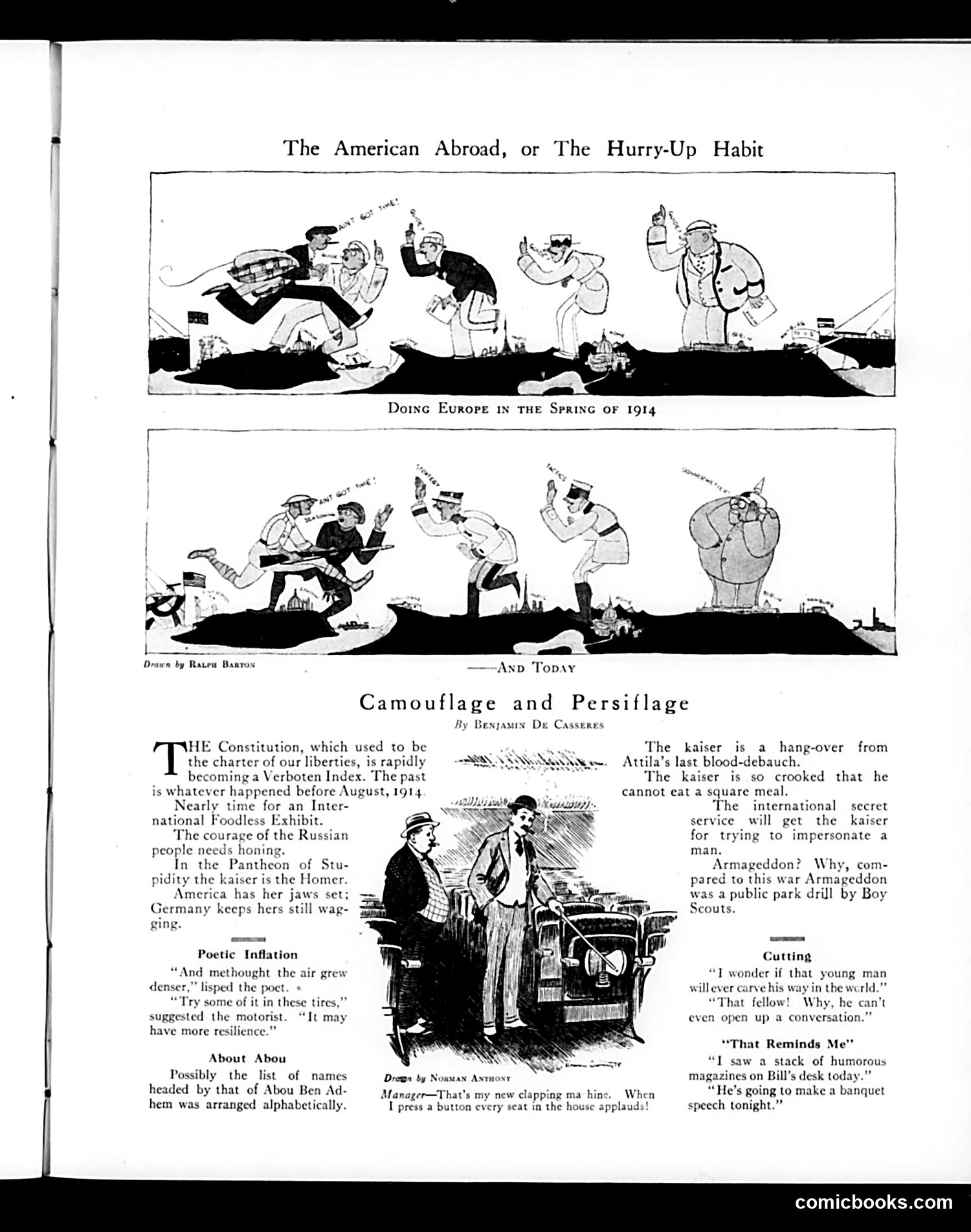
The top cartoon mocks American tourists' frantic pace abroad during early WWI. It contrasts "Doing Europe in the Spring of 1914" (pre-war leisurely travel) with "And Today" (wartime rushed tourism), showing Americans frantically cramming sightseeing while conflict erupts around them—satirizing the American "hurry-up habit" of treating travel like a checklist. Below, brief satirical items attack Germany's Kaiser Wilhelm II as a prehistoric brute ("hang-over from Attila") and tactlessly crooked. Other quips mock wartime absurdities: the Constitution becoming "Verboten" (forbidden, like German rules), a "Foodless Exhibit" referencing food shortages, and inflated rhetoric. A cartoon shows a theater manager with a mechanical applause button—satirizing false enthusiasm or propaganda. The page reflects American attitudes during 1914: viewing the Kaiser as barbaric, anxiety about constitutional freedoms, and somewhat detached amusement at European chaos.
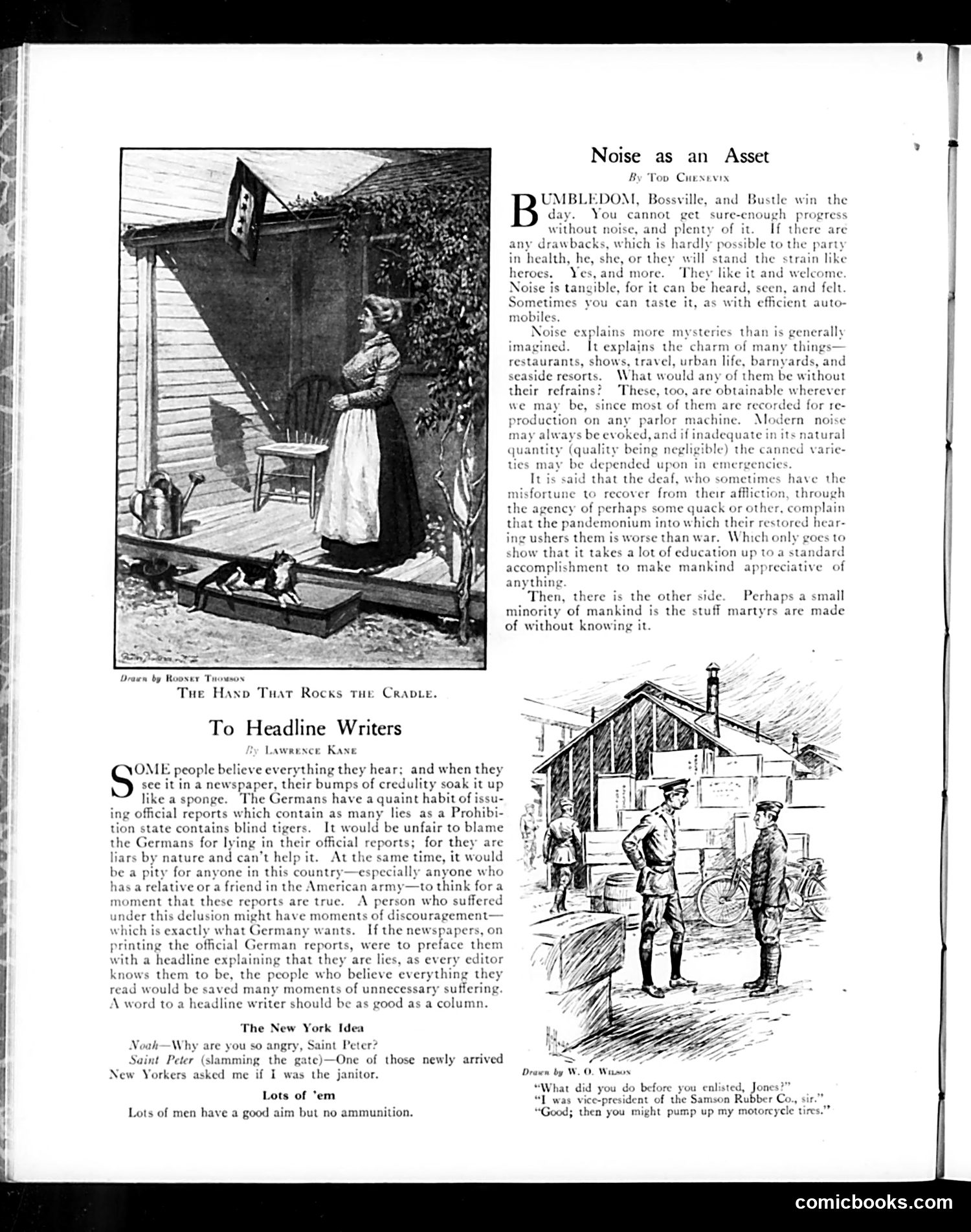
**"Noise as an Asset"** (by Tod Clveneix): A humorous essay defending noise as essential to modern life—restaurants, travel, urban activity all require it. The essay acknowledges that some find noise disturbing but argues it's inescapable in contemporary society. The accompanying illustration shows a woman rocking a cradle, the archetypal "hand that rocks the cradle," establishing noise's presence even in domestic life. **"To Headline Writers"** (by Lawrence Kane): A wartime criticism of American newspapers. Kane argues editors must clearly label German official military reports as lies rather than printing them uncritically. He warns that credulous readers—especially those with relatives in the American army—might suffer demoralization if they believe German propaganda. This appears to be WWI-era commentary on the need for responsible journalism when publishing enemy communications. **Two minor jokes** follow, including one about a proud New Yorker mistaking Saint Peter for a janitor, mocking New York arrogance.
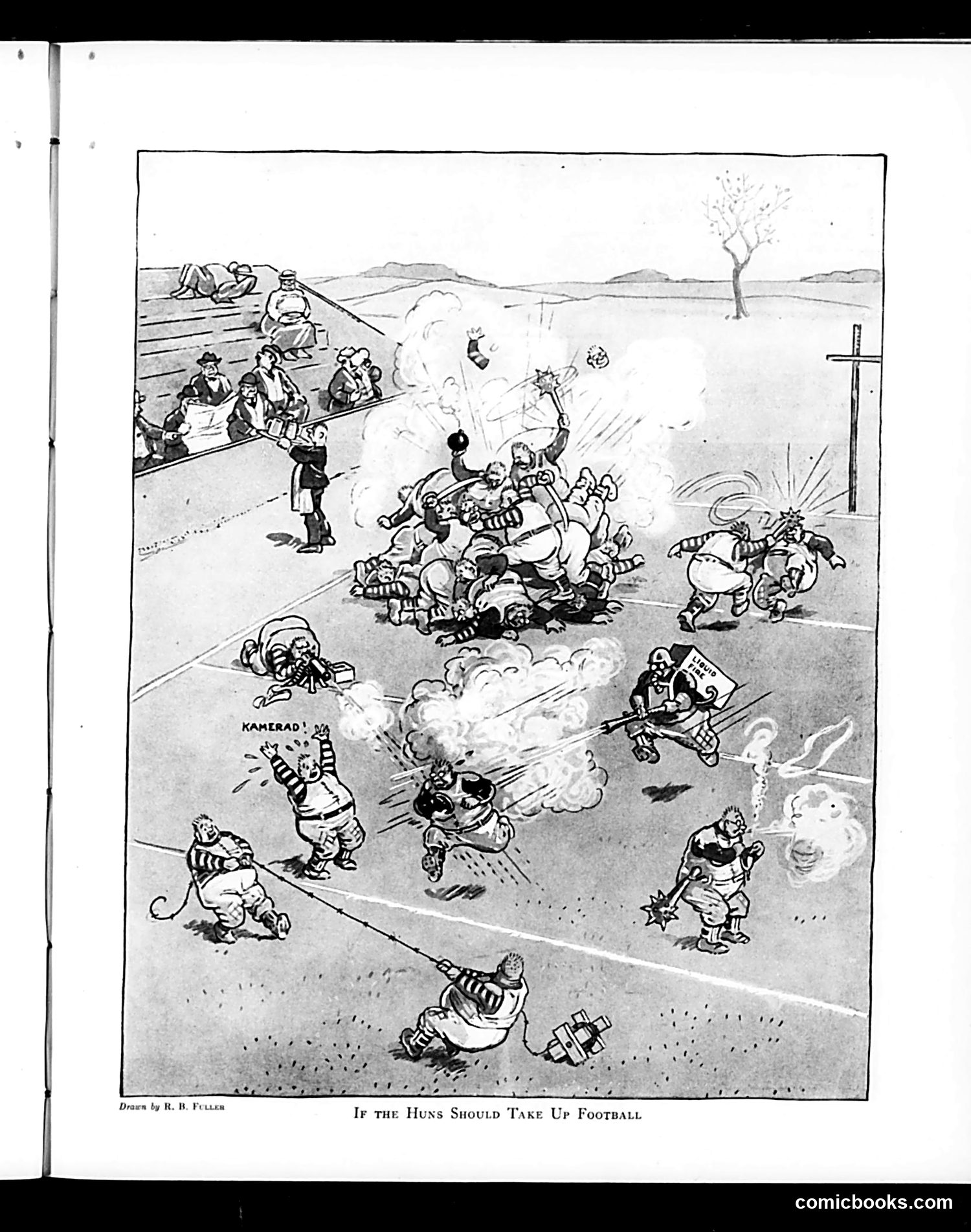
This satirical cartoon by R.B. Feuele imagines a hypothetical scenario where German soldiers ("Huns"—a dehumanizing WWI-era term for Germans) play American football. The drawing shows caricatured German military figures in football gear engaged in a chaotic, violent game. The satire works on multiple levels: it mocks both German militarism and American football's brutality by conflating them. The joke suggests that Germans' aggressive military nature would translate naturally to football's violent contact sport. The cartoon likely dates from the World War I period, when anti-German sentiment was high in America. It uses grotesque caricatures and the absurdist premise to ridicule the enemy while also gently critiquing American football itself as barbaric.
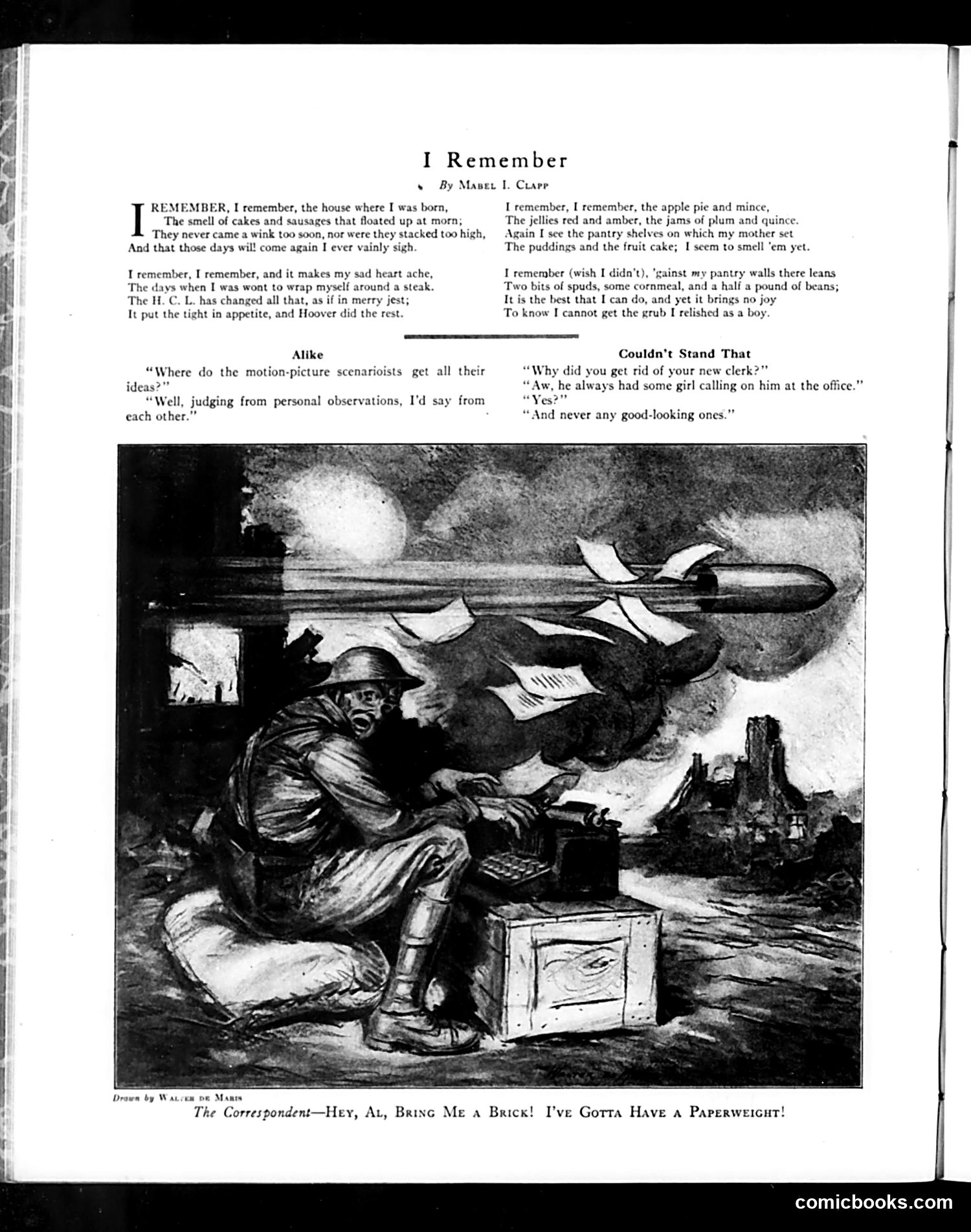
This *Judge* magazine page contains nostalgic humor about post-WWI American hardship, likely from the early 1920s. **"I Remember"** (poem by Mabel I. Clapp): Satirizes the contrast between pre-war abundance and current scarcity. References to "H.C.L." (High Cost of Living) and "Hoover" (President Herbert Hoover) blame wartime/postwar inflation and government policy for food shortages. The speaker laments losing hearty meals—steaks, apple pie, puddings—now replaced by beans and cornmeal. **"Alike"** (two-line joke): Mocks Hollywood screenwriters for copying each other's ideas rather than creating original work. **"Couldn't Stand That"** (office joke): Plays on unexpected prudishness—a boss fires a clerk not for *having* a girlfriend calling at work, but for her lack of attractiveness. **Bottom cartoon**: Depicts a WWI soldier/correspondent under fire, requesting a brick as a paperweight—dark humor about wartime chaos and absurdity. The page reflects 1920s anxieties about economics, entertainment mediocrity, and war's lingering effects.
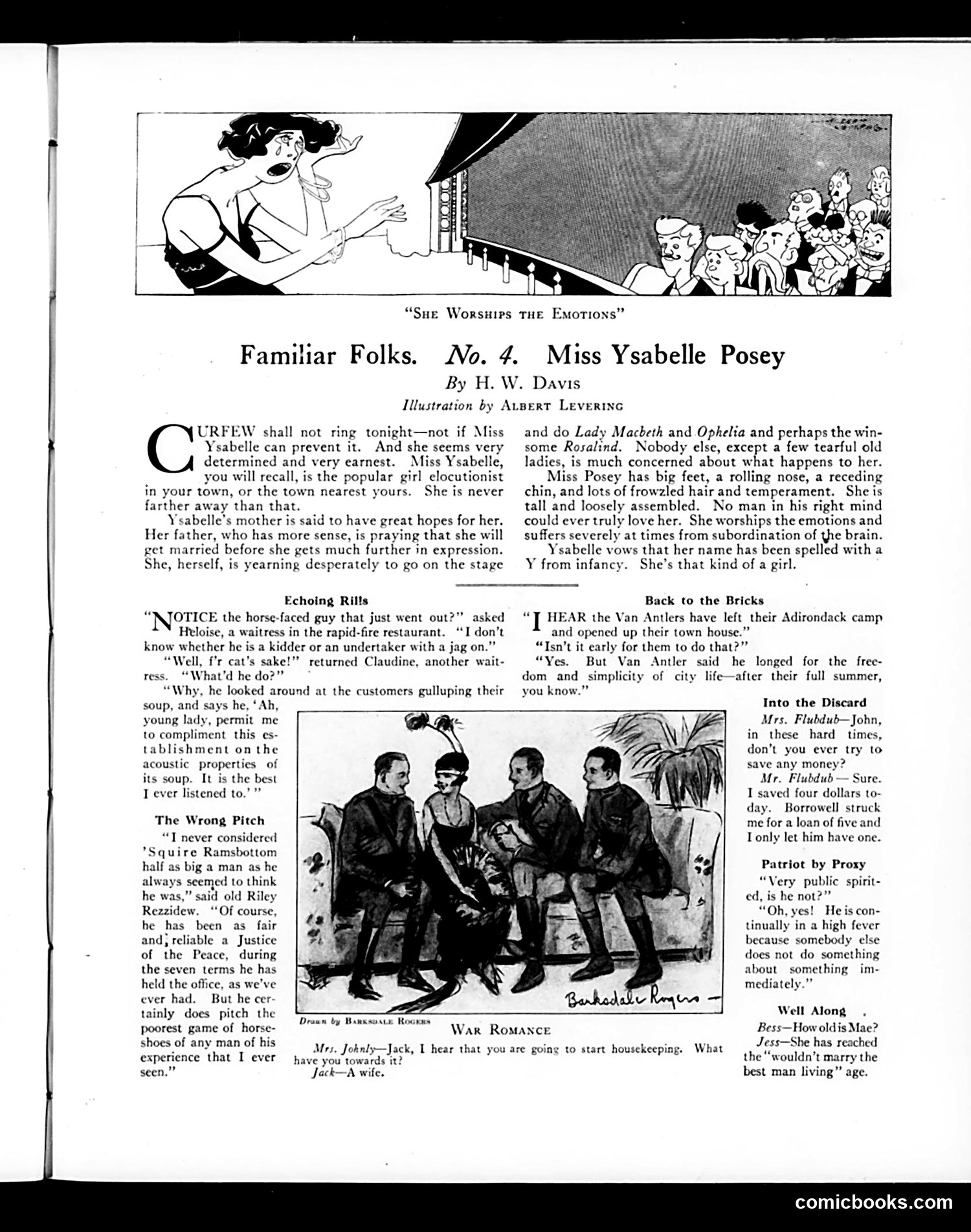
This satirical piece mocks a common social type of the era: the amateur female elocutionist (dramatic reciter) with theatrical ambitions. Miss Posey is physically unattractive ("big feet, a rolling nose, a receding chin") yet obsessed with performing Shakespeare and other dramatic roles. The satire's point: she "worships the emotions" while lacking the brain or talent to match her aspirations. Her parents' contrasting reactions—mother hopeful, father praying she'll marry instead—reflect period anxiety about young women pursuing stage careers. The surrounding comic snippets mock other social pretenses: affected soup-compliments, wealthy families performing rural simplicity, failed political ambitions, and marriages of convenience. The overall message targets middle-class pretension and emotional self-indulgence across multiple contexts.
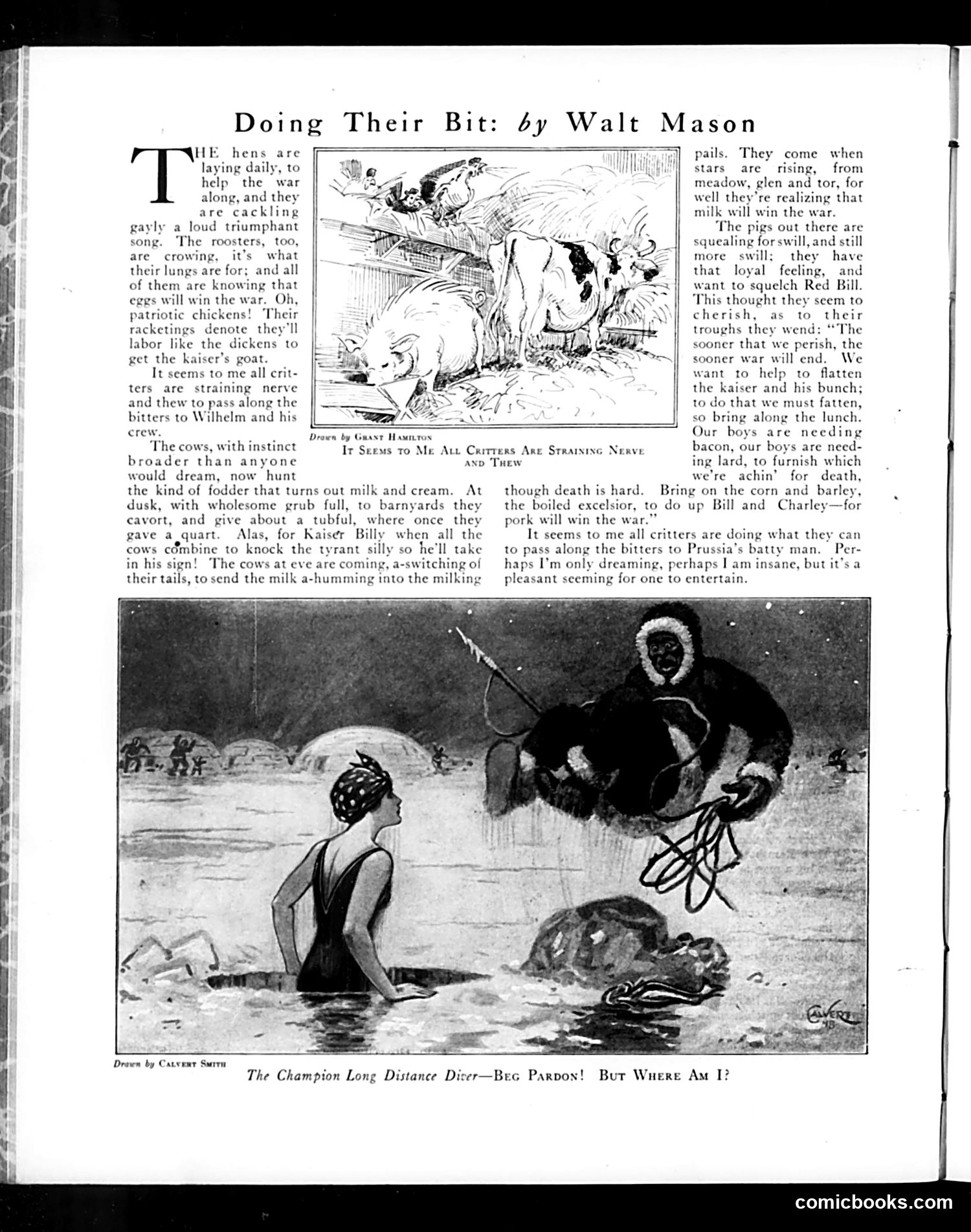
This is a WWI-era propaganda piece celebrating American farm animals' patriotic contributions to the war effort. Mason's poem personifies chickens, cows, and pigs as willing participants in supporting the war against Germany ("Kaiser Billy"). Each animal—laying eggs, producing milk, providing pork—is portrayed as consciously sacrificing for victory, with their products framed as weapons against the enemy. The top cartoon (by Cesare Hamilton) shows farm animals straining with effort, symbolizing their collective labor. The bottom cartoon (by Cesare Smith), titled "The Champion Long Distance Diver—Beg Pardon! But Where Am I?" depicts a woman in water with what appears to be a sea creature or diver, likely making a humorous non-sequitur or visual pun unrelated to the text above. The piece uses gentle anthropomorphization to encourage food production and boost civilian morale during wartime.
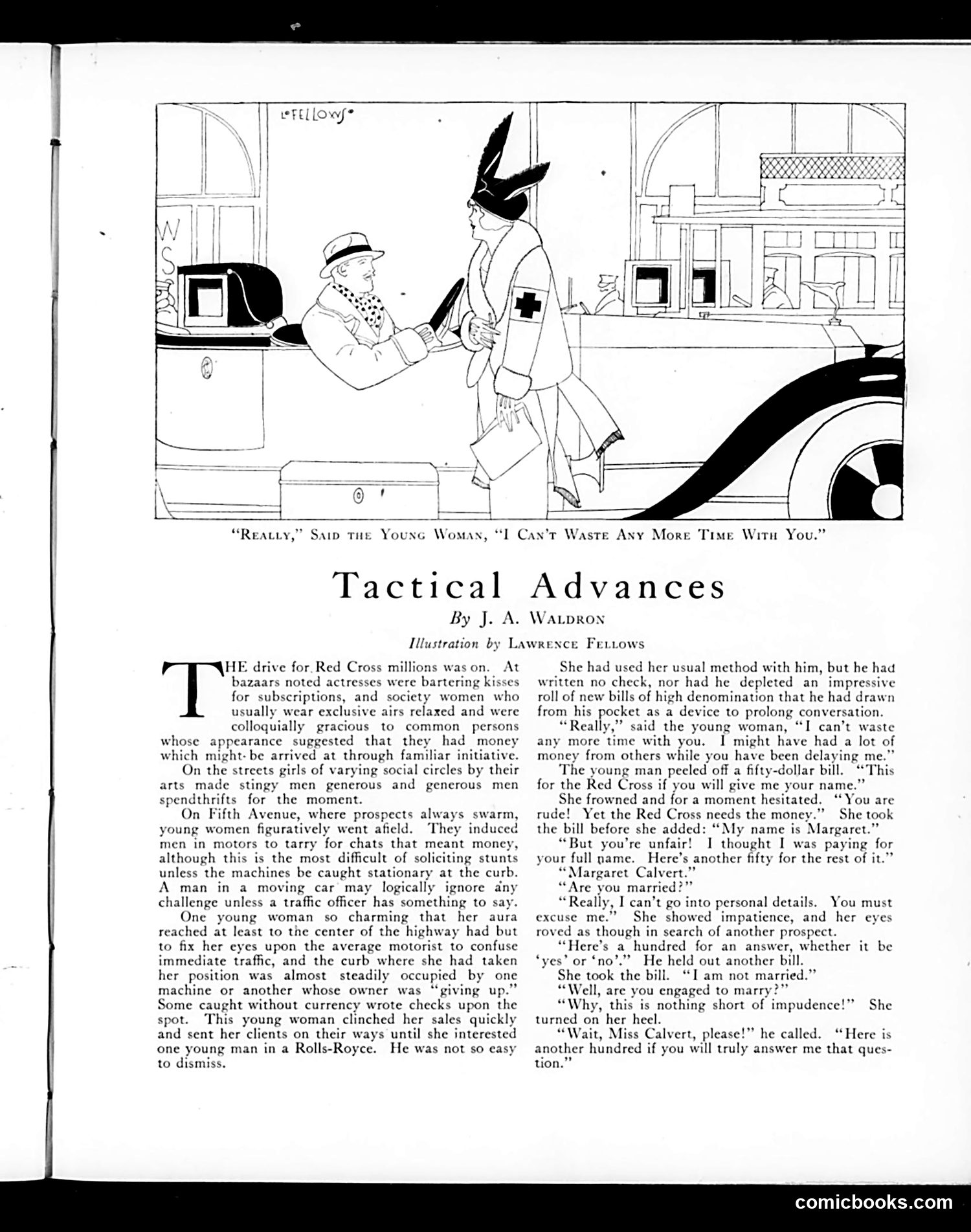
This story satirizes the Red Cross's aggressive 1910s fund-raising campaigns, which employed attractive women soliciting donations from wealthy men on city streets—particularly Fifth Avenue. The "tactical advance" refers to the young woman's calculated strategy of withholding personal information to extract money from a persistent motorist. The humor lies in the reversal: rather than the man using money to charm information from her, she repeatedly sells him answers about her identity and marital status. He keeps paying escalating amounts ($50, then $100) for each revelation. The satire mocks both the commercialized nature of wartime charity appeals and the gullibility of wealthy men who'll pay handsomely for conversation with an attractive woman—all ostensibly for a worthy cause. The cartoon illustrates the text's point: modern fund-raising had become a calculated transaction blurring charity, romance, and mercenary exchange.
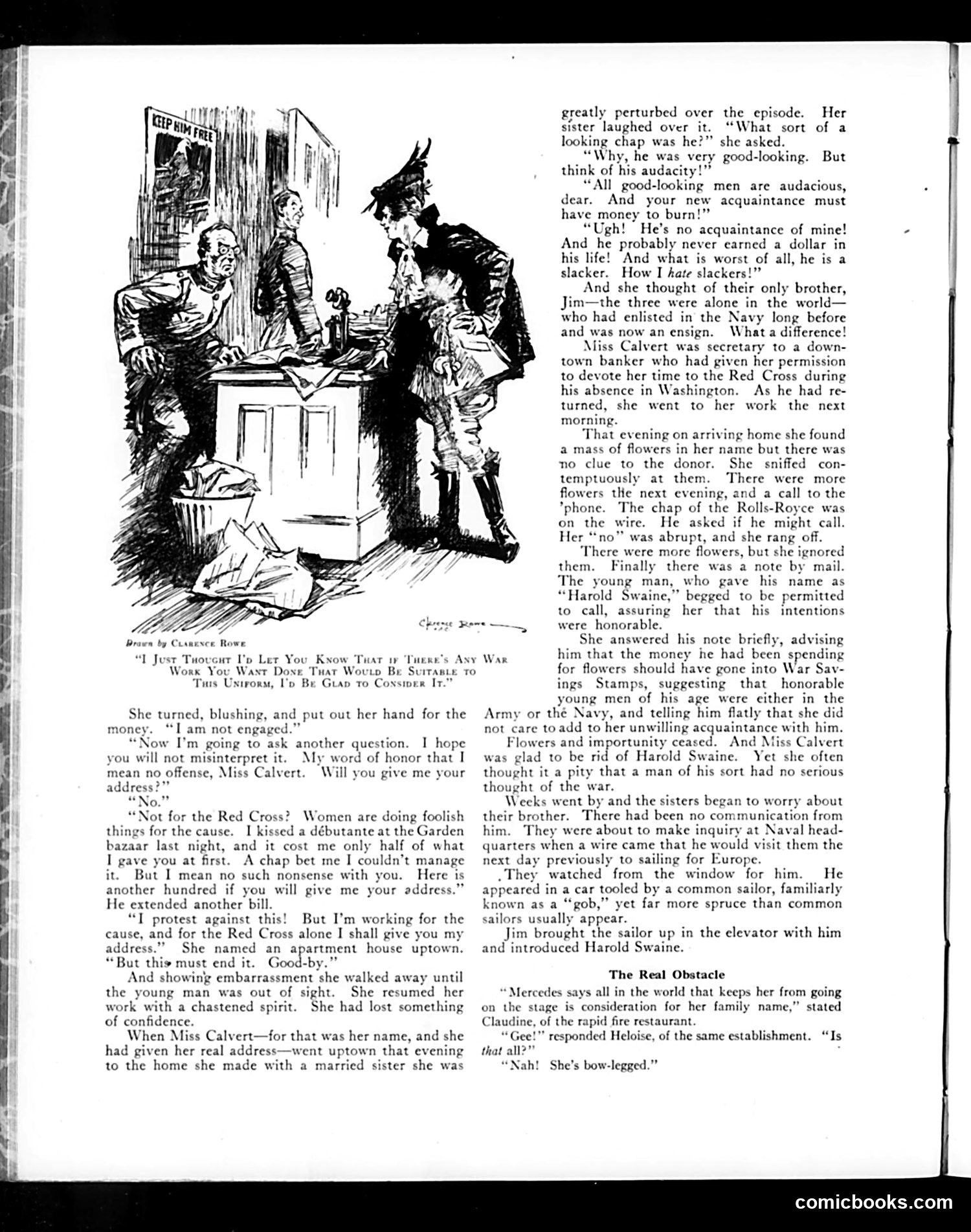
This cartoon satirizes wealthy young men avoiding military service during World War I. The narrative follows Miss Calvert, a Red Cross volunteer, who rebuffs an affluent, persistent suitor named Harold Swaine. She despises him as a "slacker"—a man of draft age unwilling to serve—contrasting him with her own brother Jim, who enlisted in the Navy. The irony unfolds when Jim arrives home on leave in a car driven by a common sailor ("gob"). The title "The Real Obstacle" suggests the satire: wealthy idleness and social pretension, not poverty or circumstance, prevent men like Swaine from serving. His audacity in courting Miss Calvert while others sacrifice illustrates the moral bankruptcy Judge associated with draft dodgers. The cartoon criticizes both Swaine's cowardice and the social system that allowed privileged men to avoid military obligation during WWI.
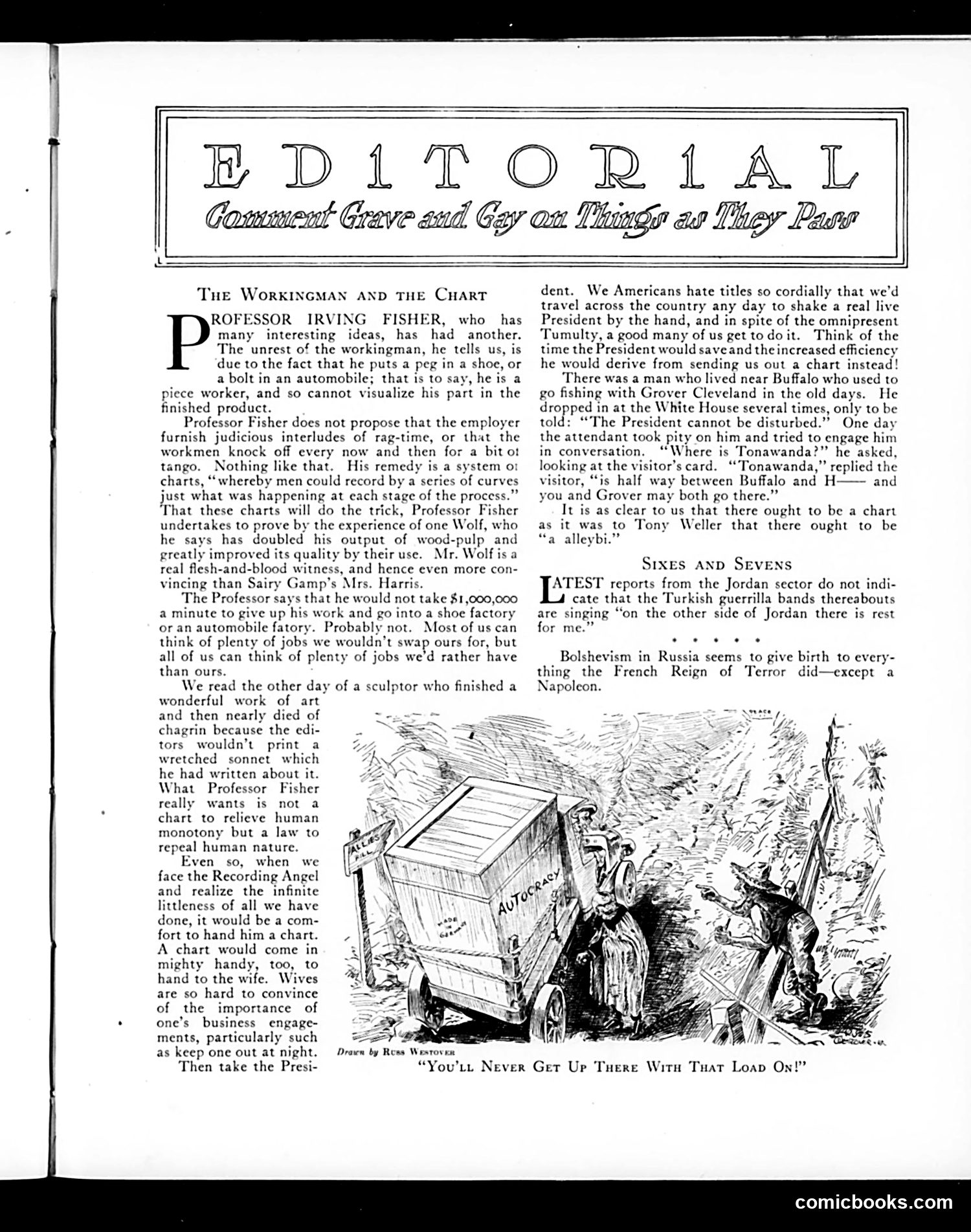
This editorial page satirizes **Professor Irving Fisher's** proposal to improve factory worker productivity through charts tracking output at each production stage. The satire operates on multiple levels: **The Main Argument:** Fisher claims workers suffer monotony because they can't visualize their contribution to finished products. Charts would solve this. The editorial ridicules this as naive—no chart can "repeal human nature." **The Satire's Points:** - A chart won't make tedious work meaningful - Workers' real problem isn't lack of visualization but monotony itself - Even the President should use charts to manage visitors (a jab at administrative inefficiency) - The accompanying cartoon shows an overloaded truck struggling uphill, captioned "You'll Never Get Up There With That Load On!"—suggesting charts won't fix fundamental problems **Historical Context:** This reflects early-20th-century debates over scientific management and worker alienation during industrialization. The other brief items mock Turkish guerrillas and Russian Bolshevism, standard Judge fare for the period.
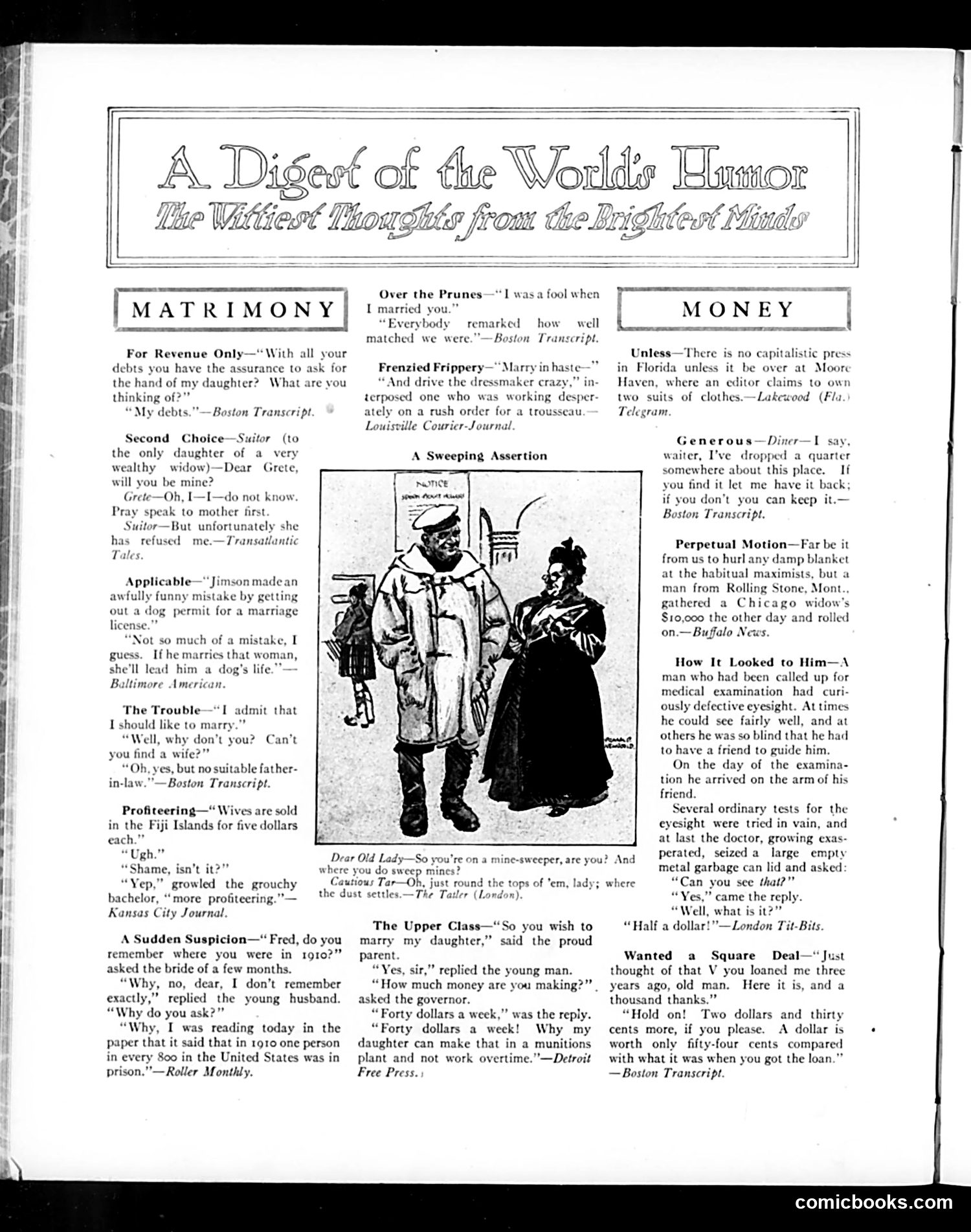
This page collects brief satirical jokes on marriage, money, and social hypocrisy, typical of early 20th-century American humor magazines. The central cartoon depicts a street scene with a military or uniformed figure and a woman, captioned "Dear Old Lady—So you're on a mine-sweeper, are you?" The joke plays on the double meaning: she asks about his wartime occupation (sweeping for naval mines), but the pun suggests domestic "sweeping." Surrounding jokes mock matrimony as a financial transaction ("For Revenue Only" — marrying for money), the dangers of hasty wedding expenses ("Frenzied Frippery"), and class pretension ("The Upper Class" — a wealthy widow's daughter earning factory wages). "Perpetual Motion" satirizes male con artists who seduce and rob wealthy widows. "How It Looked to Him" mocks military medical exams through visual comedy (mistaking a garbage can lid for currency). The overall theme: marriage is primarily a business arrangement, gender relations are transactional, and everyone schemes for financial advantage.
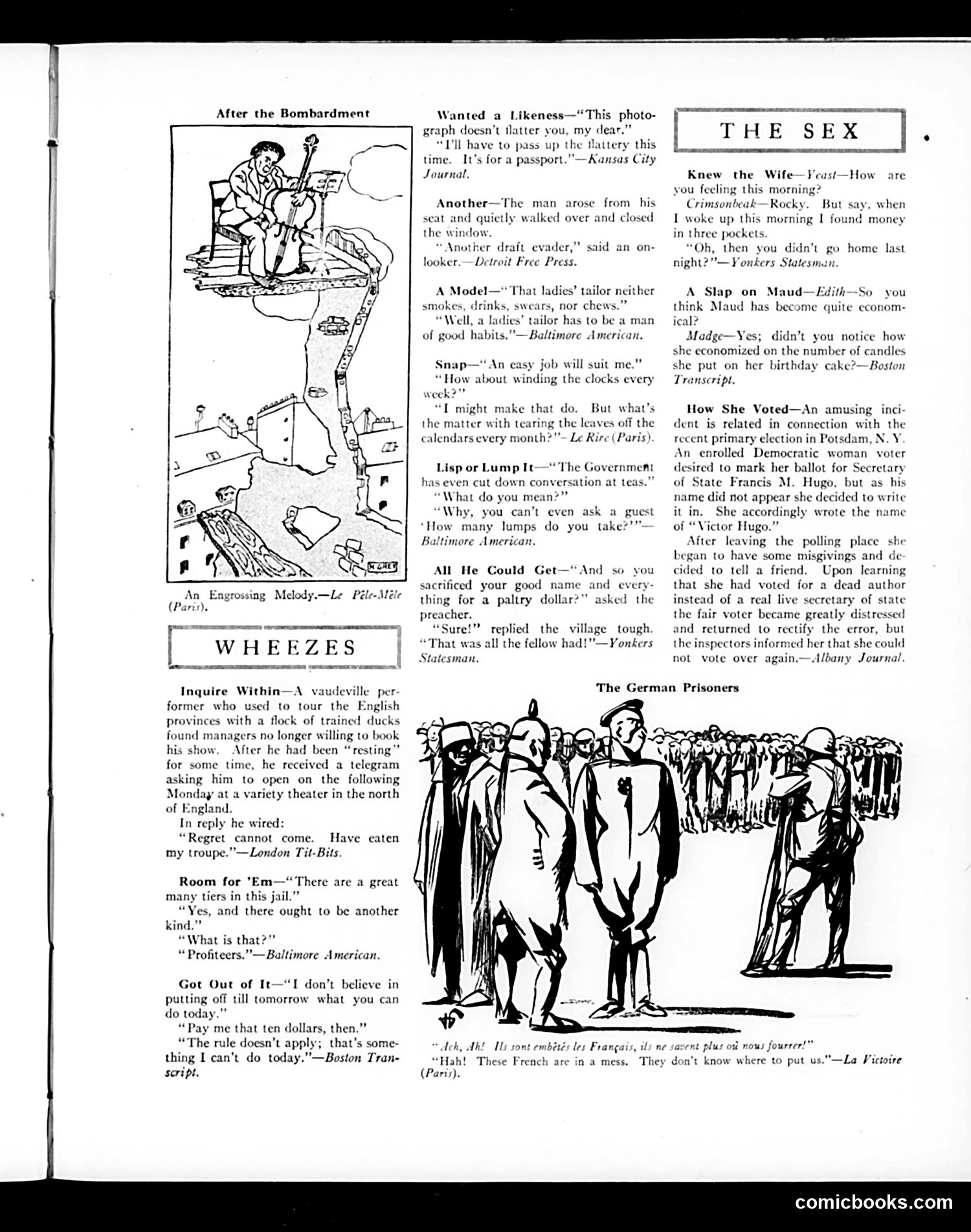
This page from *Judge* (an American satirical weekly) collects humor pieces and cartoons reflecting early-20th-century concerns: **"After the Bombardment"** cartoon satirizes wartime hardship—a musician who toured with trained ducks has eaten them out of desperation, darkly joking about WWI-era scarcity. **"Wheezes" section** contains short jokes mocking various targets: draft evaders, war profiteers (timely during WWI), and government austerity measures restricting casual conversation. **"The Sex" section** offers domestic humor—a man waking with money in pockets (implying he didn't go home), and a woman economizing on birthday candles. **"How She Voted"** mocks female voters (recently enfranchised) by recounting a woman who mistakenly voted for the historical figure "Victor Hugo" instead of the living candidate "Francis M. Hugo." **"The German Prisoners"** cartoon depicts captured Germans, with French caption joking about overcrowding—wartime commentary on POW logistics. The page reflects *Judge*'s blend of anti-German sentiment, domestic satire, and skepticism toward newly-voting women.
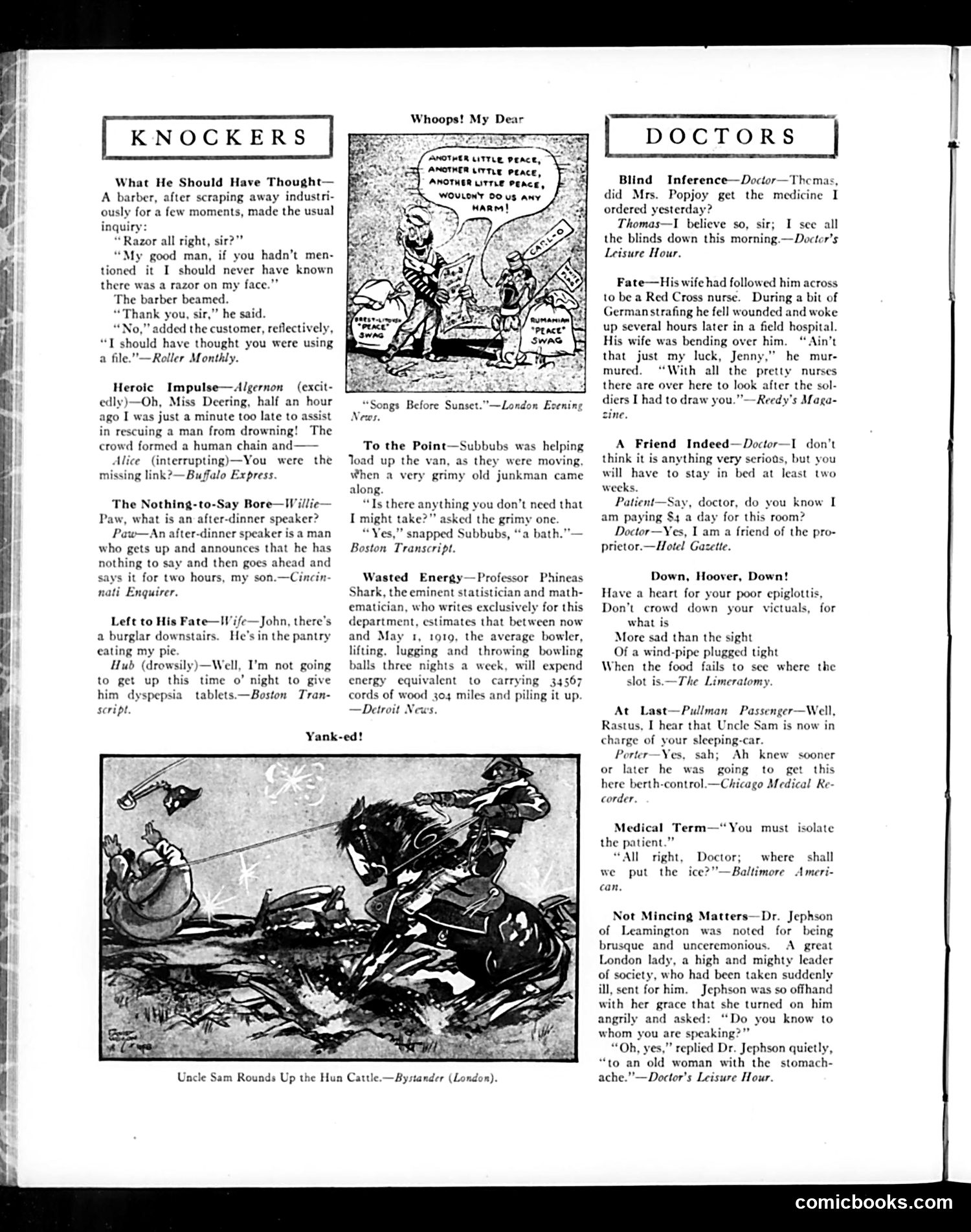
This page from Judge contains short humorous anecdotes and two political cartoons. The "KNOCKERS" section features jokes about everyday incompetence (a barber with no razor, an ineffectual rescuer, a boring after-dinner speaker). The central cartoon, captioned "Whoops! My Dear," depicts soldiers or military figures amid chaos, with speech bubbles mentioning "another little peace"—likely satirizing World War I peace negotiations or ceasefire attempts as repetitive failures. The "DOCTORS" section continues with medical-themed humor. The bottom cartoon, "Uncle Sam Rounds Up the Hun Cattle," appears to reference American military involvement, showing conflict with German forces ("Hun"). These pieces reflect 1910s-era American attitudes: workplace frustrations, WWI anxieties, and skepticism toward diplomatic solutions. The tone is lighthearted satire targeting both personal foibles and contemporary geopolitical instability. The cartoons specifically reference the war context, though exact dating and specific events remain unclear from this page alone.
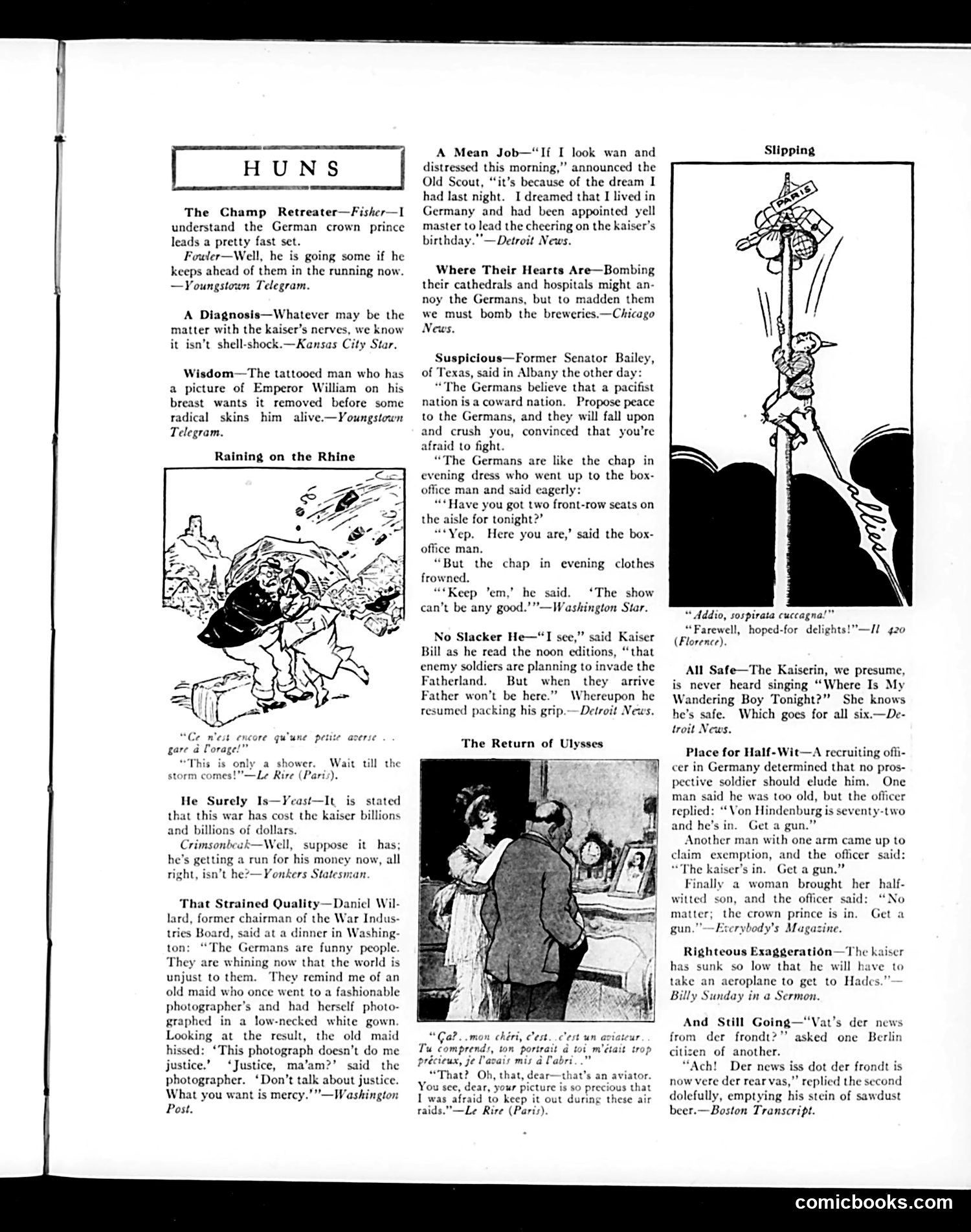
This page from Judge magazine contains WWI-era American satirical commentary mocking Germany and its leadership. The cartoons and quips ridicule Kaiser Wilhelm II and the German war effort through various angles: **Key targets:** The Kaiser ("Kaiser Bill"), the German Crown Prince, and German militarism generally. **Recurring themes:** - German cowardice masked by aggression (the pacifist nation joke) - The Kaiser's personal extravagance despite war costs - German hypocrisy (bombing hospitals while whining about injustice) - Desperation of German recruitment (accepting the elderly, disabled, and mentally unfit) **Visual content:** "Raining on the Rhine" depicts a soldier enduring hardship; "The Return of Ulysses" shows a Frenchwoman protecting her lover's portrait during air raids—contrasting civilian sacrifice with German leadership's apparent unwillingness to fight. The overall message: Germany's leadership is cowardly, hypocritical, and willing to sacrifice its citizens while avoiding personal risk.
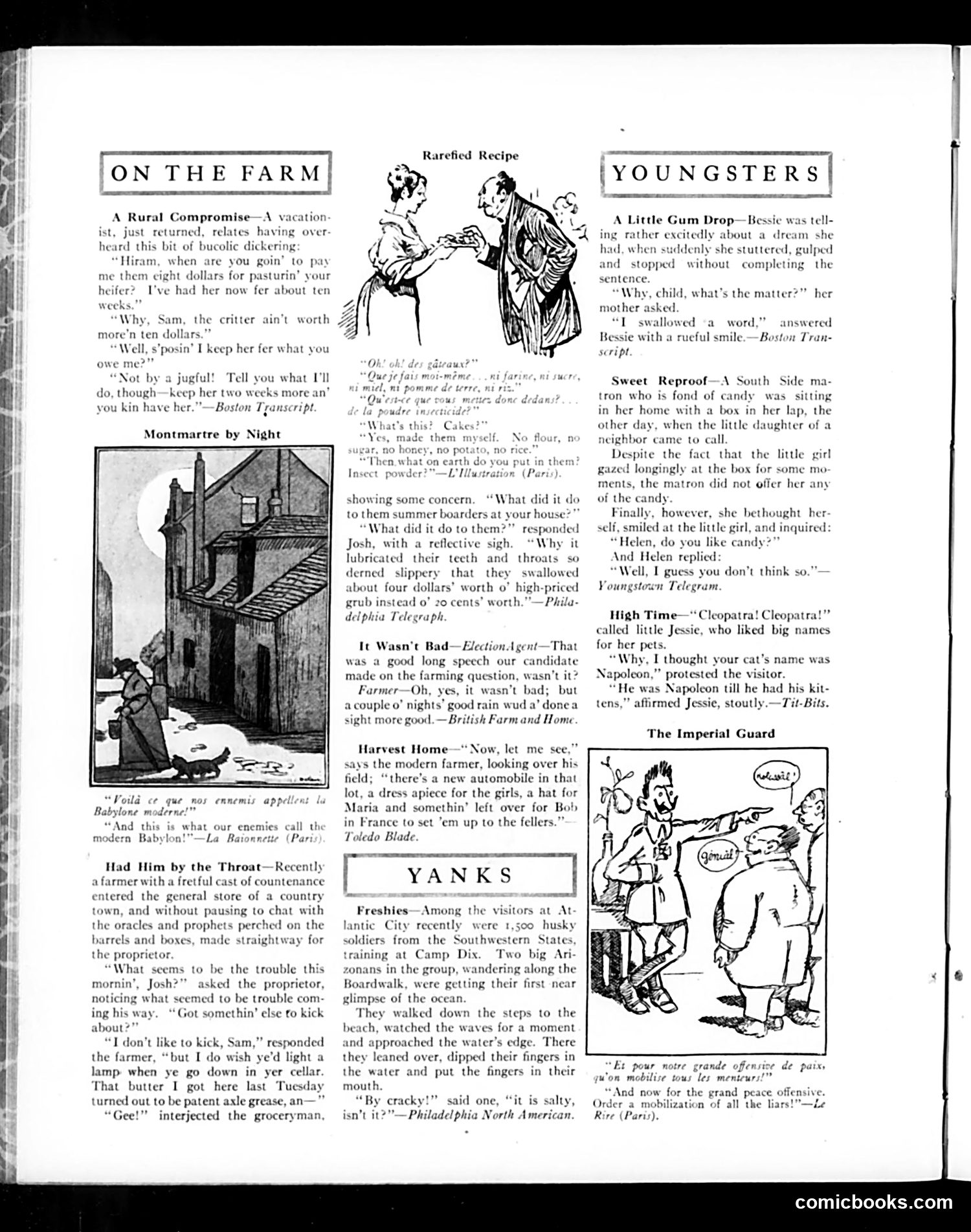
This page from *Judge* magazine contains several rural humor pieces and a cartoon mocking American soldiers' naïveté. **"On the Farm" section:** Comic anecdotes about rural life, including a farmer's dispute over pasturing fees (resolved by barter), a grocer selling butter that's actually axle grease to summer boarders, and a farmer noting that rain helps crops more than political speeches. **"Montmartre by Night" cartoon:** A French caption mockingly calls modern Babylon (Paris) what "our enemies" call it—likely referencing pre-WWI Franco-German tensions and French cultural decadence as perceived by American critics. **"Yanks" section:** Soldiers from the American Southwest, training at Camp Dix (likely during WWI era), visit the ocean for the first time. Two Arizonans taste saltwater and express surprise—the joke depends on depicting rural/Western American soldiers as unsophisticated and unfamiliar with basic geography. The humor reflects period attitudes toward rural Americans, European "decadence," and military recruits as comedic figures.
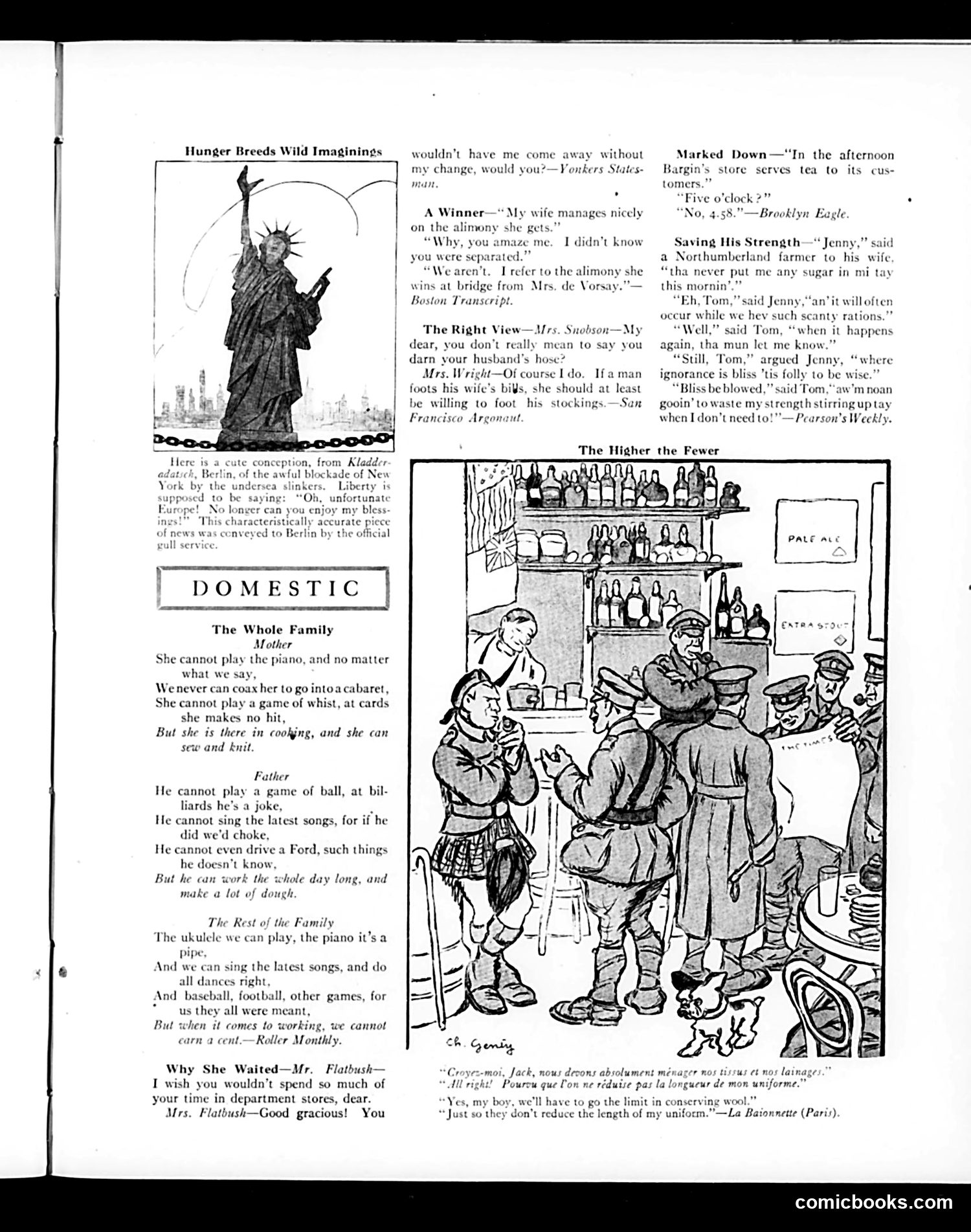
This page contains **wartime humor** (likely WWI, given references to "blockade" and uniform conservation). **Top cartoon:** "Hunger Breeds Wild Imaginings" shows the Statue of Liberty amid a blockaded New York skyline—satirizing how food shortages sparked exaggerated fantasies. **"Domestic" section:** A humorous poem contrasts family roles: parents excel only at practical work (cooking, earning money) while unable to enjoy modern entertainments (cards, driving Fords, singing). Their children do the opposite—play instruments and sports but can't work. The satire critiques generational divide and changing social values. **Bottom cartoon "The Higher the Fewer":** A French soldier argues with his superior about uniform length during wartime rationing. The joke: he's obsessed with preserving his uniform's length despite material shortages, prioritizing appearance over practicality—mocking military bureaucracy during wartime scarcity. **Scattered jokes** address petty domestic complaints and female spending habits, typical of the era's humor.
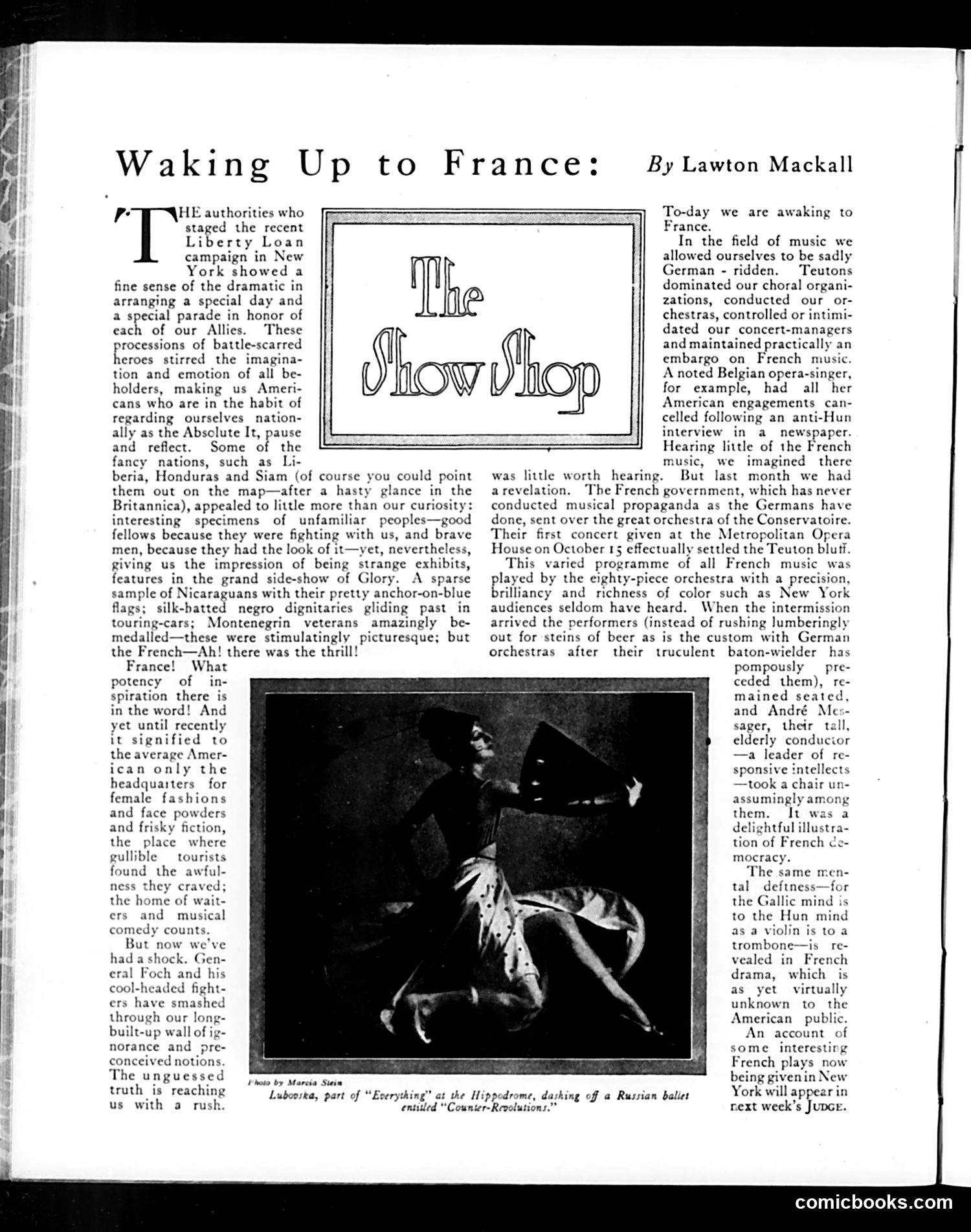
This article argues that Americans have been culturally dominated by Germany and are only now discovering France's superiority during World War I. **The Satire's Points:** 1. **German cultural hegemony**: Before the war, German conductors controlled American orchestras and concert halls; a Belgian opera singer had her engagements cancelled for anti-German statements. 2. **French dismissal**: Americans previously viewed France as mere frivolity—fashion, cosmetics, and musical comedy—not serious culture. 3. **The revelation**: When the French Conservatoire orchestra performed at the Metropolitan Opera House in October, their precision and brilliance exposed how Americans had been culturally starved by German dominance. 4. **Contrasting behavior**: The article contrasts German conductors' pompous post-concert departures with French conductor André Messager's democratic modesty—sitting among his players rather than departing grandly. **The Message**: American audiences must "wake up" and recognize French cultural and intellectual superiority to German Teutonic coarseness. The war context makes this patriotic advocacy for cultural realignment.
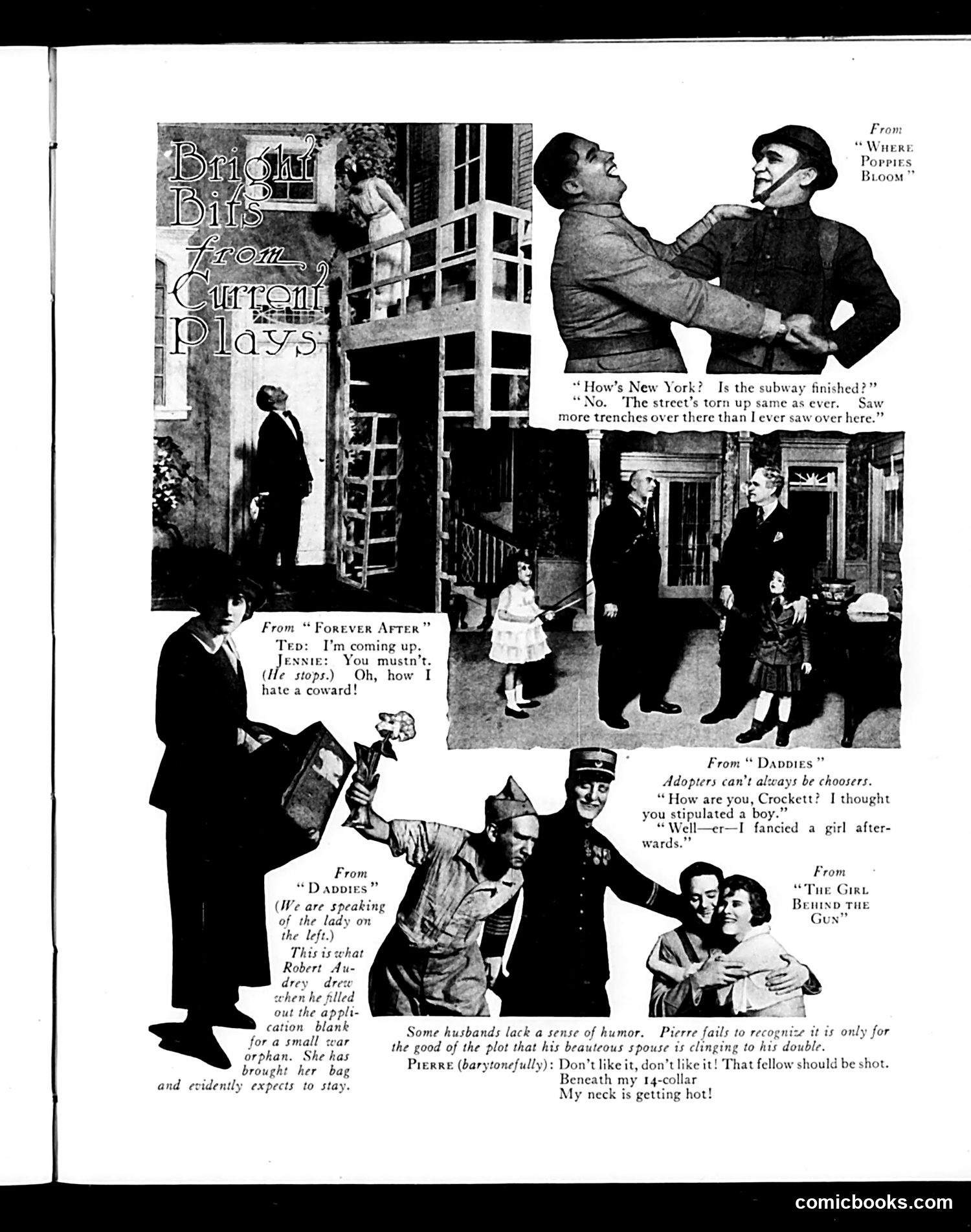
This page showcases "Bright Bits from Current Plays"—humorous scenes extracted from contemporary theatrical productions, likely from the 1910s-1920s based on the styling. The cartoons illustrate comedic moments from five different plays: 1. **"Where Poppies Bloom"** and **"Forever After"** appear to feature romantic/dramatic conflicts typical of period melodramas. 2. **"Daddies"** depicts a domestic humor scene about adoption—the joke being that an adoptive parent who requested a boy received a girl instead, and now prefers the outcome. 3. **"The Girl Behind the Gun"** shows a theatrical moment where a husband (Pierre) misinterprets an innocent embrace between his wife and another man, launching into an indignant aria about his discomfort—the satire mocking operatic overreaction to harmless stage business. The page's humor relies on readers' familiarity with these Broadway productions. The jokes turn on domestic situations, romantic entanglements, and the gap between theatrical convention and real emotion—staple Judge magazine fare for urban theater-goers.
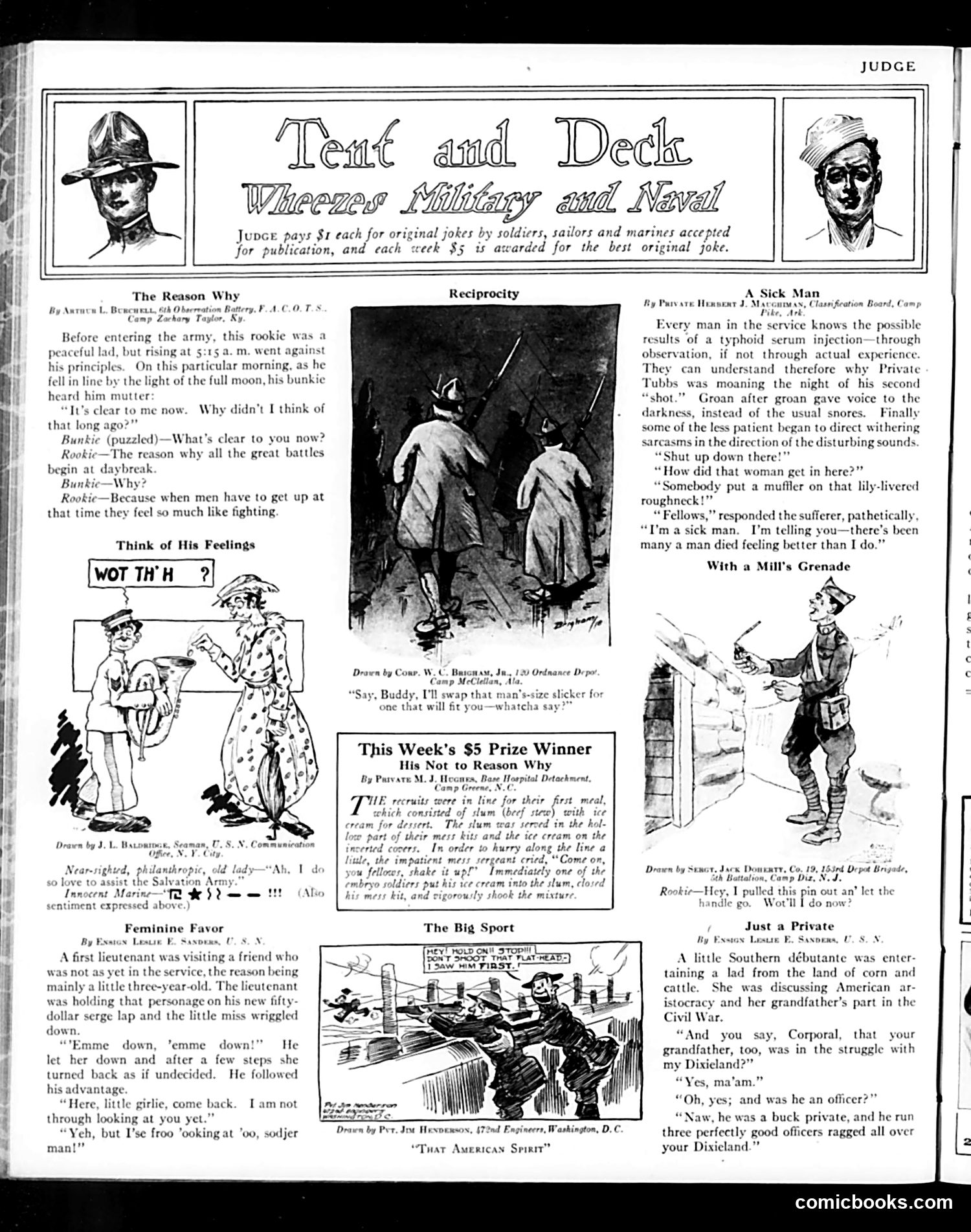
This Judge magazine page collects jokes and cartoons by soldiers and sailors, paying contributors $1-5 per submission. The content reflects barracks humor from World War I. The cartoons mock military life's absurdities: a rookie's dawning realization that early wake-up times cause fighting; a near-sighted soldier's mishap; a child's sass to a lieutenant; a sergeant's impatience with mess-line soldiers; a soldier's exaggerated complaint after typhoid vaccination; and a grenade mishap joke. Most pointed is "Just a Private"—a Southern woman boasts of her grandfather's Civil War service as an officer, only to be deflated when told he was merely a "buck private" while "three perfectly good officers ragged all over your Dixieland." This deflates romantic nostalgia about the Confederacy. The overall tone is good-natured griping about military routines, food, discipline, and medical procedures—entertainment for service members enduring wartime conditions.
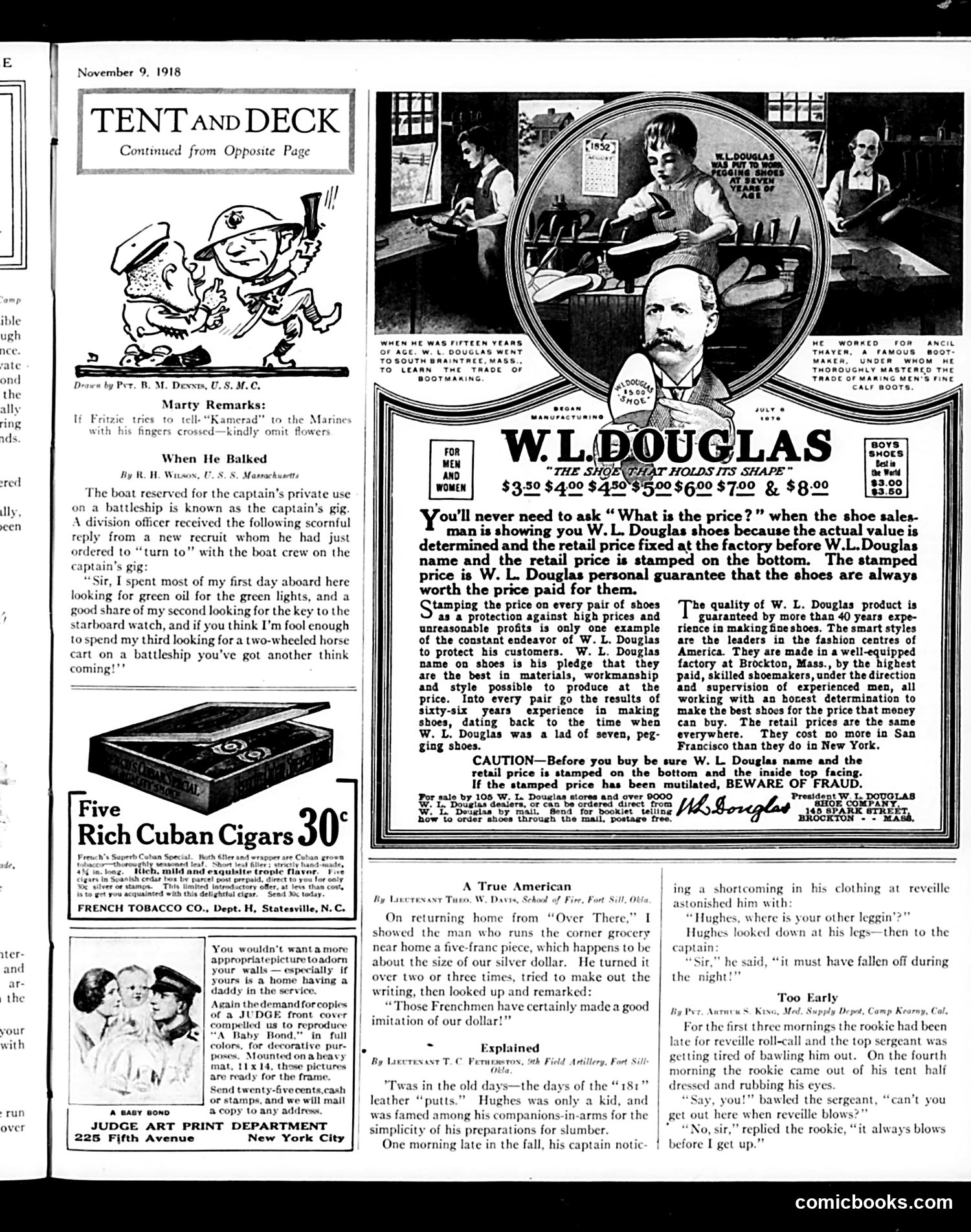
This page mixes military humor with advertising. The "Tent and Deck" cartoons appear to be light service comedy—one depicts a recruit's confusion about naval terminology (the "two-wheeled horse cart" joke plays on sailors tricking newcomers with nonsensical orders). The Marines joke references the trench warfare context of WWI, which was ongoing when this issue published (one week before the Armistice). The page is dominated by a large W.L. Douglas shoe advertisement featuring the company founder's biography and a circular portrait. This was typical magazine advertising of the era, emphasizing brand heritage and price transparency—Douglas shoes promoted their stamped retail prices as protection against inflation and price-gouging, a consumer concern during WWI. The smaller "Baby Bond" ad references war bonds, tying patriotic duty to home decoration.
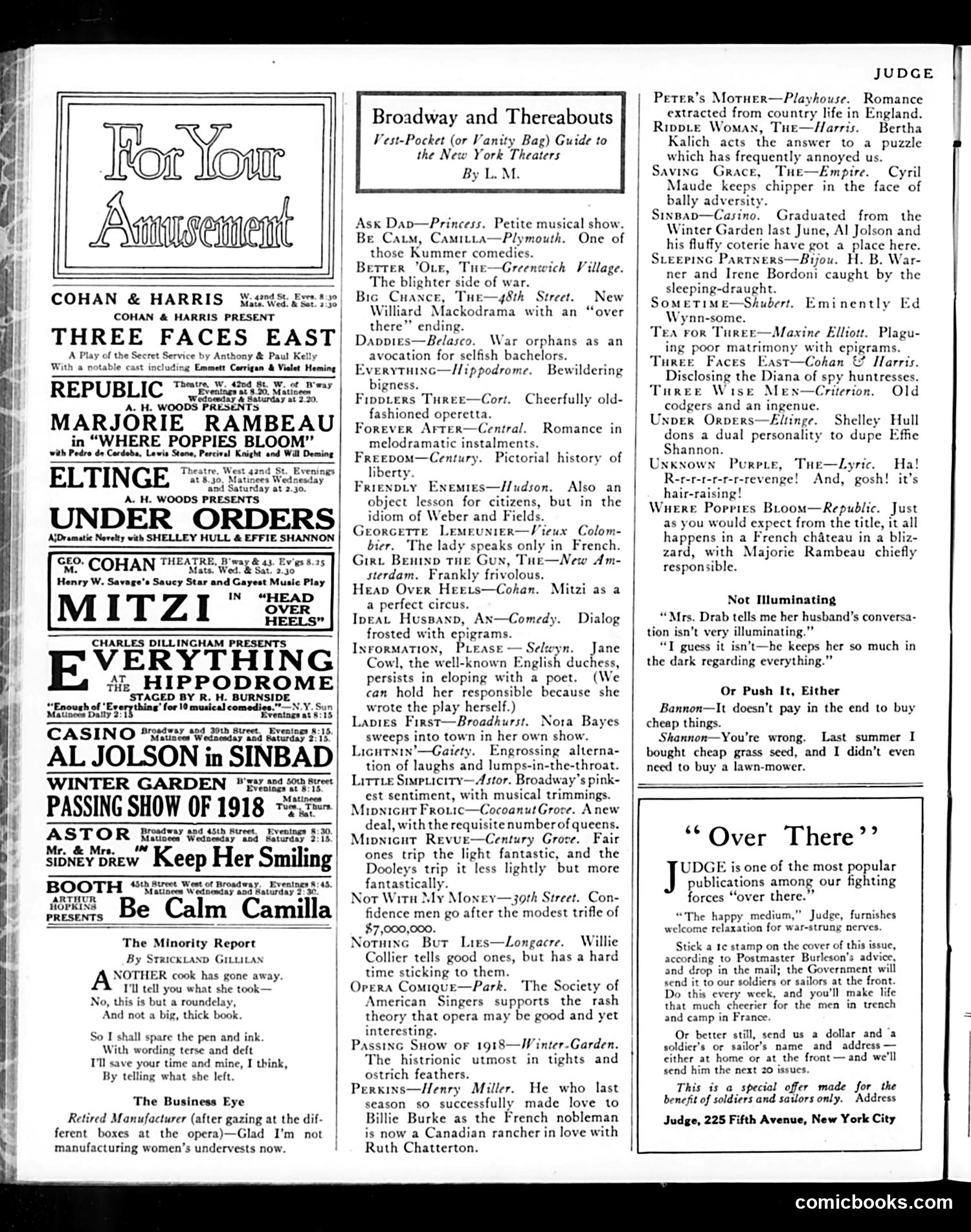
This page is primarily **theater advertising and reviews** for New York Broadway productions during 1918, with minimal political satire. The left side features advertisements for popular shows including Al Jolson in *Sinbad*, Marjorie Rambeau in *Where Poppies Bloom*, and Mitzi in *Head Over Heels*—typical entertainment promotions. The center contains "Broadway and Thereabouts," a brief theater guide reviewing current productions with commentary on their themes. Several shows reference **World War I** (*The Better 'Ole*, *Daddies*, *The Passing Show of 1918*), reflecting wartime popular culture. The right sidebar includes a humor column "The Minority Report" by Strickland Gillilan with lighthearted observations, and one weak satirical item: a "Business Eye" joke about a retired manufacturer relieved he's not manufacturing women's undergarments during economic uncertainty. The page demonstrates Judge's shift toward general entertainment coverage rather than sharp political commentary, typical of American magazines during the WWI era.
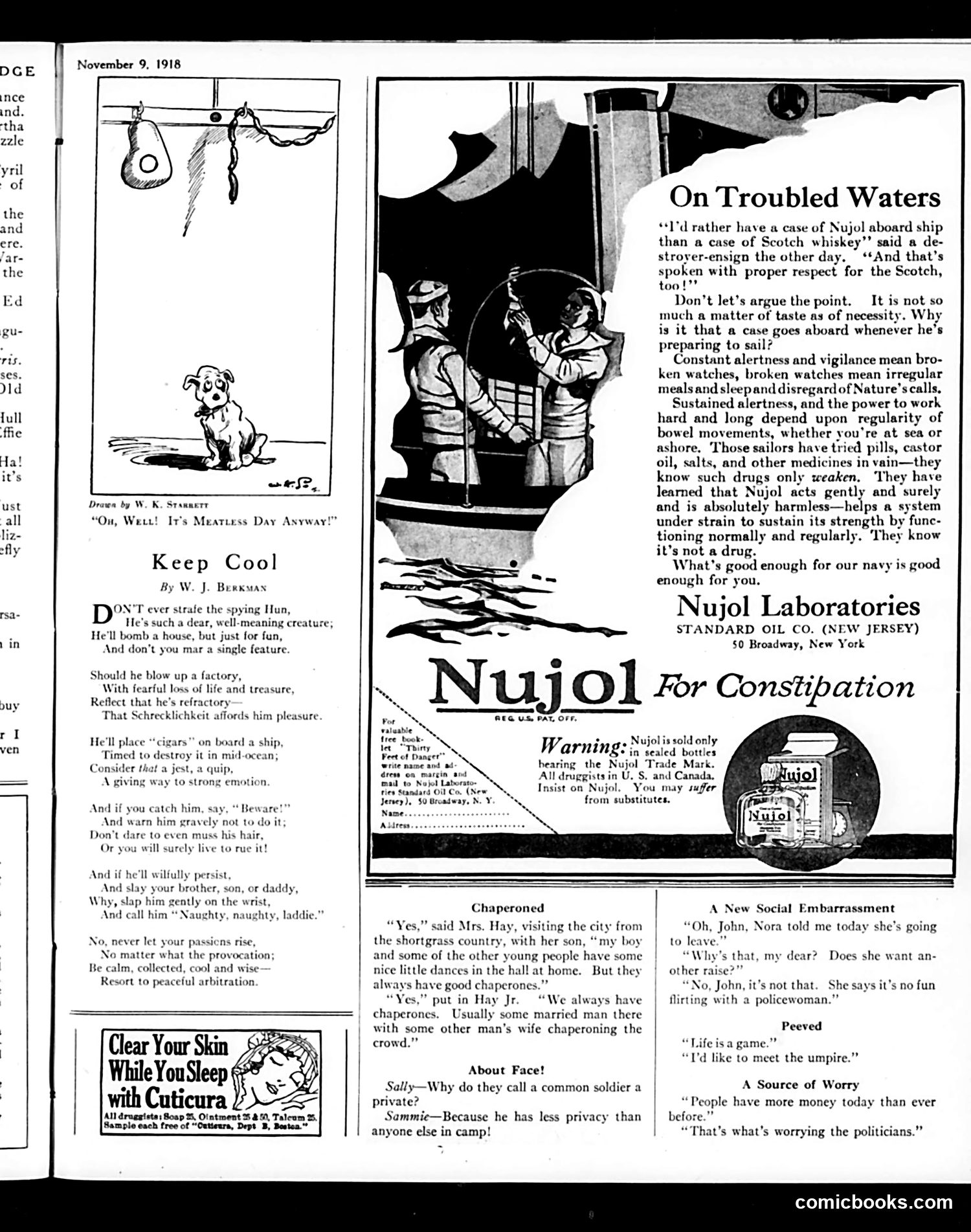
**"Keep Cool" Poem:** This is bitter satire mocking pacifist or restrained responses to German warfare. Written just before WWI's armistice (November 11, 1918), it sarcastically advises readers to respond gently to German aggression—bombing factories, torpedoing ships, killing civilians—with mere wrist-slaps and calls of "naughty, naughty." The poem ridicules those advocating restraint toward the enemy, advocating instead for passionate resistance. "Schrecklichkeit" (German for "terror") references Germany's explicit strategy of terrorizing civilians. **"On Troubled Waters" Advertisement:** A Nujol laxative ad exploiting wartime anxieties. It appeals to sailors' experiences during active duty—claiming naval officers prefer Nujol over whiskey because constant vigilance causes digestive irregularity. The ad frames a medicinal laxative as essential military equipment, more valuable than alcohol, and uses patriotic language ("good enough for our navy") to market a constipation remedy. **Minor Humor Items:** Light social jokes about chaperoned dances (suggesting marital infidelity), soldier privacy, domestic servants, and Depression-era financial worries.
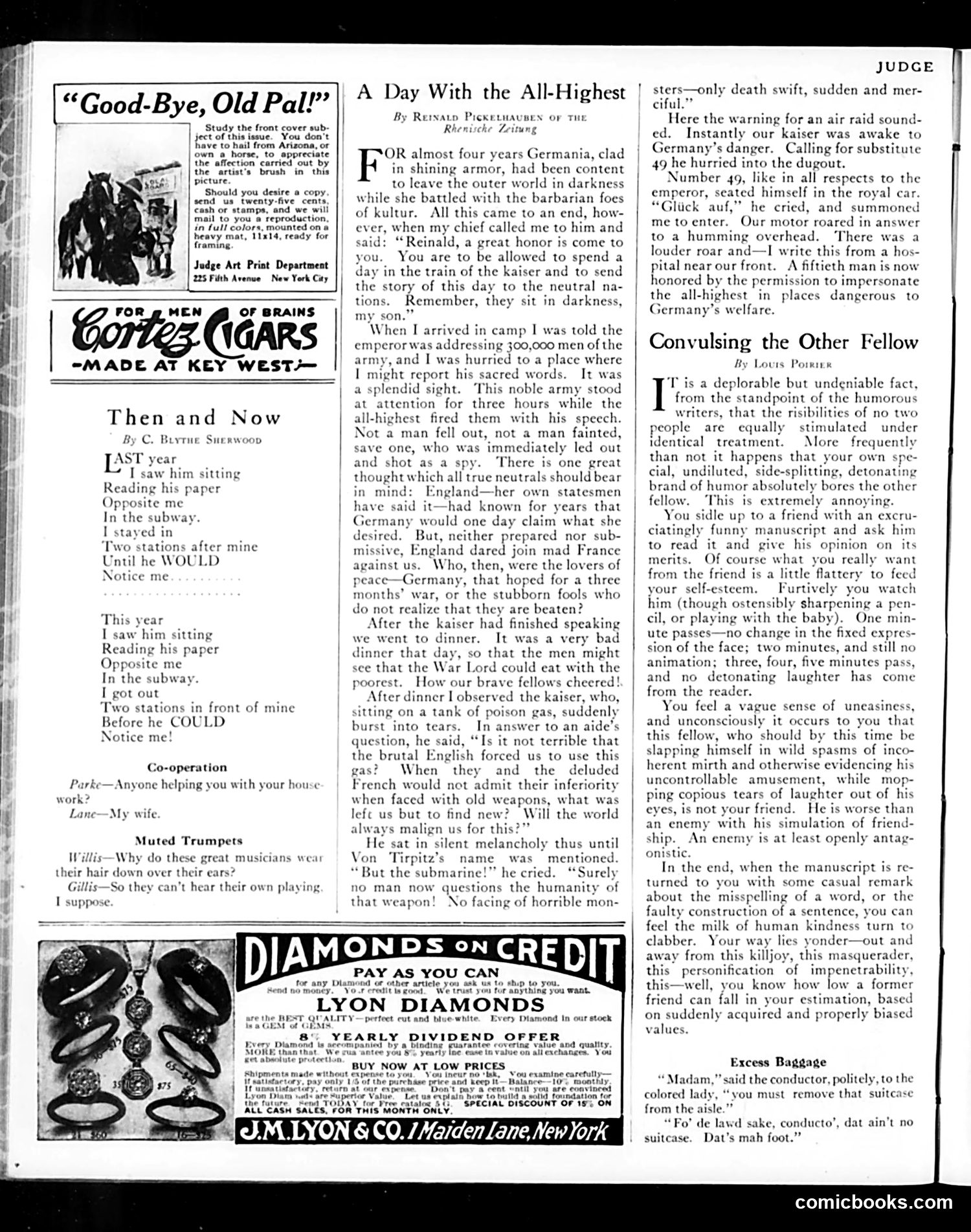
The main satirical piece, "A Day With the All-Highest," is a German perspective on Kaiser Wilhelm II during World War I. Written by a fictional German journalist, it mocks German propaganda by presenting absurdly propagandistic claims: the Kaiser's three-hour speech that leaves soldiers standing without fainting (except one shot as a spy), a deliberately meager meal to show solidarity, and emotional justifications for poison gas as a "humanitarian" weapon forced upon Germany by English brutality. The satire works by *appearing* to support German claims while the exaggerations—the melodramatic Kaiser weeping over submarine "humanity," the ridiculous soldier discipline—expose them as hollow propaganda. For modern readers, it reveals American skepticism toward German WWI justifications. The cartoons above (including "Good-Bye, Old Pal!" featuring a horse) appear sentimental, likely unrelated to the political content. The advertisements filling the page are typical period commerce, unremarkable today.
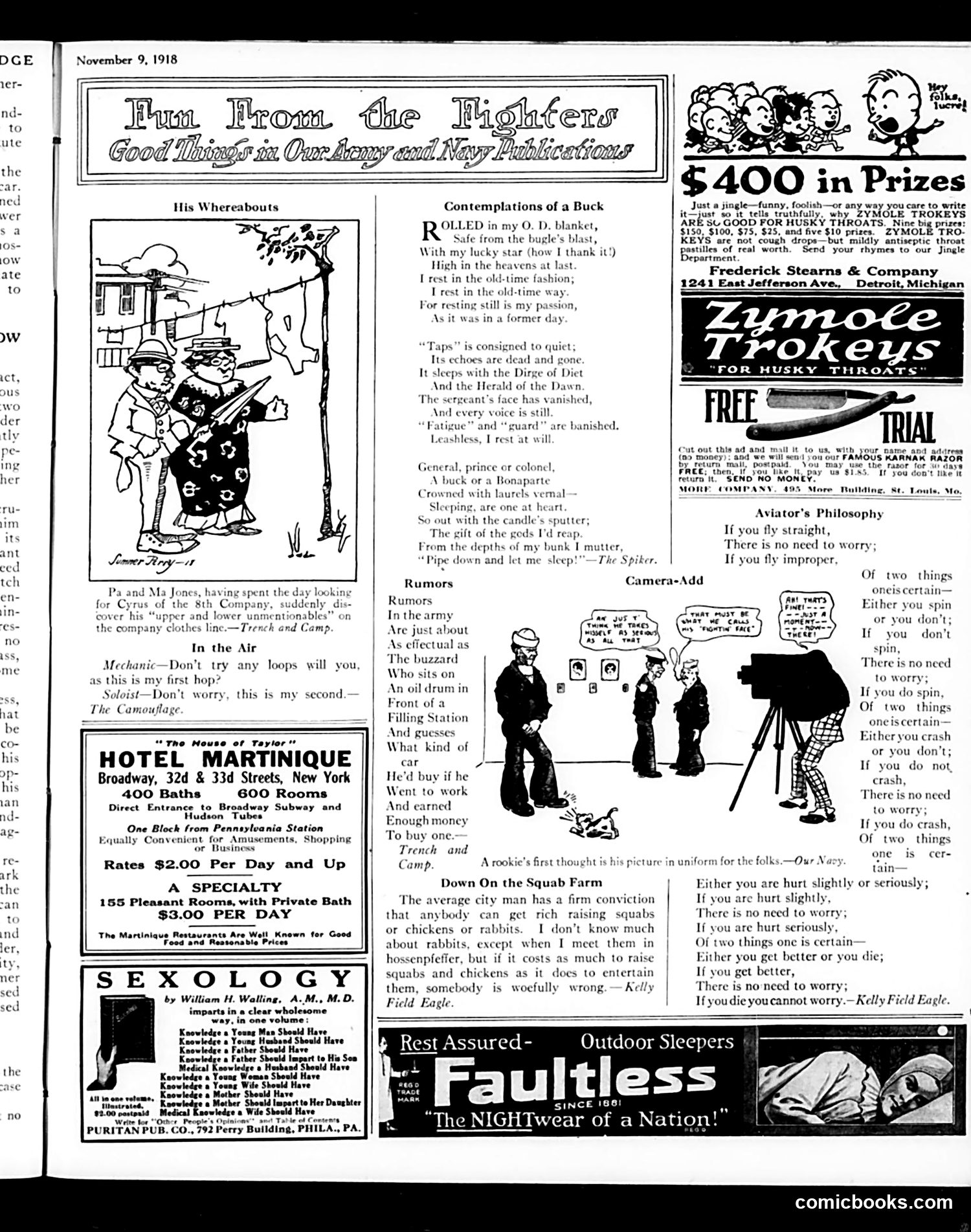
This page, dated November 9, 1918 (just before Armistice Day), contains military-themed humor reflecting WWI's final weeks. **Main Content:** The cartoons and verses focus on soldiers' experiences. "His Whereabouts" depicts a soldier resting safely in camp, relieved to escape military discipline ("Fatigue" and "guard" are banished). "In the Air" jokes about a nervous pilot on his first flight. Multiple short pieces mock army rumors and military absurdities. **Key Context for Modern Readers:** The humor reflects soldiers' exhaustion and longing for peace as the war neared its end. References to "O.D. blanket" (olive drab), trenches, and camp life were immediately recognizable to readers with soldiers in their families. The "Aviator's Philosophy" uses circular logic as absurdist humor—typical of period comedy. **Note:** The page is primarily **advertising** (Hotel Martinique, Zymole throat lozenges, Faultless nightwear) interspersed with light military satire rather than sharp political commentary.
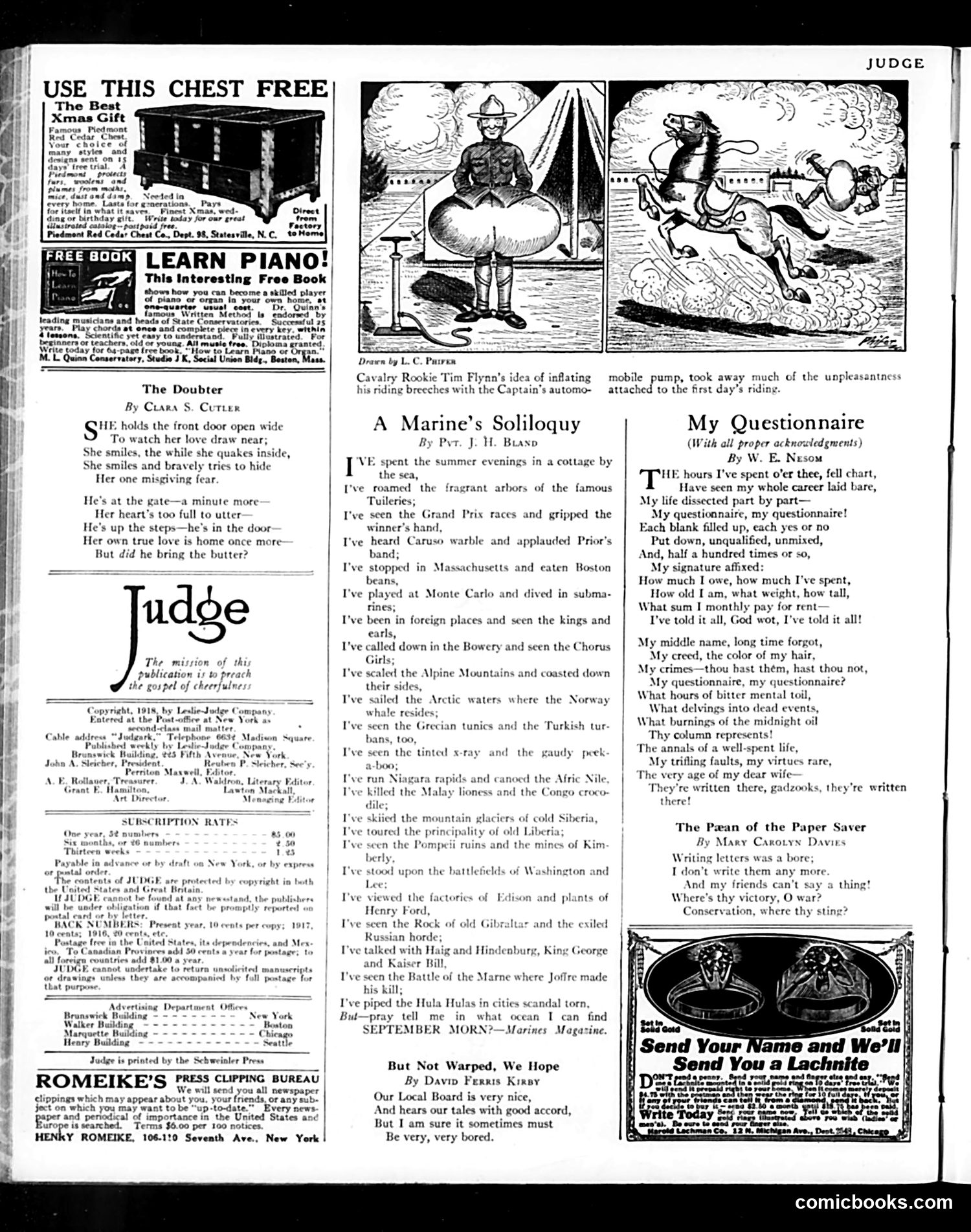
This page from Judge contains primarily **light satirical verse and humorous fiction** rather than political cartoons. Key content includes: **"The Doubter"** — A domestic humor poem about a wife anxiously awaiting her husband's return, only to worry he's forgotten to buy butter. It satirizes domestic anxiety and marital expectations. **"A Marine's Soliloquy"** — A lengthy poem cataloging exotic travels (Monte Carlo, the Arctic, battlefields, industrial sites) that culminates in a joke: despite seeing everything, the speaker has never found "September Morn" (likely referencing a famous 1912 painting by Paul Chabas, known for its controversial nudity). It mocks travel boasting. **"My Questionnaire"** — References WWI-era draft questionnaires, humorously treating the bureaucratic form as an invasive examination of one's entire life. The page also contains period advertisements (piano lessons, press clipping services) and a brief anecdote about a cavalry recruit. The humor is gentle and domestic rather than sharp political satire.
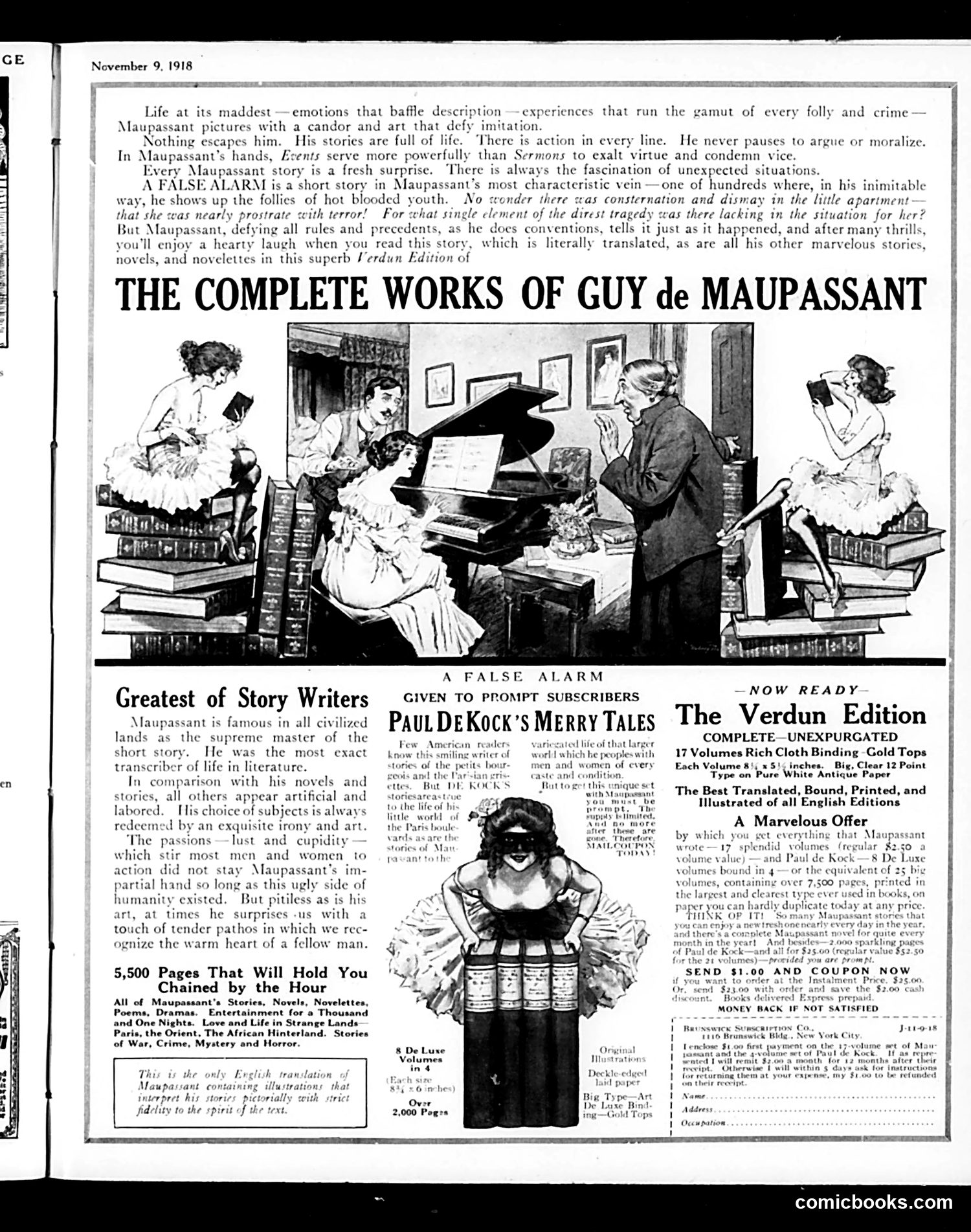
This is primarily a **book advertisement page**, not political satire. It promotes two literary collections: **Main content:** Advertisements for complete works of Guy de Maupassant (a 19th-century French short-story master) and Paul de Kock's "Merry Tales." The page emphasizes Maupassant's skill at depicting "life at its maddest" with unflinching realism about human folly, passion, and vice. An example story, "A False Alarm," is highlighted. **The illustrations** show genteel Victorian/Edwardian domestic scenes—women reading, a man at a piano, figures with bookshelves—romanticizing literary culture. The timing (November 1918, just after WWI's end) is notable but the page itself contains **no political commentary or satire**. It's straightforward publishing promotion targeting educated readers interested in classic European literature, emphasizing completeness, translation quality, and attractive binding as selling points.