
Judge, 1918-11-09 · page 26 of 36
Judge — November 9, 1918 — page 26: what you’re looking at
What you’re looking at
This article argues that Americans have been culturally dominated by Germany and are only now discovering France's superiority during World War I. **The Satire's Points:** 1. **German cultural hegemony**: Before the war, German conductors controlled American orchestras and concert halls; a Belgian opera singer had her engagements cancelled for anti-German statements. 2. **French dismissal**: Americans previously viewed France as mere frivolity—fashion, cosmetics, and musical comedy—not serious culture. 3. **The revelation**: When the French Conservatoire orchestra performed at the Metropolitan Opera House in October, their precision and brilliance exposed how Americans had been culturally starved by German dominance. 4. **Contrasting behavior**: The article contrasts German conductors' pompous post-concert departures with French conductor André Messager's democratic modesty—sitting among his players rather than departing grandly. **The Message**: American audiences must "wake up" and recognize French cultural and intellectual superiority to German Teutonic coarseness. The war context makes this patriotic advocacy for cultural realignment.
📄 Transcribed text from this page (OCR, searchable)
Machine-transcribed from the original scan — historical spelling and the odd misread are preserved.
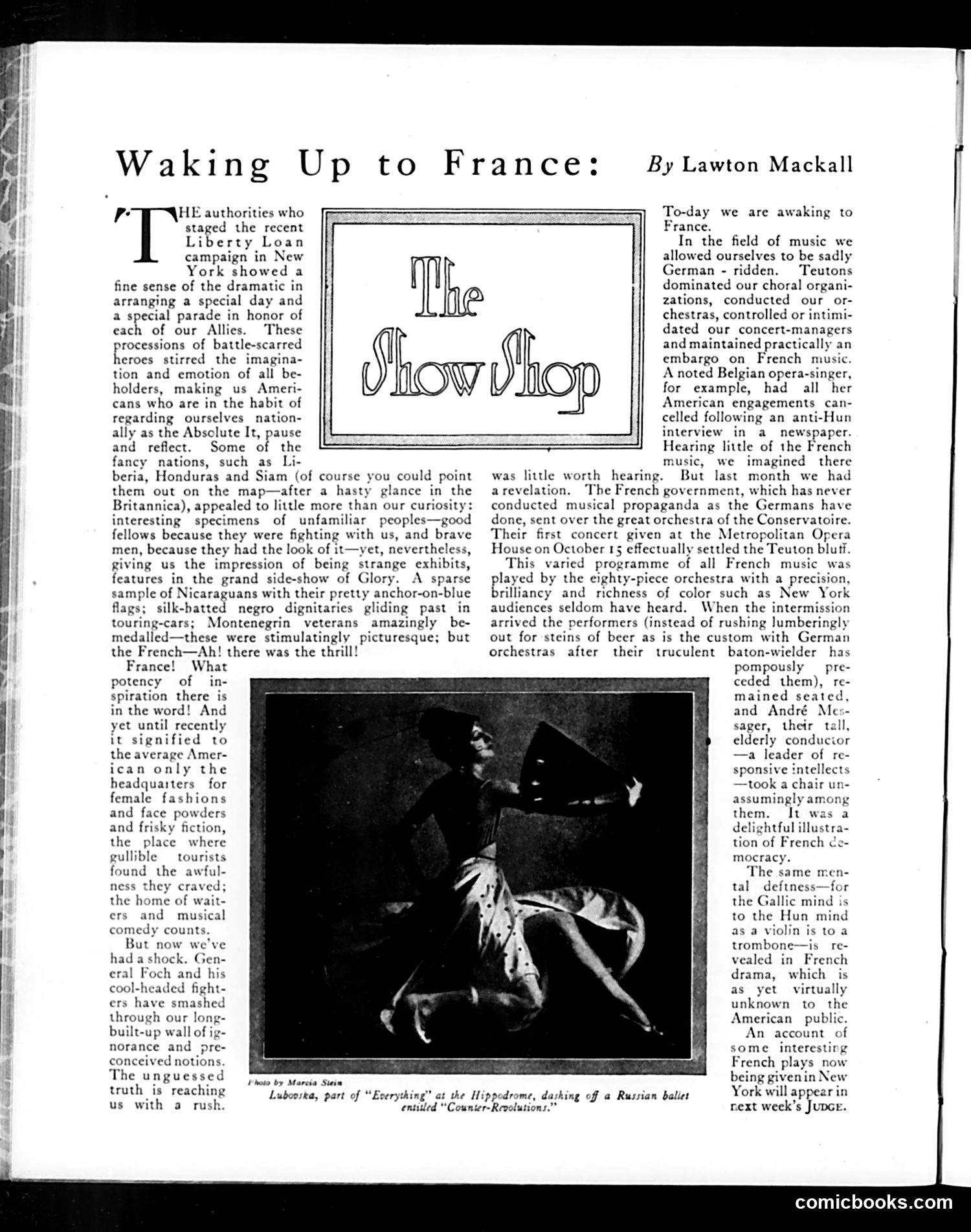
Waking Up to France: By Lawton Mackall vr HE authorities who [= staged the recent Liberty Loan campaign in New York showed a fine sense of the dramatic in arranging a special day and a special parade in honor of each of our Allies. These processions of battle-scarred heroes stirred the imagina- tion and emotion of all be- holders, making us Ameri- cans who are in the habit of regarding ourselves nation- how flop To-day we are awaking to France. In the field of music we allowed ourselves to be sadly German - ridden. Teutons dominated our choral organi- zations, conducted our or- chestras, controlled or intimi- dated our concert-managers and maintained practically an embargo on French music. A noted Belgian opera-singer, for example, had all her American engagements can- celled following an anti-Hun interview in a newspaper. ally as the Absolute It, paus and reflect. Some of the fancy nations, such as Li- beria, Honduras and Siam (of course you could point them out on the map—after a hasty glance in the Britannica), appealed to little more than our curiosity: interesting specimens of unfamiliar peoples—good fellows because they were fighting with us, and brave men, because they had the look of it—yet, nevertheless, giving us the impression of being strange exhibits, features in the grand side-show of Glory. A sparse sample of Nicaraguans with their pretty anchor-on-blue flags; silk-hatted negro dignitaries gliding past in touring-cars; Montenegrin veterans amazingly be- medalled—these were stimulatingly picturesque; but the French—Ah! there was the thrill! France! What potency of in- spiration there is in the word! And yet until recently it signified to the average Amer- ican only the headquaiters for female fashions and face powders and frisky fiction, the place where gullible — tourists found the awful- ness they craved; the home of wait- ers and musical comedy counts. But now we've had a shock. Ge eral Foch and his cool-headed fight- ers have smashed through our lon built-up wall of ig- norance and pre- conceived notions. The unguessed truth is reaching us with a rush. Vhoto by Marcia Stein Luboosta, part of “Everything” at the Hippodrome, dashing off @ Russian ballet entitled “Counter-Regolutions.” Hearing little of the French music, we imagined there was little worth hearing. But last month we had arevelation. The French government, which has never conducted musical propaganda as the Germans have done, sent over the great orchestra of the Conservatoire. Their first concert given at the Metropolitan Opera House on October 15 effectually settled the Teuton bluff. This varied programme of all French music was played by the eighty-piece orchestra with a precision, brilliancy and richness of color such as New York audiences seldom have heard. When the intermission arrived the performers (instead of rushing lumberingly out for steins of beer as is the custom with German orchestras after their truculent baton-wielder has pompously _ pre- ceded them), re- mained seated, and André Mes- sager, their tall, elderly conducior —a leader of re- sponsive intellects —took a chair un- assumingly among them. It was a delightful illustra- tion of French ce- mocracy. The same men- tal deftness—for the Gallic mind is to the Hun mind as a violin is toa trombone—is__re- vealed in French drama, which is as yet. virtually unknown to the American public. An account of some interesting French plays now being givenin New York will appear in next week’s Jupce. comicbooks.com