
Judge, 1918-11-09 · page 19 of 36
Judge — November 9, 1918 — page 19: what you’re looking at
What you’re looking at
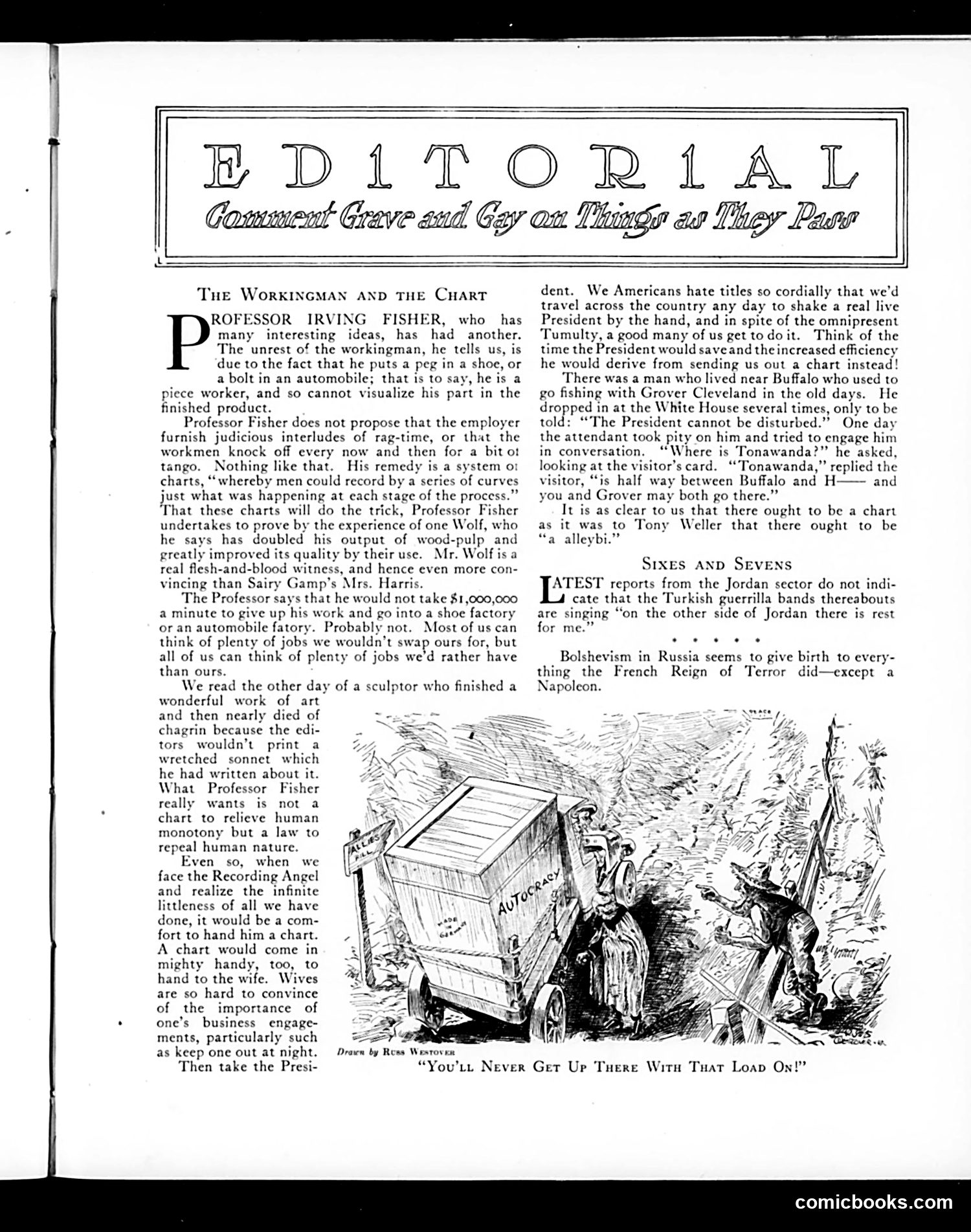
This editorial page satirizes **Professor Irving Fisher's** proposal to improve factory worker productivity through charts tracking output at each production stage. The satire operates on multiple levels: **The Main Argument:** Fisher claims workers suffer monotony because they can't visualize their contribution to finished products. Charts would solve this. The editorial ridicules this as naive—no chart can "repeal human nature." **The Satire's Points:** - A chart won't make tedious work meaningful - Workers' real problem isn't lack of visualization but monotony itself - Even the President should use charts to manage visitors (a jab at administrative inefficiency) - The accompanying cartoon shows an overloaded truck struggling uphill, captioned "You'll Never Get Up There With That Load On!"—suggesting charts won't fix fundamental problems **Historical Context:** This reflects early-20th-century debates over scientific management and worker alienation during industrialization. The other brief items mock Turkish guerrillas and Russian Bolshevism, standard Judge fare for the period.
📄 Transcribed text from this page (OCR, searchable)
Machine-transcribed from the original scan — historical spelling and the odd misread are preserved.
Tue WorKINGMAN AND THE CHART ROFESSOR IRVING FISHER, who has many interesting ideas, has had another. The unrest of the workingman, he tells us, is due to the fact that he puts a peg in a shoe, or a bolt in an automobile; that is to say, he is a piece worker, and so cannot visualize his part in the finished product. Professor Fisher does not propose that the employer furnish judicious interludes of rag-time, or that the workmen knock off every now and then for a bit ot tango. Nothing like that. His remedy is a system o: charts, “whereby men could record by a series of curves just what was happening at cach stage of the process.” ‘That these charts will do the trick, Professor Fisher undertakes to prove by the experience of one Wolf, who he says has doubled his output of wood-pulp and greatly improved its quality by their use. Mr. Wolf is a real flesh-and-blood witness, and hence even more con- vincing than Sairy Gamp’s Mrs. Harris. The Professor says that he would not take $1,000,000 a minute to give up his work and go into a shoe factory or an automobile fatory. Probably not. Most of us can think of plenty of jobs we wouldn’t swap ours for, but all of us can think of plenty of jobs we'd rather have than ours. We read the other day of a sculptor who finished a wonderful work of art and then nearly died of chagrin because the edi- tors wouldn’t print a wretched sonnet which he had written about it. What Professor Fisher really wants is not a chart to relieve human monotony but a law to repeal human nature. Even so, when we face the Recording Angel and realize the infinite littleness of all we have done, it would be a com- fort to hand him a chart. A chart would come in mighty handy, too, to hand to the wife. Wives are so hard to convince of the importance of one’s business engage- ments, particularly such as keep one out at night. — Drawn by Ress Westone Then take the Presi- dent. We Americans hate titles so cordially that we'd travel across the country any day to shake a real live President by the hand, and in spite of the omnipresent Tumulty, a good many of us get todoit. Think of the time the President would saveand the increased efficiency he would derive from sending us out a chart instead! There was a man who lived near Buffalo who used to go fishing with Grover Cleveland in the old days. He dropped in at the White House several times, only to be told: “The President cannot be disturbed.” One day the attendant took pity on him and tried to engage him in conversation. ‘Where is Tonawanda?” he asked, looking at the visitor’s card. “Tonawanda,” replied the visitor, “is half way between Buffalo and H—— and you and Grover may both go there.” It is as clear to us that there ought to be a chart as it was to Tony Weller that there ought to be “a alleybi.” SIxes AND SEVENS | sie reports from the Jordan sector do not indi- cate that the Turkish guerrilla bands thereabouts are singing “on the other side of Jordan there is rest for me.” Bolshevism in Russia seems to give birth to every- thing the French Reign of Terror did—except a Napoleon. “You’tt Never Get Up Tuere With Tuat Loap On!” comicbooks.com