
A complete issue · 32 pages · 1918
Judge — September 21, 1918
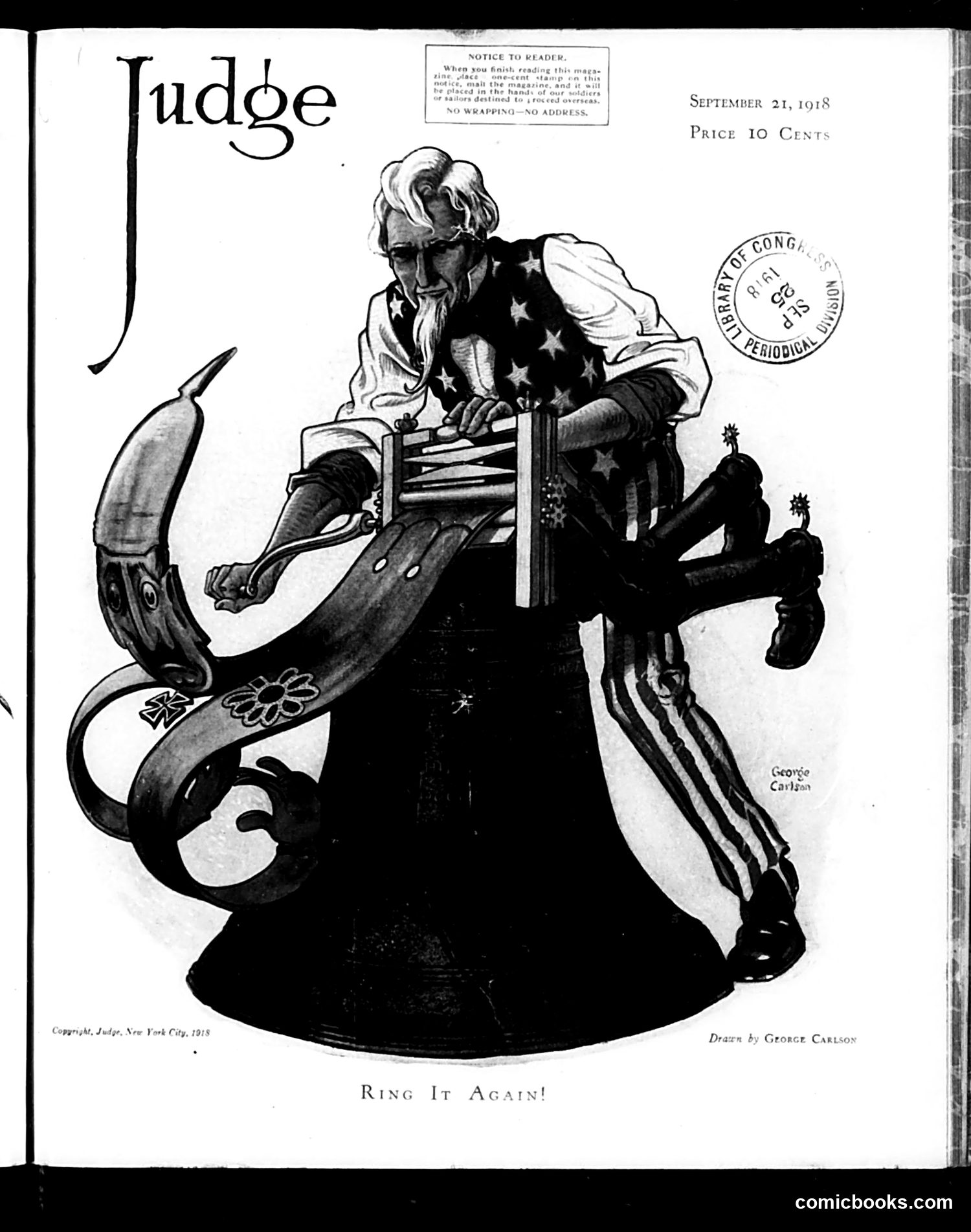
This political cartoon by George Carlson depicts Uncle Sam operating a large bell or alarm mechanism, with German imperial eagles (marked with crosses) appearing to be struck or rung by the device. The title "Ring It Again!" suggests repeated military action or warning. Published in September 1918, during World War I's final weeks, this cartoon likely celebrates American military pressure against Germany before the November armistice. The bell imagery may reference either alarm/warning signals or the ringing of victory bells. The worn, elderly depiction of Uncle Sam emphasizes America's commitment despite war fatigue. The cartoon expresses jingoistic satisfaction with ongoing American military engagement against German forces.
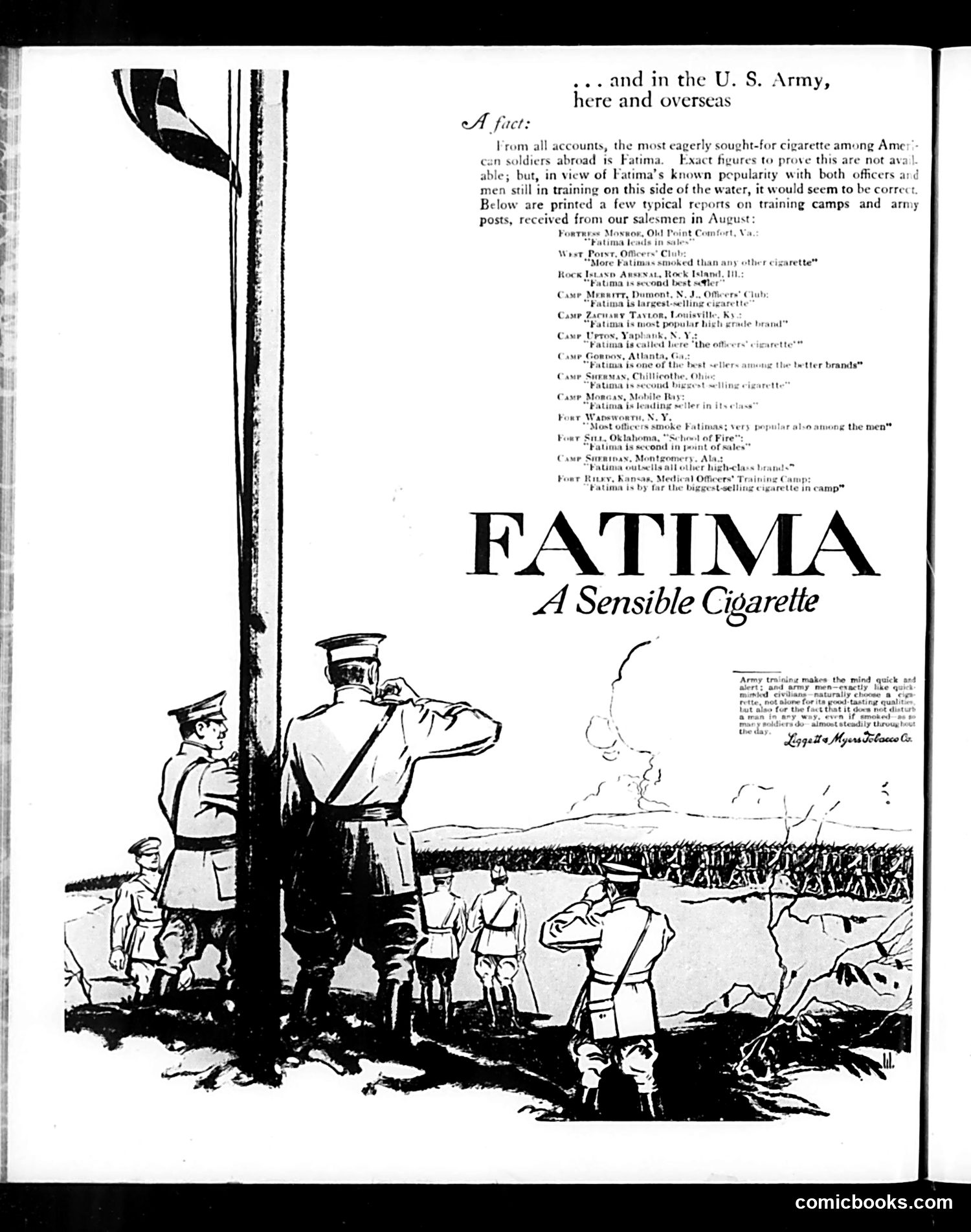
This page is primarily **advertising rather than satire or political commentary**. It promotes Fatima cigarettes as "A Sensible Cigarette" to American soldiers. The text above the advertisement presents testimonials from various military camps and posts claiming Fatima is the most popular cigarette among officers and enlisted men. The illustration depicts soldiers at what appears to be a training camp or military gathering. The advertisement's framing as a "sensible" choice likely played on early 20th-century marketing that positioned certain cigarette brands as rational consumer decisions. The military context capitalizes on soldiers' endorsements to build credibility. There is no apparent political satire or social commentary—this is straightforward commercial marketing content targeting servicemen, probably dating to the World War I era based on the uniform styles.
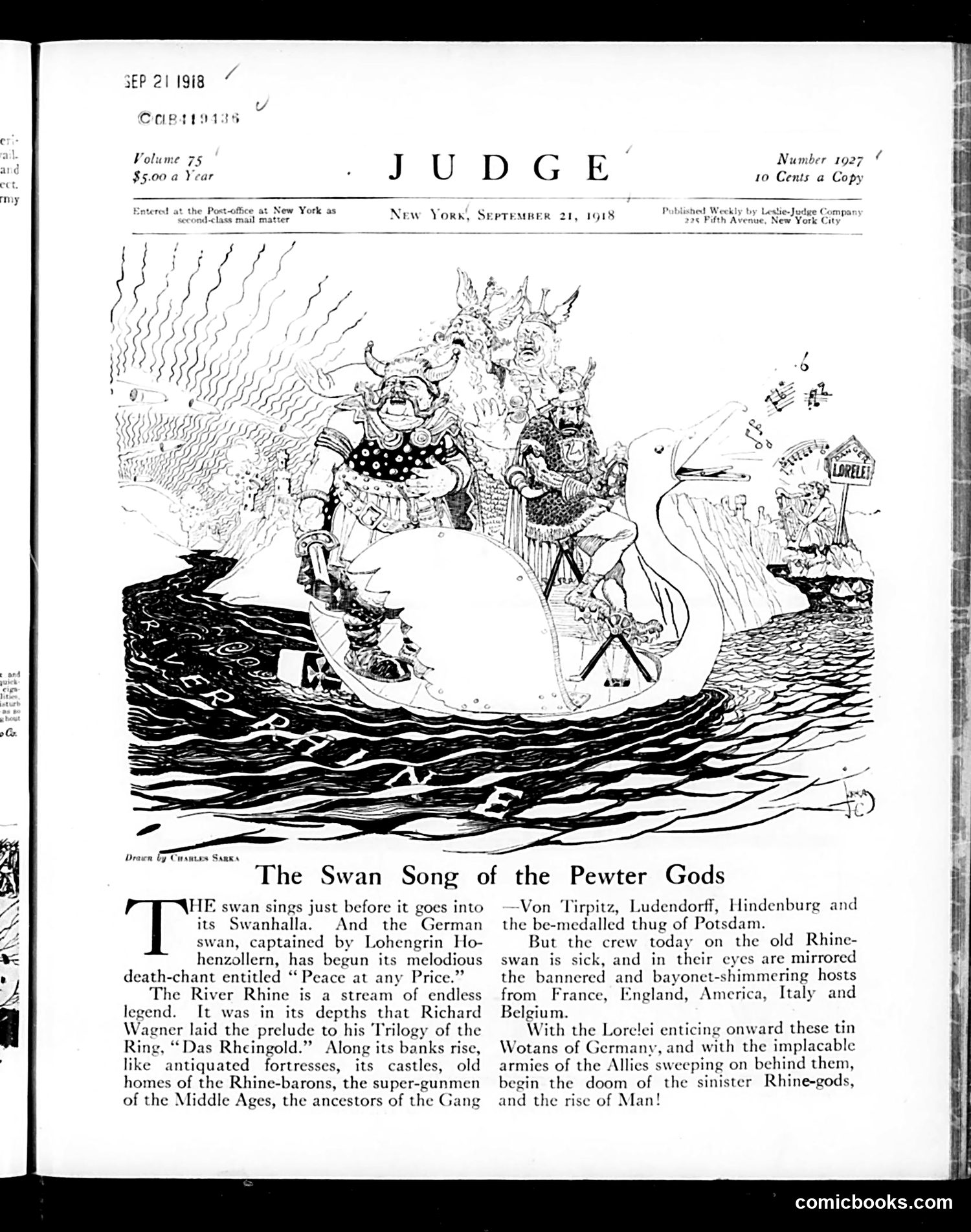
This September 1918 cartoon satirizes Germany's military collapse near WWI's end. The illustration shows German military and political leaders—identified as "Von Tirpitz, Ludendorff, Hindenburg and the be-medalled thug of Potsdam"—depicted as mythological figures singing a "death-chant entitled 'Peace at any Price.'" The text references Wagner's *Ring* cycle and the Rhine legend, comparing German leaders to doomed gods. The "old Rhine-swan" (Germany) is "sick," and the "Wotans of Germany" face defeat as Allied armies advance. The "pewter gods" mockingly suggests these military leaders are now powerless artifacts. Published as the Central Powers approached surrender, the cartoon celebrates their imminent defeat.
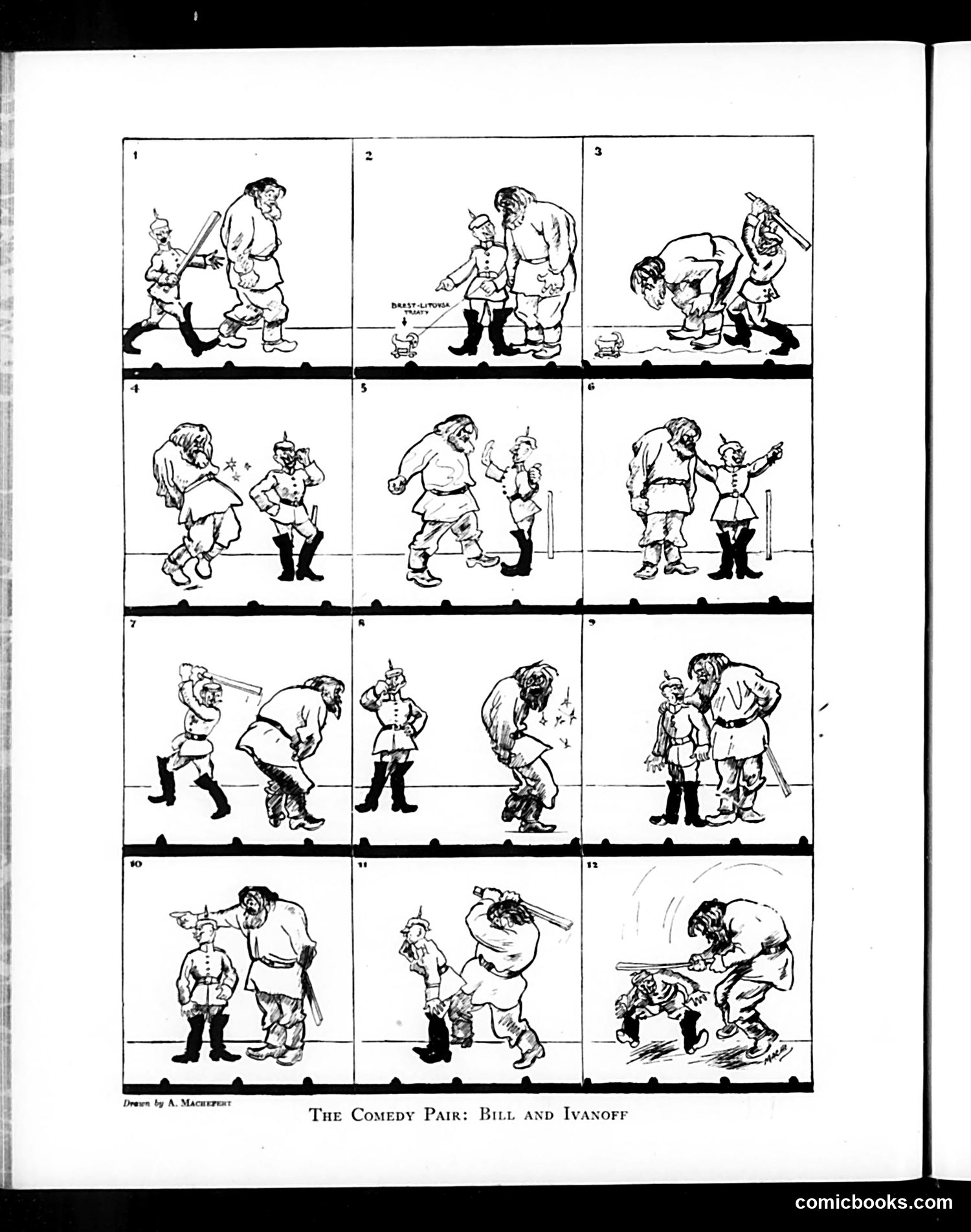
This satirical comic strip depicts two characters—Bill (a large man) and Ivanoff (a smaller figure in military attire with a spiked helmet, indicating a German or Central European soldier)—in a physical confrontation sequence. The strip shows escalating violence: Bill strikes Ivanoff with progressively larger weapons, Ivanoff retaliates, and they engage in mutual combat. The military uniform and spiked helmet suggest this references World War I-era tensions. The "comedy" appears satirical—presenting a serious geopolitical conflict (likely between Allied and enemy forces) as slapstick humor. Without the original publication date visible, the specific historical context remains unclear, but this likely mocks either wartime propaganda or contemporary international relations through exaggerated physical comedy.
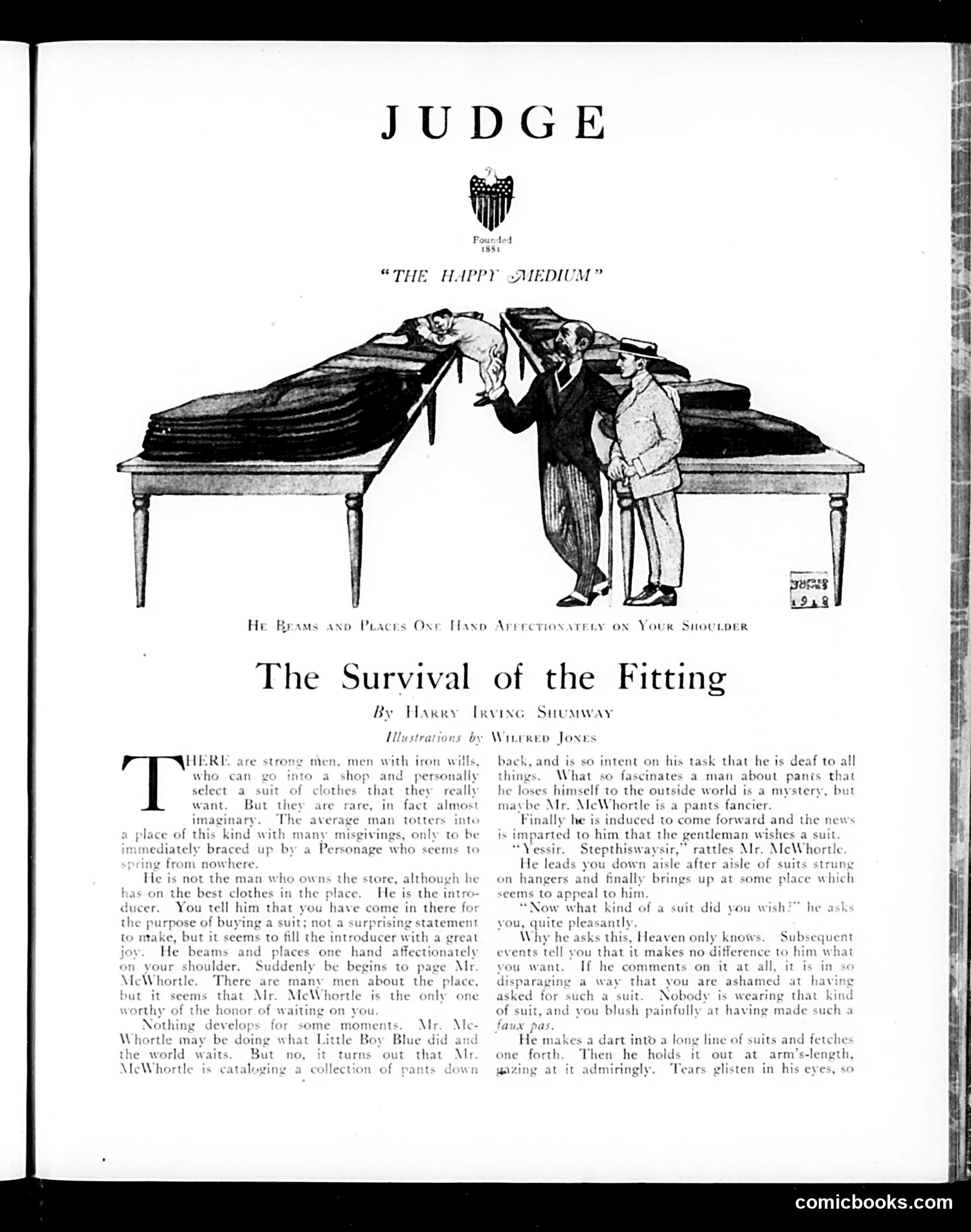
This satirical illustrated story by Harry Irving Shumway concerns a men's clothing salesman (Mr. McWhortle) struggling to fit a difficult customer for a suit. The cartoon's humor centers on the contrast between McWhortle's patience and professionalism versus the customer's pickiness and emotional investment in finding the "perfect" garment. The headline "The Happy Medium" and subtitle "He Beams and Places One Hand Affectionately on Your Shoulder" suggest the salesman's practiced charm. The story satirizes both retail customer service and men's obsessive concern with clothing fit—treating an ordinary suit purchase as a momentous, nearly existential quest. It's gentle satire on masculine vanity and consumer culture.
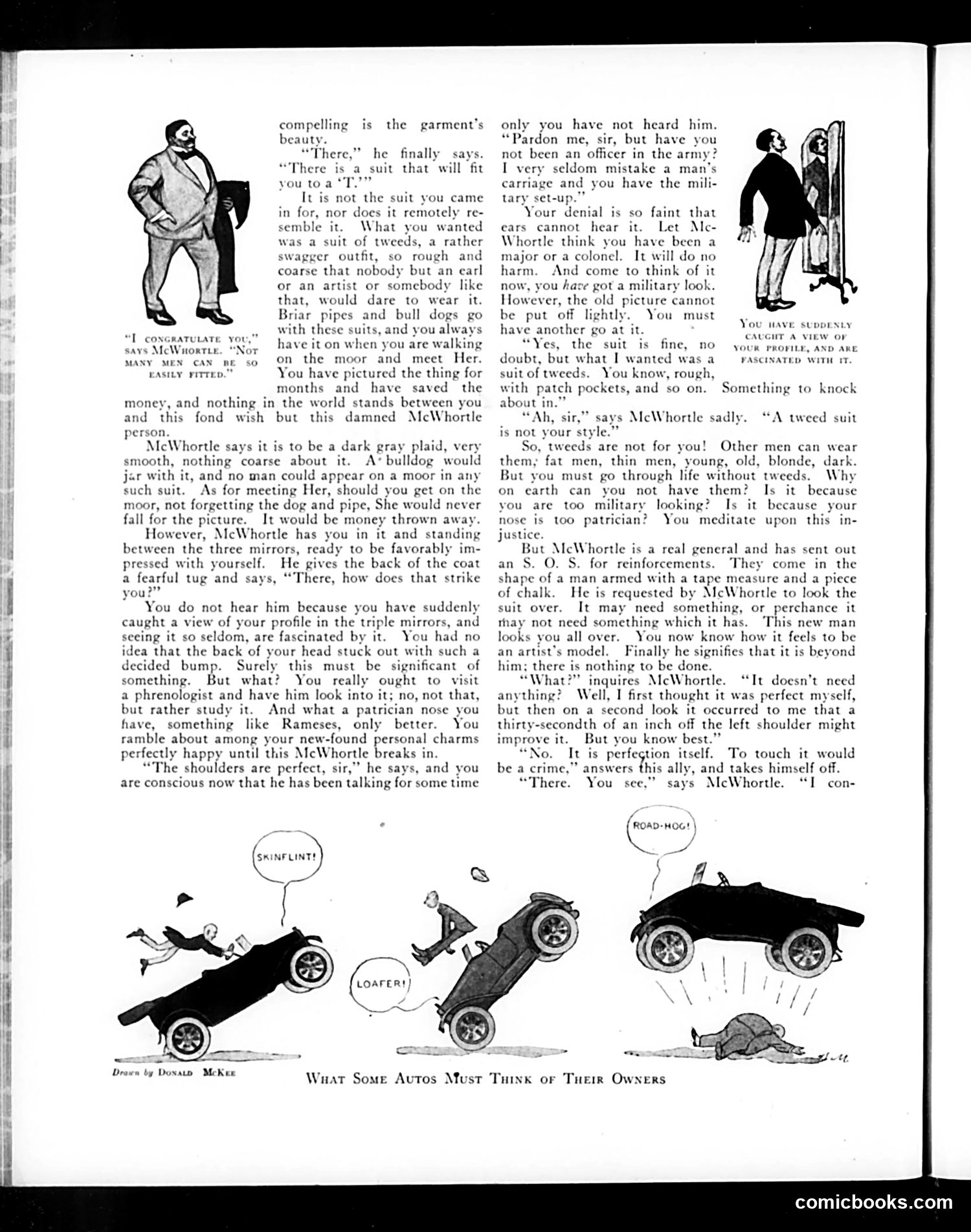
This page from *Judge* satirizes the social pretensions of wealthy automobile owners. The main text, featuring a character named McWhortle, mocks a man obsessed with acquiring fashionable clothing to match his new car and impress a woman. McWhortle's tailor ridicules him for wanting a "military" appearance, suggesting his vanity and social climbing are transparent. The bottom cartoon—"What Some Autos Must Think of Their Owners"—delivers the satire visually. Three panels show cars' perspective judgments: one owner labeled "skinflint," another "loafer," and a third "road hog." A turtle at the bottom implies these drivers are slow or foolish. The humor targets early 20th-century automobile culture and nouveau-riche status anxiety: the assumption that owning a car requires adopting an entire fashionable persona.
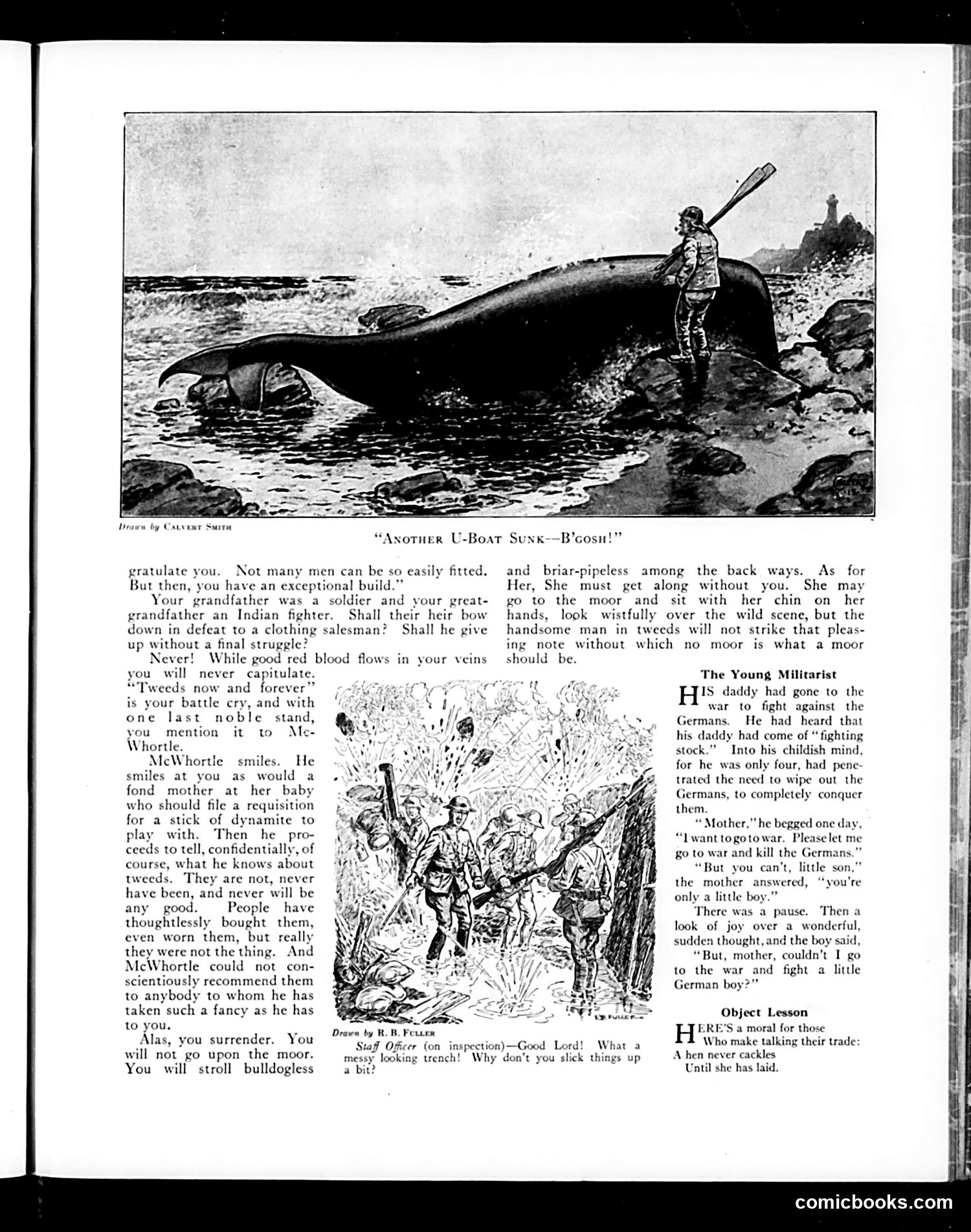
**"Another U-Boat Sunk—B'gosh!"** (top image): This WWI-era cartoon depicts the wreckage of a German U-boat on shore. The caption celebrates Allied victory over German submarines, which were a major threat to British and American shipping during the war. The drawing commemorates real naval warfare. **"The Young Militarist"** (middle): A satirical story about a four-year-old boy whose father fights Germans. The child, absorbing wartime propaganda about "fighting stock," begs to join the war and kill Germans. When told he's too young, he naively suggests fighting "a little German boy" instead. The satire mocks how militaristic rhetoric infiltrates children's minds, turning toddlers into would-be soldiers. **"Object Lesson"** (bottom): A brief moral poem: "A hen never cackles / Until she has laid." This advises against empty boasting—action speaks louder than words. All three items reflect WWI-era American attitudes: celebrating military victories while gently satirizing jingoism and its effects on civilians.
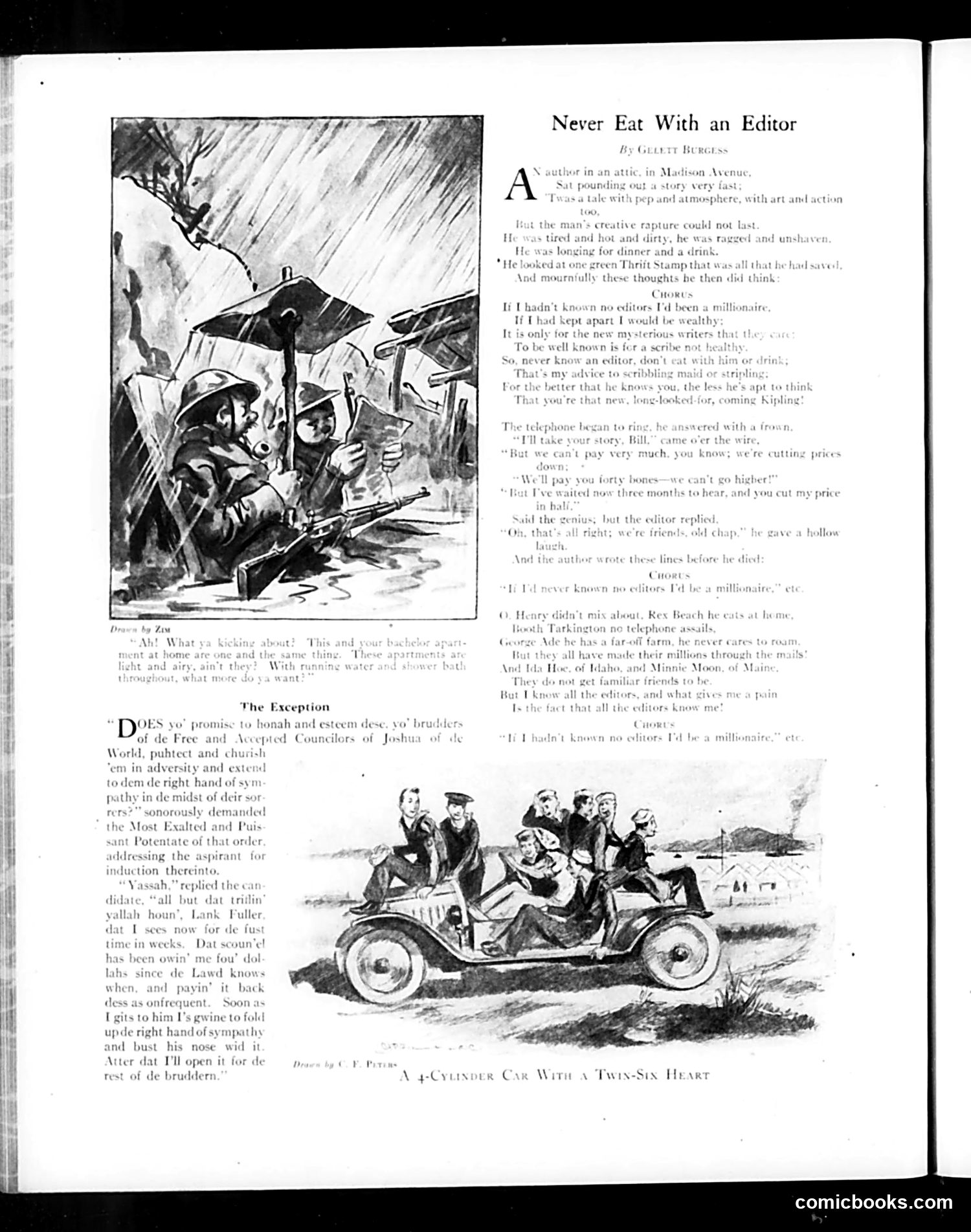
This page contains two satirical pieces from *Judge* magazine: **"Never Eat With an Editor"** (by Gluett Burgess) is a humorous poem warning freelance writers against dining with editors. The accompanying illustration shows a starving writer in an attic, contrasting with the poem's chorus: "If I hadn't known no editors I'd be a millionaire." The satire mocks the publishing industry's notoriously poor payment to writers—editors promise forty bones (dollars) but claim "we're cutting prices down," suggesting exploitative business practices toward struggling authors. **"The Exception"** appears to be a separate satirical piece referencing religious or civic organizations, though the OCR text is too corrupted to determine specific targets or meaning with confidence. The lower illustration, "A 4-Cylinder Car With a Twin-Six Heart," appears to be unrelated automotive humor. The page satirizes the economic struggles of writers and the gap between editorial promises and actual compensation.
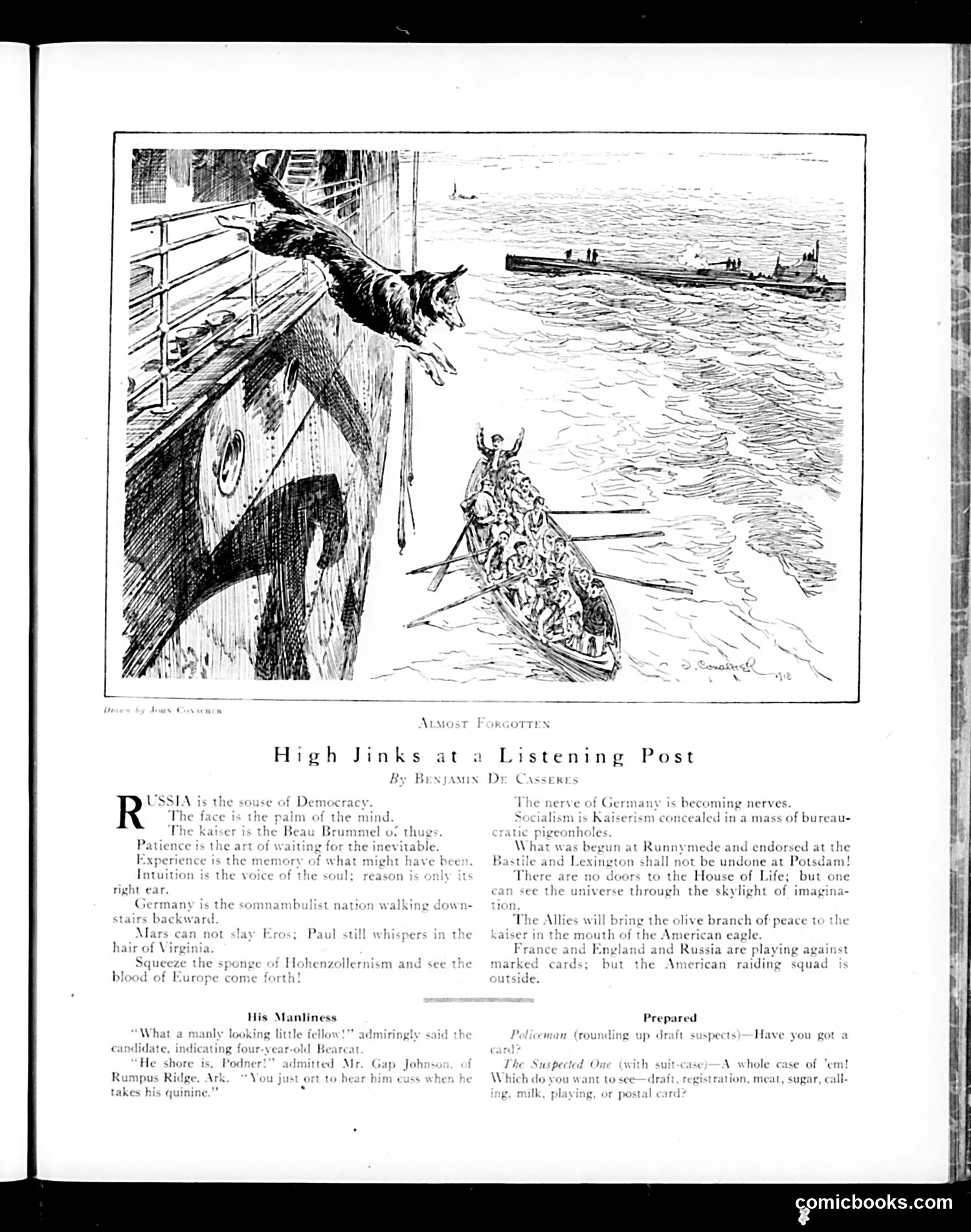
This WWI-era satirical piece by Benjamin De Casseres critiques both enemy and Allied powers. The main cartoon depicts a dog being thrown overboard from a ship while lifeboats below ignore it—likely symbolizing how nations sacrifice innocent lives during wartime. The accompanying text uses biting wordplay to attack multiple targets: Russia's authoritarianism ("souse of Democracy"), Germany's militarism and bureaucracy, and even Allied hypocrisy ("France and England and Russia...American raiding squad is outside"). References to Runnymede, the Bastille, and Lexington invoke democratic revolutions while questioning whether current powers truly serve liberty. The smaller sidebar jokes ("His Manliness," "Prepared") mock military recruitment and wartime rationing bureaucracy. The overall message: all warring powers, despite their stated ideals, behave inhumanely and hypocritically. The "listening post" title suggests overhearing uncomfortable truths about the war that polite society prefers to ignore.
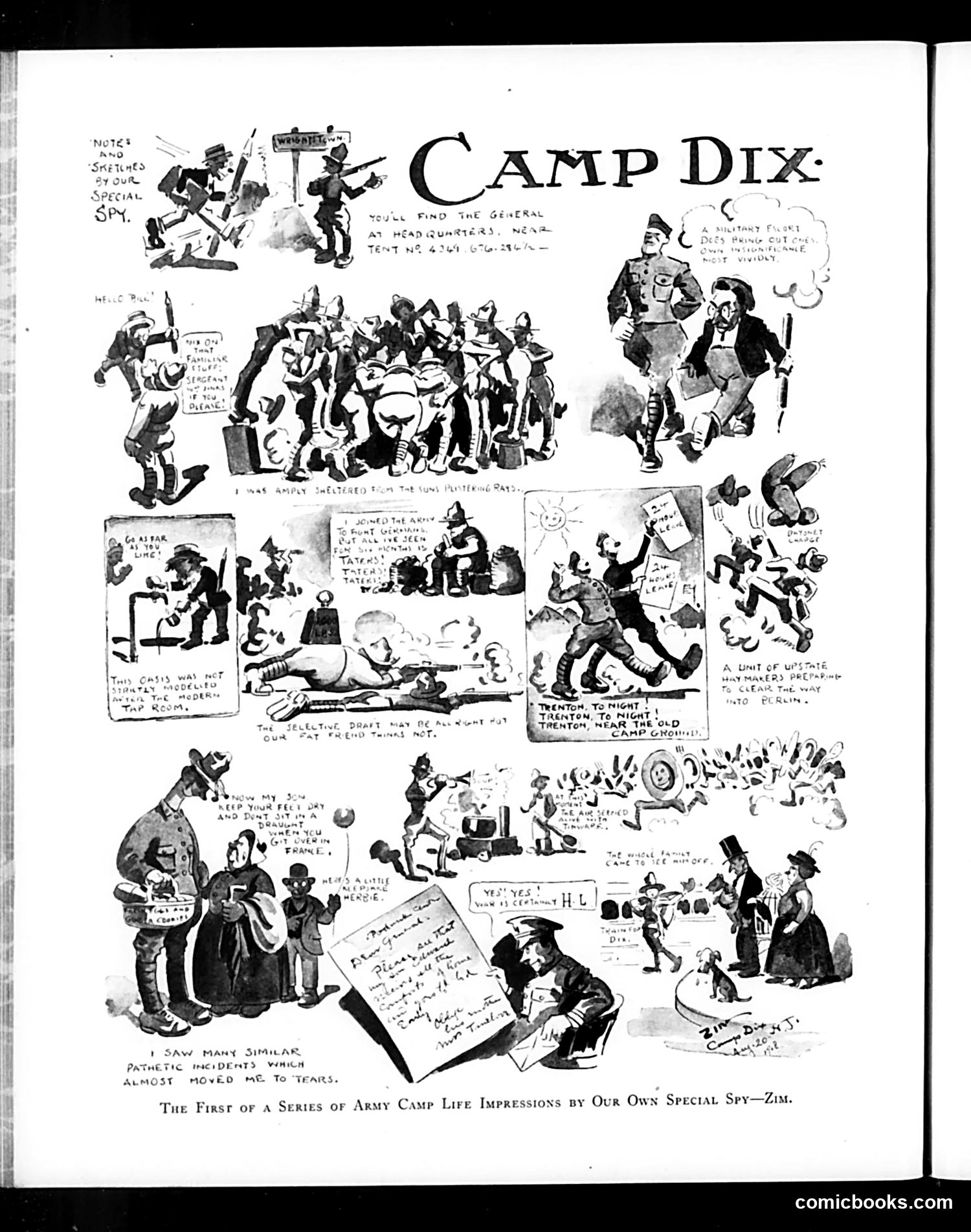
This is the first in a series of satirical sketches by cartoonist "Zim" documenting life at Camp Dix, a U.S. Army training facility (likely during WWI era, based on the style and references to "Trenton"). The humor derives from contrasting military order with chaotic reality. Various panels depict soldiers struggling with camp life: confusion about orders, bumbling officers, overcrowding, and bureaucratic absurdity. One panel shows soldiers searching for their general's headquarters; another depicts a crowded, disorganized mess. The cartoonist emphasizes incompetence and disorder in military administration—soldiers running about confused, officers issuing contradictory commands ("Trenton, to might..."). The satirical point mocks the U.S. military's organizational incompetence and the soldiers' bewilderment at camp procedures. The subtitle claims these are "impressions by our special spy," framing the cartoonist as an inside observer revealing institutional chaos to the public. This reflects contemporary anxieties about American military readiness and preparedness.
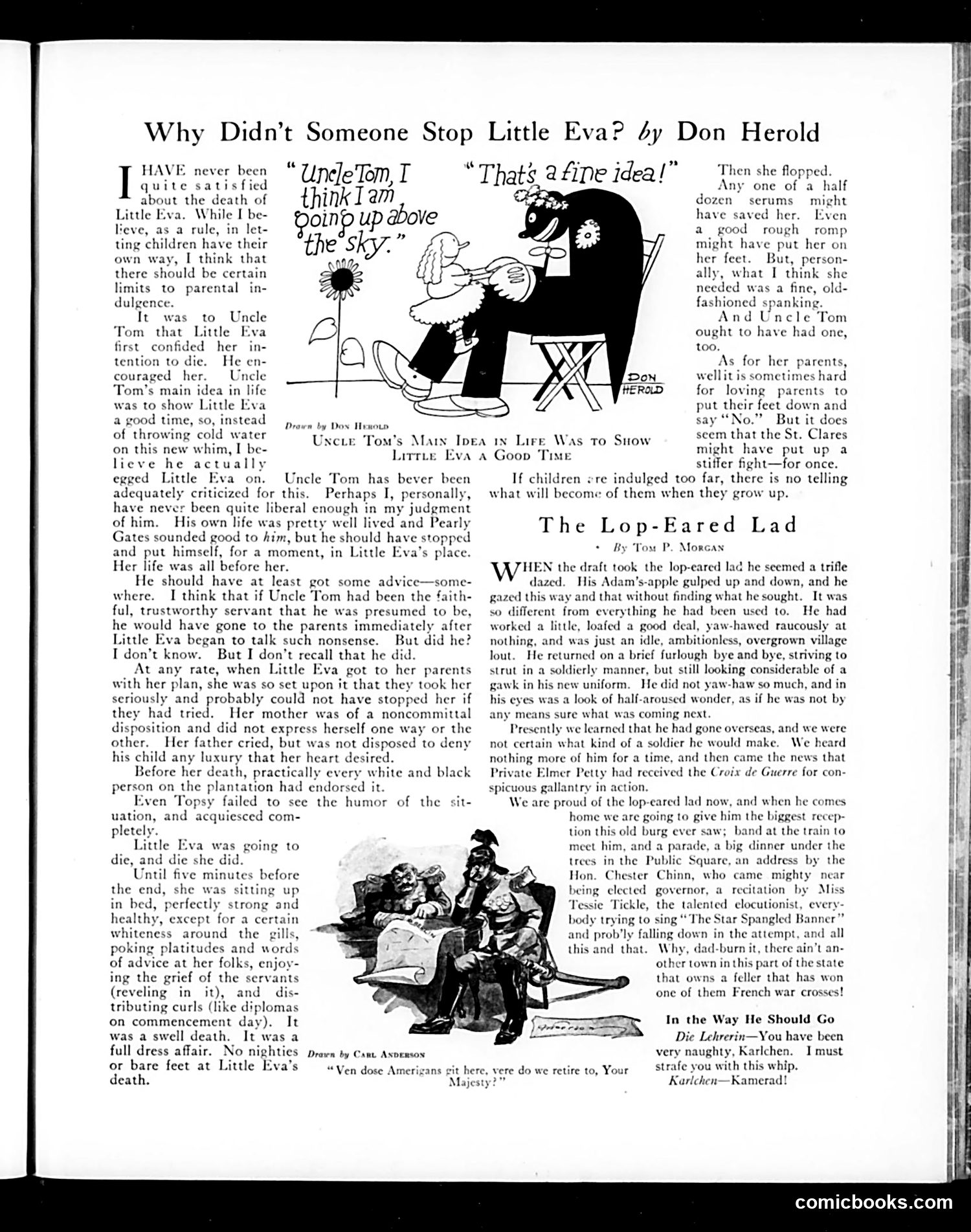
This page contains two satirical pieces critiquing American attitudes toward discipline and indulgence. **"Why Didn't Someone Stop Little Eva?"** by Don Herold mocks the sentimental death scene from *Uncle Tom's Cabin*. Herold argues that Uncle Tom and Little Eva's parents failed her by indulging her death wish rather than disciplining her. He suggests she needed "a fine, old-fashioned spanking" and that her servant and parents should have intervened. The satire targets both the novel's emotional manipulations and contemporary parental permissiveness—suggesting that allowing children unlimited freedom produces dysfunction. **"The Lop-Eared Lad"** (partially visible) appears to follow, describing a rural, unintelligent draftee transformed by military service into a more disciplined person. Both pieces reflect early 20th-century anxieties about parental indulgence, arguing for stricter child-rearing and discipline as social goods. The humor relies on readers' familiarity with *Uncle Tom's Cabin*.
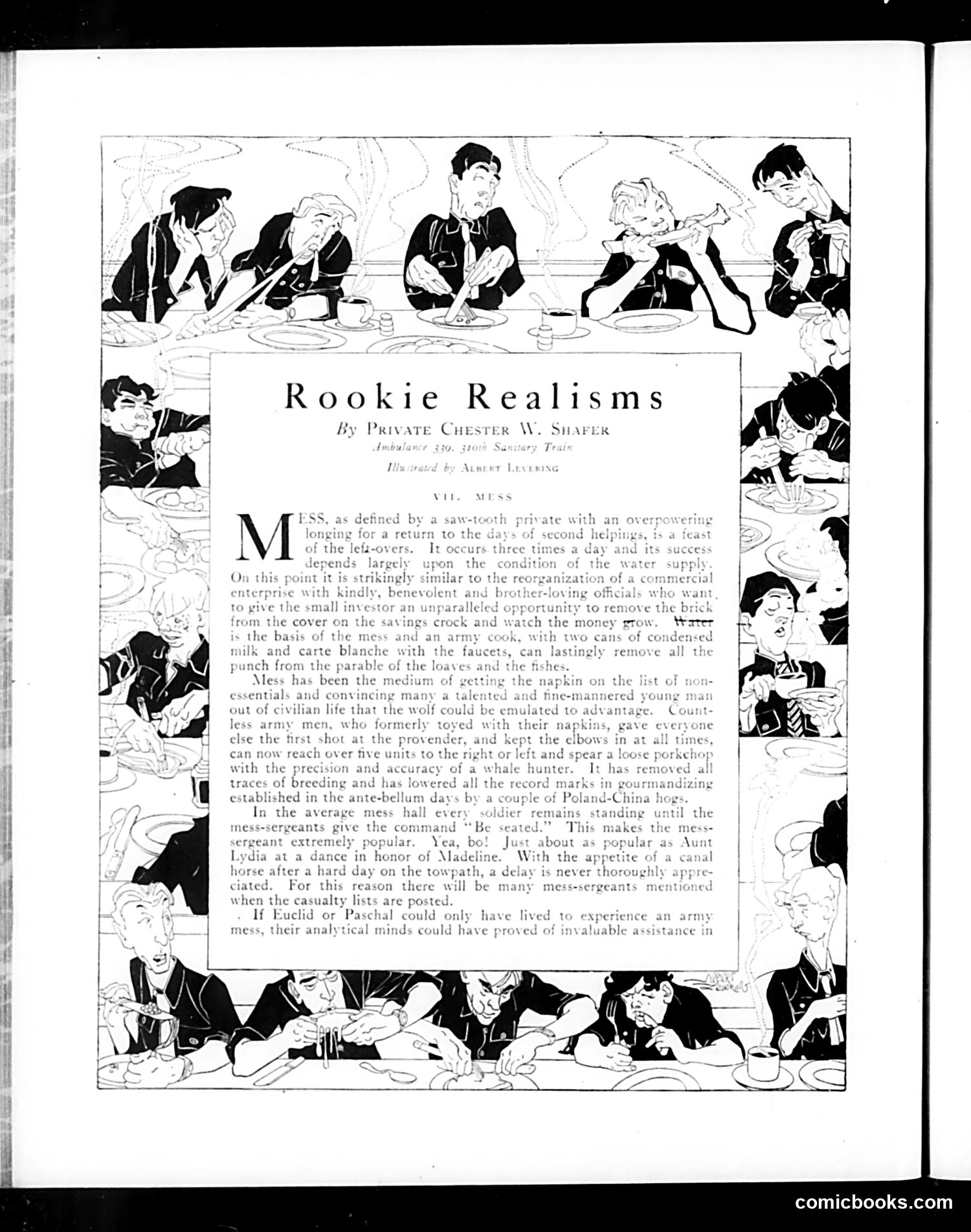
This is a satirical piece by Private Chester W. Shafer about military mess hall dining. The illustrations border a text column describing mess as "a feast of the gle-over" occurring three times daily, dependent on water supply conditions. The satire targets the chaotic reality of army cooking and dining—the text humorously describes how mess sergeants use unconventional methods (water, canned milk, blanched faucets) to remove food residue, and notes soldiers stand at attention until commanded to be seated. The piece mocks the contrast between military discipline and the actual slovenly conditions of mess hall operations. The cartoon panels show soldiers eating, emphasizing their discomfort and the informal reality beneath formal military structure. The humor lies in exposing the gap between military order and messy practical reality.
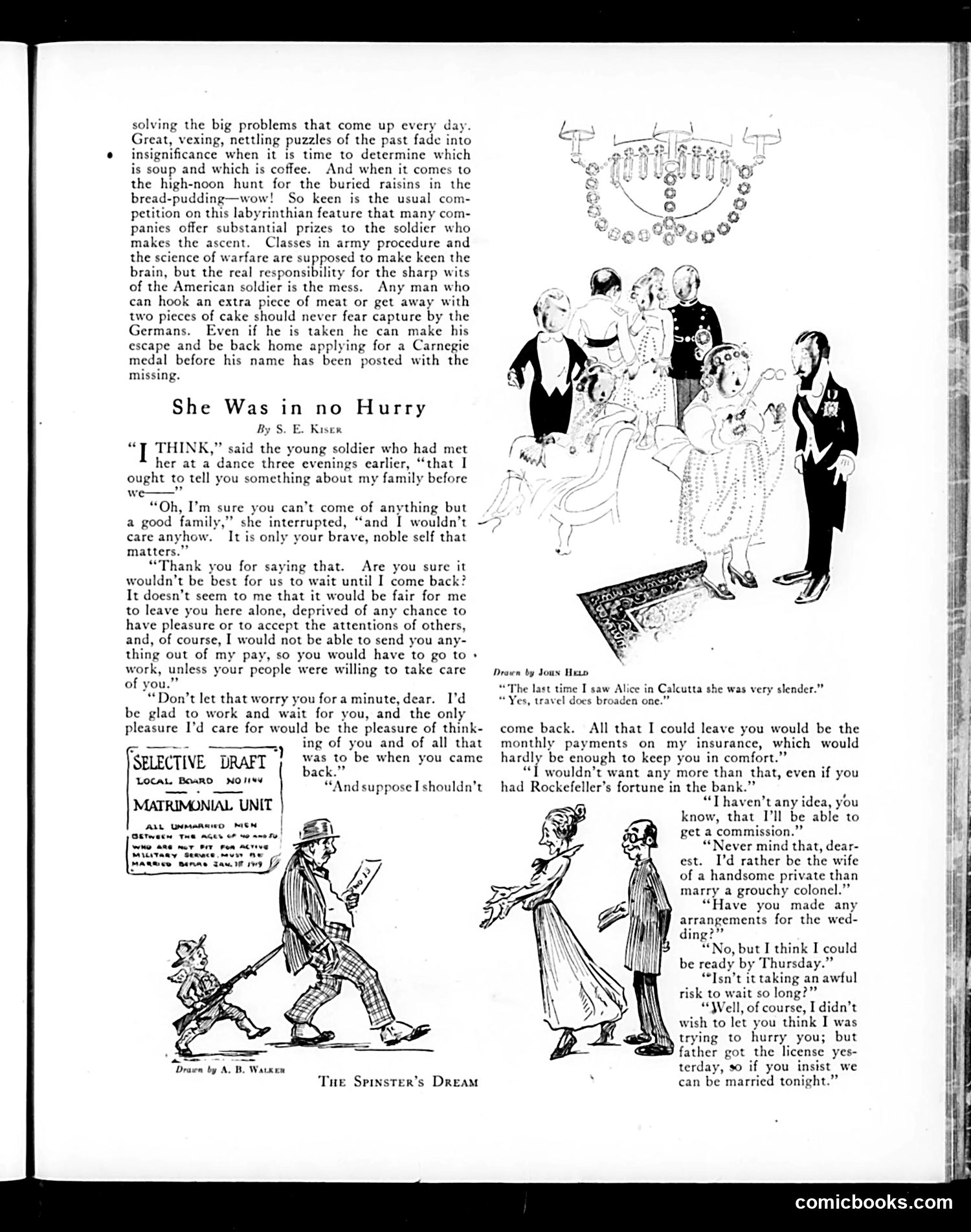
This page contains WWI-era content satirizing military life and wartime romance. **"The Spinster's Dream"** (left cartoon by A.B. Walker) depicts a "Selective Draft Matrimonial Unit"—a satirical reference to the draft board. A man in formal dress is being pulled like a puppet toward marriage by a woman, mocking how unmarried men faced social pressure (or actual draft incentives in some proposals) to marry before deployment. **"She Was in No Hurry"** (S.E. Kiser story, right) ironically reverses expectations about marriage timing. A soldier delays proposing due to financial concerns and duty, while the woman claims patience. The punchline reveals she's *already obtained a marriage license from her father*—implying she was never reluctant at all, contradicting the title. The joke satirizes how women during WWI pursued marriage with soldiers despite apparent reluctance, likely for security or patriotic duty. Both pieces mock the collision between military obligation and romantic/matrimonial pressures during wartime.
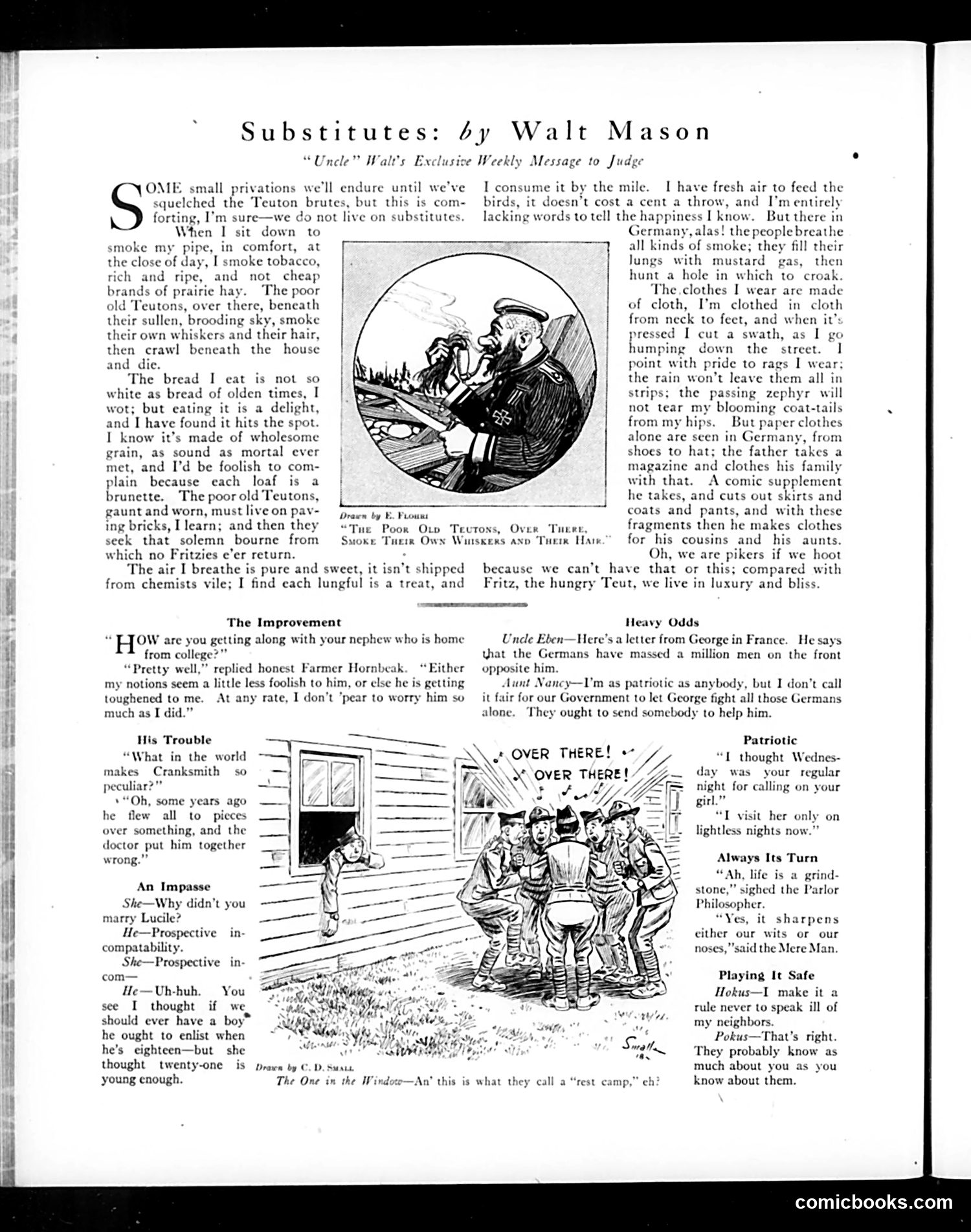
This World War I-era page satirizes American complacency about wartime sacrifice compared to European suffering. **"Substitutes" by Walt Mason** contrasts the narrator's modest American privations (plain bread, prairie hay tobacco) with German deprivation. Germans, depicted as "Teutons" and "Fritz," suffer mustard gas attacks and resort to making clothes from newspaper scraps, while Americans enjoy fresh air and proper garments. The implicit critique: Americans complain about rationing while Europeans face genuine horrors. **"The One in the Window"** cartoon shows soldiers in a "rest camp" amid explosions ("OVER THERE!"), darkly illustrating frontline conditions. **"Heavy Odds"** features "Aunt Nancy" expressing patriotic concern that one American soldier (George) fights alone against a million Germans—a complaint about insufficient Allied support or manpower. The page's overall message uses class-conscious humor (poor Teutons vs. comfortable Americans) and stark contrasts to shame American grumbling and encourage either greater sacrifice or support for the war effort. The tone is propagandistic, using British-American soldiers as virtuous figures against dehumanized German "Teutons."
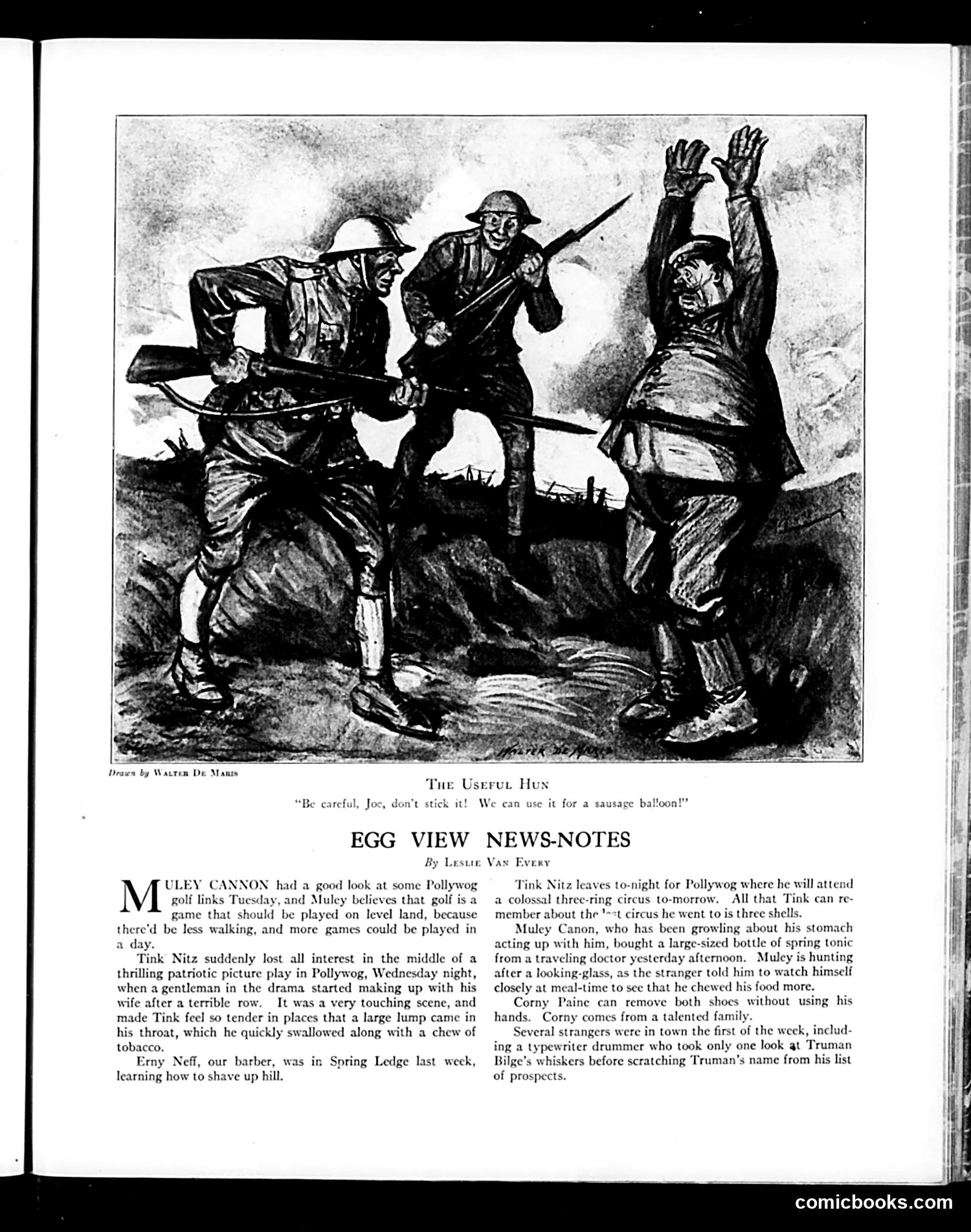
This page contains two elements: a WWI-era propaganda cartoon and small-town gossip notes. **The Cartoon ("The Useful Hun"):** Depicts three soldiers with bayoneted rifles confronting a German soldier with raised hands in surrender. The caption's joke suggests using the prisoner as a "sausage balloon"—a darkly humorous reference to both German sausage stereotypes and observation balloons used in trench warfare. The satire mocks Germans while presenting Allied soldiers as resourcefully brutal. **"Egg View News-Notes":** These are humorous local anecdotes about small-town characters (Muley, Tink, Corny, etc.)—typical Judge magazine filler content poking fun at rural life: golf on uneven terrain, emotional reactions at movies, a barber learning to shave uphill, a traveling con artist, and a traveling salesman put off by someone's appearance. The humor relies on absurdity and gentle mockery of provincial life. Together, the page contrasts wartime propaganda with peacetime small-town triviality—Judge's typical mix of patriotic sentiment and domestic satire.
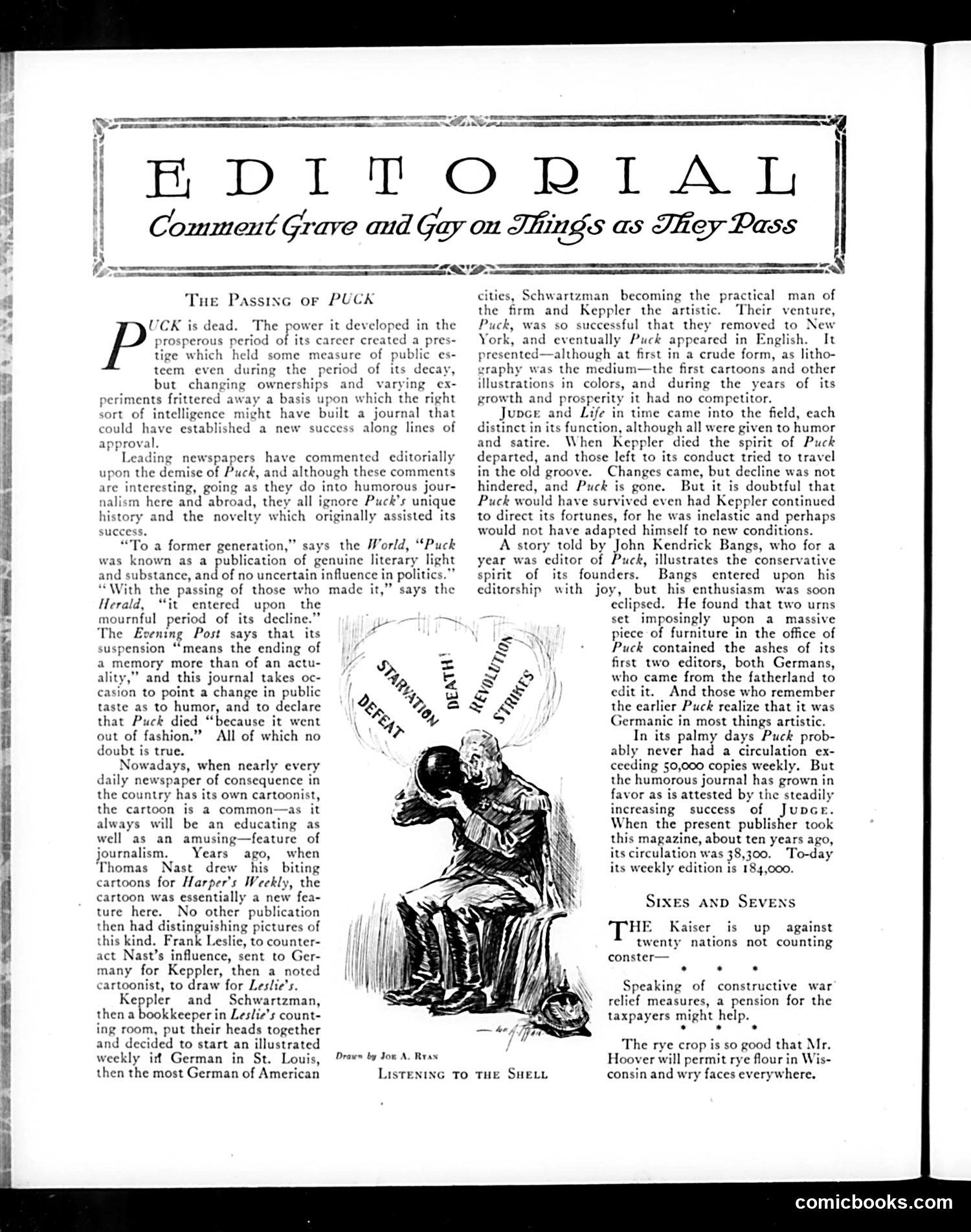
This page eulogizes **Puck magazine**, which has ceased publication. The editorial traces Puck's history: founded in St. Louis by German immigrant Joseph Keppler (an artist) and Schwartzman, it pioneered the illustrated satirical weekly in America. After relocating to New York and succeeding brilliantly, Puck declined following Keppler's death. The accompanying cartoon, "Listening to the Shell," depicts a dejected figure (representing Puck) hunched over, symbolizing the magazine's demise. The editorial attributes Puck's failure partly to changing ownership and outdated editorial conservatism—notably mentioning editor John Kendrick Bangs's anecdote about urns containing ashes of the German founders displayed in the office, suggesting their rigid Germanic aesthetic prevented adaptation to modern tastes. For modern readers: this documents how pioneering media institutions can become obsolete when leadership fails to evolve with audiences—a timeless theme.
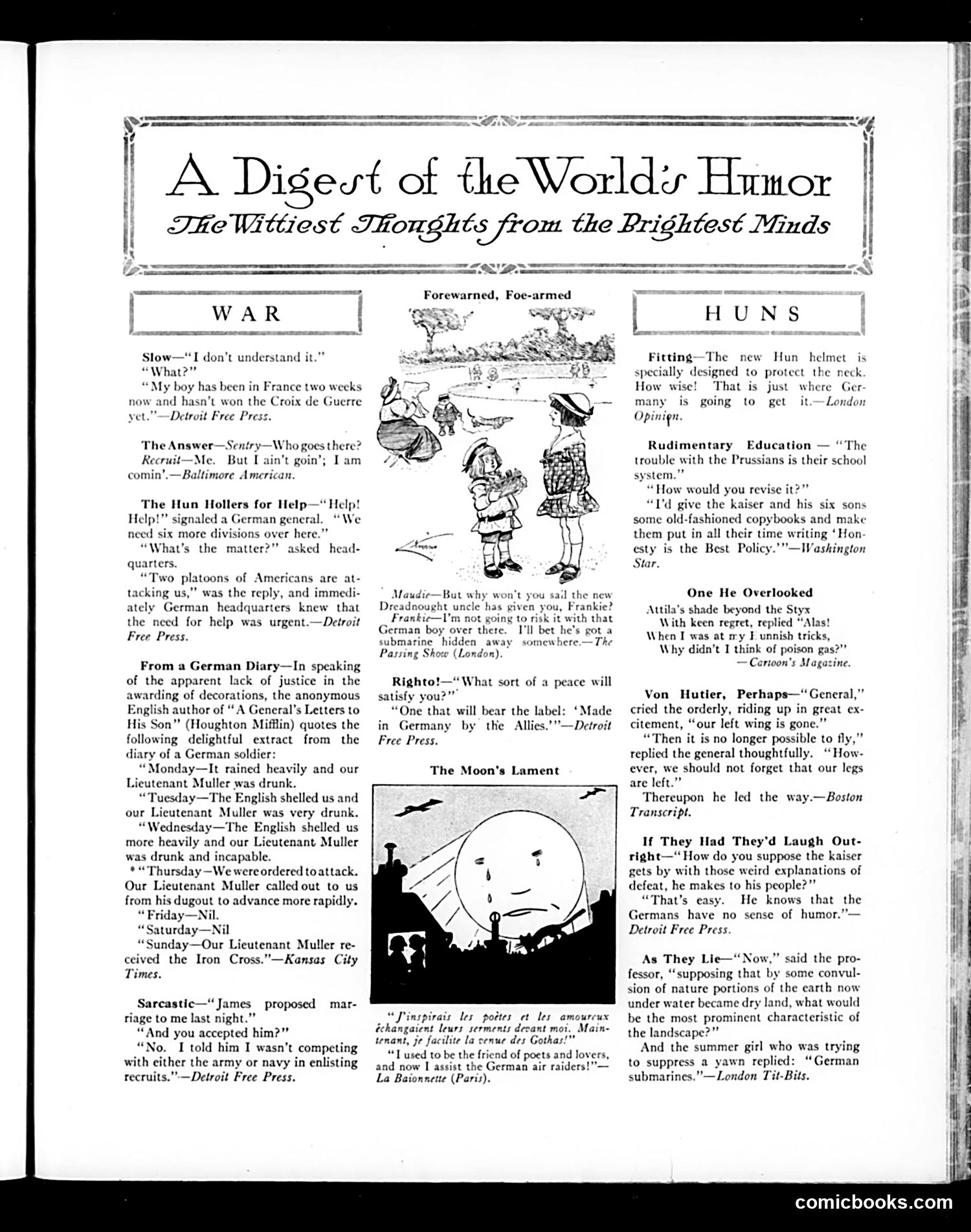
This page collects satirical quips about World War I, primarily mocking Germans and celebrating American military capability. **Key targets:** - **German incompetence**: Multiple jokes portray Germans as foolish (a general rewarding a drunk officer with the Iron Cross; a general accepting his army's collapse with illogical resignation) - **American superiority**: Americans defeat Germans with minimal forces ("two platoons of Americans" terrify German headquarters) - **German lack of humor**: A recurring theme—one joke suggests the Kaiser survives defeat because "Germans have no sense of humor" - **German militarism**: References to the Kaiser and Prussian educational system **Cartoon context**: "The Moon's Lament" (illustrated) shows the moon lamenting its shift from witnessing romantic poetry to facilitating German air raids—contrasting romantic European tradition with brutal modern warfare. **Tone**: Aggressively propagandistic. Published during U.S. involvement (1917-1918), these jokes reinforce American confidence while dehumanizing the enemy through ridicule rather than reasoned critique.
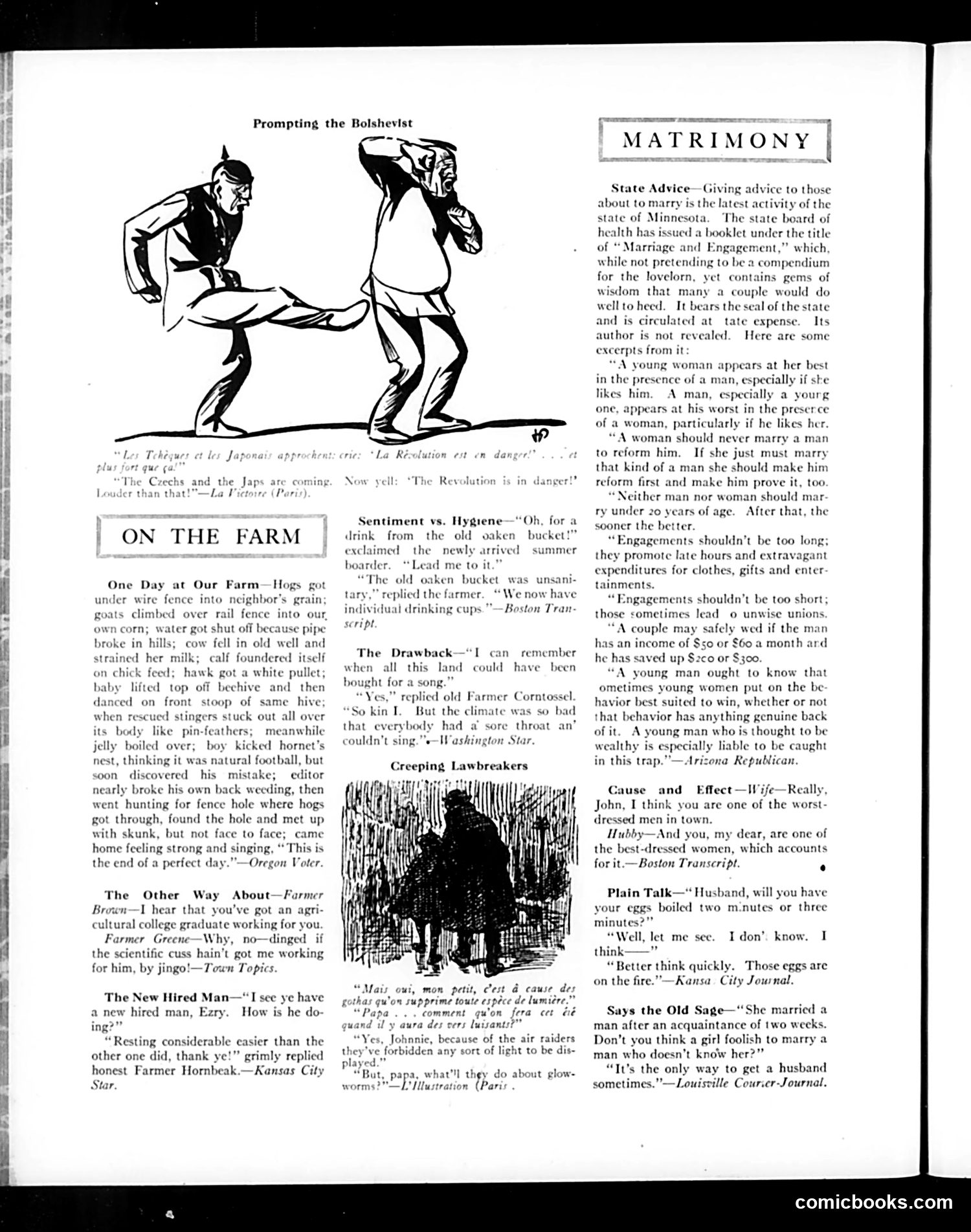
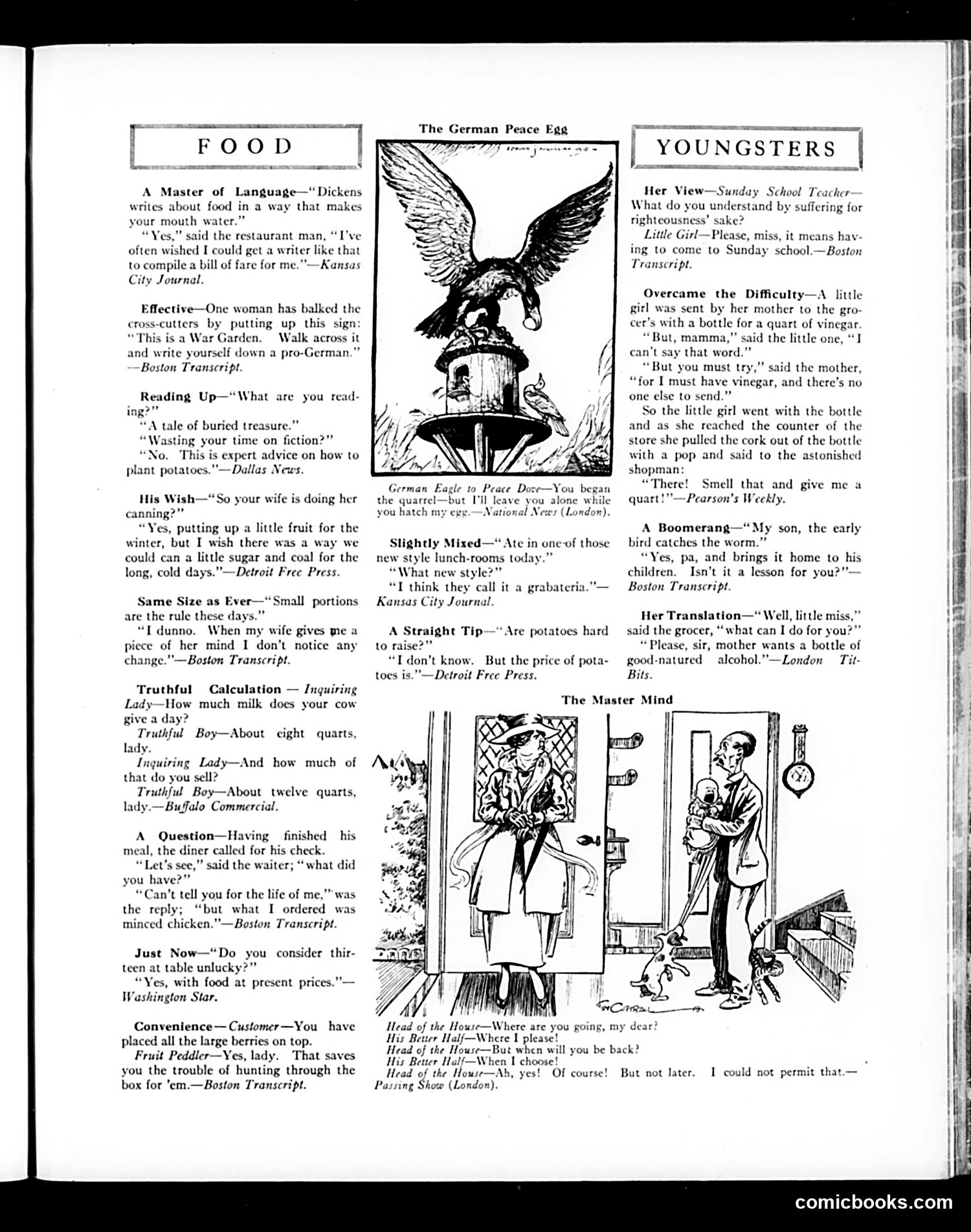
This page from Judge magazine contains satirical humor reflecting **World War I-era American concerns**, particularly food rationing and the war effort. **Key themes:** The **"Food" section** satirizes wartime scarcity—small portions, rationing of sugar and coal, and inflated prices. Jokes about wives' "pieces of mind" being small and unnoticed reference domestic austerity measures. The **"German Peace Egg"** cartoon depicts a German eagle atop a bomb or shell, captioned as a "peace egg"—bitter satire suggesting Germany's peace overtures were deceptive and dangerous. The **"Youngsters" section** includes jokes about children misunderstanding adult concepts—a girl saying Sunday school is "suffering for righteousness" and another calling alcohol "good-natured alcohol" instead of "vinegar." **"The Master Mind"** cartoon shows a husband accepting his wife's independence with resignation, satirizing shifting gender dynamics during wartime (when women took on more autonomous roles). Overall, the page blends domestic wartime frustrations with gentle mockery of German peace negotiations and social change.
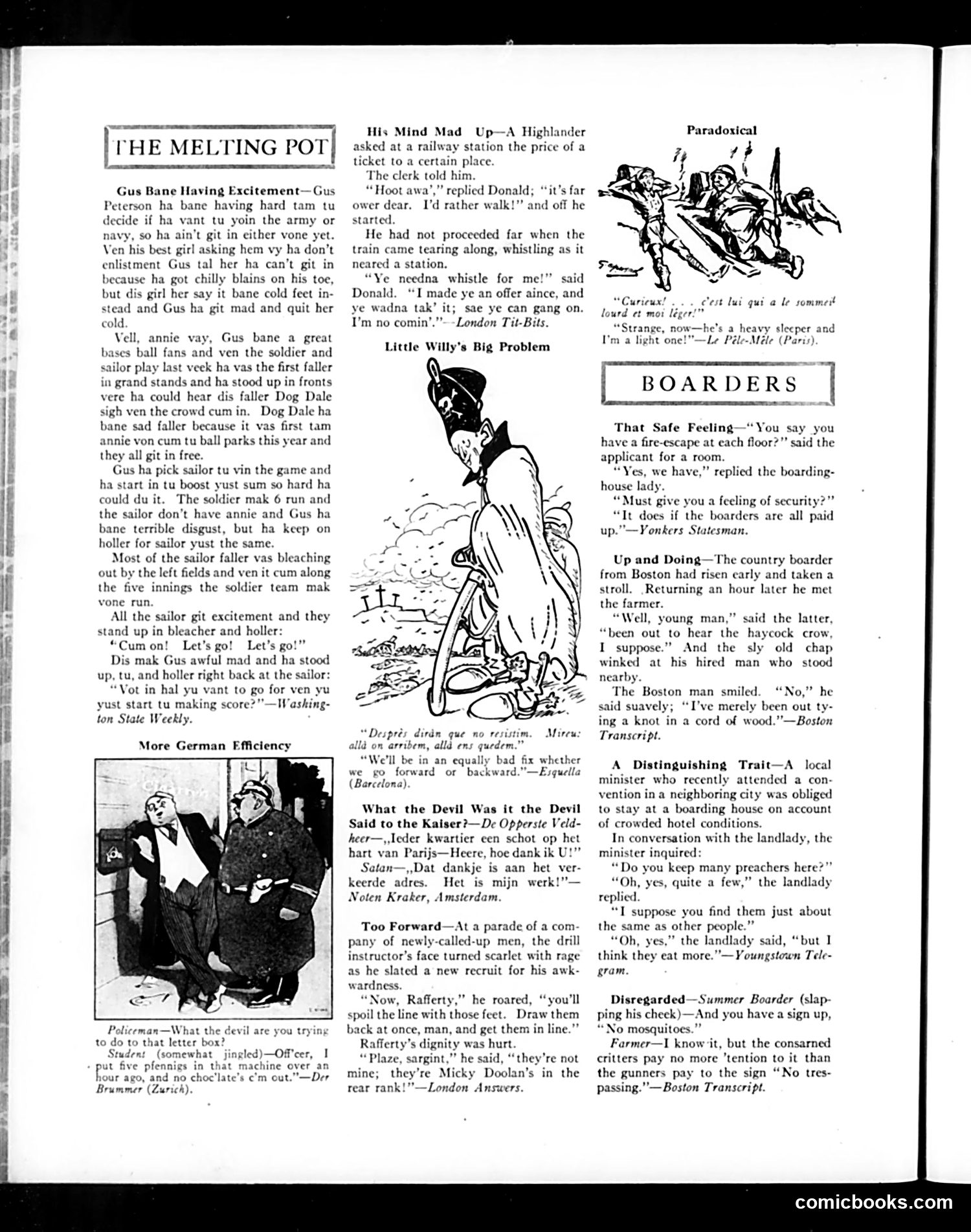
This Judge page uses ethnic humor typical of early 20th-century American satire. The title section features **"Gus Bane Having Excitement,"** a dialect-heavy story about a Swedish-American immigrant (indicated by phonetic spelling: "vone," "vay," "ta yoin") unable to decide between military service. The humor relies on his exaggerated immigrant accent and his girlfriend's criticism that his hesitation shows "cold feet." Other sketches mock various nationalities: a German student's bureaucratic frustration, a Scottish Highlander's stinginess, and an Irish soldier's spatial confusion. The "Boarders" section satirizes landlords' financial anxieties. **For modern readers:** This represents prevailing attitudes of the era—immigrants and ethnic groups were stock comedic subjects, their speech patterns exaggerated for laughs. The humor assumes readers found foreigners' mannerisms inherently amusing. While ostensibly lighthearted, these pieces reflect period xenophobia and the outsider status of immigrant communities in America.
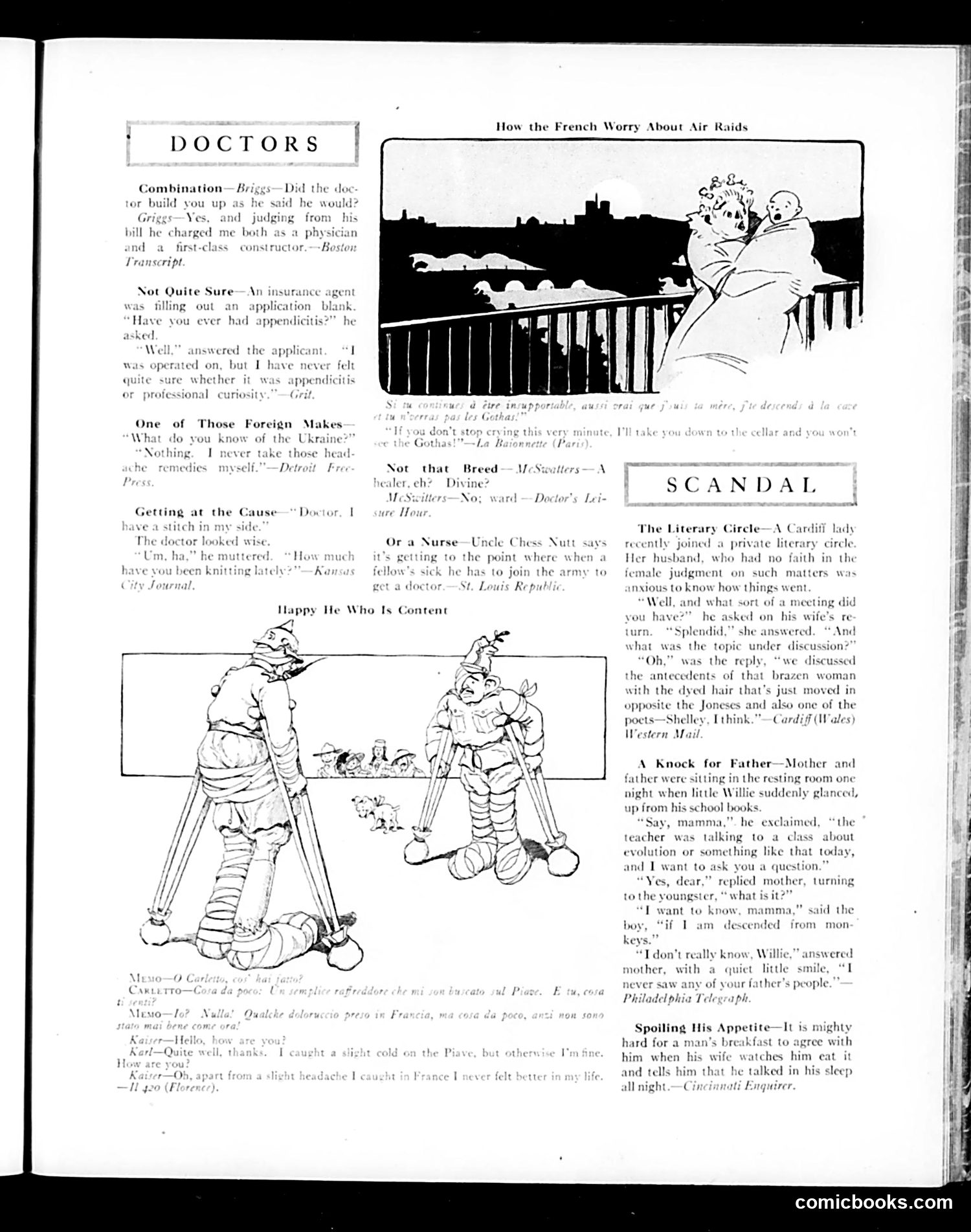
This page contains several unrelated humorous anecdotes and two cartoons rather than political satire. **Top Cartoon - "How the French Worry About Air Raids":** A woman holds a baby on a balcony overlooking a city skyline during an air raid, seemingly unconcerned. The caption (in French) suggests she's threatening to take the child to the cellar if it doesn't stop crying. This satirizes French attitudes toward WWI air raids—treating them as minor nuisances rather than serious threats. **Bottom Cartoon - "Happy He Who Is Content":** Two rotund figures in military/formal dress appear to be dining or socializing. The Italian caption references Machiavelli, likely satirizing Italian military leadership or political figures during WWI. **Text sections** are mild domestic humor anecdotes about doctors' fees, literary circles, children's questions about evolution, and marital complaints—typical early 20th-century magazine filler with no political content. The page reflects American attitudes toward European affairs during the WWI era.
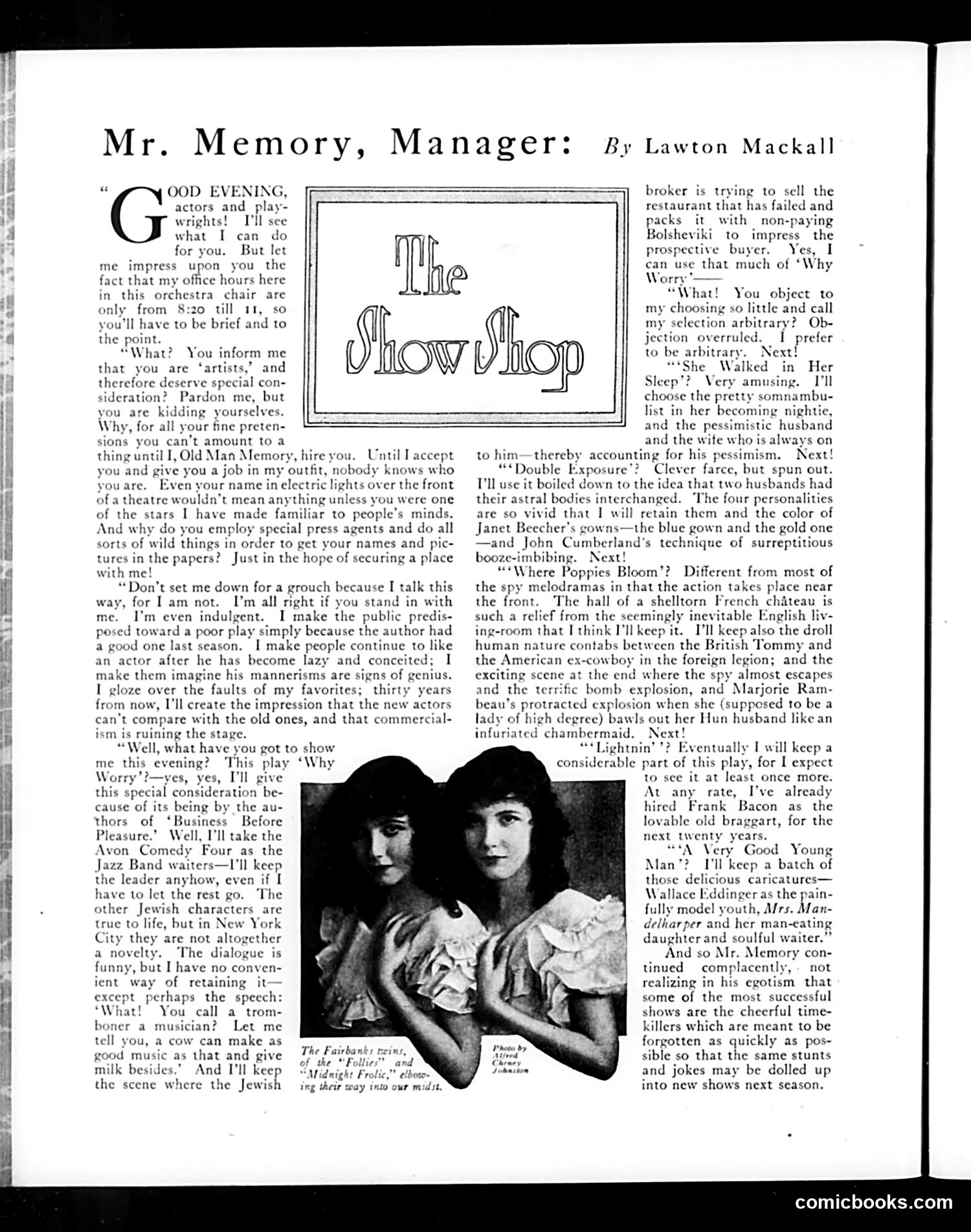
This satirical piece by Lawton Mackall mocks the absolute power wielded by theater managers and critics who determine actors' careers and which plays succeed. The central figure, "Old Man Memory," represents the collective memory and influence of the theatrical establishment—the gatekeeper who makes or breaks performers. The satire targets the manager's arrogant assertion that actors are nothing without his patronage, that he manufactures stars and can sustain mediocre performers through sheer force of reputation. He boasts of cherry-picking scenes and elements from plays, discarding the rest, and keeping certain performers "anyhow" regardless of merit. The detailed plot references (various plays listed) critique how theaters cannibalize productions, retaining only profitable elements. The photograph shows two performers, likely from the featured play "The Show Shop." The satire's point: theatrical power is dangerously concentrated in arbitrary hands that prioritize commercial advantage over artistic integrity.
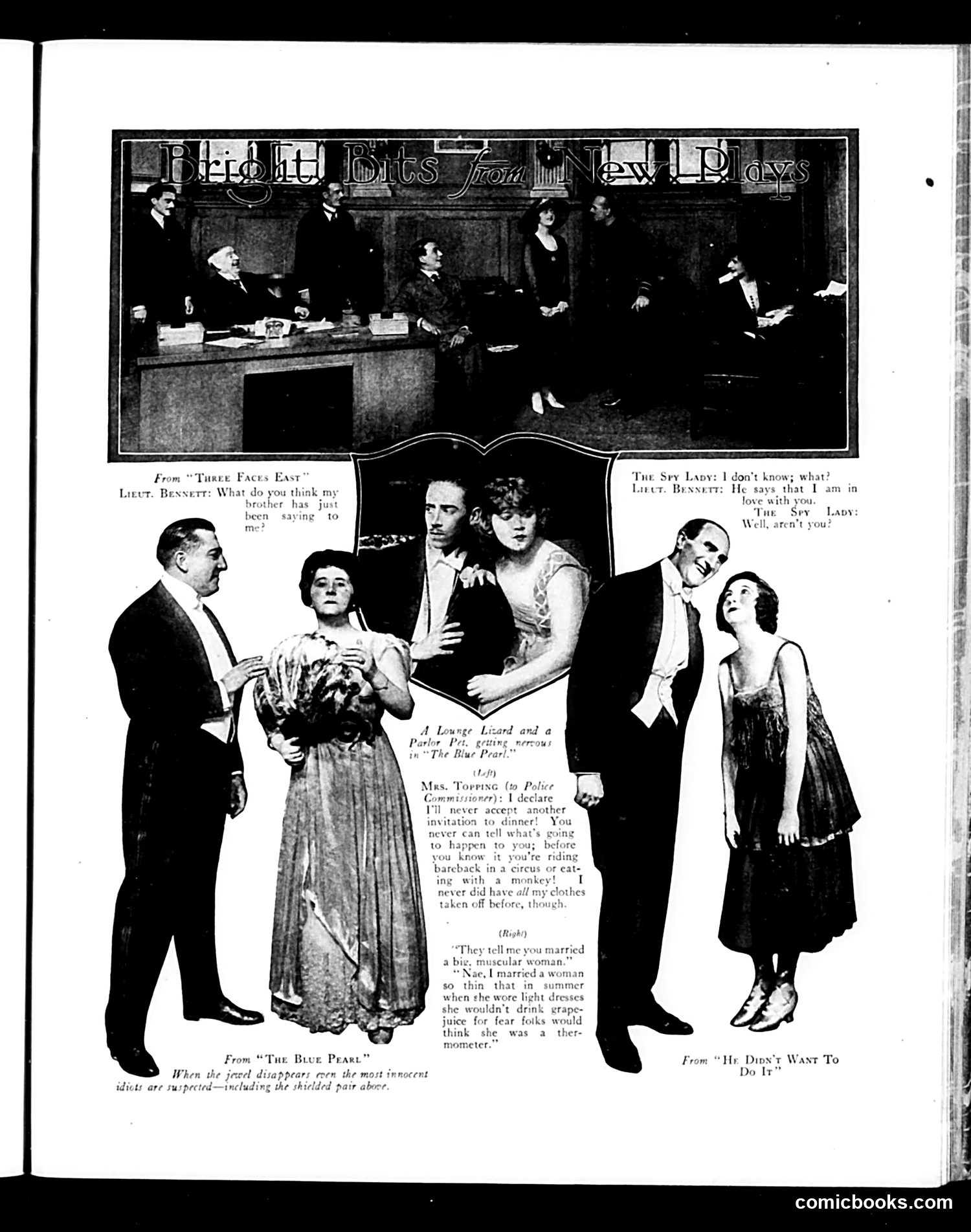
This page presents satirical scenes from contemporary theatrical productions. The content mocks dramatic conventions of the era through exaggerated dialogue and situations. The scenes appear to ridicule: 1. **Melodramatic plotting** - Characters discussing implausible scenarios (a woman so thin she wouldn't drink grapefruit juice for fear of being mistaken for a thermometer) 2. **Romantic comedies** - The "Spy Lady" exchange satirizes conventional flirtation and misunderstanding common in stage comedies 3. **Social pretension** - Mrs. Torring's dialogue about dinner invitations and unpredictable consequences mocks upper-class affectation The humor targets contemporary theater's reliance on artificial situations, overwrought emotional declarations, and stock character types. Without specific play dates visible, these appear to be generic jabs at popular theatrical tropes rather than commentary on particular political figures or events. The satire is primarily about *how plays are written*, not about real-world politics.
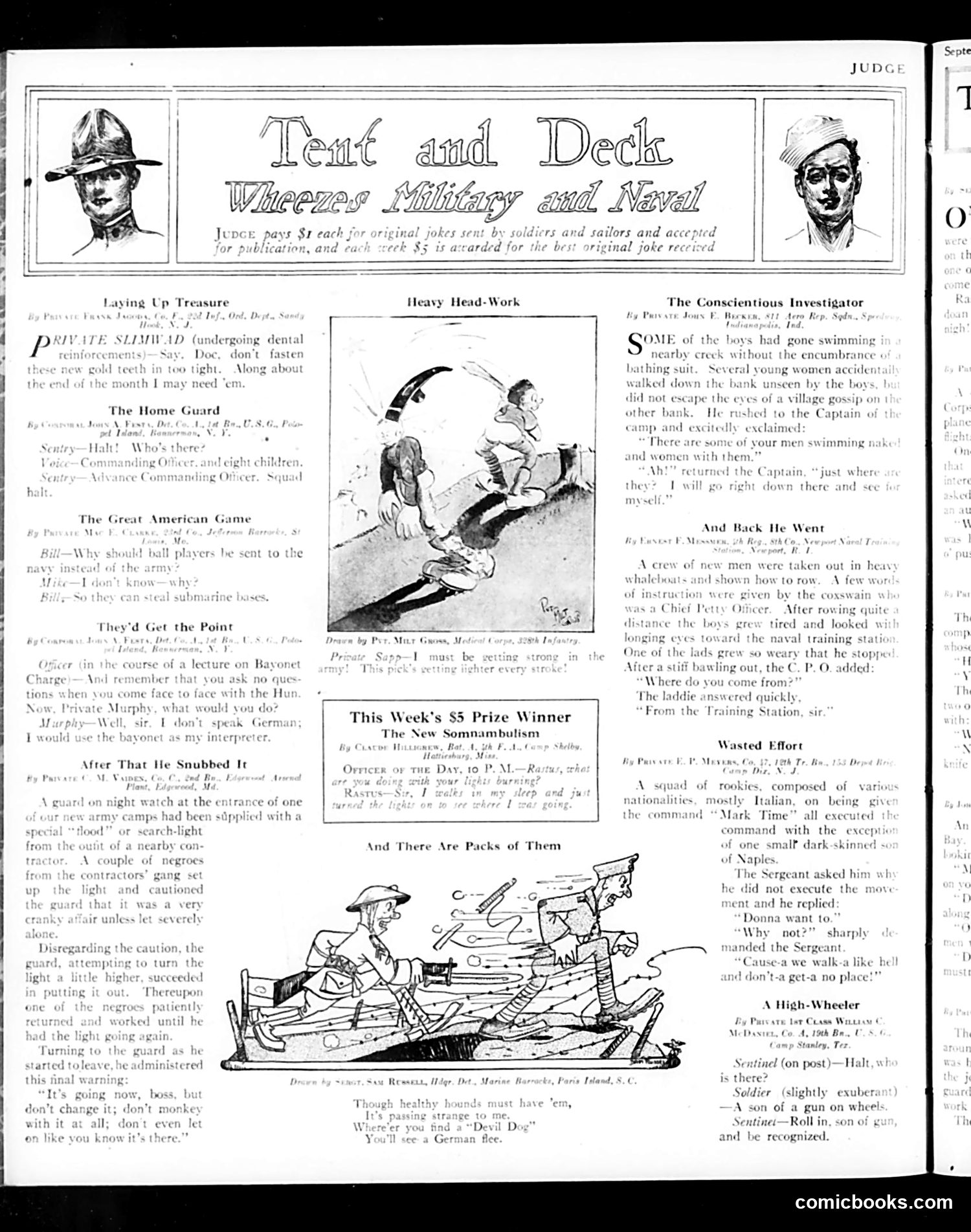
This is a collection of short military jokes and cartoons submitted by soldiers and sailors. Judge paid $1 per joke accepted for publication. The content satirizes military life and training through brief anecdotes: - **"Laying Up Treasure"**: A dental joke about a soldier getting gold teeth - **"Heavy Head-Work"**: Shows soldiers swimming; the humor involves young women observing them at camp - **"The Conscientious Investigator"**: A captain investigates swimming activity - **"And Back He Went"**: New recruits receive instruction; a recruit admits he didn't follow orders because "Donna want to" - **"High-Wheeler"**: A humorous exchange about a soldier on guard duty The cartoons depict typical WWI-era military scenarios—training, discipline, camp life—from enlisted men's perspectives. The humor is gentle, focusing on the absurdities and inconveniences of military service rather than combat. The Italian-accented dialect in one joke reflects period ethnic humor conventions.
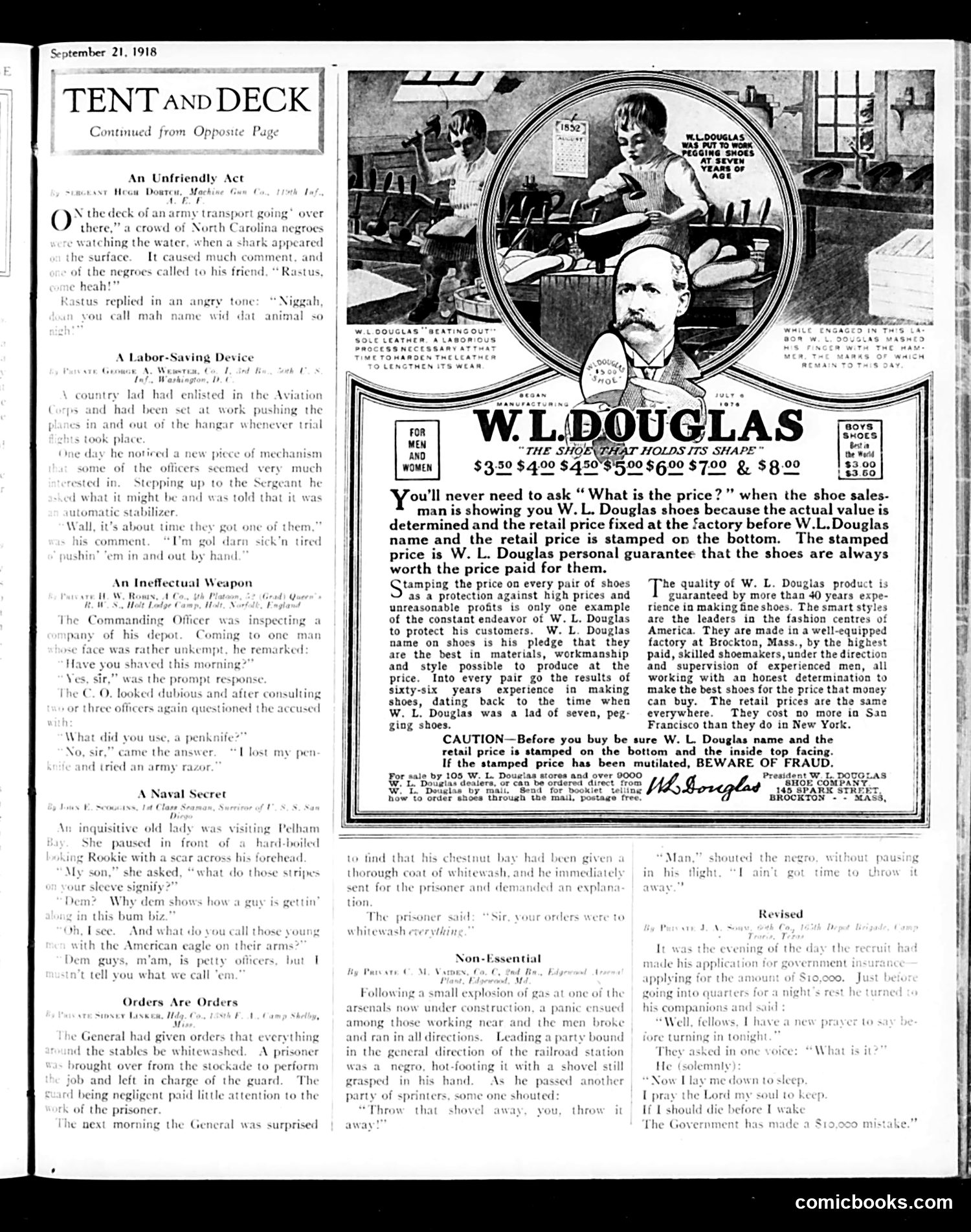
This September 1918 *Judge* magazine page contains racist humor typical of the era, alongside unrelated stories and a W.L. Douglas shoe advertisement. The "Tent and Deck" section presents anecdotes about African American soldiers during World War I. "An Unfriendly Act" depicts a shark appearing near a transport, with a soldier calling out to a friend using a racial slur—the "joke" relying on the stereotype of Black fear. Other brief stories employ similar minstrel-show dialect and stereotypical characterizations. The humor reflects the deeply segregated U.S. military of 1918, where Black soldiers served in segregated units often assigned menial labor. The magazine presents these circumstances as comic fodder rather than examining systemic racism. The dominant advertisement for W.L. Douglas shoes features the company's price-stamped guarantee, unrelated to the surrounding content—typical of *Judge's* mixed editorial and advertising format. Modern readers should recognize this as historical evidence of casual, institutionalized racism in mainstream American media, not as humor.
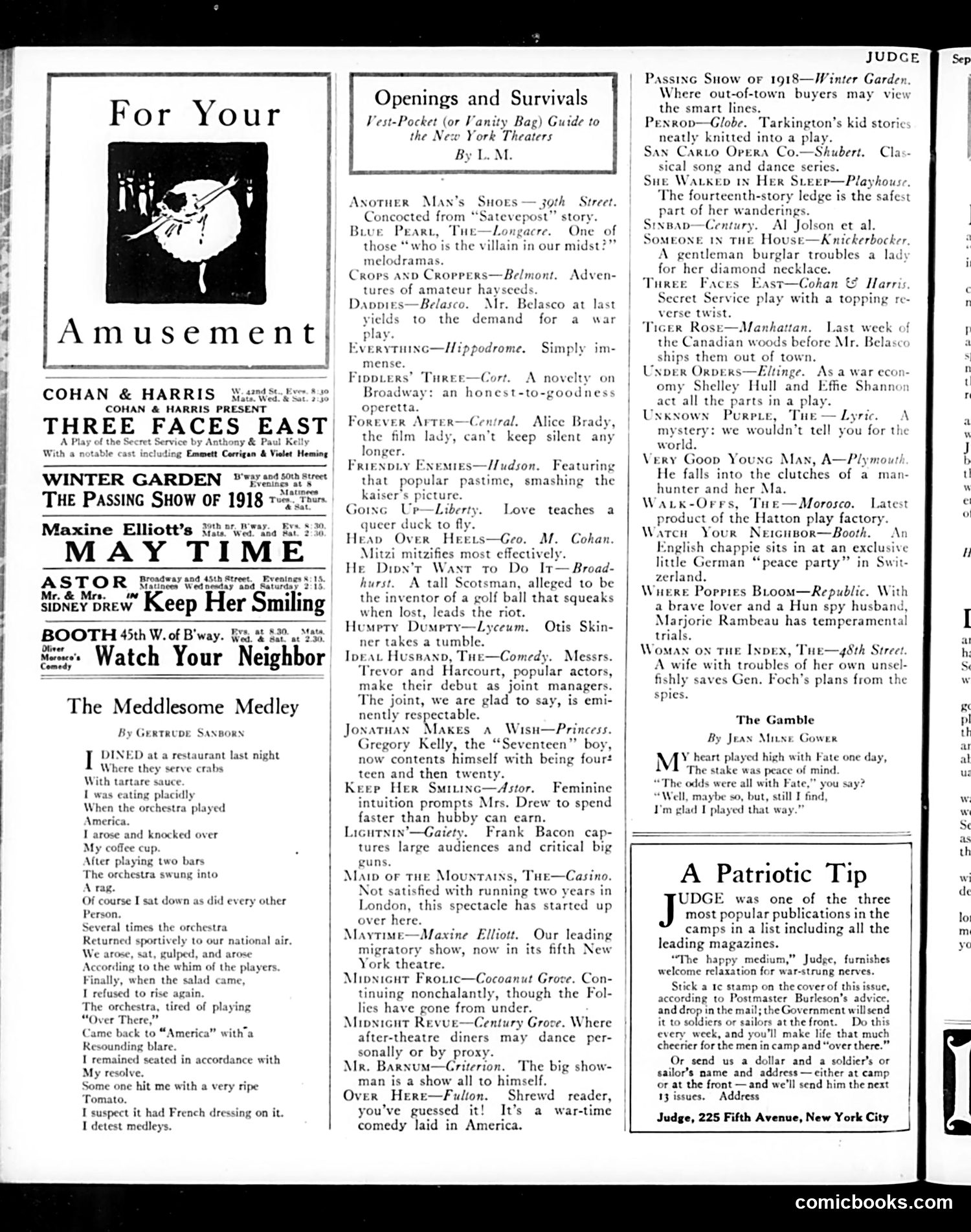
This page is primarily **theatrical advertisements and reviews**, not political satire. The main satirical content is "The Meddlesome Medley" by Gertrude Sanborn, a humorous essay about wartime patriotism. The author dines at a restaurant where an orchestra repeatedly plays "Over There" (a popular WWI patriotic song) and "America." Each time they play the national air, diners automatically stand up. The narrator resolves to remain seated during "America," but is hit with a ripe tomato by an angry fellow diner—satirizing how patriotic fervor and social pressure during WWI made dissent or even quiet non-conformity socially unacceptable and potentially dangerous. The joke critiques mob mentality and forced patriotism rather than attacking any specific political figure. The right column contains straightforward theater reviews of current Broadway productions, several featuring war-related themes appropriate to 1918.
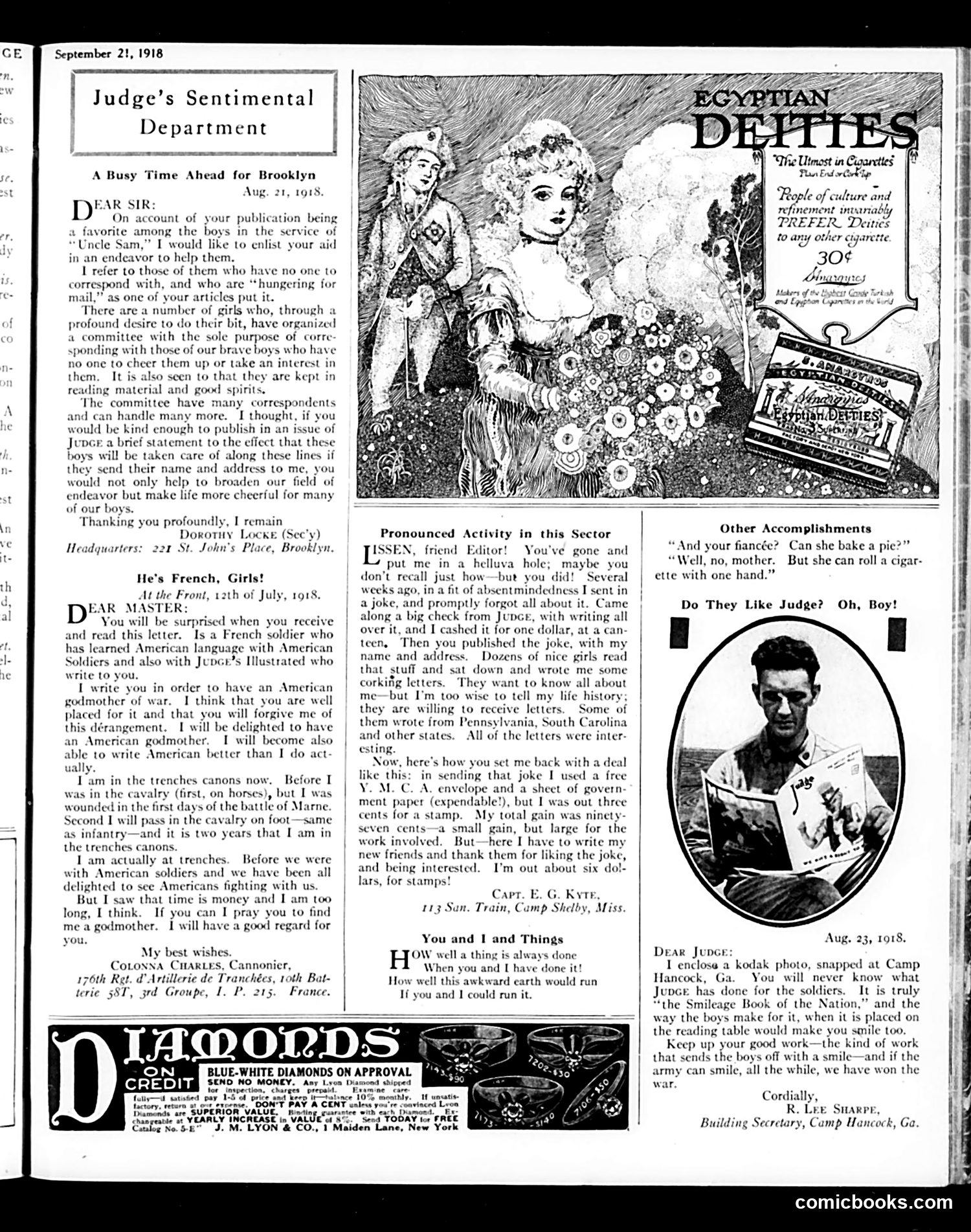
This September 21, 1918 *Judge* page addresses World War I morale and soldier correspondence. The "Judge's Sentimental Department" prints letters from readers: **Content:** - A Brooklyn woman seeks to organize pen-pal correspondence for lonely American servicemen who lack mail - A French soldier, learning English through *Judge*, requests an American "godmother" for wartime companionship and language practice - A soldier complains that publishing his joke brought unwanted romantic letters from women across multiple states **Context:** Published near WWI's end (November 1918 armistice), this reflects genuine wartime concerns: maintaining soldier morale through correspondence and the social disruption of mass mobilization. The humor in the final letter—a man overwhelmed by unsolicited romantic attention—plays on the era's assumptions about gender roles and courtship propriety. The "Other Accomplishments" sidebar jokes about women's independence (rolling cigarettes), likely satirizing changing female roles during wartime labor participation.
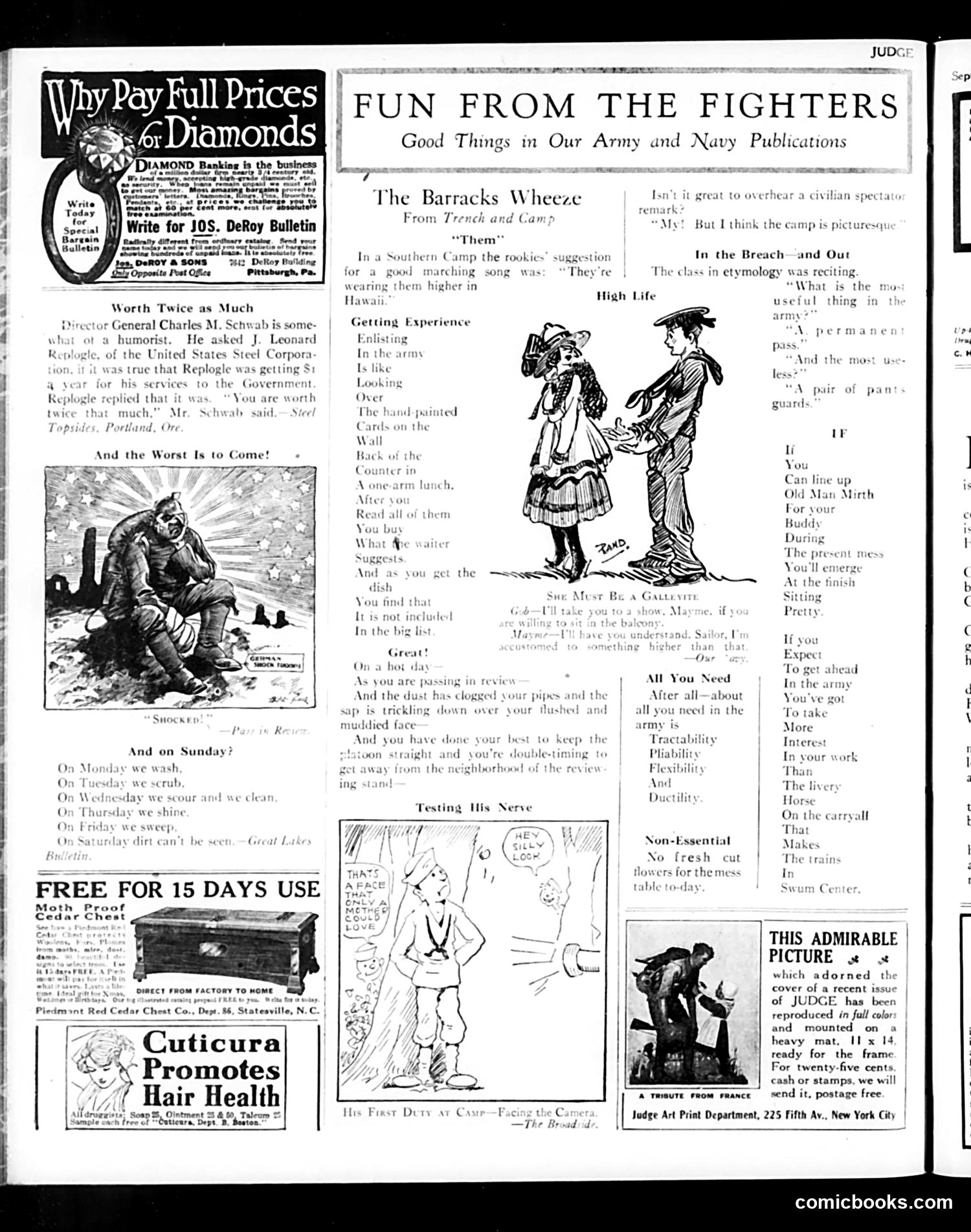
This page is primarily **advertising and filler content** from a WWI-era Judge magazine, with minimal political satire. The main feature, "Fun from the Fighters," collects humorous anecdotes and verse allegedly from Army and Navy publications. These jokes reflect **military camp life during wartime**: rookies marching in formation, soldiers' bathing routines ("Monday we wash, Tuesday we scrub"), and the tedium of military discipline. One cartoon depicts a soldier's first duty photographing the camera—likely a joke about new recruits being assigned menial tasks. The recurring theme is **the contrast between civilian expectations and military reality**: overheard civilians find camp "picturesque," but etymological wordplay highlights the gap between soldier and civilian experience. The content celebrates wartime sacrifice with gentle humor rather than sharp satire. The page also includes product advertisements (cedar chests, diamonds, hair products), typical of Judge's commercial format. No specific political figures or major events are referenced—this represents mainstream American magazine content from the WWI period aimed at domestic audiences.
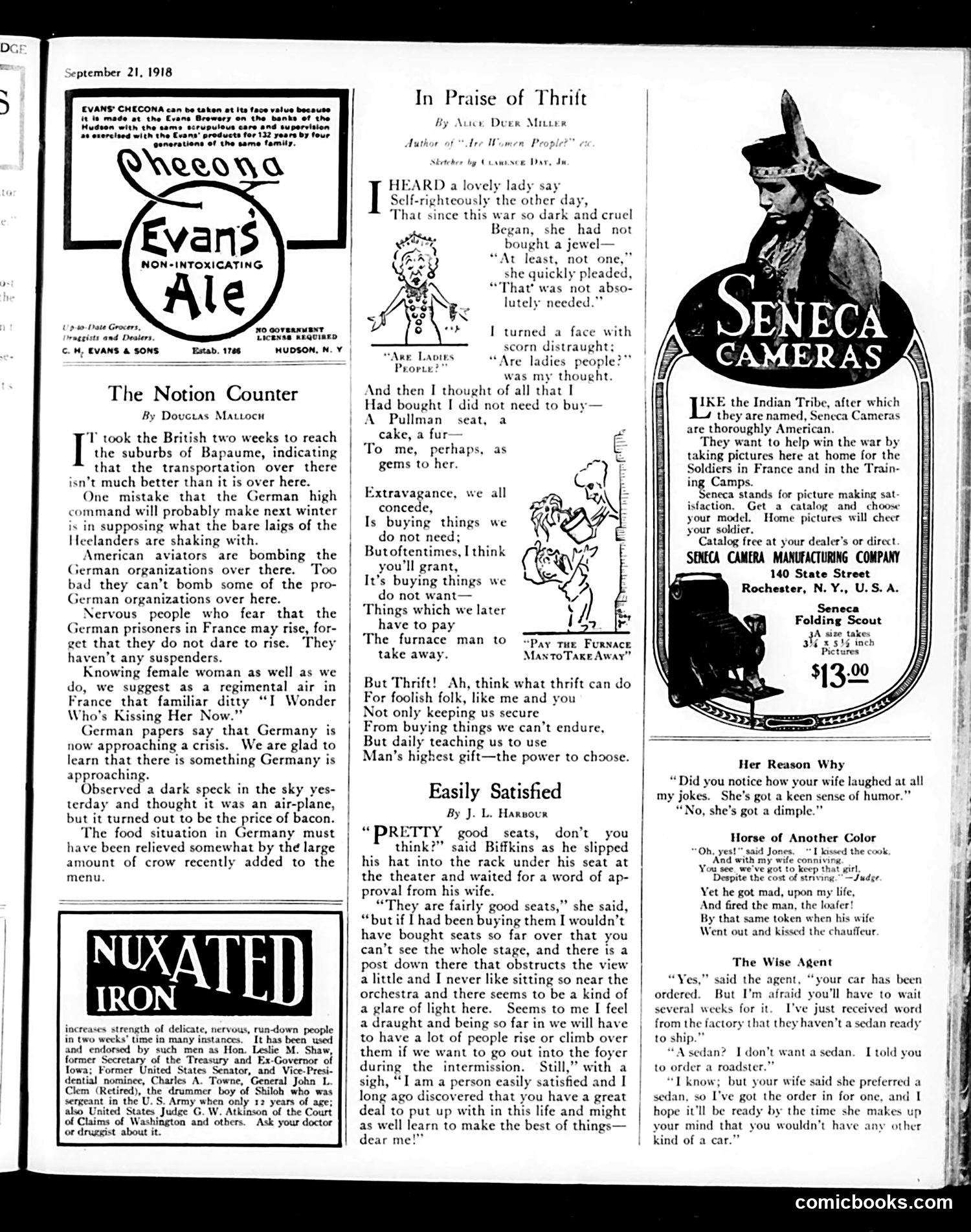
This page contains wartime humor and advertisements typical of American satirical journalism during World War I's final months. **"The Notion Counter"** by Douglas Matloch offers brief, cynical observations about the war. The jokes mock German military capacity ("bare legs of Highlanders"), suggest internalized German defeatism, and criticize pro-German sympathizers still in America. A recurring theme: food shortages in Germany are so severe they're reduced to eating "crow" (humiliation/defeat). The humor targets both the enemy and domestic disloyalty. **"In Praise of Thrift"** by Alice Duer Miller argues that wartime sacrifice shouldn't mean *complete* self-denial—rather, it should teach Americans to distinguish between genuine needs and wasteful wants, emphasizing rational choice as humanity's "highest gift." **"Easily Satisfied"** presents domestic comedy: a husband proud of theater seats his wife systematically critiques as inadequate (obstructed view, drafts, glare). The advertisements (Evans Ale, Nuxated Iron, Seneca Cameras) are standard commercial pitches. Seneca Cameras explicitly markets to soldiers wanting to photograph military camps.
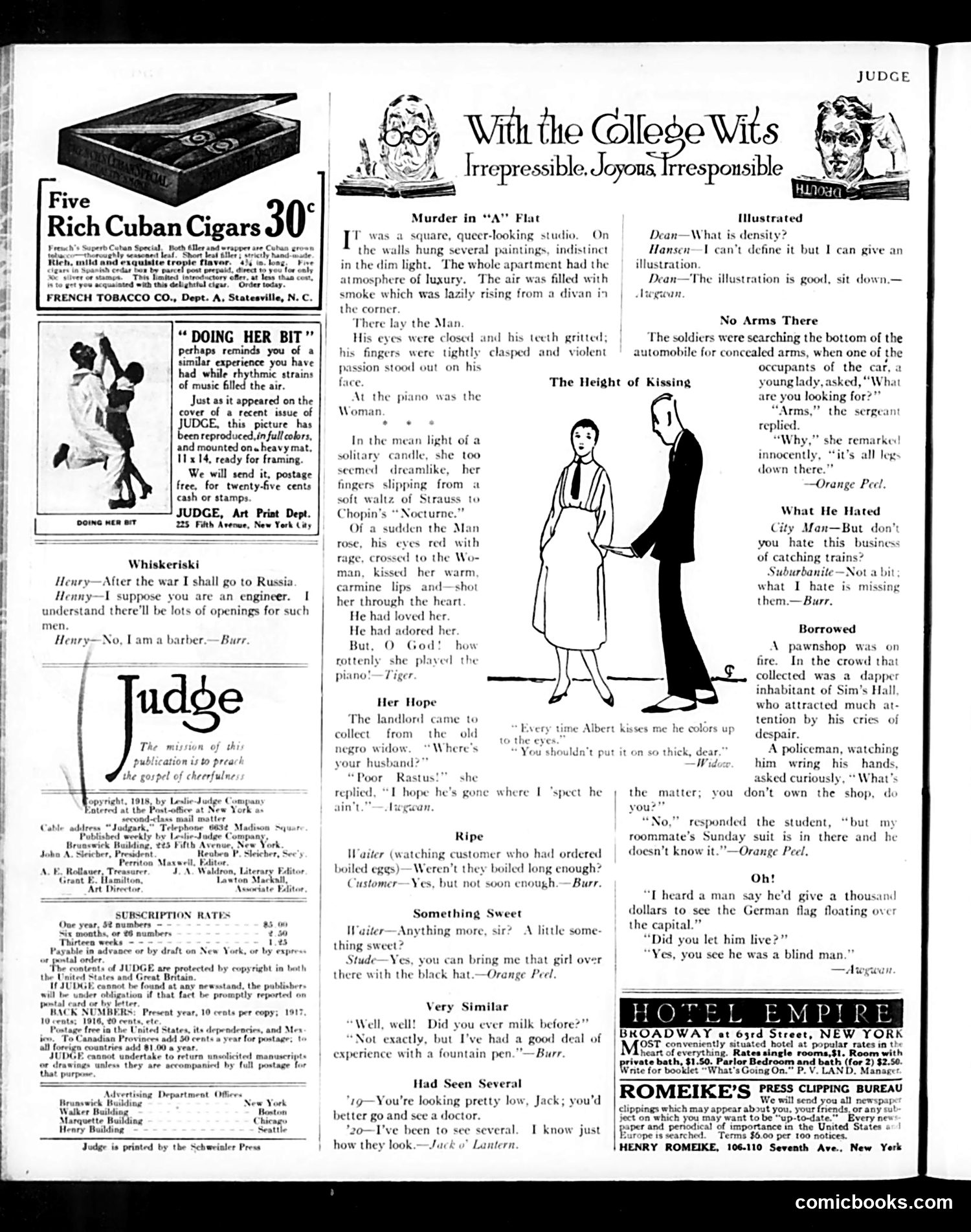
This page from **Judge** (copyright 1918) is primarily **advertising and miscellaneous content** rather than coherent political satire. The main elements include: **Advertisements**: Cuban cigars, a framed art print ("Doing Her Bit"), and hotel/bureau listings dominate the layout. **"Murder in 'A' Flat"**: A melodramatic short story about a man shooting his beloved because she plays piano poorly—satirizing overwrought romantic fiction of the era. **Brief Comic Jokes**: Scattered one-liners about WWI-era topics (a Russian barber), courtship, and everyday absurdities. The "Height of Kissing" illustration shows a couple with commentary on physical affection. **Social Humor**: References to soldiers, draftees, and suburban commuters reflect 1918 American life, but lack sharp political edge. The page exemplifies **Judge's mixed format**: advertisements subsidizing satirical content, with lightweight humor targeting genteel readers rather than hard-hitting commentary. The 1918 date suggests wartime publication, though specific contemporary references are minimal.
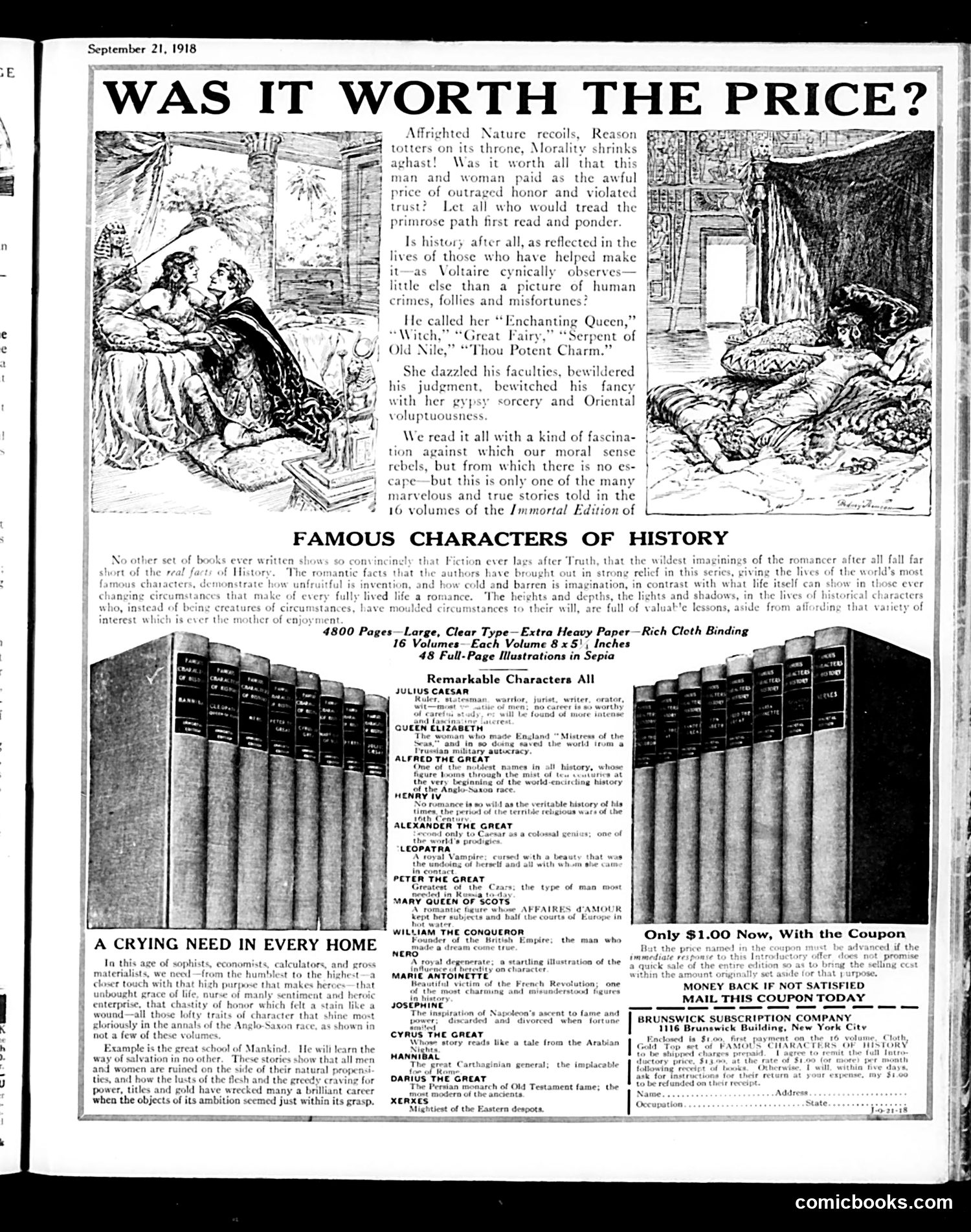
This page advertises a 16-volume book set called "Famous Characters of History" (the "Immortal Edition"). The accompanying illustrations depict what appears to be a seduction scene—a man and woman in intimate circumstances—meant to evoke scandalous historical romances. The text poses a melodramatic question: was the "price" (moral ruin, lost honor) worth the romantic transgression? It references figures like Cleopatra and references to various historical characters known for affairs and romantic entanglements (Julius Caesar, Alexander the Great, Henry IV, etc.). The satire targets both sensationalism and moralism: the ad simultaneously presents these stories as thrilling ("marvelous and true") while wrapping them in sanctimonious language about morality and honor. The pitch essentially says: *read about these scandalous affairs while pretending you're improving yourself through history*—a common sales tactic for semi-risqué literature marketed to middle-class readers as "educational." The coupon offers the complete set for just $1.00, emphasizing affordability of this morally questionable content.
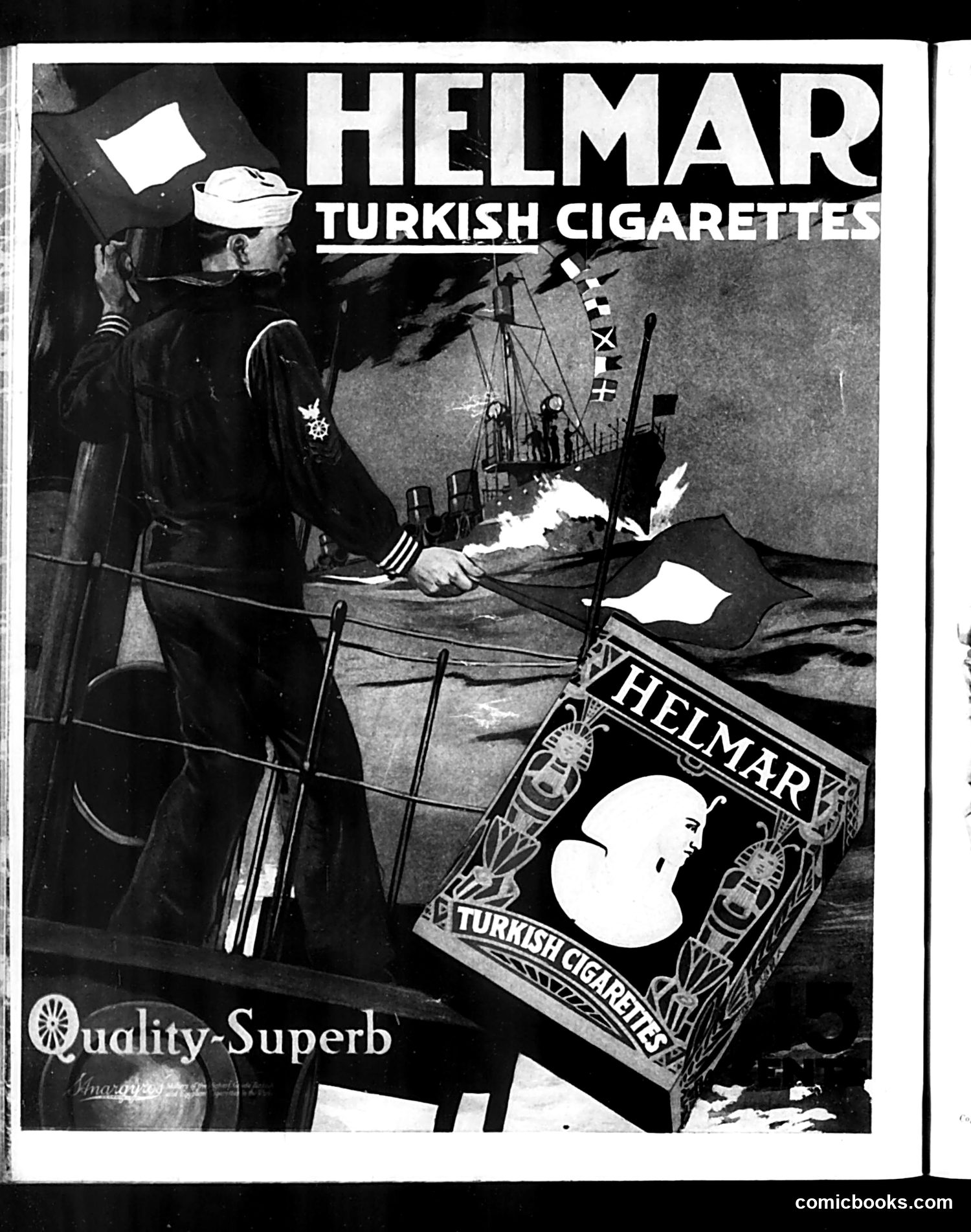
This is primarily an **advertisement for Helmar Turkish Cigarettes**, not a political cartoon. The ad features a naval scene with sailors and a ship, emphasizing exotic maritime imagery associated with Turkey and the Ottoman Empire. The visual strategy appeals to early-20th-century consumer desires for "exotic" foreign goods. The sailor figures and ship imagery suggest adventure, travel, and worldliness—qualities advertisers linked to Turkish products during this period. The tagline "Quality-Superb" emphasizes product superiority. The packet design prominently displays the Helmar branding with what appears to be a Turkish or Middle Eastern artistic motif. This reflects how American advertisers used orientalist imagery and maritime symbolism to market imported luxury goods to consumers seeking cosmopolitan sophistication.