
Judge, 1918-09-21 · page 6 of 32
Judge — September 21, 1918 — page 6: what you’re looking at
What you’re looking at
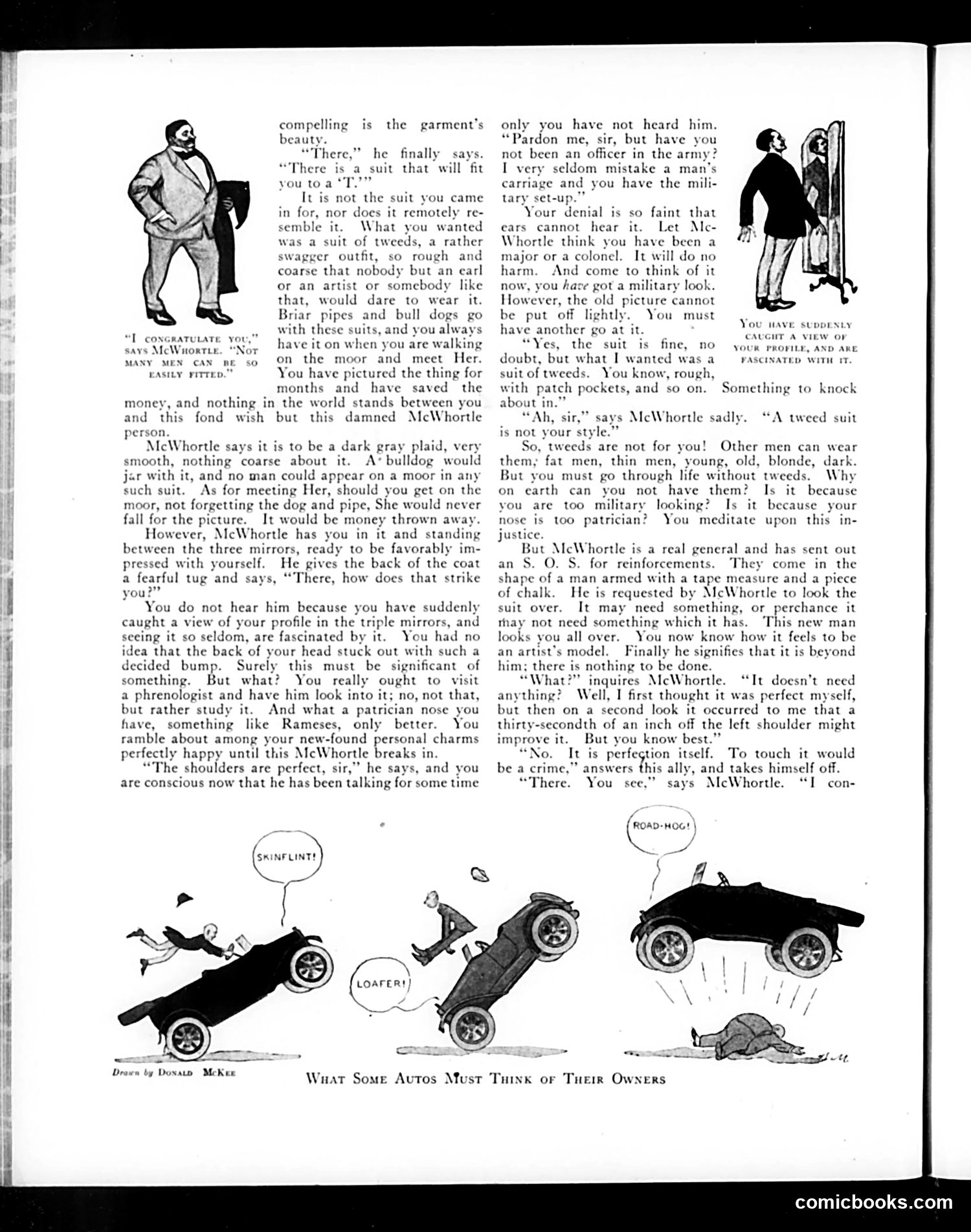
This page from *Judge* satirizes the social pretensions of wealthy automobile owners. The main text, featuring a character named McWhortle, mocks a man obsessed with acquiring fashionable clothing to match his new car and impress a woman. McWhortle's tailor ridicules him for wanting a "military" appearance, suggesting his vanity and social climbing are transparent. The bottom cartoon—"What Some Autos Must Think of Their Owners"—delivers the satire visually. Three panels show cars' perspective judgments: one owner labeled "skinflint," another "loafer," and a third "road hog." A turtle at the bottom implies these drivers are slow or foolish. The humor targets early 20th-century automobile culture and nouveau-riche status anxiety: the assumption that owning a car requires adopting an entire fashionable persona.
📄 Transcribed text from this page (OCR, searchable)
Machine-transcribed from the original scan — historical spelling and the odd misread are preserved.
Serets seen " i compelling is the garment’s beauty. There,” he finally says. here suit that will fit you toa ‘T. It is not the suit you came in for, nor does it remotely re- semble it. What you wanted was a suit of tweeds, a rather swagger outfit, so rough and coarse that nobody but an earl or an artist or somebody like that, would dare to wear it. Briar pipes and bull dogs go with these suits, and you always have it on when you are walking » on the moor and meet Her. You have pictured the thing for months and have saved the money, and nothing in the world stands between you and this fond wish but this damned McWhortle person. McWhortle says it is to be a dark gray plaid, very smooth, nothing coarse about it. A* bulldog would jar with it, and no man could appear on a moor in any such suit. As for meeting Her, should you get on th moor, not forgetting the dog and pipe, She would never fall for the picture. It would be money thrown aw However, McWhortle has you in it and standing between the three mirrors, ready to be favorably im- pressed with yourself. He gives the back of the coat a fearful tug and says, “There, how does that strike you?” You do not hear him because you have suddenly caught a view of your profile in the triple mirrors, and seeing it so seldom, are fascinated by it. You had no idea that the back of your head stuck out with such a decided bump. Surely this must be significant of something. But what? You really ought to visit a phrenologist and have him look into it; no, not that, but rather study it. And what a patrician nose you have, something like Rameses, only better. You ramble about among your new-found personal charms perfectly happy until this McW hortle breaks in. “The shoulders are perfect, sir,” he says, and you are conscious now that he has been talking for some time “T CONGRATULATE says McWuortie MANY MEN CAN RE EASILY FITTED.” A LOAFER!) re) Drowe by Doxato McKee Wuat Some Autos Must Tuink or Tuer Owners only you have not heard him. “Pardon me, sir, but have you not been an officer in the army I very seldom mistake a man’s carriage and you have the mili- tary set-up.’ Your denial is so faint that ears cannot hear it. Let Me- Whortle think you have been a major or a colonel. It will do no harm. And come to think of it now, you have got a military look. However, the old picture cannot be put off lightly. You must have another go at it. You AYE eu ; eg CAUGHT A VIEW “Yes, the suit is fine, nO youn rrorite, AND ARE doubt, but what I wanted was a rascixate worn rt suit of tweeds. You know, rough, with patch pockets, and so on. about in “Ah, sir,” says McWhortle sadly. is not your style.” So, tweeds are not for you! Other men can wear them; fat men, thin men, young, old, blonde, dark. But you must go through life without tweeds. Why on earth can you not have them? Is it because you are too military looking? Is it because your nose is too patrician? You meditate upon this in- justice. But McWhortle is a real general and has sent out an S. O. S. for reinforcements. They come in the shape of a man armed with a tape measure and a piece of chalk. He is requested by McWhortle to look the suit over. It may need something, or perchance it thay not need something which it has. This new man looks you all over. You now know how it feels to be an artist’s model. Finally he signifies that it is beyond him; there is nothing to be done. What?” inquires McWhortle. ‘It doesn’t need anything? Well, I first thought it was perfect myself, but then on a second look it occurred to me that a thirty-secondth of an inch off the left shoulder might improve it. But you know best. “No. It is perfegtion itself. To touch it would a crime,” answers this ally, and takes himself off. There. You see,”” says McWhortle. “I con- Something to knock “A tweed suit be comicbooks.com