
Judge, 1918-09-21 · page 11 of 32
Judge — September 21, 1918 — page 11: what you’re looking at
What you’re looking at
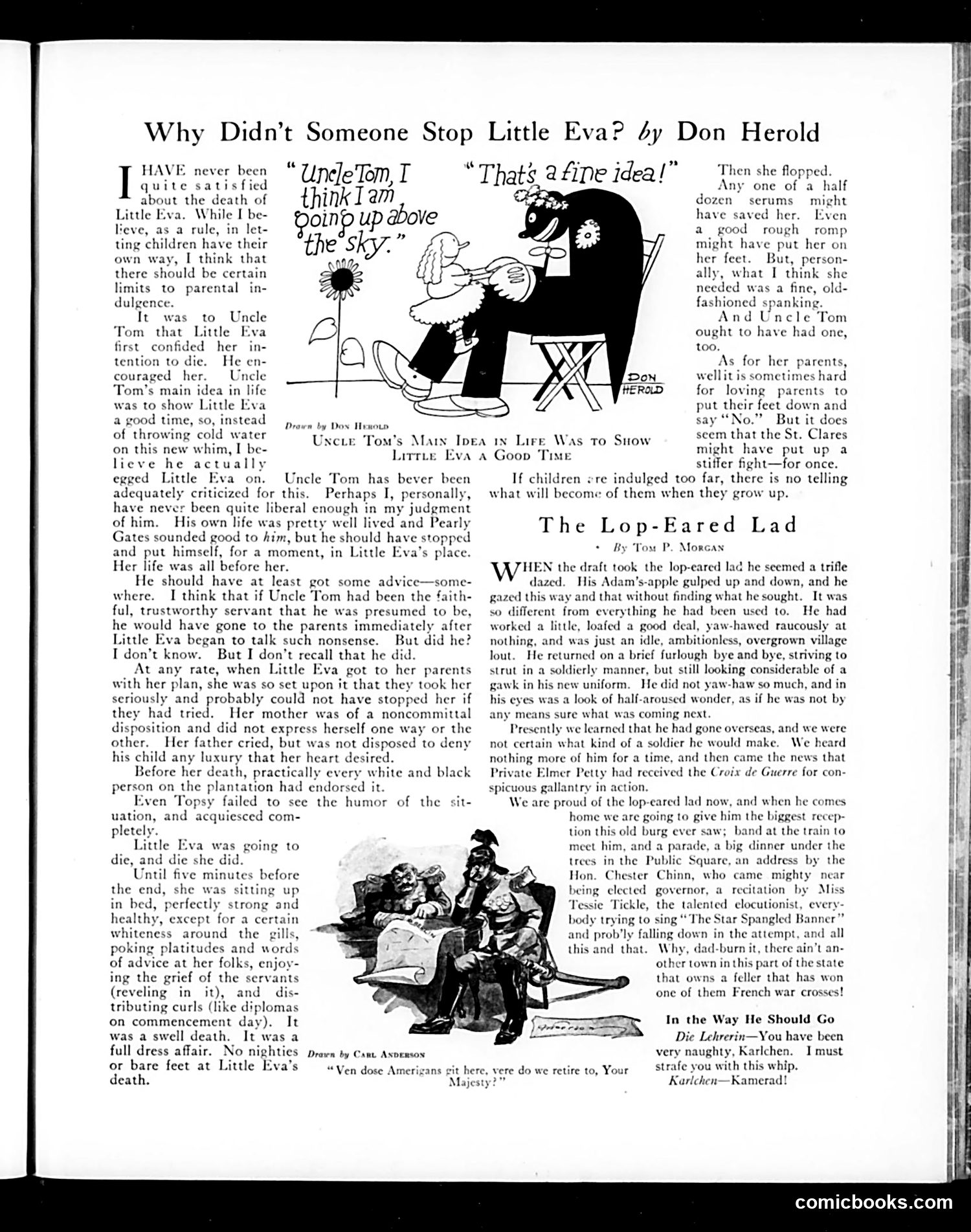
This page contains two satirical pieces critiquing American attitudes toward discipline and indulgence. **"Why Didn't Someone Stop Little Eva?"** by Don Herold mocks the sentimental death scene from *Uncle Tom's Cabin*. Herold argues that Uncle Tom and Little Eva's parents failed her by indulging her death wish rather than disciplining her. He suggests she needed "a fine, old-fashioned spanking" and that her servant and parents should have intervened. The satire targets both the novel's emotional manipulations and contemporary parental permissiveness—suggesting that allowing children unlimited freedom produces dysfunction. **"The Lop-Eared Lad"** (partially visible) appears to follow, describing a rural, unintelligent draftee transformed by military service into a more disciplined person. Both pieces reflect early 20th-century anxieties about parental indulgence, arguing for stricter child-rearing and discipline as social goods. The humor relies on readers' familiarity with *Uncle Tom's Cabin*.
📄 Transcribed text from this page (OCR, searchable)
Machine-transcribed from the original scan — historical spelling and the odd misread are preserved.
HAVE never beer“ Uncle Tom, T think I'am about the death of Little Eva. While I be- oinp up above lieve, as a rule, in let- sky. = 4 ting children have their own way, I think that a there should be certain g limits to parental in- dulgence. It was to Uncle Tom that Little Eva first. confided her in- tention to die. He en- couraged her. Uncle ‘Tom’s main idea in life was to show Little Eva a good time, so, instead py ty Dos 1 of throwing cold water U on this new whim, I be- lieve he actually egged Little Eva on. Uncle m has bever been adequately criticized for this. Perhaps I, personally, have never been quite liberal enough in my judgment of him. His own life was pretty well lived and Pearly Gates sounded good to him, but he should have stopped and put himself, for a moment, in Little Eva’s place. Her life was all before her. He should have at least got some advice—some: where. I think that if Uncle Tom had been the faith- ful, trustworthy servant that he was presumed to be, he would have gone to the parents immediately after Little Eva began to talk such nonsense. But did he? I don’t know. But I don’t recall that he did. At any rate, when Little got to her parents with her plan, she was so set upon it that they took her seriously and probably could not have stopped her if they had tried. Her mother was of a noncommittal disposition and did not express herself one way or the other. Her father cried, but was not disposed to deny his child any luxury that her heart desired. Before her death, practically every white and black person on the plantation had endorsed it. Even Topsy failed to see the humor of the sit- uation, and acquiesced com- pletely. Little E. was going to die, and die she did. Until five minutes before the end, she was sitting up in bed, perfectly strong and healthy, except for a cer whiteness around the gills, poking platitudes and words of advice at her folks, enjoy- ing the grief of the servants (reveling in it), and dis- tributing curls (like diplomas on commencement day). It was a swell death. It was a full dress affair. No nighties Drawn by Cant Aspensox or bare feet at Little Eva’s Ven doce Ame death. Maje Why Didn’t Someone Stop Little Eva? 4y Don Herold te Tom’s Maty Ipea 1x Lire Was to Siow Littte Eva a Goop Time igans git here, vere do we retire to, Your Then she flopped. Any one of a half dozen serums might have saved her. Even a good rough romp might have put her on her feet. But, person- ally, what I think she needed was a fine, old- fashioned spanking. And Uncle Tom ought to have had one, too. As for her parents, wellit is sometimes hard for loving parents to put their feet down and say “No.” But it does seem that the St. Clares might have put up a stiffer fight—for once. If children re indulged too far, there is no telling what will become of them when they grow up. The Lop-Eared Lad + By Tox P. Morcan H the draft took the lop-eared lad he seemed a trifle dazed, His Adam’s-apple gulped up and down, and he gazed this way and that without finding what he sought. It was so different from everything he had been used to. He had worked a little, loafed a good deal, yaw-hawed raucously at nothing, and was just an idle, ambitionless, overgrown village lout. He returned on a brief furlough bye and bye, striving to strut in a soldierly manner, but still looking considerable of a gawk in his new uniform. He did not yaw-haw so much, and in his eyes was a look of half-aroused wonder, as if he was not by any means sure what was coming next. Presently we learned that he had gone overseas, and we were kind of a soldier he would make. We heard and then came the news that ed the Croix de Guerre for con- not certain w nothing more of him for a tim Private Elmer Petty had recei spicuous gallantry in action. We are proud of the lop-eared lad now, home we are going to give him the biggest recep- tion this old burg ever saw; band at the train to meet him, and a parade, a big dinner under the trees in the Public Square, an address by the Hon. Chester Chinn, who came mighty near being elected governor, a recitation by Miss ie Tickle, the talented elocutionist, every- ly trying to sing “The pangled Banner” nd all nd that. Why, dad-burn it, there ain’t an- other town in this part of the state that owns a feller that has won one of them French war crosses! nd when he comes In the Way He Should Go Die Lehrerin—You have been very naughty, Karlchen. I must strafe you with this whip. Karlchen—Kamerad! comicbooks.com