
Judge, 1918-09-21 · page 16 of 32
Judge — September 21, 1918 — page 16: what you’re looking at
What you’re looking at
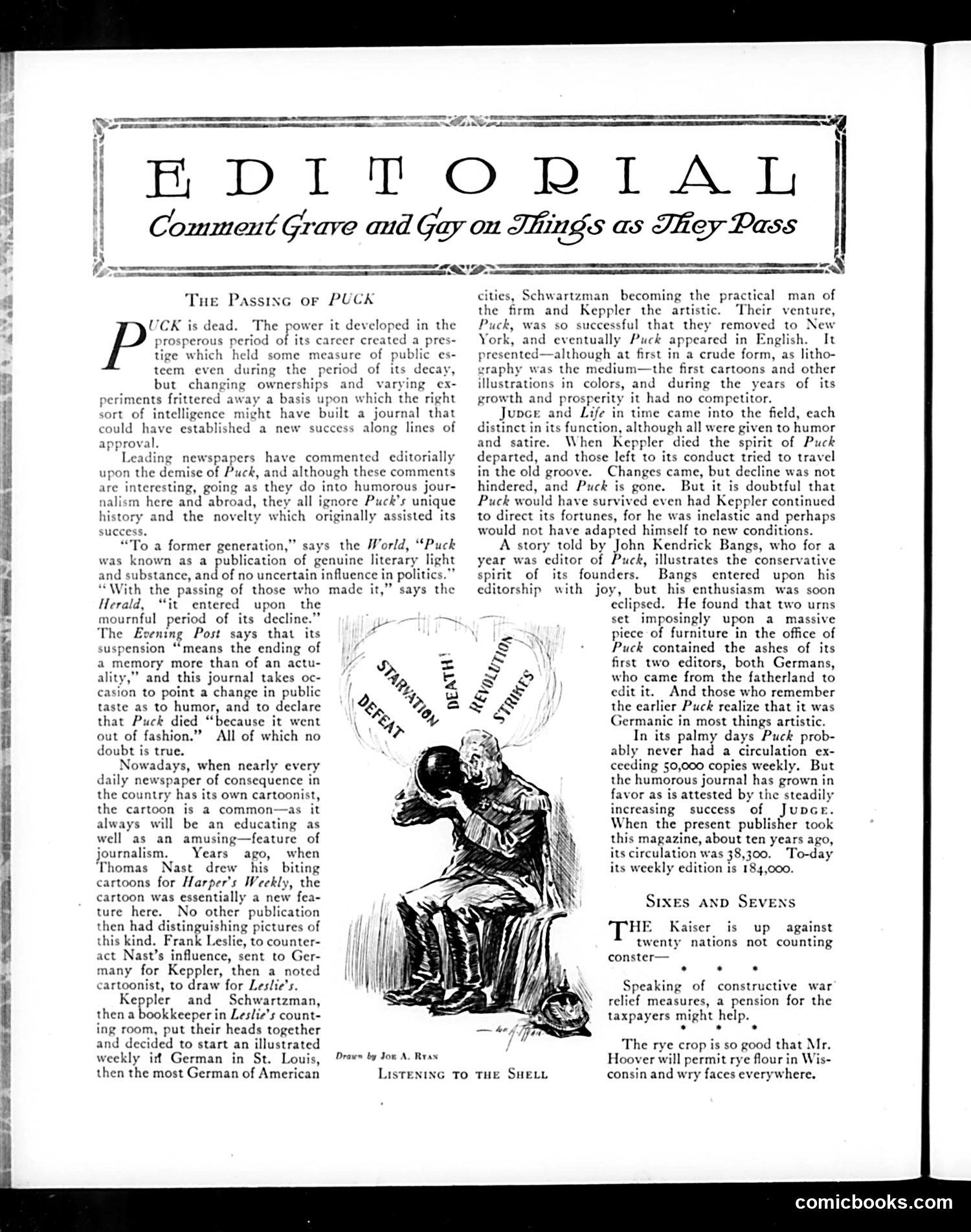
This page eulogizes **Puck magazine**, which has ceased publication. The editorial traces Puck's history: founded in St. Louis by German immigrant Joseph Keppler (an artist) and Schwartzman, it pioneered the illustrated satirical weekly in America. After relocating to New York and succeeding brilliantly, Puck declined following Keppler's death. The accompanying cartoon, "Listening to the Shell," depicts a dejected figure (representing Puck) hunched over, symbolizing the magazine's demise. The editorial attributes Puck's failure partly to changing ownership and outdated editorial conservatism—notably mentioning editor John Kendrick Bangs's anecdote about urns containing ashes of the German founders displayed in the office, suggesting their rigid Germanic aesthetic prevented adaptation to modern tastes. For modern readers: this documents how pioneering media institutions can become obsolete when leadership fails to evolve with audiences—a timeless theme.
📄 Transcribed text from this page (OCR, searchable)
Machine-transcribed from the original scan — historical spelling and the odd misread are preserved.
| | pt tnasastegeeeaee ante \ ——— SS = Tue Passinc or PUCK UCK is dead. The power it developed in the prosperous period of its career created a pres- tige which held some measure of public es- teem even during the period of its decay, but changing ownerships and varying periments frittered away a bas pon which the right sort of intelligence might have built a journal that could have established a new success along lines of approval. Leading newspapers have commented editorially upon the demise of Puck, and although these comments are interesting, going as they do into humorous jour- nalism here and abroad, they all ignore Puck's unique history and the novelty which originally assisted its success. To a former generation,” says the World, “Puck was known as a publication of genuine literary light and substance, and of no uncertain influence in politics.” “With the passing of those who made it,” says the Herald, “it entered upon the mournful period of its decline.” The Evening Post says that its suspension “means the ending of a memory more than of an actu- ality,” and this journal takes oc- casion to point a change in public taste as to humor, and to declare that Puck died “because it went out of fashion.” All of which no doubt is true. Nowadays, when nearly every daily newspaper of consequence in the country has its own cartoonist, the cartoon is a common—as it always will be an educating as well as an amusing—feature of urnalism. Years ago, when homas Nast drew his biting cartoons for Harper's Weekly, the cartoon was essentially a new fea- ture here. No other publication then had distinguishing pictures of this kind. Frank Leslie, to counter- act Nast’s influence, sent to Ger- many for Keppler, then a noted sartoonNsts to draw for Leslie's. pler and Schwartzman, thena a ere in Leslie's count- ing room, put their heads together and decided to start an illustrated weekly iff German in St. Louis, rave by Jor A. Rrax then the most German of American et —< ListeNING To THE SHELL RDITORIAL! Comment Grave aud Gay ou Things as Shey Pass =A cities, Schwartzman becoming the practical man of the firm and Keppler the artistic. Their venture, Puck, was so successful that they removed to New York, and eventually Puck appeared in English. It presented—although at first in a crude form, as litho- graphy was the medium—the first cartoons and other illustrations colors, and during the years of its growth and prosperity it had no competitor. Jupce and Life in time came into the field, each distinct in its function, although all were given to humor and satire. When Keppler died the spirit of Puck departed, and those left to its conduct tried to travel in the old groove. Changes came, but decline was not hindered, and Puck is gone. But it is doubtful that Puck would have survived even had Keppler continued to direct its fortunes, for he was inclastic and perhaps would not have adapted himself to new conditions. A story told by John Kendrick Bangs, who for a year was editor of Puck, illustrates the conservative spirit of its founders. Bangs entered upon his editorship with joy, but his enthusiasm was soon eclipsed. He found that two urns set imposingly upon a massive piece of furniture in the office of Puck contained the ashes of its first two editors, both Germans, who came from the fatherland to edit it. And those who remember the earlier Puck realize that it was Germanic in most things artistic. In its palmy days Puck prob- ably never had a circulation ex- ceeding 50,000 copies weekly. But the humorous journal has grown in favor as is attested by the steadily increasing success Jupce. When the present paniiste took this magazine, about ten years ago, its circulation was 38,300. To-day its weekly edition is 184,000. pes Soot Stxes AND SEVENS H Kaiser is up against twenty nations not counting conster— * * . Speaking of constructive war relief measures, a pension for the taxpayers might help. * * . The rye crop is so good that Mr. Hoover will permit rye flour in Wis- consin and wry faces everywhere. comicbooks.com