
Judge, 1918-09-21 · page 7 of 32
Judge — September 21, 1918 — page 7: what you’re looking at
What you’re looking at
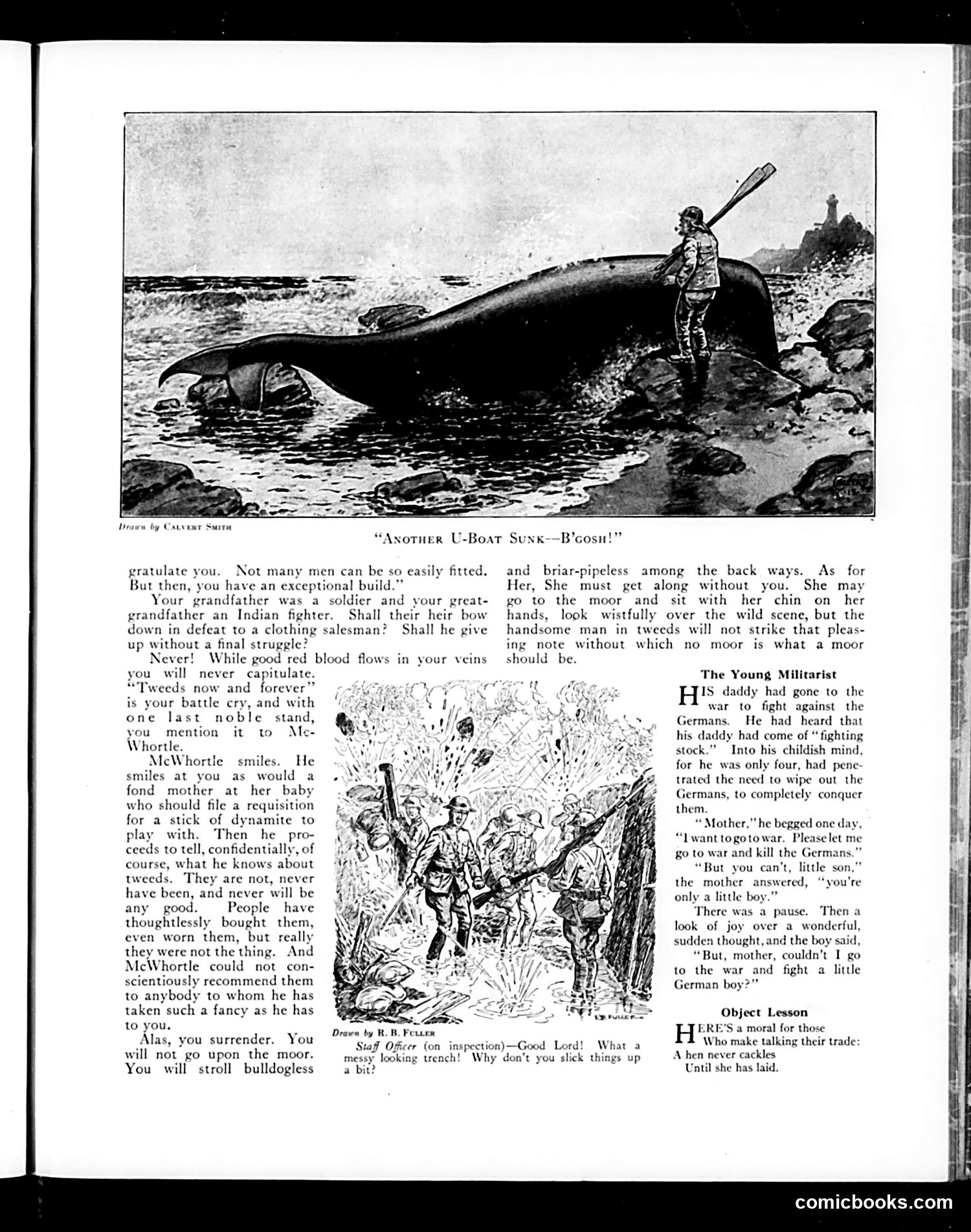
**"Another U-Boat Sunk—B'gosh!"** (top image): This WWI-era cartoon depicts the wreckage of a German U-boat on shore. The caption celebrates Allied victory over German submarines, which were a major threat to British and American shipping during the war. The drawing commemorates real naval warfare. **"The Young Militarist"** (middle): A satirical story about a four-year-old boy whose father fights Germans. The child, absorbing wartime propaganda about "fighting stock," begs to join the war and kill Germans. When told he's too young, he naively suggests fighting "a little German boy" instead. The satire mocks how militaristic rhetoric infiltrates children's minds, turning toddlers into would-be soldiers. **"Object Lesson"** (bottom): A brief moral poem: "A hen never cackles / Until she has laid." This advises against empty boasting—action speaks louder than words. All three items reflect WWI-era American attitudes: celebrating military victories while gently satirizing jingoism and its effects on civilians.
📄 Transcribed text from this page (OCR, searchable)
Machine-transcribed from the original scan — historical spelling and the odd misread are preserved.
Drawn by Cacvenr Sarr “Axotuer U-Boat Su> gratulate you. Not many men can be so easily fitted. But then, you have an exceptional build.” Your grandfather was a soldier and your great- grandfather an Indian fighter. Shall their heir bow down in defeat to a clothing salesman? Shall he give up without a final struggle? Never! While good red blood flows in your veins you will never capitulate. “Tweeds now and forever” is your battle cry, and with one last noble stand, you mention it to Me- Whortle. McWhortle smiles. He smiles at you as would a fond mother at her baby who should file a requisition for a stick of dynamite to play with. Then he _pro- ceeds to tell, confidentially, of course, what he knows about tweeds. They are not, never have been, and never will be any good. People have thoughtlessly bought them, even worn them, but really they were not the thing. And McWhortle could not con- scientiously recommend them to anybody to whom he has taken such a fancy as he has to you. Alas, you surrender. You will not go upon the moor. You will stroll bulldogless Drawn by R. B. Feuer Staff Officer (on ins looking trench! Why don’t you slick things up -—B’cosu!” and briar-pipeless among the back As for Her, She must get along without you. She may go to the moor and sit with her chin on her hands, look wistfully over the wild scene, but the handsome man in tweeds will not strike that pleas- ing note without which no moor is what a moor should be. ways. The Young Militarist H1'S addy had gone to the ar to fight against the Germans. He had heard that his daddy had come of “fighting stock.” Into his childish mind, for he was only four, had pene- trated the need to wipe out the Germans, to completely conquer them. “ Mother,” he begged one day, “l want togotowar. Pleaselet me go to war and kill the Germans.” “But you can’t, little son,” the mother answered, “you're only a little boy.” There was a pause. Then a look of joy over a wonderful, sudden thought, and the boy said, “But, mother, couldn’t I go to the war and fight a little German bo) Object Lesson ERE’S a moral for those Who make talking their trade: A hen never cackles Until she has laid. What a comicbooks.com