
A complete issue · 32 pages · 1918
Judge — August 10, 1918
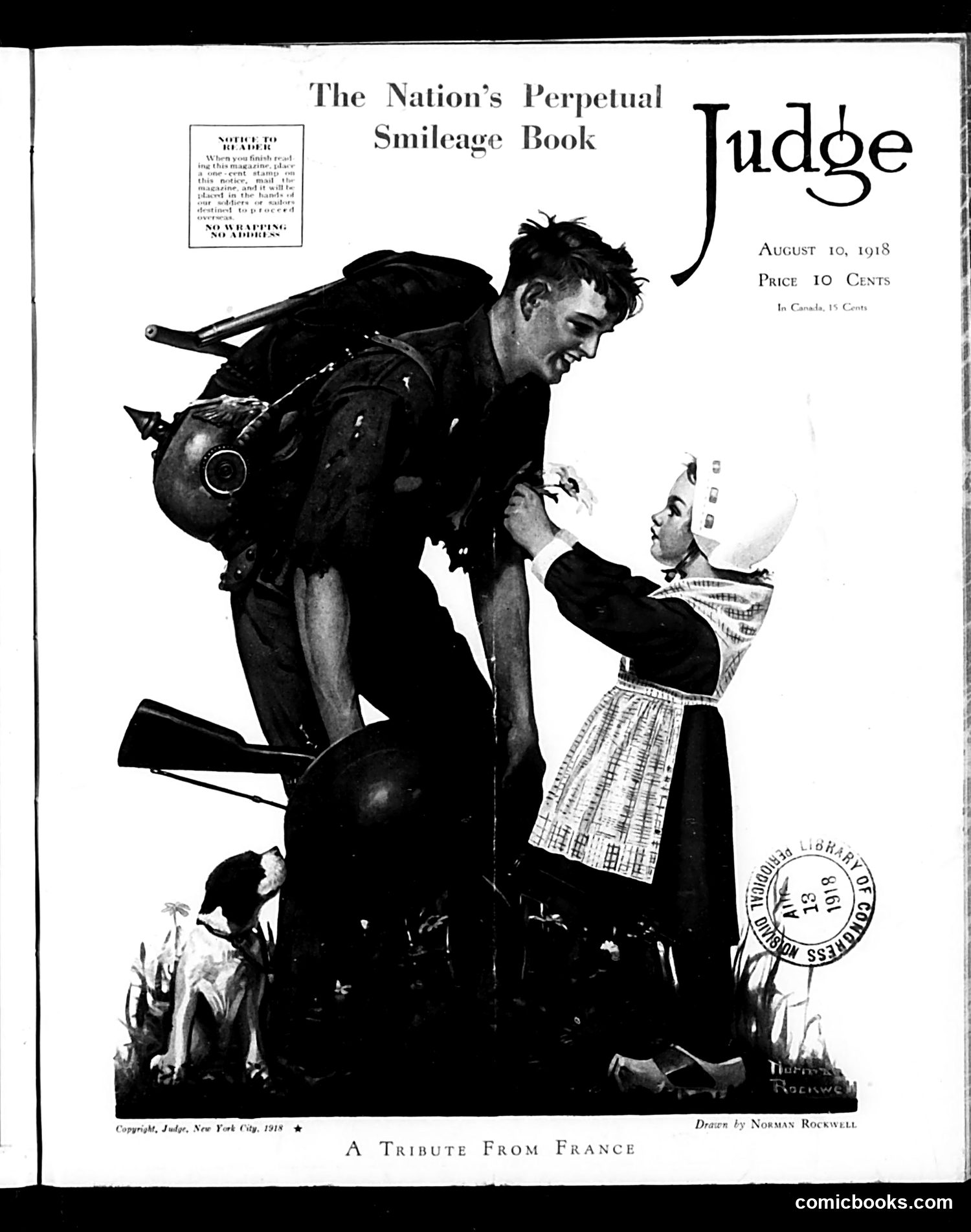
**Date & Context:** August 10, 1918—near the end of World War I. **Image:** A soldier (American, based on uniform) carries a young woman on his shoulders while she holds up papers, apparently legal documents or letters. Two civilians—a man and woman in civilian dress—stand nearby smiling. **Title:** "A Tribute from France" **Meaning:** This appears to be satirical commentary on American soldiers' romantic entanglements with French women during WWI occupation. The "tribute from France" likely refers sarcastically to the young woman—suggesting France is "offering" its women to American servicemen. The papers the woman holds may represent marriage documents or romantic correspondence, playing on contemporary anxieties about soldiers forming relationships abroad and the social complications this created. The cartoon reflects American attitudes about their military presence in France during the final year of the war.
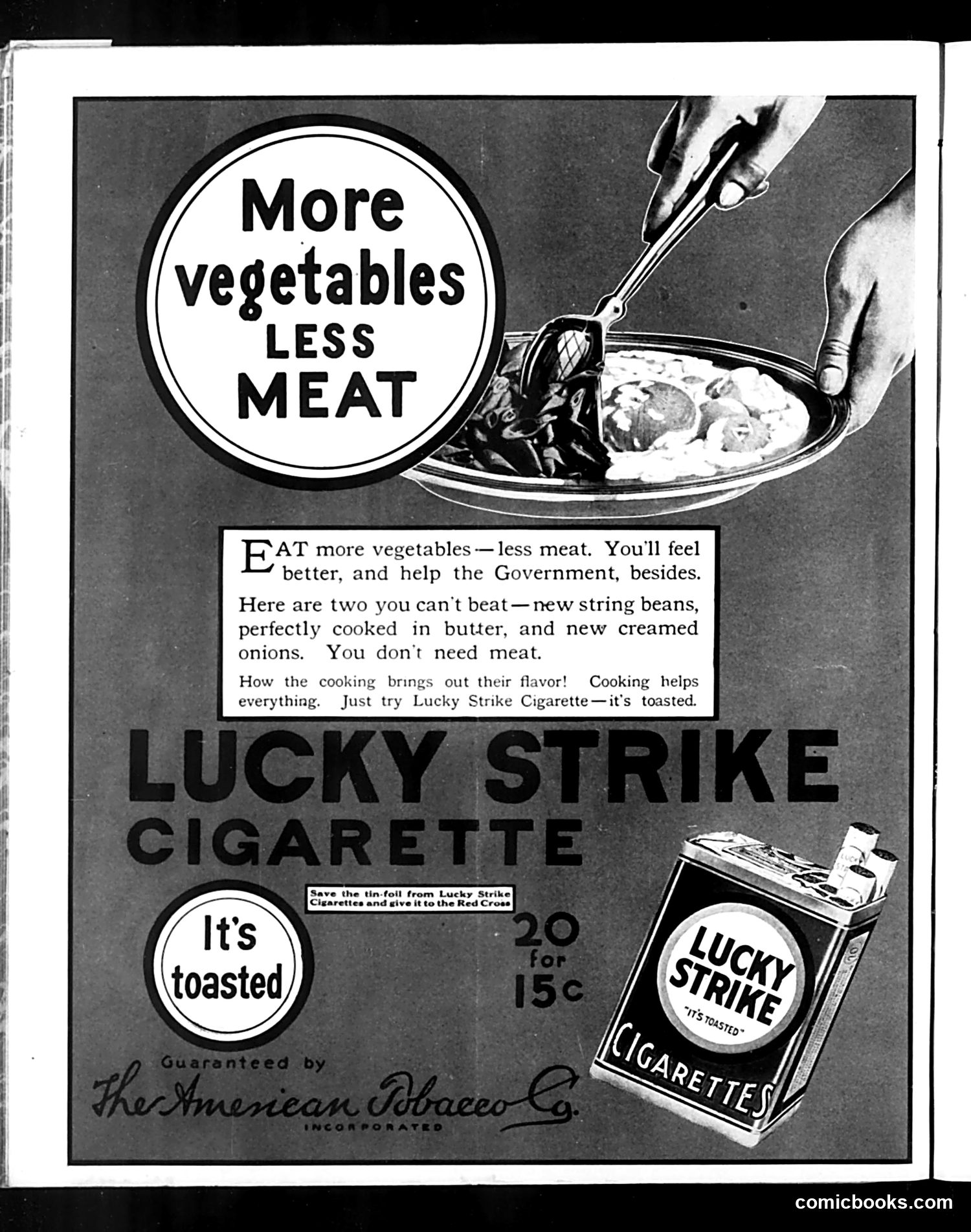
This appears to be a **WWI-era advertisement**, not satire. The "Lucky Strike Cigarette" ad promotes eating "more vegetables—less meat" as a patriotic duty, claiming it helps "the Government besides." The message reflects **food rationing and conservation efforts** during World War I, when the U.S. government encouraged civilians to reduce meat consumption to preserve supplies for troops. The ad co-opts this patriotic messaging to sell cigarettes by suggesting Lucky Strikes are "toasted" and help with digestion of vegetables. The irony a modern reader might notice: a tobacco company marketing cigarettes as health-supporting while promoting government rationing. This would be an unthinkable advertising approach today, but reflects early 20th-century attitudes toward both smoking and wartime sacrifice.
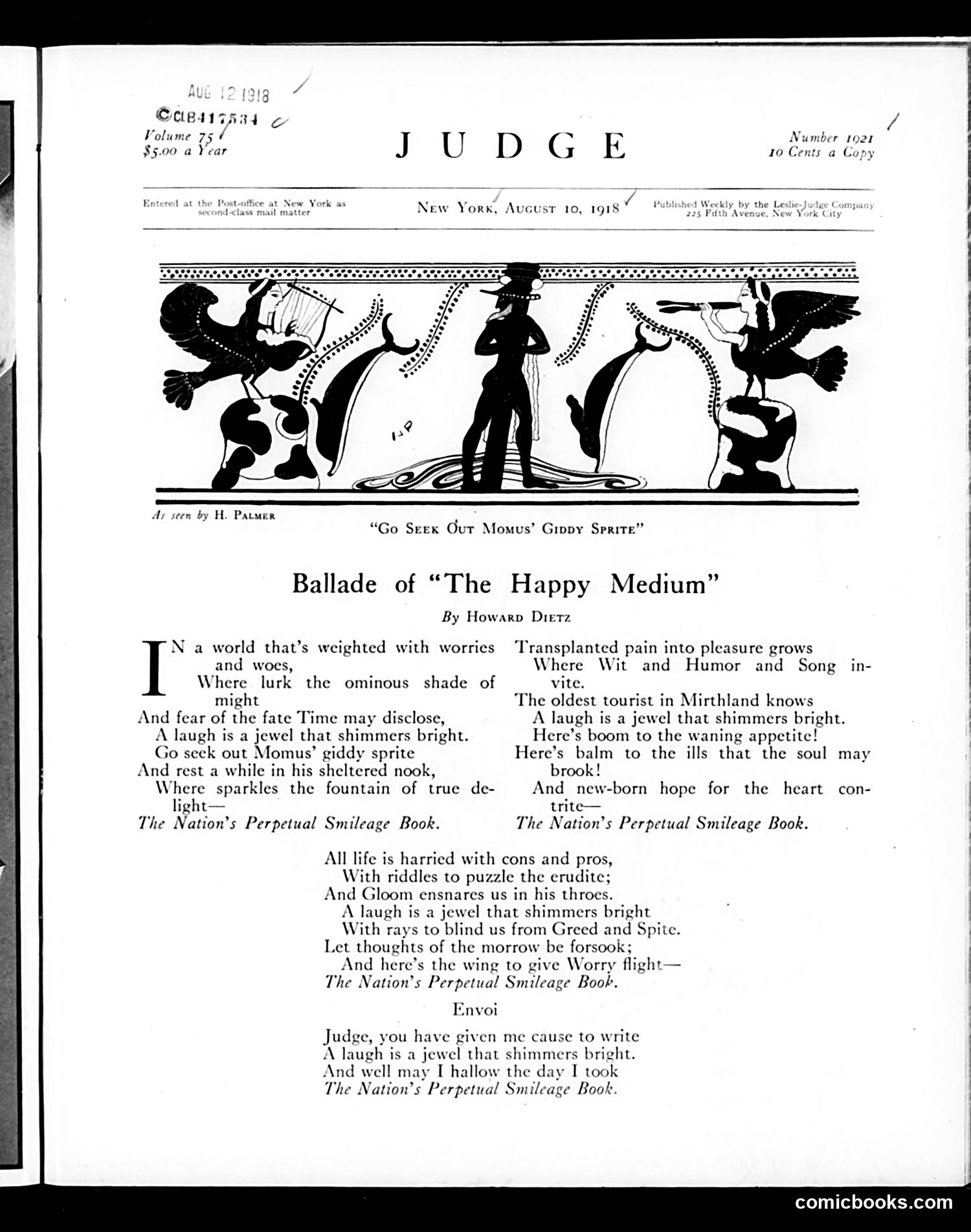
The cartoon "Go Seek Out Momus' Giddy Sprite" (drawn by H. Palmer) features silhouetted figures—two cherubic sprites flanking a central human figure—arranged in a decorative horizontal frieze. The imagery appears allegorical rather than depicting specific identifiable figures. The accompanying poem "Ballade of 'The Happy Medium'" by Howard Dietz celebrates laughter and humor as antidotes to life's worries and hardships. References to "Gloom" and "Greed and Spite" suggest WWI-era anxieties. The text emphasizes that laughter provides spiritual relief—"a jewel that shimmers bright." This is primarily literary content promoting *Judge* magazine's philosophy that satire and humor serve therapeutic social functions during troubled times.
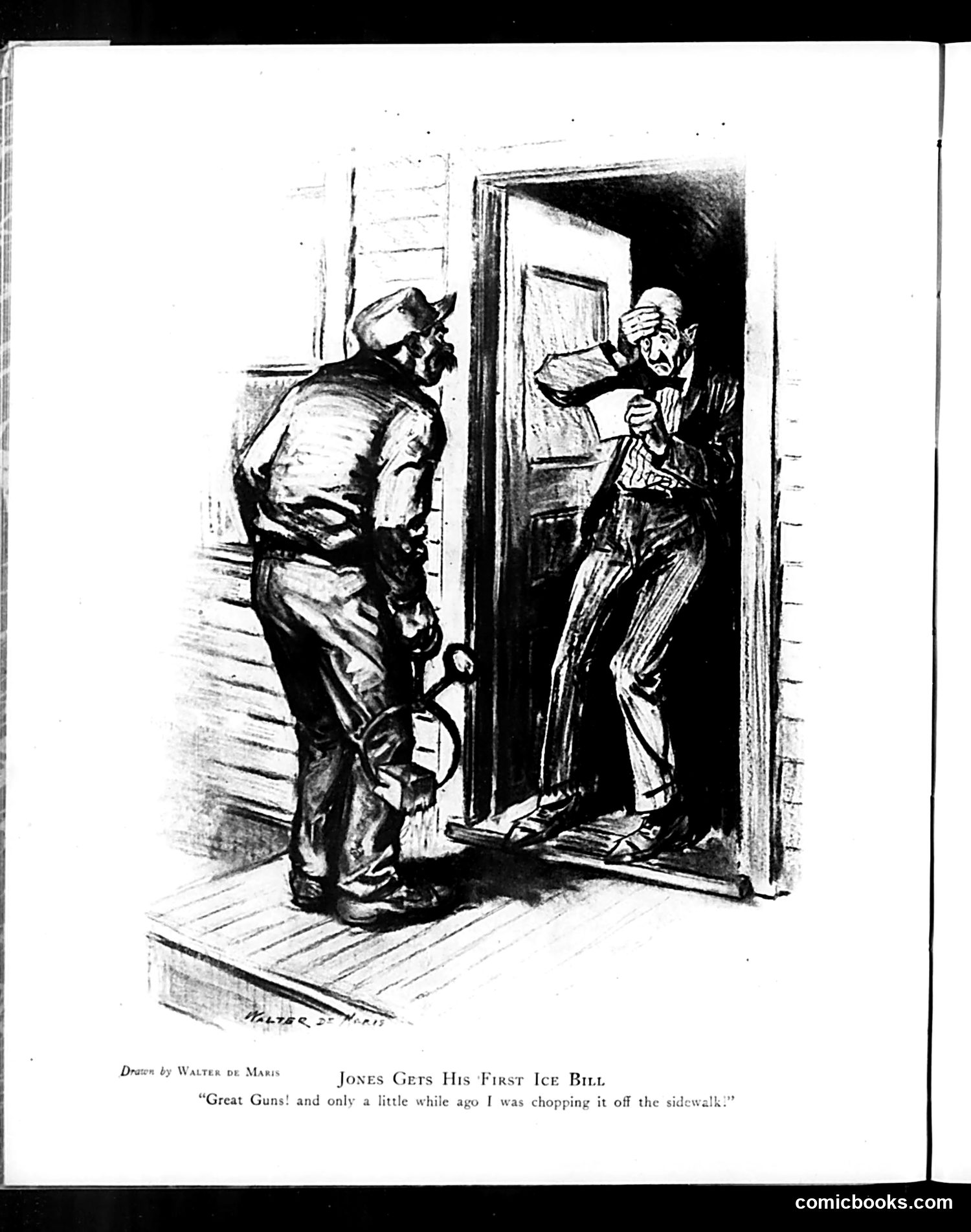
This cartoon by Walter de Maris satirizes the shock of receiving an unexpected utility bill. The scene shows a man (Jones) at his doorway confronting what appears to be an ice delivery person or bill collector. Jones exclaims in disbelief: "Great Guns! and only a little while ago I was chopping it off the sidewalk." The joke reflects early 20th-century urban life when ice was a necessity for home refrigeration before electric appliances became standard. The satire targets the absurdity of being charged for ice when it was freely available as a natural resource during winter—people commonly harvested ice from frozen surfaces. The cartoon mocks both the rising costs of utilities and consumers' surprise at commercial charges for what nature provided.
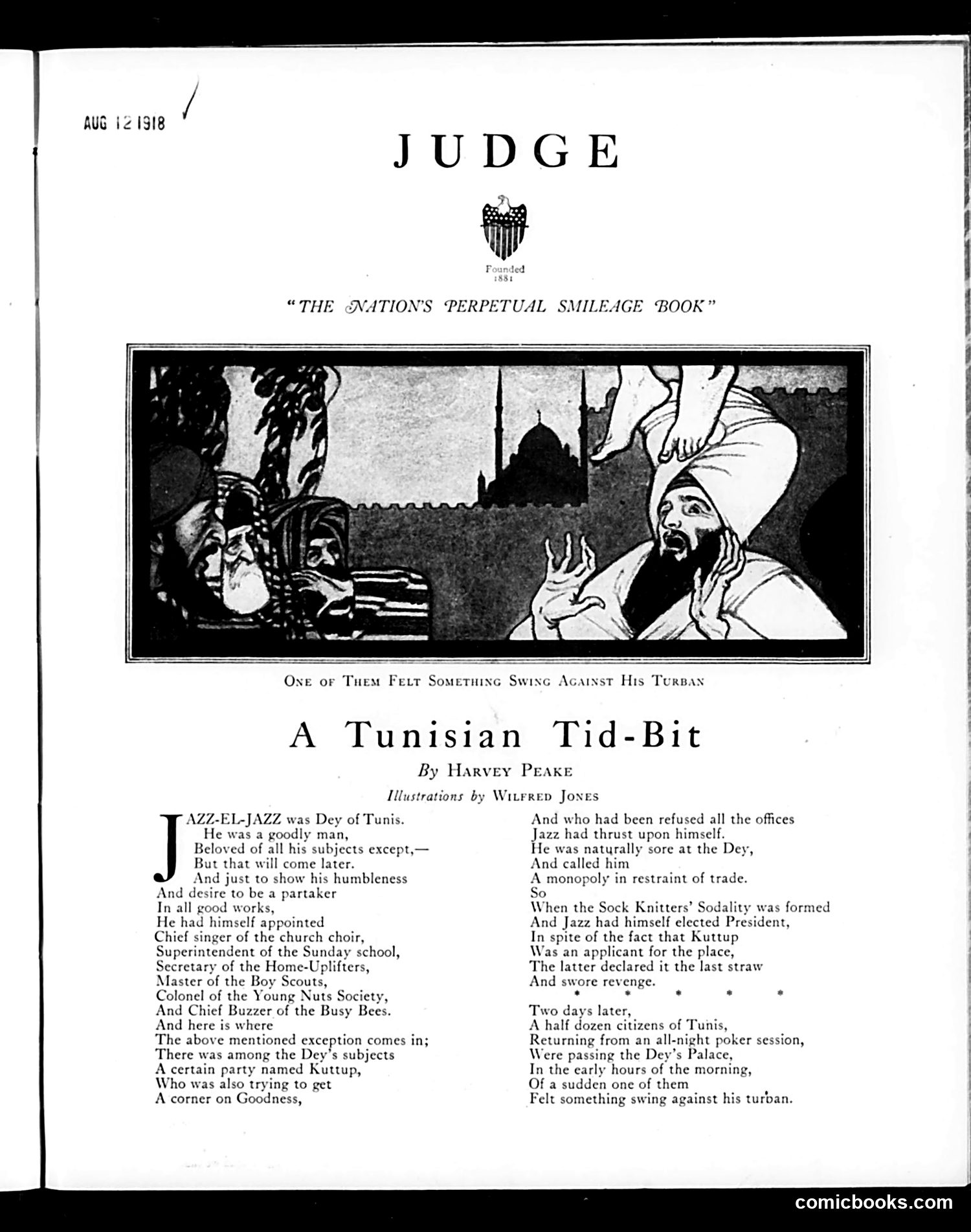
This satirical poem by Harvey Peake mocks Jazz-el-Jazz, the Dey (ruler) of Tunis, through mock-heroic verse. The narrative describes Jazz as a self-aggrandizing official who appointed himself to numerous positions despite being refused legitimate ones. The humor centers on his creation of absurd titles (Chief Buzzer of the Busy Bees, Colonel of the Young Nuts Society) to compensate for his exclusion from real power. The climax involves a rival named Kuttup, excluded from the Sock Knitters' Sodality, who exacts revenge by literally "swinging against his turban"—a physical comeuppance for Jazz's pretension. The cartoon satirizes autocratic self-importance and petty bureaucratic rivalries, likely reflecting American attitudes toward North African colonial figures during WWI.
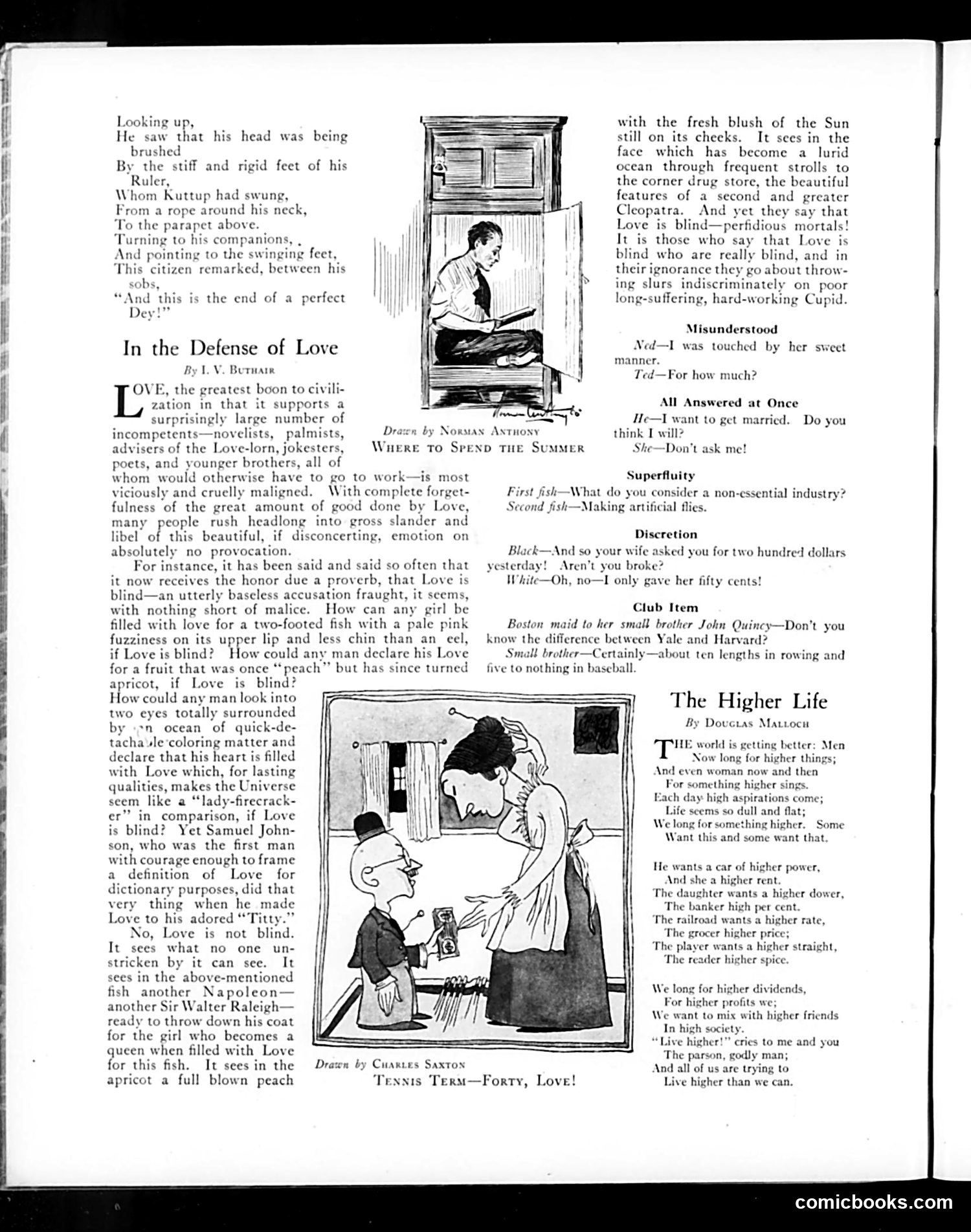
This page contains three distinct pieces: 1. **"In the Defense of Love"** by I.V. Bothair: An essay satirizing romantic sentimentality by mocking the proverb "Love is blind." It humorously argues that love cannot be truly blind since it requires sight to appreciate beauty—using absurd examples like declaring love for a two-footed fish. 2. **Two cartoon illustrations** by Norman Anthony and Charles Saxton: The first shows someone at a window; the second depicts a "Tennis Term—Forty, Love!" scene with figures playing tennis or in domestic interaction. These appear to be visual gags complementing the romantic theme. 3. **"The Higher Life"** by Douglas Malloch: A poem satirizing middle-class social climbing—mocking society's constant striving for "higher" status, better possessions, and "higher" social circles rather than genuine contentment. The page satirizes both romantic delusions and materialistic status-seeking in early 20th-century American culture.
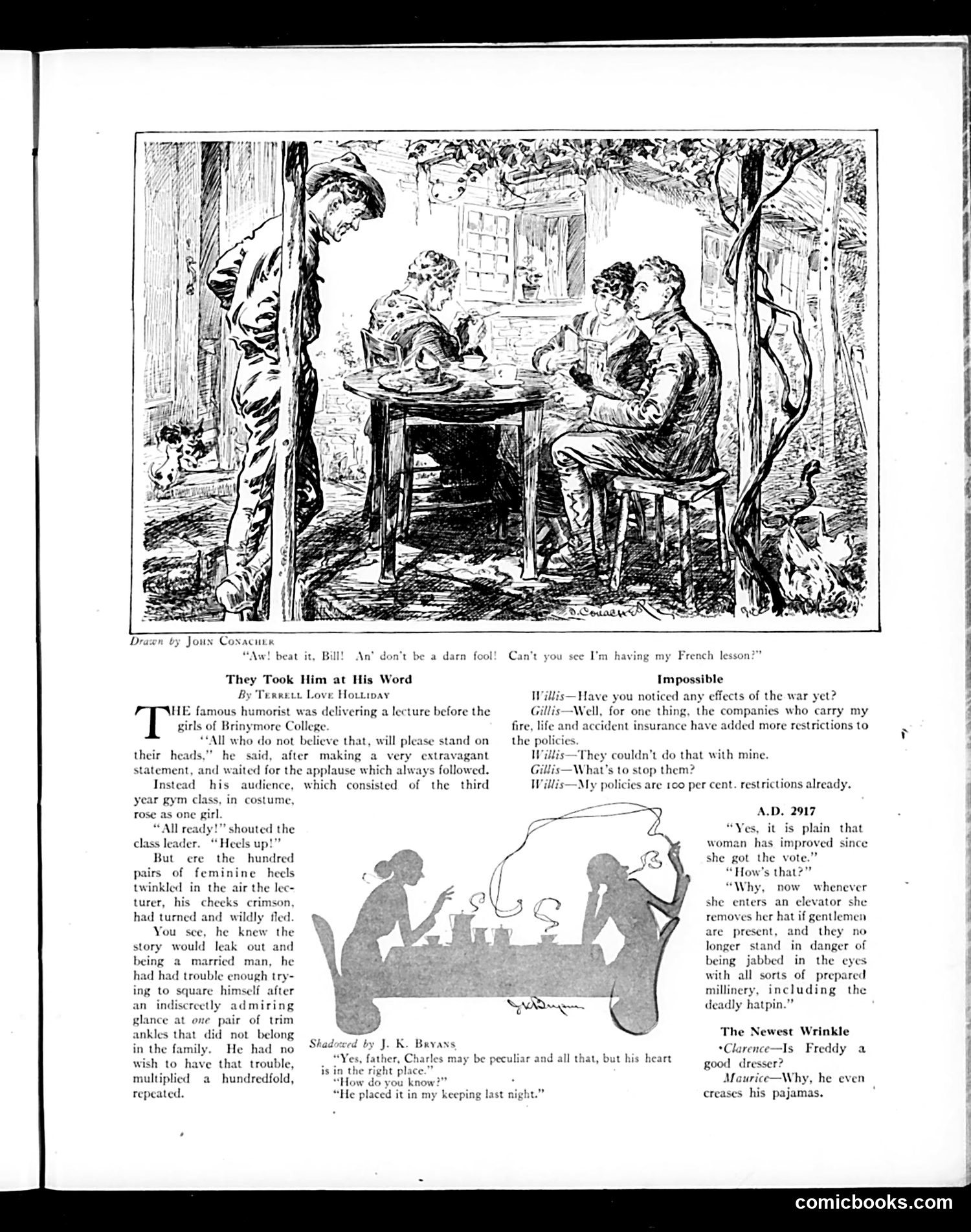
This page contains multiple unrelated humor pieces typical of the era: **Main Cartoon ("They Took Him at His Word")**: A famous humorist lecturing at Bryn Mawr College jokingly asks skeptics to "stand on their heads." When the third-year gym class literally complies en masse, he flees in panic. The joke: he fears his wife will learn he was surrounded by women in inverted positions showing their legs—potentially scandalous given early 20th-century propriety standards around women's ankles and the "hatpin" violence referenced elsewhere on the page. **Other Jokes**: Brief humor pieces on unrelated topics—insurance restrictions, women's voting improvements, and fashion affectations. **Historical Context**: The hatpin reference and ankle-gazing anxiety reflect genuine 1910s-era anxieties about changing gender dynamics, women's athletics (gym classes), and emerging feminism. The humor trades on marital suspicion and Victorian-era modesty norms now largely obsolete.
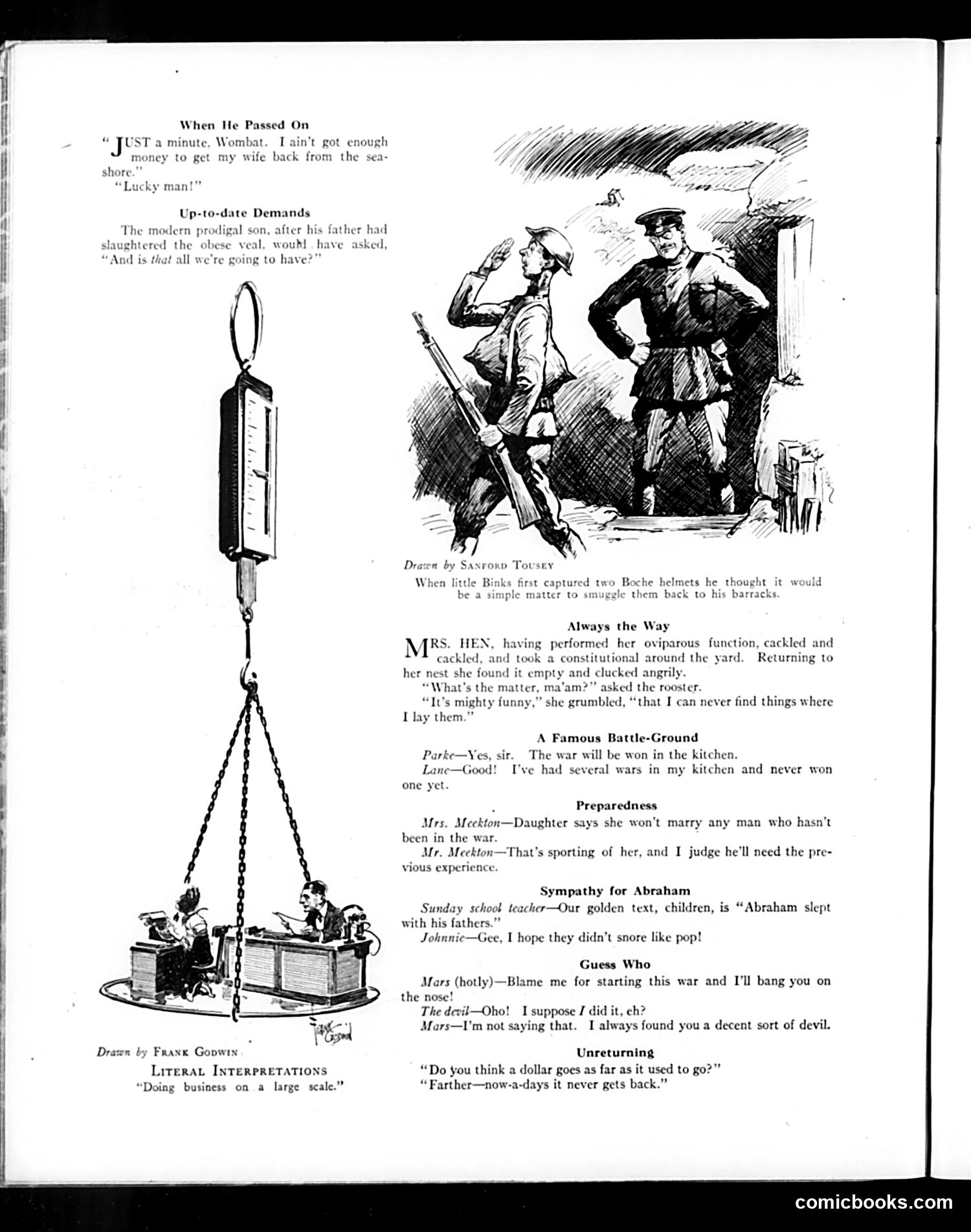
This page from *Judge* contains multiple WWI-era humor pieces satirizing American home-front anxieties: **"When He Passed On"** jokes about marriage dynamics—a man considers his wife's seaside vacation a stroke of luck, inverting traditional sentimentality about spousal separation. **"Up-to-date Demands"** mocks younger generations' entitlement, contrasting an obese father's modest expectations with his son's greedy demands. **"Literal Interpretations"** plays on business jargon scaled absurdly large (two men suspended in a scale doing paperwork). **"Always the Way"** uses a hen unable to find eggs to satirize women's domestic forgetfulness. **"A Famous Battle-Ground"** and **"Preparedness"** reference wartime anxieties—kitchens as metaphorical battlegrounds and marriage eligibility tied to military service. **"Guess Who"** features Mars (god of war) and the Devil arguing over war's origin—dark satire suggesting war's demonic nature or that blame is irrelevant. **"Unreturning"** comments on wartime inflation: money no longer circulates home as it did pre-war. The overall tone reflects American anxieties about marriage, youth, gender roles, and economic disruption during WWI.
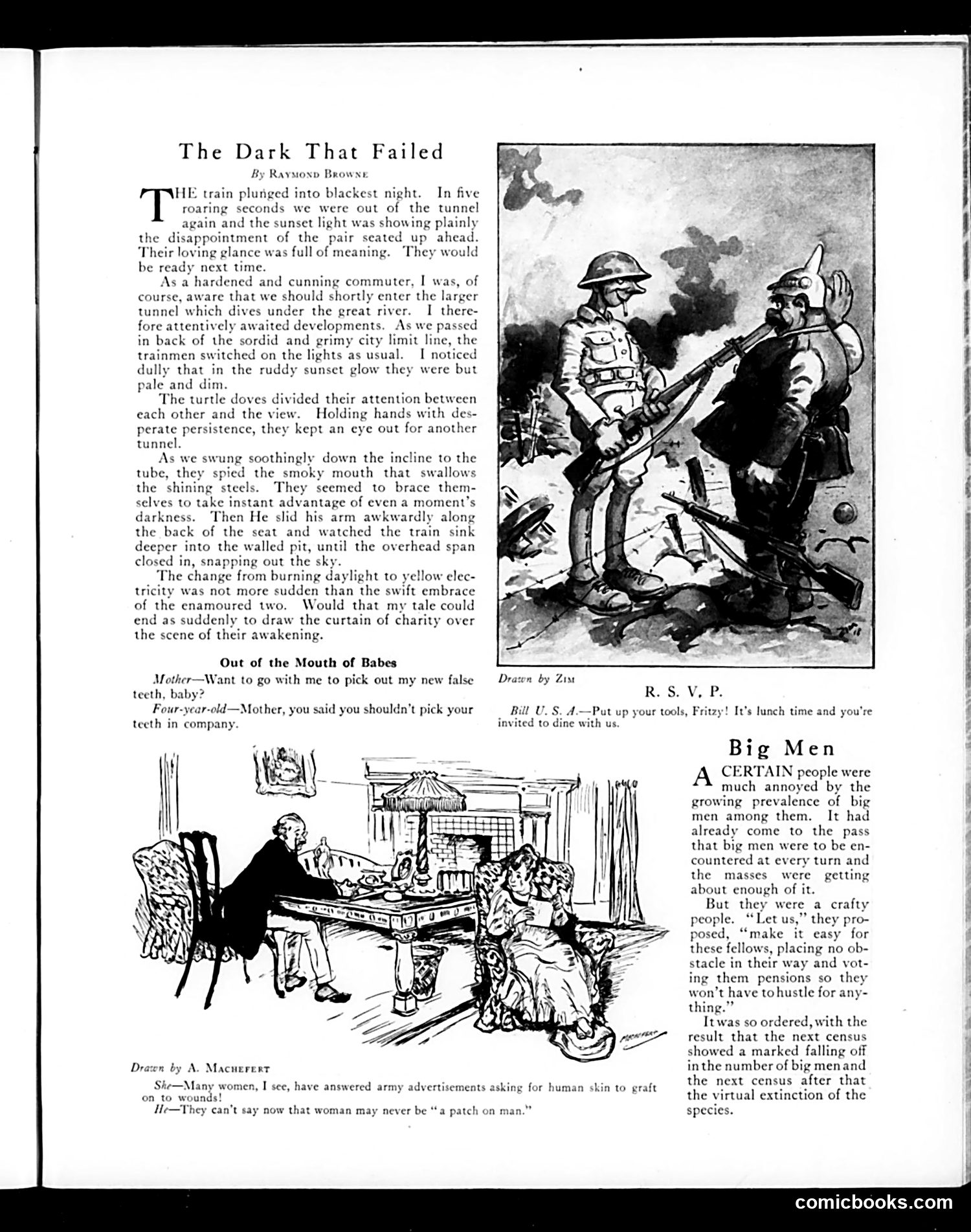
**"The Dark That Failed"** is a humorous short story about a young couple on a commuter train hoping to steal a kiss in tunnel darkness. The narrator, an experienced commuter, anticipates their plan and watches as they prepare for the larger tunnel under the river. However, when the train enters the tunnel, it's immediately lit by electric lights, thwarting their romantic moment—hence "the dark that failed." **"Out of the Mouths of Babes"** is a joke about a child catching their mother in hypocritical behavior regarding etiquette. **"Big Men"** is an allegorical fable satirizing a society's approach to dealing with an overabundance of large/tall men. Rather than competing fairly, the people vote them pensions and remove obstacles—essentially enabling idleness. This leads to their eventual disappearance. The satire likely critiques how societies coddle or subsidize certain groups, resulting in their decline rather than improvement. The page also includes a WWI-era cartoon showing American and German soldiers at lunch, and a joke about women in wartime employment.
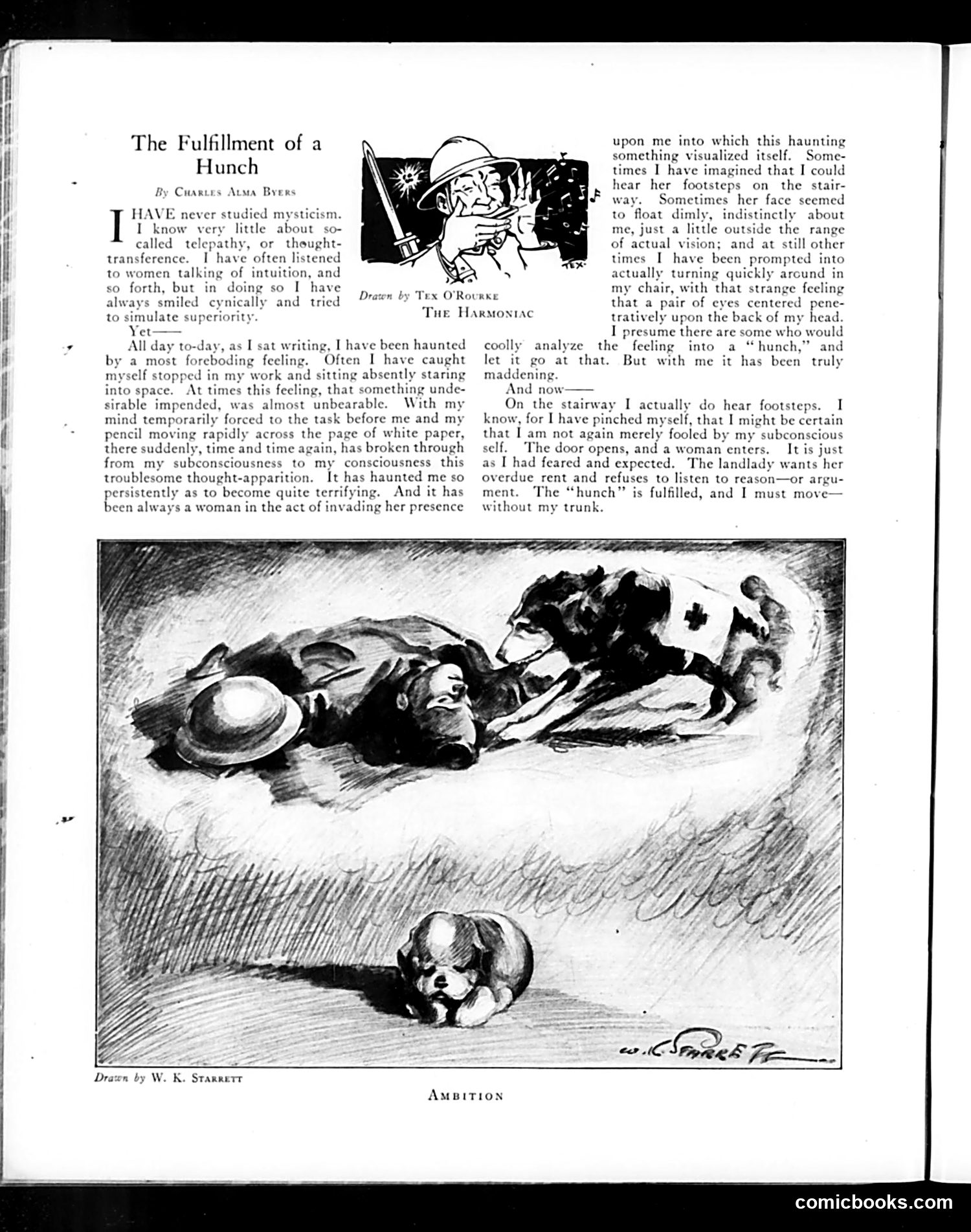
This page presents a short story by Charles Alden Byrnes illustrated with two cartoons by different artists. **The Story:** A writer experiences an inexplicable premonition throughout the day—sensing a woman's presence, hearing footsteps, feeling watched. He dismisses belief in intuition and telepathy as superstitious, yet the feeling persists and terrifies him. His "hunch" is fulfilled when his landlady arrives demanding overdue rent and refusing negotiation. He must move without his trunk. **The Satire:** The piece gently mocks masculine rationality and skepticism about "women's intuition." The narrator's smugness about not believing in telepathy or thought-transference contrasts with his actual experience of genuine premonition—suggesting such intuitions have practical validity despite scientific dismissal. **The Cartoons:** "The Harmoniac" (top) shows a mystical female figure. "Ambition" (bottom) depicts a small dog watching a man in a hat lying prone on the ground—likely illustrating the gap between ambition and reality, complementing the story's theme of unfulfilled expectations.
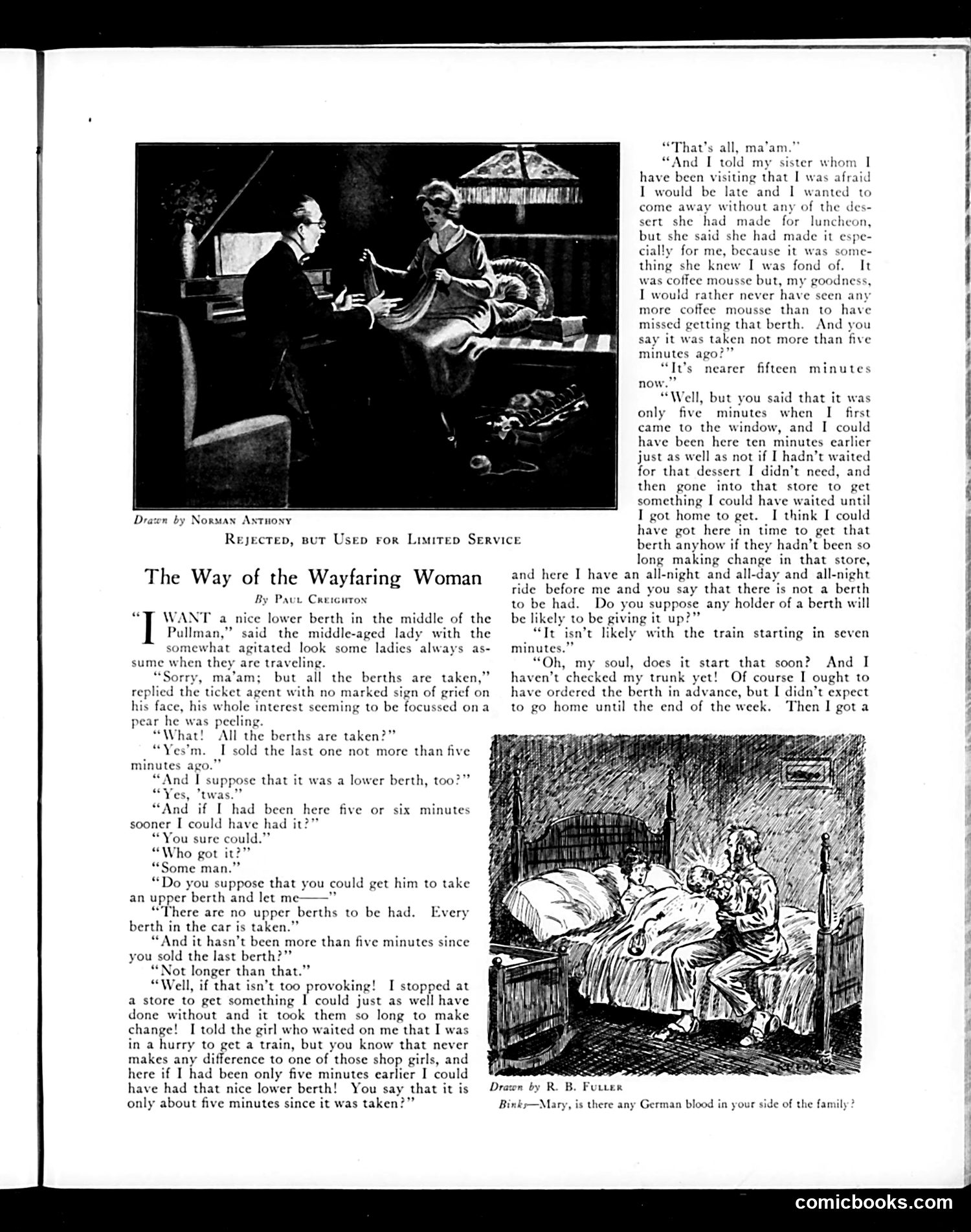
This story-cartoon satirizes the self-absorbed complaining of middle-class traveling women of the era. The protagonist's frustration over missing a train berth exposes how she blames everyone—the shop girl (slow with change), her sister (delaying her with dessert), the ticket agent—rather than accepting responsibility for her own poor planning and tardiness. The humor lies in her escalating rationalizations: she didn't *need* the dessert or the store item, yet delays for them anyway, then resents the consequences. The title's "wayfaring woman" suggests restless, rootless modern femininity, while her entitled demands on service workers (the ticket agent's indifference is pointedly noted) and victim mentality represent satire of upper-middle-class female behavior. The separate cartoon caption at bottom appears unrelated to this story.
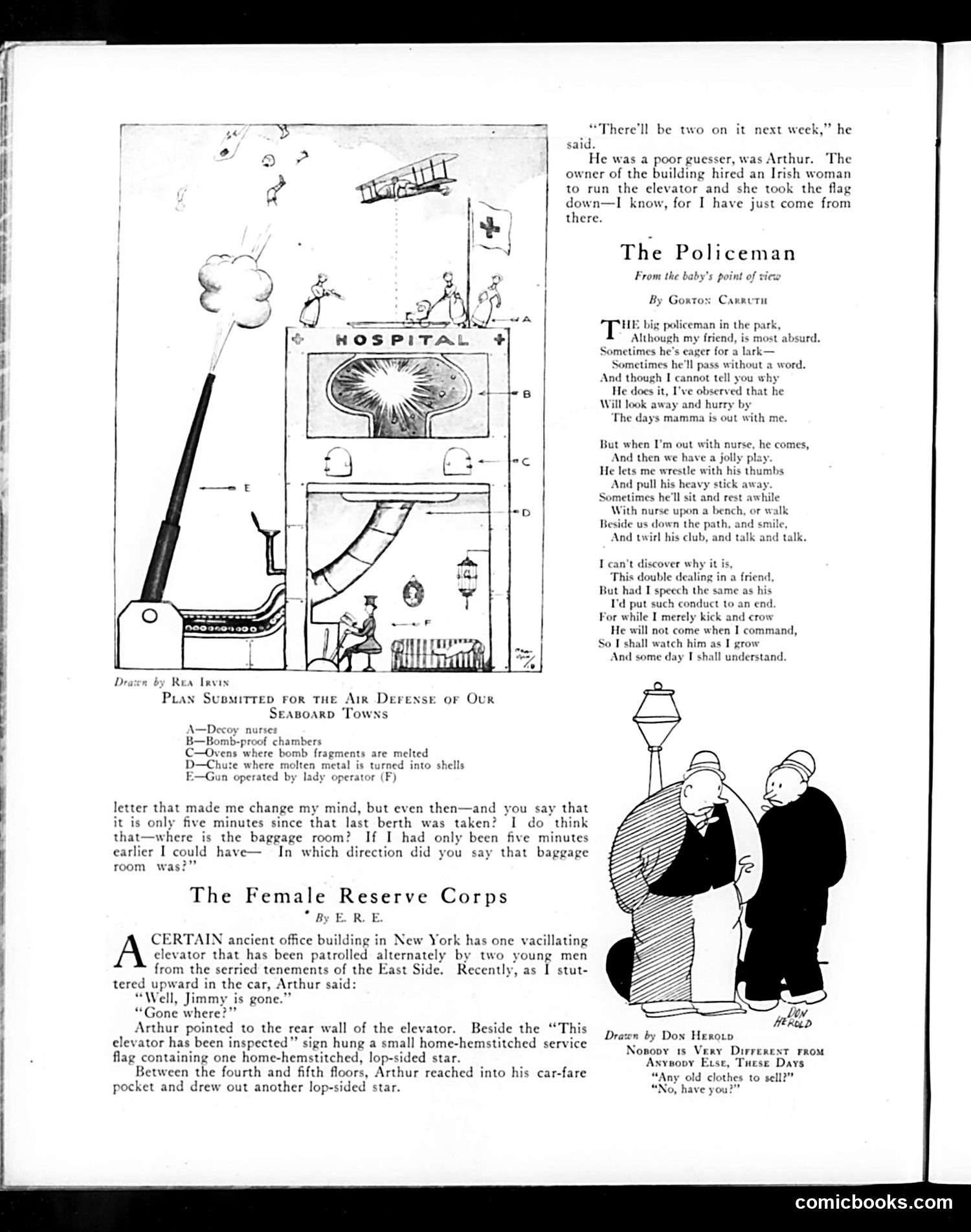
This page contains three distinct pieces of 1910s-era American social commentary: **"Plan Submitted for the Air Defense of Our Seaboard Towns"** (left): A satirical architectural diagram by Rea Irvin depicting a hospital converted into a weapons factory during World War I, with labeled sections for bomb-proof chambers, shell-manufacturing ovens, and gun operation. This reflects anxieties about coastal defense and industrial mobilization. **"The Policeman"** (right, poem): Gordon Caruth's verse humorously explores a child's observation that a park policeman behaves differently depending on whether the child's mother or nurse accompanies them—he's playful with the nurse present but avoids the child when the mother appears. The joke satirizes adult hypocrisy and selective behavior. **"The Female Reserve Corps"** (bottom): A prose piece by E.R.E. describing how an office building's male elevator operators are replaced by an Irish woman. The story suggests economic displacement of working-class men, likely reflecting post-WWI labor shifts when women entered traditionally male jobs. All three pieces use satire to comment on social change, wartime concerns, and gender/class dynamics of the era.
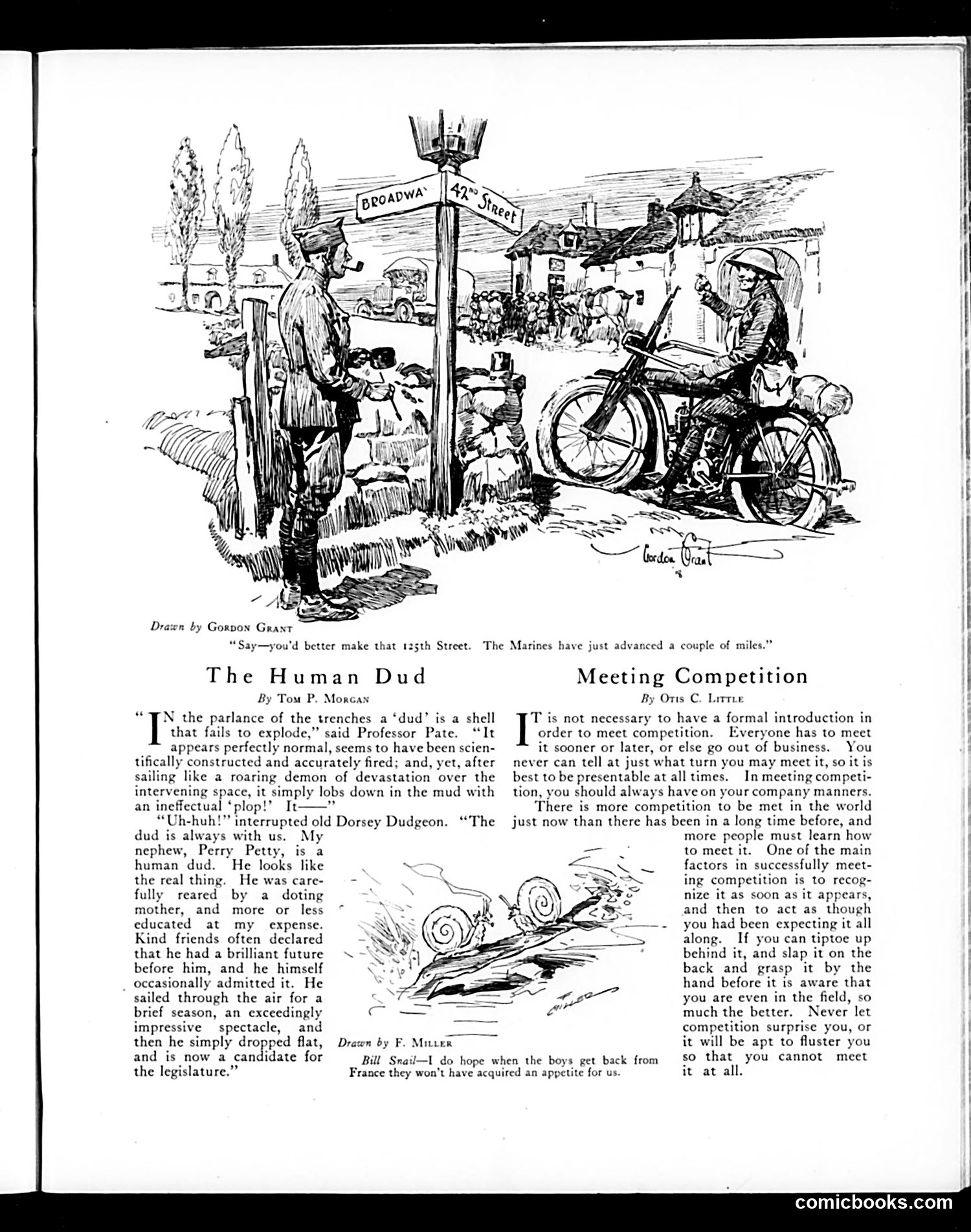
**Top Cartoon (Gordon Grant):** A street-corner scene where a policeman directs a motorist to "125th Street" instead of their requested destination, mentioning "The Marines have just advanced a couple of miles." This is WWI-era satire playing on military advancement language—applied absurdly to New York City geography. **"The Human Dud" (Tom P. Morgan):** A satirical story comparing a worthless person to military terminology. Professor Pate explains that a "dud" is an artillery shell that fails to explode despite appearing functional. Old Dorsey Dudgeon applies this to his nephew Perry Petty—a well-raised, educated young man who "looked the real thing" but ultimately accomplished nothing and "simply dropped flat," becoming a candidate for legislature. The satire mocks both underwhelming individuals and politicians. **"Meeting Competition" (Orus C. Little):** Business advice column about recognizing and managing competitors, advocating aggressive but polite tactics—essentially "beat them at their own game." The page reflects WWI-era concerns and commercial competition during that period.
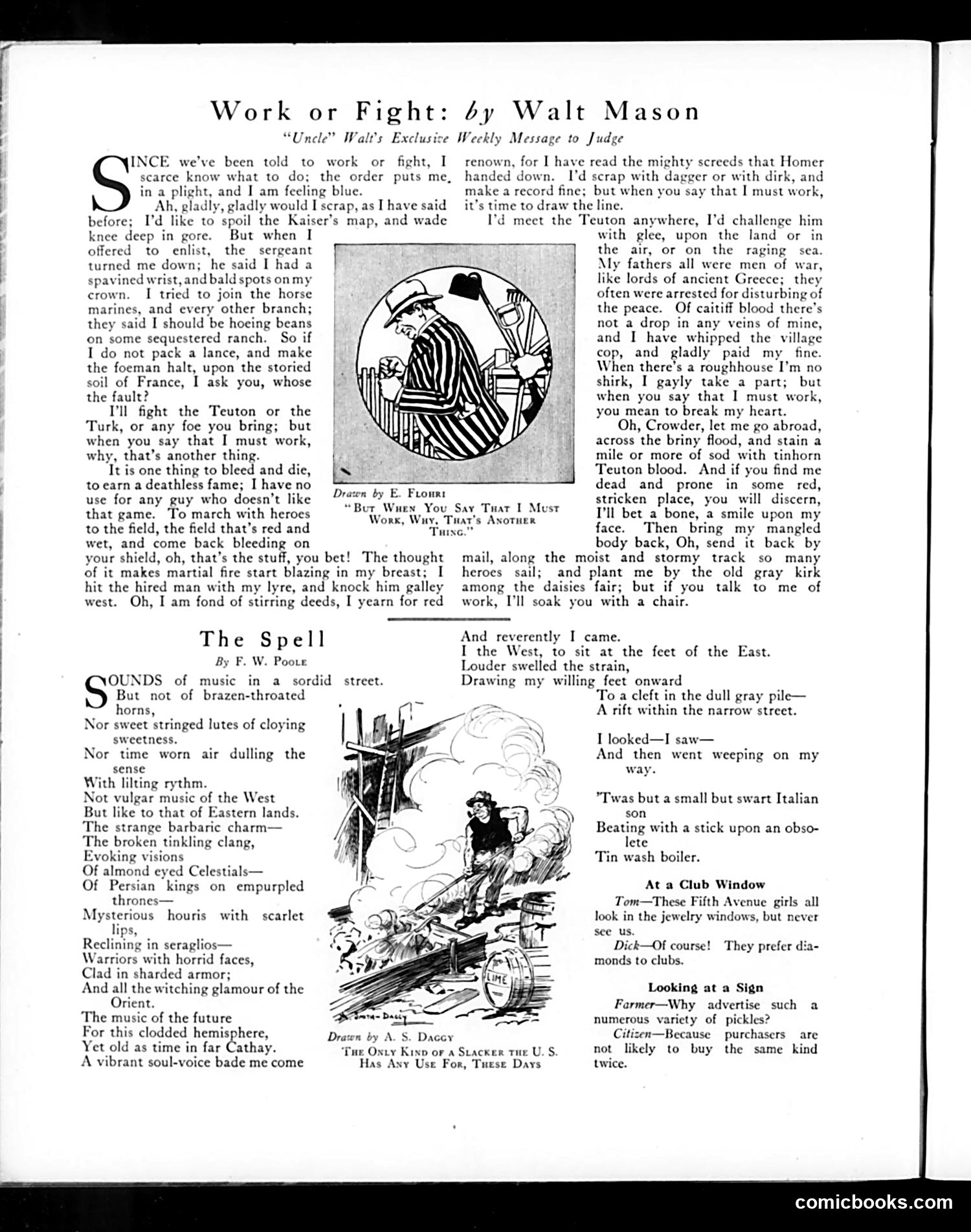
**"Work or Fight"** by Walt Mason satirizes the U.S. government's "Work or Fight" order (likely from WWI era), which compelled men to either enlist militarily or work in essential industries. The speaker claims eagerness to fight the Kaiser and Teutons abroad—using grandiose language about Greek warriors and bloodshed—yet when ordered to *work* on a farm, suddenly refuses, calling it heartbreaking. The satire targets male hypocrisy and draft resistance: men romanticize warfare as glorious but resist civilian labor as demeaning. The speaker's rejection by the Army (due to physical ailments) adds irony—he cannot fight anyway, yet still resists work requirements. The cartoons by E. Florit and A.S. Daggy visually reinforce this contradiction between martial posturing and domestic shirking. **"The Spell"** appears unrelated—a poetic piece about Eastern music's exotic allure. The page critiques wartime conscription resistance during America's WWI involvement.
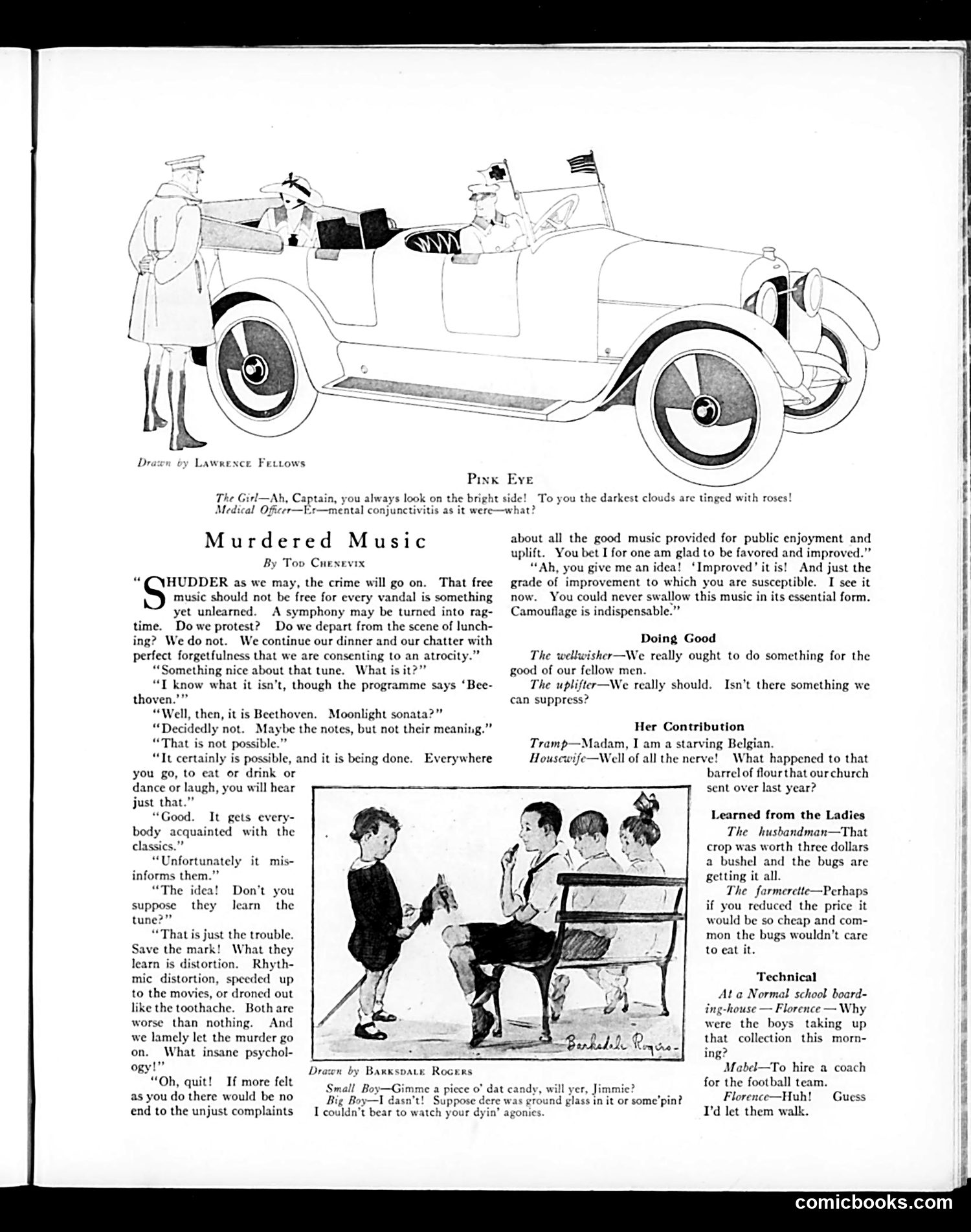
This Judge magazine page contains several satirical pieces critiquing early 20th-century social issues: **"Murdered Music"** (main article with car illustration): Satirizes how classical music—Beethoven, etc.—was being "murdered" through popularization and adaptation into ragtime and movie accompaniment. The complaint is that speeding up or distorting classical compositions for entertainment corrupts both the music and public understanding of it. The author argues people accept this "atrocity" passively while dining out. **Small illustrations below**: Brief humorous vignettes about everyday life—one involving children and candy, others about charitable impulses, farm economics, and student fundraising. These appear to be filler jokes rather than political commentary. The overall tone reflects anxiety about cultural degradation and mass commercialization of "serious" art during the early cinema era, when live orchestras accompanied films and classical music faced unprecedented adaptation and parody.
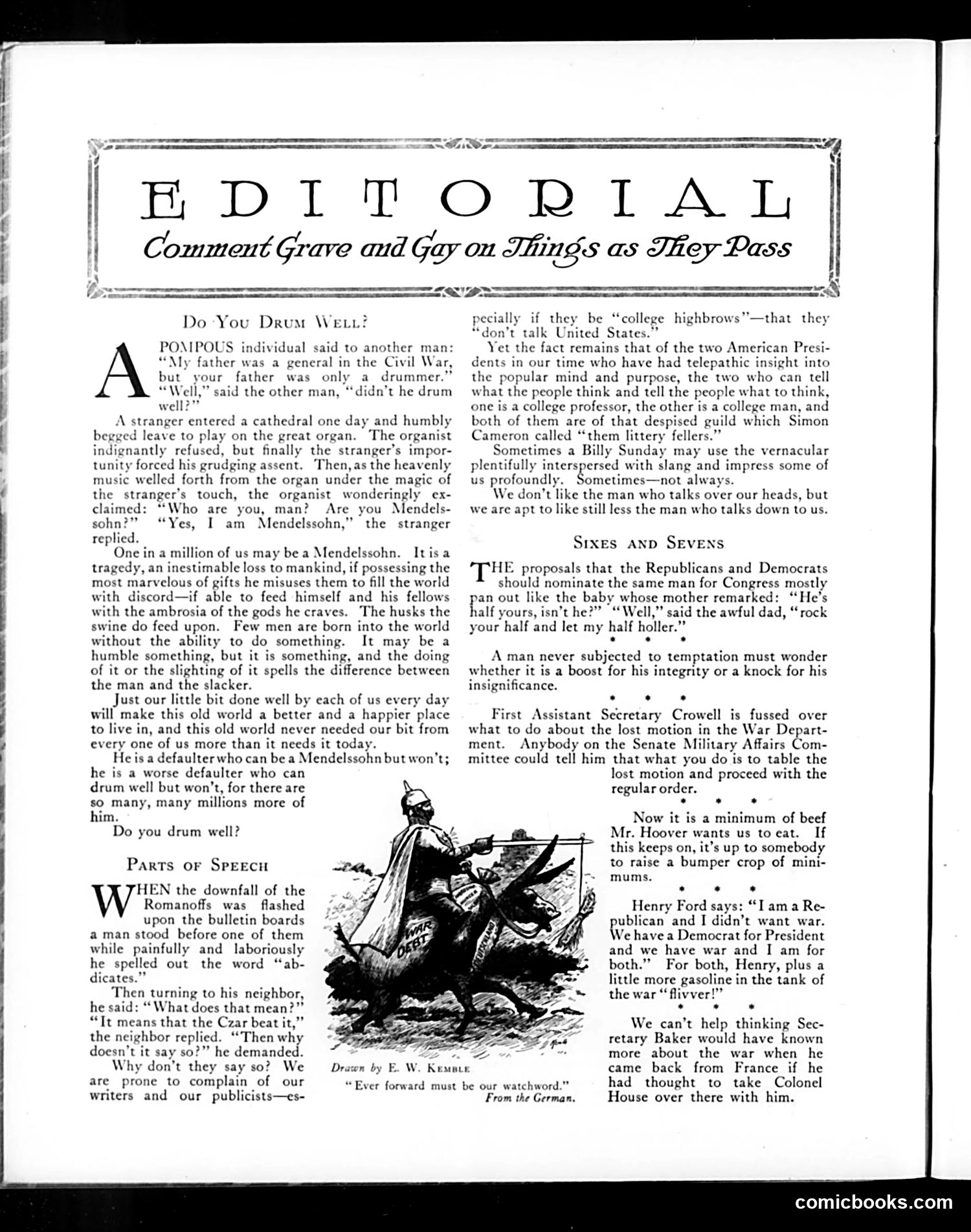
This page contains satirical editorial pieces commenting on contemporary American issues, likely from the WWI era based on references to Hoover (food conservation), the War Department, and Crowell. **"Do You Drum Well?"** uses an extended metaphor about performing one's duty competently—whether being a general or drummer (Civil War reference). It praises Mendelssohn and argues every person should do their role well, however humble, rather than become a "slacker" (a term criticizing those avoiding WWI service). **"Parts of Speech"** mocks poor public literacy by recounting someone's inability to read "abdicates" (likely referencing the 1917 Russian Revolution/Tsar's abdication). It defends educated speakers like college professors while criticizing both "college highbrows" and those who "talk down" to common people—a nuanced commentary on class and communication. **"Sixes and Sevens"** offers brief satirical jabs at political bipartisanship (comparing it to shared parenting), mentions Secretary Crowell and War Department inefficiency, and references Hoover's beef rationing policy. The tone is earnest yet satirical, addressing wartime patriotism and social divisions.
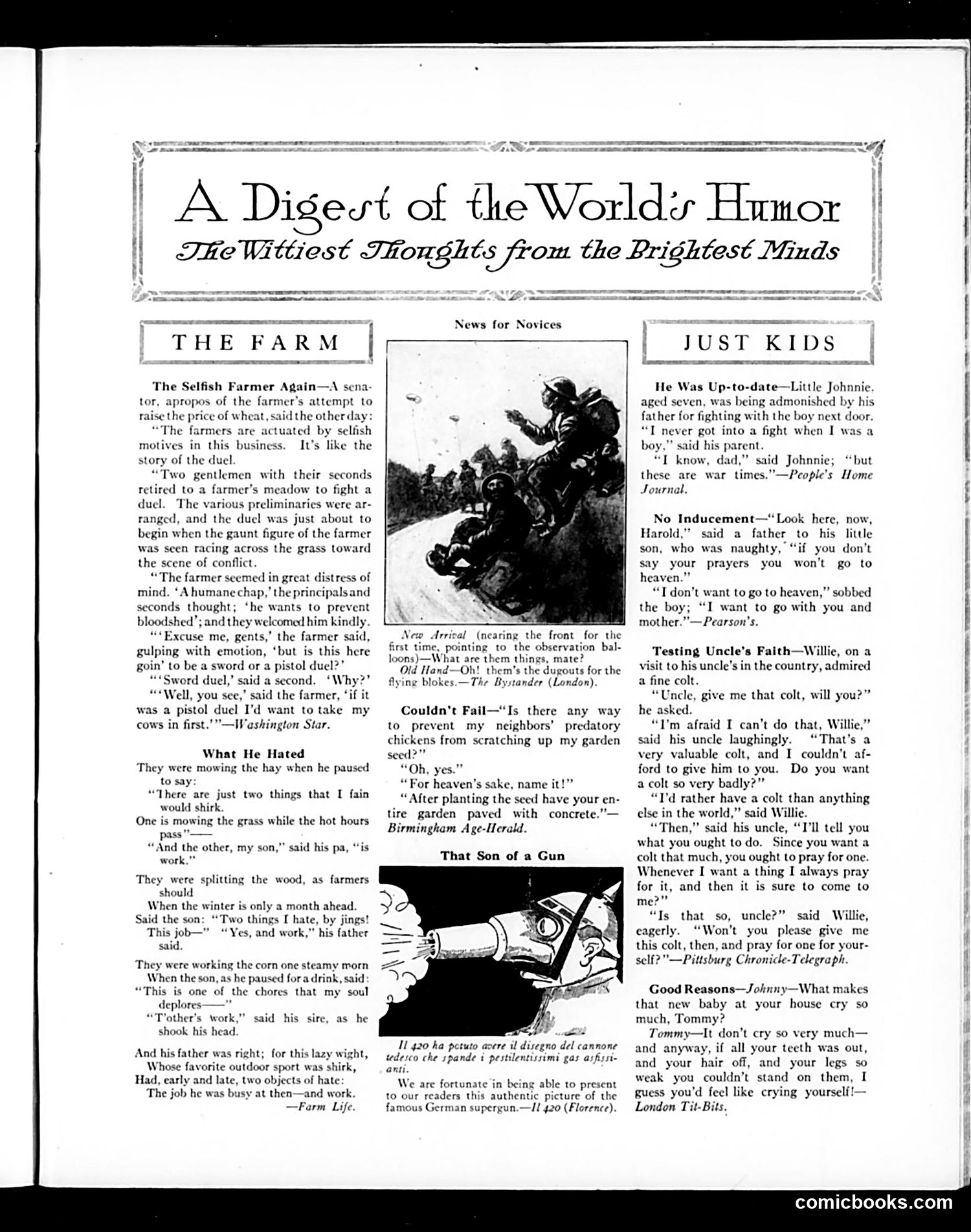
This page from Judge magazine contains satirical commentary on early-20th-century American life, likely during World War I (references to gas weapons and "flying blokes" suggest this period). **Main sections:** **"The Selfish Farmer"**: A senator's anecdote mocking farmers who raise wheat prices—portraying them as hypocritically selfish, only caring about protecting their property during others' conflicts. **Farm Life poems**: Humorous verses about lazy farmworkers who complain about their jobs while actually hating work itself—satirizing rural worker attitudes. **"That Son of a Gun"**: A cartoon captioned in Italian, showing a German artillery piece. The accompanying text ironically "congratulates" readers on seeing an "authentic picture" of the famous German "supergun" (likely referring to Big Bertha). **"Just Kids"**: Children's anecdotes using humor to comment on war times and faith—a child expects to fight in wartime, another prefers hell to heaven without parents. The overall tone mixes gentle domestic humor with sharper wartime satire.
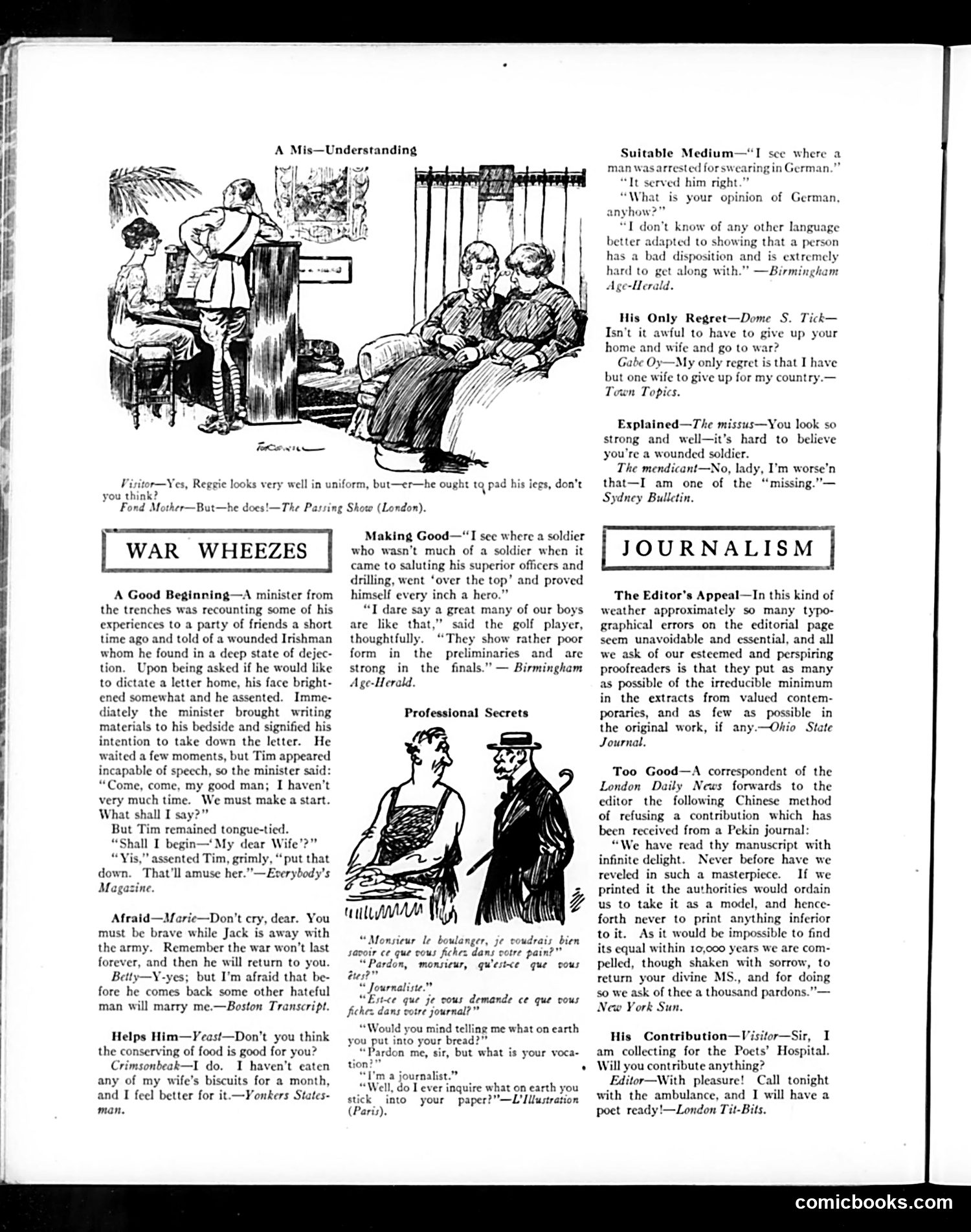
This page from *Judge* magazine contains WWI-era satirical humor and brief jokes. The main cartoon "A Mis-Understanding" depicts a mother claiming her son's thin legs are actually padded—absurd denial masking reality, likely mocking mothers' blind defense of their sons' fitness for military service. "War Wheezes" collects short anecdotes: an Irish soldier's crude letter home; a woman fearing abandonment; food rationing jokes. The "Professional Secrets" cartoon contrasts a baker and journalist—both deflect questions about what they put in their products, satirizing journalistic integrity. Other items mock: German language as suitable for expressing bad temperament (anti-German sentiment during WWI); a man boasting he has "one wife" to sacrifice; wounded soldiers claiming "missing" status; and editorial standards slipping during summer heat. The "Journalism" section includes a rejection letter supposedly from a Pekin journal, mocking overwrought Chinese politeness. These are typical wartime satirical filler—mild, topical humor for American readers.
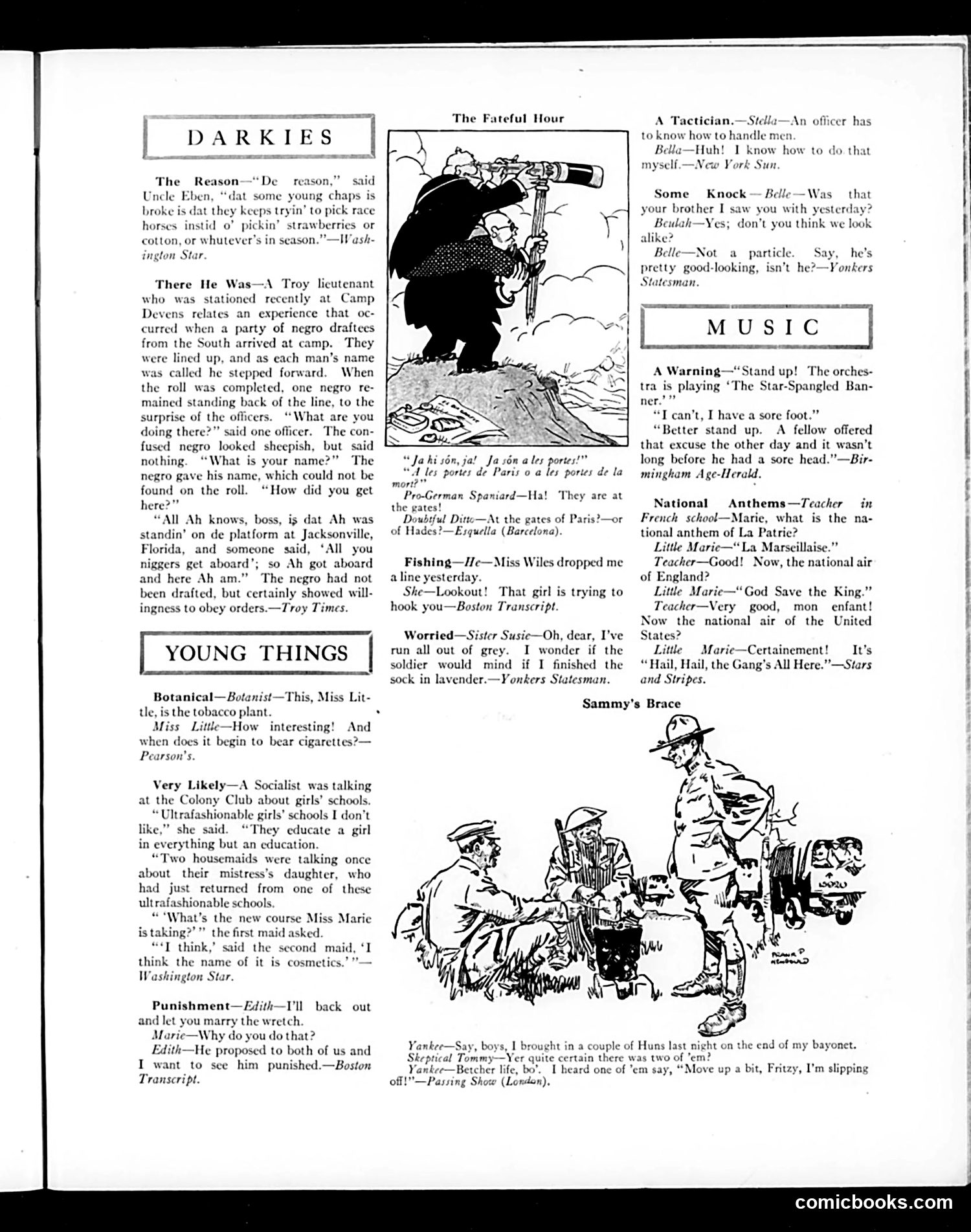
This page from Judge magazine (likely WWI-era, based on references to soldiers and "Huns") contains several satirical sections: **"Darkies"** section uses racist dialect humor common to the period, depicting Black soldiers and laborers through crude stereotypes. One anecdote mocks a Black draftee who accidentally boarded a military transport. **"Young Things"** offers gentle humor about girls' education and courtship, including a joke about cosmetics masquerading as "education" at fancy schools. **"The Fateful Hour"** cartoon depicts a figure at a telescope observing gates—likely referencing WWI anxieties about whether Spain would enter the war ("Pro-German Spaniard") or face military defeat. **"Music"** section satirizes national patriotism: a French teacher quizzes students on national anthems; Americans comically substitute a popular song ("Hail, Hail, the Gang's All Here") for the national anthem. **"Sammy's Brace"** cartoon shows American soldiers joking about capturing German soldiers ("Huns"), with dialect humor about combat encounters. The overall tone reflects 1910s-era American attitudes: casual racism, pro-war sentiment, and gentle social satire.
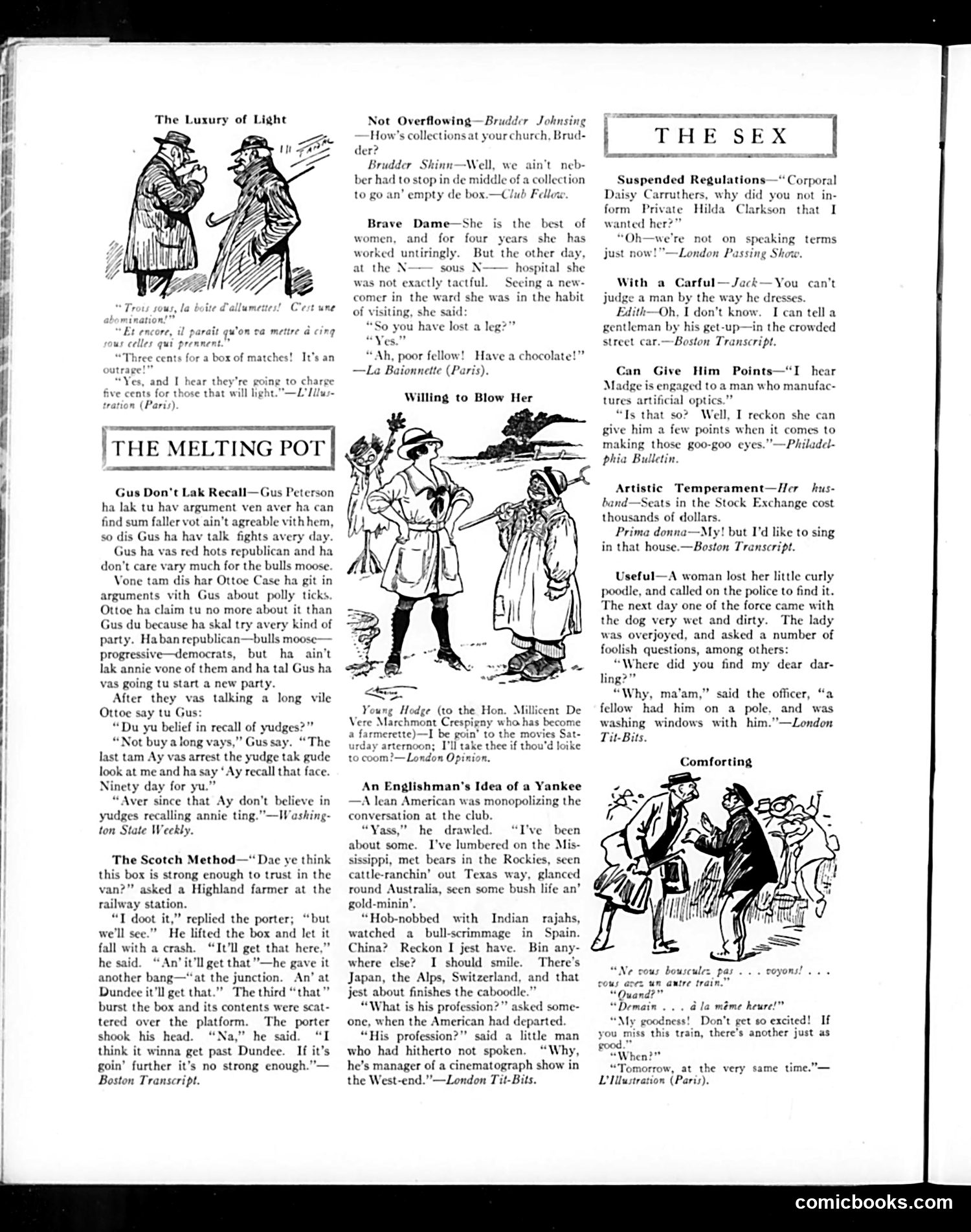
This page collects brief humorous anecdotes rather than political cartoons. The satire targets various social groups through ethnic and class stereotypes common to early 20th-century American humor: **"The Melting Pot"** section satirizes immigrants through phonetic dialect humor—a Scandinavian character ("Gus") and Scottish railway porter represent "foreign" perspectives. The jokes mock their accents and reasoning while gently ribbing American politics (recall of judges, political party-switching). **"An Englishman's Idea of a Yankee"** stereotypes Americans as boastful, world-traveling braggarts—a manager of a cinematograph show in London's West End who exaggerates his adventures absurdly. **"The Sex"** section offers mild domestic comedy about gender relations, with jokes about couples and military propriety. The humor relies entirely on ethnic caricature, accent mockery, and period-specific references (cinematograph shows, military ranks) that would require contemporary context to fully appreciate. It reflects the magazine's approach to comedy through outsider stereotyping.
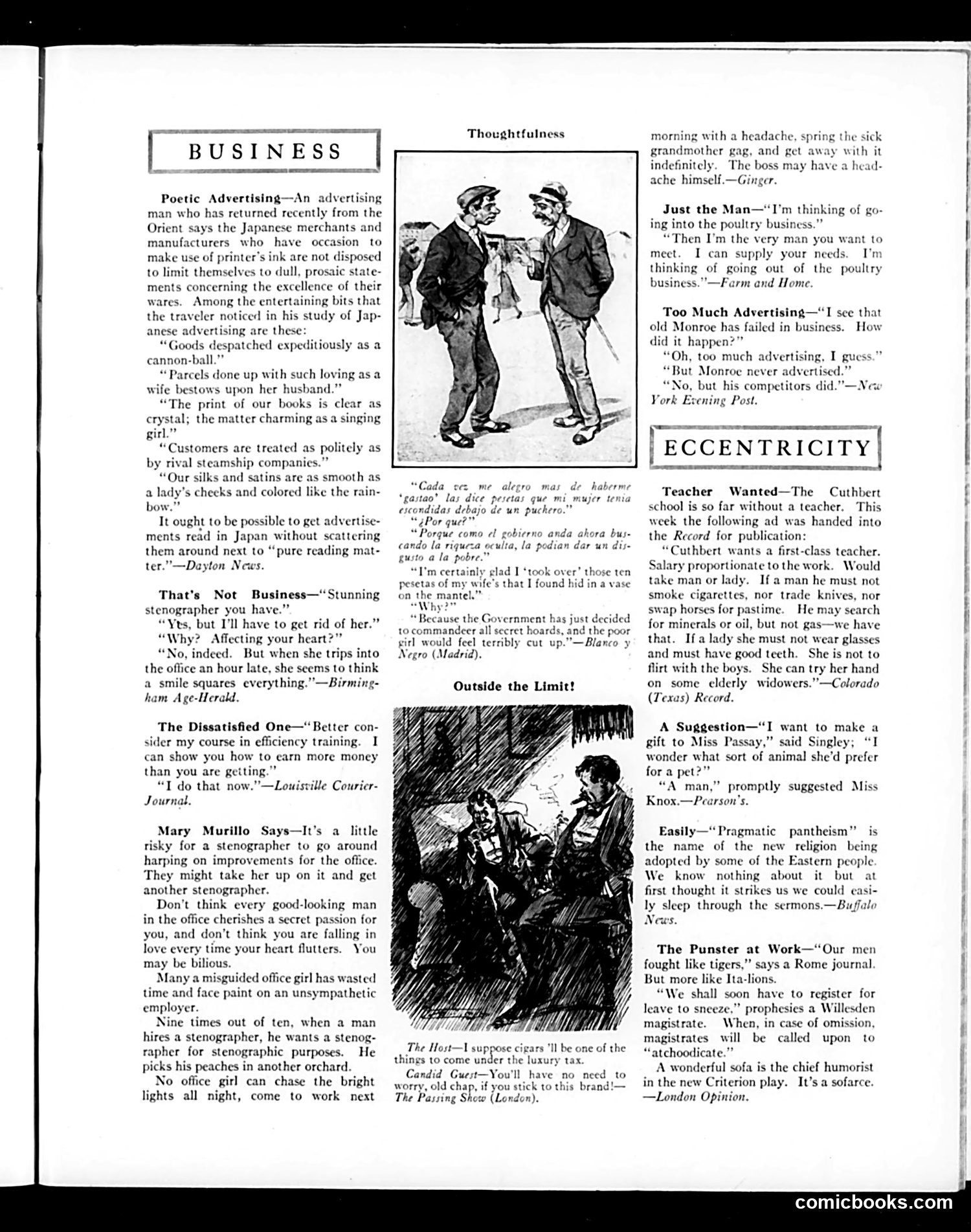
This is a business humor and advice column page. The two illustrated cartoons satirize workplace dynamics: **Upper cartoon:** Two men discussing what appears to be office strategy—a visual complement to the surrounding office-etiquette items mocking workplace pretension. **Lower cartoon:** Shows what appear to be laborers or working-class men, accompanying a humorous anecdote about a Spanish man concealing his wife's secret savings (pesetas) from government confiscation. **Satirical content addressed:** The page mocks stenographers/office girls specifically—warning them not to assume romantic interest from employers, not to presume attractiveness excuses tardiness, and not to make unsolicited "improvements." It also ridicules Japanese advertising flowery language, critiques excessive business advertising, and includes an ironic take on a teacher-wanted ad with comically restrictive requirements (no smoking, trading knives, or swapping horses). The humor targets early-20th-century office culture, workplace vanity, and bureaucratic absurdity—particularly gendered expectations of female office workers and government overreach regarding wealth.
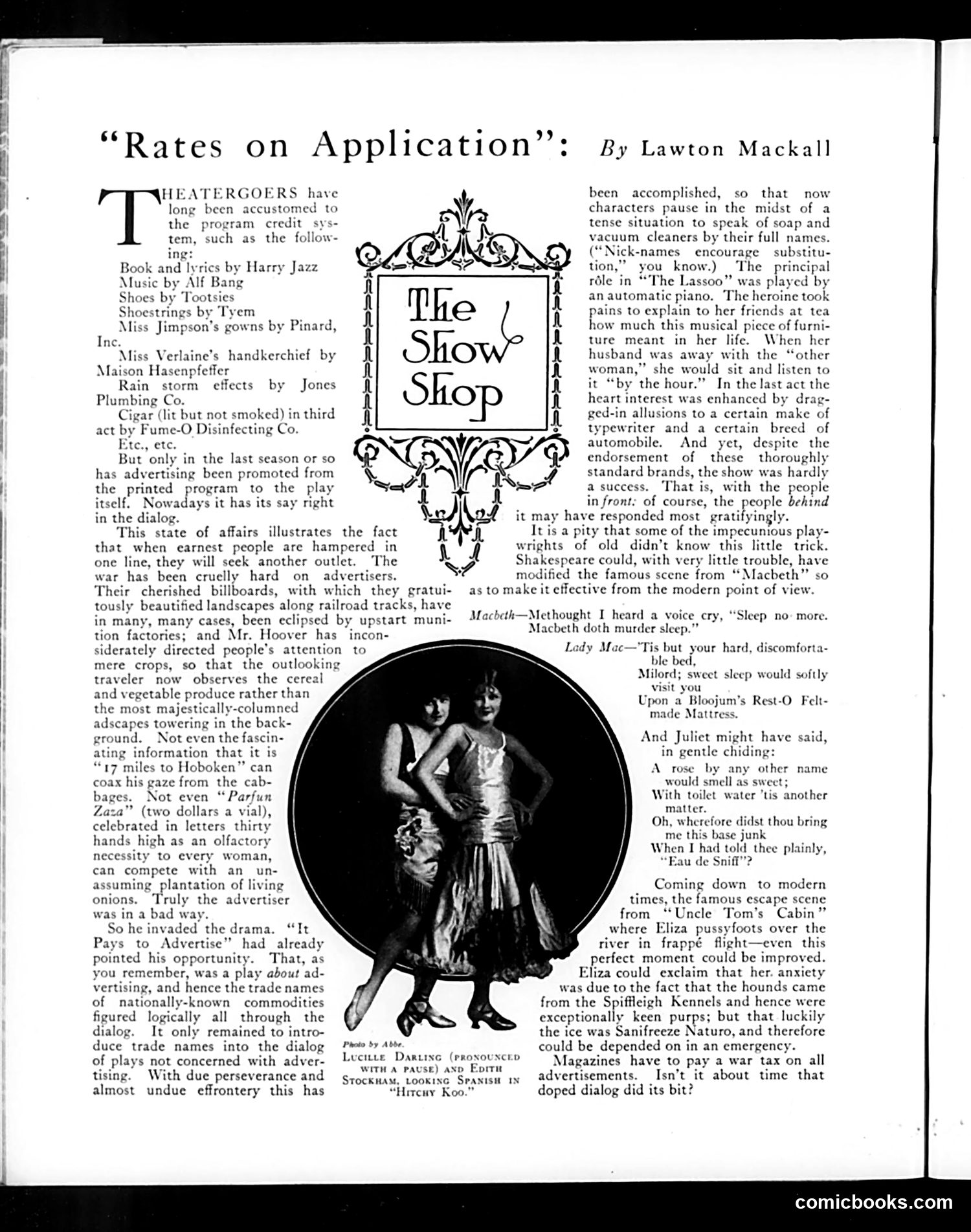
This article by Lawton Mackall satirizes the increasingly aggressive insertion of commercial advertising into Broadway plays during the 1920s. **The Satire:** Mackall complains that advertisers, frustrated by declining billboard visibility (due to highway beautification efforts and public attention to crops rather than ads), have invaded theatrical productions. Trade names for mundane products—soap, vacuum cleaners, mattresses, automobiles, typewriters—are now shoehorned into dramatic moments by characters who pause mid-scene to pitch brand names. **The Point:** The author mocks this practice by quoting famous Shakespeare scenes (*Macbeth*, *Romeo and Juliet*) rewritten with modern product placements—Macbeth recommending a "Bloojum's Rest-O Felt-made Mattress," Lady Macbeth endorsing furniture. The implication: this crass commercialism degrades art and confuses entertainment with advertising. **Context:** The accompanying photograph shows two actresses from "Hitchy Koo," apparently an actual play containing such promotional content. Mackall's critique reflects 1920s anxieties about unbridled commercialism corrupting culture.
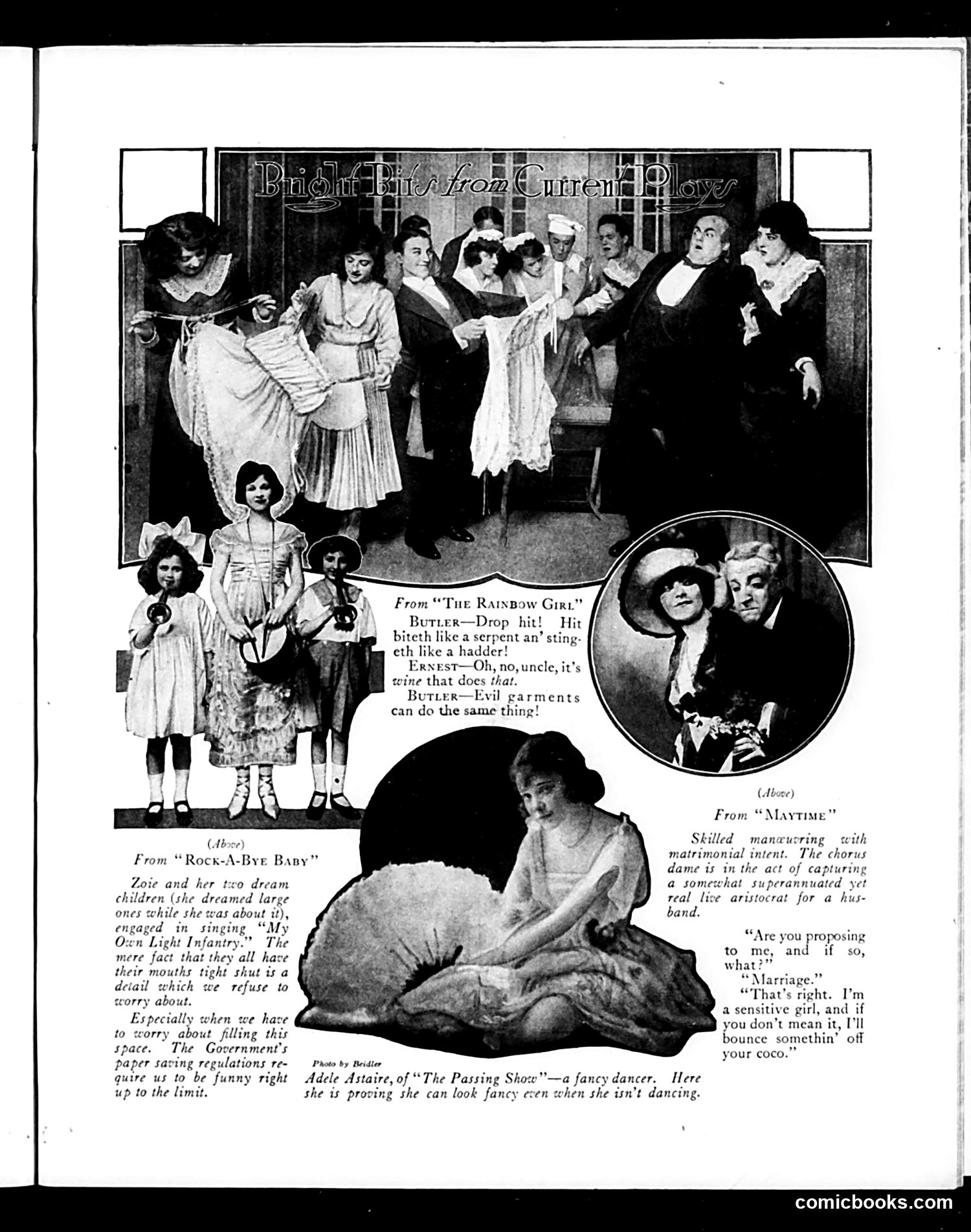
This page showcases "Bright Bits from Current Plays"—theatrical humor and commentary from Broadway productions circa the 1910s-20s. The content includes: **"Rock-A-Bye Baby"**: A joke about an actress (Zoie) and her "dream children" singing with mouths shut—satirizing either the production's quality or silent film conventions. **"The Rainbow Girl"**: A comedic exchange between characters Butler and Ernest about something that "bites" and "stings," with Butler attributing danger to "evil garments"—likely sexual innuendo about a female performer's costume or dance moves. **"Maytime"**: Commentary on a chorus girl capturing an aging aristocrat for marriage—satirizing gold-digging and class mixing on stage. **"The Passing Show"**: Adele Astaire (famous dancer) is humorously noted as proving she can "look fancy even when she isn't dancing." The page's framing joke references wartime paper-rationing regulations, requiring the magazine to be "funny right up to the limit" of available space. This adds meta-commentary about Depression-era or WWI-era constraints on publication.
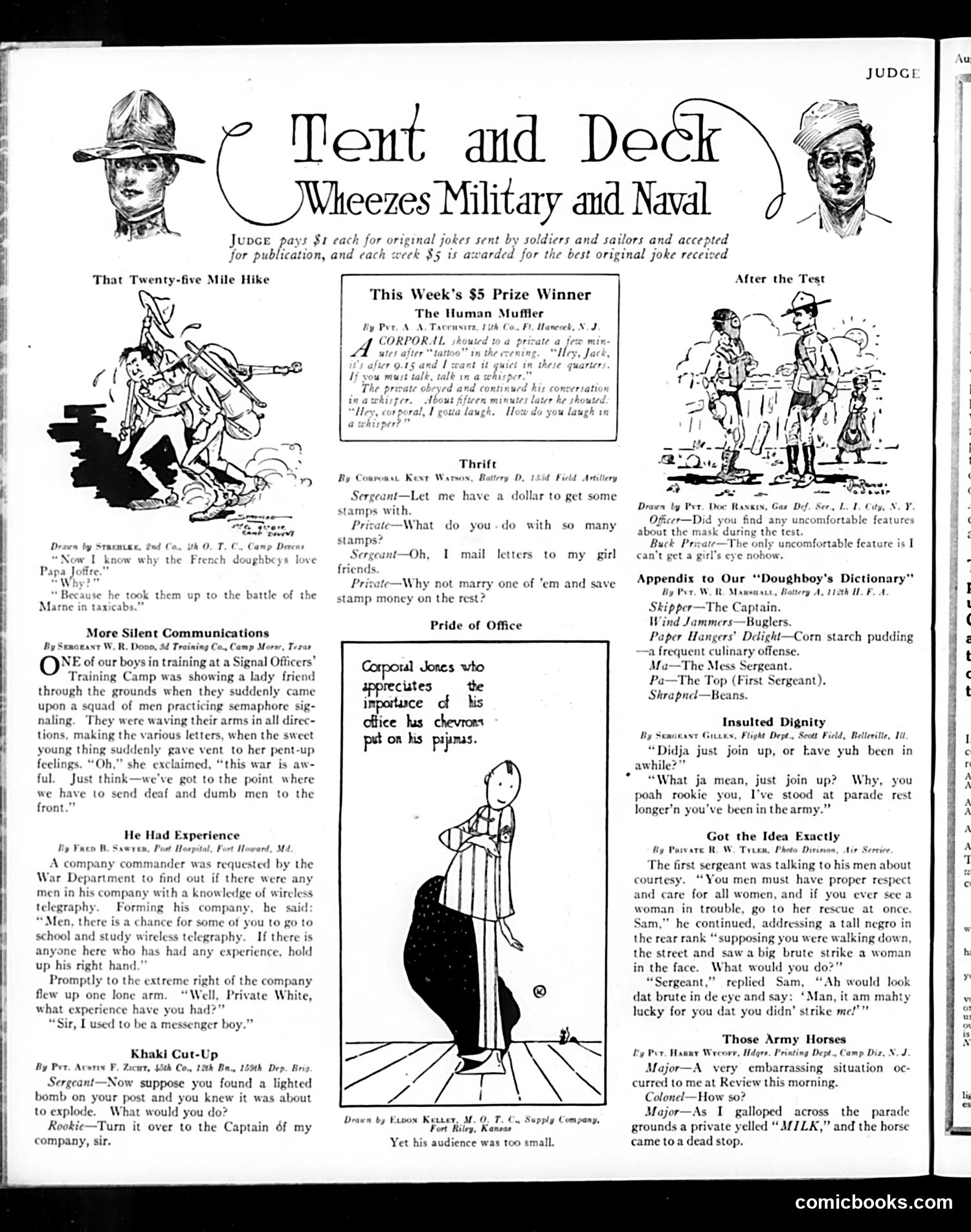
This is a humor page from **Judge magazine** featuring jokes submitted by soldiers and sailors during World War I. The page collects light anecdotes about military training and camp life, with a $5 weekly prize for the best submission. The jokes reflect common WWI-era training experiences: a 25-mile forced march, semaphore signaling practice, and gas mask drills. One recurring joke type mocks recruits' inexperience—a "rookie" soldier literally interprets orders (turning over a live bomb to his captain rather than defusing it). The cartoons use simple line drawings to illustrate these scenarios. A sidebar defines "doughboy slang" (soldier terminology), while other jokes play on military hierarchy and regulations—like a corporal proudly displaying chevrons on his pajamas to assert his rank. The humor is gentle and nostalgic rather than critical, reflecting how soldiers coped with wartime through comedic storytelling. The page demonstrates how military culture generated its own informal folk humor during the war effort.
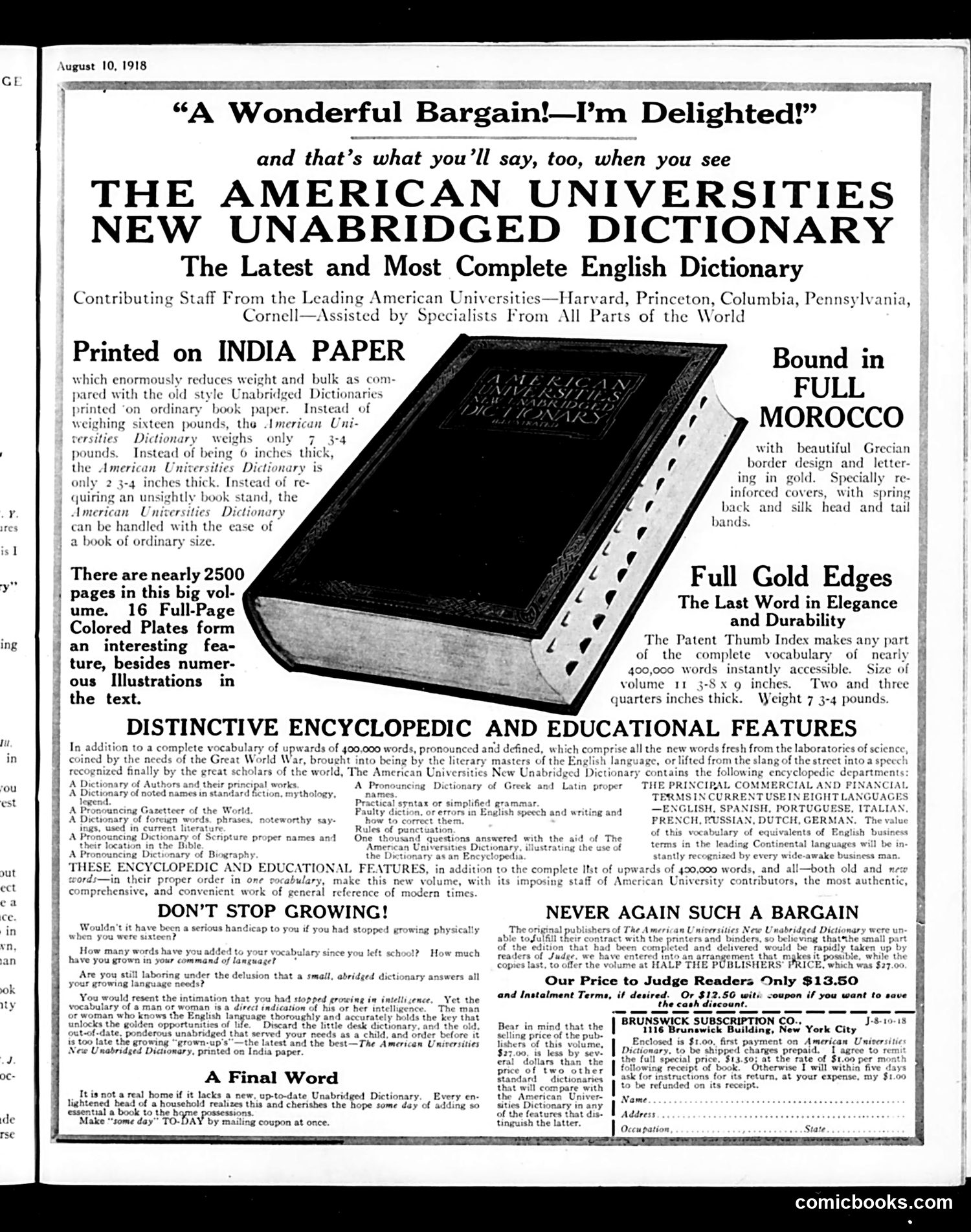
This page is **primarily a full-page advertisement**, not a political cartoon or satirical content. It advertises the American Universities New Unabridged Dictionary. The ad uses persuasive rhetoric common to early 20th-century marketing: comparing the new dictionary's lightness (7¾ pounds on India paper versus 16 pounds for older editions), emphasizing its 400,000 words and educational features, and appealing to middle-class aspirations. The slogan "Don't Stop Growing!" frames vocabulary expansion as personal self-improvement—a period concern about intellectual development. The "Wonderful Bargain" headline mimics satisfied customer testimonials typical of advertising. While appearing in *Judge* (a satirical publication), there is **no visible satire, cartoon, or political commentary** on this particular page. It's a straightforward commercial pitch using the magazine as a distribution vehicle, likely targeting educated readers who would value comprehensive reference materials.
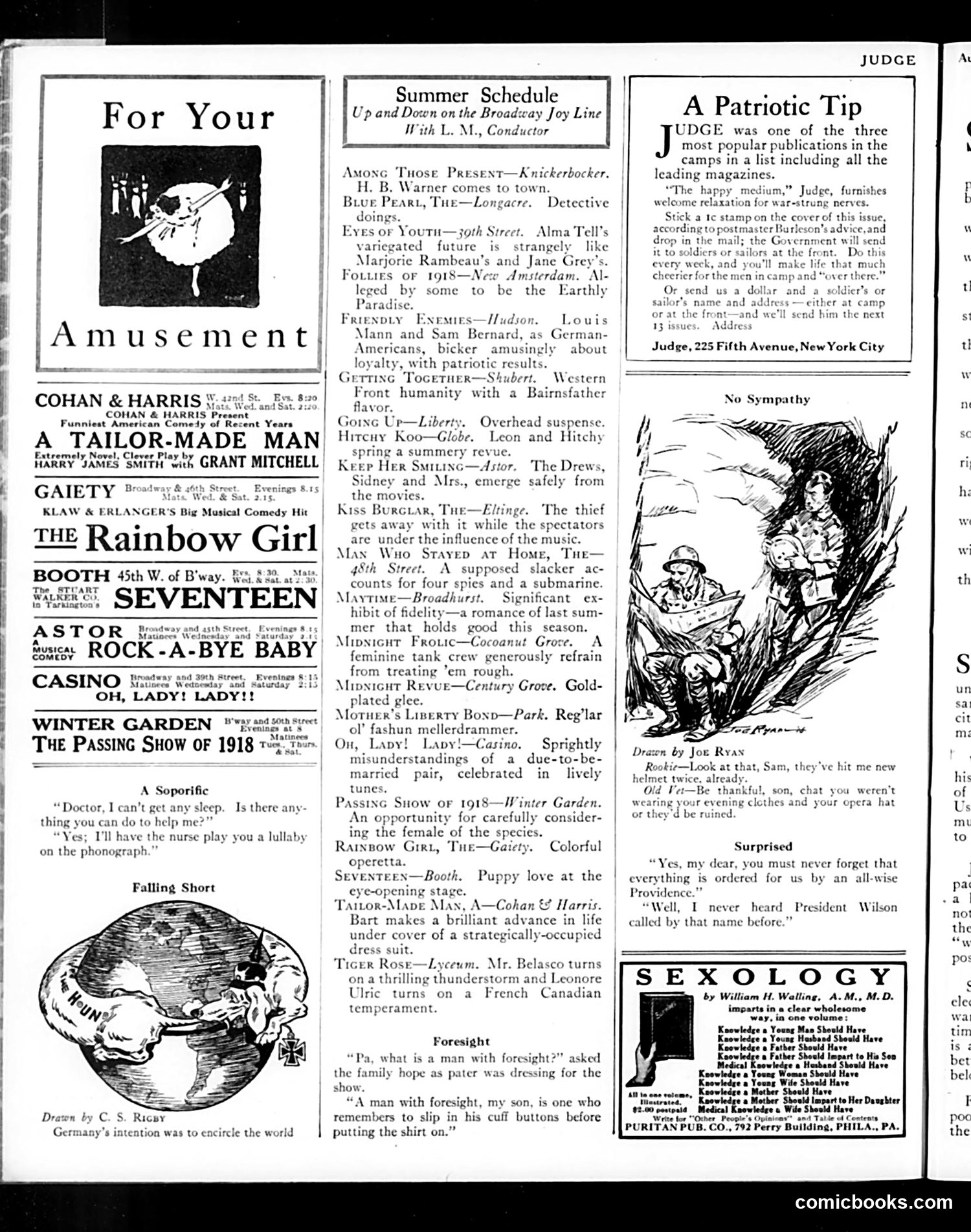
This page is primarily **theatrical advertising and entertainment content** from 1918, with minimal political satire. ## Key Elements: **Theater Listings**: The bulk of the page advertises Broadway shows. One title stands out—"Friendly Enemies" (Hudson Theater), featuring German-American characters "bickering amusingly about loyalty, with patriotic results." This reflects WWI-era anxieties about German-American loyalty, a sensitive topic in 1918. **"Falling Short" Cartoon**: Shows Germany as a head trying to encircle the world—a visual reference to Germany's failed attempt at global conquest during WWI. **"A Patriotic Tip"**: Judge promotes itself as morale-boosting reading for soldiers, encouraging readers to mail stamped copies to servicemen. This reflects the magazine's patriotic positioning during wartime. **Humor**: The "Foresight" joke about cuff buttons is apolitical wordplay. Overall, the page reflects **1918 American wartime patriotism** more than sharp satire, presenting entertainment as a patriotic duty.
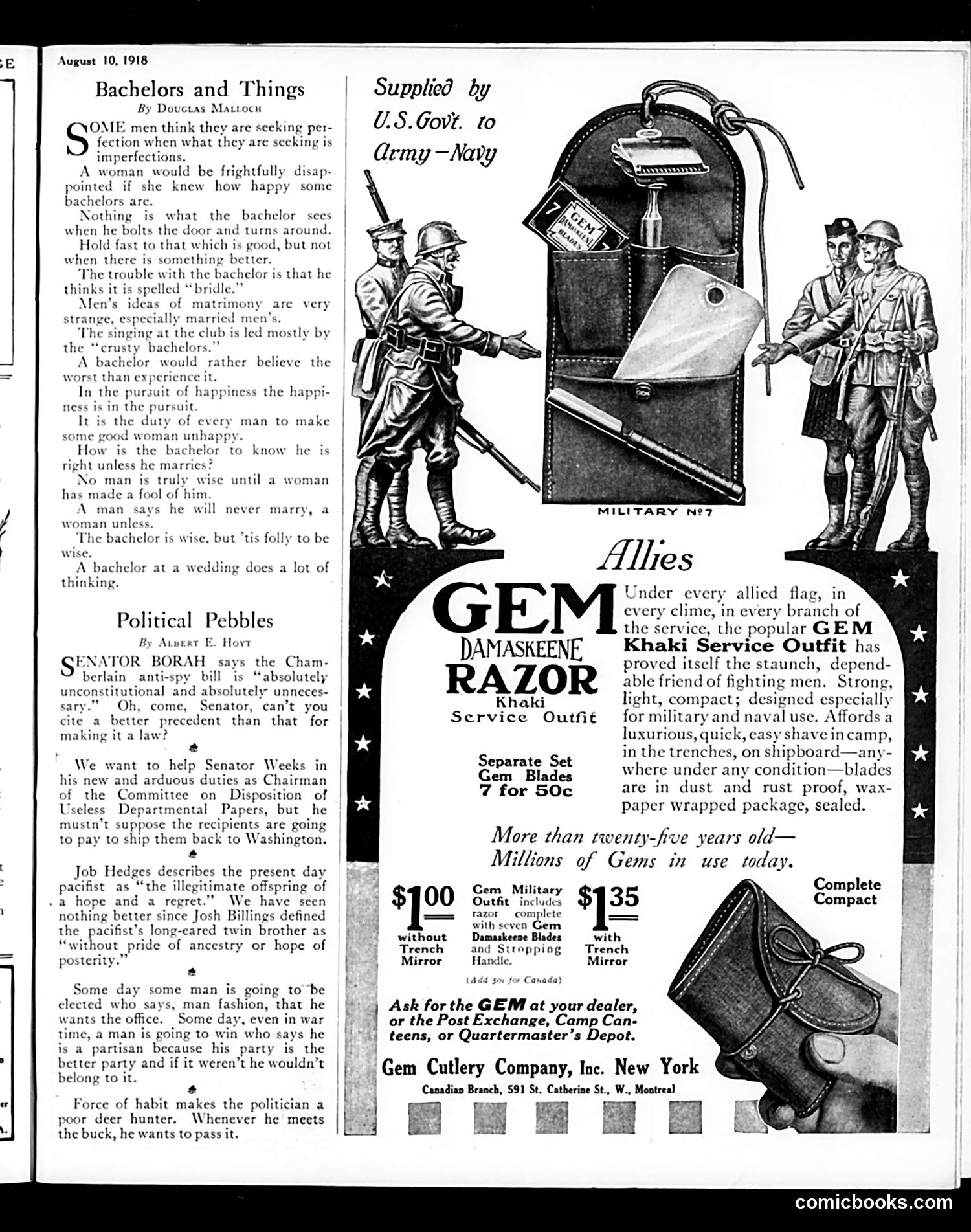
This page contains two distinct sections: **Left side:** A humorous column titled "Bachelors and Things" offering sardonic observations about unmarried men—mocking their self-deception about seeking perfection while avoiding commitment, and suggesting marriage is ultimately inevitable and necessary for male wisdom. **Right side:** A wartime advertisement for GEM Damaskeene razors, marketed as "Khaki Service Outfit" for Allied military personnel. The ad emphasizes the razor's durability in harsh battlefield conditions (trenches, ships, dust, rust) and positions it as essential equipment for soldiers. Illustrations show soldiers in WWI-era uniforms and military kit. **"Political Pebbles"** offers brief satirical jabs at Senator Borah's constitutional objections to anti-spy legislation and mocks pacifists as hypocritical. The overall context reflects August 1918—near WWI's end—when consumer products were marketed explicitly to support troops, and patriotic messaging pervaded American media.
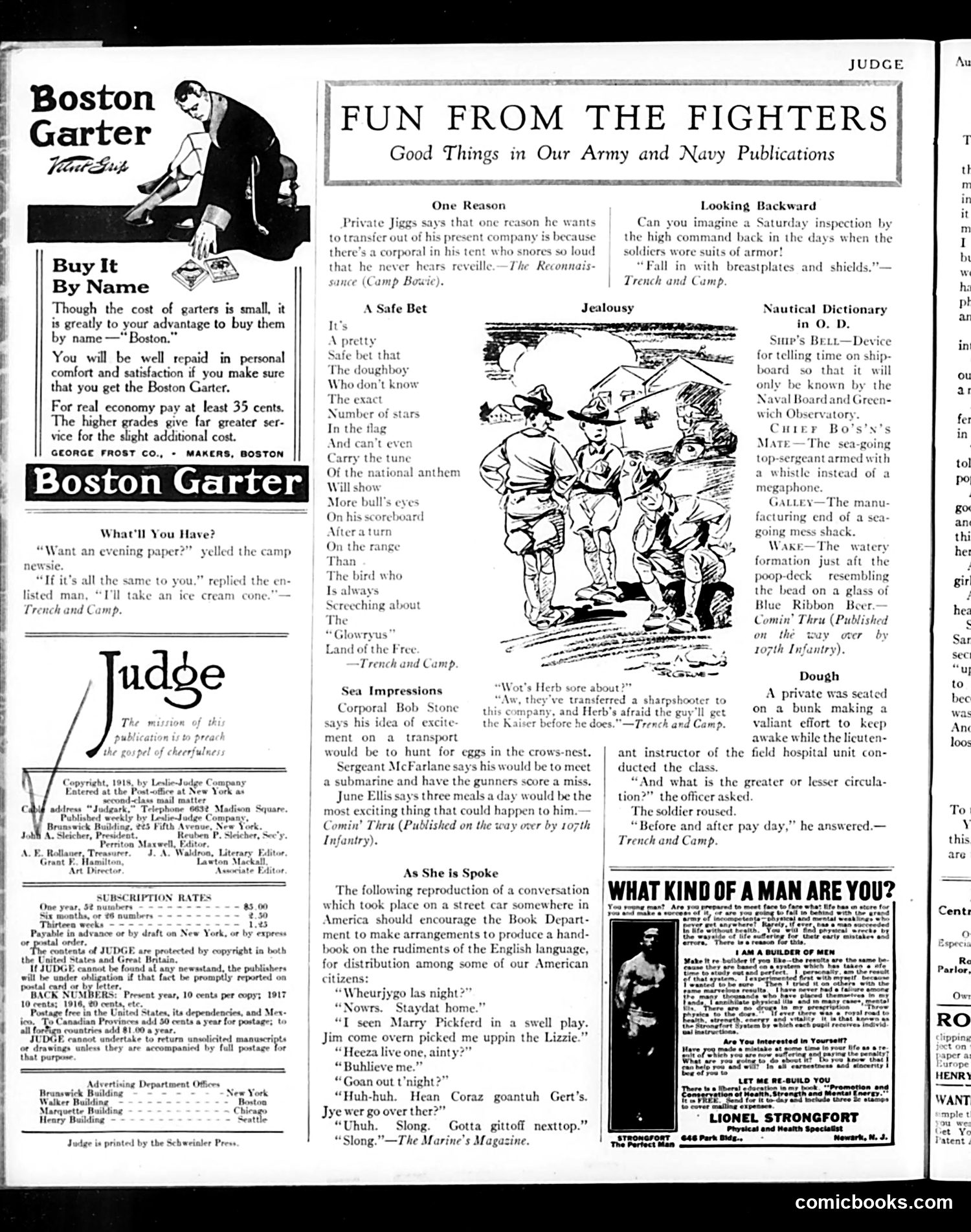
This page from Judge magazine (circa 1918, based on WWI references) combines advertising with military humor targeting American soldiers. The main cartoon "Jealousy" depicts doughboys (WWI soldiers) in a comedic scenario, likely about romantic rivalries or domestic concerns while serving abroad—a common satirical theme when men were deployed. The section "As She is Spoke" mocks American servicemen's poor grammar and dialect ("Wheurjygo," "Nowrs," "Heeza live one"), suggesting class anxieties about who comprised the Army. This reflects period attitudes about education and linguistic "correctness" among working-class recruits. Other content pokes fun at military life: soldiers' obsessions with food, homesickness, and the tedium of transport duty. The Boston Garter advertisement targets practical needs of soldiers needing reliable clothing. Overall, the page uses gentle ribbing of military personnel to boost morale while reinforcing middle-class social norms about language and comportment.
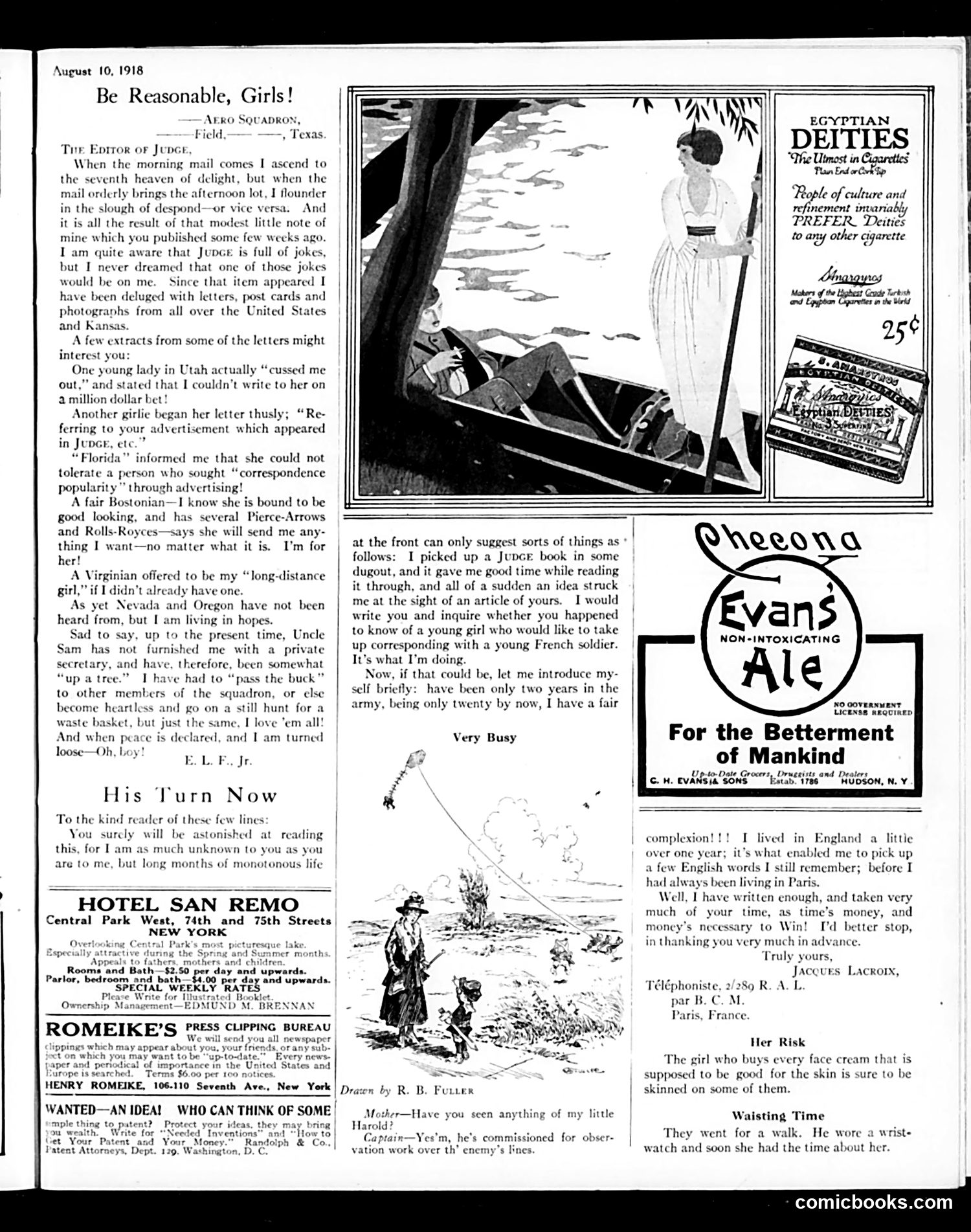
This page captures American life during **World War I's final months**. The main feature, "Be Reasonable, Girls!", is a humorous letter from an American serviceman in an Aero Squadron who published a personal ad seeking correspondence. He's now flooded with responses from women across the U.S., joking about the overwhelming mail and various replies (ranging from insulting to promising). The satire targets the collision of wartime romance and modern advertising culture—young soldiers abroad seeking companionship through published notices, while American women respond eagerly. The tone is lighthearted but reveals the loneliness of soldiers and the social acceptability of women corresponding with servicemen. A second letter from a French soldier similarly seeks a female pen pal, suggesting this was a genuine wartime phenomenon Judge found comedic. The page also contains period advertisements (Hotel San Remo, Egyptian Deities cigarettes, Cheona Evans Ale) and smaller jokes, typical of Judge's satirical format.
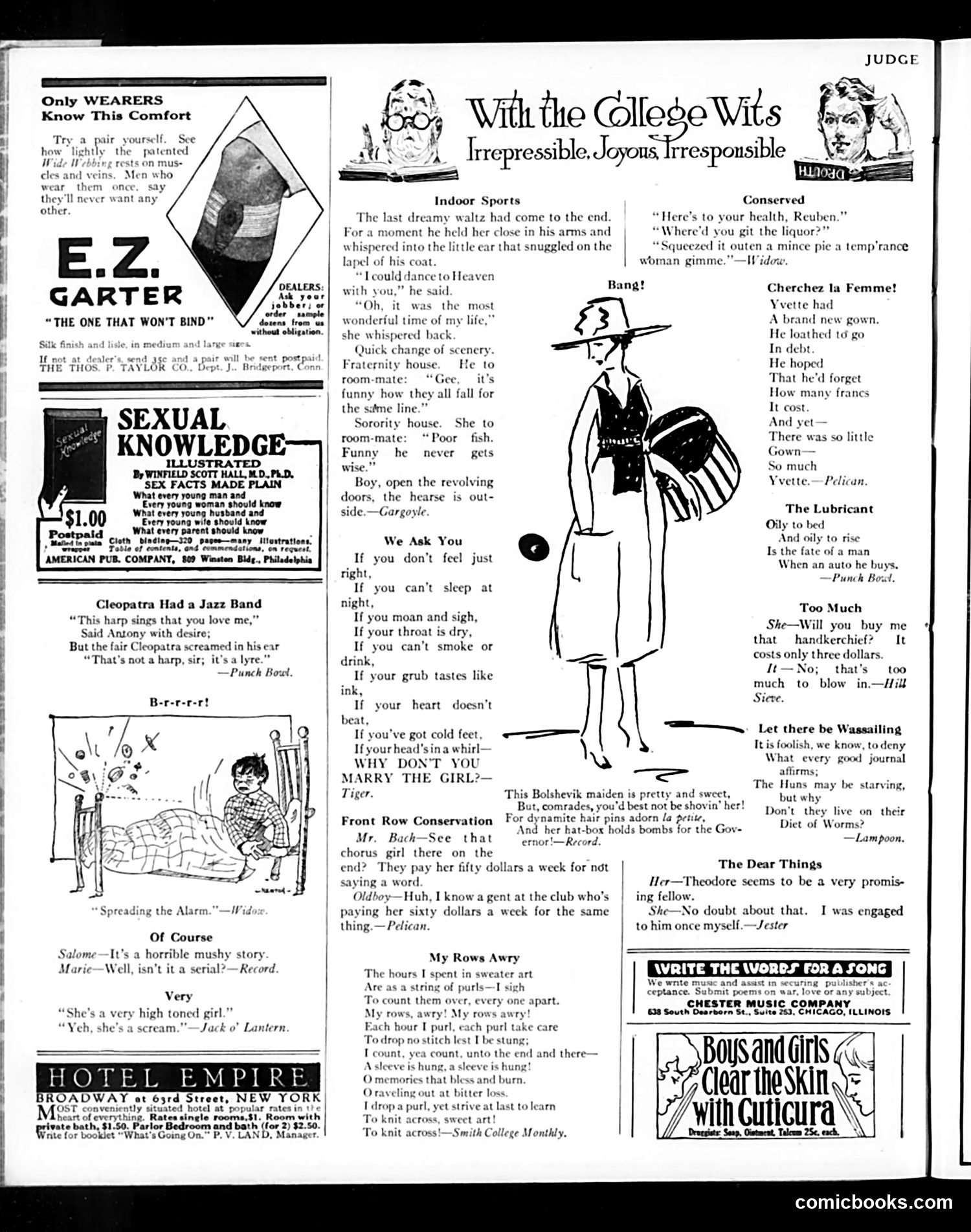
This is a **humor and satire page** from Judge magazine, featuring college-themed jokes and advertisements typical of the 1920s era. **Main Content:** The "College Wits" section collects brief humorous observations and witticisms. Most jokes mock romantic interactions, courtship conventions, and student behavior—depicting young men pursuing women through flattery, then mocking them to friends once the moment passes ("Poor fish"). **Key Satirical Targets:** - **Gender dynamics**: Women are portrayed as superficial (obsessed with new gowns, expensive gifts) and men as insincere - **Prohibition era**: References to hiding liquor ("squeezed it outen a mince pie") mock the temperance movement - **WWI aftermath**: A "Bolshevik maiden" joke reflects post-war anxieties about radical politics - **Student life**: Jokes about knitting, fraternity/sorority houses, and romantic disappointments **The humor relies on:** Double meanings, absurdist logic, and cynicism about love and relationships. The tone is lighthearted but notably misogynistic by modern standards, treating women as objects and targets of ridicule. The surrounding advertisements (garters, "Sexual Knowledge" books) reflect period consumer culture.
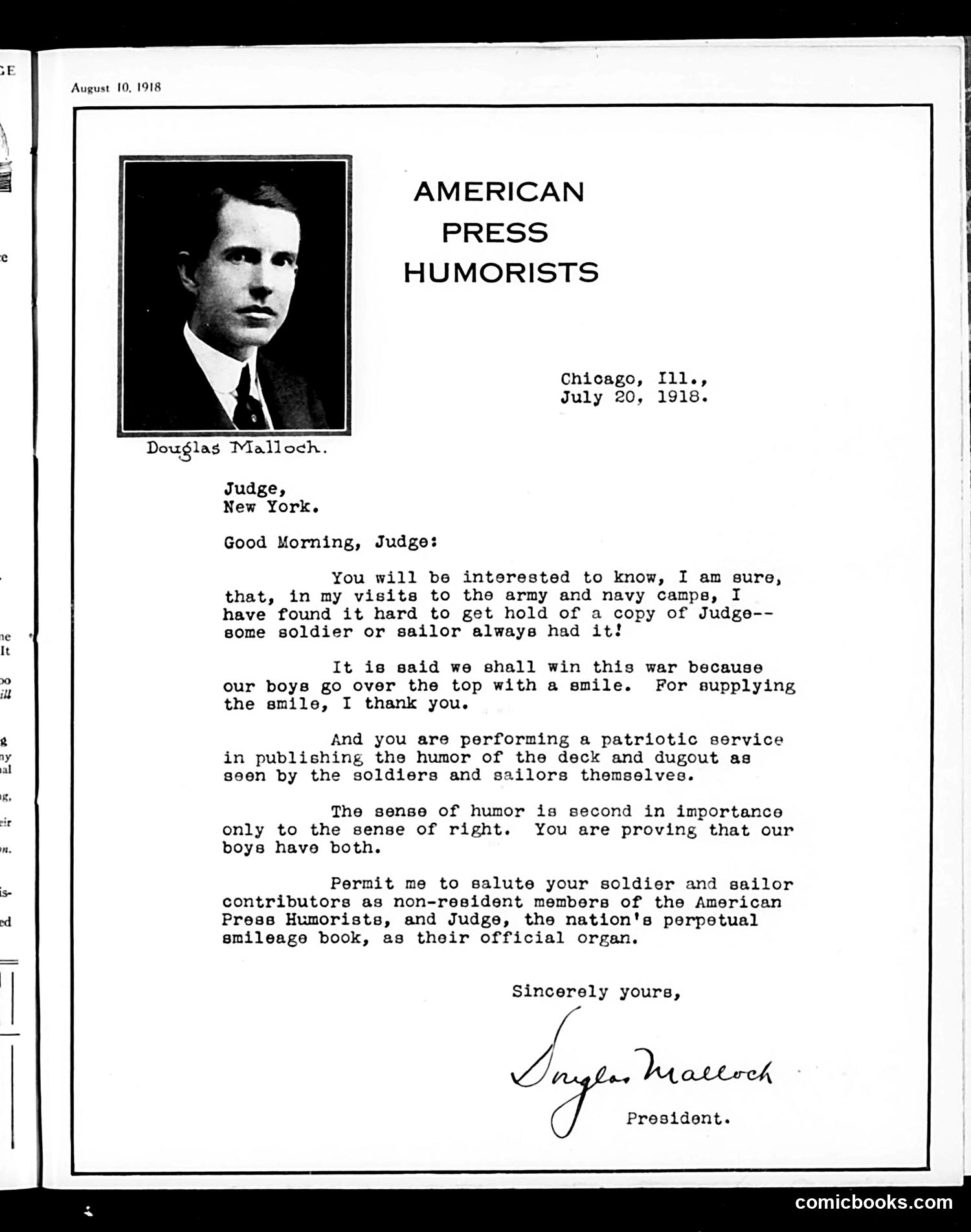
This is a congratulatory letter to *Judge* magazine from Douglas Malloch, president of the American Press Humorists, dated July 20, 1918 (published August 10). The letter praises *Judge* for boosting soldier and sailor morale during World War I. The key context: America had entered WWI in 1917, and by summer 1918, troops were in active combat. Malloch argues that humor is vital to the war effort—soldiers reportedly carried *Judge* magazines to the front lines ("go over the top with a smile"), and maintaining troop morale through comedy was considered patriotic work. He formally inducts soldier and sailor contributors as honorary members of the American Press Humorists society, recognizing their humor as an "official organ" of the organization. This reflects period attitudes treating satire and humor as legitimate wartime propaganda tools—emotional support mechanisms alongside military hardware. The letter isn't satirical itself but rather praise of *Judge*'s role in the war effort.
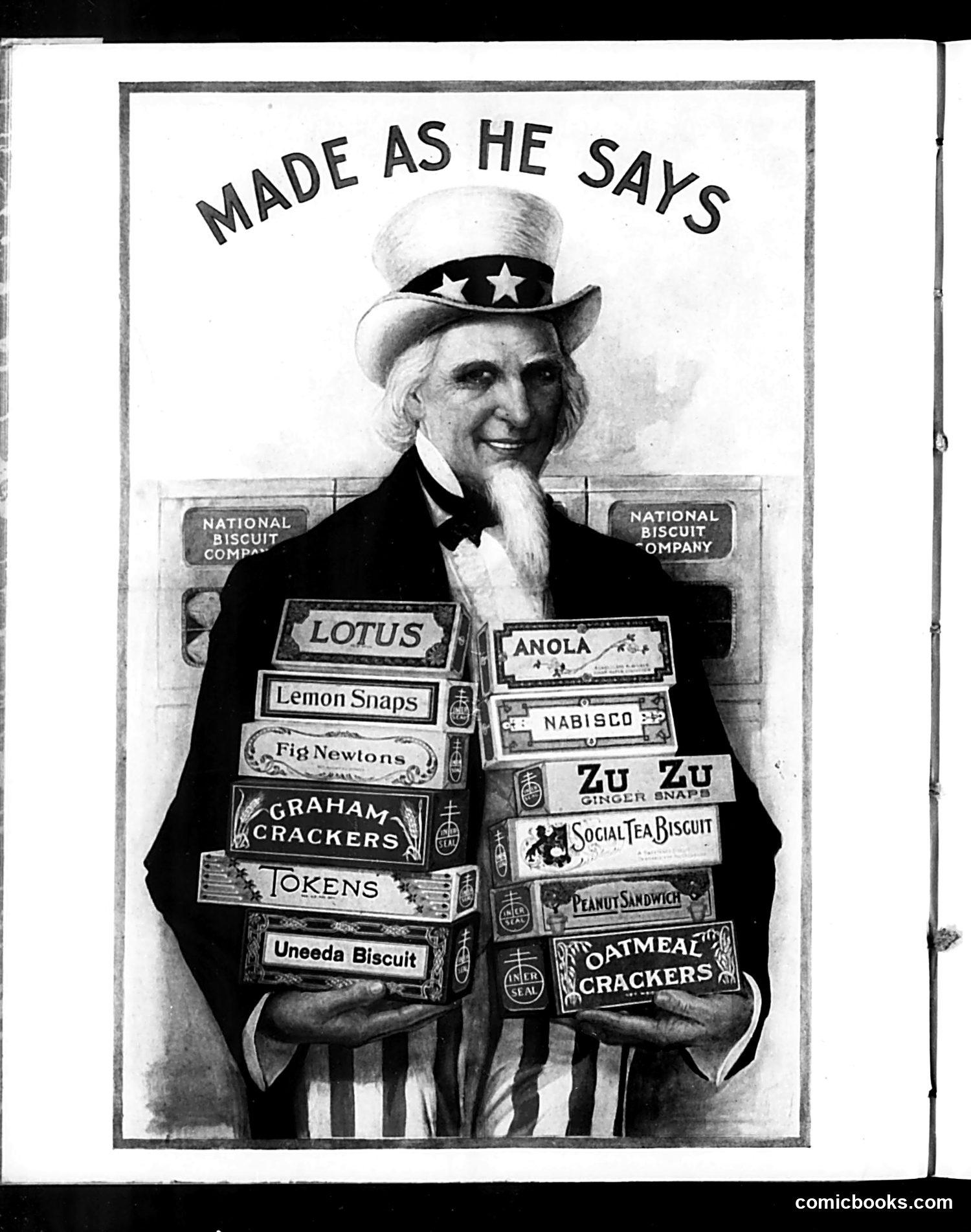
This is a National Biscuit Company advertisement disguised as political satire, featuring Uncle Sam (identifiable by his star-spangled hat and patriotic attire) carrying stacks of the company's products: Lotus, Lemon Snaps, Fig Newtons, Graham Crackers, Tokens, Uneeda Biscuit, Anola, Nabisco, Zu Ginger Snaps, Social Tea Biscuit, Peanut Sandwich, and Oatmeal Crackers. The phrase "Made as He Says" suggests Uncle Sam is endorsing these American-made products as patriotic choices. This appears to be early-20th-century advertising that conflates consumer patriotism with purchasing specific branded goods—a common marketing strategy of the era that used nationalist imagery to encourage product loyalty.