
A complete issue · 28 pages · 1918
Judge — January 19, 1918
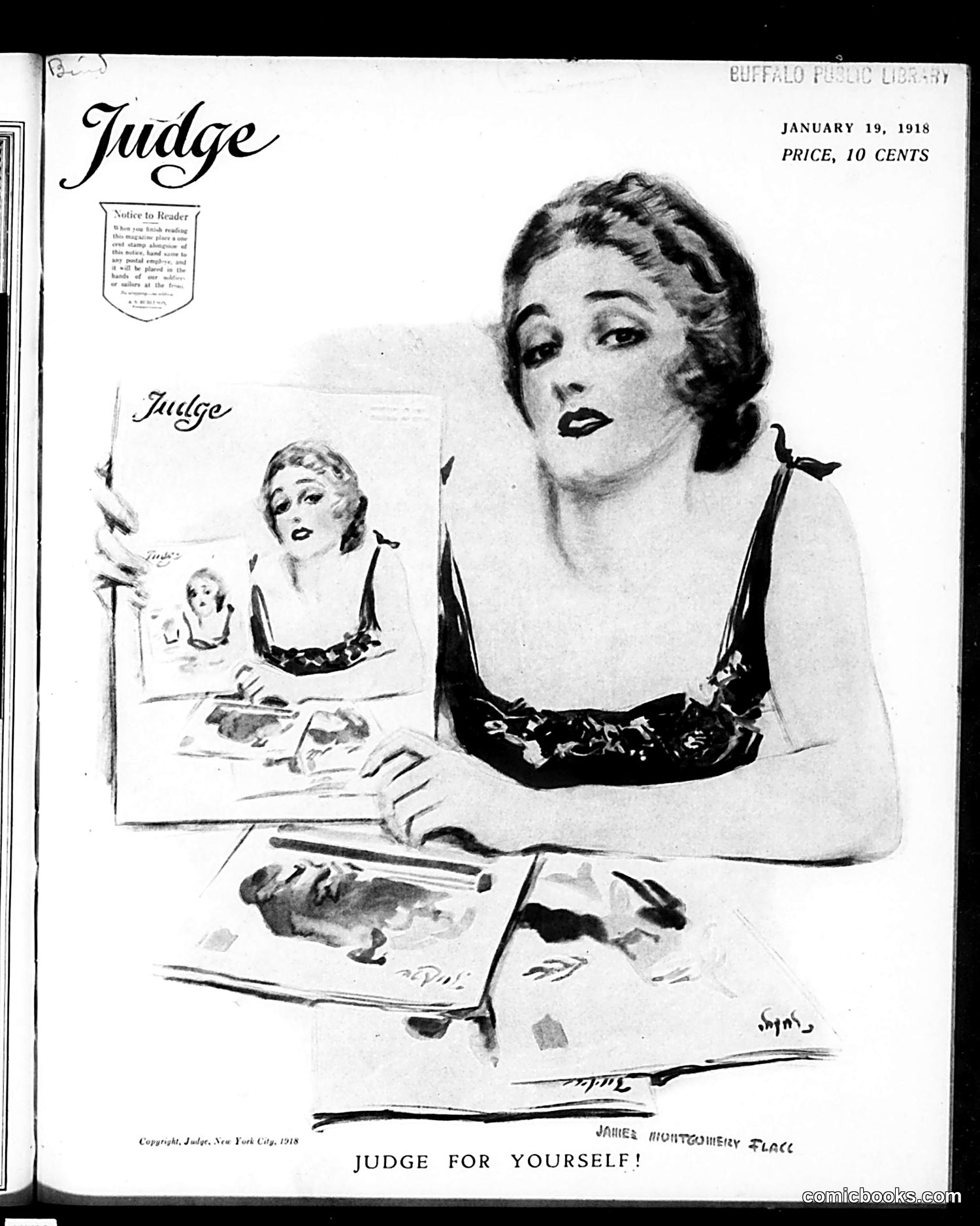
This cover illustration by James Montgomery Flagg depicts a woman artist at work, sketching or painting. The title "JUDGE FOR YOURSELF!" suggests the magazine is inviting readers to evaluate something—likely current events or public figures of early 1918, during World War I's final year. The woman appears to be creating artwork, with sketches visible on her desk. The specific reference is unclear without additional context, but the composition plays on the double meaning of "judge"—both as evaluation and as a legal/authoritative figure. The "Notice to Reader" box on the left likely contained relevant editorial context explaining the cartoon's particular satirical target, though its text isn't fully legible in this reproduction.
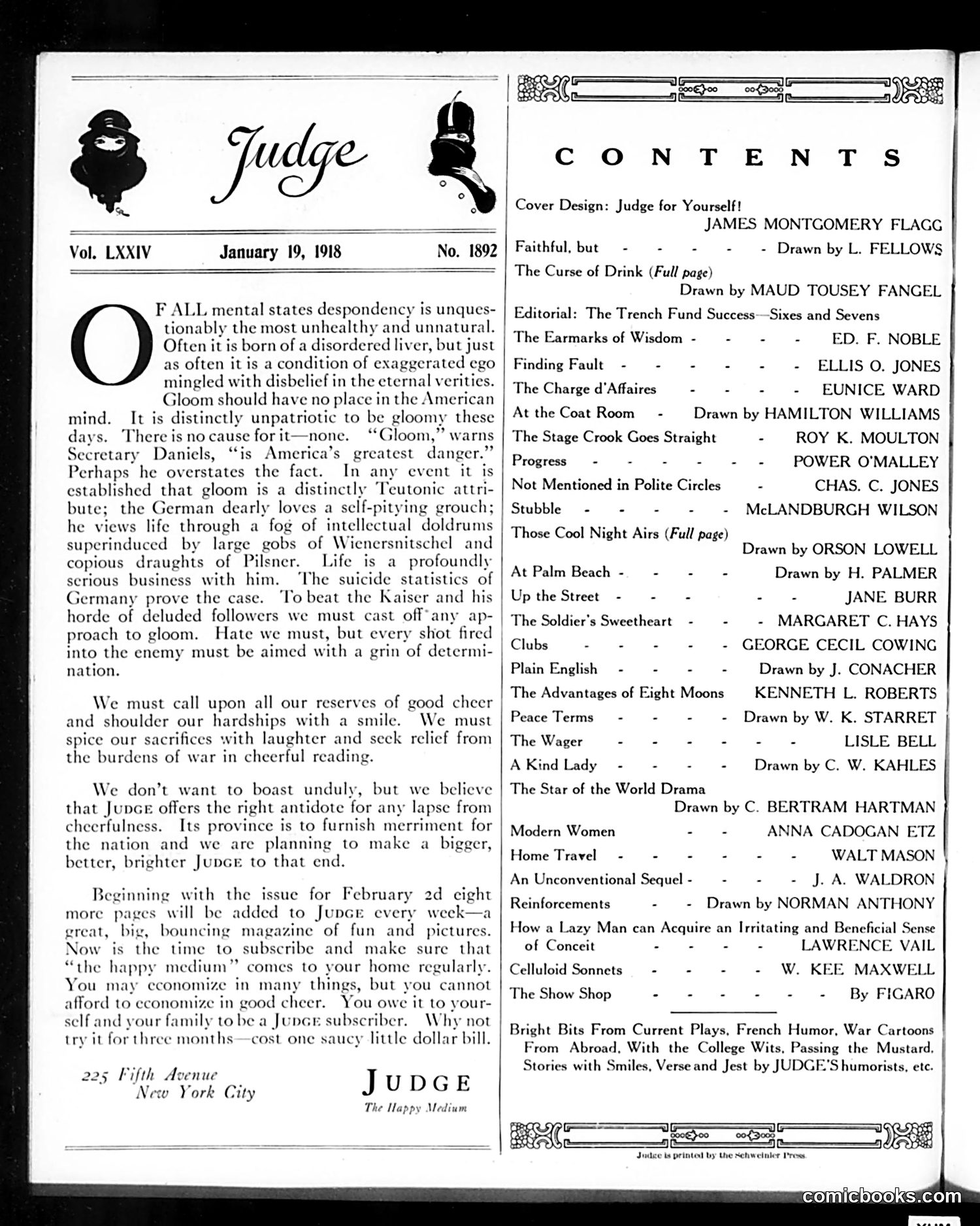
This is primarily a **contents/table of contents page** rather than a political cartoon page. It lists articles and illustrations for this wartime issue during America's involvement in World War I. The editorials reference the war effort directly: "The Trench Fund Success" and "The Soldier's Sweetheart" appear among the contents. The magazine's opening editorial emphasizes combating "gloom" as patriotic duty, arguing Germans exploit self-pity and defeatism. Judge frames cheerfulness and satirical humor as weapons against enemy morale. Notable is the emphasis on **wartime morale-building**—the editorial urges readers to subscribe and support the magazine's mission to provide "laughter and seck relief from the burdens of war" through satirical content.
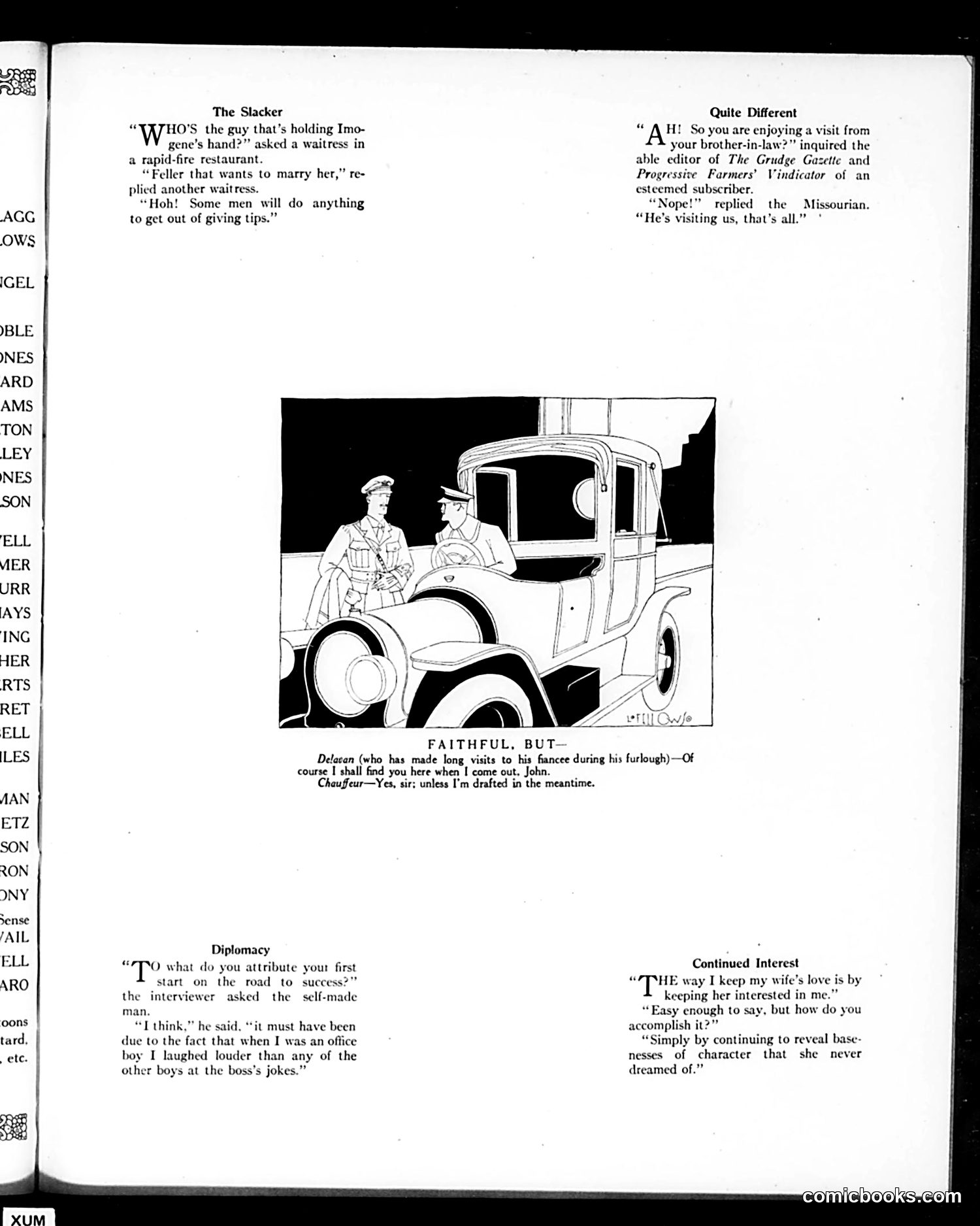
This page contains three separate humor pieces typical of early 20th-century Judge magazine: 1. **"The Slacker"**: A waitress joke about a man avoiding marriage to dodge tipping obligations—satirizing social parasitism. 2. **"Quite Different"**: A brief exchange mocking a Missouri editor's claim that his brother-in-law is merely "visiting" (a euphemism suggesting the relative is avoiding war draft obligations). The humor plays on Missouri's reputation and the draft evasion ("slacker") problem during WWI. 3. **"Faithful, But—"**: A cartoon showing a chauffeur reassuring his employer (Delacroix) that he'll visit his fiancée during furloughs, "unless I'm drafted"—again joking about draft uncertainty and wartime separation anxieties. The page reflects WWI-era concerns: draft evasion, military service disruptions, and domestic upheaval.
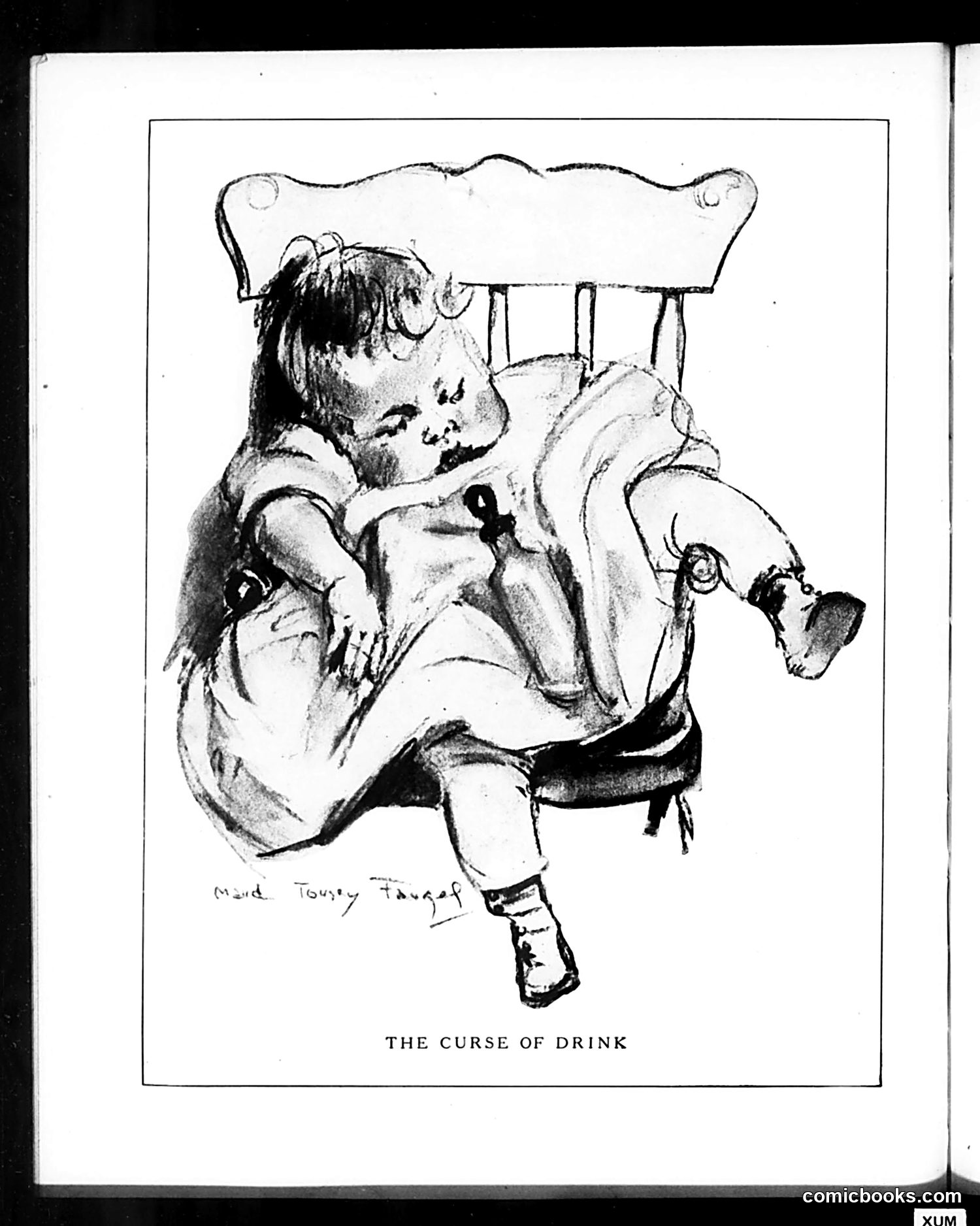
This cartoon from *Judge* magazine depicts a disheveled man slumped in a chair, clearly intoxicated or in an advanced state of alcoholic decline. The figure appears grotesquely distorted, with exaggerated facial features and a bloated physique, emphasizing physical degradation from alcohol abuse. The title "The Curse of Drink" indicates this is a temperance-era commentary—likely from the late 19th or early 20th century when anti-alcohol sentiment was strong in America. The satire presents alcoholism's consequences as a moral and physical corruption. The grotesque caricature style was typical of *Judge's* approach to social criticism, using exaggeration and dehumanization to warn against the dangers of drinking and advocate for temperance or prohibition policies.
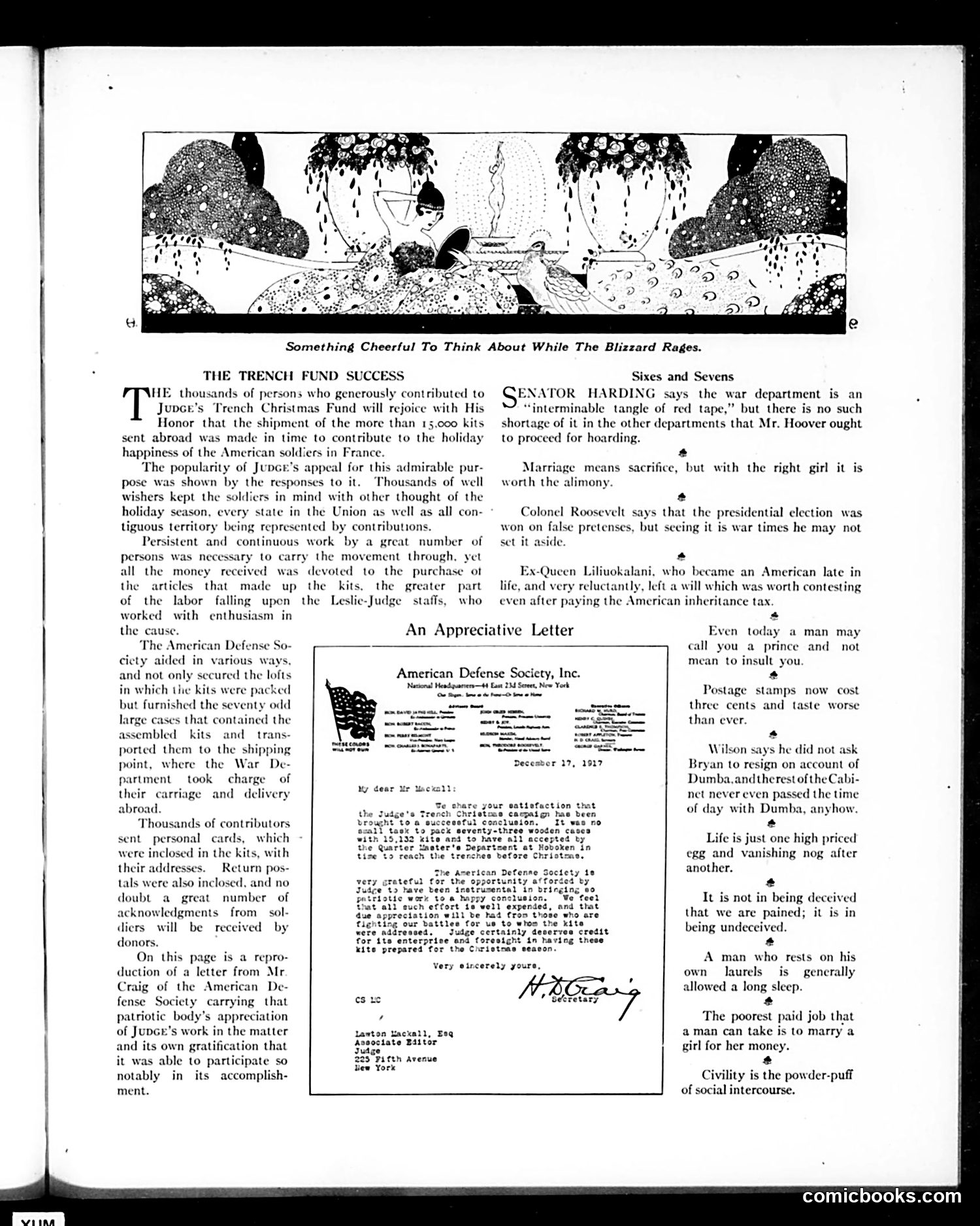
The page features a decorative header cartoon depicting an underground or trench scene with rain falling, captioned "Something Cheerful To Think About While The Blizzard Rages." The main content celebrates the "Trench Fund Success"—a charitable effort that raised over 11,000 kits for American soldiers in France during World War I. The accompanying letter from the American Defense Society (dated December 17, 1917) thanks Judge's editor for the magazine's role in promoting this patriotic fundraising campaign. The right column contains brief satirical observations on contemporary topics like marriage, presidential elections, and social customs—typical Judge humor of the era. The cartoon contextualizes wartime privations (blizzards) against the greater hardships of soldiers in trenches, framing charitable giving as uplifting during harsh conditions.
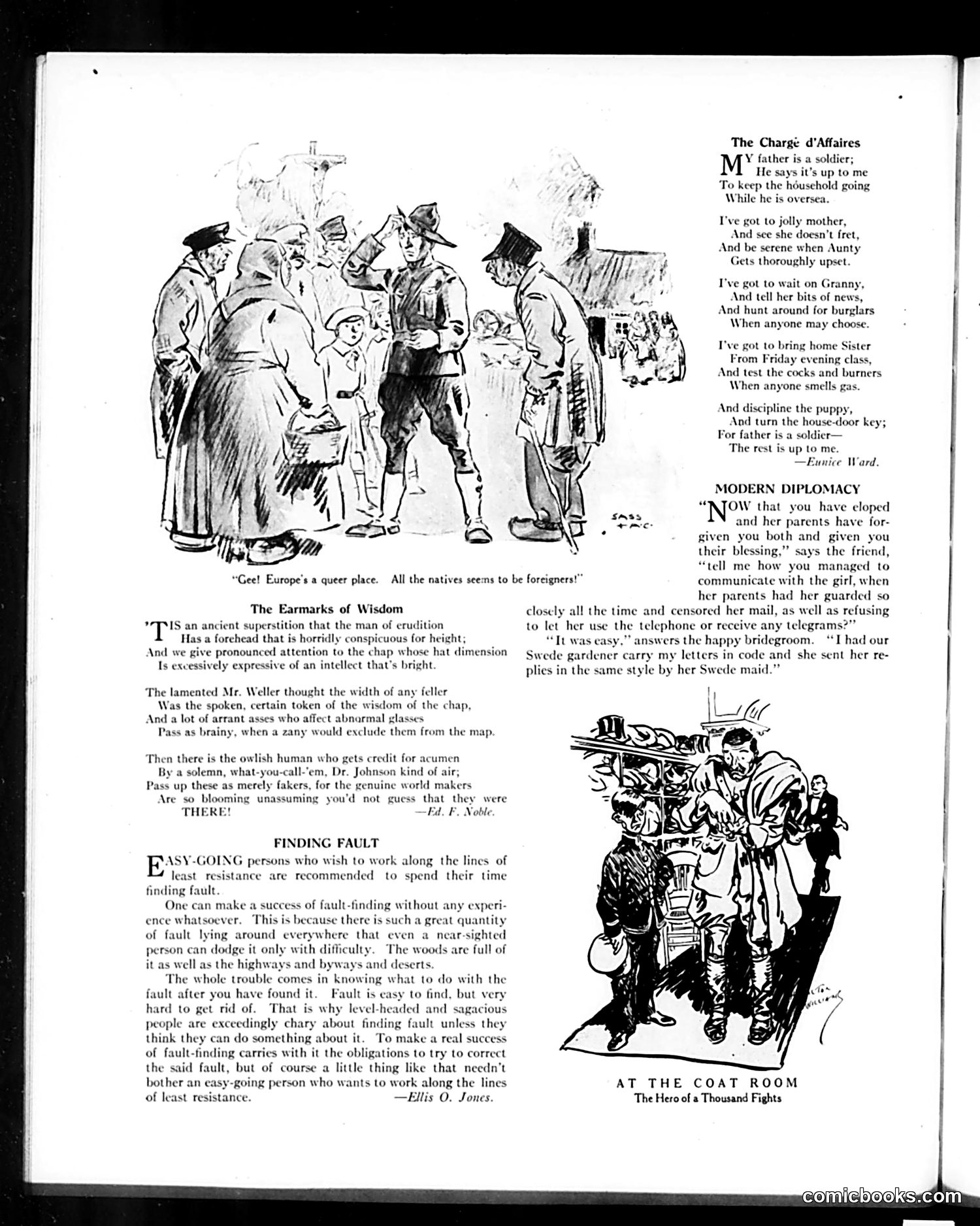
The main cartoon depicts soldiers or military personnel in what appears to be a European setting, with the caption "Get Europe's a queer place. All the natives seems to be foreigners!" This is satire about American soldiers abroad during what appears to be WWI or shortly after, mocking their cultural disorientation in Europe. The other sections include humorous essays: "The Earmarks of Wisdom" discussing character judgment, "Finding Fault" about fault-finding as an occupation, and "Modern Diplomacy" describing an elopement and coded letters sent through a Swedish maid—likely satirizing diplomatic secrecy. The "At the Coat Room" illustration appears to be comedic social commentary on crowded public spaces, captioned "The Hero of a Thousand Fights." Overall, the page blends political/social satire with light domestic humor typical of Judge's style.
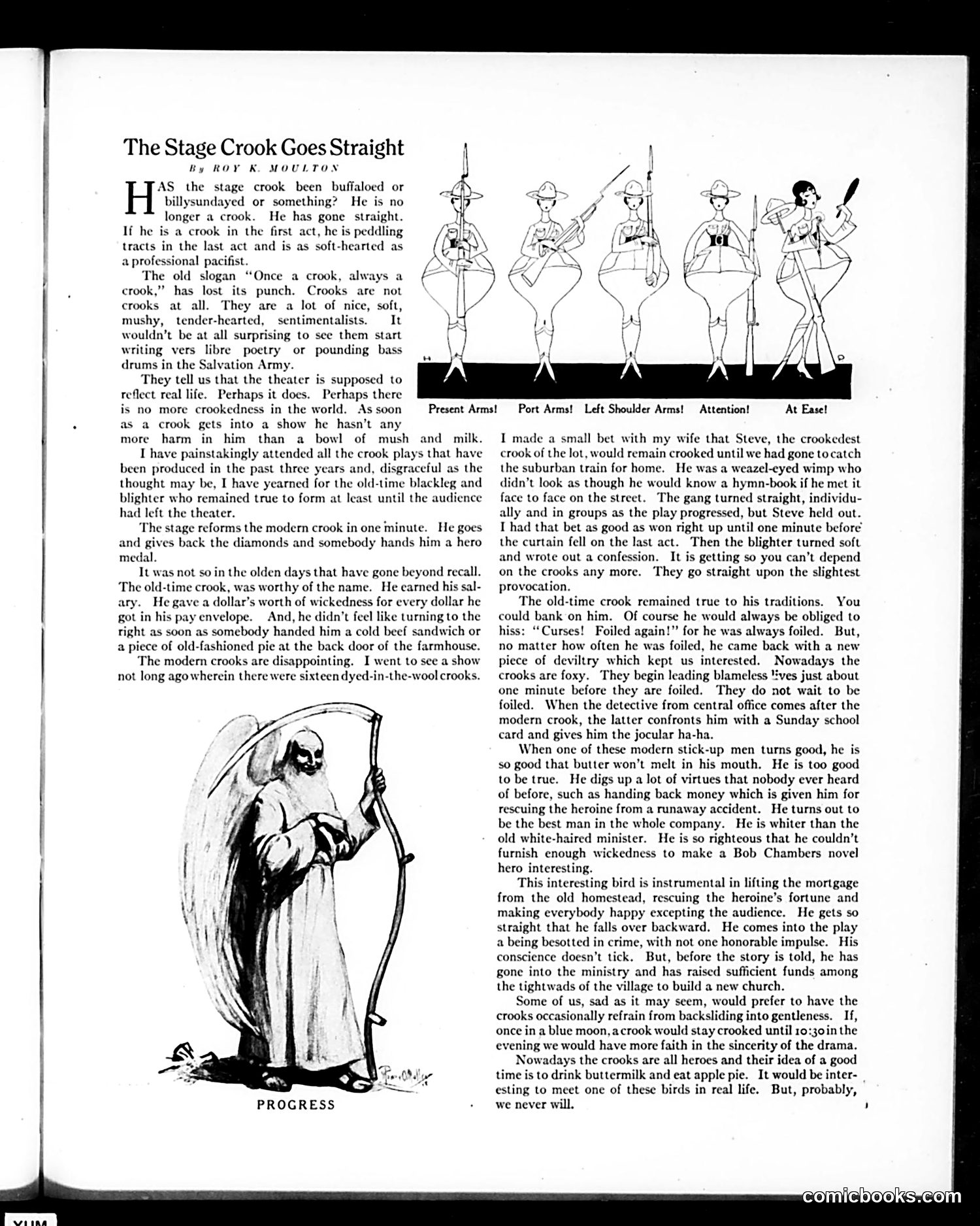
This article satirizes early 20th-century theater's treatment of criminal characters. Moulton criticizes how stage crooks undergo unrealistic, instantaneous moral reform—typically converting to goodness within minutes through sentimental redemption arcs. He nostalgically contrasts this with "old-time crooks" who remained wickedly committed to their villainy, providing genuine dramatic conflict. Modern theatrical crooks, he argues, become implausibly virtuous—almost saintly—making them boring and unconvincing as characters. The accompanying illustrations show soldiers in military poses, likely mocking how stage crooks convert to respectable, upstanding citizens (possibly through Salvation Army-style reform). Moulton's critique reflects period anxieties about morality in entertainment and audiences' preference for authentic dramatic tension over preachy redemption narratives.
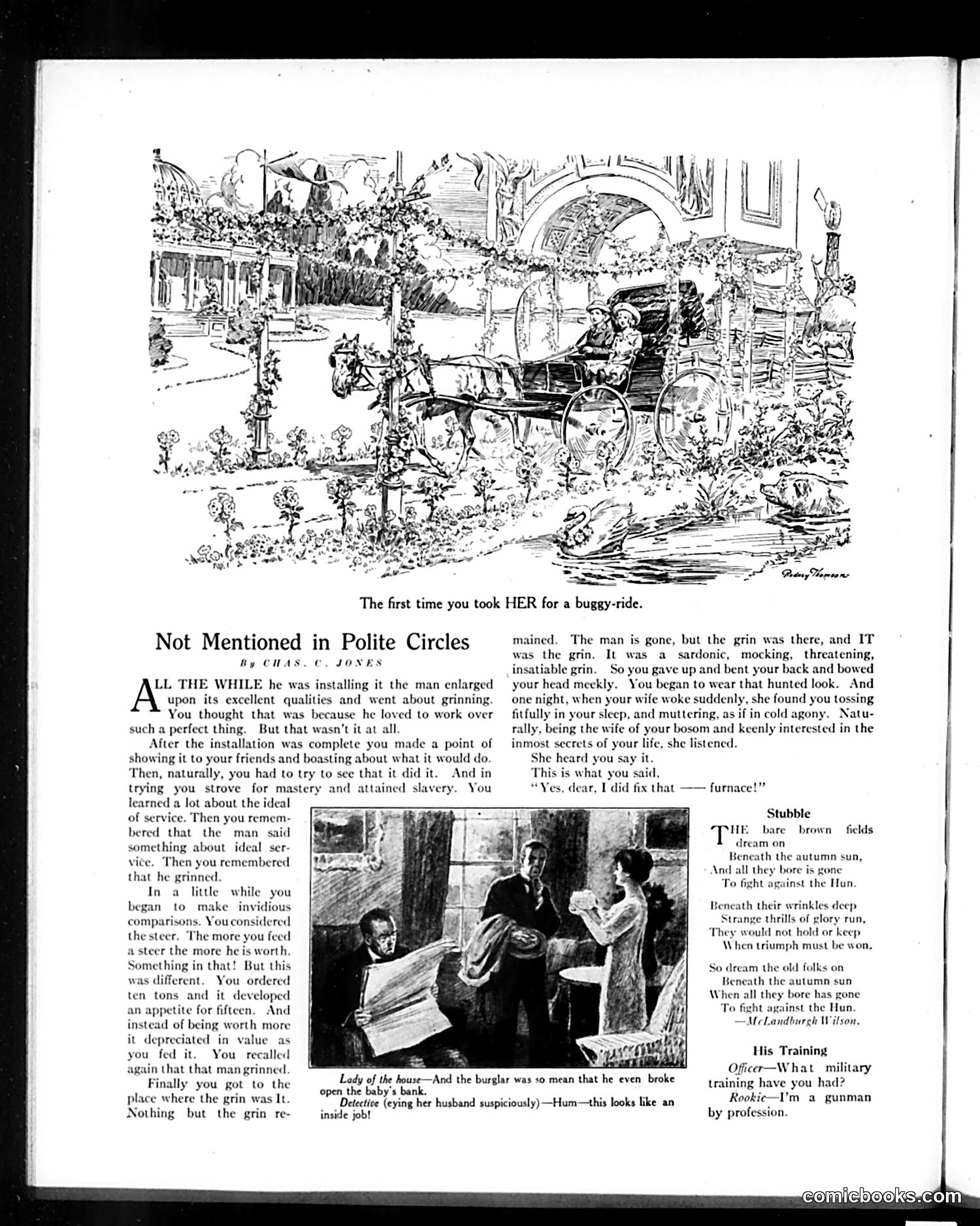
This page contains a satirical story titled "Not Mentioned in Polite Circles" by Charles E. Jones, mocking the frustrations of early household appliance ownership—specifically, a furnace. The narrative follows a man who buys a furnace from an installer with an unsettling, knowing grin. After initial enthusiasm, the furnace becomes a source of misery: it consumes resources (ten tons of fuel, then fifteen), depreciates in value, and enslaves the owner through constant maintenance demands. The grin represents the installer's awareness that the buyer will become a captive customer. The cartoon illustration shows a couple in a horse-drawn buggy, labeled "The first time you took HER for a buggy-ride"—contrasting pre-furnace domestic bliss with post-furnace marital tension. The joke satirizes consumer culture and mechanical dependency: purchasing modern conveniences paradoxically creates servitude rather than freedom. The wife's discovery of her husband muttering about the furnace captures how thoroughly this appliance has consumed his peace of mind. The page also includes unrelated poetry and a brief military joke.
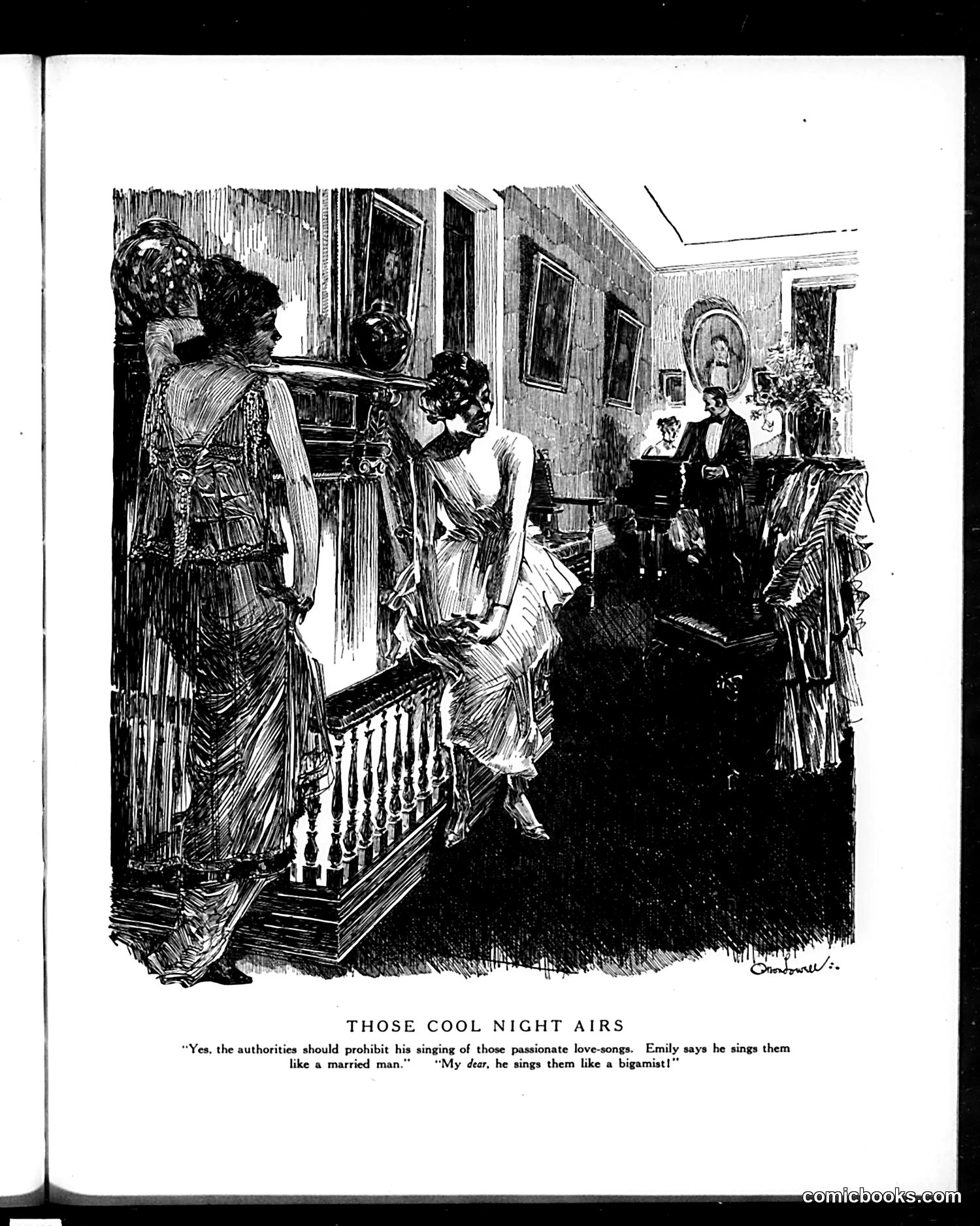
This cartoon satirizes a male singer's emotional performance of romantic songs. Two women gossip about him: one claims he sings love-songs "like a married man" (implying restrained, passionless delivery), while her companion counters he sings them "like a bigamist" (suggesting excessive passion divided among multiple lovers). The joke plays on period attitudes about marriage dampening romantic ardor, while simultaneously implying the singer's passionate performance suggests infidelity or divided affections. The elegant interior setting and well-dressed guests suggest this is a formal social gathering where such romantic musical performances were common entertainment. The satire targets both the singer's apparent emotional excess and period assumptions about how marriage affects male romantic expression.
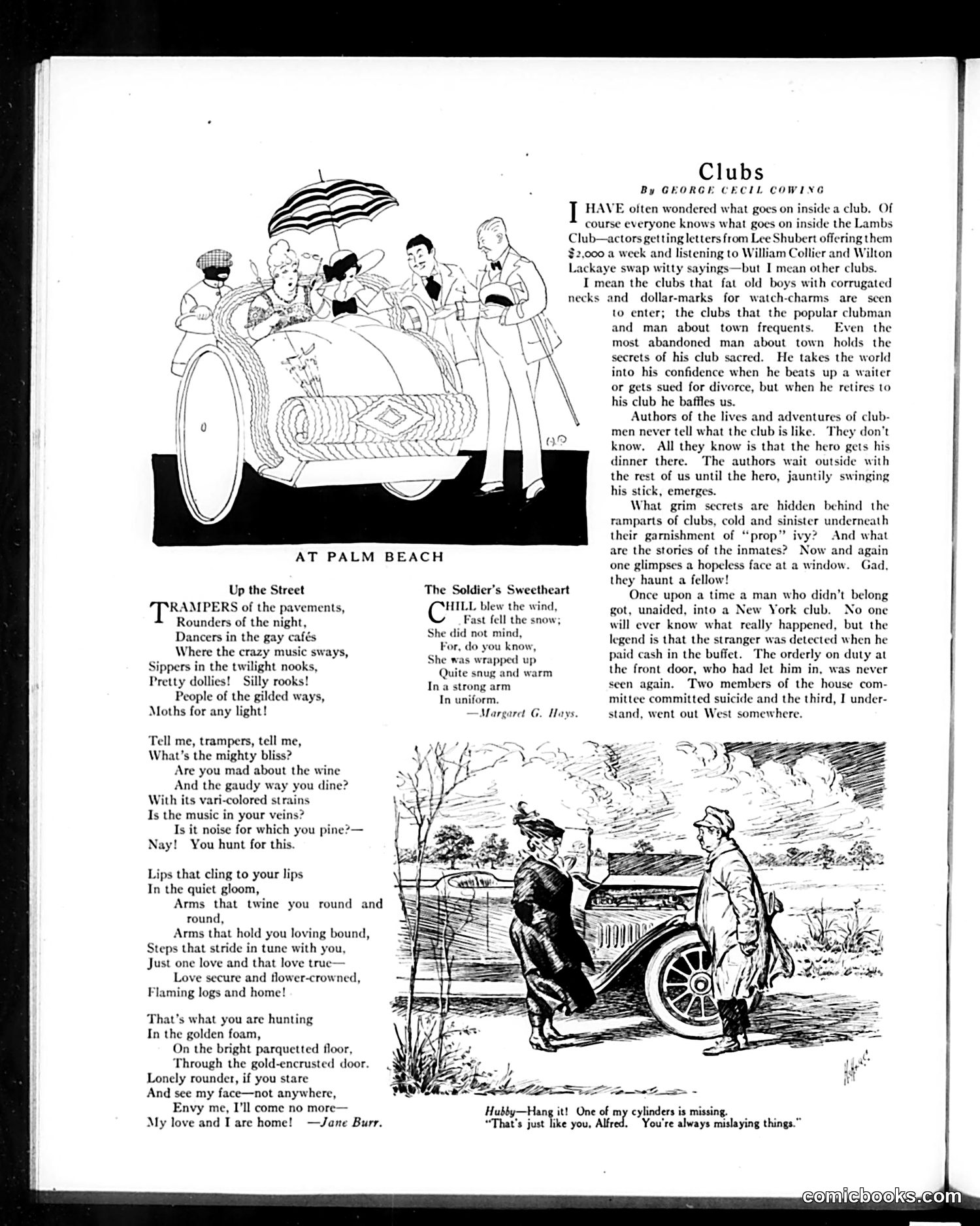
This page contains satirical essays and poetry about exclusive clubs and leisure culture from the Jazz Age era. **"Clubs" essay** (by George Cecil Cowing): A humorous critique of men's clubs as secretive institutions. The author notes that club members guard these spaces zealously—revealing scandals publicly but never club secrets. He mocks the mystery surrounding what actually happens inside, while satirizing the social pretense (clubs filled with wealthy but dull men with "corrugated necks"). The anecdote about an outsider being discovered because he "paid cash" mocks the pretension and exclusivity of such establishments. **"At Palm Beach" illustration**: Shows wealthy leisure-seekers at a fashionable resort in a vintage automobile—depicting the idle rich and their social scene. **Poetry ("Up the Street" and "The Soldier's Sweetheart")**: Contrasts carefree nightlife and hedonism with genuine romantic love and domesticity, a common early 20th-century moral theme. **Bottom cartoon**: A marital joke about a husband blaming his wife for his car problems—typical domestic humor of the era. The overall tone criticizes wealthy club culture and frivolous urban society.
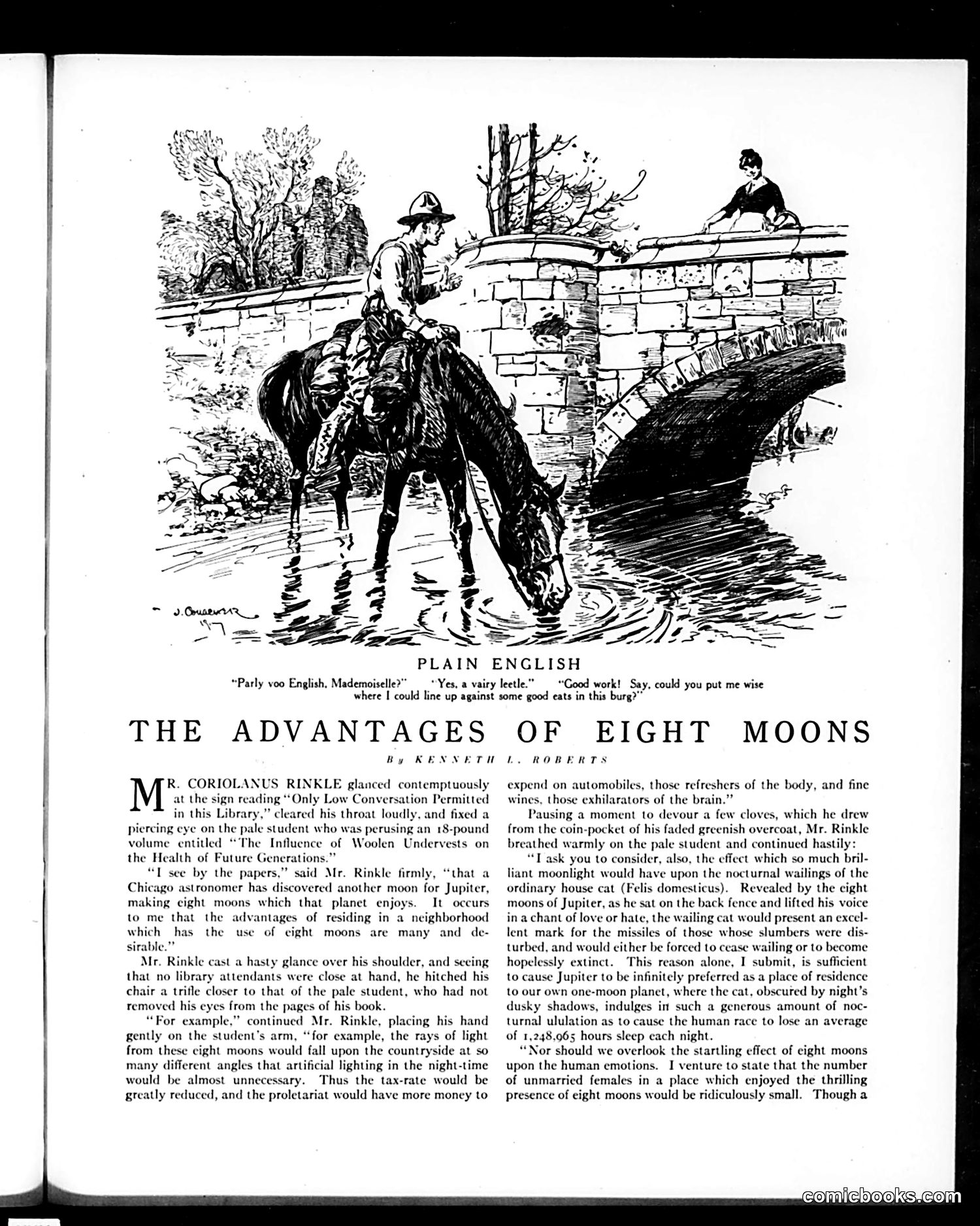
The page contains two pieces of satire: **The cartoon** (top) depicts a soldier on horseback encountering a French woman near a bridge. The "Plain English" caption mocks American servicemen's attempts at communication during WWI—the soldier butchers French ("Parly voo English?") then speaks in crude American slang asking for restaurants ("line up against some good eats in this burg?"). It satirizes American soldiers abroad as culturally insensitive and linguistically incompetent. **The story** is a humorous tall tale by Kenneth L. Roberts about Mr. Rinkle, who interrupts library quiet to lecture a student about Jupiter's eight moons. Rinkle absurdly claims Jupiter would be superior to Earth because: eight moons would eliminate nighttime darkness (reducing taxes), provide enough light to target and eliminate cats making noise, and—most ridiculous—the romantic moonlight would make women marriage-obsessed and thus unavailable. It's satirizing pseudo-intellectual pseudoscience and the absurdity of academic pedantry.
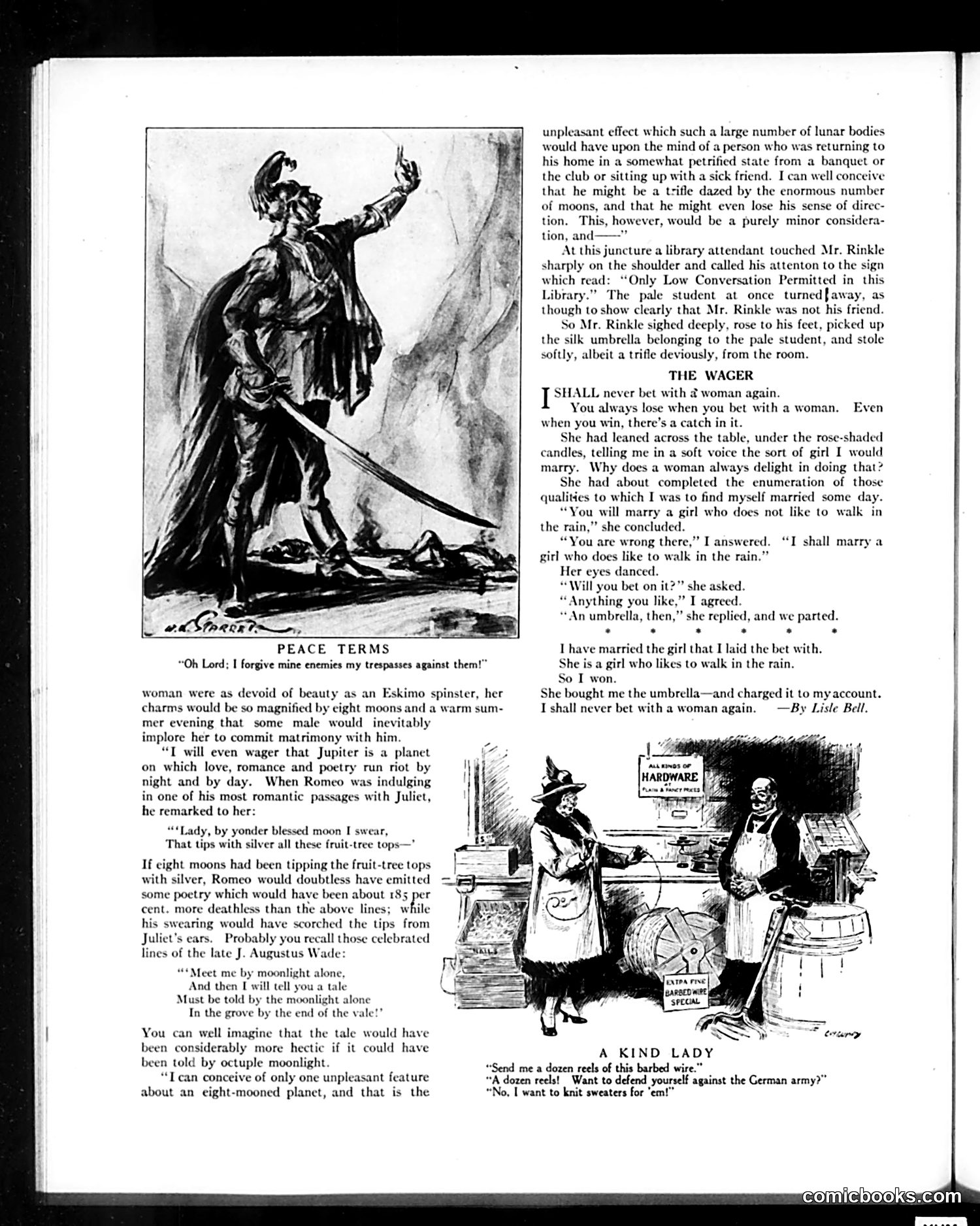
This *Judge* page contains three satirical pieces reflecting early 20th-century attitudes: **"Peace Terms"** mocks a pedantic male student monopolizing library space with pseudo-intellectual rambling about multi-mooned planets and romance. The joke: a librarian shuts him up, and he petulantly steals the "pale student's" umbrella in retaliation—absurd pettiness presented as comeuppance. **"The Wager"** plays on sexist assumptions about women's cunning. A man bets he'll marry a woman who enjoys rain; he wins the bet but "loses" because she charges him for the umbrella. The punchline assumes women are inherently duplicitous—a "victory" becomes defeat through female trickery. **"A Kind Lady"** references WWI. A woman requests barbed wire supposedly to "knit sweaters" for German soldiers, implying women are foolishly sentimental about enemies. The satire targets both pacifist sentiment and feminine naïveté during wartime. All three reinforce period stereotypes: women as illogical, scheming, or overly sympathetic; men as intellectually superior but socially inept.
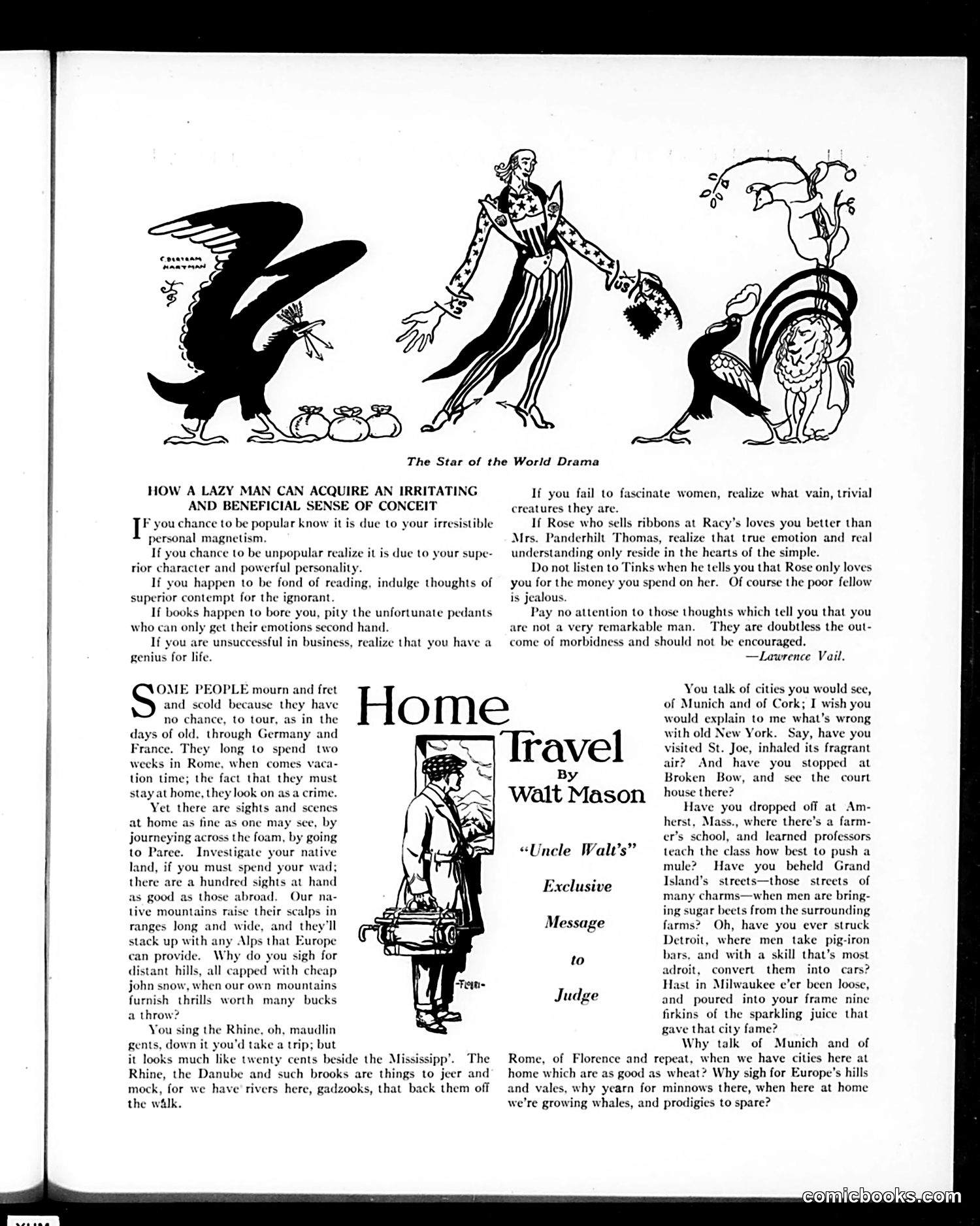
This page contains two separate satirical pieces from *Judge* magazine. **Top cartoon ("The Star of the World Drama"):** An illustrated guide mocking self-deception. It shows how lazy or unsuccessful people rationalize their failures—attributing popularity to "irresistible magnetism," unpopularity to "superior character," business failure to having "a genius for life." The satire targets the human tendency to flatter oneself rather than acknowledge genuine shortcomings. **"Home Travel" essay by Walt Mason:** A humorous argument against foreign tourism, written in folksy verse. Mason sarcastically compares American landmarks (the Mississippi River, Detroit's steel mills, Milwaukee's breweries, cities like Amherst and Broken Bow) to famous European destinations (Rhine, Munich, Rome). He mocks wealthy Americans' obsession with European travel, suggesting comparable—even superior—attractions exist domestically. The piece combines patriotic boosterism with gentle mockery of pretentious travel ambitions. Both pieces exemplify *Judge*'s satirical style: poking fun at American vanity and self-delusion.
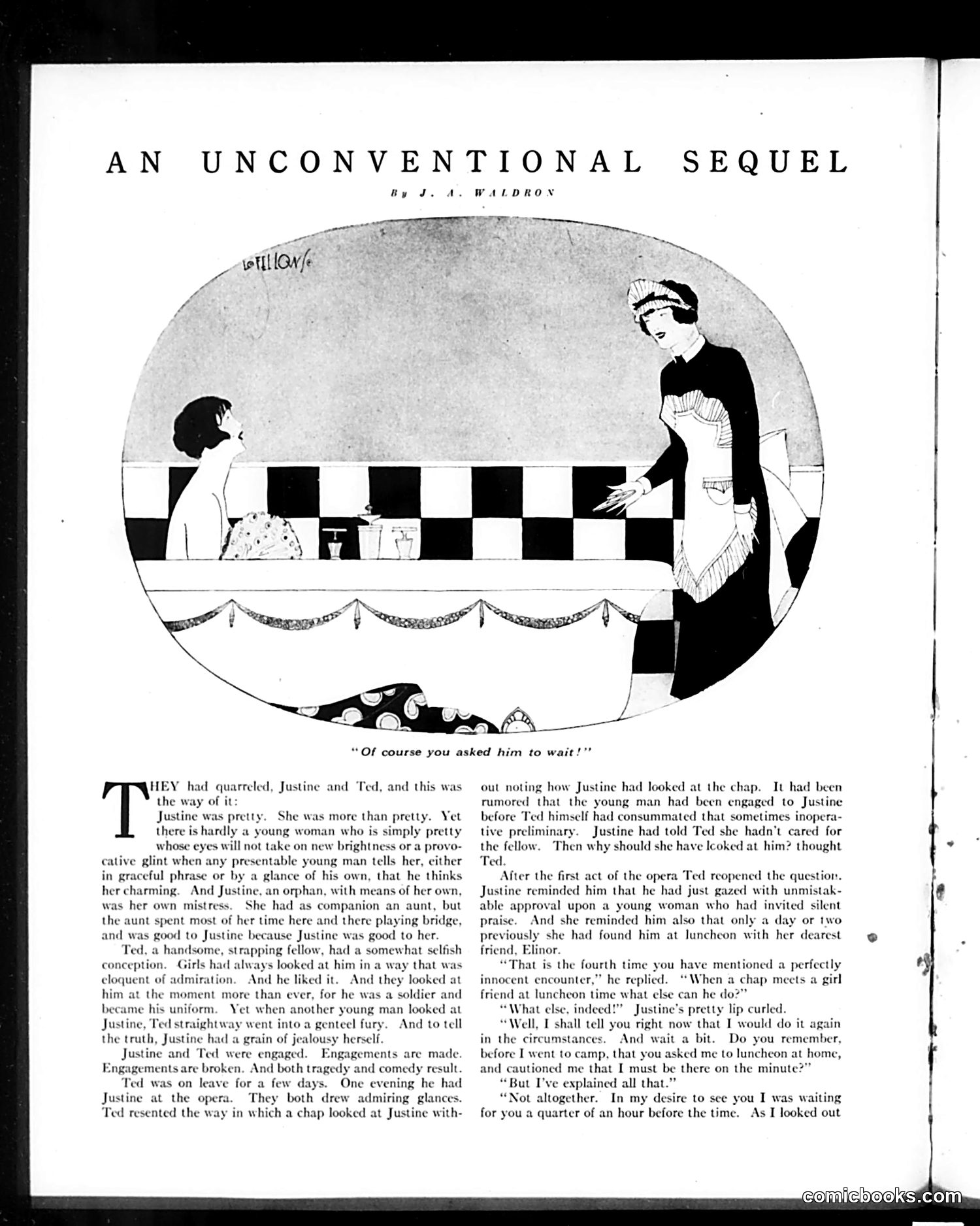
This is a romantic fiction piece, not political satire. The illustration shows a domestic quarrel between an engaged couple at the opera. **The story**: Justine (an independent, wealthy orphan) and Ted (a soldier on leave) have argued over jealousy. Ted resents how Justine looked at a former suitor at the opera, while Justine points out Ted's own admiring glances at other women—and specifically his lunch with her friend Elinor. Ted defends himself by claiming innocent encounters are unavoidable, but Justine questions his priorities by recalling he was late arriving for *her* requested lunch. **The joke**: The caption "Of course you asked him to wait!" suggests Justine, irritated by Ted's excuses, sarcastically implies she had to ask the other man to wait—implying Ted's attention to other women is habitual. The piece satirizes conventional romantic double-standards and male hypocrisy rather than politics.
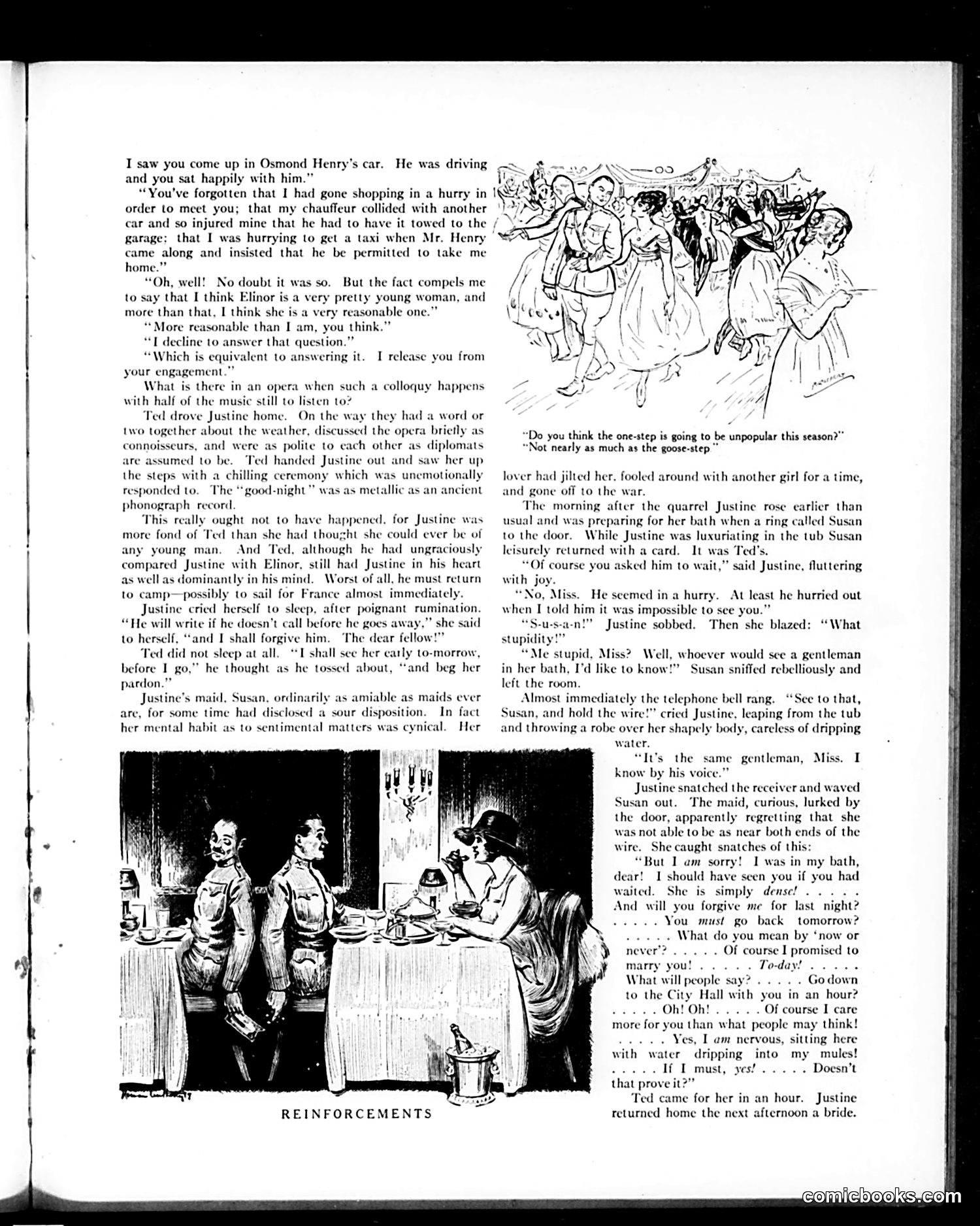
This appears to be a serialized romance story from Judge magazine, likely dating to World War I era (suggested by references to "camp" and potentially sailing "for France"). The narrative follows Justine and her fiancé Ted, whose engagement fractures over a misunderstanding: Justine accepted a ride from another man (Osmond Henry) after a car accident, which Ted witnesses and misinterprets as romantic interest. The couple quarrels at an opera. The illustration captioned "Reinforcements" shows soldiers in military uniforms, playing on the double meaning—while the story's "reinforcements" are Ted's sudden reappearance and reconciliation with Justine, the visual pun references actual military reinforcements, grounding this domestic melodrama in the wartime context. The maid Susan's cynicism (her own lover "jilted her...and gone off to the war") adds poignancy: this romance occurs against real wartime separations and losses. Ted must return to camp imminently, making their reconciliation urgent and emotionally charged for contemporary readers.
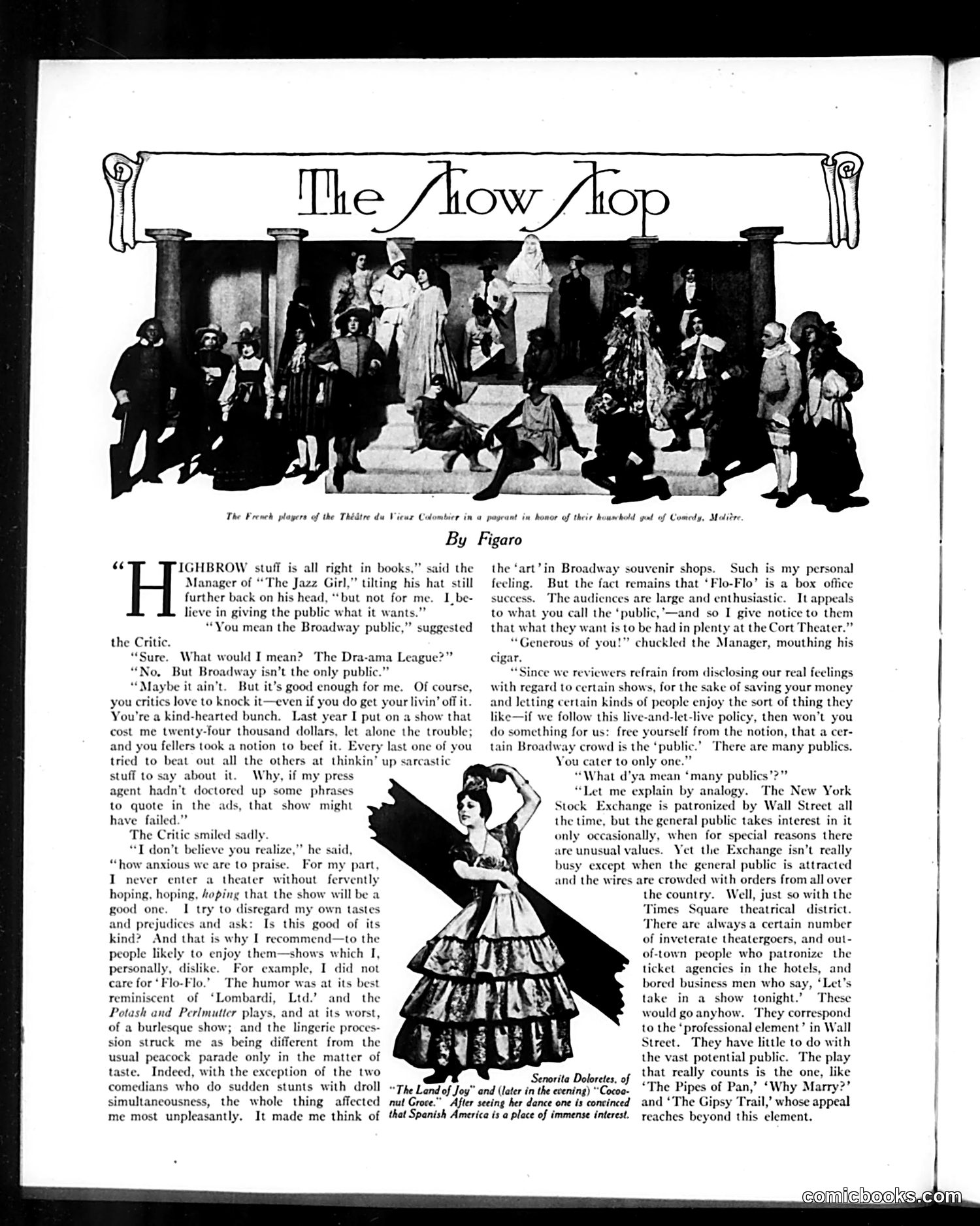
This page satirizes the tension between Broadway commercial success and critical taste. The dialogue presents a **theater manager defending popular entertainment** ("The Jazz Girl," "Flo-Flo") against a **snobbish drama critic** who claims to want shows to succeed yet dismisses crowd-pleasing productions. The critic admits he personally dislikes popular fare like "Lombardi, Ltd." and burlesque but recommends them to audiences he condescends toward. The manager uses a **stock market analogy**: just as Wall Street professionals drive occasional Stock Exchange activity, theater professionals sustain the industry, but true success requires the general public's enthusiasm. His point: critics shouldn't claim artistic superiority while profiting from mass-market theater. The satire targets **highbrow hypocrisy**—critics who publicly support "the public's" tastes while privately dismissing them as lowbrow. The image shows French theatrical performers, likely illustrating that even sophisticated theater depends on popular audiences for financial viability.
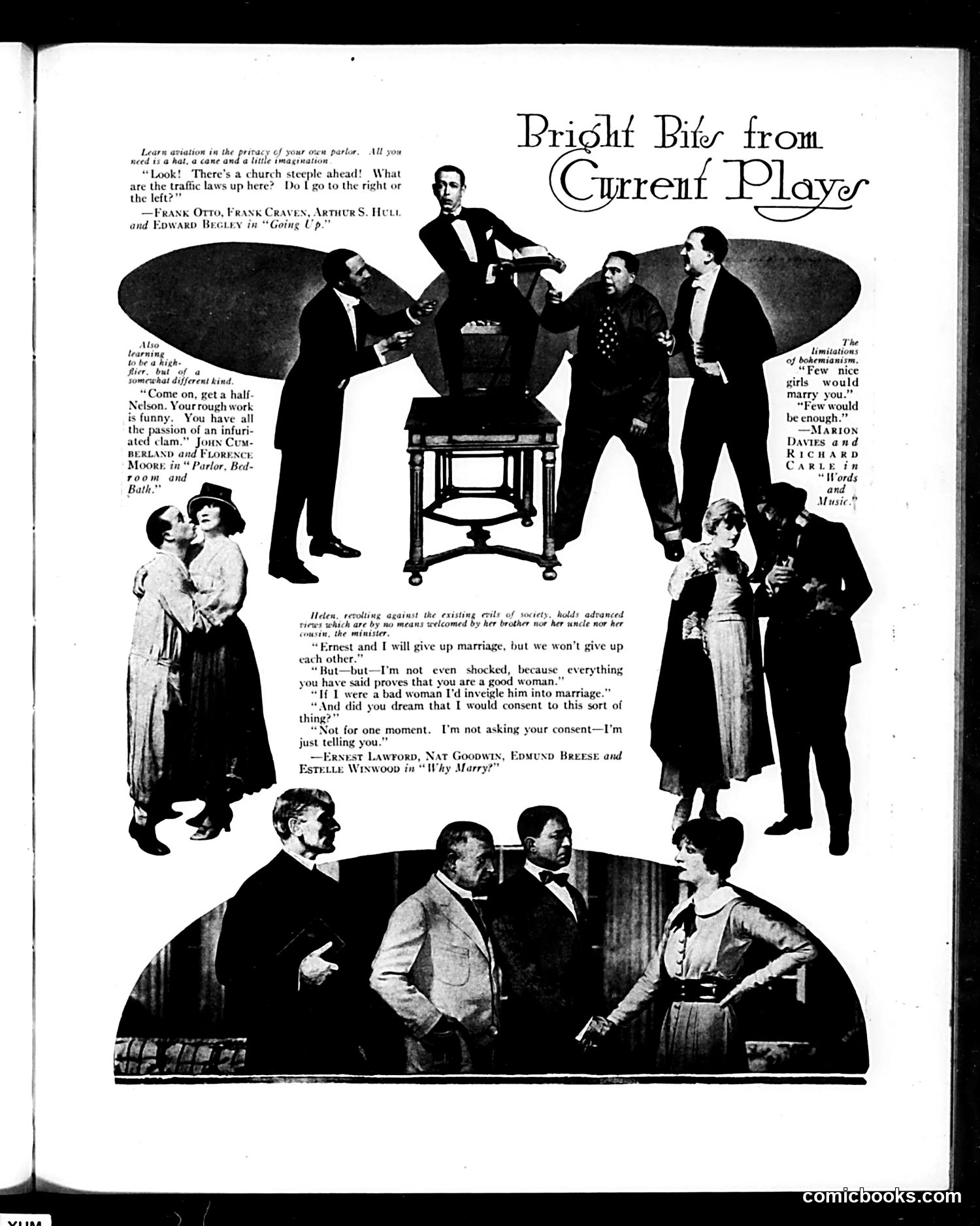
This page showcases witty dialogue excerpts from three Broadway plays of the era (likely 1910s). **"Going Up"** features a traffic-law joke: characters in an ascending elevator mistake a church steeple for street scenery, absurdly asking about traffic rules in mid-air—humor based on the novelty of vertical travel technology. **"Parlor, Bedroom and Bath"** contains a romantic insult: a man tells a woman her "rough work" is funny but she has "passion of an infuriated clam"—sarcastic understatement meant to be humorous criticism. **"Why Marry?"** satirizes modern women's independence. Helen rejects both traditional marriage *and* her family's moral authority, declaring she'll live with Ernest without marrying. The joke: her progressive views prove she's actually virtuous—inverting conventional morality where "good women" marry. The family's shock at her refusal to be shocked reveals generational disconnect over women's autonomy.
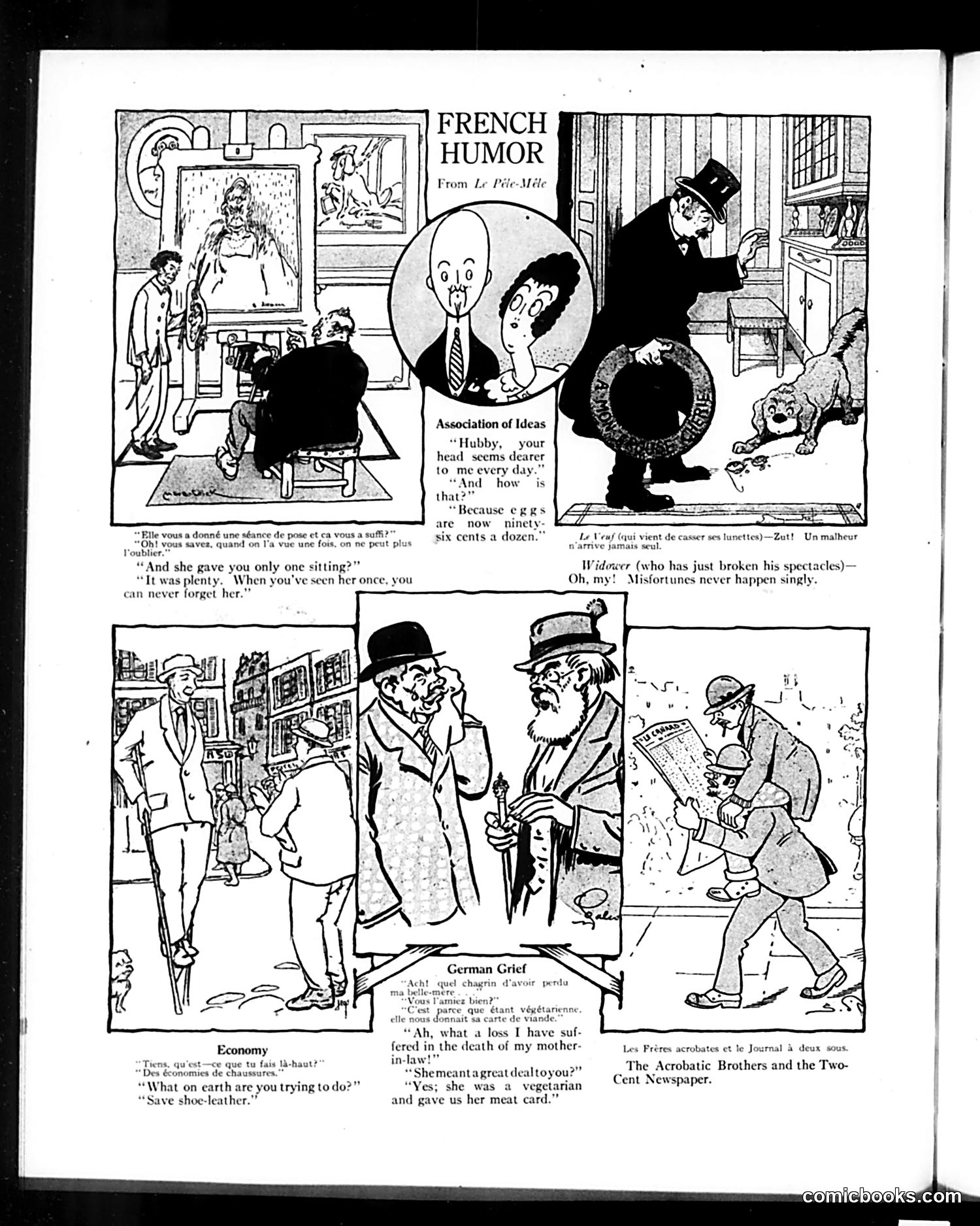
This page presents four French satirical cartoons translated for English readers. The humor relies on wordplay and domestic irony rather than political commentary. **"Association of Ideas"**: A wife compliments her husband's head, explaining eggs now cost ninety-six cents per dozen—implying his head is valuable only because eggs are expensive (a wartime rationing joke). **"Widower"**: A man who broke his spectacles laments that misfortunes never come singly—visual humor about literal and metaphorical mishaps. **"Economy"**: Someone asks what another is doing; the answer is "saving shoe-leather"—a Depression-era or wartime economy joke about conservation. **"German Grief"**: A man claims he lost his mother, a vegetarian who gave him her meat ration card—darkly humorous commentary on food scarcity and rationing during wartime, likely World War I. The cartoons satirize everyday hardships through domestic situations rather than direct political critique.
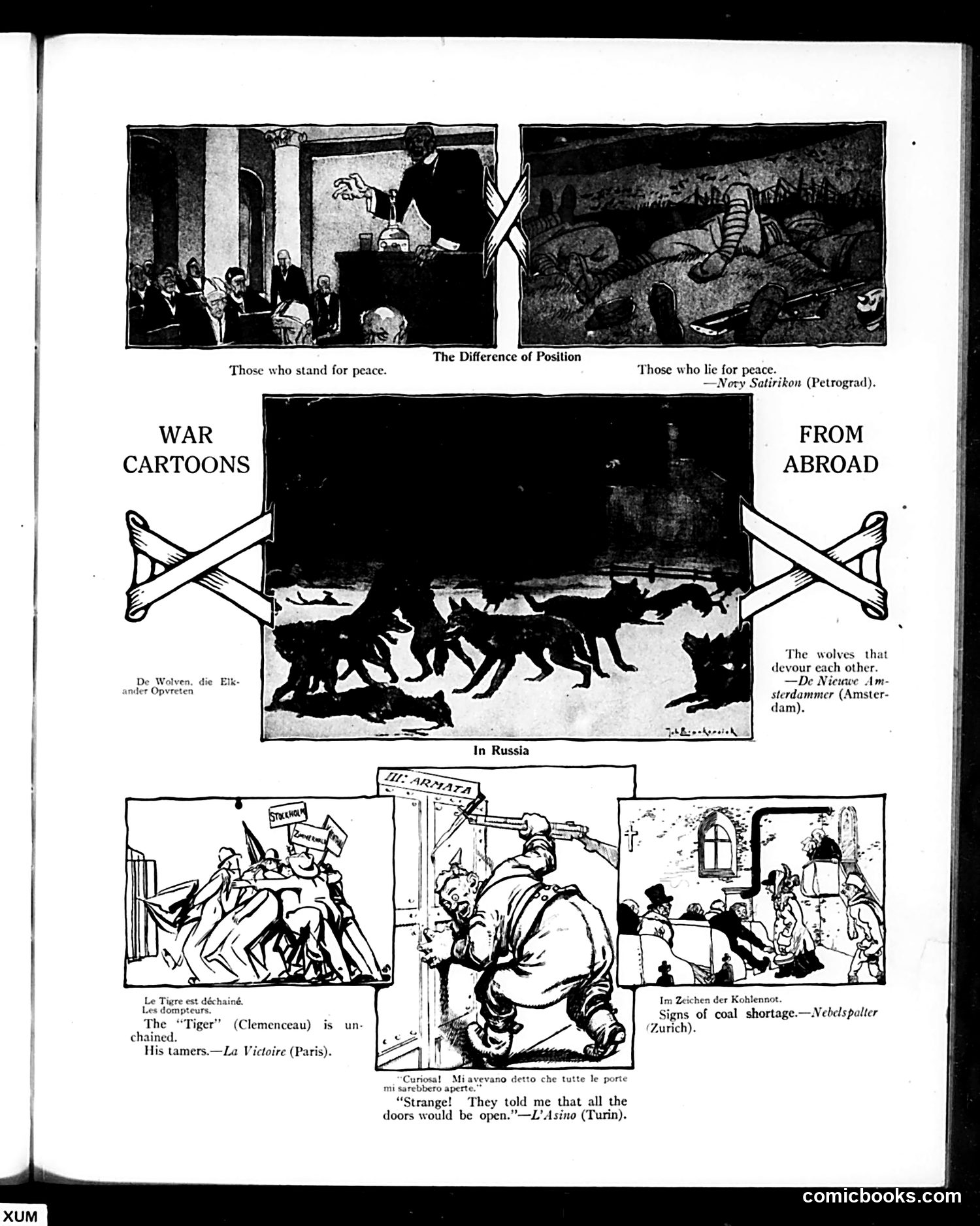
This page collects anti-war political cartoons from European publications during World War I. The top section contrasts "those who stand for peace" (diplomats at a conference) with "those who lie for peace" (dead soldiers), mocking empty peace rhetoric. The central cartoon depicts wolves devouring each other—representing warring nations—symbolizing mutual destruction. Below, three cartoons from German, Swiss, and Italian sources satirize war's effects: one shows Clemenceau (French leader) as an unchained "tiger," another depicts coal shortages affecting civilians, and the final panel mocks false promises that "all doors would be open" (likely referring to failed peace negotiations or promised supplies). The compilation demonstrates international anti-war sentiment, reprinting foreign satirical critiques for American Judge readers to show how other nations viewed the war's futility and leadership failures.
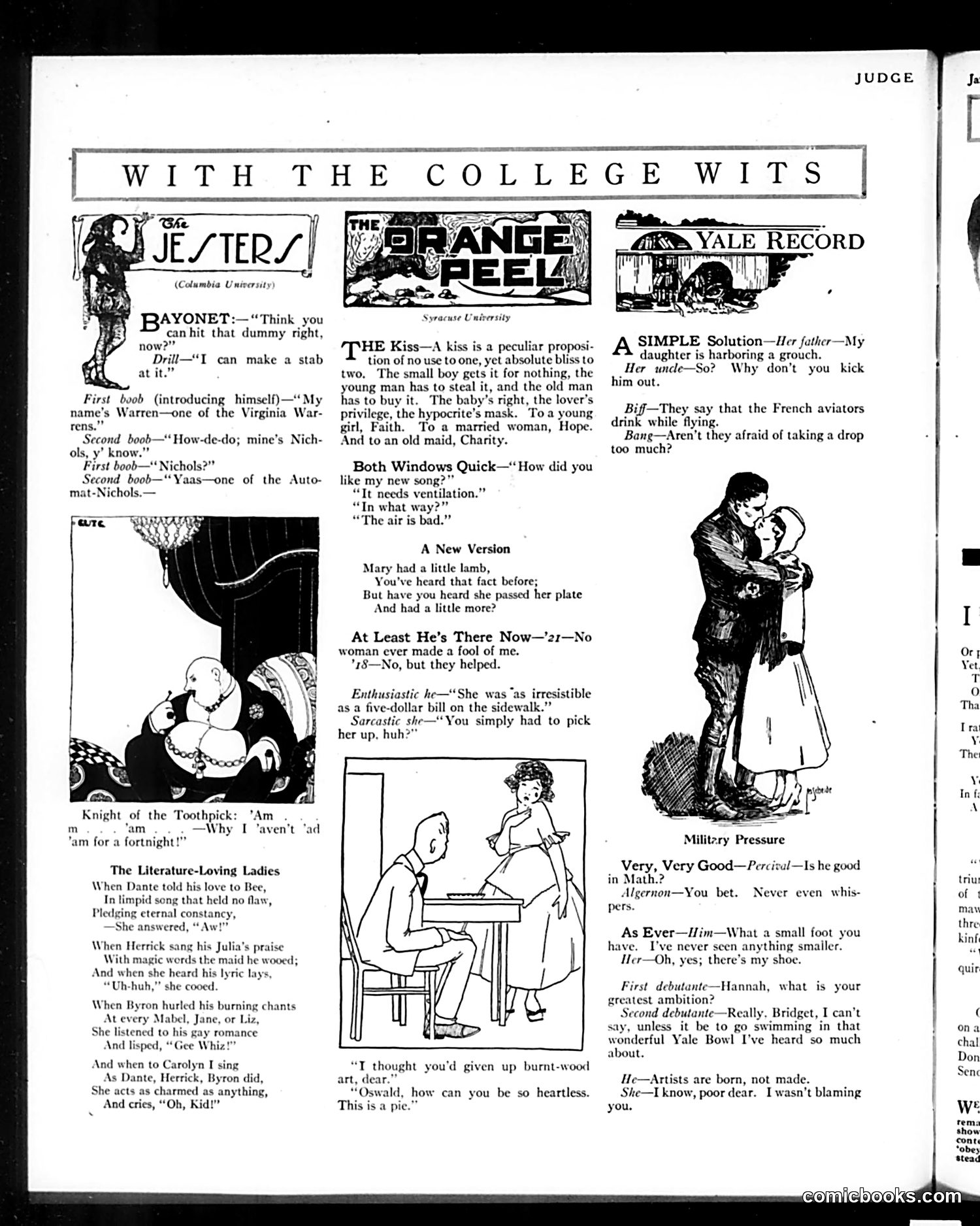
This is a humor page from Judge featuring jokes and satirical verse from three college newspapers: Columbia's *Jesters*, Syracuse's *Orange Peel*, and Yale's *Record*. The content reflects early 20th-century college humor conventions: wordplay about romance, military training (note the "Bayonet" and "Drill" jokes, likely referencing WWI-era ROTC), and gentle mockery of literary pretension. "The Literature-Loving Ladies" satirizes women who respond to romantic poetry with vapid exclamations ("Aw!", "Gee Whiz!") rather than genuine appreciation. The remaining jokes target courtship conventions (kissing, dancing, flirtation), male-female dynamics ("He—Artists are born, not made"), and college life (the Yale Bowl reference). The humor is mild and focused on romance and social etiquette rather than political commentary. The cartoons show couples in various romantic or domestic situations, reinforcing the page's lightweight comedic tone aimed at college-educated readers.
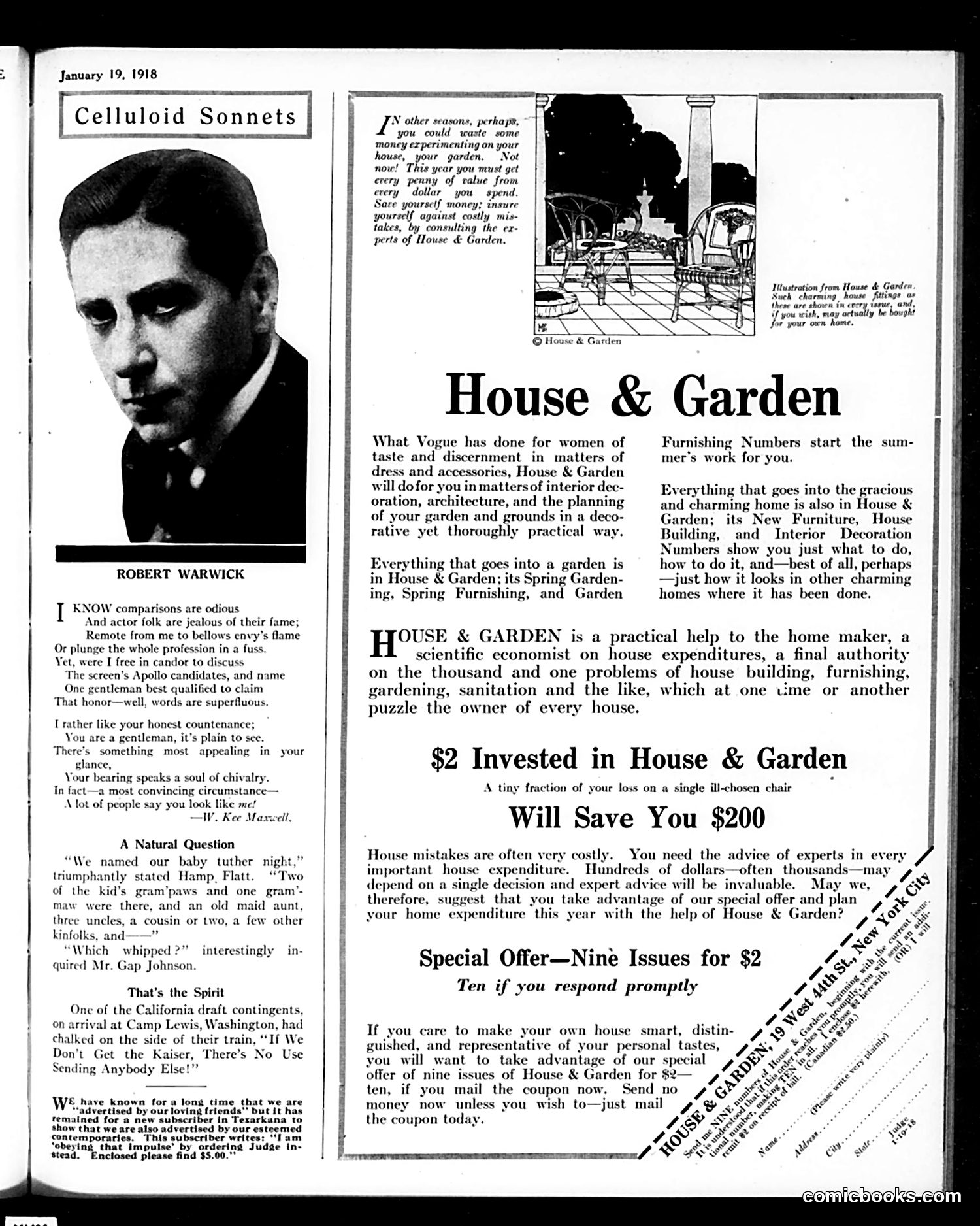
This page combines poetry, humor, and advertising with no unified political cartoon. **"Celluloid Sonnets"** features actor Robert Warwick in a mock-flattering poem by W. Kee Maxwell that ironically praises him while culminating in the joke that "a lot of people say you look like me"—poking fun at Warwick's vanity and the broader actor ego. The brief jokes below lampoon naming conventions ("Which whipped?"), draft patriotism ("If We Don't Get the Kaiser, There's No Use Sending Anybody Else!"), and magazine self-promotion. The **dominant content is advertising** for *House & Garden* magazine, capitalizing on 1918 wartime frugality. The ad urges readers to avoid costly home mistakes during economic hardship, promising that a $2 subscription will "save you $200"—a common advertising tactic exploiting WWI-era conservation anxiety and middle-class aspirations to tasteful homemaking.
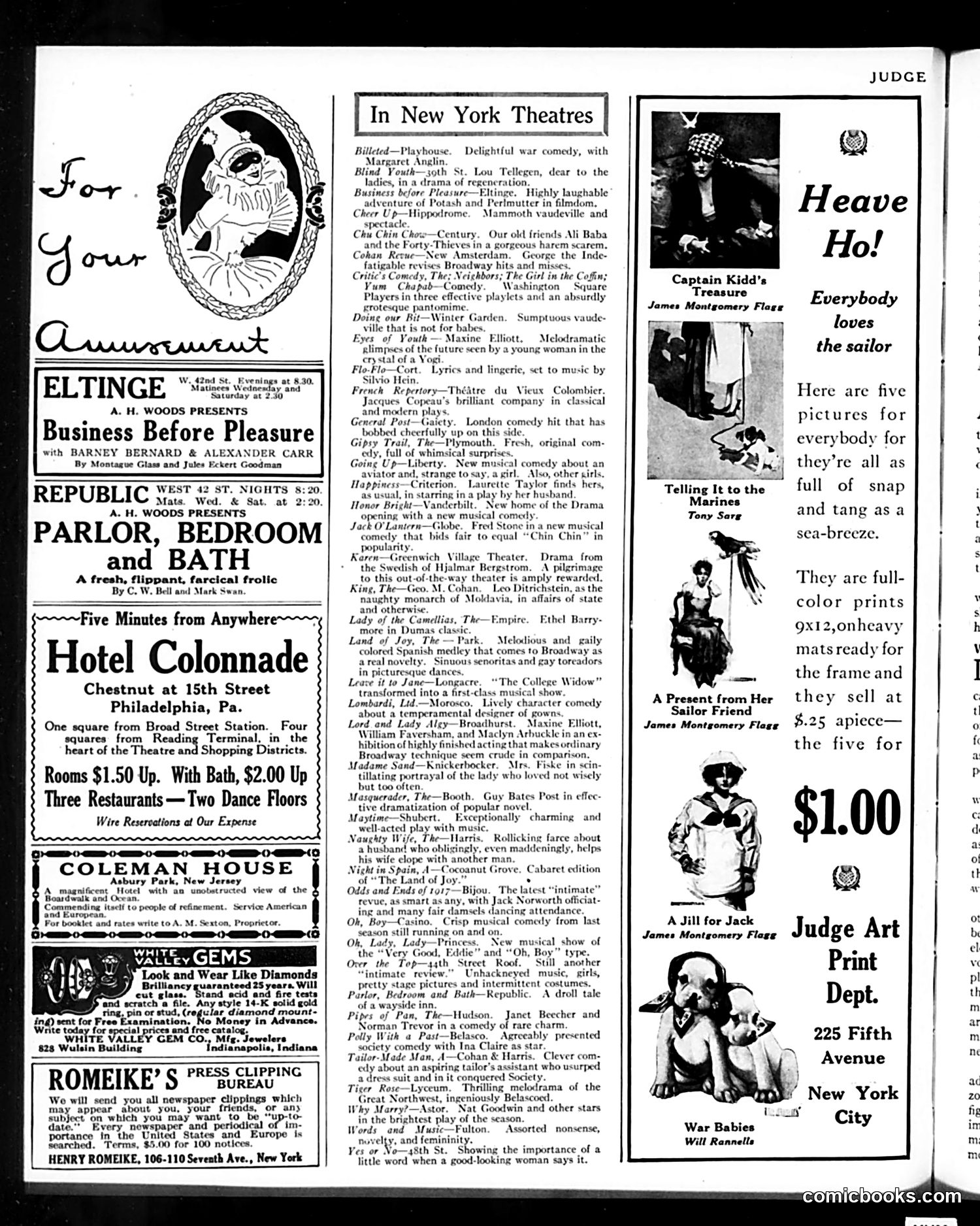
This page is primarily **theatrical advertising and reviews** for New York theaters, with embedded recruitment propaganda. The right column features **James Montgomery Flagg's sailor recruitment posters**—iconic WWI-era images promoting naval enlistment. The accompanying text ("Everybody loves the sailor / Here are five pictures for everybody") uses patriotic sentiment to market the prints at $1.00 each or five for $1.25. These aren't satirical cartoons mocking anyone; rather, they're **earnest propaganda materials**. Flagg's sailor imagery was famous for appealing to American patriotism during World War I. The placement alongside theater listings suggests Judge was leveraging entertainment advertising space to promote military recruitment. The theater section reviews current Broadway productions with brief, gossipy descriptions—typical of Judge's entertainment coverage during the 1910s era when American entry into WWI was imminent or ongoing.
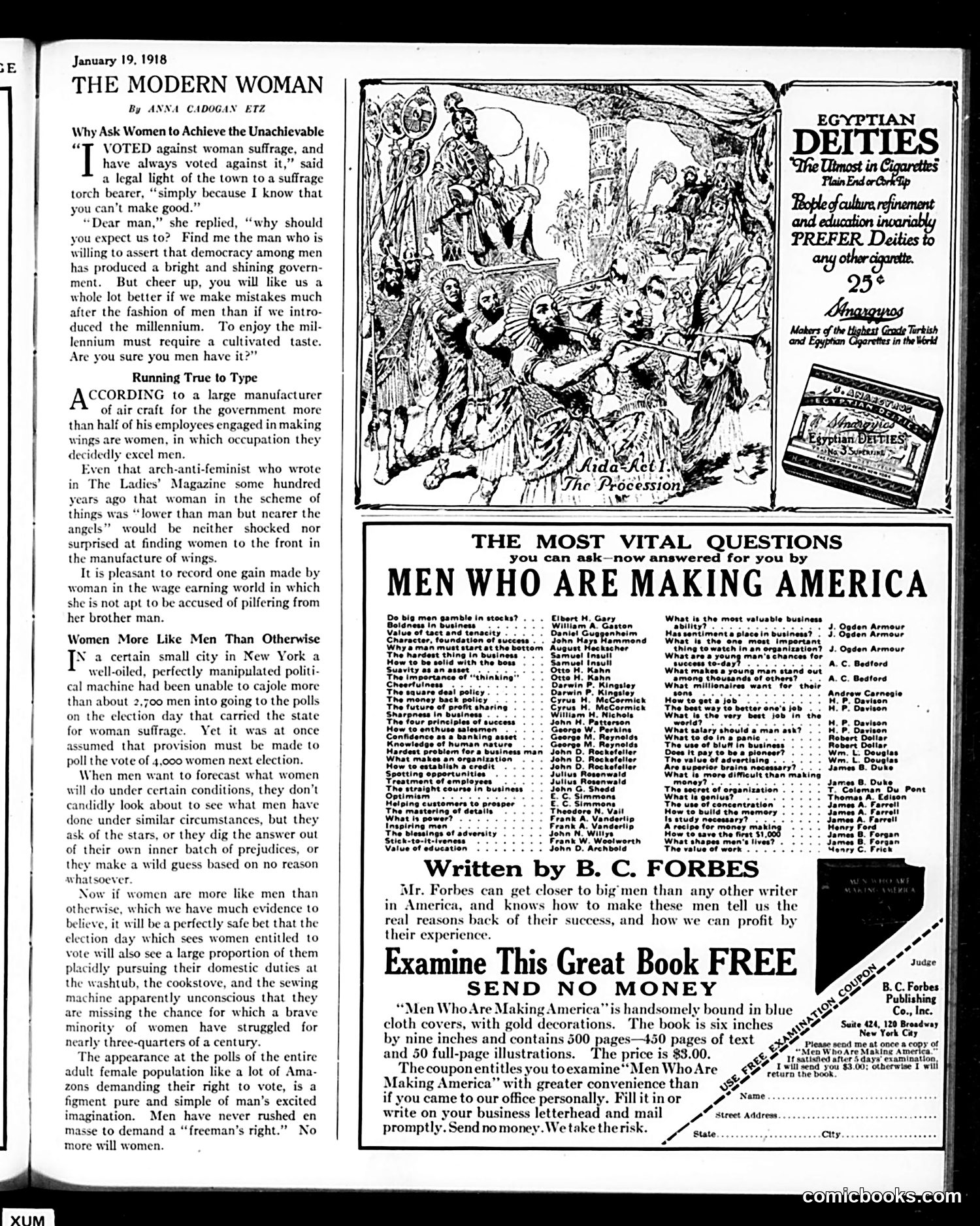
This page addresses **women's suffrage** on the eve of its passage (the 19th Amendment was ratified that year). The editorial by Anna Cadogan Etz uses satire to counter anti-suffrage arguments. The main argument: A man opposes women voting because "you can't make good." The suffragist replies that men's democracy hasn't produced good government either—so why should women be held to a higher standard? She suggests men actually *prefer* women make mistakes "like men" rather than achieve perfection. The piece then highlights women's competence in wartime aircraft manufacturing, ironically citing a historical anti-feminist who called women "lower than man but nearer the angels"—noting he wouldn't be surprised to find women excelling in this work. Finally, Etz deflates male fears of massive female voter turnout, predicting women will vote at similar low rates as men—a pragmatic counter to fantasies of "Amazons demanding their right." The page also advertises a business book featuring prominent American industrialists, typical of Judge's content.
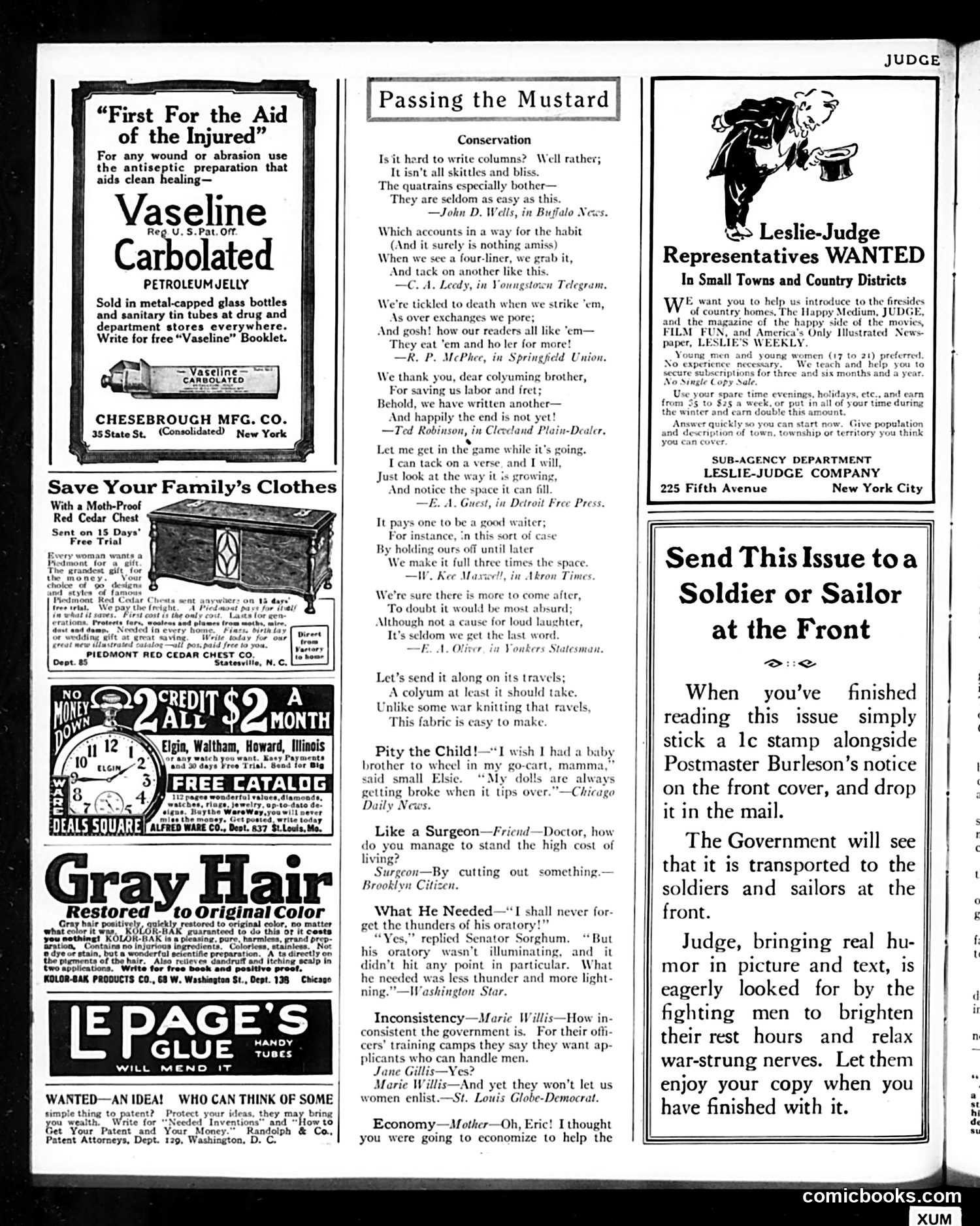
This page from **Judge** magazine contains mostly **advertisements and humorous short columns**, not political cartoons. The main illustrated content is the **Leslie-Judge recruitment ad** (top right): it shows a man in formal attire distributing copies of Leslie's Weekly/Judge magazine, appealing to salesmen in rural areas to become representatives. The **bulk of the page** is "Passing the Mustard," a lighthearted section where newspaper humor columnists joke about **reprinting each other's short jokes and quips**—a common editorial practice. They humorously acknowledge the cycle: one columnist "grabs" a funny four-line joke from another publication, reprints it, readers love it, so others do the same. The satire is gentle: it gently mocks this recycling of material while admitting everyone benefits from the practice. The rest comprises **period advertisements** for products like Vaseline, hair dye, cedar chests, and glue. Without a specific date visible, this appears to be from the **early 20th century**, likely WWI era based on the magazine's reference to training camps.
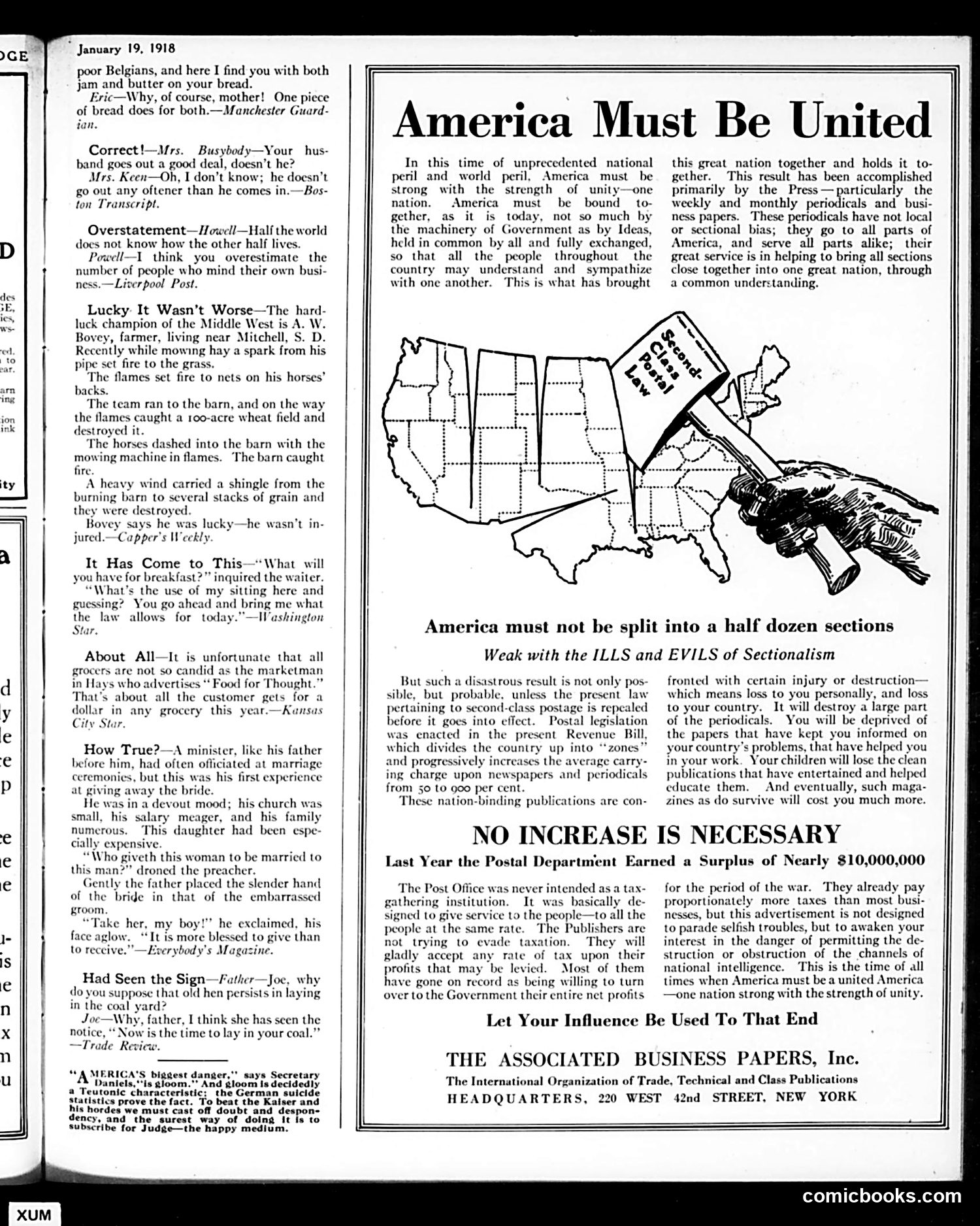
This page features a patriotic advertisement by the Associated Business Papers, Inc., published during America's involvement in World War I. The central cartoon depicts a map of the United States with a hand holding keys labeled "KEEP THE ILLS AND EVILS OF SECTIONALISM" being driven into the nation, visually representing the danger of regional division. The message warns against "sectionalism"—regional or sectional loyalty undermining national unity during wartime. The advertisement argues that trade and business publications serve the national interest by distributing uniform information across all regions, preventing dangerous regional fragmentation. The surrounding humorous anecdotes and jokes appear designed to build a light-hearted, readable context around this serious patriotic argument. The implicit message: during wartime crisis, America must think and act as one unified nation, not competing sections—a message amplified through the press's national reach.
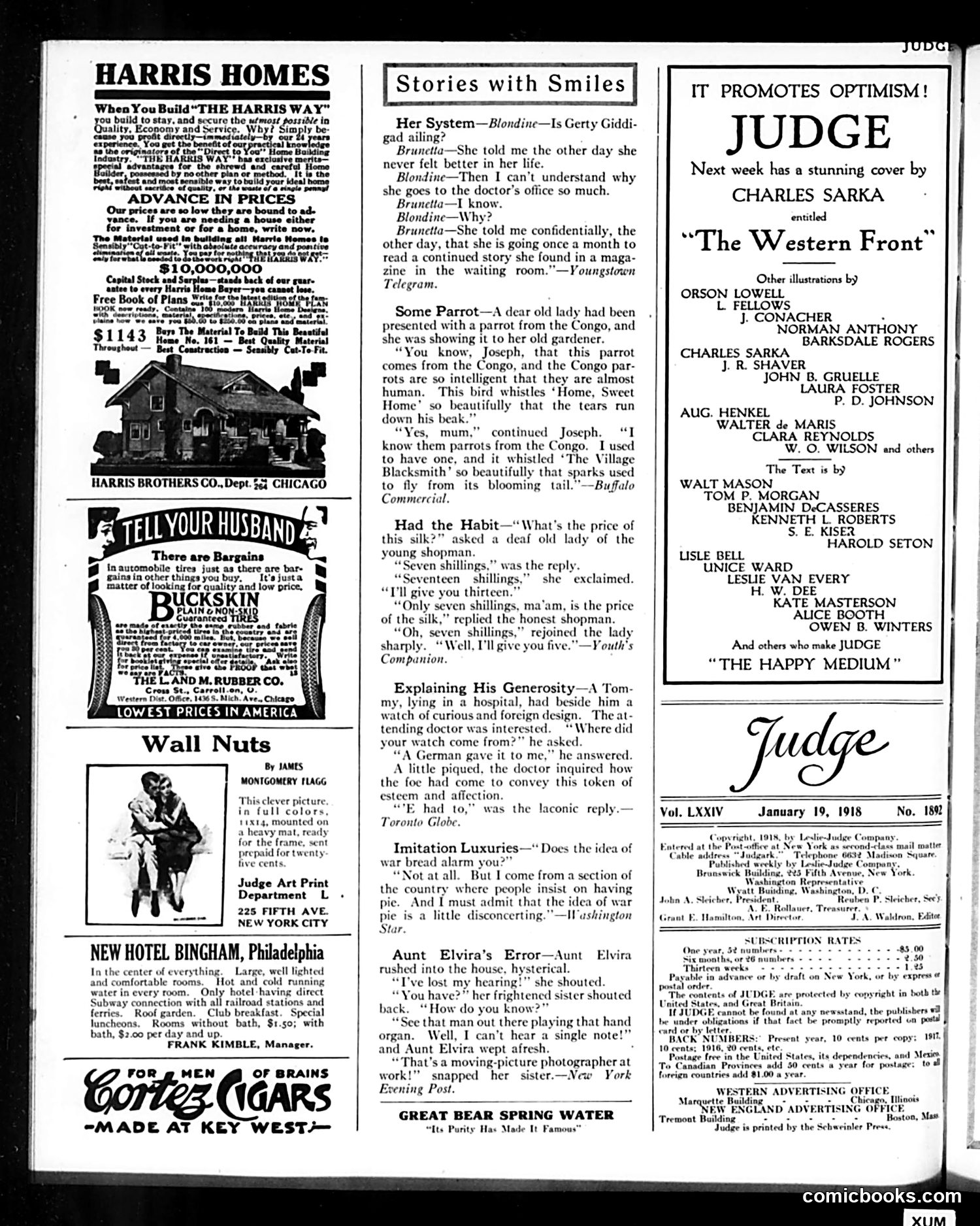
This page is primarily **advertising and humorous filler content**, not political satire. The bulk consists of ads for Harris Homes, Duckskin tires, and hotels, interspersed with brief comedic anecdotes under "Stories with Smiles." The jokes are light domestic humor typical of the era: - A woman visits the doctor frequently to read magazine serials in the waiting room - A parrot whistles "Home, Sweet Home" so beautifully it makes people cry - A deaf woman mishears the price of silk - Someone from a region that insists on "war bread" finds war pie "disconcerting" - Aunt Elvira mistakes a movie cameraman's noise for a street organ and thinks she's gone deaf **The war reference** (appearing just after America entered WWI in April 1917) is minimal—only the "war bread" joke acknowledges the conflict. The page's tone is escapist entertainment rather than commentary. The main content here is Judge's cover announcement for next week's "The Western Front" by Charles Sarka, listing numerous illustrators.
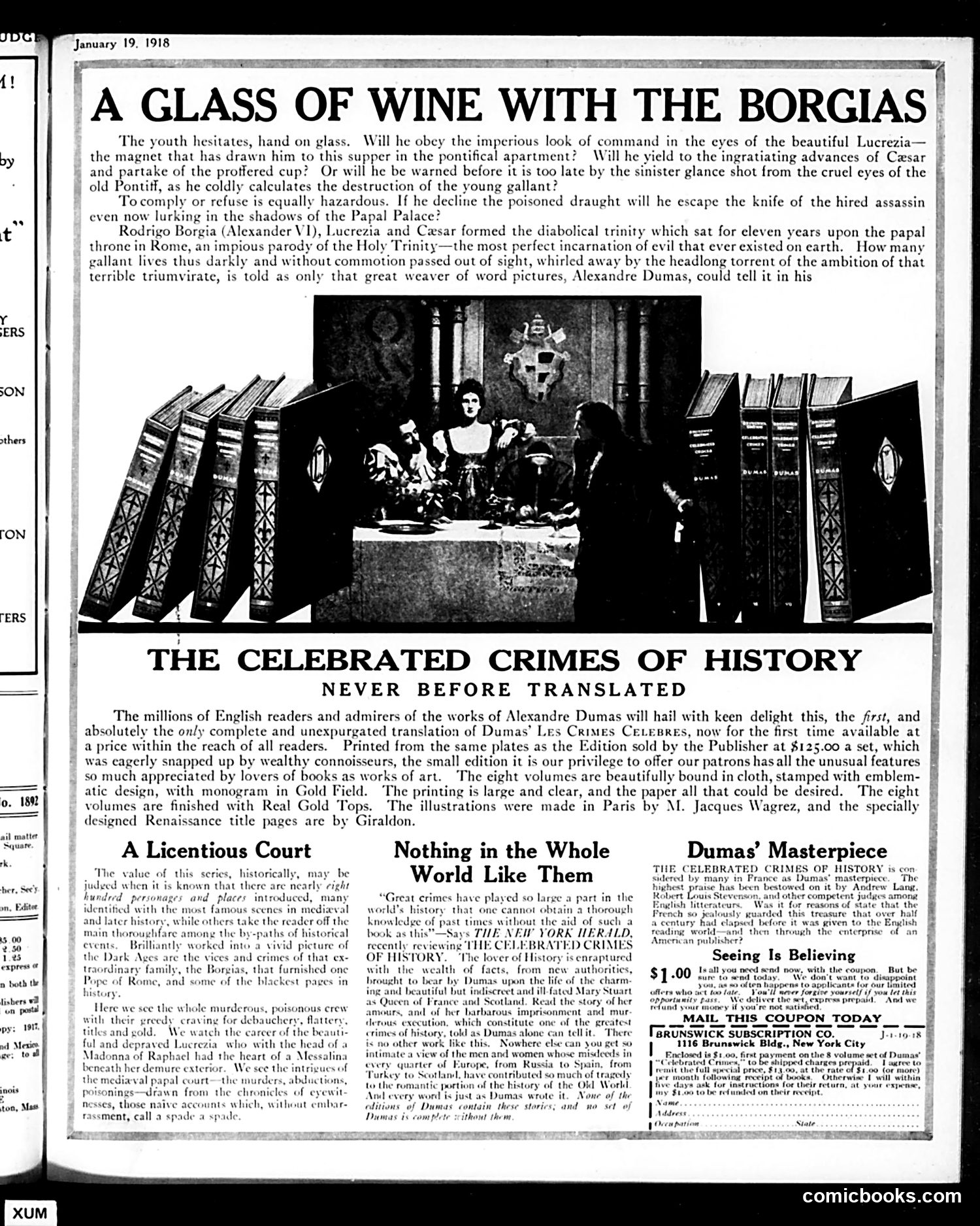
This page is primarily **advertising**, not satire. It promotes a new English translation of Alexandre Dumas' *Les Crimes Célèbres* (Celebrated Crimes of History). The top illustration depicts a famous historical scene: a youth at the papal court of the Borgias, tempted by the beautiful Lucrezia Borgia while threatened by her father Pope Alexander VI and brother Cesare—all notorious for poisoning enemies. The text emphasizes the drama and moral danger of the moment. The advertisement exploits this lurid historical tale to sell books. Published January 1918, it claims this is the "first" complete English translation, marketed as an affordable edition of a work previously available only to wealthy collectors. The language emphasizes exclusivity ("only complete and unexpurgated") and quality ("beautifully bound," "Real Gold Tops"). There is **no political satire here**—rather, this represents Judge magazine's commercial side, using sensational historical content to attract readers interested in crime narratives and fine book collecting.
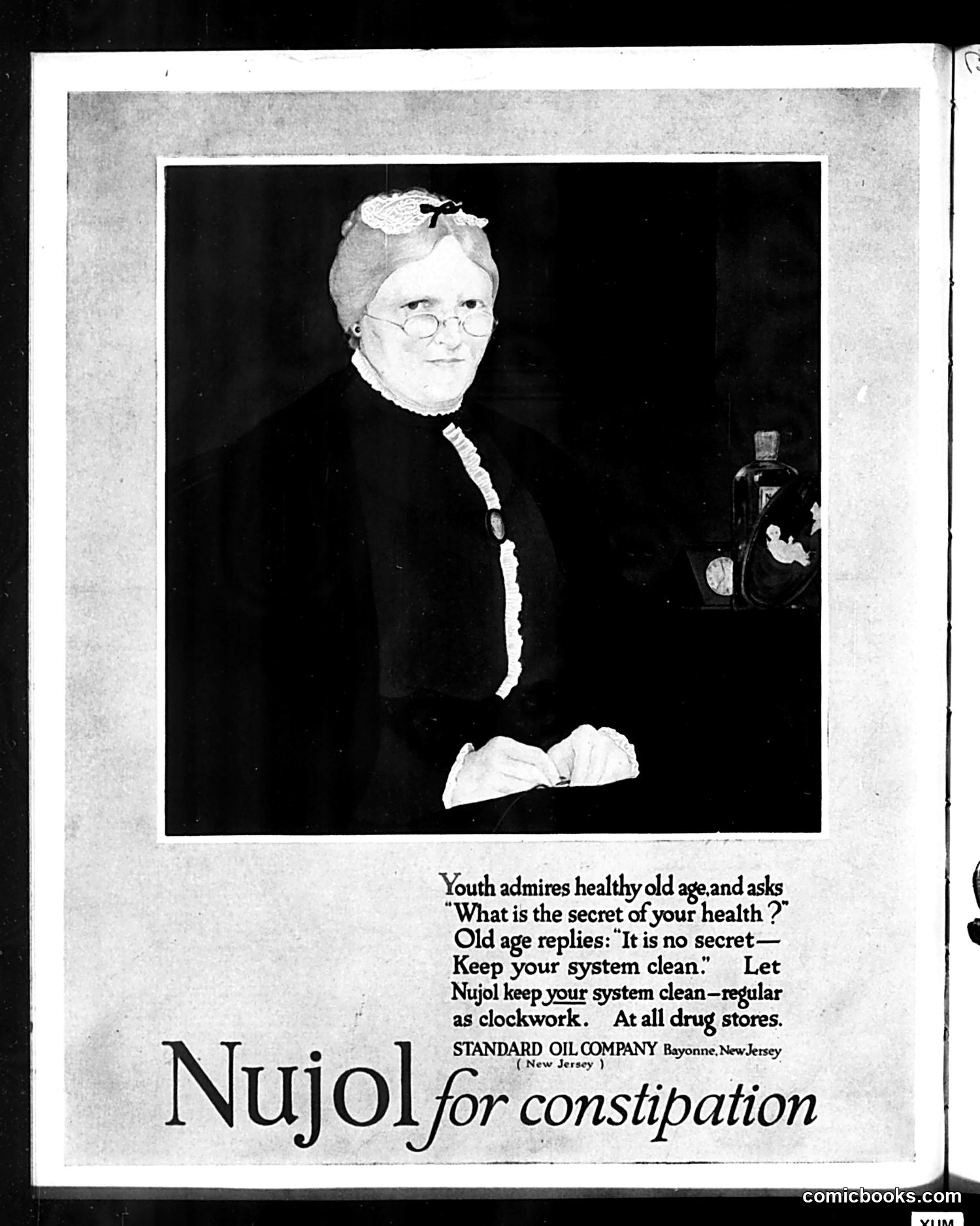
This is a **Nujol advertisement**, not political satire. Nujol was a mineral oil laxative product made by Standard Oil Company. The ad uses a common marketing device of the era: a elderly person representing health and longevity, positioned as an authority figure. The "dialogue" between Youth and Old Age delivers the sales pitch—that the secret to good health is keeping "your system clean," meaning regular bowel movements. The ad promises that Nujol will maintain this regularity "as clockwork." This reflects early 20th-century beliefs linking digestive regularity to overall health and longevity. The placement in *Judge* magazine simply means Standard Oil purchased advertising space in this satirical publication alongside actual humor content.