
Judge, 1918-01-19 · page 7 of 28
Judge — January 19, 1918 — page 7: what you’re looking at
What you’re looking at
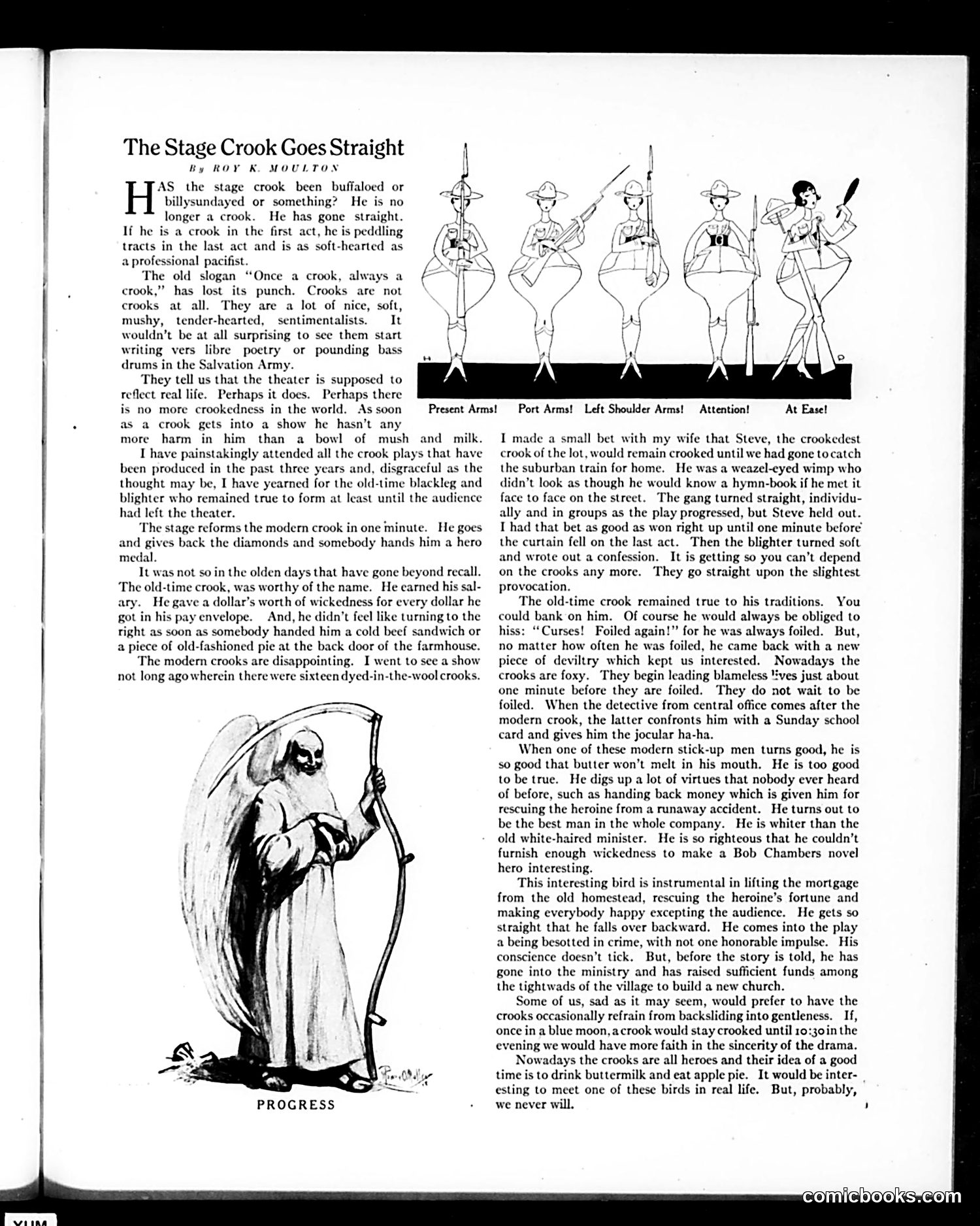
This article satirizes early 20th-century theater's treatment of criminal characters. Moulton criticizes how stage crooks undergo unrealistic, instantaneous moral reform—typically converting to goodness within minutes through sentimental redemption arcs. He nostalgically contrasts this with "old-time crooks" who remained wickedly committed to their villainy, providing genuine dramatic conflict. Modern theatrical crooks, he argues, become implausibly virtuous—almost saintly—making them boring and unconvincing as characters. The accompanying illustrations show soldiers in military poses, likely mocking how stage crooks convert to respectable, upstanding citizens (possibly through Salvation Army-style reform). Moulton's critique reflects period anxieties about morality in entertainment and audiences' preference for authentic dramatic tension over preachy redemption narratives.
📄 Transcribed text from this page (OCR, searchable)
Machine-transcribed from the original scan — historical spelling and the odd misread are preserved.
| The Stage Crook Goes Straight By ROY K. MOULTON AS the stage crook been buffaloed or H billysundayed or something? He is no longer a crook. He has gone straight. If he is a crook in the first act, he is peddling tracts in the last act and is as soft-hearted as sional pacifist. ¢ old slogan “Once a crook, always a crook,” has lost its punch. Crooks are not crooks at all. They are a lot of nice, soft, mushy, tender-hearted, sentimentalists. It wouldn’t be at all surprising to see them start writing vers libre poetry or pounding bass drums in the Salvation Army. They tell us that the theater is supposed to reflect real life. Perhaps it does. Perhaps there is no more crookedness in the world. As soon as a crook gets into a show he hasn’t any more harm in him than a bowl of mush and milk. I have painstakingly attended all the crook plays that have been produced in the past three years and, disgraceful as the thought may be, I have yearned for the old-time blackleg and blighter who remained true to form at least until the audience had left the theater. The stage reforms the modern crook in one minute. He goes and gives back the diamonds and somebody hands him a hero medal. It was not so in the olden days that have gone beyond recall. The old-time crook, was worthy of the name. He earned his sal- ary. He gave a dollar’s worth of wickedness for every dollar he got in his pay envelope. And, he didn’t feel like turning to the right as soon as somebody handed him a cold beef sandwich or a piece of old-fashioned pie at the back door of the farmhouse. The modern crooks are disappointing. I went to see a show not long agowherein there were sixteen dyed-in-the-wool crooks. Present Arms! Port Arms! Left Shoulder Arms! Attention! At Ease! I made a small bet with my wife that Steve, the crookedest crook of the lot, would remain crooked until we had gone tocatch the suburban train for home. He was a weazel-eyed wimp who didn’t look as though he would know a hymn-book if he met it face to face on the street. The gang turned straight, individu- ally and in groups as the play progressed, but Steve held out. I had that bet as good as won right up until one minute before the curtain fell on the last act. Then the blighter turned soft and wrote out a confession. It is getting so you can’t depend on the crooks any more. They go straight upon the slightest provocation. The old-time crook remained true to his traditions. You could bank on him. Of course he would always be obliged to hiss: “Curses! Foiled again!” for he was always foiled. But, no matter how often he was foiled, he came back with a new piece of deviltry which kept us interested. Nowadays the crooks are foxy. They begin leading blameless "ives just about one minute before they are foiled. They do not wait to be foiled. When the detective from central office comes after the modern crook, the latter confronts him with a Sunday school card and gives him the jocular ha-ha. When one of these modern stick-up men turns good, he is so good that butter won’t melt in his mouth. He is too good to be true. He digs up a lot of virtues that nobody ever heard of before, such as handing back money which is given him for rescuing the heroine from a runaway accident. He turns out to be the best man in the whole company. He is whiter than the old white-haired minister. He is so righteous that he couldn’t furnish enough wickedness to make a Bob Chambers novel hero interesting. This interesting bird is instrumental in lifting the mortgage from the old homestead, rescuing the heroine’s fortune and making everybody happy excepting the audience. He gets so straight that he falls over backward. He comes into the play a being besotted in crime, with not one honorable impulse. His conscience doesn’t tick. But, before the story is told, he has gone into the ministry and has raised sufficient funds among the tightwads of the village to build a new church. Some of us, sad as it may seem, would prefer to have the crooks occasionally refrain from backsliding into gentleness. If, once in a blue moon, acrook would stay crooked until 10:30in the evening we would have more faith in the sincerity of the drama. Nowadays the crooks are all heroes and their idea of a good time is to drink buttermilk and eat apple pie. It would be inter- esting to meet one of these birds in real life. But, probably, we never will.