
Judge, 1918-01-19 · page 17 of 28
Judge — January 19, 1918 — page 17: what you’re looking at
What you’re looking at
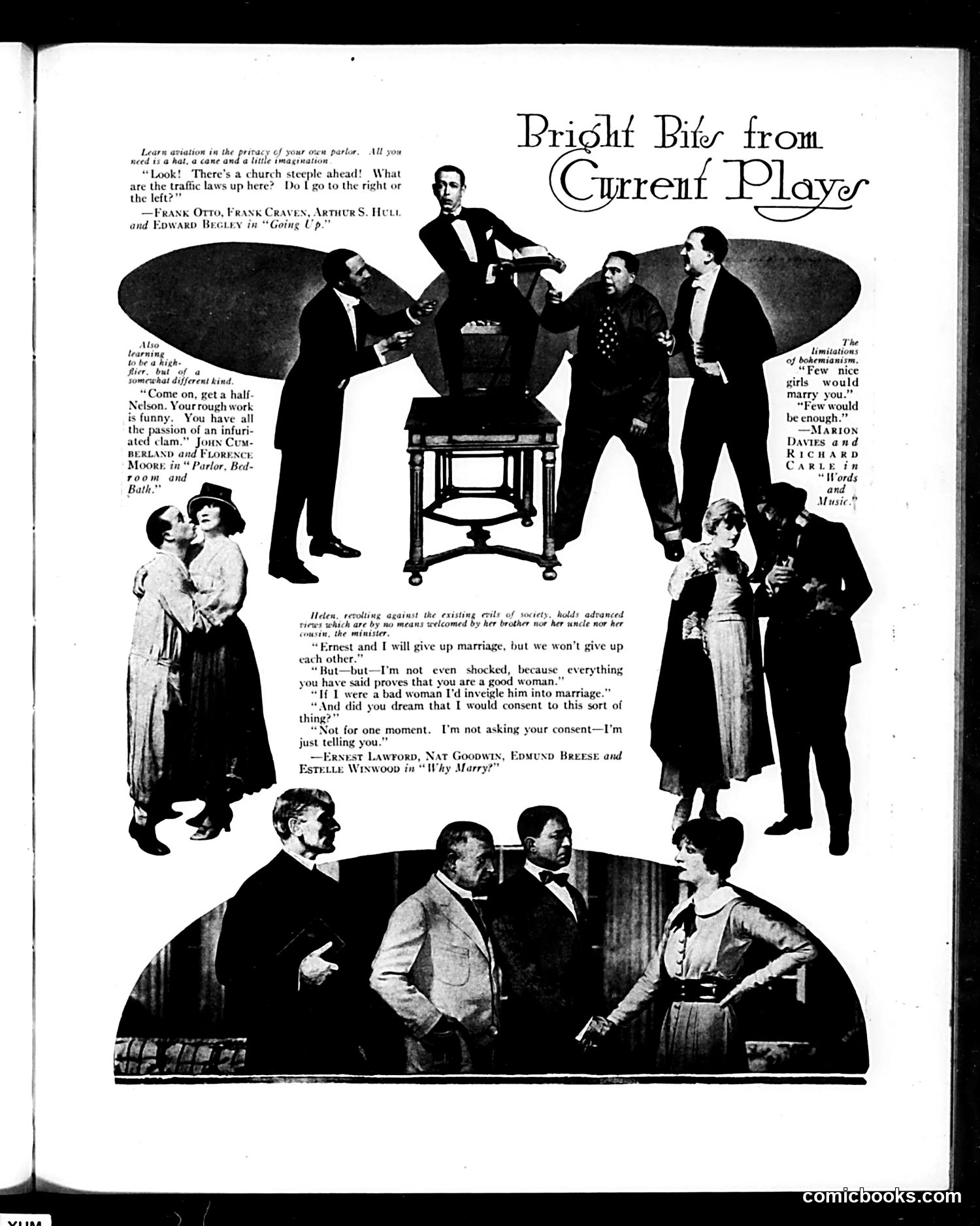
This page showcases witty dialogue excerpts from three Broadway plays of the era (likely 1910s). **"Going Up"** features a traffic-law joke: characters in an ascending elevator mistake a church steeple for street scenery, absurdly asking about traffic rules in mid-air—humor based on the novelty of vertical travel technology. **"Parlor, Bedroom and Bath"** contains a romantic insult: a man tells a woman her "rough work" is funny but she has "passion of an infuriated clam"—sarcastic understatement meant to be humorous criticism. **"Why Marry?"** satirizes modern women's independence. Helen rejects both traditional marriage *and* her family's moral authority, declaring she'll live with Ernest without marrying. The joke: her progressive views prove she's actually virtuous—inverting conventional morality where "good women" marry. The family's shock at her refusal to be shocked reveals generational disconnect over women's autonomy.
📄 Transcribed text from this page (OCR, searchable)
Machine-transcribed from the original scan — historical spelling and the odd misread are preserved.
need is @ hat, a cane and a little imagination “Look! ‘There's a church steeple ahead! What are the traffic laws up here? Do I go to the right or the left?” rren ‘on Sf —FRANK Orro, FRaxk CRAVES, ARTHURS. HL and Epwarb Brcuey in “Going Up.” | | Aso F : The i tisratae . limitations to be a high- of bohemianism. fier, but of a “Few nice somewhat different kind. girls would “Come on, get a half- marry you.” Nelson. Your rough work isfunny, You have all the passion of an infuri- ated clam.” Joux Cum- = Davies and BERLAND and FLORENCE RICHARD Moore: in “ Parlor, Bed- CaRL i room and Bath.” | Helen, revolting against the existing evils of society, holds advanced views which are by no means welcomed by her brother nor her uncle nor her | cousin, the minister, Ernest and I will give up marriage, but we won't give up cach other. “But—but—I'm not even shocked, because everything you have said proves that you are a good woman.” “If 1 were a bad woman I'd inveigle him into marriage.” And did you dream that I would consent to this sort of thing?” “Not for one moment. I'm not asking your consent—I’m just telling you.” —Ernest Lawrorp, Nat Goopwin, Epwunp Breese and Este Wrxwoop in “Why Marry?”