
Judge, 1918-01-19 · page 16 of 28
Judge — January 19, 1918 — page 16: what you’re looking at
What you’re looking at
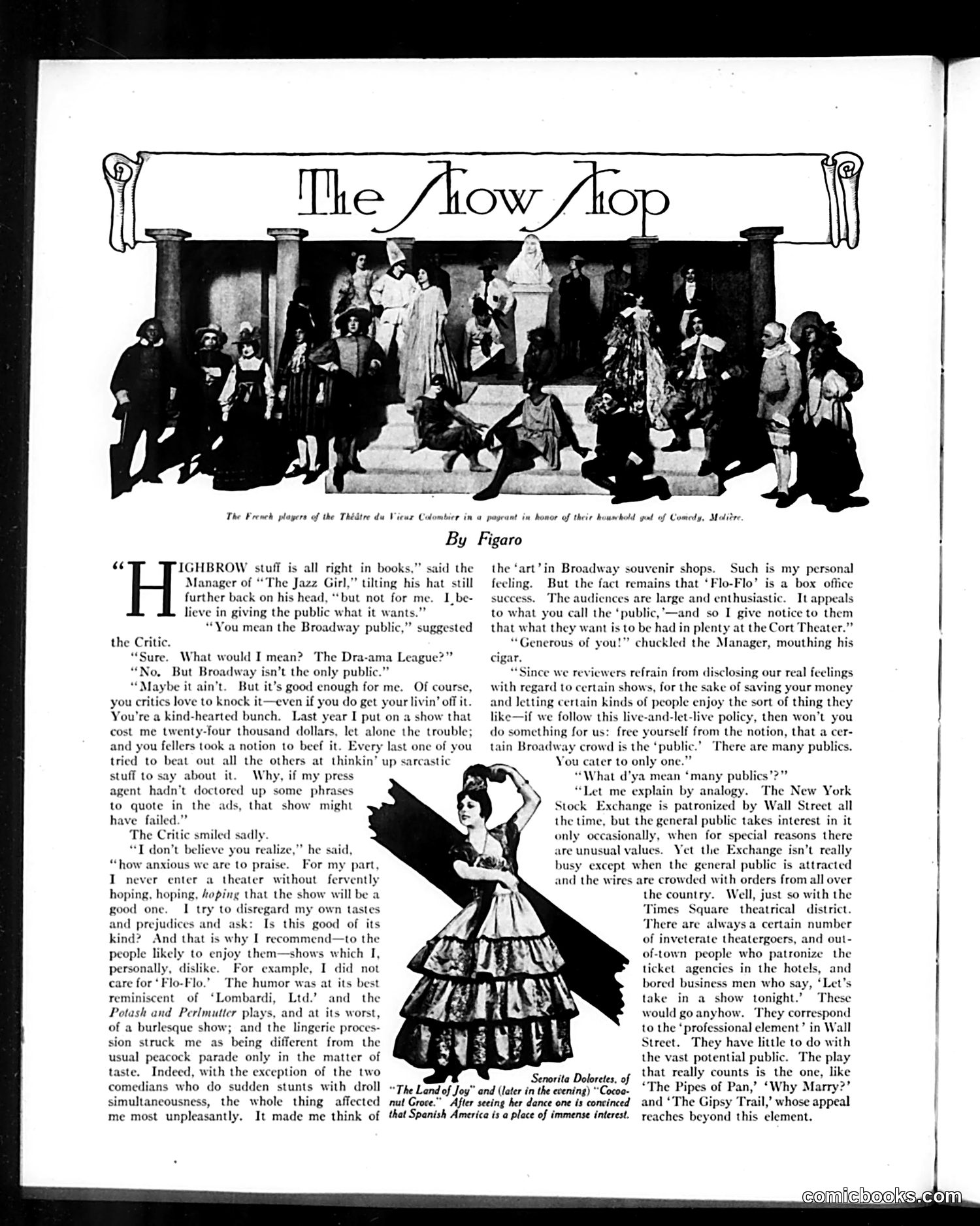
This page satirizes the tension between Broadway commercial success and critical taste. The dialogue presents a **theater manager defending popular entertainment** ("The Jazz Girl," "Flo-Flo") against a **snobbish drama critic** who claims to want shows to succeed yet dismisses crowd-pleasing productions. The critic admits he personally dislikes popular fare like "Lombardi, Ltd." and burlesque but recommends them to audiences he condescends toward. The manager uses a **stock market analogy**: just as Wall Street professionals drive occasional Stock Exchange activity, theater professionals sustain the industry, but true success requires the general public's enthusiasm. His point: critics shouldn't claim artistic superiority while profiting from mass-market theater. The satire targets **highbrow hypocrisy**—critics who publicly support "the public's" tastes while privately dismissing them as lowbrow. The image shows French theatrical performers, likely illustrating that even sophisticated theater depends on popular audiences for financial viability.
📄 Transcribed text from this page (OCR, searchable)
Machine-transcribed from the original scan — historical spelling and the odd misread are preserved.
The French players of the Thédtre du Vieux Colombicr in a poycant im honor of their houmhold yal of Comedy, Molitre By Figaro “ IGHBROW stuff is all right in books,” said the — the ‘art’in Broadway souvenir shops. Such is my personal Manager of “The Jazz Girl,” tilting his hat still feeling. But the fact remains that ‘Flo-Flo’ is a box office further back on his head, “but not for me. Ibe- success. The audiences are large and enthusiastic. It appeals lieve in giving the public what it wants.” to what you call the ‘public,’—and so I give notice to them “You mean the Broadway public,” suggested — that what they want is to be had in plenty at the Cort Theater.” the Critic. Generous of you!” chuckled the Manager, mouthing his. “Sure. What would I mean? The Dra-ama League?” cigar. “No, But Broadway isn’t the only public ince We reviewers refrain from disclosing our real feelings “Maybe it ain't. But it’s good enough for me. Of course, with regard to certain shows, for the sake of saving your money you critics love to knock it—even if you do get your livin’ off it. and letting certain kinds of people enjoy the sort of thing they You're a kind-hearted bunch. Last year I put on a show that like—if we follow this live-and-let-live policy, then won't you cost me twenty-four thousand dollars, let alone the trouble; do something for us: free yourself from the notion, that a cer- and you fellers took a notion to beef it. Every last one of you tain Broadway crowd is the ‘public.’ There are many publics. tried to beat out all the others at thinkin’ up sarcastic You cater to only one.” stuff to say about it. Why, if my press “What d’ya mean ‘many publics’? agent hadn't doctored up some phrases » “Let me explain by analogy. The New York to quote in the ads, that show might Stock Exchange is patronized by Wall Street all have failed the time, but the general public s interest in it The Critic smiled sadly only occasionally, when for special reasons there I don’t believe you realize,” he said, are unusual values. Yet the Exchange isn’t really “how anxious we are to praise. For my part, busy except when the general public is attracted I never enter a theater without fervently and the wires are crowded with orders from all over hoping, hoping, hoping that the show will be a the country. Well, just so with the good one. I try to disregard my own tastes Times Square theatrical district. and prejudices and ask: Is this good of its ‘There are always a certain number kind? And that is why I recommend—to the of inveterate theatergoers, and out- people likely to enjoy them—shows which I, of-town people who patronize the personally, dislike. For example, I did not ticket. agencies in the hotels, care for ‘Flo-Flo.’. The humor was at its best bored business men who say, reminiscent of ‘Lombardi, Ltd.’ and the show tonight.’ Potash and Perlmutter plays, and at its worst, nyhow. They correspond of a burlesque show; and the lingerie proces- to the ‘professional clement’ in Wall sion struck me as being different from the Street. They have little to do with usual peacock parade only in the matter of the vast potential public. ‘The play taste, _Indeed, with the exception of the two Scosrtie Délerddea; of that really counts is the one, like comedians who do sudden stunts with droll he Lond of Joy” and (later in the etening) “Cocoe- ‘The Pipes of Pan,’ ‘Why Marry? simultaneousness, the whole thing affected nut Groce.” After seeing her dance one is concinced and ‘The Gipsy Trail,’ whose appeal me most unpleasantly. It made me think of ‘hat Spanish America is a place of immense interest. reaches beyond this element. {