
Judge, 1918-01-19 · page 14 of 28
Judge — January 19, 1918 — page 14: what you’re looking at
What you’re looking at
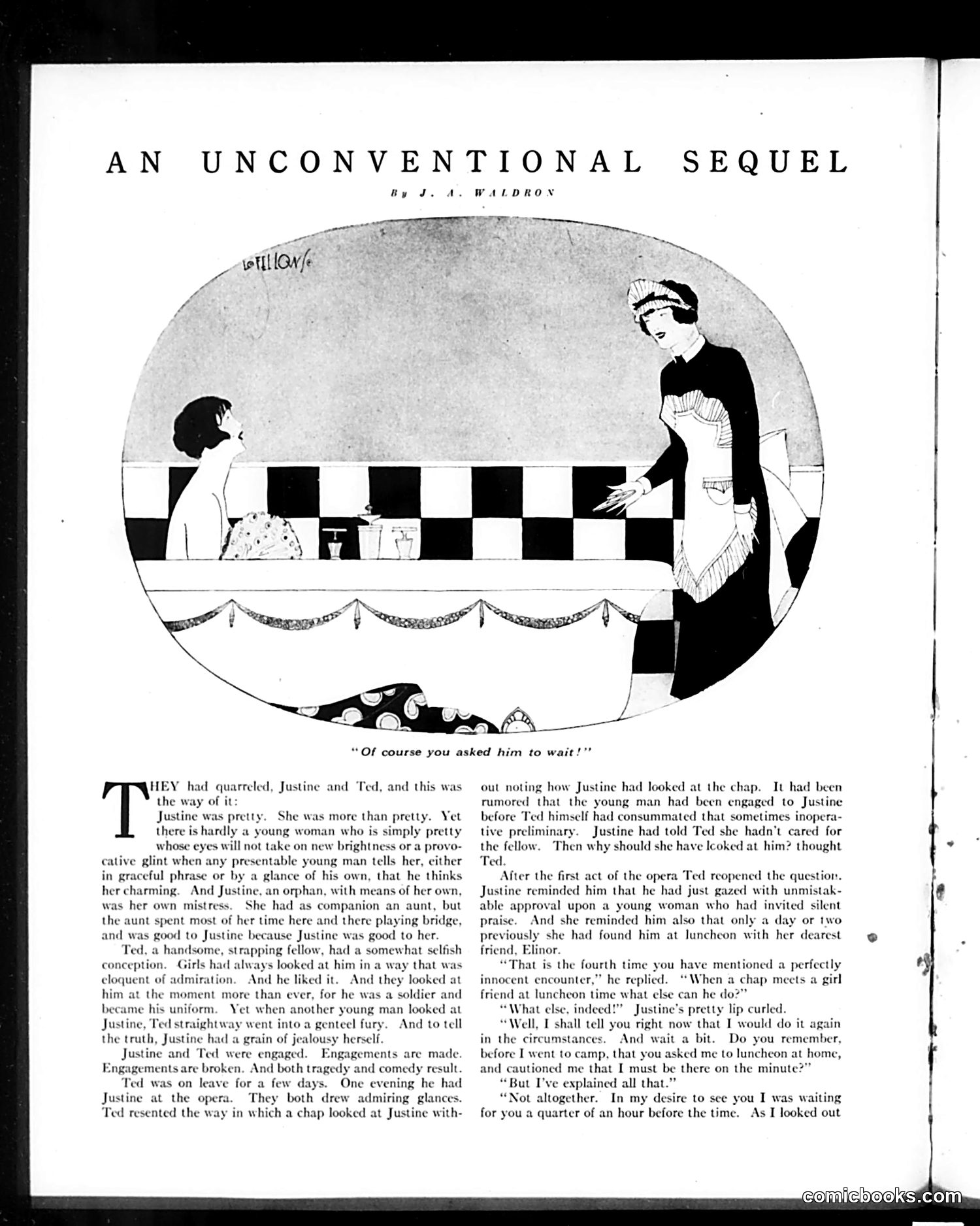
This is a romantic fiction piece, not political satire. The illustration shows a domestic quarrel between an engaged couple at the opera. **The story**: Justine (an independent, wealthy orphan) and Ted (a soldier on leave) have argued over jealousy. Ted resents how Justine looked at a former suitor at the opera, while Justine points out Ted's own admiring glances at other women—and specifically his lunch with her friend Elinor. Ted defends himself by claiming innocent encounters are unavoidable, but Justine questions his priorities by recalling he was late arriving for *her* requested lunch. **The joke**: The caption "Of course you asked him to wait!" suggests Justine, irritated by Ted's excuses, sarcastically implies she had to ask the other man to wait—implying Ted's attention to other women is habitual. The piece satirizes conventional romantic double-standards and male hypocrisy rather than politics.
📄 Transcribed text from this page (OCR, searchable)
Machine-transcribed from the original scan — historical spelling and the odd misread are preserved.
AN UNCONVENTIONAL SEQUEL By J. A. WALDRON “Of course you asked him to wait!"’ HEY had quarreled, Justine and Ted, and this was the way of it: Justine was pretty. She was more than pretty. Yet there is hardly a young woman who is simply pretty whose eyes will not take on new brightness or a provo- cative glint when any presentable young man tells her, either in graceful phrase or by a glance of his own, that he thinks her charming. And Justine, an orphan, with means of her own, was her own mistress. She had as companion an aunt, but the aunt spent most of her time here and there playing bridge, and was good to Justine because Justine was good to her. Ted, a handsome, strapping fellow, had a somewhat selfish conception. Girls had always looked at him in a way that was cloquent of admiration, And he liked it. And they looked at him at the moment more than ever, for he was a soldier and became his uniform. Yet when another young man looked at Justine, Ted straightway went into a genteel fury. And to tell the truth, Justine had a grain of jealousy herself. Justine and Ted were engaged. Engagements are made. Engagements are broken. And both tragedy and comedy result. Ted was on leave for a few days. One evening he had Justine at the opera. They both drew admiring glances. Ted resented the way in which a chap looked at Justine with- out noting how Justine had looked at the chap. It had been rumored that the young man had been engaged to Justine before Ted himself had consummated that sometimes inopera tive preliminary. Justine had told Ted she hadn't cared for the fellow. Then why should she have Icoked at him? thought Ted. After the first act of the opera Ted reopened the question. Justine reminded him that he had just gazed with unmistak- able approval upon a young woman who had invited silent praise. And she reminded him also that only a day or two previously she had found him at luncheon with her dearest friend, Elinor. “That is the fourth time you have mentioned a perfectly innocent encounter,” he replied. “When a chap meets a girl friend at luncheon time what else can he do?” “What else, indeed!” Justine’s pretty lip curled. “Well, I shall tell you right now that I would do it again in the circumstances. And wait a bit. Do you remember, before I went to camp, that you asked me to luncheon at home, and cautioned me that I must be there on the minute?” “But I’ve explained all that.” “Not altogether. In my desire to sce you I was waiting for you a quarter of an hour before the time. As I looked out ——