
Judge, 1918-01-19 · page 10 of 28
Judge — January 19, 1918 — page 10: what you’re looking at
What you’re looking at
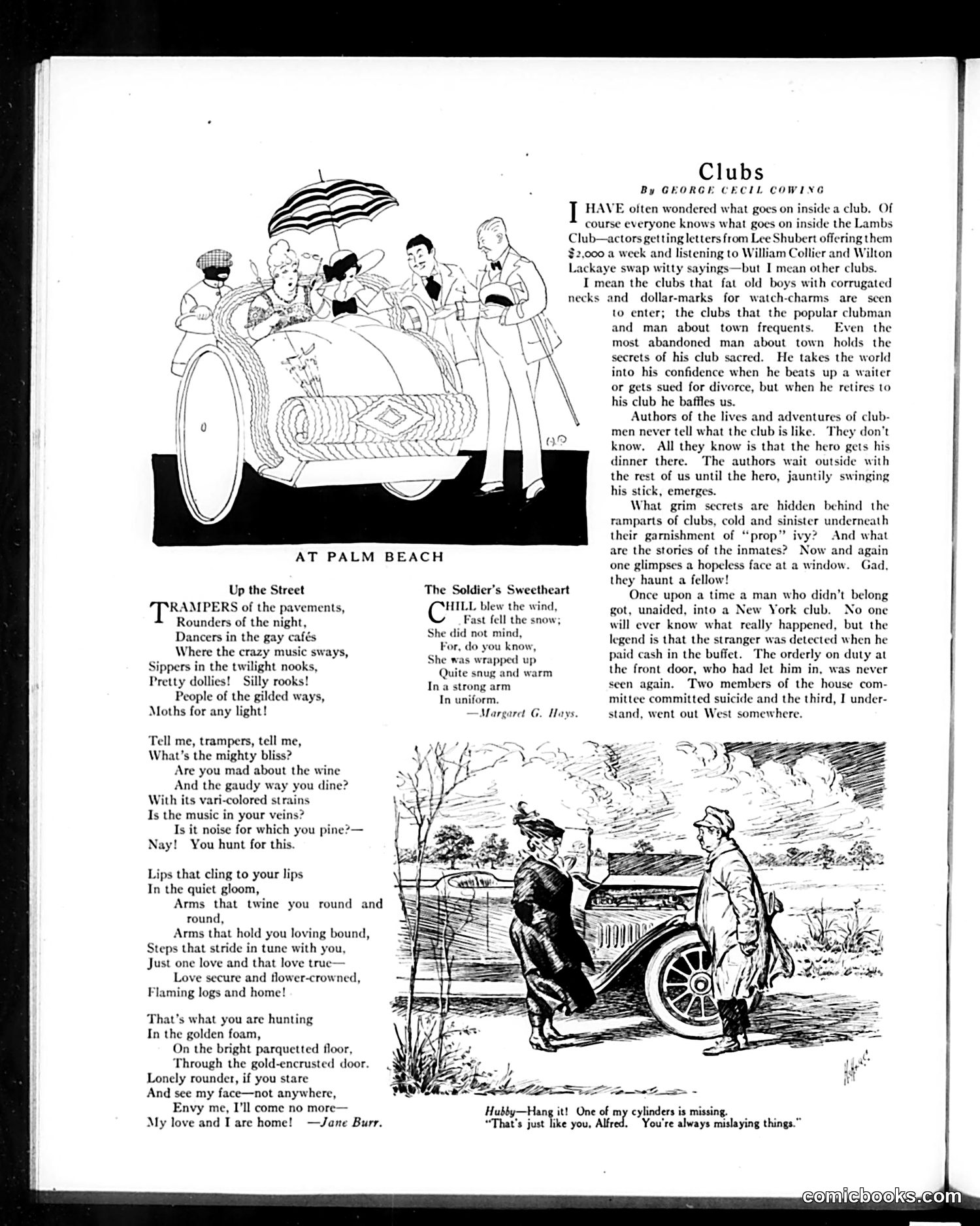
This page contains satirical essays and poetry about exclusive clubs and leisure culture from the Jazz Age era. **"Clubs" essay** (by George Cecil Cowing): A humorous critique of men's clubs as secretive institutions. The author notes that club members guard these spaces zealously—revealing scandals publicly but never club secrets. He mocks the mystery surrounding what actually happens inside, while satirizing the social pretense (clubs filled with wealthy but dull men with "corrugated necks"). The anecdote about an outsider being discovered because he "paid cash" mocks the pretension and exclusivity of such establishments. **"At Palm Beach" illustration**: Shows wealthy leisure-seekers at a fashionable resort in a vintage automobile—depicting the idle rich and their social scene. **Poetry ("Up the Street" and "The Soldier's Sweetheart")**: Contrasts carefree nightlife and hedonism with genuine romantic love and domesticity, a common early 20th-century moral theme. **Bottom cartoon**: A marital joke about a husband blaming his wife for his car problems—typical domestic humor of the era. The overall tone criticizes wealthy club culture and frivolous urban society.
📄 Transcribed text from this page (OCR, searchable)
Machine-transcribed from the original scan — historical spelling and the odd misread are preserved.
AT PALM BEACH Up the Street The Soldier's Sweetheart RAMPERS of the pavements, Cm blew the wind, Rounders of the night, \ Fast fell the snow; Dancers in the gay cafés She did not mind, Where the crazy music sways, For, do you know, ye ay She was wrapped up Sippers in the twilight noo! Quite snug and warm Pretty dollies! Silly rooks lia stiong erm People of the gilded ways, Th naifon. Moths for any light! Tell me, trampers, tell me, What’s the mighty bliss? Are you mad about the wine And the gaudy way you dine? With its vari-colored stra Is the music in your veins? Is it noise for which you pine?— Nay! You hunt for this. Lips that cling to your lips In the quict gloom, Arms that twine you round and round, Arms that hold you loving bound, Steps that stride in tune with you, Just one love and that love true— Love secure and flower-crowned, Flaming logs and home! That's what you are hunting In the golden foam, On the bright parquetted floor, Through the gold-encrusted door. Lonely rounder, if you stare And see my face—not anywhere, ’ Envy me, I'll come no more— My love and I are home! —Jane Burr. I HAV course everyone knows what goes on inside the Lambs Club—actors getting let $2,000 a we Lackay I mean the clubs that fat old boys with corrugated necks and dollar-marks for watch-charms are scen —Margaret G. Hays. Hubby—Hang it! One of my cylinders is missing, “That's just like you, Alfred. Clubs By GEORGE CECIL COWING {ten wondered what goes on inside a club. Of from Lee Shubert offering them and listening to William Collier and Wilton p witty sayings—but I mean other clubs. swa to enter; the clubs that the popular clubman and man about town frequents. Even the most abandoned man about town holds the secrets of his club sacred. He takes the world into his confidence when he beats up a waiter or gets sued for divorce, but when he retires to his club he baffles us. Authors of the lives and adventures of club- men never tell what the club is like. They don’t know. All they know is that the hero gets his dinner there. The authors wait outside with the rest of us until the hero, jauntily swinging his stick, emerges. What grim secrets are hidden behind the ramparts of clubs, cold and sinister underneath their garnishment of “prop” ivy? And what are the stories of the inmates? Now and again one glimpses a hopeless face at a window. Gad, they haunt a fellow! ‘Once upon a time a man who didn’t belong got, unaided, into a New York club. No one will ever know what really happened, but the legend is that the stranger was detected when he paid cash in the buffet. The orderly on duty at the front door, who had let him in, was never seen again. Two members of the house com- mittee committed suicide and the third, I under- stand, went out West somewhere. You're always mislaying things.”