
Judge, 1918-01-19 · page 8 of 28
Judge — January 19, 1918 — page 8: what you’re looking at
What you’re looking at
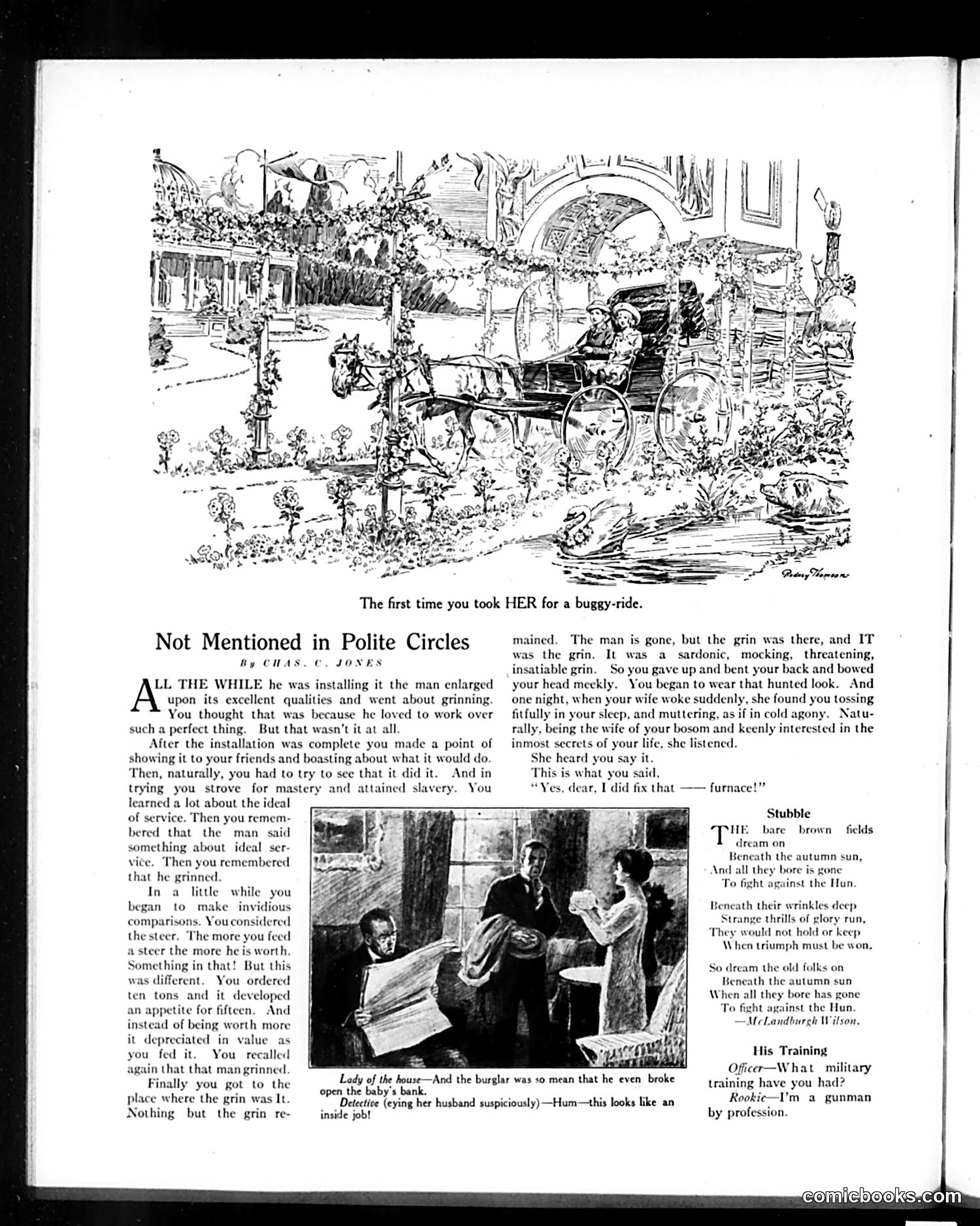
This page contains a satirical story titled "Not Mentioned in Polite Circles" by Charles E. Jones, mocking the frustrations of early household appliance ownership—specifically, a furnace. The narrative follows a man who buys a furnace from an installer with an unsettling, knowing grin. After initial enthusiasm, the furnace becomes a source of misery: it consumes resources (ten tons of fuel, then fifteen), depreciates in value, and enslaves the owner through constant maintenance demands. The grin represents the installer's awareness that the buyer will become a captive customer. The cartoon illustration shows a couple in a horse-drawn buggy, labeled "The first time you took HER for a buggy-ride"—contrasting pre-furnace domestic bliss with post-furnace marital tension. The joke satirizes consumer culture and mechanical dependency: purchasing modern conveniences paradoxically creates servitude rather than freedom. The wife's discovery of her husband muttering about the furnace captures how thoroughly this appliance has consumed his peace of mind. The page also includes unrelated poetry and a brief military joke.
📄 Transcribed text from this page (OCR, searchable)
Machine-transcribed from the original scan — historical spelling and the odd misread are preserved.
Not Mentioned in Polite Circles By CHAS. ©. JONES LL THE WHILE he was installing it the man enlarged A upon its excellent qualities and went about grinning. You thought that was because he loved to work over such a perfect thing. But that wasn’t it at all. After the installation was complete you made a point of showing it to your friends and boasting about what it would do. Then, naturally, you had to try to see that it did it. And in trying you strove for mastery and attained slavery. You learned a lot about the ideal The first time you took HER for a buggy-ride. \ B\ ee eI mained. The man is gone, but the grin was there, and IT was the grin. It was a sardonic, mocking, threatening, insatiable grin. So you gave up and bent your back and bowed your head meekly. You began to wear that hunted look. And one night, when your wife woke suddenly, she found you tossing fitfully in your sleep, and muttering, as if in cold agony. Natu- rally, being the wife of your bosom and keenly interested in the inmost secrets of your life, she listened. She heard you say it. This is what you said, “Yes, dear, I did fix that —— furnace!” of service. Then you remem- bered that the man said something about ideal ser- vice. Then you remembered that he grinned. In a little while you began to make invidious comparisons. You considered the steer. The more you feed a steer the more he is worth. Something in that! But this was different. You ordered ten tons and it developed an appetite for fifteen. And instead of being worth more it depreciated in value as you fed it. You recalled again that that man grinned. Finally you got to the place where the grin was It. Nothing but the grin re- open the baby’s bank. inside job! Detectice (eying her husband suspiciously) —Hum—this looks like an Stubble HE bare brown fields dream on Beneath the autumn sun, And all they bore is gone To fight against the Hun. Beneath their wrinkles deep Strange thrills of glory run, They would not hold or keep When triumph must be wen, So dream the old folks on Beneath the autumn sun bore has gone inst the Hun, —McLandburgh Wilson. His Training Officer—W hat military training have you had? Rookie—I’m a gunman by profession.