
Judge, 1918-01-19 · page 11 of 28
Judge — January 19, 1918 — page 11: what you’re looking at
What you’re looking at
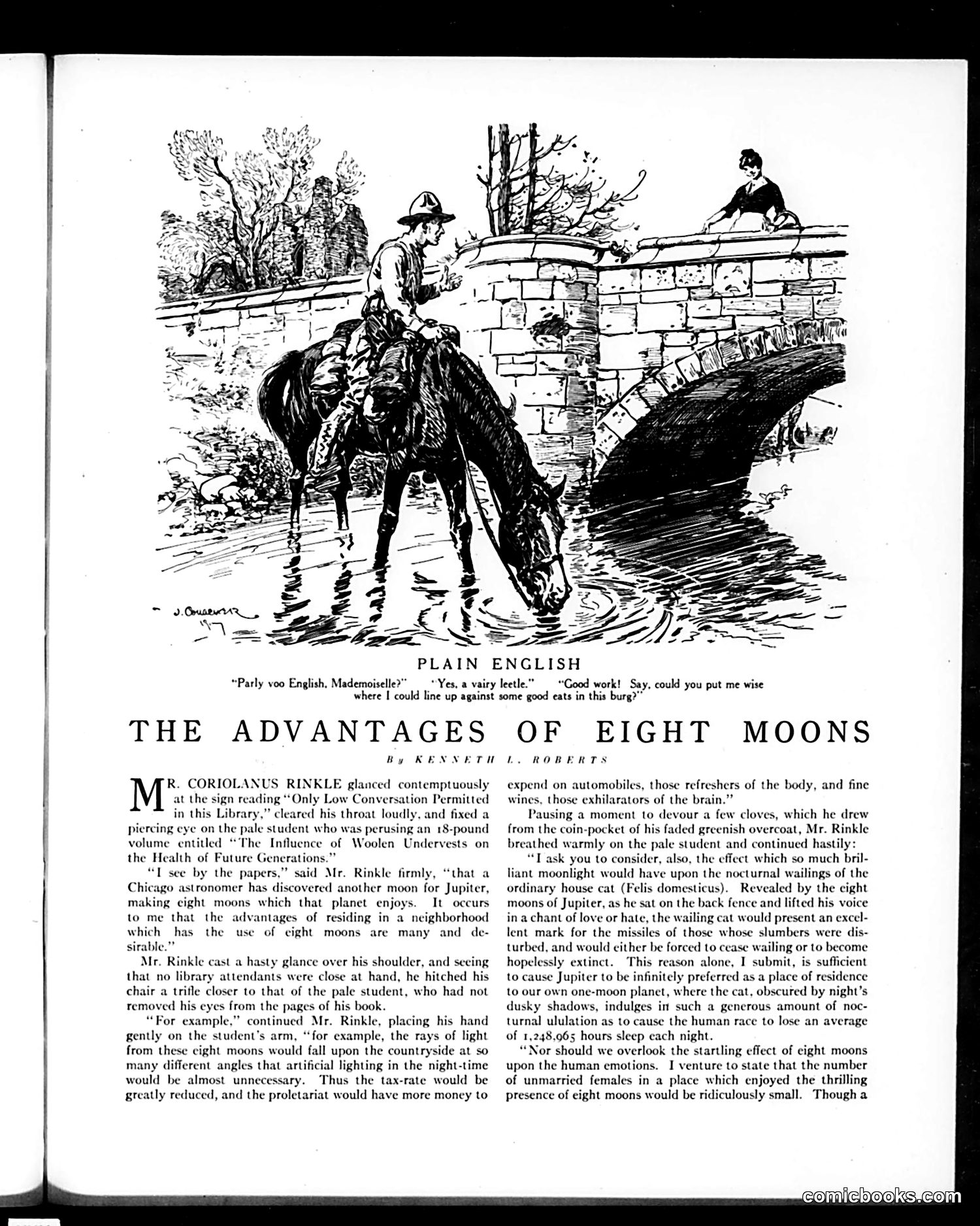
The page contains two pieces of satire: **The cartoon** (top) depicts a soldier on horseback encountering a French woman near a bridge. The "Plain English" caption mocks American servicemen's attempts at communication during WWI—the soldier butchers French ("Parly voo English?") then speaks in crude American slang asking for restaurants ("line up against some good eats in this burg?"). It satirizes American soldiers abroad as culturally insensitive and linguistically incompetent. **The story** is a humorous tall tale by Kenneth L. Roberts about Mr. Rinkle, who interrupts library quiet to lecture a student about Jupiter's eight moons. Rinkle absurdly claims Jupiter would be superior to Earth because: eight moons would eliminate nighttime darkness (reducing taxes), provide enough light to target and eliminate cats making noise, and—most ridiculous—the romantic moonlight would make women marriage-obsessed and thus unavailable. It's satirizing pseudo-intellectual pseudoscience and the absurdity of academic pedantry.
📄 Transcribed text from this page (OCR, searchable)
Machine-transcribed from the original scan — historical spelling and the odd misread are preserved.
“Parly voo English, Mademoiselle?” PLAIN ENGLISH “Yes, a vairy leetle.” “Good work! Say, could you put me wise where I could line up against some good eats in this burg?” THE ADVANTAGES By KENNETH R. CORIOLANUS RINKLE glanced contemptuously at the sign reading “Only Low Conversation Permitted in this Library,” cleared his throat loudly, and fixed a piercing eye on the pale student who was perusing an 18-pound volume entitled “The Influence of Woolen Undervests on the Health of Future Generations.” “I see by the papers,” said Mr. Rinkle firmly, “that a Chicago astronomer has discovered another moon for Jupiter, making cight moons which that planet enjoys. It occurs to me that the advantages of residing in a neighborhood which has the use of cight: moons are many and de- sirable.” Mr. Rinkle cast a hasty glance over his shoulder, and seeing that no library attendants were close at hand, he hitched his chair a trifle closer to that of the pale student, who had not removed his eyes from the pages of his book. “For example,” continued Mr. Rinkle, placing his hand gently on the student's arm, “for example, the rays of light from these cight moons would fall upon the countryside at so many different angles that artificial lighting in the night-time would be almost unnecessary. Thus the tax-rate would be greatly reduced, and the proletariat would have more money to OF EIGHT MOONS L. ROBERTS expend on automobiles, those refreshers of the body, and fine wines, those exhilarators of the brain.” Pausing a moment to devour a few cloves, which he drew from the coin-pocket of his faded greenish overcoat, Mr. Rinkle breathed warmly on the pale student and continued hastily: “Task you to consider, also, the effect which so much bril- liant moonlight would have upon the nocturnal wailings of the ordinary house cat (Felis domesticus). Revealed by the ¢ moons of Jupiter, as he sat on the back fence and lifted his voice in achant of love or hate, the wailing cat would present an excel- lent mark for the missiles of those whose slumbers were di turbed, and would cither be forced to cease wailing or to become hopelessly extinct. This reason alone, I submit, is suffici to cause Jupiter to be infinitely preferred as a place of residence to our own one-moon planet, where the cat, obscured by night’s dusky shadows, indulges in such a generous amount of noc- turnal ululation as to cause the human race to lose an average of 1,248,065 hours sleep each night. “Nor should we overlook the startling effect of eight moons upon the human emotions. I venture to state that the number of unmarried females in a place which enjoyed the thrilling presence of eight moons would be ridiculously small. Though a