
A complete issue · 28 pages · 1917
Judge — October 27, 1917
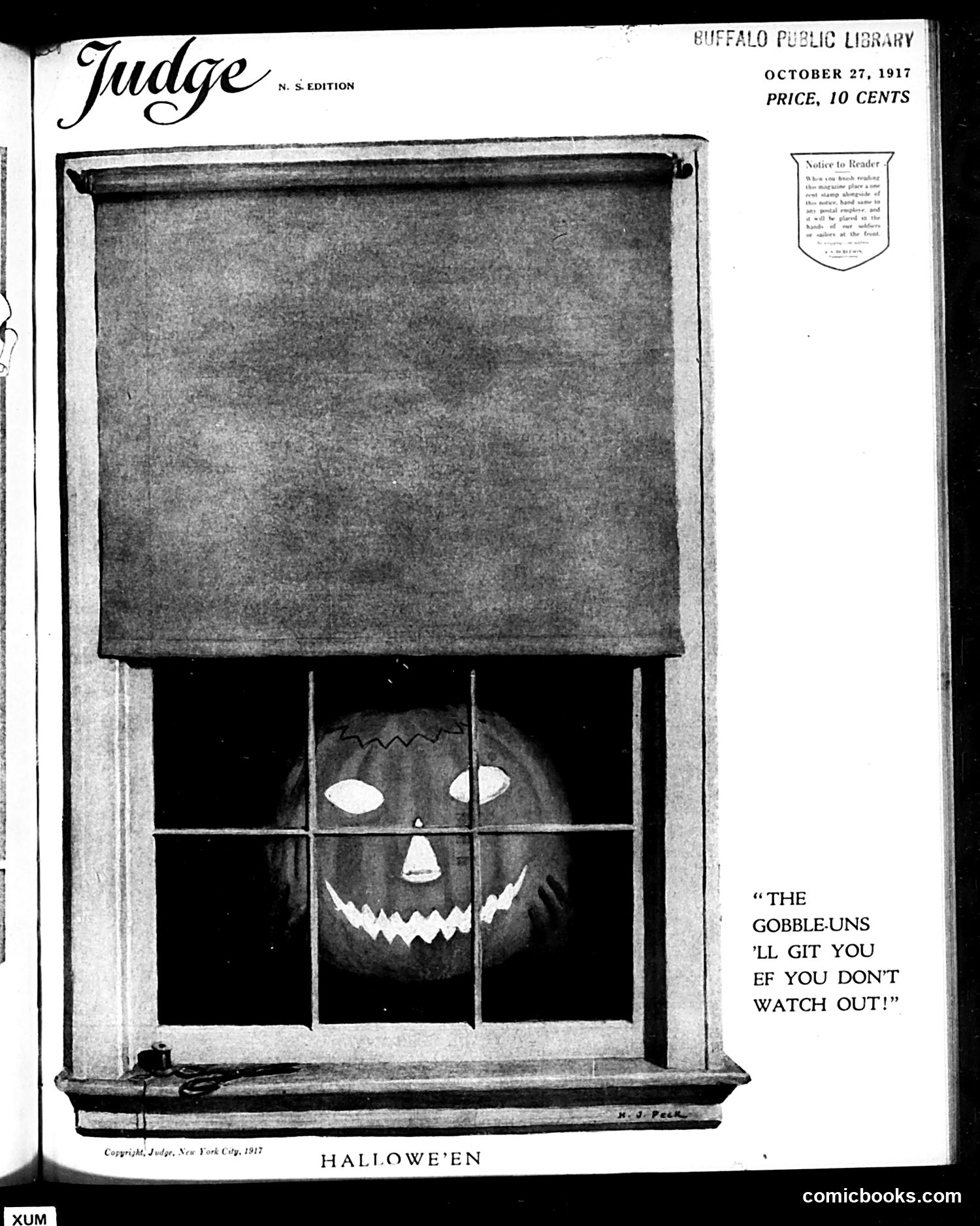
This is a Halloween-themed illustration from Judge magazine (October 27, 1917). The image shows a jack-o'-lantern face peering through a window with the caption: "The Gobble-uns 'll git you ef you don't watch out!" This references a famous children's poem by James Whitcomb Riley called "Little Orphant Annie" (1885), which uses that exact threatening phrase about "gobble-uns" to frighten children into obedience. The cartoon appears to be using this familiar cultural reference for a seasonal Halloween joke rather than making specific political commentary. The menacing pumpkin face serves as simple, recognizable spooky entertainment appropriate for the magazine's October holiday issue. No particular political figures or events appear to be satirized here—it's straightforward seasonal humor.
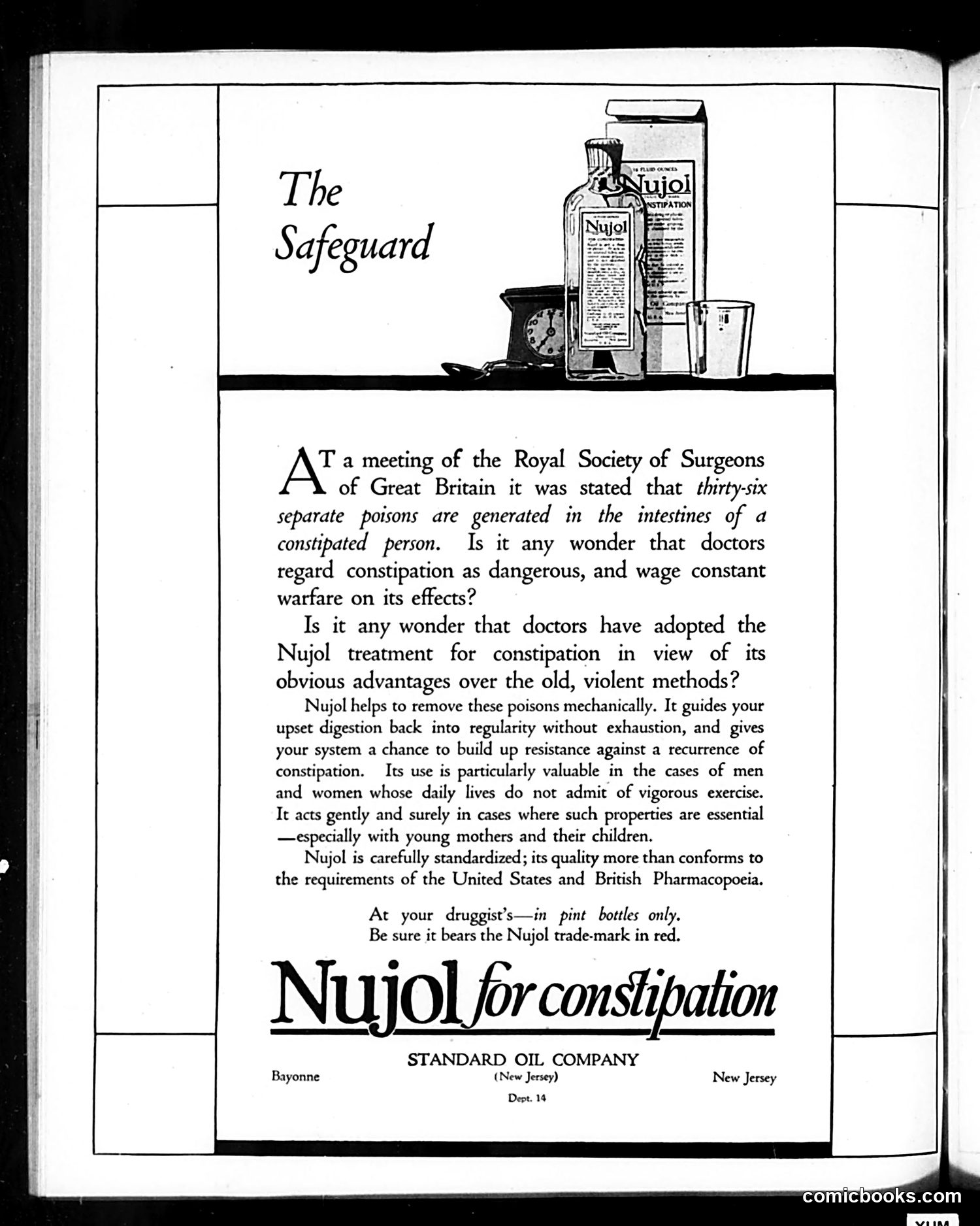
This page is **primarily an advertisement**, not satirical content. It advertises Nujol, a mineral oil laxative made by Standard Oil Company (New Jersey). The ad employs a rhetorical strategy: it cites an authoritative source (the Royal Society of Surgeons of Great Britain) claiming constipation generates "thirty-six separate poisons" in the intestines. This pseudo-scientific claim justifies the product as a gentler alternative to older, harsher purgatives. The marketing targets specific demographics—sedentary people, young mothers, and children—emphasizing Nujol's gentle action. The "Safeguard" headline frames the product as protective health care. This reflects early 20th-century advertising's heavy reliance on medical authority and exaggerated health claims, before modern FDA regulations.
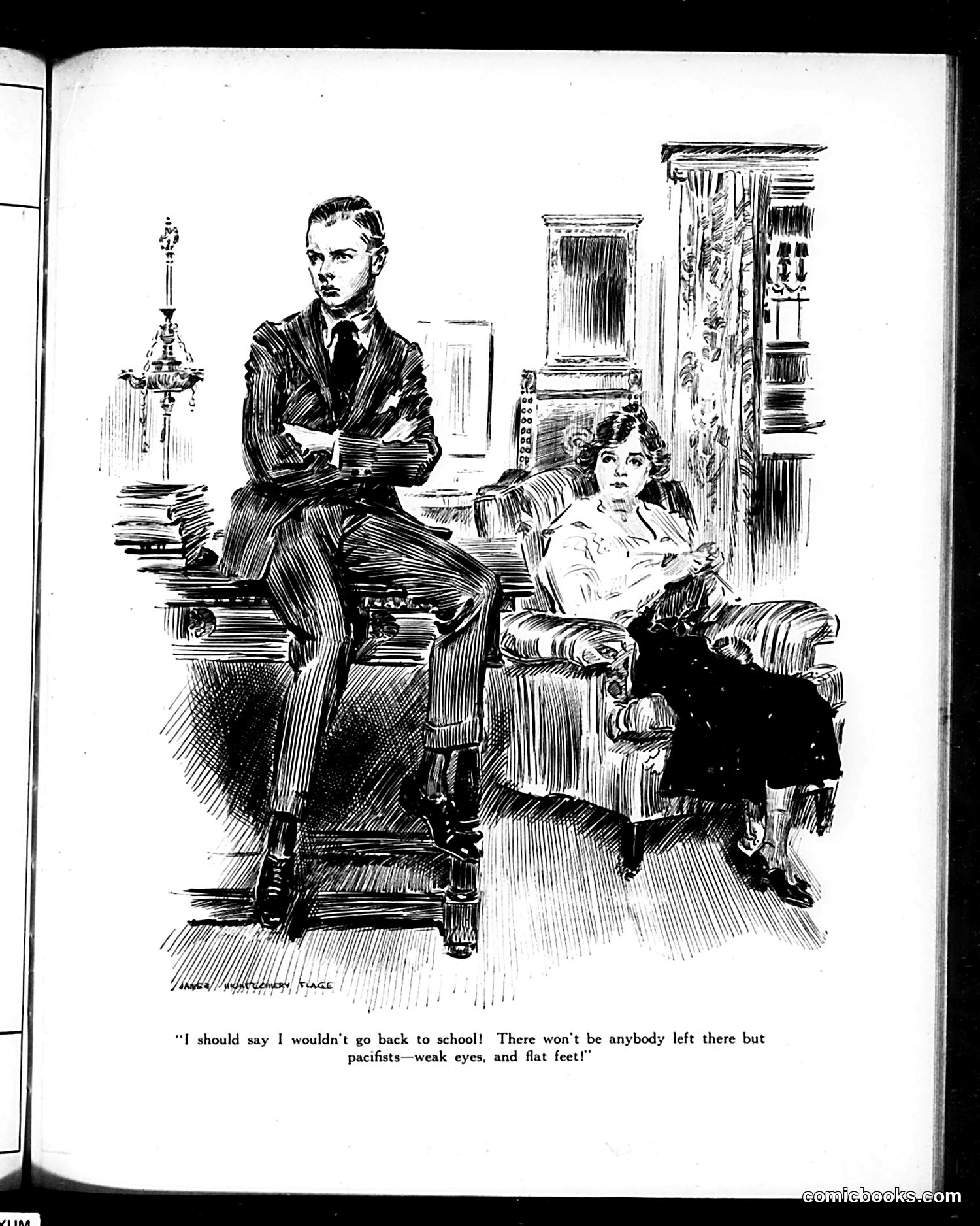
This illustration depicts a domestic scene satirizing attitudes toward education. A well-dressed man sits on a desk while a woman reclines in a chair, discussing schooling. The man's quoted dialogue expresses contempt for returning to school, dismissing fellow students as "pacifists—weak eyes, and flat feet!" The satire targets elitist snobbery about physical fitness and masculinity. The reference to "pacifists" likely dates this to the World War I era (1910s-1920s), when pacifism was politically contentious and associated with perceived weakness. The cartoon mocks the speaker's shallow social prejudices and physical vanity—judging people's worth by superficial characteristics rather than intellect or character. The humor relies on depicting such attitudes as absurd and laughable to Judge's educated readership.
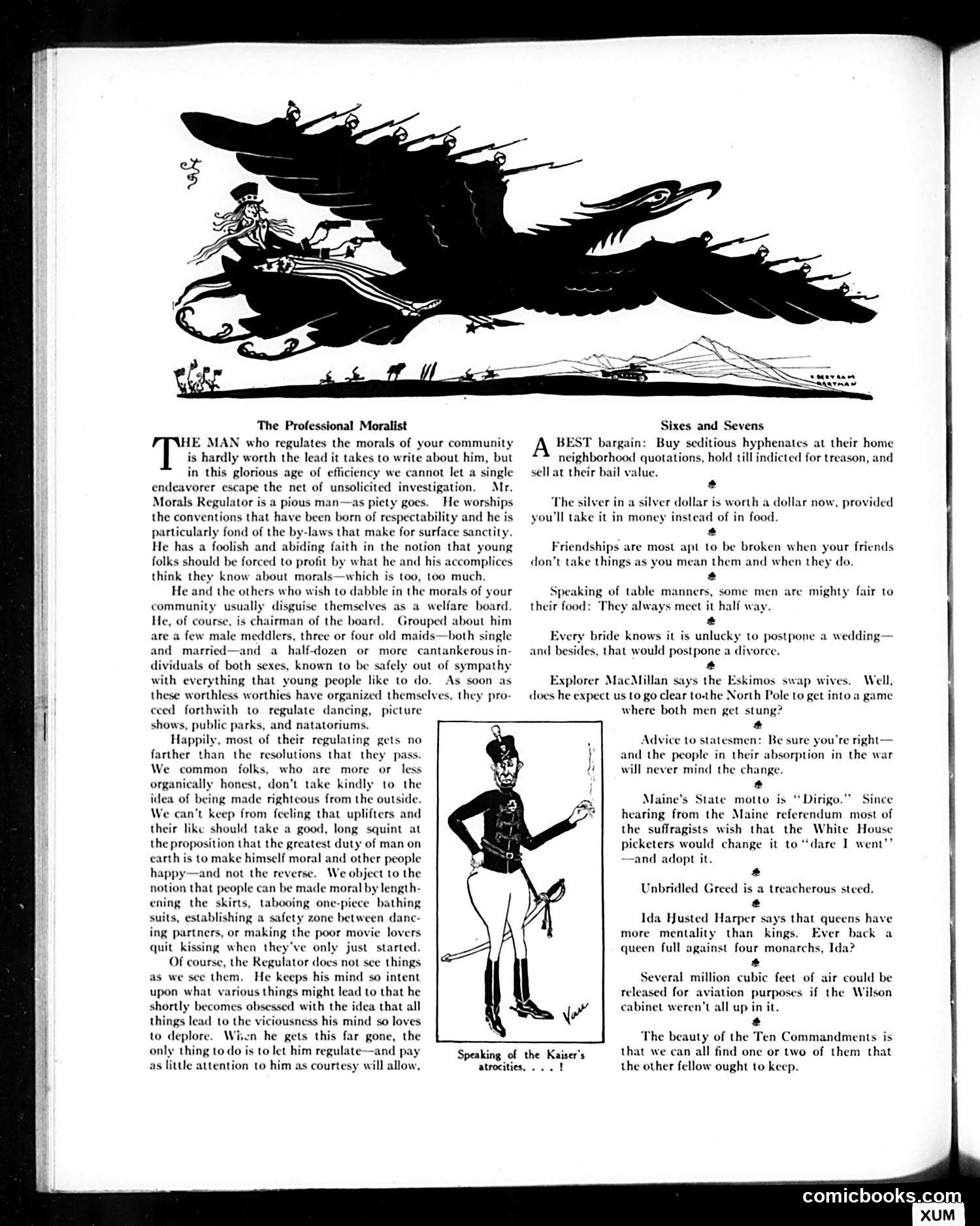
The main illustration depicts a figure riding a dragon-like creature, labeled "Speaking of the Kaiser's atrocities." This is a WWI-era satire mocking German Kaiser Wilhelm II's military conduct. The fantastical beast suggests exaggeration of German war crimes reports circulating during the conflict. The "Professional Moralist" essay critiques self-righteous community figures who regulate others' morality while ignoring their own hypocrisy—a common Judge target. "Sixes and Sevens" contains brief satirical observations on contemporary social issues: marriage, friendship, dining etiquette, and politics (referencing Maine's state motto "Dirigo" and suffragist concerns). The overall page blends visual satire with political commentary typical of Judge's format during the World War I period.
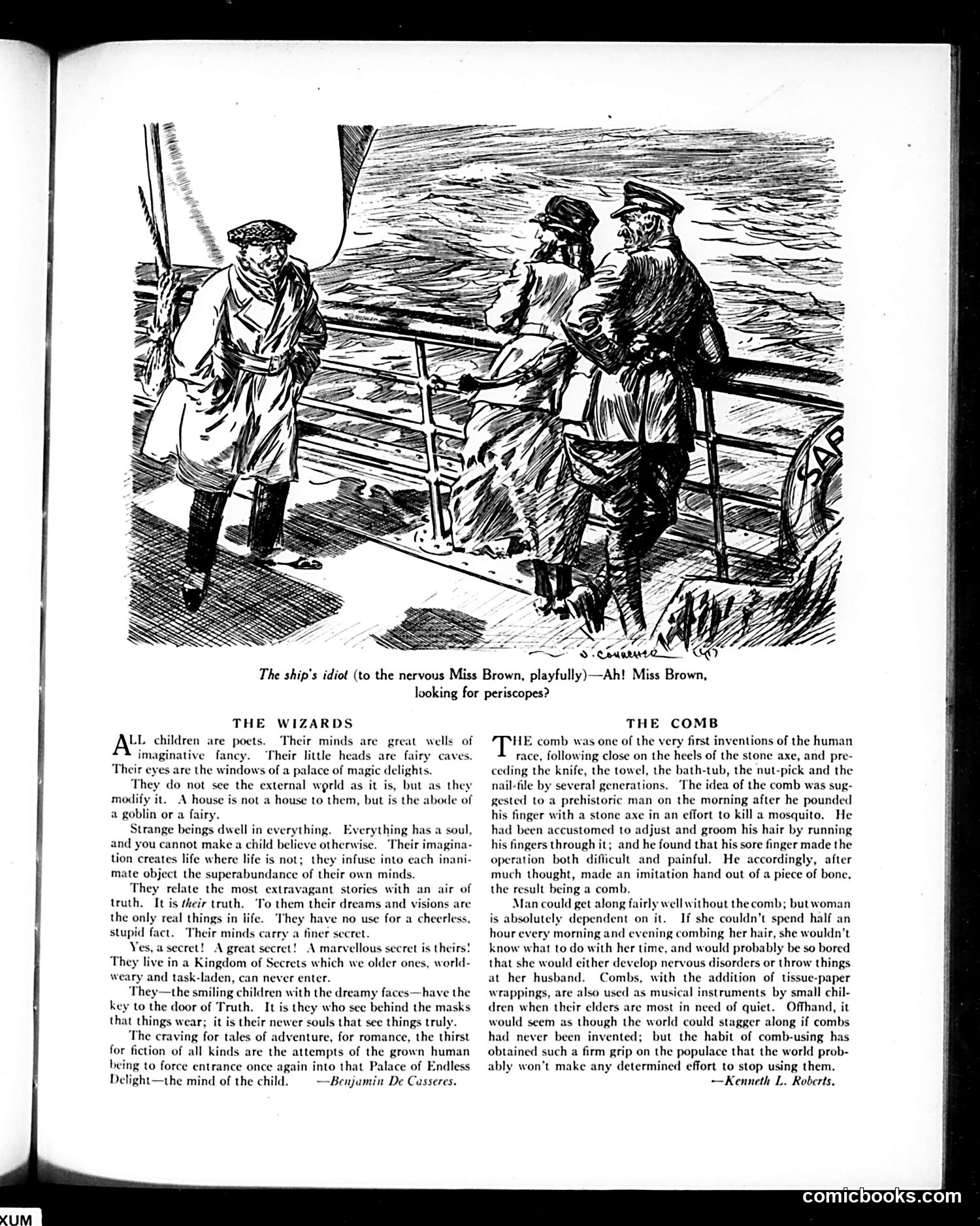
The cartoon depicts a ship's deck scene where a male officer addresses a nervous woman identified as "Miss Brown," joking about her looking for periscopes—a reference to submarine warfare. This appears to be WWI-era humor, playing on contemporary anxieties about German U-boats and the nervousness such threats created among civilians and passengers on ships. The accompanying text essays ("The Wizards" and "The Comb") are unrelated to the cartoon. They're philosophical pieces about children's imagination and the history/utility of combs, respectively. The cartoon's humor relies on gallows wit about wartime danger, treating submarine threats as an occasion for flirtation and masculine joshing of an anxious woman passenger.
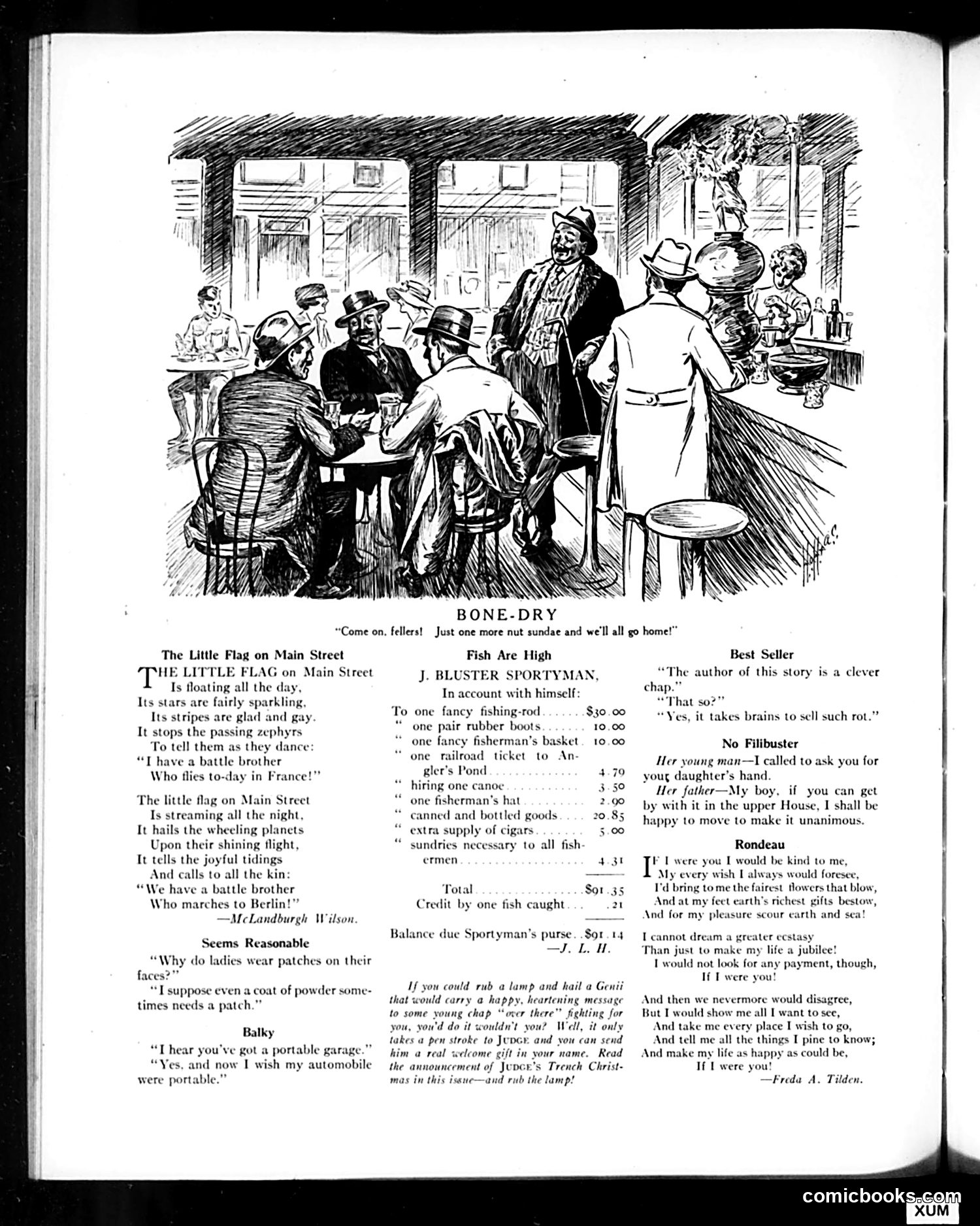
The main cartoon depicts a bar or saloon scene with the caption "Come on, fellas! Just one more nut sundae and we'll all go home!" This appears to be satire about **Prohibition-era drinking culture**. The joke seems to reference how people disguised alcohol consumption during Prohibition by ordering seemingly innocent items like "nut sundaes" at soda fountains and bars. The humor lies in the transparent pretense—everyone knows they're not actually there for dessert. The surrounding text includes various short humorous pieces and poems typical of Judge magazine's satirical format. These lack clear political references but demonstrate the magazine's focus on social commentary through wordplay and situational comedy. Without clearer context about the specific publication date, precise identification of any political figures remains uncertain. The content overall reflects early-20th-century American urban social life and Prohibition-era anxieties.
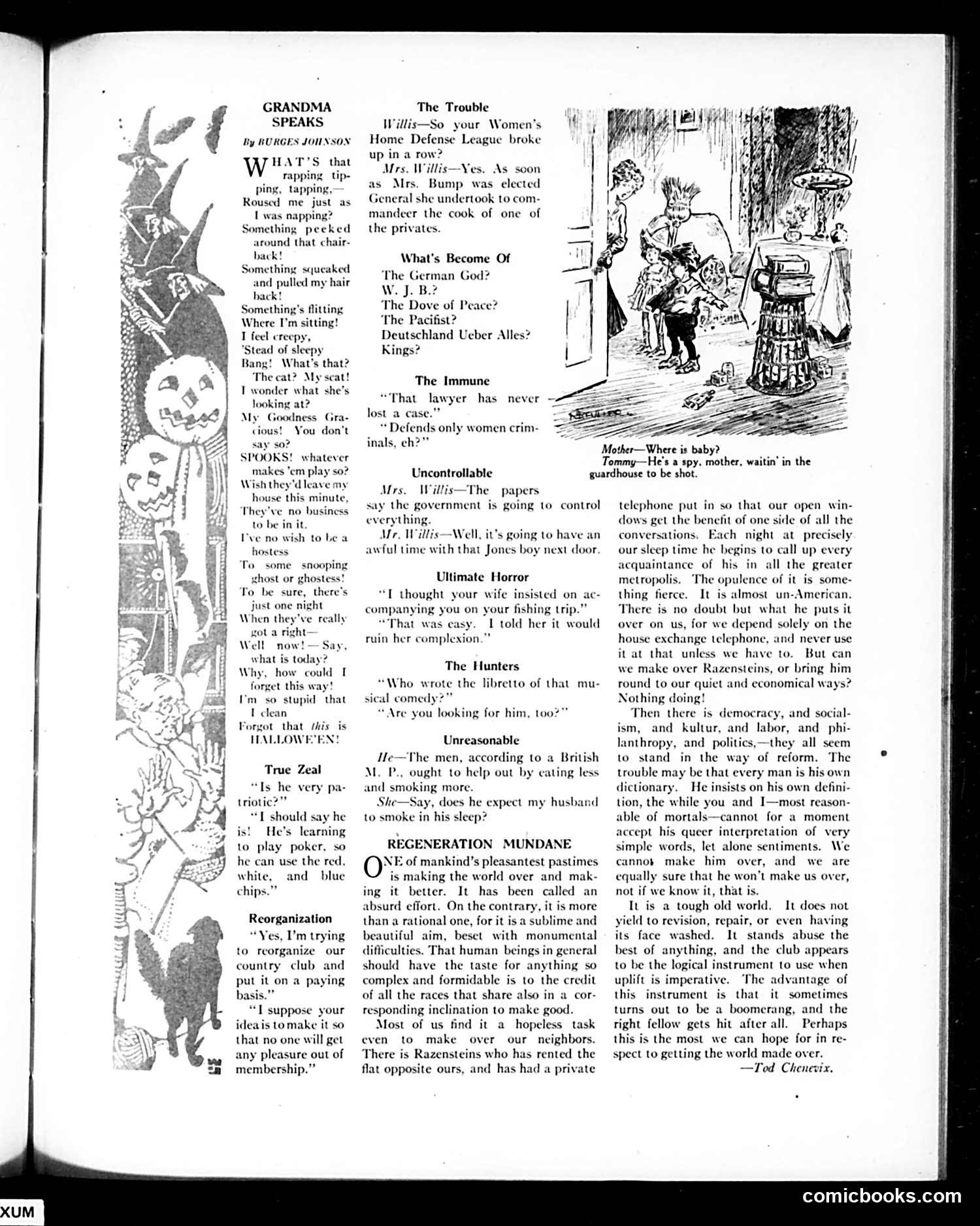
This page from *Judge* contains multiple brief satirical pieces typical of the era: **"Grandma Speaks"** is a humorous Halloween poem by Burgess Johnson about an elderly woman startled by supernatural activity, only to realize it's October 31st—the one night ghosts have "a right" to intrude. **Short jokes** mock contemporary concerns: a women's Home Defense League breaking up over class conflict when a new general commandeers a private's cook; government control anxieties; a lawyer who only defends female criminals; and a husband escaping a fishing trip by claiming it will ruin his wife's complexion. **"Regeneration Mundane"** is a longer essay-like piece critiquing humanity's impulse to reform the world while failing at smaller tasks—exemplified by an annoying neighbor (Razenstein) with a private telephone who disrupts the author's peace. It suggests that democracy, socialism, labor politics, and philanthropy all obstruct reform because everyone has idiosyncratic definitions preventing agreement on solutions. The magazine targets early 20th-century anxieties: suffrage movements, government expansion, class divisions, and progressive reform movements.
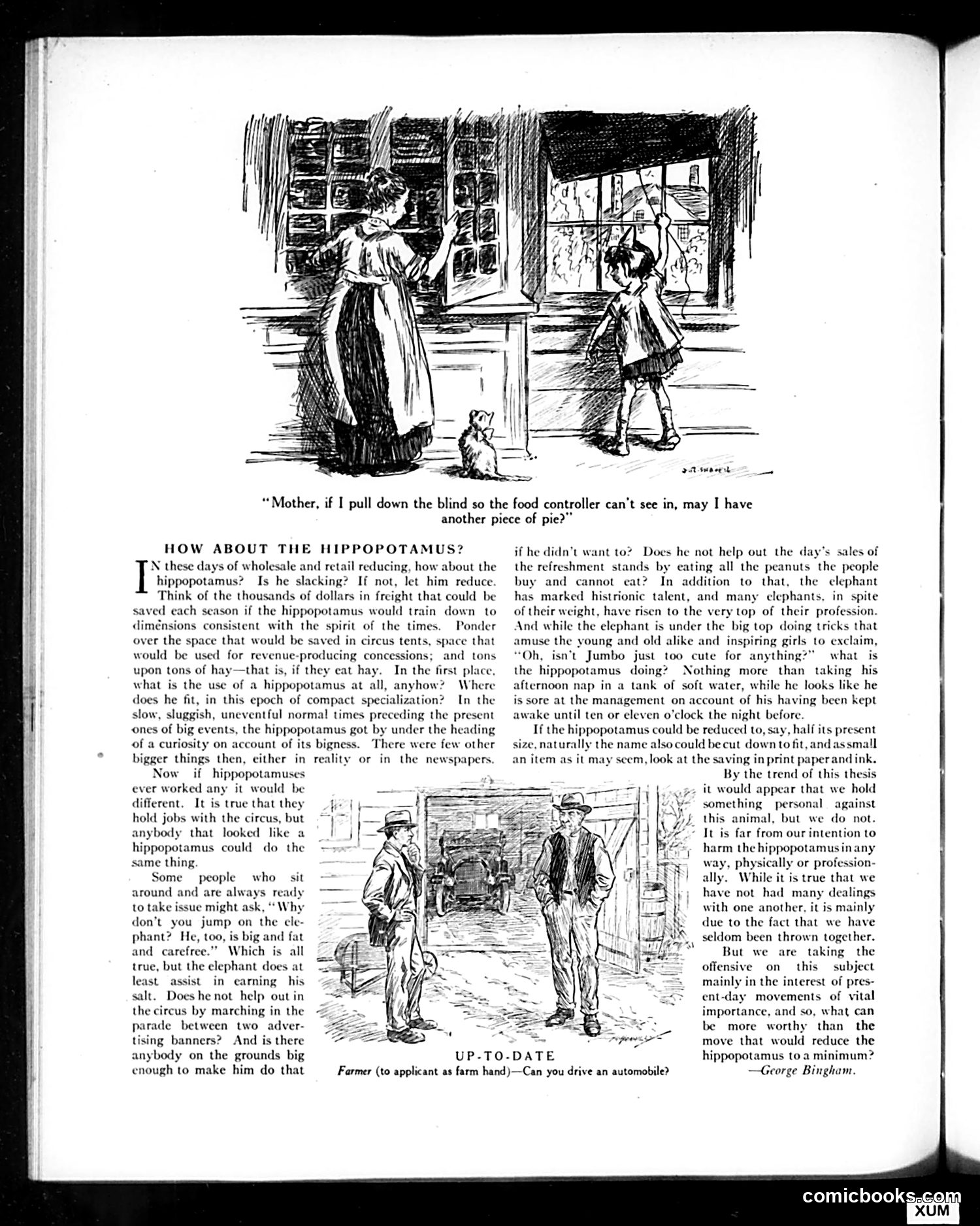
**Top Cartoon:** A mother and child at a window during wartime rationing. The child asks permission to eat more pie if they close the blind so "the food controller can't see in." This satirizes the tension between food rationing enforcement and family desires—the joke is that hiding from official oversight might allow rule-breaking. **Main Article "How About the Hippopotamus?":** This is satirical commentary on WWI-era conservation efforts. The author argues that circus hippopotamuses are useless and wasteful—they eat enormous amounts of hay, consume freight space, and contribute nothing to wartime efforts. By contrast, elephants earn their keep by performing, attracting crowds, and selling peanuts. The hippopotamus just naps and appears resentful. The satire's target appears to be inefficiency and waste during wartime, using the hippopotamus as a metaphor for any non-productive entity that consumes valuable resources. The piece advocates for reducing the animal's size or eliminating it entirely, even calculating savings in "print paper and ink." **Bottom Cartoon:** A farmer interviews an applicant for farm work, asking if they can drive an automobile—reflecting post-war mechanization of agriculture.
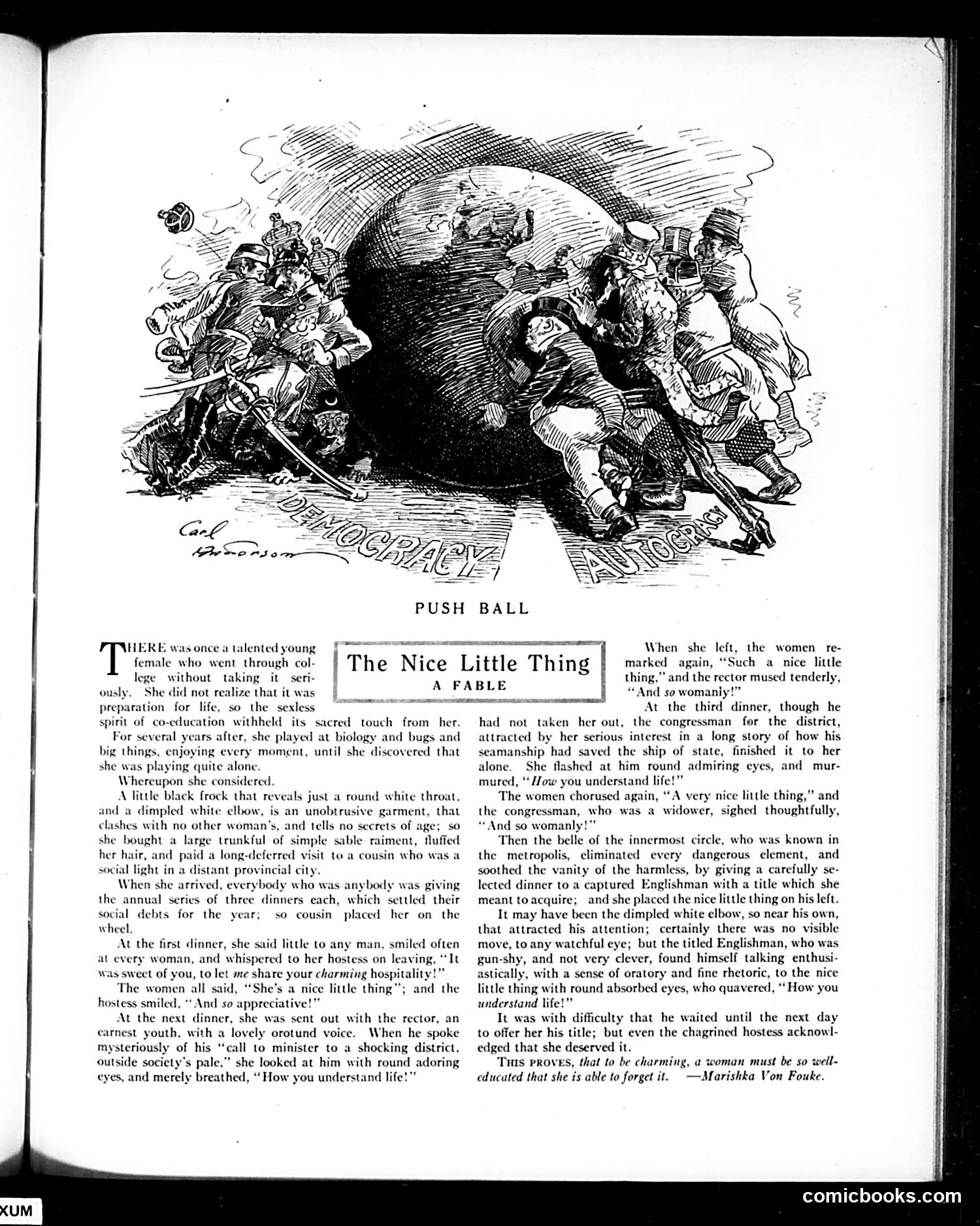
**The Cartoon**: The top illustration depicts a massive spherical object labeled "Democracy" and "Autocracy" being pushed by crowds of figures on opposite sides—a metaphor for competing political forces struggling for dominance, likely referencing tensions between democratic and autocratic systems in the early 20th century. **The Fable**: This satirical story mocks the "accomplished woman" ideal. A college-educated woman discovers her education hasn't prepared her for social life, so she reinvents herself as a demure, admiring listener. By simply flattering men's egos—the rector, congressman, and titled Englishman—she gains social acceptance and ultimately marries nobility. **The Satire's Point**: The fable critiques both women's education and social expectations. It suggests that regardless of intellectual preparation, women advance socially only by performing flattery and deference to men. The moral (attributed to "Marishka Von Fouke") ironically claims "charming" women must be educated enough to *hide* their education—exposing how women's advancement required intellectual self-erasure rather than genuine equality.
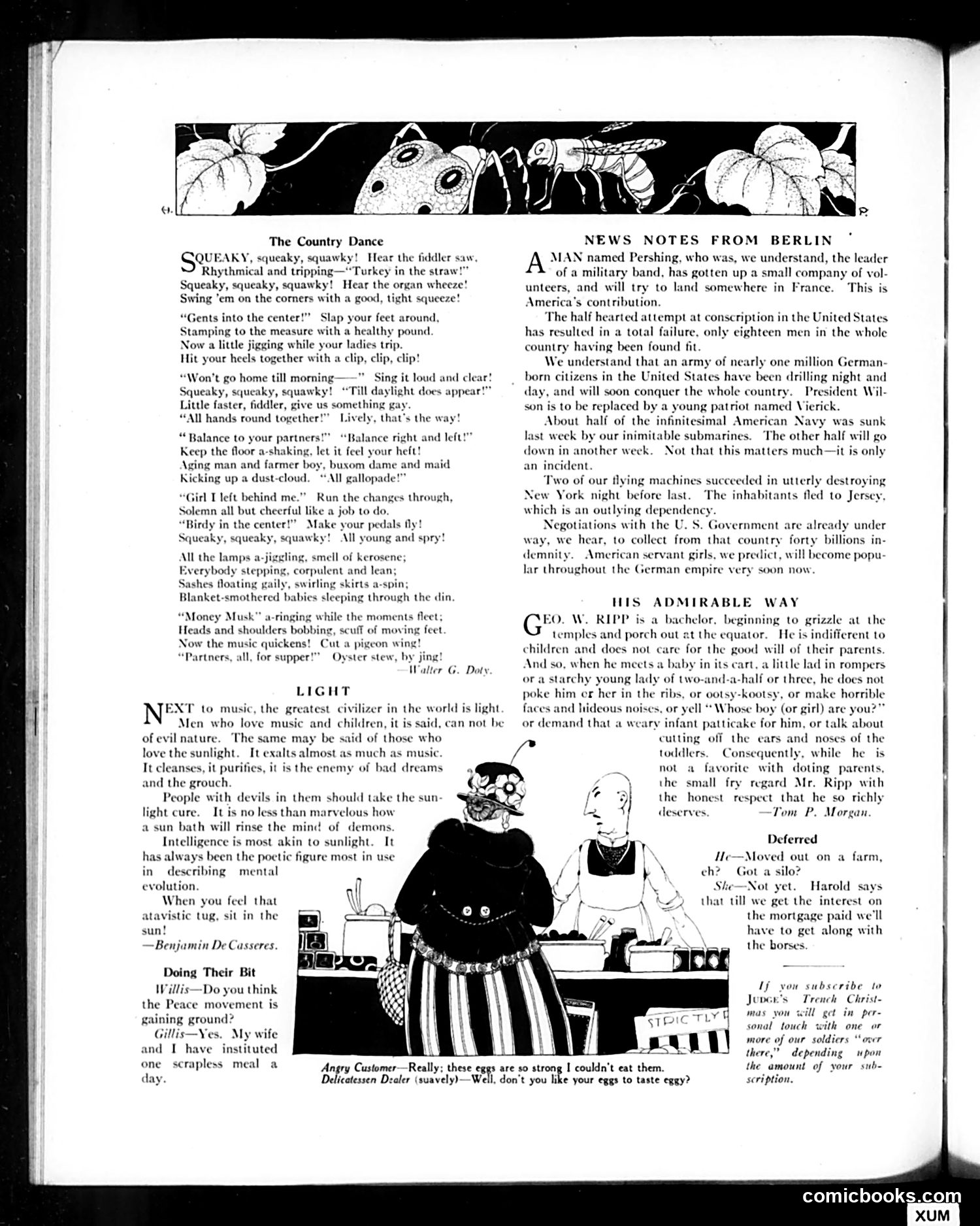
This is a multi-part satirical page from during World War I (likely 1917-1918 based on references to Pershing and conscription). **"News Notes from Berlin"** is mock German propaganda—obviously written from the enemy's perspective to ridicule German boasts about American weakness. It mocks Germany's overconfident claims: that Pershing is just a band leader, the draft failed, German-Americans will conquer America, submarines are sinking U.S. ships wholesale, and America can be forced to pay indemnities. The satire's point is exposing how absurd German expectations were. The cartoon below, titled "Angry Customer," depicts a domestic dispute over strong eggs—a commentary on food rationing and the "scrapless meal" mentioned in "Doing Their Bit," where Americans voluntarily reduced consumption to support the war effort. The remaining content—romantic and light-hearted pieces on dancing, sunlight, and a bachelor character—represents typical Judge magazine humor between weightier wartime commentary. The entire page balances patriotic war support with humor and social observation.
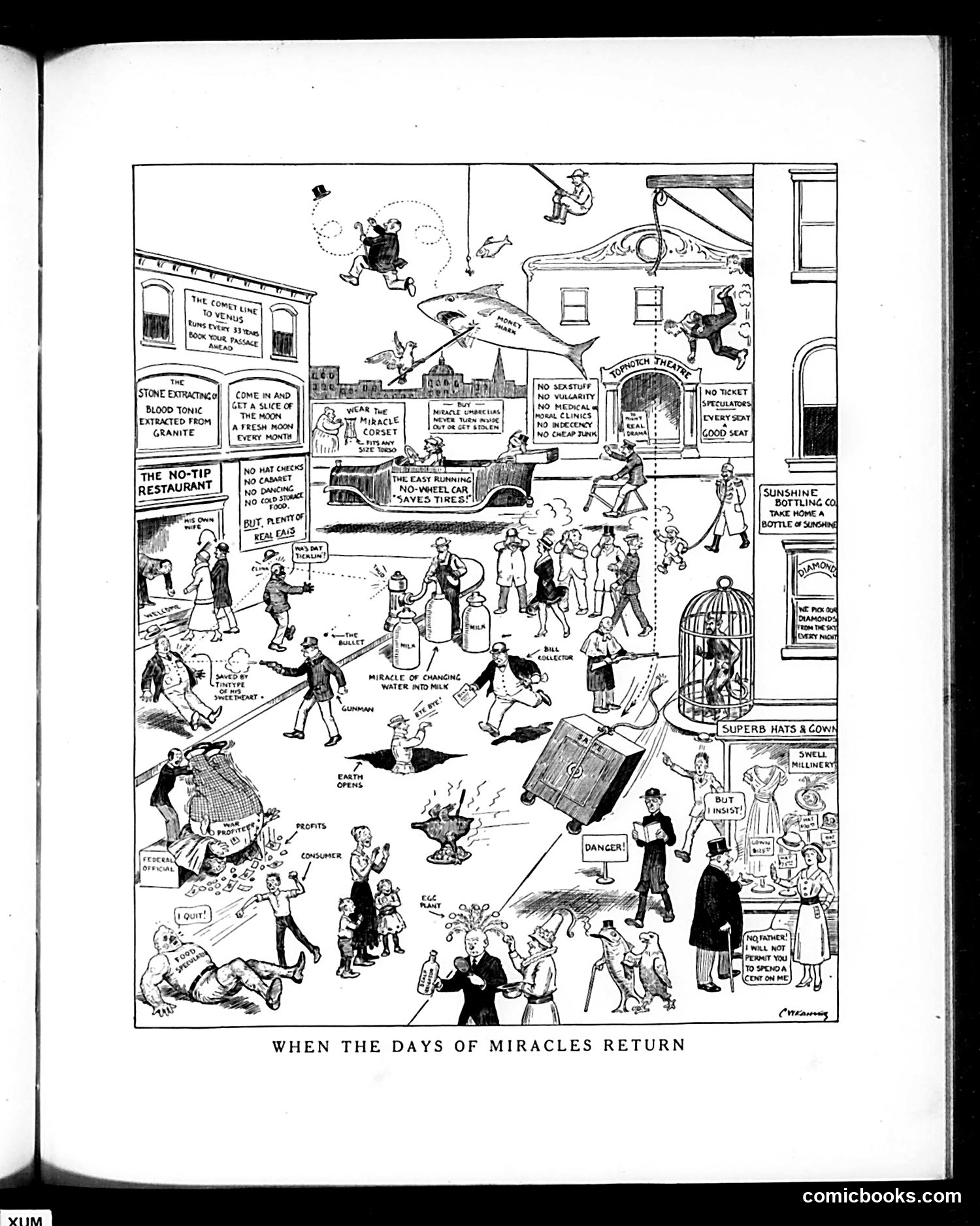
This is a satirical cartoon depicting a chaotic street scene imagining what would happen if biblical miracles became modern commercial products. The cartoon mocks both contemporary advertising and religious faith through exaggeration. Visible "miracle" vendors include: a blood tonic extracted from granite, a corset business, a "no-ticket" restaurant, a shark being sold as a miraculous catch, water-to-milk conversion (referencing the biblical miracle at Cana), and various other impossible or fraudulent products. The satire targets: - **Patent medicine fraud** (common in this era) - **False advertising claims** - **Consumer gullibility** - The notion that miraculous thinking pervades everyday commerce The packed, chaotic street scene suggests how absurd yet believable these miraculous claims seem to gullible crowds—satirizing both religious credulity and the snake-oil salesman culture of early 20th-century America.
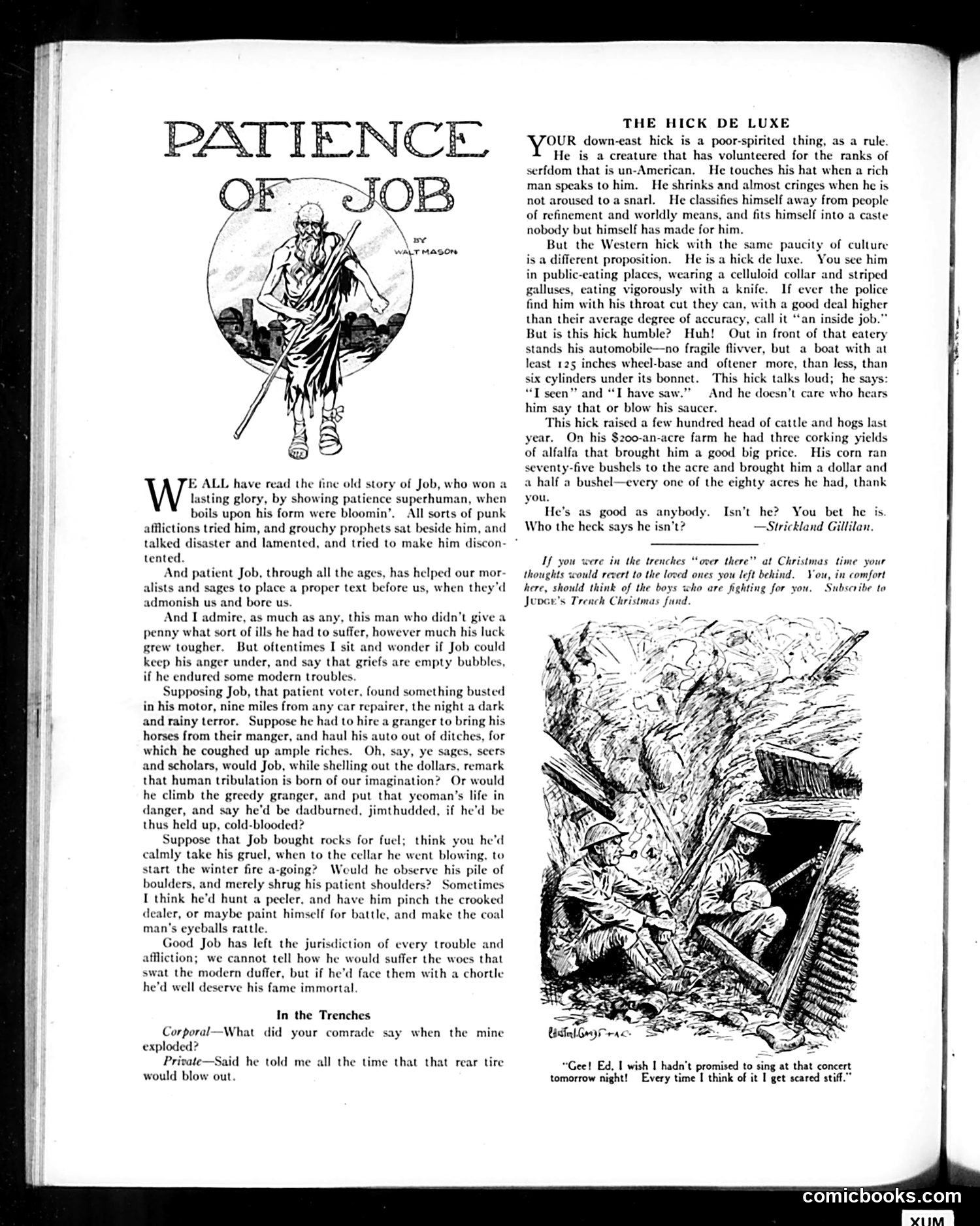
This article uses the biblical Job—famous for enduring suffering without complaint—as a foil to mock modern Americans' impatience with everyday troubles. The author argues that while Job maintained virtue through ancient hardships, a contemporary man facing modern inconveniences (a broken car motor, dishonest repair costs, defective heating fuel) would likely lose his temper and resort to violence rather than philosophical acceptance. The satire suggests modern frustrations—financial exploitation by service providers, shoddy goods—test patience more severely than Job's afflictions. The accompanying piece, "The Hick de Luxe," contrasts Eastern rural deference with Western rural arrogance. The Western farmer, despite modest education, flaunts wealth through an expensive automobile and loud behavior, embodying a new American type: prosperous but crude. Both pieces reflect early-20th-century anxiety about modern life's stresses and changing social hierarchies.
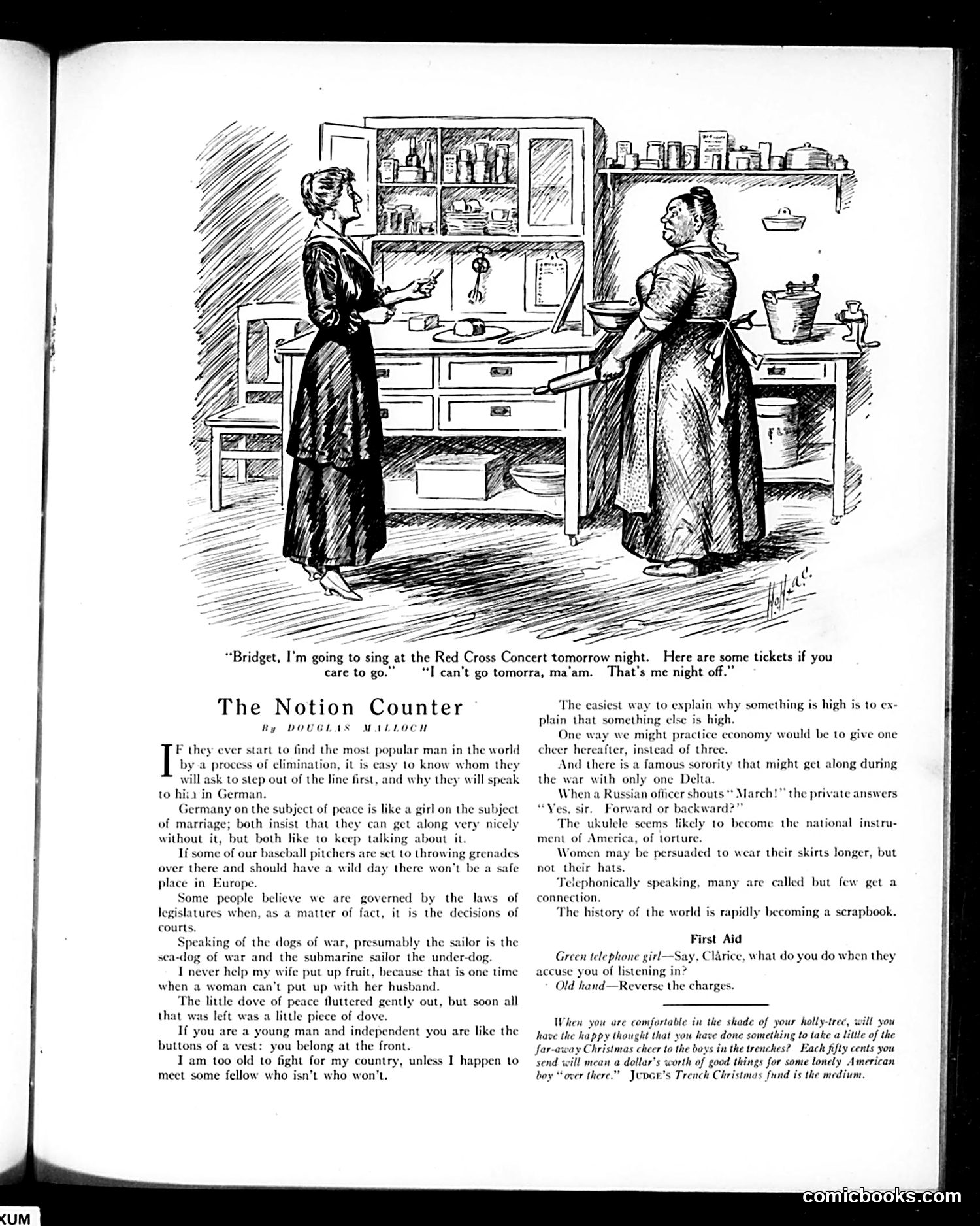
This page from Judge combines a cartoon vignette with Douglas Malloch's satirical column on WWI-era American life. The cartoon depicts two working-class women in a kitchen; one offers concert tickets to the other, who declines because "that's me night off"—a relatable domestic humor moment. Malloch's column consists of brief, biting observations about American society during WWI. He satirizes Germany's duplicitous peace rhetoric, criticizes young men expected to fight ("buttons of a vest: you belong at the front"), jokes about women's fashion and the ukulele becoming "the national instrument...of torture," and mocks telephone operators who listen in on calls. The humor turns patriotic at the end, promoting the YMCA's "Trench Christmas fund" for soldiers abroad—shifting from cynical social commentary to wartime fundraising appeal. The overall tone reflects American anxieties and gallows humor about the distant war.
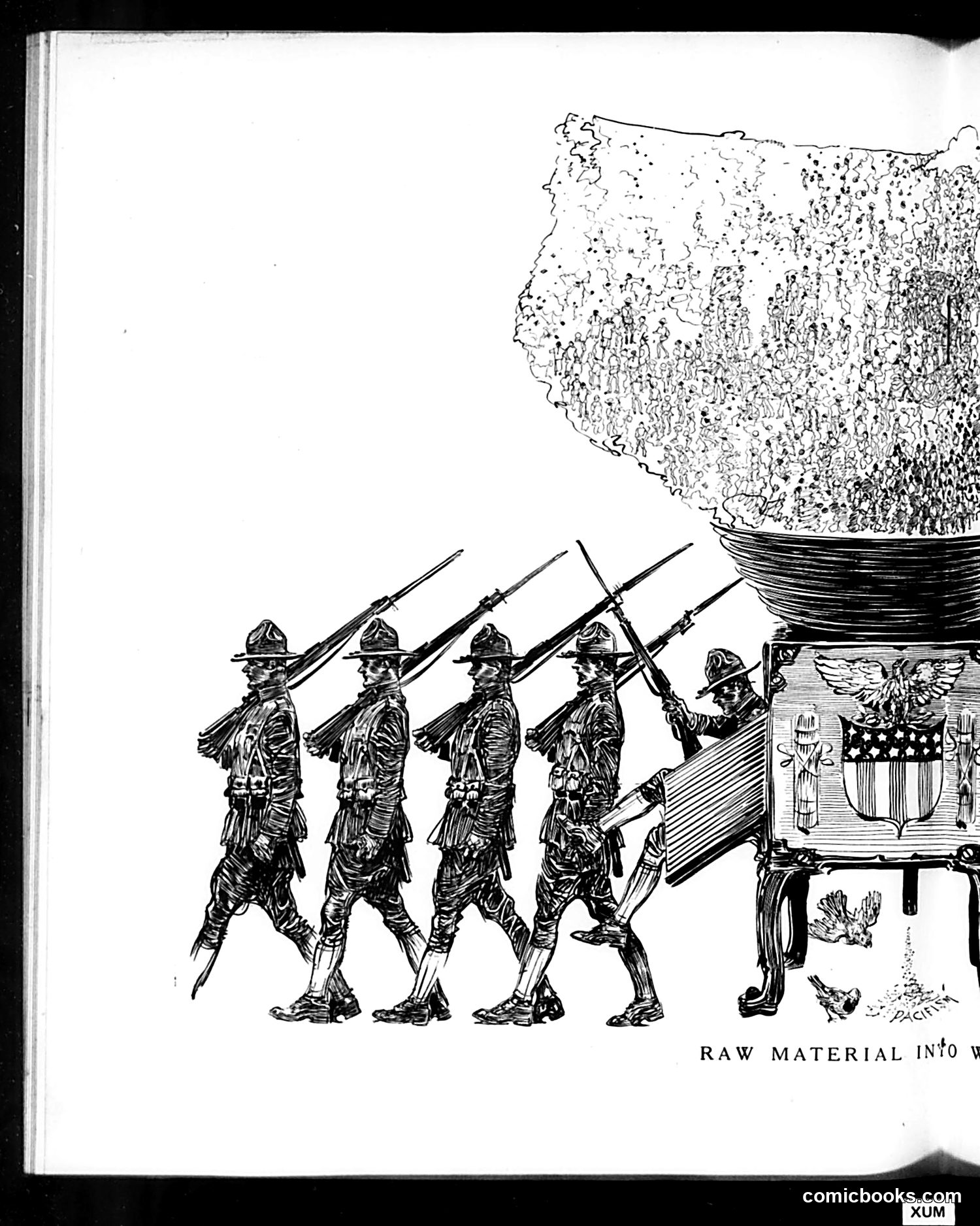
This political cartoon depicts four soldiers marching in formation, each carrying a rifle with bayonet, alongside what appears to be a military or governmental figure on the right. Above them is a map of what looks like the western United States. The title "RAW MATERIAL INTO..." (text cut off) suggests the cartoon's theme concerns converting raw materials into something else—likely military personnel or war production. Given Judge magazine's satirical nature, this appears to critique American military recruitment or conscription, portraying soldiers as "raw material" to be processed. The cartoon likely comments on militarization or preparedness during a period of geopolitical tension, though the specific historical moment remains unclear without the complete caption and date.
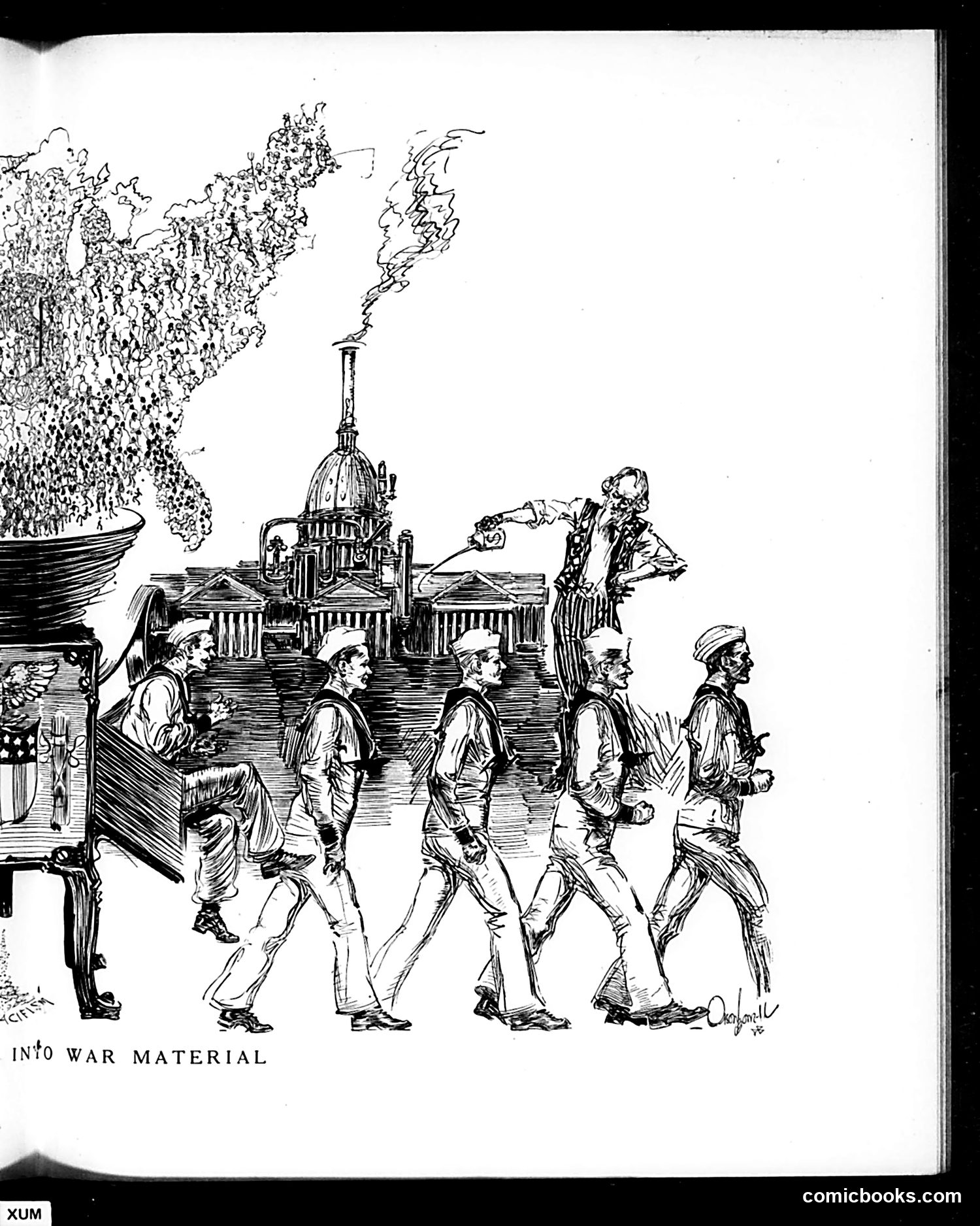
This is labeled "INFO WAR MATERIAL," suggesting it's wartime propaganda or satirical commentary. The cartoon depicts five soldiers marching in formation past a classical domed building (likely representing government or civic institutions). Above them, a well-dressed figure with a raised arm appears to be directing or commanding them—a gesture suggesting authoritarian control or manipulation. The composition satirizes military mobilization and governmental direction of war efforts. The contrast between the ordinary enlisted men (shown realistically) and the commanding figure (depicted in exaggerated, theatrical pose) suggests the cartoon critiques how distant leadership directs common soldiers. The "info war material" label implies this addresses propaganda, misinformation, or the gap between official narrative and soldier reality during wartime.
This is a theatrical review disguised as social commentary. The piece discusses "The Scrap of Paper," a play featuring actor Ellis as a clever criminal named "Handsome Harry" Mack—a character based on a real embezzler who stole $200,000. The satire targets two things: First, the public's romanticization of "clever rascals," exemplified by the country girl's admiration for the criminal character. The City Man defends this by noting society has always admired intelligent wrongdoers. Second, it mocks melodrama conventions—the absurdity that a plot hinges entirely on a single sheet of paper blown by wind, requiring police ("bulls") to appear foolish while the criminal nearly escapes. The author uses this theatrical discussion to satirize both theatrical artifice and urban sophistication, contrasting naive country sensibilities with jaded New York attitudes toward crime and entertainment.
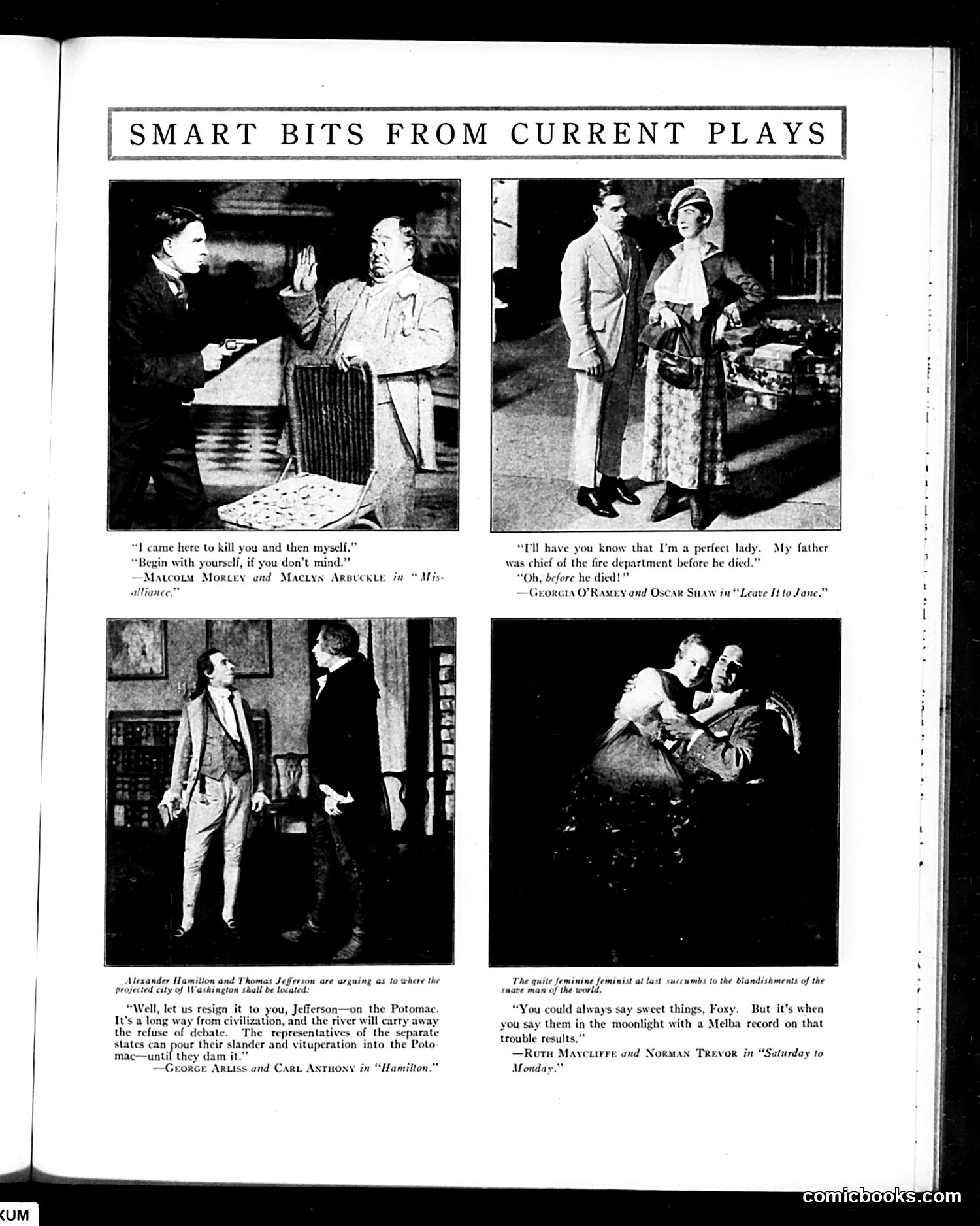
This page presents witty dialogue excerpts from Broadway productions of the era. The four scenes showcase comedic one-liners from popular plays: 1. **"Misalliance"**: A character's self-deprecating joke about beginning suicide with oneself. 2. **"Leave It to Jane"**: Social satire on pretension—a woman claims gentility by referencing her father's prestigious position, then awkwardly adds "before he died," undermining her snobbish effect. 3. **"Hamilton"**: A historical comedy where Jefferson and Hamilton argue over Washington D.C.'s location, with crude wordplay about politicians pouring "slander and vituperation" into the Potomac River like refuse. 4. **"Saturday to Monday"**: A romance scene where a woman warns that sweet words work only in specific romantic settings—implying their hollowness elsewhere. The page mocks social pretension, political corruption, and romantic manipulation through clever dialogue, reflecting early 20th-century theatrical humor.
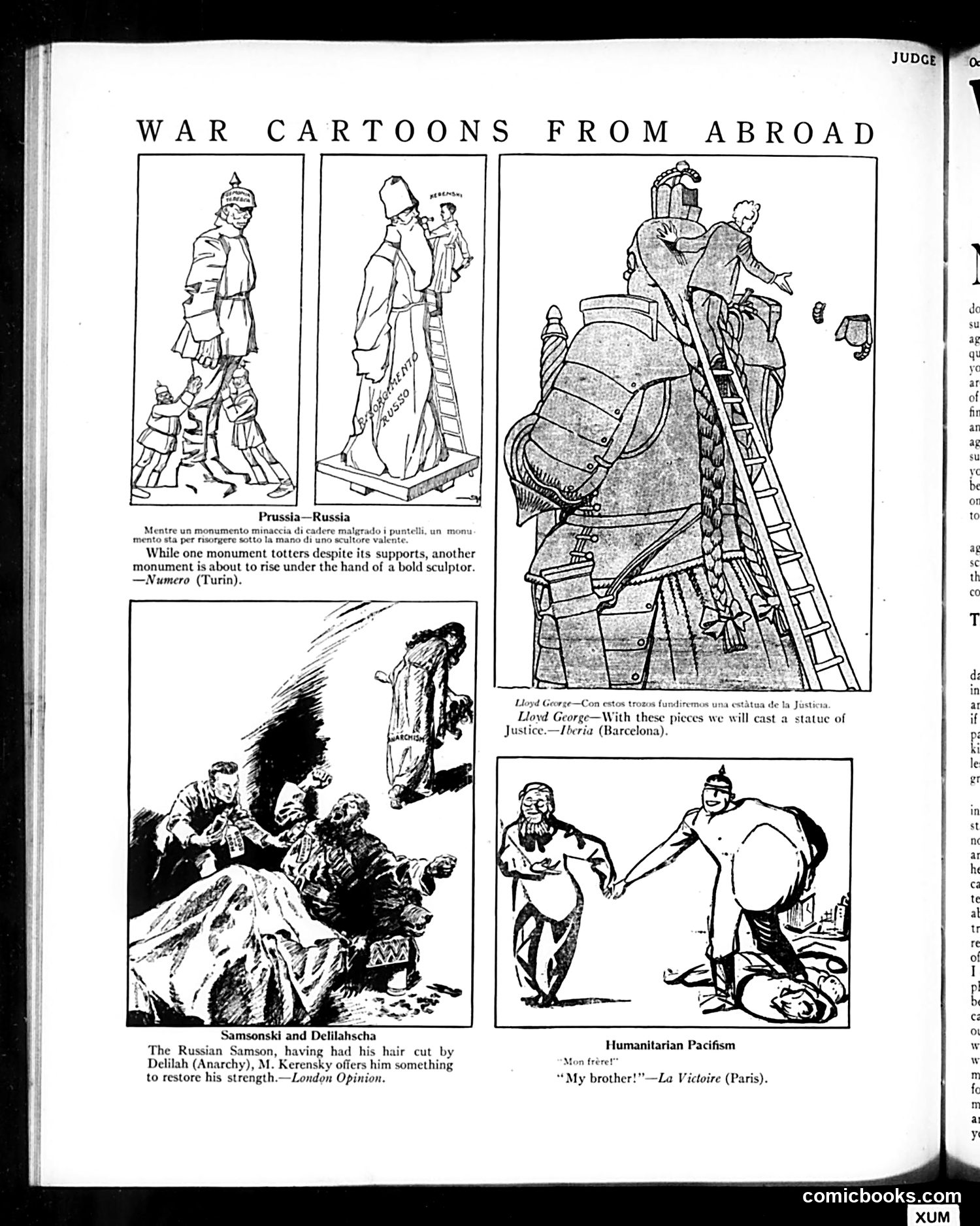
This page reprints satirical cartoons from European publications about World War I, using classical and biblical allegory: **Prussia-Russia cartoon**: Depicts competing monuments—one collapsing, another rising—symbolizing the shifting power dynamics between these nations during the war. **Samson and Delilah**: References the biblical story where Delilah betrays Samson by cutting his hair. Here, "Delilah (Anarchy)" represents Russian revolutionary chaos weakening Russia (Samson). Kerensky, the Russian political leader, offers restoration—mocking his ineffectual attempts to stabilize the collapsing Russian state amid revolution. **Lloyd George/Humanitarian Pacifism**: The final cartoon ironically critiques peace appeals ("My brother!") as naive, showing opposing soldiers calling for brotherhood while clearly prepared for continued warfare. These cartoons reflect Allied skepticism about Russian stability and pacifist sentiment during the war.
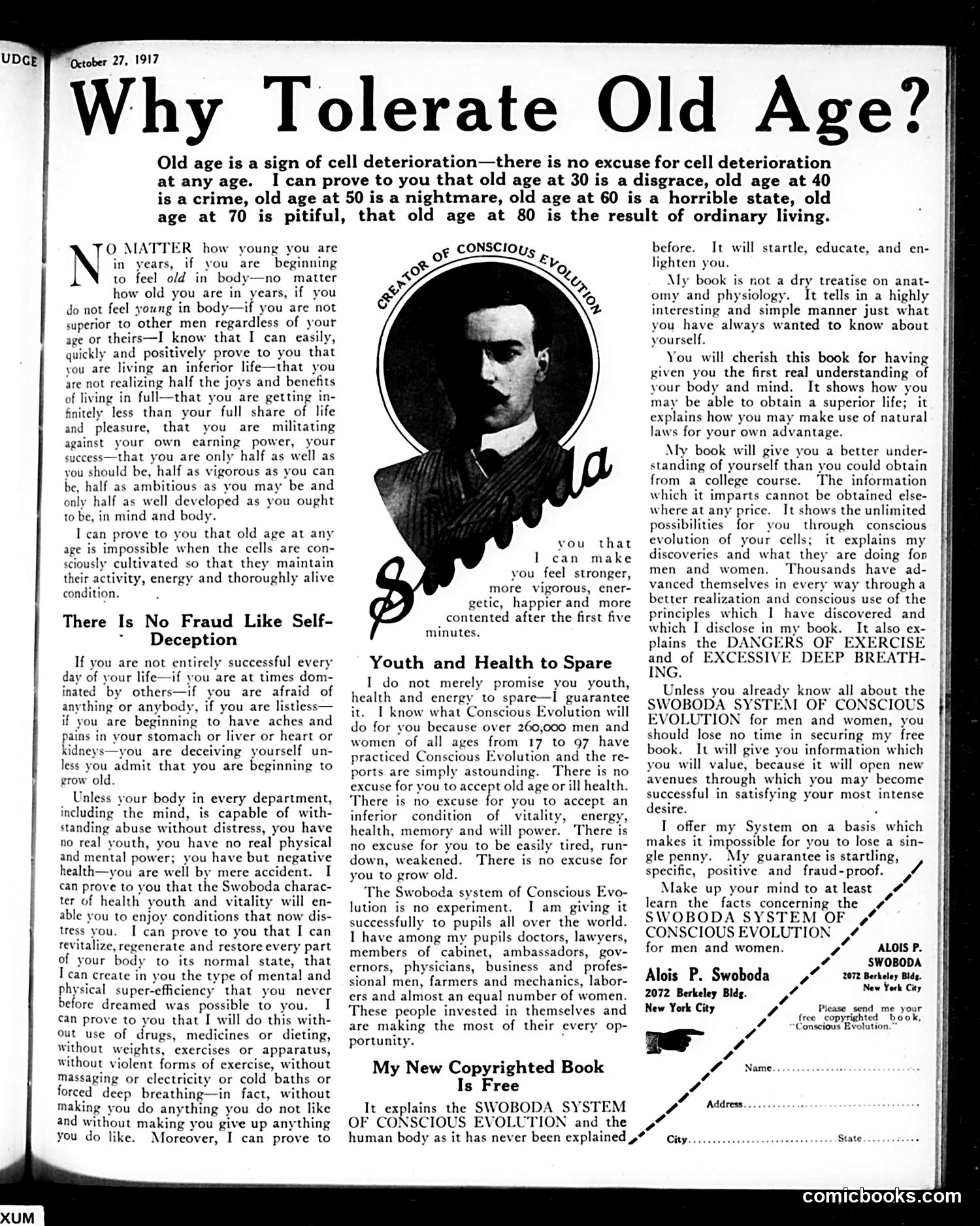
This is primarily **advertising content**, not satire. The page promotes Alois P. Swoboda's "Conscious Evolution" system—a pseudo-scientific self-improvement scheme claiming to prevent aging through mental discipline alone. **The pitch:** Swoboda argues that feeling "old" at any age (30, 40, 50, etc.) indicates you're living poorly and wasting your potential. He promises to reverse aging and boost vitality without drugs, exercise, or diet—merely through his copyrighted system. **Historical context:** This reflects early 20th-century wellness quackery that flourished before FDA regulation. Such appeals exploited widespread anxiety about aging and inadequacy, offering false guarantees of rejuvenation. **The satire opportunity Judge missed:** The bombastic claims—that aging is a "disgrace" and "crime," that 260,000 people swear by this—practically invite mockery. That Judge published this advertisement largely straightforwardly (rather than satirizing it) reveals how normalized such dubious health claims were in 1917.
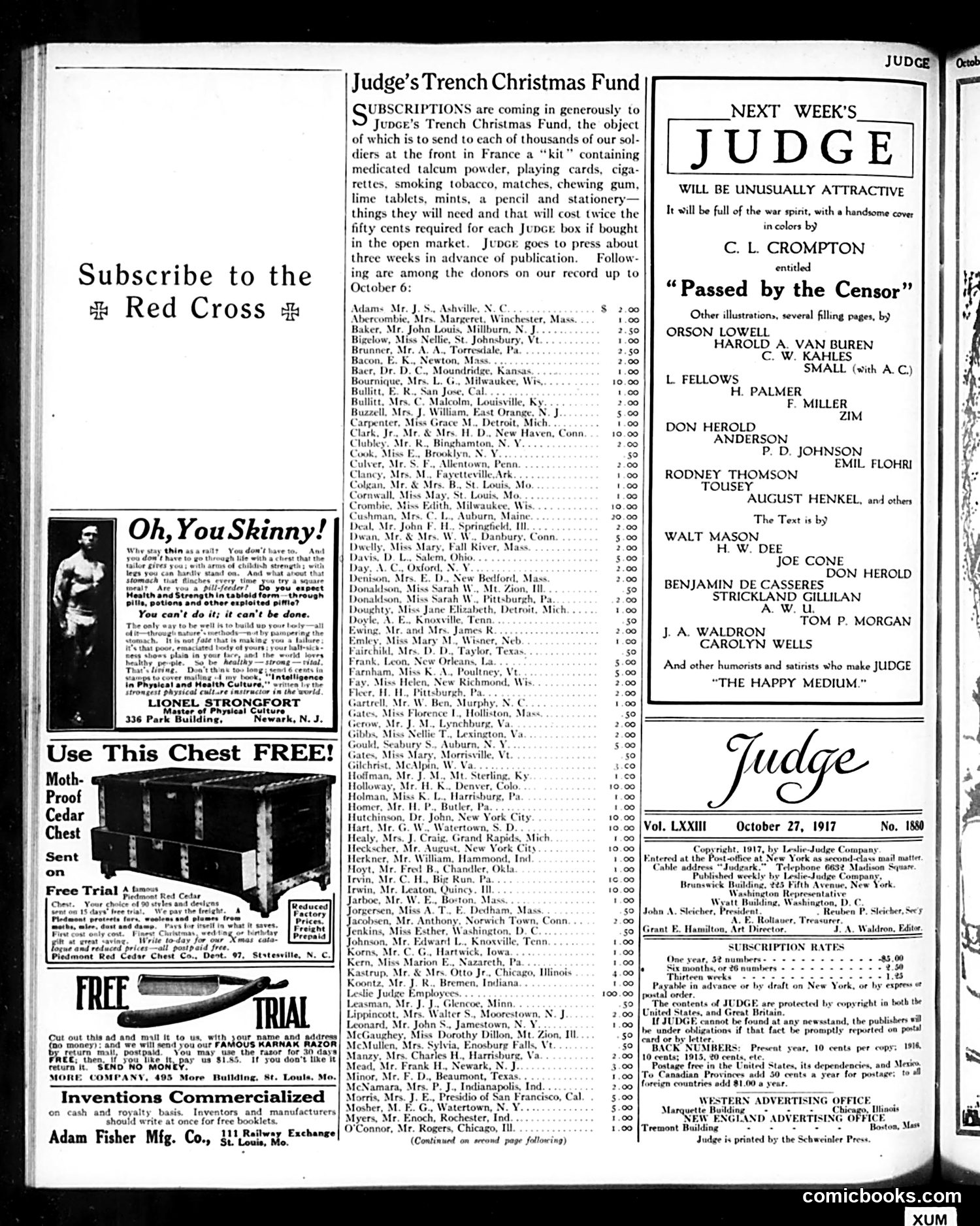
This page is primarily advertising and administrative content from an American satirical magazine published during World War I. The dominant feature is the "Judge's Trench Christmas Fund"—a charitable campaign to send care packages to American soldiers fighting in France. Each box would contain practical items (talcum powder, playing cards, tobacco, mints, pencils, stationery) costing fifty cents, with donations listed from across the country. The page also features ads for bodybuilding instruction, a safety razor, and a cedar chest, typical period advertising. The masthead announces next week's issue will feature wartime-themed illustrations by C.L. Crompton ("Passed by the Censor") and other artists. This reflects Judge's dual role: satirical commentary on public affairs alongside patriotic support for American soldiers actively fighting overseas in 1917.
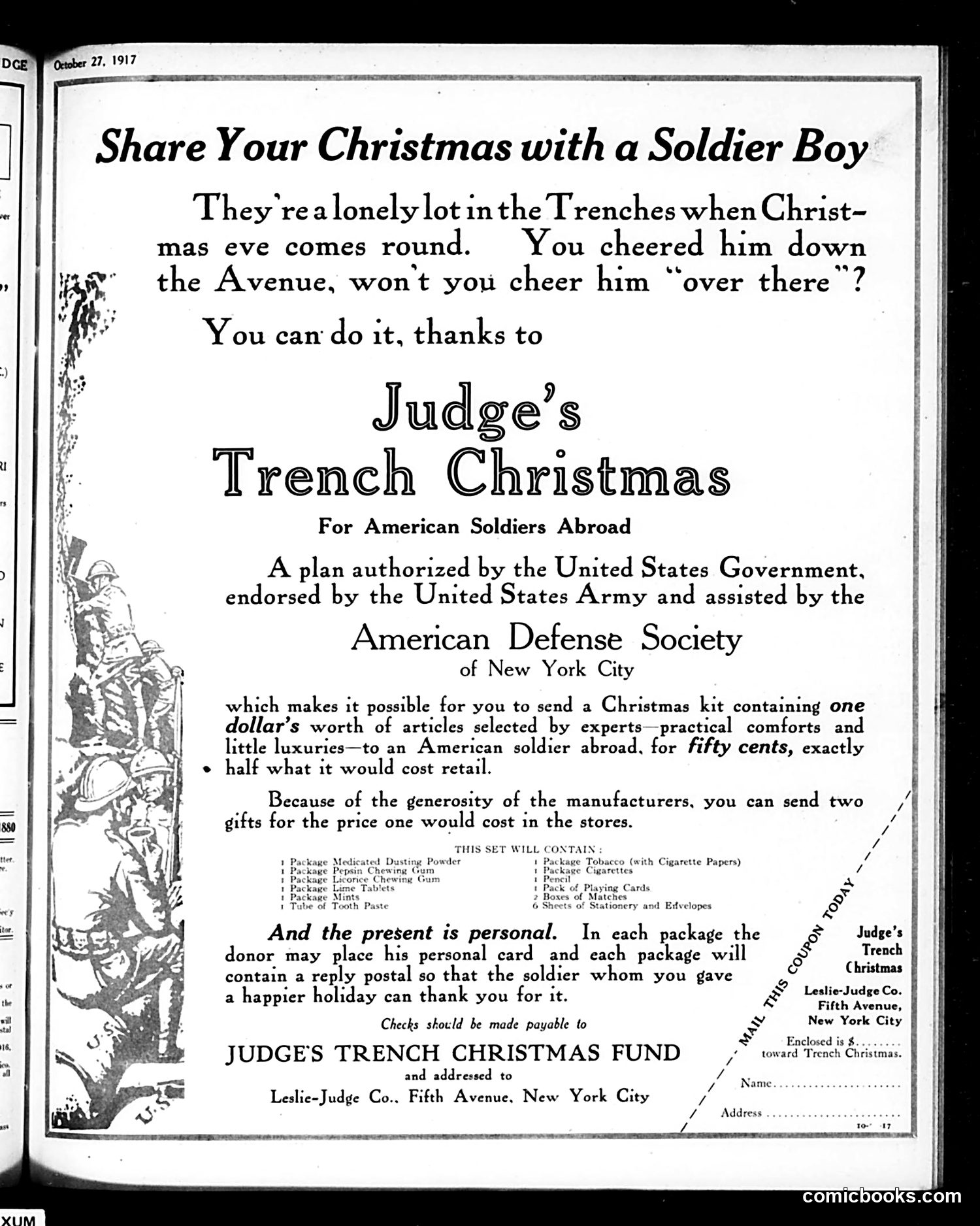
This is a full-page **charitable advertisement**, not satirical content. Published October 27, 1917 (during WWI), it promotes "Judge's Trench Christmas"—a fundraising campaign to send care packages to American soldiers fighting in Europe. **The appeal's strategy:** - Emotional pitch: soldiers are "lonely" in trenches during Christmas - Patriotic framing: endorsed by U.S. Government, Army, and American Defense Society - Value proposition: $1 worth of goods (tobacco, gum, matches, playing cards, toiletries) for 50 cents—manufacturers donate the difference, allowing donors to send two gifts for one's retail price - Personal touch: donors include cards, recipients reply via postcard **Visual elements:** The left margin features decorative military illustrations—soldiers and wartime imagery—reinforcing the patriotic appeal. **Context for modern readers:** This represents American home-front mobilization in 1917. Charitable packaging was marketed as a tangible way civilians could support distant troops, combining commerce with patriotism during total war.
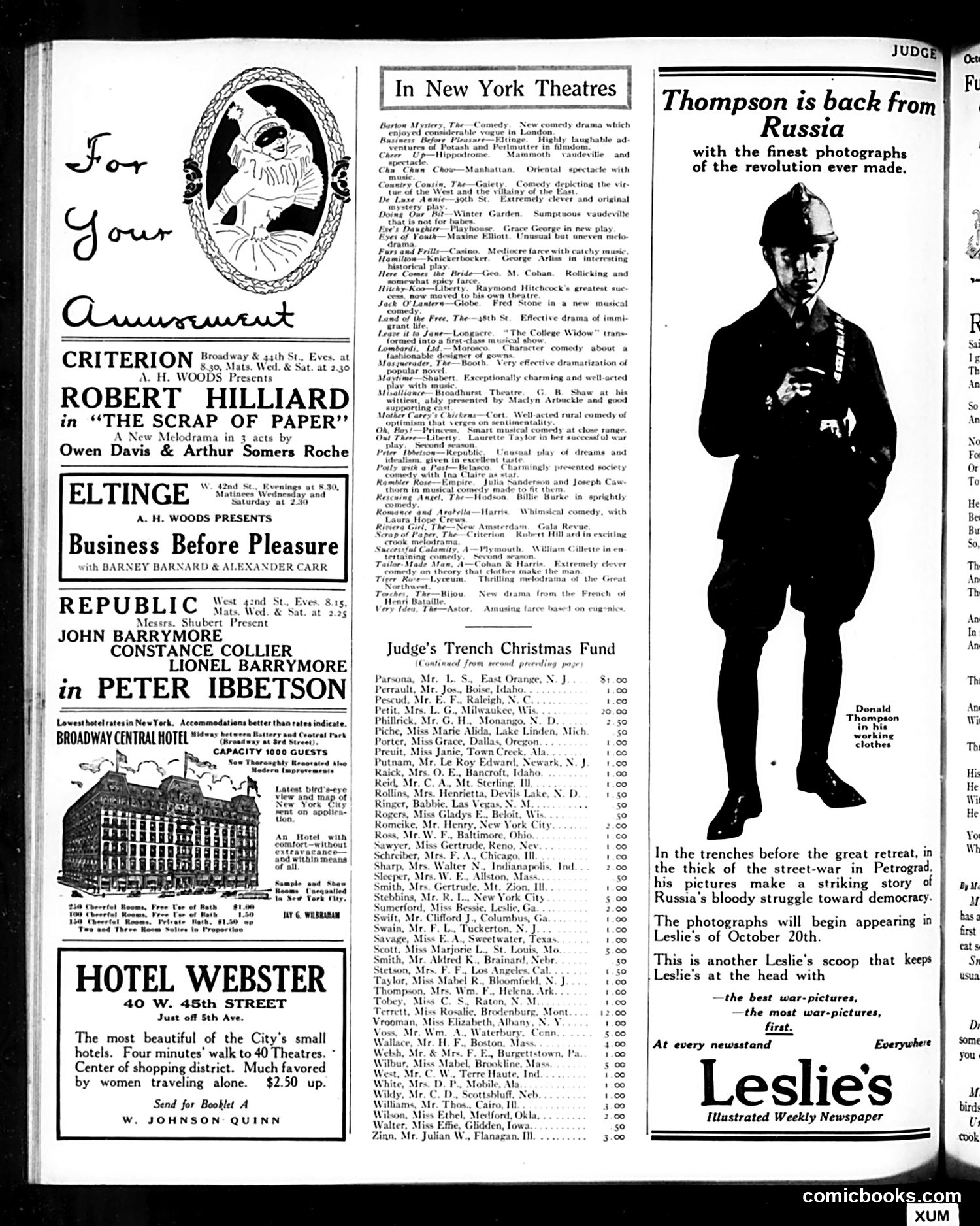
This page is primarily **advertising and announcements** rather than satirical content. The left side showcases Broadway theater advertisements (typical of Judge's era), while the right features a significant advertisement for *Leslie's Illustrated Weekly Newspaper*. The main editorial content is a **Judge's Trench Christmas Fund** listing—a charitable appeal showing donations from readers to support soldiers. The names and amounts suggest it's a fundraising effort for WWI troops. The prominent right-side advertisement announces that photographer **Donald Thompson** has returned from Russia with photographs of the Russian Revolution, showing "street-war in Petrograd" and "Russia's bloody struggle toward democracy." This references the 1917 Russian Revolution and positions *Leslie's* as having exclusive war photography—a competitive claim common in journalism of this period. The page reflects early-20th-century American magazine content: entertainment promotion, patriotic fundraising, and illustrated news competition during wartime.
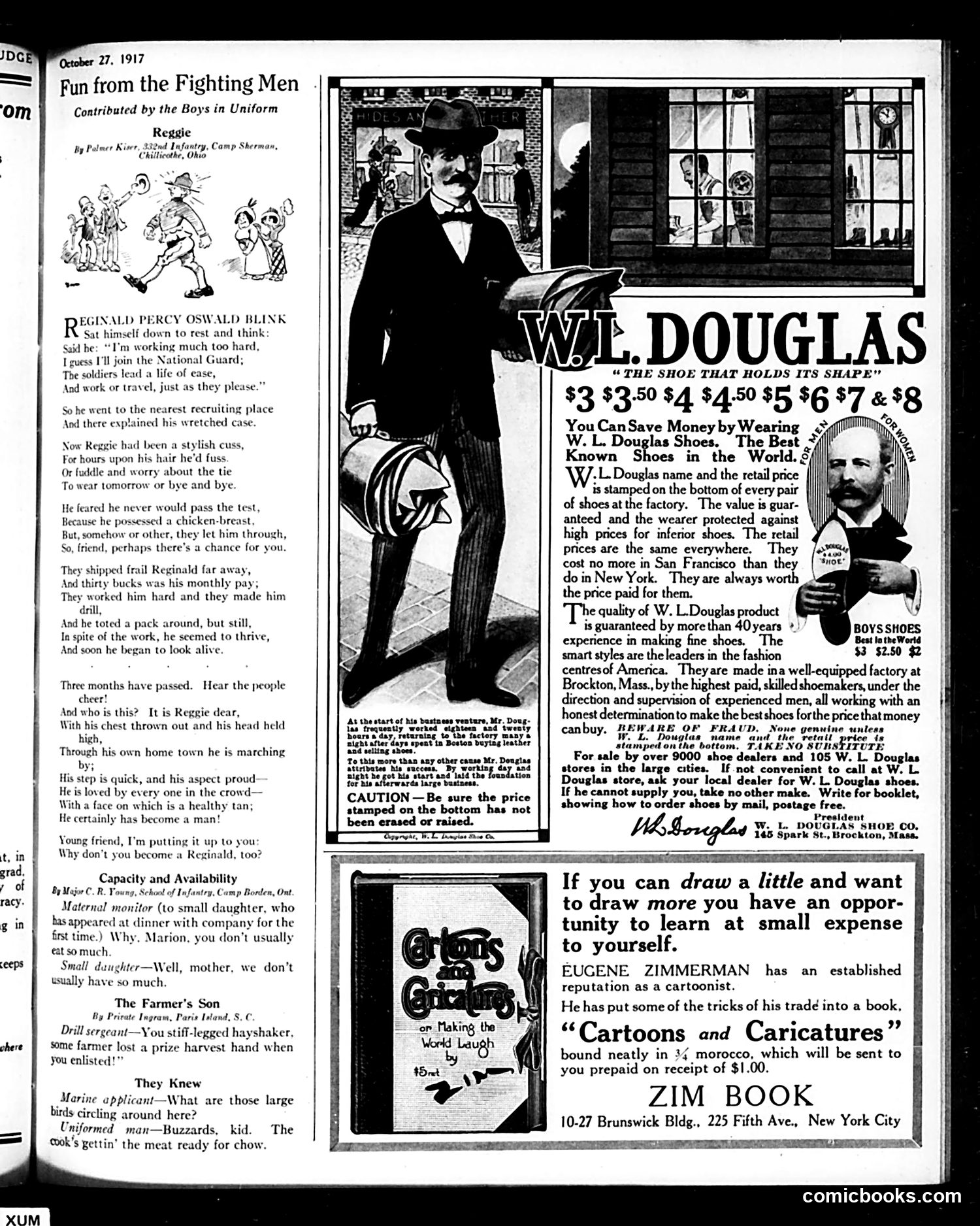
This page celebrates military recruitment during World War I. The main narrative poem tells of "Reginald Percy Oswald Blink," a vain, pampered civilian who complained of overwork and joined the National Guard seeking an easier life. Instead, the Army's rigorous training transformed him into a healthy, confident man. The poem's moral pitch to readers: "Why don't you become a Reginald, too?" The satirical angle mocks prewar civilian softness—Reggie's obsession with his hair and neckties contrasts sharply with soldierly toughness. The page also includes military camp humor ("They Knew" joke about buzzards and rations) and patriotic messaging. The W.L. Douglas shoe advertisements, positioned prominently, represent typical war-era commercial appeals to soldiers and their families. The page is primarily propaganda encouraging enlistment, wrapped in entertainment for a 1917 readership deeply engaged in WWI mobilization.
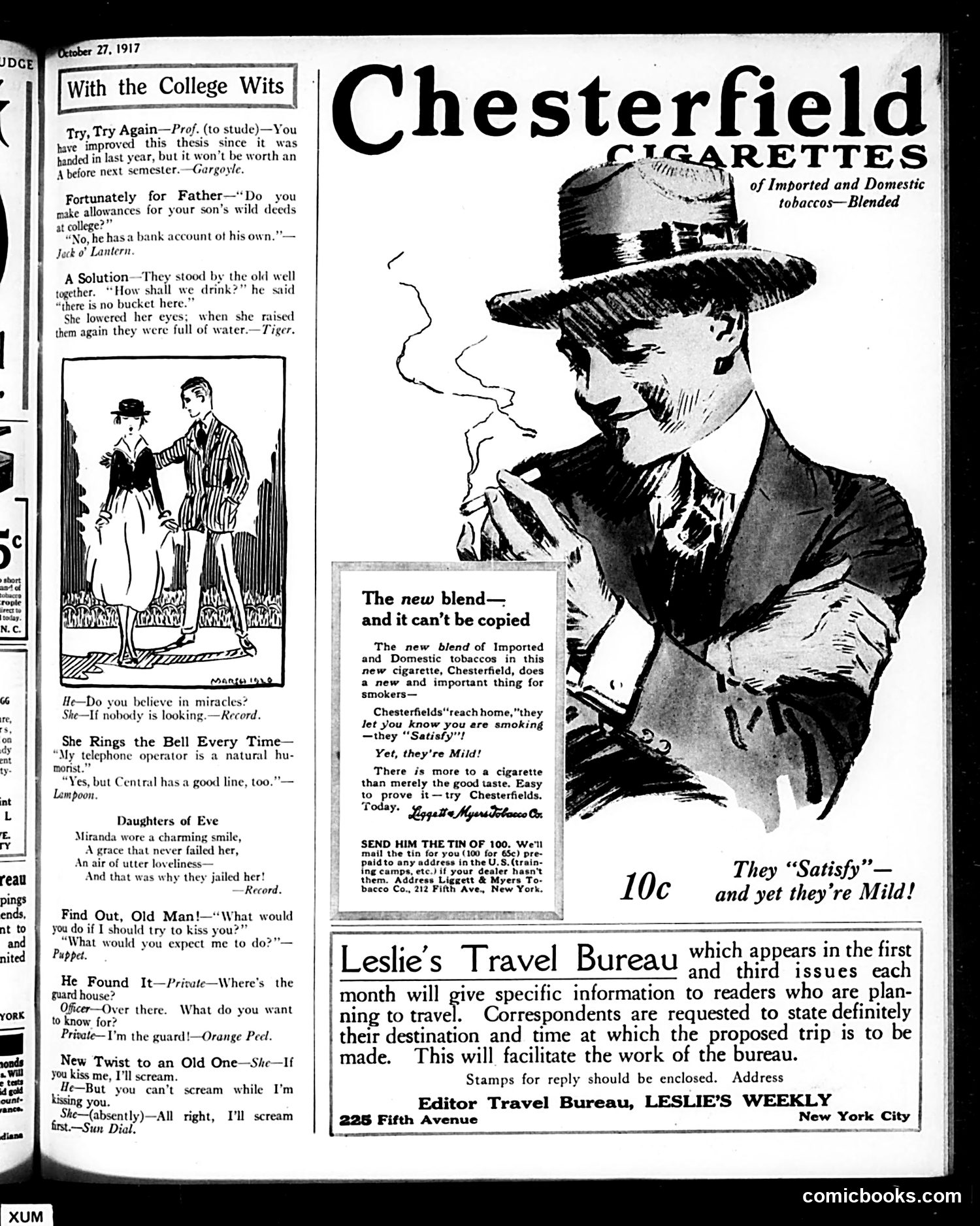
**Left side—"With the College Wits"**: A collection of brief college humor jokes typical of early-20th-century magazines. Recurring themes include: professors grading poorly, wealthy students funding themselves (not needing parental allowances), flirtation games between young men and women, and telephone operators. The humor assumes a college-educated, affluent readership familiar with campus life. These are puns and light romantic/social observations with no political content. **Right side—Chesterfield Cigarettes Advertisement**: A large ad featuring a stylishly dressed man smoking, promoting a "new blend" of imported and domestic tobacco. The ad emphasizes the cigarettes "Satisfy" while being "Mild"—a marketing claim. Notably, it offers to mail 100-cigarette tins to soldiers in training camps for 65 cents, indicating WWI-era military marketing. Cigarette advertising was entirely normalized and unregulated in 1917. **Bottom—Leslie's Travel Bureau Notice**: An announcement that future magazine issues will include travel planning assistance for readers. The page is primarily **advertising and light humor**—no political satire or significant social commentary.
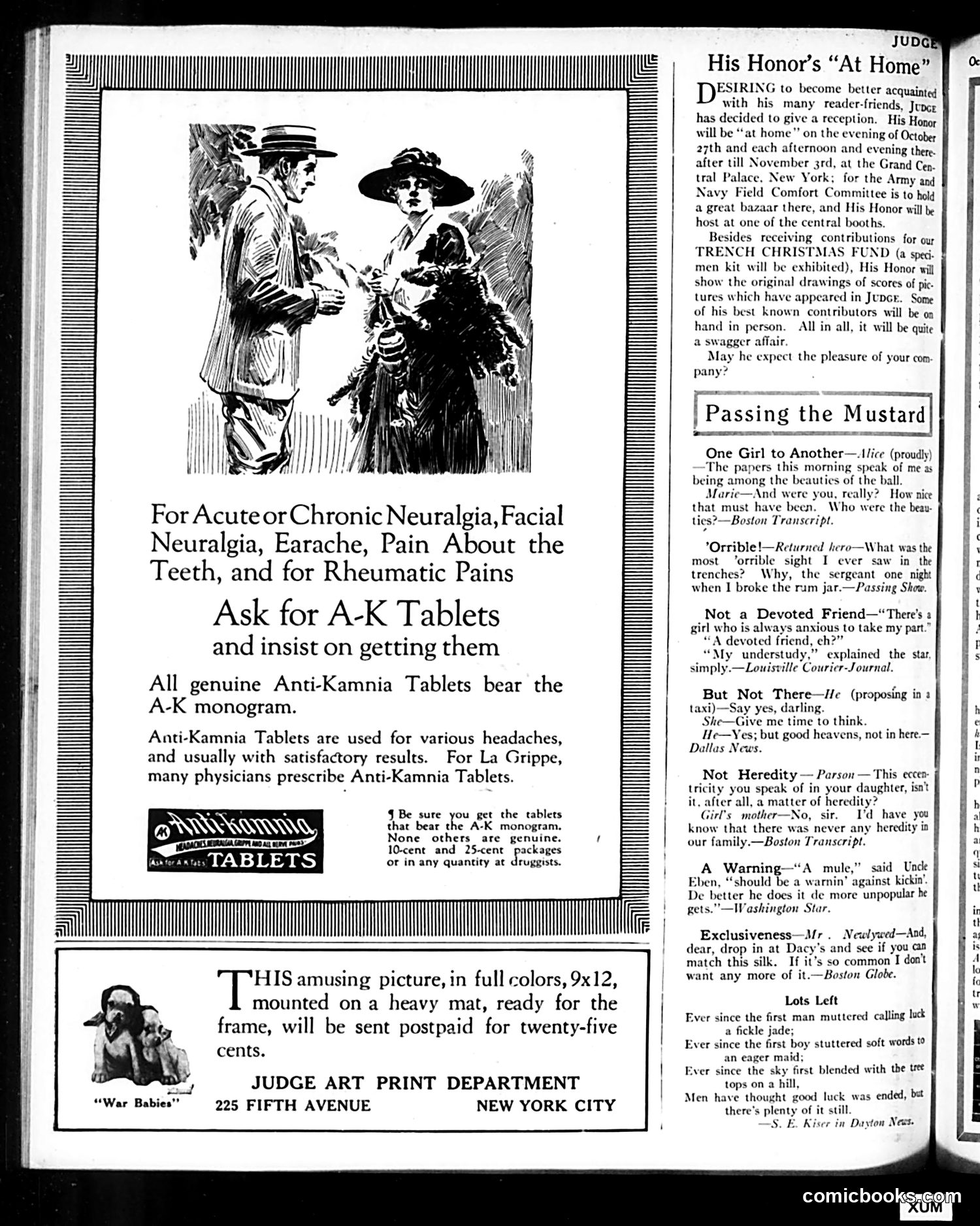
This page is primarily **advertising and social notices** rather than political satire. The main cartoon at top depicts two figures in conversation—likely representing a Judge editor/representative and a reader—announcing Judge magazine's reception on October 27th. The text explains that "His Honor" (the magazine's personified mascot) will host an event at the Grand Central Palace to raise funds for the Army and Navy Field Comfort Committee's Trench Christmas Fund. The bulk of the page consists of: - A large **A-K Tablets advertisement** for pain relief - Multiple brief **humor snippets** (short jokes) under the heading "Passing the Mustard" - Small social commentary quips and a poem about luck The advertisement and layout dominate; there is no significant political cartoon or satire visible. The page functions as a typical turn-of-the-century magazine mixture of editorial content, notices, and commercial advertising.
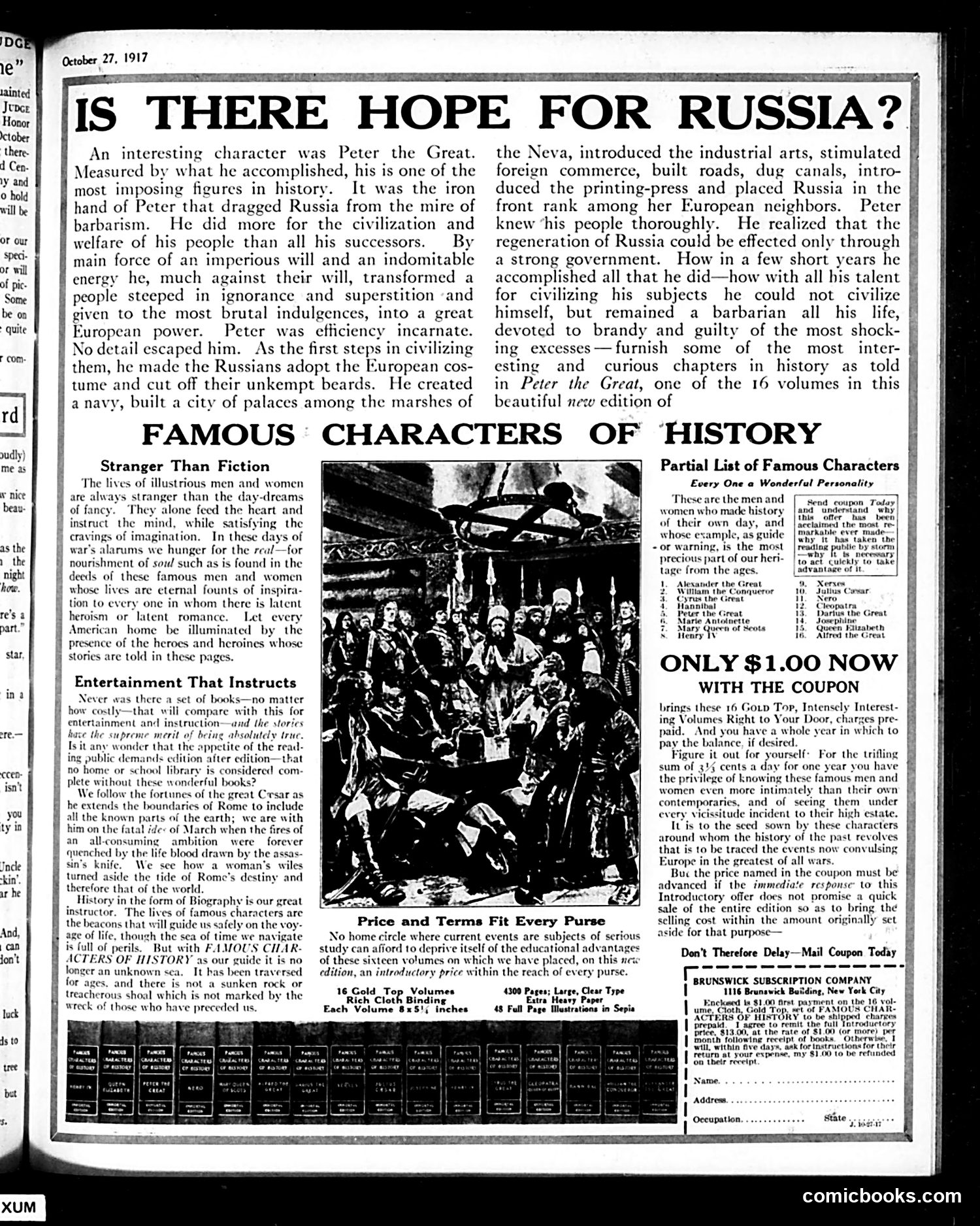
This is primarily an **advertisement disguised as editorial content**, not a political cartoon. Published October 27, 1917—during the Russian Revolution—the headline "IS THERE HOPE FOR RUSSIA?" uses contemporary geopolitical anxiety to sell encyclopedic volumes. The article praises **Peter the Great** as a modernizing autocrat who civilized Russia through iron-fisted control, implicitly contrasting him with the chaotic revolutionary upheaval happening *as this magazine went to press*. The argument suggests strong authoritarian leadership (not democracy) transforms backward societies. This is propaganda masquerading as history: by celebrating Peter's brutal efficiency and dismissing his personal barbarism as irrelevant to his accomplishments, the piece subtly endorses autocratic solutions to social chaos—exactly contrary to the revolutionary ideals then reshaping Russia. The real purpose: sell "Famous Characters of History" encyclopedias for $1.00 per volume to anxious Americans wondering about Russia's fate.
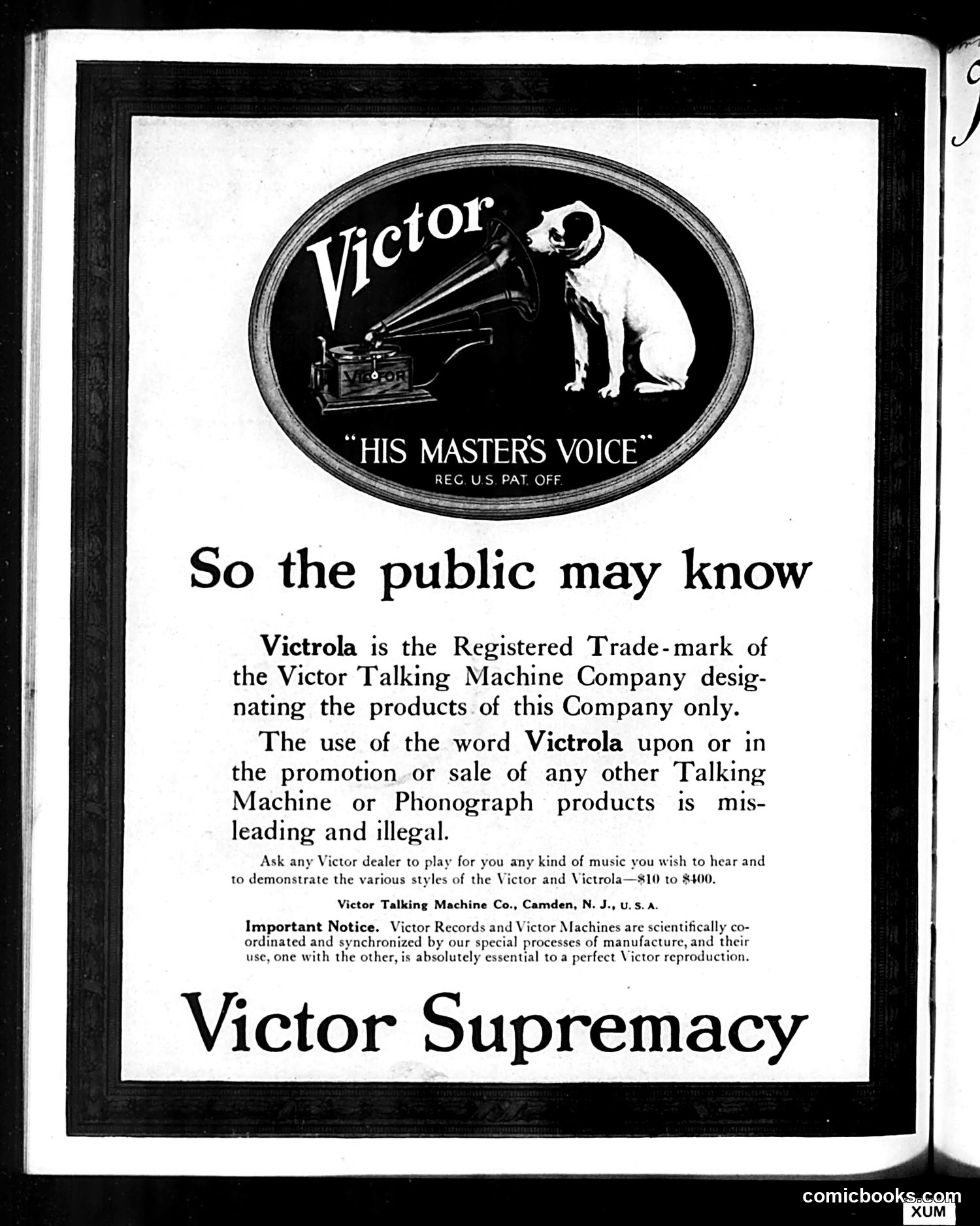
This page is **not a cartoon or satire**—it's a full-page advertisement for Victor Talking Machine Company, published in *Judge* magazine. The ad features the iconic Victor logo: a dog (Nipper) listening to a gramophone with the phrase "His Master's Voice." The company uses this page to assert legal trademark protection for the name "Victrola," warning the public that competitors' use of this term on other phonographs is "misleading and illegal." The advertisement emphasizes "Victor Supremacy" and claims Victor records and machines are scientifically coordinated in ways competitors cannot replicate. The pricing ($10 to $400) and invitation to demo machines at dealer showrooms are standard sales tactics. This represents early 20th-century brand protection efforts during the competitive phonograph/recording industry boom, when trademark confusion was common.