
Judge, 1917-10-27 · page 12 of 28
Judge — October 27, 1917 — page 12: what you’re looking at
What you’re looking at
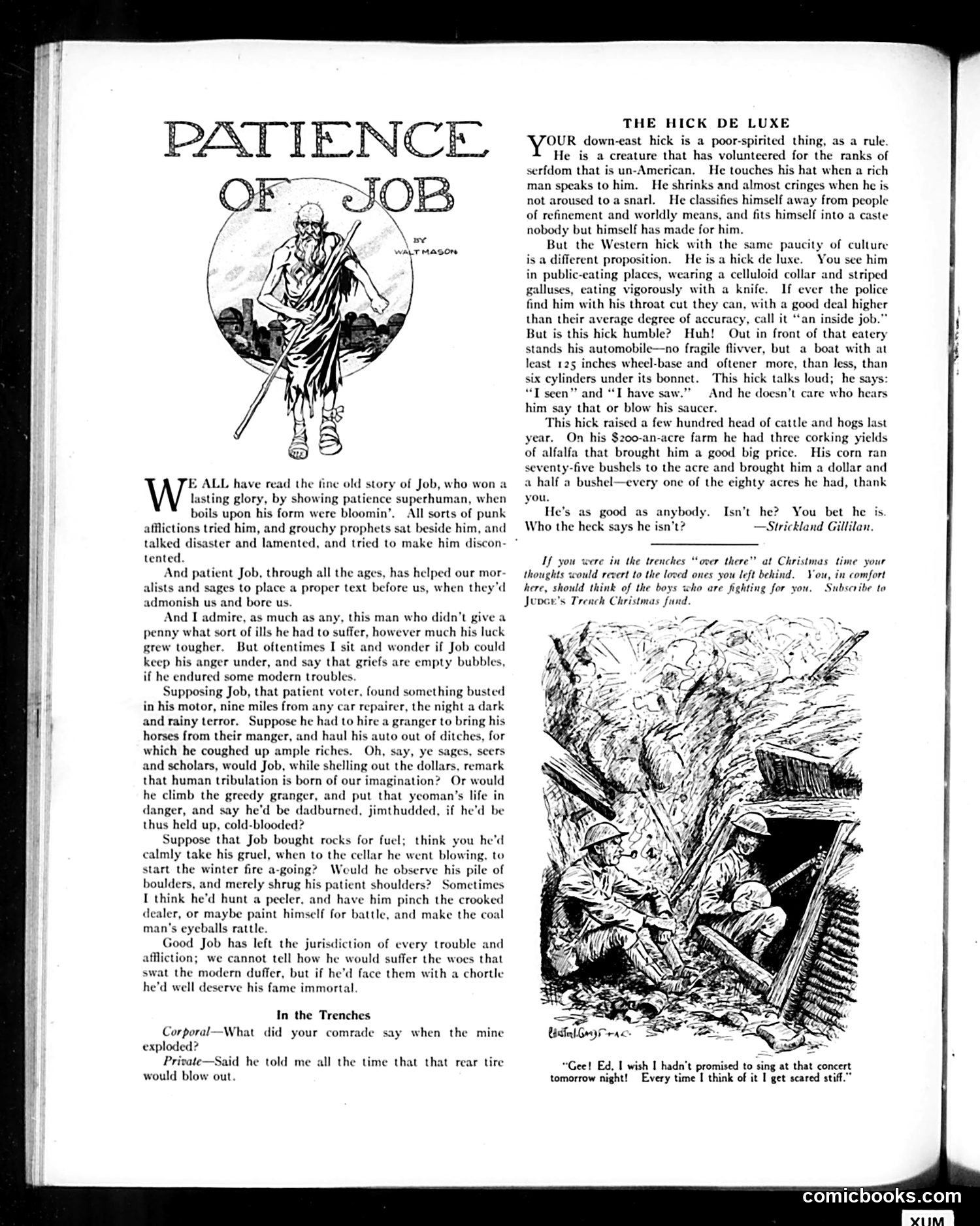
This article uses the biblical Job—famous for enduring suffering without complaint—as a foil to mock modern Americans' impatience with everyday troubles. The author argues that while Job maintained virtue through ancient hardships, a contemporary man facing modern inconveniences (a broken car motor, dishonest repair costs, defective heating fuel) would likely lose his temper and resort to violence rather than philosophical acceptance. The satire suggests modern frustrations—financial exploitation by service providers, shoddy goods—test patience more severely than Job's afflictions. The accompanying piece, "The Hick de Luxe," contrasts Eastern rural deference with Western rural arrogance. The Western farmer, despite modest education, flaunts wealth through an expensive automobile and loud behavior, embodying a new American type: prosperous but crude. Both pieces reflect early-20th-century anxiety about modern life's stresses and changing social hierarchies.
📄 Transcribed text from this page (OCR, searchable)
Machine-transcribed from the original scan — historical spelling and the odd misread are preserved.
E ALL have read the fine old story of Job, who won a lasting glory, by showing patience superhuman, when boils upon his form were bloomin’, All sorts of punk afflictions tried him, and grouchy prophets sat beside him, and talked disaster and lamented, and tried to make him discon- tented. And patient Job, through all the ages, has helped our mor- alists and sages to place a proper text before us, when they'd admonish us and bore us And I admire, as much as any, this man who didn’t give a penny what sort of ills he had to suffer, however much his luck grew tougher. But oftentimes I sit and wonder if Job could keep his anger under, and say that griefs are empty bubbles, if he endured some modern troubles. Supposing Job, that patient voter, found something busted in his motor, nine miles from any car repairer, the night a dark and rainy terror. Suppose he had to hire a granger to bring his horses from their manger, and haul his auto out of ditch which he coughed up ample riches. Oh, say, ye sage s and scholars, would Job, while shelling out the dollars, remark that human tribulation is born of our imagination? Or would he climb the greedy granger, and put that yeoman’s life in danger, and say he'd be dadburned, jimthudded, if he'd be thus held up, cold-blooded? Suppose that Job bought rocks for fuel; think you he'd calmly take his gruel, when to the cellar he went blowing, to start the winter fire a-going? Would he observe his pile of boulders, and merely shrug his patient shoulders? Sometimes I think he'd hunt a peeler, and have him pinch the crooked dealer, or maybe paint himself for battle, and make the coal man’s eyeballs rattle. Good Job has left the jurisdiction of every trouble and affliction; we cannot tell how he would suffer the woes that swat the modern duffer, but if he'd face them with a chortle he'd well deserve his fame immortal In the Trenches Corporal—What did your comrade say when the mine exploded? Private—Said he told me all the time that that rear tire would blow out. THE HICK DE LUXE ‘OUR down-east hick is a poor-spirited thing, as a rule. He is a creature that has volunteered for the ranks of serfdom that is un-American. He touches his hat when a rich man speaks to him. He shrinks and almost cringes when he is not aroused to a snarl. He classifies himself away from people of refinement and worldly means, and fits himself into a caste nobody but himself has made for him. But the Western hick with the same paucity of culture is a different proposition. He is a hick de luxe. You see him in public-eating places, wearing a celluloid collar and striped galluses, eating vigorously with a knife. If ever the police find him with his throat cut they can, with a good deal higher than their average degree of accuracy, call it “an inside job.” But is this hick humble? Huh! Out in front of that eatery stands his automobile—no fragile flivver, but a boat with at least 125 inches wheel-base and oftener more, than less, than six cylinders under its bonnet. This hick talks loud; he says: “T seen” and “I have saw. And he doesn’t care who hears him say that or blow his saucer. This hick raised a few hundred head of cattle and hogs last year. On his $200-an-acre farm he had three corking yields of alfalfa that brought him a good big price. His corn ran seventy-five bushels to the acre and brought him a dollar and a half a bushel—every one of the eighty acres he had, thank you. He’s as good Who the heck sa he? You bet he is —Strickland Gillilan. anybody. Isn't s he isn’t? If you were in the trenches “over there” at Christmas time your thoughts would revert to the loved ones you left behind. You, in comfort here, should think of the boys who are fighting for you. Subscribe to Juvcr's Trench Christmas fund. “Gee! Ed, I wish I hadn't promised to sing at that concert tomorrow night! Every time I think of it I get scared stiff.” comicbooks.com