
Judge, 1917-10-27 · page 8 of 28
Judge — October 27, 1917 — page 8: what you’re looking at
What you’re looking at
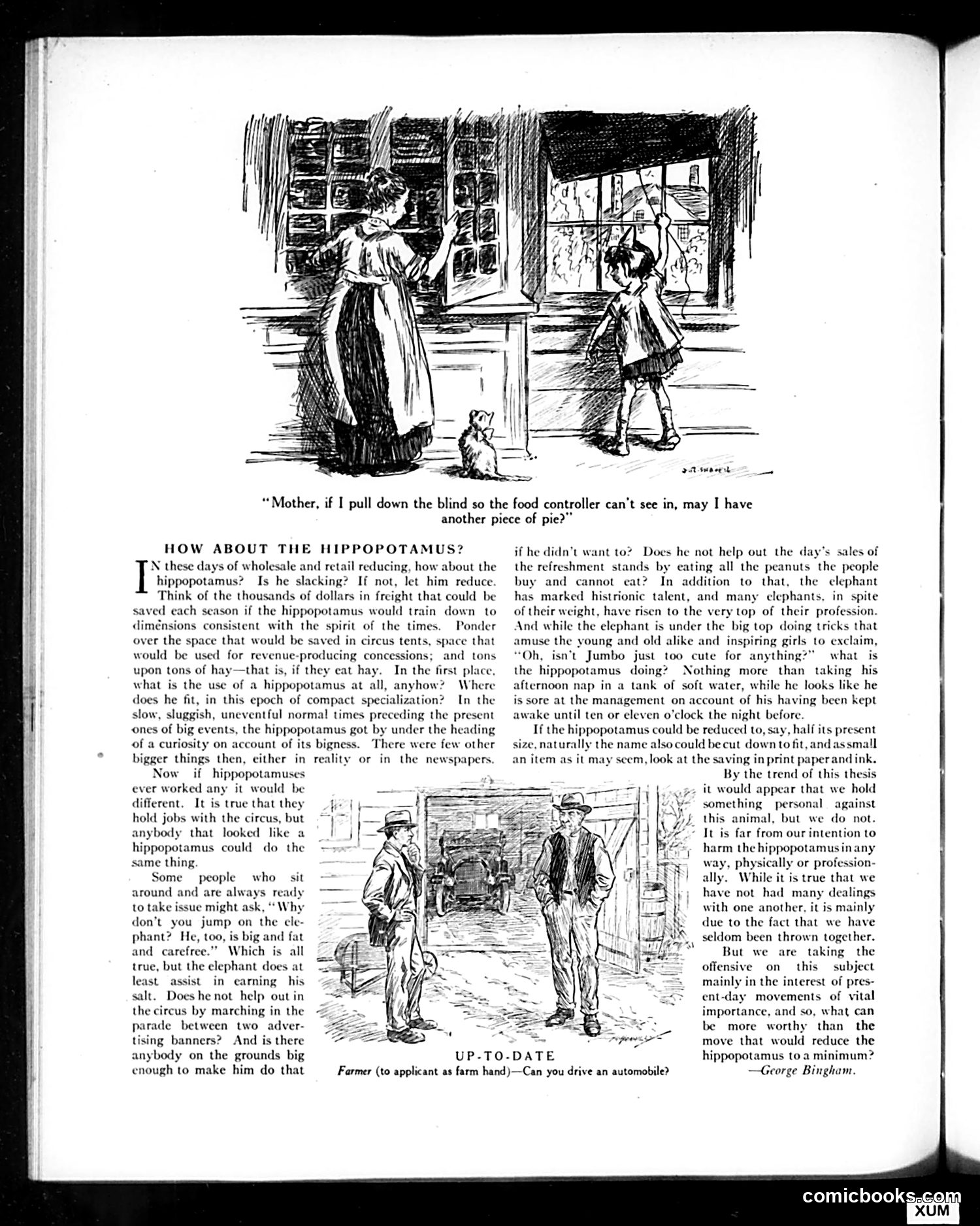
**Top Cartoon:** A mother and child at a window during wartime rationing. The child asks permission to eat more pie if they close the blind so "the food controller can't see in." This satirizes the tension between food rationing enforcement and family desires—the joke is that hiding from official oversight might allow rule-breaking. **Main Article "How About the Hippopotamus?":** This is satirical commentary on WWI-era conservation efforts. The author argues that circus hippopotamuses are useless and wasteful—they eat enormous amounts of hay, consume freight space, and contribute nothing to wartime efforts. By contrast, elephants earn their keep by performing, attracting crowds, and selling peanuts. The hippopotamus just naps and appears resentful. The satire's target appears to be inefficiency and waste during wartime, using the hippopotamus as a metaphor for any non-productive entity that consumes valuable resources. The piece advocates for reducing the animal's size or eliminating it entirely, even calculating savings in "print paper and ink." **Bottom Cartoon:** A farmer interviews an applicant for farm work, asking if they can drive an automobile—reflecting post-war mechanization of agriculture.
📄 Transcribed text from this page (OCR, searchable)
Machine-transcribed from the original scan — historical spelling and the odd misread are preserved.
aL smaoet “Mother, if I pull down the blind so the food controller can’t see in, may I have another piece of pie?” HOW ABOUT THE HIPPOPOTAMUS? hippopotamus? Is he slacking? If not, let him reduce. Think of the thousands of dollars in freight that could be each season if the hippopotamus would train down to sions consistent with the spirit of the times. Ponder over the space that would be saved in circus tents, space that would be used for revenue-producing concessions; and tons upon tons of hay—that is, if they cat hay. In the first place, what is the use of a hippopotamus at all, anyhow? Where does he fit, in this epoch of compact speci tion? In the slow, sluggish, uneventful normal times preceding the present ‘ones of big events, the hippopotamus got by under the heading of a curiosity on account of its bigness. There were few other bigger things then, either in reality or in the newspapers Now if hippopotamuses ever worked any it would be different. It is true that they hold jobs with the circus, but anybody that looked like a hippopotamus could do the same thing. Some I these days of wholesale and retail reducing, how about the people who © sit around and are always ready to tak, ue might ask, “Why don’t you jump on the cle- phant? He, too, is big and fat and carefree.” Which is all true, but the elephant does at least’ assist’ in earning his. salt. Does he not help out in the circus by marching in the parade between two adver- tising banners? And is there anybody on the grounds big enough to make him do that UP-TO-DATE Farmer (to applicant as farm hand)—Can you drive an automobile? if he didn’t want to? Does he not help out the day's sales of the refreshment stands by eating all the peanuts “the people buy and cannot cat? In addition to that, the clephant has marked histrionic talent, and many elephants, in spite of their weight, have risen to the very top of their profession. And while the elephant is under the big top doing tricks that amuse the young and old alike and inspiring girls to exclaim, “Oh, isn’t Jumbo just too cute for anythin; what is the hippopotamus doing? Nothing more than taking his afternoon nap in a tank of soft water, while he looks like he is sore at the management on ount of his having been kept ke until ten or cleven o'clock the night before. If the hippopotamus could be reduced to, say, half its present » naturally the name also could be cut down to fit, andassmall an item as it may seem, look at the saving in print paperand ink. By the trend of this thesis it would appear that we hold something personal this animal, but we do not. Tt is far from our intention to harm the hippopotamusinany way, physically or profession- ally. While itis true that we have not had lings with one another, it is mainly due to the fact that we have seldom been thrown together. But we are taking the offensive on this subject mainly in the interest of pres- ent-day movements of vital importance, and so, what can be more worthy than the move that would reduce the hippopotamus toa minimum? —George Bingham. comichookaeg m