
Judge, 1917-10-27 · page 5 of 28
Judge — October 27, 1917 — page 5: what you’re looking at
What you’re looking at
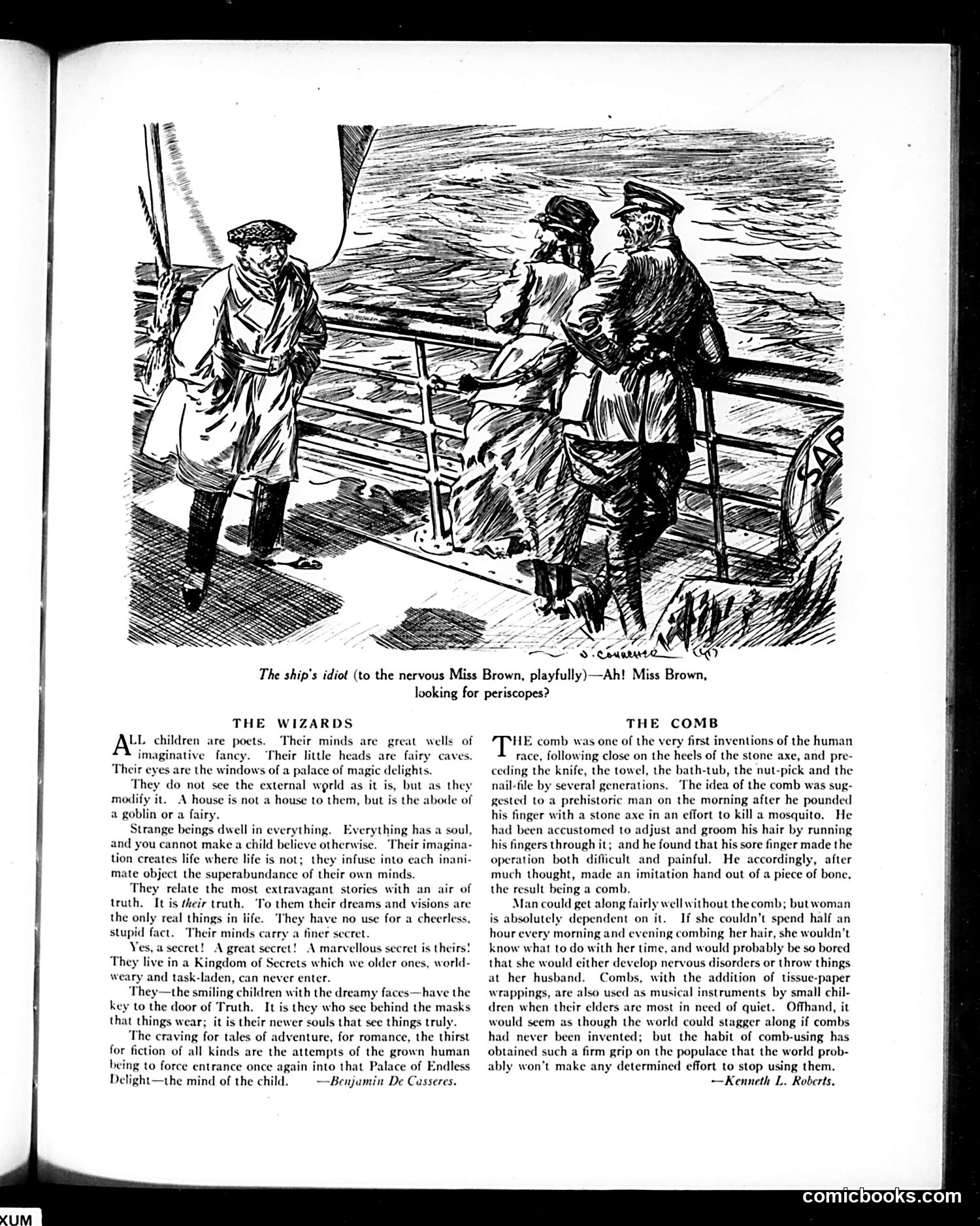
The cartoon depicts a ship's deck scene where a male officer addresses a nervous woman identified as "Miss Brown," joking about her looking for periscopes—a reference to submarine warfare. This appears to be WWI-era humor, playing on contemporary anxieties about German U-boats and the nervousness such threats created among civilians and passengers on ships. The accompanying text essays ("The Wizards" and "The Comb") are unrelated to the cartoon. They're philosophical pieces about children's imagination and the history/utility of combs, respectively. The cartoon's humor relies on gallows wit about wartime danger, treating submarine threats as an occasion for flirtation and masculine joshing of an anxious woman passenger.
📄 Transcribed text from this page (OCR, searchable)
Machine-transcribed from the original scan — historical spelling and the odd misread are preserved.
The ship's idiot (to the nervous Miss Brown, playfully)—Ah! Miss Brown, looking for periscopes? THE WIZARDS Their minds are great imaginative fancy. Their little heads are fairy caves. Their eyes are the windows of a palace of magic delights. They do not see the external world as it is, but as they modify it. A house is not a house to them, but is the abode of a goblin or a fairy. Strange beings dwell in and you cannot make a c tion creates life where life is not; they infuse into each inani- mate object the superabundance of their own minds. They relate the most ext gant stories with truth. It is their truth. ‘To them their dreams and visio the only real things in life. They have no use for a cheerless, stupid fact. Their minds carry a finer secret. Yes, asecret! A great secret! A marvellous secret is theirs! They live in a Kingdom of Secrets which we older ones, world- weary and task-laden, can never enter. They—the smiling children with the dreamy faces—have the key to the door of Truth. It is they who see behind the masks that things wear; it is their newer souls that see things truly The craving for tales of adventure, for romance, the thirst for fiction of all kinds are the attempts of the grown human being to force entrance once again into that Palace of Endless Delight—the mind of the child. —Benjamin De Casseres. L children are poets. wells of THE COMB THe comb was one of the very first inventions of the human race, following close on the heels of the stone axe, and pre- ceding the knife, the towel, the bath-tub, the nut-pick and the nail-file by several generations. ‘The idea of the comb was sug- gested to a prehistoric man on the morning after he pounded his finger with a stone axe in an effort to kill a mosquito. He had been accustomed to adjust and groom his hair by running his fingers through it; and he found that his sore finger made the operation both difficult and painful. He accordingly, after much thought, made an imitation hand out of a piece of bone, the result being a comb. Man could get along fairly well without the comb; but woman is absolutely dependent on it. If she couldn’t spend half an hour every morning and evening combing her hair, she wouldn’t know what to do with her time, and would probably be so bored that she would either develop nervous disorders or throw things at her husband. Combs, with the addition of tissue-paper wrappings, are also used as musical instruments by small chil- dren when their elders are most in need of quiet. Offhand, it would seem as though the world could stagger along if combs had never been invented; but the habit of comb-using has obtained such a firm grip on the populace that the world prob- ably won't make any determined effort to stop using them. Kenneth L. Roberts. comicbooks.com