
Judge, 1917-10-27 · page 4 of 28
Judge — October 27, 1917 — page 4: what you’re looking at
What you’re looking at
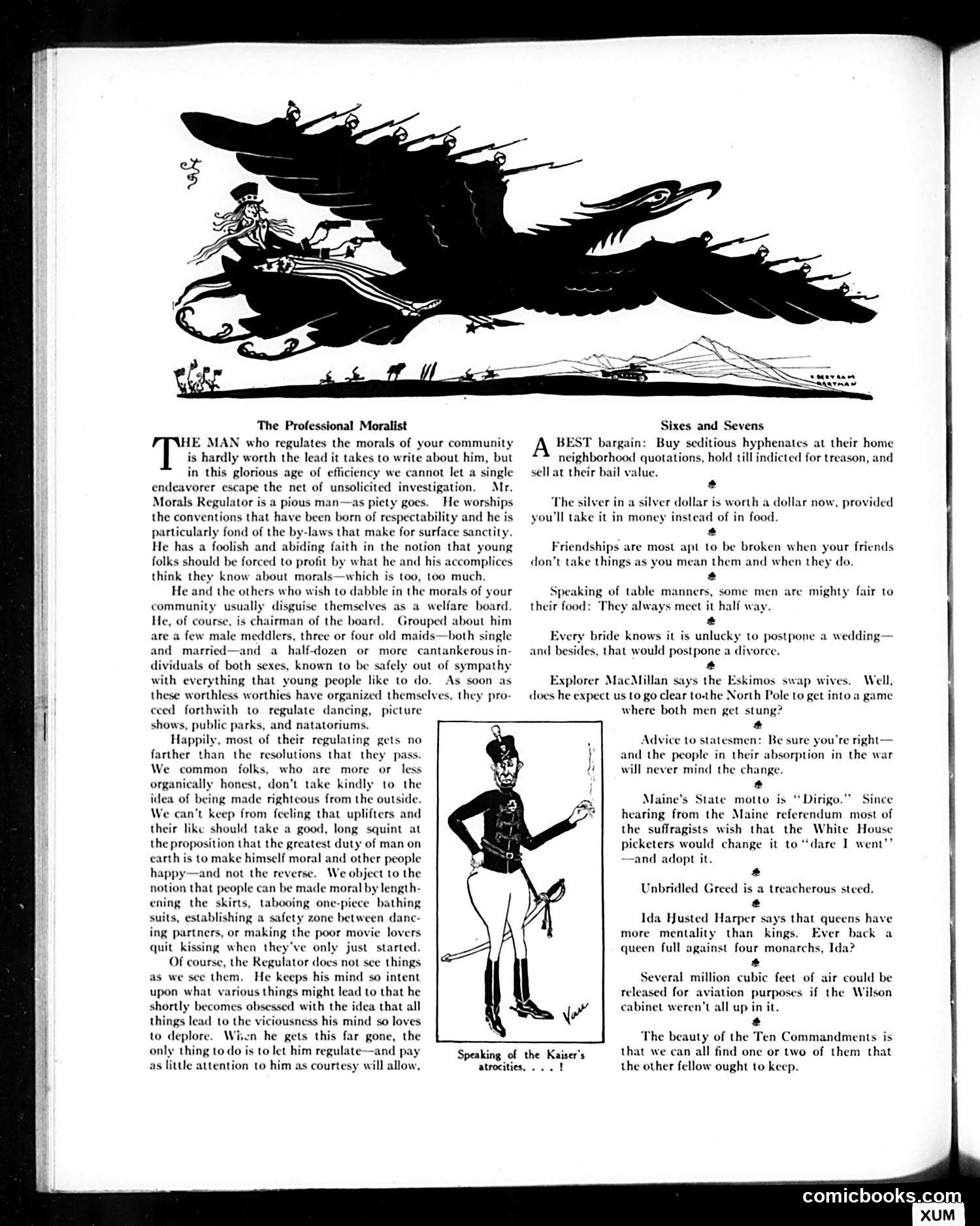
The main illustration depicts a figure riding a dragon-like creature, labeled "Speaking of the Kaiser's atrocities." This is a WWI-era satire mocking German Kaiser Wilhelm II's military conduct. The fantastical beast suggests exaggeration of German war crimes reports circulating during the conflict. The "Professional Moralist" essay critiques self-righteous community figures who regulate others' morality while ignoring their own hypocrisy—a common Judge target. "Sixes and Sevens" contains brief satirical observations on contemporary social issues: marriage, friendship, dining etiquette, and politics (referencing Maine's state motto "Dirigo" and suffragist concerns). The overall page blends visual satire with political commentary typical of Judge's format during the World War I period.
📄 Transcribed text from this page (OCR, searchable)
Machine-transcribed from the original scan — historical spelling and the odd misread are preserved.
The Professional Moralist HE MAN who regulates the morals of your community T is hardly worth the lead it takes to write about him, but in this glorious age of efficiency we cannot let a single endeavorer escape the net of unsolicited investigation. Mr. Morals Regulator is a pious man—as piety goes. He worships the conventions that have been born of respectability and he is particularly fond of the by-laws that make for surface sanctity. He has a foolish and abiding faith in the notion that young folks should be forced to profit by what he and his accomplices think they know about morals—which is too, too much. He and the others who wish to dabble in the morals of your community usually disguise themselves as a welfare board. He, of course, is chairman of the board. Grouped about him are a few male meddlers, three or four old maids—both single and married—and a half-dozen or more cantankerous in- dividuals of both sexes, known to be safely out of sympathy with everything that young people like to do. As soon these worthless worthies have organized themselves, they pro- ceed forthwith to regulate dancing, picture shows, public parks, and natatoriums. Happily, most of their regulating gets no farther than the resolutions that they pass. We common folks, who are more or less organically honest, don’t take kindly to the idea of being made righteous from the outside. We can’t keep from feeling that uplifters and their like should take a good, long squint at the proposition that the greatest duty of man on earth is to make himself moral and other people happy—and not the reverse. We object to the notion that people can be made moral by length- ening the skirts, tabooing one-piece bathing suits, establishing a safety zone between danc- ing partners, or making the poor movie lovers quit kissing when they've only just’ started. Of course, the Regulator does not see things as we see them. He keeps his mind so intent upon what various things might lead to that he shortly becomes obsessed with the idea that all things lead to the viciousness his mind so loves to deplore. Wien he gets this far gone, the only thing to do is to let him regulate—and pay as litUe attention to him as courtesy will allow. Speaking of the Kaiser's atrocities, . . Sixes and Sevens A BEST bargain: Buy seditious hyphenates at their home neighborhood quotations, hold till indicted for treason, and sell at their bail value. 2 The silver in a silver dollar is worth a dollar now, provided you'll take it in money instead of in food £ Friendships are most apt to be broken when your friends don’t take things as you mean them and when they do. 2 Speaking of table manners, some men their food: They always meet it half way. e Every bride knows it is unlucky to postpone a wedding— and besides, that would postpone a divorce. 2 Explorer MacMillan says the Eskimos swap wives. Well, does he expect us to go clear to-the North Pole to get into a game where both men get stung? * Advice to statesmen: Be sure you're right— and the people in their absorption in the war will never mind the change. 2 Maine's State motto is “Dirigo.” Since hearing from the Maine referendum most of the suffragists wish that the White House picketers would change it to “dare I went"’ -and adopt it. © mighty fair to 2 Unbridled Greed is a tre & Ida Husted Harper that queens have more mentali' than kings. Ever back queen full against four monarchs, Ida? * Several million cubic feet of air could be released for aviation purposes if the Wilson cabinet weren't all up in it. 2 The beauty of the Ten Commandments is that we can all find one or two of them that the other fellow ought to keep. cherous steed. a ot comicbooks.com