
Judge, 1917-10-27 · page 16 of 28
Judge — October 27, 1917 — page 16: what you’re looking at
What you’re looking at
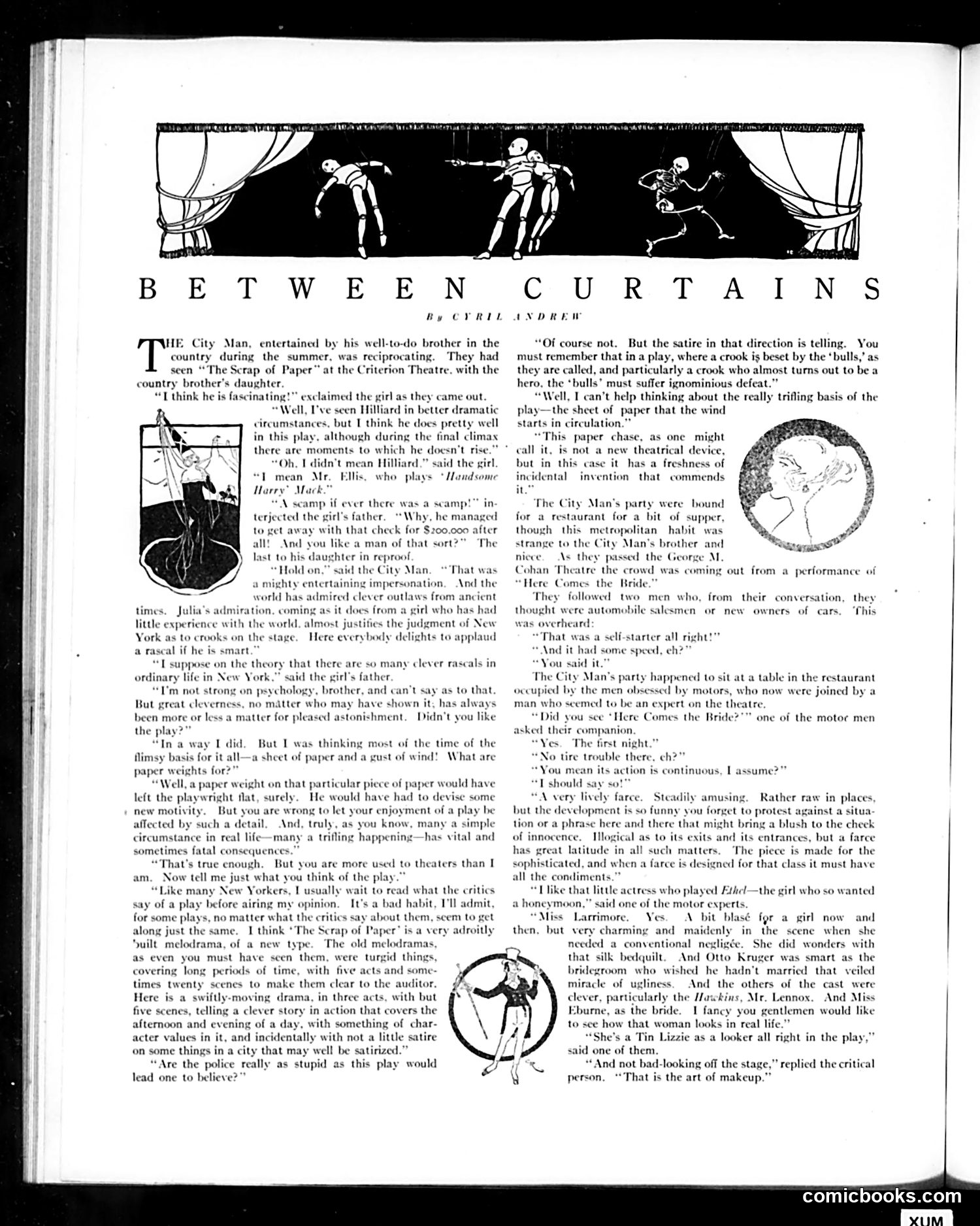
This is a theatrical review disguised as social commentary. The piece discusses "The Scrap of Paper," a play featuring actor Ellis as a clever criminal named "Handsome Harry" Mack—a character based on a real embezzler who stole $200,000. The satire targets two things: First, the public's romanticization of "clever rascals," exemplified by the country girl's admiration for the criminal character. The City Man defends this by noting society has always admired intelligent wrongdoers. Second, it mocks melodrama conventions—the absurdity that a plot hinges entirely on a single sheet of paper blown by wind, requiring police ("bulls") to appear foolish while the criminal nearly escapes. The author uses this theatrical discussion to satirize both theatrical artifice and urban sophistication, contrasting naive country sensibilities with jaded New York attitudes toward crime and entertainment.
📄 Transcribed text from this page (OCR, searchable)
Machine-transcribed from the original scan — historical spelling and the odd misread are preserved.
B ET WEEN By CYRIL country during the summer, was reciprocating. They had T= City Man, entertained by his well-to-do brother in the n Theatre. with the seen “The Scrap of Paper” at the Crite country brother's daughter. “TL think he is fascinating!” exclaimed the girl as they came out. “Well, 've seen Hilliard in better dramatic circumstances, but I think he does pretty well there are moments to which he doesn’t rise.” “Oh, I didn’t mean Hilliard.” said the giel “Lo mean Mr. Ellis, who plays ‘Handsome Marry’ Mack.” ““\ scamp if ever there was a seamp!” in terjected the girl's father. “Why, he managed get away with that check for $200,000 after all! And you like a man of that sort?” The last to his daughter in reproof “Hold on,” said the City Man, “That was a mighty entertaining impersonation, And the world has admired clever outlaws from ancient as it does from a girl who has had times. little experience with the world. almost ju York as to crooks on the stage, Here everybody delig! a rascal if he is smart “[ suppose on the theory that there are so many clever rascals in ordinary life in New York.” said the girl's father “I'm not strong on psychology, brother, and But great cleverness, no matter who may have shown it, has always been more or less a matter for pleased astonishment. Didn't you like the play?” “In a way I did flimsy basis for it all paper weights for?” “Well, a paper weight on that particular piece of paper would have left the playwright flat, surely. He would have had to devise some new motivity. But you are wrong to let your enjoyment of a play be affected by such a detail. And, truly, as you know, many a simple circumstance in real life—many a trifling happening—has vital and sometimes fatal consequences.” “That's true enough. But y« am. Now tell me just what you think of the play.” “Like many New Yorkers, I usually wait to read what the critics say of a play before airing my opinion. It’s a bad habit, I'll admit, for some plays, no matter what the critics say about them, scem to get along just the same. I think ‘The Scrap of Paper’ is a very adroitly uilt- melodrama, of a new type. The old melodramas as even you must have scen them, were turgid things, with five acts and some- Julia’s admiration. comin tifies the judgment of New nts to applaud an't say as to that But I was thinking most of the time of the a sheet of paper and a gust of wind! What are are more used to theaters than I covering long periods of time times twenty scenes to make them clear to the auditor. Here is a swiftl in three acts, with but five scenes, telling a clever story in action that covers the afternoon and evening of a day, with something of char- acter values in it, and incidentally with not a little satire fon some things in a city that may well be satirized.” “Are the police really as stupid as this play would lead one to believe?” fi “moving drama iy in this play, although during the final climax C UR TAT tNDREW “Of course not. But the satire in that direction is telling. You must remember that in a play, where a crook is beset by the ‘bulls,’ as they are called, and particularly a crook who almost turns out to be a hero, the ‘bulls’ must suffer ignominious defeat.” Well, I can’t help thinking about the really trifling basis of the play—the sheet of paper that the wind starts in circulation.” This paper chase, as one might call it, is not a new theatrical device, but in this case it has a freshness of dental invention that commends in it The City Man's party were bound for a restaurant for a bit of supper, though this metropolitan habit was strange to the City Man's brother and niece. M Cohan Theatre the crowd was coming out from a performance of “Here Comes the Bride.” They followed two men who, from their conversation, they thought were automobile salesmen or new owners of cars.‘ was overheard *That was a self-starter all right!” “And it had some speed, eh?” “You said it.” The City Man’s party happened to sit at a table in the restaurant occupied by the men obsessed by motors, who now were joined by a man who seemed to be an expert on the theatre. “Did you sce *Here Comes the Bride?’” one of the motor men asked their companion “Yes. The first night.” *No tire trouble there, ch?” “You mean its action is continuous, | assume?” “T should : “A very lively farce. Steac Rather raw in places but the development is so funny you forget to protest against a situa tion or a phrase here and there that might bring a blush to the cheek of innocence. Ilogical as to its exits and its entrances, but a farce has great latitude The piece is made for the sophisticated, and when a farce is designed for that class it must have all the condiments.” “Like that little actress who played Ethel a honeymoon,” said one of the motor experts. “Miss Larrimore. Yes. \ bit blasé for a girl now and then, but very charming and maidenly in the scene when she needed a conventional negligée. She did wonders with that silk bedquilt. And Otto Kruger was smart as the bridegroom who wished he hadn't married that veiled sacle of ugliness. And the others of the cast were clever, particularly the Hawkins, Mr. Lennox. And Miss Eburne, as the bride. I fancy you gentlemen would like to see how that woman looks in real life.” She's a Tin Lizzi a looker all right in the play,” said one of them. x “And not bad-looking off the stage,” replied the critical \ person. “That is the art of makeup. As they passed the Geo Ay so! amusing in all such matters. the girl who so wanted comicbooks.com YLIM