
A complete issue · 28 pages · 1917
Judge — October 13, 1917
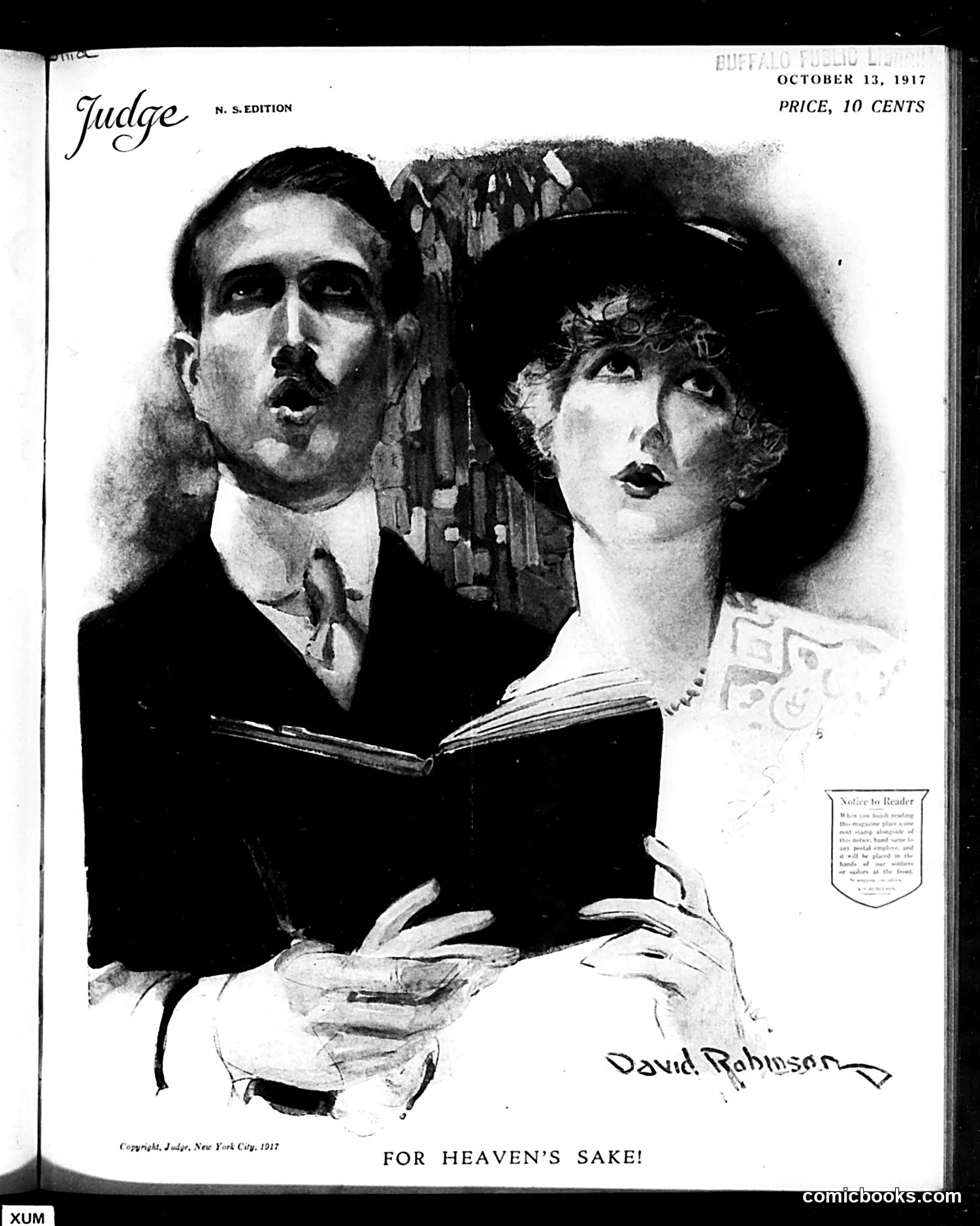
This satirical cover, signed by David Robinson, depicts two figures sharing a book titled "FOR HEAVEN'S SAKE!" The well-dressed man with a prominent mustache and the fashionably-dressed woman appear to be engaged in reading material together. Given the October 1917 date—during America's involvement in World War I—the satire likely comments on contemporary social attitudes or domestic life during wartime. The phrase "For Heaven's Sake!" suggests moral or social commentary, possibly critiquing leisure activities or entertainment choices during a period when patriotic sacrifice was emphasized. However, without clearer identification of the specific figures or clearer OCR text of accompanying text, the precise satirical target remains unclear.
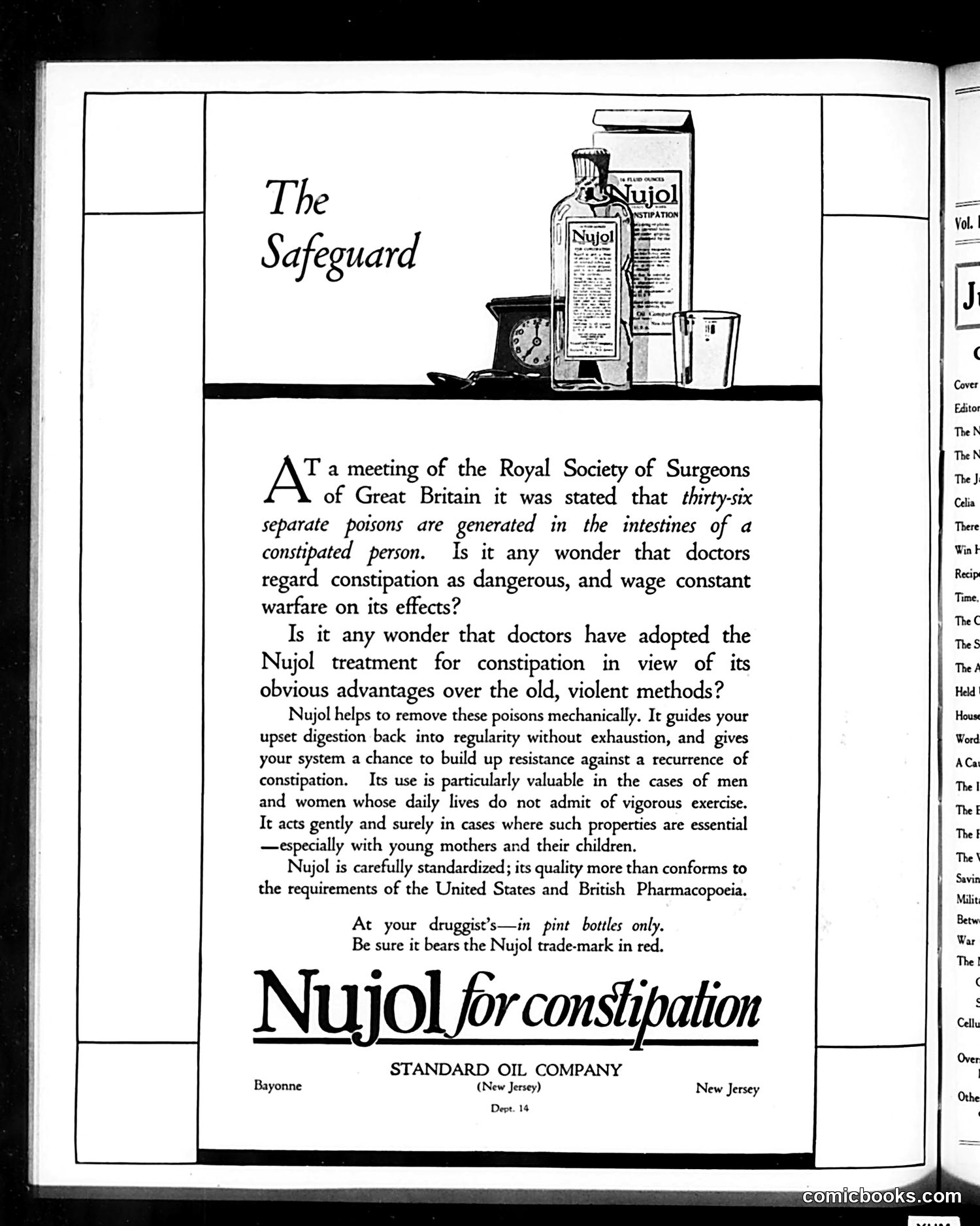
This page is **primarily an advertisement**, not satire or political commentary. It's a full-page ad for Nujol, a mineral oil laxative made by Standard Oil Company. The ad references a legitimate medical claim from a Royal Society of Surgeons meeting: that constipation generates intestinal poisons. The advertisement argues Nujol is superior to older, harsh laxatives because it works mechanically without violent effects—important for children and nursing mothers. The visual header shows a clock and medical bottles, emphasizing the product's reliability and pharmaceutical legitimacy. The headline "The Safeguard" positions Nujol as protective health care. There is **no political cartoon or satire** present on this page—it's straightforward period advertising using medical authority to market a commercial product.
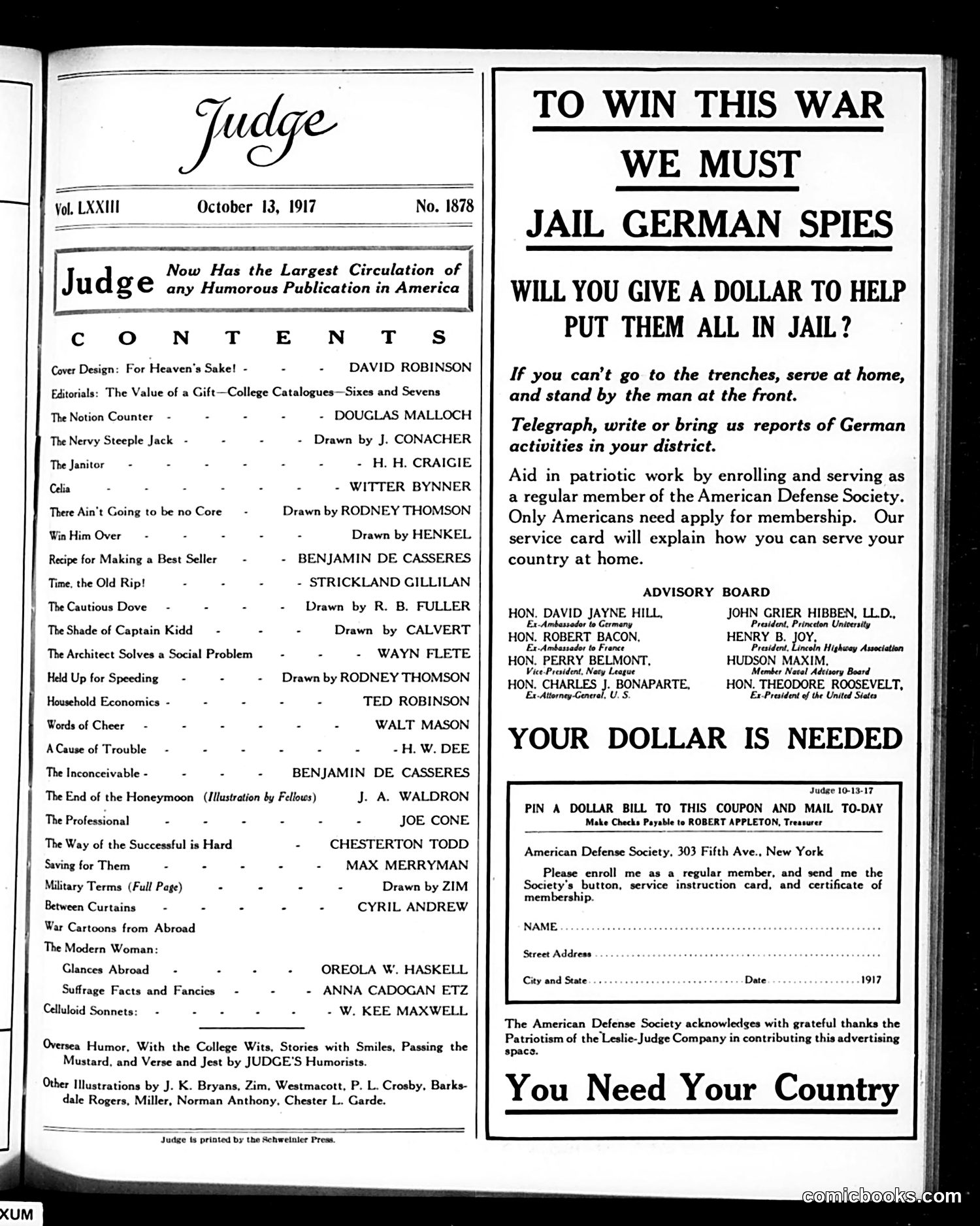
This page combines satirical content with a full-page wartime advertisement. The right side features a propaganda appeal from the American Defense Society urging readers to donate dollars to "jail German spies," reflecting widespread anti-German sentiment during World War I. The ad appeals to patriotism, offering membership in a civilian defense organization with an advisory board including Theodore Roosevelt and other prominent figures. The left side lists Judge's typical humor content—cartoons and articles by contributors like Chesterton Todd and Joe Cone. The specific cartoons aren't visible in this image, but they would have been contemporary satirical commentary. The juxtaposition reveals how American publications merged entertainment with official wartime messaging to mobilize public support and funding for military and domestic security efforts.
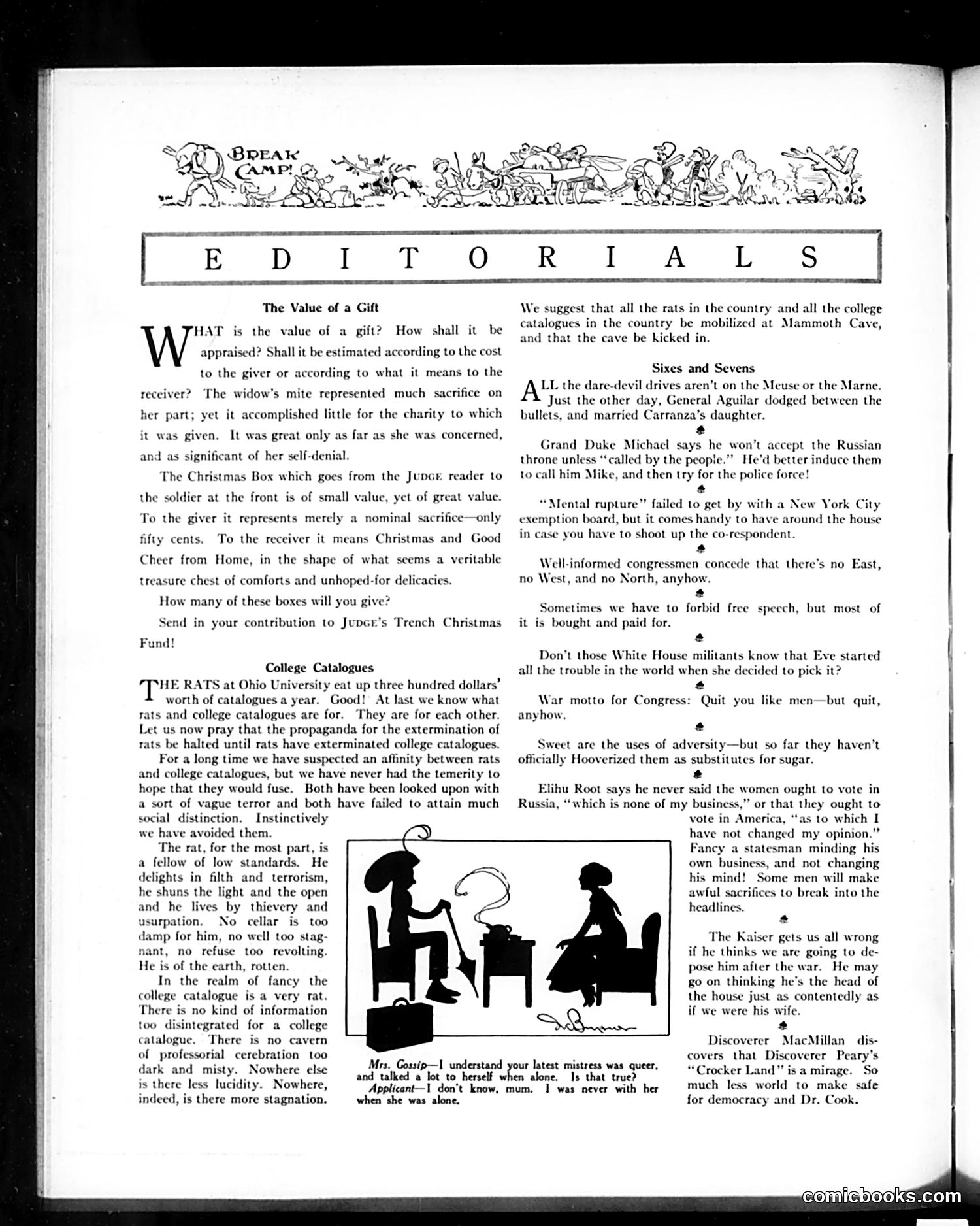
The main cartoon shows a couple in silhouette: a man asking a woman about her "latest mistress" being "queer" and whether she "talked a lot to herself when alone." The woman responds dismissively. This appears to be satirizing domestic gossip and infidelity accusations among the wealthy or upper classes. The joke likely relies on the woman's evasive answer implying the mistress was mentally unstable or eccentric—a cutting insult masked as innocent questioning. The surrounding "Editorials" section contains political satire about contemporary issues: college catalogues, rats at Ohio University, Christmas charity boxes, and various barbs at politicians and social movements (mentions of "White House militants," Congress, Russia, the Kaiser, and Hooverization). The overall tone mocks both high society pretension and political absurdities of the WWI era.
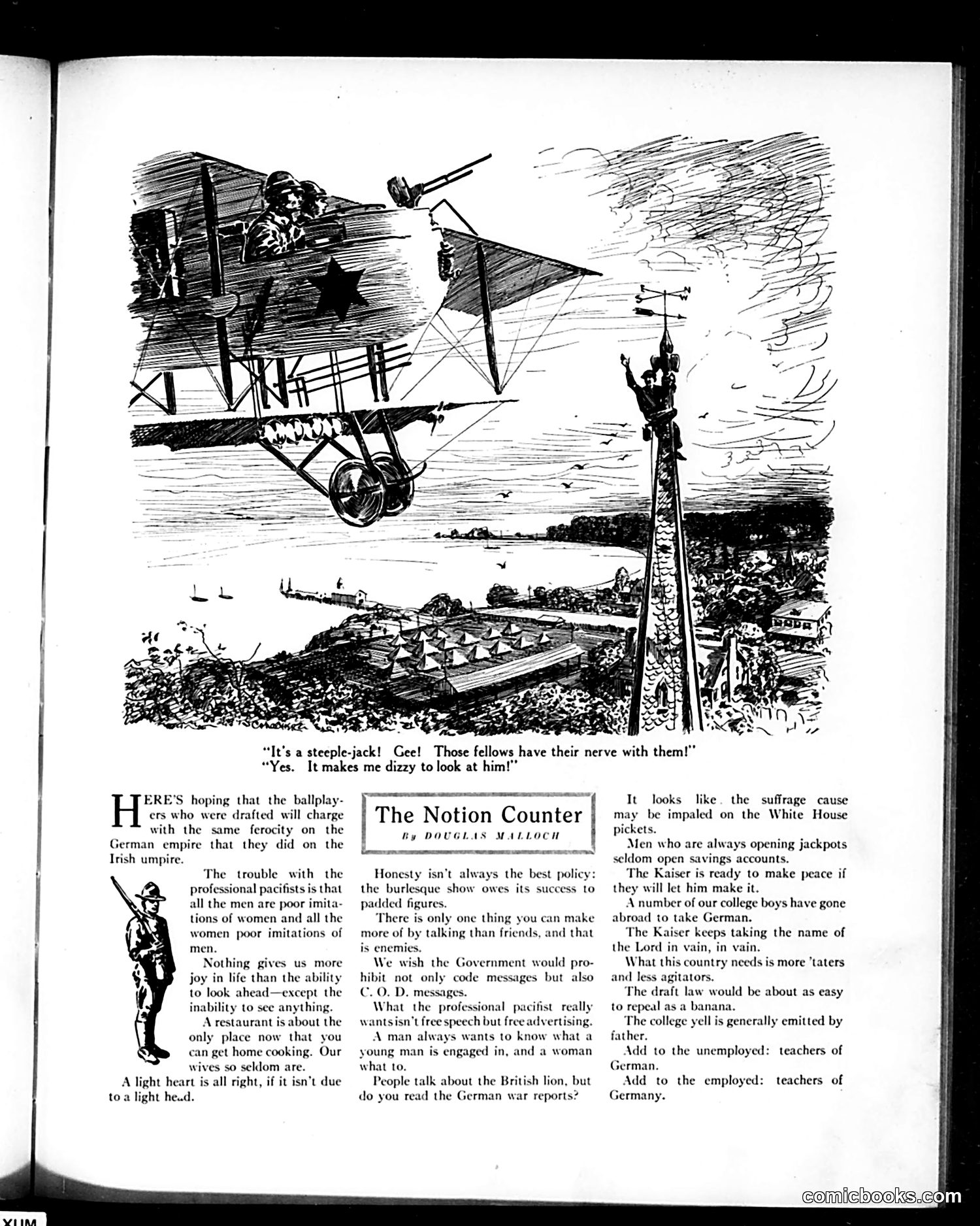
This WWI-era satirical column attacks American pacifism and defeatism. The cartoon shows a daredevil pilot performing stunts above a landscape with a wireless tower—visualizing bold military action against cowardice. The text mocks various peace advocates: those hoping drafted men won't fight with "German ferocity," politicians relying on "padded figures," and professional pacifists preferring "free speech but free advertising." Malloch argues pacifism is intellectually dishonest and weak. He sarcastically suggests repealing laws "as easy as a banana" and criticizes college boys studying German rather than fighting Germans. The final lines equate teaching German with unemployment—suggesting cultural disloyalty. The piece reflects pro-war sentiment and suspicion of dissent common in American publications during WWI.
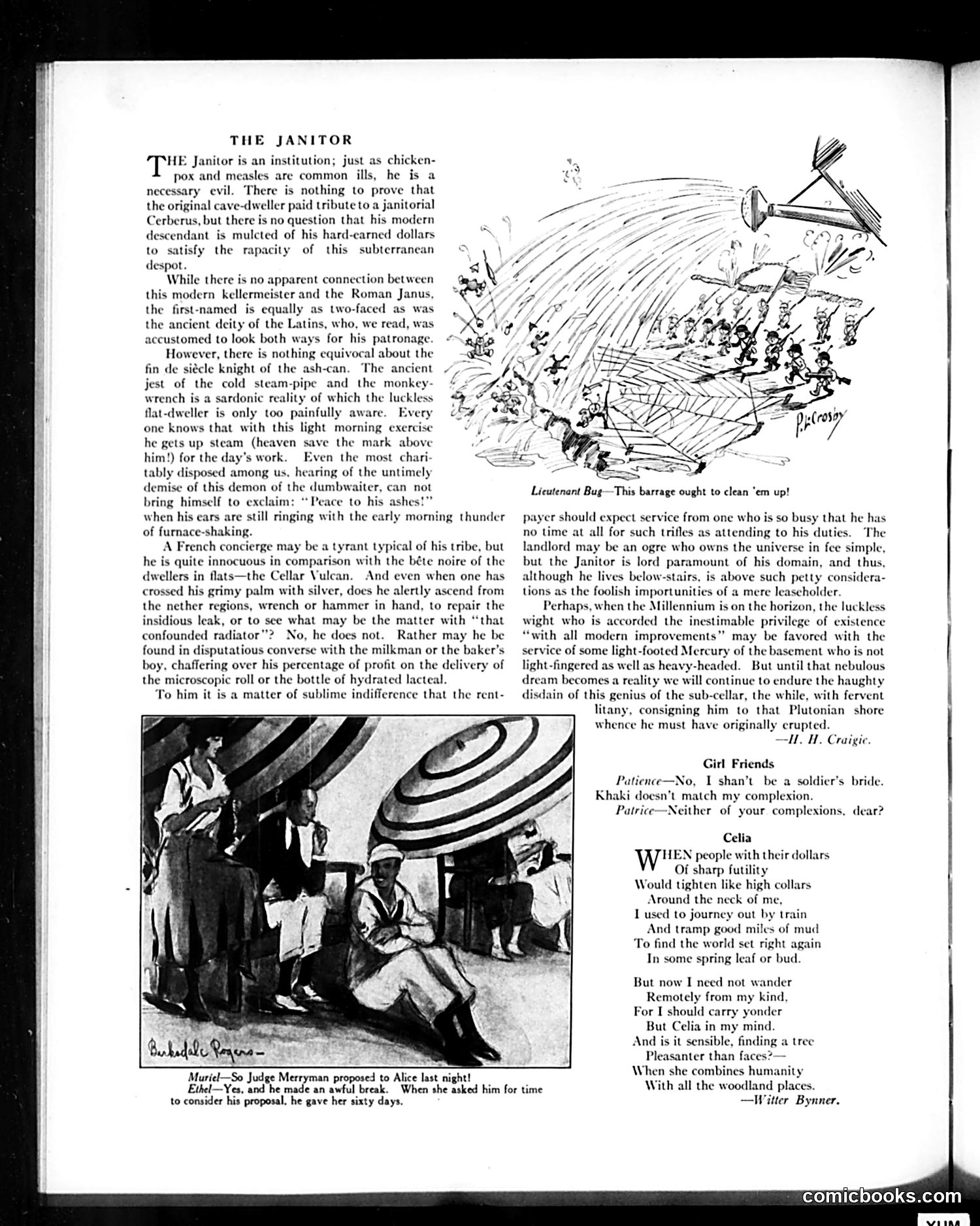
This page contains **"The Janitor,"** a satirical essay mocking the working-class building superintendent. The text portrays him as an institution—necessary but troublesome, comparing him unfavorably to historical figures while acknowledging his importance to urban life. The **cartoon illustration** (top right) shows a janitor overwhelmed by tenants' complaints, depicted as a harried figure surrounded by demanding residents pointing at leaks and problems. Below is a photograph captioned about "Judge Merryman" proposing to "Alice"—a social commentary on romance, though the specific reference is unclear without additional context. The page concludes with poetry about **"Celia,"** addressing romantic longing and travel. Overall, the satire targets working-class service providers and social anxieties of early 20th-century urban America.
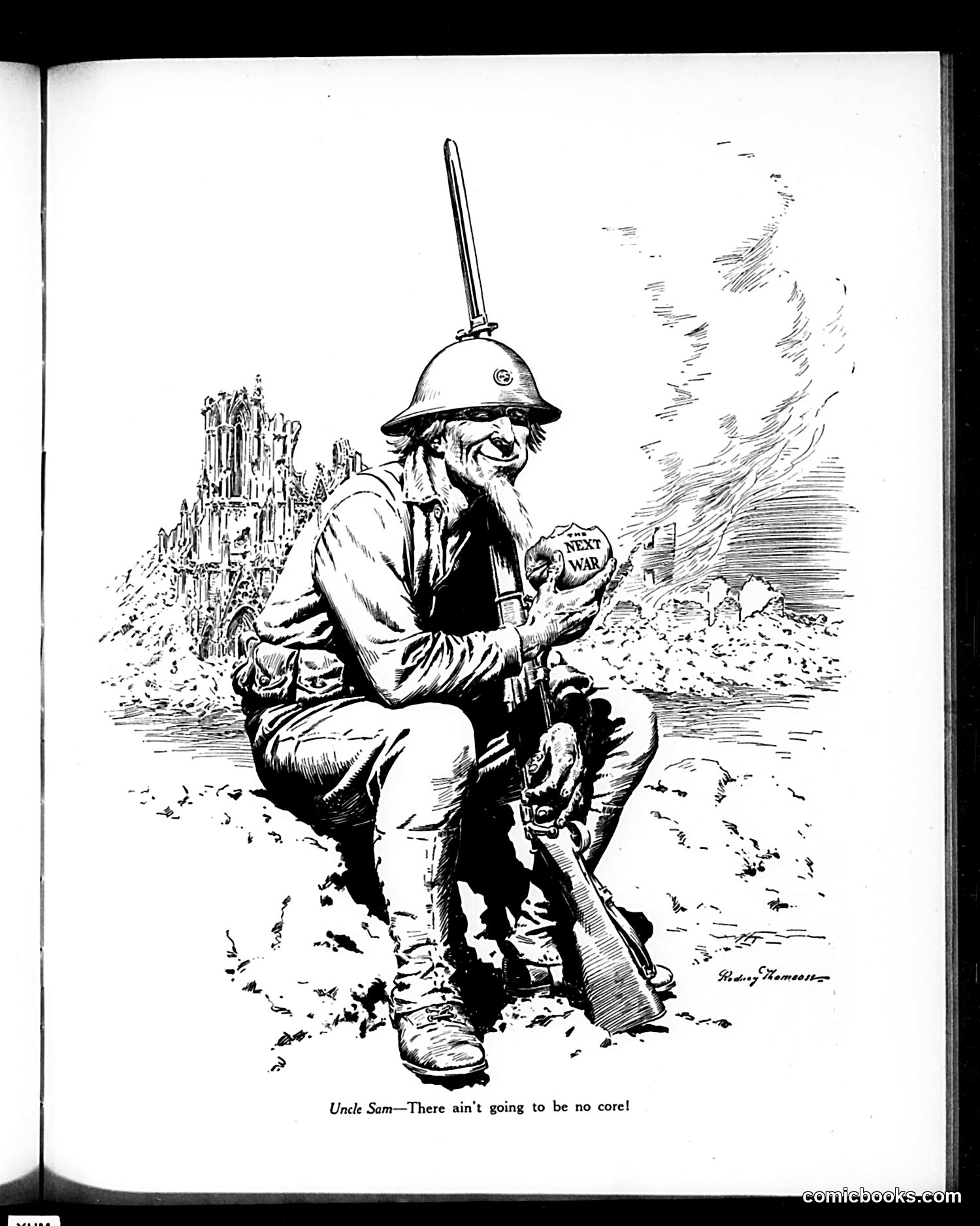
This cartoon depicts **Uncle Sam** (personification of the United States) as a soldier in a German spiked helmet (Pickelhaube), standing amid battlefield ruins. He holds a grenade or bomb labeled "NEXT WAR" while declaring "There ain't going to be no core!" The caption's phrase "no core" appears to be a pun or dialectal speech suggesting "no encore"—meaning no repetition of war. The cartoon satirizes post-WWI American attitudes, likely warning against future military conflict or commenting on ongoing war preparations despite public desire for peace. The German military imagery suggests tension with Germany. The cartoon's date and specific historical context remain unclear without additional publication information, but it appears critical of militarism or prophecy about coming conflicts.
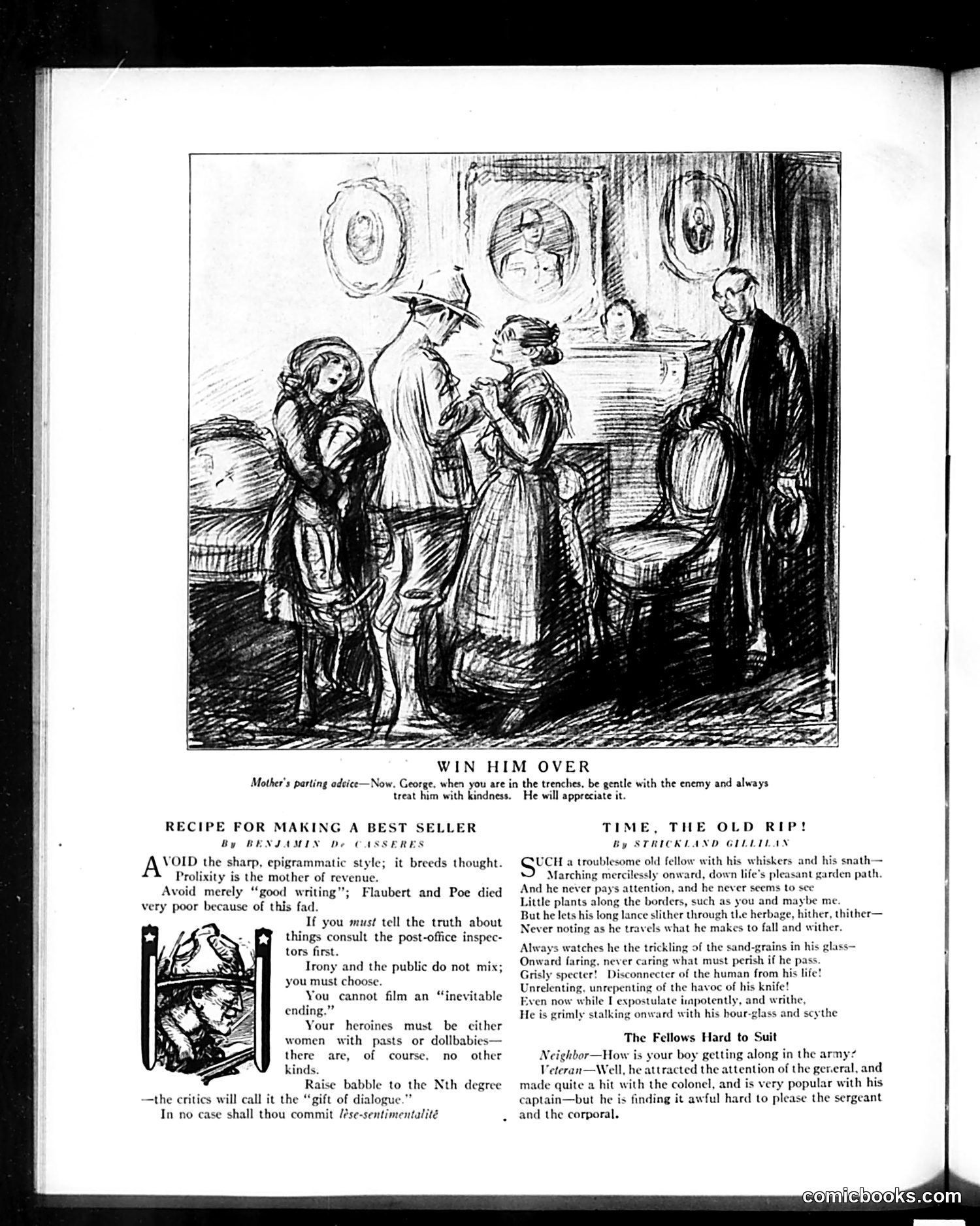
The top cartoon depicts a mother giving her son wartime advice about treating the enemy kindly—satirizing naive, sentimental attitudes about WWI combat. The irony is that such gentleness would be impractical or fatal in actual trench warfare. Below, "Recipe for Making a Best Seller" mocks commercial publishing practices: avoid genuine thought or quality writing; prioritize profit over artistry; consult censors before truth-telling; appeal to lowest common denominators rather than intelligent readers. It's a cynical critique of mass-market entertainment prioritizing revenue over integrity. The poem "Time, the Old Rip!" personifies Death as an indifferent reaper who destroys life without remorse while watching sand fall through an hourglass. "The Fellows Hard to Suit" jokes that a soldier impresses high-ranking officers but can't satisfy the sergeants and corporals—those with direct authority over daily life. The humor lies in this inverted hierarchy of actual power.
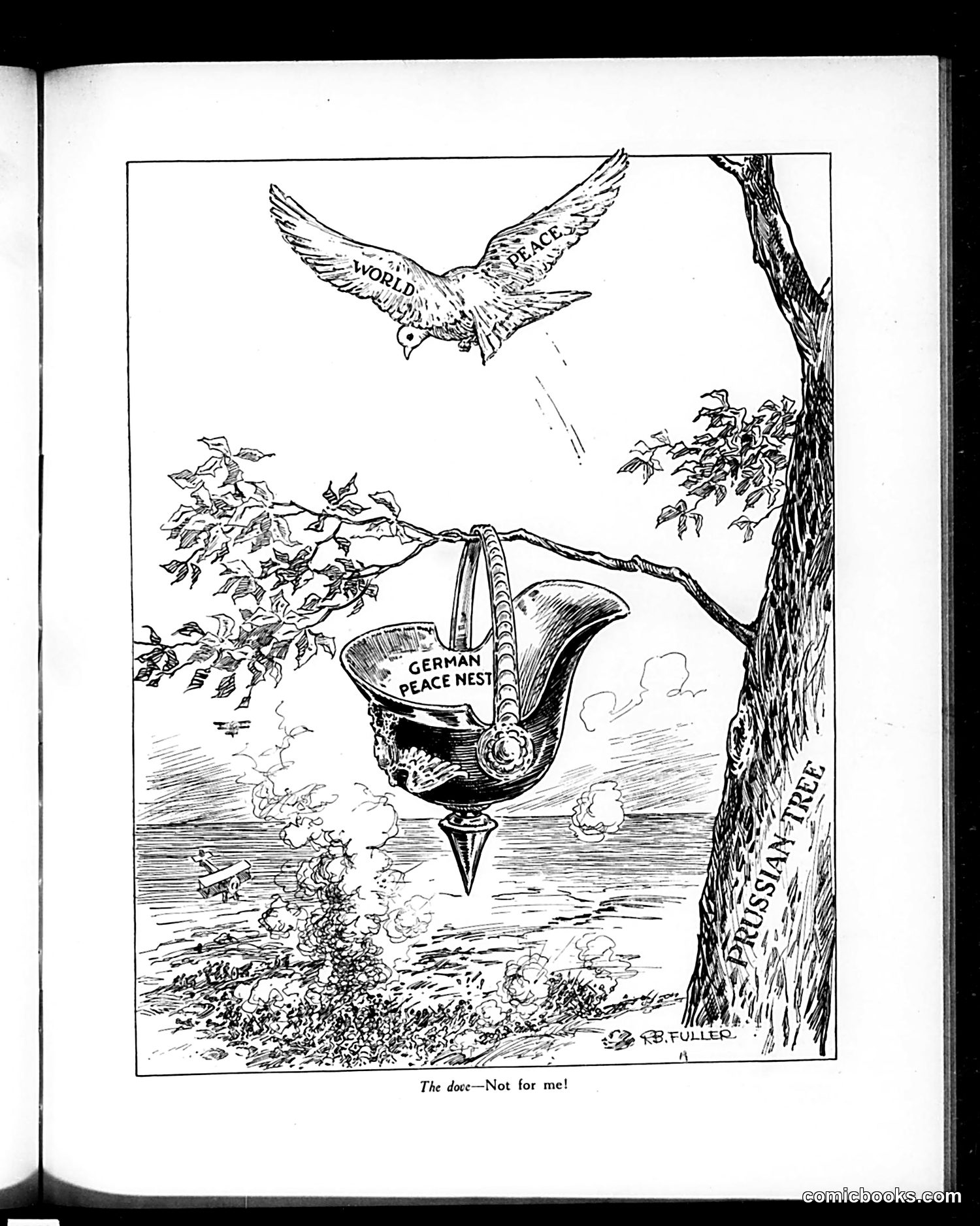
This is a World War I-era satirical cartoon by F.B. Fuller depicting a "German Peace Nest" — a military helmet serving as a nest — rejecting a dove of peace descending from above (labeled "PEACE" and "WORLD"). The cartoon criticizes Germany's rejection of peace overtures, suggesting the German military establishment refuses peaceful resolution. The inverted helmet-as-nest is a visual pun mocking German militarism: rather than nurturing life, German military ideology creates only destruction. The "Prussian Tree" labeled on the right appears to represent German imperial power. The cartoon's caption reinforces the message that Germany spurns peace efforts, likely reflecting American frustration with German war aims during WWI negotiations or peace discussions.
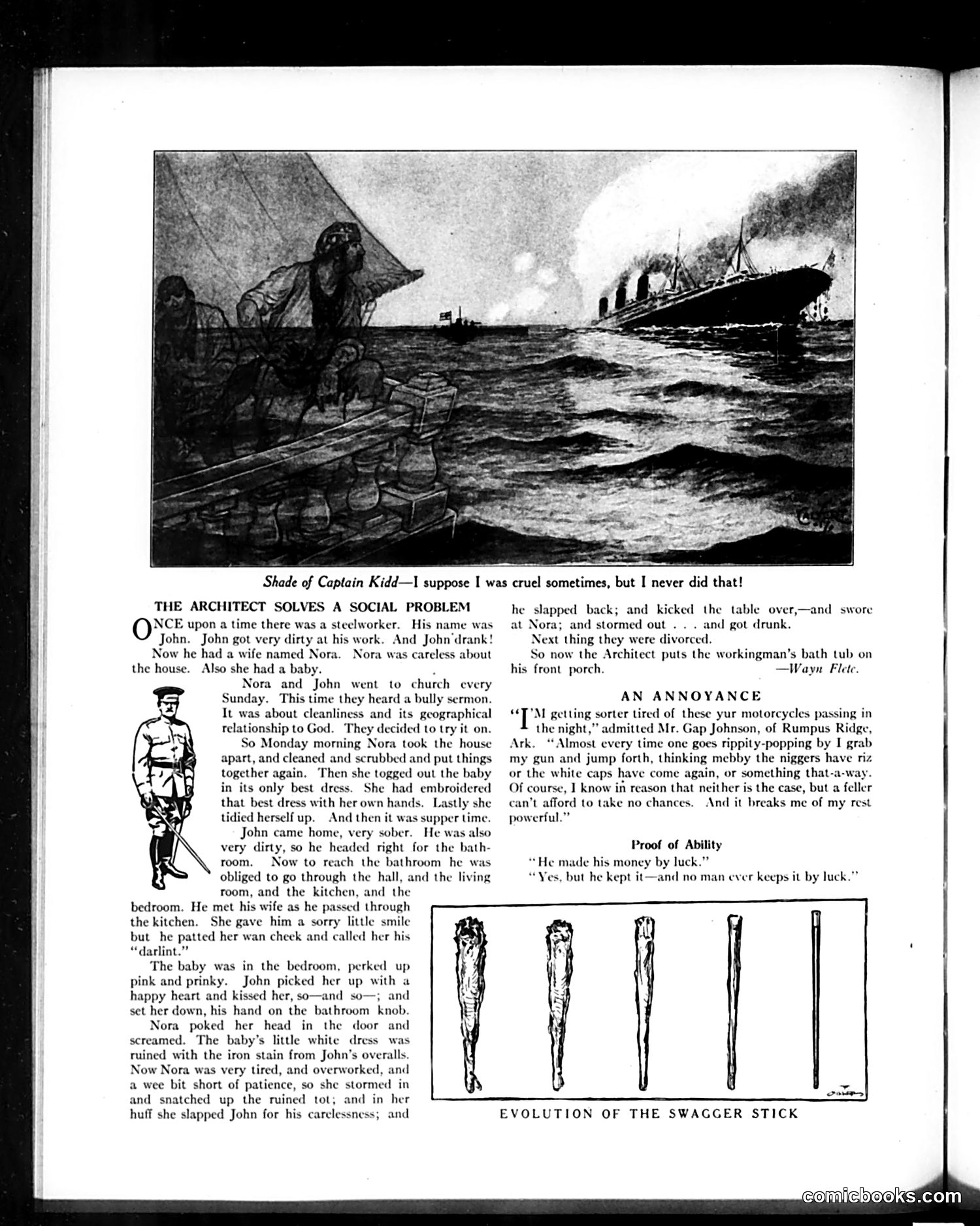
This page contains two satirical pieces from *Judge* magazine: **"The Architect Solves a Social Problem"** is a morality tale about a working-class couple. After hearing a church sermon on cleanliness, Nora thoroughly cleans their home and baby. When her husband John returns dirty from the steel mill and inadvertently stains the baby's dress with his work clothes, Nora's exhaustion causes her to lose patience. The escalating conflict ends in divorce. The satire critiques how middle-class moral ideals ("cleanliness is next to godliness") are impractical for working families living in poverty and industrial conditions. The "solution"—moving the bathtub to the front porch—mockingly suggests architects design homes without understanding actual working-class domestic struggles. **"An Annoyance"** features a rural Southerner complaining about motorcycles disturbing his rest, constantly fearing they signal racial violence (lynchings or KKK activity). This satirizes both rural paranoia and the actual prevalence of such threats in the Jim Crow South. The "Evolution of the Swagger Stick" appears to be a simple comparative illustration.
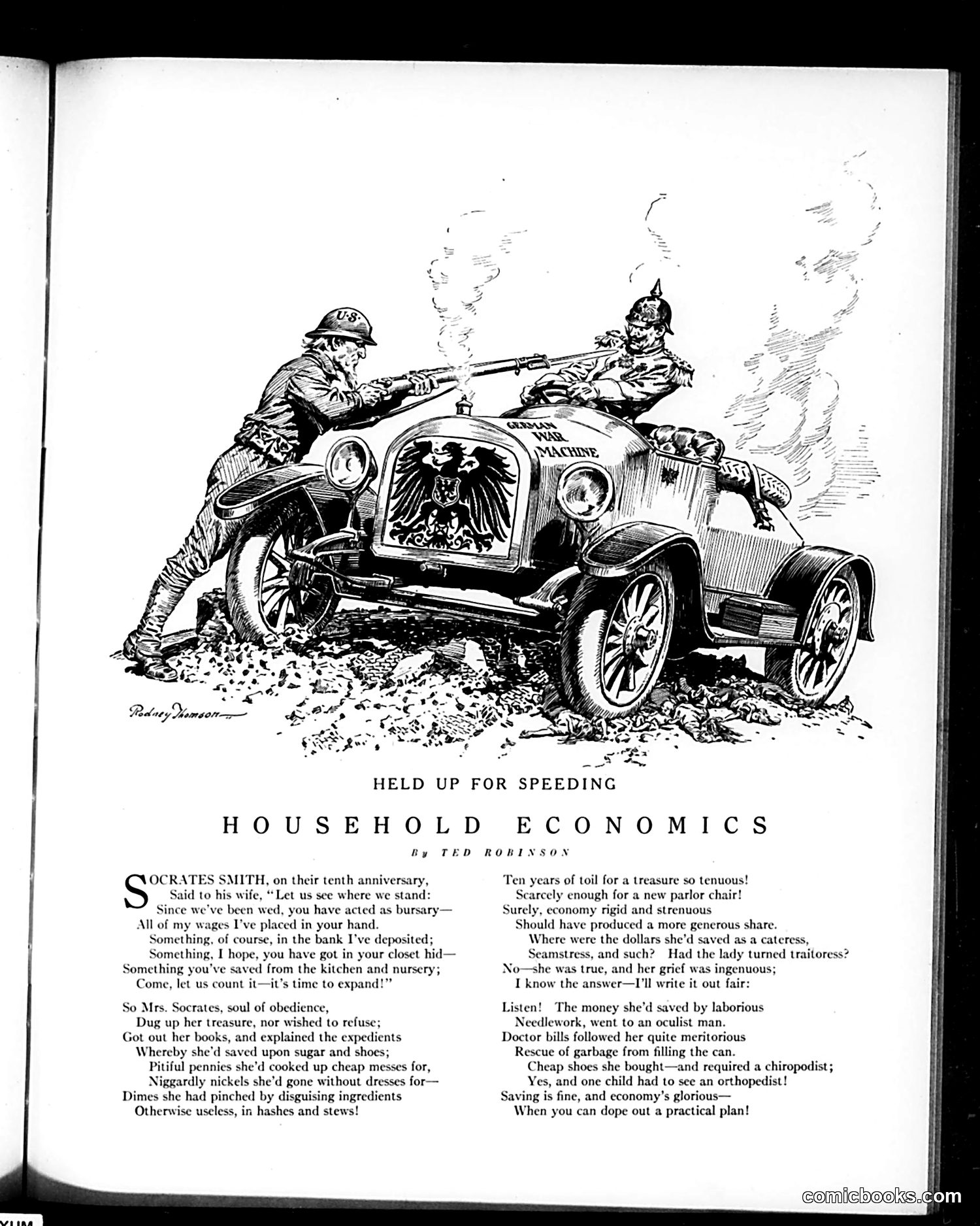
This satirical poem by Ted Robinson mocks the gap between economic theory and domestic reality. The cartoon shows a soldier stopping a German military vehicle—a visual pun on "held up"—while the poem explores the phrase literally applied to household budgeting. The narrative follows Socrates Smith, who expects his frugal wife to have accumulated substantial savings from ten years of careful domestic management. Instead, her "treasure" barely covers a parlor chair. The satire reveals why: her economies were consumed by medical expenses—an oculist for vision problems, a chiropodist for cheap shoes' consequences, an orthopedist for a child's condition, and doctor bills from salvaging garbage. The poem's moral: rigid personal economy fails without accounting for inevitable life expenses. It's social commentary on working-class financial struggle and the impossibility of genuine savings when health crises and children's needs arise. The title's ironic reference to traffic enforcement parallels being "held up" by unavoidable costs.
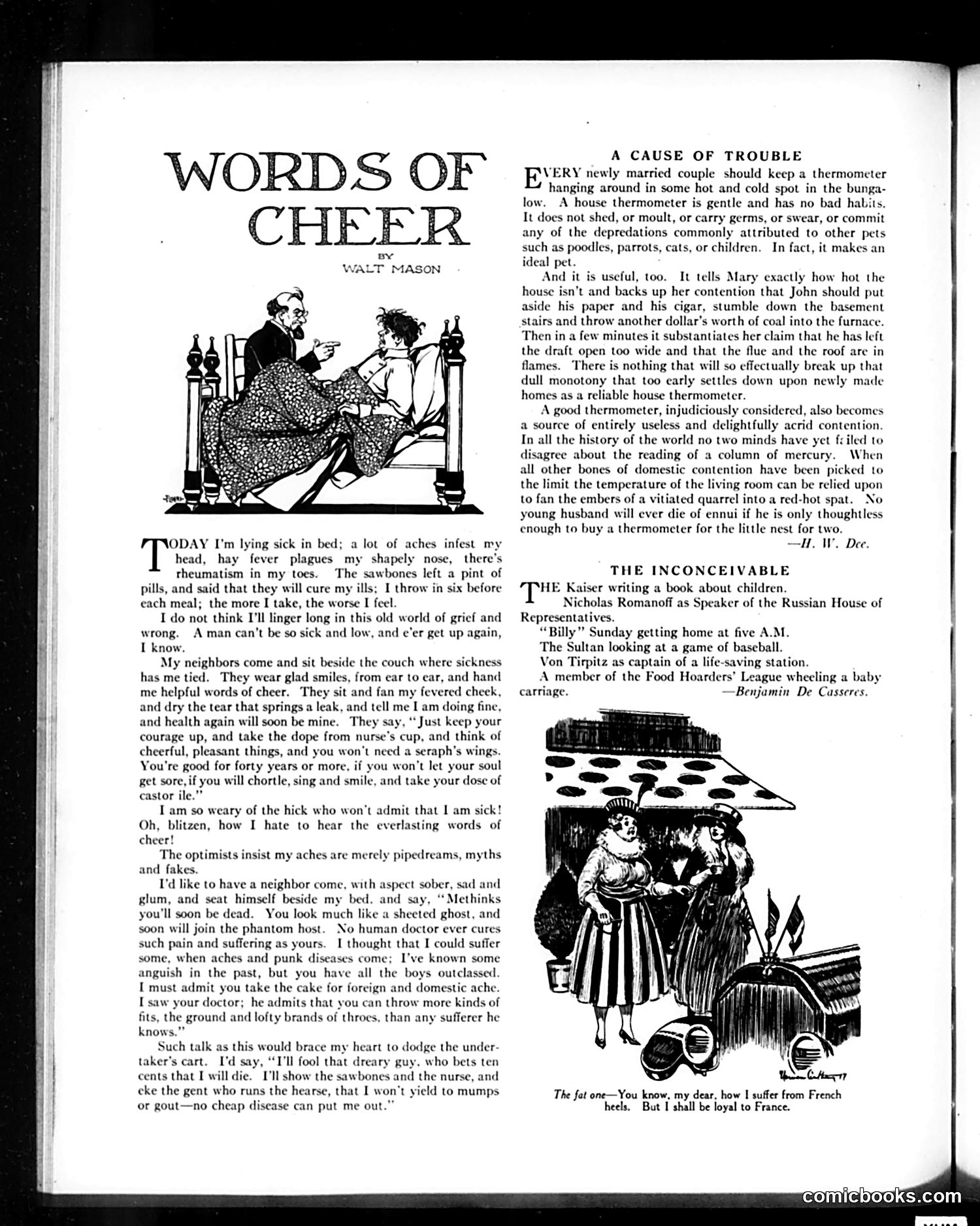
**"Words of Cheer" by Walt Mason** (left column): A satirical poem about a bedridden sick man complaining that well-meaning neighbors' relentless optimism—their insistence his ailments are imaginary and he'll recover—actually worsens his misery. Mason's joke: the sick man ironically wishes someone would acknowledge he's genuinely ill and dying, which would paradoxically give him fighting spirit. This mocks the early 20th-century American cultural habit of forced positivity and denial of real suffering. **"A Cause of Trouble"** (right column): Satirizes newlywed couples over a house thermometer. The piece jokes that while thermometers seem useful household pets (unlike messy dogs or parrots), they actually become weapons in marital arguments—couples endlessly dispute mercury readings, with wives weaponizing temperature complaints to demand husbands perform household tasks. The satire targets domestic friction and the absurd quarrels that plague young marriages. Both pieces use humor to critique social pretense: one mocks hollow cheerfulness, the other mocks petty domestic conflict.
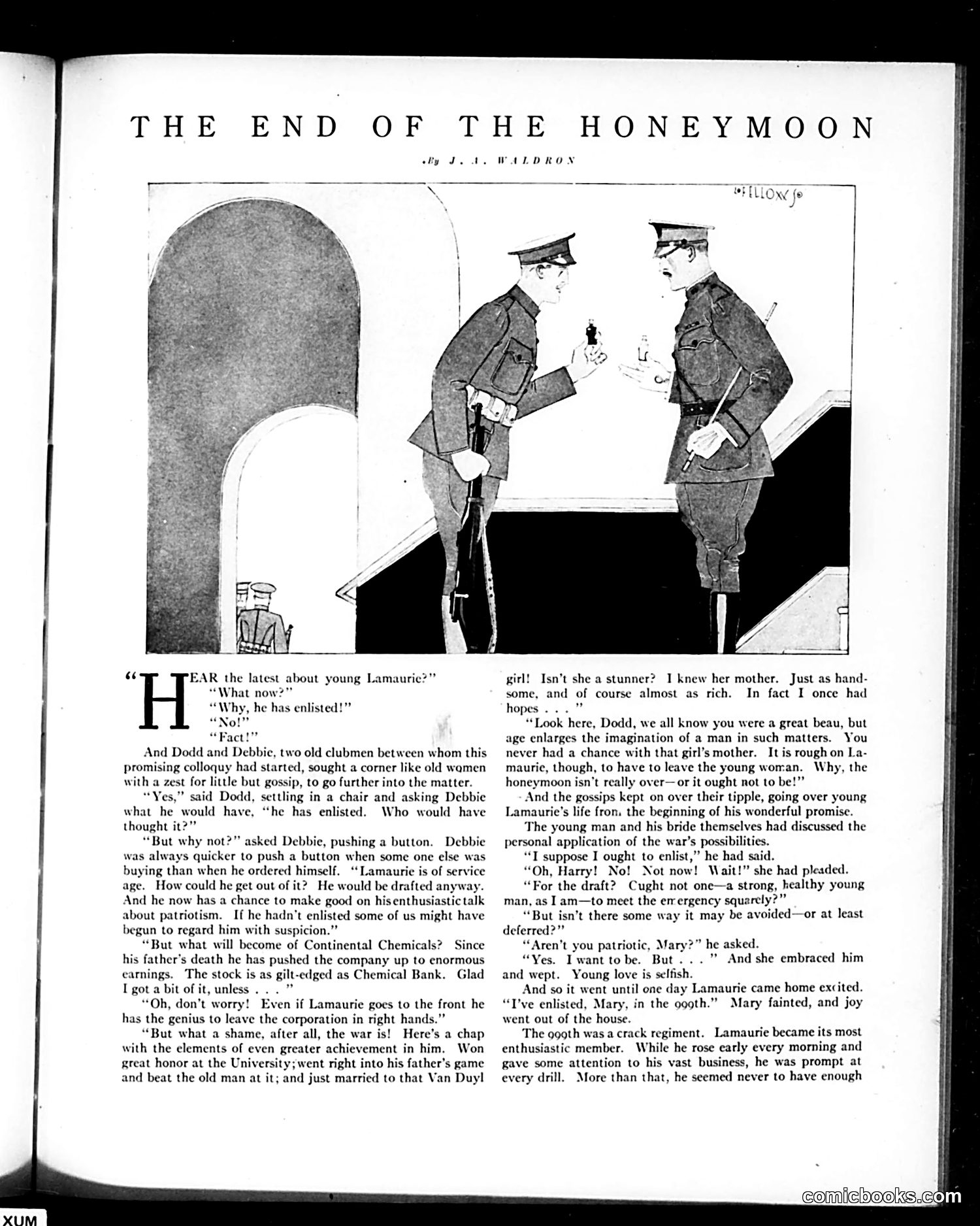
This story satirizes the tension between patriotic duty and personal selfishness during wartime (likely WWI, given the draft reference). Young Lamaurie, a successful businessman who inherited and expanded his father's chemical company, enlists in the military despite being eligible for the draft anyway. The satire operates on two levels: Club gossips praise his patriotism while lamenting the loss of his business talents and recent marriage. Meanwhile, Lamaurie's wife Mary initially pleads with him to avoid service, wanting to prolong their honeymoon—representing selfish romantic desires conflicting with national need. The title's irony is sharp: the "honeymoon ends" not through natural marital wear, but through Lamaurie's voluntary patriotic sacrifice. His wife's initial resistance and subsequent despair underscore how individual happiness must yield to collective duty. The story presents Lamaurie's ultimate enthusiasm for military service as moral redemption from the couple's initial self-centeredness.
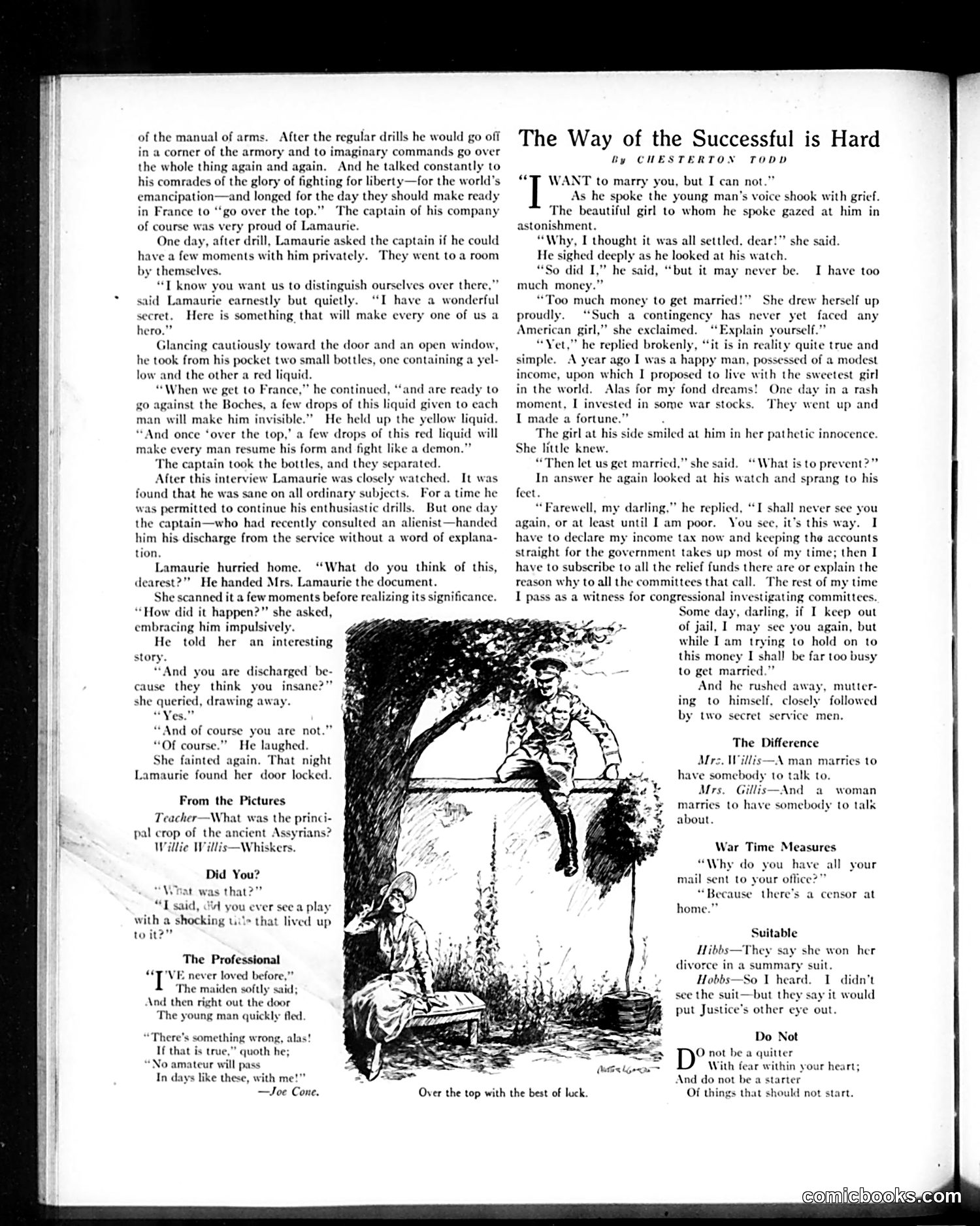
This page contains satirical content reflecting WWI-era American concerns. The main story, "The Way of the Successful is Hard" by Chesterton Todd, depicts a young man who cannot marry his sweetheart because he's become *too wealthy* from war stock investments—an ironic reversal of typical romantic obstacles. The satire critiques profiteering from war; the protagonist's sudden fortune makes him feel morally compromised, suggesting wartime wealth-building was viewed with suspicion or shame. The accompanying illustration shows soldiers in combat, reinforcing the war context. The smaller comic pieces ("The Professional," "Did You?") appear to be lighter humor about military life and civilian ignorance. The overall message critiques how ordinary Americans could accumulate fortunes during wartime while soldiers died, creating moral discomfort about materialism during patriotic sacrifice.
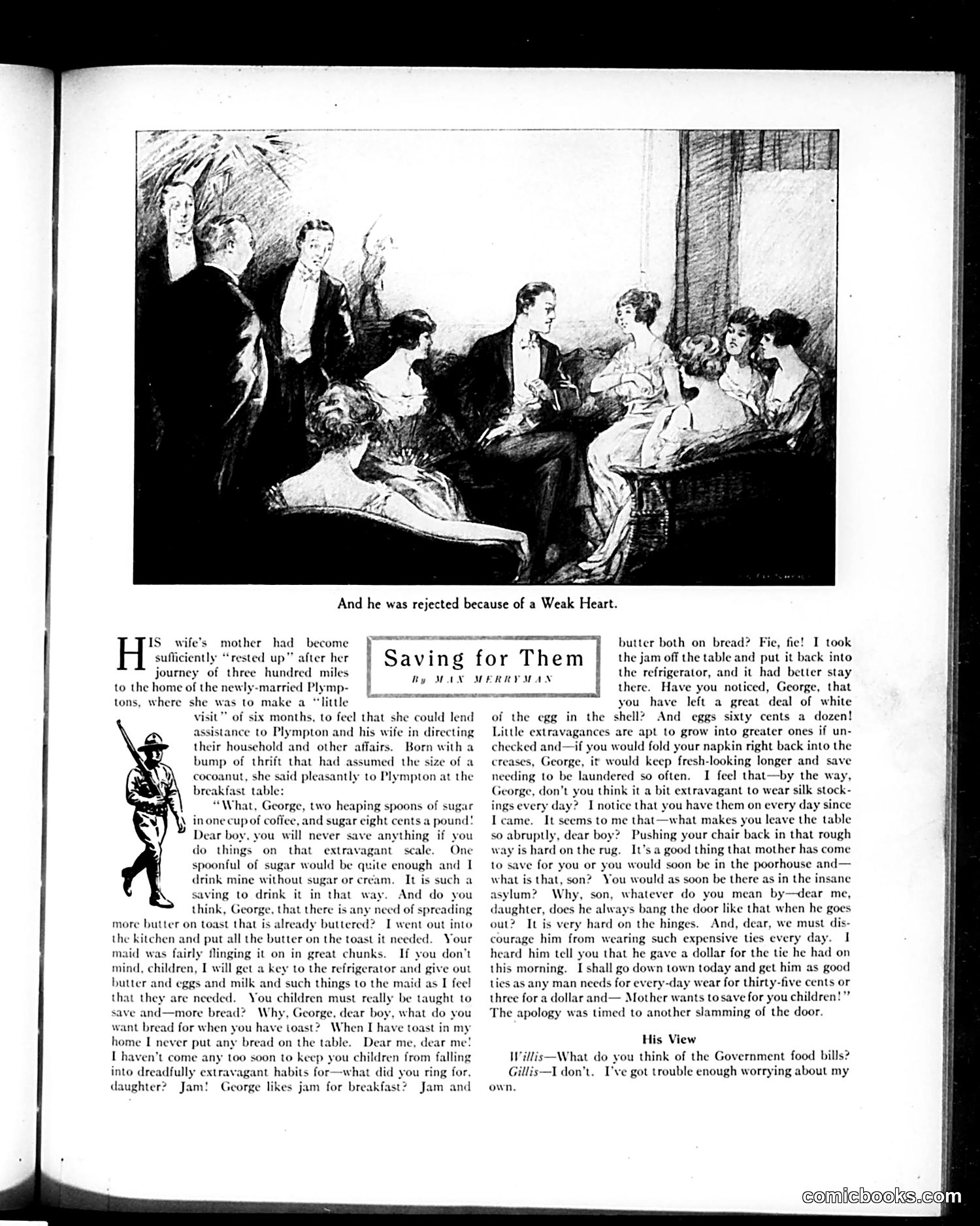
This satirical story depicts a meddlesome mother-in-law whose obsessive penny-pinching drives her son-in-law to desperation. The narrative illustrates early 20th-century anxieties about household economics and generational conflict. The mother, visiting for an extended "little visit," systematically critiques every modest expenditure—sugar in coffee, butter on toast, silk stockings, expensive ties—lecturing constantly about thrift. Her relentless cost-cutting and control over the household (taking refrigerator keys, rationing jam) humiliates the son-in-law George, who eventually abandons the breakfast table in frustration, slamming doors. The satire mocks both the obsessive frugality of older generations and the intrusive domestic management by in-laws. The title's irony is sharp: she claims to be "saving for them," but her manic economizing destroys household peace. The brief dialogue at bottom about government food bills adds topical resonance, likely referencing wartime or Depression-era food rationing concerns.
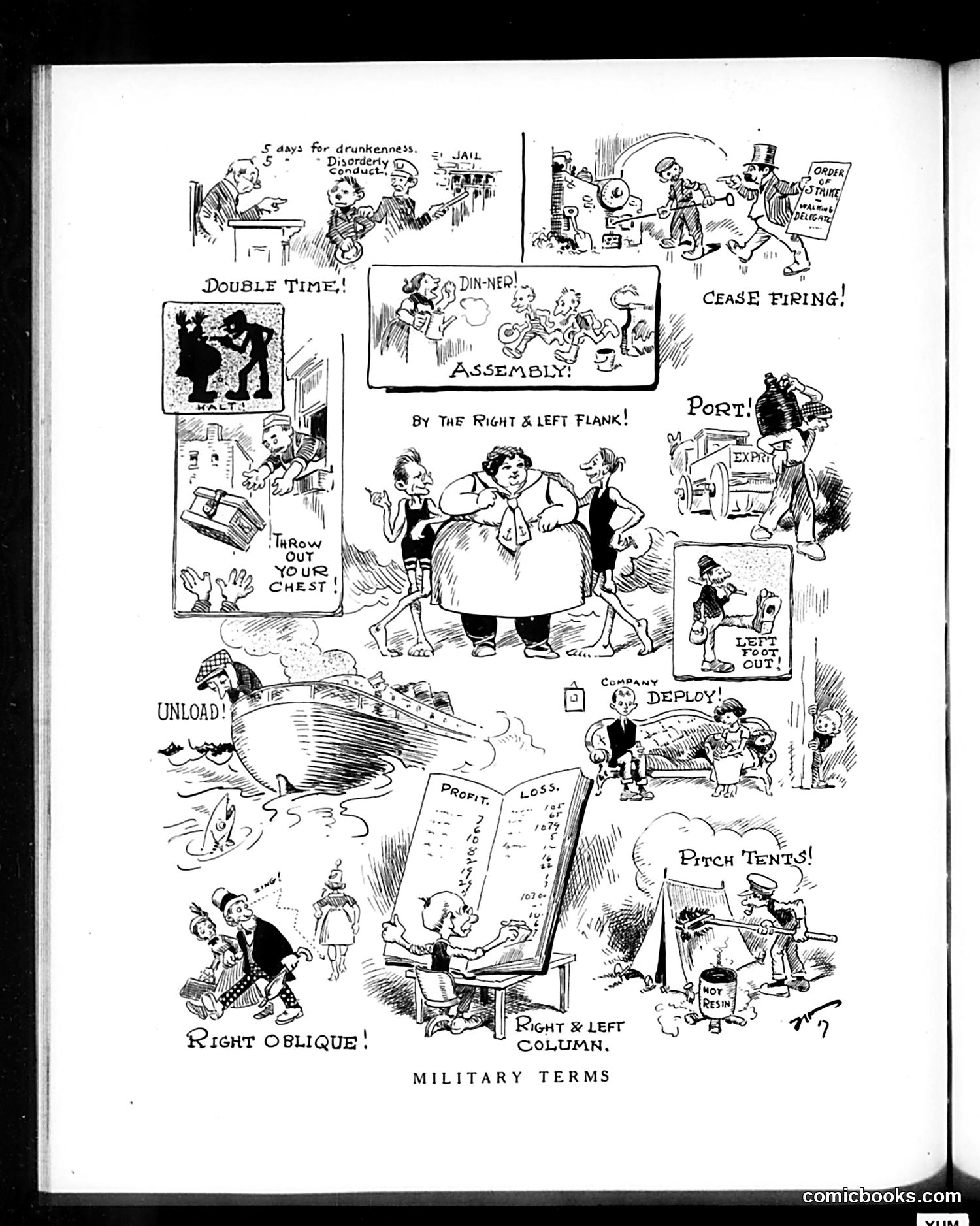
This satirical page humorously reinterprets military commands through domestic and civilian life. Each panel shows a different "military term" applied to absurd situations: - "Double Time" depicts a marital dispute - "Assembly" shows chaotic dinner preparation - "Cease Firing" and "Port" reference drinking and rowdy behavior - "Company Deploy" shows military officers amid civilian chaos - "Right Oblique" and "Pitch Tents" depict domestic disorder The central image features a large ledger showing "Profit" and "Loss" columns, suggesting business or economic themes alongside the military humor. The satire mocks both military jargon and civilian incompetence—implying that ordinary people facing domestic troubles might benefit from military discipline, or conversely, that military terms are laughably inapplicable to real life. The overall tone is lighthearted social commentary on American civilian culture.
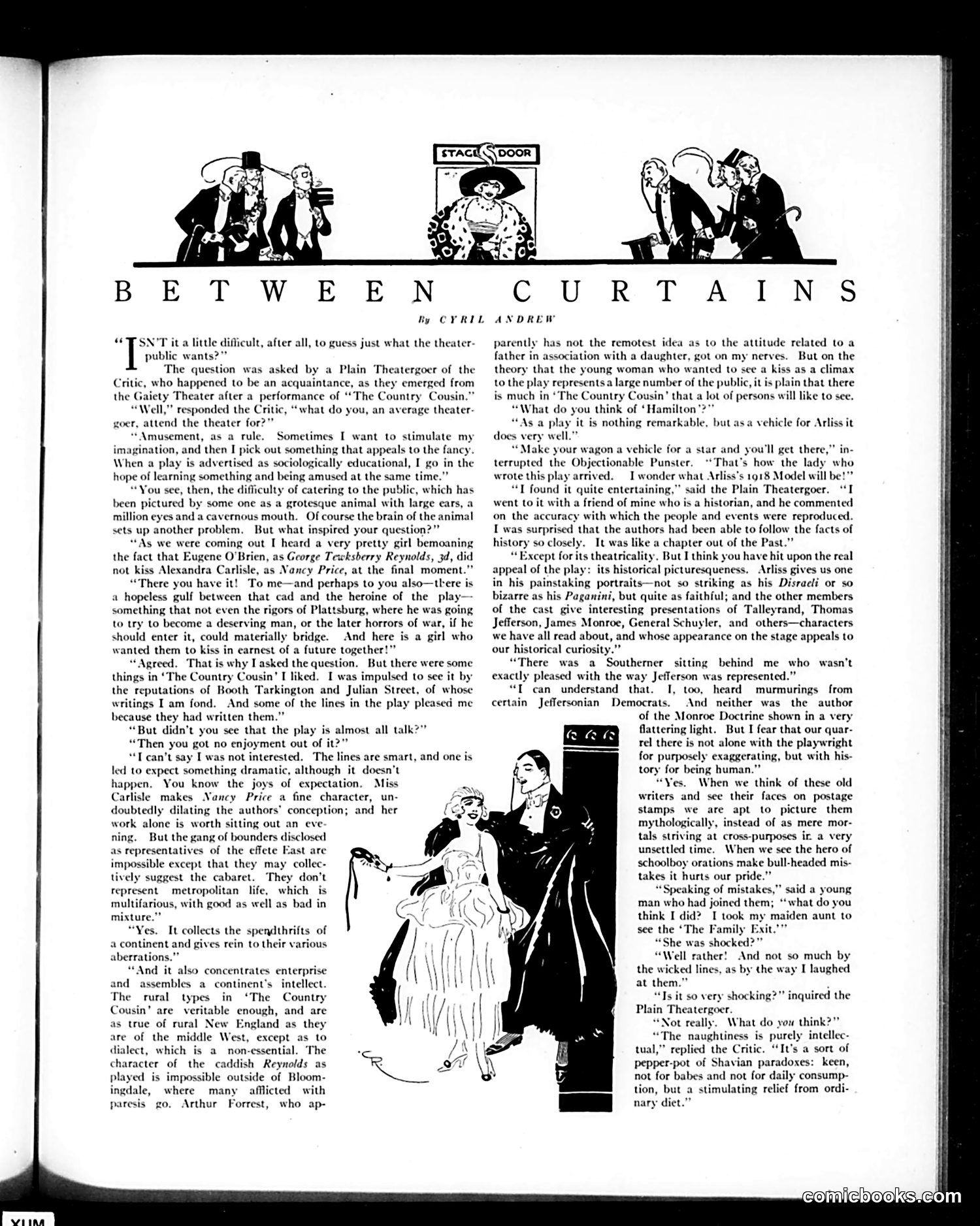
This is a theater criticism piece by Cyril Andrew discussing the play *"The Country Cousin."* The article takes the form of a dialogue between a "Plain Theatergoer" and a "Critic" debating what audiences want from theater. They discuss the play's merits and flaws: it features smart dialogue but lacks dramatic action, strong performances (particularly Alexandra Carlisle) offset weak characterizations (notably Arthur Forrest as the caddish Reynolds), and rural characters ring true despite being set in a cosmopolitan cabaret world. The central tension is whether entertainment should satisfy mass audience desires (the girl who wanted a kiss ending) or maintain artistic integrity. The critic acknowledges the play succeeds as a "vehicle for a star" (likely referring to actor Arliss, mentioned at the piece's end) despite its theatrical limitations. The illustration shows well-dressed theatergoers in conversation, reflecting the Broadway-attending class Judge addressed. This is straightforward theater criticism rather than sharp political satire.
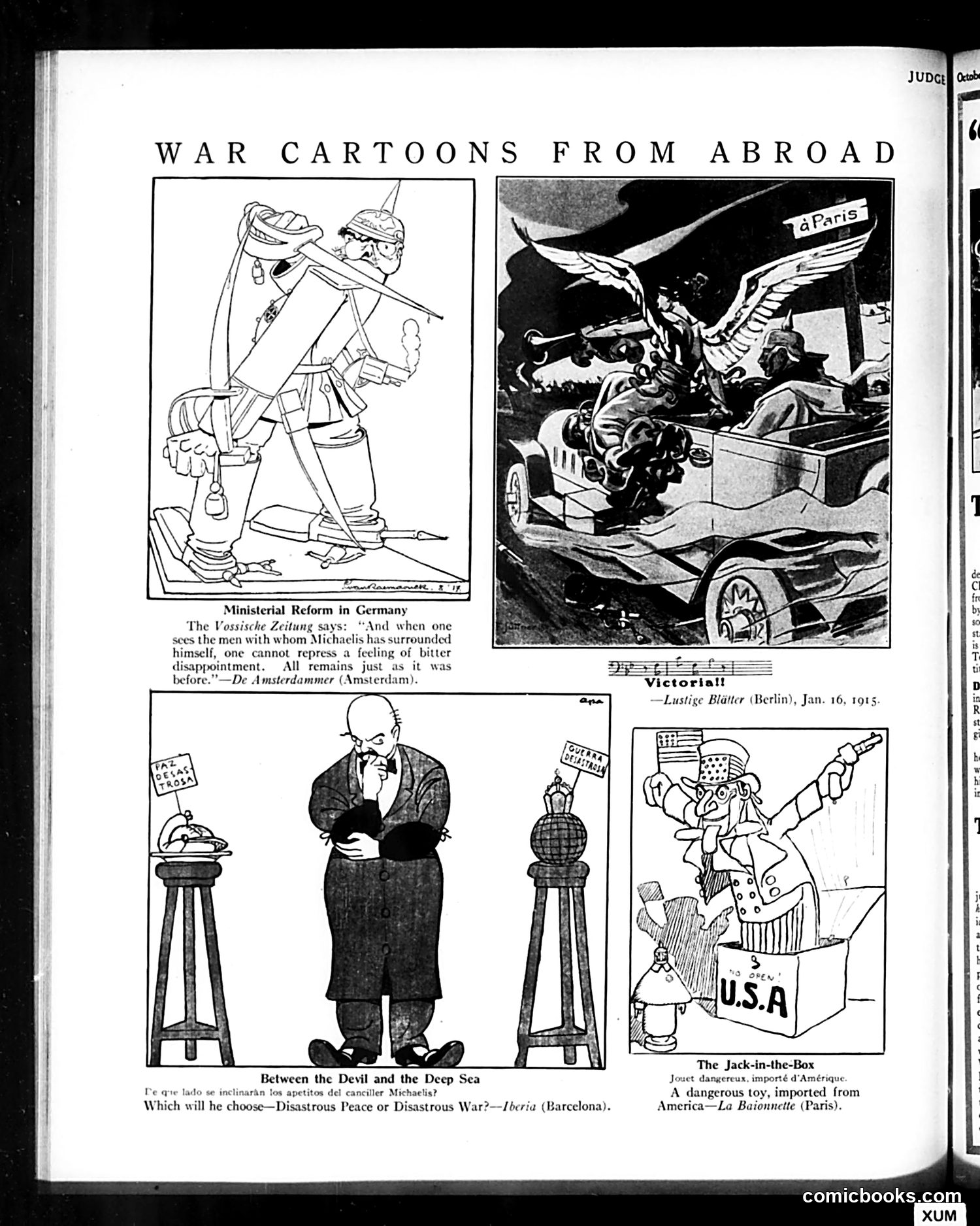
This page collects European political cartoons from early 1915, mocking German leadership and the war situation: **"Ministerial Reform in Germany"**: Criticizes German Chancellor Michaelis for surrounding himself with incompetent advisors, suggesting nothing will improve. **"Between the Devil and the Deep Sea"**: Shows Michaelis trapped between two globes labeled with disastrous peace and war options—satirizing Germany's impossible strategic position. **"Victoria!"**: A German cartoon celebrating military victory, showing an eagle and triumphant figure emerging from a car. **"The Jack-in-the-Box"**: American intervention is depicted as a dangerous "toy" springing from a U.S. box—expressing European anxiety about American involvement potentially destabilizing the war's outcome. The page demonstrates how Judge republished foreign satirical commentary about the ongoing European conflict and Germany's precarious situation.
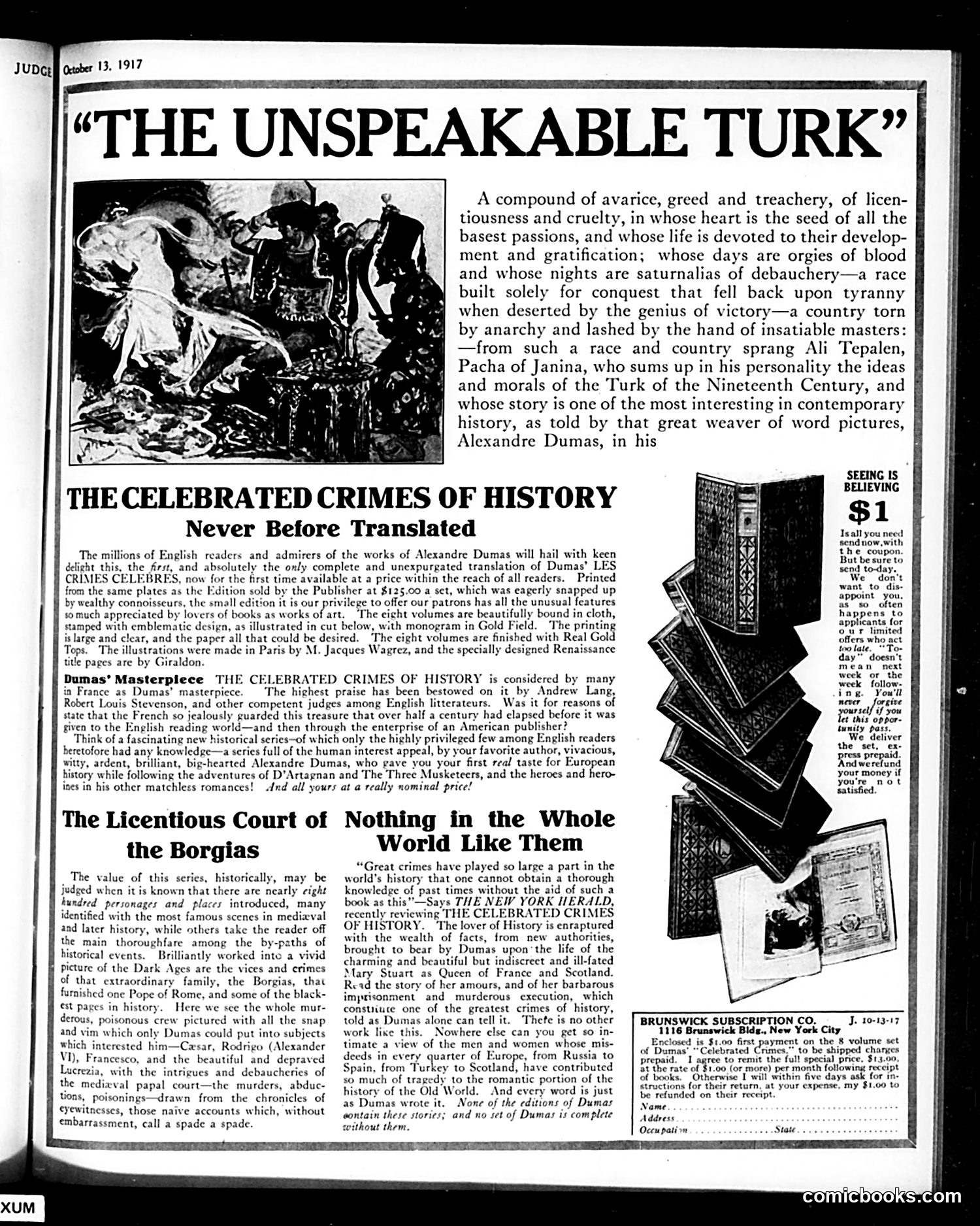
This page advertises Alexandre Dumas's *Celebrated Crimes of History*, newly translated into English. The opening section attacks the Ottoman Empire with inflammatory rhetoric, describing Turks as inherently cruel and degenerate. It frames Ali Tepalen, Pasha of Janina, as the embodiment of Turkish immorality. **Historical Context:** This reflects 1917 American attitudes during World War I. The Ottoman Empire was allied with Germany and Austria-Hungary against the Allied powers (including America). Anti-Turkish propaganda was common wartime rhetoric, portraying the Ottomans as barbaric to justify Allied opposition. **The Advertisement Strategy:** Judge weaponizes Dumas's literary credibility and romance-adventure appeal to sell the book by pairing it with contemporary anti-Turkish sentiment. The vivid denunciations serve as marketing copy, promising readers sensational historical tales of corruption and vice. The page uses prejudiced stereotyping as commercial strategy rather than reasoned argument, typical of wartime propaganda messaging in American popular media.
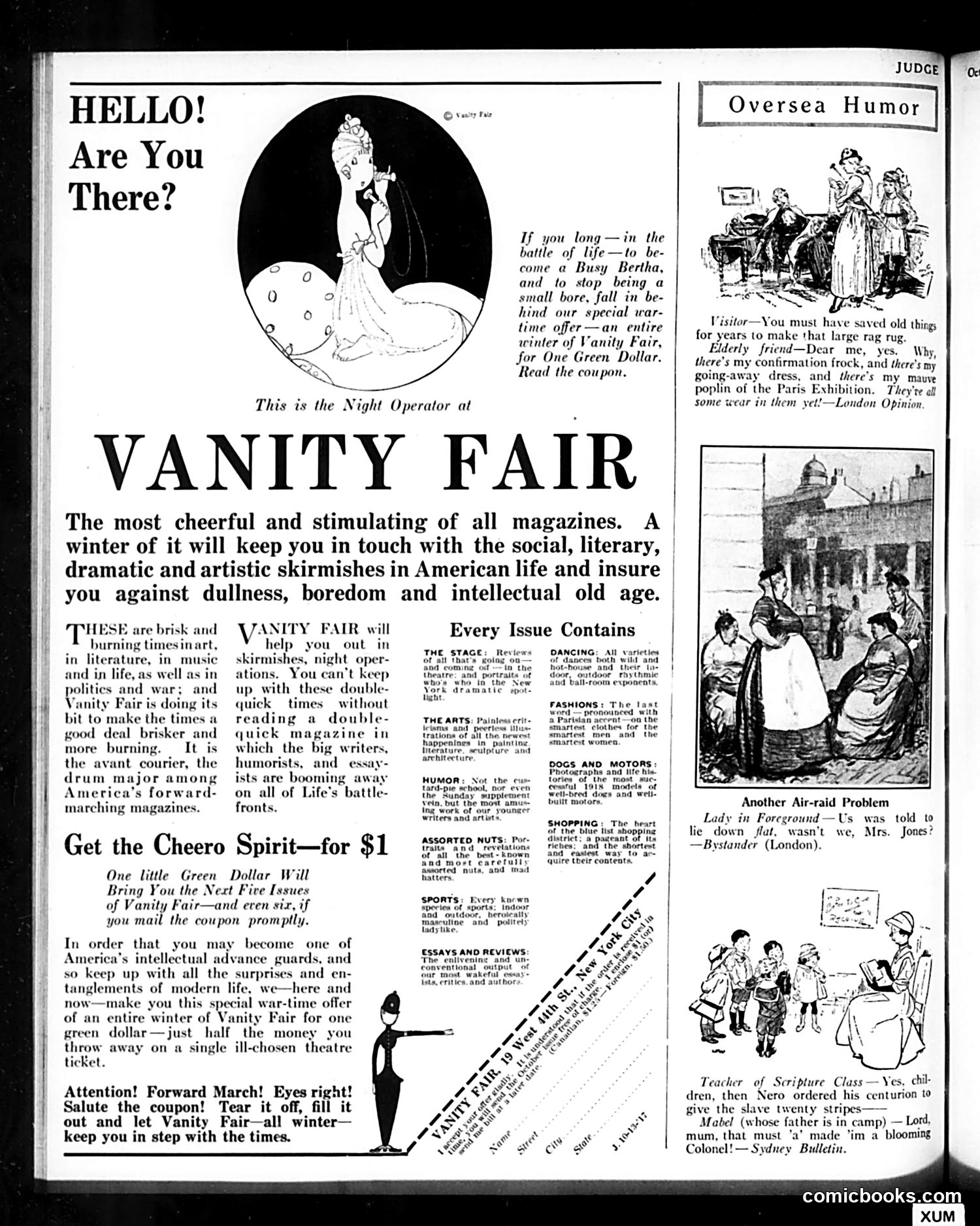
This page is primarily **advertising for Vanity Fair magazine**, not political satire. The main content promotes a subscription offer: five issues for one dollar during wartime. The central illustration shows a glamorous woman ("the Night Operator") answering a telephone—likely referencing both the magazine's social sophistication and the era's emerging telephone culture. The surrounding text emphasizes Vanity Fair's appeal to intellectually ambitious readers by promising coverage of theater, arts, humor, fashion, and sports. The "Oversea Humor" section on the right contains three brief jokes from British publications, typical of how American magazines reprinted international humor. These jokes touch on wartime themes (air raids, rationing) in gentle, comedic ways—reflecting how civilians coped with World War I or II through humor. The overall message: Vanity Fair positions itself as essential reading for modern, culturally aware Americans who want to stay informed and entertained during uncertain times.
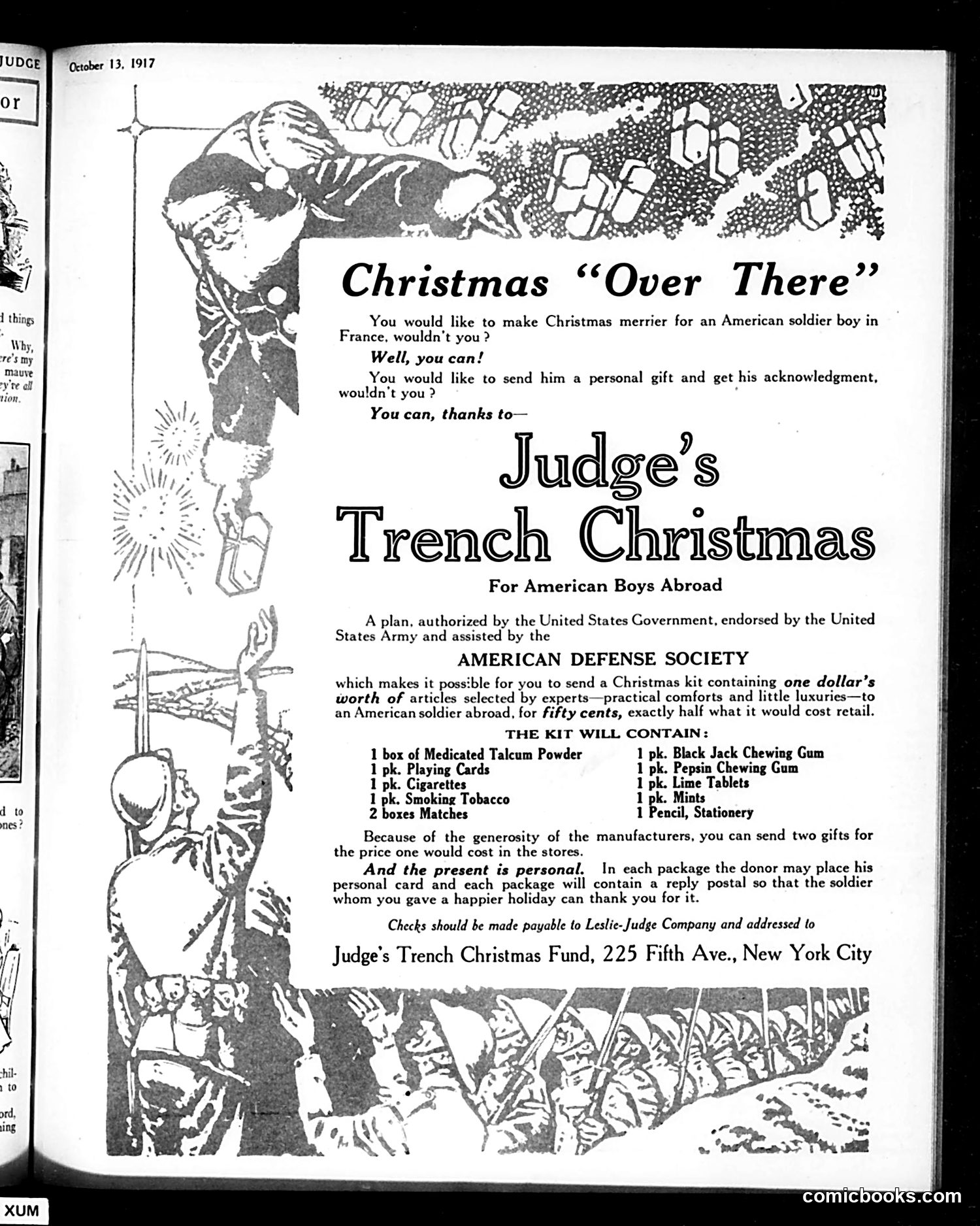
This is primarily a **charitable advertisement**, not satire. Dated during America's involvement in World War I, it promotes "Judge's Trench Christmas"—a fundraising campaign by the magazine to send care packages to American soldiers fighting in France. The appeal uses patriotic language ("Over There," referencing the famous WWI song) and emotional appeals to encourage civilian donations. For fifty cents, donors could send a one-dollar care package containing practical items: cigarettes, matches, chewing gum, talcum powder, and stationery. The kits included reply postcards so soldiers could thank donors personally—emphasizing the "personal" connection between home and front. The illustrations show Santa in a trench and soldiers in combat, visualizing the contrast between Christmas celebration and wartime conditions. The American Defense Society's endorsement lends official legitimacy. This represents typical WWI-era morale-building and home-front fundraising efforts marketed through popular magazines.
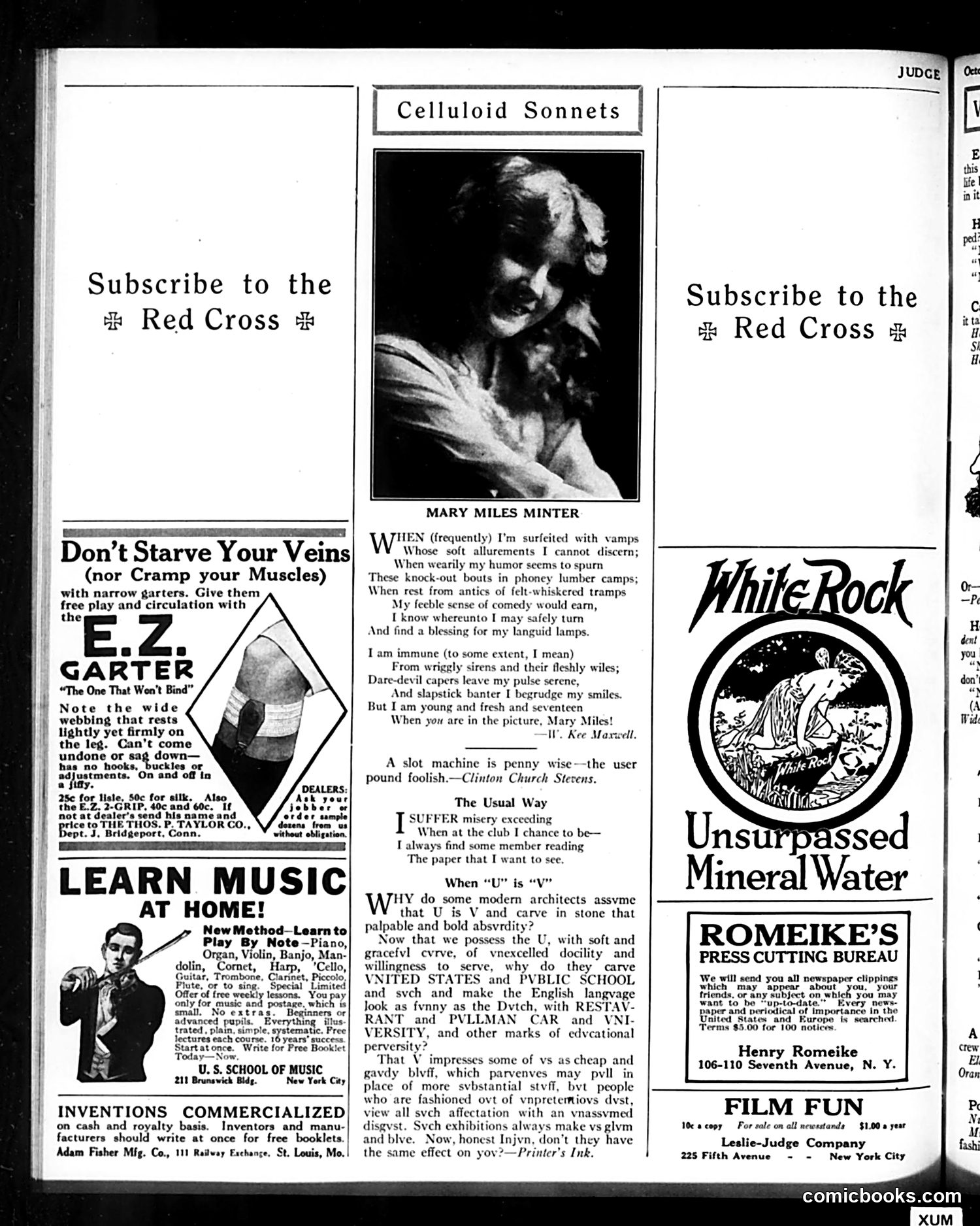
This page is primarily **advertising and light verse**, not political satire. The "Celluloid Sonnets" section features **Mary Miles Minter**, a silent film actress popular in the 1910s-20s. The poem humorously describes a male moviegoer immune to most screen entertainers' charms until Minter appears—a flattering tribute common in fan magazines of the era. The remaining content is straightforward advertisements: garters, music lessons, inventions, a press-clipping bureau, and mineral water. One brief satirical piece, "When 'U' is 'V'," mocks modernist architects' pretentious use of the letter V instead of U in signage (spelling "SCHOOL" as "SCHVOL"), criticizing this as affected snobbery. It's mild social commentary on architectural fads. The page also contains **Red Cross subscription appeals**—likely WWI-era public service announcements, given the publication's timing. This is a typical Judge magazine page mixing entertainment, advertising, and gentle social humor rather than sharp political commentary.
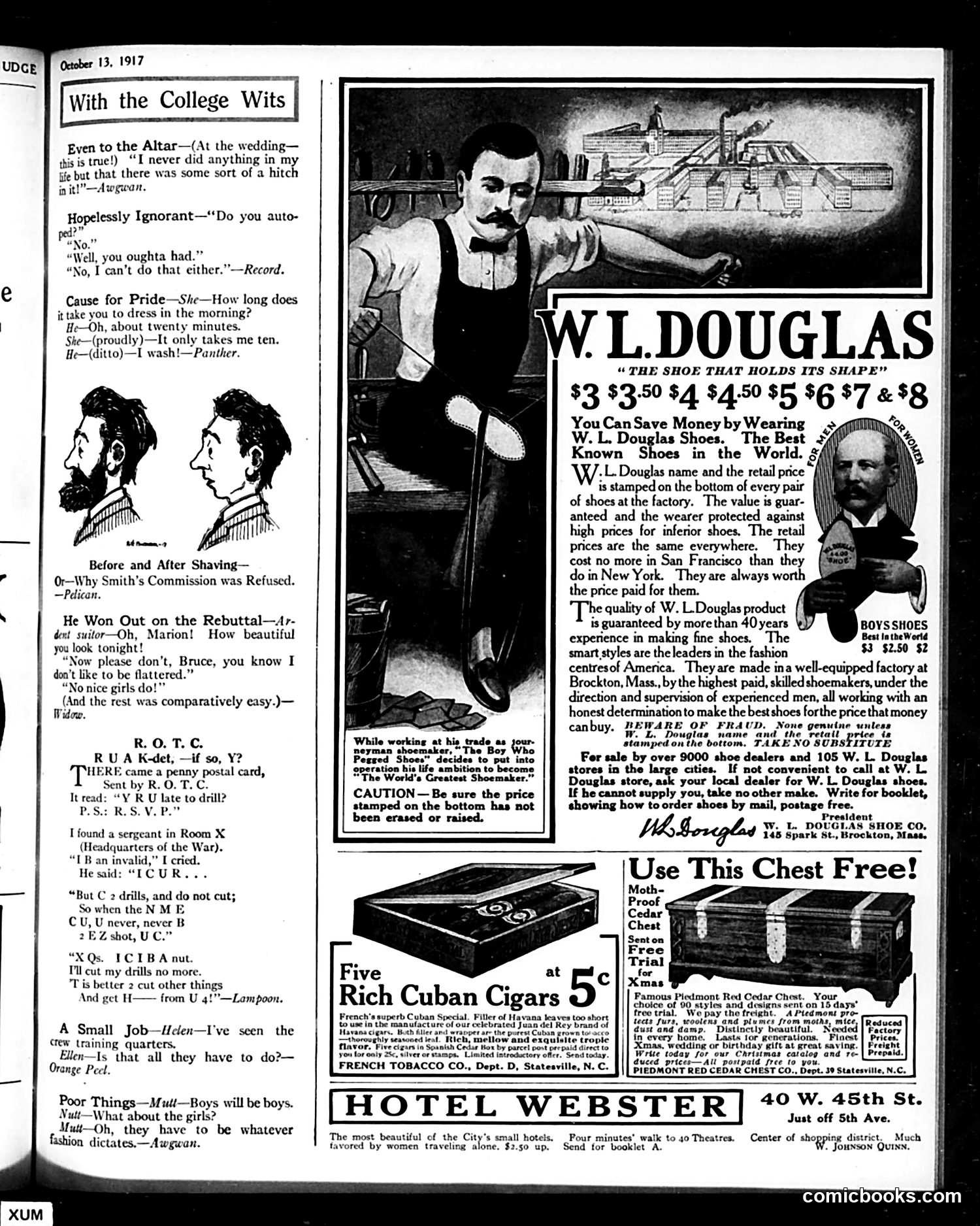
This page contains humor columns typical of college magazines of the era, featuring short jokes about dating, courtship, and military training. The recurring targets are romantic misunderstandings and the absurdities of young love—a girl proud she dresses faster than her suitor, a young man struggling with compliments, etc. One notable item references "R.O.T.C." (Reserve Officers' Training Corps) and military drills, reflecting 1917's wartime context—America had entered World War I months earlier. The humor plays on military abbreviations and acronyms in a coded "text-speak" style. The page is dominated by period advertisements, particularly W.L. Douglas shoes and other consumer goods. The content reflects early-20th-century college culture and courtship norms aimed at a young, educated audience.
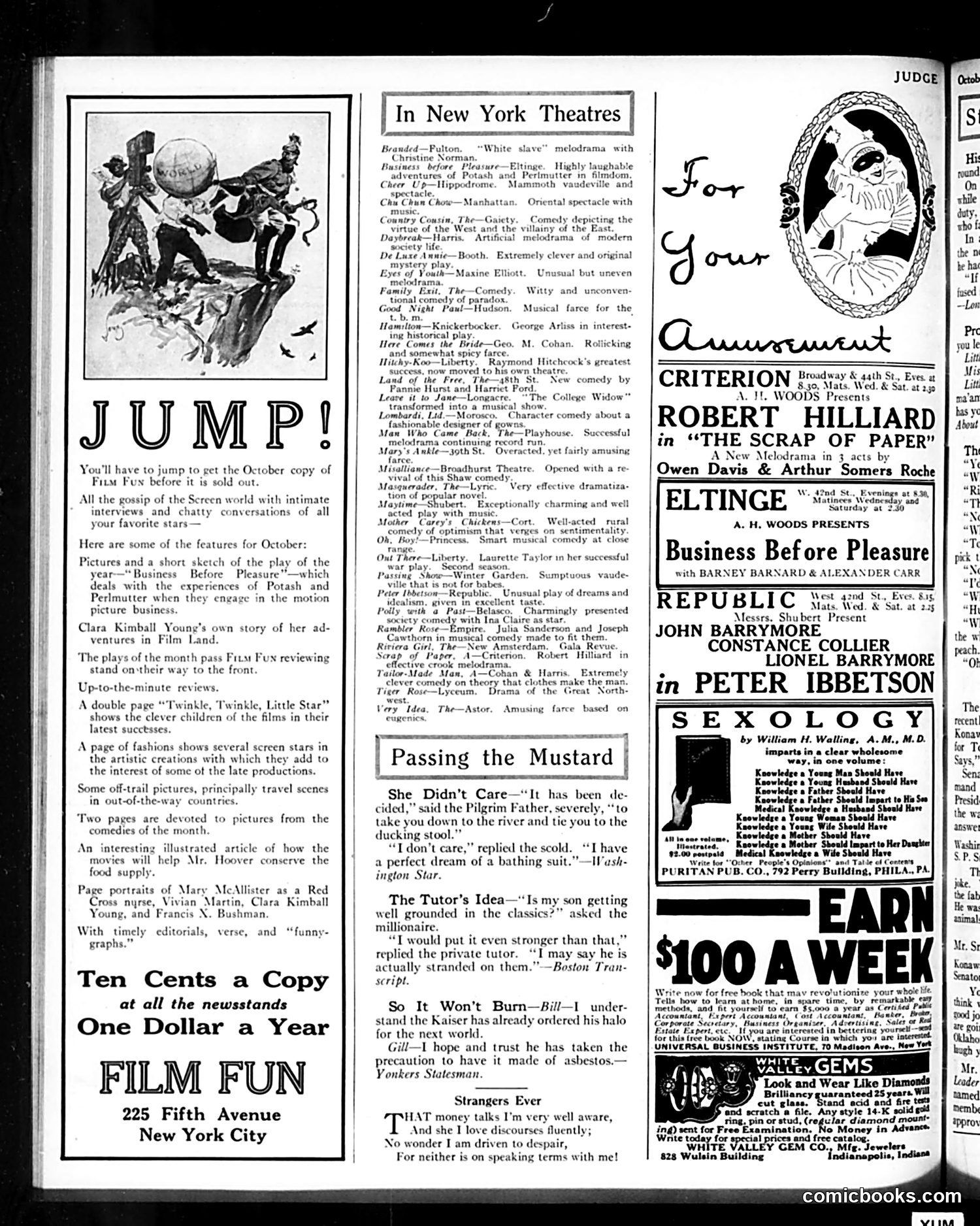
This page is primarily **advertising and promotional content** rather than political satire. The left side advertises *Film Fun* magazine, highlighting upcoming October features about silent film stars like Clara Kimball Young and Francis X. Bushman. The center column lists current Broadway productions available in New York theaters. The right side contains theater advertisements and classified ads, including one for a book on "Sexology" and a "Earn $100 a Week" mail-order scheme. **The only cartoon** appears in the upper left—a theatrical illustration showing performers juggling a globe, promoting the dramatic spectacle and international adventures featured in *Film Fun*. The page's humor is minimal and incidental (brief quips like the "asbestos halo" joke about the Kaiser). This is essentially a **trade publication page** mixing entertainment industry news with period advertising, not a vehicle for political commentary or satire.
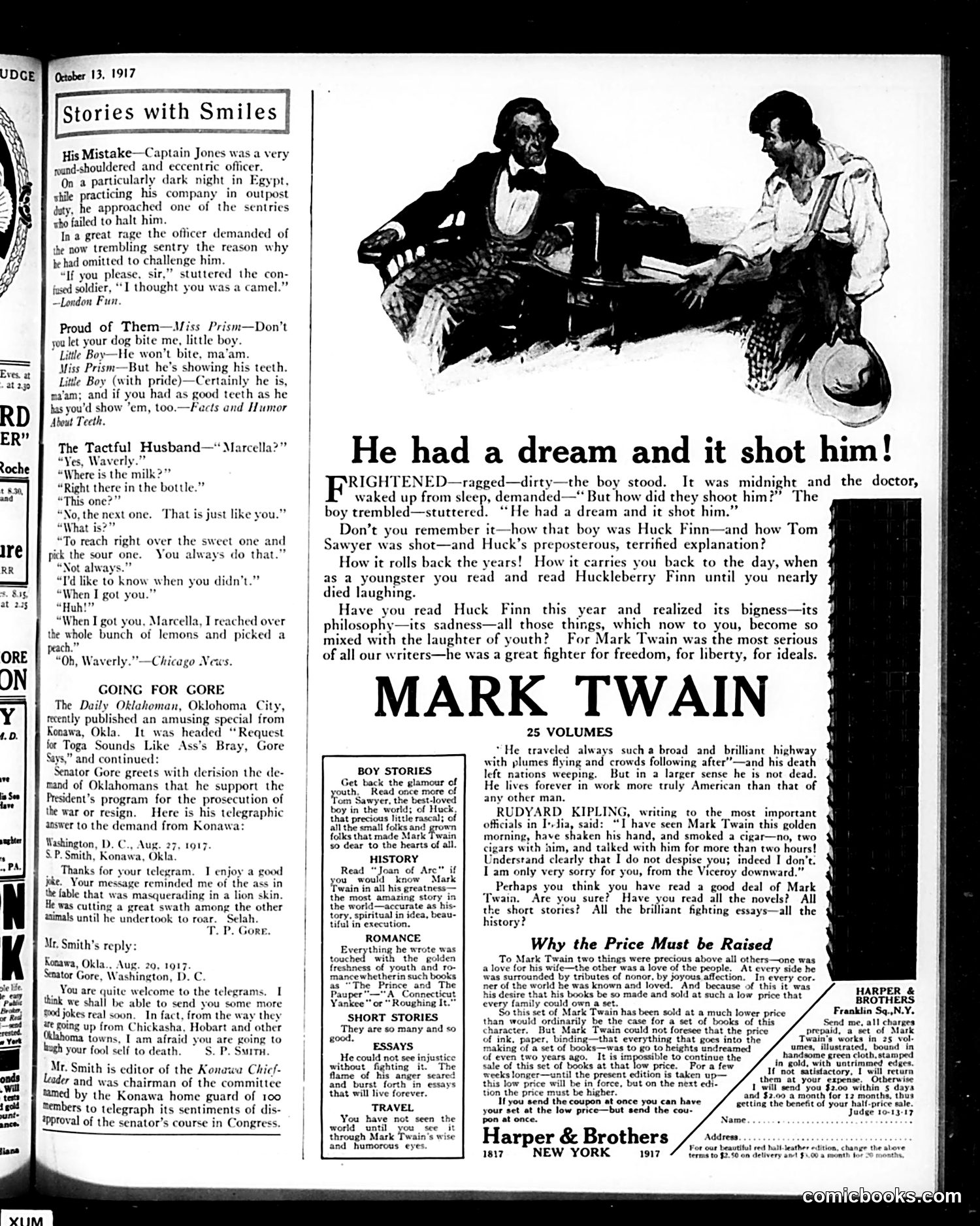
This page advertises Mark Twain's collected works (25 volumes) through Harper & Brothers publishers, using a dramatic illustration and emotional appeal. The main image shows a boy describing to a doctor how someone "had a dream and it shot him"—referencing the famous scene from *Huckleberry Finn* where young Huck explains Tom Sawyer's gunshot wound with this absurd, terrified explanation. Modern readers would miss that this is a *famous literary moment* that contemporary 1917 readers immediately recognized. The advertisement argues Twain deserves rereading by adults, not just children. It emphasizes his "bigness" and "philosophy"—claiming he was "a great fighter for freedom, for liberty, for ideals," not merely a humorist. Kipling's testimonial (praising their recent conversation) adds prestige. The smaller "Stories with Smiles" section contains unrelated jokes, typical filler for the magazine. The page essentially markets Twain as a serious American writer whose work has grown in stature since publication, encouraging educated adults to own his complete works.
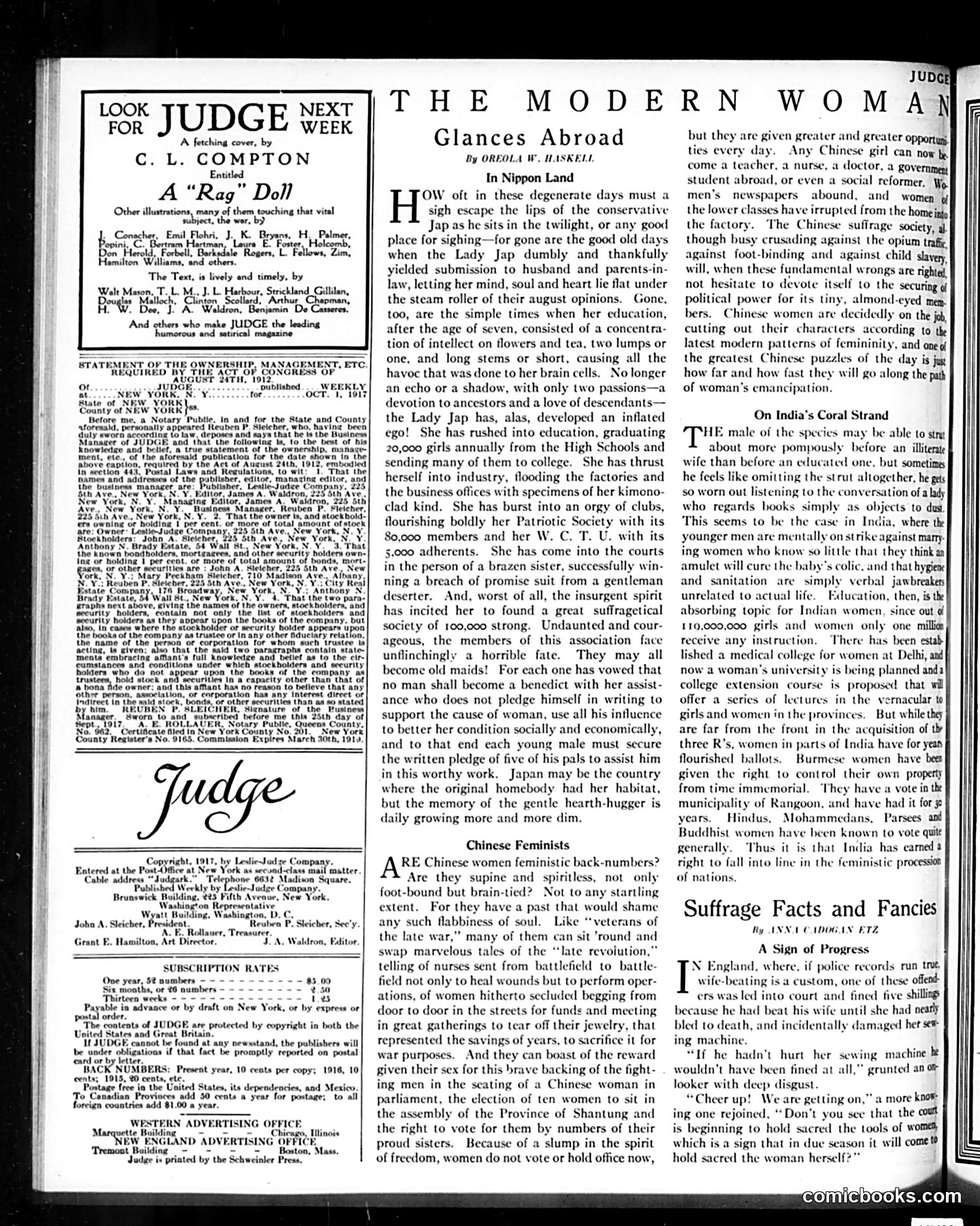
This is primarily a **masthead and legal/administrative page** rather than a satirical content page. The visible elements are: **Prominent feature**: A preview announcement for next week's cover titled *"A 'Rag' Doll"* by C.L. Compton, with contributor credits listed below. **Main content**: The legally-mandated **Statement of Ownership, Management, etc.**, required by Congressional act—listing the Leslie-Judge Company as publisher, James A. Waldron as editor, and various stockholders and officers. **Historical context**: The date (October 1, 1917) places this during U.S. involvement in World War I; the text mentions "many of them touching that vital subject, the war," indicating the magazine's coverage of contemporary events. **What we see**: No actual political cartoons or satire are visible on this reproduction—only administrative documentation and preview material. Judge was a leading American humor magazine, but this particular page serves institutional rather than satirical purposes.
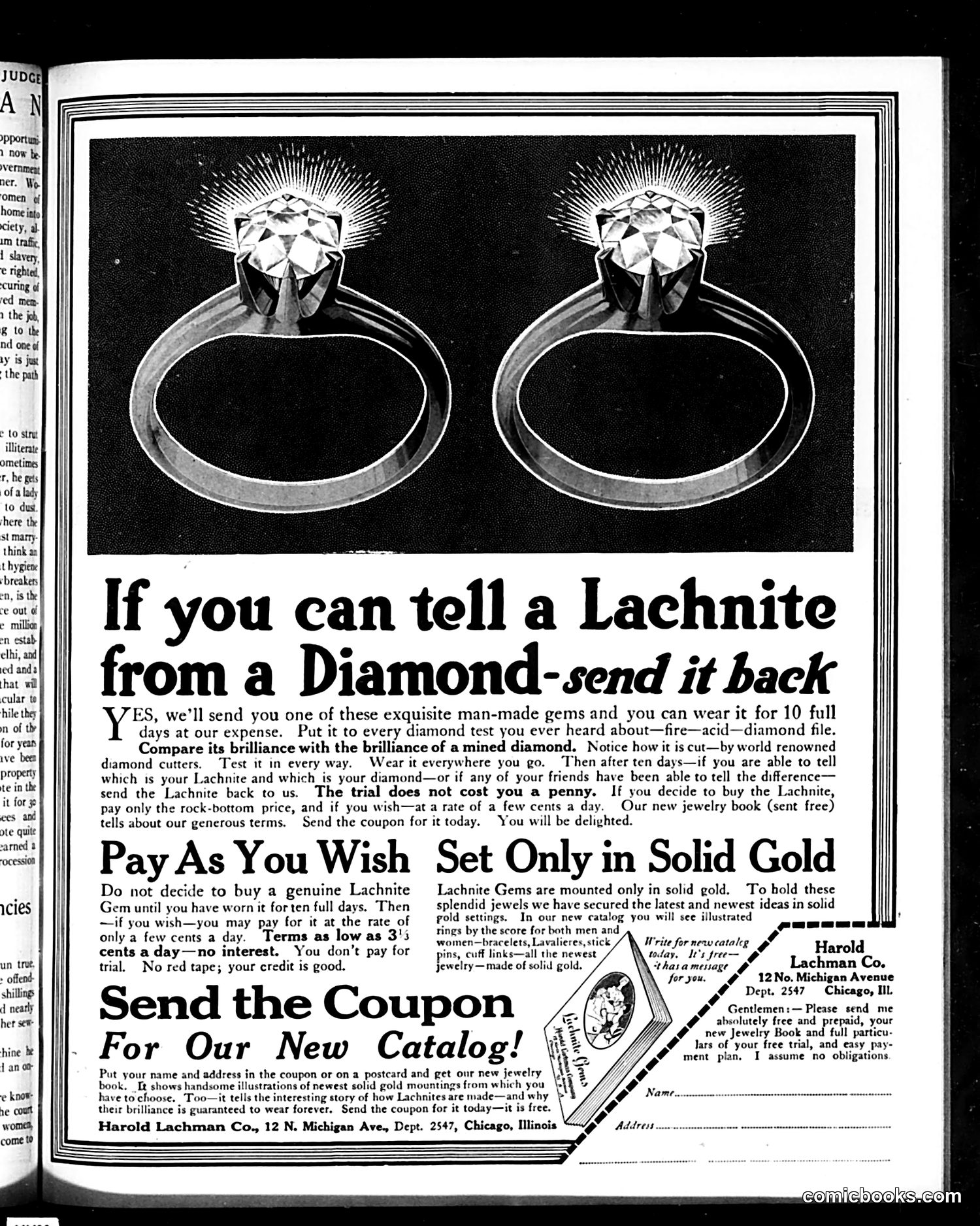
This is primarily **advertising, not satire**—a full-page promotion for Lachnite, a synthetic diamond substitute made by the Harold Lachman Co. The ad's appeal centers on a **challenge to the consumer**: the company will loan you a Lachnite gem for 10 days free. If you can distinguish it from a real diamond through standard tests (fire, acid, diamond file), you return it at no cost. If you *cannot* tell the difference—and the ad implies most people won't—you can buy it on installment at "a few cents a day." **The social context**: This reflects 1920s-era fascination with synthetic gems as affordable luxury. The ad targets middle-class consumers who desire diamond jewelry but cannot afford genuine stones. The implicit message: visual brilliance matters more than material authenticity; the wearer's satisfaction and others' inability to detect the fake is the real product. No political cartoon or satire is present on this page—it is entirely commercial advertising.
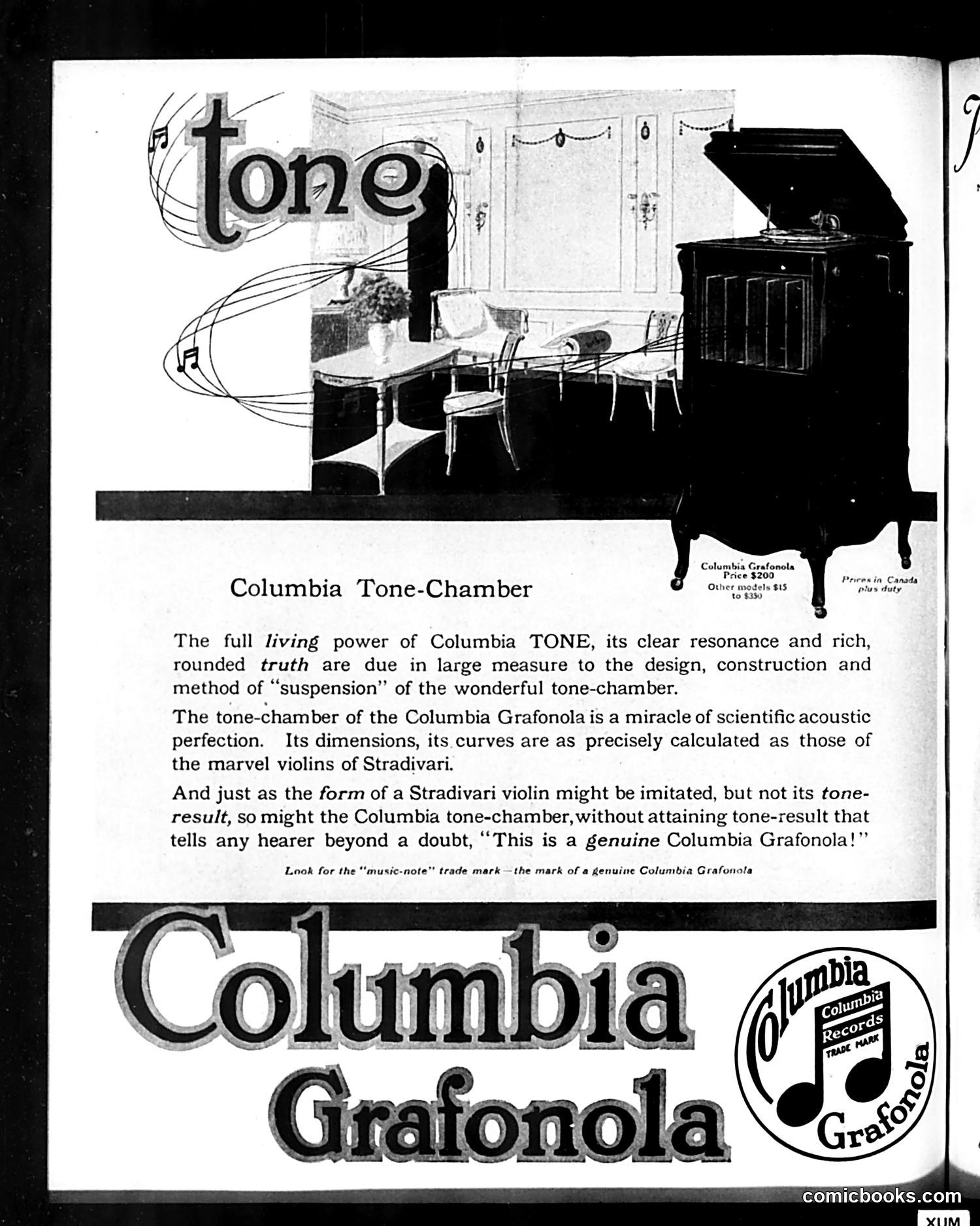
This is a **full-page advertisement**, not political satire. It promotes the Columbia Grafonola, an early phonograph/gramophone model featuring a "tone-chamber." The ad uses a comparison to Stradivari violins to establish credibility—just as Stradivarius instruments are prized for their acoustic perfection, Columbia claims their tone-chamber is scientifically engineered to match that quality. The sales pitch emphasizes that while competitors might copy the *design*, only Columbia achieves authentic superior *sound quality*. The illustration shows a living room scene with the grafonola as a furniture piece, suggesting it as an upscale home entertainment product. The "music-note" trademark is highlighted as proof of authenticity—protecting against knockoffs in a competitive market. This reflects early 20th-century consumer culture, where technological sophistication and brand authentication were key marketing strategies.