
Judge, 1917-10-13 · page 17 of 28
Judge — October 13, 1917 — page 17: what you’re looking at
What you’re looking at
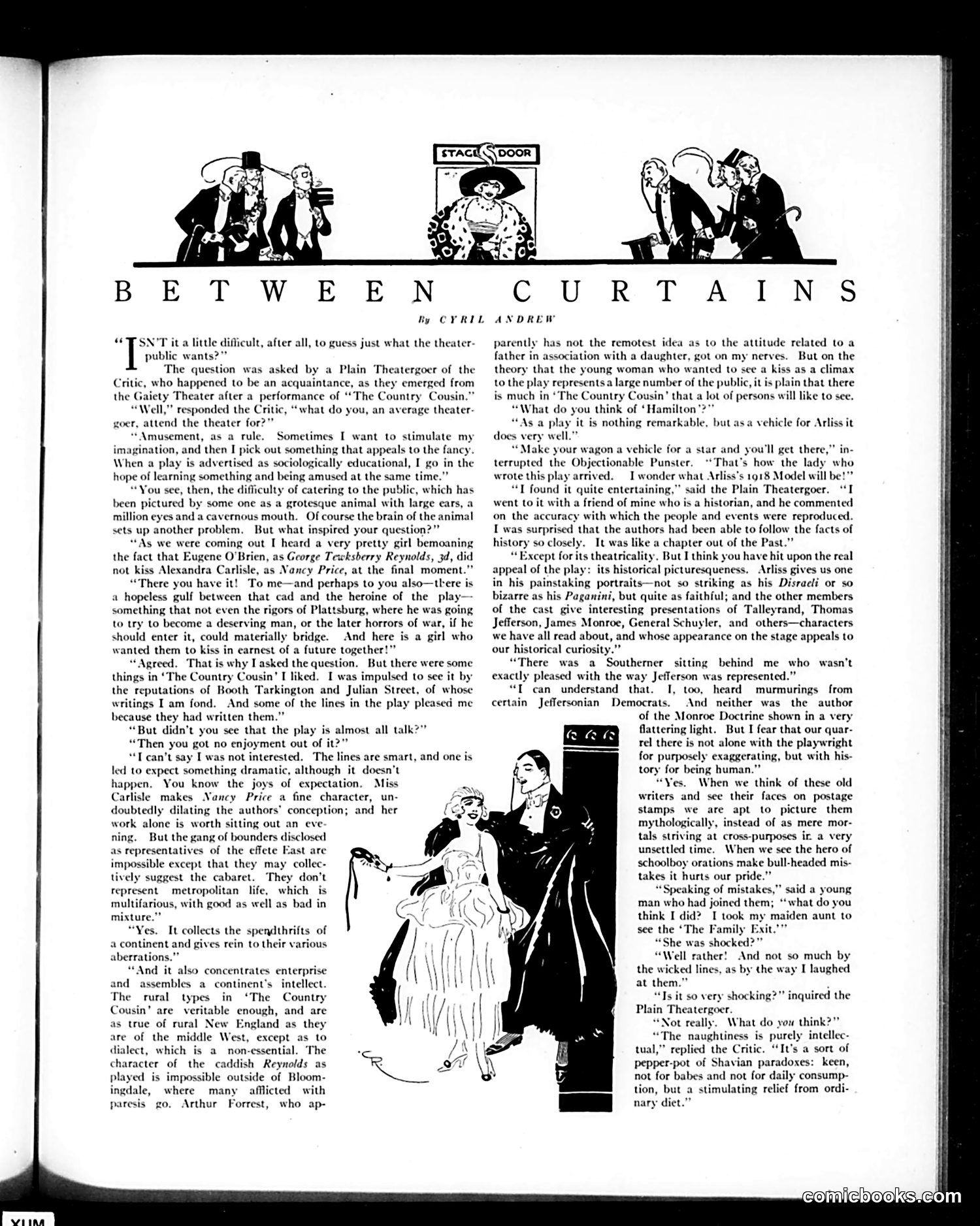
This is a theater criticism piece by Cyril Andrew discussing the play *"The Country Cousin."* The article takes the form of a dialogue between a "Plain Theatergoer" and a "Critic" debating what audiences want from theater. They discuss the play's merits and flaws: it features smart dialogue but lacks dramatic action, strong performances (particularly Alexandra Carlisle) offset weak characterizations (notably Arthur Forrest as the caddish Reynolds), and rural characters ring true despite being set in a cosmopolitan cabaret world. The central tension is whether entertainment should satisfy mass audience desires (the girl who wanted a kiss ending) or maintain artistic integrity. The critic acknowledges the play succeeds as a "vehicle for a star" (likely referring to actor Arliss, mentioned at the piece's end) despite its theatrical limitations. The illustration shows well-dressed theatergoers in conversation, reflecting the Broadway-attending class Judge addressed. This is straightforward theater criticism rather than sharp political satire.
📄 Transcribed text from this page (OCR, searchable)
Machine-transcribed from the original scan — historical spelling and the odd misread are preserved.
P it a little difficult, after all, to guess just what the theater- public wants?” The question was asked by a Plain Theatergoer of the who happened to be an acquaintance, as they emerged from the Gaiety Theater after a performance of The Country Cousin.” “Well,” responded the Critic, “what do you, an average theater- goer, attend the theater for?” Amusement, as a rule, Sometimes I want to stimulate my ayination, and then I pick out something that appeals to the fancy. When a play is advertised as sociologically educational, I go in the hope of learning something and being amused at the same time. “You see, then, the difficulty of catering to the public, which has been pictured by some one as a grotesque animal with large ears, million eyes and a cavernous mouth. Of course the brain of the animal sets up another problem, But what inspired your question?” As we were coming out I heard a very pretty girl bemoaning the fact that Eugene O'Brien, as George Tewksberry Reynolds, 3d, did not kiss Alexandra Carlisle, as Nancy Price, at the final moment.” “There you have it! To me—and perhaps to you also—there is a hopeless gulf between that cad and the heroine of the play— something that not even the rigors of Plattsburg, where he was going to try to become a deserving man, or the later horrors of war, if he should enter it, could materially bridge. And here is a girl who wanted them to kiss in earnest of a future together!” “Agreed. That is why Tasked the question. But there were some things in ‘The Country Cousin’ I liked. I was impulsed to see it by the reputations of Booth Tarkington and Julian Street, of whose writings Iam fond. And some of the lines in the play pleased me because they had written them. “But didn’t you see that the play is almost all talk?” “Then you got no enjoyment out of it?” “T can’t say I was not interested. The lines are smart, and one is led to expect something dramatic, although it doesn’t happen. You know the joys of expectation. Miss Carlisle makes Nancy Price a fine character, un- doubtedly dilating the authors’ conceptio work alone is worth sitting out an eve ning. But the gang of bounders disclosed as representatives of the effete impossible except that they m: tively suggest the cabaret. They don’t represent metropolitan life, which multifarious, with good as well as bad in mixture.” “Yes. It collects the spendthrifts of a continent and gives rein to their various aberrations.”” And it also concentrates and assembles a continent's intellect. The rural types ‘The Country Cousin’ are veritable enough, and are as true of rural New England as they are of the middle West, except as to dialect, which is a non-essential. The character of the caddish Reynolds as played is impossible outside of Bloom- ingdale, where many afflicted with paresis go. Arthur Forrest, who ap- is nterprise CURTAINS L ANDREW parently has not the remotest idea as to the attitude related to a father in association with a daughter, got on my nerves. But on the theory that the young woman who wanted to see a kiss as a climax to the play represents a large number of the public, it is plain that there is much in ‘The Country Cousin’ that a lot of persons will like to see. “What do you think of ‘Hamilton it is nothing remarkable, but asa vehicle for Arliss it “Asa ph does very well “Make your wagon a vehicle for a star and you'll get there,” in- terrupted the Objectionable Punster. “That's how the lady who wrote this play arrived. I wonder what Arliss’s 1918 Model will be!” “T found it quite entertaining,” said the Plain Theatergoer. ‘IT went to it with a friend of mine who is a historian, and he commented on the accuracy with which the people and events were reproduced. I was surprised that the authors had been able to follow the facts of history so closely. It was like apter out of the Past.” “Except for its theatricality, But I think you have hit upon the real appeal of the play: its historical picturesqueness. Arliss gives us one in his painstaking portraits—not so striking as his Disraeli or so bizarre as his Paganini, but quite as faithful; and the other members of the cast give interesting presentations of Talleyrand, Thomas Jefferson, James Monroe, General Schuyler, and others—characters we have ail read about, and whose appearance on the stage appeals to our historical curiosity.” “There was a Southerner sitting behind me who exactly pleased with the way Jefferson was represented. “LT can understand that. I, too, heard = murmurings from certain Jeffersonian Democrats. And neither was the author of the Monroe Doctrine shown in a very wasn’t flattering light. But I fear that our quar- rel there is not alone with the playwright for purposely exaggerating, but with his- tory for being human.” “Yes. When we think of these old writers and see their faces on postage stamps we are apt to picture them mythologically, instead of as mere mor- tals striving at cross-purposes ir a very unsettled time. When we see the hero of schoolboy orations make bull-headed mis- takes it hurts our pride.” “Speaking of mistakes,” said a young man who had joined them; “what do you think I did? I took my maiden aunt to see the ‘The Family Exit.” “She was shocked?” “Well rather! And not so much by the wicked lines, as by the way I laughed at them.” ‘ “Is it so very shocking?” inquired the Plain Theatergoe ‘ot really. What do you think?” The naughtiness is purely intellec- tual,” replied the Critic. “It's a sort of pepper-pot of Shavian paradoxes: keen, not for babes and not for daily consump- tion, but a stimulating relief from ordi- nary’ die!