
Judge, 1917-10-13 · page 15 of 28
Judge — October 13, 1917 — page 15: what you’re looking at
What you’re looking at
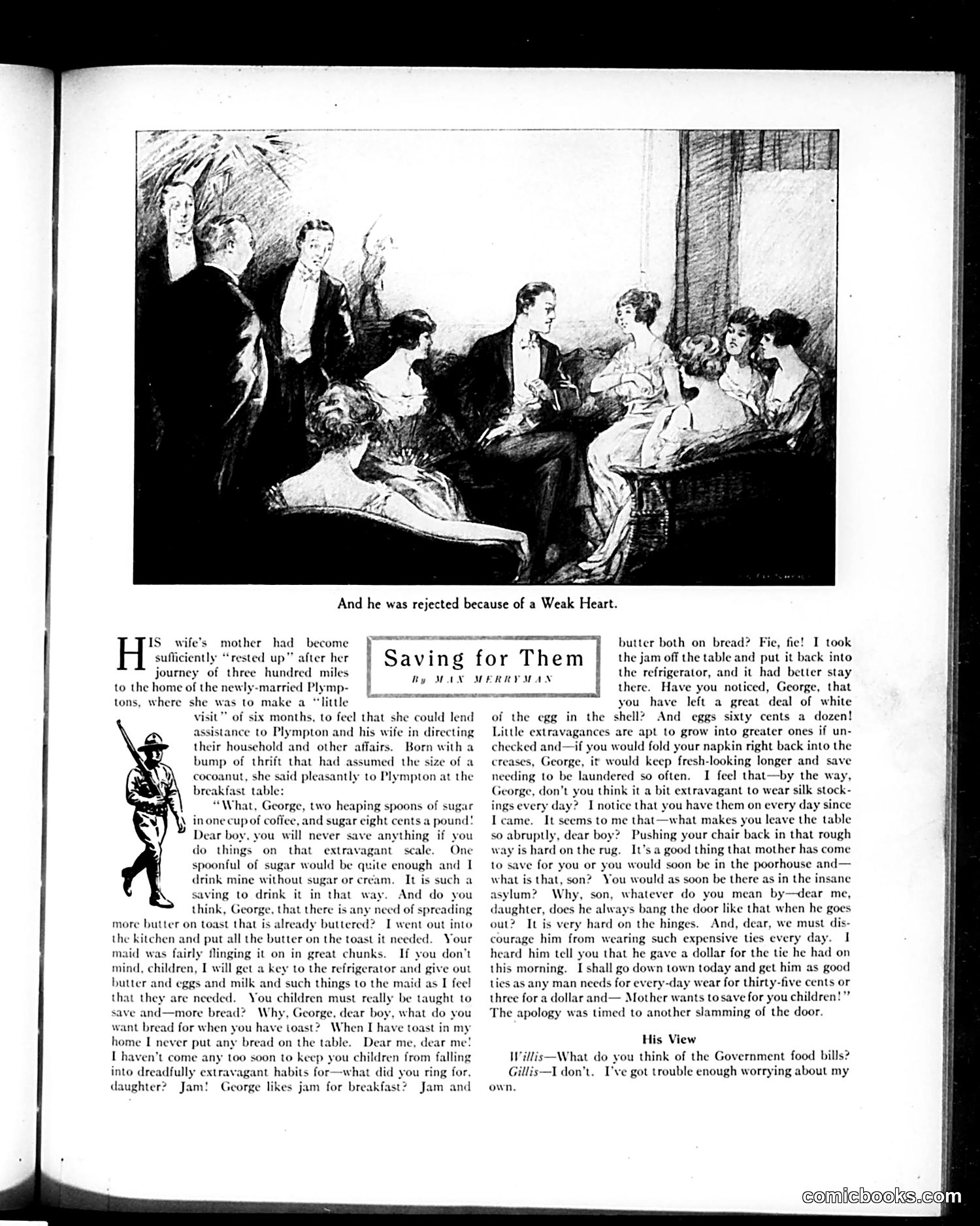
This satirical story depicts a meddlesome mother-in-law whose obsessive penny-pinching drives her son-in-law to desperation. The narrative illustrates early 20th-century anxieties about household economics and generational conflict. The mother, visiting for an extended "little visit," systematically critiques every modest expenditure—sugar in coffee, butter on toast, silk stockings, expensive ties—lecturing constantly about thrift. Her relentless cost-cutting and control over the household (taking refrigerator keys, rationing jam) humiliates the son-in-law George, who eventually abandons the breakfast table in frustration, slamming doors. The satire mocks both the obsessive frugality of older generations and the intrusive domestic management by in-laws. The title's irony is sharp: she claims to be "saving for them," but her manic economizing destroys household peace. The brief dialogue at bottom about government food bills adds topical resonance, likely referencing wartime or Depression-era food rationing concerns.
📄 Transcribed text from this page (OCR, searchable)
Machine-transcribed from the original scan — historical spelling and the odd misread are preserved.
And he was rejected because of a Weak Heart. IS wife’s mother had become sufficiently “rested up” after her journey of three hundred miles to the home of the newly-married Plymp- tons, where she was to make a “little visit” of six months, to feel that she could lend assistance to Plympton and his wife in directing their household and other affairs. Born with a bump of thrift that had assumed the size of a cocoanut, she said pleasantly to Plympton at the breakfast table: “What, George, two heaping spoons of sugar in one cup of cofice, and sugar eight cents a pound! Dear boy, you will never save anything if you do things on that extravagant scale. One spoonful of sugar would be quite enough and I drink mine without sugar or cream. It is such a saving to drink it in that way. And do you think, George, that there is any need of spreading more butter on toast that is already buttered? I went out into the kitchen and put all the butter on the toast it needed. Your maid was fairly flinging it on in great chunks. If you don’t mind, children, I will get a key to the refrigerator and give out butter and eggs and milk and such things to the maid as I fee! that they are needed. You children must really be taught to save and—more bread? Why, George, dear boy, what do you want bread for when you have toast?) When I have toast in my home I never put any bread on the table. Dear me, dear me! I haven’t come any too soon to keep you children from falling into dreadfully extravagant habits for—what did you ring for, daughter? Jam! Gcorge likes jam for breakfast? Jam and Ny MAX Saving for Them MERRY MAN butter both on bread? Fie, fie! I took the jam off the table and put it back into the refrigerator, and it had better stay there. Have you noticed, George, that you have left a great deal of white of the egg in the shell? And eggs sixty cents a dozen! Little extravagances are apt to grow into greater ones if un- checked and—if you would fold your napkin right back into the creases, George, it would keep fresh-looking longer and save needing to be laundered so often. I feel that—by the wa George, don’t you think it a bit extravagant to wear silk stock- ings every day? I notice that you have them on every day since Icame. It seems to me that—what m you leave the table so abruptly, dear boy? Pushing your chair back in that rough way is hard on the rug. It’s a good thing that mother has come ¢ for you or you would soon be in the poorhouse and— what is that, son? You would as soon be there as in the insane asylum? Why, son, whatever do you mean by—dear me, daughter, does he always bang the door like that when he goes out? It is very hard on the hinges. And, dear, we must dis- courage him from wearing such expensive ties every day. 1 heard him tell you that he gave a dollar for the tie he had on this morning. I shall go down town today and get him as good tie any man needs for every-day wear for thirty-five cents or three for a dollar and— Mother wants to save for you children!” The apology was timed to another slamming of the door. Poses crema to sa’ His View Willis—What do you think of the Government food bills? Gillis—I don’t. I’ve got trouble enough worrying about my own. comichooks.