
A complete issue · 28 pages · 1917
Judge — September 29, 1917
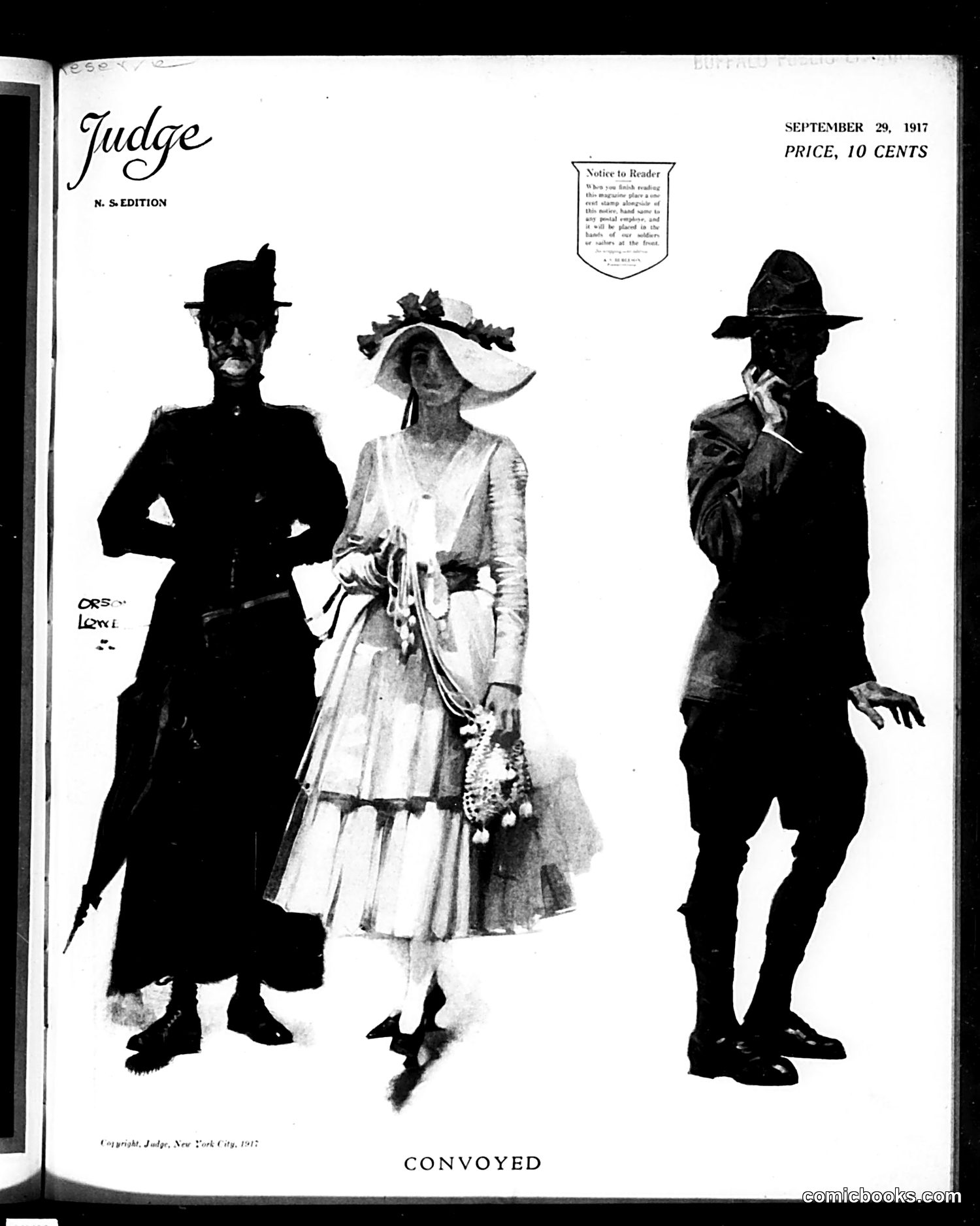
This page depicts three silhouetted figures titled "Convoyed," appearing to reference World War I military escorts. The left figure wears a military uniform and hat, the center figure is dressed as a woman in a light dress with an elaborate hat and carries flowers, and the right figure is also in military attire. The satire likely mocks the practice of women being "convoyed" or escorted by soldiers during wartime—a common social custom of the era. The joke appears to play on the contrast between the woman's fashionable, innocent appearance and her military accompaniment, possibly satirizing either wartime romance, security measures, or social propriety during the war years when American troops were actively engaged in Europe.

This page is primarily a **commercial advertisement** for Nujol, a laxative product made by Standard Oil Company (New Jersey), rather than political satire or editorial cartoon. The dramatic illustration shows a man struggling to control horses pulling a heavily-loaded cart up a steep mountain, with birds flying overhead. The "vigor" metaphor connects to the ad's message: just as autumn plowing requires energy for next spring's crops, the body needs vigor maintained through proper digestive health. The advertisement warns that constipation drains energy and threatens tomorrow's productivity. It promotes Nujol as a "harmless remedy" endorsed by physicians that works "naturally and gently" without griping. This reflects early 20th-century advertising's use of ambitious visual narratives to sell patent medicines and digestive aids.
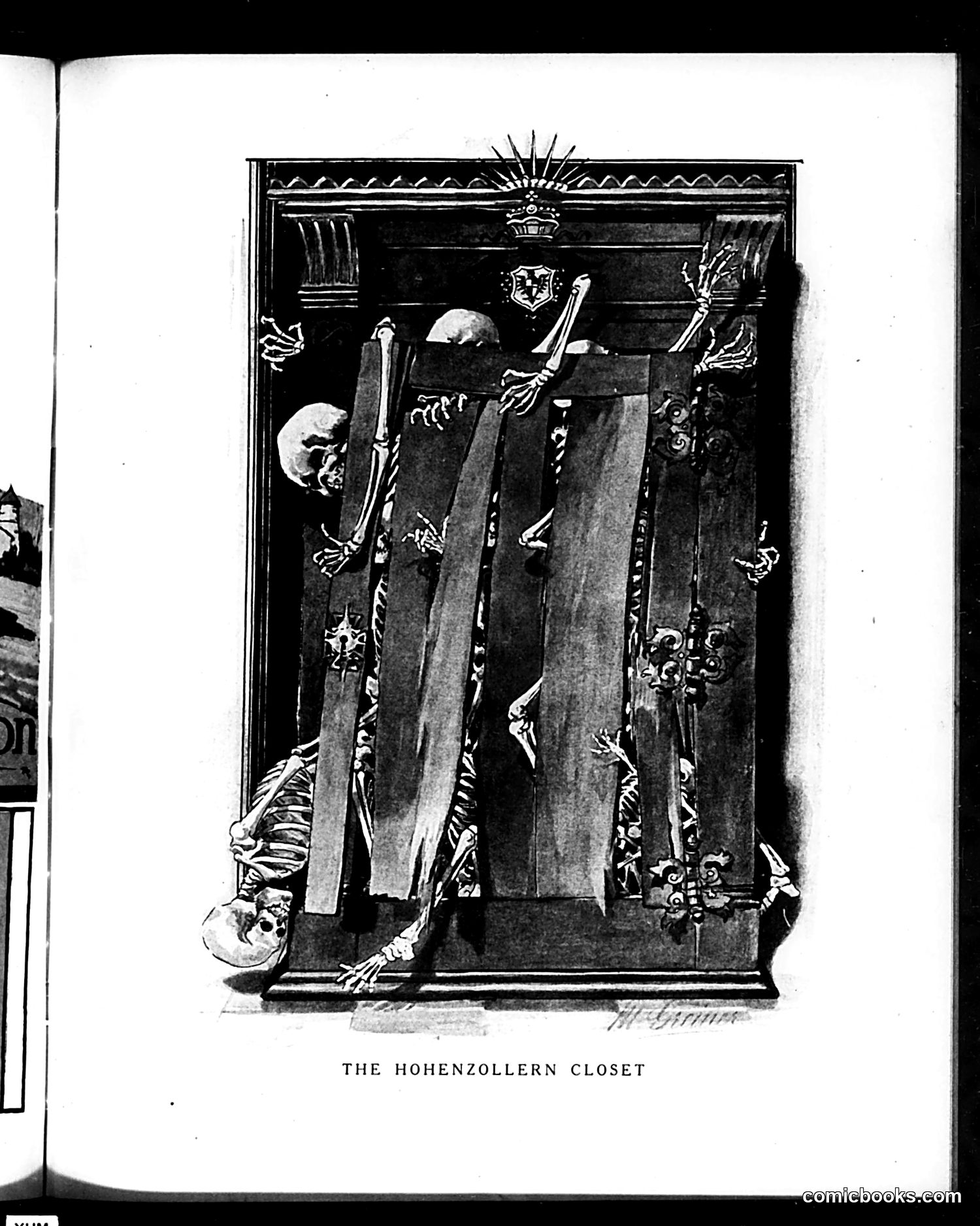
This political cartoon satirizes the German imperial Hohenzollern dynasty by depicting their "closet" — a storage space filled with skeletons and bones. The image uses the common metaphor of "skeletons in the closet" (hidden shameful secrets) to critique Germany's history. The ornate Germanic heraldry and decorative elements frame the darkly humorous scene. The skeletons represent Germany's violent past — likely including military aggression, imperial atrocities, or authoritarian abuses. The "closet" conceit suggests these historical crimes were deliberately concealed or ignored by the German establishment. Published in *Judge*, a satirical American magazine, this piece reflects early-to-mid 20th century American criticism of German imperial militarism and the Hohenzollern dynasty's controversial legacy.
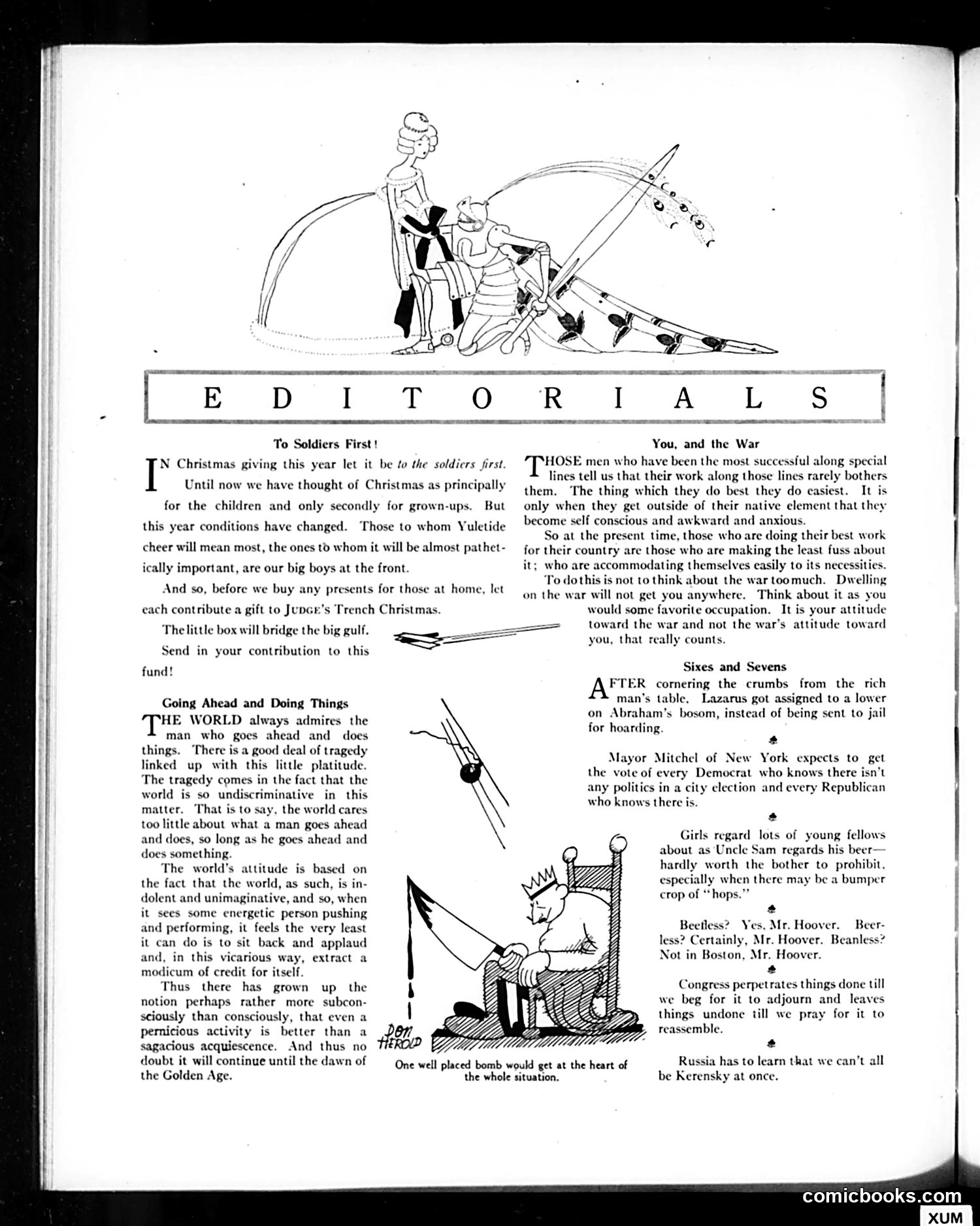
This is an editorials page from Judge magazine containing three opinion pieces and accompanying illustrations. The main cartoon depicts a figure labeled "One well placed bomb would get at the heart of the whole situation," showing what appears to be a military/wartime context, likely WWI-era given references to "soldiers" and trenches. The editorials address: 1. **"To Soldiers First"** - advocating Christmas gifts prioritize soldiers at the front over civilians 2. **"Going Ahead and Doing Things"** - praising active, forward-thinking individuals 3. **"Sixes and Sevens"** - brief political commentary, including references to Mayor Mitchel of New York and congressional politics The page reflects American wartime sentiment emphasizing military sacrifice over civilian comfort, typical of WWI-period patriotic rhetoric in satirical publications.
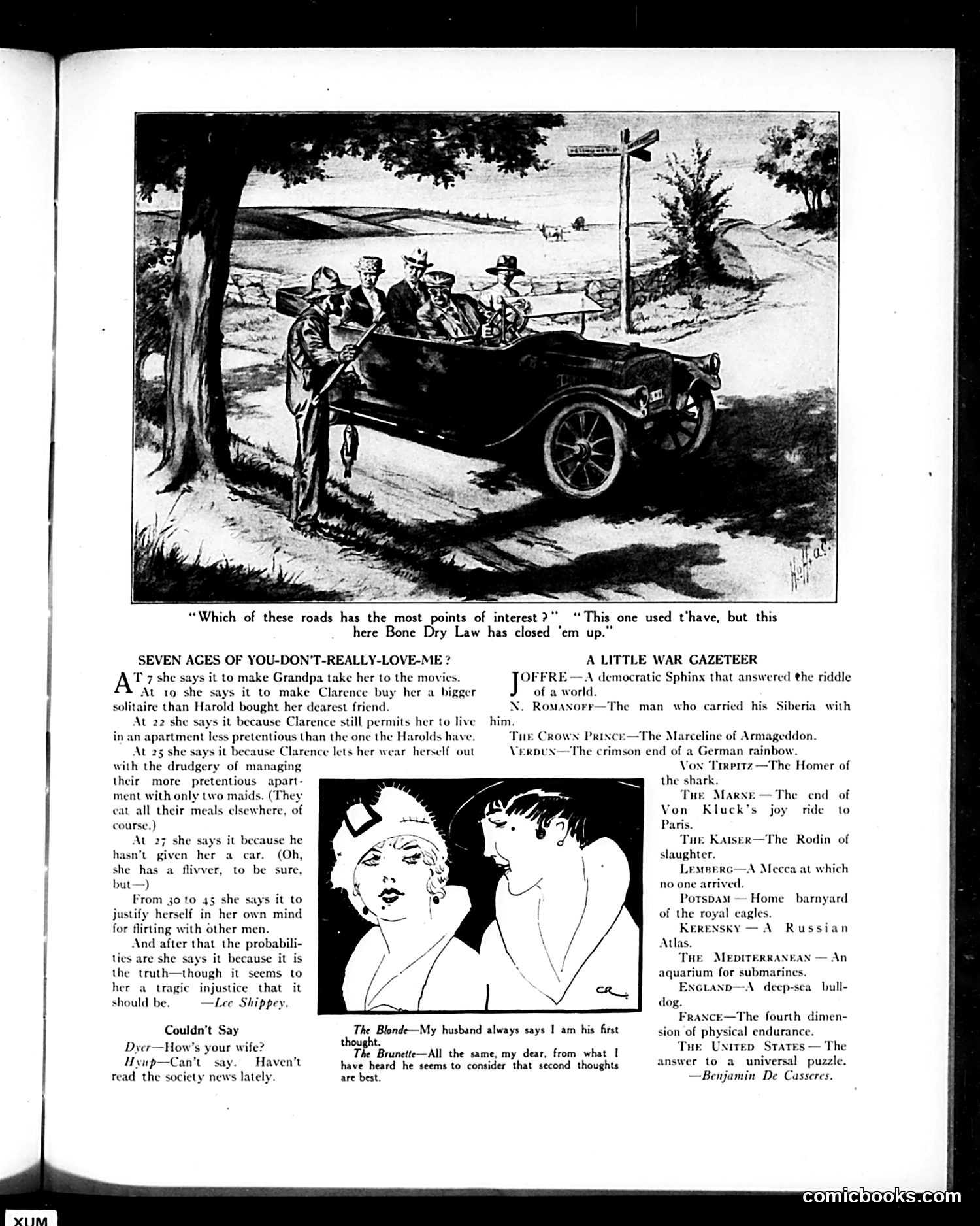
The top illustration shows an early automobile with five men in period dress (likely 1920s-era) stopped at a crossroads. One man stands outside the vehicle asking about interesting roads, while another responds that the "Bone Dry Law has closed 'em up." This is satire about Prohibition (the "Bone Dry Law"): popular roadside destinations—likely speakeasies and bars—have been shut down by alcohol prohibition enforcement, making leisure driving less appealing. Below are humorous definitions of international figures and concepts as "ages of you-don't-really-love-me" and "A Little War Gazetteer," using whimsical names like "The Kaiser," "The Marne," and "Potsdam" to satirize post-WWI European politics and geography in a tongue-in-cheek manner.
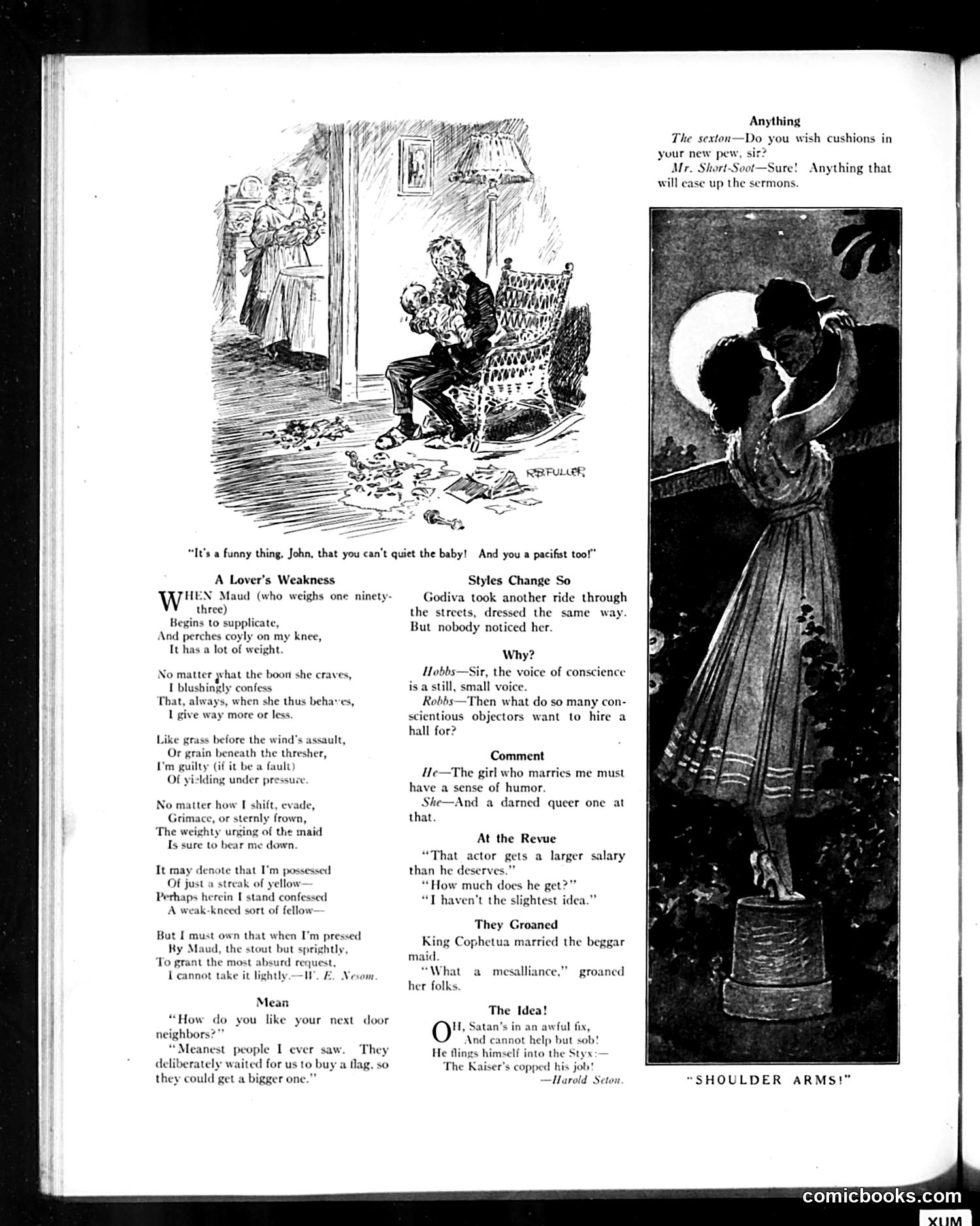
This page contains several short humorous pieces typical of early 20th-century satirical magazines: **Top cartoon**: Shows a domestic scene where a man sits surrounded by scattered items while a woman stands in a doorway. The caption jokes about inability to quiet a baby despite being a "pacifist," satirizing the contradiction between pacifist ideology and real-world parental frustration. **"A Lover's Weakness"**: A poem mocking a man named Maul who cannot control his lightweight girlfriend's behavior, suggesting male weakness in romance. **Other brief humor pieces**: Include observations about neighbors, actors' salaries, and marriage mishaps—standard magazine filler joking about domestic life and social pretension. The right-side photograph with caption "Shoulder Arms!" appears unrelated promotional material, likely from a contemporary film. The overall tone reflects pre-WWI American middle-class anxieties about marriage, propriety, and social status.
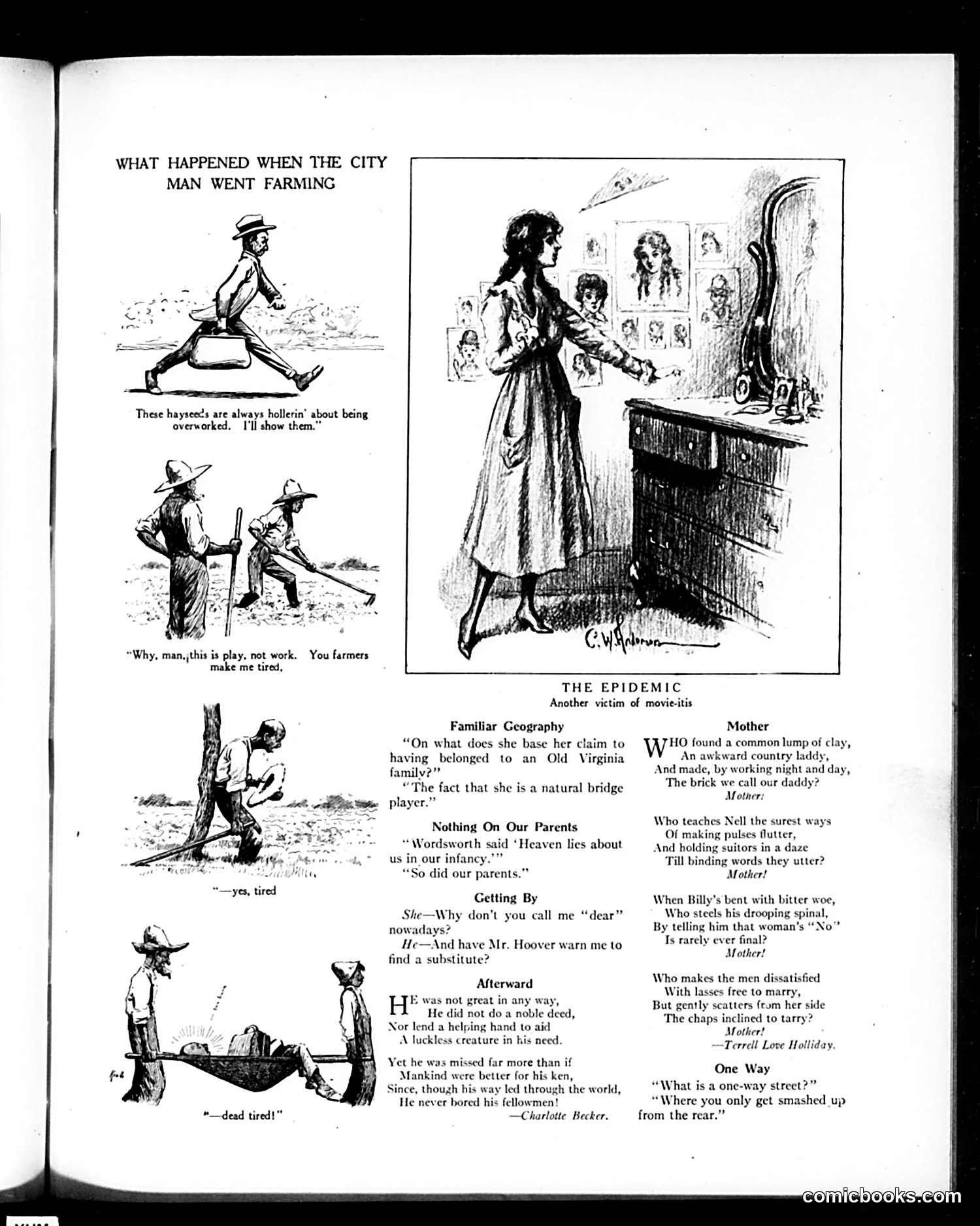
This satirical comic mocks the urban-rural divide popular in early 20th-century American humor. A city man boasts he'll show overworked farmers they're just complaining—farm work is easy play. The sequential panels show his comeuppance: after attempting actual farm labor, he collapses in exhaustion, repeatedly declaring himself "dead tired." The joke targets condescending city attitudes toward rural workers. The farmer's initial complaint about being "overworked" is vindicated when the city man, unaccustomed to physical labor, discovers farming is genuinely arduous. It's a humbling reversal that satirizes urban smugness and ignorance of agricultural hardship. The rest of the page contains unrelated light verse and humor pieces about social matters ("movie-itis," courtship, gender relations), typical of Judge's miscellaneous satirical content from this era.
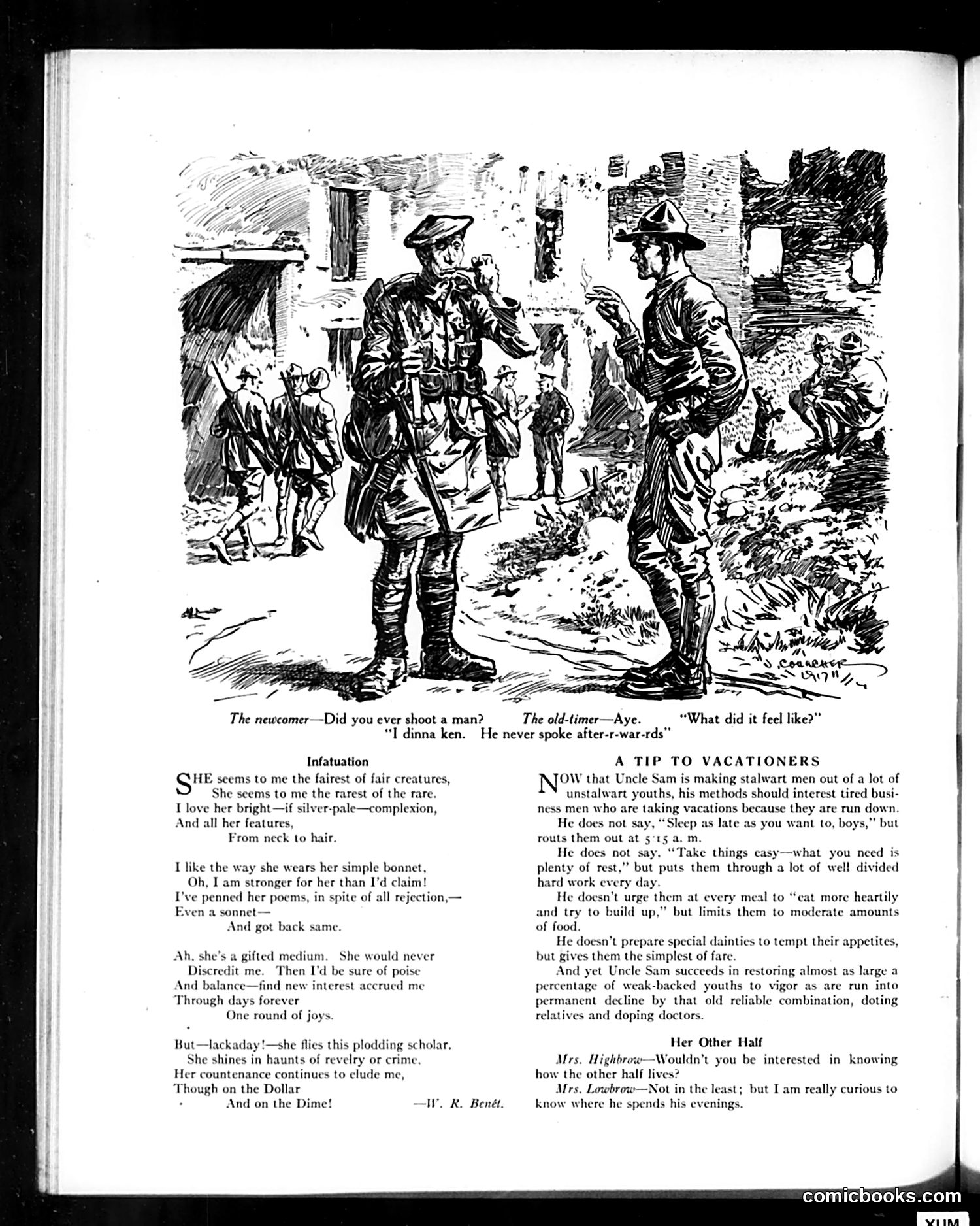
This page contains three distinct pieces of satirical content from *Judge* magazine: **Top cartoon**: A WWI-era military scene depicting soldiers. The dialogue jokes darkly about combat experience—a newcomer asks a veteran if he's killed someone; the old-timer replies evasively, implying the trauma has left him unable to speak about it afterward ("never spoke after-r-war-rds"). **"Infatuation" poem**: A humorous critique of an impractical scholar infatuated with a woman who ignores him, preferring "haunts of revelry or crime." The joke targets both his romantic delusion and his obsession with money ("the Dollar / And on the Dime"). **"A Tip to Vacationers"**: Satirizes how wealthy businessmen seeking rest vacations might benefit from military-style discipline—early rising, hard work, simple food, no coddling. The piece suggests this approach restores vigor better than affluent self-indulgence or medical intervention. **"Her Other Half"**: A brief domestic joke about a wife curious where her husband spends evenings, implying marital separation or infidelity. The page reflects early-20th-century concerns: WWI trauma, class anxieties, and marital discord.
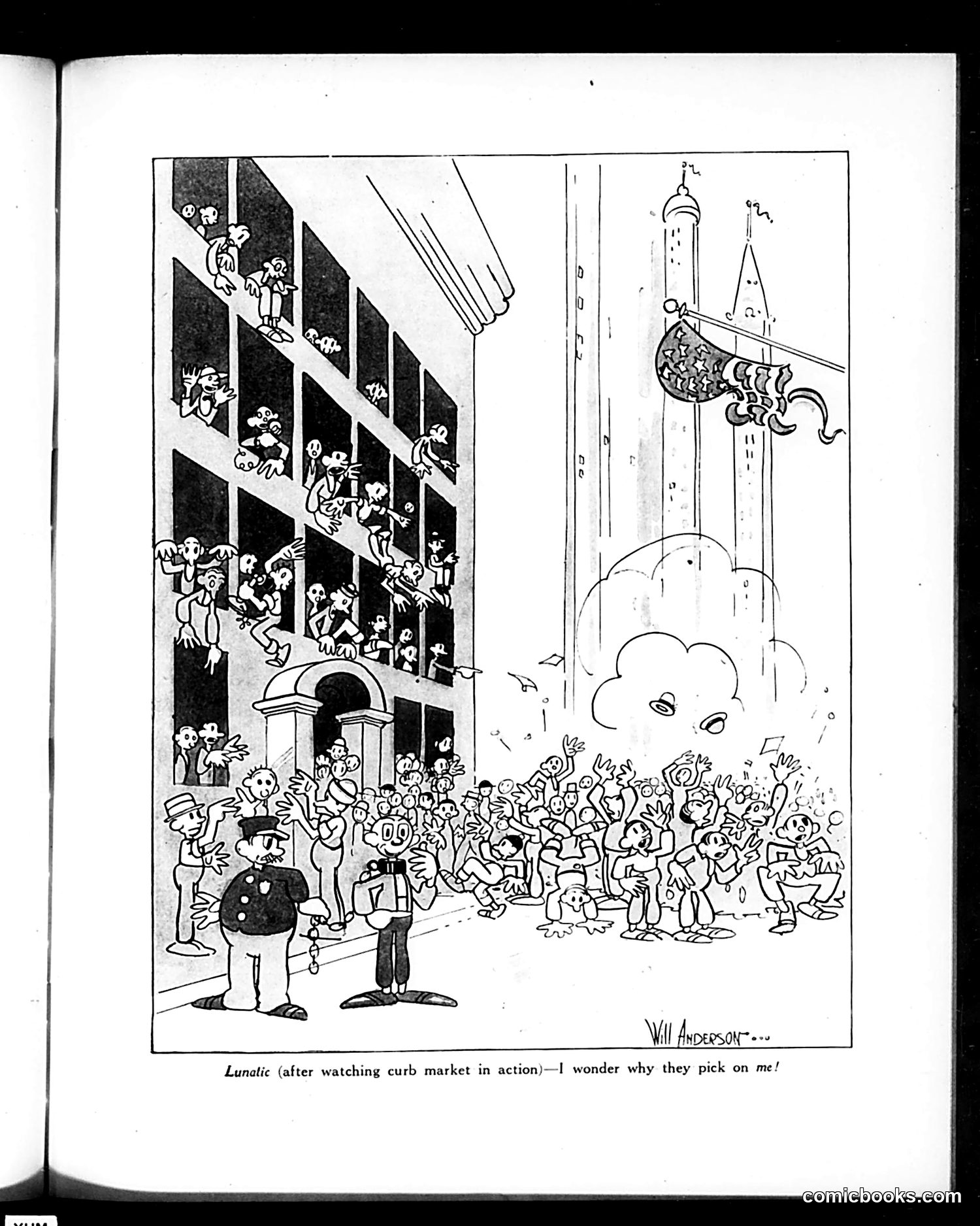
This cartoon satirizes stock market speculation during a boom period (likely the 1920s). The left panel shows a crowded building—presumably a brokerage or exchange—packed with eager investors. The right panel depicts a fantastical airship labeled with dollar signs floating above clouds, representing the speculative bubble and unrealistic wealth expectations. The "lunatic" figure observes this frenzy and complains about being targeted or mocked, likely because he warned against such reckless investing or refused to participate. The satire mocks both the crowds' irrational enthusiasm for "get-rich-quick" schemes and the lunatic's bewilderment at being the outsider—suggesting that sanity itself becomes the minority position during financial mania. The cartoon critiques speculation as collective madness.
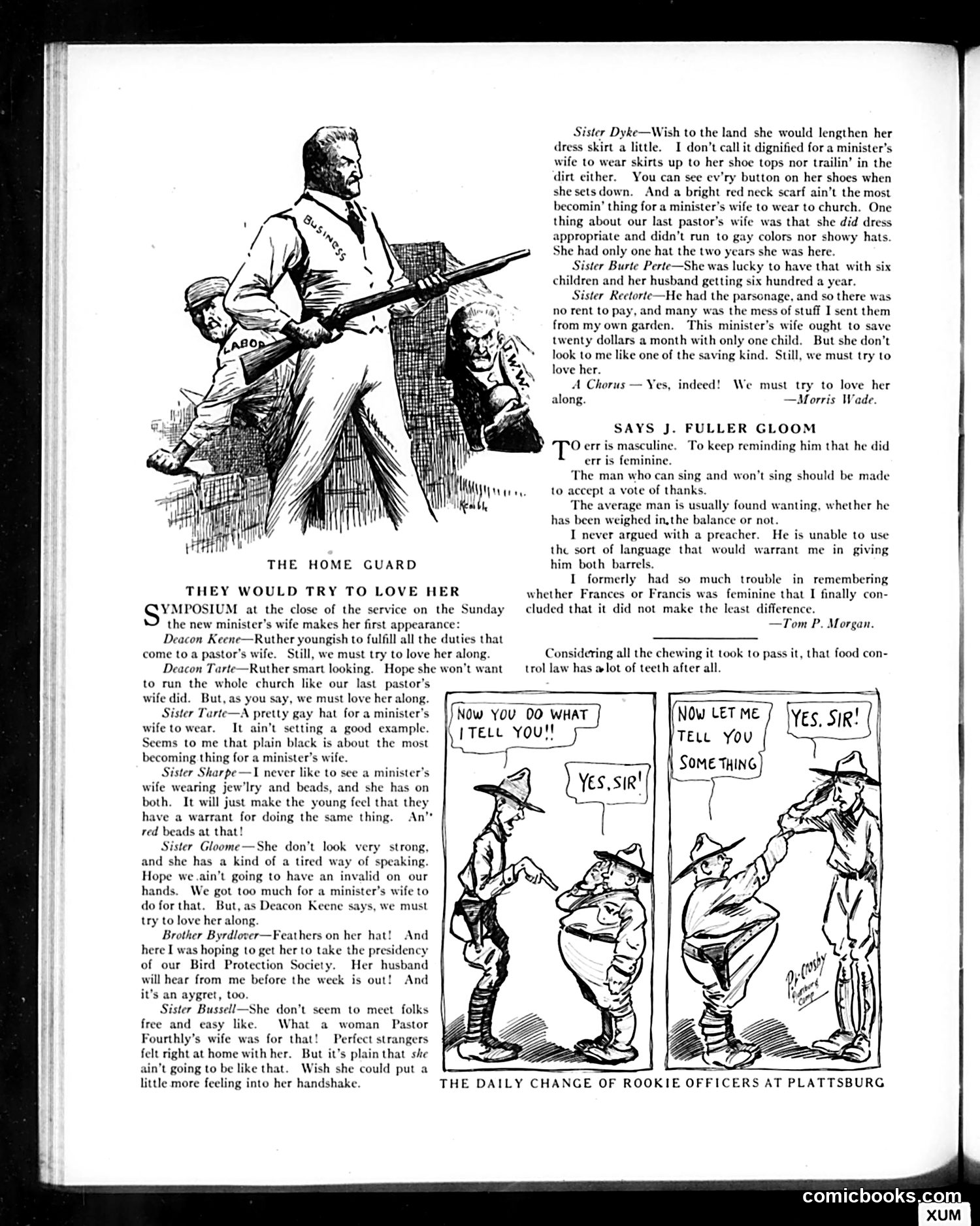
This is a satirical "symposium" about a new minister's wife's first church appearance. Various parishioners nitpick her appearance and demeanor—her hat is too fashionable, her skirt too short, her jewelry inappropriate, her handshake cold—while repeatedly insisting "we must try to love her along." The joke is the transparent gap between Christian charity they claim to practice and their actual judgmental small-mindedness. The bottom cartoon, "The Daily Change of Rookie Officers at Plattsburg," depicts military officers at a training camp, apparently joking about their frequent reassignments (unclear without more context). The page mocks bourgeois church culture's unforgiving expectations of clergy wives while revealing how congregational "love" masks petty social policing. The hypocrisy—constantly reminding readers they *must* love her while cataloging her failures—is the satire's target.
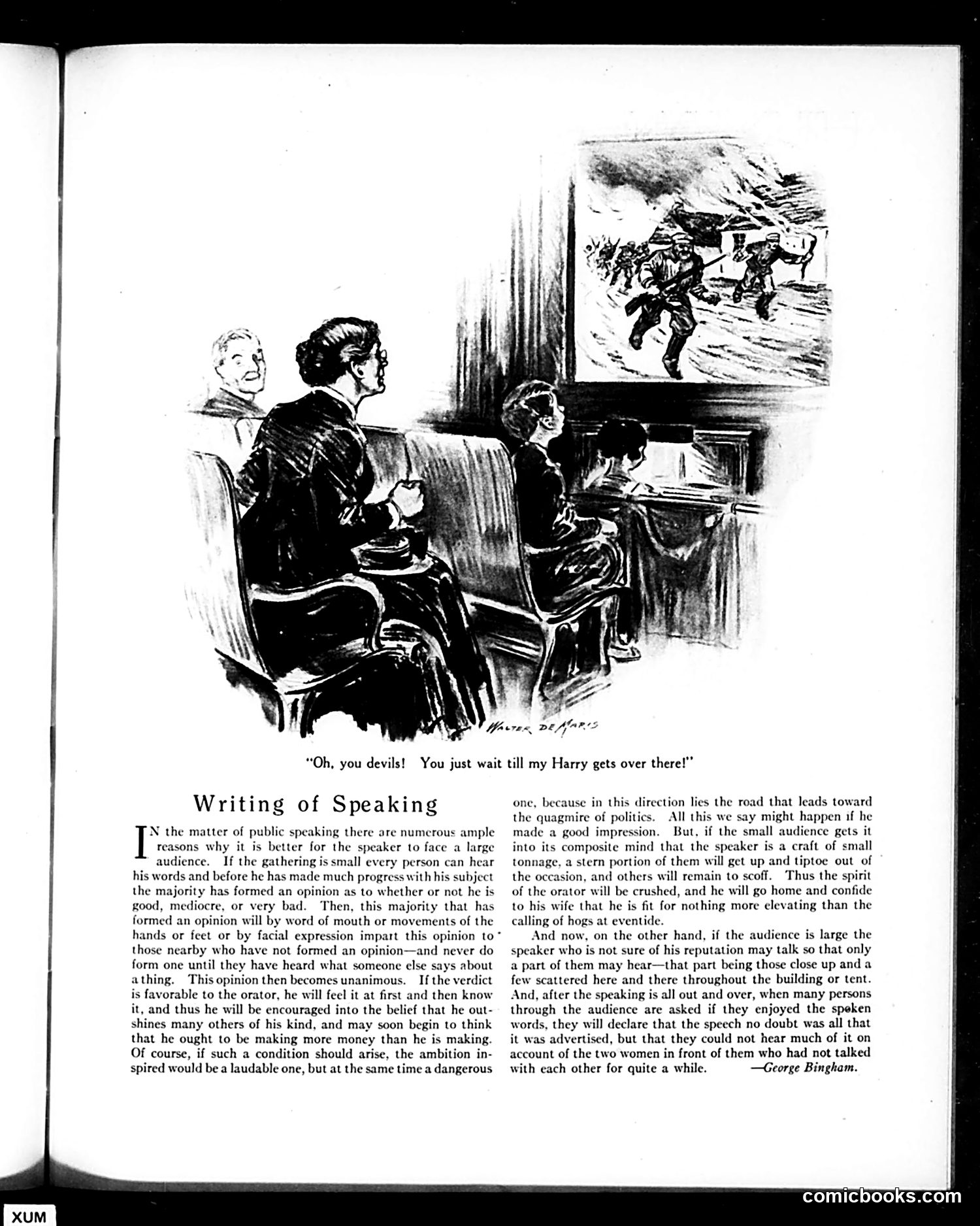
The cartoon depicts a domestic scene where a woman watches what appears to be a war film or newsreel (visible in the framed image showing soldiers in combat), while sitting with her husband. Her exclamation—"Oh, you devils! You just wait till my Harry gets over there!"—suggests she's viewing footage of military action, likely World War I combat. The accompanying essay by George Bingham humorously discusses public speaking, contrasting small versus large audiences. The cartoon's joke appears to satirize how audiences—particularly distracted or inattentive ones (the two women mentioned at essay's end who "had not talked with each other for quite a while")—miss important messages entirely, even when presented dramatically. The broader point: wartime propaganda and public messaging can fail when audiences are preoccupied or simply not listening carefully, undermining efforts to communicate urgent civic matters or military updates to the home front.
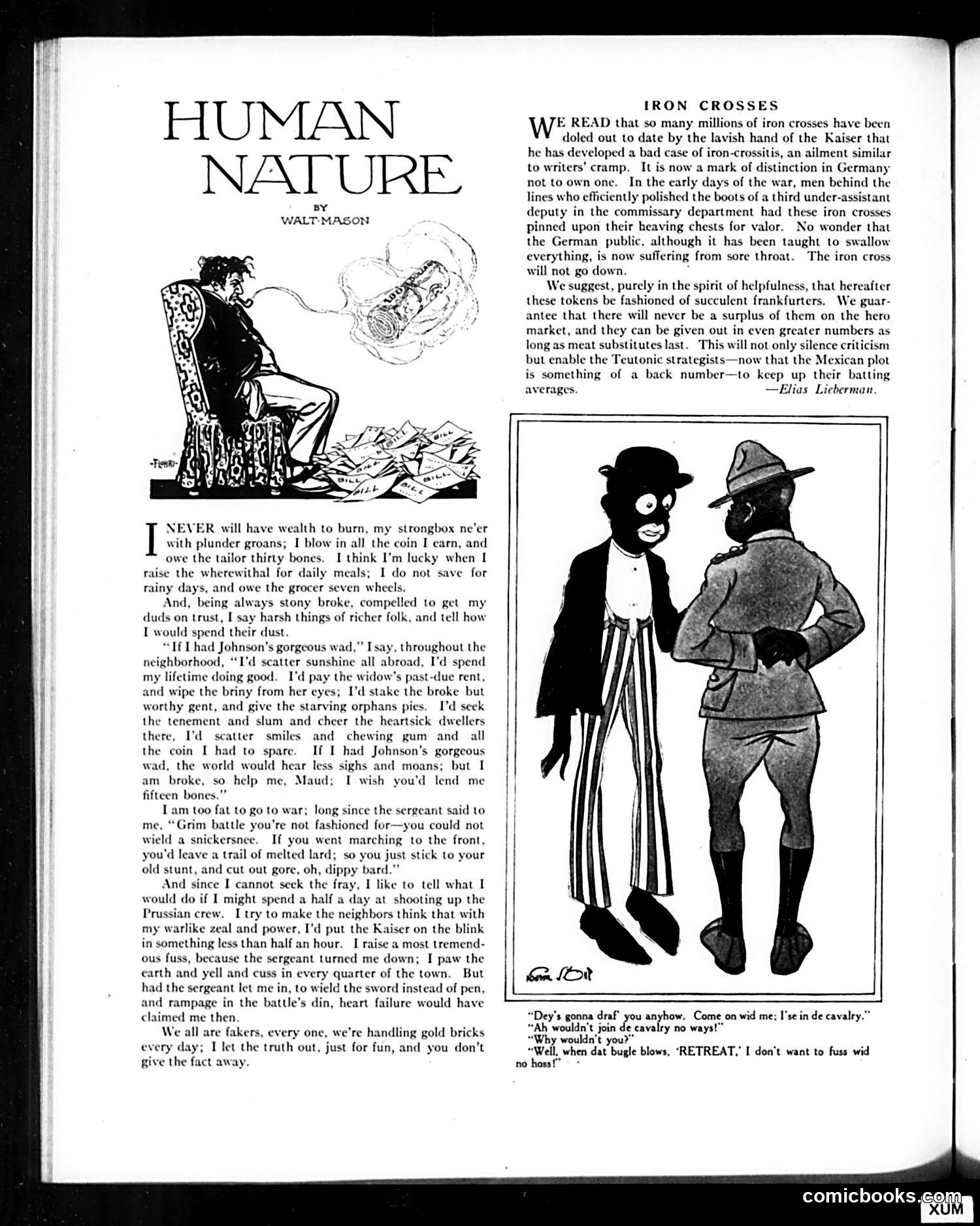
This page contains two distinct satirical pieces from Judge magazine, likely WWI-era (based on Kaiser references). **"Iron Crosses"** (top): A commentary mocking Germany's over-distribution of Iron Cross military medals. The satire suggests the Kaiser awarded them so liberally—even to rear-echelon soldiers polishing boots—that the decoration lost all prestige. The author suggests replacing them with frankfurters, a cynical jab at both German militarism and food shortages affecting the German public. **"Human Nature"** (bottom left): Walt Mason's verse satirizing class resentment and hypocrisy. The speaker, perpetually broke, fantasizes about how generously he'd spend wealth if he had it, yet remains selfish. He also boasts of warlike ambitions while admitting he was rejected from military service—exposing the gap between patriotic talk and actual courage. **The cartoon** (right): Shows two figures discussing military service, with one reluctant to join cavalry despite pressure. It illustrates working-class resistance to conscription. Together, these pieces mock German militarism, American class pretensions, and public attitudes toward war service.
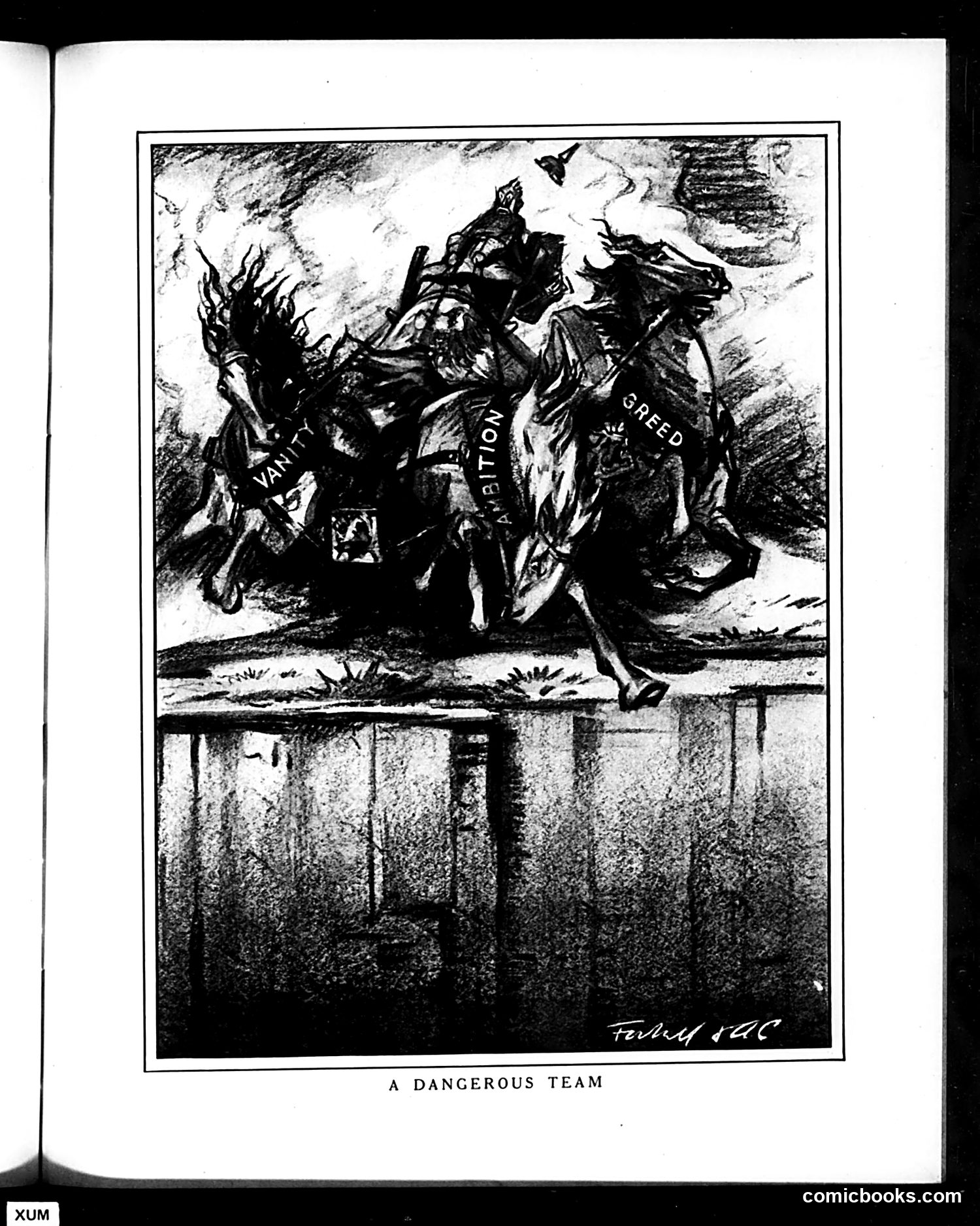
This political cartoon depicts three demonic or monstrous figures labeled "VANITY," "AMBITION," and "GREED" riding together on horseback across a bridge. The allegorical imagery—personifying human vices as dangerous demons—was a common satirical device in early 20th-century political commentary. The cartoon critiques how these three character flaws work in concert, suggesting they form a destructive "team" capable of causing significant harm to society or individuals. The dramatic, expressionistic art style emphasizes the threatening nature of this combination. The exact historical context—what specific political event or figure prompted this commentary—is unclear without additional publication information, though Judge magazine typically addressed contemporary political scandals and social criticism through such moral allegories.
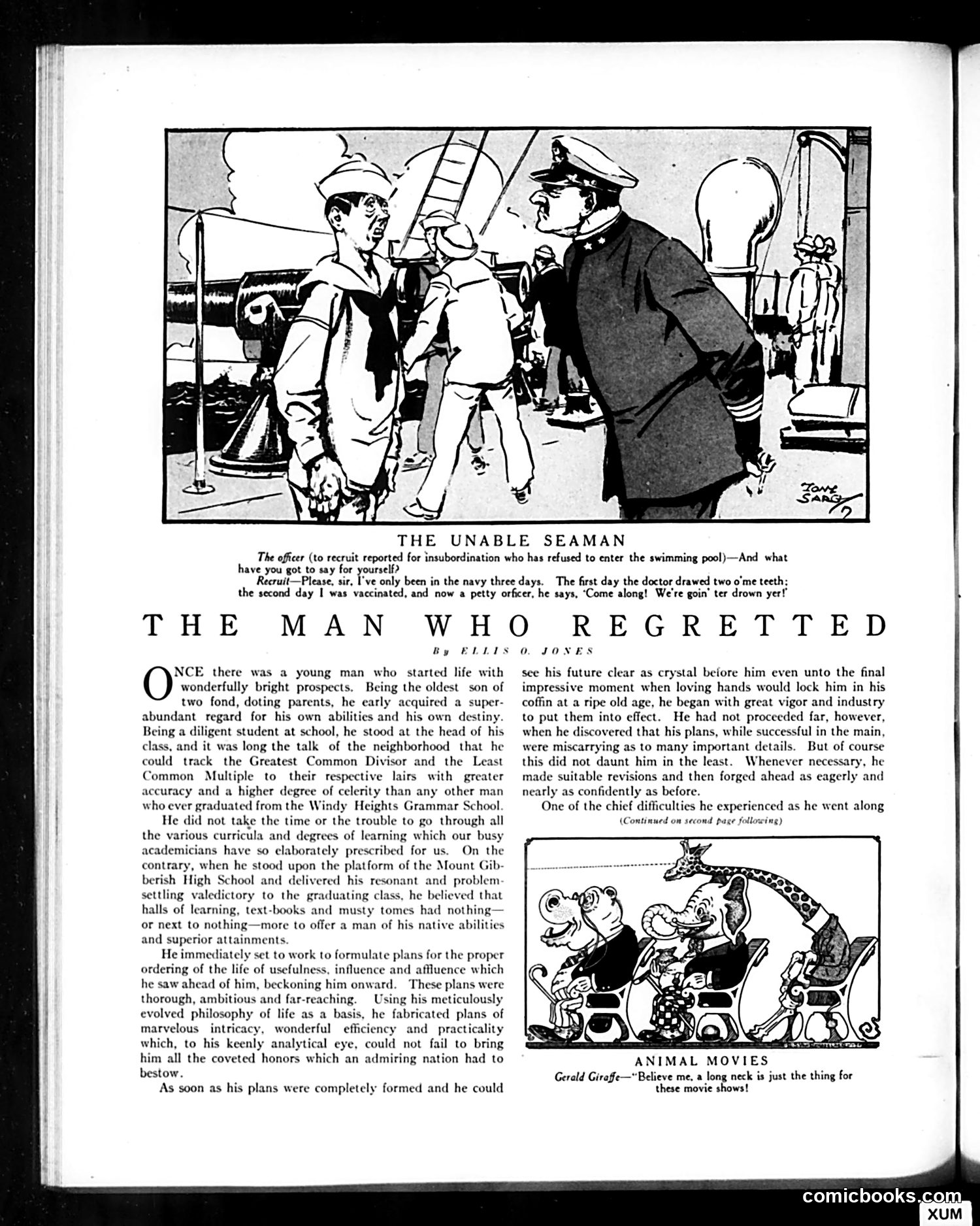
**The Top Cartoon:** This satirizes military recruitment and hazing. A navy recruit reports for insubordination after refusing to enter the swimming pool. His defense reveals the brutal initiation he's endured in just three days: tooth extraction by a doctor, vaccination, and now a petty officer threatening to "drown" him during swimming lessons. The joke targets the harsh, physically punishing nature of early naval training—the recruit's fear seems reasonable given his actual experiences. It's social satire mocking military practices presented as routine. **The Main Story:** "The Man Who Regretted" (by Ellis O. Jones) begins serialization here. It tells of an overconfident youth—brilliant at mathematics, valedictorian—who believes his native abilities require no further education. He formulates elaborate life plans with absolute certainty of success, then discovers reality requires constant adjustment. This appears to be a morality tale satirizing youthful arrogance and the gap between theoretical planning and practical experience. **The Bottom Comic:** A brief joke about a giraffe's long neck being advantageous for movie work (likely vaudeville or silent film performance).
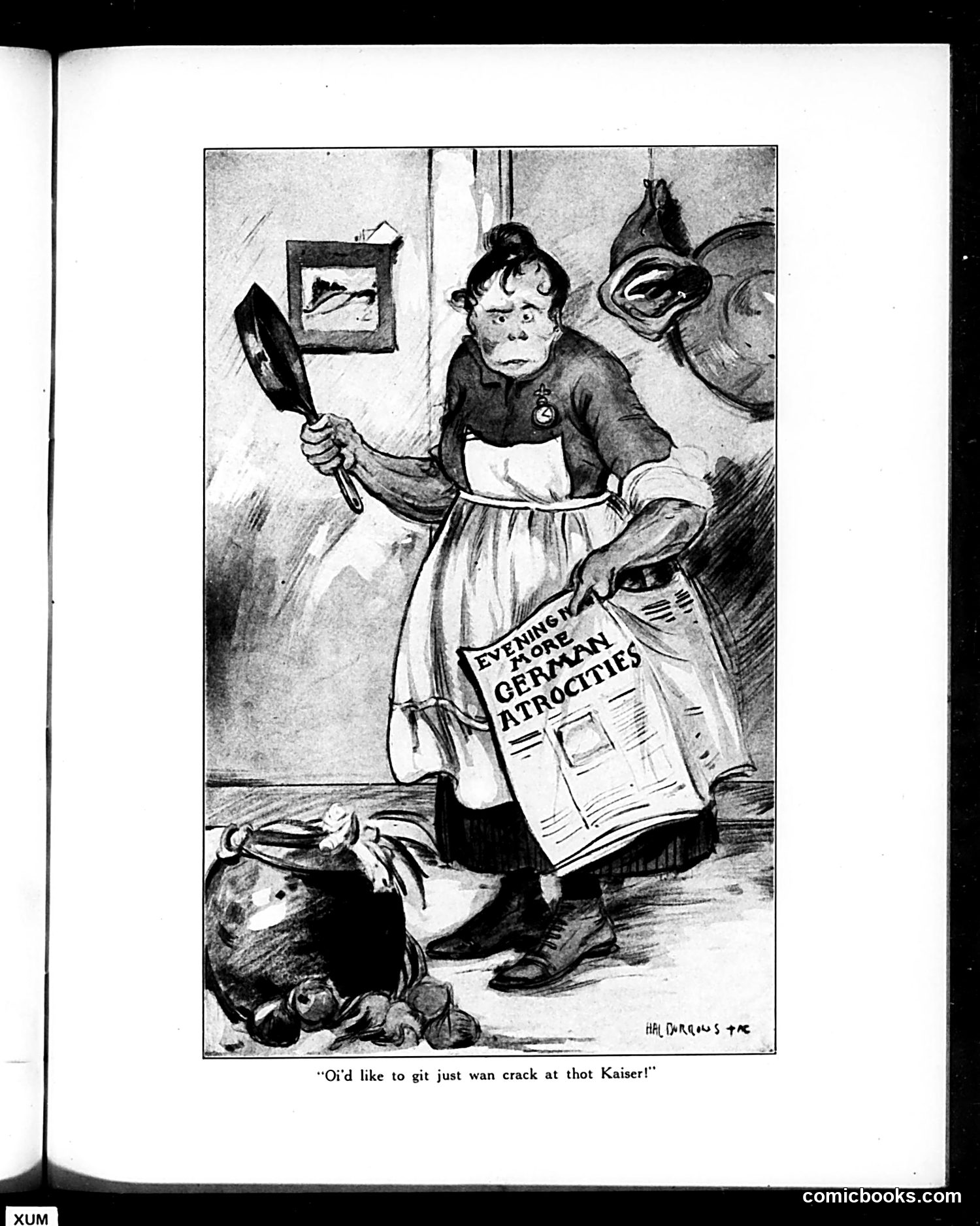
This is a World War I-era satirical cartoon from *Judge* magazine. It depicts a working-class woman (identifiable by her apron and accent rendered in dialect: "Oi'd like to git just wan crack") holding a frying pan as a weapon, standing over what appears to be a German soldier or military figure on the ground. The cartoon references the "Kaiser"—German Emperor Wilhelm II—symbolizing American anger toward Germany. The woman represents ordinary American citizens (likely an Irish immigrant, suggested by the dialect) eager to participate in the war effort against Germany. The frying pan humorously depicts domestic, feminine tools repurposed as weapons, suggesting even civilian non-combatants wanted to fight. The *Evening German Atrocities* newspaper she holds references German wartime conduct, which American propaganda heavily emphasized to build support for entering WWI.
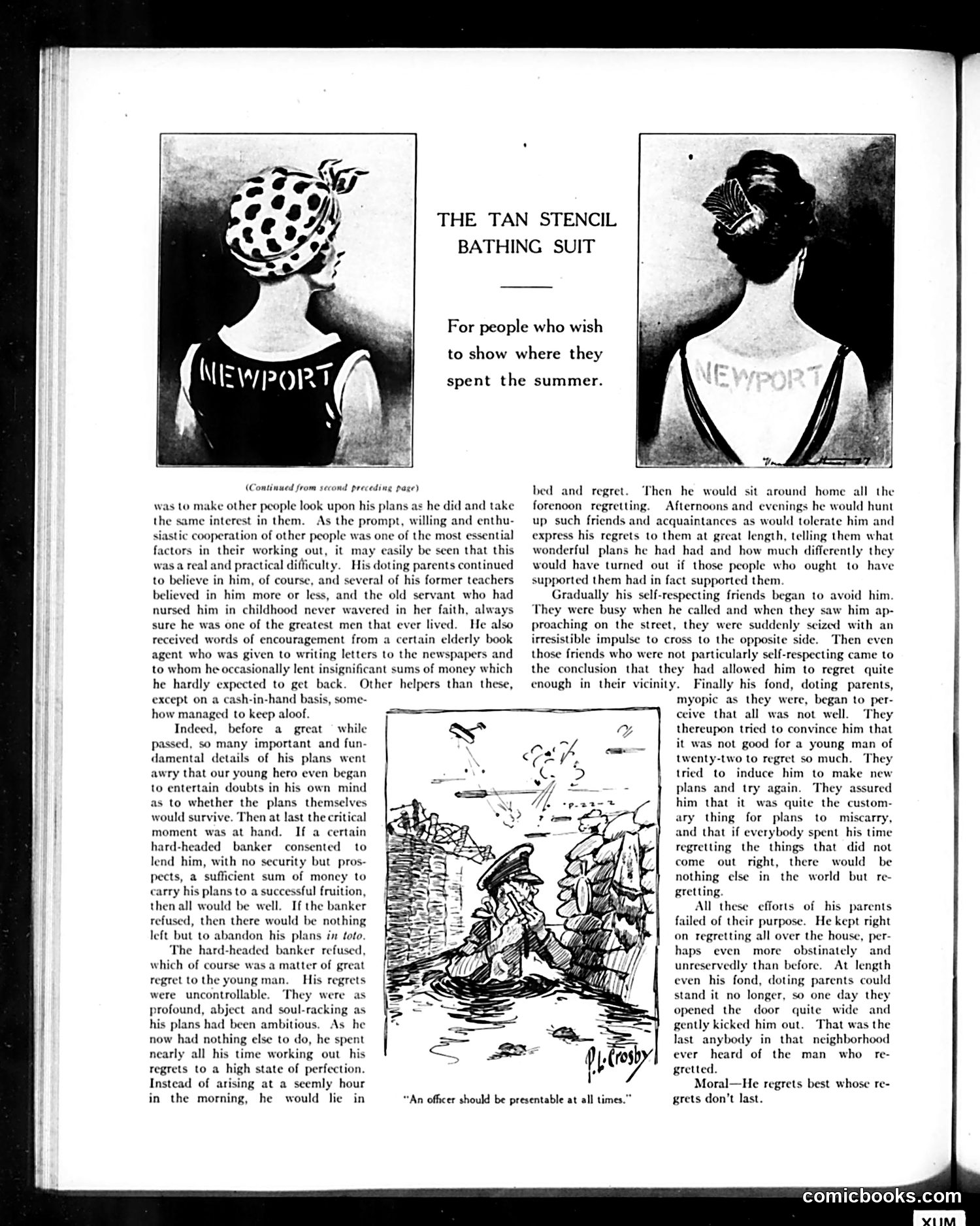
**The Satire:** This is a simple visual joke about fashionable bathing suits with polka-dot patterns. The humor plays on early-20th-century vanity: women wore these patterned suits so that the unpatterned skin beneath would tan in the dot shapes, creating a visible record of where they'd worn the suit—and thus proving they'd vacationed at prestigious places like Newport (visible on the suits). **The Point:** The satire mocks status-consciousness and the desire to display wealth and leisure. By wearing these "stencil" suits, women could literally advertise their summer travels to fashionable seaside resorts. The joke is on those vain enough to need such obvious proof of their social standing. The accompanying story text appears unrelated to the advertisement, making this a typical Judge layout mixing satirical commentary with commercial content.
This theater review critiques "The Very Idea," a Broadway farce starring Ernest Truex. The play centers on a eugenic plot—a wealthy man hires his chauffeur and maid to produce a "superior" child through selective breeding, treating matrimony as irrelevant. The satire targets two things: (1) the fashionable but absurd eugenic movement of the early 20th century, ridiculed as pseudoscientific nonsense, and (2) changing social morality. An older audience member questions whether such scandalous content should be witnessed, but her modern daughter finds it "fearfully amusing"—illustrating generational shifts in propriety. The critic argues the play succeeds despite its controversial premise because Truex's comedic performance is brilliant enough to overcome moral objections. The discussion with "Romeo Rundle," an aging actor, further explores how star power (handsome male leads) draws audiences regardless of dramatic quality.
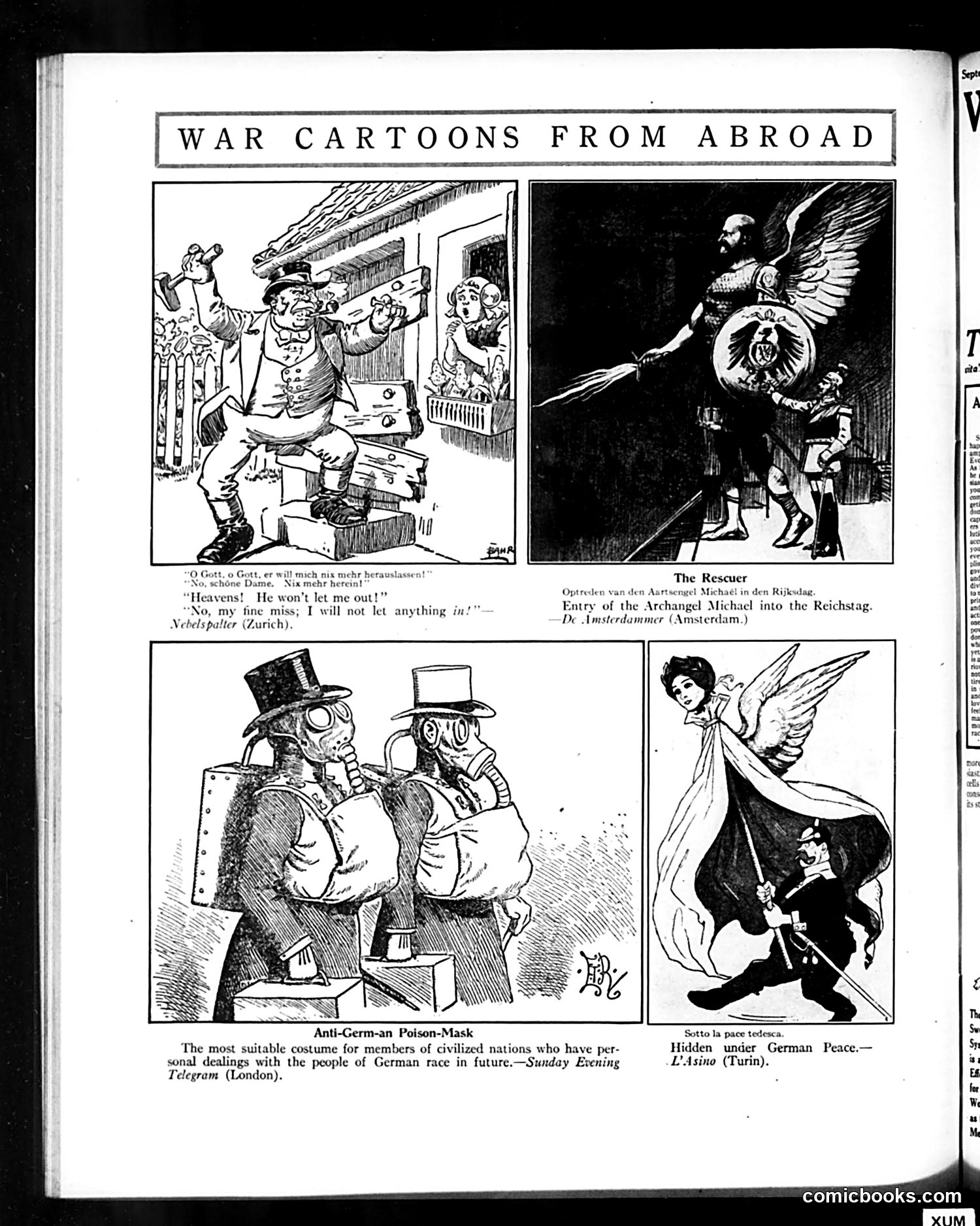
This page collects anti-German satirical cartoons from European publications during WWI. The top-left cartoon (Swiss *Nebelspalter*) shows a German military figure refusing to let anyone enter or leave—satirizing German wartime restrictions and aggression. The top-right (Dutch *De Amsterdammer*) depicts Archangel Michael entering the German parliament (Reichstag), suggesting divine judgment against Germany or hopes for its defeat. The bottom-left cartoon (British *Sunday Evening Telegram*) shows two figures in gas masks and protective gear labeled "Anti-German Poison-Mask," sarcastically suggesting civilized nations need such protection when dealing with Germans—implying Germans are toxic or dangerous. The bottom-right Italian cartoon (*L'Asino*) shows an angel figure with an unfurled flag obscuring a figure below, titled "Hidden under German Peace," criticizing German peace proposals as deceptive cover for continued aggression or occupation.
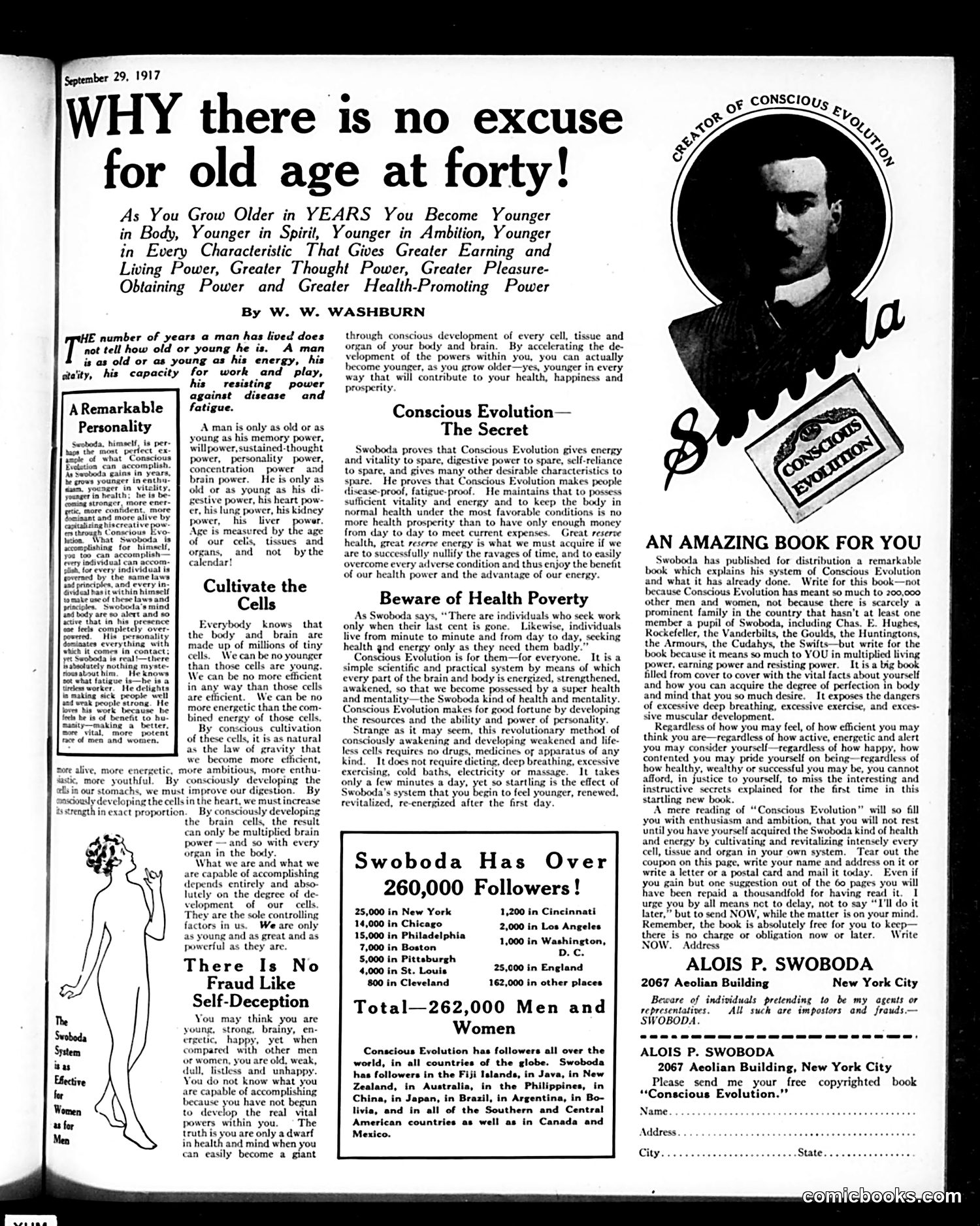
This page is primarily **commercial advertising**, not satire. It promotes "Conscious Evolution," a self-improvement system by Alois P. Swoboda, a figure who appears to have operated a quasi-scientific wellness movement in the early 20th century. The article by W.W. Washburn argues that aging is psychological rather than chronological—one can remain "young" through developing cellular vitality and mental power. The accompanying portrait and circular seal identifying Swoboda as "Creator of Conscious Evolution" present him as an authority figure. The advertisement claims Swoboda has 262,000 followers across America and internationally, listing cities and follower counts. This reflects the era's popular "self-development" movements (similar to New Thought), which blended pseudoscience with motivational philosophy. The page represents early-20th-century wellness marketing rather than editorial commentary or political satire.
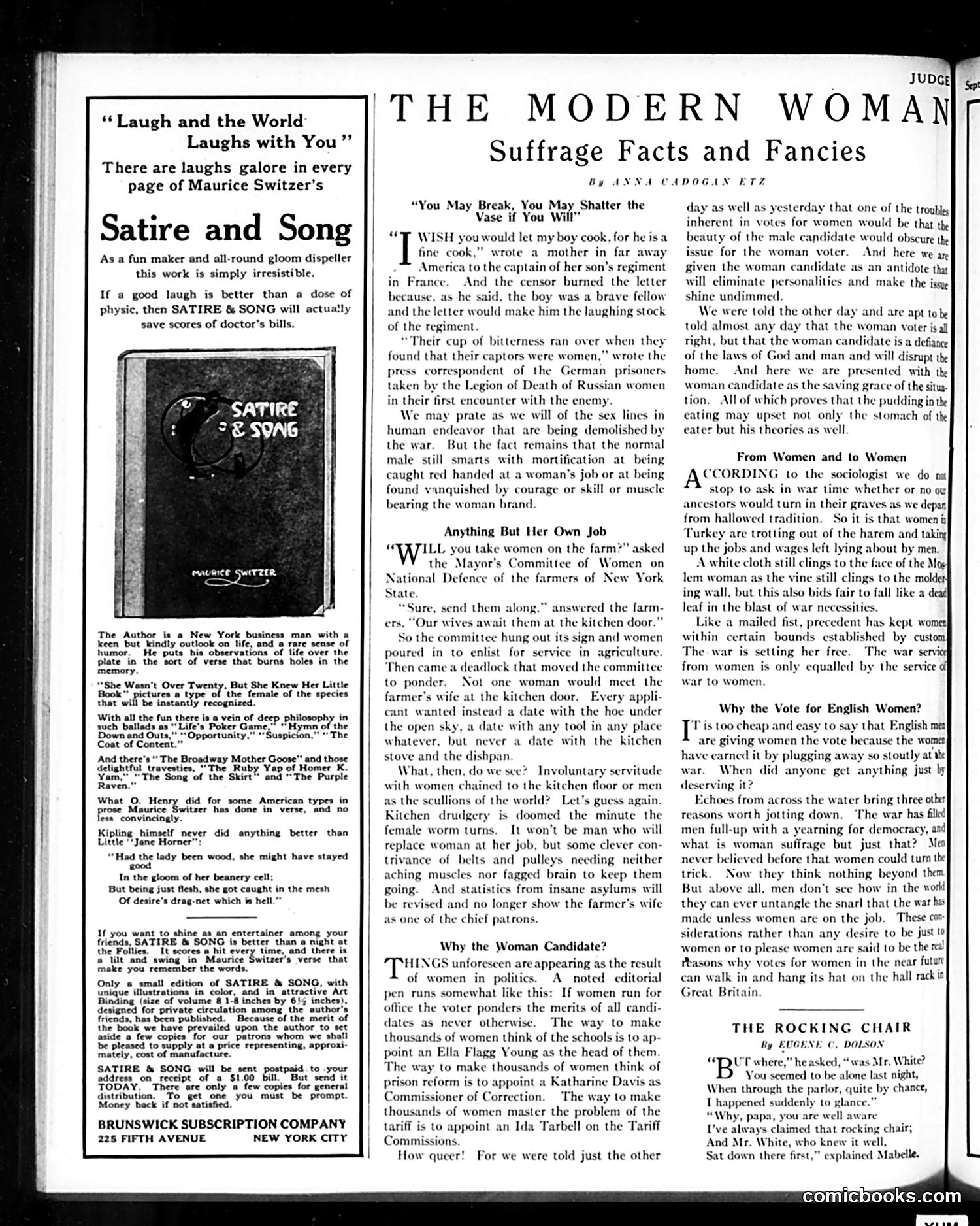
This page from *Judge* contains two distinct sections: a book advertisement and a suffrage commentary. **Advertisement (Left):** Promotes Maurice Switzer's poetry collection *Satire and Song*, emphasizing humor and social observation in verse form. The ad compares Switzer to O. Henry and Kipling, marketing the limited-edition book as entertainment. **"The Modern Woman: Suffrage Facts and Fancies" (Right):** By Anna Cidogan Etz, this satirical piece critiques resistance to women's expanding roles, particularly during wartime. The author highlights male mortification at women performing traditionally male jobs—citing examples of German POWs embarrassed by female Russian soldiers, and American farmers reluctant to accept women farm laborers despite wartime need. The satire's point: men claim to support women's equality but resist when women actually perform "men's work," preferring to keep them confined to kitchens. The title's opening quote ("You May Break...the Vase") suggests women are simultaneously fragile and capable—exposing the contradiction in anti-suffrage arguments. The commentary advocates for women's voting rights by demonstrating their actual competence.
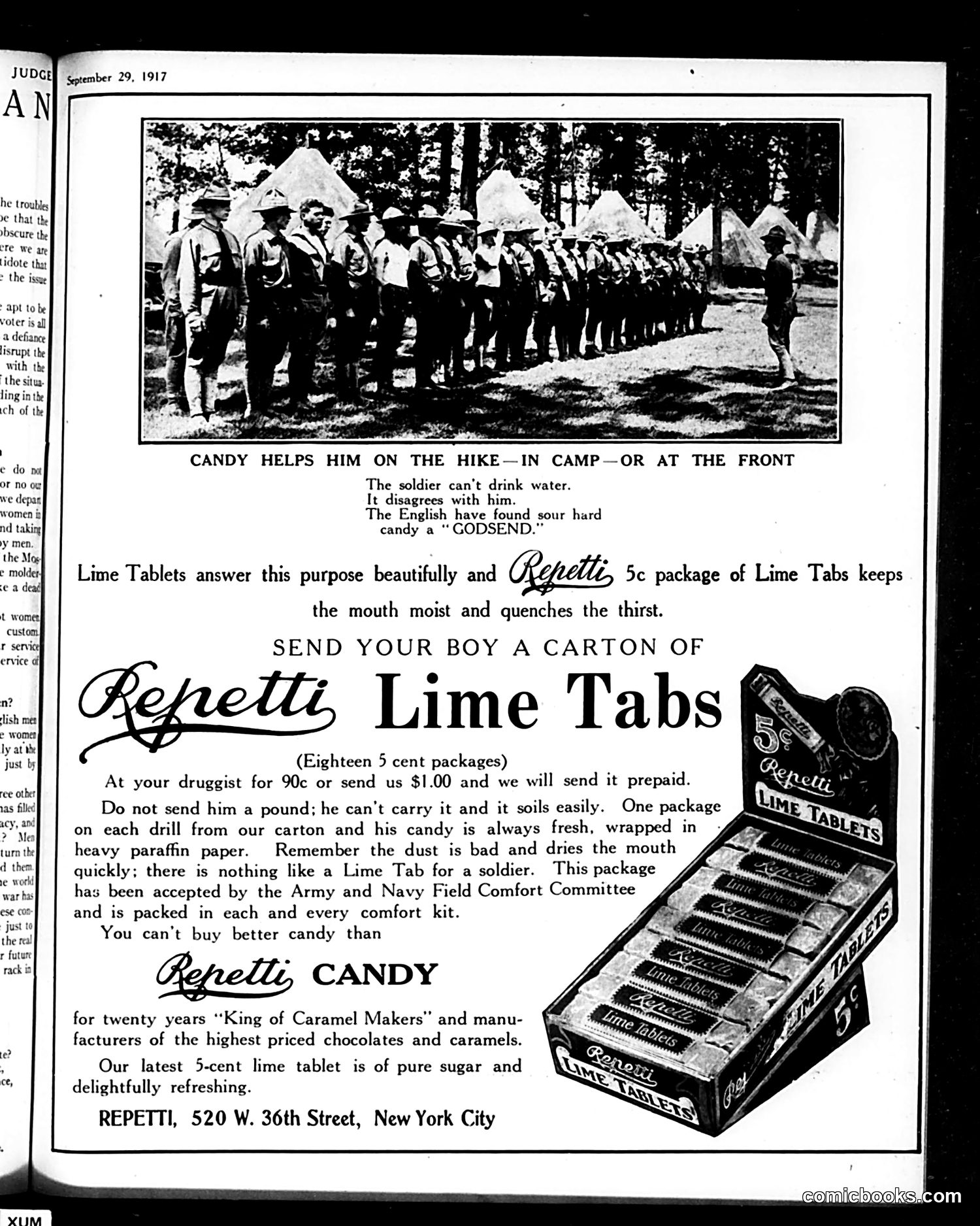
This is primarily a **wartime advertisement**, not satire. Dated September 29, 1917 (early U.S. involvement in WWI), it promotes Repetti brand Lime Tablets as care packages for soldiers. The photograph shows troops in a military camp with tents, establishing the soldier context. The advertisement addresses a genuine WWI concern: soldiers on marches and in camps suffered from dehydration and poor water quality. The text notes soldiers "can't drink water" because it "disagrees with him," and mentions British troops found sour hard candy helpful. The pitch leverages patriotic duty: parents should send their sons small, practical candy packages (not heavy ones). Notably, the ad claims the Army and Navy Field Comfort Committee accepted the product—lending official credibility. This reflects how American companies marketed consumer goods as morale-boosting support for troops during WWI, blending commerce with patriotic messaging.
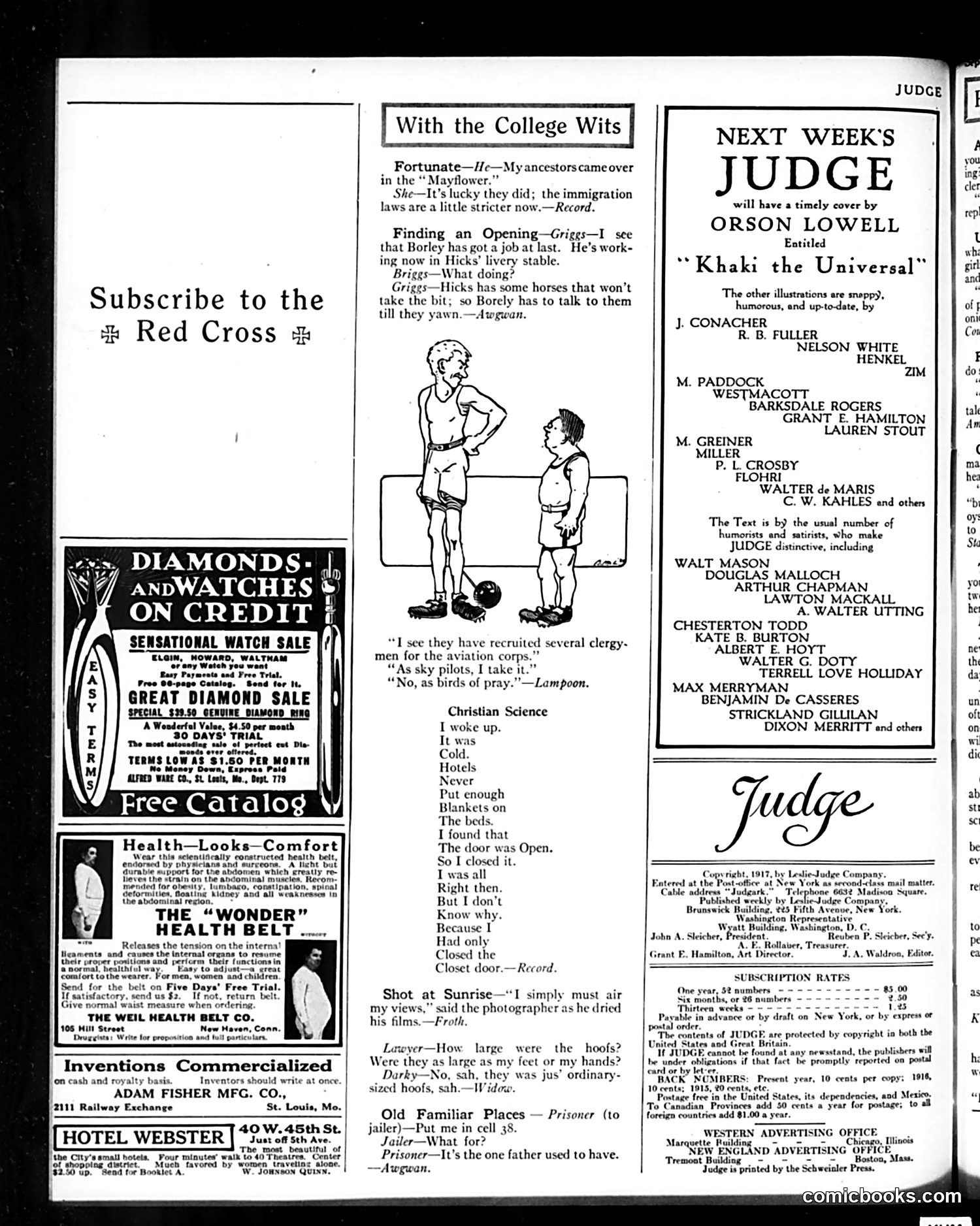
This is primarily an **advertising and announcements page** from Judge magazine, with minimal editorial cartoon content. The main cartoon (center) depicts two men discussing military recruitment for aviation. One recruiter boasts they've enlisted clergymen, calling them "sky pilots" (a nickname for military chaplains). The other man makes a dark joke: "No, as birds of pray"—a pun conflating "birds of prey" with clergy, satirizing the irony of religious men being recruited for warfare. The page is dominated by **commercial advertisements** (health belts, diamonds on credit, watches) typical of early 20th-century magazines. Several short **joke items** appear, including quips about immigration restrictions, horse-training, and Christian Science. The bulk of the page announces **next week's cover** by Orson Lowell titled "Khaki the Universal," suggesting the magazine was addressing military/wartime themes—likely from WWI era based on the aviation recruitment joke and the cover's title reference to military uniforms.
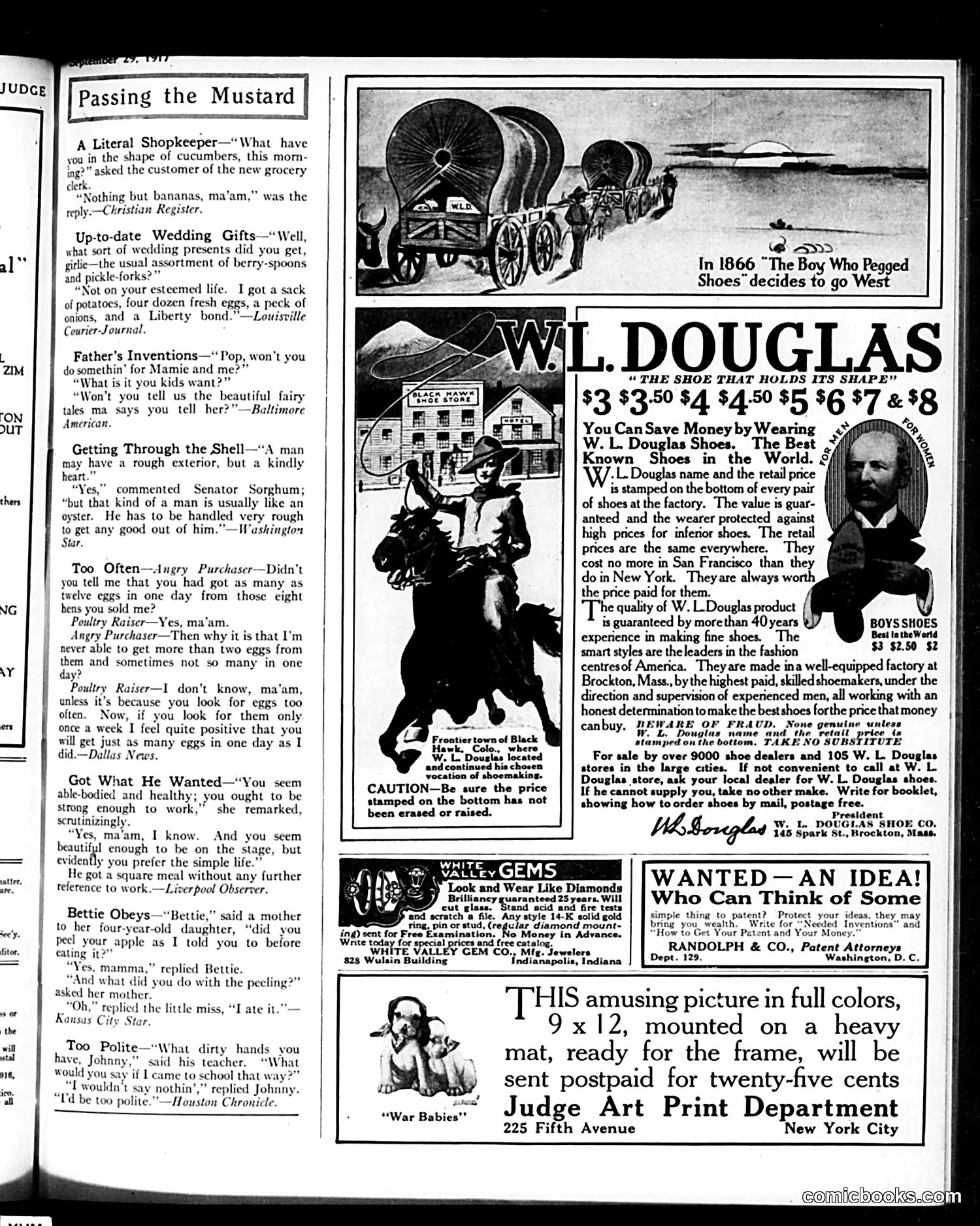
This is primarily an **advertising page** with humorous filler content typical of Judge magazine's format. **Main Content:** The large W.L. Douglas shoe advertisement dominates the page, featuring a narrative illustration titled "In 1866 'The Boy Who Pegged Shoes' Decides to Go West"—a founding legend suggesting the company's humble origins. The ad emphasizes price consistency nationwide and quality guaranteed by 40+ years of manufacturing experience in Brockton, Massachusetts. **Sidebar Humor:** The left column contains brief jokes under "Passing the Mustard," including: - A shopkeeper who misunderstands customer requests - A groom receiving practical gifts (potatoes, eggs) instead of fancy items - Comedic exchanges about chickens and politeness **Context:** These are gentle, family-friendly quips typical of early 20th-century magazines. The "Liberty bond" reference suggests post-WWI dating. The humor relies on wordplay, misunderstandings, and domestic situations—reflecting period attitudes about marriage, commerce, and social propriety, with no sharp political satire evident on this particular page.
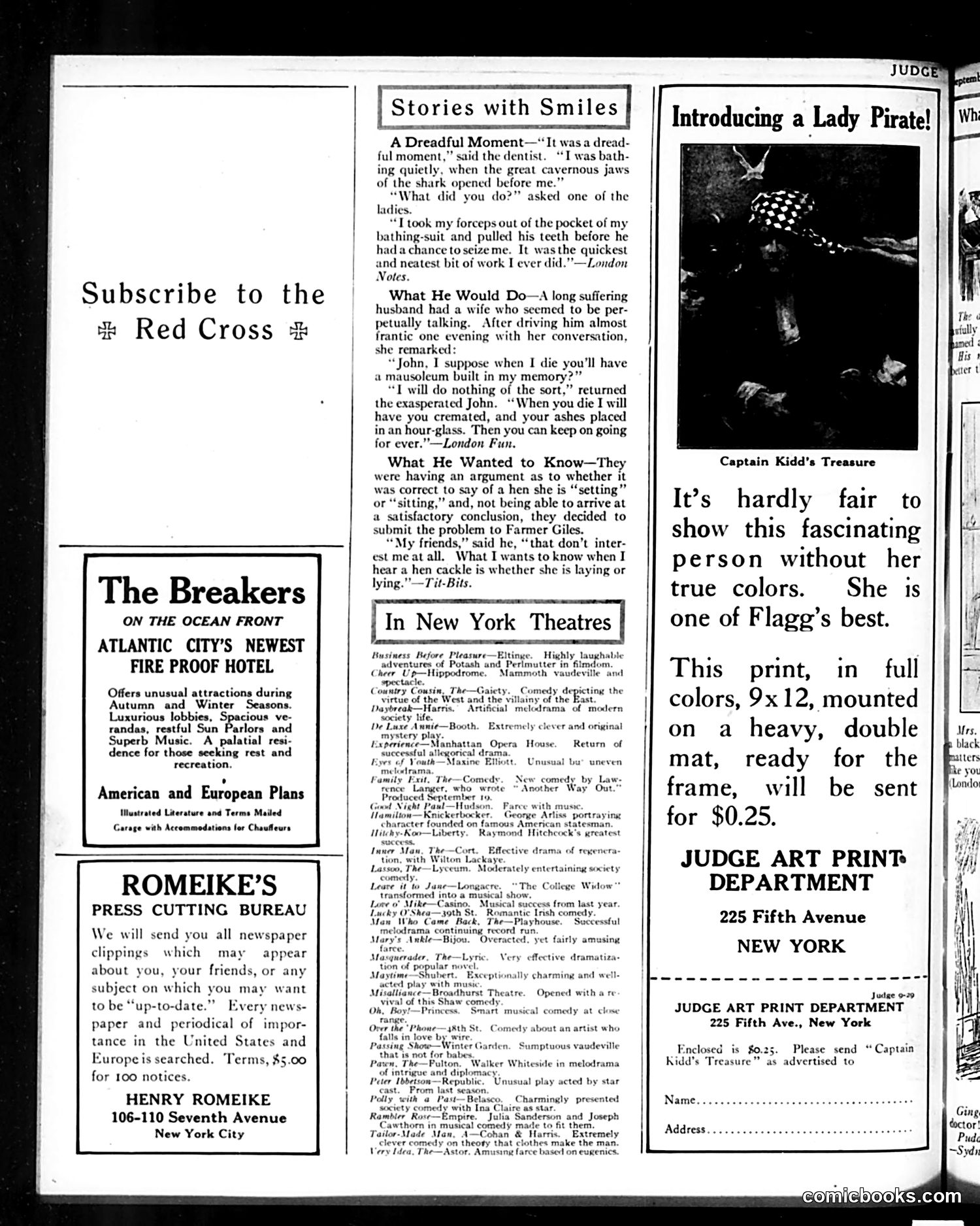
This page is primarily **advertising and filler content**, not political satire. The main elements are: **Top section**: "Stories with Smiles"—three short humorous anecdotes (a dentist fighting a shark, a husband joking about his talkative wife, a debate over hen terminology). These are light comic pieces typical of Judge's filler material. **Left column**: Ads for The Breakers hotel in Atlantic City, Romeike's Press Cutting Bureau (a clipping service), and a Red Cross subscription appeal. **Right section**: An advertisement for a Judge Art Print titled "Captain Kidd's Treasure," described as featuring a "fascinating person" (a woman pirate) by artist Flagg, available for $0.25. The accompanying image appears to show a woman in period costume. **Bottom**: A theater listing for New York shows (musicals, comedies, dramas). There is **no visible political cartoon or satirical commentary** on this page—it's a typical early 20th-century magazine advertisement and entertainment filler.
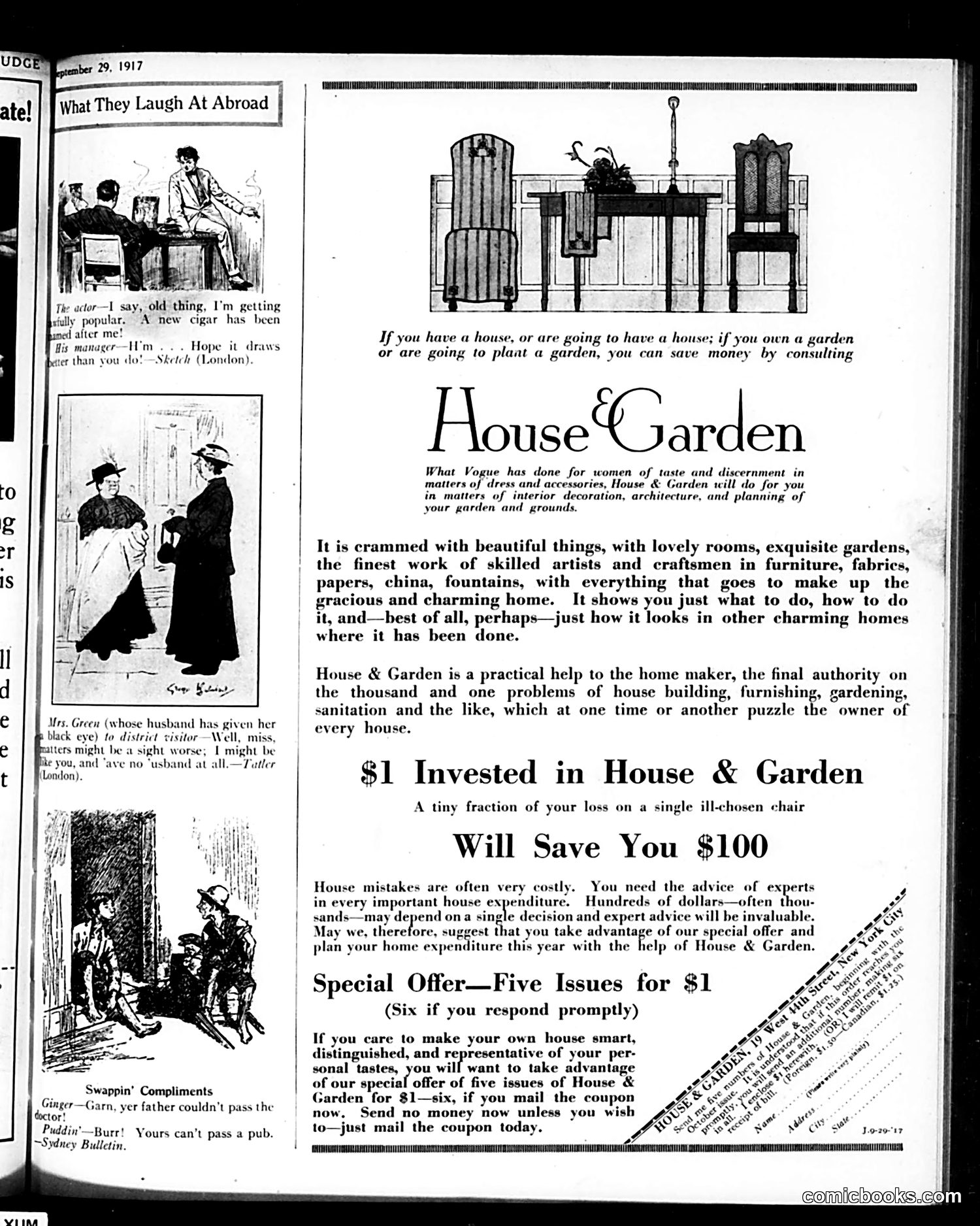
This page combines British humor with advertising. The left column shows three cartoons mocking English wit and social customs: 1. **The actor joke**: A theatrical figure claims popularity; his manager hopes the cigar has helped—light satire on vanity. 2. **Mrs. Green cartoon**: A domestic worker complains that her husband gave her a black eye to "distract visitors," suggesting her situation is worse than if she had no husband at all—dark humor about working-class domestic abuse, presented as absurd English comedy. 3. **Swappin' Compliments**: Australian pub humor about fathers and pudding—likely untranslatable regional jokes. The cartoons mock what "they" (the British) find amusing, positioning American Judge readers as superior to such crude or resigned humor. The right side is a full-page **House & Garden magazine advertisement** claiming $1 for five issues will save readers $100 on home mistakes—a common early-20th-century subscription pitch emphasizing expert advice for domestic decoration and planning.
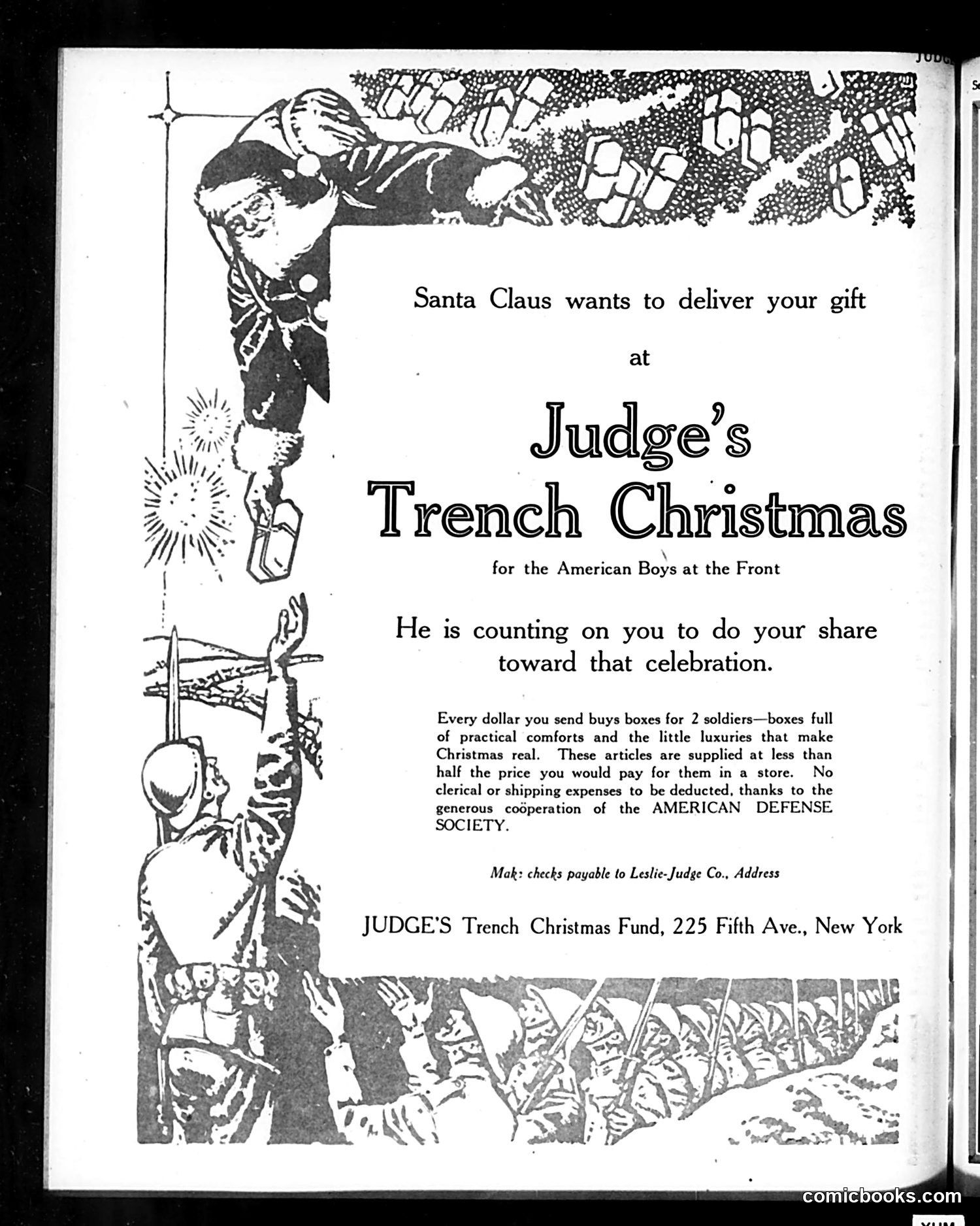
This is a wartime charity advertisement, not satire. It solicits donations for American soldiers fighting in World War I trenches. The imagery depicts Santa Claus descending into a trench system with holly and gifts, appealing to American patriotism and holiday sentiment. The pitch promises that each dollar funds comfort boxes for two soldiers. It leverages the American Defense Society's cooperation to assure donors their contributions avoid overhead costs. The trench setting emphasizes soldiers' harsh conditions, positioning Christmas gifts as morale boosters and a patriotic duty for the home front. This represents how commercial magazines like Judge mobilized readers for the war effort through emotional appeals blending Santa, Christmas tradition, and national defense obligations.
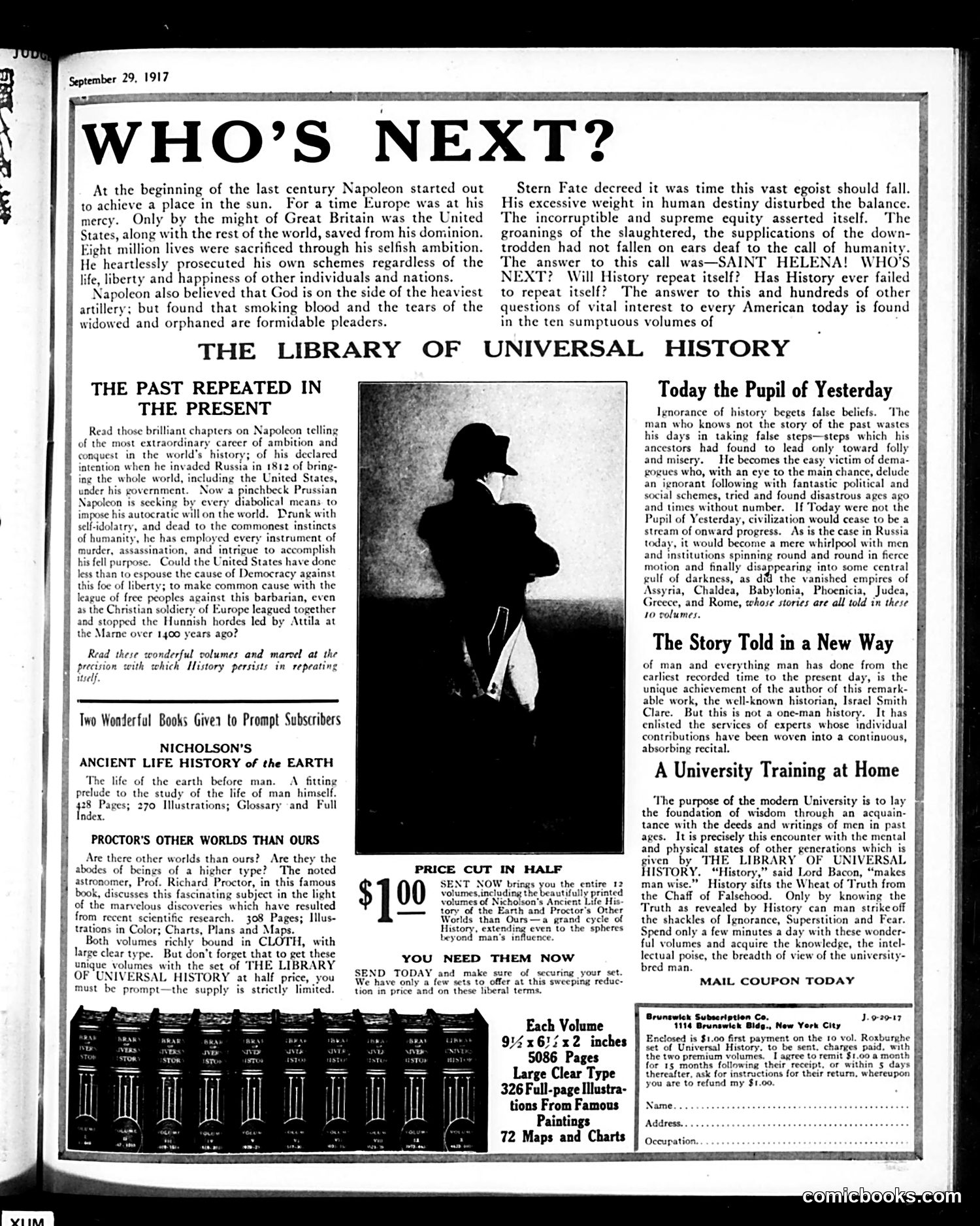
This page uses Napoleon as a historical parallel to warn against German militarism in World War I. The main text draws an explicit comparison: just as Napoleon sought world domination through conquest and ruthlessness, the "pinchbeck Prussian Napoleon" (Kaiser Wilhelm II) is employing "every instrument of murder, assassination, and intrigue" to impose autocratic rule globally. The satire's point: History repeats itself—and America was right to enter WWI to defend democracy against this modern tyrant, just as Europe once united against Napoleon. The rhetorical question "WHO'S NEXT?" after describing Saint Helena (Napoleon's exile) implicitly suggests Germany faces similar defeat. The page is primarily advertising "The Library of Universal History" books, using this historical analogy as persuasive marketing to American readers in 1917—framing the purchase as essential to understanding current events and preventing history's repetition.
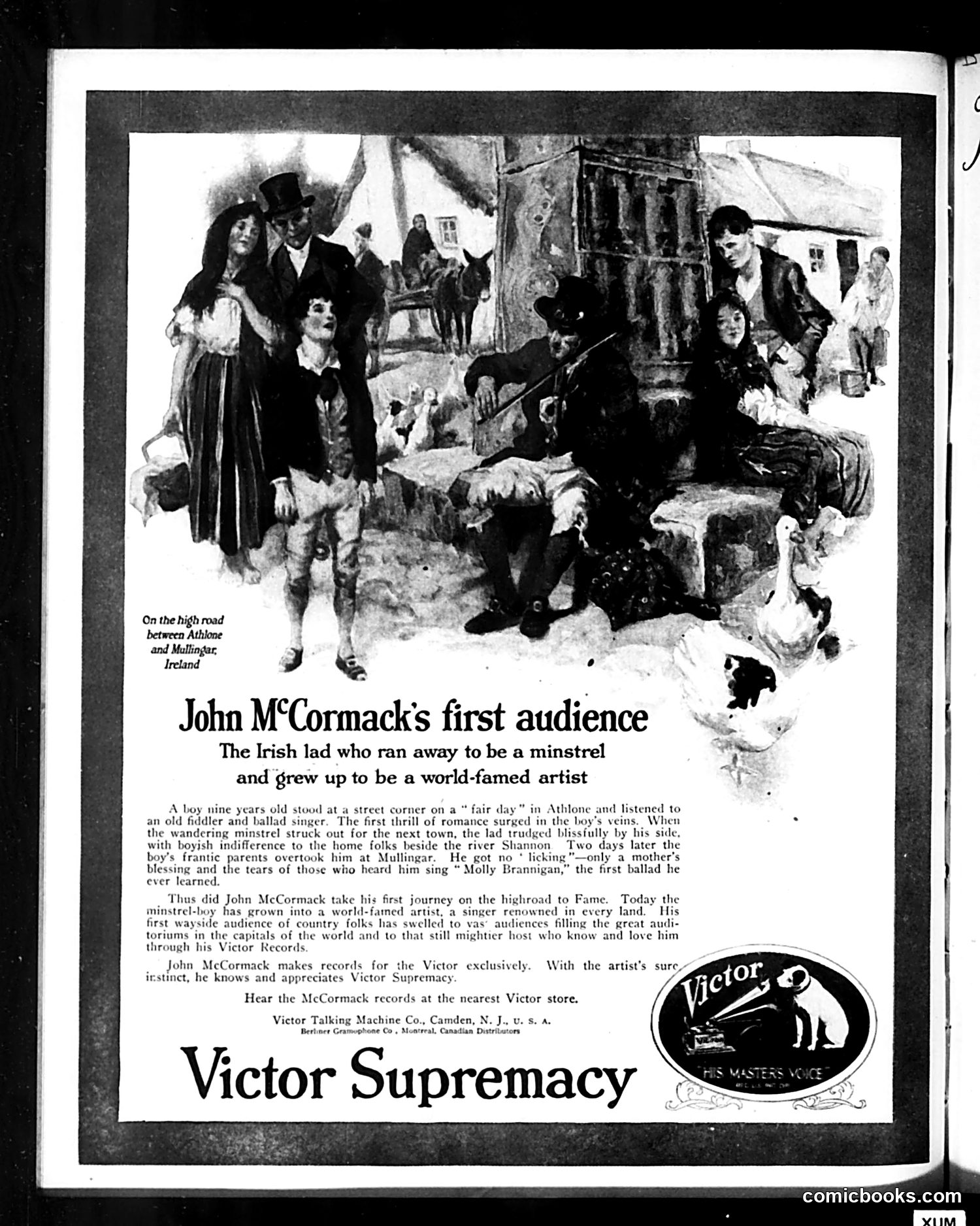
This is **not a political cartoon or satire**—it's a **Victor Talking Machine Company advertisement** disguised as an inspirational biographical narrative. The page tells the romanticized origin story of **John McCormack**, a real Irish-American tenor singer who was famous in the early 20th century. The narrative traces his journey from a poor Irish boy who ran away at age nine to follow a traveling fiddler, to becoming an internationally renowned concert artist. The "satire" or humor is gentle: the ad uses sentimental storytelling about humble Irish origins to create emotional appeal for purchasing McCormack's phonograph records. The implicit message is that Victor records connect consumers to authentic talent and authentic experience—you can own a piece of this famous artist's voice. The illustration depicts McCormack's "first audience" of Irish country people by a roadside, contrasting his modest beginnings with his later fame filling grand concert halls. This is fundamentally **advertising masquerading as human interest journalism**—a common early 20th-century marketing technique.