
Judge, 1917-09-29 · page 16 of 28
Judge — September 29, 1917 — page 16: what you’re looking at
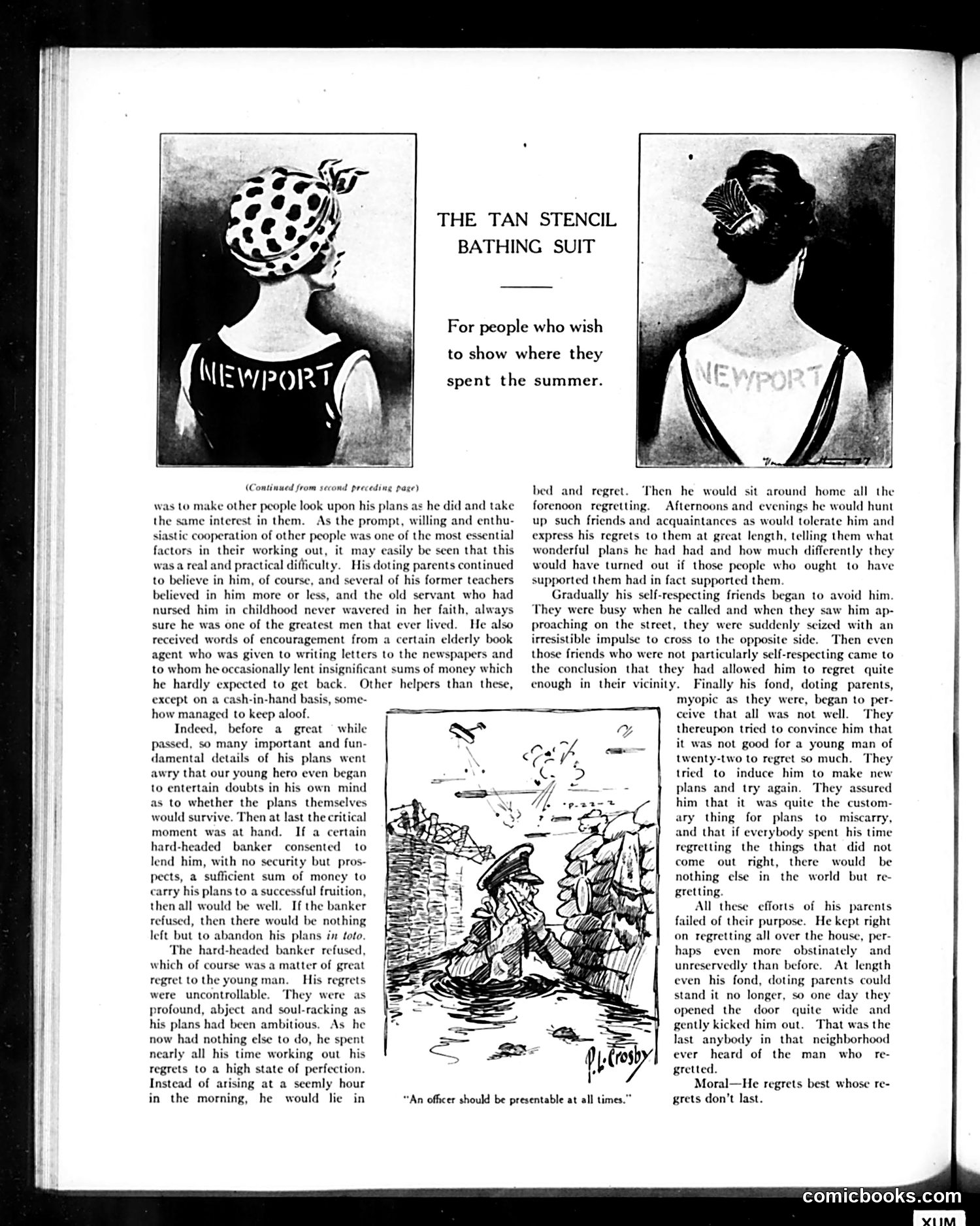
What you’re looking at
**The Satire:** This is a simple visual joke about fashionable bathing suits with polka-dot patterns. The humor plays on early-20th-century vanity: women wore these patterned suits so that the unpatterned skin beneath would tan in the dot shapes, creating a visible record of where they'd worn the suit—and thus proving they'd vacationed at prestigious places like Newport (visible on the suits). **The Point:** The satire mocks status-consciousness and the desire to display wealth and leisure. By wearing these "stencil" suits, women could literally advertise their summer travels to fashionable seaside resorts. The joke is on those vain enough to need such obvious proof of their social standing. The accompanying story text appears unrelated to the advertisement, making this a typical Judge layout mixing satirical commentary with commercial content.
📄 Transcribed text from this page (OCR, searchable)
Machine-transcribed from the original scan — historical spelling and the odd misread are preserved.
THE TAN STENCIL BATHING SUIT For people who wish to show where they spent the summer. (Continued from second preceding page) was to make other people look upon his plans as he did and take the same interest in them. As the prompt, willing and enthu- siastic cooperation of other people was one of the most essential factors in their working out, it may easily be seen that this was a real and practical difficulty. His doting parents continued to believe in him, of course, and several of his former teachers believed in him more or less, and the old servant who had nursed him in childhood never wavered in her faith, always sure he was one of the greatest men that ever lived. He also received words of encouragement from a certain elderly book agent who was given to writing letters to the newspapers and to whom he occasionally lent insignificant sums of money which he hardly expected to get back. Other helpers than these, except on a cash-in-hand basis, some- how managed to keep aloof. Indeed, before a great while passed, so many important and fun- damental details of his plans went awry that our young hero even began to entertain doubts in his own mind as to whether the plans themselves would survive. Then at last the critical moment was at hand. If a certain hard-headed banker consented to lend him, with no security but pros- pects, a sufficient sum of mone carry his plans to a successful fruition, then all would be well. If the banker refused, then there would be nothing left but to abandon his plans in foto. The hard-headed banker refused, which of course was a matter of great regret to the young man. His regrets were uncontrollable. They were as profound, abject and soul-racking as his plans had been ambitious. As he now had nothing else to do, he spent all his time working out his regrets to a high state of perfection. Instead of arising at a seemly hour in the morning, he would lie in “An officer should be presentable at all times.” bed and regret. Then he would sit around home all the forenoon regretting. Afternoons and evenings he would hunt up such friends and acquaintances as would tolerate him and express his regrets to them at great length, telling them what wonderful plans he had had and how much differently the: would have turned out if those people who ought to have supported them had in fact supported them: Gradually his self-respecting friends began to avoid him. They were busy when he called and when they saw him ap- proaching on the street, they were suddenly seized with an irresistible impulse to cross to the opposite side. Then even those friends who were not particularly self-respecting came to the conclusion that they had allowed him to regret quite enough in their vicinity. ly his fond, doting parents, myopic as they were, began to per- ceive that all was not well. They thereupon tried to convince him that it was not good for a young man of twenty-two to regret so much. They tried to induce him to make new plans and try again. They assured him that it was quite the custom- ary thing for plans to miscarry, and that if everybody spent his time regretting the things that did not come out right, there would be nothing else in the world but re- gretting. All these efforts of his parents failed of their purpose. He kept right on regretting all over the house, per- haps even more obstinately and unreservedly than before. At length even his fond, doting parents could stand it no longer, so one day they opened the door quite wide and gently kicked him out. That was the last. anybody in that neighborhood ever heard of the man who re- gretted. Moral—He regrets best whose re- grets don’t last. comicbooks.com