
Judge, 1917-09-29 · page 17 of 28
Judge — September 29, 1917 — page 17: what you’re looking at
What you’re looking at
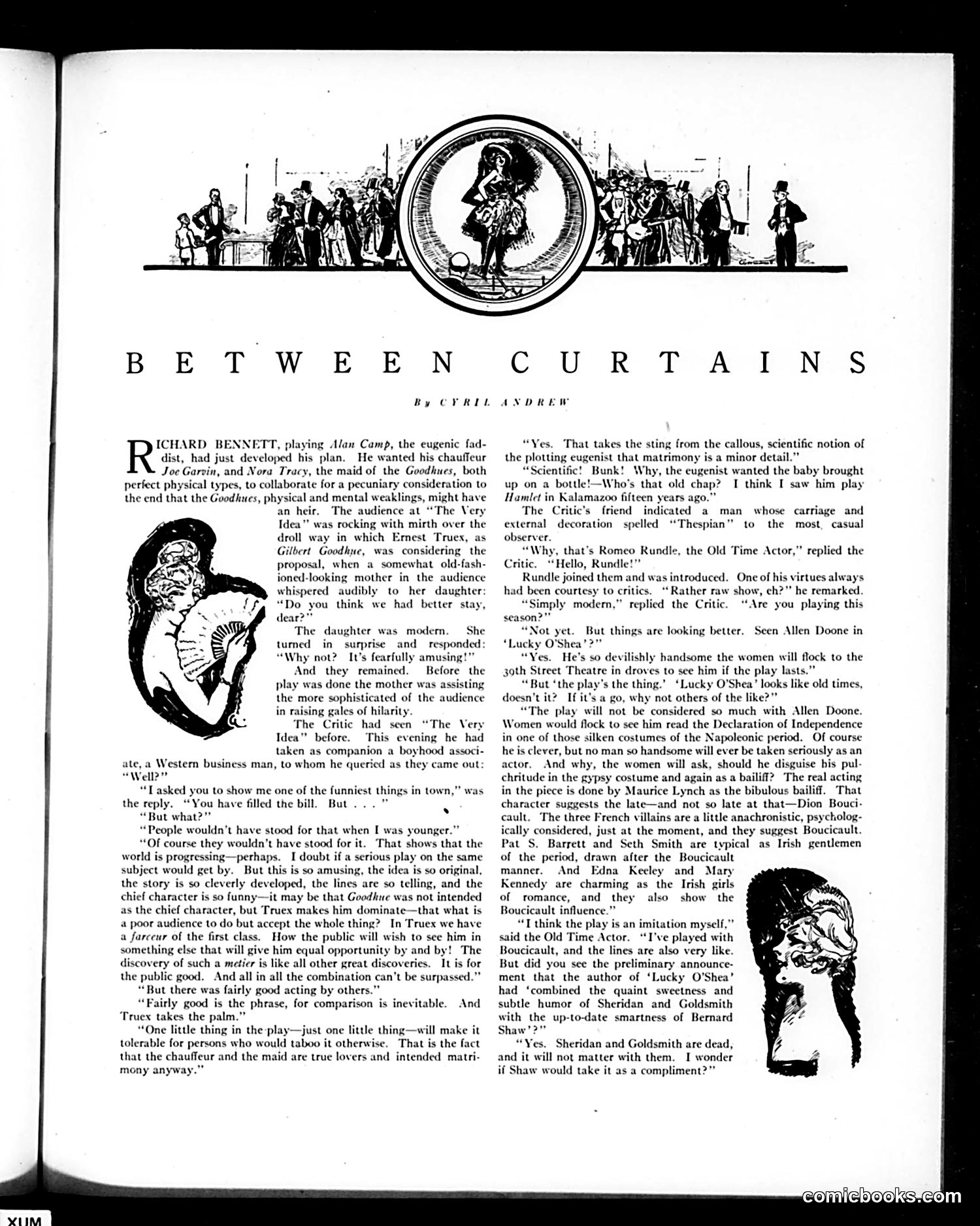
This theater review critiques "The Very Idea," a Broadway farce starring Ernest Truex. The play centers on a eugenic plot—a wealthy man hires his chauffeur and maid to produce a "superior" child through selective breeding, treating matrimony as irrelevant. The satire targets two things: (1) the fashionable but absurd eugenic movement of the early 20th century, ridiculed as pseudoscientific nonsense, and (2) changing social morality. An older audience member questions whether such scandalous content should be witnessed, but her modern daughter finds it "fearfully amusing"—illustrating generational shifts in propriety. The critic argues the play succeeds despite its controversial premise because Truex's comedic performance is brilliant enough to overcome moral objections. The discussion with "Romeo Rundle," an aging actor, further explores how star power (handsome male leads) draws audiences regardless of dramatic quality.
📄 Transcribed text from this page (OCR, searchable)
Machine-transcribed from the original scan — historical spelling and the odd misread are preserved.
BETWEEN By CYRIL Joped his plan. He wanted his chauffeur Joe Garvin, and Nora Tracy, the maid of the Goodhues, both perfect physical types, to collaborate for a pecuniary consideration to the end that the Goodhues, physical and mental weaklings, might have an heir. The audience at “The Very Idea” was rocking with mirth over the droll way in which Ernest Truex, as Gilbert Goodhue, was considering the proposal, when a somewhat old-fash- ioned-looking mother in the audience whispered audibly to her daughter “Do you think we had better stay, dear?” The da tumed in ICHARD BENNETT, playing Alan Camp, the eugenic fad- dist, had just d zhter was modem. She surprise and responded “Why not? It’s fearfully amusing!” And they remained. Before the play was done the mother was assisting the more sophisticated of the audience in raising of hilarit The Critic had seen “The Very Idea” before. This evening he had taken as companion a boyhood associ- a Western business man, to whom he queried as they came out: “TL asked you to show me one of the funniest things in town,” was. the reply. “You have filled the bill. But...” “But what?” “People wouldn't have stood for that when I younger.” “Of course they wouldn’t have stood for it. That shows that the world is progressing—perhaps. I doubt if a serious play on the same subject would get by. But this is so amusing, the idea is so original, the story is so cleverly developed, the lines are so telling, and the chief character is so funny—it may be that Goodhue was not intended as the chief character, but Truex makes him dominate—that what is 4 poor audience to do but accept the whole thing? In Truex we have a farceur of the first class. How the public will wish to see him in something else that will give him equal opportunity by and by! The discovery of such a metier is like all other great discoveries. It is for the public good. And all in all the combination can’t be surpassed.” “But there was fairly good acting by others.” “Fairly good is the phrase, for comparison is inevitable. ‘Truex takes the palm.” “One little thing in the-play—just one little thing—will make it tolerable for persons who would taboo it otherwise. That is the fact that the chauffeur and the maid are true lovers and intended matri- mony anyway.” . And R TAINS C U ANDREW “Yes. That takes the sting from the callous, scientific notion of the plotting eugenist that matrimony is a minor detail.” “Scientific! Bunk! Why, the eugenist wanted the baby brought up on a bottle!—Who's that old chap? I think I saw him play Hamlct in Kalamazoo fifteen years ago.” The Critic’s friend indicated a man external decoration spelled “Thespian” to the observer. Why, that’s Romeo Rundle, the Old Time Actor,” replied the Critic. “Hello, Rundle!” Rundle joined them and was introduced. One of his virtues always. had been courtesy to critics. “Rather raw show, ch?" he remarked. Simply modern,” replied the Critic. “Are you playing this season?” “Not yet. But things are looking better. ‘Lucky O’Shea’?" ‘es. He's so devilishly handsome the women will flock to the 3oth Street Theatre in droves to see him if the play lasts.” “But ‘the play’s the thing.’ ‘Lucky O'Shea’ looks like old times, doesn’t it? If it’s a go, why not others of the like?” “The play will not be considered so much with Allen Doone. Women would flock to see him read the Declaration of Independence in one of those silken costumes of the Napoleonic period. Of course he is clever, but no man so handsome will ever be taken seriously as an actor. And why, the women will ask, should he disguise his pul- chritude in the gypsy costume and again as a bailiff? The real acting in the piece is done by Maurice Lynch as the bibulous bailiff. That character suggests the late—and not so late at that—Dion Bouci- cault. The three French villains are a little anachronistic, psycholog- ically considered, just at the moment, and they suggest Boucicault. Pat S. Barrett and Seth Smith are typical as Irish gentlemen of the period, drawn after the Boucicault manner. And Edna Keeley and Mary Kennedy are charming as the Irish girls of romance, and they so show the Boucicault influence.” “T think the play is an imitation myself,” said the Old Time Actor. “I've played with Boucicault, and the lines are also very like. But did you see the preliminary announce- ment that the author of ‘Lucky O’Shea’ had ‘combined the quaint sweetness and subtle humor of Sheridan and Goldsmith with the up-to-date smartness of Bernard whose carriage and most, casual Seen Allen Doone in Sheridan and Goldsmith are dead, and it will not matter with them. I wonder if Shaw would take it as a compliment?”