
A complete issue · 28 pages · 1917
Judge — September 8, 1917
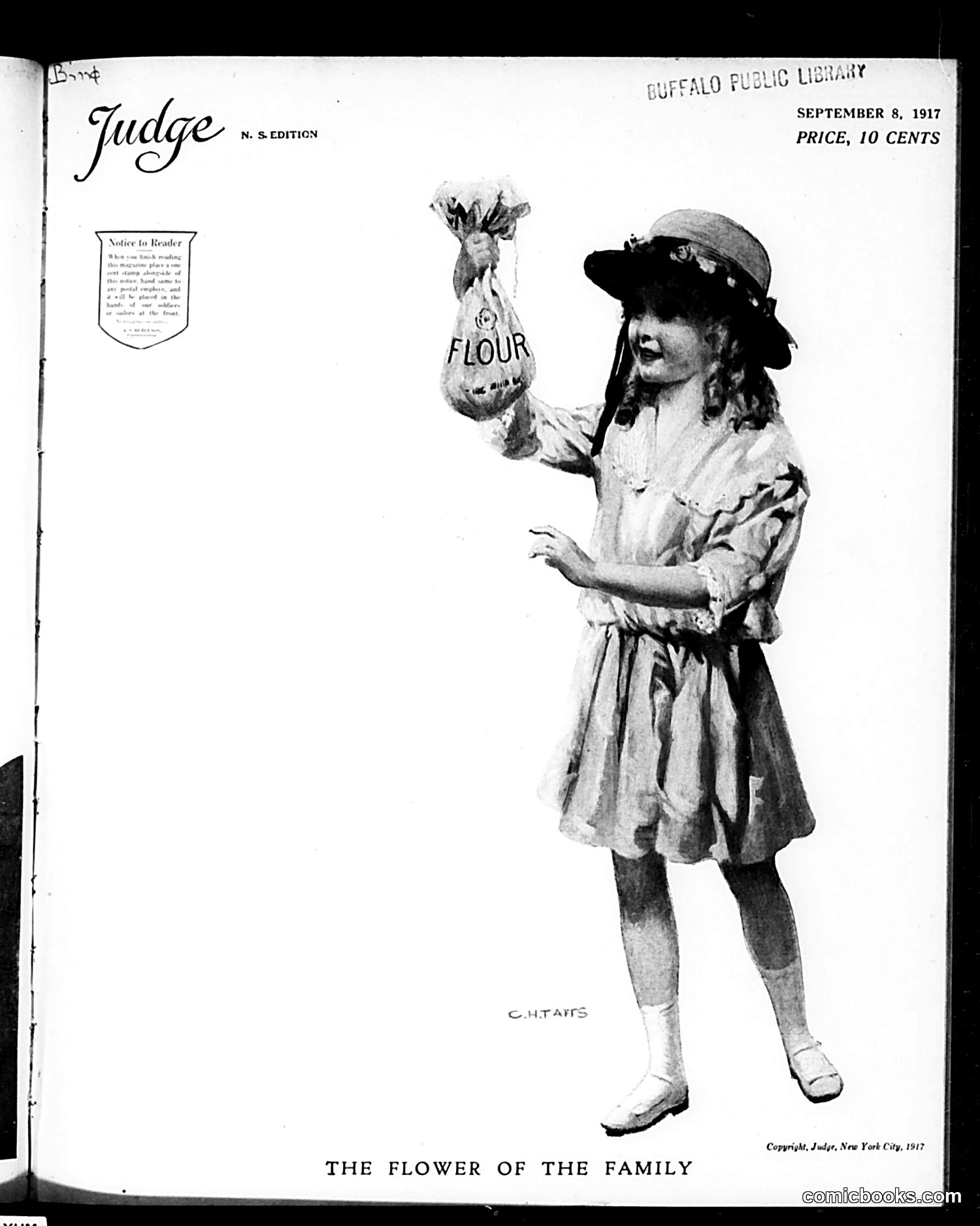
This Judge magazine cover from September 1917 shows a young woman holding a sack of flour, titled "The Flower of the Family." The pun plays on "flower/flour" — a common wordplay in period advertising. The timing is significant: America entered World War I in April 1917. This image likely promotes flour consumption and home-based food production as patriotic duty during wartime rationing. The girl's wholesome appearance and domestic focus reflect propaganda encouraging women to support the war effort through careful household management and food conservation. The "notice to reader" box (upper left) appears to provide additional context, though text is illegible at this resolution. The signature reads "C.H. Taffs."
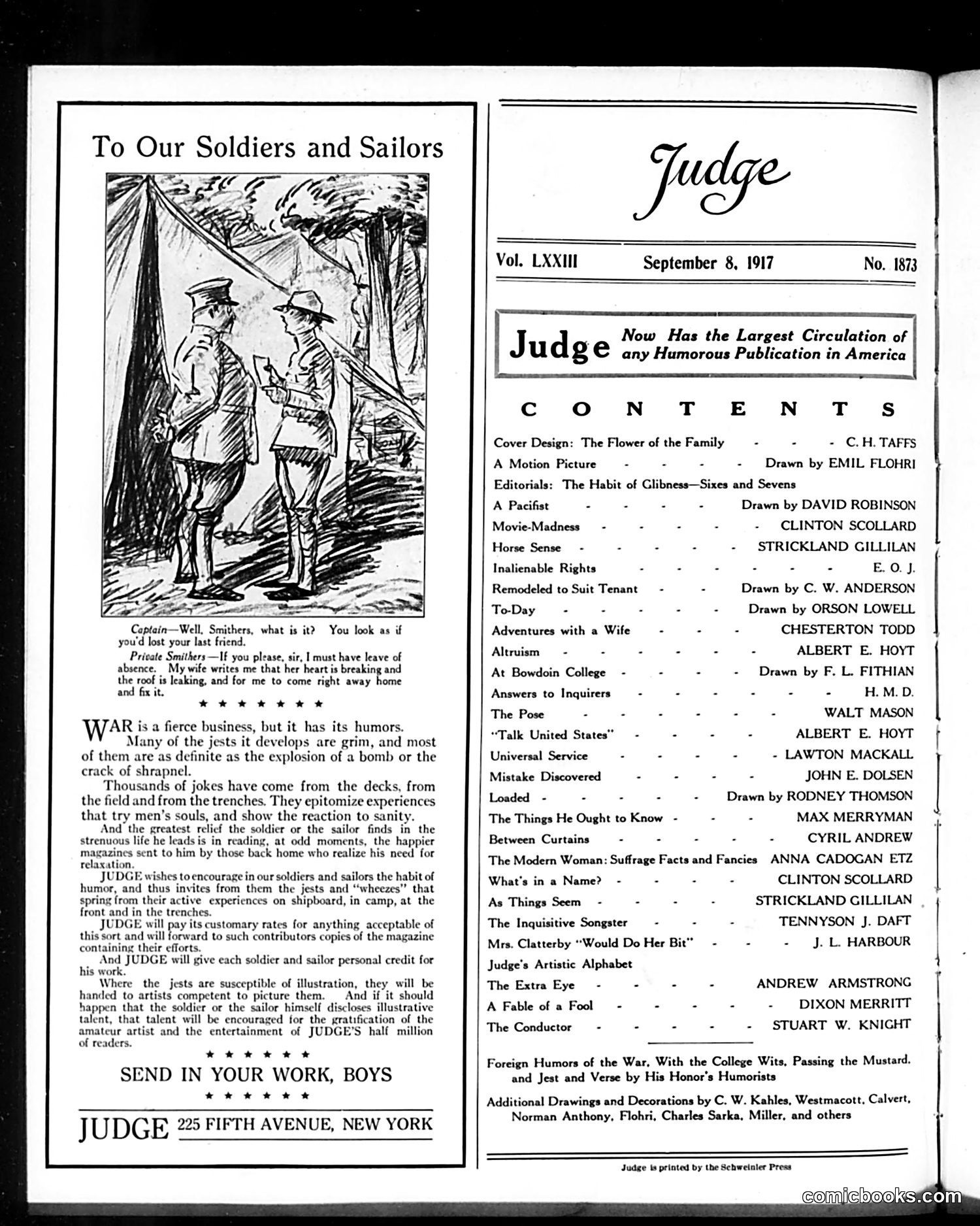
The left page features a WWI-era recruitment appeal titled "To Our Soldiers and Sailors." The cartoon shows two military figures (a captain and sailor) in conversation, with the caption suggesting one has lost a friend and must leave to care for his widow. The accompanying editorial text explains Judge's purpose: to boost soldiers' and sailors' morale by publishing humor from their experiences. The magazine frames wartime jokes as psychologically valuable—helping men cope with combat's brutality through laughter. The right page's contents list shows this issue mixes patriotic messages with typical satirical content (domestic humor, commentary on suffrage and social issues). This reflects Judge's dual role in 1917: supporting the war effort while maintaining its satirical traditions.
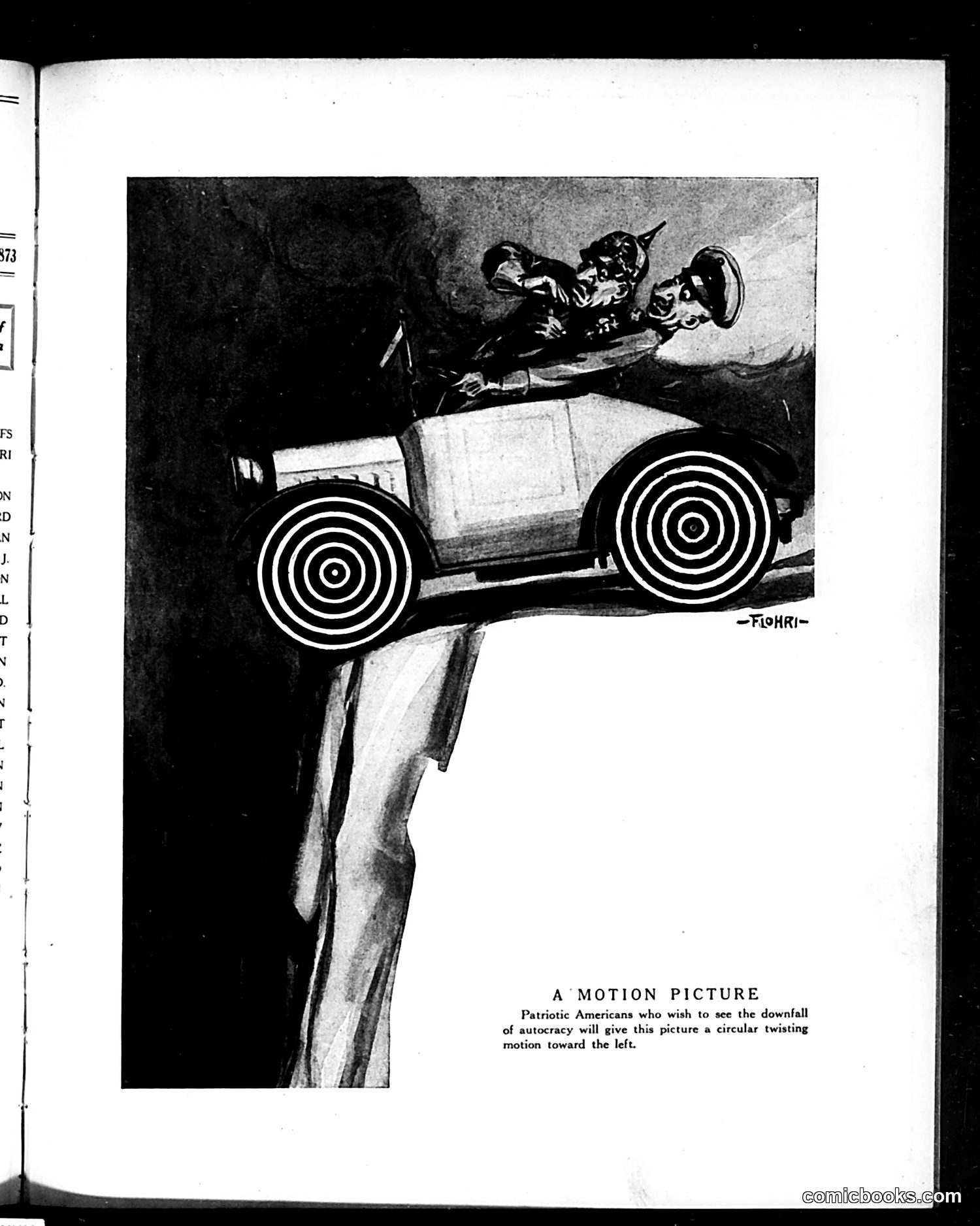
This is a political cartoon from *Judge* magazine featuring an optical illusion titled "A Motion Picture." The image shows a vintage automobile balanced on a figure's hand/arm. The wheels are rendered as concentric circles designed to create the illusion of motion when the page is rotated counterclockwise (as instructed in the caption). The satirical point targets "autocracy" — the caption explicitly states "Patriotic Americans who wish to see the downfall of autocracy will give this picture a circular twisting motion toward the left." This appears to be anti-autocratic propaganda, likely from the World War I era when American sentiment turned against authoritarian regimes. The spinning wheels symbolize the overthrow or destabilization of autocratic government, framed as patriotic action.
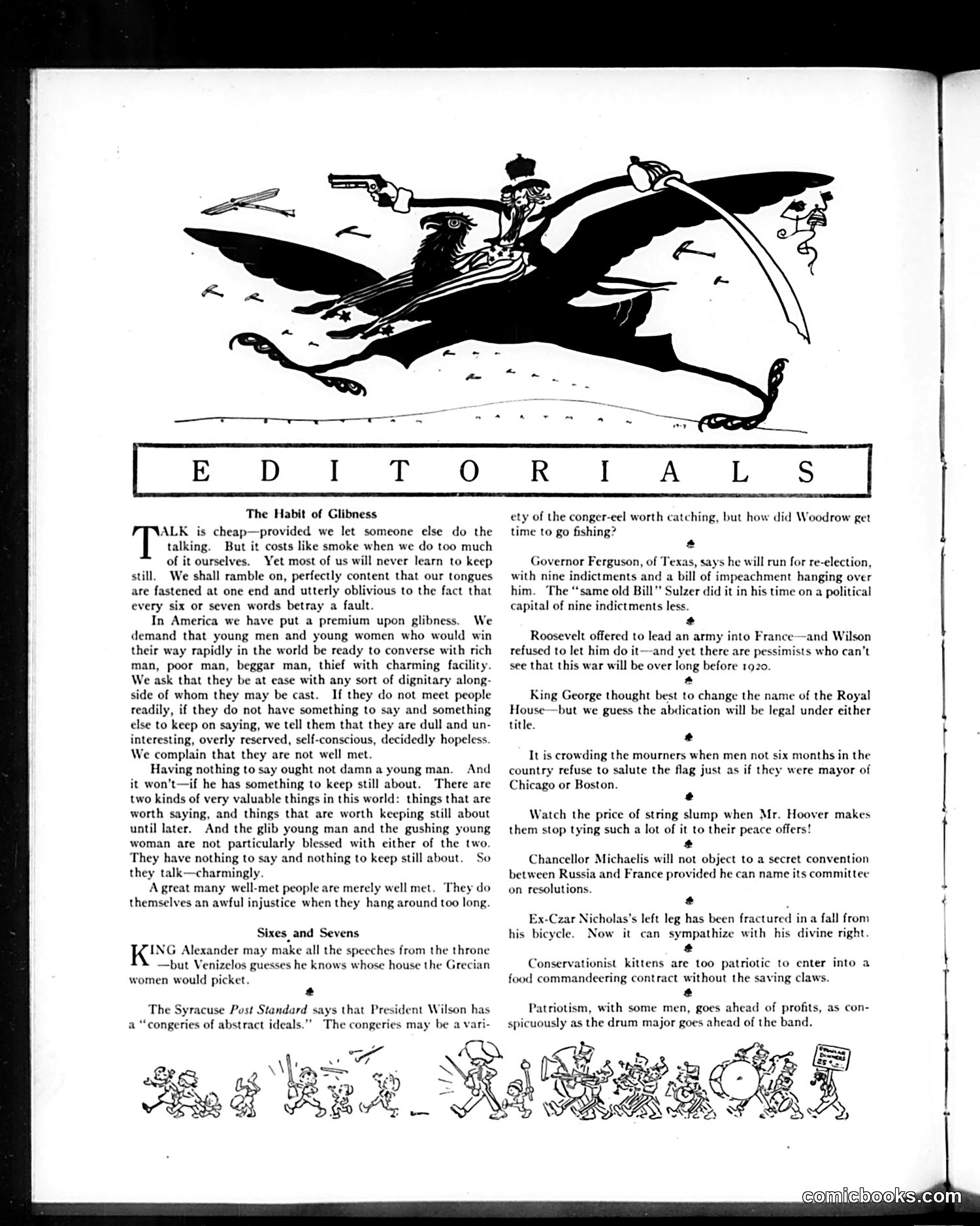
The main cartoon depicts a figure riding a large eagle or bird in flight, wielding a gun and sword—likely representing American political authority or interventionism. The accompanying editorial "The Habit of Glibness" criticizes American men for talking cheaply without substance, noting that while Americans value quick speech, they often lack meaningful things to say. The "Sixes and Sevens" section contains brief political jabs, including criticism of President Wilson's "congeries of abstract ideals," commentary on King George potentially changing the Royal House name, and a joke about Chancellor Michaelis refusing a secret convention with Russia and France. References appear to WWI-era politics and diplomatic tensions, though specific dates aren't provided in the text.
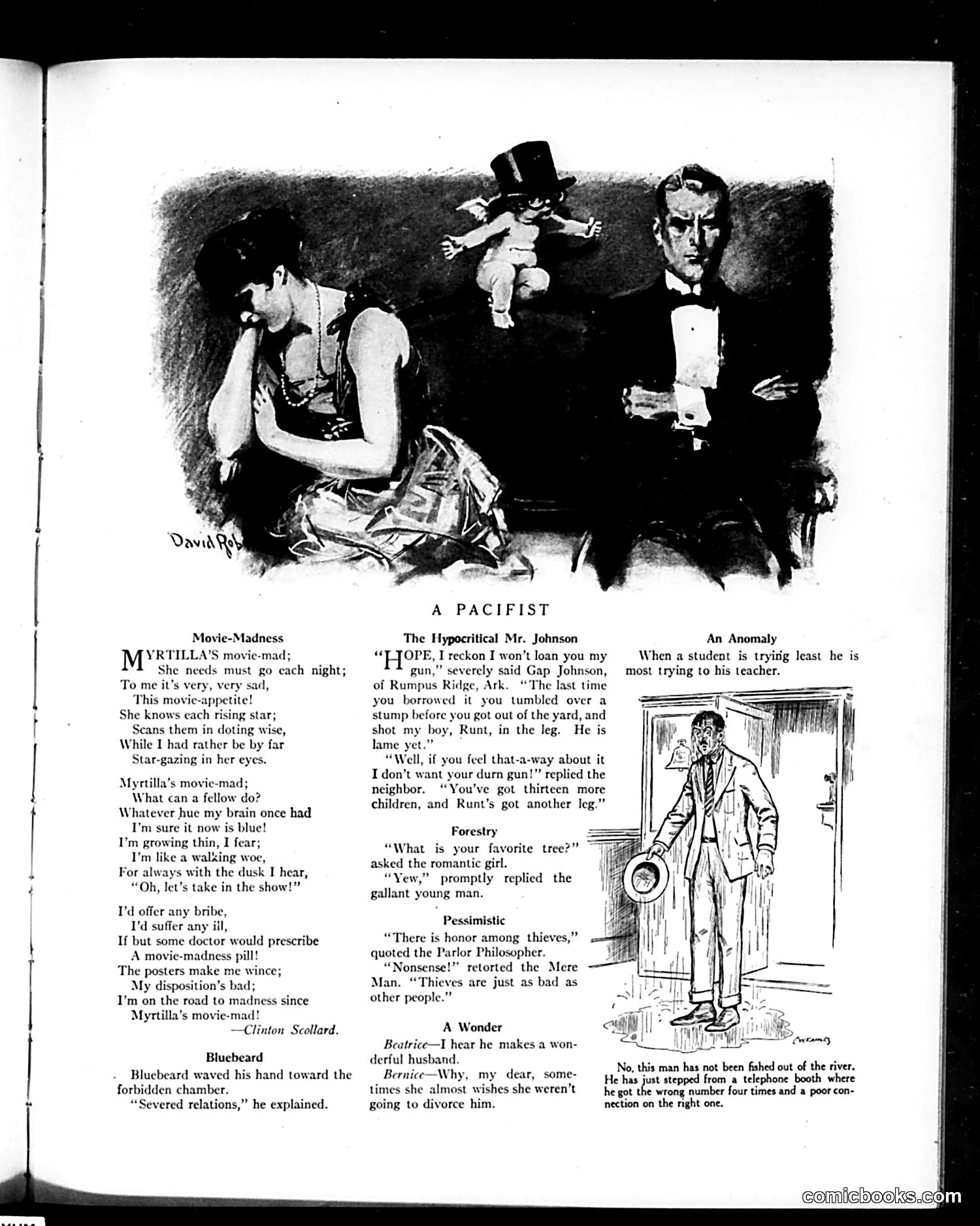
This page from *Judge* magazine contains several brief humorous pieces rather than a single political cartoon. The top illustration depicts "A Pacifist" — showing a well-dressed man appearing indifferent while a woman grieves and holds a child, satirizing pacifism during what appears to be a wartime context (likely WWI era, given *Judge*'s timeline). The remaining text pieces are unrelated jokes: "Movie-Madness" mocks cinema obsession; "The Hypocritical Mr. Johnson" jokes about gun ownership; "An Anomaly" puns on student behavior; "Forestry," "Pessimistic," and "A Wonder" are brief quips about romance and human nature. The "Bluebeard" reference alludes to the folk tale of a serial killer, used here as mild social commentary on marriage. These are lighthearted satirical vignettes typical of *Judge*'s format, mixing social observation with wordplay.
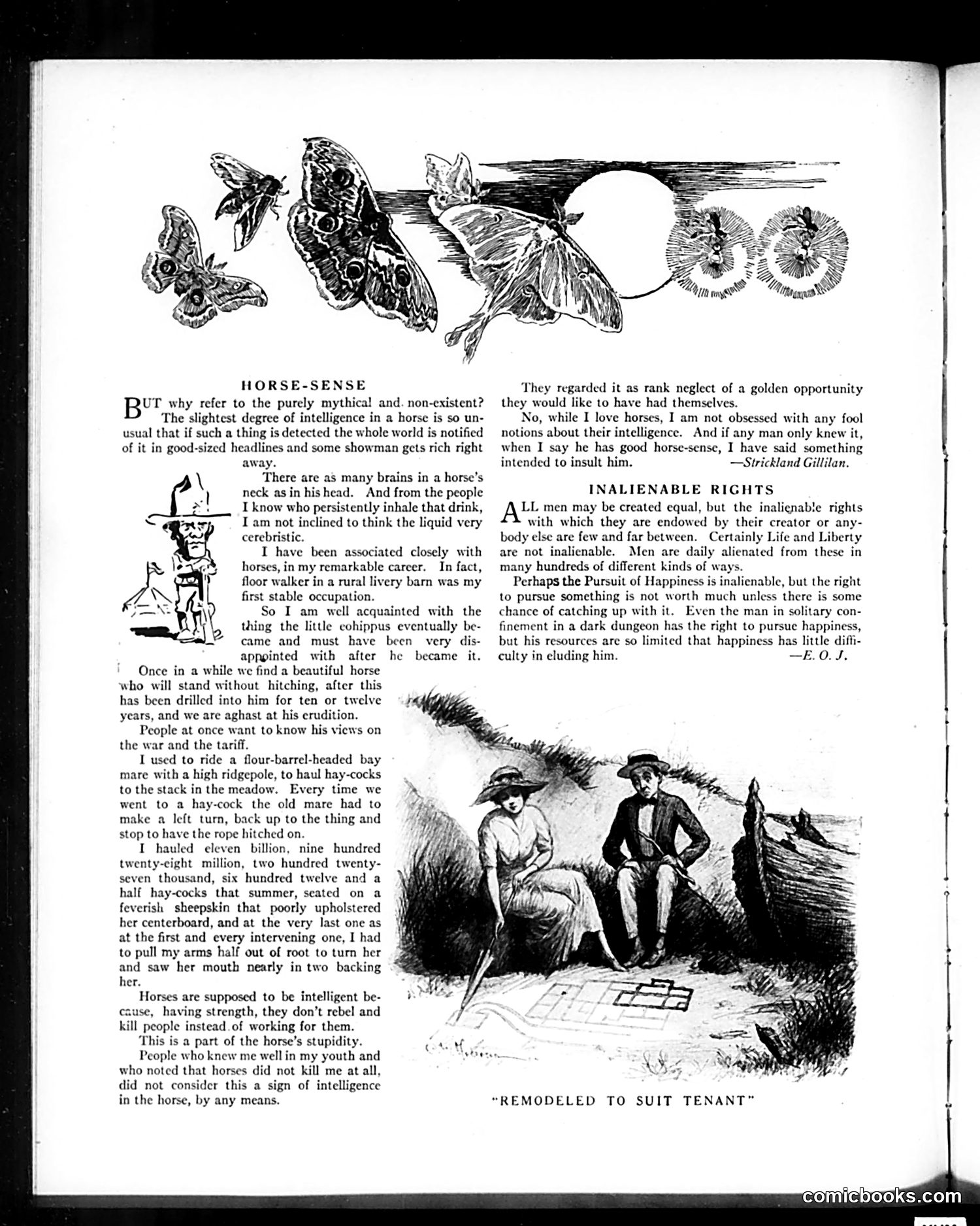
This page from *Judge* magazine contains two distinct pieces: **"Horse-Sense"** (left column): A humorous essay defending horses against charges of stupidity. The author argues horses possess practical intelligence and shouldn't be judged by human standards. The small illustration shows a cowboy, reinforcing the practical working-horse context. **"Inalienable Rights"** (right column): A philosophical piece asserting that while men possess equal inalienable rights to Life and Liberty, the "Pursuit of Happiness" has limits—particularly for the poor. The accompanying illustration titled "Remodeled to Suit Tenant" depicts working-class figures, likely satirizing how housing or opportunities get stripped down for poor tenants. Both pieces reflect early-20th-century social commentary on labor, class distinction, and practical realities versus idealistic rhetoric.
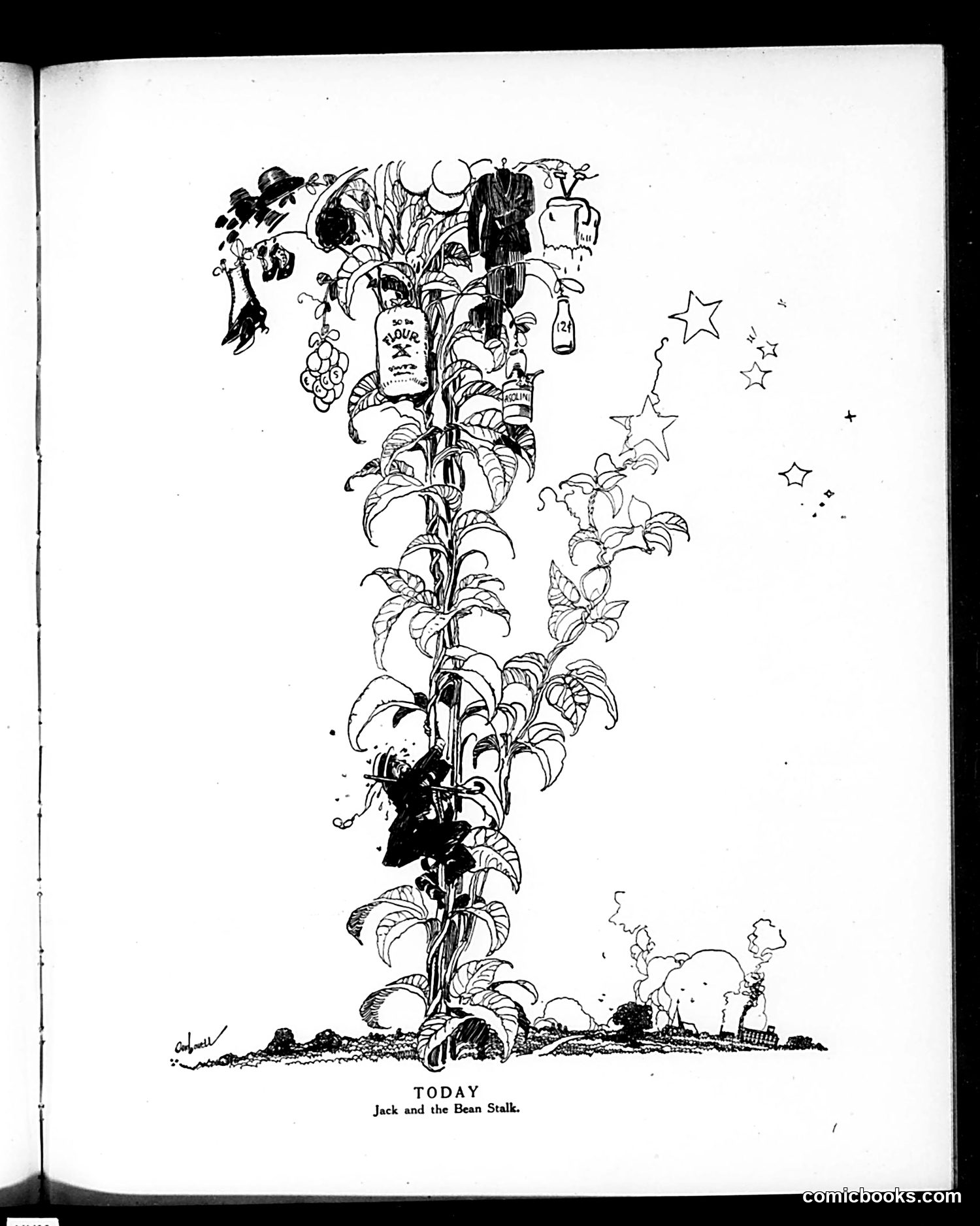
This cartoon reimagines the classic fairy tale "Jack and the Beanstalk" as social commentary. The giant beanstalk grows upward laden with various objects—bottles, clothing, and other goods—suggesting rapid, excessive growth or inflation of commerce and consumerism. At the top, figures appear to be engaged in chaotic activity, while at the bottom, Jack-like characters and ordinary people remain grounded. The satire likely critiques early 20th-century American economic expansion, wealth accumulation, or market speculation—the beanstalk's uncontrolled growth suggesting unsustainable boom conditions. The positioning of common folk below and the chaos above implies social commentary on wealth inequality or the precarious nature of prosperity. The stars on the right may symbolize aspiration or dreams, adding ironic commentary on the American Dream's accessibility to ordinary people.
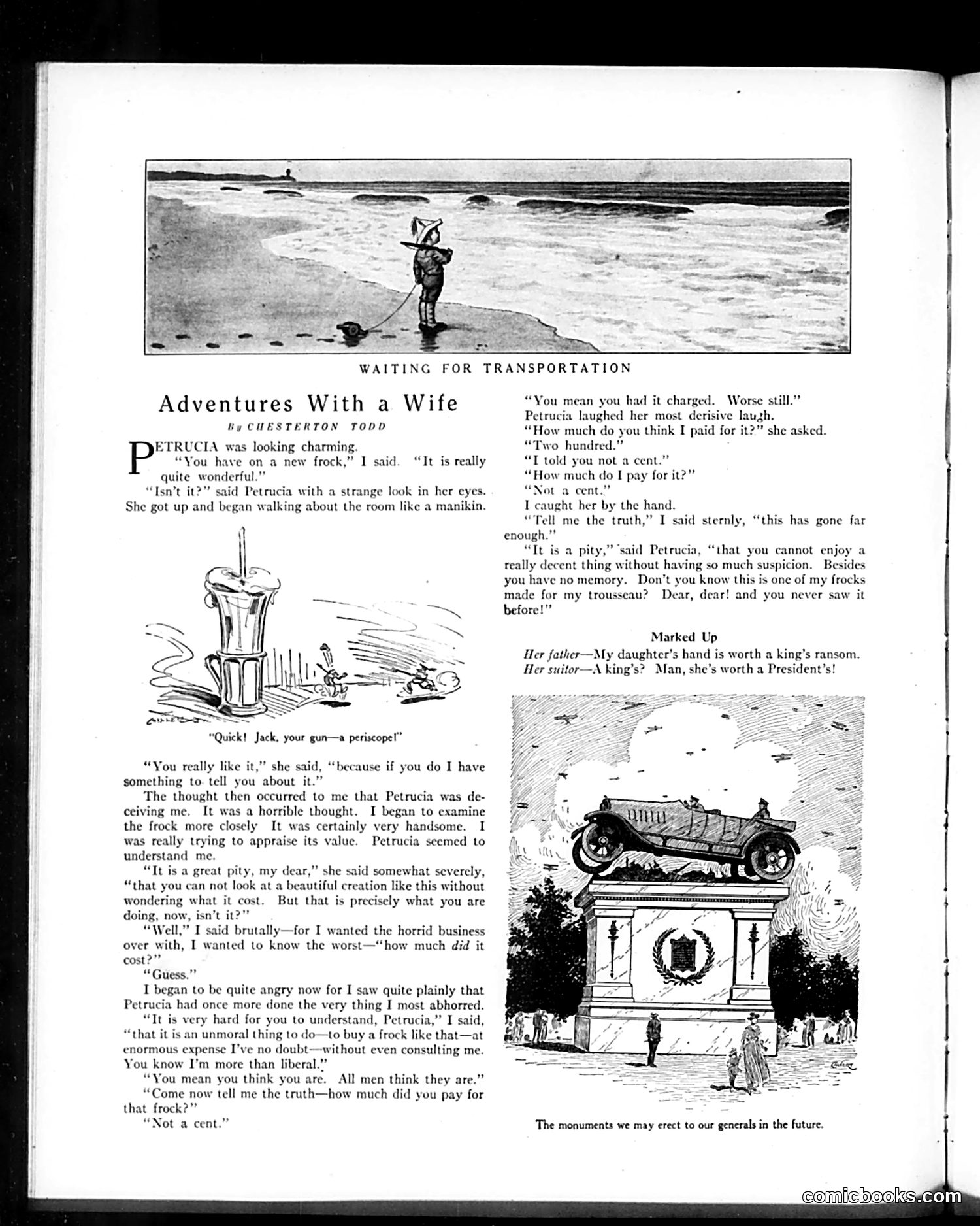
This page contains a humorous short story by Chesterton Todd titled "Adventures With a Wife," satirizing the friction between spouses over clothing expenses and domestic finances. The narrative joke centers on a husband's suspicion that his wife has purchased an expensive new dress without his permission. When he demands the cost, she claims "not a cent"—revealing it's actually an old dress from her trousseau that he'd forgotten. The satire mocks the husband's immediate distrust and obsessive concern with the price tag, suggesting men's shallow materialism when confronted with women's fashion. The accompanying illustration and the brief joke labeled "Marked Up" continue this theme: a suitor claims a woman is worth a President's ransom (rather than merely a king's), joking about inflated female value in the marriage market. The top photograph ("Waiting for Transportation") appears unrelated editorial content showing a man at the seashore. The satire targets early 20th-century gender dynamics around marital finances and male anxiety about wives' spending.
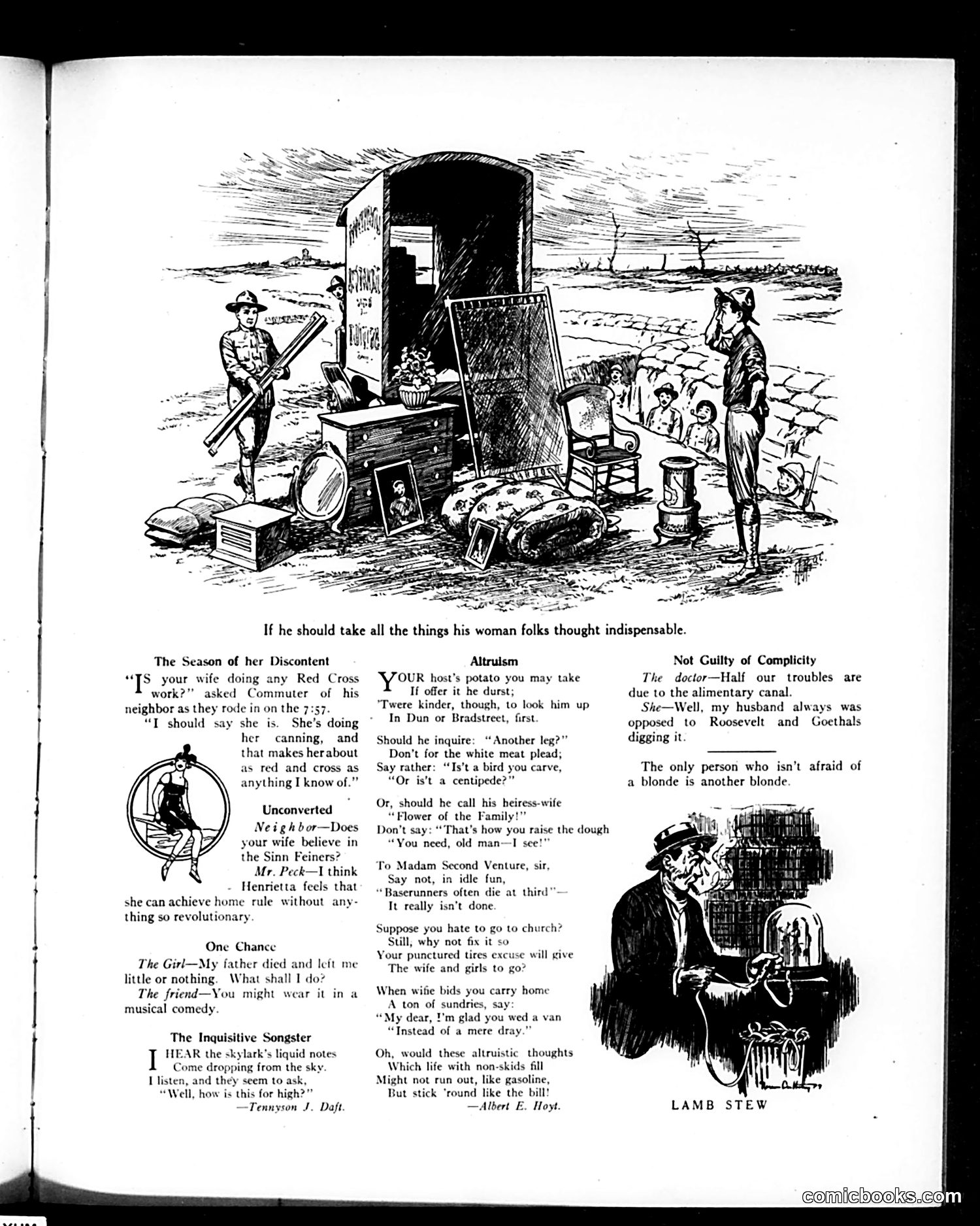
This page contains multiple short humor pieces satirizing American domestic life during the WWI era (likely early 1910s, given references to Roosevelt and the Panama Canal's Goethals). **Key satirical themes:** The main cartoon depicts a poor family's meager possessions, captioned about taking "all the things his woman folks thought indispensable"—mocking wives' perceived materialism and domestic priorities. **Text satire focuses on:** - Wives' Red Cross work and canning efforts (patronizing war-effort participation) - Women's interest in Irish independence ("Sinn Feiners")—suggesting women pursue political causes without revolutionary commitment - Marital etiquette pieces mocking husbands' attempts at false gallantry and pseudo-altruism - A final quip about Roosevelt and Goethals (Panama Canal engineers), suggesting husbands blame wives' ailments on the canal's construction The humor reflects contemporary class anxiety and gender tensions—mocking both wives' pretensions to seriousness and husbands' transparent insincerity in domestic relations. The overall tone is gently misogynistic, typical of Judge's target audience: middle-class men.
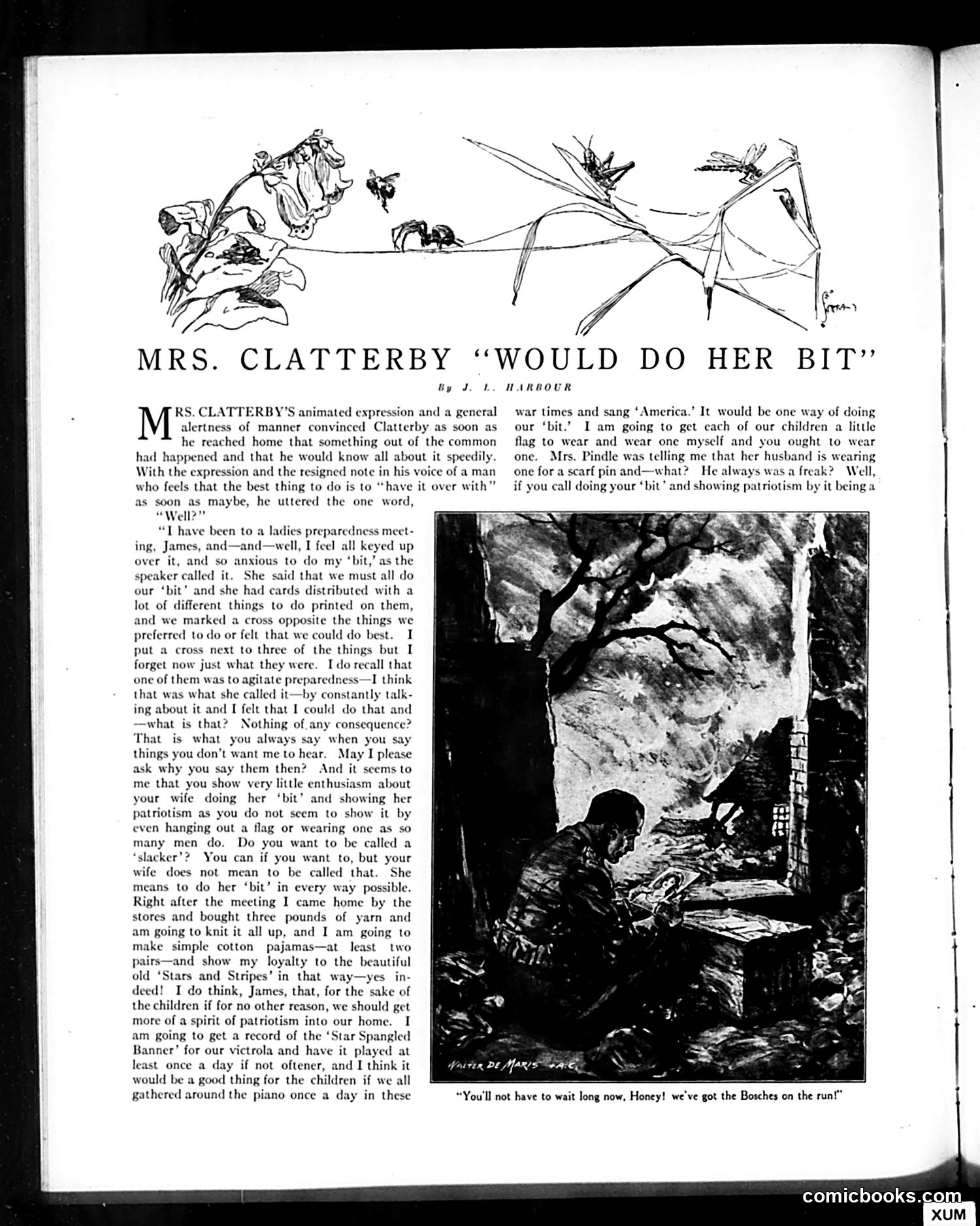
This satirical piece mocks excessive homefront patriotism during World War I. Mrs. Clatterby attends a ladies' preparedness meeting where women sign cards pledging various patriotic acts. She enthusiastically commits to knitting cotton pajamas, wearing a flag pin, playing the "Star-Spangled Banner" daily on the victrola, and "agitating preparedness" through constant talk. The humor targets her well-meaning but somewhat performative patriotism—doing visible, easy patriotic gestures while her husband James remains skeptical. The cartoon's absurdist insects and tangled lines suggest the chaotic, overwrought nature of such civilian enthusiasm. The photograph caption's confident claim—"we've got the Bosches on the run!"—contrasts with the war's actual 1917-1918 grimness, adding ironic commentary on how removed civilian boosterism was from battlefield reality. The satire critiques both *performative* patriotism and the social pressure ("slacker" accusation) to demonstrate loyalty through conspicuous displays rather than substantive contribution.
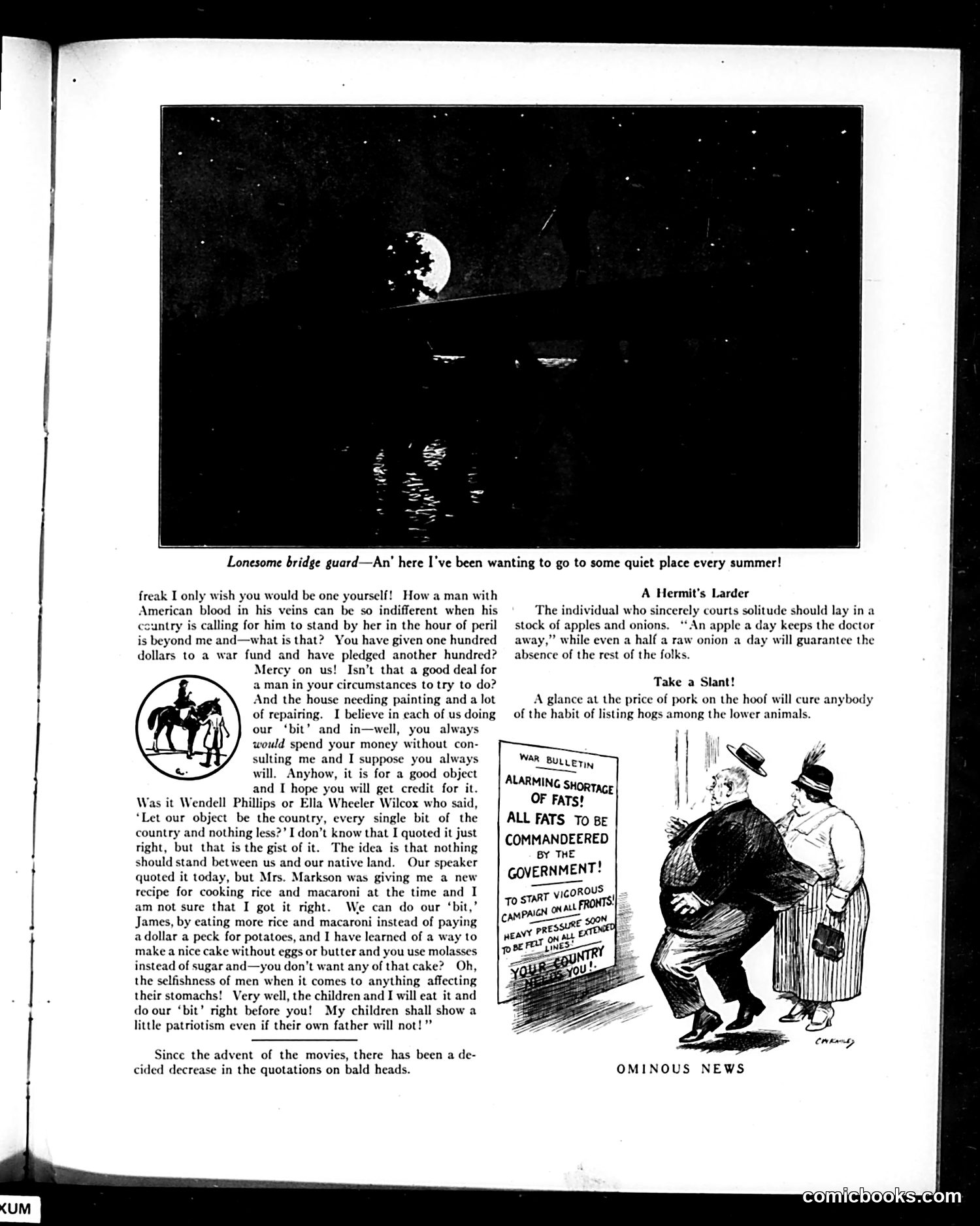
This Judge magazine page satirizes WWI-era patriotism and domestic sacrifice. The main narrative mocks a nagging wife who berates her husband for insufficient patriotic "doing his bit," despite his substantial war fund donations. She advocates sacrifice through deprivation—eating rice and macaroni instead of potatoes, making cakes without eggs or butter—while dismissing his reasonable objections. The satire targets how civilians (particularly women) weaponized moral superiority around wartime rationing and sacrifice, turning personal hardship into performative patriotism. The "Ominous News" cartoon depicts government fat rationing/commandeering, visualizing wartime scarcity and government control over civilian resources. Together, these pieces critique both the performative nature of home-front "sacrifice" and the real privations WWI imposed on ordinary Americans through rationing and resource requisitioning.
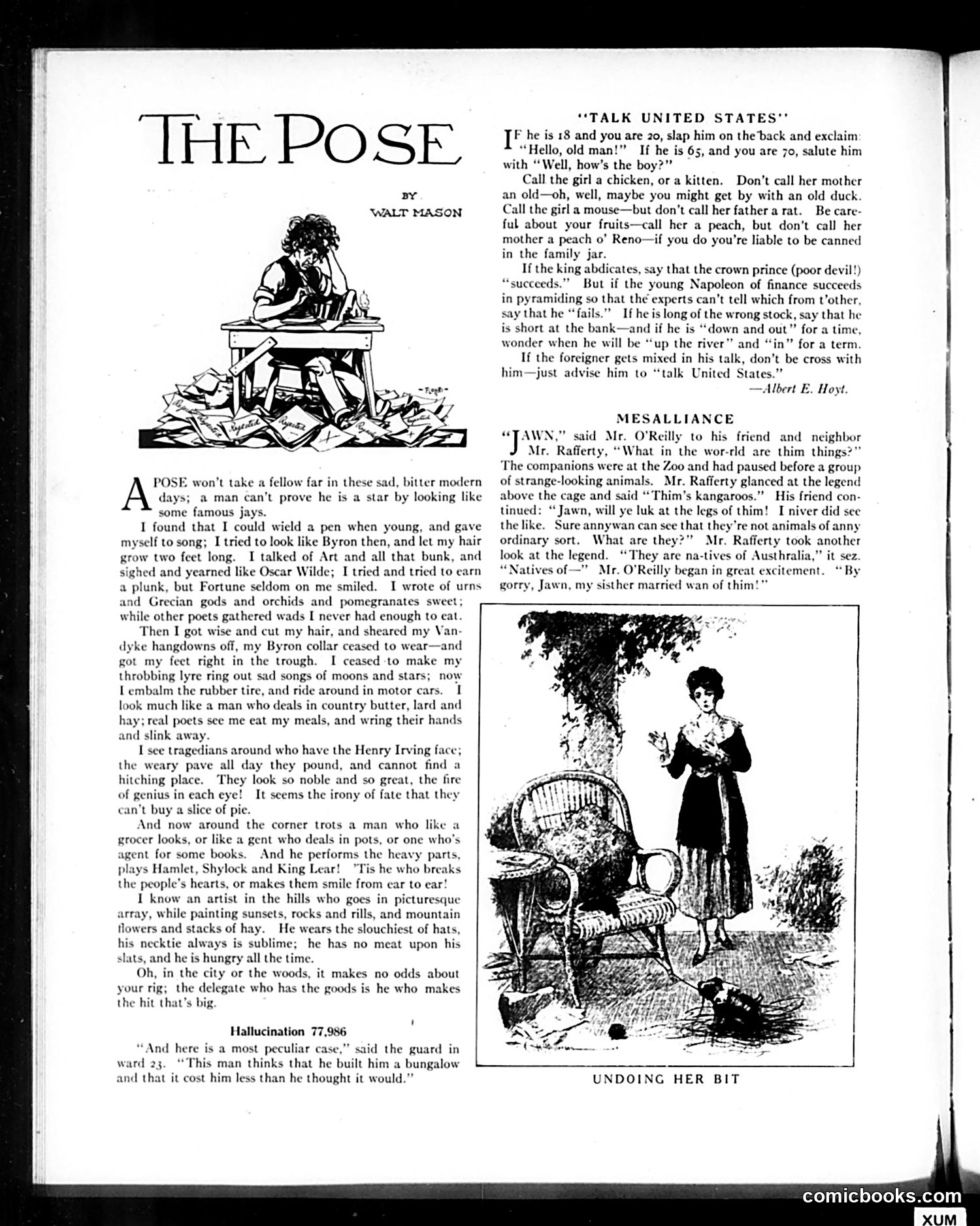
**"The Pose"** (by Walt Mason) satirizes artistic pretension in early 20th-century America. The poem mocks young men who adopt bohemian affectations—growing long hair, writing overwrought poetry about "urns and Grecian gods"—in imitation of famous poets like Byron and Oscar Wilde, hoping to succeed as artists. Mason's point: such posturing fails. Real success comes not from looking the part but from practical work. He contrasts failed romantic poets with successful businessmen who "deal in country butter, lard and hay" or perform Shakespeare—people who actually accomplish things. **"Mesalliance"** is a brief comedic anecdote about two Irish men (O'Reilly and Rafferty) at the zoo. They observe kangaroos and misread the label as "kangaroos" from "Austhralia." O'Reilly's punchline: his sister married one of these creatures—a joke about marrying a foreigner (Australian), presented as scandalously mismatched. Both pieces reflect period anxieties about authenticity versus pretense, and ethnic/cultural otherness.
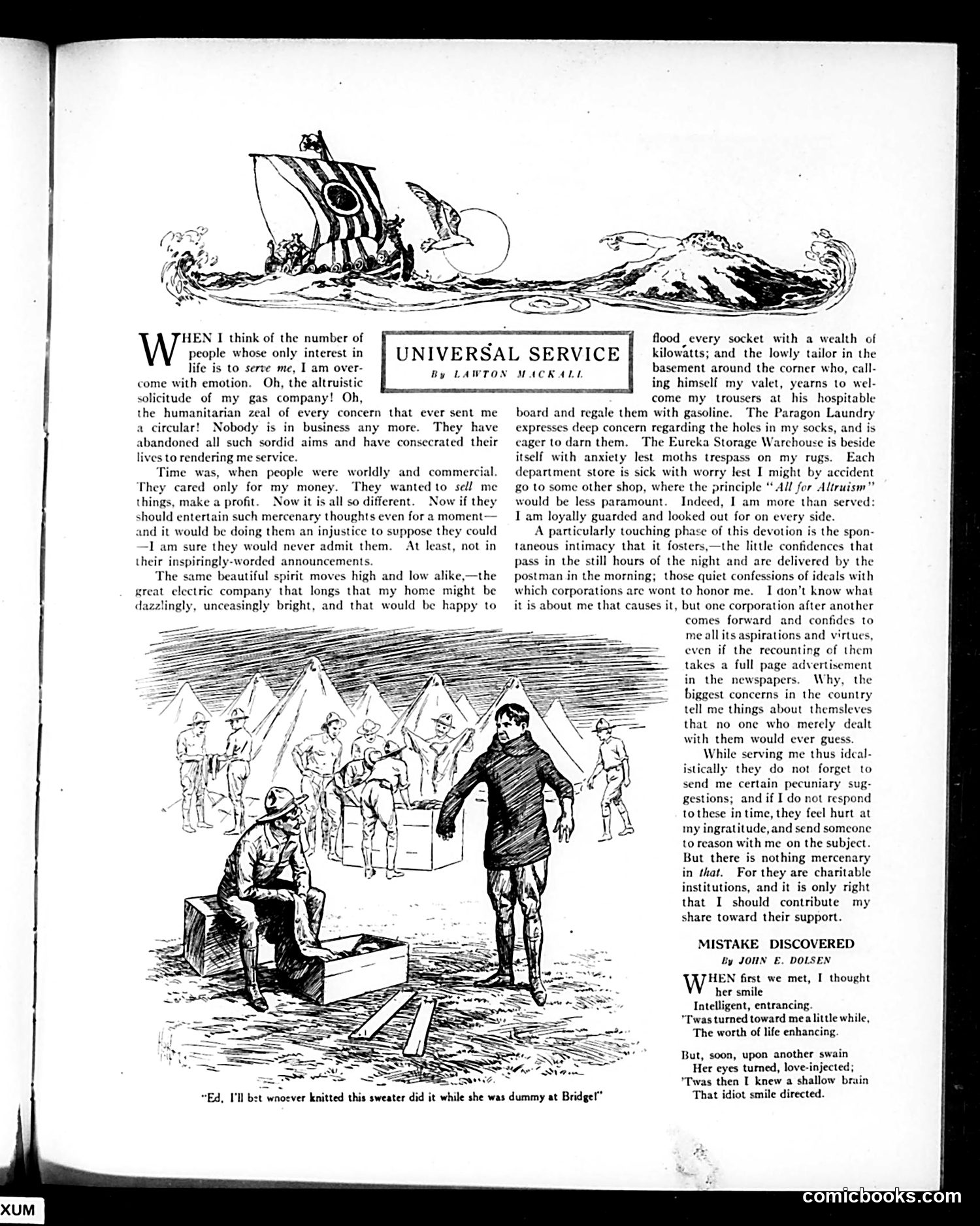
This page contains two distinct pieces: **"Universal Service" by Lawton Mackall** (main article with cartoon): A satirical essay mocking corporations' marketing language claiming to exist solely for the customer's benefit. The author observes that businesses now pretend their motivation is altruistic service rather than profit—their circulars and advertisements emphasize how much they "care" about him personally. The cartoon depicts soldiers in a military camp, with a caption about a sweater knitted while someone was a "dummy at Bridget"—likely a period reference to knitting circles or wartime production. The satire's point: big companies (electric utilities, laundries, department stores) cynically exploit emotional language and mass-mailing intimacy to manipulate consumers into loyalty while still demanding payment, yet hide their obvious profit motive behind hollow rhetoric about serving the public good. **"Mistake Discovered" by John E. Dolsen**: A brief poem about realizing a woman's charming smile was actually directed at someone else—revealing her shallow nature.
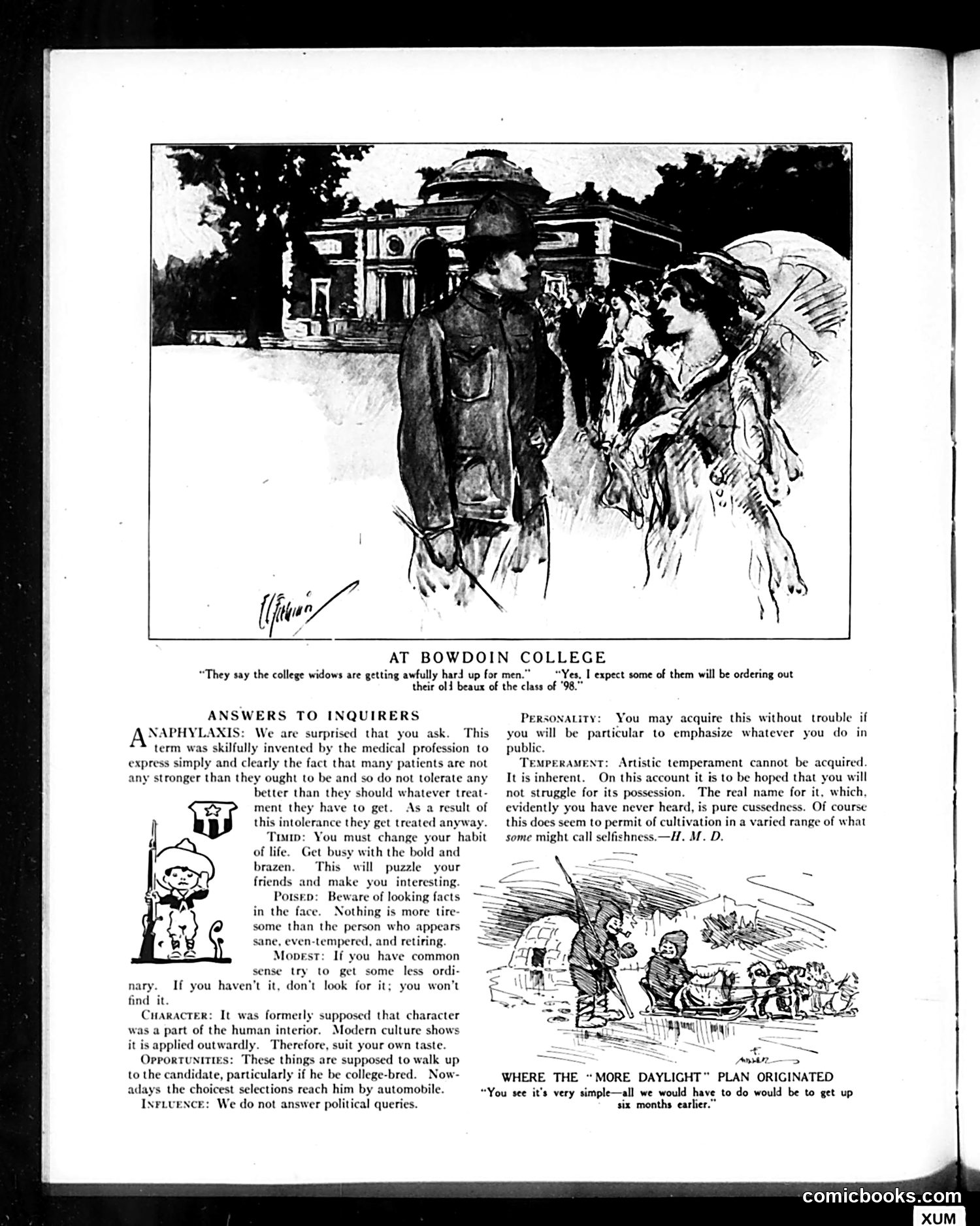
**Top Cartoon ("At Bowdoin College"):** This satirizes "college widows"—a period term for older women who frequented college towns seeking romantic attention from students. The joke: these women are now so desperate they're contacting men from the class of 1898 (likely decades prior), suggesting they've exhausted current prospects. **"Answers to Inquirers" Section:** Humorous pseudo-advice columns mocking common self-help platitudes and social pretensions. The writer sarcastically "explains" medical jargon, character development, and modern etiquette with cynical reversals—e.g., claiming character is external rather than internal, or that "artistic temperament" is actually just "cussedness." **Bottom Cartoon ("More Daylight Plan"):** Satirizes the daylight saving time concept by showing someone suggesting the solution is simply "getting up six months earlier"—mocking the absurdity of trying to artificially manipulate time rather than just adjusting schedules. The page targets pretension, romantic desperation, and pseudointellectual nonsense typical of early 20th-century American society.
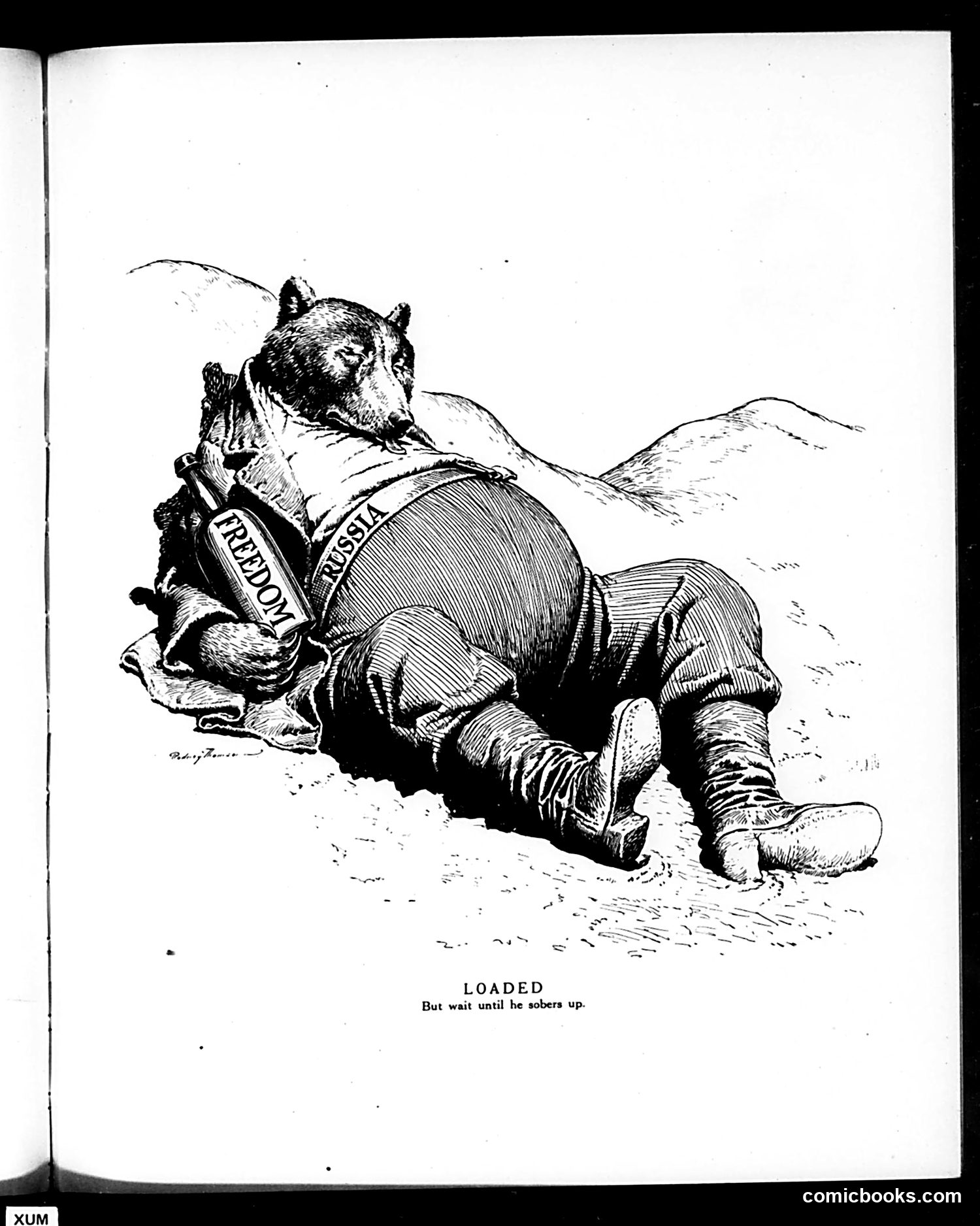
This is a political cartoon from *Judge* magazine depicting a bear (labeled "RUSSIA" on its barrel) heavily laden with supplies and equipment, crawling or stumbling across snowy terrain. The bear appears intoxicated or incapacitated ("loaded"), and the caption reads "But wait until he sobers up." The satire likely references Russia's military capacity and resources during a period of apparent weakness or distraction. The "loaded" pun suggests Russia is both literally burdened with supplies and metaphorically drunk or impaired—but the warning implies that once Russia recovers or becomes serious, it will pose a significant threat. This reflects historical anxiety about Russian military power, though without a visible date, the specific historical moment remains unclear.
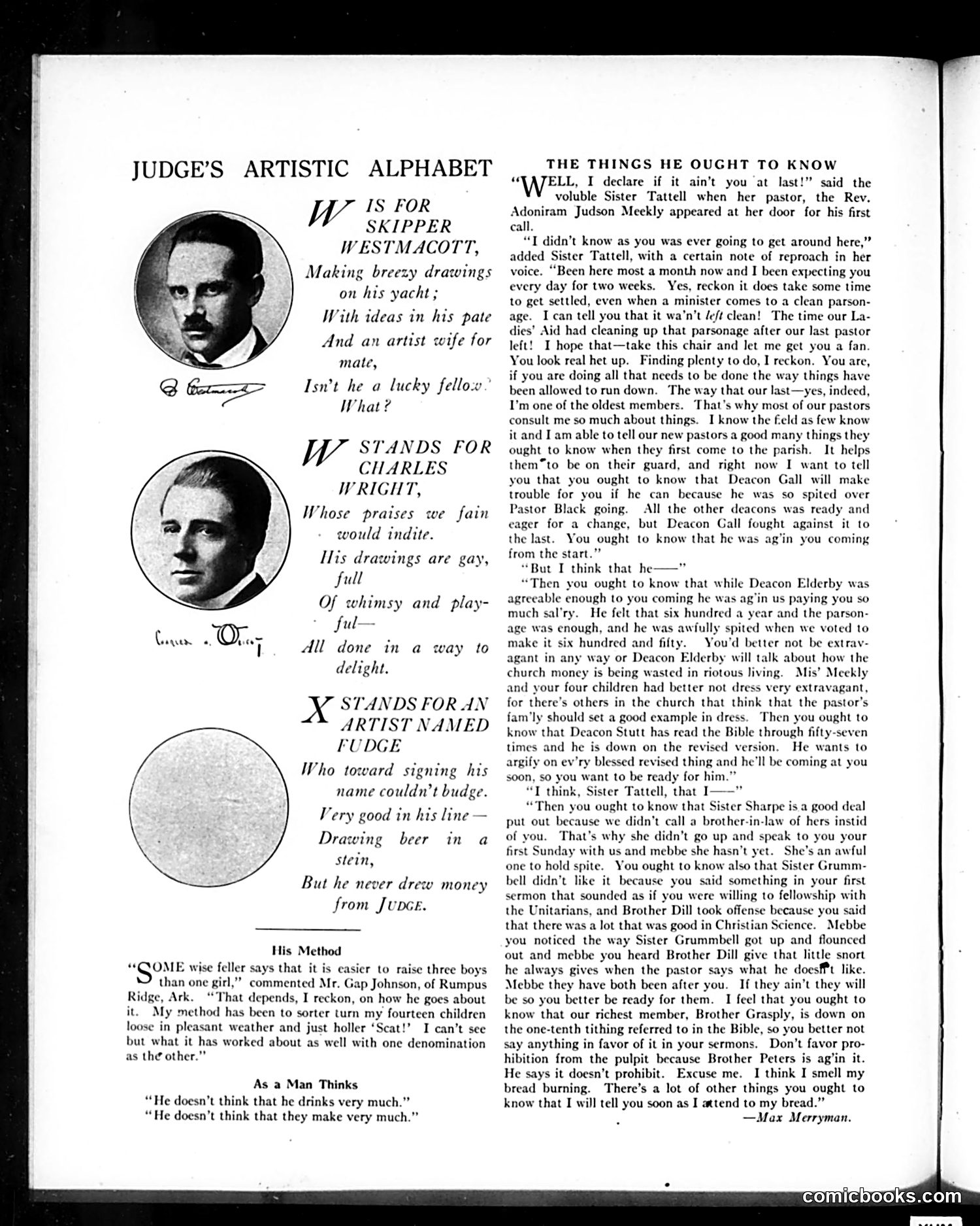
This page features two distinct sections: **Left side:** A lighthearted artist profile series introducing illustrators associated with *Judge* magazine—Skipper Westmacott, Charles Wright, and "Fudge" (an artist who draws beer steins but never profits financially). These are inside jokes celebrating the magazine's own contributors. **Right side:** A satirical sketch mocking small-town church politics. A garrulous church member, Sister Tattell, ambushes the new pastor (Rev. Meekly) with unsolicited advice about problematic deacons and parishioners—Deacon Gall (disgruntled), Deacon Elderby (stingy), Deacon Stutt (pedantic Bible literalist), and Sister Sharpe (nepotistic). The satire targets how established congregants police and micromanage their pastors' conduct, dress, and finances through gossip and social pressure. The pastor's repeated attempts to respond are steamrolled, capturing small-town busybodyism and institutional hypocrisy.
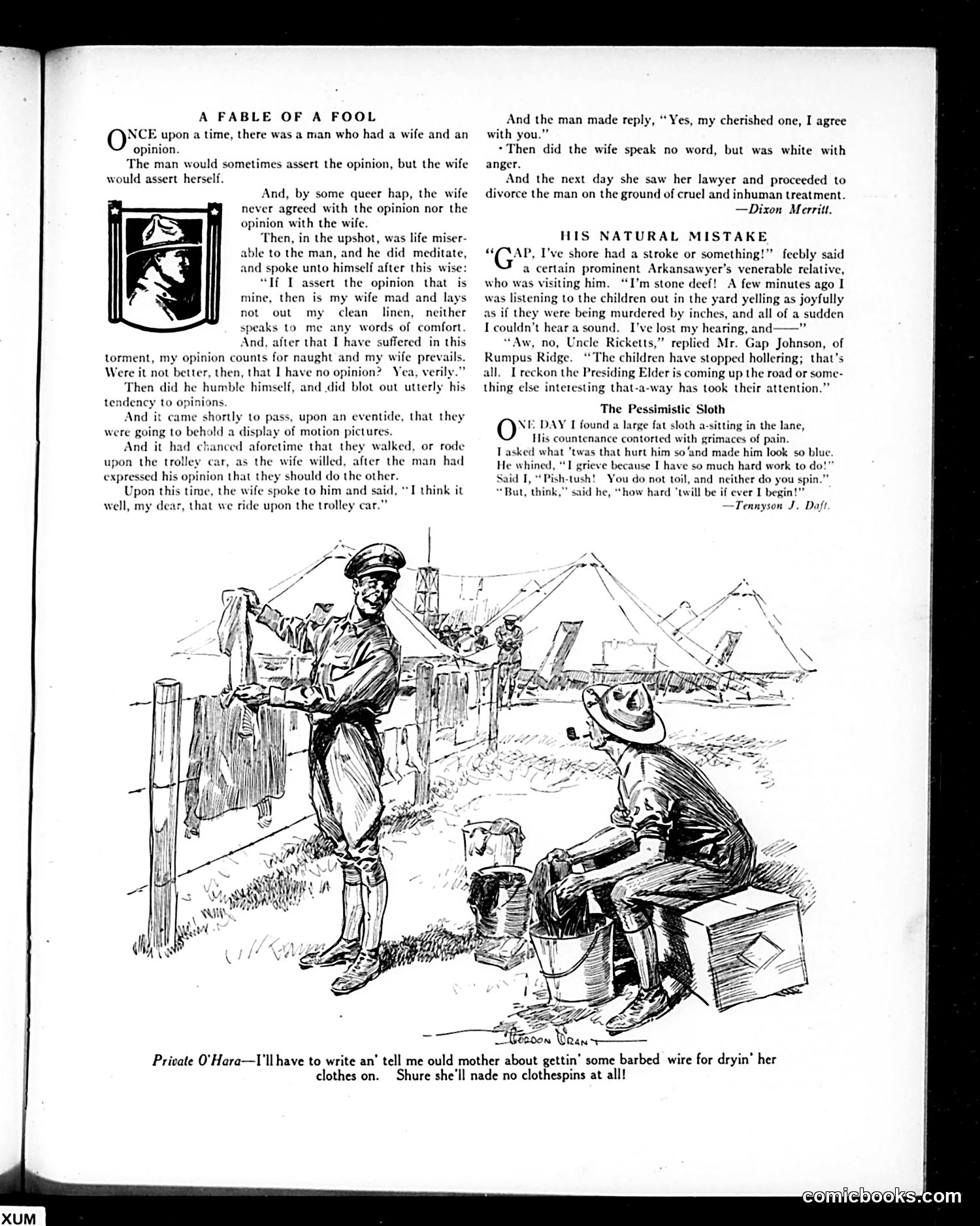
This page contains three distinct satirical pieces: **"A Fable of a Fool"** mocks a husband who abandons all opinions to appease his argumentative wife. The irony: when he finally agrees with her about taking the trolley car, she becomes furious and divorces him for "cruel and inhuman treatment." The satire targets marital conflict and the impossibility of pleasing a querulous spouse through submission. **"His Natural Mistake"** presents a rural Arkansas joke: an elderly visitor thinks he's gone deaf when children stop yelling, but a neighbor explains the Presiding Elder (a religious authority) is arriving—implying the children fall silent out of respect or fear of the church official. **"The Pessimistic Sloth"** is a poetic moral about a lazy creature who complains about hypothetical future work despite doing nothing currently—satirizing chronic complainers and those who manufacture problems. **"Private O'Hara"** is a brief Irish-dialect joke about a soldier planning to send barbed wire home as clotheslines, eliminating the need for clothespins—absurdist military humor. All employ Judge's characteristic gentle, moralistic satire of everyday human folly.
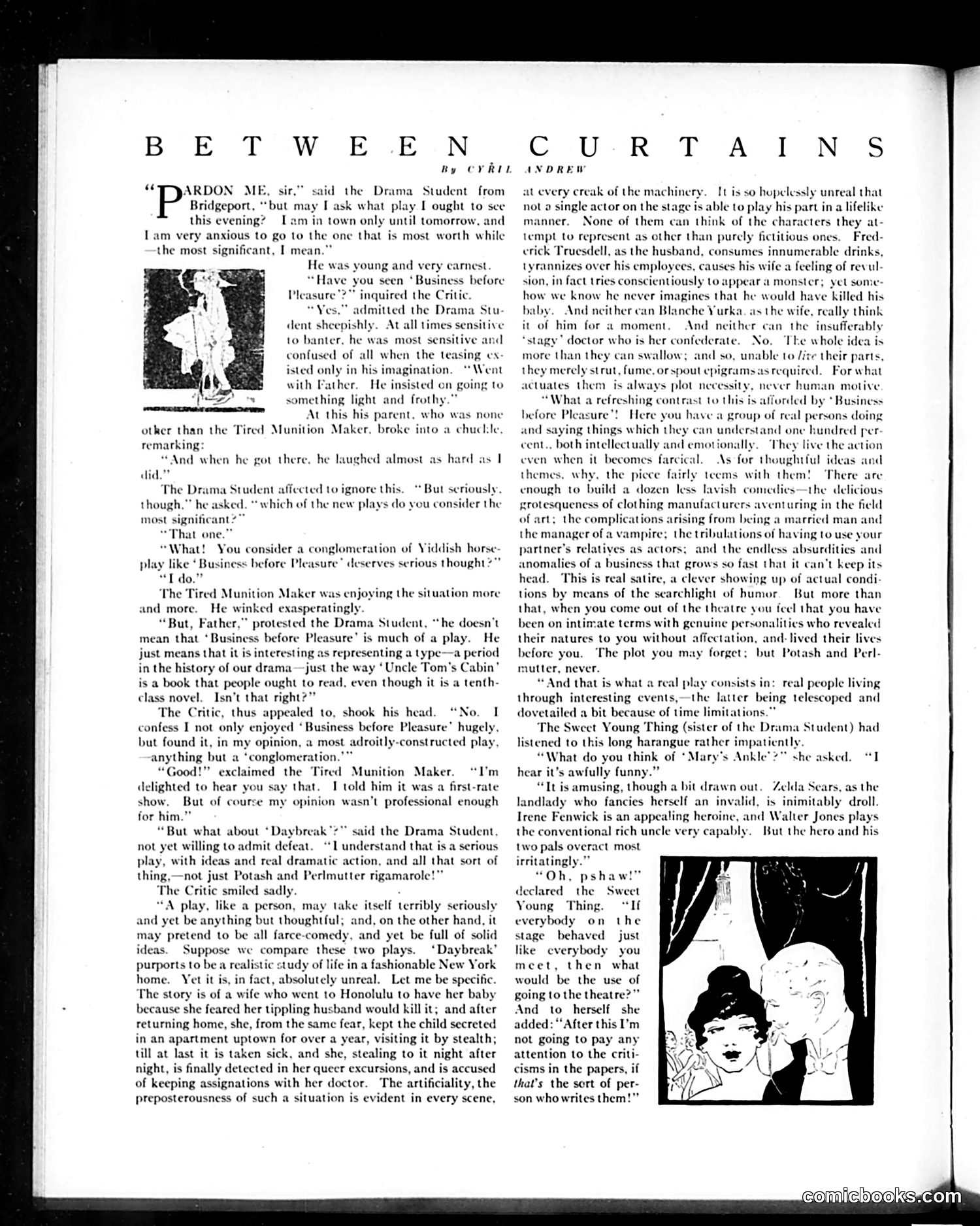
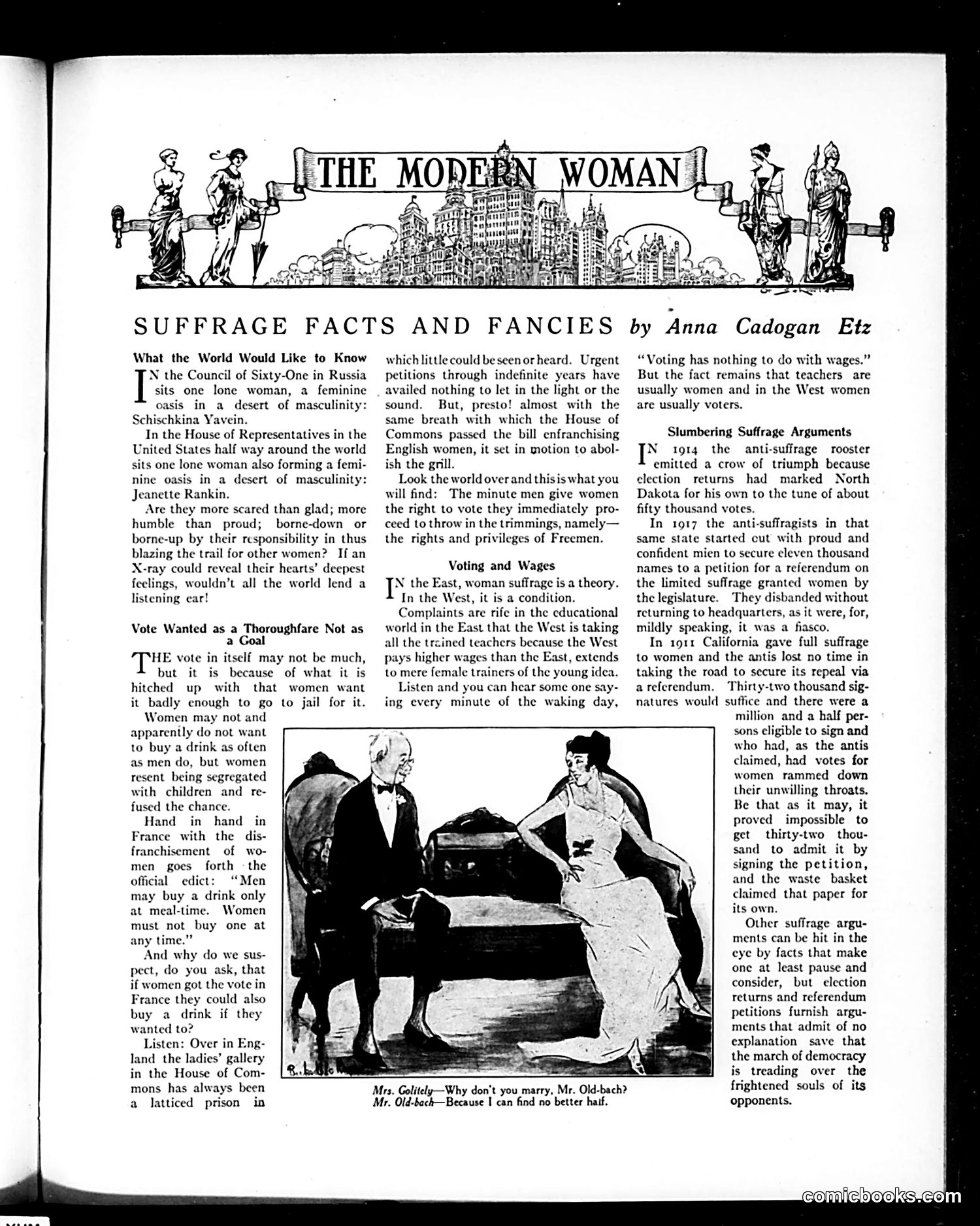
This page from *Judge* presents pro-suffrage arguments by Anna Cadogan Etz. The central cartoon depicts a domestic scene with the caption "Mrs. Golitely—Why don't you marry, Mr. Old-bach? / Mr. Old-bach—Because I can find no better half," satirizing the idea that women need men to complete them—a common anti-suffrage argument. The article compares women's political representation in Russia and the U.S. (each with one female representative), then argues voting is a "thoroughfare" to broader rights. It highlights wage disparities, noting Western teachers (mostly women voters) earn more than Eastern counterparts, contradicting claims that suffrage and wages are unrelated. The final section ridicules failed anti-suffrage campaigns in North Dakota (1917) and California (1911), where petitions for referendum/repeal couldn't gather required signatures despite millions being eligible—suggesting the public supported women's voting rights. The satire mocks anti-suffrage logic as weak and increasingly indefensible.
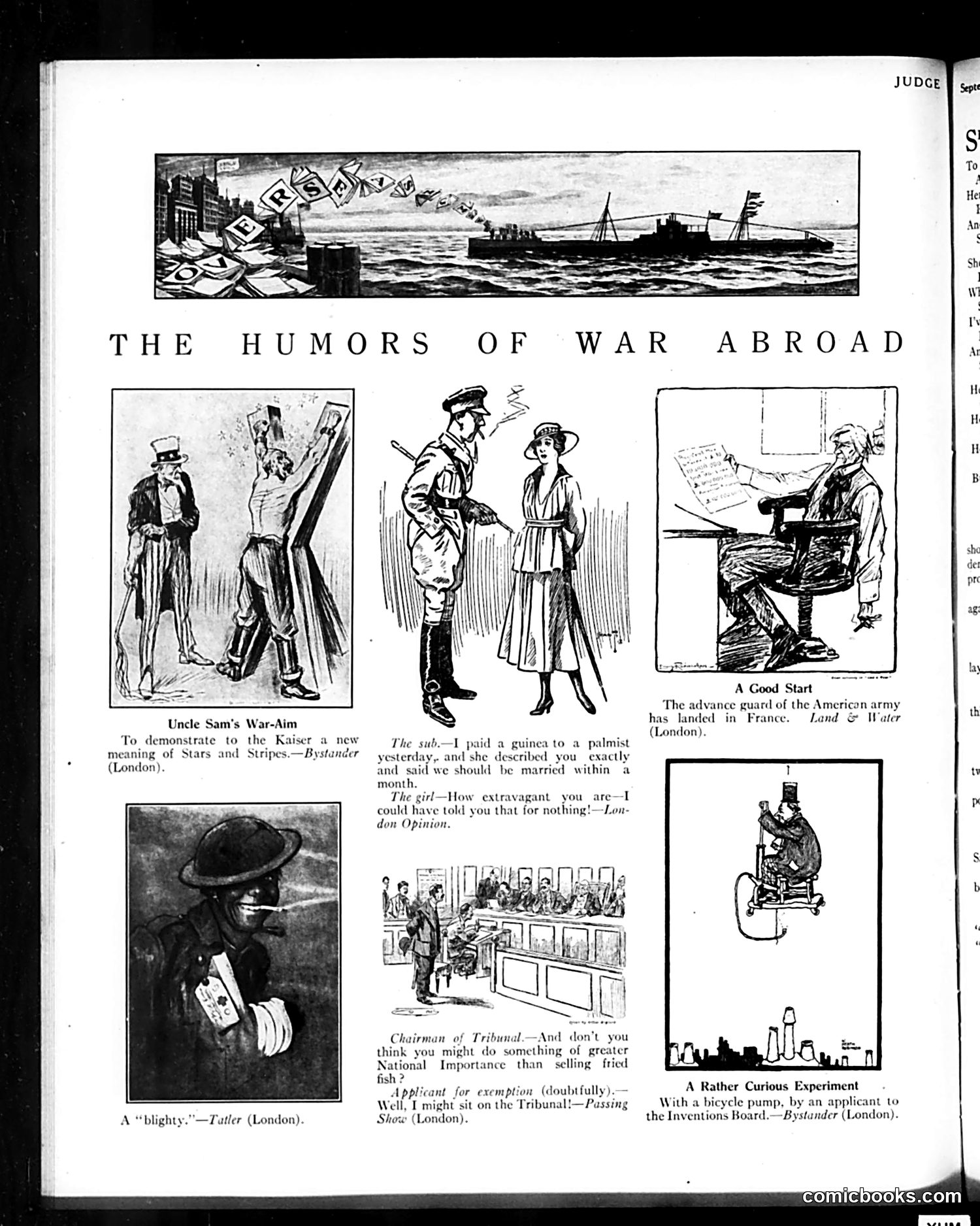
This page collects British and American wartime humor from WWI. The cartoons mock various war-related situations: **"Uncle Sam's War-Aim"** shows Uncle Sam demonstrating a new meaning of the American flag to "the Kaiser"—satirizing American war aims. **"A 'blighty'"** depicts a wounded soldier; "blighty" was British slang for a wound serious enough to warrant home leave. **"A Good Start"** celebrates American troops arriving in France as "advance guard." The remaining jokes target the home front: a palmist's fortune-telling, a tribunal exemption applicant who quips he could "sit on the Tribunal" instead of selling fish, and an inventor proposing an absurd "bicycle pump" weapon to the Inventions Board. The satire mocks both wartime bureaucracy and civilian anxiety about conscription and military service.
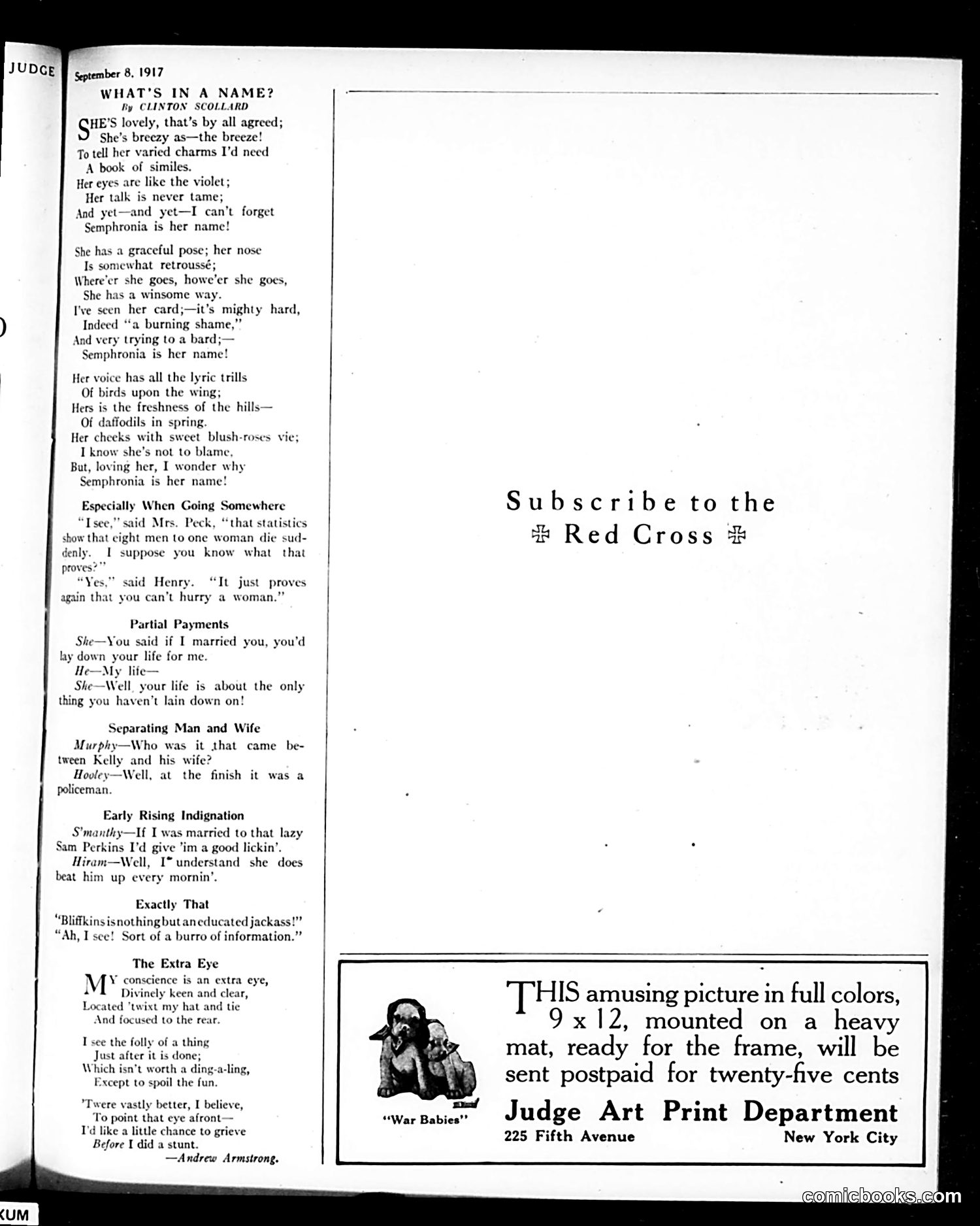
This page contains light satirical humor typical of Judge magazine, mixing a romantic poem with short domestic jokes. The main content is "What's In a Name?" by Clinton Scollard—a playful poem praising a woman's beauty while complaining that her name "Semphronia" is awkward and hard to work into verse. The surrounding jokes mock marital dynamics: a wife notes her husband won't sacrifice anything for her; a husband jokes that statistics proving eight men die to one woman simply show "you can't hurry a woman"; and brief exchanges joke about spousal violence and education. Published September 1917 (during WWI), the page's advertisement for a "War Babies" art print appears to reference war orphans or displaced children—a contemporary humanitarian concern. The Red Cross subscription appeal reflects wartime charitable mobilization. The humor reflects early 20th-century attitudes toward gender and marriage that modern readers would find dated and often offensive.
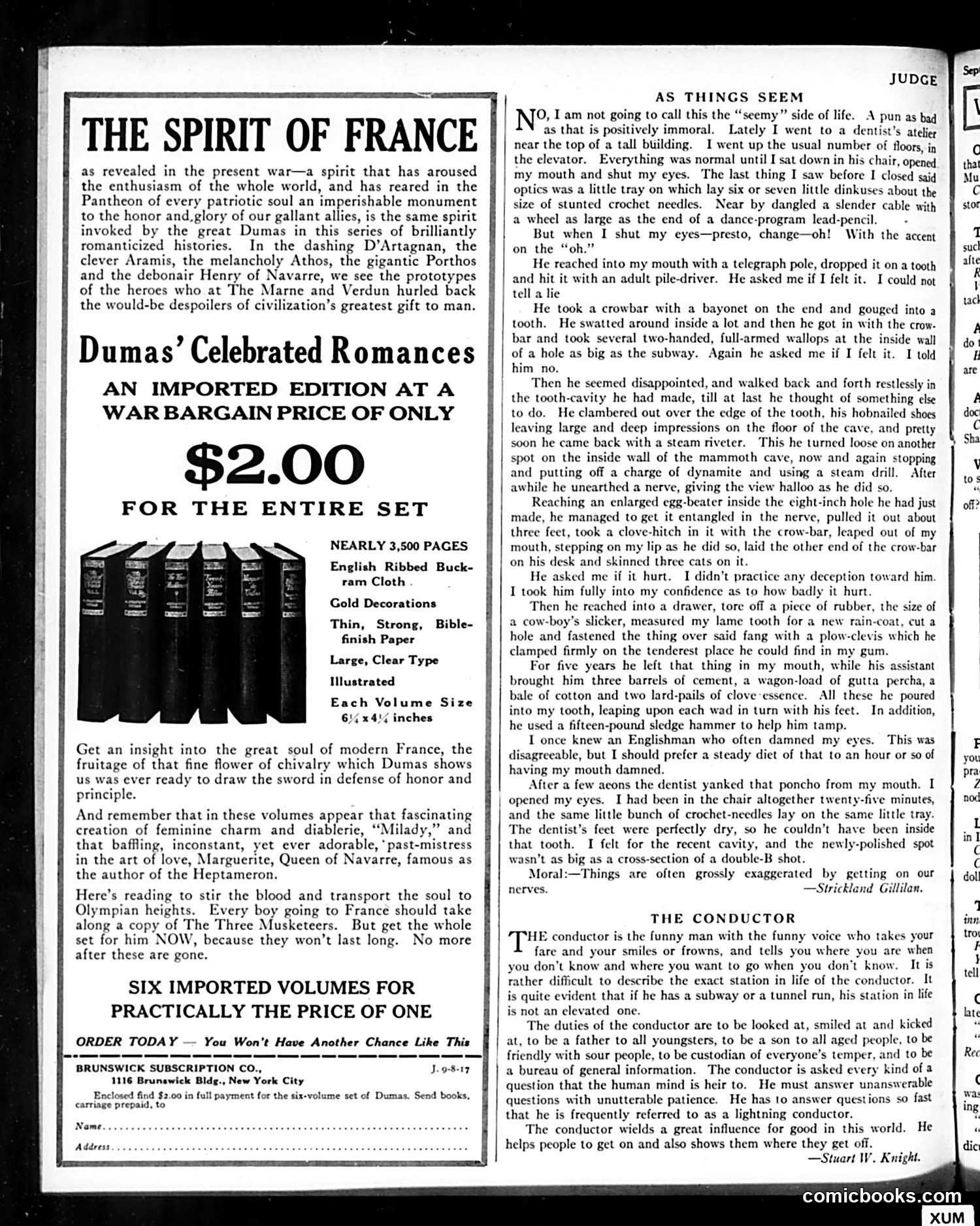
This is a humorous personal essay satirizing a dental visit through grotesque exaggeration. The narrator describes routine dental procedures—cleaning, drilling, extraction—using absurdly inflated language that transforms ordinary instruments into weapons of war: a "telegraph pole," "crowbar with a bayonet," "steam riveter," and "dynamite." The joke relies on the universal experience of dental anxiety. By comparing the dentist's tools and actions to industrial equipment and military weaponry, the author mocks both his own cowardice and the gap between actual minor discomfort and perceived torture. The recurring refrain of the dentist asking "if I felt it" emphasizes the narrator's stoic (or cowardly) denials. Published during World War I, the military imagery adds contemporary resonance, though the piece is primarily domestic comedy rather than war commentary.
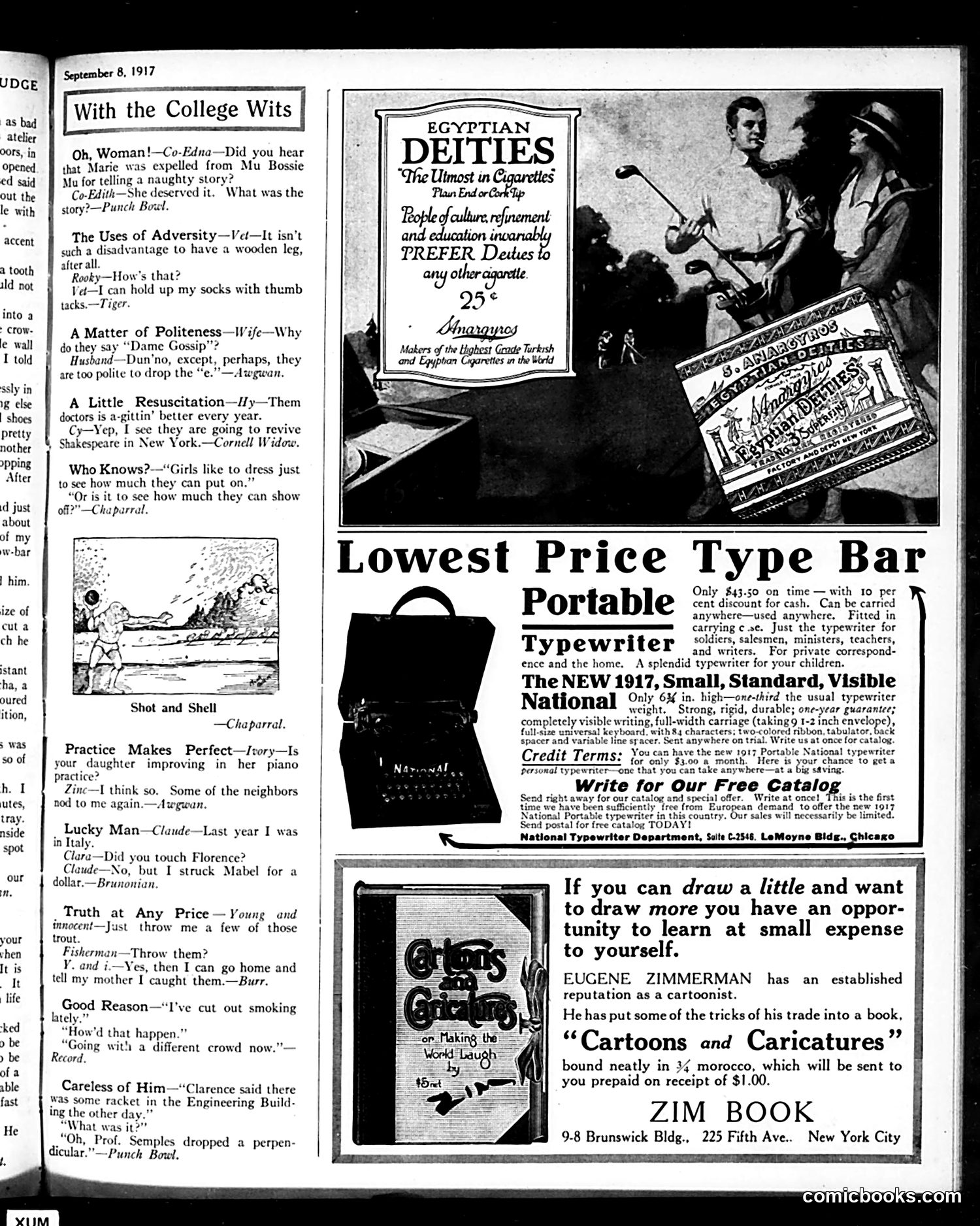
This page features **humor columns** rather than political cartoons. The "College Wits" section collects brief jokes attributed to college humor magazines (Tiger, Chaparral, Cornell Widow, etc.), mocking contemporary social situations. The jokes target familiar subjects: **women's changing social roles** (college women telling "naughty stories"), **courtship and romance**, and **wartime contexts** (a "Vet" with a wooden leg, dating soldiers). One joke references **Shakespeare being revived in New York**, likely a cultural note of the period. The rest of the page is **advertising**: Egyptian Deities cigarettes (25¢), a National typewriter ($43.50 on time), and Eugene Zimmerman's cartooning instruction book. The typewriter ad specifically pitches portability for "soldiers, salesmen, ministers, teachers"—reflecting 1917's wartime economy. This is a typical magazine page mixing entertainment with commercial content, not satirical commentary.
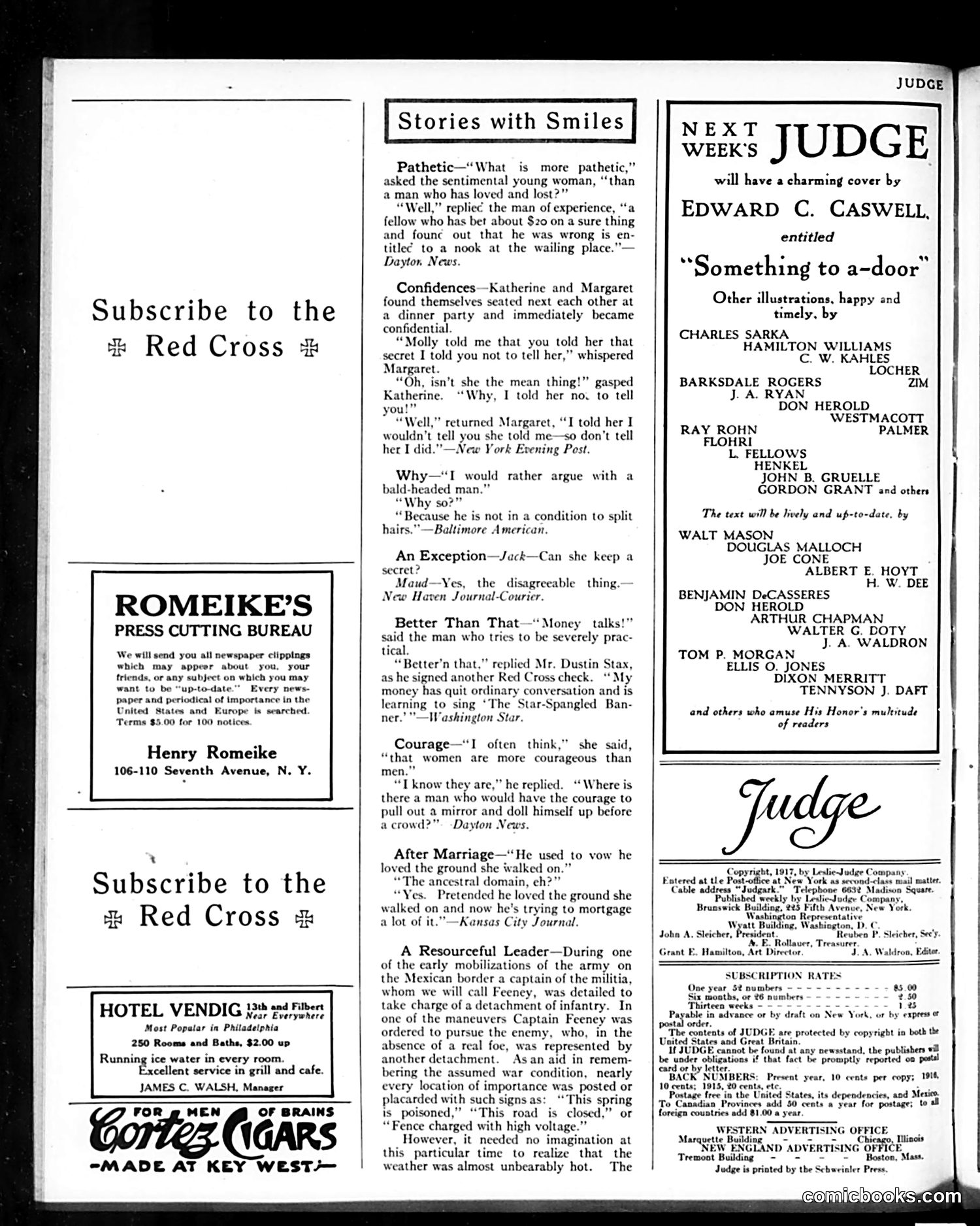
This page is primarily **advertising and publication information**, not political satire. The content consists of: 1. **Advertisements** for the Red Cross, a press-clipping bureau, and a Philadelphia hotel 2. **"Stories with Smiles"** – a humor column featuring brief anecdotes from various newspapers. These are genteel period jokes about romance, marriage, secrecy, and gender relations. The humor relies on wordplay and observational comedy (e.g., a man's courage compared to a woman's willingness to primp before a crowd) 3. **Announcement of next week's cover** by Edward C. Caswell, titled "Something to a-door" 4. A list of contributing illustrators and writers The single extended anecdote about "A Resourceful Leader" concerning a Captain Feeney during Mexican border mobilizations appears to discuss military logistics during the 1917 period, though the text is partially cut off. There are no prominent political cartoons or partisan satire visible on this page.
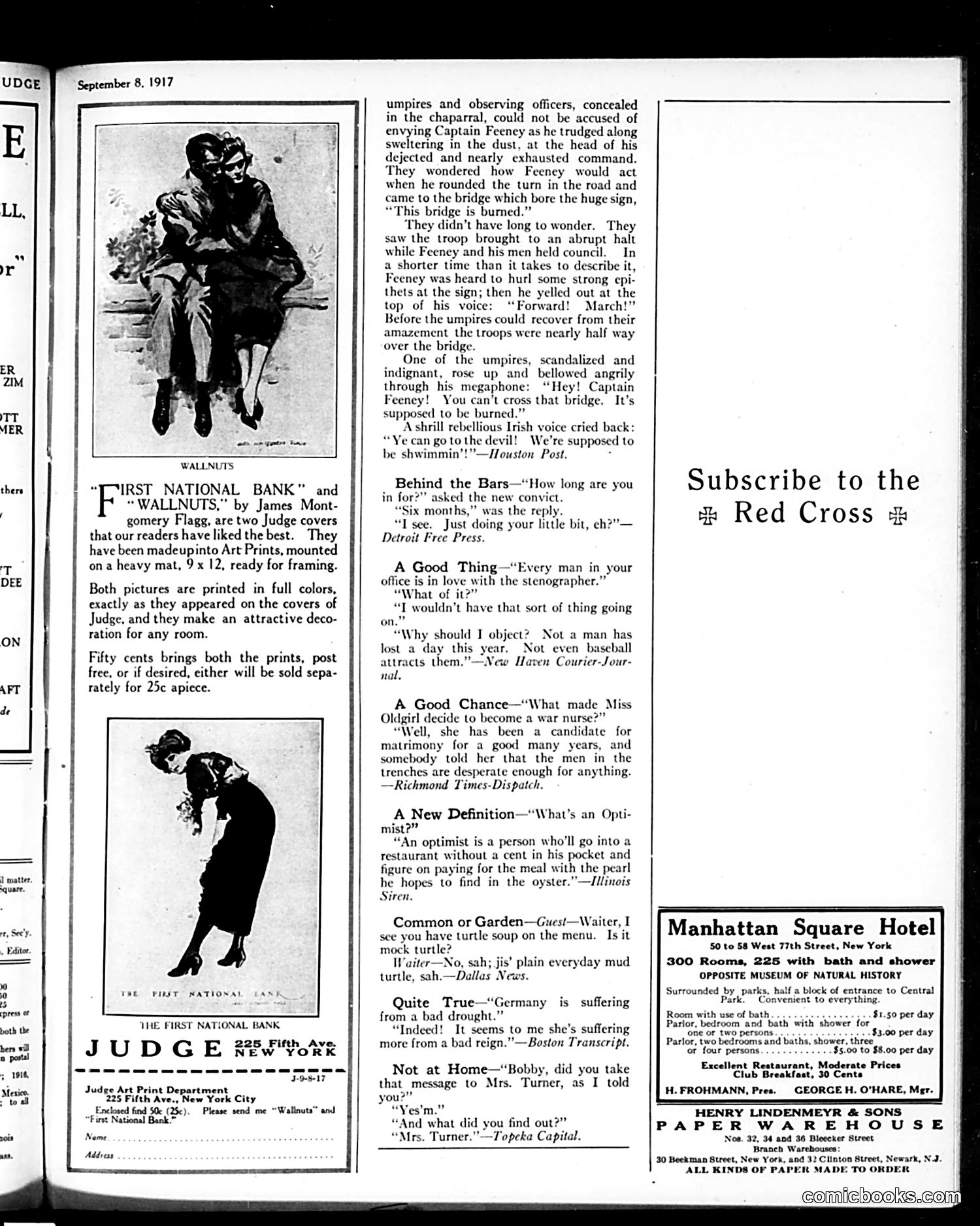
This page contains two illustrated art prints by James Montgomery Flagg advertised for sale ("Walnuts" and "First National Bank"), plus miscellaneous humorous short jokes typical of Judge's satirical content. The main narrative excerpt describes a military exercise where Captain Feeney encounters a "burned bridge" obstacle course but orders his troops across anyway, defying the umpires' rules. An Irish soldier quips they're "supposed to be shwimmin'"—a joke playing on Irish stereotypes and the absurdity of military drills. The other jokes mock various targets: a convict's sentence, office romance, a woman becoming a war nurse for marriage prospects, definitions of optimism, and German military defeats ("suffering from a bad reign"). The page also includes period advertisements for the Manhattan Square Hotel and a Red Cross subscription appeal. The content reflects 1917 American attitudes during World War I—including ethnic humor, romantic cynicism, and patriotic appeals.
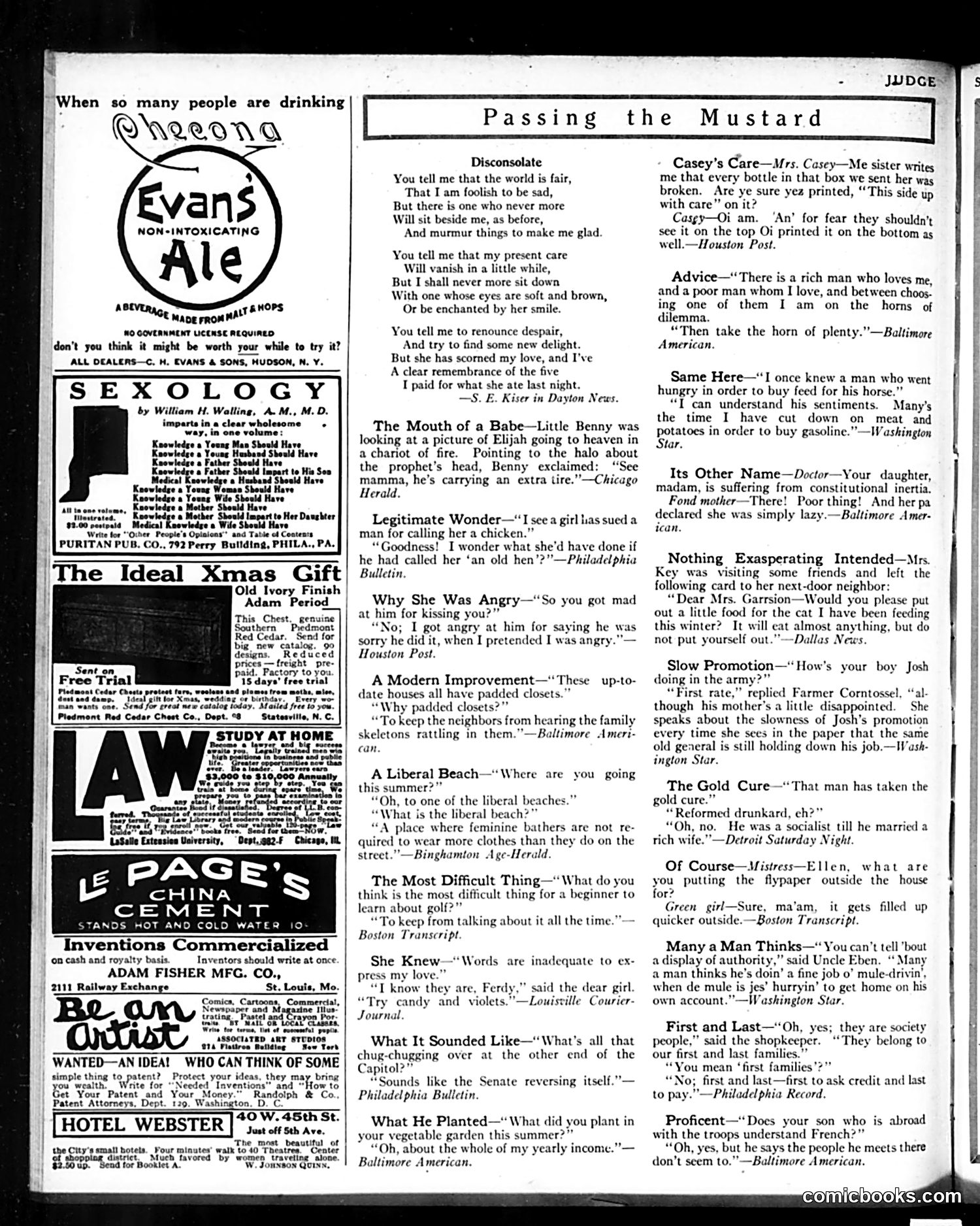
This page from Judge (a major American satirical weekly) is primarily **advertising and light humor columns**, not political cartoons. The content reflects early 20th-century concerns: **The Ads** reference products typical of the era: Evans non-alcoholic ale (ironic given Prohibition debates), a "Sexology" medical book, cedar chests, and patent services—reflecting consumer culture and anxieties about modern knowledge. **The Humor Section** ("Passing the Mustard") contains brief jokes about: - Romantic rejection and wasted money - Children's innocent misunderstandings - Domestic discord (padded closets to muffle family arguments) - Women's bathing attire standards - Golf etiquette **The Political Reference**: One joke mocks the U.S. Senate as perpetually "reversing itself"—a common early-20th-century critique of legislative ineffectiveness. Overall, this represents Judge's mix of consumer advertising and genteel, domestic-focused humor rather than sharp political satire. The tone is sentimental and mildly cynical about marriage and social manners.
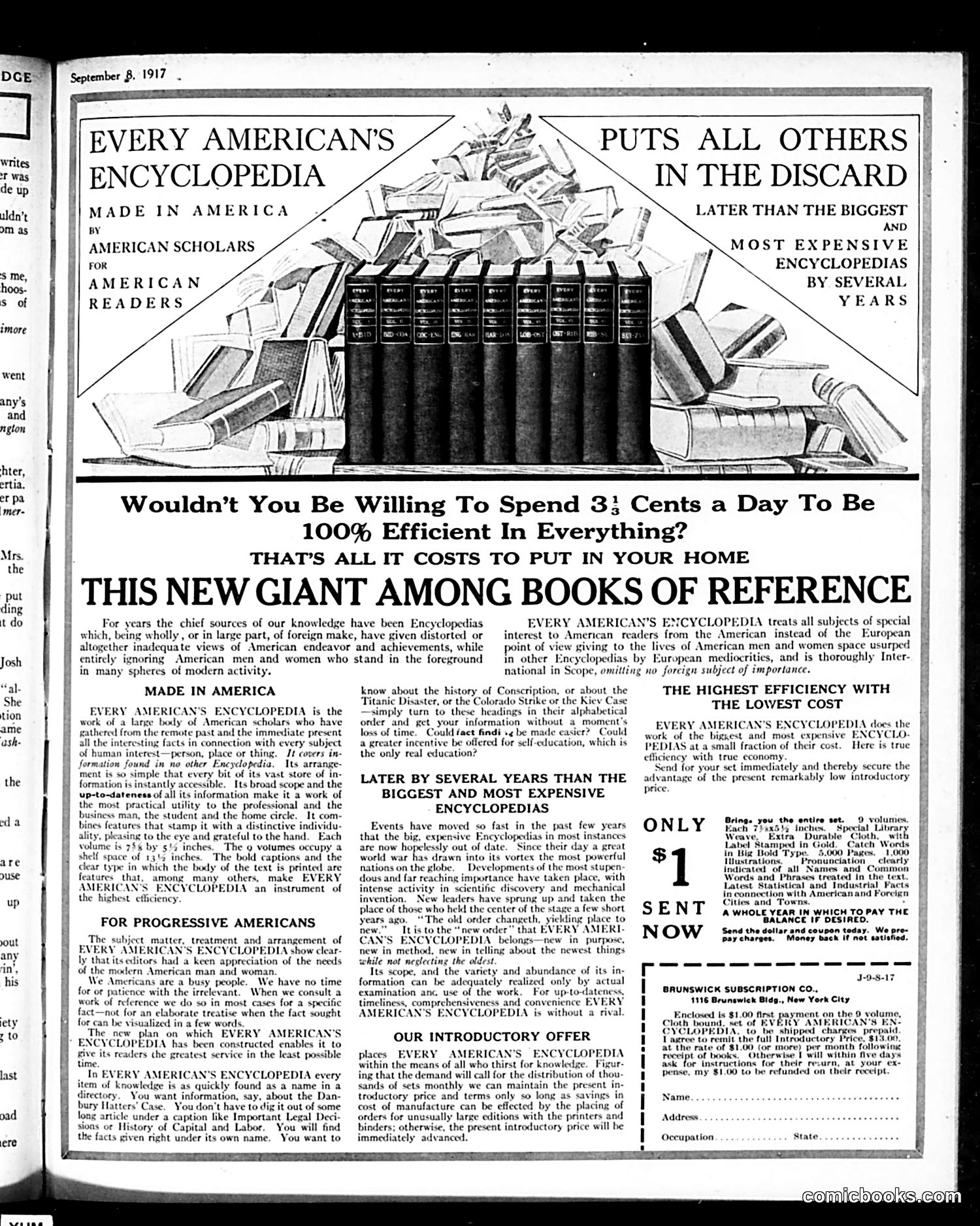
This is primarily a **commercial advertisement**, not political satire. It promotes a new American encyclopedia set positioned as superior to existing foreign-made references. The ad's central appeal targets American nationalism and practicality: it emphasizes the encyclopedia is "made in America by American scholars" and claims to cover American achievements previously neglected by foreign sources. The visual shows the encyclopedia's 9 volumes dramatically displayed amid discarded competitors, claiming superiority over "the biggest and most expensive encyclopedias." The main selling point is efficiency and currency: at "3½ cents a day," it's affordable, and—crucially—it contains recent information about World War I developments, new leaders, and modern discoveries that older, expensive encyclopedias cannot. The ad explicitly states older encyclopedias are "hopelessly out of date." This reflects 1917 anxieties about American cultural independence and the rapid pace of modern events, particularly WWI's impact on world affairs.
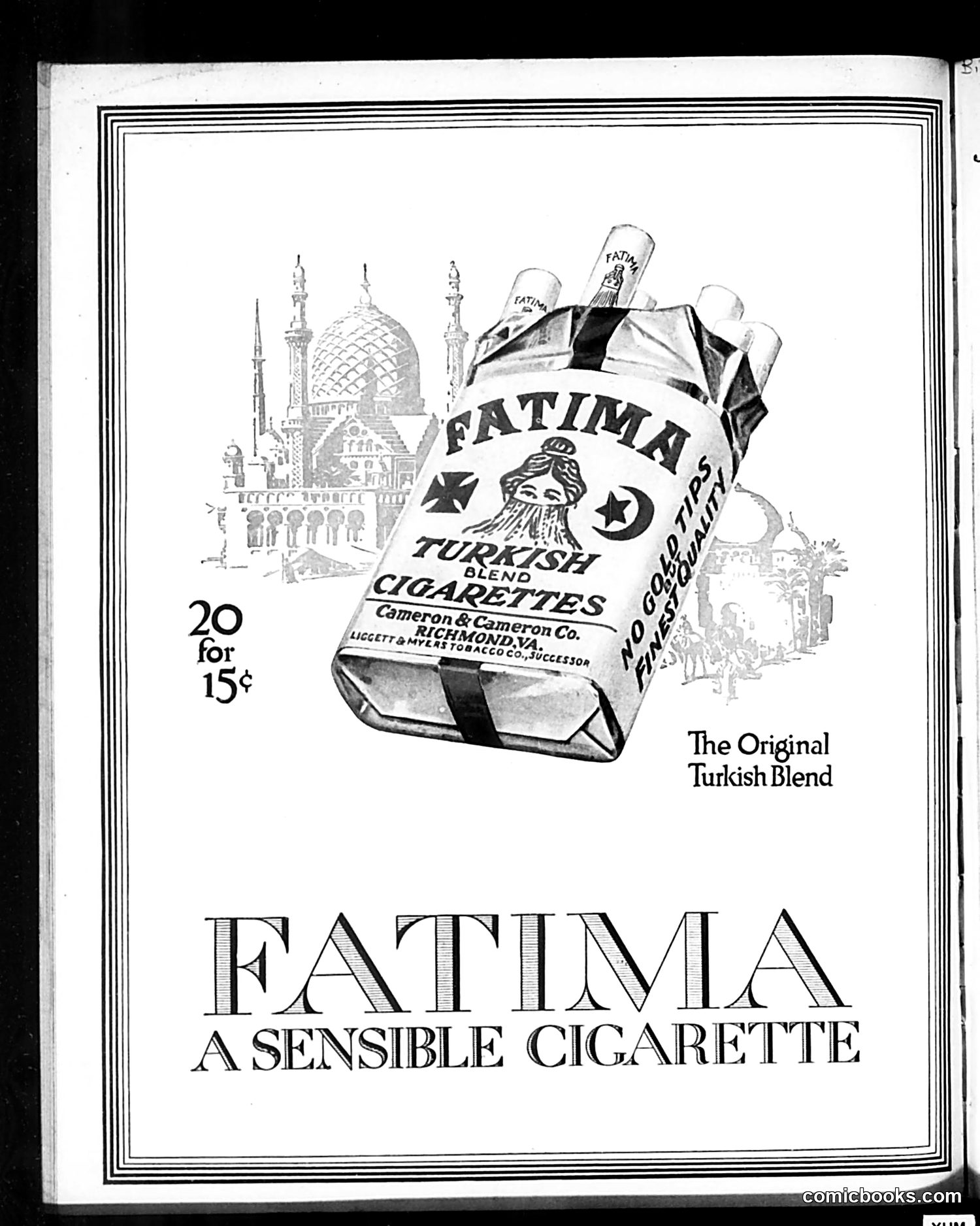
This is a cigarette advertisement, not political satire. The page promotes Fatima brand Turkish Blend cigarettes, made by Cameron & Cameron Co. of Richmond, Virginia. The ad features the product package prominently, decorated with Turkish architectural imagery (a mosque with minarets and dome) and a turban-wearing figure—design elements meant to evoke the cigarettes' "Turkish blend" origin and appeal to early 20th-century American consumers' fascination with exotic goods. The price ("20 for 15¢") and tagline "A Sensible Cigarette" suggest marketing to cost-conscious smokers. The exotic branding and imagery were common in tobacco advertising of this era, before modern health warnings or regulations on cigarette marketing.