
Judge, 1917-09-08 · page 12 of 28
Judge — September 8, 1917 — page 12: what you’re looking at
What you’re looking at
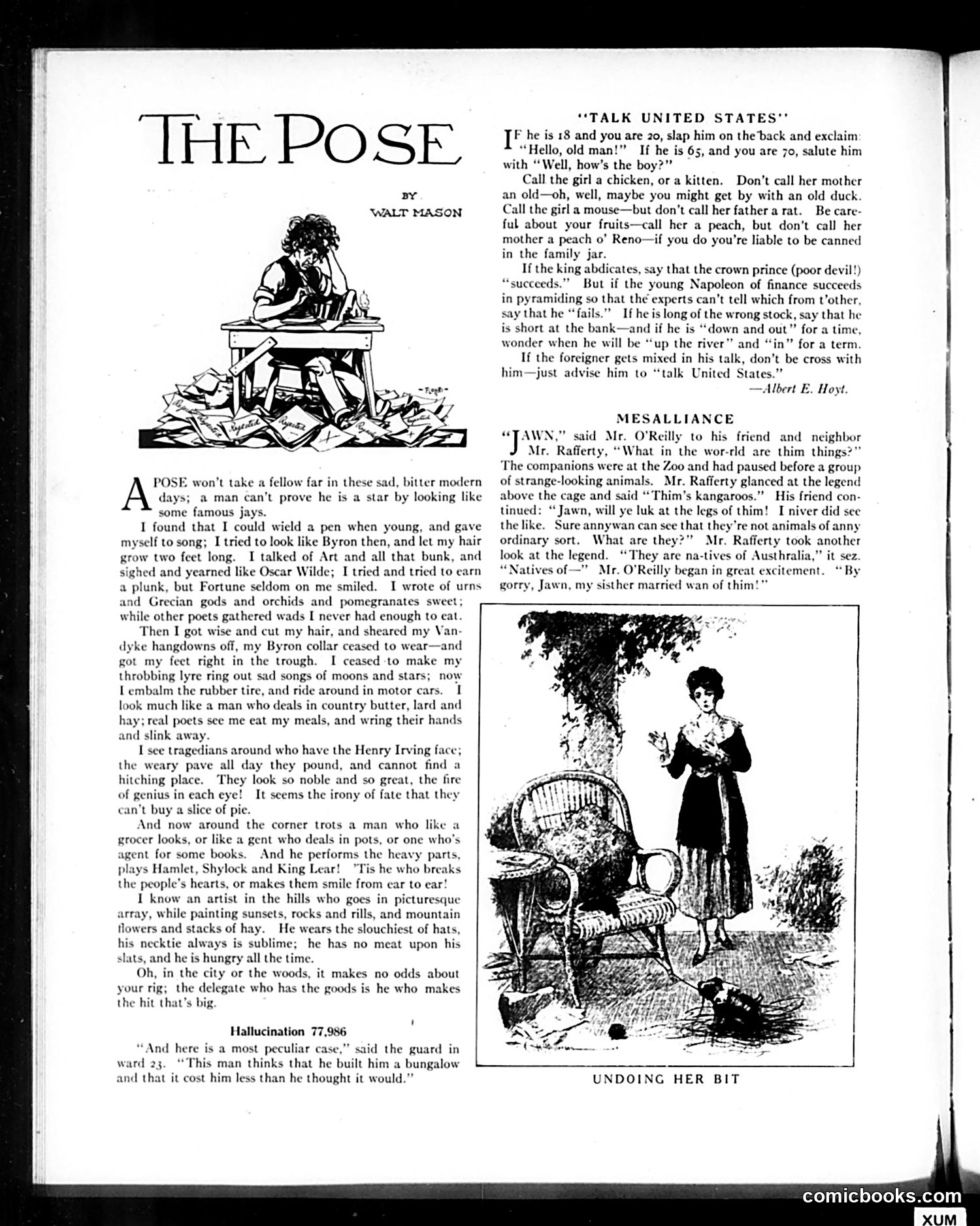
**"The Pose"** (by Walt Mason) satirizes artistic pretension in early 20th-century America. The poem mocks young men who adopt bohemian affectations—growing long hair, writing overwrought poetry about "urns and Grecian gods"—in imitation of famous poets like Byron and Oscar Wilde, hoping to succeed as artists. Mason's point: such posturing fails. Real success comes not from looking the part but from practical work. He contrasts failed romantic poets with successful businessmen who "deal in country butter, lard and hay" or perform Shakespeare—people who actually accomplish things. **"Mesalliance"** is a brief comedic anecdote about two Irish men (O'Reilly and Rafferty) at the zoo. They observe kangaroos and misread the label as "kangaroos" from "Austhralia." O'Reilly's punchline: his sister married one of these creatures—a joke about marrying a foreigner (Australian), presented as scandalously mismatched. Both pieces reflect period anxieties about authenticity versus pretense, and ethnic/cultural otherness.
📄 Transcribed text from this page (OCR, searchable)
Machine-transcribed from the original scan — historical spelling and the odd misread are preserved.
‘THE POSE POSE won't take a fellow far in these sad, bitter modern A days; a man can't prove he is a star by looking like some famous jays. I found that I could wield a pen when young, and gavi myself to song; I tried to look like Byron then, and let my hair grow two feet long. I talked of Art and all that bunk, and sighed and yearned like Oscar Wilde; I tried and tried to earn a plunk, but Fortune seldom on me smiled. I wrote of urns and Grecian gods and orchids and pomegranates sweet; “TALK UNITED STATES" F he is 18 and you are 20, slap him on the*back and exclaim “Hello, old man!” If he is 65, and you are 70, salute him with “Well, how’s the boy?”” Call the girl a chicken, or a kitten. Don’t call her mother an old—oh, well, maybe you might get by with an old duck. Call the girl a mouse—but don’t call her father a rat. Be care- ful about your fruits—call her a peach, but don’t call her mother a peach o’ Reno—if you do you're liable to be canned in the family jar. If the king abdicates, say that the crown prince (poor devil!) succeeds.” But if the young Napoleon of finance succeeds in pyramiding so that the experts can’t tell which from other, say that he “fails.” If he is long of the wrong stock, say that he is short at the bank—and if he is “down and out” for a time, wonder when he will be ‘up the river” and “in” for a term. If the foreigner gets mixed in his talk, don’t be cross with him—just advise him to “ tes.” —Albert E. Hoyt. MESALLIANCE “TAWN,” said Mr. O'Reilly to his friend and neighbor Mr. Rafferty, “What in the wor-rld are thim things?” ‘The companions were at the Zoo and had paused before a group of strange-looking animals. Mr. Rafferty glanced at the legend kangaroos.” His friend con- wn, will ye luk at the legs of thim! I niver did see the like. Sure annywan can see that they’re not animals of anny ordinary sort. What are they?” Mr. Rafferty took another look at the legend. “They are na-tives of Austhralia,” it sez. “N Mr. O'Reilly began in great excitement.“ By wn, my sisther married wan of thim!” while other poets gathered wads I never had enough to eat. Then I got wise and cut my hair, and sheared my Van- dyke hangdowns off, my Byron collar ceased to wear—and got my fect right in the trough. I ceased to make my throbbing lyre ring out sad songs of moons and stars; now Lembalm the rubber tire, and ride around in motor cars. I look much like a man who deals in country butter, lard and hay; real poets see me eat my meals, and wring their hands and slink a the weary pave all day they pound, and cannot find a hitching pla They look so noble and so great, the fire of genius in It seems the irony of fate that they can’t buy a And now around the corner trots a man who like a grocer looks, or like a gent who deals in pots, or one who's agent for some books. And he performs the heavy parts, plays Hamlet, Shylock and King Lear! "Tis he who breaks the people's hearts, or makes them smile from car to ear! I know an artist in the hills who goes in picturesque ‘ay, while painting sunsets, rocks and rills, and mountain flowers and stacks of hay. He w the slouchiest of hats, his necktie always is sublime; he has no meat upon his slats, and he is hungry all the time. Oh, in the city or the woods, it makes no odds about your rig; the delegate who has the goods is he who makes the hit that’s big. ' Hallucination 77, “And here is a most peculiar case,” said the guard in ward 23 his man thinks that he built him a bungalow and that it cost him less than he thought it would.” ] UNDOING HER BIT comicbooks.com