
Judge, 1917-09-08 · page 13 of 28
Judge — September 8, 1917 — page 13: what you’re looking at
What you’re looking at
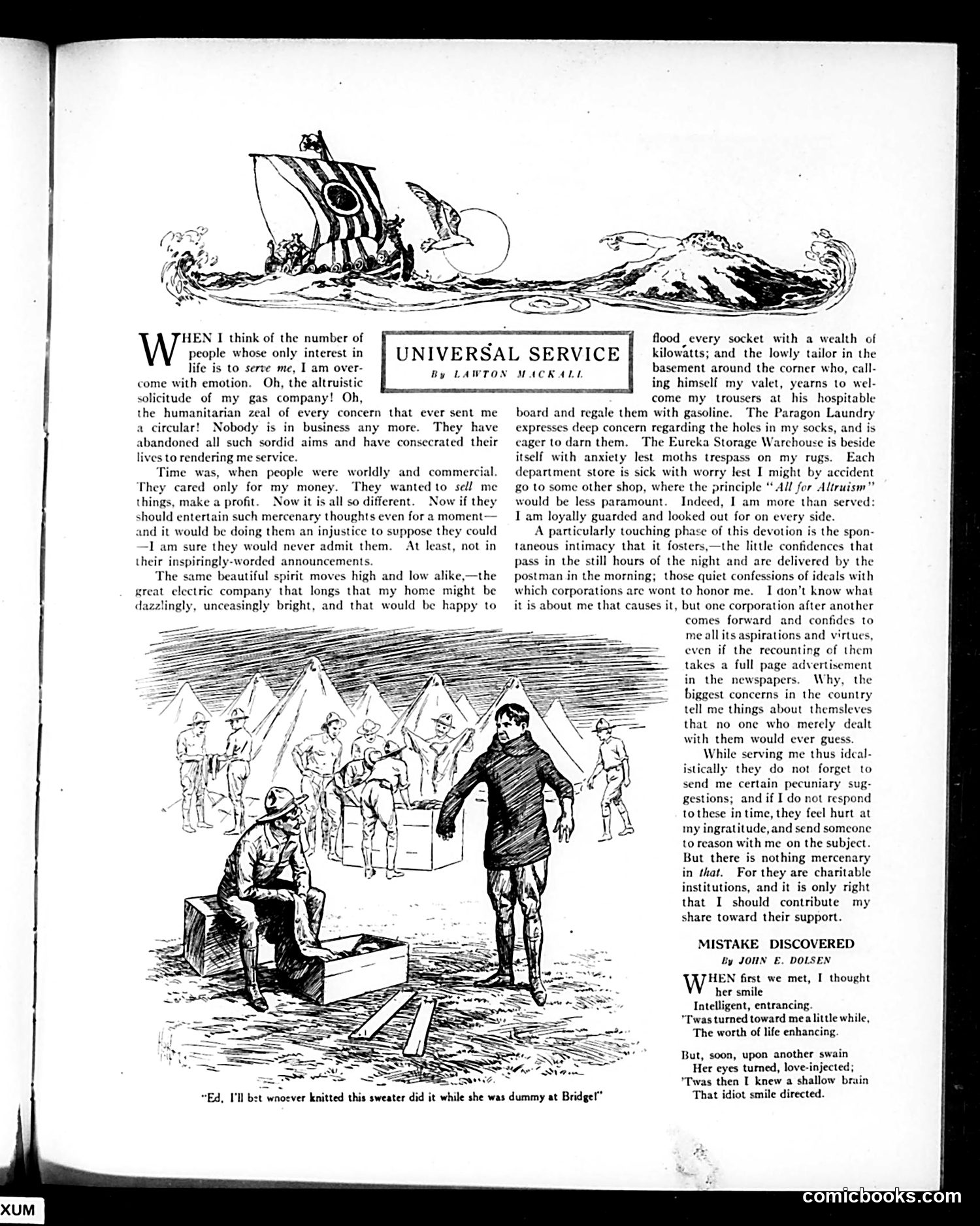
This page contains two distinct pieces: **"Universal Service" by Lawton Mackall** (main article with cartoon): A satirical essay mocking corporations' marketing language claiming to exist solely for the customer's benefit. The author observes that businesses now pretend their motivation is altruistic service rather than profit—their circulars and advertisements emphasize how much they "care" about him personally. The cartoon depicts soldiers in a military camp, with a caption about a sweater knitted while someone was a "dummy at Bridget"—likely a period reference to knitting circles or wartime production. The satire's point: big companies (electric utilities, laundries, department stores) cynically exploit emotional language and mass-mailing intimacy to manipulate consumers into loyalty while still demanding payment, yet hide their obvious profit motive behind hollow rhetoric about serving the public good. **"Mistake Discovered" by John E. Dolsen**: A brief poem about realizing a woman's charming smile was actually directed at someone else—revealing her shallow nature.
📄 Transcribed text from this page (OCR, searchable)
Machine-transcribed from the original scan — historical spelling and the odd misread are preserved.
HEN I think of the number of W people whose only interest in life is to serve me, 1 am over- come with emotion. Oh, the altruistic solicitude of my gas company! Oh, the humanitarian zeal of every concern that ever sent me a circular! Nobody is in business any more. They ha abandoned all such sordid aims and have consecrated their lives to rendering me service. Time was, when people were worldly and commercial. They cared only for my money. They wanted to sell me things, make a profit. Now it is all so different. Now if they should entertain such mercenary thoughts even for a moment— and it would be doing them an injustice to suppose they could am sure they would never admit them. At least, not in r inspiringly-worded announcements. The same beautiful spirit moves high and low alike,—the great electric company that longs that my home might be zlingly, unceasingly bright, and that would be happy to th UNIVERSAL SERVICE By LAWTON flood every socket with a wealth of kilowatts; and the lowly tailor in the basement around the corner who, call- ing himself my valet, yearns to wel- come my trousers at his hospitable board and regale them with gasoline. The Paragon Laundry expresses deep concern regarding the holes in my socks, and is cager to darn them. The Eureka Storage Warchouse is beside itself with anxiety lest moths trespass on my rugs. Each department store is sick with worry lest I might by accident go to some other shop, where the principle “ All for would be less paramount. Indeed, I am more t 1 am loyally A particularly touching ph; MACKALL ¢ of this devotion is the spon- taneous intimacy that it fosters,—the little confidences that pass in the still hours of the night and are delivered by the postman in the morning; those quiet confessions of ideals with which corporations arc wont to honor me. I don’t know what it is about me that causes it, but one corporation after another comes forward and confides to me all its aspirations and virtues, even if the recounting of them takes a full page advertisement in the newspapers. Why, the biggest concerns in the country tell me things about themsleves that no one who merely dealt with them would ever guess. While serving me thus idcal- istically they do not forget to send me certain pecuniary sug- gestions; and if I do not respond to these in time, they feel hurt at my ingratitude, and send someone to reason with me on the subject. But there is nothing mercenary in that. For they are charitable institutions, and it is only right that I should contribute my share toward their support. MISTAKE DISCOVERED By JOUN E. DOLSEN HEN first we met, I thought her smile Intelligent, entrancing. ’Twas turned toward mea little while, The worth of life enhancing. But, soon, upon another swain Her eyes turned, love-injected; "Twas then I knew a shallow brain That idiot smile directed.