
A complete issue · 28 pages · 1917
Judge — September 1, 1917
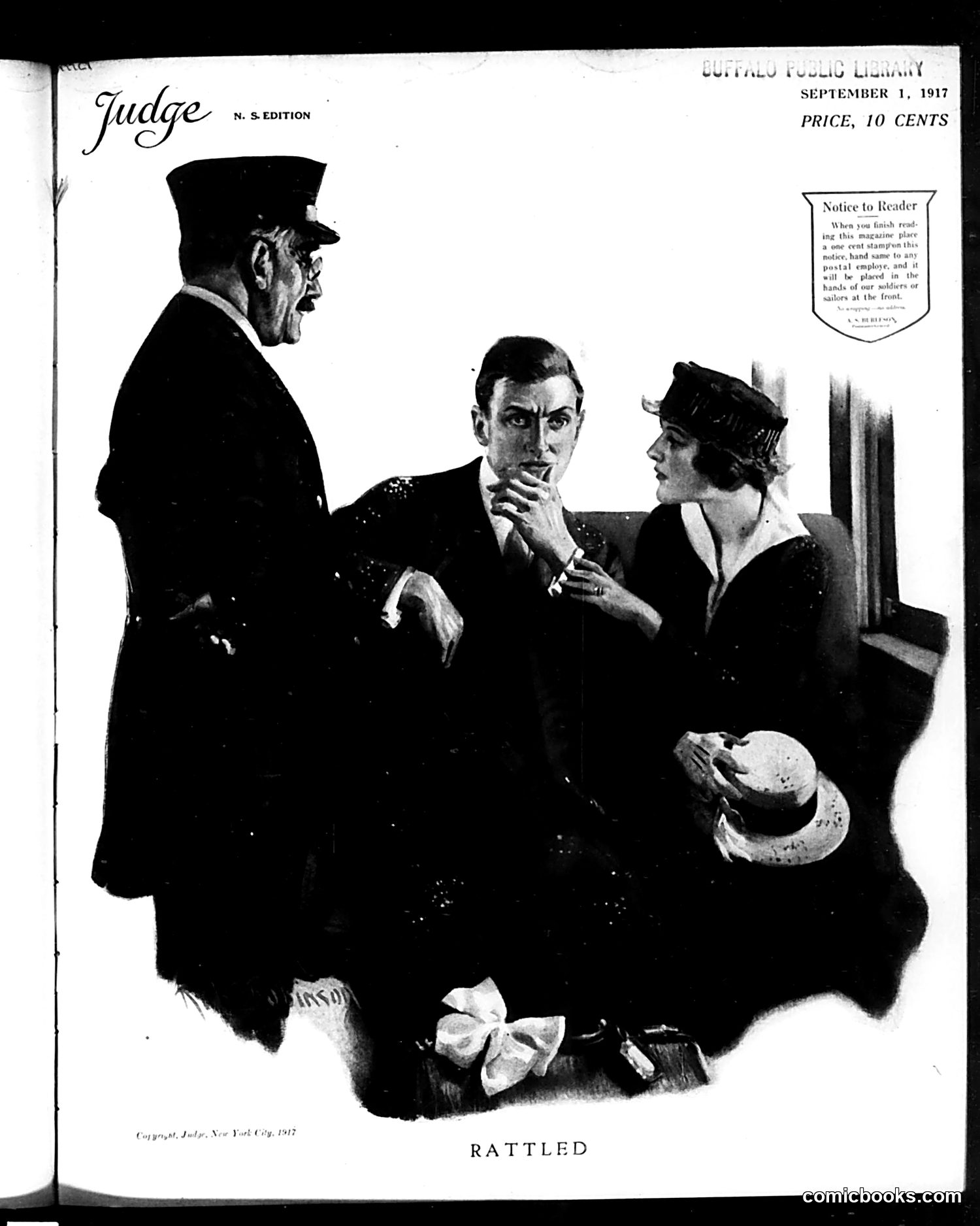
This cartoon depicts three figures in what appears to be a tense conversation. A uniformed official (likely military or postal authority, given the formal cap) stands confronting two civilians—a man in a suit who appears anxious, hand to his face, and a woman holding a hat. The title "Rattled" and the "Notice to Reader" box above suggest this satirizes wartime regulations about handling mail or packages. The woman's nervous demeanor and the man's worried expression suggest they've been "rattled" (disturbed/caught) by official scrutiny, possibly regarding suspicious mail during WWI when censorship and security concerns were heightened. The cartoon likely mocks public anxiety over wartime restrictions.
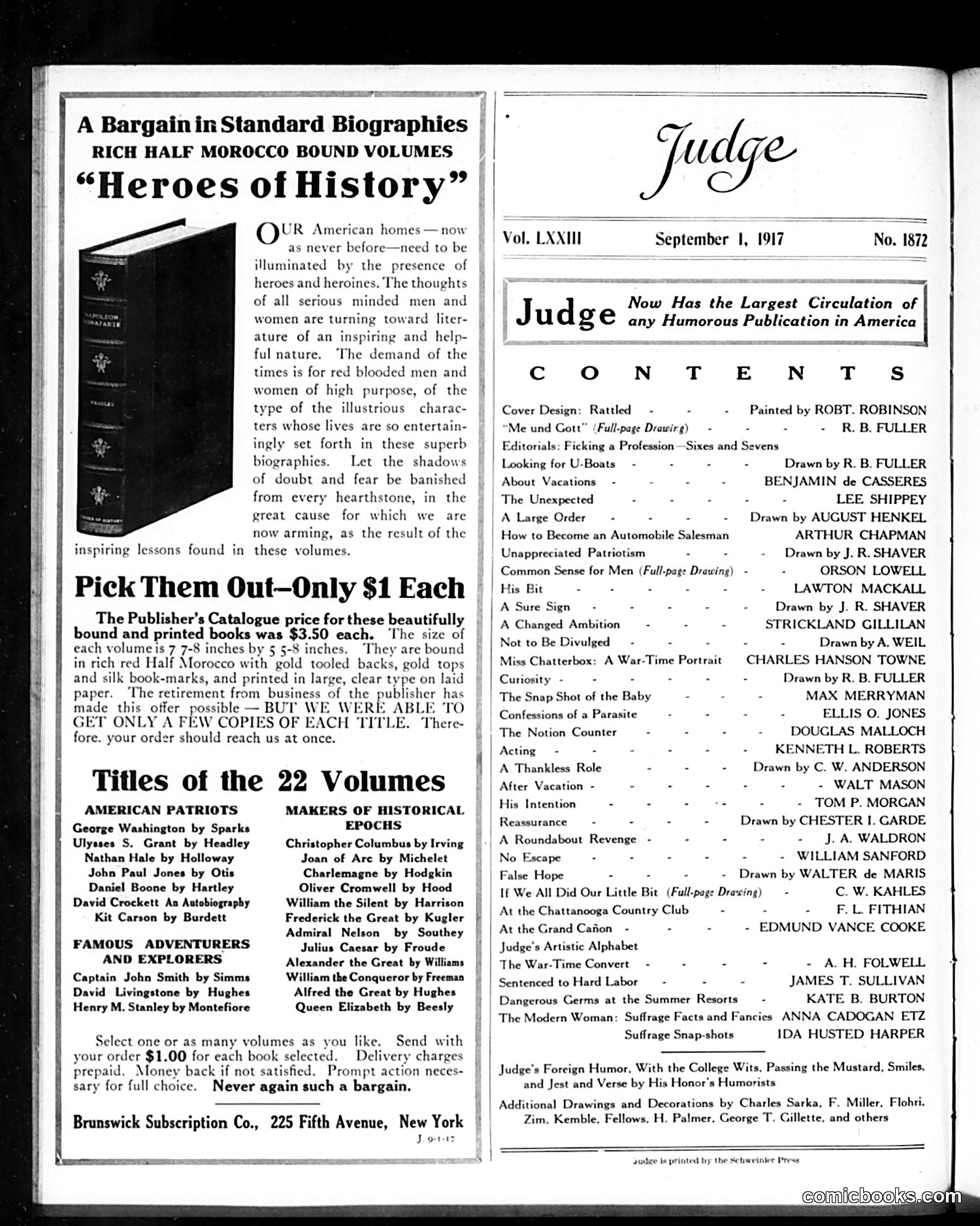
This page is primarily **advertising and table of contents** rather than political cartoons. The left side advertises "Heroes of History" biography volumes sold by Brunswick Subscription Co. at $1 each—a commercial pitch emphasizing inspiring biographical narratives for American readers during World War I era (the ad mentions "the great cause for which we are now arming"). The right side is Judge magazine's contents page (September 1, 1917, Vol. LXXIII). It lists numerous articles and illustrations, including pieces titled "Ficking a Profession," "Looking for U-Boats," and "The Unprotected," though without seeing the actual cartoons, their satirical meaning remains unclear. The contents suggest wartime-related humor typical of 1917 American satire. No specific political figures or caricatures are identifiable from this page.
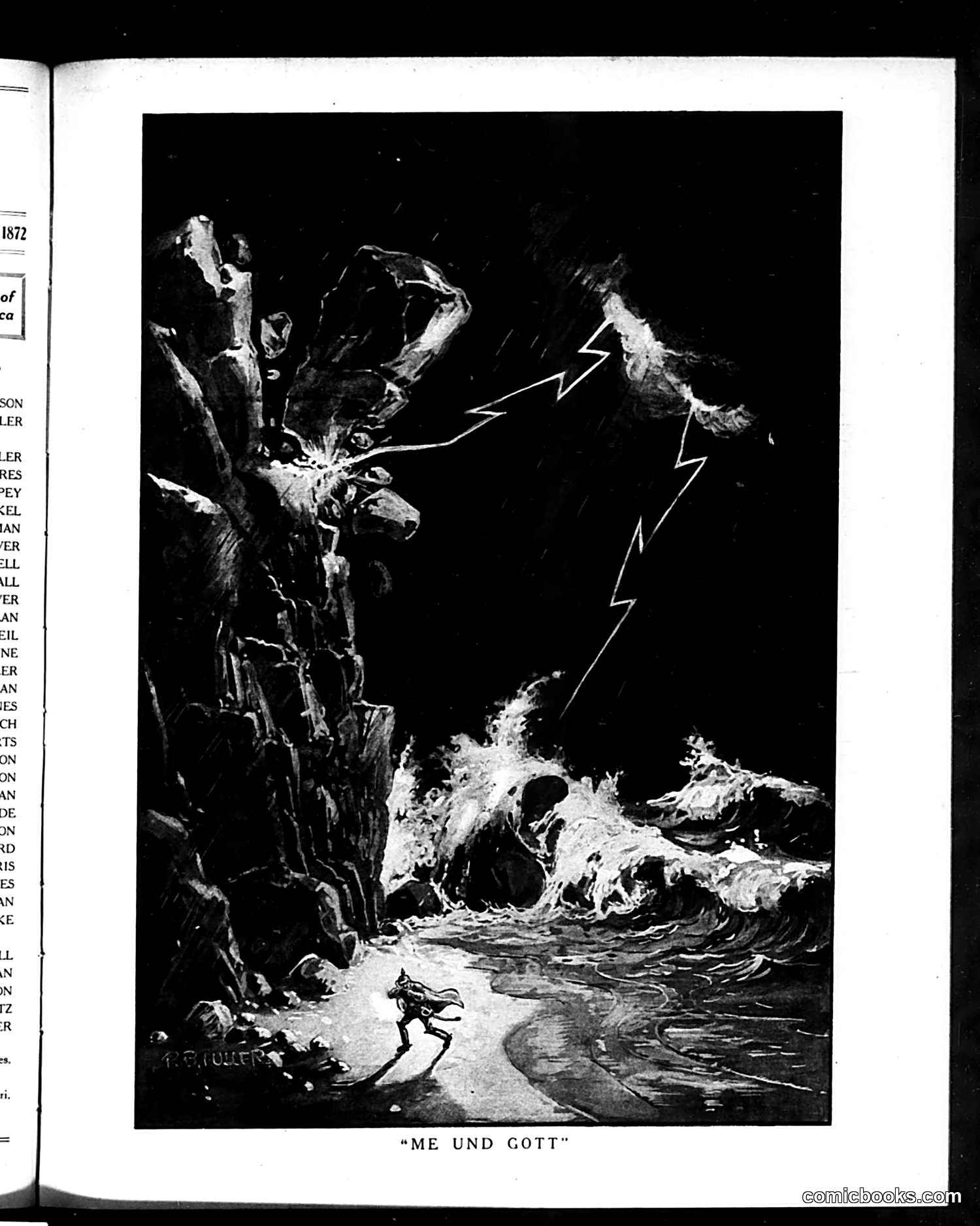
This dramatic illustration depicts a figure in a stormy, apocalyptic landscape with lightning striking down from above. The title "Me Und Gott" uses German, suggesting the cartoon targets German militarism or a German leader (likely from the WWI era, given Judge magazine's timeframe). The scene shows a solitary human figure dwarfed by towering, destructive forces—suggesting divine judgment against the subject. The lightning bolts and violent landscape imagery imply catastrophic consequences or divine punishment. Without additional text on the visible page, the exact identity remains unclear, but the satire appears to mock someone's grandiose claims or actions by invoking biblical-scale retribution. The German language choice points toward critiquing German political or military leadership.
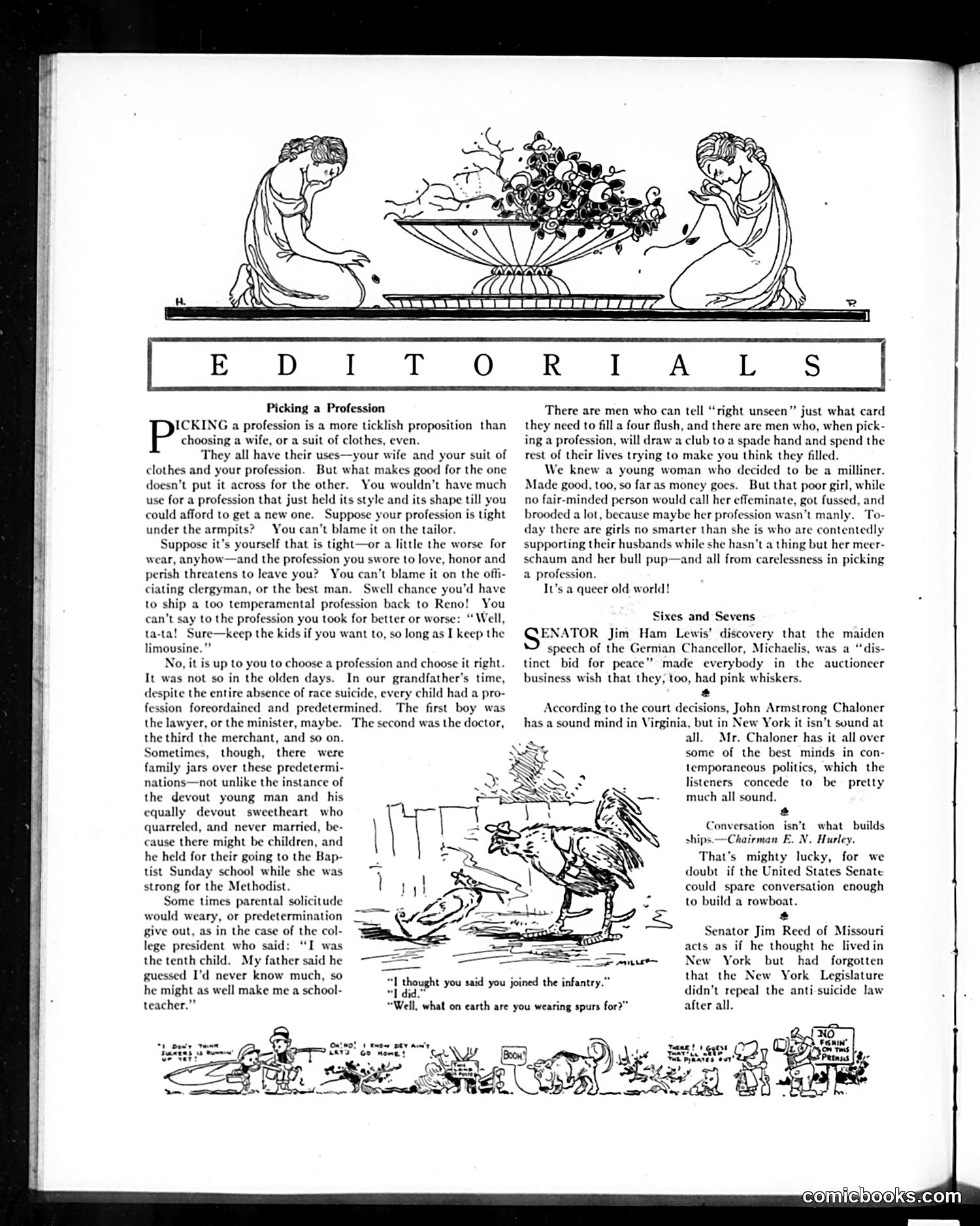
This page contains editorial content rather than political cartoons. The main article, "Picking a Profession," discusses how young people choose careers, noting that profession selection was historically predetermined by family tradition. The piece humorously laments modern uncertainty about vocational choice. The "Sixes and Sevens" section includes brief political commentary, mentioning Senator Jim Ham Lewis of the German Chancellor Michaelis, and Senator Jim Reed of Missouri regarding New York legislation on suicide laws. The central illustration depicts a military scene with the caption "I thought you said you joined the infantry" / "I did" / "Well, what on earth are you wearing spurs for?" — a joke about military uniform confusion rather than political satire.
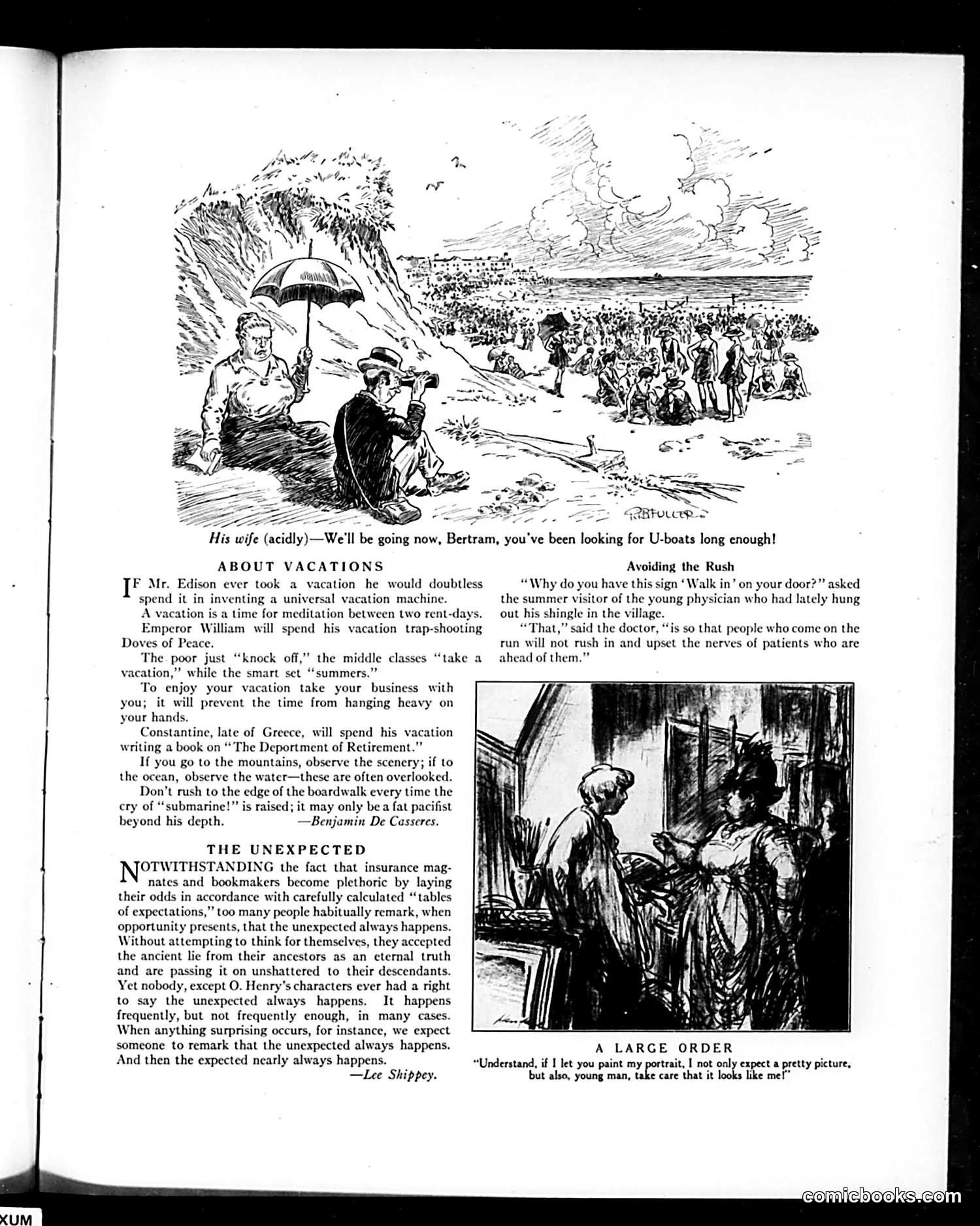
**Top Cartoon**: "His wife (acidly)—We'll be going now, Bertram, you've been looking for U-boats long enough!" This satirizes a husband obsessively searching for German U-boats (submarines) during what appears to be a beach vacation, likely referencing WWI-era anxiety. His wife's sarcastic comment mocks his paranoia—he's supposedly relaxing but remains fixated on military threats, unable to enjoy leisure time. **Text Sections**: "About Vacations" discusses vacation philosophy and avoiding summer crowds. "The Unexpected" quotes Lee Shippey on how the unexpected always occurs despite careful planning. **Bottom Illustration**: "A Large Order" depicts a portrait painter's interaction with a vain client demanding both flattery and accuracy—satirizing vanity and unrealistic expectations. The page emphasizes leisure, relaxation anxieties, and social pretension as recurring themes.
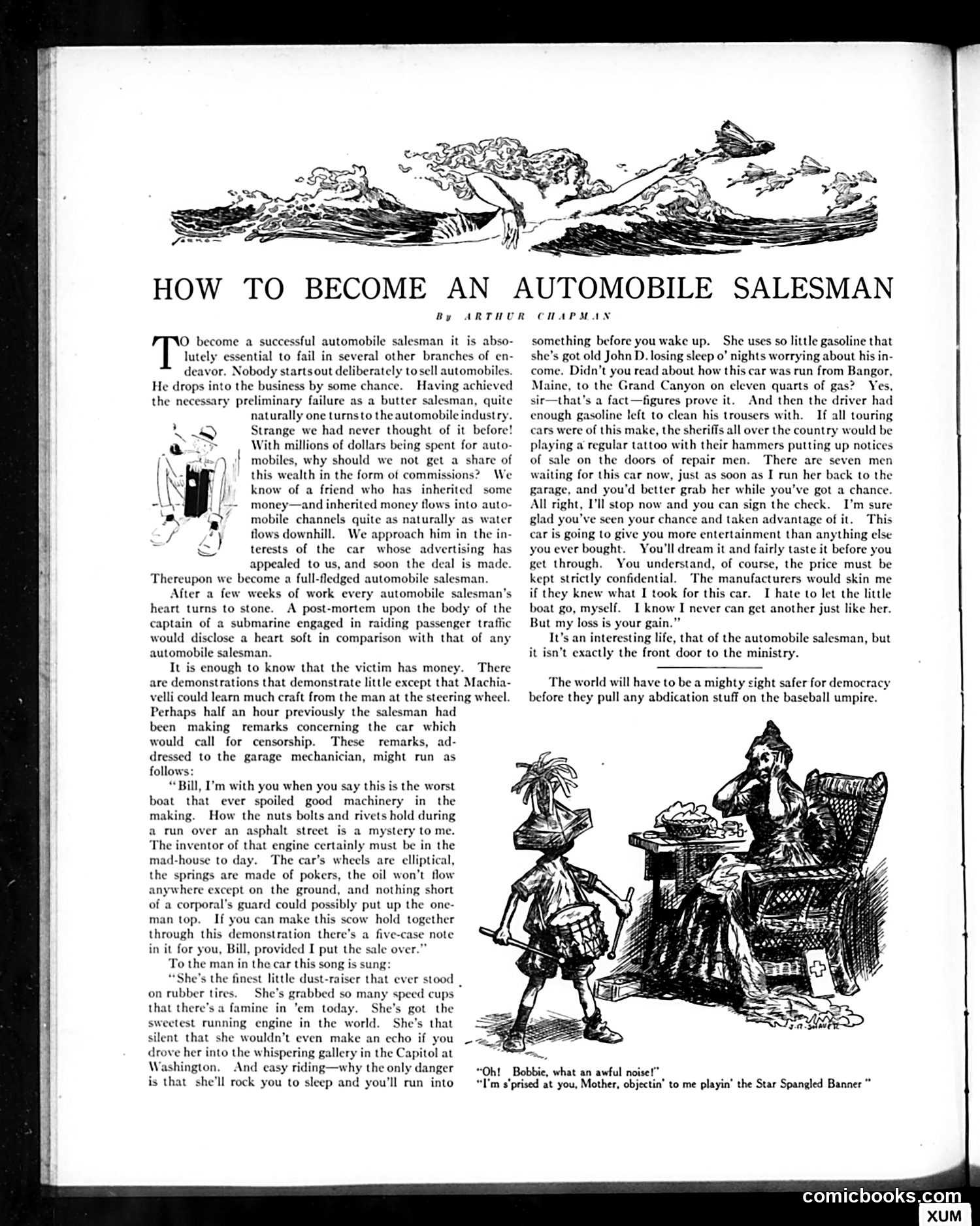
This article by Arthur Chapman satirizes automobile salesmen through humorous anecdotes about their dubious sales tactics and exaggerated claims. The main cartoon depicts a mother objecting to her son Bobbie playing "the Star Spangled Banner" loudly, suggesting the car's noise is so terrible it's compared to patriotic music played badly. The text mocks salesmen's deceptive practices—claiming cars use minimal gasoline, attributing grand achievements to mediocre vehicles, and fabricating technical specifications. Chapman compares selling cars to submarine captains "raiding passenger traffic," emphasizing the predatory nature of sales. The satire critiques early automobile industry's aggressive marketing culture and the gap between advertised promises and actual performance. The magazine targets both unscrupulous dealers and gullible consumers, reflecting public skepticism about emerging automotive commerce.
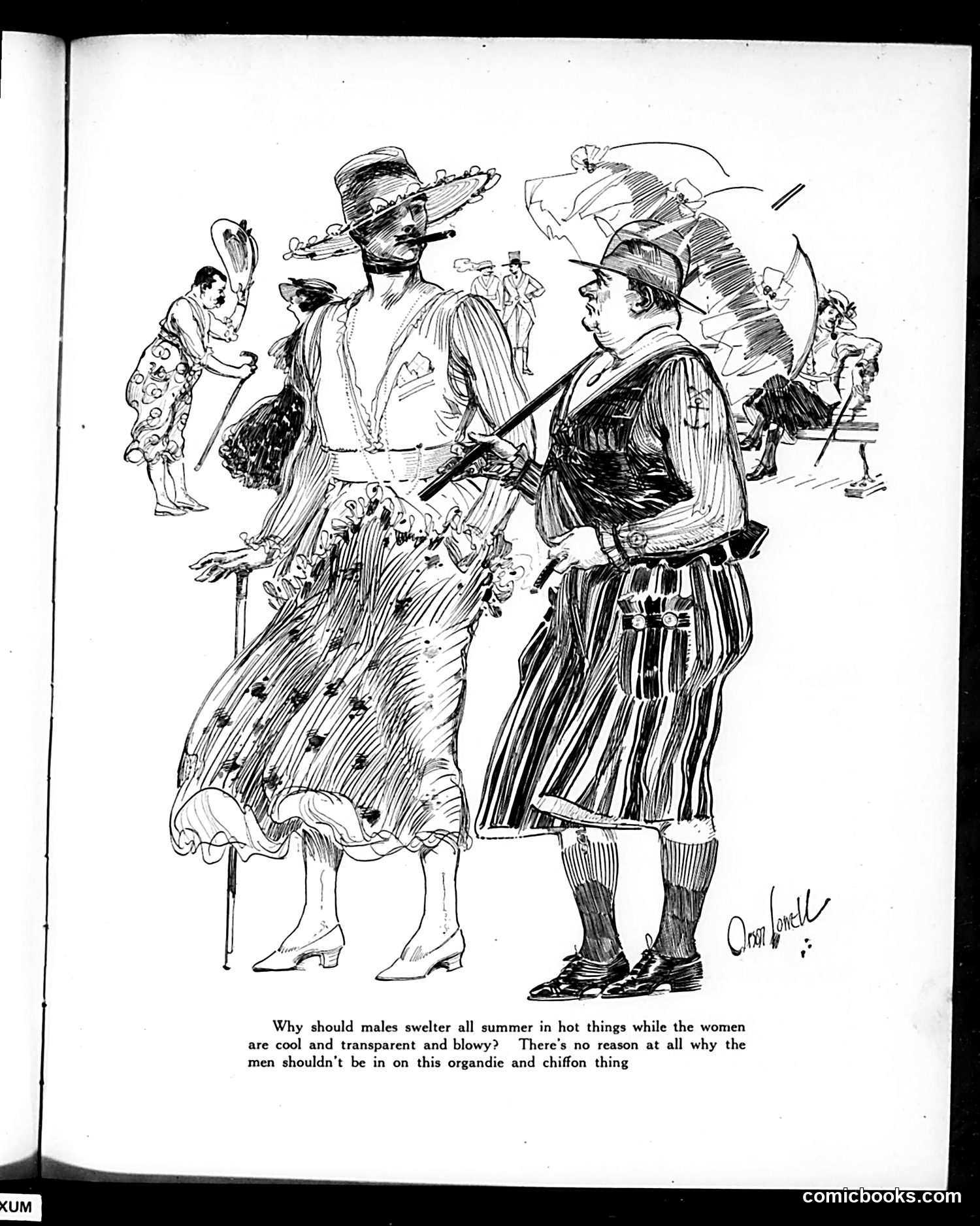
This cartoon satirizes early-20th-century gender norms around summer clothing. The caption argues men should wear the same light, breathable fabrics (organdie and chiffon) that women wear in hot weather, rather than being confined to heavy wool suits. The cartoon shows men in traditional formal attire (suits, hats) appearing uncomfortable, while women wear flowing, airy dresses. The satire mocks the impracticality and arbitrariness of gendered dress codes—why should comfort be denied to men based merely on convention? This reflects a broader period of fashion and social change, likely from the 1910s-1920s when gender roles faced increasing scrutiny. The cartoon's humorous approach to this "radical" idea (men wearing light fabrics) reveals how strictly enforced these social conventions actually were. It's essentially arguing: comfort shouldn't be gendered.
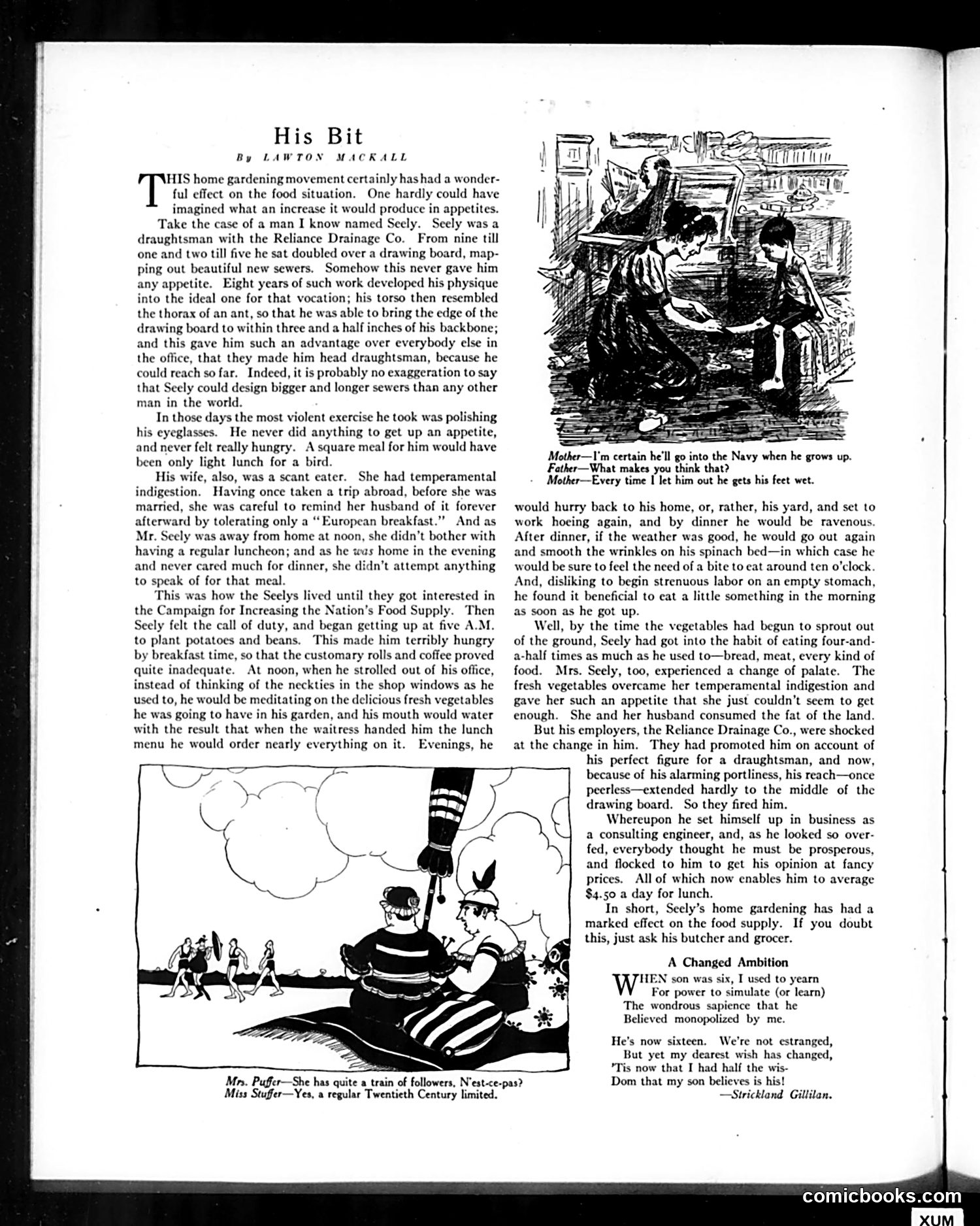
This article satirizes the unintended consequence of America's WWI-era home gardening campaign (the "Food Supply" initiative). The story follows Seely, a thin office draughtsman whose sedentary work left him perpetually without appetite. When he joins the patriotic gardening movement, the physical labor awakens his hunger dramatically—he begins eating four-and-a-half times his normal amount, as does his wife. The satire's point: the government's well-intentioned food-conservation campaign backfired by creating *more* food consumption among participants. His employers, who had valued his thin frame as ideal for reaching across drafting boards, grow dismayed at his newfound portliness, essentially undoing the productivity gains they'd gained from his physique. The humor lies in this ironic reversal—Seely's patriotic duty produces the opposite of intended results.
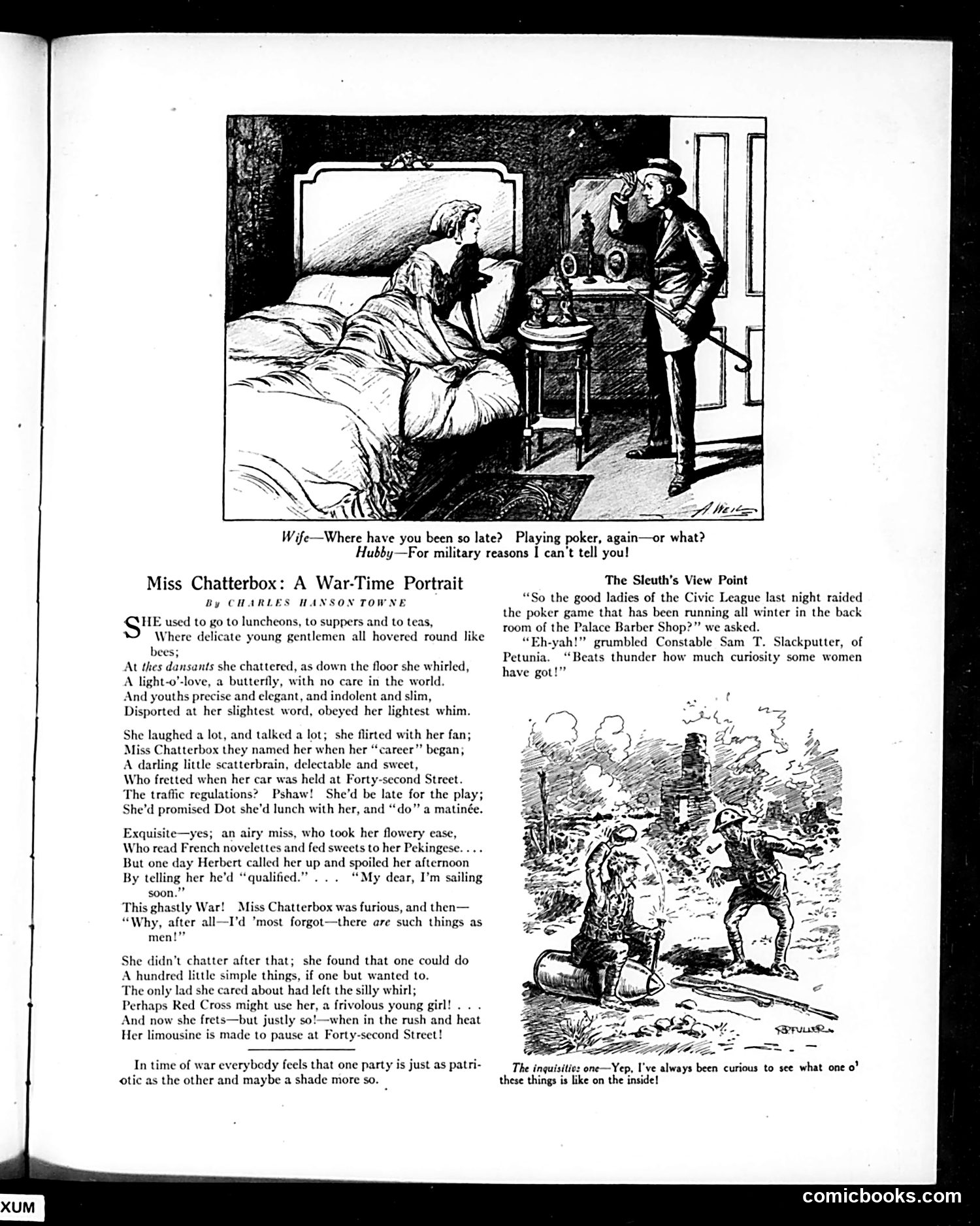
This page contains two satirical pieces about wartime social behavior during WWI: **"Miss Chatterbox: A War-Time Portrait"** critiques a frivolous society woman who suddenly becomes serious when her boyfriend Herbert announces he's enlisted ("qualified"). The poem contrasts her pre-war obsession with parties, French novels, and traffic delays with her newfound patriotic commitment to Red Cross work. The satire suggests the war transformed even shallow socialites into more responsible citizens. **"The Sleuth's View Point"** is a brief two-panel joke about gender hypocrisy: a husband uses "military reasons" to avoid explaining his late-night poker games, while the accompanying cartoon shows women from the "Civic League" raiding the illegal poker operation at a barber shop. The constable's irritation at their curiosity mocks both the deception and the women's moral policing. Together, these pieces satirize how WWI disrupted normal social rules and exposed contradictions in wartime behavior.
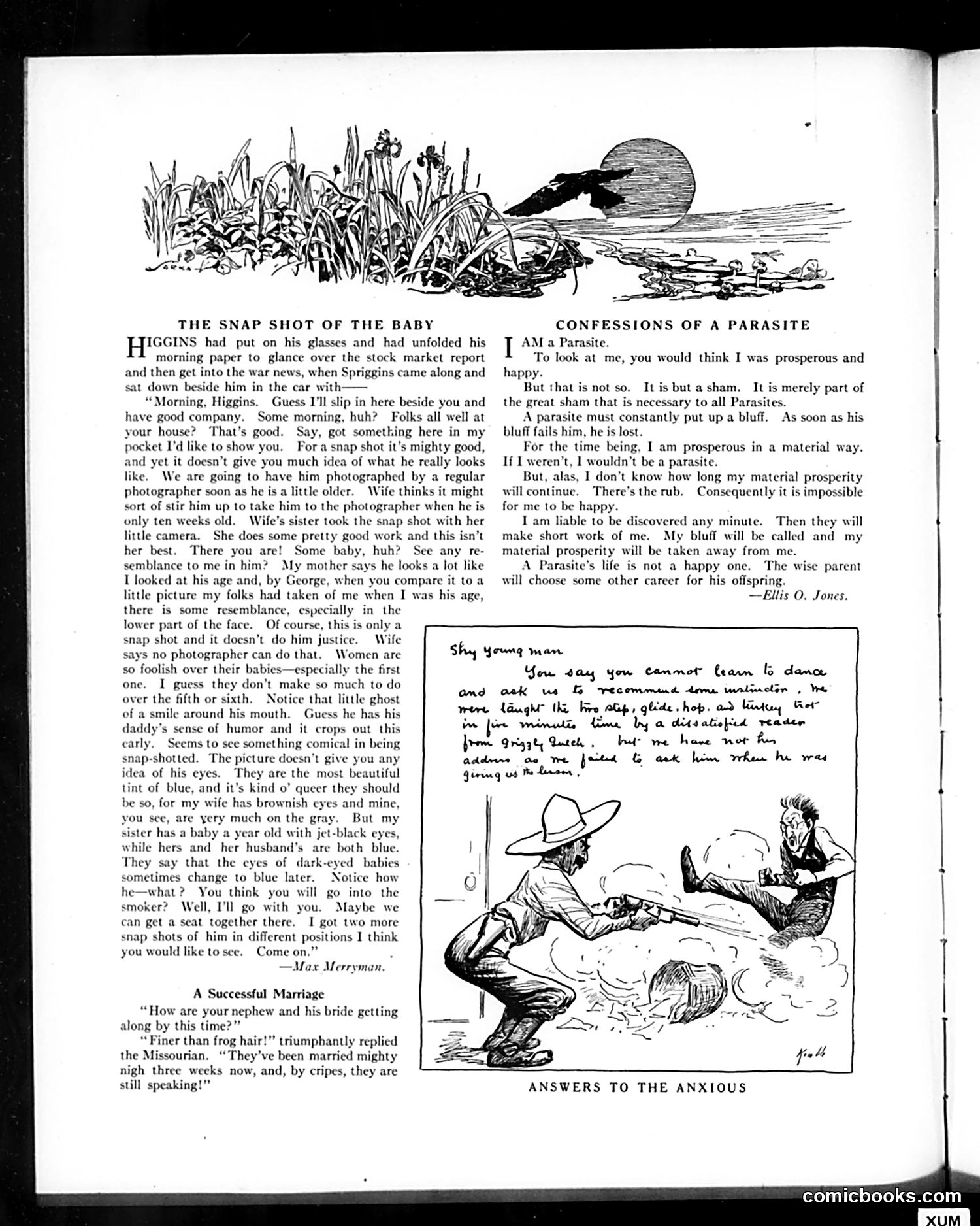
This page contains three satirical pieces typical of early 20th-century American humor: **"The Snap Shot of the Baby"** mocks new fathers' tedious enthusiasm for showing baby photographs to captive audiences. Spriggins traps Higgins in a car to display an unflattering photo, then offers to show more in the smoker—satirizing how new parents bore anyone within reach with inferior snapshots while making elaborate excuses for the pictures' poor quality. **"A Successful Marriage"** is a brief joke about a nephew and bride who've been married three weeks yet still speak to each other—implying most marriages quickly descend into silence, a common period joke about marital discord. **"Confessions of a Parasite"** features a monologue (by Ellis O. Jones) from someone living as a social or financial dependent, constantly maintaining a false appearance of prosperity. The confession warns that parasites live in constant fear of exposure and collapse, making a cautionary tale against such dependency. The page illustrates Judge's blend of domestic humor, social commentary, and lighthearted cynicism about marriage and social pretense.
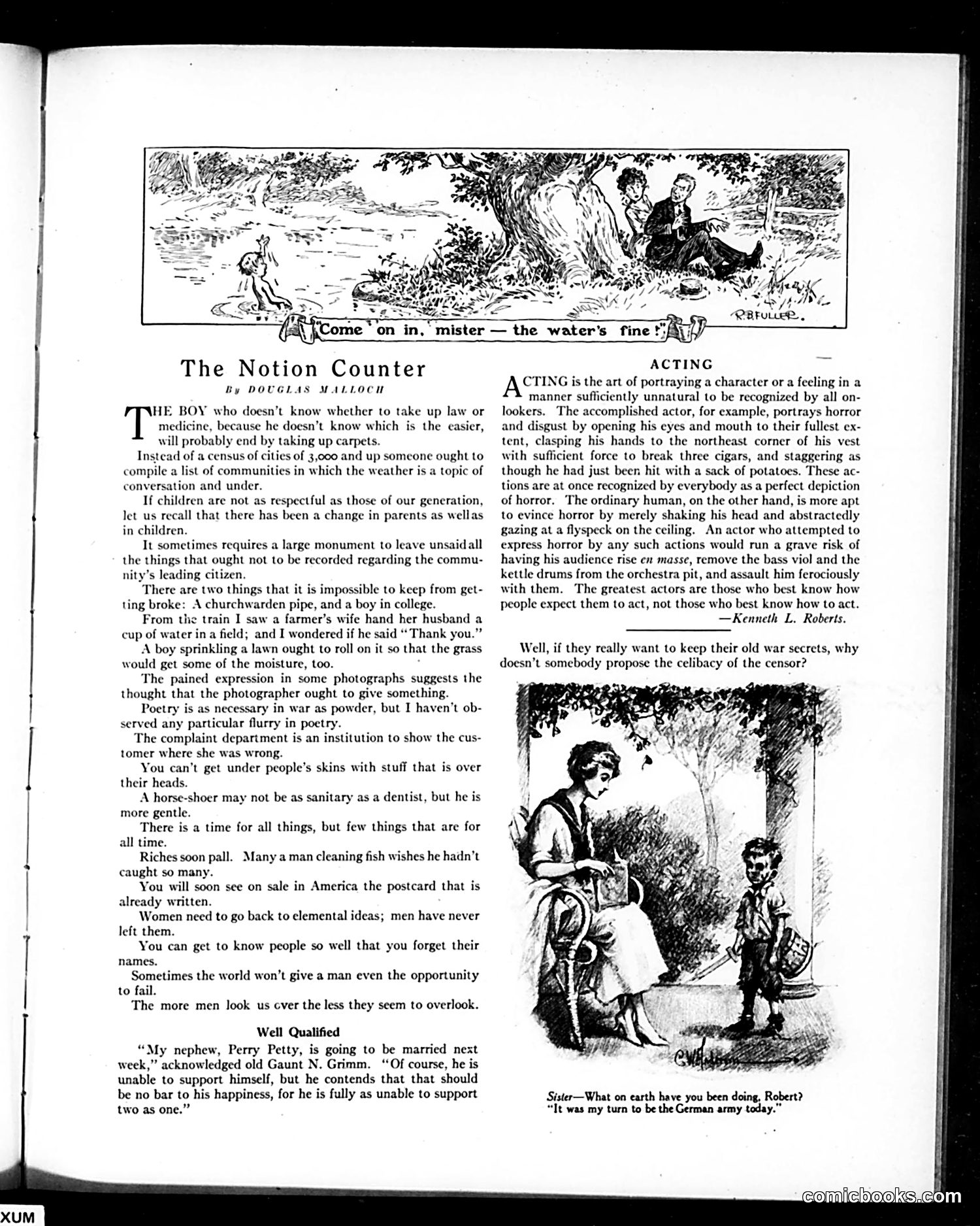
This Judge magazine page contains two distinct pieces of social commentary: **"The Notion Counter"** is a humorous column of brief observations about human nature and social foibles—mostly aphorisms about laziness, hypocrisy, and the disconnect between appearance and reality. There's no specific political target; it's general satire of everyday life. **"Acting"** is a cynical essay (attributed to Kenneth L. Roberts) mocking theatrical performance as pure artifice. The author argues that accomplished actors succeed not by genuinely understanding human emotion, but by performing exaggerated, unnatural gestures that *audiences expect* to see. The satire criticizes both actors and audiences for preferring theatrical convention over authentic human behavior. **The cartoon** shows a child explaining to his sister that he's been "playing German army"—likely a WWI-era reference to children's war games mimicking contemporary military conflict. The overall theme: society values performative exaggeration over authenticity, whether on stage or in daily life.
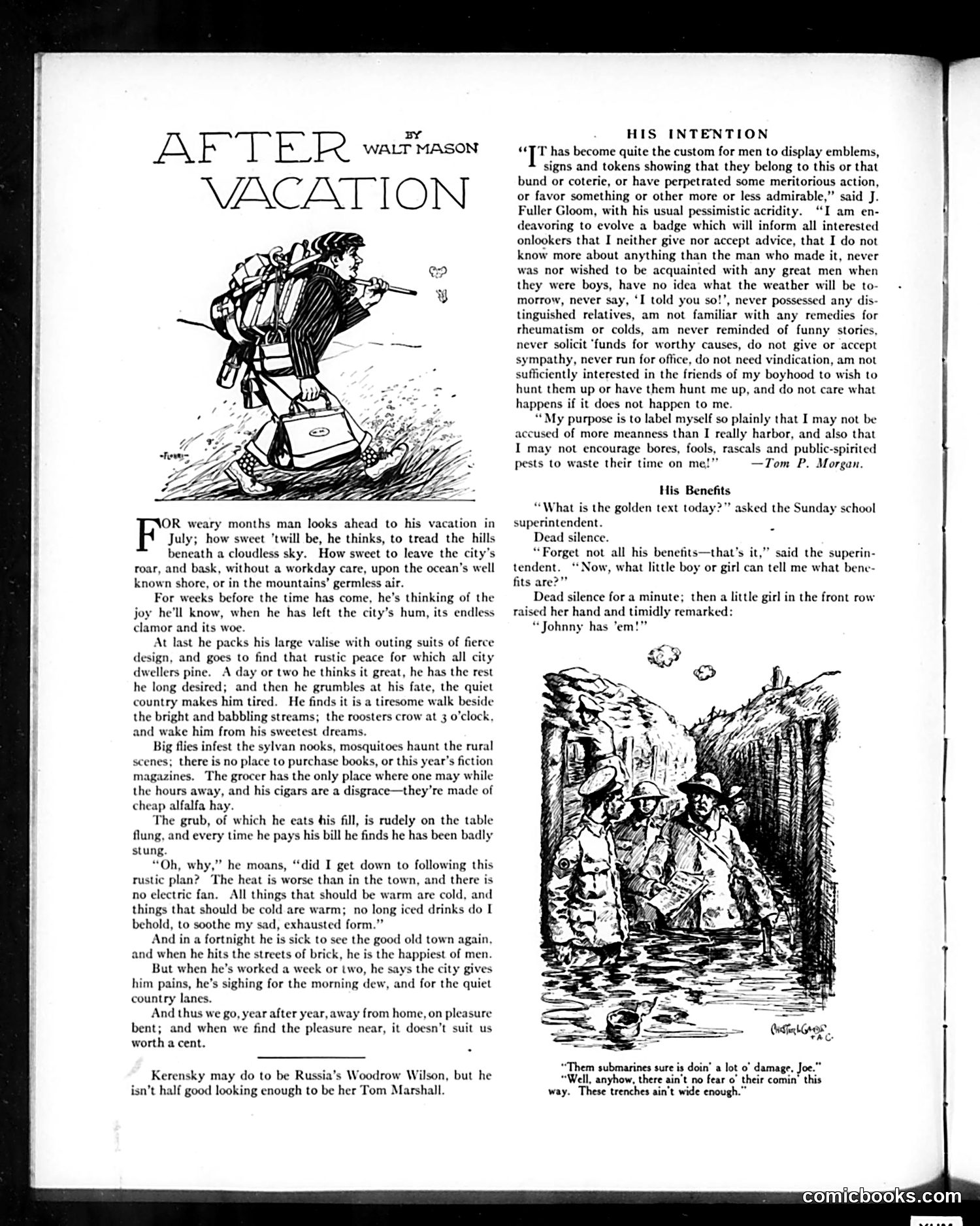
This page satirizes the common middle-class vacation fantasy versus reality. The main article mocks urbanites who romanticize rustic retreats for months, imagining peaceful countryside escape. Upon arrival, the protagonist discovers rural life miserable: mosquitoes, early-crowing roosters, bad food, expensive groceries, no electric fans, and boredom. Within two weeks he craves the city. Yet returning to work, he immediately yearns for country quiet again—an endless, futile cycle of discontent. The humor derives from recognizing this universal pattern: vacation promises happiness but delivers disappointment; city life seems unbearable until you leave it. A secondary satirical piece, "His Intention," mocks a cynical character (J. Fuller Gloom) designing a badge advertising his profound indifference and unsociability—listing every way he won't help, advise, or engage others. It's dark humor about cultivating deliberate unpleasantness as identity. A brief final joke about biblical Sunday school instruction adds light relief.
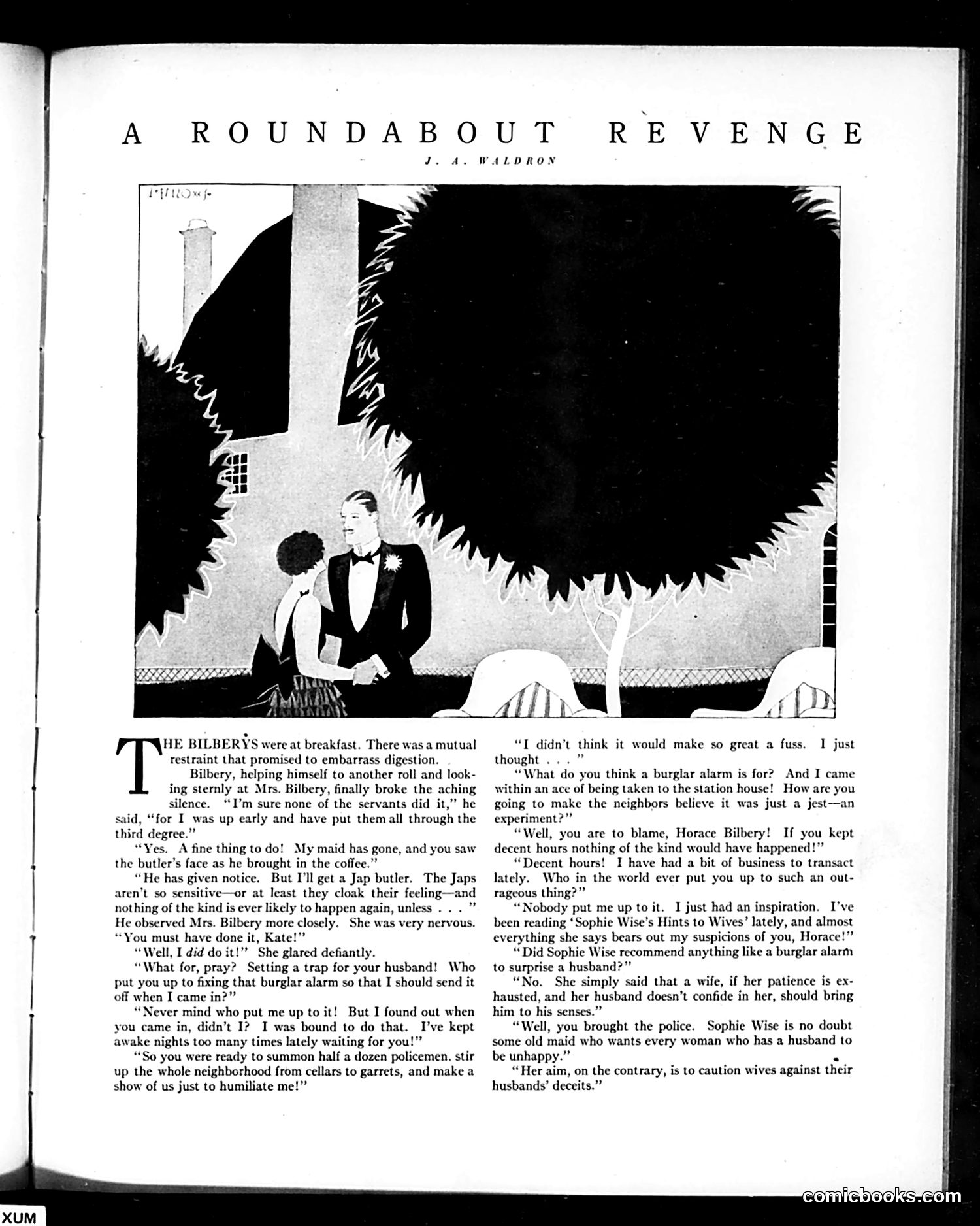
This is a domestic comedy depicting marital conflict. Mr. Bilbery has come home late, prompting his suspicious wife Kate to set a burglar alarm as a trap—triggering a police response that embarrasses them both publicly. The satire targets early 20th-century gender dynamics: Kate has been reading "Sophie Wise's Hints to Wives," a self-help advice column that apparently encourages wives to police their husbands' behavior and demand accountability for late hours. Bilbery dismisses Sophie Wise as "some old maid," while Kate weaponizes the advice to expose what she suspects is infidelity or deception. The joke relies on the era's tension between wives' limited power and their growing assertiveness. Kate's "revenge" backfires spectacularly—the very public humiliation undermines her goal. The cartoon satirizes both suspicious wives and evasive husbands, suggesting neither relationship strategy serves domestic harmony. The reference to hiring a Japanese butler reflects period attitudes about immigrant labor's perceived docility.
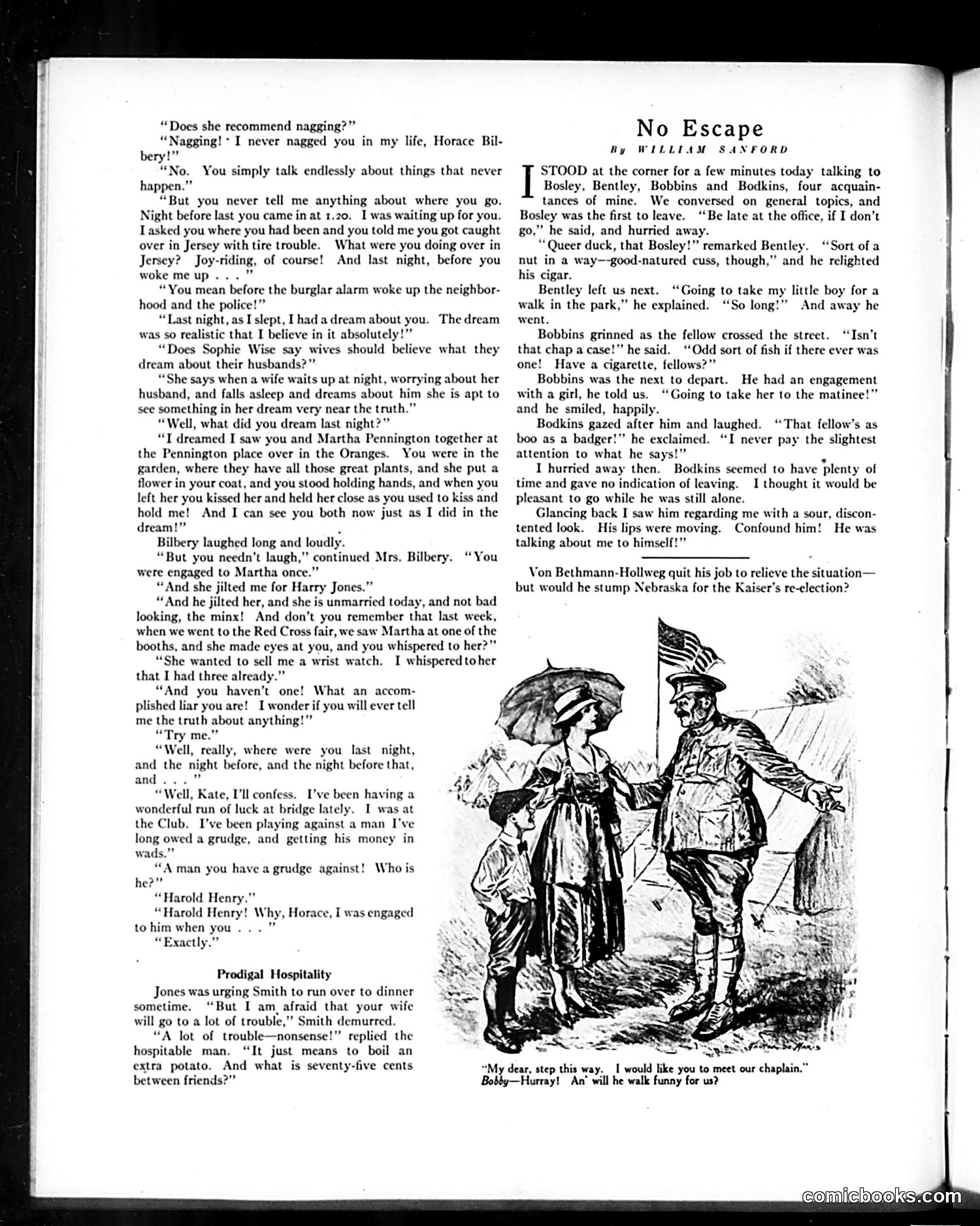
This page contains two distinct pieces: a marital comedy dialogue and a satirical sketch. The main story, "No Escape" by William Sanford, depicts a husband (Horace Bilbery) caught in domestic entanglement. His wife Kate confronts him about late nights, suspicious behavior with an ex-fiancée (Martha Pennington), and lies about his whereabouts. Bilbery eventually confesses he's been gambling at his club, winning money from Harold Henry—who was *also* engaged to Kate previously. The satire highlights the inescapable web of small-town social connections and past romantic entanglements that trap even guilty husbands. The secondary piece, "Prodigal Hospitality," mocks working-class pretense: a man invites a friend to dinner, dismissing concerns about trouble by claiming it "just means to boil an extra potato," reducing hospitality to 75 cents' worth of effort—suggesting stingy superficiality disguised as friendliness. The illustration shows a soldier and woman, likely supporting the magazine's patriotic content typical of this era.
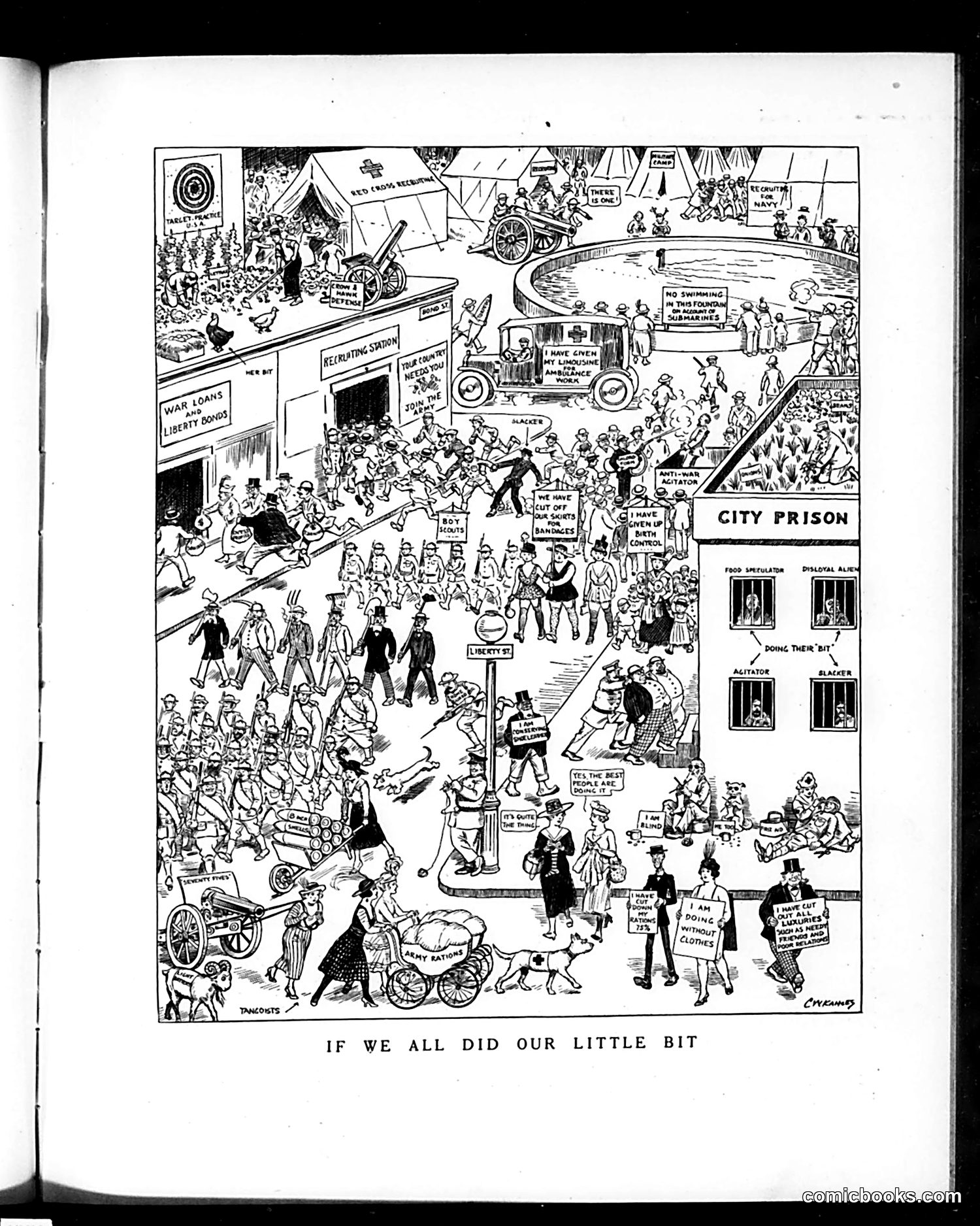
This Judge magazine cartoon depicts a bustling public carnival or fair promoting civic contributions during what appears to be World War I. The title "If We All Did Our Little Bit" references the patriotic slogan encouraging Americans to support the war effort through various means. The scene shows multiple booths and attractions: War Loans, Liberty Bonds, a recruiting station, and displays labeled with military and civilian activities. A "City Prison" section appears on the right with inmates visible behind bars—likely sarcastically suggesting that those not contributing to war efforts belong in jail. The cartoon satirizes how thoroughly war mobilization penetrated American civilian life, turning public spaces into recruitment and fundraising venues. It mocks the pressure on citizens to demonstrate patriotic commitment through financial and military participation, implying that refusing to "do your bit" was socially unacceptable or even criminal.
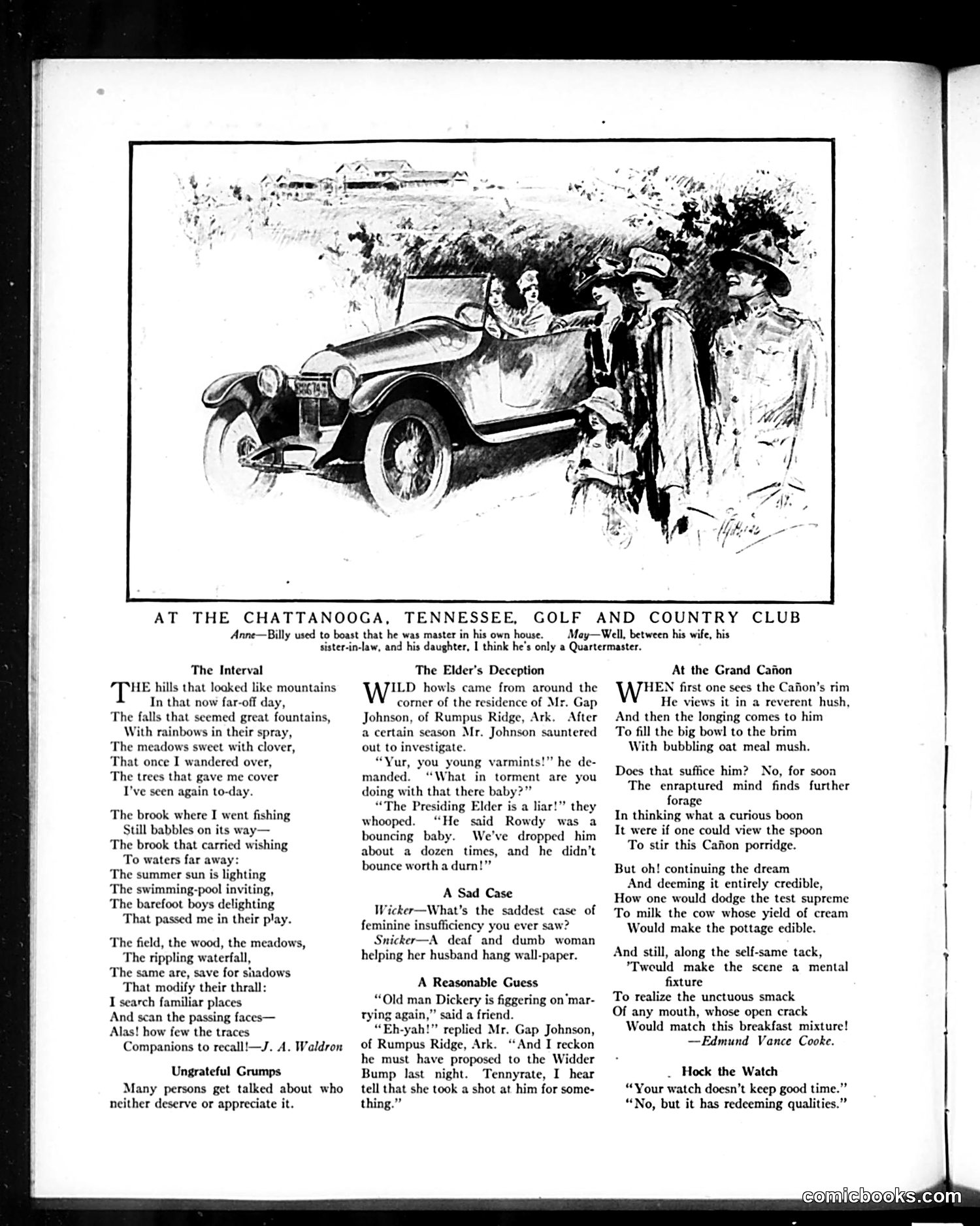
This Judge magazine page from the early 1900s contains a cartoon and several humorous pieces set in rural Arkansas. The illustration shows a well-dressed couple at a country club, with a caption joking that Billy "used to boast" he was master of his own house—suggesting his wife now dominates him, a common domestic humor trope of the era. The text pieces are mostly light rural comedy featuring "Mr. Gap Johnson of Rumpus Ridge, Ark," a yokel character. They play on stereotypes: children testing whether a preacher lied about a baby "bouncing," a deaf-dumb woman incompetently helping hang wallpaper (mocking female capability), and a man proposing to a widow who shoots at him. The other pieces are sentimental poetry and brief jokes about timekeeping. The satire is gentle and relies on period assumptions about gender roles, rural ignorance, and marital dynamics that would seem dated today.
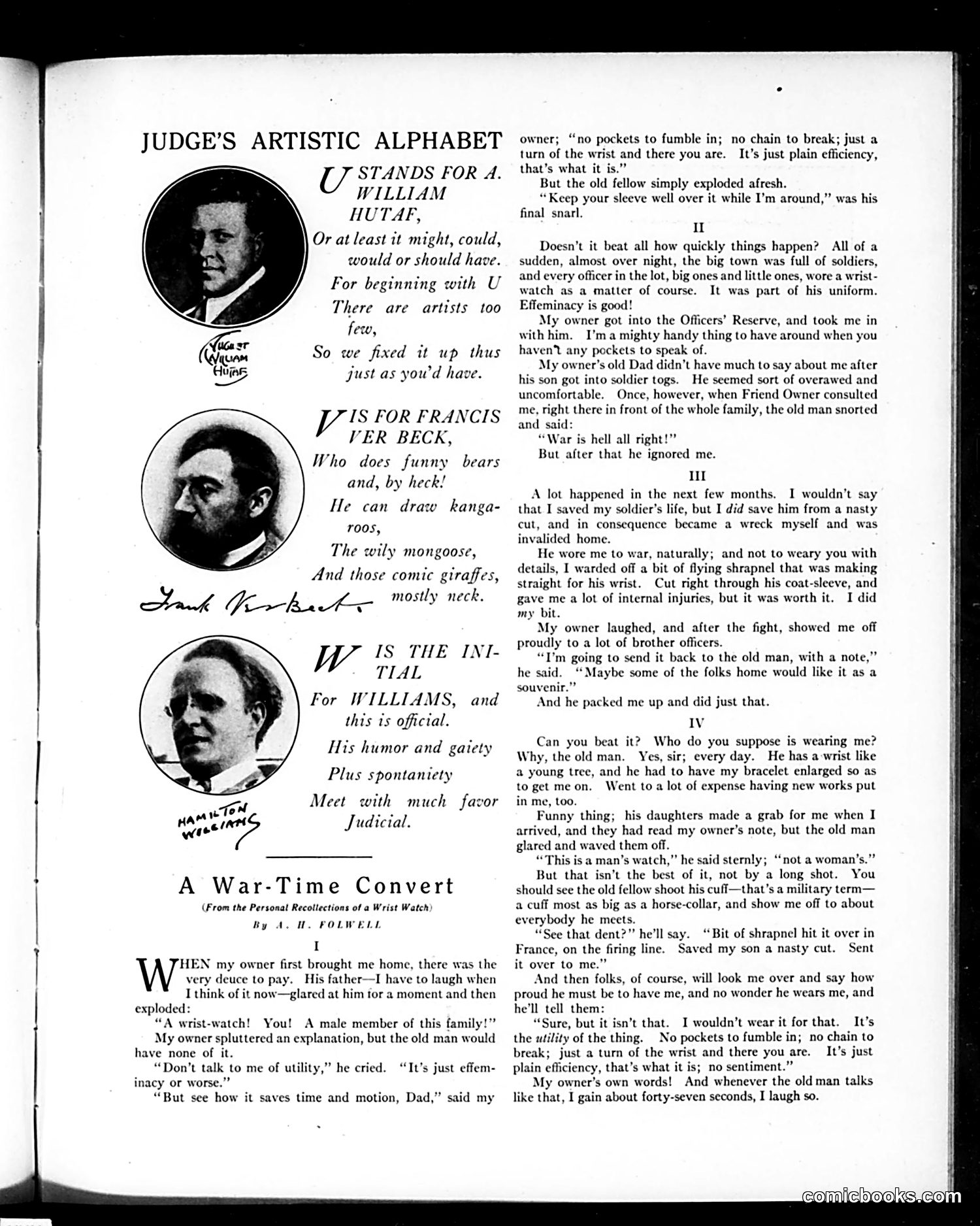
This page contains two distinct satirical pieces: **"Judge's Artistic Alphabet"** features caricatures of three American cartoonists: A. William Hutaf, Francis Ver Beck (known for animal comics), and Hamilton Williams. This is lighthearted professional tribute humor, playfully justifying why these artists deserve spots in an artistic alphabet despite the scarcity of "U" and "W" names. **"A War-Time Convert"** is the main piece—a humorous story narrated by a wrist watch. It satirizes changing gender attitudes during World War I. Initially, the old father dismisses his son's wrist-watch as "effeminate," but when soldiers adopt them as practical military equipment, he accepts them as masculine. When his son's watch saves him from shrapnel and is returned home, the father becomes its proud wearer, constantly showing off the dent as a war souvenir. The satire mocks how the same object transforms from "unmanly" to heroic simply through wartime context and military association.
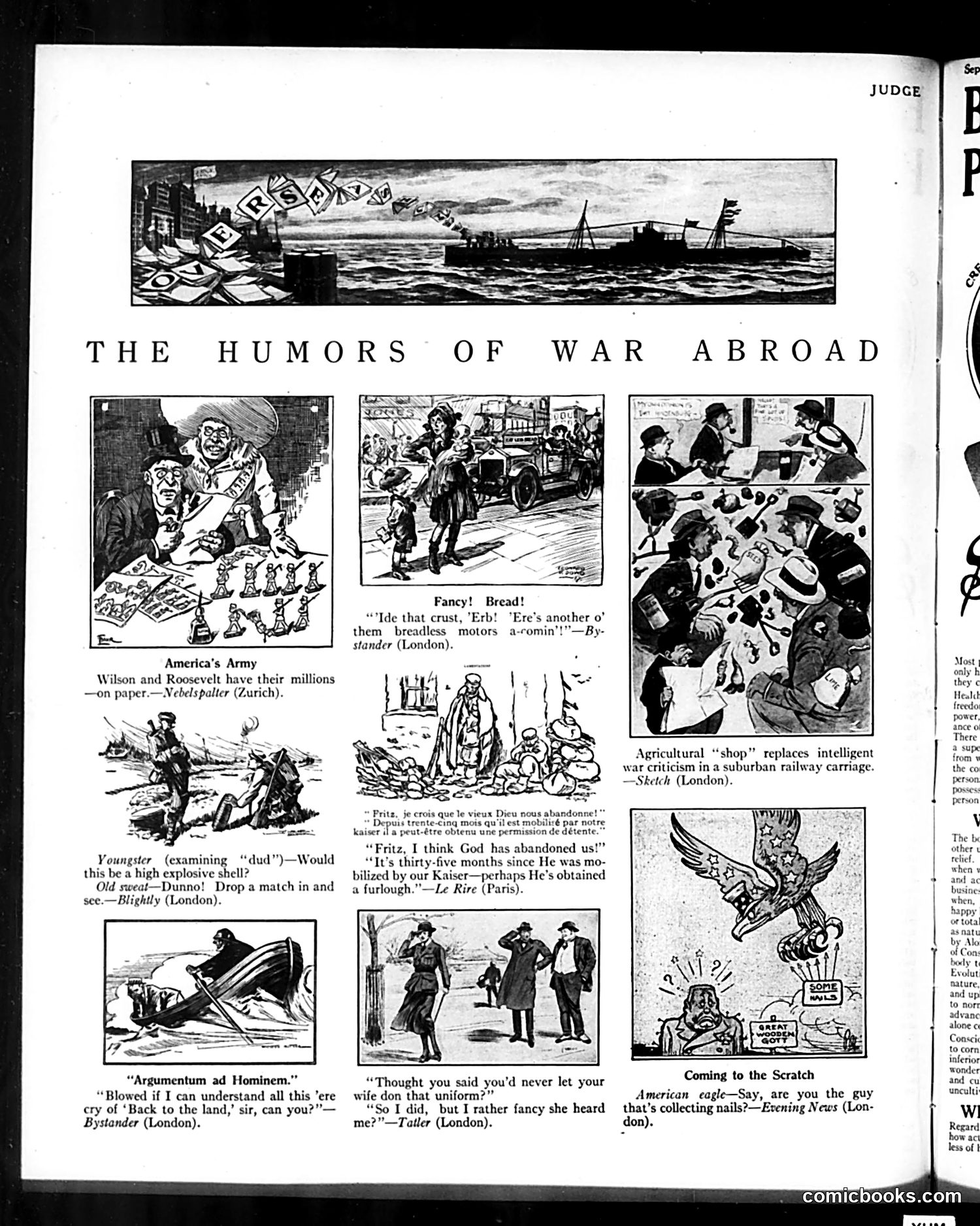
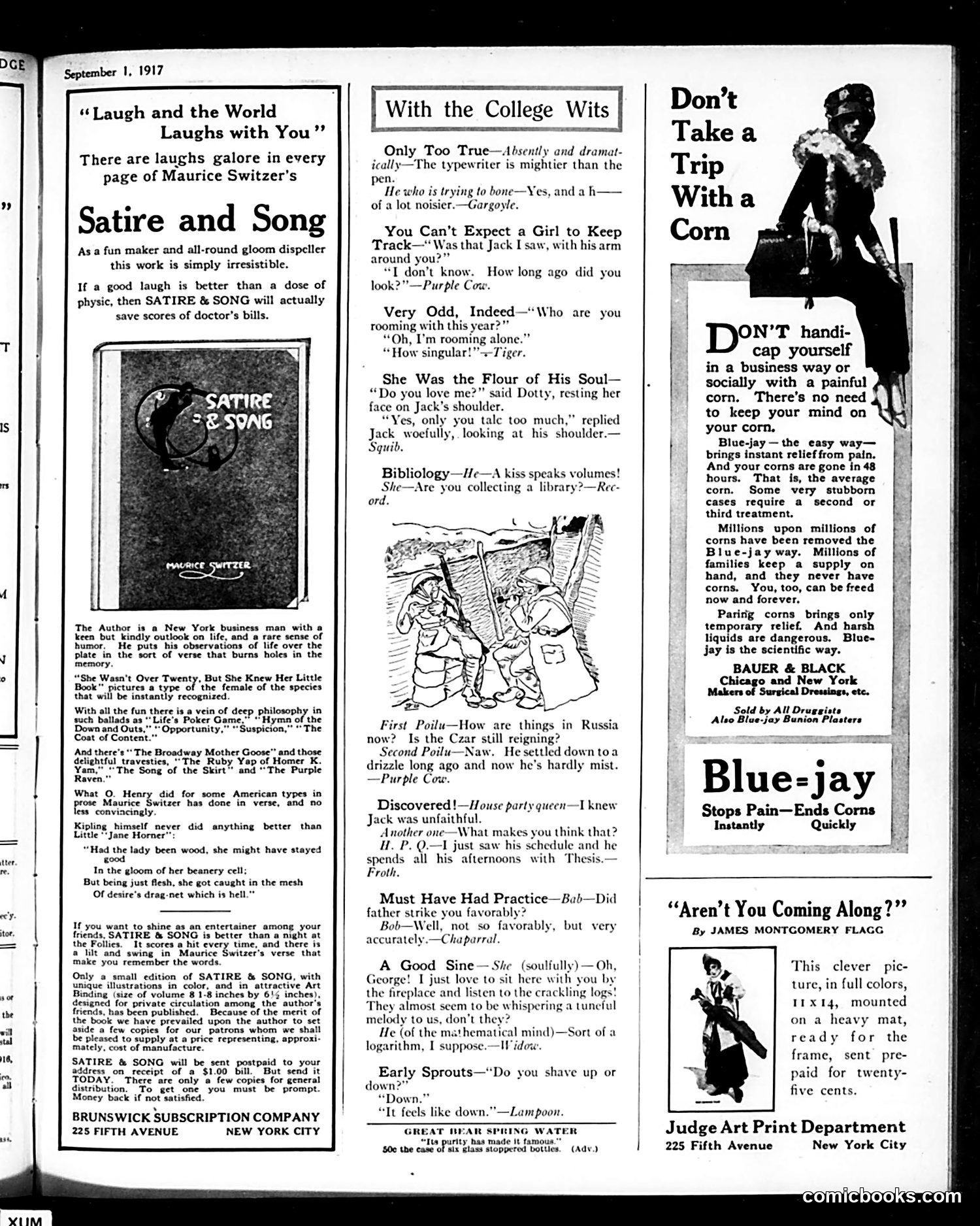
This Judge page collects war-related cartoons from international sources, satirizing WWI-era absurdities. Key themes: **Political figures**: Wilson and Roosevelt are mocked for their paper millions—suggesting inflated promises or resources. **Military incompetence**: A British "old sweat" (veteran) suggests testing a dud shell with a match, satirizing military bungling. **Home front privation**: "Breadless motors" jokes about fuel/food rationing; civilians questioned about "back to the land" agricultural programs seem confused. **German despair**: A German soldier suggests God has abandoned them after 35 months of Kaiser conscription—dark humor about war's duration and futility. **Women's roles**: A wife wearing a military uniform despite her husband's objection reflects changing wartime gender dynamics. The page's title and sourcing from international publications (Zurich, London, Paris) suggest Judge presented international war commentary to American readers, finding dark humor in universal wartime confusion and suffering.
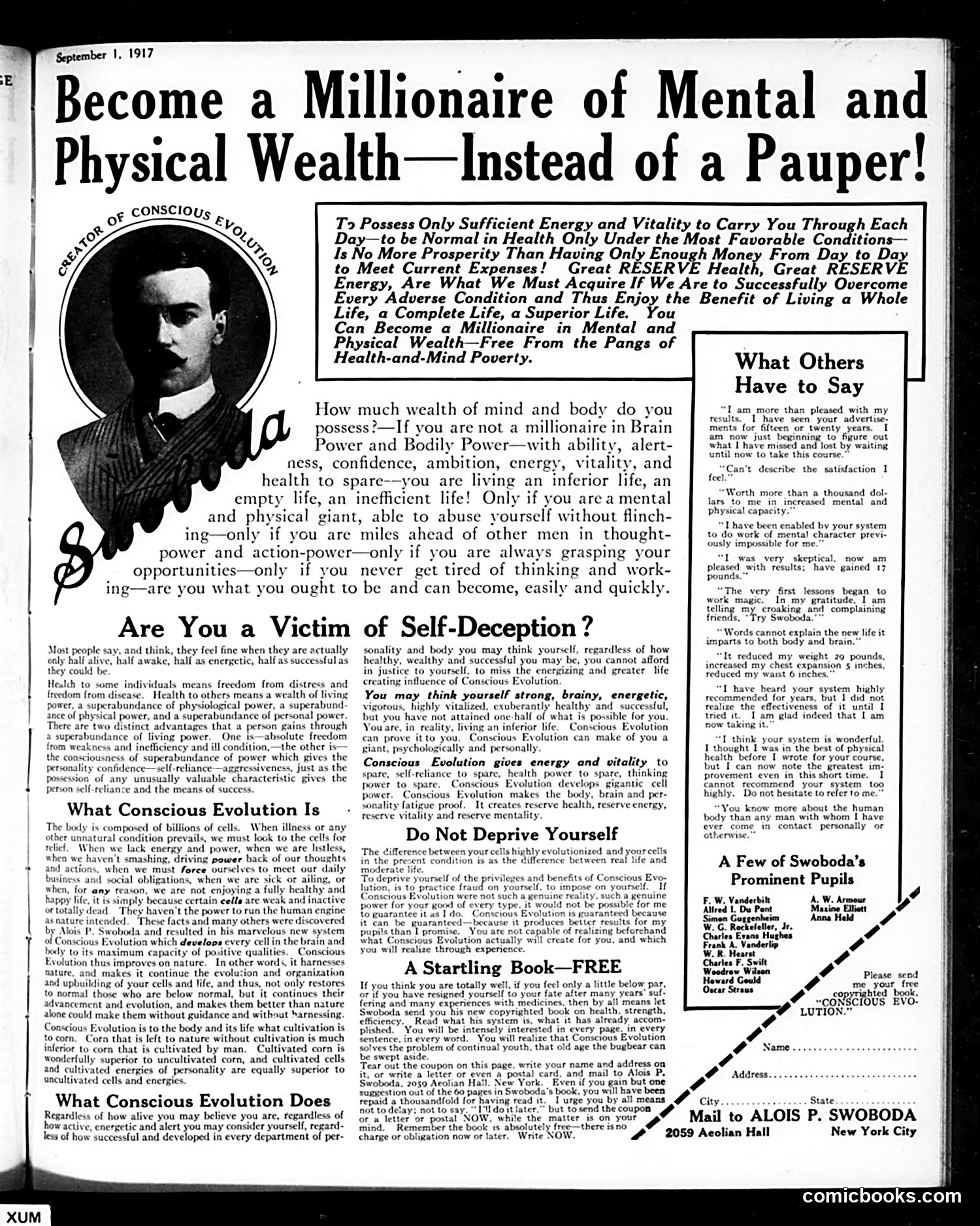
This page is primarily a self-help advertisement, not political satire. The featured figure labeled "Svoboda" (likely referring to Yacov Svoboda or a similar wellness promoter) promotes "Conscious Evolution"—a pseudoscientific health system promising to transform readers into "millionaires of mental and physical wealth." The pitch targets early 20th-century anxieties about vitality and success, claiming ordinary people are "half alive" unless they possess extraordinary "brain power" and "bodily power." It promises readers can become mental and physical "giants" through this system, free from "health-and-mind poverty." The testimonials ("What Others Have to Say") provide fake social proof, claiming dramatic results: weight loss, increased vigor, improved mental capacity. For modern readers: this represents vintage pseudoscience marketing—combining vague self-improvement language with pseudo-medical claims about cells and energy to sell expensive courses. It exemplifies exploitative wellness advertising that preys on insecurity about health and success.
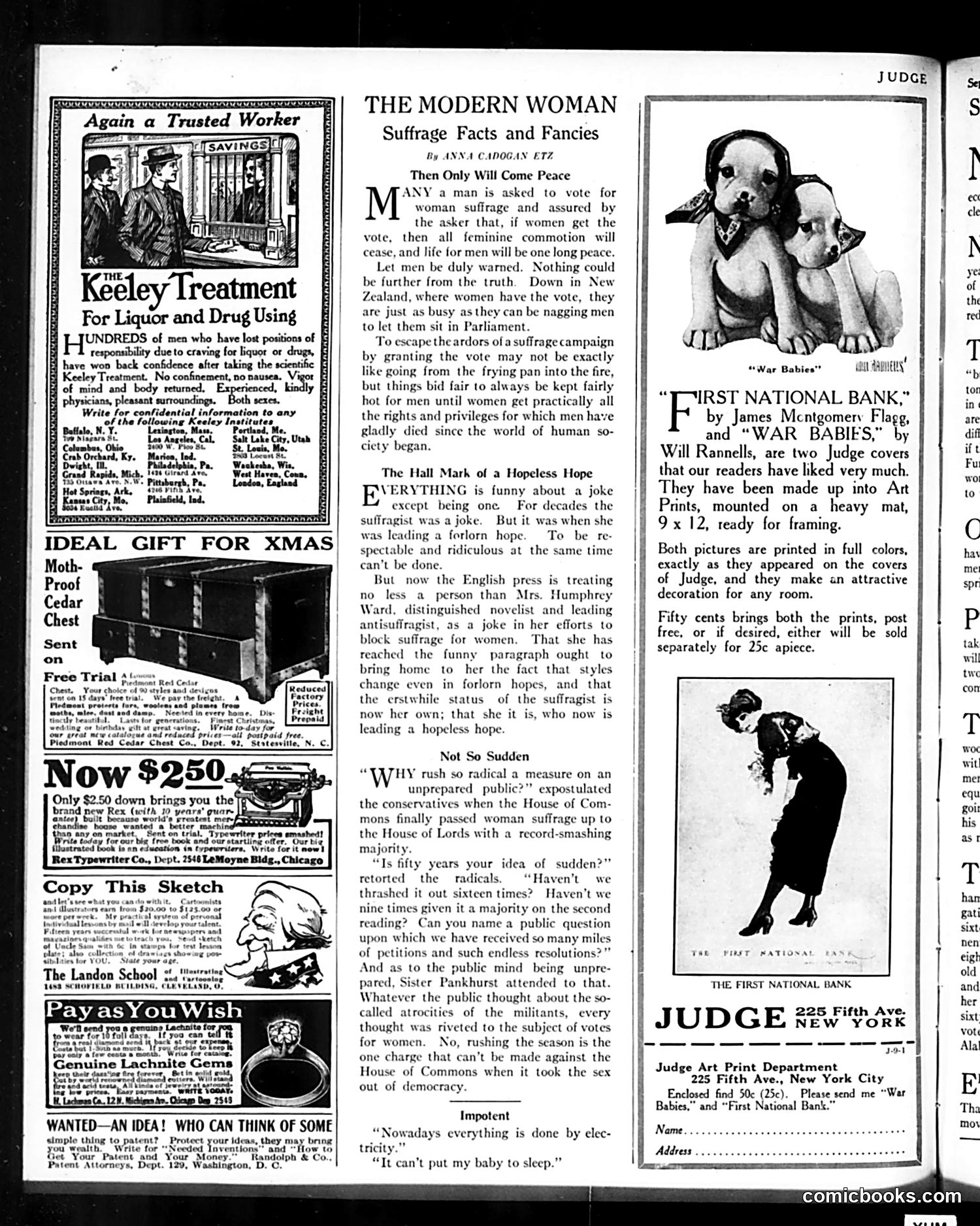
This page satirizes the women's suffrage movement through two main pieces: **"The Modern Woman: Suffrage Facts and Fancies"** presents anti-suffrage arguments as humor. The author claims that granting women the vote won't bring peace to men—instead, women will become equally demanding in Parliament as they are at home. The satire mocks male anxiety about women's political power, portraying men as already nagged by women and fearing worse if suffrage passes. The piece ridicules both suffragists and anti-suffragists: it jokes that Mrs. Humphrey Ward (a real anti-suffrage activist) has become "funny" and "hopeless" by opposing women's suffrage. The author also mocks conservative politicians' panic about "rushing" such a "radical measure," noting suffragists have campaigned for fifty years—hardly sudden. **The accompanying illustrations** show puppies labeled "War Babies" and a woman bending over, likely reinforcing stereotypes about women's proper domestic role versus political ambition. The overall message uses humor to both mock suffrage opponents' fears and subtly critique women's demands for equality as inherently disruptive.
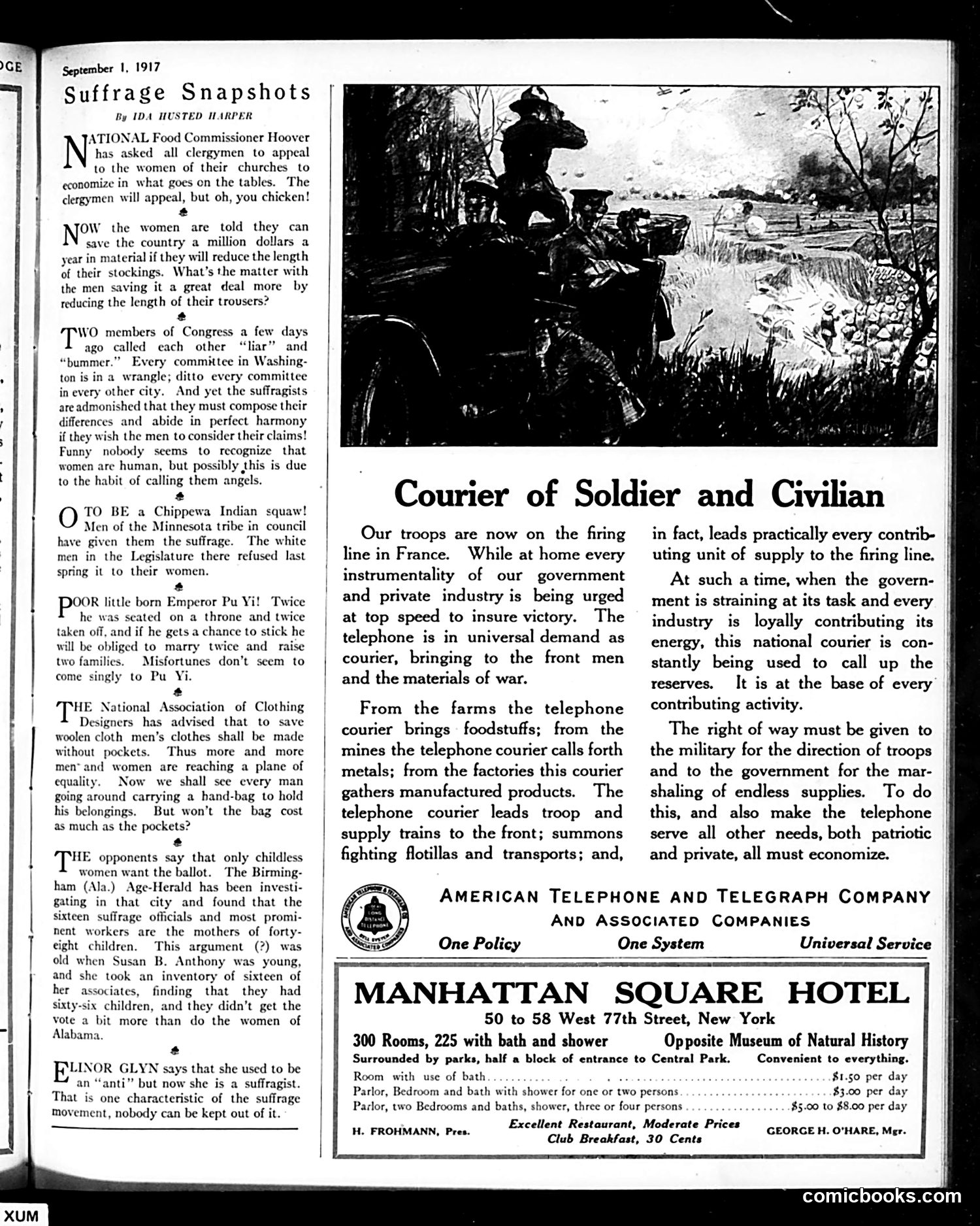
This page combines satirical commentary on women's suffrage with wartime patriotism. Written by suffrage advocate Ida Husted Harper, the column uses ironic vignettes to expose the hypocrisy of opposing women's voting rights. Harper's key arguments: Women are asked to conserve (shorter stockings, less food) while men aren't similarly restricted; Congress members behave badly yet demand suffragists be "harmonious"; a Native American tribe granted women voting rights before Minnesota's legislature did; and suffrage opponents claim only childless women want the ballot—disproven by data showing suffrage leaders are mothers of dozens of children. The cartoon image shows a woman as "Courier of Soldier and Civilian," paired with an AT&T advertisement emphasizing telephony's wartime military importance. This juxtaposes women's invisible labor contributions during WWI with their political exclusion—the implicit argument being that women deserve voting rights given their essential wartime role.
This page from Judge magazine (1917) contains poetry and humor reflecting **wartime anxieties about gender roles and food scarcity during World War I**. The lead poem "Sentenced to Hard Labor" satirizes upper-class women at summer resorts doing patriotic handicraft for soldiers while complaining about it—but ironically suggests their "patriotic fervor" evaporates immediately if an attractive male dancer appears. "Dangerous Germs at the Summer Resorts" jokes about "grass widows" (women whose husbands are away), likely military service. "The Main Point" offers a darkly humorous vignette where a man prioritizes custody of dogs over children during a separation—poking fun at misplaced priorities. "Food Substitutes" presents satirical recipes using wartime substitute ingredients (alfalfa, jimson weed, soybeans, locust-pods), mocking the resourceful-but-unappetizing dishes Americans endured during rationing. The remainder is advertising and promotion for next week's issue. The overall tone reveals middle-class anxiety about homefront sacrifices during WWI.
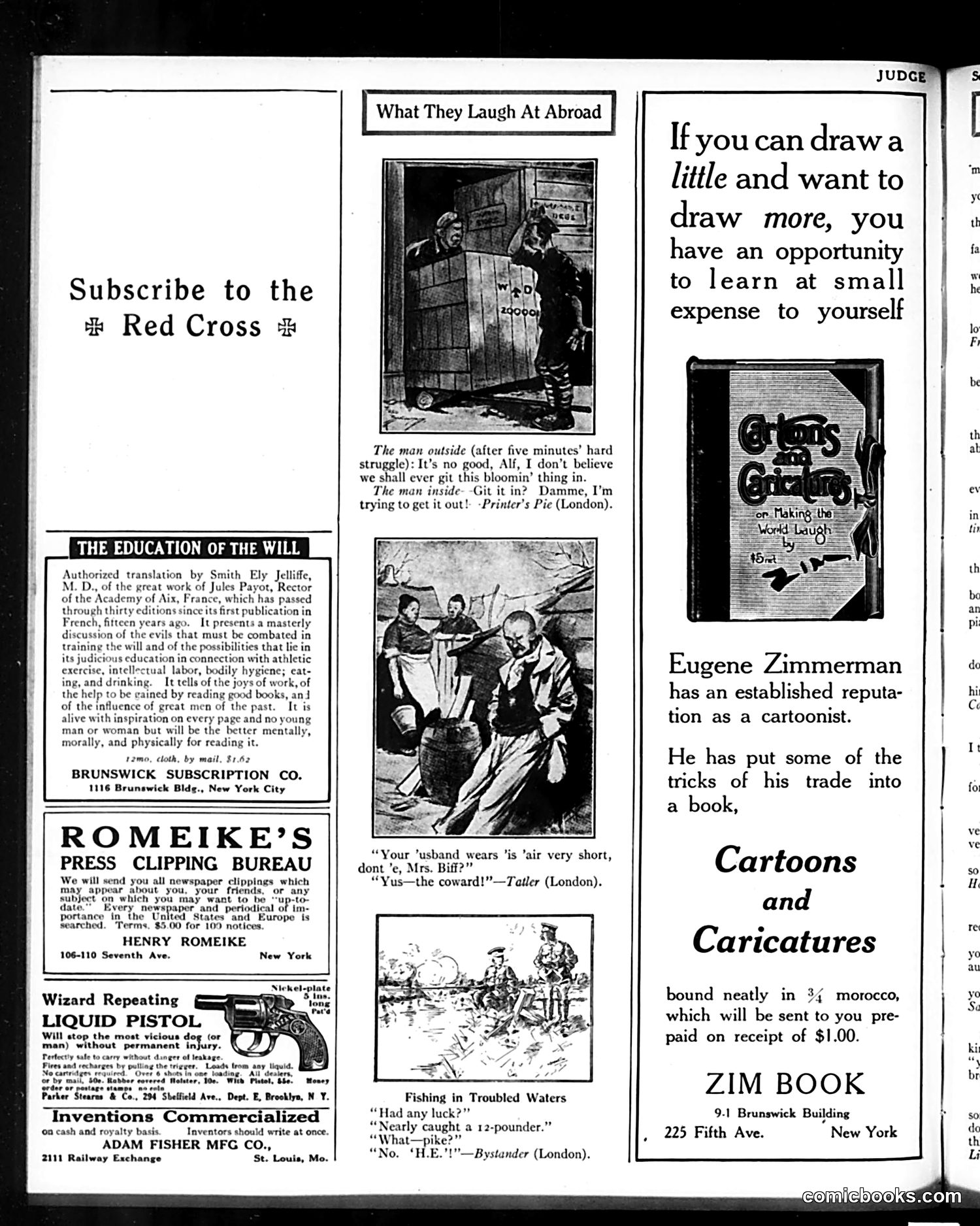
This page reprints British humor from London publications (*Printer's Pie* and *Tatler*). The three cartoons showcase working-class British comedy based on dialect and social observation: 1. **Top cartoon**: Two men struggle with an object—one outside, one inside a doorway. The joke plays on misunderstanding: the outside man thinks they're trying to *insert* something; the inside man is actually trying to *remove* it. 2. **Middle cartoon**: A woman comments that her husband wears his hair very short, calling him "the coward"—implying he cuts his hair to avoid having it grabbed in fights, suggesting cowardice. 3. **Bottom cartoon**: A fishing joke about catching a "12-pounder"—the questioner mishears "pike" (the fish) as "pike" (the weapon), creating absurdist humor. The page demonstrates early 20th-century transatlantic humor appreciation, presenting British working-class comic sensibilities to American *Judge* readers.
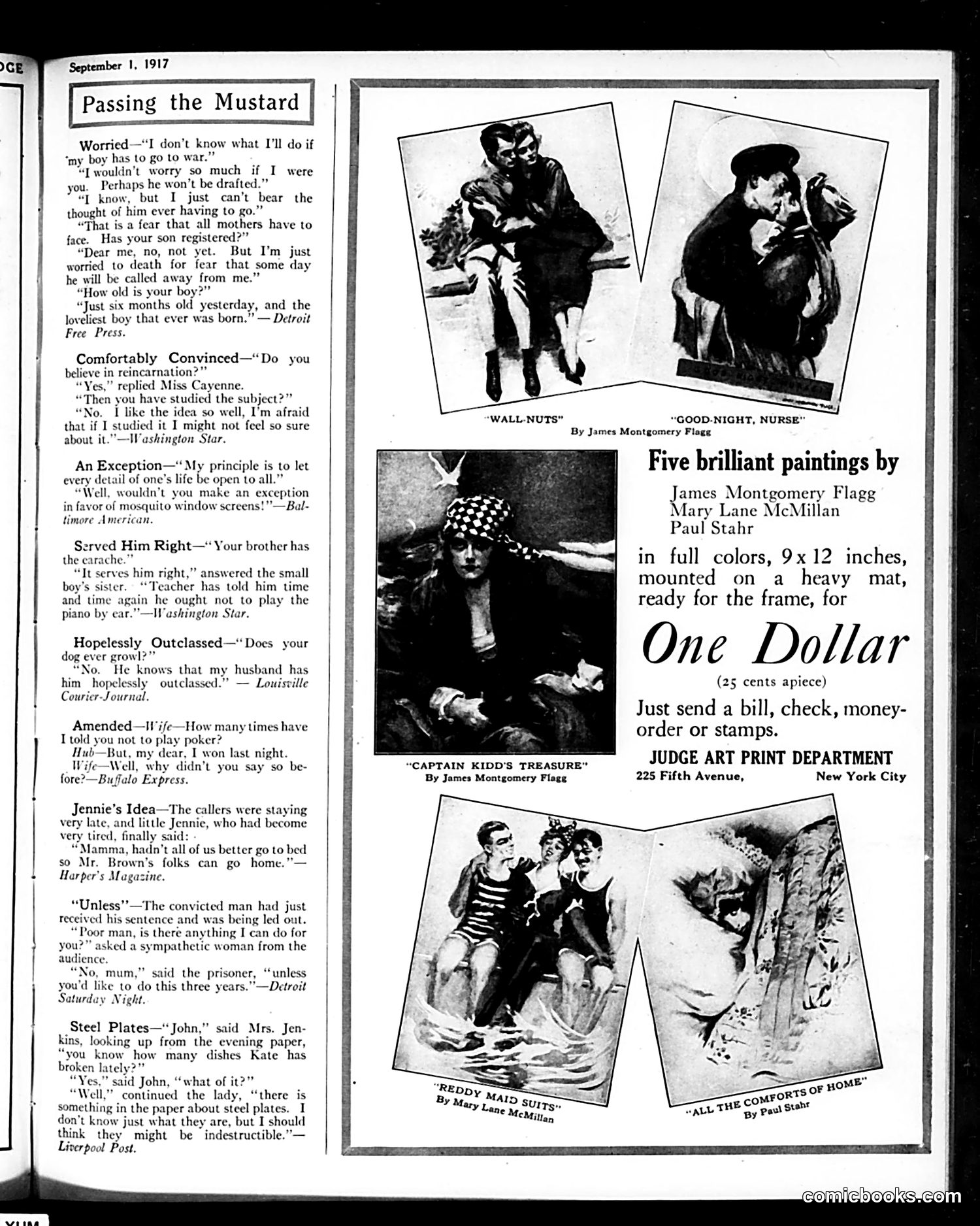
This page from the September 1, 1917 *Judge* magazine contains mostly brief humor pieces and advertising, but reveals period concerns. The opening section "Passing the Mustard" includes a joke about a mother worried her infant son will be drafted—satirizing the anxiety surrounding World War I conscription and Americans' recent entry into the conflict. The humor mocks her irrational fear for a six-month-old child. The remaining pieces are light domestic humor unrelated to the war: jokes about marriage, children, and social behavior. The page advertises five paintings by prominent illustrators (James Montgomery Flagg, Mary Lane McMillan, Paul Stahr) available through the Judge Art Print Department for one dollar—a considerable sum in 1917, making these prints accessible to middle-class readers. The illustrated titles ("Wall-Nuts," "Good-Night, Nurse," "Captain Kidd's Treasure," "Roddy Maid Suits," "All the Comforts of Home") appear to be whimsical or sentimental subjects typical of period commercial art.
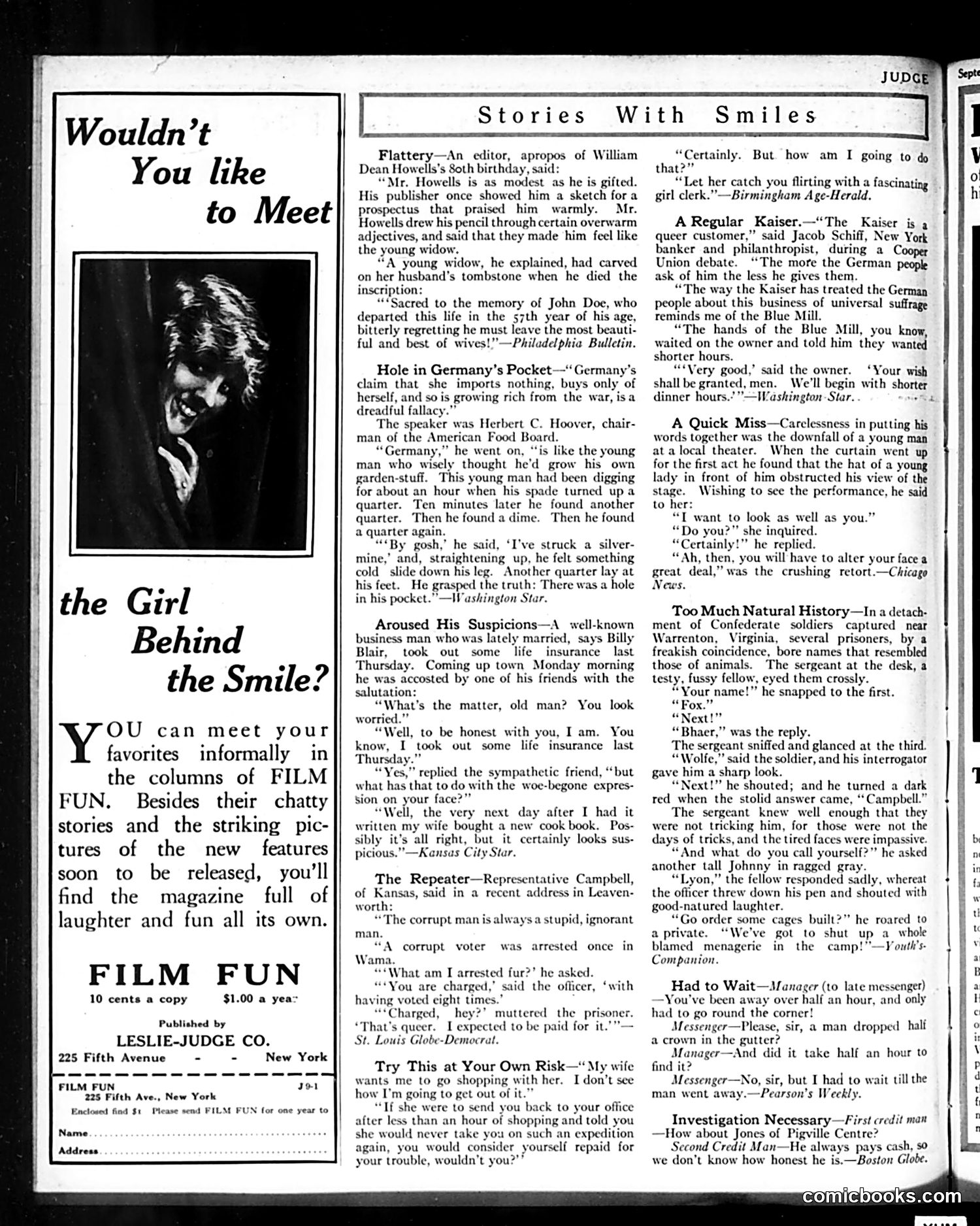
This page is primarily **advertising for *Film Fun* magazine** (a companion publication), paired with a collection of short humorous anecdotes titled "Stories With Smiles." The advertisements use an alluring illustration of a smiling young woman to promote *Film Fun*, promising readers access to movie stars' "chatty stories" and behind-the-scenes content. The accompanying jokes are typical early-20th-century humor: - **Flattery**: A modest author anecdote - **Hole in Germany's Pocket**: References Herbert Hoover and WWI-era criticism of Germany's economic claims—the joke uses a parable about finding money with a hole in one's pocket - **Marriage/Insurance humor**: Plays on newlywed anxieties - **Kaiser criticism**: References the German Kaiser's authoritarian treatment of his people The content reflects **wartime American sentiment** (likely WWI era, given Hoover's Food Board reference), with gentle political jabs at Germany mixed with domestic comedy. The overall tone is light entertainment for a general audience.
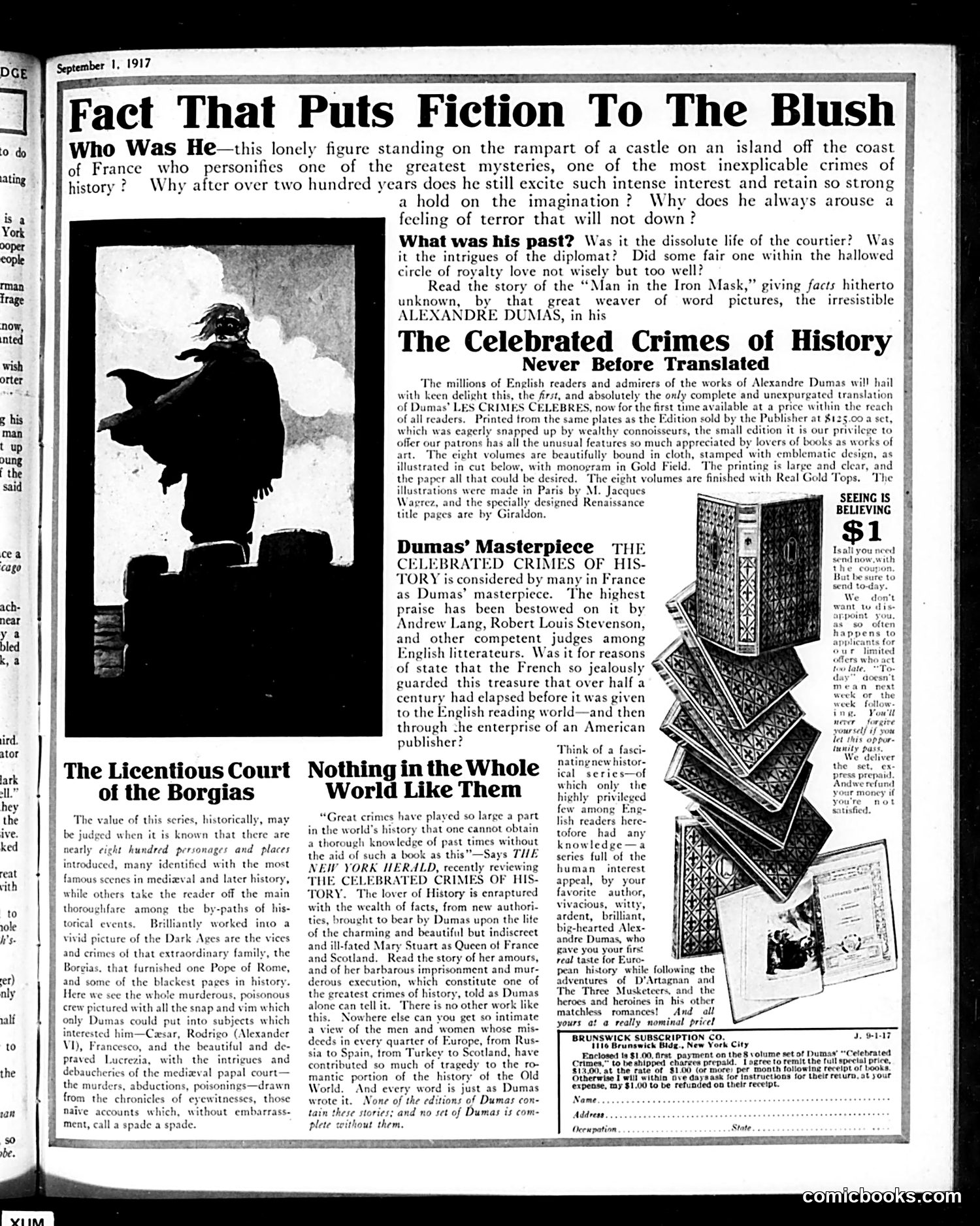
This page mixes advertising with literary promotion rather than political satire. The primary content advertises Alexandre Dumas's *Celebrated Crimes of History*, a multi-volume set presenting historical criminal cases with dramatic detail. The illustrated figure on the left appears to be the "Man in the Iron Mask"—Dumas's famous fictional prisoner—representing the mysterious, historically captivating subjects within the series. The silhouette emphasizes intrigue and unknown identity. The page emphasizes that this is the "first...complete and unexpurgated translation" into English, suggesting previous editions were incomplete or censored. The marketing targets educated readers fascinated by history's dark chapters, particularly tales of the Borgias and Mary Stuart. The ornate binding shown at right indicates this was premium merchandise for wealthy collectors. Rather than satire, this represents Judge magazine's commercial side—literary promotion dressed in period-appropriate dramatic language typical of 1917 advertising.
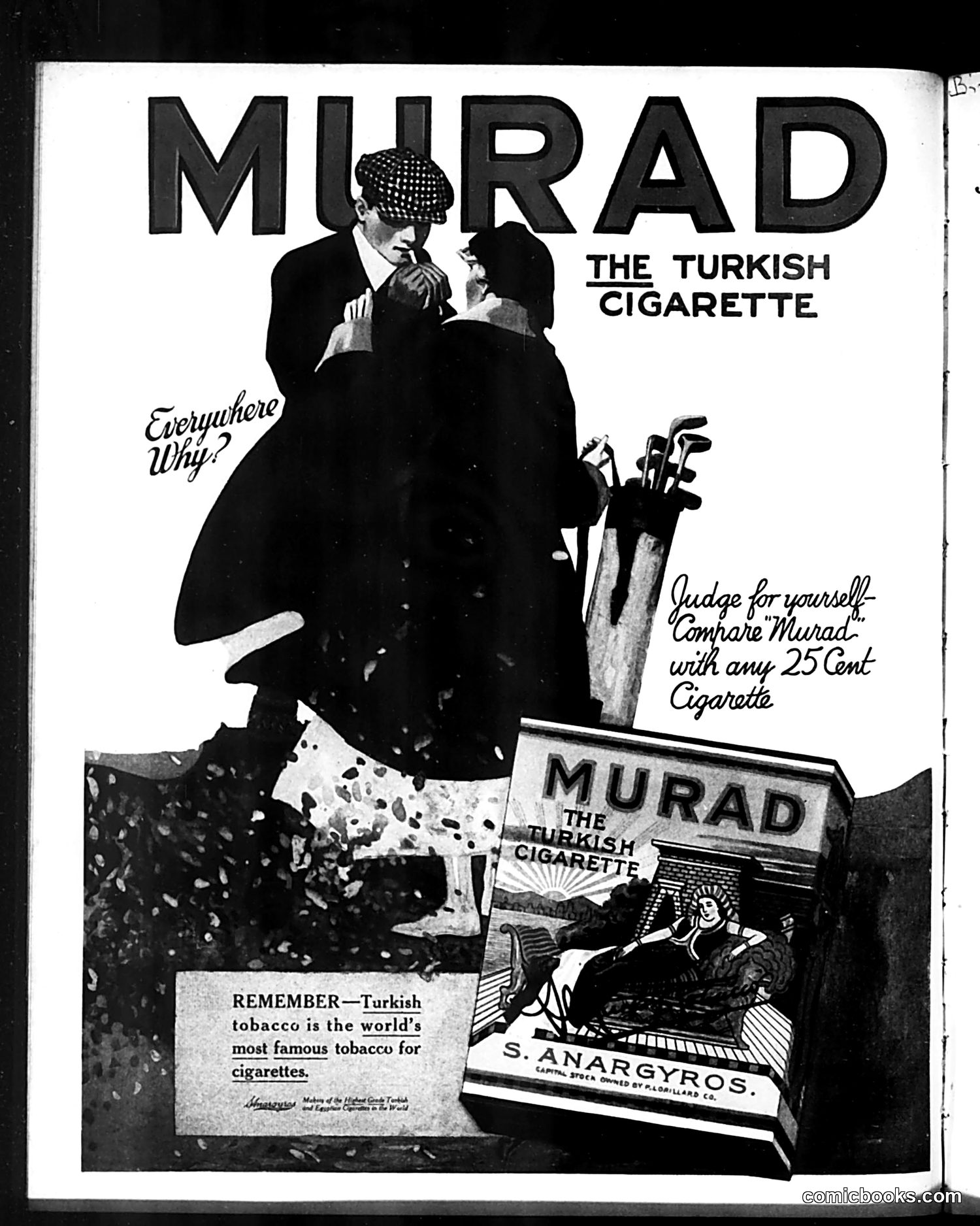
This is a **Murad cigarette advertisement**, not political satire. The page promotes "Murad: The Turkish Cigarette" by emphasizing the prestige of Turkish tobacco. The imagery shows well-dressed men in what appears to be a gentlemen's club or social setting, suggesting sophistication and status. The ad's tagline "Everywhere Why?" and the invitation to "Judge for yourself—Compare Murad with any 25 Cent Cigarette" uses competitive marketing rhetoric typical of early 20th-century advertising. The text emphasizes that Turkish tobacco is "the world's most famous tobacco for cigarettes"—a common marketing claim of the era positioning imported Turkish tobacco as superior to domestic alternatives. This reflects early 1900s cigarette marketing that equated smoking with refinement and masculinity.