
Judge, 1917-09-01 · page 8 of 28
Judge — September 1, 1917 — page 8: what you’re looking at
What you’re looking at
This article satirizes the unintended consequence of America's WWI-era home gardening campaign (the "Food Supply" initiative). The story follows Seely, a thin office draughtsman whose sedentary work left him perpetually without appetite. When he joins the patriotic gardening movement, the physical labor awakens his hunger dramatically—he begins eating four-and-a-half times his normal amount, as does his wife. The satire's point: the government's well-intentioned food-conservation campaign backfired by creating *more* food consumption among participants. His employers, who had valued his thin frame as ideal for reaching across drafting boards, grow dismayed at his newfound portliness, essentially undoing the productivity gains they'd gained from his physique. The humor lies in this ironic reversal—Seely's patriotic duty produces the opposite of intended results.
📄 Transcribed text from this page (OCR, searchable)
Machine-transcribed from the original scan — historical spelling and the odd misread are preserved.
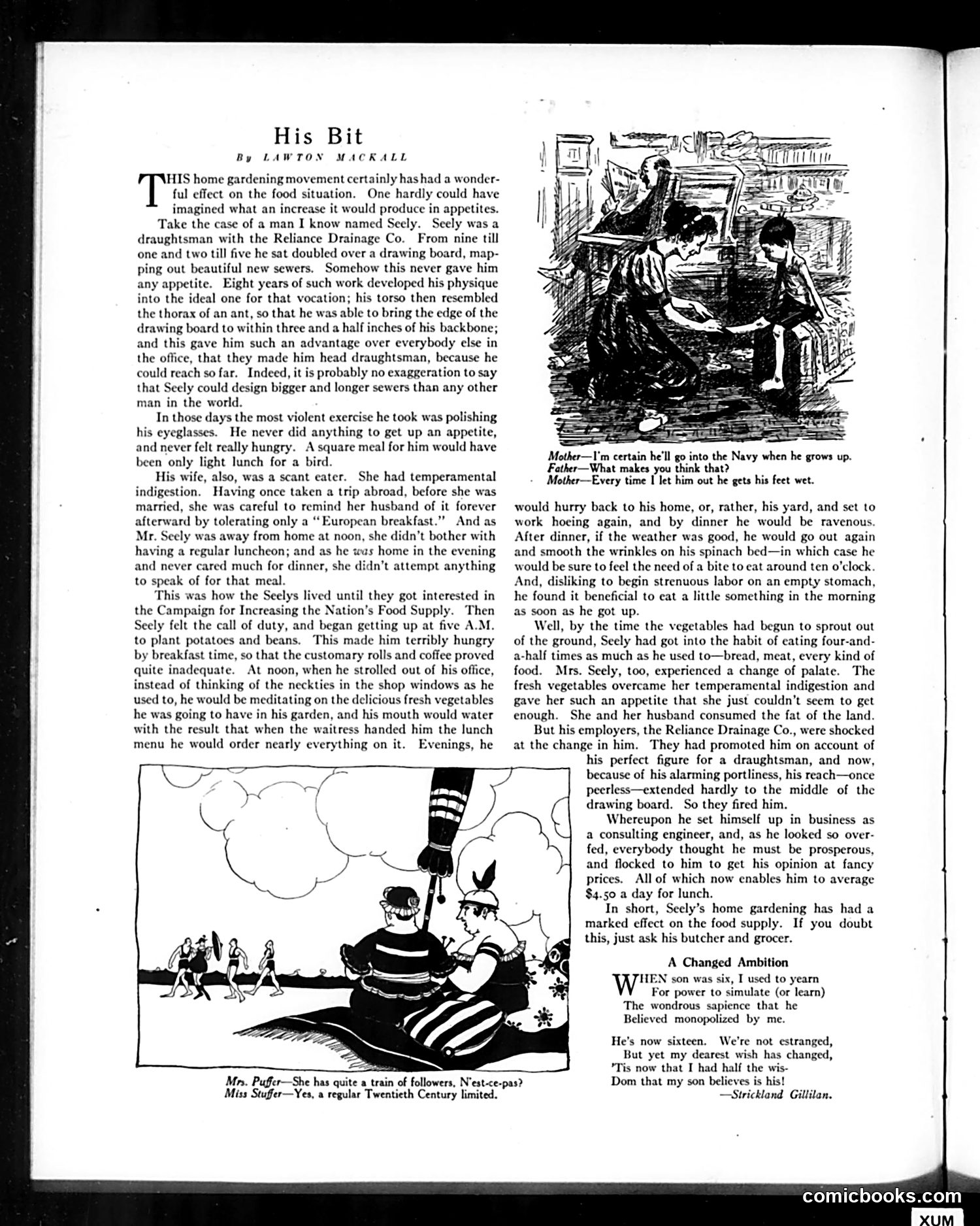
His Bit By LAWTON MACKALL HIS home gardening movement certainly has had a wonder- T ful effect on the food situation. One hardly could have imagined what an increase it would produce in appetites. e of a man I know named Seely. Seely was a draughtsman with the Reliance Drainage Co. From nine till one and two till five he sat doubled over a drawing board, map- ping out beautiful new sewers. Somehow this never gave him any appetite. Eight years of such work developed his physique into the ideal one for that vocation; his torso then resembled the thorax of an ant, so that he was able to bring the edge of the drawing board to within three and a half inches of his backbone; and this gave him such an advantage over everybody else in the office, that they made him head draughtsman, because he could reach so far. Indeed, it is probably no exaggeration to say that Seely could design bigger and longer sewers than any other man in the world. In those days the most violent exercise he took was polishing his eyeglasses. He never did anything to get up an appetite, and never felt really hungry. A square meal for him would have been only light lunch for a bird. His wife, also, was a scant eater. She had temperamental indigestion. Having once taken a trip abroad, before she was married, she was careful to remind her husband of it forever afterward by tolerating only a “European breakfast.” And as Mr. Seely was away from home at noon, she didn’t bother with having a regular luncheon; and as he was home in the evening and never cared much for dinner, she didn’t attempt anything to speak of for that meal. This was how the Seelys lived until they got interested in the Campaign for Increasing the Nation's Food Supply. Then Seely felt the call of duty, and began getting up at five A.M. to plant potatoes and beans. This made him terribly hungry by breakfast time, so that the customary rolls and coffee proved quite inadequate. At noon, when he strolled out of his office, instead of thinking of the neckties in the shop windows as he used to, he would be meditating on the delicious fresh vegetables he was going to have in his garden, and his mouth would water with the result that when the waitress handed him the lunch menu he would order nearly everything on it. Evenings, he Mother—I'm certain he'll go into the Navy when he grows up. Father—What makes you think that? Mother—Every time I let him out he gets his feet wet. would hurry back to his home, or, rather, his yard, and set to work hocing again, and by dinner he would be ravenous. After dinner, if the weather was good, he would go out again and smooth the wrinkles on his spinach bed—in which case he would be sure to feel the need of a bite to eat around ten o'clock. And, disliking to begin strenuous labor on an empty stomach, he found it beneficial to eat a little something in the morning as soon as he got up. Well, by the time the vegetables had begun to sprout out of the ground, Seely had got into the habit of eating four-and- a-half times as much as he used to—bread, meat, every kind of food. Mrs. Seely, too, experienced a change of palate. The fresh vegetables overcame her temperamental indigestion and gave her such an appetite that she just couldn’t seem to get enough. She and her husband consumed the fat of the land. But his employers, the Reliance Drainage Co., were shocked at the change in him. They had promoted him on account of his perfect figure for a draughtsman, and now, Mn. Puffer—She has quite a train of followers, N’est-ce-pas? Miss Stuffer—Yes, a regular Twentieth Century limited. because of his alarming portliness, his reach—once peerless—extended hardly to the middle of the drawing board. So they fired him. Whereupon he set himself up in business as a consulting engineer, and, as he looked so over- fed, everybody thought he must be prosperous, and flocked to him to get his opinion at fancy prices. All of which now enables him to average $4.50 a day for lunch. In short, Seely’s home gardening has had a marked effect on the food supply. If you doubt this, just ask his butcher and grocer. A Changed Ambition HEN son was six, I used to yearn For power to simulate (or learn) The wondrous sapience that he Believed monopolized by me. He's now sixteen. We're not estranged, But yet my dearest wish has changed, ’Tis now that I had half the wis- Dom that my son believes is his! —Strickland Gillilan. comicbooks.com XUM