
Judge, 1917-09-01 · page 4 of 28
Judge — September 1, 1917 — page 4: what you’re looking at
What you’re looking at
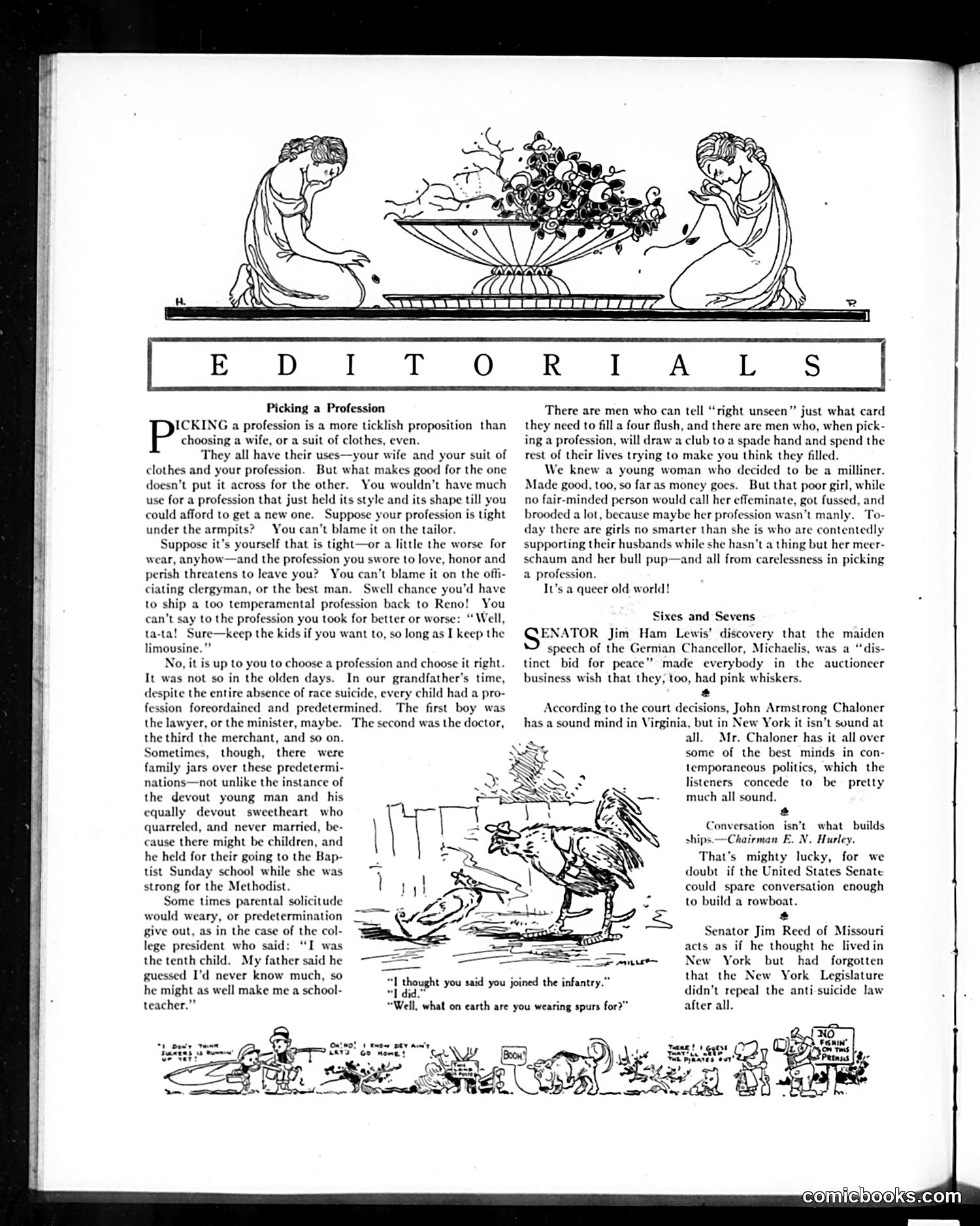
This page contains editorial content rather than political cartoons. The main article, "Picking a Profession," discusses how young people choose careers, noting that profession selection was historically predetermined by family tradition. The piece humorously laments modern uncertainty about vocational choice. The "Sixes and Sevens" section includes brief political commentary, mentioning Senator Jim Ham Lewis of the German Chancellor Michaelis, and Senator Jim Reed of Missouri regarding New York legislation on suicide laws. The central illustration depicts a military scene with the caption "I thought you said you joined the infantry" / "I did" / "Well, what on earth are you wearing spurs for?" — a joke about military uniform confusion rather than political satire.
📄 Transcribed text from this page (OCR, searchable)
Machine-transcribed from the original scan — historical spelling and the odd misread are preserved.
Picking a Profession ICKING a profession is a more ticklish proposition than P choosing a wife, or a suit of clothes, even. They all have their uses—your wife and your suit of clothes and your profession. But what makes good for the one doesn’t put it across for the other. You wouldn't have much use for a profession that just held its style and its shape till you could afford to get a new one. Suppose your profession is tight under the armpits? You can’t blame it on the tailor. Suppose it’s yourself that is tight—or a little the worse for wear, anyhow—and the profession you swore to love, honor and perish threatens to leave you? You can’t blame it on the offi- ciating clergyman, or the best man. Swell chance you'd have to ship a too temperamental profession back to Reno! You can’t say to the profession you took for better or worse: “ Well, ta-ta! Sure—keep the kids if you want to, so long as I keep the limousine.” No, it is up to you to choose a profession and choose it right. It was not so in the olden days. In our grandfather’s time, despite the entire absence of race suicide, every child had a pro- fession foreordained and predetermined. he first boy was the lawyer, or the minister, maybe. The second was the doctor, the third the merchant, and so on. Sometimes, though, there were family jars over these predetermi- nations—not unlike the instance of the devout young man and his equally devout sweetheart who quarreled, and never married, be- cause there might be children, and he held for their going to the Bap- tist Sunday school while she was strong for the Methodist. Some times parental solicitude would weary, or predetermination give out, as in the case of the col- lege president who said: “I was the tenth child. My father said he guessed I'd never know much, so he might as well make me a school- teacher.” Mow BEY Aunt Wome! ze thought you said you joined the infantry.” “Well, what on earth are you wearing spurs for?” There are men who can tell “right unseen” just what card they need to fill a four flush, and there are men who, when pick- ing a profession, will draw a club to a spade hand and spend the rest of their lives trying to make you think they filled. We knew a young woman who decided to be a milliner. Made good, too, so far as money goes. But that poor girl, while no fair-minded person would call her effeminate, got fussed, and brooded a lot, because maybe her profession wasn’t manly. To- day there are girls no smarter than she is who are contented|, supporting their husbands while she hasn’t a thing but her me schaum and her bull pup—and all from carelessness in picking a profession. It’s a queer old world! Sixes and Sevens ENATOR Jim Ham Lewis’ discovery that the maiden speech of the German Chancellor, Michaelis, was a “dis- tinct bid for peace” made everybody in the auctioneer business wish that they, too, had pink whiskers. 2 According to the court decisions, John Armstrong Chaloner has a sound mind in Virginia, but in New York it isn’t sound at all. Mr. Chaloner has it all over some of the best minds in con- temporancous politics, which the listeners concede to be pretty much all sound. @ Conversation isn’t. what builds ships. —Chairman E. N. Hurley. That's mighty lucky, for we doubt if the United States Senate could spare conversation enough to build a rowboat. 2 Senator Jim Reed of Missouri acts as if he thought he lived in New York but had forgotten that the New York Legislature didn’t repeal the anti-suicide law after all.