
Judge, 1917-09-01 · page 12 of 28
Judge — September 1, 1917 — page 12: what you’re looking at
What you’re looking at
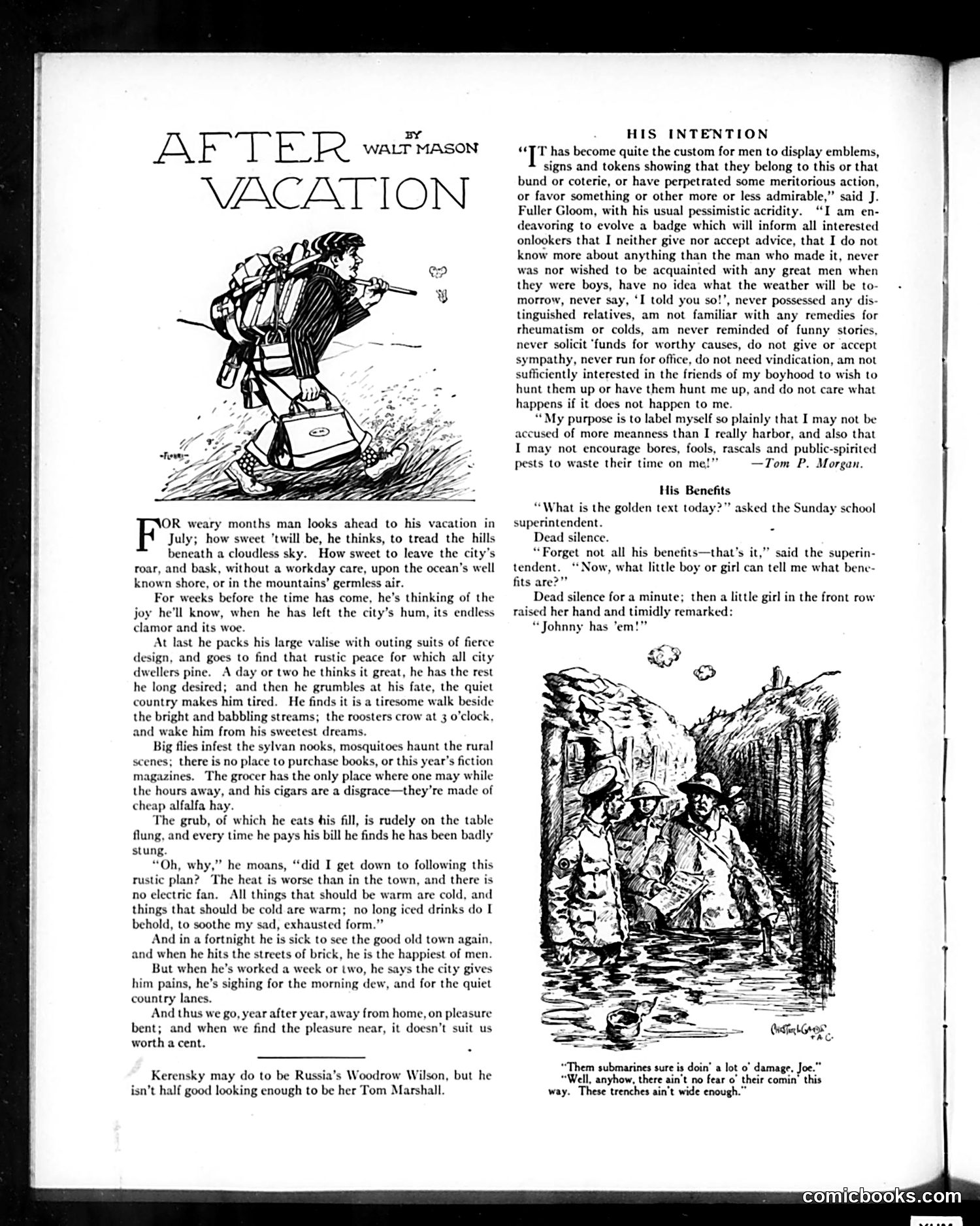
This page satirizes the common middle-class vacation fantasy versus reality. The main article mocks urbanites who romanticize rustic retreats for months, imagining peaceful countryside escape. Upon arrival, the protagonist discovers rural life miserable: mosquitoes, early-crowing roosters, bad food, expensive groceries, no electric fans, and boredom. Within two weeks he craves the city. Yet returning to work, he immediately yearns for country quiet again—an endless, futile cycle of discontent. The humor derives from recognizing this universal pattern: vacation promises happiness but delivers disappointment; city life seems unbearable until you leave it. A secondary satirical piece, "His Intention," mocks a cynical character (J. Fuller Gloom) designing a badge advertising his profound indifference and unsociability—listing every way he won't help, advise, or engage others. It's dark humor about cultivating deliberate unpleasantness as identity. A brief final joke about biblical Sunday school instruction adds light relief.
📄 Transcribed text from this page (OCR, searchable)
Machine-transcribed from the original scan — historical spelling and the odd misread are preserved.
VACATION OR weary months man looks ahead to his vacation in July; how sweet ‘twill be, he thinks, to tread the hills beneath a cloudless sky. How sweet to leave the city’s roar, and bask, without a workday care, upon the ocean's well known shore, or in the mountains’ germless air. For weeks before the time has come, he’s thinking of the joy he'll know, when he has left the city’s hum, its endless clamor and its woe. At last he packs his large valise with outing suits of fierce design, and goes to find that rustic peace for which all city dwellers pine. A day or two he thinks it great, he has the rest he long desired; and then he grumbles at his fate, the quiet country makes him tired. He finds it is a tiresome walk beside the bright and babbling streams; the roosters crow at 3 o'clock, and wake him from his sweetest dreams. Big flies infest the sylvan nooks, mosquitoes haunt the rural scenes; there is no place to purchase books, or this year’s fiction magazines. The grocer has the only place where one may while the hours away, and his cigars are a disgrace—they’re made of cheap alfalfa hay. The grub, of which he eats his fill, is rudely on the table flung, and every time he pays his bill he finds he has been badly stung. “Oh, why,” he moans, “did I get down to following this rustic plan? The heat is worse than in the town, and there is no electric fan. All things that should be warm are cold, and things that should be cold are warm; no long iced drinks do I behold, to soothe my sad, exhausted form.” And in a fortnight he to see the good old town again, and when he hits the streets of brick, he is the happiest of men. But when he’s worked a week or two, he says the city gives him pains, he’s sighing for the morning dew, and for the quiet country lanes. And thus we go, year after year, away from home, on pleasure bent; and when we find the pleasure near, it doesn’t suit us worth a cent. . Kerensky may do to be Russia’s Woodrow Wilson, but he isn’t half good looking enough to be her Tom Marshall. HIS INTENTION “TT has become quite the custom for men to display emblems, signs and tokens showing that they belong to this or that bund or coterie, or have perpetrated some meritorious action, or favor something or other more or less admirable,” said J. Fuller Gloom, with his usual pessimistic acridity. “I am en- deavoring to evolve a badge which will inform all interested onlookers that I neither give nor accept advice, that I do not know more about anything than the man who made it, never was nor wished to be acquainted with any great men when they were boys, have no idea what the weather will be to- morrow, never say, ‘I told you so!’, never possessed any dis- tinguished relatives, am not familiar with any remedies for rheumatism or colds, am never reminded of funny stories, never solicit ‘funds for worthy causes, do not give or accept sympathy, never run for office, do not need vindication, am not sufficiently interested in the friends of my boyhood to wish to hunt them up or have them hunt me up, and do not care what happens if it does not happen to me. “My purpose is to label myself so plainly that I may not be accused of more meanness than I really harbor, and also that I may not encourage bores, fools, rascals and public-spirited pests to waste their time on me!’ —Tom P. Morgan. His Benefits “What is the golden text today?” asked the Sunday school superintendent. Dead silence. “Forget not all his benetits—that’s it,” said the superin- tendent. ‘Now, what little boy or girl can tell me what bene- fits are? Dead silence for a minute; then a little girl in the front row raised her hand and timidly remarked: “Johnny has ‘em! “Them submarines sure is doin’ a lot o’ damage, Joe.” “Well, anyhow, there ain't no fear o' their comin’ this way. These trenches ain't wide enough.” icbooks.com